




Abstract
This study aimed to clarify the role that career resilience plays in preventing inhibition of career development when individuals confront changes during their working life, such as changes in work tasks or health condition. Career resilience consists of five factors: ability to cope with problems, social skills, interest in novelty, optimism about the future, and willingness to help others. In all, 1,000 Japanese company employees completed an online survey. The results showed that optimism about the future and ability to cope with problems exhibited a negative correlation with NPC when confronting changes. The results of simple slope analysis suggested that social skills and ability to cope with problems decreased the negative influence that psychological symptoms caused by changes had on job satisfaction, which was one index of career development. This study underlines the necessity of developing the ability to cope with problems and social skills.
Keywords
Introduction
Sources indicate that in recent years in Japan, a considerable number of employees have developed mental health problems and have subsequently either taken leaves of absence or resigned. According to the Workers’ Health Condition Survey in 2012 (Ministry of Health, Labour and Welfare, 2013), 60.9% of respondents had strong anxiety, worries, or stress related to work or occupational life in Japan. This has, as may be expected, negatively affected their career development. The Labour Standards Bureau of Ministry of Health, Labour and Welfare (2010) of Japan reported that personnel relocation and promotion are among the main triggers of such problems. Such changes in working conditions therefore appear to cause mental health issues and thus may hinder career development; this necessitates preemptive measures.
Changes During Working Life That Might Trigger Career Risk
In the present study, “changes during working life that might trigger career risk” is defined as changes causing negative psychological symptoms and negatively affecting career development. Some changes lead to negative psychological outcomes. For example, Okada (2013) conducted a survey of regular employees at companies; The author examined transitions or turning points in the employees’ career development (especially with regard to triggers of negative psychological outcomes) and the employees’ psychological condition at the time. The five triggers identified were as follows: (a) health condition changes, including illness, associated with the psychological symptoms of feeling impatient or irritation and reexamining personal aptitude; (b) promotion associated with feeling psychological pressure; (c) increased workload; (d) change of supervisor; and (e) a decline in physical strength associated with feelings of anxiety, self-limitation, unclarity about one’s role, confusion, and change of viewpoint. Heppner et al. (1994) defined career transition as a change of task, position, or occupation. Such changes could lead to negative psychological conditions (NPC), similar to the triggers mentioned above.
Drawing on Okada (2013) and Heppner et al. (1994), the present study considered six types of changes in working life: health condition changes, promotion, increased workload, change of supervisor, decline in physical strength, and change of task or job.
Career Resilience
Resilience is a useful concept for considering how individuals can overcome “changes during working life that might trigger career risk.” “Resilience” has received several definitions, and they fall into three categories. The first concerns the process. For example, Luthar et al. (2000) defined it as “a dynamic process encompassing positive adaptation within the context of significant adversity” (p. 543). The second relates to ability or psychological traits. For example, Grotberg (2003) termed it “the human capacity to deal with, overcome, learn from, or even be transformed by the inevitable adversities of life” (p. 1). The third covers the first and second categories. Masten et al. (1990) defined “resilience” as “the process of, capacity for, or outcome of successful adaptation despite challenging or threatening circumstances” (p. 426). All these definitions imply a likelihood that resilience can reduce the negative outcomes of a risk; various studies have supported this view.
Career resilience applies the notion of resilience to career development and also has various definitions. The term itself was initially suggested by London (1983), who regarded it as a sub-concept of career motivation, and London (1993, p. 55) defined it as “the ability to adapt to changing circumstances.” Mishra and McDonald (2017) reviewed the literature on career resilience and reported that the definitions could be classified into two groups: (a) “an ability of individuals to recover from career-related setbacks” and (b) “a process” (p. 216). The present study aims to clarify ability, and other psychological traits, for dealing with certain changes during working life that may cause negative psychological outcomes and threaten career development. “Career resilience” in this study therefore is defined in accordance with the first group; thus, the definition of Kodama (2015) is applied here. Kodama (2015) determined that the components of previous scales of career resilience were inadequate. Kodama (2015) defined career resilience as “psychological traits that help people cope with risks and facilitate career development” (p. 151) and developed a scale for measuring it, drawing on scales developed in previous studies. Five factors were identified: (a) ability to cope with problems and changes, (b) social skills, (c) interest in novelty, (d) optimism about the future, and (e) willingness to help others.
Some studies have examined the function of career resilience, regarding it as abilities or certain psychological traits, in career development. For example, Lyons et al. (2015) reported that career resilience mediated the relationship between such aspects as career satisfaction and protean career attitude. Carless and Bernath (2007) found that among psychologists, career resilience was one of a number of predictors of intention to change career. These studies did not, however, examine the role of career resilience in facing certain events (including working life changes) that could cause NPC.
Among these studies, some examined the role of career resilience when facing changes during working life. Grzeda (1999) looked at the relationship between career resilience and career change in managers and professionals whose positions had been eliminated. Here, career change implied proactive choice, and it was measured by intent to change jobs and by attractiveness of different jobs, using certain job facets. The study concluded career resilience had a positive effect on career change. Gowan et al. (2000) examined the role of personality variables, including career resilience, in U.S. Army personnel transitioning to civilian jobs. The result showed that appraisal of harm in that transition was lower when there was higher career resilience. Another study suggested a model for overcoming career barriers such as changes, noting, Resilience promotes positive frames of reference, positive emotions (e.g., optimism and hope), and mindful cognitive strategies that lead to insights about oneself in relation to a career barrier. Changes in self-concept and accurate recognition of situational conditions promote positive coping strategies. (London, 1997, p. 34)
As mentioned above, Grzeda (1999) noted that career resilience had positive effects on career change when facing some types of changes, such as elimination of position. Gowan et al. (2000) reported that appraisal of some types of changes tended not to be negative if there was high career resilience. However, these studies confirmed the role of career resilience only partly. According to the definition of resilience, resilience can reduce the negative outcomes of a risk. In accordance with this notion, career resilience could play a role in reducing adverse effects of “changes during working life that trigger career risk” on career development. However, the above studies did not examine the role of career resilience in reducing the negative effect on career development when certain changes lead to NPC.
Kodama (2015, 2017) examined this role when facing negative events during working life. Kodama (2015) focused on negative life events that could occur at any time in the workplace, such as work personally not going well, and considered these events a risk if they caused NPC. The results of Kodama (2015) suggested the ability to cope with problems and changes, which was one element of career resilience, was particularly effective in preventing the event from becoming a risk. It was also suggested that social skills, optimism about the future, and willingness to help others, that were elements of career resilience, reduced negative effects regarding risk toward career development, which was measured using vocational identity, career maturity, and work commitment (Kodama, 2015). Kodama (2017) focused on reality shock, which is distress produced by gaps between expectations and reality, as a risk, and examined the functions of career resilience. The results suggested that ability to cope with problems and changes, and optimism about the future, that were elements of career resilience, decreased the tendency to experience such shock. Kodama (2017) also suggested social skills, which was one element of career resilience, reduced the negative effects reality shock could have on career development, which was measured using vocational identity and intent to continue working. These studies suggested that career resilience defined by Kodama (2015) would play two roles: (a) preventing individuals from developing particular psychological symptoms that affect career development when they experience certain negative events, and (b) reducing such symptoms’ negative effects on career development.
Study Aims and Hypothesis Development
As noted above, the role of career resilience when individuals face changes that could trigger career risk has not been sufficiently examined. This study therefore aimed to clarify the role of career resilience, as defined by Kodama (2015), when dealing with these changes during working life and in promoting career development, based on the results of Kodama (2015, 2017).
Career development was measured using vocational identity and job satisfaction as indices, referring to Kodama (2015, 2017) and Lyons et al. (2015) that examined the relation between career resilience and some aspects of career development. Vocational identity is an important factor in career development, as company employees are generally required to decide their own career paths these days (Kodama & Fukada, 2005). Previous studies have shown negative correlations between job satisfaction and leaving or changing jobs. These two factors were therefore considered appropriate indices for career development.
According to London (1997), Gowan et al. (2000), and Kodama (2015), career resilience could play a role in preventing individuals from developing particular psychological symptoms or conditions that affect career development when they experience changes during working life. Thus, the following hypothesis is advanced:
According to Kodama (2015, 2017), career resilience could reduce the negative effect of such symptoms or conditions on career development. Thus, the second hypothesis is proposed:
This study aimed to clarify the role that career resilience plays in preventing inhibition of career development when individuals confront changes during their working life—as detailed in the above two hypotheses.
Method
Procedures and Participants
The study participants were Japanese company employees and managers in various types of employment and industry. An online survey was conducted in December 2015 via a research company. The participants acted as monitors for the research company. Guidelines concerning personal information protection by the survey company appear on its website, and the present study complied with those guidelines. This study also guaranteed anonymity and the voluntary nature of responding to the survey.
The minimum time required to read all the question items was measured as 3 min; thus, any surveys completed in less than 3 min were excluded. Data without missing values (N = 1,000; registered respondents living in Japan: 500 men and 500 women; age: 19–65 years; M = 44.10 years) were collected. Respondents included permanent employees (n = 581); part-time employees (n = 199); seconded, dispatched, contract, and temporary employees (n = 196); and managers and executive officers (n = 24). They were from a range of sectors, including manufacturing (n = 216); wholesale and retail trade (n = 130); information and communication industries (n = 97); medical and welfare services (n = 87); finance and insurance (n = 70); construction (n = 65); transportation (n = 57); accommodation, eating, and drinking services (n = 31); real estate agencies (n = 28); academic research, education, and learning support (n = 25); other service industries (n = 113); and others (n = 81).
Measures
The survey measured career resilience, experience of changes during working life, NPC or symptoms following changes, vocational identity, and job satisfaction.
Career resilience
A 34-item career resilience scale developed and confirmed for validity and reliability by Kodama (2015) was used. The constructs were as follows: ability to cope with problems and changes, with 13 items (e.g., You can flexibly cope with changes around you); social skills, with nine items (e.g., You are good at making friends with others); interest in novelty, with six items (e.g., You like new and novel things); optimism about the future, with four items (e.g., You are hopeful about your future); and willingness to help others, with two items (e.g., You are usually kind to others). Participants responded using a 4-point scale, ranging from “very much” (4) to “not at all” (1).
Vocational identity
The vocational identity scale for company employees, which was developed and confirmed for validity and reliability by Kodama and Fukada (2005), was used. This has three factors, each with four items: vocational role identity achievement (e.g., You think that you have the necessary ability to take charge of your own work), vocational life identity achievement (e.g., You feel that the goal of your vocational life has been realized), and vocational identity diffusion factor (e.g., The goal of your vocational life is not clear). Participants responded using a 4-point scale, ranging from “very much” (4) to “not at all” (1).
Job satisfaction
Three items about job satisfaction (e.g., Your job is suitable for you), developed and confirmed for validity and reliability by Adachi (1998), were used. Participants responded using a 4-point scale, ranging from “very much” (4) to “not at all” (1).
Experience of changes in working life and associated negative psychological conditions
Following the method in Kodama (2015), participants were asked whether they had experienced six types of changes during the preceding 3 months, using a single question for each change, with response options of “yes” or “no.” The changes were as follows: (1) health condition changes, (2) promotion, (3) increased workload, (4) change of supervisor, (5) decline in physical strength, and (6) change of task or job. Those who responded “yes” were asked the degree of the NPC (based on Okada, 2013). Participants responded using a 4-point scale, ranging from “very much” (4) to “not at all” (1).
For Change 1, they were asked whether they had experienced adverse physical changes related to illness or mental changes. To measure the extent of their psychological symptoms or conditions, they were asked whether they felt impatient or irritated by these changes and whether they resultantly re-evaluated their own aptitude. For Change 2, they were asked whether they had experienced a promotion or becoming a manager for the first time. To measure the extent of their psychological symptoms or conditions, they were asked whether they felt pressure or heavy responsibility. For Change 3, they were asked whether they had become busier. For Change 4, they were asked whether their supervisor had changed. For Change 5, they were asked whether they felt their physical strength had declined.
To measure the extent of psychological symptoms or conditions for Changes 3, 4, and 5, participants were asked whether they felt anxiety, self-limitation or helplessness, confusion, that their role was unclear, and whether they had changed viewpoints on these issues.
For Change 6, they were asked whether their tasks or job had changed. To measure the extent of psychological symptoms or conditions, they were asked whether the changes had caused them to feel shocked or confused, in conflict, anxious, impatient or irritated, or despair or helplessness.
Data Analyses
It was necessary to select changes during working life that might trigger career risk. Individuals who had experienced changes and suffered a NPC were defined as the NPC group. Where career development scores of the NPC group were lower than those of the non-NPC group, the associated changes were identified as ones that could trigger career risk.
Hypothesis 1 would be considered true if there were negative correlations between the scores for each factor of career resilience and those for psychological symptoms or conditions for participants who experienced the indicated changes.
Hypothesis 2 was examined as follows. The hypothesis would be considered true if the scores for career development (vocational identity and job satisfaction) of the NPC group were lower than those of the non-NPC group when the score for career resilience was low but with no such differences when the score was high.
Hierarchical multiple regression analysis was then conducted as follows. First, control variables were input. Then, NPC classification was input (using a dummy variable; the non-NPC group was represented by 0 and the NPC group by 1) followed by career resilience. After that, the interactions between career resilience and NPC classification were input. When a significant increase was indicated between Steps 3 and 4, post hoc investigation was used on items with significant interaction, with simple slope analysis to examine the functions of career resilience as moderating factors. To check which demographic factors should be used as control variables, relations between demographic factors (sex, age, employment type, and occupation) and response variables were checked, using a t test for sex, analysis of variance (ANOVA) for employment type and occupation, and correlation analysis for age.
Results
Preliminary Analyses
Reliability
Cronbach’s alpha coefficients for each element of career resilience were as follows: ability to cope with problems and changes, .868; social skills, .841; interest in novelty, .845; optimism about the future, .731; and willingness to help others, .783. Alpha coefficients for each construct of vocational identity were as follows: vocational life identity achievement, .773; vocational role identity achievement, .763; and vocational identity diffusion, .692. The value of vocational identity diffusion was relatively low and therefore was excluded from further analysis. The alpha coefficient of job satisfaction was .720.
Changes during working life that might trigger career risk
Participants who reported having experienced change and also responded “very much” (4 points) or “somewhat” (3 points) to one or more questions, suggesting they had developed NPC, were classified into the NPC group. The rest were classified into the non-NPC group. Classification was performed separately for each type of change. Differences in the mean values of vocational identity and job satisfaction between the two groups were examined using a t test to identify the changes that might trigger career risk (Table 1). The results of three types of changes—health condition changes, decline in physical strength, and change of task or job—were associated with significant differences in one or both career development indices. Scores for the group that had experienced psychological symptoms were lower than for the other group. Effect sizes (Cohen’s d) were also calculated. This suggested there was not a significant difference between the two groups for decline in physical strength, as the effect size was too small; therefore, only two types of change were identified as ones that might trigger career risk and were used for further analysis—health condition changes and change of task or job.
Score of Vocational Identity/Job Satisfaction by Negative Psychological Symptoms, and Result of t Test and Effect Sizes (Cohen’s d).

df = degrees of freedom; NPC = negative psychological condition.
p < .10. *p < .05. ***p < .001.
Relations between demographic factors and response variables
The results of the ANOVA with employment type and occupation used separately as independent variables and the t test with sex as an independent variable indicated no significant effects on response variables. Only age had a significant correlation with response variables (vocational life identity achievement: r = .133, p < .001; vocational role identity achievement: r = .189, p < .001; job satisfaction: r = .113, p < .001).
Correlation Analysis Between Psychological Conditions and Career Resilience of Participants Who Had Experienced Working Life Changes
Correlations between the scores for NPC and the scores for the five factors comprising career resilience were calculated for participants who had experienced health condition changes (n = 391) and those who had experienced task or job changes (n = 425). Table 2 shows the results. For both types of change, there were significant negative correlations between the extent of psychological symptoms and both ability to cope with problems and changes and optimism about the future. There were also significant negative correlations between the extent of psychological symptoms following task or job changes and both social skills and interest in novelty. No evident association was found between willingness to help others and any psychological conditions.
Correlations Between Career Resilience and NPC in Individuals Experiencing Changes in Their Working Life.

NPC = negative psychological condition.
p < .10. *p < .05. **p < .01. ***p < .001.
Hierarchical Multiple Regression Analysis
Age was used as a control variable in the hierarchical multiple regression analysis. The variables were input in stages, with age in Step 1, psychological symptoms linked to a particular type of change (using a dummy variable, that is, non-NPC group was represented by 0 and NPC group by 1) in Step 2, the five factors in career resilience in Step 3, and interaction terms between each career resilience factor and psychological symptoms in Step 4.
Table 3 shows the results for psychological symptoms linked to health condition changes, and Table 4 for task or job changes. In addition, no multicollinearity was found among the variables.
Results of Hierarchical Multiple Regression Analysis With Psychological Symptoms Caused by Health Condition Change as an Explanatory Variable.

Note. Values of β (standard partial regression coefficient) are those at Step 4. N = 1,000.
p < .10. *p < .05. **p < .01. ***p < .001.
Results of Hierarchical Multiple Regression Analysis With Psychological Symptoms Caused by Changes in Tasks or Job as an Explanatory Variable.
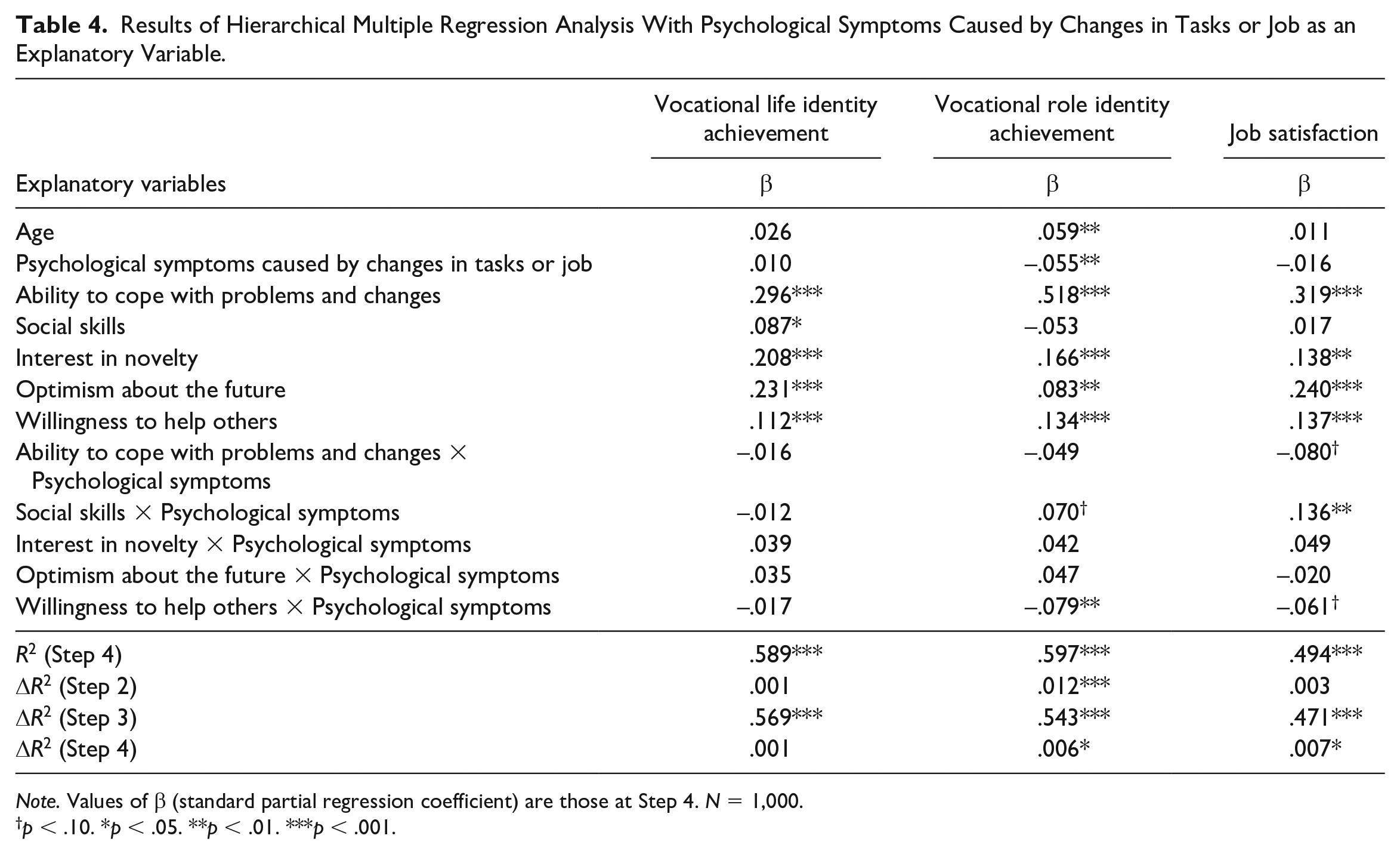
Note. Values of β (standard partial regression coefficient) are those at Step 4. N = 1,000.
p < .10. *p < .05. **p < .01. ***p < .001.
The results of the significance test on the change in R2 between Steps 3 and 4 suggested a significant increase in three cases. First, the results of hierarchical multiple regression analysis with job satisfaction as a response variable and psychological symptoms linked to health condition changes as an explanatory variable showed a significant interaction between ability to cope with problems and changes and psychological symptoms linked to health condition changes. Post hoc investigation with simple slope analysis suggested psychological symptoms negatively affected job satisfaction (β = −.092, p = .006) when there was low ability to cope with problems and changes, though there were no differences when such ability was high.
Hierarchical multiple regression analysis with vocational role identity achievement as a response variable and psychological conditions linked to changes in tasks or job as an explanatory variable showed a significant interaction between willingness to help others and the development of psychological symptoms. Post hoc investigation using simple slope analysis showed psychological symptoms negatively affected vocational role identity achievement (β = −.185, p < .001) with high willingness to help others, though there was no difference with low willingness to help others.
Using job satisfaction as a response variable and psychological symptoms linked to changes in tasks or jobs as an explanatory variable, the regression analysis showed a significant interaction between social skills and psychological symptoms. Psychological symptoms negatively affected job satisfaction (β = −.104, p = .005) when social skills were low, but there were no differences when social skills were high.
Discussion
Functions of Career Resilience in Preventing Occurrence of Psychological Symptoms and Conditions Following Changes in Working Life
Health condition changes
Correlation analysis results for participants who had experienced health condition changes supported Hypothesis 1 for ability to cope with problems and changes and optimism about the future. Having the ability to cope with problems and changes and being optimistic about the future may prevent development of NPC even when one is experiencing health condition changes.
No previous research has shown the role of resilience in the career development of people with mental and physical disorders. Mann (2015) identified the importance of developing occupational resilience for changes that resulted from dealing with unexpected health conditions. However, many studies have examined resilience in individuals with mental and physical disorders without examining the relationship with career development. Nio et al. (2014) clarified the behavior and way of thinking that overcome difficulties related to illness. Those authors used factor analysis to examine resilience with relation to illness in school-aged children, adolescents, and young adults with congenital heart diseases and found it consisted of three elements: “understanding one’s illness,” “positive behaviors and thinking,” and “not engaging in strenuous physical activities.” According to Nio et al. (2014), previous studies on adolescents with congenital heart diseases had suggested that individuals with high resilience had positive self-perception. That study’s “positive behaviors and thinking” is similar to the present study’s “optimism about the future,” and “understanding one’s illness” and “not engaging in strenuous physical activities” are coping methods. The present results are therefore similar to, and consistent with, those of Nio et al. (2014).
Task or job changes
Correlation analysis results for those who had experienced task or job changes also supported Hypothesis 1 for four factors: ability to cope with problems and changes, optimism about the future, social skills, and interest in novelty. Heppner et al. (1994) developed the Career Transitions Inventory to measure perception of psychological resources to support career change adjustment. That study’s Readiness and Confidence factors were similar to the career resilience scale factor “ability to cope with problems and changes.” The Support factor from the Career Transitions Inventory is very closely related to the social skills factor in the career resilience scale because social skills are important toward obtaining support from others. According to Heppner et al. (1994), people with high scores for these factors on the Career Transitions Inventory tended to be more confident in coping with career transitions and more effectively cope with task, position, or occupation changes. The results of the present correlation analysis showed that social skills and ability to cope with problems and changes were negatively correlated with NPC; thus, they are consistent with the results of Heppner et al. (1994).
Reducing Negative Effects of Psychological Symptoms on Career Development
The hierarchical multiple regression analysis and simple slope analysis indicated ability to cope with problems and changes, social skills, and willingness to help others all functioned as moderators.
Health condition changes
Hypothesis 2 was supported for ability to cope with problems and changes when facing health condition changes. Job satisfaction decreased among those with psychological symptoms resulting from health condition changes, but only if there was low ability to cope.
Task or job changes
Hypothesis 2 was supported for social skills when facing task or job changes. Job satisfaction decreased for those who developed psychological symptoms because of task or job changes, but only if their social skills were low. However, Hypothesis 2 was not supported for willingness to help others when facing task or job changes. The degree of vocational role identity achievement did not change with psychological symptoms when there was low willingness. When willingness was high, this degree declined when psychological symptoms developed.
Similarities and Differences in the Role of Career Resilience With Different Types of Changes
Some similarities and differences were found in the role of career resilience with different types of working life changes. Ability to cope with problems and changes and optimism about the future both helped prevent development of psychological symptoms in people who experienced health condition changes and task or job changes. As Kodama (2015), which examined the role of career resilience when facing negative life events, and Kodama (2017), which examined reality shock, showed similar results, these two traits may prevent development of NPC when people go through various job-related experiences that could pose career risk.
The results also suggested, however, that the influence of particular elements of career resilience would vary with the type of change experienced. When facing task or job changes, social skills seem to help prevent development of NPC and also decrease the negative effect of such conditions on career development. Social skills played a role in decreasing the negative effect of reality shock regarding job content (Kodama, 2017). The present results and Kodama (2015) suggest social skills are especially important in managing risks related to job content. Ability to cope with problems and changes, however, is particularly important in managing risks related to health condition changes because it buffers against developing NPC and also decreases these conditions’ negative effects on career development.
Implications of the Study Results
The role of individual elements of career resilience in preventing NPC, or in reducing adverse effects of NPC on career development, when facing health condition changes has not been examined in any previous studies. Such role when facing tasks or job changes has been examined only partly. The present results, which revealed the important elements of career resilience for coping with task changes or health condition changes, are useful for examining preventive measures.
Based on the results, helping employees to develop career resilience, especially the ability to cope with problems and changes, as well as improving social skills can be considered among the most effective strategies for preventing working life changes from inhibiting career development. Programs for achieving these ends should therefore be widely introduced. As an example of this approach, McGonagle et al. (2014) found that coaching for workers with chronic illness helps augment their internal resources, including their resilience. The resilience scale used in the present study addresses themes in line with the ability to cope with problems and changes, so the program in McGonagle et al. (2014) could be useful for boosting career resilience. The coaching intervention developed by those authors was designed to help workers manage challenges (such as managing symptoms at work, attaining accommodations, and career planning while considering health limitations) and reduce strains.
In addition, though many social skills programs have been developed, humor training (e.g., Tagalidou et al., 2019) is also potentially effective, as the social skills factor of career resilience mainly consists of items related to one’s capacity for humor. The humor training of Tagalidou et al. (2019) comprised seven sessions, starting with simple topics, such as “finding humor in everyday life,” and ending with more advanced subjects, such as “laughing at personal weaknesses.” According to those authors, all the training sessions aimed to develop different strategies for coping with everyday stressors using humor. Such training could enable employees to apply humor as a strategy to deal with changes during working life.
Limitations of This Study
The present study did have several limitations. First, it is ideal to use longitudinal investigations to examine the functions of career resilience in dealing with changes in working life over time. However, it is difficult to examine the process of experiencing and dealing with changes among a large number of subjects. This study used a one-off survey to collect data; therefore, only correlations, and no causal relationships, could be examined. In the future, longitudinal data should be collected to examine the process.
Second, in this study, the experience of each type of change was measured using a single item. Furthermore, each change was measured separately—even though the changes could have been related to one another. For example, health condition changes could result in a change of task or job. The simple measurement adopted in this study allowed a comparison of the role each element of career resilience plays in different types of changes. However, greater detail on each change would better aid in understanding the role of career resilience.
Third, data were collected from people in multiple occupations, employment types, and age groups of both sexes. In the hierarchical multiple regression analysis, however, only age was used as a control variable because only this had any correlation with vocational identity and job satisfaction. The role of career resilience in dealing with changes might vary with other demographic factors; therefore, further investigation is required. This study also used an online survey, which may have resulted in selection bias among the participants.
Fourth, London (1997) suggested that higher resilience would facilitate more positive coping strategies. Correlations between coping strategies and career resilience were not examined in this study, but this is a potentially suitable subject for future investigation.
Finally, this study only examined employees in Japan. Examination of populations in other countries could confirm broader applicability of the results.
Footnotes
Acknowledgements

Declaration of Conflicting Interests
The author declared no potential conflicts of interest with respect to the research, authorship, and/or publication of this article.
Funding
The author disclosed receipt of the following financial support for the research, authorship, and/or publication of this article: This study was supported by JSPS KAKENHI (26380887).