




Abstract
This study sought to examine the kinds of mindsets that the participating teachers demonstrated in their teaching and the impact of teachers’ mindsets on their ways of teaching mathematics and science. Seven teachers who were teaching science or mathematics in high-needs schools in the urban context of the Bronx, New York were the participants of the study, with interview data and analysis provided for three participants representing the low, medium, and high mindset groupings. Qualitative research method was used to analyze the data. The data were collected through three different questionnaires, lesson observations, and interviews. Data analysis revealed that six participating teachers demonstrated a growth mindset with different degrees and one teacher seemed to have a fixed mindset. Teachers with a growth mindset adopted instructional practices that are more aligned with those that are recommended in the growth mindset literature.
Plain language summary
Set in the urban context of the Bronx, New York, this study sought to examine the kinds of mindsets that the participating teachers demonstrated in their teaching and the impact of teachers’ mindsets on their ways of teaching mathematics and science. The study employed a case study design within the qualitative research method. Seven teachers who were teaching science or mathematics in high-needs schools in the urban context of the Bronx, New York formed the case of the study. The data were collected through three different questionnaires, lesson observations, and interviews. All data collection tools except the interview were used to gather information from all of the seven participants. Interview data and analysis were provided for three participants representing the low, medium, and high mindset groupings. Data analysis revealed that six participating teachers demonstrated a growth mindset with different degrees and one teacher seemed to have a fixed mindset. Teachers with a growth mindset adopted instructional practices that are more aligned with those that are recommended in the growth mindset literature. The study has important implications for teacher education that are discussed in the paper.
Keywords
Introduction
Set in the urban context of the Bronx, New York, this study was a follow-up to previous research seeking to investigate classroom challenges and reflective solutions (Kelly et al., 2015). The purpose was to explore the impact of teachers’ mindsets on their ways of teaching mathematics and science and the ensuing influence on student learning. When we consider the background, cultural context, and locale of the schools and teachers framing this study, the influence on the teaching and learning can be viewed through this lens, as discussed by Matthews (2008, p.2) who defines “the view of the urban domain extends beyond the geographical context, into the lives of people within the multitude of cultural, social, and political spaces in which mathematics teaching and learning takes place.” Set within this cultural context, seven teachers were the focal participants in the study, who were teaching mathematics or science in high-needs middle or high schools in the Bronx. These teachers were graduates (2010–2015) from the Lehman College Mathematics and Science Teacher Education Recruitment (MASTER) program with a full scholarship funded by the National Science Foundation’s Robert Noyce Scholarship Program. The program was designed to prepare New York State initially certified mathematics and science teachers for high-need schools within a four-year period. We provided a one-year scholarship to full-time undergraduate STEM seniors to complete the bachelor’s degree and be recommended for a New York State (NYS)-approved alternate certificate that enabled them to teach in New York City public schools while completing a master’s degree in the STEM shortage areas of mathematics or science education in grades 5 to 12. As in-service teachers, Noyce Scholars received scholarships for 2 years and earned an initial teaching credential (full certificate) at the completion of the program.
Theoretical Framework
The present study is based on the mindset theory developed by Dweck (2006, 2010; Yeager & Dweck, 2012), who theorizes that individuals with a growth mindset would believe their learning ability to be malleable, while individuals with a fixed mindset would believe that their intelligence is fixed. The mindset theory draws on the attribution theory and achievement goal theory. Attribution theory posits that an individual’s explanations (perceived causes) for an outcome, such as success or failure, affect how the individual reacts to the situation (Weiner, 2010). Stable causes such as lack of ability tend to give rise to future failure while changeable factors such as lack of effort promote perseverance and future success. Achievement goal theory proposes that individuals who try to avoid demonstrating a lack of competence (performance-oriented goals) tend to have less intrinsic motivations and show more helpless reactions to challenging situations compared to individuals who aim to acquire new knowledge or skills (learning-oriented goals; Grant & Dweck, 2003). Both attribution theory and achievement goal theory try to explain why individuals with similar abilities might react differently to the same learning situation. The kinds of mindset will impact individuals’ reactions and thereby the learning outcomes, especially when the learning task is complex, challenging, and counterintuitive.
Prior research has reported that teachers who use a growth mindset pedagogy are more able to support their students’ academic achievement compared to teachers who espouse a more fixed mindset pedagogy (Yeager et al., 2022). When explaining the reasons behind student behaviors and achievements, teachers with a growth mindset try to rely on learning strategies and contextual factors rather than referring to fixed abilities. Rissanen et al. (2019) proposed that the following list contains the elements of a growth mindset pedagogy:
Supporting students’ individual learning processes: Teachers differentiate instruction based on student needs and help students overcome their individual learning barriers.
Promoting mastery orientation: Teachers use formative assessment and promote learning goals. Comparisons among students are avoided.
Developing students’ persistence: Teachers encourage students to work on challenging tasks and provide honest constructive feedback.
Fostering students’ process-focused thinking: Teachers praise effort and learning-to-learn instead of personal traits and qualities.
Teachers who use these practices were found to support students’ growth mindset and impact the academic success (Schmidt et al., 2015).
Review of Literature
For the purpose of this study, mindsets refer to Noyce teachers’ conception about teaching and learning: the nature of knowing, learning, and teaching science or mathematics (Hofer & Pintrich, 1997). Why is it important to examine Noyce teachers’ mindsets about teaching and learning science and mathematics? First, science and mathematics are considered to be challenging disciplines for many students. Where teachers exhibit growth mindset thinking, students encounter more positive classroom environments, such as their sense of belonging, and fewer concerns related to assessment (Kroeper et al., 2022). In addition, Kroeper and colleagues observed that students are more willing to engage in behaviors leading to academic success, such as increased class attendance and engagement in lessons, when teachers endorse growth mindset beliefs. Studies of mindsets, such as Seo and Lee (2021), have demonstrated that in the face of difficulties and challenging tasks, students’ academic performances are influenced by their beliefs about intelligence (Good, 2003), motivation, and persistence (Lee & Seo, 2019), and learning (Qian & Alvermann, 1995). As Noyce teachers are teaching science and mathematics, it is important that they develop a growth mindset about teaching and learning difficult subjects so that they can identify effective strategies that facilitate their students’ growth mindset and help their students to face the challenges in learning science and mathematics (Blackwell et al., 2007).
Second, research has documented that teachers’ mindsets related to their instructional strategies and actions in teaching science at secondary schools (Esparza et al., 2014) and their ways of using lab activities and other pedagogical tools to promote student engagement (Uekawa et al., 2007). In teaching mathematics, there is a sizable body of literature on undergraduate students’ conceptions of the nature of mathematical knowledge, their beliefs about mathematics education (Ryan, 1984; Schommer-Aikins et al., 2005), mathematics-related belief systems (Marshman & Goos, 2018; Op ‘t Eynde et al., 2006), and ways of changing elementary pre-service teachers’ mindsets about teaching and learning mathematics (Gill et al., 2004). However, there is a need for research on the relationship between science and mathematics teachers’ mindsets and their instructional practices.
Third, teachers with growth mindsets are likely to use more desirable instructional strategies to nurture their students’ growth mindset (Rissanen et al., 2019), which will in turn help students to understand the complexity of science concepts and solve difficult mathematics problems. Research has established that teachers with growth mindsets tend to adopt instructional strategies that facilitate students’ understanding of complex science concepts (Alvermann, 2000; Hochanadel & Finamore, 2015). Instead of teaching complex concepts in traditional and oversimplified ways, teachers should explore multiple ways to represent a complex concept, fostering students’ ability to crisscross a complex concept by assembling knowledge from different sources.
There is limited research that explores the relationship between teachers’ mindset and their instructional strategies. Do growth-minded teachers tend to use inquiry-based, student-centered approaches to instruction which give students opportunities to construct their own understanding of basic concepts and lead to higher student engagement? Indeed, inquiry-based, student-centered approaches engage students in critical, in-depth, higher-order thinking using manipulatives, technology, cooperative learning, and other pedagogy enabling them to construct mathematics and science concepts on their own, through questioning, hypothesizing, exploring and experimenting, interpreting data, reflecting, communicating and concluding (Artigue & Blomhøj, 2013; Grouws & Schultz, 1996; National Council of Teachers of Mathematics, 2000; Pedaste et al., 2015). This approach departs in significant ways from what occurs in “traditional” teacher-centered classrooms. In a teacher-centered approach, the teacher directs the learning, defines the observations, questions, and methods to be used, then examines the results, leaving the students to implement procedural aspects of the task (Maass et al., 2017; Mullis et al., 2008). In this setting, it is assumed that learning occurs passively when students absorb received knowledge from an all-knowing teacher or expert. Based on previous research, the following questions are proposed:
What kinds of mindset do Noyce teachers demonstrate in their teaching?
To what extent do Noyce teachers’ mindsets relate to their ways of teaching?
Methods
Research Design
We adopted a qualitative research approach to gain insight into Noyce teachers’ mindset and how it relates to their teaching. Within the qualitative research paradigm, we used the case study design to investigate the research questions. A case study allows researchers to focus on the exploration of a bounded system such as a program, a group of people, or an individual (Creswell, 2008). The seven Noyce teachers formed the case in this study as explained in the next section.
Participants
Seven Noyce teachers were the focal participants in the present study utilizing convenience sampling. These teachers were selected as participants because they were teaching at the time of this study and available to participate in the study. Consent from the participant teachers was sought and gained. All these teachers who were awarded a full scholarship to complete their undergraduate studies were teaching in high-needs schools in 2016 and 2017. Except for Kathy, who was White, all the other six teachers were either Hispanic or Black (see Table 1). All names used are pseudonyms.
Demographic Summary of the Seven Teachers.

Data Sources and Analysis
Case studies typically collect rich data from multiple sources to develop a thorough understanding of the case and can include both qualitative and quantitative types of data (Cohen et al., 2008). In the current study, following the theoretical framework of the mindset theory (Dweck, 2006, 2010; Yeager & Dweck, 2012), we collected both qualitative and quantitative data to understand the mindset of the participant teachers and how their mindset influences their teaching. The quantitative data were analyzed using non-parametric statistics and were collected through the following questionnaires from all the participants: Epistemological Belief Questionnaire (EBQ), Lehman College Observation System (LCOS), and Annual Professional Performance Review (APPR). The qualitative data were obtained from lesson observations and interviews and were analyzed using thematic analysis. Each teacher was observed twice, however, interview data has only been provided for three participants to represent the categories of low, medium, and high mindsets. Each data collection tool and the analysis approach used are explained below.
Epistemological Belief Questionnaire
A 32-item Epistemological Belief Questionnaire (EBQ; Qian & Alvermann, 1995; Schommer, 1993) was used to collect data on Noyce teachers’ mindsets about teaching and learning mathematics and science. The survey items loaded on three factors: quick learning (15 items—learning is quick or not at all), innate ability (6 items—ability to learn is innate rather than acquired), and simple and certain knowledge (11 items—knowledge is simple and certain rather than complex and tentative). Each item is in the 5-point Likert scale format ranging from 1 (strongly agree) to 5 (strongly disagree). To analyze the data collected through the EBQ, the average per factor was computed for each participant. People’s mindset varies on a continuum scale ranging from fixed to growth at two ends (Burnette et al., 2020). Average scores of 4 or 5 can be interpreted as having a growth mindset while lower averages can be considered as representing a more fixed mindset (Qian & Alvermann, 1995).
Lehman College Observation System (LCOS) Design
The LCOS was adapted from the Classroom Observation Protocol (COP) that was shown to be a valid and reliable tool to observe mathematics and science lessons (Lawrenz et al., 2002). The COP contained, among other things, information about 16 types of instructional activities and pedagogical choices. When the LCOS was being designed and adapted to Lehman College’s context, the first two authors who had more than 20 years of teaching experience were trained to use this lesson observation tool based on a five-minute time sampling system. Specifically, they were asked to observe a lesson in five-minute blocks of time and note whether or not the observed teacher used one or more of 16 specific types of instruction (see Table 2). At the end of the training, the inter-rater reliability was .71.
Snapshot of Parts of LCOS and Its 16 Types of Instruction.

Discrete types of instruction were combined to form three broad categories for the purpose of comparative analysis: teacher-centered instruction, partially student-centered instruction, and student-centered instruction. The following types of instructional activities were considered a priori to indicate teacher-centered pedagogy: lecturing (L), lecturing with limited class discussion (LCD), and demonstrations by the teacher (D). The sum of minutes for teachers’ use of each of these activities constituted the metric for teacher-centered pedagogy. The following instructional activities were judged a priori as indicators of student-centered pedagogy: small group discussions (SGD), class discussions (CD), hands-on activities (HOA), cooperative learning (CL), student presentations (SP), and use of a learning center or station (LC). The sum of the minutes for teachers’ use of each of these activities constituted the metric for student-centered pedagogy. The exact nature of some activities such as writing work (WW), reading seat work (RSW), assessment (A), or modeling problem solving (PM) could not be determined a priori. In these cases, the observers used their own judgment on whether the activity was teacher-centered (coded as 1), partially student-centered (coded as 2), or student-centered (coded as 3).
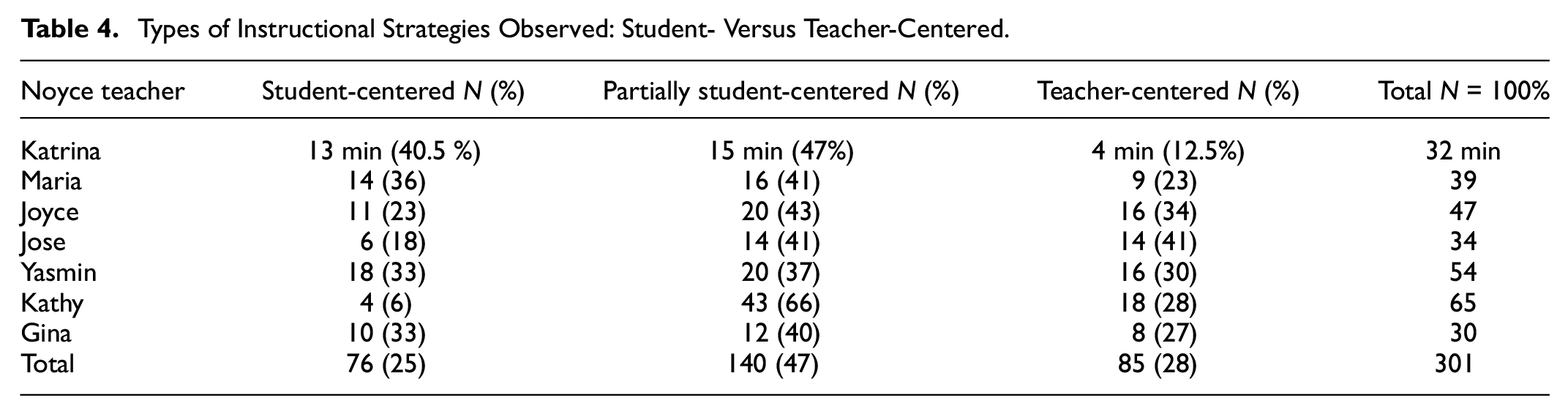
On average, each lesson observation lasted for about 50 min, with most observations being for 45 or 50 min. The observers recorded if at any time during a five-minute period a specific type of instruction was employed. Because 5 min is a considerable amount of time for classroom activities, the teacher could have employed several types of instructional activities during each five-minute interval. In such cases, the observers noted the minutes for each type of instructional activity (e.g., 2 min on L). After the observation, the minutes were added for each category of instructional type, and then the average was calculated for the two visits made for each participant. As an example, in Table 4, during a 32-minute average observation span, Katrina averaged 13 min of student-centered pedagogy (40.5%), 15 min of partially centered-pedagogy (47%), and 4 min of teacher-centered pedagogy (12.5%).
One section of the LCOS used in this study concerned the level of Student Engagement (SE) rated as high, medium, or low. During each observation, SE was rated as high when 80% or more of students were engaged, as low when 80% or more of students were off-task, and as medium otherwise. An engaged student was observed as the one who, during the time of the observation, was involved in the lesson in meaningful ways, that is, he/she participated in all classroom activities, and collaborated effectively with the teacher and with other students. Student engagement data was collected in blocks of five-minute time intervals during the two visits. The average number of five-minute intervals for each engagement category for two visits is presented in Table 5. For example, Maria averaged three blocks of five-minute intervals of high engagement (30%), five blocks of medium engagement (50%), and two blocks of low engagement (20%).
Annual Professional Performance Review
The Annual Professional Performance Review (APPR) was an assessment of teacher effectiveness required by the New York State at the time of this study. The APPR reports a teacher’s performance on eight specific skills in five domains. The teacher receives a rating of highly effective, effective, developing, or ineffective (HEDI) as indicated by a composite score (HEDI Score). We used the APPR as a measure in this study to verify if our findings are aligned with the school administrators’ assessment of teaching effectiveness by the participants. APPR ratings cannot be shared by administrators, but teachers have the rights to do so if they want. Only three teachers chose to share their ratings with the researchers.
Lesson Observations
The researchers (the first two authors) visited and observed all seven Noyce teachers twice teaching their subjects in their schools in fall 2016 and spring 2017. LCOS was used during these observations. The two observers made all the observations together, then discussed and agreed on the ratings. One section of LCOS is reserved for the observer to write field notes. The field notes focused on the teacher’s interactions and verbal communications with their students through the lens of the mindset theory. Particular attention was paid to how the teachers framed their feedback to the students as this provides important information about a teacher’s mindset (Rissanen et al., 2019). These notes were used to clarify and elaborate on the quantitative results obtained from other sections of LCOS.
Interviews
Unstructured interviews were conducted right after the lessons based on what was observed. Open-ended questions were asked about their lessons, students, and professional development to promote reflection on the instructional activities and teaching practices. The focus of these open-ended questions was to clarify the purposes behind the teachers’ instructional choices. Each interview lasted between 30 and 45 min. All the interviews were audio recorded and later transcribed. The data from the interviews were thematically analyzed to notice any emerging patterns (Creswell, 2008). Teachers’ responses were used to relate their teaching practices to their mindset as indicated by the results from the EBQ.
Findings from the three teachers (Jose, Maria, and Katrina) were elaborated on in detail because they were representative of the low, medium, and high growth mindsets and they were from different ethnic groups. Jose, Maria, and Katrina were also willing to release their APPR results in 2015 to 2016, which included the characteristics of the number of students, subject/content area, measures of teacher practice, measures of student growth, and mean student growth percentile.
Results
Analysis of Mindset Data
The preliminary analysis of the EBQ (Table 3) was conducted to classify Noyce teachers’ mindsets about teaching and learning. The results of the EBQ indicate that six teachers except one, Jose, demonstrated growth mindset with differing degrees, that is, they believed that learning is an accumulating process, the ability to learn is acquired, and knowledge is evolving and complex. Average scores of 4 or 5 were interpreted as having a more growth mindset while lower averages were considered as representing more a fixed mindset. Jose’s average, 3.3, was the lowest among the participant teachers.
Beliefs About Teaching and Learning: Mean Scores.

Note. Five-point Likert scale with maximum score=5; 1=strongly agree, 5=strongly disagree.
Growth-Minded Versus Instructional Strategies
In the following analysis of the LCOS data collected by the two observers, we wanted to understand the degree to which these Noyce scholars adhered to practices of student-centeredness versus teacher-centeredness. More specifically, we aimed to explore the relationship between the teachers’ mindset and the instructional strategies they used in their lessons. We also wanted to see the level of student engagement observed.
The data presented were examined both collectively and individually. The data displayed in Table 4 are based on 14 classroom observations, two per teacher, with each observation lasting 50 min, on average. By way of interpretation, student-centered or partially student-centered pedagogy was observed in 72% of the intervals, that is an average of 36 min per 50-minute class period. Teacher-centered pedagogy, on the other hand, accounted for 28% of the time or an average of 12 min per 50 min class period. Six Noyce teachers are, therefore, more likely to use student-centered strategies than Jose, the one with a more fixed mindset.
Types of Instructional Strategies Observed: Student- Versus Teacher-Centered.
Student Engagement
Observers also assessed the level of student engagement in mathematics or science classes at five-minute intervals. They recorded three possible levels of engagement: low engagement (80% or more of students are off-task); medium engagement (mixed engagement); and high engagement (80% or more of students engaged). A total of 67 cases were recorded for the seven teachers. High engagement was seen in 63% of the recorded intervals, medium engagement 21%, and low engagement in 16% of the cases. Jose, however, accounted for 7 of the 11 cases of student low engagement recorded or 64%. According to the mindset measure, he demonstrated a more fixed mindset than the other participants. The results appear to provide some evidence of the relationship between student engagement and teacher mindset (Table 5).
Student Engagement.

Documentation of Class Visits and Observations
Although the quantitative data presented in Tables 4 and 5 implied that teachers with a more growth mindset used more student-centered and engaging instructional activities in their observed lessons, it provided us with a limited perspective about how the teacher’s mindset related to their instructional approaches. The analysis of the class observations enabled us to identify some characteristics of growth-minded teachers and what they do in the classroom as they teach mathematics or science to their students, particularly when the subject or topics are challenging. In the following, we will present our analysis of observations of three of the participants, Maria, Katrina, and Jose who were teaching in high-need schools where the majority of the students were from low social economic Black or Hispanic homes. It is critical for these students to experience some success in school so that they could build their confidence on their way of becoming motivated learners of mathematics and science. We found that both Katrina and Maria demonstrated adopting and adapting effective strategies with a certain degree of flexibility, using group activities to approach challenging topics, making strong connections between the subject and students’ personal lives or the real world, and encouraging efforts to learn with multiple trials. In contrast, Jose appeared to be struggling with his teaching and adopted some fixed-minded instructional strategies.
Maria’s Ways of Teaching Mathematics with a Medium Level of Growth Mindset
Maria is an African American teacher who grew up in the Bronx and completed her undergraduate study in mathematics and teaching certification in 2013. She started to teach in the fall of 2014. In teaching mathematics, Maria was trying to approach topics and concepts that allow students to see the connection between their learning and their personal lives. In the post-observation interview, she stated: It’s that shift that’s happening. If you’re excited about it or you show them … And we try to relate it to their everyday life so they understand,… We know they like to move around, we give them a chance … Like, just different modalities that they can access the information, because scientific notation can be a little abstract sometimes, but then, just making it relatable and also, you know, how can they access this information and just keeping them moving at different points, so they have a chance what they know in different ways.
In discussing with students about how to approach some of the mathematics problems, Maria encouraged students to face the difficulties with multiple readings and try different strategies (Kroeper et al., 2022; Lee & Seo, 2019).
I’m happy you said that, because a lot of the problems, what I noticed is that, if you read it just once, you may not understand what it was asking, but you would have to read it again, or perhaps a third time. Right? (During her classroom teaching)
Maria liked to put students in heterogeneous groups so that they could solve some challenging mathematics problems with collective wisdom and provide opportunities for those who might be shy to share their learning and interact with other students (Schmidt et al., 2015).
So, a lot of you got into discussions about your ‘try it.’ So, the ‘try it’ problems were a little bit challenging, I get it, but a lot of you were talking it through. Good job in your groups. Reyon and Loisha to the board. They are going to share with you some of the strategies and techniques they used to get to their answer before you guys explore on your own. (During her classroom teaching)
Toward the end of the class, Maria praised students on a specific behavior that demonstrated their willingness to try or learn. For example, And wherever you need help, just to see an eye, you come over. Good job. Most of you did that today. First thing you need to give to your captain is the sheet that says, “Independent practice.” (During her classroom teaching)
As a mathematics teacher, Maria was willing to learn and try new effective instructional practices to engage students in learning. At the same time, she tried to adapt the strategy to fit the situations where her students can learn more effectively.
We also use a “Suppress and Release” approach. We went to a workshop at one point, and we saw where, okay, we give them this much and then we allow them to just release it by sharing it with a partner. So, we do a lot of turn and talk, and share with your partner what your thinking is. Again, coming back to the whole group. And if we heard something that valuable, let’s share it together, so it’s like discourse teacher-to-teacher, teacher-to-student, student-to-student, and then whole class. (Quote from the post-observation interview)
For the future, Maria indicated that she would need to take the leadership role by sharing her knowledge and skills with other teachers in the school. This was something that she shared with the researchers when she was asked about her needs so that the former college teacher education program could help.
… because my principal will come in and she’ll see me do all these things and she’s like, “Come on. I need you to share this with everyone else.” Sometimes I’m like, “How? Where do I begin?” You know, just helping, I guess, me to go in the line of being a leader. I know my degree or whatever my specialty was, was not focused on that, but I feel like as a group, that’s who you have prepared.
Maria received an effective rating by the New York City Department of Education in her Annual Professional Performance Review (APPR).
Katrina’s Ways of Teaching Biology to Her Students with a High Level of Growth Mindset
Katrina is a Hispanic who immigrated to the U.S. as a teenager, completed her undergraduate study in biological science and obtained certification to teach biology in 2014. Katrina did her best to work with her students to promote their learning of science. She was always passionate about teaching and her students. One advantage she had is that she spoke Spanish as the majority of the students in her class were Hispanic. Sometimes she would use Spanish to explain a concept that students did not quite understand. Due to her caring and support of her students, she won their trust as if she were their family member, a relationship beyond a teacher, as stated below during the post-interview: Believe it or not, they call me Mom. And it’s high school you wouldn’t expect to see that in high school, but they call me Mom at least three times a week.
Katrina believed that it is important to connect learning with a real-world situation to make teaching effective and learning meaningful (Weiner, 2010).
For example, we do the DNA we look at documentaries, how they use DNA to cure diseases, so they investigate the Genome Project. I always try to look for the social impact of whatever we’re learning in the classroom, so they see the application. And it works for them.
In teaching students to deal with challenging and difficult topics, she allowed them to make mistakes, but also encouraged students to stick to learning, try multiple times, and never give it up (Dweck, 2006; Yeager & Dweck, 2012).
Those I think I teach the challenging ones to relax more than the easier ones, because you made the mistakes and that’s okay. And I tell them, “To make the mistake it’s okay. If it didn’t go well you tried it again.” You write the day that you got, honestly saying this is what I got, and why you think that happened, and you try it again.
The following excerpt illustrates how she dealt with the situation where students got stuck with difficulties.
From the documentary, anyone remember what the four bases in DNA? We have four. We have adenine, guanine, cytosine, and thymine. You also have in Spanish right here. Well you know the first time that we actually covered DNA, so I know it’s a lot of information but I’m going to review this. We’re going to do this a lot, and we’re going to do a lab tomorrow, so we’re going to review this for a few days.
One strategy Katrina used so well was to push the students to an enhanced understanding of the concept through discussion and questioning.
They are amino acid chains, very good thank you, Catalina. Brennan, you want to add something to what Catalina said? Very good, so yes, next month. They are macromolecules that have oxygen, very good. Dominica? Those are molecules like I told you biological classes. It’s very good. Anyone else want to say something different about proteins? They control the biological property. Very good. Jocelyn? I can help you, but you need to try.
The mixed ability grouping is a format where Katrina expected students to share their own independent learning with others and help others to see and learn.
Very good. Who wants to help her with the next one? This is going to be a C. What are we going to have on the other side? What is going to be the pairing base, Brian?
For future professional development, Katrina expressed her interest in pursuing an additional certification in teaching bilingual (English and Spanish) students and students with learning abilities.
I am working on a bilingual extension right now. … after the bilingual extension, maybe going for special education.
Katrina received an effective rating by the New York City Department of Education in her Annual Professional Performance Review (APPR).
Jose’s Ways of Teaching Science with a Fixed Mindset
Jose completed his undergraduate study in earth science and became a certified teacher in 2013. It was his second year of teaching when we visited his class in 2017. He demonstrated strong content knowledge and was motivated to do a good job in teaching students with diverse cultural backgrounds. However, his teaching did not look effective as he relied mainly on lecturing, recitation type of questioning, and definition of the concept. He tended to push students to seek the right answer in their initial attempt instead of providing opportunities for students to see the connection between the concepts and obtain a deep understanding of the topic. For example, he got engaged in the following conversation with students:
Okay, Karen. What is homeostasis? Let’s hurry up, homeostasis? I gave you the meaning last week. Homeostasis. Okay, Ashley, bail them out. Let’s go.
Homeostasis gives signals to release hormones … I mean, to your body to release hormones which is …
Is she correct? Does homeostasis give anything to your body? Martin?
Jose liked to rush the students to get the work done or urge them to “hurry up.”
Okay, your time starts. Okay, go on. Some people are ahead of the game already. For those of you talking … You have three minutes twenty seconds left. Three minutes, twenty seconds. Just raise your head. You have one more minute left. If you’re still writing, don’t raise your hand. If you’ve finished writing, raise your hand. Simple and straightforward, I’ll let you share … I always love it if you put in your own words. Forty seconds left. Okay, let’s pause right here and share our answers. Those who I appointed to share, raise your hands. Omar, share with us.
Then, he would spend a large chunk of time lecturing which caused students to fidget, talk among themselves, and he appeared to finally lose control of the class. He did not seem to allow students to read and digest on their own. Instead, he wanted to feed them the information (Maass et al., 2017; Mullis et al., 2008). The following exemplifies Jose’s approach:
Okay, so when you talk about hormones, where do the hormones come from? I want you to say something that connects the hormone and something else that we’ve said in the class. What releases the hormones? Where do the hormones come from? The glands. So you have to use the glands in your sentence. Okay, so now, let’s go to page 247 in your book, we’ll look at different glands and what they do. We have different glands and what they do. You and your partner, look closely. Closely look at the glands in figure 12, page 247. 247, yes. So with your partner look at the various glands that are listed there with pictures. Read over them and we’re going to come back to our sentence … I want to see you on task, not talking about basketball. I see your hand, I’m coming … Maria, voice level one. Fabio, I don’t see you on task. Nobody is using a computer yet. The answer is right there. I want you to look on that page. 247, they’ve summarized it for you. Some people are having fruitful discussions. Guys, you have two minutes to go. Two minutes to discuss and then move on. Two minutes. Just scan them.
Yes? Okay, let’s pause right here. From what you scanned, scanning means you just look and briefly get an idea of what they do. So we’re going over page 247. If we look at the picture there, we see different boxes and different glands. Who can tell us which group is the work of the thymus. The thymus gland. What does it do?
Jose received a developing rating by the New York City Department of Education in his Annual Professional Performance Review (APPR).
Discussion
Several factors might have influenced how the growth mindsets of Maria and Katrina influenced their teaching practices. First, the design of the program included a one-year internship in a school, working with a dedicated in-school teacher mentor, and a two-year continuous mentorship once they started teaching in public schools. Such professional development scheme was probably a factor in giving them the confidence to implement strategies that promote growth mindset and enabling them to have “effective” (Maria and Katrina) or to a lesser extent “developing” (Jose) ratings in their APPR school assessments.
Second, the number of years of teaching could have also played a role. Except Jose who was in his third year of teaching, all the other six teachers were in their fourth year of teaching. Teachers with 4 years of experience are considered to be at the beginning professional stage, having passed the probationary stage (years 1–3). Jose on the other hand was probably still focusing on his own survival as a first stage teacher having not yet secured tenure (Ryan & Kokol, 1988) and having received a “developing” rating from his school the previous year. While Maria and Katrina displayed more learning-oriented teaching, Jose’s teaching was more performance-oriented (Grant & Dweck, 2003; Weiner, 2010). Teachers with growth mindset promote process-focused thinking, provide constructive feedback, and encourage students’ persistence (Rissanen et al., 2019). The two teachers with higher levels of growth mindsets, Maria and Katrina displayed such characteristics. Moreover, they both showed a low percentage of teacher-centeredness (23% for Maria and 13% for Karina). Jose on the other hand showed over 41% of teacher centeredness in his teaching, spending most of his time teaching directly to his students. One assumption is that students are more engaged and achieve more when teachers use active learning strategies, relate new learning to prior learning, and provide students with a variety of opportunities to apply and use knowledge and skills in different learning situations (Kemp & Hall, 1992; Rosenshine, 2012). Teachers with a growth mindset might tend to use these types of student-centered instructional strategies in their lessons as observed in this study.
Moreover, other patterns that emerged from the data showed how Maria and Katrina adopted instructional practices that are aligned with those that are recommended in the growth mindset literature. For example, in dealing with successes and failures, parents and teachers are recommended to be specific and to teach their students or children to “love challenges, be intrigued by mistakes, enjoy efforts, seek new strategies, and keep on learning” (Dweck, 2006, pp. 179–180). Both these Noyce teachers encouraged their students to keep on trying and not to give up when they are facing challenging and difficult science or mathematics concepts.
Finally, another factor that might have influenced how these teachers’ growth mindset related to their teaching could be their personal beliefs and values. These teachers applied and enrolled in the Noyce program as mathematics or science majors with the belief that they could shape the education of lower income and underserved children of the same background. They believed in the importance of being role models for the children they taught and showed more intrinsic motivation in the form of using growth mindset pedagogy to influence their students’ achievement (Yeager et al., 2022). The effective rating they received on the APPR, which included measures of student growth and mean student growth percentile, was probably the result of such beliefs, values and learning-oriented goals (Grant & Dweck, 2003).
Therefore, the successful learning and effective teaching outcomes could not have just come from encouragement but were also the results of effective instructional strategies and explicit teaching in the classroom. Both these teachers resorted to more growth minded instructional practices such as organizing teamwork, setting high standards and expectations for students, providing ample opportunities to share their understanding of science and mathematics concepts in class and small group discussions as well as independent work (Rissanen et al., 2019). Although Maria and Katrina are not atypical teachers who are effective, their growth-minded teaching is critical in helping students in high needs schools to learn successfully challenging subjects in mathematics and science.
We have observed instances that these two growth-minded teachers tried to help students to close the gap by telling the students that there was still something missing showing their understanding of the concept. Unlike some educators, they tell the students the truth, but more importantly, they provide tools that the students need to close the gap (Dweck, 2006). First, they were trying to create a culture in their class implicitly or explicitly where students feel comfortable and willing to try even when sometimes they make mistakes. Growth often implies that students will experiment with new ideas, make mistakes, meet with challenges, handle struggles, or experience failures as they are on their way of successfully learning math or science concepts (Boaler, 2016; Dweck, 2006). Second, their use of heterogeneous or mixed ability grouping strategies sends growth mindset messages to the students so that students with differing abilities can work together. Finally, their purposeful, step-by-step questioning helps students to engage in learning challenging concepts and to focus on science and mathematics tasks, for example, Katrina managed to help students to learn the concept of proteins and move to another topic on DNA. Both try to rely more on learning strategies and contextual factors rather than referring to fixed abilities (Yeager et al., 2022).
In line with Dweck’s (2006) observation that growth-minded teachers love to learn, Maria and Katrina are interested in learning more about how to teach effectively. Maria adapted the “Suppress and Release” strategy and tried it in her class, while Katrina was enrolled in the bilingual extension program and planned to learn how to teach effectively to students with learning disabilities. In the context of schools where teachers are being held accountable for their students’ learning as evidenced by the standardized tests, however, these two teachers stick to their beliefs that all students can learn difficult mathematics and science concepts through effective student-centered teaching as they provide a growth-minded environment in their classrooms. This highlights the importance of the influence of teacher’s beliefs and mindset in the pursuit of teaching effectiveness and students’ academic success (Yeager & Dweck, 2012).
Conclusion
One major advantage of conducting a teacher preparation program in urban schools is that it gave the program and research team access to the classroom. Urban schools educate large numbers of children, and they tend to be underperforming relative to their more affluent suburban neighbors. The data we collected, direct observation of teaching in urban schools, especially in urban secondary schools, was a rare commodity at the time of the study.
The data we presented could have important implications for teacher training. The findings imply that teachers’ mindset might influence the way they teach to students. Teacher education courses and field work experiences can integrate a growth-mindset pedagogy (Rissanen et al., 2019) to promote the implementation of student-centered teaching practices as such practices are more likely to improve student learning and performance (Kemp & Hall, 1992; Rosenshine, 2012). The pedagogy employed by the mentor teachers are also important as mentors are role models for the prospective teachers (Butler & Cuenca, 2012). Teacher education institutions can work collaboratively with the schools to promote a growth mindset pedagogy.
We were able to explore the relationship between teachers’ mindset and teaching practices with a small number of participants. We were only able to present the results of three focal participants. This study builds the foundation for future studies. For example, future work could be extended to include a much larger number of teachers utilizing more observations per each teacher. In the current study, the two observers might have only seen some elements of the teachers’ teaching repertoires of due perhaps to some scholars’ anxiety. Having been trained under circumstances that comprised besides their own observations, frequent observations by program personnel, school administrators and teachers, the presence of the observers did not probably influence the scholars’ pedagogy. Another area that future studies can explore is mentor teachers’ mindset and its relation to prospective teachers’ teaching practices.
Footnotes
Declaration of Conflicting Interests
The author(s) declared no potential conflicts of interest with respect to the research, authorship, and/or publication of this article.
Funding
The author(s) disclosed receipt of the following financial support for the research, authorship, and/or publication of this article: This study was completed as part of the Mathematics and Science Teacher Education Renewal (MASTER-Phase I) Program at Lehman College [NSF Award 0833317]. The project supports undergraduate mathematics and science majors entering secondary STEM-related teaching disciplines in underserved areas; this includes funding students’ senior year of college, master’s degrees in education, mentorship, related stipends, and research on epistemological beliefs. (PI: Gaoyin Qian; Co-PIs: Serigne Mbaye Gningue, Liesl Jones, Wesley Pitts: Lehman College of the City University of New York [CUNY]).

Data Availability Statement
The data presented in this study are available on request from the corresponding author with restrictions due to Institutional Review Board rules.