




Abstract
This article analyses different methodological approaches adopted by theoretical articles published in translation studies journals. To account for the range of perspectives, a small corpus comprising articles from three journals listed in both the Thomson and Reuters Social Sciences Citation Index (SSCI) and the Arts and Humanities Citation Index (A&HCI) was studied. The article discusses how the methods used could gain in rigor from being formalized. It begins by defining translation theory before outlining a corpus of articles to be studied. It then moves onto describing and discussing four methodologies to provide recommendations for conducting future research in translation theory.
Introduction
How does a discipline think? When translation studies emerged as a discrete area of academic enquiry, James Holmes (1988), in a landmark paper, drew on Michael Mulkay (1969, p. 136) to argue that science moves forward by revealing “new areas of ignorance.” He went on to provide a tentative mapping of research in the nascent field, dividing it into two branches, “pure” and “applied.” For Holmes, while the former built theoretical concepts to conceptualize translation phenomena, the latter looked to improve translation practices by setting guidelines for assessing the quality of outputs. More recent mappings of the discipline, such as by Luc van Doorslaer (2007), also divide research according to whether it is of a more practical bent, or whether it addresses conceptual problems. In each case, there is an emphasis on “theory” on one hand, and, on the other, a focus on “practice.” The perceived divide between the two is such that it is commonplace among professional translators to consider theory abstruse (Chesterman & Wagner, 2002; Polizzotti, 2018).
There is, in fact, no such thing as “translation theory” per se. Rather, there are different theories of translation which may provide “organized set[s] of principles and procedures” to produce “good translations” (Jin & Nida, 2006, p. 7), or which may describe normative approaches to translate utterances (Toury, 2012). While some focus on the specific procedures involved in rendering a text in a different language (e.g., Franco Aixelá, 1996; Venuti, 1995), others consider the role of translated texts within global systems of cultural exchange (e.g., Glynn, 2021; Heilbron, 1999). Characterizing how theories are elaborated is key to outlining the range of discursive choices available within a specific field. While there are publications that highlight major topics (Zanettin et al., 2015) and research methodologies (Saldanha & O’Brien, 2013) in translation studies, there has been little analysis of the theoretical branch of the field specifically.
The following article seeks to address the gap in knowledge by first categorizing the range of approaches used, and second, by outlining methodological recommendations for conducting future theoretical research in translation theory. Translation studies is at the “interface” of other disciplines (Duarte et al., 2006), including literary and cultural studies, history, and sociology. Thus, in addition to speaking to scholars concerned with translation, the article aims to comment more generally on how the humanities and social sciences utilize qualitative methods to “think” and, indeed, “theorize.”
Method
This study provides a “systematic review” (see Fisher et al., 2020) of the theoretical articles published in core translation studies journals, focusing on the qualitative methods they use to build and discuss concepts. The scope of the review is deliberately restricted to three journals for reasons outlined below.
Corpus
Perspectives—Studies in Translation Theory and Practice, Translation Studies, and The Translator publish “original and innovative research on a variety of issues related to translation and interpreting as acts of intercultural communication.” 1 There are other translation studies journals (Meta, Babel, and Translation and Interpreting Studies, notably) which contain discussions of theory; there are also articles that are not published in translation studies journals which do so. However, the journals selected for this review are particularly prominent, combining both humanities and social sciences methodologies. Indeed, their interdisciplinarity explains why they feature in both the Thomson and Reuters Social Sciences Citation Index (SSCI) and Arts and Humanities Citation Index (A&HCI). Moreover, all three are with the same publisher, Taylor & Francis, which implies a certain level of homogeneity in terms of their management, review and publishing processes, including the fact that they only publish research in English (unlike, for instance, Babel). Most importantly, the websites of the journals share the same search function, meaning that the results can be collected in the same way.
Search Inclusion and Exclusion Criteria
Since the journals in question publish research that is not necessarily theoretically oriented, a search for the keyword “theory” was conducted to identify appropriate articles. The dedicated function on the journals’ respective websites was used to retrieve results. These were then narrowed down following careful browsing to retain articles whose titles included the noun “theory,” the present participle “theorizing” (as well as the British spelling variant “theorising”), and the adjective “theoretic.” While other articles might also cover theoretical ground, those that contain an overt reference in their title most explicitly state their engagement with translation theory. Only research articles were kept in the final selection, whereas review articles were excluded, as were announcements, responses, and editorials. What is more, a research article that analyzed the TV show The Big Bang Theory, but was not specifically concerned with translation theory, was also excluded.
Findings
Search Results
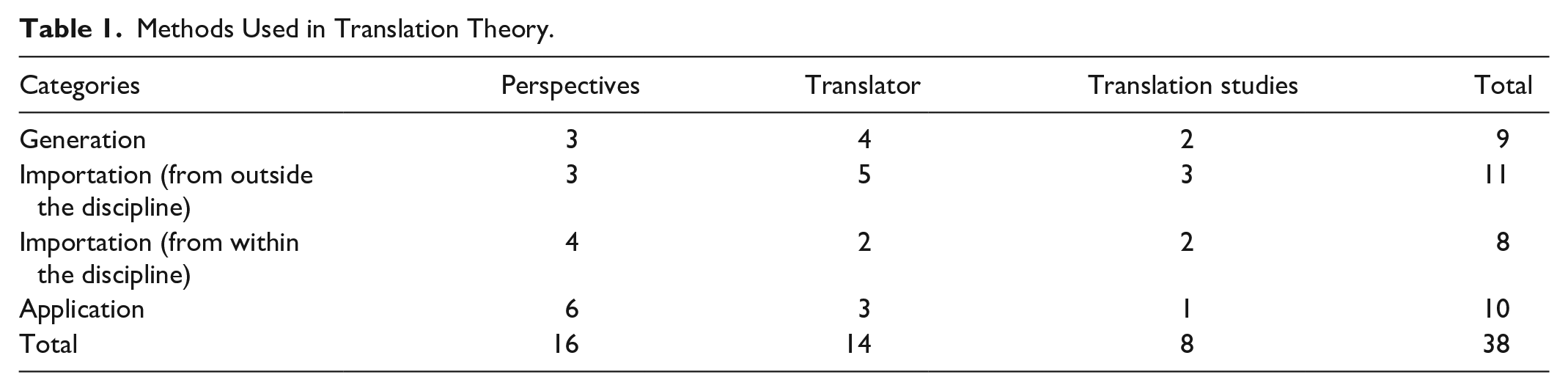
On July 9, 2021, “theory” yielded 721 hits for Perspectives, 471 for The Translator, and 363 hits for Translation Studies. 2 After applying the exclusion and inclusion criteria, the respective totals for each journal were 16 (Perspectives), 14 (Translator), and 8 (Translation Studies). The vast majority of the 38 research articles selected contained the keyword “theory” (or theories) in their titles (33), while one included “theoretic,” and four had “theorising” (or “theorizing”).
Classification of Results
The articles retained were then classified into different categories according to the approaches they used to discuss theory. While some articles generate new theoretical concepts or perspectives (e.g., Chan, 2002; Glynn & Hadley, 2021), others import theories from other disciplines (e.g., Alós, 2016; Attardo, 2002; Buzelin, 2005) or from non-Anglophone translation studies (e.g., Yu, 2007). Others still provide case studies to test the application of theories to new contexts (e.g., Hu, 2004). As a result, the following typology of classifications was adopted: “generation,” “importation” both from outside and from subareas of the discipline, and “application” to case studies. In what follows, a table presenting the results is provided (Table 1), the labeling of each category is explained, while illustrative examples of articles that correspond to each type are discussed.
Methods Used in Translation Theory.
Approaches to Discussing Theory
Table 1 summarizes the utilization of the three different methods in the sample.
Within the sample, nine articles generate new theories, 11 import theories from outside the discipline, eight from within the discipline, and 10 apply theories to case studies. As might be expected, more articles either import theories (19 do, if importation from outside and within the discipline are counted together) or provide case studies rather than generate new theories. Yet, theories are nevertheless developed in translation studies, with some focusing on linguistic aspects and others on cultural elements. The generation of new theories is the focus of the next section.
Generation
Within the corpus, various articles scaffold new theoretical models. Those that contain “theorizing” (or “theorizing”) in their title do so explicitly. Thus, Glynn and Hadley (2021, p. 22) provide “the first systematic theorization of (un)performability” by articulating it with the concept of “untranslatability,” which has gained considerable traction within recent years in translation studies. Their article looks at a cogent discipline (performance studies) to add definition to “untranslatability” and to build a theoretical understanding of translation for the stage. In another article, Leo Tak-Hung Chan (2002) develops a theory to explain how bilingual and multilingual texts may be translated. Chan (2002, p. 52) uses historical examples of how Tolstoy’s French and Russian texts in War and Peace have been rendered in Chinese, before outlining different strategies for translating other multilingual texts, from literal translation (p. 63) to double-voiced language (p. 64). A third example of an article that develops a new theory is Suzanne Lauscher’s (2000) “Translation quality assessment: Where can theory and practice meet.” Lauscher looks to bridge the gap between practice and theory in the area of quality assessment. Lauscher (2000, pp. 151–158) begins by reviewing existing frameworks for assessing translations, such as equivalence and functional approaches. She then goes on to propose her own theoretical framework, which relies on analysis of the translation situation, and of the conditions in which a particular translation was commissioned.
Holmes (1988, pp. 73–76) classified translation theories into different types: “general theories,” which attempt to provide laws for all forms of translation, and “partial theories,” which account for particular types of translation. The latter may be restricted in terms of “medium” (human or machine), “area” (language pairings), “rank” (word or text), “text type” (informative or literary), “time” (contemporary or ancient), or “problem” (equivalence or cultural specificity). In the cases outlined above, the articles provide partial theories. Indeed, the article on unperformability and untranslatability is specifically concerned with translating for performance, whereas Chan theorizes the translation of a particular type of literary text. Yet, in both cases they provide a range of examples relating to different situations. This is because the new theoretical notions are intended to be applicable to various, if not all, contexts within the restrictions of text types (dramatic and multilingual, respectively). It is to be noted, however, that the rationale for selecting the examples is not always made apparent, save that they serve to illustrate the argument. Lauscher adopts a somewhat different approach. Having reviewed approaches to translation quality assessment, she provides a case study in which to formulate a new theoretical position. As such, this differs considerably from the use of case studies to apply a theoretical reading, or to test a theory, as outlined in the section “application.”
Importation
As well as creating their own sets of theories and methodologies, academic disciplines “borrow” or incorporate theoretical concepts from other areas of knowledge. Edward Said (1983) describes the process by which a theory travels in terms of a journey during which it is subject to multiple changes, reinterpretations, and developments. This is true regarding translation studies, which has sought to “import” theories that emerged in other disciplines to explore how they may be relevant to describing translation practices. It is also the case that the international discipline of translation studies, for which the main language of scientific publications is English, imports theories developed in non-Anglophone contexts. As such, it is possible to classify the “borrowing” or “importation” of theories in two subcategories: one includes those imported from outside the discipline; the other comprises those developed within the discipline.
From outside the discipline
In recent years, there has been a “sociological turn” within translation studies. Many scholars have looked to methods and theories developed in sociology to bolster approaches to studying translation as a process. It is therefore not surprising that many articles within the corpus incorporate theories from the social sciences. Jean-Marc Gouanvic (2005), for instance, evaluates the applicability of Pierre Bourdieu’s theoretical concepts of “field,” habitus “capital,” and “illusio” to analyze translations. Gouanvic was among the first to look to sociology to provide translation studies with an understanding of translation as a social phenomenon. This gave more weight to the existing understanding of translation being governed by normative behavior (Chesterman, 1997). It specifically focused the attention on what translators did, which in turn led to the development of a subset of translation studies which Andrew Chesterman (2017) has labeled “translator studies.”
Other articles in the corpus also apply theories from the social sciences to explain translation. In fact, it is notable that while case studies tend to utilize literary theories to analyze their objects of inquiry, those articles in the corpus that apply theories to new contexts predominantly look to the social sciences. This might be because of the shift in the discipline away from comparative literature to a broader understanding of translation not necessarily related to literary works. A notable exception, however, is Panagiotis Sakellariou’s (2015) article on “the appropriation of the concept of intertextuality for translation-theoretic purposes.” Sakellariou (2015, p. 35) specifically describes the mechanics of the “appropriation of a core concept from a different discipline.” He considers how “intertextuality,” which was first theorized by the Tel Quel literary theory group in France, “appears always intertwined with a certain conception of textuality” (p. 40). Of all the articles in the corpus, Sakellariou’s is the one which goes into greatest detail about how theories adapt to new settings.
Unlike Sakellariou, Zhonggang Sang (2011) looks to the social sciences to adapt activity theory to improve translation pedagogy. Sang argues that the theory can provide solid grounding to foster better teaching of translation. The article (Sang, 2011, pp. 292–295) thus provides a detailed overview of activity theory before discussing its application to frame translation practice. Translation is conceived as a system of hierarchical rules (p. 300) which govern decision-making processes relative to the adoption of specific procedures. Since the focus is on the teaching of translation, the article highlights ways in which students can learn to consider translation as part of a larger process that involves more than the rewriting of a text in another language but includes discussions with commissioners, quality assessment, and so on. Other articles in the corpus which import theories from the social sciences include Sergey Tyulenev’s (2009) utilization of Niklas Luhmann’s social theory. Tyulenev (2009, p. 150) establishes three paradigms that might describe translation. He then highlights existing research in the discipline that follows such conceptualization of translation, bringing in Luhmann to frame this research. Like Sang, Tyulenev shows how an imported theory can shift understanding of translation, or more specifically in his case, of translation research.
A slight variant on the theme is provided by Hélène Buzelin (2005) who rather than simply demonstrating how an outside theory can benefit translation studies, underlines how the discipline can itself contribute to reconsidering that theory. Buzelin argues that the works of Pierre Bourdieu and Bruno Latour, which are considered to be antinomic in sociology, can be reconciled within translation studies. Indeed, Buzelin (2005, p. 214) argues that Latour’s actor network theory can help define processes of translation in conjunction with Bourdieu’s analysis of the social environment of translation. This then allows for a reassessment of the supposed non-compatibility of the theoretical models. Jeremy Munday (2004), also in the corpus, goes a step further still. Instead of importing a theory from another discipline to explain translation, he exports translation theory to comment on marketing and advertising. At the time when the article was published, little research considered advertising and translation, given that in marketing studies little attention is paid to “the translation of written copy” (Munday, 2004, p. 200). Munday (p. 204) analyzes the relevance of famous theories within translation studies, such as Eugene Nida’s notion of dynamic equivalence, which explains how the message is rendered in a manner that it is understandable by the target audience, to describing the development of advertising campaigns that use local references to appeal to target markets.
From within the discipline
Within the corpus, several articles either consider how well-known theories and concepts have been translated into non-anglophone contexts, or present theories that are well-known in a specific cultural environment but are relatively unknown in anglophone translation studies. Li Xin (2010), Maciej Litwin (2021), and Yangsheng Guo (2009) do the former. Li Xin charts the development of a well-known translation theory in an unfamiliar context, analyzing the reception of Eugene Nida’s concepts of equivalence in China. By presenting the reception of Nida in China from a historical perspective, Li is able to discuss the theory in some detail and highlight how it has been challenged by Chinese scholars. Maciej Litwin explores the concept of “energija” (energy) as exposed in Jan Januszowsk’s commentary of his Latin-Polish translation of Basil Bessarion. Yangsheng Guo (2009), on the other hand, comments on how the semantic differences between “zhengzhi” in Chinese and “politics” in English lead to a different understanding of what might be meant by the politics of translation. The purpose is to underscore how terms take on new meaning when they migrate.
Another example of this type of approach is Yu Chengfa’s (2007) commentary of Qian Zhongshu’s theory of translation. Yu (2007, p. 214) argues that Qian’s work is acclaimed in China, however, the article presents his theories to a non-Chinese-speaking audience. To do so, Yu compares concepts discussed by Qian to theories that are more familiar to an anglophone translation studies readership. For instance, he (pp. 216–217) highlights how Qian describes two possible orientations in translation: “Europeanisation” or “sinization.” The underlying assumption is that texts will be translated from European sources rather than, for instance, from other Asian languages. However, Yu relates these concepts to those of foreignization and domestication, which are commonly understood through the lens of Lawrence Venuti’s (1995) notion of The Translator’s Invisibility. He then moves on to consider two other ideas explored in Qian’s work: misrepresentation (pp. 217–220), and the “function” of translation (pp. 221–222). The latter in particular is a notion that is heavily associated with the functionalist school of translation in the 1970s (see, e.g., Reiss & Vermeer, 2013), but, intriguingly, Yu makes no direct reference or allusion to this school. Nor is the discussion of misrepresentation related to other discussions of translation quality assessment. Yu therefore shows in his commentary how Qian Zhingshu’s theory of translation relates to others that are better known within anglophone translation studies, though he could have gone deeper in the comparisons. He also provides a new set of concepts that might be used by non-Chinese speaking theorists or analysts of translation.
Zaixi Tan (2009) adopts a different perspective by bringing to the attention of the readership discussion of the “Chineseness” of translation theories in China. Such debates provide, for the anglophone translation studies readership, a different perspective on the concept of ethnocentric translation theories. As such, the article explores how one views the traditions of a particular context against those of others (Tan, 2009, p. 287). Analysis of the discourse about translation is central to understanding its practice. As in other disciplines, such as communication, for instance, analysis of the context is fundamental to comprehend the practice in itself.
The articles in the corpus show that there is both “importation” of theories from other disciplines to develop and enlarge the theoretical apparatus of translation studies. There is also “exportation” of theories developed within the discipline to other areas of inquiry. Arguably though, to better measure the impact of translation studies on other disciplines, it would be necessary to look at which articles published in leading journals in these disciplines make use of translation theories. The interest in applying theories to new contexts is in highlighting how they might develop a new understanding of a concept or be read differently themselves through the prism of another discipline. In this manner, there is much in common with the “application” method, which studies theories in relation to specific cases.
Application
According to Şebnem Susam-Sarajeva (2009, p. 37), the case study is one of the most common research methods in translation studies (this is evidenced in the sample), and the single most common method used by doctoral students for their research. A “case” from a translation studies perspective is taken to mean “a unit of translation or interpreting related activity, product, person, etc. in real life, which can only be studied or understood in the context in which it is embedded” (Susam-Sarajeva, 2009, p. 40). The “context” in translation refers to the “target culture” into which a “source text” is translated. There are many theories of translation (Heilbron, 1999; Lefevere, 1992) that explain in general terms how works are selected to be translated. However, each “context” is different and general principles are more or less relevant to explain specifically how translation occurs there.
Within the corpus, several articles make use of the case study method to apply a theory to a new context. For instance, Hu Kung-Tze’s (2004) examines the translation of Chinese classics by early 20th-century German translator Richard Wilhelm in “Postcolonial translation theory: a case study.” Hu (2004, p. 286) proceeds to evaluate what the author terms Wilhelm’s “re-translations,” including Confucius and Laozi (Dao de Jing). To do so, Hu uses André Lefevere’s (1992) theory of translation as a process of rewriting. Hu labels Wilhelm’s translations “re-translations” because they are not the first German translations of these works. It is not surprising that Hu should refer to Lefevere’s work as he is a “go-to” reference in translation studies (see, e.g., Chang, 2015). However, what is a little strange is the fact that Lefevere is not generally regarded as a postcolonial theorist, though his work does consider how translation is a culturally embedded practice. A more appropriate though less punchy title may have been “Translation and Cultural Studies: A Case Study.” As it stands, the title is indicative of a loose interpretation of “postcolonialism,” though Hu (2004, pp. 288–290) does discuss the history of China’s colonization by European powers. It is to be noted, however, that the article was published in Perspectives over 15 years ago, when the journal did not command the same stature as it does today.
Another article, written by Zhao Huan (2021), also adopts the case study methodology to study the transmission of a particular theory to China in the 1920s. It also uses the postcolonial lens, calling on Said. While it does so with more discernment than the article by Hu, Zhao nevertheless does not draw much on Said as the theory only provides a general framework. A third example of the case study methodology from the corpus is Katherine Batchelor’s (2015) “study of repetition in Amadou Kourouma’s Allah n’est pas obligé.” Batchelor examines the text and its translations into English and German through the lens of trauma theory. She presents this theory (2015, pp. 193–194), highlighting the fact she follows Judith Herman’s (1992/2001) understanding of trauma originating in a specific event rather than in a victim’s response to that event. She then considers “the nature of the narrated events themselves and the positing of the narrative as testimony” (p. 194), before analyzing strategies of repetition in the novel as a way of translating trauma into narrative schemata (pp. 196–198). Much like with Hu, the value of her study derives from the prestige and recognition of its object. Kourouma is not as universally well-known a reference as Confucius and Laozi, but nevertheless commands considerable prestige in contemporary Francophone studies. Following in the lineage of comparative literature research, both articles use specific theories to cast new light on their case studies. In doing so, they test the applicability of the theories to new contexts, since each “case” presents a different set of questions.
Discussion
Each discipline has its own features and methods to build new theoretical concepts and interrogate notions developed in other disciplines. In the above, the approaches present a set of advantages and disadvantages. For instance, the case study approach is useful because it provides highly detailed analysis of a specific case, instance, or context. It can therefore lead to a more detailed understanding of a particular object of study. However, as self-proclaimed anti-theorist Mark Polizzotti (2018) has contended, each case is unique, and the lessons learned from analyzing one specific set of circumstances might not be transferable to others. The other problem is that, as Susam-Sarajeva (2009, p. 41) has argued, case studies are rarely studied as cases but rather as examples to illustrate or represent a general rule. This is of greater concern than the first problem. Indeed, the fact that the lessons learned from one setting do not necessarily transfer to a different context does not invalidate the reasons for conducting the research in the first place. However, using case studies under false pretenses is to be avoided. It is suggested that each article that uses the case study approach sets out its reasons for doing so explicitly.
The “importation” method presents the advantage of testing the applicability of theories to different environments. As a result, the discipline is enriched by perspectives that have been developed in cogent fields of enquiry. As a discipline, translation studies is well-placed to reflect on the appropriation—or translation—process involved when a theory travels from one discipline to another. Indeed, reflecting on the changes in how a theory is understood and applied in its “source” context and in its “target” context goes to the heart of what the discipline endeavors to achieve. Yet, other disciplines also profit from importing or borrowing other theories from different contexts. Indeed, cross-disciplinary fertilization is to be actively encouraged to elaborate new interdisciplinary avenues of research.
The most problematic approach is that which uses “examples in context” to construct a general theory. The main issue concerns the way in which examples are selected. For the most part, theorists rely on their own knowledge of translation in different historical contexts and around the world. The spread of examples serves as a means of illustrating the general validity of their theories however, it is suggested that the rationale for selecting the examples, beyond the fact that they illustrate the phenomenon they are considering, is made clear in the articles. For, indeed, there may be other examples that illustrate counterarguments. Certainly, detailed case studies can be used in follow-up articles to test the pertinence of particular theories and notions in specific contexts. Providing detailed information about the selection process of examples will only help such articles to gain rigor. This recommendation is not specific to translation studies and applies to humanities research in general, which often does not set out clearly its methodological framework, or not as clearly perhaps as many projects in the social sciences.
Conclusion
This article has provided an overview of different research methods in translation studies with a specific focus on those that engage with theory. It has shown how there is both an “inward” movement to import theories from other disciplines. There is also an “outward” movement to export theories into other disciplines. While the former serves to enrich translation studies as an area of inquiry, the latter demonstrates that the discipline has already come of age and can speak to others, offering up developed models to apprehend practice. It has highlighted how there are diverging methodological approaches that include the use of case studies and a range of examples to construct a general theory. It has suggested that there is a need for greater explanation of how examples are sourced to back up claims. It is hoped that in future there will be other surveys of qualitative methods in translation theory taken from larger data sets that will add to the conversation on formalizing research methods within the discipline. More generally, this study hopes to serve as a pilot for further research into methodological approaches in constructing theories across the humanities and social sciences.
Footnotes
Declaration of Conflicting Interests
The author(s) declared no potential conflicts of interest with respect to the research, authorship, and/or publication of this article.
Funding
The author(s) disclosed receipt of the following financial support for the research, authorship, and/or publication of this article: This work was supported by the City University of Hong Kong [Grant Number 7005339].
