



Abstract
This study evaluated the effect of ambient music on customers’ emotional cognitive responses and impulse buying behavior. A conceptual model was developed using the existing body of knowledge. The model was used to examine the influence of ambient music and whether gender moderates this impact. The hypothesized relationships were examined via path analysis. Implications of the results for the management of shopping malls/superstores are discussed.
Keywords
Introduction
Retail markets are becoming increasingly competitive. Retailers are continuously looking to differentiate their retail offerings. In this regard, retailers have distinguished themselves by providing an environment customized to meet customers’ needs. That customization is not only in terms of merchandise, convenience, and pricing but also in providing a pleasant and exciting shopping atmosphere (Sherman et al., 1997). Music affinity is a term coined by Kinnally et al. (2008). Music affinity refers to an individual’s music fanship and the degree of importance one places on music (Kinnally et al., 2008). A college student survey indicated that music affinity was positively associated with compact disc (CD) purchasing behavior (Kinnally et al., 2008). The study of Andersen and Frenz (2010) surveyed Canadian respondents and found that music interest was positively correlated with music purchase and download behavior. Xiang (2016) found that music affinity slightly influences the willingness to pay for digital music. It can be speculated that music affinity is associated with users’ demand for listening to music, which further affects their purchase intention. There exists a large number of studies on store atmospherics. However, a limited number of studies have specifically explored the effects of ambient music on consumers’ emotions and behaviors (Beverland et al., 2006; Daunfeldt et al., 2021; Mattila & Wirtz, 2001). With this research gap in mind, this study aims to examine the impact of one very important environmental factor, that is, ambient music, on young shoppers of famous shopping malls and superstores.
More specifically, this study examines the impact of ambient music (music affinity) on consumer attitudes and behavioral responses in the retail setup of an emerging economy, that is, Pakistan. The first research objective is to evaluate the influence of music affinity on customers’ appraisal of store offerings, sales personnel, and store environment. The second research objective is to assess the influence of music affinity on customer emotional responses and its subsequent influence on customer behavioral responses. The third research objective is to assess whether gender moderates the impact of (a) music affinity on consumer’s appraisal of store offerings and appraisal of sales personnel, and (b) consumer’s emotional response to consumer’s impulse buying behavior and approach behavior. In today’s competitive environment, it is critically important that retail stores learn consumer behavior and respond with strategies to attract and satisfy the needs of consumers (Jang et al., 2011). There is a growing interest among businesses in using atmospherics to enhance customer’s perception of the service environment (Caldwell & Hibbert, 2002). By examining the effects of ambient music in retail stores in Pakistan, the results of this study may offer guidance to the retail industry, especially the owners and managers of retail stores.
Literature Review
Emotion research in marketing has been classified into various approaches, such as categories, dimensions, and cognitive appraisal. Under the categories approach, each emotion is allocated to a set of mutually exclusive categories to understand its effect on consumer behavior. Under this approach, there exist six basic, distinct, and universal emotions. There exist clear boundaries that separate consumer’s emotional states (Watson & Spence, 2007). Under the dimensional approach, all emotions are considered to be associated with one or more dimensions. Two broadly identified dimensions are emotional arousal and emotional pleasure. Two fundamental dimensions of valence and arousal form an emotional space (Laukka et al., 2005). According to the cognitive appraisal approach, a person evaluates the possible impacts of a certain event on their interpretation of the event and then come up with a response (behavior) based on that interpretation (Bell & Song, 2005). Johnson and Stewart (2005) consider this approach a very relevant approach for understanding how consumers respond in a marketplace. Some consider this a better approach to gain in-depth understanding of how consumers behave under different emotions (Bagozzi et al., 1999). With these benefits in sight, researchers are still contemplating about the possible characteristics of an event that can stimulate consumer’s emotions.
The available literature on the impact of music on the customer in the marketplace has analyzed various attributes and types of music and customer preferences. The researchers have also analyzed the effect of these variables on consumer behavior, emotional responses, and purchase behavior. These studies have been conducted in a variety of marketplace settings (such as banking). Few studies have considered the impact of gender as a control variable as well. The findings of these studies are divergent and suggest that the understanding of the impact of music on consumer’s behavioral responses is still somewhat scant. Experimental design studies are limited to the examination of pleasant/unpleasant music on consumer’s behavioral response (e.g., Andersson et al., 2012; Beer & Greitemeyer, 2019; Dube & Morin, 2001; Garlin & Owen, 2006: Hussain, & Ali, 2015; Hwang et al., 2020; Park, 2002; Uhm et al., 2021).
Most empirical studies have used the M-R model by Mehrabian and Russell (1974) to study music’s impact. This model addresses how environmental stimuli, emotional responses, and customer’s behavioral responses are linked. The consumer’s emotional states have three dimensions: Emotional Pleasure, Emotional Arousal, and Emotional Dominance. Emotional pleasure refers to the extent to which customer considers a particular environmental stimulus enjoyable or not enjoyable (Greenland & McGoldrick, 2005; Menon & Kahn, 2002). Emotional arousal refers to the degree to which a specific environmental stimulus invokes customer’s excitement and ultimately results in a consumer’s approach behavior (Jang & Namkung, 2009; McGoldrick & Pieros, 1998). Emotional dominance refers to customer’s feeling of control in the shopping environment (Chen et al., 2015; Herrington, 1996).
Many studies investigating the impact of music have utilized the PAD approach (Bae et al., 2018; Chebat & Michon, 2003; Haußmann, 2015; Hui & Dube, 1997; Mattila & Wirtz, 2001; Sádaba & Lenzi, 2016; Vida et al., 2007; Yang et al., 2020). Many studies found evidence linking customer behavior to customer’s emotional pleasure and emotional arousal. While dominance was not considered an irrelevant dimension (Donovan & Rossiter, 1982; Ward & Barnes, 2001), it was found that either dominance had little influence on customer behavior or needs an improved measure (Castro et al., 2019; Spangenberg et al., 2006; Yalch & Spangenberg, 2000).
Besides the PAD model, Bitner (1992) offered another model to examine the impact of environmental conditions on an individual’s behavioral response in service organizations. According to this model, an individual’s perception of environmental conditions impacts physiological, cognitive, and emotional responses. These responses, in turn, affect an individual’s attitude and behavior. A. C. North et al. (1999) study of the impact of ambient music on alcoholic beverage consumers in a supermarket revealed that music did play a significant role in increasing sales. These findings were supported by Daunfeldt et al. (2021) and Fuentes et al. (2017). The indirect effects model of Greenland and McGoldrick (1994) is another model aimed to measure the environmental effects on consumer behavior in service organizations. Besides environmental elements, their model also examined individual’s characteristics (e.g., individual’s experience with the organization). Baker et al. (2002) proposed a model to investigate the impact of environmental cues in a retail setting. Baker proposed that design, perceived service quality, store offerings, effort, and store choice criteria influence consumer’s purchase behavior.
The Effects of Music
Many empirical studies have used the theoretical paradigms discussed above to examine the impact of ambient music on consumer’s behavioral reactions. The study of Caldwell and Hibbert (2002) observed that music elements independently influence a customer’s time in restaurant. Both music tempo and music preference were significantly related to the time spent in a restaurant when each was examined independently. However, only music preference was significant when tempo and preference were analyzed together. They concluded that music preference provided a better explanation of actual time spent dining than tempo. These findings were further supported by W. Rodgers et al. (2021). Yalch and Spangenberg (2000) found that customers spent a more extended time shopping when listening to unfamiliar music. The exotic music caused increased customer arousal. They found that only familiarity with the music significantly impacted customer’s shopping time. Customers also felt more dominant while listening to unfamiliar music. These findings were further supported by Burghelea et al. (2015). Ward and Barnes (2001) found a significant link between increased customer dominance with customer pleasure and arousal. Customers who felt more dominant were also more involved in interaction with store offerings and sales personnel.
Many researchers have studied the impact of music elements on customer’s behavioral reactions. The study of Bogomolny (2003) was in the context of a restaurant. Bogomolny found that music with a fast tempo increased customer turnover and food consumption. Another study found that slow-tempo music in a shopping mall increased customer’s stay and their attention toward mall offerings. Whiting (2012) further supported these findings. Herrington (1996) found that customer’s music preferences significantly and positively influenced the amount of time and money spent in the supermarket. The study of Petruzzellis et al. (2018) supported these findings. However, Herrington did not find any impact of music attributes (e.g., tempo or volume).
In examining customer’s emotional responses, Hui and Dube (1997) found that customer’s emotions were positively and significantly influenced by music valence (liking) despite longer waiting times. Many studies have found that customers more pleased with ambient music showed a more positive attitude toward the store environment and sales personnel. The customers also provided a more positive overall evaluation of the store. These findings were consistent with the findings of previous studies (e.g., Andersson et al., 2012; Dube & Morin, 2001; Gorn et al., 1993; Loureiro et al., 2021; MacInnis & Park, 1991; Mattila & Wirtz, 2001; McGoldrick & Pieros, 1998; Oakes, 2000; Soh et al., 2015; Vida et al., 2007; Yalch & Spangenberg, 2000). A study (Beverland et al., 2006) found that music valence (liking) positively and significantly influenced customer’s mood. It can be said that ambient music in a retail environment drives customer’s pleasure or displeasure, resulting in the positive (negative) reinforcement of customer’s evaluation of the store’s offering and sales personnel. Many studies found that longer the customer stays in store, the more money he/she will tend to spend (e.g., Baker et al., 2002; Caldwell & Hibbert, 2002; Chebat & Michon, 2003; Greenland & McGoldrick, 2005; Herrington, 1996; Loureiro et al., 2021; Michon & Chebat, 2004; Sherman et al., 1997; Soh et al., 2015). Impulse purchase is triggered by some environmental clues such as aroma (Mattila & Wirtz, 2001), music (Milliman, 1986), and servicescape (Bitner, 1992).
Environmental Cues
Retailing is experiencing a new trend. Retail stores now emphasize the breadth, depth and nature of goods or product offerings to provide a joyful shopping atmosphere (Loureiro et al., 2021; Sherman et al., 1997). Customer responses depend on differences in retail atmospheric cues such as ambient music (Milliman, 1986) and ambient scent (Michon & Chebat, 2004). Both arousal and pleasure positively impact money spent by customers (Sherman et al., 1997).
The store offerings consist of product layout, shelving, and quality of goods and products. It is essential that the ambient music match the product offerings in the store. The customer’s pleasure is directly and positively influenced by the customer’s positive appraisal of store offerings and its sales personnel (Vida et al., 2007).
The impulse buying refers to instant buying or unplanned buying by the customer, that is, purchase that is more than planned (Chang et al., 2011). Some stimuli can trigger customer arousal and pleasure. That stimulus may be any environmental cues like ambient scent (Mattila & Wirtz, 2001), ambient music (Milliman, 1986) and store environment (Bitner, 1992). The increased pleasure results in impulse buying (Mattila & Wirtz, 2001).
The M-R model by Mehrabian and Russell (1974) proposes that there is a conditional interaction between emotional pleasure and arousal in determining approach behaviors. Mild arousal tends to enhance approach behavior in an environment that is neither pleasing nor displeasing. In a pleasant environment, a higher level of arousal results in greater approach behavior.
Based on the discussion above, the following hypotheses are proposed.
H1a: Ambient music (music affinity) has a significant influence on consumer’s perception of store environment.
H1b: Arousal induced by music affinity increases consumer’s emotional pleasure.
H2: Ambient music (music affinity) has a significant influence on consumer’s appraisal of store offerings.
H3a: Store environment has a significant influence on consumer’s emotional arousal.
H3b: Store environment has a significant influence on customer’s emotional pleasure.
H4a: Consumer’s appraisal of store offerings has a significant influence on consumer’s emotional arousal.
H4b: Consumer’s appraisal of store offerings has a significant influence on consumer’s emotional pleasure.
H5: Consumer’s arousal has a significant influence on consumer’s emotional pleasure.
H6: Ambient music (music affinity) has a positive influence on consumer’s emotional arousal.
H7: Ambient music (music affinity) has a significant influence on consumer’s emotional pleasure.
H8: Consumer’s emotional pleasure has a significant influence on the consumer’s approach behavior.
H9: Consumer’s emotional pleasure has a significant influence on consumer’s impulse buying behavior.
H10: Store environment has a significant influence on consumer’s appraisal of sales personnel.
H11: Ambient music (music affinity) has a significant influence on consumer’s appraisal of sales personnel.
Moderating Effect of Gender
Consumer behavior research have reported gender as a significant variable that impacts how an individual handles information or exhibit certain behavior. Women’s behavior is more emotionally dominant than men’s (Baron-Cohen, 2016) and they more likely to find cues to details (S. Rodgers & Harris, 2003) while men’s trust depends on cognition (Riedl et al., 2010). For women, emotional factors are more important in purchase decisions (Dittmar et al., 2004). While men rely on heuristic, women are more selective and detailed when consuming advertising information (Kempf et al., 2006; Papyrina, 2015, 2019). Women are more detailed and analyze both objective and subjective attributes of a product while men tend to ignore small hints (Darley & Smith, 1995) and are less likely to consider other attributes when choosing a product (Kempf et al., 2006). Trust and purchase intention is more cognitive for men, while for women, it is more emotional. It can, therefore be speculated that, as compared with men, women’s arousal and pleasure can be more affected by their appraisal of sales personnel and store offerings. Individual studies have been conducted that analyzed the impact of ambient music on consumer purchase intention. These studies focused exclusively either on men (e.g., E. J. North & Croeser, 2006) or women (e.g., Broekemier et al., 2008). The results of these studies were mixed. E. J. North and Croeser (2006) found that ambient music contributed to the creation of an environment that enhances the customer’s in-store shopping experience and can elicit emotional pleasure/arousal in customers that could lead to an increase in satisfaction with the store, repeat visits and enhancing store loyalty. Broekemier et al. (2008) found that ambient music significantly affected consumer’s shopping intention. However, it is unclear whether gender moderates the relationship between ambient music (music affinity) and consumer purchase intention/impulse buying in the retail sector.
Based on the discussion above, the following hypotheses are proposed.
H12-a: Gender moderates the impact of music affinity on the appraisal of store offerings.
H12-b: Gender moderates the impact of music affinity on the appraisal of sales personnel.
H12-c: Gender moderates the impact of a consumer’s emotional pleasure on customer’s impulse buying behavior.
H12-d: Gender moderates the impact of consumer’s emotional pleasure on approach behavior.
Methodology
Procedure
The data was collected from the customers of famous shopping malls and superstores in Karachi city. These customers had at least once visited the shopping mall and stores where ambient music was playing. The data were collected both offline and online using a self-administered questionnaire. Offline data was collected through one-to-one interaction with the customers. The online data was collected through an online questionnaire. All data were collected during 1 month (March 1–30, 2022). Data was collected from both offline and online mediums to increase the sample size. The final sample consisted of 233 participants. Of the participants, 43.8% were male and 56.2% were female. Regarding age distribution, a vast majority belonged to 18 to 25 years (60.1%) and 26 to 35 years (34.8%).
Measures
This study adapted established scales to measure the variables in the conceptual model of this study. Specifically, Music Affinity (Morier, 2006; Vida et al., 2007), Pleasure (Koo & Kim, 2013; Mehrabian & Russell, 1974), Arousal (Koo & Kim, 2013; Mehrabian & Russell, 1974), Store Environment (Fisher, 1974), Appraisal of Sales Personnel (Taylor & Cronin, 1994), Appraisal of Store Offerings (Morier, 2006; Vida et al., 2007), Approach Behavior (Donovan & Rossiter, 1982; Manja Zidansek, 2013; Robert & John, 1982; Spangenberg et al., 1996), and Impulse Buying (Mattila & Wirtz, 2001). All items were measured using 7-point Likert-type scales (1 = Very strongly disagree, 7 = Very strongly agree). Figure 1 shows the conceptual model of this study.

Conceptual model.
Data Analysis
This study used confirmatory factor analysis to establish the reliability and validity of various constructs used in the conceptual model. SmartPLS was used for the statistical analysis of the data. Pearson correlation and variance inflation factor (VIF) were calculated to assess any multicollinearity problems. Multiple regression analysis was used to evaluate the influence of independent variables on dependent variables. A multi-group analysis was used to assess the moderating effect of gender. The results reported in this article are based on the reflective measurement perspective. The significance statistics reported are based on the bootstrap resampling procedure.
Results
Measurement Validation
Testing Model Fit
The χ2/df for our model was 2.501. According to Marsh and Hocevar (1985), for a good model fit this value should be less than 3. Other model fit statistics also showed that the measurement model provided a good fit. The GFI for the model was 0.995. According to Jöreskog and Sörbom (1984), GFI value should be greater than 0.90. The value of CFI was 0.921. According to Bentler (1990), CFI value should be greater than 0.90. Finally, the value of RMSEA was 0.015. According to Browne and Cudeck (1993), RMSEA value should be less than 0.08. The summary results are shown in Table 1.
Model Fit.

The internal consistency of latent variables was measured using Cronbach’s alpha (α) and composite reliability (CR). According to Chin (1998) and Gefen and Straub (2005), the value of α and CR should be greater than 0.70 for acceptable reliability. To establish convergent validity, the criterion of Hair et al. (2010) states that CR values should be greater than the average variance extracted (AVE) and the AVE should be greater than 0.5. Table 2 provides values of measures of construct reliability and validity.
Construct Reliability and Validity.

Note. ASO = appraisal of store offerings; ASP = appraisal of sales personnel; AB = approach behavior; AR = emotional arousal; PL = emotional pleasure; SE = store environment; IB = impulse buying; MA = music affinity.
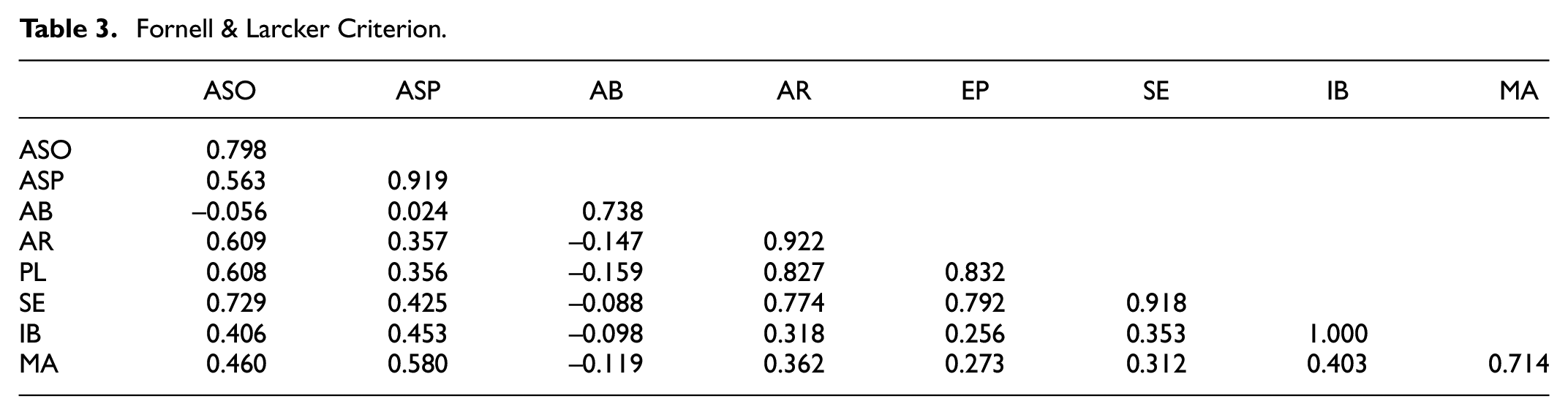
VIF test revealed no multicollinearity issues. In worst cases, the VIF values were less than 5 (Hair et al., 2010). Two criteria were used to establish discriminant validity. The first criterion was the Fornell-Lacker criterion. To meet this criterion, the square root of the AVE of a latent construct must be greater than the correlation between the construct and any other construct. Looking at the results of Table 3 and we can see that this criterion was satisfied. The second was the HTMT criterion. To meet this criterion, the HTMT value should be less than 0.90. The results in Table 4 show that this criterion was satisfied. Therefore, the discriminant validity of the model was established.
Fornell & Larcker Criterion.
Heterotrait-Monotrait Ratio (HTMT).

Hypotheses Testing
We used SmartPLS to test the research hypotheses. Table 5 presents the path coefficients and their statistical significance. Table 6 reports the R2 values, which indicate the predictive ability of independent variables.
Model Testing.

R 2 Values.

H1a postulates a direct impact of music affinity on the store environment. Findings show that music affinity has an impact on Store Environment (β = .312, p = .000). Hence, H1a is supported. H2 proposes music affinity directly impacts the appraisal of store offerings. Looking at Table 5, we can see that music affinity impacts the appraisal of store offerings (β = .460, p = .000). Hence H2 is supported. H3 postulates that the store environment directly impacts consumer’s arousal and pleasure. Results show that store environment directly impacts consumer’s arousal (β = .709, p = .000) and pleasure (β = .173, p = .000). Hence, H3 is supported. H4 proposes that the appraisal of store offerings directly impacts consumer’s arousal and pleasure. Results show that the appraisal of store offerings does not directly impact consumer’s arousal (β = .0305, p = .580) and pleasure (β = .032, p = .423). Hence, H4 is not supported. H5 postulates a direct impact of consumer’s emotional arousal on emotional pleasure. Results show that consumer’s emotional arousal directly impacts consumer’s emotional pleasure (β = .805, p = .000). Hence, H5 is supported. H6 postulates a direct impact of music affinity on consumer’s emotional arousal. Findings show that music affinity has a direct impact on consumer’s emotional arousal (β = .125, p = .017). Hence, H6 is supported. H7 postulates a direct impact of music affinity on consumer’s emotional pleasure. Looking at Table 5 we can see that music affinity directly impacts consumer’s emotional pleasure (β = −.088, p = .002). Music affinity decreases consumer’s emotional pleasure. Hence, H7 is supported. H8 proposes that consumer’s emotional pleasure directly influences the consumer’s approach behavior. Results show that consumer’s emotional pleasure does not directly impact consumer’s approach behavior (β = −.0159, p = .155). Hence, H8 is not supported. Results show that consumer’s emotional pleasure directly influences consumer’s impulse buying behavior (β = .256, p = .000). Hence, H9 is supported. Store Environment directly impacts the consumer’s appraisal of sales personnel (β = .270, p = .000). Hence, H10 is supported. Music affinity directly impacts the consumer’s appraisal of sales personnel (β = .496, p = .000). Hence, H11 is supported.
Mediating Effect of Customer Emotional Arousal
H1b postulates consumer’s arousal acts as a mediator variable in the relationship between music affinity and the consumer’s pleasure. Findings show that music affinity influences consumer’s arousal (β = .125, p = .017) and pleasure (β = −.088, p = .002). Arousal significantly increases pleasure (β = .805, p = .000). The total indirect effect for relationship music affinity consumer’s pleasure was significant (original sample (O) = .360, t-Statistics = .369, p-value = .000). Using the mediation criterion of Zhao et al. (2010), we can say that a consumer’s arousal partially mediates the relationship between music affinity and the consumer’s pleasure. Hence, H1b is supported.
Moderating Effect of Gender
In this study, it is hypothesized that gender moderates the influence of music affinity. To assess the moderating role of gender, we compared our conceptual model by dividing it into two sub-samples, that is, female and male. For this comparison, we ran a multi-group analysis using SmartPLS software (see Table 7) and compared the coefficients of the corresponding structural paths for the two sub-samples. The results show that the female model’s path coefficient from music affinity to the appraisal of store offerings (female path coefficient = .513, male path coefficient = .443, p-value = .000) are significantly stronger than the male model. Hence, hypothesis 12-a is supported. The path coefficient from music affinity to the appraisal of sales personnel (female path coefficient = .553, male path coefficient = .479, p-value = .000) of the female model is significantly stronger than the male model. Hence, hypothesis 12-b is supported. The path coefficient from emotional pleasure to impulse buying (female path coefficient = .190, male path coefficient = .308) is significant only for the male model. Hence, hypothesis 12-c is partially supported. The path coefficient from emotional pleasure to approach behavior (female path coefficient = −.203, male path coefficient = −.162) was insignificant for either the male or female model. Hence, hypothesis 12-d is partially supported.
Path Coefficients: Multi-group Analysis.

Discussion of Results, Conclusion, and Theoretical Implications
The results of this study show that music affinity positively and significantly influences consumer’s arousal in a shopping mall/Super Store context. However, music affinity also leads to lower consumer’s emotional pleasure. It seems the music affinity does help arouse consumers but fails to make them calm and relaxed. This result contradicts the findings of Ryu and Jang’s (2008) but is in line with the findings of Vida et al. (2007). Ryu and Jang found that arousal had a positive link with pleasure. This contradiction can be explained by the orientation of customer motivation as described by Kaltcheva and Weitz (2006). According to them, the orientation of customer motivation affects how arousal impacts customer pleasure. There are two orientations of customer motivations, namely task orientation and recreational. Customers with task motivation tend to finish shopping with minimum hassle. Customers with recreational motivation look for intrinsic satisfaction when shopping. Their results showed that for consumers having task motivation, arousal negatively influences pleasure. However, for consumers having recreational motivation, arousal positively influences pleasure. The results show that consumers in this study probably have task motivation and trying to complete their shopping in a minimum amount of time. The insignificant relationship between store offering and consumer’s arousal and pleasure reinforces this inference.
According to the approach-avoidance model, consumer’s pleasure and arousal act as mediators in the impact of environmental stimulus on consumer’s emotional responses and behavior (Mehrabian & Russell, 1974). The insignificant direct impact of emotional pleasure on approach behavior shows that our results are consistent with the findings of this model. However, music affinity affects pleasure through arousal. The store environment also directly and positively influences consumer’s appraisal of sales personnel. Previous studies about music affinity have found similar findings (e.g., Beer & Greitemeyer, 2019; Dube & Morin, 2001; Morin et al., 2007). As expected, high emotional pleasure directly increases consumer’s impulse buying behavior. This study found no direct influence of music affinity on impulse buying behavior. This finding is consistent with the M-R model. This model proposes that the consumer’s evaluative judgment acts as a mediator in the relationship between the consumer’s pleasure/displeasure with music affinity and the consumer’s approach/avoidance response. The findings of this study show that ambient music generates positive feelings in consumers. Our findings also suggest that gender significantly moderates how music affinity affects consumer’s appraisal of store offerings and sales personnel. Gender also plays an important moderating role in the way emotionally pleased consumer exhibit impulse buying behavior and approach behavior.
Theoretical Implications
Previous research has applied the Mehrabian and Russell model to examine the role of environmental stimuli in creating emotions and consumer behaviors. However, a limited number of studies have specifically explored the effects of ambient music on consumers’ emotions and behaviors. More specifically, this article examines the impact of ambient music (music affinity) on consumer attitudes and behavioral responses in retail set up of an emerging economy. This study has several theoretical implications by making up for this research gap.
First, consistent with past research (e.g., Jang & Namkung, 2009; Mattila & Wirtz, 2001), our findings show that adding pleasant environmental cues (such as ambient music) enhances the shopping experience. Second, this study considers additional constructs (i.e., Appraisal of Store Offerings, Appraisal of Sales Personnel) and atmospheric stimuli (i.e., ambient music) to create a more comprehensive evaluation. This study empirically examined the different effects of each stimulus on emotions and behavioral intentions in a retail consumption context. Therefore, the present study provides an extended Mehrabian–Russell Model. Third, this study examines how emotional arousal mediates between ambient music and emotional pleasure. The results empirically support that emotions have a stronger positive indirect effect than the direct effect from ambient music on consumer’s behavioral intentions. Fourth, the results show that not all the proposed relationships are supported. By embracing diverse stimuli in retail settings, this empirical evidence could establish the important link among ambient music, appraisal of sales personnel, store environment, appraisal of store offerings, emotional arousal, emotional pleasure, and behavioral intentions rooted in the Mehrabian-Russell Model (Mehrabian & Russell, 1974). Fifth, the results show the moderating effect of gender in the relationship between ambient music and appraisal of store offerings/sales personal. The moderating effect of gender in the relationship between consumer’s emotional pleasure and consumer’s impulse buying behavior was partial. The moderating effect of gender in the relationship between consumer’s emotional pleasure and approach behavior was partial as well.
Managerial Implications
One of the most important implications of this study is the impact of music affinity on the store environment. Retailers must pay close attention to ambient music in their stores. A higher level of music affinity does help increase consumer’s arousal, but at the same time, it can lower the level of consumer’s pleasure. Consumer’s motivation orientation is also important to make the consumer feel relaxed and calm. Consumers pleased with the shopping environment tend to exhibit impulse buying behavior. As such, retailers can use music affinity to increase their sales. It is also vital that the music selection be carried out keeping in view the consumer’s motivational orientation. That way it will be easier for retailers to induce impulse buying behavior among customers. Another important implication is the role of gender. It appears that music affinity has a stronger impact on female consumer’s subjective evaluation of store offerings, subjective evaluation of sales personnel, pleasure, and impulse buying behavior. Therefore, the design of the retail environment should carefully consider gender preferences when choosing in-store music as an environmental stimulus to induce consumer’s impulse buying behavior.
Limitations and Areas of Future Research
The first limitation of this study was that the research was conducted in a single city. Future studies could replicate this study to generalize the results. This study did not use music characteristics (e.g., tempo and liking) as control variables. However, previous studies found the influence of these variables on customer’s emotional responses and behavior. As such, future replications of this study can also consider using these control variables. Future studies can also replicate this research model in other retail settings. Future studies may also use the conceptual model of this study to investigate how a consumer’s appraisal of sales personnel influences a consumer’s behavioral response in a service organization. This is important given that performance of sales personnel in a service context is a prerequisite to gain a competitive advantage.
Footnotes
Declaration of Conflicting Interests
The author declared no potential conflicts of interest with respect to the research, authorship, and/or publication of this article.
Funding
The author received no financial support for the research, authorship, and/or publication of this article.

Data Availability Statement
Data sharing not applicable to this article as no datasets were generated or analyzed during the current study.