




Abstract
Art brings rich, pleasurable experiences to our daily lives. However, many theories of art and aesthetics focus on specific strong experiences—in the contexts of museums, galleries, and concert halls and the aesthetic perception of canonized arts—disregarding the impact of daily experiences. Furthermore, pleasure is often treated as a simplistic concept of merely positive affective character, yet recent psychological research has revealed the experience of pleasure is far more complicated. This study explored the nature of pleasure evoked by everyday aesthetic objects. A mixture of statistical and qualitative methods was applied in the analysis of the data collected through a semi-structured online survey (N = 464). The result asserts the experience of emotional ambivalence occurred and was composed of a variety of nuanced emotions and related association, rather than just a combination of contradicting emotions. Such paradoxical pleasure is defined as a self-conscious hedonic exposure to negative emotions in art reception. The study also depicted four types of attitudinal ambivalence: loss, diversity, socio-ideology, and distance, reflecting contextual elements intertwined into experience, and the connection between ambivalence and intense emotional experience.
Introduction
Pleasure appears to be something people tend to seek from the variety of sources by which they are surrounded. In common language, the term “pleasure” is typically used as a somewhat simplistic concept, typically referring to a response that is characterized by a positively valenced affective state. However, when experiences are related to personally significant artifacts, whether they are music, images, or architectural spaces, there are indications that the experience of pleasure is more complicated, including conflicting emotional content (e.g., Hanich, Wagner, Shah, Jacobsen, & Menninghaus, 2014; Juslin, Liljeström, Västfjäll, Barradas, & Silva, 2008; Kawakami, Furukawa, Katahira, & Okanoya, 2013; Maksimainen & Saarikallio, 2015; Taruffi & Koelsch, 2014; Vuoskoski & Eerola, 2012). In aesthetics and the philosophy of art, the discussion of conflicting emotions induced by the experience of art derives from the Aristotelian theory of tragedy (Aristotle, 1967). Individuals do not necessarily avoid experiencing art that deals with negative emotions, such as violence, aggression, or sadness. Instead, such art may be experienced as rewarding. In this article, we refer to such complex, mixed, or even contradictory emotional content in art experience as emotional ambivalence.
The complexity of art experience has recently been approached using the concept of Semantic Instability (Muth & Carbon, 2016; Muth, Hesslinger, & Carbon, 2018). Muth and Carbon (2016) argue that art has the capacity to afford a variety of potential meanings and this is appealing, because it offers opportunity for rewarding insights. Muth et al. (2018) empirically studied experiences of artworks and identified four clusters of Semantic Instability: integrative blend, multistability, indeterminacy, and contrast to perceptual habits. These categories have some explanatory potential also for better understanding emotional ambivalence of art experiences, yet the concept of Semantic Instability has been developed first and foremost in the context of perceptual processing of art. In contrast, our focus in this article is more specifically in the emotional experience of art.
The conflicting, mixed, and ambivalent emotions elicited by art objects have been a widely debated topic in emotion research, music psychology, and in art research and aesthetics (e.g., Gombrich, 1966/1982; Fontaine, Scherer, & Soriano, 2013; Garrido & Schubert, 2011; J. Goldstein, 1999; T. R. Goldstein, 2009; Hanich et al., 2014; Kawakami et al., 2013; Silvia & Brown, 2007), and the occurrence of negative emotions are recognized to have a central role in art reception. Besides providing pleasure, movies, plays, music, and visual arts can, for example, elicit feelings of sadness. Such intertwining of negative with positive emotions in also part of the essence of contemporary entertainment, media content, and of a variety of cultural artifacts in daily life. We argue that such emotional experience, often called the paradox of art (Hume, 1739/1985), is not limited to fine arts, or particular art forms, but applies a broad range of daily art objects, from music and pictures to a variety of visual, written, or played cultural artifacts. Paradoxical pleasure can be evoked by a painting of a violent scene, but such aesthetic emotions can also appear in the context of noncanonical art (e.g., Konecni, 2005), such as the view of a dramatic landscape; these emotions appear in a qualitative account of categories of ambiguity in art (Muth, Hesslinger, & Carbon, 2015). In this study, the term art is used in a broad sense referring to such variety. We place our interest in this article specifically in the mundane, everyday experiences of art, and we therefore focus on objects that are integrally present as part of the daily life of individuals: daily music listening and a range of everyday visual objects.
In music psychology, the past research has either focused on the concept of beauty (Istok et al., 2009; Juslin, 2013) or preferences for stimuli with different properties (Berlyne, 1971; Huron, 2001), music genres (Rentfrow, Goldberg, & Levitin, 2011), or the different emotions perceived in and evoked by music (Eerola & Vuoskoski, 2012), but pleasure as a complex mixture of differently nuanced emotional contents has not received dedicated attention. It is unclear whether the existing frameworks such as valence, preference, or emotion labels (basic or high-dimensional ones such as the GEMS models by Zentner, Grandjean, & Schere, 2008) would be sufficient to capture these conceivably nuanced, ambivalent experiences. Next, we discuss the inadequacies of the existing frameworks in more detail.
Current Perspectives to Complex Emotions in Art
Exposure to artwork is typically presumed to be driven by hedonic expectations and followed by actual reward (e.g., Arnold, 1960; Berenbaum, 2002; Dubé & Le Bel, 2003), especially when scrutinized through an empirical aesthetics perspective. Pleasurable experience, or more generally, positive affect, is known to support approach behavior, whereas negative affect results in avoidance or defensive responses (Norris, Gollan, Berntson, & Cacioppo, 2010). What constitutes the paradox is a self-conscious hedonic exposure to negative emotions in art reception. In this article, we further presume that such paradoxical experiences include more nuanced emotion combinations and associations than just contradicting emotions.
The relationship between the sensory characteristics of an object and the conflicting emotions they elicit has been a widely debated topic in emotion research, music psychology, and art research. Music psychology has been particularly interested in the paradox of pleasurable sadness (Eerola, Vuoskoski, Peltola, Putkinen, & Schäfer, 2018; Huron, 2011) where a radical difference between the emotion expressed by the object (sad music) and the emotion experienced (e.g., pleasure) is often reported. Hunter, Schellenberg, and Schimmack (2010), for instance, observed that the perceptions of emotions in music mediate the impact of musical features on the emotions that arise in the listeners. Furthermore, Weth, Raab, and Carbon (2015) showed, using an automated analysis of facial expressions, that self-selected music evoked more mixed emotions in listeners than experimenter-selected music. These results demonstrate that perceptual and meaning-making processes are likely to play a significant role in understanding the ambivalence of emotional experiences of art.
In general psychology, there are three theoretical positions regarding contradicting emotions: (a) conceptual unidimensionality of pleasure and displeasure, (b) summation of pleasure and displeasure, and (c) conditional co-occurrence of pleasure and displeasure (e.g., Berrios, Totterdell, & Kellett, 2015; Russell, 1980; Schimmack, 2001, 2005). Beebe-Center (1932) was a proponent of the conceptual unidimensionality position, arguing that pleasure and displeasure are merely opposite semantic labels that depict different quantities of a particular quality of a given emotion—its hedonic tone (cf. Barrett, 2005). In this dimension, from extreme unpleasantness to extreme pleasure, there are quantitative differences in strength of hedonic quality, but no qualitative differences. Consequently, the center of the dimension does not represent indifference but a moderate quantity of hedonic quality. The position of conceptual unidimensionality denies the possibility of mixed, contradicting feelings on the grounds that there are not two separate emotional entities to begin with. By definition, according to this view, pleasure and displeasure occupy different positions along a continuum. Therefore, it is semantically inaccurate to say that one feels pleasure and displeasure concurrently.
In contrast to this approach, Bain (1859) argued for an affect summation model (also Reisenzein, 1992, 2000; Wundt, 1897) that conceptualizes pleasure and displeasure as separate feelings. Within this view, the center of the dimension represents qualitatively distinct state in which neither pleasure nor displeasure is being experienced. The model still rejects the possibility of ambivalent emotions due to the presence of one affect excluding the opposite affect from experience. For this reason, it is possible to represent the two different qualities along a single dimension. When pleasant and unpleasant stimuli are simultaneous, each stimulus will serve to neutralize the other to the degree that they are matched in intensity (Bain, 1859; Reisenzein, 1992). According to the model, the intensity of displeasure is subtracted from the intensity of pleasure; therefore, result is a positive (pleasure), a negative (displeasure), or zero value (indifference).
Unlike the previous models, the conditional co-occurrence model allows for the experience of ambivalent emotions. Conditionality refers to the occurrence of ambivalence only under certain circumstances. The model’s basic assumption is depicted by Hume (1739/1985) who noted that, it sometimes happens, that both the passions exist successively, and by short intervals; sometimes, that they destroy each other, and neither of them takes place; and sometimes that both of them remain united in the mind. It may, therefore be ask’d, by what theory we can explain these variations, and to what general principle we can reduce them. (p. 488)
When the same event has positive and negative aspects, the affective reactions neutralize each other. In other words, Hume (1739/1985) proposed the affect summation model with regard to affects that are elicited by the same object (also Reisenzein, 1992).
There have been several approaches dealing with contradicting, or mixed emotions (e.g., Hunter et al., 2010; Russell, 2017). However, focusing on altering positive and negative emotions has been deemed insufficient to explain the rich emotional blends in the context of arts (Menninghaus et al., 2017). Similarly, we assume that the emotional experiences that occur in the context of daily encounters with art will require a different approach than the one offered by mixed emotions models. Here, with the term ambivalence, we aim to discern whether the emotion induced by experiences with art could be more than the sum of its parts.
Rationale
As discussed above, all terms in the past literature make strong assumptions about the nature of experience. Here, we take the term emotional ambivalence as the conceptual frame for our exploration and aim toward a better conceptualization of the contents of this experience in the context of everyday art engagement. In particular, we focus on the following:
(a) Elaborating the contradictory emotional contents of emotionally ambivalent experiences. The notion that art factually involves individual in negative emotions have been rejected by some authors. It is suggested that the respondents may only erroneously report expected negative emotions in response to an art object with negative emotional implications, but not actually experience those emotions, because the exposure to art is essentially distinct from everyday contexts (Krämer & Witschel, 2010). However, research regarding sad music (Lundqvist, Carlsson, Hilmersson, & Juslin, 2009; Vuoskoski & Eerola, 2012), as well as affectively negative pictures (Gerger, Leder, & Kremer, 2014; Wagner, Menninghaus, Hanich, & Jacobsen, 2014), has provided evidence of physiological responses of the autonomic nervous system (ANS) corresponding to the expected patterns for episodes of the reciprocal negative emotions. This study presumes that pleasure is not only associated with negative emotions, negative emotions may be part of the intended experience, as they may lead to higher intensity. Based on the evidence provided by previous studies, it is expected that negative emotions are not just represented by an art object, but actually felt by the individuals, at least to some extent (cf. Juslin, 2013). Within this presumption, the specific interest of this study is in the conceptualizations of contradicting emotions, and how such contradicting emotions are combined in respondents’ interpretations of their experience. Is the experience merely compounded by opposing feelings or do these conceptualizations reveal something more about emotional complexity of pleasure?
(b) Defining the respondents’ stance toward an art object. In the exploration of conflicting emotional experience, ambivalent attitude is used as a conceptual tool to approach the possible common denominators defining—or how the respondents define—their position toward an art object. Research on ambivalent attitudes (e.g., Bell & Esses, 2002; Cacioppo & Berntson, 1994; Kaplan, 1972; Priester & Petty, 1996, 2001) has shown that such attitudes are distinct from ambivalent emotions in several ways. They might, for example, be the result of conflict between the cognitive, affective, or behavioral components of attitudes, whereas ambivalent emotions focus exclusively on the possibility of conflicting affects; the cognitive and behavioral components of attitudes remain irrelevant. As attitudes are more temporally stable than emotions, ambivalent attitudes might produce opposing affective reactions at different times, but not at the same time, whereas ambivalent emotions are defined as emergence of emotional experience with concurrently opposite valence (Cacioppo & Berntson, 1994; Cunningham, Raye, & Johnson, 2004). Despite these differences, attitudes and emotions are closely related, and research on emotions can contribute to the understanding of the affective component in ambivalent attitudes and vice versa. Ambivalent attitude is here expected to hold a prominent role in defining the conceptualizations of emotional experience evoked by an art object.
(c) Exploring emotional intensity, including aesthetic and bodily experiences, in the context of emotionally ambivalent experiences. Due to the presumption that the ambivalent attitudes may serve as mediators conveying negative emotions into positive experience, even intensifying such experience, this study explores whether experiencing contradicting emotions relates to higher intensity of experience. There is indeed evidence that interest, pleasure, or powerfulness of affect, that here is linked to the intensity of experience, may be influenced positively by contradicting emotions (e.g., Muth, Hesslinger, & Carbon, 2015; Turner & Silvia, 2006). Intensity is defined by the strength of the variables emotional response, pleasure, aesthetic experience, and bodily experience (see Appendix B). Previous studies on highly intense emotional responses to art associate the phenomena with chills and goose bumps (e.g., Benedek & Kaernbach, 2011; Blood & Zatorre, 2001; Rickard, 2004; Salimpoor, Benovoy, Larcher, Dagher, & Zatorre, 2011; Salimpoor, Benovoy, Longo, Cooperstock, & Zatorre, 2009). Activation of these physical reactions, for example, when listening to music, was reported to occur with increased electrodermal activity, indicating emotional arousal of the ANS and primary reward network (Blood & Zatorre, 2001; Salimpoor et al., 2011). Yet it seems, according to recent research that, in art, reception chills and goose bumps are not just peak responses, but physiological indicators of being emotionally moved (Benedek & Kaernbach, 2011; Wassiliwizky, Wagner, Jacobsen, & Menninghaus, 2015), which may, as an emotional state, involve a variety of positive and negative emotional components (Menninghaus et al., 2015). High levels of aesthetic enjoyment are similarly associated with artworks eliciting negative affect (Blood & Zatorre, 2001; Sumpf, Jentschke, & Koelsch, 2015).
The observations summarized above suggest that negative emotions can function as a resource on which the experience of pleasure relies, even acting as mediators for intensifying emotional involvement. Therefore, in this study, we expect that those reporting emotional contradiction would show higher scores than those who do not report emotional contradiction for variables indicating intensity of the art experience. This intensity may be reflected particularly as bodily experience or as aesthetic experience. As no systematic comparison between the more embodied versus more conceptual (aesthetic) levels of experience in relation to emotional ambivalence has been executed to date, we will also explore the presence of these levels of experience.
Method
To provide a sufficiently comprehensive account of the characteristic features of the paradoxical nature of daily art-induced pleasure, a mixed-methods design was utilized. Data consisted of self-reports about affective experiences related either to musical or visual objects, with the basic paradigm of the study being the assumption that an emotional experience is a result of an individual’s interpretations of their emotions as particular feelings. Such interpretations are intertwined into subjective narratives of one’s experience and are further impacted by socioculturally shared conceptualizations of these emotional experiences. In this study, these conceptualizations were approached qualitatively following the principles of conventional and summative content analysis, complemented with statistical analyses of Likert-type questions.
Data Collection
Data collection was conducted as a semi-structured online questionnaire. The questionnaire was delivered to potential participants through social media networks, and mailing lists at the University, and other higher or tertiary educational institutions. Volunteering participants answered the questions online using as much time as they needed. The answers were kept confidential and anonymous, and the participants were not given any incentives regarding the preferred choices of content of the musical or visual objects. For the analyses, and reporting of the results, the questionnaire was translated from Finnish to English using back-translation.
Participants
A total of 464 participants took part in the study, with ages ranging from 18 to 82 years (M = 39.9 years, SD = 13.8 years). The sample was predominantly female (78.9%; 19.2% male; 1.9% Other). Majority of the sample was highly educated, reporting a university graduate degree as their highest level of education (14.4% High school examination; 8.6% Polytechnic; 10.8% Bachelor’s degree; 39.9% Master’s degree; 19.6% PhD or doctorate).
Procedure and Measures
Respondents were instructed to select one musical or visual object they considered to induce pleasure and hold personal significance in their daily life (see Appendix A). The object could be either any musical piece or visual object (a specific object or a visual space). Comparison between the modalities was not an object of this study and was therefore not included in the analyses, but a possibility for selecting different objects was given to reach a data set that would be representative of a wide range of experiences with a variety of material involving both modalities as instances of everyday art experiences.
Object selection was equally divided: in the overall sample, musical stimuli were selected by 49% (N= 228) of respondents and visual by 51% (N = 236) of respondents. Object selection within the group that reported experiences of ambivalence was equivalent to the total sample: visual stimuli were selected by 51% (N = 162) and musical stimuli by 49% (N = 159). Meanwhile, 30% of participants (N = 141) reported absence of ambivalent emotional content (value 1 on the scale). The total mean score for the strength of emotional ambivalence was 3.0 (SD = 1.88). The open-ended question that allowed for a detailed, free description of the ambivalent experience was answered by 192 participants, and is the primary component of the data.
When responding to the survey, participants were instructed to think about their chosen musical or visual object. The questions concerned the experienced emotions and any related emotional contradiction. The participants were presented with an open-ended question to specify and describe freely their experience of conflicting emotions, for cases in which such experience occurred.
To provide further information about the intensity and nature of the experience, participants were also asked to evaluate the strength of pleasure, and the general strength of emotions evoked by the art object, and rate the experience in terms of how strongly it would be characterized as bodily experience (e.g., Blood & Zatorre, 2001; Salimpoor et al., 2009) and how strongly the experience would be characterized as aesthetic (Blood & Zatorre, 2001; Sumpf et al., 2015; see Appendix B). The previous variables were included based on their relevance to pleasure experience as factors of emotion intensity, indicated by previous research (Maksimainen & Saarikallio, 2016). A 7-point Likert-type scale, ranging from 1 = Not at all to 7 = Extremely strong, was used in all self-evaluations.
Analysis Procedure
Data analysis was conducted as a mixed-methods design that was predominately qualitative in nature, to develop a comprehensive understanding of the phenomenon. The analysis consisted of a combination of conventional and summative content analysis approaches (Hsieh & Shannon, 2005), and also utilized statistical comparison. This allowed for the formulation of novel, data-based conceptual categories. Frequencies of the emergent categories were also calculated, to make further interpretations about the content of the phenomenon, following the principles of summative content analysis (Hsieh & Shannon, 2005). A preliminary overview of the data was first conducted to make a grounded decision on how the data would best be comprehended, and it was decided to classify respondents’ descriptions in regard to two main aspects: ambivalent attitudes and emotional content.
For investigating ambivalent attitudes, open responses were categorized based on descriptions depicting a stance, viewpoint, orientation, or feeling about the selected object. This analysis aimed to reveal fundamental predispositions for perceiving the object, that is identifying the underlying approaches or stances that explained the basis from which the constituting ambivalent emotional experience was derived. This classification process resulted in four major categories. After eliminating nonvalid responses (e.g., I don’t know), each participant’s description was placed under one of the four categories. In some cases, a response may have applied to more than one category; in these cases, the response was classified in terms of its most dominant content.
Descriptions were studied through the emotion concepts by which the participants described the experience of ambivalence evoked by their chosen object. Concepts that could be conceived as depicting emotion or emotional state were mentioned 551 times. Among these, 171 different concepts occurred. After combining synonyms and expressions near to each other in terms of their meaning, the total number of concepts was reduced to 142. Previous analyses involving emotion categorization have been noted to contain concepts that tend to have fuzzy boundaries and overlap in many ways (Russell & Lemay, 2000). Among the emotions named in respondents’ descriptions, some terms were found to be almost synonymous, for example, the terms afraid, fear, and scared. Although these terms could be grouped under one main title, such as fright (as used in this study), attention was also paid to the diversity of the terms used, because even minimal variations in meaning can be significant for the users of the terms. To provide an overview of the nature of emotional valence within ambivalent experiences, the emotion concepts were categorized into four groups according to their positive or negative valence, or in some cases, neutrality (positive, negative, positive/negative, neutral). In classifying, the unit of analysis was either a singular word or in few cases, a short expression, for example, (feeling of) getting something done, or (feeling of) limited possibilities of having an influence. Categorization of valence was based on the authors’ interpretation of the concepts that the participants used in their descriptions, taking into account the exact wording of the 142 distinct concepts and expression, and ways that they were used within the broader context of participants’ descriptions.
For the categorization of ambivalent attitudes and emotion concepts, the precategorization and coding were executed by the first author. Precategorization was based on interpretation of the language used in the written responses, through careful consideration of the culturally shared connotative meanings of the terms and expressions. This phase resulted in four major categories emerging for ambivalent attitudes. After the preclassification phase, both authors separately categorized the descriptions into the emergent categories using criteria that were first discussed and mutually agreed upon. For ambivalent attitudes, each description that could clearly be placed under one of the four attitude categories was labeled as such. Out of the 192 descriptions, 133 were designated into one of the categories, and the match for interpretation between the authors was 94%. The 53 responses excluded from categorizations did not include contents depicting information of respondent’s attitude toward the art object. Those were typically a pair of terms (e.g., sadness—comfort, enjoyment—melancholy). A similar procedure was executed for emotion concepts that occurred in descriptions. Each of the 142 distinct concepts was designated for one of the four valence categories. Match for interpretation between the authors was 97%. In regard to the few descriptions for which the interpretations for attitudes and emotion concepts differed between the authors, the most distinctive differences concerned whether some of the terms should be included in the analysis at all. Each unclear case was re-analyzed by the authors together, and after further negotiation, consensus was reached for each item.
The classification of each description under one of the ambivalent attitude categories enabled them to be combined for subsequent statistical analyses, conducted on the data from the questions that were answered with rating scales. The four emergent categories of ambivalent attitudes, created from the qualitative data, were coded into a numeric variable according to the category they were included. We then explored whether the attitude categories differed in terms of how much the experience was perceived as being an aesthetic experience and a bodily experience. Analysis of variance (ANOVA) was conducted separately for aesthetic experience and bodily experience to investigate whether their mean values differed between the ambivalent attitude categories.
Finally, for investigating whether the experiences involving ambivalence in general were perceived as being emotionally more intense than those compounded solely of positive emotions, a comparison between individuals who reported ambivalence and individuals who did not report ambivalence was executed. The groups were compared with each other (t-tests) regarding the variables emotion strength, pleasure strength, bodily experience, and aesthetic experience.
Results
Contradicting Emotions in Pleasurable Experiences
The ratings for the strength of emotional contradiction (Table 1) showed that 70% of participants (N = 323) reported at least some emotional ambivalence as part of the experience of pleasure (through selection of 2-7 on the scale ranging from 1 (not at all) to 7 (extremely strong)). The prevalence of contradicting emotions appears notably more typical than expected due to the indications of previous studies in the context of emotional responses to music, reporting notably lower prevalence of such contradicting emotional experience (cf. 11% in Juslin, Liljeström, Laukka, Västfjäll, & Lundqvist, 2011; 13% in Gabrielsson, 2010). Obviously, these previous studies cannot be directly compared with present one, yet they designate the close interplays of positive and negative emotions, and the role of their concomitant occurrence in integrating negative emotions into altogether pleasurable experience.
Frequencies of Ambivalence Strength.
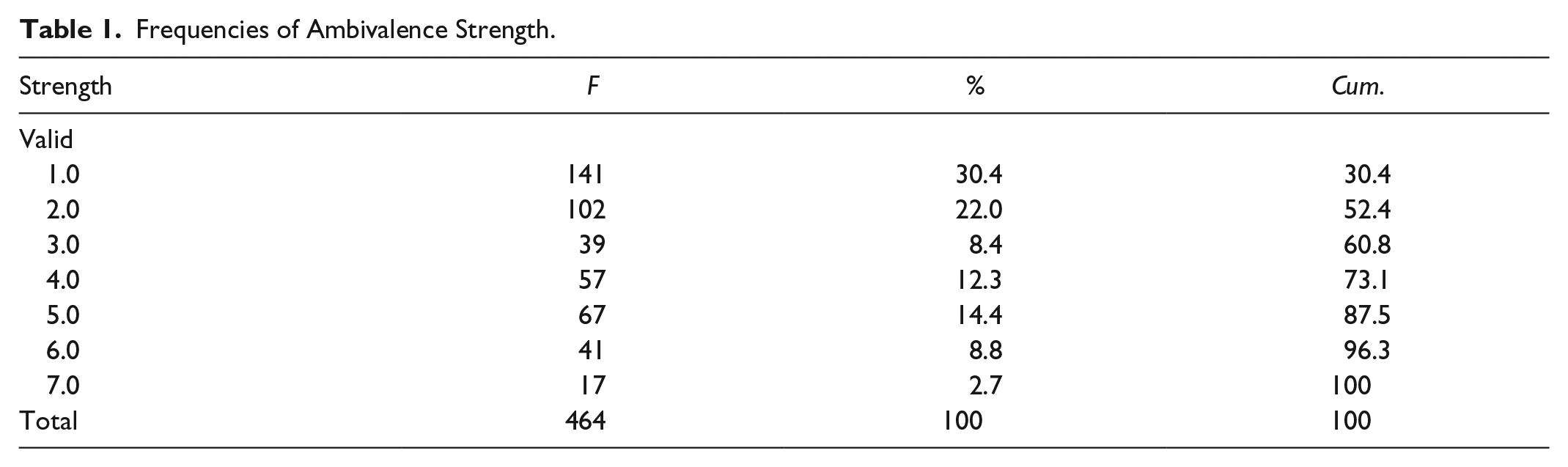
A total of 192 participants provided free description of their experiences of emotional ambivalence. Mean score for strength of emotional ambivalence in this group was 4.54 (SD = 1.50), and the object selection was comparable with the overall sample: visual stimuli were selected by 48.4% (N = 93) and musical stimuli by 51.6% (N = 99).
In regard to the qualitative data analysis, an overall assessment of the respondents’ descriptions was made that the emotional engagement with art objects did not simply focus on emotion concepts. Typically, the descriptions included elements additional to the pleasure experience that could be defined as ambivalent attitudes, referring to a viewpoint, stance, or approach to feeling or thinking about the object (e.g., Bell & Esses, 2002; Priester & Petty, 1996, 2001). Generally, those indicated a certain predisposition to perceiving the object positively or/and negatively. Conflicts in attitudes and their conceptualizations are the object of the next analysis.
Ambivalent Attitudes
The descriptions about contradicting emotions consisted of far more complex contents than contradiction at the level of emotions. Here, we decompose these contents into ambivalent attitude types identified in the respondents’ descriptions that were classified into four categories: loss, diversity, socio-ideology, and distance. Each category represents a particular attitude type: A basis from which the ambivalent experience was derived from the textual descriptions given by the respondents. The attitudes could be defined as underlying conceptual approaches of how the ambivalent experience related to pleasure was constituted in respondents’ interpretations. In addition to emotions contradicting in terms of their valence, the attitudes were observed to be compounded by social, ideological, and/or wider sociological issues as sources of emotional ambivalence, and also of contextual or situational factors: their contents could, for instance, refer to the state of one’s physical environment, or mental state. Descriptions of each attitude category are presented below.
Loss was characterized by the probability of loss being generally negative in terms of valence in its emotional content: It makes me worry about the changes in environment. They can do something that will destroy the landscape. In this song all the good is wished for the growing child, but the narrator knows, one cannot protect the child from all evil. On one hand, there is worry about the future, and on the other there is trust in it, and there is also awareness of mortality and forthcoming losses.
In contrast, diversity was characterized by a positive valence, reflecting a possibility for experiencing a variety of emotions: It makes me think that contradiction keeps one alive. Therefore, I don’t conceive the artwork as positive or negative, or emblem by one particular taste or feeling. Instead, it is a space allowing all kinds of feelings.
Socio-ideology represented both positive and negative emotional content, consisting of the social, societal, and ideological belonging or relations as foundation of the ambivalence: On one hand, there are lots of beauty, benefit, interest, inspiration, etc. material in it. However, it is also compounded of commerciality, and the pictures provided by other users don’t necessarily fit into my own values, or I don’t find them beautiful or inspiring, but useless and time consuming.
Distance represents the distance between one’s ideal state and the state of reality, being dominantly negative in terms of its valence: I’ve been very stressed and depressed. The song is happy and joyful, representing such a way of thinking that I’ve experienced before, and towards which I’m actively pursuing.
Out of the 192 descriptions, 133 could be clearly allocated to one of these attitude categories. The category consisting of the largest amount of descriptions was diversity, with 51 descriptions. Table 2 presents the number of descriptions placed under each category and elaborates the characteristics of each category in terms of its conceptual definition, general emotional valence, the prominent emotional content that frequently occurred in the respondents’ descriptions, and other characteristics.
Ambivalent Attitudes.
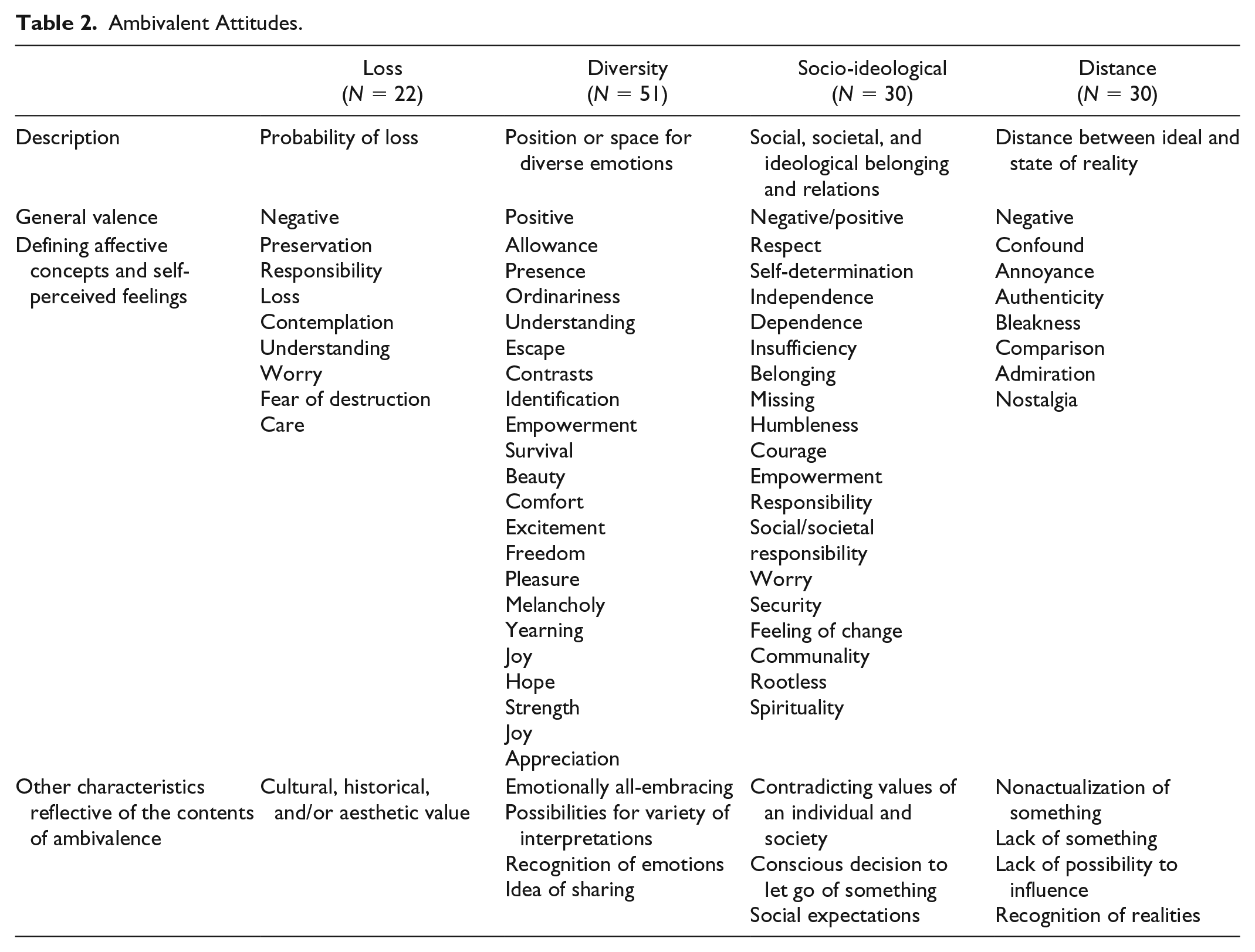
Although the attitude categories were originally created inductively based on the data, they can in retrospect be assessed against the prior theoretical propositions of contradicting emotions. According to respondents’ depictions of their emotions, the emergent ambivalent attitudes seem generally reflective of the concomitant occurrence of emotions (see Hume, 1739/1985; Reisenzein, 1992): emotions with positive and negative valence were often described in the context of anticipatory emotions, such as hope or worry, that typically were experienced concurrently. Such anticipatory aspect refers to events that are not timely coextensive with what they represent, but with an art mediator overcoming such distance, resulting representations of the event that may emphasize particular perceivable features of such (real life or imaginary) event or scenario. The anticipatory aspect seems to connect with the distancing (Trope & Liberman, 2010; Trope, Liberman, & Wakslak, 2007) effect of art that refers to indirect exposure to emotions originally experienced in the event that is, or its certain features, represented in the art object. This distancing effect by anticipatory emotions was observed to be prevalent throughout the attitude types, though, varying in terms of valence. Within diversity, emotions were generally embraced as they occur, whereas loss and distance were distinctively characterized with negative tones. Socio-ideological attitude type settles between, yet being probably the most complex category, in terms of emotional contents.
Aesthetic and Bodily Aspects, and Emotional Strength
Further details about the characteristics of the ambivalent attitudes were investigated through quantitative comparison. Qualitative responses from the 133 participants, whose descriptions were placed into one of the attitude categories were coded into numeric form according to the categories, were included in these analyses. On a scale of 1 to 7, the mean score for strength of emotional ambivalence within the group was 4.54 (SD = 1.50) referring to moderate ambivalence. The object selection was again equivalent to the whole sample with visual stimuli selected by 50.3% (N = 67) and musical stimuli by 49.6% (N = 66).
The ambivalent attitude categories were compared in terms of ratings for strength of aesthetic and bodily experience. Table 3 shows mean ratings within each attitude types for aesthetic and bodily experience. ANOVAs indicated a significant overall group difference of medium effect size between the categories for the bodily experience, F(3, 129) = 3.52, p = .017,
Descriptive Statistics.

To provide descriptive overview of both variables, pairwise comparisons between the categories are presented not only for bodily experience but also for aesthetic experience (Table 4). In regard to aesthetic experience, the score was highest for the category characterized by feelings of loss (N = 22, M = 6.5), which was significantly higher than the lowest-scoring category of socio-ideology (N = 30, M = 5.6). For bodily experience, the highest mean score (M = 5.3) was observed for the attitude category characterized as a space for diverse emotions (N = 51). Bodily experience score for diversity is significantly higher than that for both the attitude characterized by socio-ideological issues (N = 30, M = 4.6) and the attitude characterized by distance (N = 30, M = 4.6).
Multiple Comparisons (LSD) for Ambivalent Attitude in Aesthetic Experience and in Bodily Experience.

Note. Based on observed means. The error term is mean square (error) = 1.689. LSD = least significant difference.
The results suggest that the experience of ambivalence, in the contexts defined as pleasurable per se, seems highly aesthetic in nature. The experience was rated as distinctively aesthetic within all attitude types. The bodily nature of the experience was emphasized particularly within diversity, which is the only attitude type holding distinctly generally positive valence in terms of how emotional ambivalence was conceived (Table 2). Diversity is also unique due to its focus on purely affective components referring to the experience of various emotions, whereas loss, socio-ideological, and distance are more clearly dominated by cognitive components of attitudes, including values or ideals, pertaining to higher level processes in which pleasure is derived from cognitive appraisal. In diversity, ambivalence appears to be an inherently enjoyable experience that reaches both mental and bodily levels, containing variety of emotional contents, not just those reflective of beauty.
Of the total sample, the group not experiencing ambivalence (N = 141) was compared with the group experiencing ambivalence (N = 323) in terms of strength of emotions evoked by the object, strength of pleasure, aesthetic experience, and bodily experience (Table 5).
Comparison Between Groups Not Experiencing Ambivalence (N) and Group Experiencing Ambivalence (Y).

Note. Descriptives for emotion strength, pleasure strength, aesthetic experience, and bodily experience.
Pleasure strength and aesthetic experience were rated to be equally intensive between the groups, but the general strength of emotions evoked by the object was somewhat higher within those experiencing ambivalence, t(46) = −2.84, p = .005, MD = −0.26. There was also a distinctive difference regarding bodily experience: When ambivalence was involved, the bodily experience was more intensive than within the group not experiencing emotional ambivalence, t(437.67) = −2.79, p = .006, MD = −0.44. It seems the concurrence of positive and negative emotions have an effect on particular aspects of the experience, but the differences between the groups remained minor in size.
Emotion Terms
Terms and short expressions that could be considered to depict emotional state or feeling (of something) were mentioned 551 times in the 192 descriptions. Among these, after combining synonyms, and terms highly similar in terms of their meaning (e.g., joy, joyful, and delightful were included into joy; strength, power, and feeling of strength were included into strength; sad, sadness, and sorrow were included into sadness), altogether 142 different terms were found, which is reflective of the great variety of nuances intertwined into ambivalence experience. It is worth noting that not all the terms observed in the data were emotion concepts in a traditional sense. The data included also expressions such as communality, artistic worthlessness, and difficulty to understand. It can be debated whether some of the terms mentioned, such as timelessness or reaching a destination, actually are emotions as such. However, in the context of respondents’ descriptions, they were described as feeling of timelessness and feeling of reaching a destination, and therefore included in the analysis.
The most frequently repeated (N ≥ 9) terms were sadness (occurred 38 times), joy (29), feeling blue (27), calmness (15), sense of beauty (13), happiness (12), fright (12), emotionally touching feeling (12), communality (10), melancholy (9), and empowerment (9), as illustrated below (Figure 1).

Most frequently repeated emotion terms.
The terms could be divided broadly between those reflecting positive (e.g., joy, calmness, happiness, and empowerment) and negative valence (sadness, feeling blue, fright, and melancholy). Overall, the terms with positive valence were illustrative of both energetic and relaxed states, whereas the negative ones tended toward clearly lower arousal states (sadness, feeling blue, and melancholy). It was also observed that only a few participants explicitly mentioned in their descriptions that they were experiencing aesthetic pleasure, even though the results of the statistical analysis showed high intensity of aesthetic experience within all attitude types. This may be explained by aesthetic not being the term people use in their daily language, although respondents tend to interpret the experience as aesthetic when asked explicitly in the questionnaire. Instead, the term beauty was a typically mentioned as a component of the experiences that could be interpreted to depict aesthetic experience. This supports prior research demonstrating beauty as a core concept through which aesthetic responses to music (Istok et al., 2009) and visual arts (e.g., Silvia, 2009; Silvia & Brown, 2007; see also Markovic, 2012) are conceptualized in people’s descriptions. Another term emerging in this study, emotionally touching feeling, also follows the findings of Istok et al. (2009), who showed that beauty was typically combined with touching. This also bears similarity to concept of being moved (Kuehnast, Wagner, Wassiliwizky, Jacobsen, & Menninghaus, 2014; Menninghaus et al., 2015). However, the question remains, does the explicit question actually change the meaning of the experience, and if so, does this happen (a) due to changes in its conceptualization by using the term aesthetic, resulting changes in the way the experience is interpreted, or (b) does the experience itself change using concepts provided from researcher.
Nonetheless, previous notions indicate pleasure evoked by daily art objects are (a) highly aesthetic in nature; (b) occur despite or, possibly, because of ambivalent emotional contents; and yet (c) are not clearly conceptualized as aesthetic, but rather beautiful and touching in respondents’ interpretations. Finally, (feeling of) communality emerged frequently in the descriptions. The term may not refer to emotion in a traditional sense, and its frequency urges us to re-consider the relevance of shared emotions and to approach emotional experience as something that is inherently bound with social experience. As it is widely known that personal significance in music often relates to social connectedness and belonging (e.g., Clayton, 2009; Cross, 2014; Ruud, 1997), it seems obvious such emotional ambivalence of art experiences is linked also to social emotions. Furthermore, emotion regulation might be a motivation to experience especially negative, such as sad contents. One factor that might play a role for listening to sad music is “felt companionship” or the notion of being part of the community in general.
Valence of emotional contents
For elaborating the conceptual relation between pleasure and displeasure, one key focus of the analysis was the valence of the emotion terms. Each emotion term was placed under one of the four valence categories: (a) Positive, (b) Negative, (c) Positive and negative, and (d) Neutral. Evaluations of valence were made by appraising each term as part of the context in which they occurred in respondents’ descriptions. Some of the terms were clearly positively or negatively valenced, such as happiness, joy, worry, or grief. There were also terms and expressions used as positive, neutral, or negative, or similarly referring to both positive and negative. Feeling of social disapproval, for instance, could be conceived inherently both positive and negative. Terms such as yearning, sadness, and nostalgia appeared simultaneously positive and negative in several descriptions. However, yearning, for example, can include elements of missing, longing, worry, tenderness, or enjoyment. Therefore, the broader context of each description was crucial to take into account in defining valence for each term. Table 6 lists the categories for valence, the number of different concepts/expressions included to each of them, and the number of occurrences of any of those concepts within the category.
Valences of Emotion Terms and Their Occurrence in the Data.

Of the total 551 times that the emotional terms were mentioned in the responses, 254 occurrences held positive valence, whereas emotion terms of a negative valence were mentioned 199 times. Terms that were used in the sense of both positive and negative valence taking place simultaneously were mentioned 78 times, and neutral expressions of an emotion or feeling (of something) were mentioned 20 times.
Although the majority of terms were labeled as holding positive valence, the proportion of negative and ambivalent terms is notable. Although respondents mentioned terms that within the context of the description could be interpreted as emotionally neutral, such as confusion and feeling of letting go, these formed only 3.6% of the set of terms. Most of the terms could thus be interpreted to be unambiguous and strong in terms of their valence character. This strength indicates that the relation to the chosen object was experienced intensively, partly reflecting the instruction to select a personally meaningful object. In regard to conceptualizations of positive and negative emotions, their combinations and relations, findings reflect experiences of ambivalence in which a wide range of identifiable, distinct emotions were merged. Although most components the experience were clearly identifiable as either positive or negative, a total of 78 terms were conceived as intrinsically ambivalent, simultaneously holding positive and negative tones.
Other emotion combinations were far less common, and, as described earlier, they often could not be interpreted simply as pairings of particular emotions, but rather as contradictions within a higher level conceptual understanding. Examples of such contradictions included: Understanding of the beauty of world and people is intertwined with melancholy caused by notion that everything will perish. Behind the pleasure and strong feeling of spirituality, there is the undertone of emptiness and existential confusion.
Further examination of the distinct emotion terms and their connections demonstrated that by far the most common contradicting pairing of emotions was sadness-joy. Below are examples of respondents’ interpretations of ambivalence reflective to the combination: Listening to this piece of music as such evokes pleasure and joy, but, at the same time, its’ message evokes feelings of sadness and melancholy. Concurrent feelings of respect and wonder. Feeling of joy regarding the piece, and sadness regarding the issues it represents.
The transfer of sadness into pleasure by an art mediator, intertwined with concurrent emotion, such as joy, together seem to shift the focus from the object to the response of the individual’s own feelings. Sadness may be colored, for instance, by nostalgia (Juslin, 2013; Taruffi & Koelsch, 2014), or by feeling of being moved (Kuehnast et al., 2014), allowing sadness to be combined in characteristically positive, yet ambivalent affective state. Several descriptions of sadness depicted experiences of loss (loved one, personal or societal resource, qualities of humanity, values, nature), or awareness that a certain period of one’s life—whether difficult or happy times—are gone. Sadness associated with tones of nostalgia and being moved stressed the close connection between real life events and art-elicited emotional ambivalence (on contrary to ambivalence based on objects’ perceivable features), similarly eliciting feelings of communality, gratitude, or respect.
Experienced emotions and emotions represented by the object
Results revealed variations regarding respondents’ tendencies to focus on different components of the experience. Some paid attention to the emotional expression of the object, whereas the majority reflected on their own emotional experience, either as an experience itself or with some level of connection to the emotional expression of the object. As identified in prior research (e.g., Gabrielsson, 2002), there is some difficulty in differentiating between the respondents’ descriptions of emotional expression of the object and their own experience. In some cases, responses clearly indicated that the ambivalence was derived from the fact that a certain emotion was depicted in the object but not necessarily experienced by the respondent. For example, if the emotional quality of the object was evaluated as joyful, calm, or sad, these emotions were not necessarily directly experienced. It is possible that the depiction of a particular negative emotion was actually experienced positively, such as in the case of the object serving as a source of relief. Some respondents reported happiness because they no longer were a part of the situation the object represented. For instance, perceived sadness of a song could produce a positive experience, from the notion of one’s own current situation is more positive or satisfying than the situation the song relates, and to memories it associates. The opposite also occurred: Joyful emotions expressed by the object caused experiences of negative valence, if they were associated with a negative memory, such as a reminder of a loss. It seems that, when it comes to aesthetic objects, we often deal with multiple levels of meaning, such as depicted image. Consequently, emotional response might be influenced by the motive (e.g., Christ on a cross), but we don’t actually see Christ on a cross, but artistic portrayal of it that seems crucial also for our aesthetic response (e.g., Wollheim, 1987). An object might represent suffering or music might express sadness, but this does not necessarily make one suffer or sad. Such dichotomy (e.g., Pepperell, 2015) may be relevant when it comes to paradoxical pleasure.
Several respondents experienced the objects as emotionally touching and reported having had intense emotions while listening or looking at them. Some referred to the feeling of their reality, indicating that the object, whether musical or visual, had been able to depict their inner world, allowing for expression of their existential experience: I create myself through the object. The experience is not static, but contextually determined based on my own experiential states and feelings of the time.
A characteristic to many of the descriptions was that the respondents could recognize their own life experiences through the objects. When describing their experiences, some stressed the importance of their feelings becoming recognized by the object they had chosen: Sadness and joy are intertwined. The feelings evoked by the piece may even be painful in their sadness. Yet, the feeling of comfort also becomes evoked when some form (of the object) kind of recognises my feelings, my feelings that I thus imagine to become shared.
These experiences of recognition implicate observation of art functioning as personal, mood-regulatory resource solace, a feeling of becoming comforted and understood when being troubled (cf. Saarikallio & Erkkilä, 2007). Similarly, through recognition, perceived objects allow personal experiences to become symbolically shared through identification with musical, visual, lyrical, or other types of contents that the art object holds. Nonetheless, the participants who experienced anxious, painful, and sad emotions in a positive way tended to consider the presence of these emotions were a positive, natural part of humanity.
The high degree of integration of personal experiences of ambivalence with the emotions perceived in the object follows the notion of simultaneous absorption and dissociation (Garrido & Schubert, 2011), and the positive experiences of negatively valenced artifacts can be seen as a safe way of experiencing negative emotions, distinctive to personal experiences. This study showed that similar to music, visual art objects function as mirrors to reflect one’s current state.
Respondents’ descriptions of their emotions were typically contemplated through reflective and interpretative processes, settling into the discussion of emotion refinement as ability to savor affective states through a reflective distance (Frijda & Sundararajan, 2007; cf. Menninghaus et al., 2017; Trope & Liberman, 2010; Trope et al., 2007). These observations from this study recall the question of whether negative emotions faced in art are separate from negative emotions faced in real life. It has been suggested that art-elicited emotions are conceived as “quasi” or “as if” emotions (Gaut, 2003; Levinson, 1997; Mulligan, 2009; Solomon, 2003). However, in terms of linguistics, such depictions hold a somewhat confusing implication that art-elicited emotions are inauthentic in nature. Moreover, it is not natural for all people to make this distinction (cf. Tan, 2000), and such debate may appear irrelevant beyond the discipline of the philosophy of emotions. Therefore, taking a stance of distinguishing art-elicited emotions from other emotions by means of previous terms is excluded from the scope of this study.
Overall, the study demonstrated that people tend to use art-mediated emotional processing in their everyday lives through very common artifacts. The responses reflected the great variety of ways by which emotional ambivalence is experienced, and the analysis showed the complicated nature of the relationship between the experiencing individual, the art-object, and the context, including a temporal horizon that often spanned from past to the future. The responses also showed a distinction between the emotion expressed by an art object and the individual’s interpretations of this expression in relation to their earlier experiences and current mental state. In the process of art perception, respondents did not only perceive the object but also simultaneously evaluated the related personal meanings (cf. Haviland-Jones & ahlbaugh, 2000) suggesting that the mere emotional experience is almost impossible to disentangle from this broader relational process, which can perhaps be understood more broadly at the level of attitudes.
Conclusion
This study demonstrated a close relationship between ambivalent attitudes and emotions, indicating that emotional ambivalence is a prominent and complex part of the pleasure drawn from the daily engagement with art. The majority of emotion terms in the descriptions of ambivalence were positively valenced (46%), yet a notable proportion of negative (36%) and simultaneously positive and negative (14%) emotion terms were also observed. These findings showed that emotional ambivalence is often composed of strong, distinct emotions with contradicting valence (e.g., joy/happiness combined with sadness/melancholy), but in the respondents’ descriptions, negative emotions tended to be perceived through a positively nuanced, broader reflective understanding of their own emotional processes.
In this study, those reporting conflicting emotions were expected to show higher emotional intensity. The group scored higher values for general emotion strength and bodily experience, indicating slightly higher intensity of art experience compared with the group not reporting the occurrence of emotional contradiction. No difference was observed between the groups regarding the other aspects of the experience, pleasure strength and aesthetic experience, and differences between the groups were not statistically significant. However, the presence of a negative component and its intensifying effect on the emotional experience was observed. Negative emotions seem to have a specific potential to create high intensity of subjective feeling. It may be that negative affective component can, in some cases, strengthen pleasure not only by being a contributor of emotional intensity but also through acting as mediators of pleasure. This may be explained by evidence resulting from psychological research, indicating that several negative emotions hold strong attention-capturing power and high memorability due to this power and emotional intensity (Cacioppo & Gardner, 1999; Frijda, 1988; Larsen & Prizmic, 2008; Vaish, Grossmann, & Woodward, 2008).
Ambivalent attitudes were expected to play a prominent role in defining the conceptualizations of emotional experiences. The role of ambivalence, embedded into these stances, appeared to be that of a mediator, as well as a composition of confronting emotions holding a significant role in defining the contents of emotional experience. The study revealed four types of ambivalent attitudes, loss, diversity, socio-ideology, and distance, depicting the respondents’ stance toward the object. These attitudes reflected a range of social, ideological, and contextual elements that were observed to define the emotional contents of the experience. Ambivalence associated with such stances were attributed a central role highlighting the importance of concurrent relations among interacting emotions or affective states, framing the particular ranges of negative emotions eligible to be adopted for reaching pleasurable experiences. Distinct characteristics of the attitude types were further identified, such as the attitude category diversity, embracing diverse emotions, which was significantly linked to increased levels of bodily experience compared with other attitude categories. Diversity also differed from the other types by its increased proportion of emotional experiences arising from object features, whereas the other attitude types were related more to emotions associated with the represented world (cf. Tan, 2000). A broad differentiation could thus be made between (a) ambivalence as a simultaneous bodily-grounded and object-feature-activated experience of diverse emotional states, generally conceived to be positive, as a space for experiencing multiple affective nuances (diversity) and (b) ambivalence that was distinctively cognitive in nature, characterized by conscious reflection and emotions arising from associations with the external world, and among those, the occurrence of negative emotions was observed in a more prominent role in the interplay of concurrent emotions (loss, socio-ideology, distance). This result implicates the associations being more negative when directed to past, or future. Experiences focussing on the current moments appeared to be more positive in terms of general valence.
There are certain limitations of this study that should be acknowledged. Although it is a regularly observed tendency in samples of Finnish respondents to obtain a greater number of responses from women to voluntary surveys (e.g., Purhonen, Gronow, & Rahkonen, 2009), the sample of participants was biased in terms of gender, age, and education level, thus limiting the generalizability of the findings. Another limitation is the retrospective nature of the data. It is possible that memorizing the experience may be somewhat different from the instant moment of experience, due to memory loss. However, it can also be argued that deliberate concentration on issues that were memorized actually served the purpose of tracking personally significant meanings. When interpreting the results, it must also be taken into account that the pleasure-evoking object of interest was self-selected by each participant, and therefore responses were specific to that particular object and does not represent the respondents’ engagement to musical or visual objects in general. Furthermore, similar research in different cultural environments may achieve somewhat different results in terms of how emotions evoked by art encounters are experienced, conceptualized, and linked to pleasure. Finally, our data consisted of examples from two distinct modalities, which raises the question of similarity/comparability between musical (temporal) and visual (spatial) artifacts, of which the latter further covered a wider range of object types. Different sensory modalities do not necessarily provide the same representation of a particular emotional state (e.g., sadness in music vs. sadness in a still image), and future research could take a comparative approach to elaborate on the possible differences between different types of art objects.
Despite these limitations, this study serves to increase the understanding about the ways art affects us emotionally and cognitively. Findings indicated that there is no simple correspondence between the emotions expressed by an object and those experienced by an individual. Daily experiences of art appeared to function as a means through which to reflect one’s own experiences, and these were further linked to a broader reflection of the intersections of culture and identity, community, resistance, or counter-power and power issues. The connection of art-induced emotions to such self-referential contemplation is in line with prior notions that, for instance, music’s relevance to the quality of life includes a variety of elements from affective awareness to personal agency, belonging, and meaning in life (Ruud, 1997). The idea expressed by several participants that their daily art experiences allow them to recognize and learn something about their own feelings is one of the core justifications for why arts should play a major role in the topical discussion of emotional well-being of individuals. The study highlights the relevance of art in everyday context as a source of strong, meaningful emotional experience.
Footnotes
Appendix A
Appendix B
Questions measuring contradicting emotional experience, aesthetic experience, bodily experience, the strength of pleasure, and general strength emotional experience:
For responding to the questions, the respondents were instructed to utilize the scale ranging from 1 (not at all) to 7 (extremely strongly) in their self-evaluations.
Declaration of Conflicting Interests
The author(s) declared no potential conflicts of interest with respect to the research, authorship, and/or publication of this article.
Funding
The author(s) disclosed receipt of the following financial support for the research, authorship, and/or publication of this article: This work was supported by Kone Foundation (grant no. 331d5b).
