




Abstract
To achieve sustainable development of e-commerce and promote customers’ online shopping conduct, companies develop online shopping platforms to enhance customers’ online shopping behavior. The growing significance of technology in advertising has sparked intense interest in the worlds of education and business to create enjoyable experiences for online clients. Analyzing flow-related states is crucial for generating these experiences. Based on a combined theoretical framework comprising the antecedents of flow, the expectation confirmation model, and the technology acceptance model, this research examines how flow experiences influence the willingness to participate in online purchasing through online shopping platforms, with a focus on Chinese internet users of online shopping platforms. Three hundred internet clients were selected using the convenience sampling technique, and a survey methodology was employed to collect information from internet consumers. Findings from this study suggest that flow had a significant effect on continuous intention, perceived usefulness, and satisfaction. Furthermore, concerning flow’s antecedents, flow was significantly influenced by feedback, perceived enjoyment, and perceived vividness. Moreover, perceived usefulness and perceived ease of use were found to have substantial relationships with satisfaction and continuous intention. This research provides significant implications for research scholars and practitioners.
Plain language summary
This research explores how online shopping platforms can improve the online shopping experience for Chinese internet users. The study focuses on the concept of “flow,” which refers to a state of complete immersion and enjoyment during an activity. The study involved 300 Chinese internet users, and data was collected through a survey. The findings indicate that the flow experience significantly affects users’ intentions to continue shopping online, their perception of usefulness, and their overall satisfaction. In terms of what influences the flow of experience, feedback, enjoyment, and vividness were identified as significant factors. These insights are valuable for both researchers and practitioners in the field of e-commerce, shedding light on the factors that contribute to a positive online shopping experience and suggesting ways to enhance user satisfaction and engagement in the rapidly growing Chinese online market.
Introduction
To achieve sustainable development of e-commerce and promote customers’ online shopping conduct, companies develop online shopping platforms (OSP) to enhance customers’ online shopping behavior (Xiao et al., 2019). The growing importance of technology in advertising has sparked intense interest in the worlds of education and business to create enjoyable experiences for online clients. Analyzing flow-related states is crucial for generating these experiences, as this mental state is quintessential for accomplishing tasks with enjoyment and predicting online consumer behavior. Csikszentmihalyi and Csikzentmihaly (1990) established the idea of flow (FL), defining it as the common sensation people experience when fully immersed in an activity. In electronic enterprises, FL and positive attitudes foster and increase purchase intent, support for online properties, and usage. Thus, the FL state is crucial in e-commerce organizations and should be researched to identify customer behavior and improve interactions between the company and consumers in virtual settings. Online contexts also include elements that promote FL, like their level of communication. In particular, the e-commerce environment enables customers to focus and lose track of time throughout their collaborations, allowing them to enjoy FL activities (Barta et al., 2021).
Research scholars have frequently chosen the methodology typically used in assessing performance in conventional media to identify online behavior, but they have also researched several features most pertinent to online contexts. The notion of FL, the most important of these concepts due to its impact on characterizing virtual experiences, is the one that is most applicable (Novak et al., 2000). People in a FL state are fully engaged in a task, with lower attention levels and a feeling of command over their surroundings. FL experiences have been described in various behaviors, such as chess, rock climbing, dancing, etc. Given the declining numbers of repeat customers, research on critical factors influencing continued use intent is essential for those developing online platform marketing strategies (S. Lee & Kim, 2020). To create commercial value, internet platforms must be sustainably used in corporate operations. Therefore, sustainability concerns can be employed to develop considerations impacting the continued usage of OSPs (Park et al., 2021). This study aims to determine the relationship between FL and customers’ continuous intention (CI) when they use OSP. Thus, the study utilizes antecedents for assessing customer FL experience, such as confirmation (CONF), perceived vividness (PV) (Zhao & Khan, 2021), concentration (CONC), feedback (FB), perceived enjoyment (PE) (Barta et al., 2021; Xu et al., 2021) undergone by consumers when using online purchasing platforms.
Additionally, the expectation confirmation model (ECM) suggests the two crucial elements of CONF (primary-acceptance belief) and perceived usefulness (PU) (post-acceptance belief), which are reciprocally connected to satisfaction (SAT) and CI (Halilovic & Cicic, 2013). Online consumers recognize it as a crucial driver of OSP purchase intentions. The degree to which a specific item or equipment is incredibly beneficial for people to execute activities is referred to as PU, and online consumers would anticipate an increase in OSPs’ PU confirmation (Elwalda et al., 2016). Moreover, a pivotal component influencing the inclination to engage in OSPs is the happiness of online customers. Furthermore, CONF denotes a connection to contentment (Zhao & Khan, 2021). Thus, the current research aims to examine how SAT and PU relate to CONF. Additionally, FL and SAT are characterized as the emotive and analytical assessments of OSP customers, and accordingly, these factors have a substantial link with each other (Foroudi et al., 2018). Furthermore, the extent of FL that customers experience as a result of OSPs has a significant impact on their usage intent concerning the OSP, as well as their PU, reflecting their usage intent for the online platform (Cheng, 2014). Consequently, this study investigates how FL affects SAT and PU.
The trend of customer actions in the online platform has been demonstrated by many theoretical frameworks created by earlier researchers, indicating a conceptual shift in the approach to recognizing recent online consumers’ activities. Several recent types of research, including the platforms’ PU and perceived ease of use (PEOU) for purchasing, show a weak association between flow (FL) and the technology acceptance model (TAM), underscoring the significance of OSPs and the spending habits of online customers. Consequently, it can be concluded that the TAM model and FL theory-based CI of online shopping have received less attention from an online business standpoint. The currently available study takes into account necessary constructs, such as PEOU and PU of technology, to shape customers’ perspectives on innovative technology. These TAM belief aspects primarily influence the awareness and use intent of innovative technical items, including online shopping. Thus, by combining the notion of FL with TAM and examining the FL of shopping online CI, a framework for comprehending why people prefer to use online platforms for buying can be created (Hyun et al., 2021). Hence, this investigation aims to discover the implications related to the effects of PEOU (Tawafak et al., 2018) and PU (Zhao & Khan, 2021) on consumers’ SAT. Also, this study will assess the influences of PEOU and PU when combined with CI (Xu et al., 2021). Additionally, this study will examine how PU affects PEOU (Zhao & Khan, 2021). Finally, this research will assess the effects of CI on SAT.
There are at least four research shortcomings that this study addresses. First, it examines the relationship between online shoppers’ FL experiences and their purchase intent (CI) when using shoe OSPs. Second, it discusses the factors that contribute to or have an impact on how online shoppers interact with shoe industry OSPs. Third, it investigates how the ECM affected this research. Fourth, it explores how the FL experience and the TAM model relate to one another. Finally, it examines how the TAM model relates to customer happiness and CI for online purchases.
Theoretical Background and Hypothesis Development
Flow and Continuous Intention
Prior research indicating the online context as a source of FL can be harnessed to establish the relationship between FL and OSP’s CI, highlighting FL as a crucial framework for explaining individual conduct in an online setting (Xu et al., 2021). Regardless of the specific age group, the primary reason customers opt for OSPs is their ability to enhance customer satisfaction (SAT) by offering better value, leading to the CI of using OSPs (Kwak et al., 2014; Zhao & Khan, 2021). The findings from Lim’s (2014) research reveal a significant correlation between the customer’s CI to purchase and the OSP’s experience with the online FL experience. FL may be attributed to the notable increase in online product purchases (L. Gao & Bai, 2014). While the majority of earlier research emphasizes a strong connection between FL and buying on conventional retail websites, an analysis of OSP’s CI to purchase has also unveiled a robust link between FL and online CI to purchase in studies (Rahman et al., 2020; Xu et al., 2021). Consequently, the subsequent hypothesis is suggested:
H1. Flow positively impacts CI.
Antecedents of Flow
Performance confirmation implies CONF of the actual and expected results of employing web-based platforms (Zhao & Khan, 2021). Integrating this fundamental aspect into the ECM may potentially result in a more comprehensive explanation of the OSP’s CI, even though the ECM provides only minimal support for incorporating the CONF of customers’ intrinsic motivation in using OSPs, which can be a significant factor influencing the customers’ CI (Thong et al., 2006). Users may experience a sensation of FL after using the collaborative tools provided by OSPs to connect with others, as these OSPs may cause them to feel wholly immersed in their activity (M.-C. Lee, 2010). Customers may recognize the value of such an OSP when they are entirely absorbed in their purchasing activity and have had the pleasure of working with it (Cheng, 2014; Saadé & Bahli, 2005).
FB refers to the method of mutual knowledge FL (Xu et al., 2021), defining the information FL between consumers and websites from a web perspective (Huang, 2003). The FB technique is enhanced when the individual feels in control of the individual-technology relationship. It fosters feelings of competence and self-assertion that boost individuality and, consequently, the belief that the individual is capable of handling the work. FB is crucial to the success of online marketing as it allows the formation of FL states (Barta et al., 2021), influencing the level of FL experienced by customers based on the frequency of transparent and clear FB from their actions on OSPs. If online customers receive prompt FB, their FL will increase, but if they don’t, it can decrease and hinder their FL experience. Hence, this situation might lead customers into a state of anxiety because they are not fully aware of the outcomes of their purchasing behaviors (Massimini, 1988; Xu et al., 2021).
The emphasis on a specific stimulus area is referred to as concentration. One of the most well-established factors in the assessment of FL is concentration; the findings suggest that to experience FL, people need to focus on their environments (including the stimuli) (Barta et al., 2021). To consistently experience FL and lose understanding of all additional factors unrelated to their actions, clients should direct all their attention to the source of the stimuli, which is the screen in this case (Barta et al., 2021). Higher concentration is associated with a greater FL, according to certain studies on web-based consumer experience (Novak et al., 2000). It is common for online shopping customers to encounter various product suggestion stimuli while using OSPs. These stimuli can divert customers’ attention while they are engaged in using the OSPs. However, according to the research, individuals with a superior degree of concentration while engaged in an activity are likely to achieve a high degree of FL experience, leading them to pay less attention to these stimuli (Xu et al., 2021).
According to the definition of PE in the context of interactions between people and technology, it refers to how much the user enjoys using the system, disregarding any negative side effects (Davis et al., 1992). PE and CONC serve as reliable predictors of individual behaviors for researchers, as individuals are inclined to engage in an activity or task as long as they perceive or experience enjoyment, as opposed to activities deemed enjoyable (S. M. Lee & Chen, 2010). Furthermore, if an individual is determined to achieve a certain goal, it is expected that the individual should ignore all irrelevant distractions and concentrate on the specific goal (Atombo et al., 2017). Additionally, within the internet framework, PE is characterized as the sensation individuals experience while browsing the internet, considering their areas of interest, accessed content, the medium in use, and their overall sense of contentment (Barta et al., 2021). As a result, it was discovered that FL is significantly correlated with the enjoyment felt during online buying activities (Kim et al., 2013).The potential of technology to create an incredibly potent assisted environment is referred to as PV. It suggests a technique for combining the nonsensual imaginary objects created in a person’s mind with the sensual comprehension of real things that may be seen to create a precise vision of an experience (Barhorst et al., 2021). The vividness and the visual appeal of the OSP are typically associated with an online context (Flavián et al., 2017). When opposed to interaction, PV makes it easier for internet users to picture their future experiences (Phillips et al., 1995). According to research by Rauschnabel et al. (2017), individuals feel a sense of enjoyment while engaged in an online platform. Hence, it can be inferred that customers would enjoy shopping activities while employing OSPs. Furthermore, online customers can feel a sense of uniqueness regarding a certain activity because of the vividness related to that activity (McLean & Wilson, 2019). By examining FL from both an AR and traditional buying standpoint, one study further discovered the significance of PV in online AR technologies (Barhorst et al., 2021).
The following hypotheses can be proposed in light of the literature that has been provided.
H2a. Confirmation positively impacts flow.
H2b. FB positively impacts flow.
H2c. Concentration positively impacts flow.
H2d. PE positively impacts flow.
H2e. PV positively impacts flow.
Flow, PU, and Satisfaction
The theory of FL and the underlying TAM has been attempted to be merged in earlier studies (Hyun et al., 2021). These studies indicate that when individuals are in the zone and believe that investing their time in a particular activity is worthwhile, the cognitive dissonance associated with the use of technology is reduced (Agarwal & Karahanna, 2000). The self-perception theory posits that individuals can rationalize their actions and make an effort to diminish the cognitive dissonance caused by conflicting attitudes, beliefs, or behaviors (Bem, 1972). People who experience cognitive absorption with technology activities derive pleasure and satisfaction while in this state, and their disagreements also decrease when they are in a comfortable and happy state (Purwanto & Ismail, 2020).
If online users engage in a specific enjoyable activity associated with OSPs that provides a significant amount of satisfaction, then the FL experience can be linked to satisfaction (Ali, 2016). Employing a Stimulus-Organism-Response concept to explore the online behavior of clients in a previous study revealed a positive correlation between FL and satisfaction (Zhao & Khan, 2021). Numerous studies have demonstrated a robust connection between FL and happiness when using online platforms. The volume of online consumers is believed to significantly impact satisfaction (L. Wu et al., 2020). Therefore, it is possible to formulate the following hypotheses:
H3. Flow has a significant impact on PU.
H4. Flow has a significant impact on SAT.
ECM
The first acceptance belief that identifies an active impact to boost a customer’s perceived usefulness, also known as the post-acceptance belief connected to using the OSP, is characterized as the performance CONF of OSP (L. Wu et al., 2020). Confirmation associated with the OSPs plays a crucial role in determining customers’ SAT and CI of using the OSP (Bhattacherjee, 2001). In several studies, the ECM has been employed as a theoretical framework to examine how OSPs are utilized, and it has been found that online platform performance CONF significantly influences PU (Tsao, 2013). C.-C. Lu et al.’s (2019) research, specifically on the effects of cell phone advertising on ECM, revealed a favorable and substantial relationship between OSP confirmation and PU.
According to the ECM, there is a considerable link between SAT and CONF (Oliver, 1980). Consequently, it can be asserted that a theoretical connection between both the OSP and customers’ SAT has been established. To analyze CI for usage, the ECM advises establishing a connection between OSP confirmation and consumers’ pleasure (Bhattacherjee, 2001). Specifically, the ECM has been utilized in multiple research studies to examine this connection for different web-based frameworks involving impulsive buying and mobile commerce (C.-C. Lu et al., 2019). Notably, a substantial connection between SAT and CONF was discovered in past research (Hsu & Lin, 2015). Therefore, the following hypothesis can be put forward.
H5. Confirmation positively impacts PU.
H6. Confirmation positively impacts SAT.
TAM, Satisfaction, and Continuous Intention
PU is characterized as a post-acceptance belief in the application of information technology and implies a crucial connection to SAT (L. Wu et al., 2020). Customers’ PU of the OSP, which is based on the ECM, has a significant impact on how satisfied their SAT (Oliver & DeSarbo, 1988). Customers are further motivated to adopt a positive outlook when engaging in online buying because OSPs are perceived as helpful in their cooperation to research and locate information about the services provided (Zhao & Khan, 2021).
ECM is utilized as a fundamental prototype to investigate the hypothesized associations in an OSP’s setting, and it considered reasonable to employ ECM in the online platform’s context (Zhao & Khan, 2021). Similarly, the narrative associated with the acceptance of information technology identifies PU as the most important element in the acceptance of CI of clients (L. Wu et al., 2020). Therefore, the ECM posits that clients’ PU of OSPs has a substantial influence on their CI (Bhattacherjee, 2001).
Additionally, CI and SAT are impacted by the integration of technology with PEOU. The goal of PEOU is for clients to believe that the framework involves no effort and that learning abilities through an OSP are uncomplicated, starting with perceptions (B. Wu & Chen, 2017). PEOU, on the other hand, has a significant influence on SAT. Studies on TAM participants and first acceptance have yielded prior hypotheses, showing that the PEOU between users on websites significantly affects SAT (Joo et al., 2018).
The PEOU of OSP for purchases is predicted in this study to be simple to use, enhancing the pleasure and accessibility whenever customers use the benefits offered by OSP, such as the variety of products, straightforward payment methods, and uncomplicated purchasing procedures. As a result, OSP’s CI is higher (Hyun et al., 2021). Yahia et al.’s (2018) study indicated that there was a strong link between PEOU and CI. Additionally, according to Hansen et al.’s (2018) research, PEOU is crucial when assessing customers’ desire to use OSPs, making it one of the crucial factors that can characterize online buying behavior.
According to Legris et al.’s (2003) study, PEOU and PU have a significant impact on each other. In the OSP context, PEOU is discovered to be a substantial link between PU and customer SAT (Amin et al., 2014). Additionally, PU perceived behavioral control, and PEOU reveal a significant impact on the CI to use social media (Shin & Perdue, 2019). Additionally, PEOU plays a crucial role in determining PU for technological products (X. Chen et al., 2018). The following hypotheses can be proposed in light of the literature that has been provided.
H7a. PU positively impacts SAT.
H7b. PU positively impacts CI.
H7c. PEOU positively impacts SAT.
H7d. PEOU positively impacts CI.
H7e. PEOU positively impacts PU.
Continuous Intention and Satisfaction
Following the ECM, the overall CI of an individual using an OSP is determined by three criteria, comprising the PU, SAT, and CONF. It has been found that online consumers’ SAT strongly influences their CI to use OSPs (Figure 1). As per a marketing study, individual SAT scores are the most influential factor in determining whether they repeat particular actions (M.-C. Lee, 2010; Szymanski & Henard, 2001). Due to the link between SAT and CI among users online, the following study hypothesis is suggested:
H8. CI positively impacts SAT.

Theoretical framework.
Methodology
This research focuses on Chinese internet users of OSPs. Three hundred internet clients were selected using the convenience sampling technique. With the assistance of a market research firm, an online questionnaire was administered. The marketing firm employed the convenience sampling approach to collect information from internet consumers. Online distribution of a closed-ended questionnaire resulted in a response rate of 88.21%, which is generally considered an optimal response rate (MacCallum et al., 1999). Instead of asking participants for approval or acknowledgment of an argument, Likert scale questions assessed how strongly they approved or disapproved of it, typically on a 7-point scale ranging from 1 (= strongly disapprove) to 7 (= strongly agree), with 4 indicating a moderate opinion. The FL experience was evaluated using items derived from Zhao and Khan’s (2021) analysis. The CONF items were derived from Cheng’s (2014) study. The PV and PE questionnaire items were adjusted and used in the research by Barhorst et al.’s (2021) research. In addition, the items used to assess SAT, CI, and PU were taken from Tawafak et al.’s (2018) research. Finally, the concentration, PEOU, and FB were measured using a research analysis by Xu et al. (2021). Before actually initiating the main research questionnaire, a trial was conducted with 50 randomly chosen relevant organizations. This test was utilized to examine and verify the survey questions. This hypothesis of this report was evaluated using a PLS model of structural equations.
Data Analysis
PLS (partial least squares) was used to assess the gathered information. This research is divided into two stages. The accuracy and reliability of the constructs were examined during the initial stage of the research, while the second phase involved identifying the causal orientations and path coefficients of the constructs (Hulland, 1999). PLS has been found to be the most effective method for maintaining proposed relationships and calculating complex study frameworks (Petter et al., 2007). Moreover, user-friendly procedures to estimate the uniformity and unpredictability of constructs are considered to make PLS the most effective method for handling the inconsistent dispersion of constructs. Additionally, PLS can compute variable prediction models (Chin & Newsted, 1999). PLS was deemed superior to other structural equation model (SEM) techniques for executing the data evaluation procedure for the investigation of the study.
Convergent Validity
PLS-SEM is acknowledged as an effective tool for assessing complicated research frameworks (Hair et al., 2014). Table 1 illustrates that the generalized component loadings of every signal vary from .791 to .940, including all readings surpassing the minimal threshold figure of .5, suggesting that every indicator has a high level of validity (Xie et al., 2021). Using rho A, AVE, Cronbach’s alpha, and CR, the evident convergent coherence of the study was examined. Cronbach’s alpha was utilized to verify inner coherence, while rho A and CR were employed to establish reliability. Rho A assessed the questionnaire’s dependability by measuring the weights rather than the loadings (Henseler et al., 2014). Cronbach alpha and rho A (Taber, 2018) must exceed .7 to be considered trustworthy (Ruangkanjanases et al., 2023). As hypothesized, Table 1 indicates that all constructs have Cronbach’s alpha and rho_A levels greater than .7. Furthermore, the CR readings of all elements were greater than .70 (Chin, 1998), demonstrating the instrument’s internal consistency and corresponding with Table 1’s results. While evaluating the composite reliability, the average variance for every construct, which was one of the parameters reported by the AVE, was also factored in. This construct may have strong convergent validity only if its score exceeds .5 (Fornell & Larcker, 1981). Table 1 indicates the AVEs of the hypothetical construct variables range from .742 to .908, indicating a significant degree of convergence.
Construct Reliability and Validity.

Note. CONC = concentration; CONF = confirmation; CI = continuous intention; FB = feedback; FL = flow; PEOU = perceived ease of use; PE = perceived enjoyment; PU = perceived usefulness; PV = perceived vividness; SAT = satisfaction.
Discriminant Validity
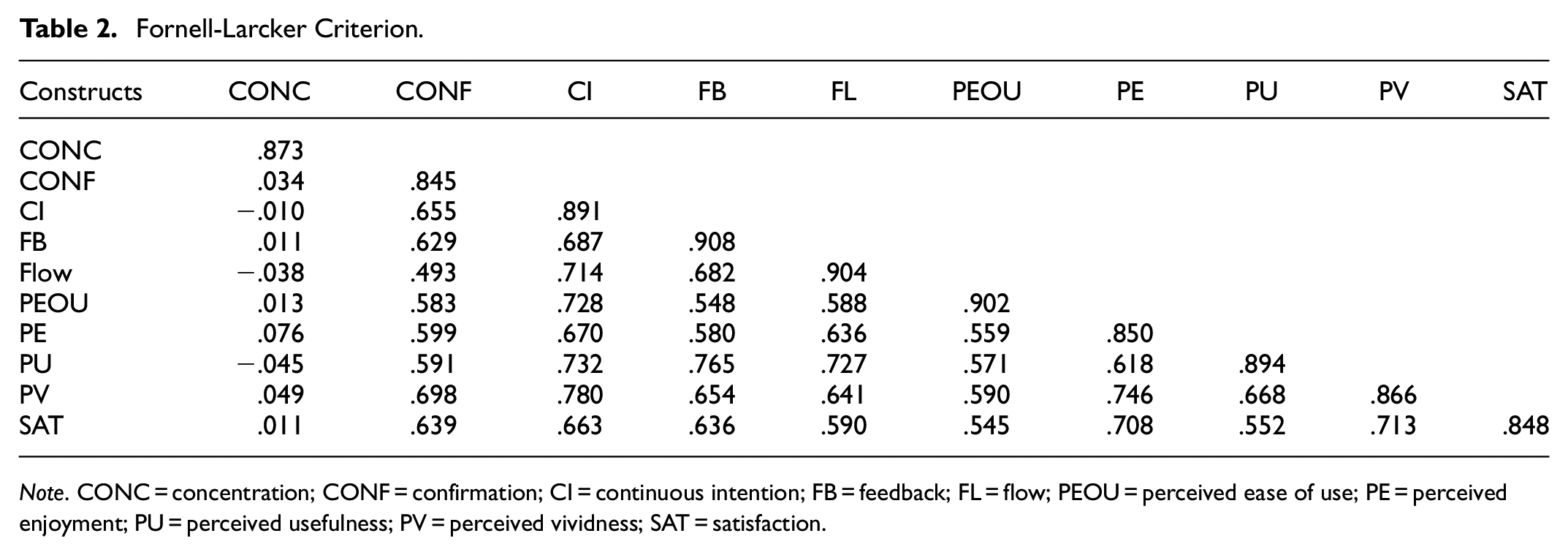
It signifies the level of dissimilarity between two entities. The discriminatory reliability of the study was evaluated utilizing the Fornell and Larcker criteria. This methodology employs the square root of the AVE to identify latent variables (Ab Hamid et al., 2017). Table 2 illustrates that the elements are more effective at characterizing variability than opposing constructs, as their square root of adjusted variance estimates (AVEs) is higher than those of opposing constructs.
Fornell-Larcker Criterion.
Note. CONC = concentration; CONF = confirmation; CI = continuous intention; FB = feedback; FL = flow; PEOU = perceived ease of use; PE = perceived enjoyment; PU = perceived usefulness; PV = perceived vividness; SAT = satisfaction.
Empirical Results
Utilizing Smart PLS, a path evaluation of the assessment of the study framework was performed. The underlying model was generated throughout this stage. Using p-value and t-value, researchers analyzed the hypotheses presented by the underlying model. The hypothesis is validated if the t-value is more than 1.96 and the p-value is less than .05. Furthermore, R2 is employed to express the proportion of predictor constructs, which is then employed to highlight the predictive strength of the research context (C.-C. Chen et al., 2021; A. Khan et al., 2021). Therefore, it is proposed that the R2 number be regarded as significant if it is around .67, considered moderate if it is around .33, and considered low if it is around .19 (Chin, 1998). The empirical results are stated in Table 3 and Figure 2. Data from this study suggest that FL had a significant effect on CI (β = .165, t-value = 2.834), PU (β = .529, t-value = 10.416), and SAT (β = .159, t-value = 2.037). Furthermore, in terms of “FLs” antecedents, FL was significantly impacted by FB (β = .316, t-value = 3.934), PE (β = .343, t-value = 4.183), and, PV (β = .211, t-value = 2.204), whereas, FL was not impacted by CONF (β = .044, t-value = 1.124), and CONC (β = .068, t-value = 0.948). CONF did not have a significant effect on PU (β = .004, t-value = 0.091), and SAT (β = .018, t-value = 0.358). Moreover, PU (β = .264, t-value = 3.078) and PEOU (β = .306, t-value = 4.240) had a significant impact on SAT, whereas PU (β = .328, t-value = 4.361) and PEOU (β = .356, t-value = 5.770) were also found to be in a significant association with CI. In addition, PEOU had a significant relationship with PU (β = .300, t-value = 4.996). Finally, SAT was significantly associated with CI (β = .182, t-value = 2.930).
Empirical Results.

Note. CONC = concentration; CONF = confirmation; CI = continuous intention; FB = feedback; FL = flow; PEOU = perceived ease of use; PE = perceived enjoyment; PU = perceived usefulness; PV = perceived vividness; SAT = satisfaction.

Research results.
Discussion and Conclusions
Drawing on the combined theoretical framework of FL antecedents, ECM, and TAM, this research explores how FL experiences shape the inclination to engage in online purchasing through OSPs. Hence, the results hold significance. The antecedents of FL, such as PV, were found to share a substantial link with the FL. However, CONF did not exhibit a substantial association with the FL. aligning with the findings of a prior investigation by Zhao and Khan (2021). In addition, the outcomes of the antecedents, such as PE and FB, were discovered to have a substantial link with the FL. However, no substantial association was identified between concentration and FL experiences. These outcomes concord with research by Barta et al. (2021), suggesting that PE and FB are more important than concentration in providing an ideal FL experience. Thus, considering these results regarding the antecedents for flow experience, practitioners are encouraged to reflect the significance of PV (Kim et al., 2023) in the OSP’s design. Moreover, the practitioners are recommended to incorporate a swift FB feature (Hongsuchon et al., 2023; Liu & Hwang, 2023) in the OSPs to easily cope with the needs and demands of “OSPs” users. Finally, based on user feedback, practitioners can enhance the PE (Yang, 2023) of OSP users by adding features and functionality to OSPs.
Moreover, the considerable impact of FL on the CI for shopping via OSPs suggests that consumers find the OSP experience interesting and delightful. As consumer FL increases, the expected trend is a more positive CI for OSP sales. These findings align with prior research (C.-H. Chen et al., 2018; Ozkara et al., 2017). Additionally, the results illustrate that FL enhances OSP user acquisition and contentment, consistent with analyses by Xu et al. (2021) and Hyun et al. (2021). The positive effects are exemplified by heightened concentration during purchasing and the enjoyment of interacting with OSPs. FL demonstrates a significant link with the PU of OSPs used for shopping, suggesting that FL diminishes negative perceptions of OSPs and enhances the PU of OSPs for purchasing when consumers experience FL. In light of these findings, practitioners are advised to emphasize the importance of the FL experience in promoting online shopping. Therefore, they are recommended to boost the SAT (Hsu & Lin, 2023) of OSP users, subsequently enhancing users’ behavior and ensuring their CI (B. Gao, 2023) in using OSPs for their shopping needs.
The study’s results indicated robust relationships between FL and ECM characteristics. The impact of FL or ECM on online platforms as a whole has been extensively examined. This research drew conclusions that CONF did not significantly impact PU and SAT, which differs somewhat from earlier studies. In ordinary online platforms, ECM related to the technology aspect or FL experience is typically considered a significant concern (Floh & Madlberger, 2013; Tsao, 2013). Specifically, substantial connections were found between ECM-related variables, such as CONF, and both PU and SAT (Hsu & Lin, 2015; L. Wu et al., 2020).
Additionally, this analysis reveals additional relationships among TAM variables, such as PU and PEOU, and CI and SAT. According to findings of this research, PU and PEOU have a substantial effect on CI. Consistent with other studies (S. Khan & Khan, 2021; Xu et al., 2021; Yahia et al., 2018), the results reveal a robust influence of PU on CI. There is also a significant connection between PEOU and CI, comparable to an earlier study (Hyun et al., 2021). The current results highlight the vital role of TAM variables, including PU and PEOU (K. Lu et al., 2023), in the continued usage of OSPs by users. Hence, practitioners are encouraged to enhance the user-friendliness of OSPs to improve the usage CI of OSP users.
Moreover, as per the findings of the current study, PU and PEOU show a substantial association with SAT. The association between PU and PEOU in terms of SAT can also be contrasted with past studies (Hsu & Lin, 2015; Joo et al., 2018). The significance of PU may indicate that clients believe using OSP for purchasing is advantageous, allowing them to research products and make purchases in the same location. This structure enhances the efficiency of purchases.
Theoretical Implications
The study was grounded in the theoretical foundations related to the theories of FL, ECM, TAM, and the antecedents of FL. This study intended to discover the impacts of FL antecedents via TAM and ECM on the CI of OSP usage by online customers. Consequently, this research aims to provide a unique approach to measuring the FL of customers while using OSPs. Despite the growing market segment of online customers, there is still a lack of theoretical research linking it to FL and the CI of using OSPs (Yang, 2023). The study makes several significant theoretical contributions. Firstly, it enriches FL theory by connecting it to the different antecedents of FL (Ding & Hung, 2021; Xu et al., 2021). Furthermore, the research contributed to FL by linking it theoretically with ECM containing CONF, PU, and SAT of customers (Zhao & Khan, 2021). According to the results of this study, FL can enhance the usefulness of customers using OSPs, which may further enhance the SAT of online customers. FL is responsible for eradicating stimuli that are not related to making the online shopping experience satisfactory. Furthermore, this study associates FL with “TAMs” PU and PEOU to measure the technology acceptance of online customers using OSPs (Purwanto & Ismail, 2020). Finally, the research establishes a link between FL and CI of OSPs, elaborating that FL enhances online shopping purchase intention using OSPs.
Practical Implications
The study provides several practical implications by examining dynamic nature of OSPs is explored in this study by incorporating both FL and ECM to identify the motivation of online shopping customers using OSPs. According to study’s findings, FL is discovered to have a significant impact on PU, SAT, and CI of using OSPs. Hence, these results allow marketing practitioners to create and improve OSPs usability by including more attractive, helpful, and simpler features associated with generating FL for online shopping customers. Furthermore, the implications related to PEOU and CI of OSPs allow practitioners to improve the efficiency of online shopping. The efficiency of OSPs can be enhanced by building a comfortable and productive shopping experience for online customers. In addition, marketing experts are advised to consider the FL of online customers during all the steps of the online shopping journey of customers to eradicate or reduce the frustration of online customers. It has been indicated that customers’ frustration can reduce the FL experience (Herrando et al., 2018). Consequently, practitioners should strategize and implement marketing tactics to maintain customers in a state of FL throughout the online purchasing journey and boost the customer experience well enough to generate positive online reviews. Online reviews are deemed to be significant in both conventional and online shopping experiences (Orús et al., 2019).
Significance of the Research
The dynamic nature of OSPs is explored in this study by incorporating antecedents of FL, including FB, CONC, CONF, PV, and PE with “TAMs” PU and PEOU, and CI of online shopping customers. The study was built on the theoretical foundations related to the theory of FL, ECM, TAM, and the antecedents of FL. This study aimed to examine the impacts of FL antecedents via TAM and ECM on the CI of OSP usage by online customers. This research concentrated on Chinese internet users of OSPs. Three hundred internet clients were selected using the convenience sampling technique. With the aid of a market research firm, an online questionnaire was carried out. The marketing firm employed the convenience sampling approach to gather information from internet consumers. Utilizing Smart PLS 3.2.8, a path evaluation of the assessment of the study framework was performed. The underlying model was generated throughout this stage. Using p-value and t-value, the researchers analyzed the hypotheses presented by the underlying model. Findings from this study suggest that in terms of “FLs” antecedents, FL was significantly impacted by FB, PE, and, PV, whereas FL was not impacted by CONF and CONC. Furthermore, FL had a significant effect on CI, PU, and SAT. Moreover, CONF did not have a significant effect on PU and SAT. Additionally, PU and PEOU were found to have substantial associations with SAT and CI. In addition, PEOU was significantly related to PU. Finally, SAT was significantly associated with CI.
Limitations and Future Research
The study’s limitations warrant attention when planning potential investigations. Initially, the study was carried out in only one country; therefore, the conclusions do not extend to other regions. To assess these findings, it is recommended that a similar study be conducted in diverse geographic regions worldwide. This study was carried out in a developing nation and future research may target advanced countries. In addition, it is feasible to undertake a cross-cultural analysis of the results of developing and established economies. Since this research focuses on the enhancement issues of OSPs, several digital frameworks, such as the IS success model, the uses and gratifications theory, (Petter et al., 2013), and the theory of planned behavior (Ajzen, 2011) and their variants, can indeed be scrutinized as alternatives to explore multiple key interests associated with online behavior. Moreover, it might be argued that FL is a multidimensional entity, although it is depicted as a one-dimensional construct in this study. Consequently, there is a lack of complete understanding of FL and its relationship to OSPs’ PU, SAT, and CI. Future research is encouraged to integrate and evaluate multimodal FL components. Lastly, future research can incorporate the impact of novel AI technologies implemented in the OSPs for the efficient services provision to the online buyers (Anupong et al., 2022; Venkateswarlu et al., 2022; Wongchai et al., 2022).
Footnotes
Declaration of Conflicting Interests
The author(s) declared no potential conflicts of interest with respect to the research, authorship, and/or publication of this article.
Funding
The author(s) received no financial support for the research, authorship, and/or publication of this article.

Data Availability Statement
The data sets analyzed during the current study are available from the corresponding author upon reasonable request.