



Abstract
This study focuses on how remittance outflow shapes the economic growth (EG) performance in leading remittance-sending nations, considering the role of trade, ICT, and human and physical capital as control variables. It utilizes panel data from 1990 to 2021 and utilizes second-generation econometric methods. Our findings reveal a cointegration among variables and show that remittance outflow is growth-enhancing in leading remittance-paying countries. Trade, capital formation, and ICT deployment positively impact economic performance and appear to be a blessing for EG. While the role of HC is insignificant, indicating that it does not affect EG. The outcome suggests that remittance outflow is not an economic problem for the remittance-paying nations; instead, they must utilize the talent and skills of migrant labor to achieve EG. Our results suggest that policymakers should concentrate on using the talent and skills of migrant labor, consider trade as a source of growth, develop policies to improve the skills and competencies of the local workforce and deploy and utilize ICT facilities effectively to achieve sustainable EG.
Introduction
Remittance studies have significantly increased, but the focus has largely been on inbound remittance, while studies on outbound remittance are only a few. This is because remittance inflows have grown to be a significant source of funding for development in many nations, as they carry no risk and require no repayment (Islam & Alhamad, 2023). Numerous studies, including Islam et al. (2023), Islam (2022a), Cheema et al. (2021), Jushi et al. (2021), Yoshino et al. (2017), Islam et al. (2012), and Yang and Choi (2007) have looked at the various ways that inbound remittances can positively impact the remittance-receiving country’s economic growth (EG). Remittances from abroad increase income, spending, and standard of living; they also lower poverty and income disparity, help develop human capital, make it easier to construct hospitals and schools, and encourage economic growth (EG) in the nations that receive the remittances. However, research on outbound remittance flow (ORF) is still in its infancy, and empirical data is only available for GCC nations (Al-Malki et al., 2023; Alsamara, 2022; Islam & Alhamad, 2023; Khan et al., 2019). Empirical research into ORF’s effects on (EG) has attracted less attention due to the smaller ORF’s size to the GDP of remittance-sending countries.
Thus, the ORF-growth nexus has only seen a few studies in the current literature. Just a few studies have been done that specifically address the relationship between ORF and growth, including Islam and Alhamad (2023), Alsamara (2022), Khan et al. (2019), Rahmouni and Debbiche (2017), Hathroubi and Aloui (2016), Kaabi (2016), and Alkhathlan (2013). These studies only focus on the GCC, Qatar, and Saudi Arabian economies, and the rest of the world is ignored.
ORF typically occurs from developed nations to developing nations, indicating that the GDP of the economy sending remittances is usually high. According to popular belief, ORF weakens the sending nation’s EG. Theoretically, sending remittances to other countries will likely impede that nation’s EG. ORF is a portion of the expatriates’ income, which involves an import [human resource] and an outflow of income from the economy. Therefore, economists typically believe ORF may result in a decline in the EG of remittance-sending economies based on national income identity. The expats also contribute to the host nation’s GDP and accelerate its EG, which is a different side of the story that is typically ignored. Hence, this study aims to examine ORF’s contribution to the EG growth of host countries, considering the top 10 economies. The top 10 economies that accounted for the largest remittance outflows in 2021 were the USA, UAE, Saudi Arabia, Switzerland, China, Kuwait, Germany, Luxembourg, the Russian Federation, and France (World Bank, 2022a). Under the circumstances, we formulate the following hypotheses:
H0: Remittance outflow does not affect EG in the top 10 remittance-paying economies.
HA: Remittance outflow affects EG positively in the top 10 remittance-paying economies.
Moreover, we consider three additional variables: ICT diffusion, human capital, and trade into the ORF-growth nexus to avoid “omitted variable bias.” In the remittance outflow-growth nexus, trade is frequently utilized as an explanatory factor in many studies (Alkhathlan, 2013; Islam & Alhamad, 2023; Rahmouni & Debbiche, 2017). Trade affects EG by boosting the manufacturing industry. It serves as an engine for EG and promotes growth performance over time by easing access to products and services, achieving optimum resource allocations, and enhancing total factor productivity by promoting technology adoption and dissemination of knowledge and skills (Islam, 2021a, 2022a). Several studies have highlighted the positive effects of trade on EG, such as Alkhathlan (2013), Huang and Chang (2014), Brueckner and Lederman (2015), Hye et al. (2016), Keho (2017), Marilyne et al. (2018), Emrah et al. (2019), Islam (2021a, 2021b), Islam, Saleh, and AlSaif (2022) and Islam and Alhamad (2023). Besides, several studies argue that trade remains detrimental to EG as it may increase inflation and devalue currencies (Cooke, 2010; Jafari Samimi et al., 2012) and for nations that focus on producing low-quality goods (Haussmann et al., 2007). The impact of trade, thus, on EG remains unsettled and volatile and demands further research. Hence, this research examines trade’s effects on the EG of top remittance-receiving countries.
ICT use or ICT diffusion, has significantly increased across all economic activities globally due to globalization and the rapid mechanization of work. ICT has advanced substantially over the past three decades, and empirical data suggests that using ICT has been advantageous in spurring EG for nations (Islam et al., 2023). ICT diffusion promotes innovative and efficient production methods, reduces waste, and makes communication accessible, quick, and effective. These factors help EG gain momentum; hence, many nations depend more on ICT diffusion to increase productivity and EG (Zhang and Danish, 2019). Several studies are available focusing on the contributory effects of ICT on EG across a diverse set of countries, such as Shahiduzzaman and Alam (2014), Kumar et al. (2016), Latif et al. (2018), Niebel (2018), Bahrini and Qaffas (2019), Fernandez-Portillo et al. (2022), Kallal et al. (2021), Remeikiene et al. (2021), and Kurniawati (2022). We follow Islam et al. (2023; 2024) and use an ICT index [comprised of “fixed broadband users, Internet users, mobile phone users, fixed telephone users- per every 100 persons and medium and high-tech exports as a ratio of total factory-made exports”], and investigate its consequence on EG.
We calculate EG as a nation’s GDP increase over the research period. We look at a traditional two-factor growth model where the utilization of labor and capital determines output. The primary and most crucial production component is labor, and both surplus and labor shortages hurt a nation’s economic performance. There must be a workforce with human capital (HC) to reap the rewards of technology adoption in the economy. Human capital positively relates to a nation’s EG if it is effectively formed and used. The human capital theory (Becker, 1993; Mincer, 1974) asserts the importance of education and health spending to create HC. The primary justification for public expenditure on HC is that it promotes EG through higher productivity, a stable society, and better health (Maringe, 2015). Contrarily, deciding to invest in education as a private investment option results in higher lifetime income for those with a higher level of education, access to jobs with more excellent pay, a shorter time spent looking for work, and quicker transitions to improved job possibilities (Wahrenburg and Weldi, 2007). Numerous studies have demonstrated how HC positively helps EG (Alsamara, 2022; Islam, 2021a, 2021b; Maneejuk and Yamaka, 2021). Islam and Alhamad (2023) accounted for a positive but insignificant impact, while Rahmouni and Debbiche (2017) revealed a negative and negligible impact of HC on EG in Saudi Arabia. However, Almutairi (2023) accounted for an adverse and significant effect of HC on EG in Saudi Arabia. As a result, there is conflicting and inconclusive evidence regarding how HC affects EG. As a result, we want to look at how it affects the EG in the top remittance-paying counties. We create an HC-index that combines two measures of human development: the mean year of schooling and life expectancy.
The size of capital a country can accumulate determines the volume and scale of output a nation can produce. It is a crucial component of production, and a lack of it frequently hinders production (Islam, 2022b, 2022c). Capital occupies the central place in neoclassical growth theory. Numerous studies have looked into how capital formation affects EG in the literature. Several studies have witnessed the positive contribution of physical capital to EG. Keho (2017) in Cote d’Ivoire, Rahmouni and Debbiche (2017) in Saudi Arabia, and Alsamara (2022) in Qatar, Islam (2022b) in South Asia, and Islam, Saleh, and Alshammari (2022) in Saudi Arabia all showed that physical capital had a positive impact on EG. However, Islam (2021a) in Bangladesh and Islam (2021b) in Saudi Arabia showed a negligible impact of “gross fixed capital formation (GFCF)” on EG. Although the effects of capital formation on EG are predominantly positive, there are other cases as well. This study wants to investigate the physical capital contribution to EG in leading remittance-paying economies.
Therefore, the research aims to ascertain how ORF contributes to EG of leading remittance-paying economies controlling ICT, trade openness, physical capital, and human capital, utilizing the most recent “Augmented Mean Group (AMG)” and “Commonly Correlated Effects Mean Group (CCEMG)” estimators. The uniqueness of this research is that (1) To the best of our knowledge and at least for the 10 leading remittance-paying countries, no study has considered the ORF-EG nexus; this is the maiden attempt. (2) Earlier research considered the first-generation estimation techniques, which cannot accommodate the “cross-sectional dependency (CD) and slope heterogeneity” among cross-sections and consequently generate biased and unreliable coefficients. We have used the second-generation estimation methods, including AMG, CCEMG, and Driscoll-Kraay estimators, which adjust to CD and “slope heterogeneity” matters in the panel dataset and are decisively superior to the first-generation assessment procedure. The subsequent segments of the research are described below. Part two provides a review of the literature; Part three discusses data and procedures; Part four presents the results; and Part Five concludes the study.
Literature Review
Remittance studies are a relatively recent phenomenon and the countries in the GCC region account for most of the evidence. Numerous studies, such as Chuc et al. (2021), Islam (2022a), and Islam et al. (2023), have looked into the influence of incoming remittances on the development of remittance-getting countries’ economies. In contrast, only a few studies have examined how remittance outflows affect the EG of remittance-receiving nations. Here, we review and present the available relevant studies on remittance-growth nexus.
Alkhathlan (2013) looked at the effect of the remittance outflows on EG controlling government expenditure, exports, and inflation in Saudi Arabia using annual data from 1970 to 2010 and an ARDL assessment. Although the study found an adverse short-term effect of outbound remittances on EG, it found no significant long-term effects of such outflows. Kaabi (2016) used panel data from 2004 to 2014 and the panel least squares technique to examine the influence of ORF on EG and the rate of inflation in the GCC countries. She found that only Saudi Arabia was negatively impacted by ORF on EG, with no other GCC nations experiencing appreciable effects. Hathroubi and Aloui (2016) used a time-frequency approach to examine the lead/lag relationships between workers, outbound remittances, and economic factors in Saudi Arabia during 1980 to 2013. They conducted wavelet tests, which showed a strong correlation between outbound remittances and short-term real GDP growth. Expatriate workers’ prompt remitting wages to their home countries might cause this result.
Rahmouni and Debbiche (2017) estimated the impact of remittance transfers from Saudi Arabia on its EG using an ARDL model and annual data from 1970 to 2014. They noted that per capita income depended on remittance outflow, public consumption spending, openness to trade, human capital (the proportion of the population enrolled in tertiary education), and gross fixed capital creation. They reported that outward remittance had negligible effects on the EG of Saudi Arabia, both in the short and long terms. The study did not consider any additional research, like causality tests. Khan et al. (2019) tested the association between EG and outward remittances in GCC nations utilizing yearly data between 1996 and 2017 and the bootstrap panel causality technique. They found that ORF had a significant positive influence on income per person in Oman, Bahrain, and Saudi Arabia and an insignificant effect in Kuwait, Qatar, and the United Arab Emirates. As a result, the study could not produce a remarkable and reliable result.
The Qatari economy was studied using quarterly data from 2000: Q1 to 2019: Q4 by Alsamara (2022), who used the NARDL technique and looked at how remittance outflow affected the EG of the Qatari economy and found that it harmed EG. Additionally, the study looked into the same thing using a usual ARDL model, but it was unable to find any effects of ORF on EG. Furthermore, no proof of the pattern of causality across variables was provided by the study. Al-Malki et al. (2023) utilized panel data from 1999 to 2018 and the “Feasible Generalized Least Squares (FGLS)” technique to examine the possible impacts of outgoing remittances on the EG of the GCC nations. They concluded that outgoing remittances and EG were negatively correlated. In a recent study, Islam and Alhamad (2023) investigated the effect of outbound remittance flow on EG in Saudi Arabia, utilizing yearly data from 1985 to 2019 and the NARDL estimation. The outcomes revealed that the ORF harmed the economic performance of the Kingdom. Table 1 presents an overview of the reviewed literature.
Recap of the Literature Review.

All earlier studies on the ORF-EG nexus are concentrated on the GCC economies, and none considered other countries. Most are country-specific, and one study considered a panel framework. In contrast, this study focuses on a panel approach considering the leading remittance-paying economies, including some of the GCC nations. Thus, our study is distinct from earlier research in several ways. (1) No study has assessed the remittance outflow and EG nexus in leading remittance-paying countries; this is the maiden attempt. (2) Previous studies employed panel least square and Bootstrap panel causality techniques, but we use the second-generation methods: the “augmented mean group (AMG)” and “common correlated effects mean group (CCEMG)” estimators, which are decisively superior to one’s previous studies utilized. (3) Moreover, we operate another second-generation method, the Driscoll-Kraay technique, to authenticate the robustness of the AMG and CCEMG assessments.
Data and Methods
Data is collected on the 10 leading remittance-paying countries: the USA, UAE, Saudi Arabia, Switzerland, China, Kuwait, Germany, Luxembourg, the Russian Federation, and France. The data sources include the “World Development Indicators” (World Bank, 2022a), “Migration and Remittances Data” (World Bank, 2022b), and “Human Development Data” (UNDP, 2023). The available data spans 1990 to 2021 according to the accessibility of key data [The ORF, ICT, and HC data are available starting in 1990]. We employ a two-variable conventional growth function represented in equation (1), where GDP stands for “gross domestic product,”L for the labor force, and K for physical capital.

In compliance with the empirical literature, we augment equation (1) with three additional variables and respecify in equation (2), where ORF stands for remittance outflow, TR indicates trade volume, and ICT denotes the information and communication technology index.

In line with Alkhathlan (2013), Rahmouni and Debbiche (2017), Islam (2021b), Islam, Saleh, and AlSaif (2022), and Islam and Alhamad (2023), we employ trade volume (TR) as a regressor. ICT is used as a regressor
We replace labor force L with human capital (HC) index and capital K with gross capital formation (GCF) and rewrite it in equation (3).

We take the natural log of the above variables except for HC and ICT because they have both positive and negative magnitudes, and taking a log of them is impossible.

The description of the variables is demonstrated in Table 2.
Description of Variable.

First, we utilize the “cross-sectional dependency (CD)” test by Pesaran (2004) to ensure whether the cross-sections are independent. If they are independent, we can apply the conventional first-generation panel unit root (UR) test; otherwise, assuming CD among variables, we use cross-section augmented UR tests such as CADF (Pesaran, 2007) and CPIS (Pesaran et al., 2009).
If a CD problem exists, we further need to test for the slope heterogeneity. Accordingly, we employ a kernel-based, heteroskedastic autocorrelation (HAC) robust slope heterogeneity test by Blomquist and Westerlund (2013). A cointegration test by Westerlund (2007) is also carried out to determine whether the variables have any log run associations. In the presence of slope heterogeneity, we employ the “Augmented Mean Group (AMG)” estimator by Eberhardt and Bond (2009) and Eberhardt and Teal (2010) and the “Common Correlated Effects Mean Group (CCEMG)” estimator by Pesaran (2006). The CCEMG estimation embraces the average values of the explained and explanatory variables as well as the unobserved common effects

Where
By using the common dynamic effect parameter in equation (5), the AMG estimator can recover the unobservable common factors

Where

In addition, the Driscoll and Kraay (1998) method is applied in this study for a robustness assessment due to cross-sectional correlation and heterogeneity. According to Baloch et al. (2019), this estimation resists common types of cross-sectional and temporal dependency. When there is a chance of spatial and serial dependency and heteroscedasticity, this method is regarded as one of the best. In addition, the approach can be used with data from panels that are uneven and balanced (Jiang et al., 2022).
Outcomes and Findings
CD and Stationarity Assessment Outcomes
The CD of the panel is assessed using the Persarn CD test, and its outcome is described in Table 3. The outcome demonstrates that the variables are correlated to each other, and they have a dependency problem.
CD Test Outcome.

Note. CD ~ N(0, 1).
p < .01.
Since the variables have CD problems, we have utilized “second generation UR” tests, and their results are revealed in Table 4. The UR test results exhibit that the variables are stationary in different orders. Based on CADF, all of the variables are I(0) except HC, while based on CIPS, three variables are I(0), and three are I(1) at 1% and 5% significance levels. The model’s lag specification is chosen utilizing the “Akaike Information Criterion (AIC).”
Unit Root Test Outcomes.
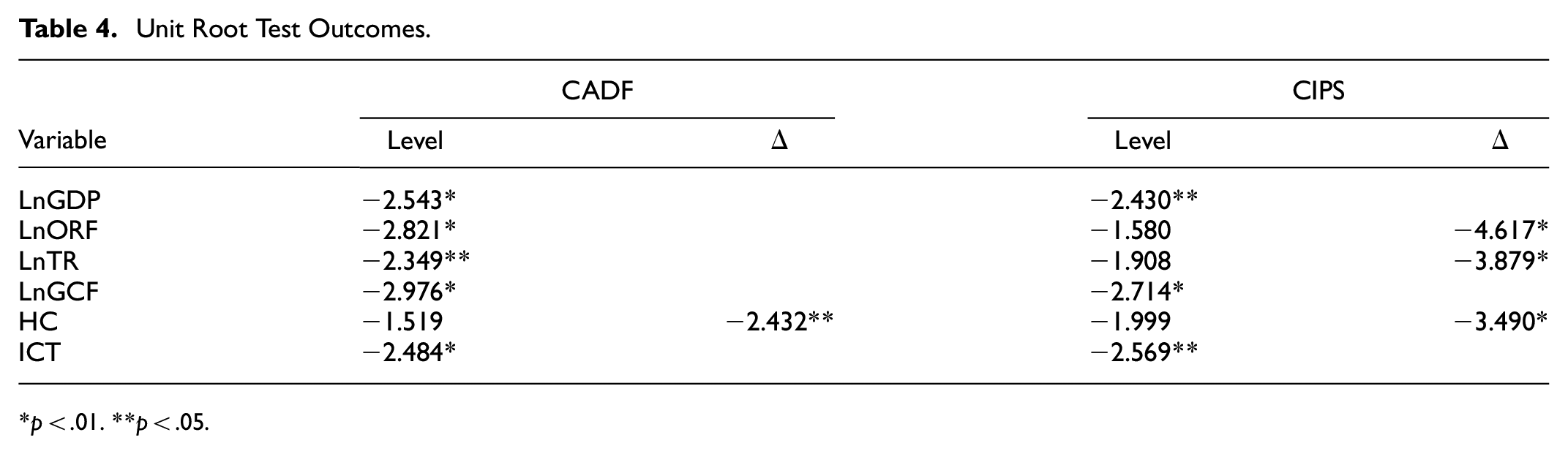
p < .01. **p < .05.
Slope Homogeneity and Cointegration Test
As the panel series have CD and their stationary properties are appropriate, we have conducted the slope homogeneity test by “Blomquist and Westerlund.” The test outcome is exhibited in Table 5. It is apparent from the result that the coefficient slopes are not homogenous, and the heterogeneity issue persists in the panel.
Slope Homogeneity Test Result.

Note. H0: slope coefficients are homogenous.
p < .01.
In the presence of CD and heterogeneity problems, “second generation” Westerlund bootstrap cointegration is operated, and the result is produced in Table 6. The test output indicates that the panel variables have a long-run relationship.
Westerlund Bootstrap Cointegration Result.

Note. H0: Panel variables are not cointegrated.
p < .01.
Long Run Estimation
Since the panel series have CD and heterogeneity problems, we assess the long-run association among variables using “second generation” AMG and CCEMG assessments. The robust outcome of long-run relationships is exhibited in Table 7.
Long-Run Output Based on AMG and CCEMG Assessments.

p < .01. **p < .05.
The magnitudes of the LnORF coefficient based on the AMG and CCEMG methods are very close, positive, and significant. It means ORF, as opposed to general theoretical perception, contributes to EG; it does not harm the economic expansion of the remittance-providing countries as hypothesized but rather accelerates. According to the AMG and CCEMG assessments, respectively, a 1% increase in ORF results in a rise in GDP of 0.036% and 0.03%. Usually, ORF is thought to curtail growth performance, as it involves draining out of income from an economy. However, the positive contribution of expatriate workers outweighs their remittances back to their homes. Thus, based on the findings, the null hypothesis is precluded, and we reach the conclusion that the outflow of remittances is growth-enhancing. The study’s outcome is unique because it contradicts Alkhathlan (2013) and Rahmouni and Debbiche (2017), who reported no significant long-term effects of RFO on EG. It also opposes the findings of Kaabi (2016), Alsamara (2022), Al-Malki et al. (2023), and Islam and Alhamad (2023), who revealed RFO’s damaging effect on the latter. However, the outcome is in line with part of the findings of Khan et al. (2019), who documented RFO’s positive impact for half of the sampled countries and an insignificant impact for the other half of the economies.
The coefficients of HC [0.041, −0.32] in the two assessment procedures are insignificant, indicating that human capital does not affect EG. Thus, human capital falls short of targets to boost EG. This outcome aligns with Islam and Alhamad (2023) and Rahmouni and Debbiche (2017) who reported similar effects of HC on EG. It, however, controverts with Islam (2021a, 2021b), Maneejuk and Yamaka (2021), and Alsamara (2022), who demonstrated HC’s positive impact on EG. Besides, it also conflicts with Almutairi (2023), who accounted for a significant adverse effect of HC on EG. The results of the study point the policymakers must devise policies to be targeted to enhance the skills and competencies of the workforce.
Human capital [measured by the HC index] does not account for labor migration. The impact of human capital and labor migration proxied by outbound remittance flow is estimated separately. While the impact of HC is statistically insignificant, the contribution of ORF [migrant laborers] is positive to EG. Generally, countries deficient in skilled labor import expatriate laborers, utilize the skills and talents of migrant laborers, and fill in the gap in the labor market. It follows the insight that the positive contribution of ORF is due to their employability, skills, and expertise. The finding may push the policymakers to reconsider the outflow of remittance not as an economic problem but rather to focus on utilizing the talent and skills of migrant labor to achieve EG.
The values of the LnTR coefficient following the two approaches are closer, positive, and significant. A 1% increase in TR causes 0.131% and 0.158% increases in GDP, according to the AMG, and CCEMG assessments, respectively. Thus, trade appears to be a blessing for the sampled economies, affecting EG positively. The result is consistent with Alkhathlan (2013), Huang and Chang (2014), Brueckner and Lederman (2015), Hye et al. (2016), Keho (2017), Marilyne et al. (2018), Emrah et al. (2019), Islam (2021a, 2021b), Islam, Saleh, and AlSaif (2022) and Islam and Alhamad (2023), who found a positive impact of trade on EG. However, it refutes the findings of Cooke (2010), Jafari Samimi et al. (2012), and Haussmann et al. (2007), who highlighted the unfavorable effects of trade on the latter. The outcome has important policy consequences for the policymakers to consider trade as a powerful source of EG and engage in trade to grow their output and economy and increase EG.
The coefficients [0.118, 0.115] of LnGCF are almost equal, affirmative, and statistically significant based on two assessment methods. It follows that an increase in gross investment of physical capital augments GD. A 1% rise in GCF causes 0.118% and 0.115% increases in GDP, according to the AMG, and the CCEMG assessments, respectively. Thus, capital formation remains crucial for the EG of sampled countries. The outcome is in agreement with Keho (2017), Rahmouni and Debbiche (2017), Alsamara (2022), Islam (2022b), and Islam, Saleh, and Alshammari (2022), who unveiled the positive effects of physical capital on EG. Nonetheless, this result challenges Islam (2021a) and Islam (2021b), who exhibited an insignificant impression of capital formation on EG. The result reinforces the crucial importance of capital formation in achieving EG. Therefore, policymakers must focus on policymaking, ensuring the required capital accumulation to sustain EG.
The constants of ICT [0.010; 0.006] are positive and significant, and both estimation techniques generate similar coefficients. The growth impact of ICT diffusion is positive in the reference countries. This outcome complies with the finding of prevailing literature, including Shahiduzzaman and Alam (2014), Kumar et al. (2016), Latif et al. (2018), Niebel (2018), Bahrini and Qaffas (2019), Fernandez-Portillo et al. (2022), Kallal et al. (2021), Remeikiene et al. (2021), and Kurniawati (2022). The outcome and existing literature suggest that the countries under consideration may properly deploy and utilize ICT facilities to reap the greater benefits of ICT diffusion.
Robustness Assessment
The AMG and CCEMG estimates’ robustness is assessed using the Driscoll & Kraay approach. The output is generated in Table 8.
Robustness Check with Driscoll & Kraay Assessment.

p < .0.01, **p < 0.05.
The outcome of the Driscoll & Kraay assessment is similar to those of the AMG and CCEMG approach, particularly for four explanatory variables: LnORF, LnTR, LnGCF, and HC, with some variations in the magnitudes of their coefficients. Thus, the impact of these four variables on EG remains similar across the three estimation methods. However, the coefficient of ICT differs in sign and reveals its harmful effects on EG. With this exception, the Driscoll & Kraay assessment authenticates the AMG and CCEMG outcomes.
Conclusion and Policy Implications
This research has made an effort to examine the contribution of ORF to EG in 10 leading remittance-sending economies controlling ICT, trade openness, physical capital, and human capital. It has employed annual panel data from 1990 to 2021 and applied the second-generation approaches. The existence of CD in the panel has led us to utilize the CADF and CIPS stationary assessments, ensuring that the panel is free from any unit roots. The panel is devoid of any unit roots, according to the results of the stationary tests.
Since the research is conducted on 10 countries, which are apparently heterogeneous, we have employed a slope heterogeneity assessment. We have detected a slope heterogeneity problem in the panel. In the existence of CD and slope heterogeneity, the bootstrap cointegration assessment has been used, which has revealed a long-run correlation among variables. We utilize the AMG and CCEMG robust assessment methods to estimate the long-run robust coefficients. The outcomes of the AMG and CCEMG robust estimations are further authenticated by the Driscoll-Kraay method.
Our analysis shows that ORF does not limit EG, as it is perceived and hypothesized; instead, it favors EG due to the migrants’ contribution to host economies. Countries lacking skilled labor typically import foreign workers, make use of migrant workers’ skills and talents, and close the labor market gap. This comes from the understanding that ORF’s beneficial impact results from the migrant laborers’ employability, competence, and abilities. Thus, remittance outflow is growth-enhancing in leading remittance-paying countries. Trade, capital formation, and ICT deployment positively impact economic performance and appear to be a blessing for EG. The role of HC is insignificant, signifying that it does not affect EG. Three assessment methods provide similar outcomes and lead us to an identical conclusion.
The output of the study has several important implications for the policymakers: not to consider remittance outflow as an economic problem but rather to focus on utilizing the talent and skills of migrant labor to achieve EG. They should also consider international trade a source of expanding output and ensure the required capital formation to sustain EG. Moreover, they must devise policies to enhance the skills and competencies of their workforce and properly deploy and utilize ICT facilities to reap the more significant benefits of ICT and achieve a sustainable EG.
Limitations and Future Research Track
The research effort is limited to the top 10 remittance-paying countries. The future sample may include a panel of the GCC economies or other leading remittance-providing nations. We have utilized several control variables, including trade volume, ICT, and physical and human capital; future studies may consider other control variables, such as foreign direct investment and energy consumption. We have applied AMG, CCEMG, and Driscoll & Kraay assessment methods of estimation, and future studies may apply different estimation techniques such as the CS-ARDL method.
Footnotes
Acknowledgements
Not applicable.
Declaration of Conflicting Interests
The author(s) declared no potential conflicts of interest with respect to the research, authorship, and/or publication of this article.
Funding
The author(s) disclosed receipt of the following financial support for the research, authorship, and/or publication of this article: The authors thank the University of Ha’il for its financial support. This research has been funded by the Scientific Research Deanship at the University of Hail, Hail, Saudi Arabia, through a project numbered RG-23 017.
Ethical Approval
Not applicable.
Informed Consent
Not applicable.
Consent to Publish
Not applicable.
Data Availability Statement
Data is taken from the following two websites; https://databank.worldbank.org/source/world-development-indicators#,  .
.