




Abstract
This study examines the effectiveness of animated movies (AM) in increasing students’ vocabulary and determines what students think about English language learning in Pakistan. Particularly in the education field, vocabulary is an essential factor for foreign language learning in academic achievements. This research aimed to determine whether using animated images/movies aid students in learning new vocabulary by helping them to make connections between the words they know and real-world occurrences. The research used pre-tests and post-tests to examine the impact of AM on vocabulary acquisition. Total participants (N = 64) were 12th-grade students in Lahore, Pakistan, separated into controlled and experimental groups to make a judgment. In the second semester of college, half the students (N = 32) utilized AM to acquire English vocabulary, while the control group employed the conventional technique. The results were evaluated using a t-test for an independent sample to detect significant differences between the groups. The vocabulary exam was constructed and verified as a pre and post-test. The findings revealed a statistically significant difference in receptive vocabulary, productive vocabulary, and overall score in favor of the experimental group owing to the use of (AM). It added to the growing body of information by investigating how animated videos might support EFL education.
Plain language summary
This study examines the effectiveness of animated movies (AM) in increasing students’ vocabulary and determines what students think about English language learning in Pakistan. Particularly in the education field, vocabulary is an essential factor for foreign language learning in academic achievements. This research aimed to determine whether using animated images/movies aid students in learning new vocabulary by helping them to make connections between the words they know and real-world occurrences.
Introduction
The primary goal of this study was to evaluate the efficacy of animated movies for teaching new words compared to traditional methods of teaching vocabulary, such as still images and written explanations. Kocak and Goktas (2020) study used cartoons, which considerably influence children’s learning. It seems impossible to acquire new vocabulary with many such terms just by looking up a word or phrase in dictionaries. As a result, a novel way of introducing words is required. Lai and Chen (2021) study investigated the impact of virtual realities (VR) and personal computer games on language learners’ vocabulary learning and affective perception. Mousavi and Gholami (2014) explored the effects of flash stories with and without descriptions on incidental vocabulary acquisition in elementary students. Islam (2021) pointed out that when a student can identify and use a word in different backgrounds and not only speak but also pronounce it correctly, they can declare that they have a strong command of that word. Younas, Noor, et al. (2022) check out how college students in Pakistan cope with the COVID-19 pandemic by exploring the online elements that impact their education. Barak et al.’s (2011) study examined how animated films influenced students’ learning outcomes and enthusiasm. Nuansari and Sriyanto (2021) demonstrated the usefulness of employing animation movies to improve the speaking skills of elementary kids.
Gorjian’s (2014) study looks into subtitle modality’s influence on related vocabulary learning in Iranian EFL students. Akbulut (2007) and David (2009) stated that the English language has become increasingly prevalent across the globe, and it is becoming the language in the sphere of education at universities and institutes as a method of learning and scientific study. Moreover, it has become the language of modern life communication. Flint et al. (2021) study investigated affordances and options when students write multimodal writing. Algilasi (2010) pointed out that the initiative to teach English as a foreign language has benefited enormously from its crucial role as TESOL, and applied linguistics educators and researchers have been looking for acceptable methods and strategies. Younas, Khalid, and Noor (2022) enlighten that teaching methods have altered in response to learner demands and syllabus changes. Various studies investigated the usefulness of cartoon dialogues in vocabulary acquisition through action research conducted in a foundation institution’s preparatory program (Özkurkudis & Bümen, 2021). People in the field of education have limitless opportunities thanks to fast-moving technology (Imran & Almusharraf, 2023). Because of Al Seghayer’s (2001) study has generated widespread interest in computers and unique instructional approaches for English language learning environments. Vitasmoro et al. (2019) found that teaching with animated cartoons could increase students’ language mastery. Using computers is one of the most efficient strategies for teaching children vocabulary. Dong and Sun (2002) regard animation as a bit of the computer revolution, a huge part of high technology. AM and graphical definitions help students to understand new terms as these contain fascinating, colorful characters and situations that grab students’ attention and boost their concentration. Language learning settings may be more colorful, stimulating, and encouraging for students in the vocabulary acquisition process using cutting-edge techniques and resources provided by multimedia. The article explains that including meaning-rich situations and discourse is the key to using diverse multimedia explanations like audio/videos to help students learn a new vocabulary of a second or foreign language. Animated films might help students better understand a new term by placing it in a familiar setting.
The learning process is strongly connected with skills, and vocabulary plays a significant role in learning and knowledge. It is a very handy source for slow or weak learners to improve their vocabulary, increasing their interest in the English language (Noor et al., 2022). This novel approach employs animated visuals to teach new words and language and helps students comprehend the meaning of words by relating them to the events they see on the screen (Ridha et al., 2022). To determine if utilizing cartoon characters is more successful than using real actors and live-action movies to create a tale that teaches the definitions and uses of vocabulary concepts to university undergraduate English language learners (ELLs) (J. Li et al., 2017; Sato, 2022). We educate English language instructors on the fundamentals of developing, choosing, and deploying metaphoric and animated graphics in the classroom (Zhou et al., 2022). The study by Pratama et al. (2018) aims to learn more about the relationship between animation film usage and entering behavior and narrative writing skills in elementary school students. The current research is anticipated to contribute significantly to the easy learning of English vocabulary. The study addresses the following questions:
How the animated movies support students in learning vocabulary at the college level?
Is there any difference in vocabulary learning if taught with the help of animated movies?
Literature Review
Due to colonial impact, the English language has become more dominant in Pakistan, particularly in education, and vocabulary is the most important factor in academic achievement for foreign language learning. The study investigates the adequacy of using animated movies (AM) to learn English vocabulary among college-level Lahore college learners. Using visual aids, such as movies or animated graphics, is one of the most efficient and effective ways to learn English vocabulary. Using (AM) helps students develop communication skills, engaging learners in real-world learning activities.
Importance of Learning Vocabulary
Animated films may help kids learn more about a variety of subjects. Rawan et al. (2018) research investigated the links between exposure to the Hindi-dubbed Japanese cartoon Doraemon and the learning of various Hindi terms in a sample of youngsters (both girls and boys) aged 6 to 11 years old residing in Islamabad. Kutbi (2015) defines multimedia learning as the transmission of instructional material through numerous modalities, including visual and audio information, and applying this knowledge. Few studies pointed about the cartoon movies with a humorous aspect that depicts an event (Adhannisa et al., 2020; Purnama, 2018). Ainsworth (2008) affirms that utilizing animation on computers has become more accessible with the advent of various media technologies. It is a practical approach for students to convey cultural material. Munir (2016) and Gull et al. (2020) have analyzed audio-visual media, particularly cartoon film media, as a suitable medium for developing pupils’ vocabulary at the primary level. Zubair and Iqbal’s (2019) research identifies these numerous prospects and modern trends associated with the issue of learning motivation in Pakistani and Chinese universities.
Additionally, Henry (2010) defined animated films as a quick presentation of a series of static images that provide movement. Peters et al. (2016) study describes two exploratory experiments that looked at the impact of L1 subtitles and captions on several areas of word knowledge among English as a foreign language (EFL) learner. Haberman et al. (2020) investigated the various roles in developing EFL learners’ English skills.
The Impact of (AM) on Vocabulary Learning
Learning vocabulary is a crucial part of learning a second language. Nassaji and Fotos (2004) state that ESL students with a higher vocabulary may engage in vocabulary inferencing procedures more efficiently than they may employ their weaker counterparts. Y. Li and Leng’s (2019) goal of the study is to see how the display of learning materials affects students’ learning performance in a role-playing game about acquiring English vocabulary. Nielen et al. (2018) explain that students’ reading interests and incidental vocabulary acquisition might improve by using a digital pedagogical agent (PA) (Shabiralyani et al., 2015). Using visual aids (such as photos, animated videos, and projectors) as a motivating technique in enhancing students’ consideration while reading literary texts is a strong focus of a study that examines instructors’ views. Tai et al. (2020) research bridges the gap by examining the impact of VR through mobile-rendered on EFL learners’ vocabulary development using a commercial VR app. Perez and Rodgers (2019) pointed out that the rich source of L2 input is television and video, which provide audio-visual aids in L2 learning. Bhutto et al. (2018) the use of animation as a multimedia learning aid based on cognitive theory is under investigation and implementation. Zhang’s (2021) study describes one teacher education course focused on teaching general education preservice teachers to deal with ELLs. One teacher educator attempted to implement a multimodal vocabulary mini-lesson project (Saleem, 2017). This research uses animation cartoons to encourage students’/subjects’ creative thinking. Stack Whitney and Whitney (2021) stated that because of the COVID-19 pandemic, youngsters all around the United States are spending more time on screens for education and amusement. August et al. (2005) found that English learners with sluggish vocabulary development were less able to read grade-level texts than their classmates.
Strategies for Learning Vocabulary
Learners have different aptitudes and learning styles; they struggle with learning a second language and vocabulary. Two recent studies (J. Li et al., 2017; Pratama et al., 2018) analyzed the impact of an intervention based on animated films on the behavior and narrative writing abilities of fifth graders in primary schools. Chacón-Beltrán (2018) discusses scholars’ interests and a particular focus on teaching and acquiring second language vocabulary. Fatima and Pathan (2016) the major goal of this study is to examine the methods undergraduate students use to develop language. Şahin Kızıl and Savran’s (2018) study hopes to fill a vocabulary learning gap in the current research by creating a learning environment and performing a domain-specific assessment. Studies such as Ali and Zaki (2019) highlight the goal of this study to identify the vocabulary learning strategies (VLS) profiles of varied learners and undertake the work of a geographical evaluation of vocabulary learning methods in numerous nations.
Hao et al. (2019) discuss the usefulness of a mobile application built within the concept of cognitive apprenticeship to assist students who are suffering from learning English as a foreign language vocabulary. Because everyone acquires knowledge differently, Wafi (2013) claims that learning novel vocabulary may be enjoyable and straightforward if you use the correct vocabulary tactics. Malik and Akhtar’s (2015) research examined how male and female high school pupils acquire language via various methods. C. M. Chen et al. (2019) created an English vocabulary-learning app with a self-regulated learning (SLR) mechanism to aid learners in improving their SRL skills. Gu (2019) tries to review the last 30 years of research on vocabulary acquisition techniques and identify a few areas for further study. Wang (2018) emphasizes the significance of communication and negotiation in teaching strategy. Renatha (2009) also adds traditional pedagogical methods for vocabulary acquisition. Lastly, Tosun (2015) looks at how blended learning techniques affect teaching vocabulary and how students feel about the procedure.
Statement of the Study
In today’s fast-paced, technological world, animated movies are a common kind of multimedia used for learning English language vocabulary because of their proven effectiveness in helping students quickly learn new vocabulary. The educational implications include using podcasts to teach and learn vocabulary and creating an animation/video-based application called “My English Idiom Learning Assistant” (MELIA) to investigate various idiom-learning habits (Nurmukhamedov & Sharakhimov, 2021; Wu et al., 2021). The primary goal of studies is to examine an animated television series’ linguistic qualities and suitability for use in pre-primary education and a broad overview of published studies, digital games for vocabulary acquisition, and implications (Scheffler et al., 2021; Zou et al., 2021). This study uses animations to evaluate the value of technology in higher education for Pakistan’s students. This initiative aims to help students acquire a deeper understanding of the English language via more flexible methods of instruction that foster long-term retention. Learning English vocabulary based on generating, selecting, and deploying animated visuals in the classroom is expected to contribute considerably to the easy learning of vocabulary.
Research Method
Study Locale and Population
The study is quantitative and conducted in colleges in Lahore, Pakistan (Figure 1). Pre and post-tests were used to collect the data from students to determine the impact of animated movies on learning English vocabulary. The study participants were (N = 64) 12th-class students of both genders, 16 to 18 years old, attending English as a compulsory subject.

Study population.
Study Design and Participants
The research used an experimental design, as Allen (2017) mentioned, which entails two groups of students: a practical and a control group. The experimental group learned new words by watching animated movies. On the other hand, the control group learned new words in the usual way. Sixty-four students in 12th grade were selected from a college in Lahore using a convenient sampling technique, and data were divided into control and experimental groups. The quasi-experimentation strategy was adopted for assigning students to the treatment groups (Dörnyei, 2007). This strategy was suitable because the study context did not allow random assignment. The researcher took two existing classes as experiments and control classes. The experiment class has been given treatment for 1 month according to a schedule mutually decided by the college heads. On the other hand, the regular teacher taught the control class using a direct teaching method (Figure 2).

Study plan.
Data Collection Process
The researchers used pre-tests and post-tests to collect data, as Salkind (2010) mentioned, and these exams were used to determine the students’ vocabulary competence. The exam is a multiple-choice quiz, with nouns, verbs, adjectives, and adverbs as the four types of words. The pre-test aimed to determine the pre-ability of students’ vocabulary knowledge before watching a cartoon movie. The post-test was to determine post-ability and the students’ lexicon mastery after seeing a cartoon movie.
Data Analysis
After group selection, a pre-test was conducted with both groups. The mean scores on the tests are judged against the independent samples t-test. The researcher proceeded with intervention as the difference in mean scores was insignificant (both groups were statistically similar). The intervention included planned sessions on animated picture activities and vocabulary learning tasks. It lasted for 4 weeks. Before the intervention, informed consent from the volunteer participants and the college heads was pursued. After receiving their consent, both the groups (experiment and control) were given the post-test.
Finally, the post-test scores’ results were measured using an independent samples t-test. This test was used to determine significance, as it was appropriate when scores from two groups were compared. Before applying the t-test, variables were identified. The current study contained the following variables: 1. English (AM) (X) is an independent variable. 2. Student vocabulary test scores (Y) are the dependent variable.
Results
This section includes demographic details and average marks of each category and compares results from before and after training, which is discussed in detail.
Table 1 shows the age categories of students before training and shows that out of 64 students, 50% are 16 years old, 40.6% are 17, and the rest are 18. The second variable shows the gender categories of students before training and shows that, out of 64 students, 65.6% are males and 34.4% are females. The table displays students’ marks concerning genders before training and shows that the average effects of males are 9.17 and females are 9.05. The overall class average before training is 9.11. A group of 64 students has been divided into two groups of 32 each. One group of 32 got training; the other 32 did not.
Demographics Information of All Participants.
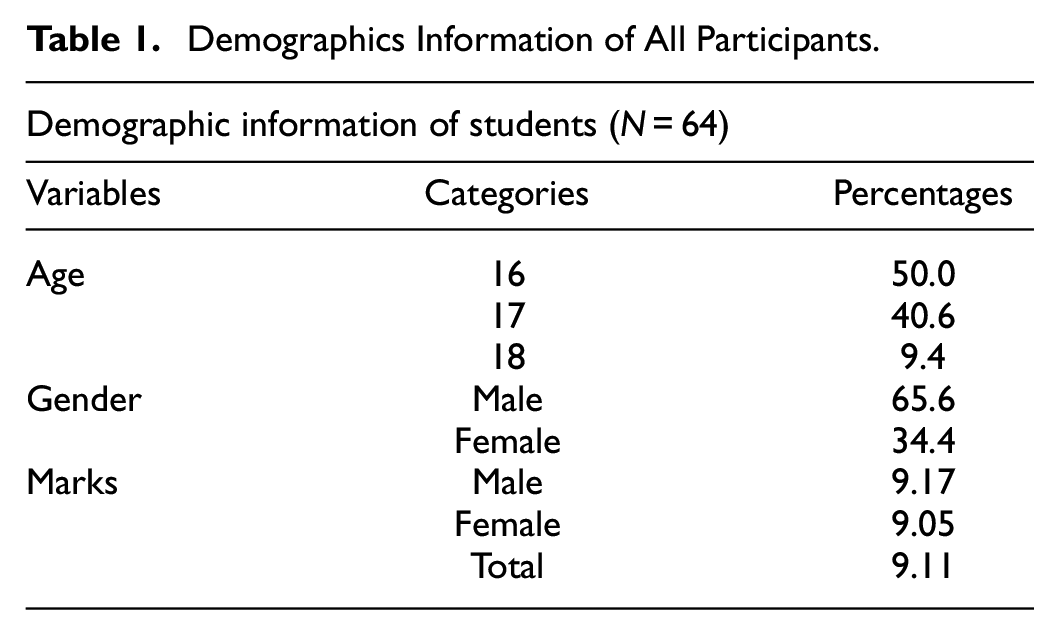
Table 2 shows that out of 32, 46.9% are 16, 40.6% are 17, and 12.5% are 18. The gender variable shows that 62.5% of males and 37.5% of females did not get training. The Marks variable displays the results of the retest of students, and it shows that students who did get training got an average of 8.11 marks, in which the average of males was 7.80 and females was 8.42.
Demographics Information of Participants (Before Training).

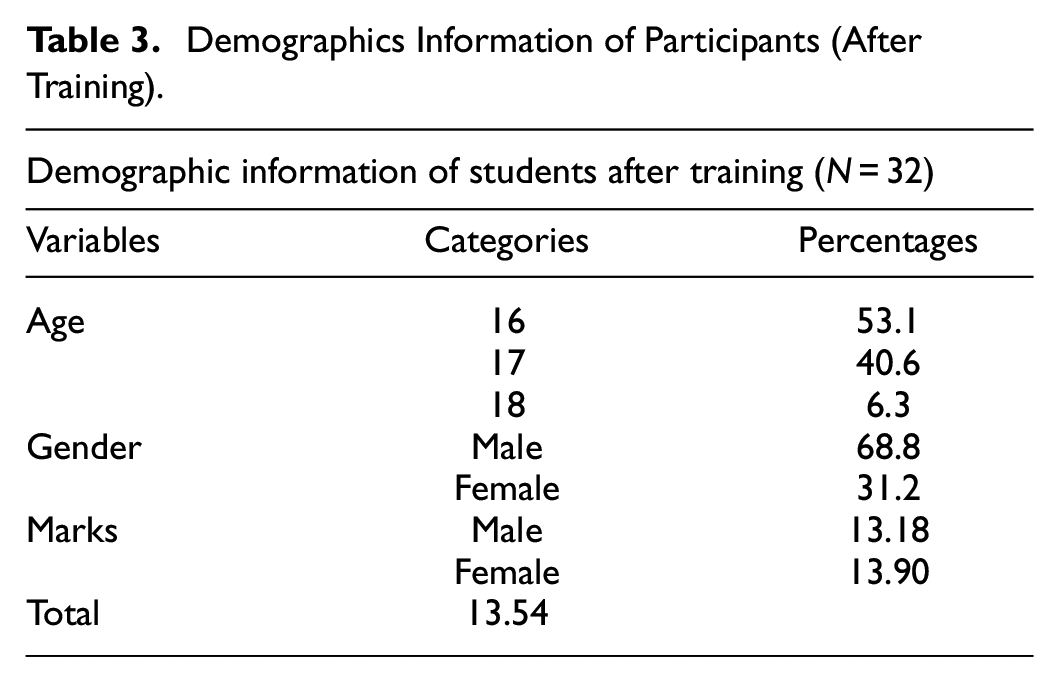
In Table 3, a total of 32 students got training, of which 53.1% were 16 years old, 40.6% were 17, and the rest of 6.3% were 18. In the second variable, 32 students got training, of which 68.8% were male, and 31.2% were female. After training, the average class marks were 13.54%, of which males got 13.18% and females got 13.90% on average.
Demographics Information of Participants (After Training).
In Table 4, the Paired Samples t-test matches the mean score of two dimensions taken from the same individual, object, or related units. Here, authors compare marks between groups having training and not training. After training, the results are significant and improved, that is, t = 13.081, mean = 5.375, p = .000.
Paired Sample t-Test.

In Table 5, Cohen (1988) has delivered benchmarks to define small (η2 = .01), medium (η2 = .06), and large (η2 = .14) effects. Here, the value of eta squared is .707, which is above the threshold with p = .000. Eta squared is .707, which shows that marks got a 70.7% variance in results after training.
Eta Square Test (Tests of Between-Subjects Effects).

A t-test for independent samples was applied to compare the mean scores of the control and the experiment groups. Before running the test, safety checks were made. The independent variable was categorical, and the dependent variable (scores) was continuous. However, the sampling was not random, and the distribution of the scores (checked by histogram using SPSS) was not normal. However, these violations are adjustable by a parametric test like a t-test. Such conditions are usually difficult to meet in social sciences like Applied Linguistics. Then, the equality of variance was checked by the Levene test.
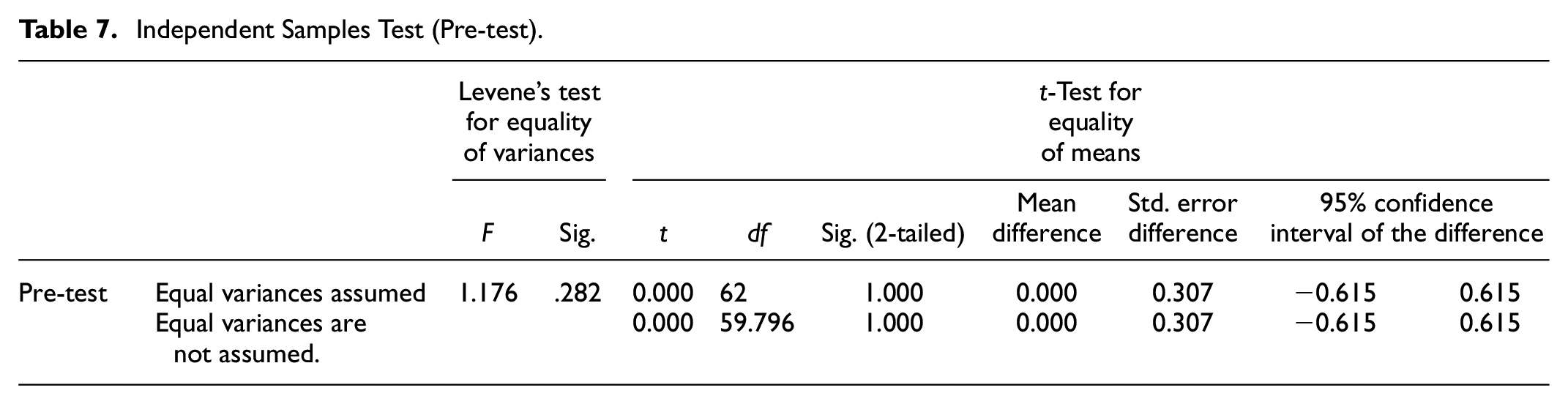
Tables 6 and 7 show that the F-test’s Sig-value is insignificant. It indicates the equality of variance condition is satisfied. Further, the result of the Levene test demonstrates that the Sig. The value of t given in the first row of the table will be selected for decision-making. The table shows that p > .05 means there was no substantial difference between the two groups on the pre-test. So, we can say that the control and experimental groups were statistically the same before treatment.
Group Statistics (Marks in Pre-test).

Independent Samples Test (Pre-test).
Tables 8 and 9 provide descriptive statistics. Tables show the difference in means. A t-test for the independent samples was applied after ensuring the safety checks to test the significance of this difference. As the F-test shows, there is no significant difference in the variances. The value of t given in the first row was considered for decision-making. The significance level of t is indicating that the difference in mean scores between the control and experiment groups is significant. So, we can say that using animated pictures to teach fifth-grade students English vocabulary was a good idea.
Group Statistics (Marks in Post-test).

Independent Samples Test (Post-test).

Discussion
This study easily contributes to learning English vocabulary as it establishes an enjoyable situation during learning through animations as learners have different aptitudes and learning styles and have great difficulty learning a second language vocabulary. Karakas and Sariçoban’s (2012) research aimed to see whether viewing cartoons with subtitles helped students acquire language. Vocabulary learning via cartoons with and without captions and the children’s responses to completing the two dissimilar combinations have been the subject of several scholarly research, and college students have shown a lot of appreciation for these studies (i.e., Arifani, 2020; Arıkan & Taraf, 2010; Fauzi & Muljanto, 2021). Bakla (2019) reported the outcomes of mixed-methods entrenched experimental research, aiming to examine the influence of tailor-made animated cartoons’ usage of mutual punctuation procedures in English. It makes the students the center of the educational process and leads them toward stimulating self-learning. The researcher used the (AM) as a learning strategy for improving college students’ vocabulary. The analysis results of One-sample t-tests look for evidence that the population mean deviates significantly from the observed or expected value. In this case, we chose a value of 10 as our test threshold, and the findings are statistically significant at the p = .0001 level. Since we used 10 as our test value (comparison value), the additional data (t = 5.87) reveal that most students who received instruction improved their score by more than one point on the retest. Holiday (2021) shows how Children’s Television Workshop (CTW) planned and produced commercial segments to demonstrate their level of expertise while creating this content. Salahuddin et al. (2021) investigate the impact of animated video in improving eighth-grade students’ Arabic vocabulary acquisition. Mahdiloo and Izadpanah (2017) investigated the effects of amusing movie clips on improving vocabulary learning in the English language. Mohsen and Mahdi (2021) video captioning may help students improve their pronunciation, which is an essential part of learning a second language’s vocabulary. Alfadil’s (2020) study looked at how the virtual reality game “House of Languages” affected English as a Foreign Language (EFL) vocabulary learning in middle school. AM allows students to use visual and auditory skills to improve their English vocabulary. To provide a vital source of motivation for the students to better understand the English language. It lets students work independently, changing the teacher’s job from giving information to helping students learn.
It is evident that vocabulary plays a crucial role in the language attainment of students, and they acknowledge the importance of (AM) in vocabulary learning. Y. R. Chen et al. (2018) investigate the impact of captioning on the spoken vocabulary of EFL learners. Cintrón-Valentín et al. (2019) study adopted a randomized control design to examine the effect of salience raising via text-enhanced captions on L2 vocabulary and grammatical growth. After learning English for many years, students can only read and understand short and introductory texts. They find it difficult and unconfident to replicate their vocabulary to converse with foreigners. The statistical result of the Paired Samples t-test compares the average of two measures that were collected from the same person, thing, or sets of related units. Here, we examine the difference in performance between those who received instruction and those who did not. There was a statistically significant improvement in performance after training (t = 13.081, mean = 5.375, p = .000). M. P. Chen et al. (2020) explained students’ attitudes, motivation, and learning outcomes in English language arts classes for junior high school students and examined the use of captions and English competence. Pujadas and Muñoz (2019) find out how extensive TV watching may help students acquire vocabulary in a second language (L2) and what impact this sort of training has on their ability to retain new vocabulary. Sadiku (2018) confirmed this in a recent study examining subtitles’ value in various circumstances. It explains how a linguistic framework detailing resources for communicating attitudinal meanings and extending to visuals inspired a multimodal writing method to increase year five kids’ repertoires for evaluative expression (Fethi & Marshall, 2018; Unsworth & Mills, 2020). S. Y. Chen et al. (2018) created a prototyped animated e-book system, including animation films in e-books, and investigated how girls and boys responded to design elements. Roberts (2018) focused on student involvement and comprehension in large-group teaching in higher education, especially multimedia learning techniques. Oakley (2017) focuses on how the development of such texts might help literacy learners achieve reading comprehension, fluency, and motivation. One of the best and most efficient ways to learn English is to use visual aids like movies or animated graphics. It could be a convenient source for slow or weak learners to improve their vocabulary, increasing their interest in English.
Conclusion
With the changing face of the world as well as the emergence of computer and social media apps, new techniques in the education sector are being applied and used quite smartly. Learners feel great appeal toward using the latest technology and new methods of learning language and vocabulary. (AM) are one of the new techniques adopted by language experts. It would attract and help the average learner to take an interest and develop their vocabulary. According to the outcomes of this research, (AM) outperformed the conventional technique in learning English language vocabulary. Education in Pakistan still requires a large number of studies that cover all aspects of the educational system. To advance educational strategies at the college level by removing traditional techniques that negatively impact students’ access to evidence, values, and impressions by emphasizing the importance of and focusing on the new strategies with perfect educational philosophy and playing a key role in boosting learning through practice.
Limitations of the Study
This study’s short treatment period is a drawback, and future studies should extend the intervention throughout the academic year. Furthermore, this research suggests that animated learning is effective and should be promoted across all educational levels. Only college students participated in this study; thus, the results may not apply to younger or older persons, and more research is needed for confirmation.
Footnotes
Declaration of Conflicting Interests
The author(s) declared no potential conflicts of interest with respect to the research, authorship, and/or publication of this article.
Funding
The author(s) disclosed receipt of the following financial support for the research, authorship, and/or publication of this article: This study was funded by General Program of NSFC: “Research on Cognition and Brain Mechanism of Students’ Mathematical Creative Thinking in Complex Situations (no: 62277003)”.

Data Availability Statement
Data sharing not applicable to this article as no datasets were generated or analyzed during the current study.