




Abstract
This study is dedicated to the research of vocabulary learning strategies (VLSs) employed by a group of Saudi Arabian learners in an EFL (English as a foreign language) context. The rationale for the study is to clarify a pronounced lack of research on the EFL context in Saudi Schools Abroad (SSA), and a dearth of prior research into VLSs in this context. In particular, this research intends to explore how do students at Saudi School Malaysia (SSM) employ VLSs in their actual learning process. Therefore, this study is conducted on cognitive theory of learning studies, the mental processes involved in the learning process. Moreover, this study conducted an analysis of studies dedicated to VLSs through secondary students at Saudi school in Malaysia based on previous research problems of models and theories. In addition, this study applied quantitative approach, and the questionnaire was conducted using 105 students. The results of this study revealed the percentage and frequency have further underscored this role and the significance of vocabulary learning in both students and teachers. Also, the results show that students at SSM have employed the five categories of VLSs at a medium level and almost at a close range.
Introduction
There has been significant development in the political, social, financial, and economic sphere of Saudi Arabia (S.A.) since 1925; English has been introduced in schools as a foreign language (FL) by the Ministry of Saudi Education (MSE) for meeting new challenges (Al-Ahaydib, 1986). Besides, for the development of economy, updated and sophisticated technological process, and internationalization (Spolsky, 1998), a very significant role is played by the English language. It is also important for the usage and development of the Internet and the World Wide Web (Pakir, 2000). Also for making English as a second language (ESL) and English as a foreign language (EFL), it is crucial to have lexical knowledge that has a significant function. As we know, English is spoken, written, read, understood, and widespread in most parts of the world. It is considered as the most common language as Kachru and Nelson (2001, p. 9, as cited in Kuo, 2006, p. 213) have proposed that “English has actually developed from the native language of a relatively small island nation to the most commonly taught, shown, read and spoken language that the world has ever known.” Apart from that, language plays an essential function in development and advancement of human society and culture; it is the main means of communication and interaction between individuals, groups, and countries. Soon after, English not only became an important language but a requirement, which made English as one of the core subjects in all levels of Saudi education. What has been mentioned above is a brief introduction of the significance of English across the world and specifically the status and functions of English in S.A.
The current study also focuses on such aspects related to students’ knowledge and use of appropriate and effective vocabulary learning strategies (VLSs) to see their actual use of such strategies and to understand certain factors which affect their use of VLSs. For students of any languages, a large number of new vocabularies could be obtained by the support of VLSs (Nation, 2001). Language comprises four basic skills which are necessary in learning a FL. Normally learners start to comprehend listening and speaking skills, and later they go with reading and writing skills. At the same time, in every skill of language, no one can deal with or communicate without words as Hunt and Belglar (2005) state that words are “the heart of language comprehension and use is the lexicon” (p. 2). In other words, vocabulary is essential and required where it appears in every skill of using a language. D. Schmitt (2010) notes that “learners carry around dictionaries and not grammar books” (p. 4). Besides, McCarthy (2001, cited in Fan, 2003, p. 222) states that “vocabulary is the biggest part of meaning of any language and it is the biggest problem for most learners. Therefore, vocabulary learning is the real key to second language learning.” Consequently, this study is interested in investigating VLSs among those specific students who study and live outside their country, and because a lot of previous research works on VLSs have been carried out in several contexts of ESL/EFL at the same environment in which students live in. Besides, there are few studies in terms of VLSs have been conducted within Saudi context (EFL) such as Al-Otaibi (2004). However, as for those particular students who study at Saudi School Malaysia (SSM) and live in Malaysia, the investigation of this issue (VLSs) is considered as one of the unique contexts among those previous ones. Therefore, it is worthy to investigate VLSs among those particular students at SSM as one sample of Saudi Schools Abroad (SSsA) to help the researcher to fill the gap between both previous studies that have been conducted on both EFL/ESL contexts in which students study and live at the same environments. In addition, teachers encounter challenges, particularly on the effective way of helping students acquire and utilize new words. In such process, VLSs may be utilized effectively, so students should be trained some effective VLSs of vocabulary learning. Particularly, it is of great help for students at SSM to learn such effective strategies in order to know how to find out the meaning of new words, how to store them in their memory, and how to use them by practicing and expanding their vocabulary. Several scholars as Williams and Burden (1997), O’Malley and Chamot (1990), Oxford (1990), and Rubin (1987) have asserted that strategies are crucial tools for developing communicative competence.
S.A. and the FLs
Notably, the first FL to be integrated into Saudi syllabus was Turkish. It was mainly taught in schools that owned and managed by Ottoman. The Arabian Peninsula citizens (Saudis), however, snubbed these schools because the teaching medium was through Turkish language, which they perceived as the tormentor’s language—the invaders’ language (Al-Ghamdi & Al-Saadat, 2002). Thus, after the Ottoman Empire fell in 1914, Turkish language became obsolete. On the contrary, the lack of confidence coupled with the negative perception of FL instruction (e.g., Turkish language) changed because of rapid advancement and progress made by S.A.; to keep in touch with the 20th-century needs, there was a gradual need of developing schools to aid in preparing Saudis to move to Western countries for further studies. Therefore, to achieve this identified need, a “Scholarship Preparation School” was launched in 1936 in Makkah. The school was specifically meant for Western-bound Saudis, thus students who were remaining at home were not eligible for enrolment (Al-Ghamdi & Al-Saadat, 2002). Furthermore, the school was seen as the main starting point for modern high school education within S.A. as well as teaching EFL was initially launched at this stage. With regard to the universal forging languages, English alongside French were incorporated into Saudi secondary education structure as FLs (Al-Adulkader, 1978). In 1958, teaching of English and French started within the newly launched intermediate-level education system (Grades 7-9). However, the MSE did not include French, during the launch in 1969, thus was only retained in secondary level curriculum (Grades 10-12; Al-Adulkader, 1978). Since that time, English has acquired a higher stature. English is considered a critical subject in both public and private learning institutions in the country. Nowadays, English is clearly promoted in the educational system as the MSE has stated teaching English as its major goal; the aim of teaching English in the secondary schools is to have the public attain a standard which will permit him or her to make ready use of desired materials in English and which will enable him or her to communicate satisfactorily, according to his or her needs, in both spoken and written forms (Ministry of Education, Educational Development Center, 2001).
SSM
SSM is located in Kuala Lumpur. It was established and formalized in May, 1991, by MSE where it is responsible to supply the school (SSM) and all SSsA with prescribed curriculum, textbooks, and trained teachers. Besides, the study is free and no tuition fees for Saudi students. Materials and subjects in all SSsA are the same as what is taught inside Saudi schools. Apart from that, opening this type of schools (SSsA) plays great and positive aspects as it would motivate Saudis who work or study outside to bring their families, so their children can join these types of schools and find the same curriculum as they were in Saudi. In addition, establishing SSsA could help MSE to achieve its objectives and aims of both teaching and learning process as well as to facilitate procedures for all Saudi high-grade secondary students when they have finished their studies abroad and like to join a university or a college. In other words, students outside S.A., who study at one of these SSsA across the world, could easily join any schools inside S.A. when they come back because they already have followed the same curriculum and grade level of their previous studying at SSsA. Generally, teaching English starts from the first grade of the elementary stage at SSM and then continues in both intermediate and secondary ones. In elementary and intermediate levels, students learn to read and write alphabet letters, numbers, and learning new words and grammar rules but in secondary level, students master language skills (read and write for comprehension). Finally, English curriculum and syllabus are designed gradually; English textbooks differ from one grade to another. For each grade, there are two textbooks; the first one (pupil’s book) is divided into units and each unit is divided into language skills and grammar rules, and the second one (writing book) is designed for applying the exercises based on the pupil’s book.
Definition of Relevant Terms
This section intends to explain the basic and salient terms used in this study; these terms are presented in an alphabetical list and defined as follows:
EFL: As an EFL country, S.A. belongs to the third circle, the expanding circle, where English is used as a tool for communication, trade, business, diplomacy, travel, and as a medium in higher education. According to Kachru (1985), English belongs to the third circle or the “expanding circle” and hence in S.A. it is regarded as a FL (i.e., EFL).
ESL: In the outer circle, English is used quite widely for internal (international) purposes; examples are India, Singapore, and Malaysia.
History of S.A. and Its Education
S.A. is located on the Arabian Peninsula, and also is the biggest country in the Arabian Gulf. Although large in area, the nation is sparsely populated as it is covered by the world’s largest sand desert, the Rub al-Khali (Al-Sugayyer, 2006). Historically, S.A. was a small country without any resources where people were staying in mud houses without any sort of technologies, and life was easy and simple as it was in the past centuries. Later on, after 1950s when the oil was discovered, the life is completely changed in different ways. In other words, a huge improvement includes all country aspects (e.g., social, health, education, transpiration, and other fields). About the society, people in S.A. are ethnic Arabs, who share one religion, which is Islam. Besides, the nature of Saudi family is similar a little bit to the neighboring Gulf and Arab States. For examples, the social relations are indirectly linked to family considerations. Although there are some variations in the family structure as it exists among the nomadic Arabs and cities, the basic pattern is the same, and the differences are largely of degree.
Regarding the history of S.A. education, the first learning institution was established by the government in 1925. This modest institution, encountering numerous challenges, was the only advanced facility that provided education for a period of 10 years. Several public schools emerged in 1936; however, these new schools were fully recognized as elementary schools in 1939. At that period, about 2,319 learners enrolled for learning in schools in the entire Emirate of S.A. The education demand rose as the country’s General Directorate of Education (GDE) grew. The number of elementary learning institutions was 182 in 1949, with an overall enrolment at 21,409 pupils. Although there was an increase in the number of schools as well as student enrolment between 1930 and early 1950, the illiteracy levels in S.A. remained high (Alromi, 2000). Briefly, the education in S.A. has undergone several developments as follows:
Establishment of formalized education system (1926-1953).
Oil and education (1954-1970).
Emphasis on quality of teacher education (1971-1984).
Debates on the curricula in S.A. (1985-2000).
Post 9/11: Conflicting discourses in S.A. educational paradigm (2001-2003).
Education and embracing neoliberal needs (2001-2010).
Vocabulary and Its Importance in Language Learning
Vocabulary is considered as a vital aspect in language use and a core element in learning and mastering a FL as Rubin and Thompson (1994) state that “one cannot speak, understand, read or write a foreign language without knowing a lot of words so, vocabulary learning is at the heart of mastering a foreign language” (p. 79). Besides, in all linguistic skills, vocabulary takes its role in developing a student’s language proficiency as Taylor (1992) points that “vocabulary permeates everything language learners or language teachers do in an English language class, whichever skill or language point is being practiced” (p. 30). In other words, it is prevalent to claim that understanding any language is difficult without knowing words whether in the spoken or the written forms (Hall, 2000; N. Schmitt, 2000).
No doubt, EFL learners with more vocabulary will have no difficult barriers in building up their linguistic skills as Smith (1998) refers that students with large and rich vocabulary are thought to enhance their language skills and also thinking abilities. Therefore, vocabulary is a basic part which should be given much attention in learning and teaching as Meara (1980) suggests because language students accept that they encounter significant difficulties in vocabulary even after upgrading from the preliminary phase of learning L2 to an advanced level. In addition, the findings from Macaro’s (2003) survey indicate that L2 instructors consider vocabulary as a subject that requires to be investigated upon to promote teaching as well as learning within classrooms.
Language Learning Strategies (LLSs)
According to Oxford (1990), LLSs have been defined by several well-known researches in the field, but there is no absolute consensus concerning the definition and as a result the classification of strategies. O’Malley and Chamot (1985) explain that there is no agreement on what constitute a learning strategy in second language learning or how these vary from other types of learner activities. Learning, teaching and communication strategies are frequently interlaced in discussions of language learning and are typically used to the same behaviour. (p. 22)
Besides, O’Malley and Chamot (1990) also remark on this issue by pointing out that “in second language acquisition there had been no consensus on the definition and classification of strategies, and there remained to be relentless confusion over the distinction between learning strategies and other types of strategies applied more to language use” (p. 114) (e.g., communication and production strategies). Apart from that, a number of distinctions and differences can be noted in the definitions of LLSs. At first, the definitions appear to have changed gradually in which the early ones concentrate on linguistic or sociolinguistic competence, whereas the later definitions put more focus on processes and characteristics of LLSs (Lessard-Clouston, 1997). Second, some definitions of such researchers (e.g., Cohen, Stern, Chamot, and to some extent Rubin and Wenden) assert clearly that applying LLSs is basically conscious. What follows are some various examples of LLSs’ definition (see Table 1).
An Overview (Definition of LLSs).

Note. LLSs = language learning strategies.
Furthermore, even though Kachru (1985) agree that LLSs could be unconscious, Cohen (1994) argues that “consciousness identifies strategies from the processes that are not strategic in which he proceeds the factor of choice is considered a salient aspect in LLSs and consequently there cannot be strategies which are unconscious” (p. 4). By contrast, Oxford (1990) specifies that LLSs are typically seen as intentional and conscious actions made by the learner to take command of their own learning.
Theoretical Framework
As an introductory to the theoretical framework of this study, it is better to know that the interest in learning strategies dates back to the 1970s with the development of the so-called cognitive revolution in psychology. The cognitive theory of learning studies used for vocabulary learning strategies employed by secondary students at Saudi School Malaysia, the mental processes involved in the learning process. It is applied to the second/foreign language acquisition, and it looks for examining how linguistic knowledge is stored into memory and how it comes to be automatic in both receptive and productive procedures. In addition to that, it deals with linguistic learning exactly in the same way as any other type of complex knowledge. Therefore, the focus of attention of the cognitive approach has shifted to the learner who deals with and encounters the process. It promotes that each individual constructs his or her own reality, so individual differences gain salient significance; the role of the learner in the acquisition process has got more focus and attention (Pavicic, 1999). Several models of second language acquisition have been proposed since then. Among them, Skehan (1998) has designed a cognitive learning model based on four keystones that comprise the individual differences. Therefore, the present study at the first phase intends to investigate the types of VLSs employed by students and explores which particular factors that affect the use of VLSs among them. See Figure 1.

Individual differences in language learning (Skehan, 1998, p. 268).
Based on the above figure, we can see that, there are four basic individual differences as follows:
Modality preference: It describes the input channel that better fits students’ preference as visual, auditory, or kinesthetic.
FL aptitude: It is identified by skills in phonemic coding, language analytic (i.e., “the capacity to infer rules of language and make linguistic generalizations and extrapolations” [Skehan, 1998: 207]), and memory (information storage and retrieval). Thus, some students concentrate more on analyzing the language system, while others focus on their memory capacity.
Learning style: It is seen as a tendency to process information in a certain way. Individuals are considered to be either holistic (regarding a situation as a whole) or analytic (regarding a situation as analyzable into parts), either visual (preferring information presented visually, namely, pictures, colors, and so on) or verbal (opting for information presented both orally or written), and either active (committing to the learning process, self-directed) or passive (not interacting but expecting).
Skehan also argues that both modality preferences and FL aptitude are difficult to change, whereas learning styles are more flexible because each individual has a range of styles. Finally, LLSs are completely manageable and they are stated to enable for training.
Apart from that and based on what has been stated through this introductory chapter that many Saudi students encounter such difficulties in vocabulary learning which could be a crucial aspect to their poor linguistic skills, so the current study at the second phase concerns with teaching students such effective and recommended strategies in all five stages of learning vocabulary (FL) based on the theory of Brown and Payne’s (1994) five-stage model. In other words, to investigate the construction of VLSs in all five stages of vocabulary learning to assist in drawing the salient effective strategies practiced among students.
Therefore, the theoretical base of the main objective (of the present study) is grounded on the work of Brown and Payne’s (1994) five-stage model. Because of the complexity of the vocabulary learning process, a number of different models for vocabulary learning stages have been proposed by different researchers (e.g., Beers & Henderson, 1977; Templeton, 1983). Of these proposals, Brown and Payne’s (1994) five-stage model is considered to offer the clearest account of the various aspects of vocabulary learning, as well as being the most extensively discussed in the literature. For the purposes of this study, it is crucial to have a model that clearly identifies the aspects of vocabulary learning that are addressed by the various learning strategies under investigation. In summary, the five vocabulary-learning stages and the effective strategies used in them are as follows:
Encountering new words: The vocabulary-learning strategy the literature suggests as helpful for EFL students here is “guessing strategies.” This strategy includes guessing from contexts by activating background knowledge of parts of speech, parts of the sentence, predicates, and other grammatical features. The literature also suggests that EFL learners can make use of the morphology of the word and make good guesses form pictures, illustrations, and charts that come with the text.
Getting the word form: The literature suggests that EFL learner should use their dictionaries to learn the form of the new word. It also suggests that doing spoken and written repetition can help them get the pronunciation and spelling of new words.
Getting the word meaning: The two learning strategies recommended in the literature for this stage are “using monolingual dictionaries” and “using picture dictionaries.”
Consolidating word form and meaning in memory: To help EFL students overcome forgetting the form and meaning of the new word, the literature suggests making use of “using memory strategies” and “using verbal/written repetition in many various examples” for the purpose of consolidating word form and meaning in memory.
Using the word: In the final of the vocabulary-learning stages, the literature suggests that EFL learners should use the new word with all its possible collocations as often as possible.
Research Methods
Actually, computer software is required by the huge majority of data analysis methods. For example, a widespread and flexible statistical analysis and data administration solution is statistical package for the social sciences (SPSS). It can even handle any sort of file or data and can utilize them for producing arranged reports, charts, and plots of distributions and trends, descriptive statistics, and can perform difficult statistical investigations as well. SPSS is considered as one of the widely used software programs, so data from VLSQ (Vocabulary Learning Strategies Questionnaire) are coded as in the field of social sciences research.
Data Collection Methods
Creswell (2003) proposes that “individual researchers have a freedom of choice. They are ‘free’ to choose the methods, techniques, and procedures of research that best meet their needs and purposes” (p. 12). In other words, researchers could select the methods of data collection that best suit their goals of their investigation. Definitely, various techniques of data collection would lead to different outcomes of every study. Based on a considerable review of related literature and past research works in the field of VLSs, different methods of data collection have been used. However, the two major ones employed in the use of VLSs are questionnaire and semistructured interview. Creswell and Plano Clark (2011) identifies “the mixed methods as a research design in which the researcher collects, analyses, and mixes (integrates or connects) both quantitative and qualitative data in a single study or a multiphase program of inquiry” (p. 119). In addition, several scholars as Cohen and Manion (1994), Robson (2002), and Merriam (2002) explain that “triangulation” is the use of two or more methods of data collection to study complex issues and to enhance the validity of research findings. Regarding the data collection approaches to elicit the information about strategy employed, it is noticeably understood by the appraisal of these examples of works that two main approaches of data collection applied as a survey by the application of a vocabulary strategy survey, or an experimentation by the application of different individual VLSs, including the rote rehearsal, context and keyword method.
Validity and Reliability
The triangulation of the research instruments used would assist to build informative insights about the construction of VLSs employed as well as to enhance the reliability, validity, and findings of the study. Apart from that, Nunnally (1978) claims that as there is no general agreement on what is accepted as an estimate of internal reliability using Cronbach’s alpha, 0.7 and above is considered a reliable scale. Particularly, all items of VLSQ are tested for their internal reliability in which the scores obtained show a fair internal consistency for the five factors which are the five strategies of learning vocabulary (Discovery, Use, Retrieval, Metacognitive, and Storage strategies). The internal consistency details for the three factors are shown in Table 2.
Reliability of Questionnaire Items.

Result and Analysis
The study includes five demographic information of the participants, which are treated as categorical variables. They are as follows: gender, age, grade (level of the study), years of studying English, and language proficiency. The individual demography of participants is discussed in details below.
Participants’ Demographic Characteristics (N = 105).

Vocabulary Use
These strategies are related to the exploitation of already learnt vocabulary. Table 4 illustrates that they all fall within the range of a medium use. In fact, all items of this category of students’ vocabulary learning are within the close range, meaning that the mean of each item is very close to one another. To be more specific, “Using learnt material” has the highest mean (2.41), and it is followed by “Making up new words to overcome communicative limitation” (2.30). However, “Making up sentences in English with learnt words” has the lowest mean (2.11) and “Restoring to media and technologies” has the second lowest mean (2.24).
VLSs Usage—Vocabulary Use Category.

Note. VLSs = vocabulary learning strategies.
Vocabulary Retrieval
Particularly, these strategies (VLSs) are related to retrieve vocabulary from memory when they are necessary. Overall, there is a medium use of these strategies because all items of this category are within the close range, meaning that the mean of each item is very close to one another and to be more specific, “Remembering words in the collocational sets” has the highest mean (2.38). It is followed by “Remembering words in semantic” (synonyms and antonym) with mean 2.32. However, “Remembering words in situational sets” (e.g., Bank: open an account, cheque, and cash) has the lowest mean among all these three items (2.09). See Table 5.
VLSs Usage—Vocabulary Retrieval Category.

Note. VLSs = vocabulary learning strategies.
Metacognitive Strategies
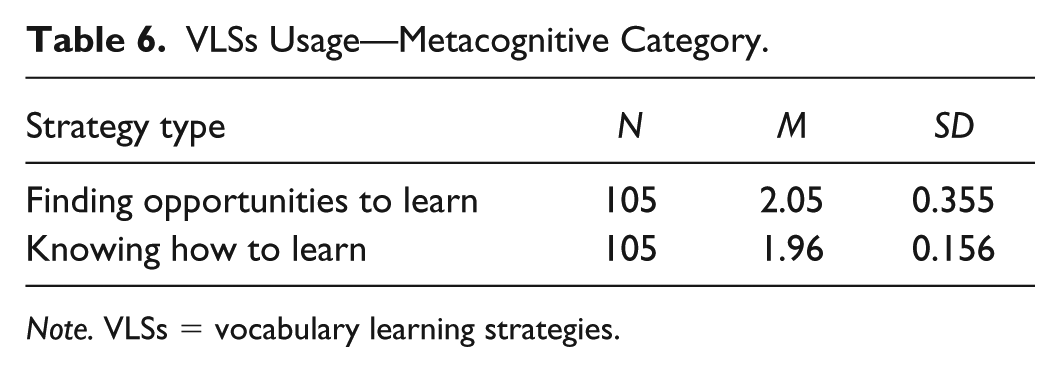
These strategies are related to students’ own regulation and monitoring of their vocabulary learning. Table 6 shows the results which are somewhat low. Especially within the strategy of “Knowing how to learn,” students in general have reported low practice with average mean (1.96). However, regarding the strategy of “Finding opportunities to learn,” students have reported using an average medium mean (2.05).
VLSs Usage—Metacognitive Category.
Note. VLSs = vocabulary learning strategies.
Storage Into Memory Strategies
Participants have stated that they were less likely to use strategies to store new vocabulary into memory. Nonetheless, there were notable differences of use among them—depending on the particular strategies under discussion, as illustrated in both Figure 2 and Table 7.
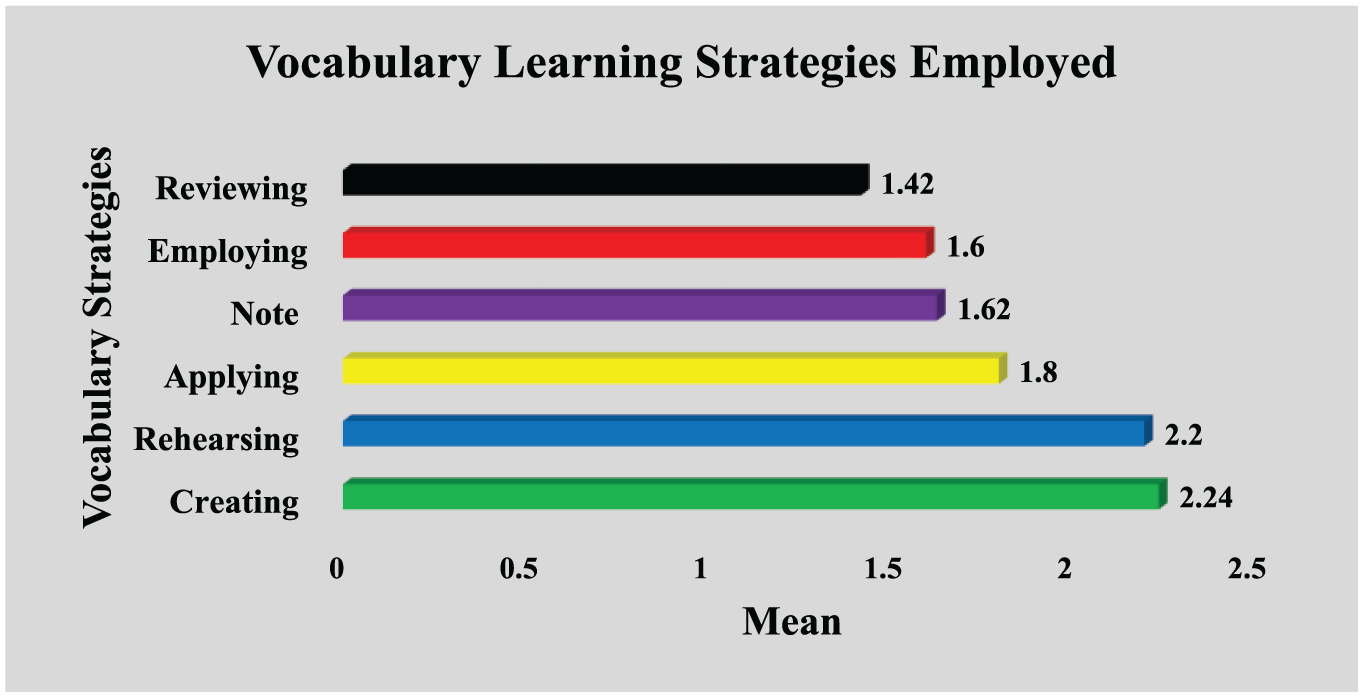
Vocabulary learning strategies employed.
VLSs Usage Storage into Memory Category.

Note. VLSs = vocabulary learning strategies.
Accordingly (the bar chart and table above) the six strategies of the category “Storage into memory” were analyzed, through descriptive analysis, and the outcomes were clearly showed. The results indicated that the means score generated from the table can be relatively described as low, bearing the above threshold in mind as stated by Oxford (1990). In other words, most of these subcategories fell within the average of <2.00 which was categorized as low level, except only two strategies, namely, “Rehearsal” and “Creating,” which were slightly above 2.00. As a summary, all six strategies of this category “Storage into memory” were within the close range, meaning that the mean of each category was very close to one another. Nevertheless, as it was stated, there were two strategies above 2.00: “Rehearsal” which had the highest mean (M = 2.24, SD = 0.2134), followed by “Creating” (M = 2.20, SD = 0.0673). However, the third level of the category “Retrieval” (M = 2.26, SD = 0.1565) was followed by the forth level of the category “Metacognitive” (M = 2.06, SD = 0.2732) and the last level of the category “Storage” (M = 1.81, SD = 0.4073). In short, it could be concluded that students at SSM have employed the five categories of VLSs at a medium level and almost at a close range.
Discussion and Implications
This research found that the SSM students use five stages of VLSs, namely, encountering new word, getting the word form, getting the word meaning, consolidating word form and meaning in memory, and finally using the word. At the first stage, encountering new word, the students employ those strategies identified in this research. One of the strategies mostly employed is the use of guessing strategy, followed by asking others, then analyzing, and finally using dictionary. In previous studies by Al-Rahmi, Othman, and Yusuf (2015a) and Al-Rahmi, Alias, Othman, Marin, and Tur (2018b), it was supported that interactivity with group members and peers was claimed to have a significant relationship with collaborative learning and engagement. Thus, this could support the idea that interactivity with peers and lecturers affects vocabulary learning (VL). When using guessing strategy, the students prefer guessing from the context by first trying to understand the part of speech a word belongs to. Otherwise, the students guess from a picture, caption, or illustration. Pictures are particularly found to draw the attention of students when they are involved. This strategy is found to be more frequently employed by the lower level students. Similarly, the students guess from the morphology of the word where they look at the prefixes, suffixes, and roots in guessing the meaning of a word. In general, applying such tools could help EFL learners recognize the importance of collocation. Words may also be presented accompanied by L1 collocation examples that are often applied, and then compared with examples of English collocations. Rudzka, Channell, Ostyn, and Putseys (1981) propose the use of a grid method in presenting collocations. In addition, Carter (1987) argues that instead of presenting words in the form of paired associated or separately, the enlargement occurs through grids in which words originating from a common semantic group undergo an adapted componential analysis or an evaluation that reveals the common collocates associated with the target items. Teachers who are conversant with the finer points of teaching words within context will not present the grids as inflexible; instead, they will present them as hypotheses, which learners may then test against alternative data. Active collaborative learning and motivating cognitive skills reflection and metacognition is a fundamental of social media for active collaborative learning in higher education (Al-Rahmi, Othman, & Yusuf, 2015b).
Finally, it is likely the associations that arise from words or among words in such semantic networks facilitate both learners’ recall and retention of new words (Carter, 1987). As demonstrated in the numerous sections of this literature review, EFL learners can easily employ newly learn words naturally with varied collocations provided they have learnt the word across diverse context and with an ample number of collocations.
In addition, Fan (2003) supports the model offered by Brown and Payne (1994) that classifies the learning process of vocabulary learning in a FL into five critical stages as previously mentioned in the end of theoretical framework section. As for the current study, a number of explanations were stated by respondents regarding the strategies they employed in learning new vocabulary. In other words, the analyses of qualitative data were carried out with the objective of identifying strategies employed in all five stages of vocabulary learning among them. Regarding the research question which concerns with the social and demographic factors among students, there are several factors which play a considerable impact on the use of VLS among them. Particularly, the analyses of the data obtained reveal that gender is not significant in terms of VLSs adopted by them as p value is more than .05. Likewise, age also appears insignificant as p value is more than .05. In terms of grade (level of study), there are no significant statistical differences among them of the three grades studied. However, there are significant differences in terms of how much a strategy is adopted by a particular grade. Equally, in terms of duration of English instruction (experience) among students at SSM, it does not have any influence on the categories of VLSs have been studied. Besides, in the case of students’ language proficiency, the results found that there were significant differences of VLSs adopted by students of different language proficiency ability because students who identified as a very good were found to be employing the strategy of use and discovery more than other categories of students. The web and web-based social networking have significantly expanded in simplicity and speed for vocabulary learning, and thus social networking sites also allow for the public sharing of information, engagement, and collaborative learning (Al-Rahmi et al., 2018a; Al-Rahmi, Othman, & Yusuf, 2015c).
Conclusion
To improve students’ performance and achieve better learning, this article investigated VLSs employed by secondary students at SSM. Therefore, English is considered as a FL in S.A. because it belongs to the third circle, “expanding circle,” as referred by Kachru (1985). The third circle (expanding circle) uses English for international communication, and English occupies the dominant role in education system and means of international communication. Due to the developing of the third circle worldwide economically and socially, S.A. recognizes to take its part globally and prepares itself to be able to get involved internationally; Saudi citizens have to learn and master at least one or two FLs besides their Arabic one. Thus, the MSE has been introduced English as a compulsory subject in schools starting from the fourth grade of the primary level, but for Saudi Schools Abroad (i.e., SSM), learning English starts from the first grade of the primary level. The current article also used the cognitive theory of learning studies to investigate from students’ performance; it also provides a novel strategic, which other researchers may use in future research. In this research, a number of explanations (themes) have been stated by participants regarding the strategies they employed in all five stages of vocabulary learning, such as guessing strategies, using dictionaries and using memory strategies. Particularly, enhancing strategies (VLSs) assist in the achievement of communicative competence among learners. Thus, the focus and great emphasis should be on the role of strategies in learning new vocabulary rather than on memorizing grammar rules and structures.
Footnotes
Acknowledgements
We would like to thank the School of Education and Modern Languages, Universiti Utara Malaysia, Sintok, Kedah Darulaman, Malaysia, for giving the authors an opportunity to conduct this research.
Declaration of Conflicting Interests
The author(s) declared no potential conflicts of interest with respect to the research, authorship, and/or publication of this article.
Funding
The author(s) received no financial support for the research, authorship, and/or publication of this article.
