




Abstract
The ongoing Russian invasion of Ukraine has adverse effects on Russians residing outside of their home country. To test whether a crisis communication strategy by a Russian association can mitigate the adverse effects, a 3 × 2 online experiment with 404 participants representing the general German population was implemented. Crisis communication strategy (denial vs. diminish vs. bolstering) and framing (emotional vs. rational) of a statement given by a Russian cultural organization in Germany on the news about Russian war crimes in the Ukraine were manipulated. By an intervention tournament design, two reference groups (comment declined vs. no manipulation) were employed. Our results show that a statement by the Russian association significantly positively affects respondents’ attitudes toward this association. Furthermore, when the statement was framed emotionally, participants had a more positive attitude toward the association. The type of crisis communication strategy used is of minor importance if a comment is provided.
Introduction
Since 2014, the conflict in Ukraine has been a staple of the national and international media. The crisis peaked with Russia’s military aggression on February 24, 2022. This conflict has an international dimension in the relations between Russia, on the one side, and Western countries and alliances, on the other side (Fengler et al., 2020). Furthermore, unjustified military aggression creates a negative public sentiment toward the aggressor party. Asadzade and Izadi (2022) show that the Russian war of aggression has significantly damaged the reputation of Russia as a country and the Russian government. Due to the intense media presence of the Russian war in Ukraine, the reputation of Russian organizations and Russians outside their home country has been negatively affected. A comparison with terrorism news coverage shows that more frequent exposure to terrorism news is associated with a higher perceived threat of terrorism and stronger self-protective behavior (Wallace, 2021). This could indicate that constant coverage of the conflict in Ukraine may lead to an increasing sense of threat in European societies.
Given the ties that Russian communities in Europe still have to their or their parent’s country of birth, the war’s negative spillover effects must be minimized to ensure that the war in Ukraine is not fought at the expense of Russians living abroad. In fact, Russian associations in Germany have also criticized the war in Ukraine and called for a distinction to be made between the individuals and the state (German Russian Forum, 2022; Thießen, 2022).
The present study aimed to test the effectiveness of statements from Russian associations in the context of reports of atrocities. As reported in a previous study, it is not only communication from politicians that matters for conflict discourse but also statements from non-governmental organizations (Fröhlich & Jungblut, 2018). Our study aims at understanding the role of a non-government organization during a crisis and how its crisis communication efforts could help a group be exonerated from negative public perception. Clementson and Beatty (2021) found that attitudes toward an organization play an important role in attributing blame and maintaining reputation. Crisis communication aims to positively influence these attitudes toward the organization (Coombs, 2007).
The Situational Crisis Communication Theory (SCCT) by Coombs and Holladay (1996) has become the major paradigm in crisis communication. SCCT was developed in the 1990s based on Attribution Theory (Weiner, 1984) to find the best match between crisis types and response strategies to safeguard organizational reputation during a crisis. Attribution Theory postulates that individuals look for the causes of events, especially negative events, and choose the causal attribution that seems most satisfying to them (Carroll, 2013; Coombs & Holladay, 1996). Coombs (1995, 2007) claims that different types of crises are associated with various levels of crisis responsibility. Therefore, he categorized crises into three clusters differing in the level of responsibility that is attributed to the organization. The victim cluster includes crises with low levels of organizational responsibility (e.g., natural disasters or rumors). The accidental cluster consists of crises with a specific but low level of organizational responsibility (e.g., technical-error accidents). The preventable cluster includes crises with high levels of responsibility (e.g., human-error accidents).
It must be emphasized that the Russian attack of the Ukraine is a crisis caused by the Russian government as an external actor and clearly not by the Russian association or Russians living outside their home country. Therefore, a low level of responsibility should be attributed to them. Nonetheless, it is inevitable that Russian citizens are also ostracized for the actions of the Russian government (Asadzade & Izadi, 2022). The increased number of attacks on Russians abroad at the onset of the war shows that the responsibility is directly and indirectly attributed to them. Consequently, the conflict cannot simply be categorized under the victim cluster when looking at a Russian association and the Russians living outside their home country. Therefore, this study aims at testing the use of a crisis strategy by a party believed to be responsible for the crisis despite not having any responsibility for it.
As reported in previous studies, it is not only the use of the most effective response strategy that minimizes reputational damage but also the way the message is framed. A substantial body of research underscores the significance of how information about a crisis is presented and perceived (Claeys & Cauberghe, 2014; McKay-Nesbitt et al., 2011; Yoo & MacInnis, 2005). Framing encompasses a collection of concepts and theoretical perspectives elucidating the cognitive and communicative processes through which individuals, groups, and societies structure, perceive, and convey their understanding of reality (Richards, 2004). The phenomenon of framing is observable in both cognitive processes and interpersonal communication modalities and can, therefore, become an important factor for effective crisis communication.
The present study expands the scope of SCCT from an organizational to a broader, societal context with confused attributions of responsibility like the ongoing Russian-Ukraine conflict. Therefore, our first research question reads as follows: How does a statement issued by a Russian association on reports of Russian war crimes in the Ukraine affect the attitude toward the Russian association and Russians living in Germany. Moreover, we assume that different crisis communication strategies and the framing of the statement will lead to differences in the attitude toward the Russian association and the Russian population in Germany. Hence, our secondary research question is: How do crisis communication strategies and the message framing employed by a Russian association affect the attitude toward the Russian association and Russians living in Germany?
Theoretical Framework
Crisis and Crisis Communication
Wars, like the ongoing Russia-Ukraine conflict, impact not only the involved parties but also have global consequences, making them crises with unpredictable outcomes. War should, therefore, be viewed as a non-linear and complex crisis (M. W. Seeger, 2002). A crisis often leads to tensions, conflicts, and divisions as the crisis actors offer competing interpretations of responsibility. Knowledge of this is of major importance for effective crisis communication (M. W. Seeger, 2002).
Crisis communication is studied from various disciplines, including communication science, psychology, and political science, with sometimes overlapping definitions and theoretical models. In our study, we take the perspective of communication science as it bridges the gap between theory and practice in analyzing crises and their effects on organizations and society (H. S. Seeger, 2022). Crisis communication should be treated as contingent because no best practice works in all crisis situations (Coombs & Holladay, 2022). In highly complex crises, even minor deviations in crisis communication processes, for example, in terms of content, form, or other factors, can lead to varying perceptions of stakeholders (M. W. Seeger, 2002). Therefore, crisis communication can be treated as a complex form of strategic communication that serves as an intervention designed to lessen the adverse effects of a crisis for any actor affected by the crisis situation (Coombs & Holladay, 2022). H. S. Seeger (2022) claims that most commonly used theories in crisis communication are the Apologia Theory, Image Restoration Theory (IRT), and Situational Crisis Communication Theory (SCCT).
Apologia theory is one of the first theories developed in crisis communication and is applied as a communication structure when the company engages in a defensive reaction. This theory could be applied by an organization to deny public discourse and manage a crisis (Arendt et al., 2017; H. S. Seeger, 2022). The Image Repair Theory (IRT) by Benoit is based on the apologia theory. He introduced different response strategies to protect an organization’s image (Benoit, 1995). Unlike IRT, SCCT by Coombs and Holladay (1996) is a target group-oriented theory focusing on stakeholders’ perceptions of crisis situations. Especially in non-linear and complex crises, such as a war, it is essential for effective crisis communication to have a comprehensive view of the needs and concerns of stakeholders and to adapt communication strategies accordingly. Therefore, our study focuses on the SCCT.
Crisis Response Strategies
Crisis response strategies can be understood as the unique perceptions, interpretations and responses shared by different sets of people involved in a situation (Farrell & Littlefield, 2012). They should soften the damage to an organization’s reputation by demonstrating that the organization cares about the victims and knows how to behave properly, thus fulfilling the public’s expectations (Hegner et al., 2014). Since these expectations vary from situation to situation organizations need to choose a specific strategy. Therefore, SCCT differentiates four main response strategies: denial, diminish, rebuild, and bolstering. As a strategy, denial declines all responsibility the organization could have for the crisis or denies that a crisis exists. To protect the reputation of an organization, this response strategy is considered suitable within the victim crisis cluster (Coombs, 2007). Diminish is a strategy that reduces the organization’s responsibility for the crisis. This response strategy is preferred when the organization only has a limited amount of responsibility (e.g., accidental cluster) (Coombs, 2007). Rebuild involves accepting full responsibility for the crisis and extending an apology to affected parties. This response strategy is to be utilized when the organization has a high-level responsibility (e.g., human-error accidents). Research has shown that corporate apologies during crises characterized by high-level corporate responsibility leads to a more effective reputation restoration than the more defensive denial or diminish response strategies (Coombs, 2007; Coombs & Holladay, 2008). Bolstering is a reinforcing strategy that is used to restore the reputation of the organization by highlighting an organization’s good deeds in the past (Coombs, 2007). This response strategy is not used independently but rather in combination with other crisis response strategies and is not assigned to a specific cluster.
Coombs (1998) further states that some organizations resort to a “no response tactic.” No response might imply that the organization does not care about the crisis’ consequences (Heath, 1998; Saffir, 1993) and, therefore, could jeopardize corporate reputation (Bradford & Garrett, 1995). Studies into the effectiveness of crisis response strategies, however, have yielded mixed results (Claeys et al., 2010; Coombs, 2007; Hirschfeld & Thielsch, 2022). Ma and Zhan’s (2016) meta-analysis shows that the advantage of matching response strategies over mismatching response strategies was more noticeable in accidental crises than in preventable crises. Following the matching hypothesis of response strategies and objectively assessing the responsibility for the war of the Russian association and the Russian population residing outside of their home country as low would lead to the suggestion that a denial response strategy might be the most adequate. Nevertheless, assigning the victim cluster type in the case of Russian associations and Russians is not as clear as the framework of the SCCT suggests as hostility toward Russians abroad increased after the Russian invasion. Therefore, this study examines the question of an effective response strategy in the case of an attributed responsibility without having an actual responsibility. The aim of the study is to see which of the SCCT’s response strategies has a beneficial effect on attitudes toward the Russian organization and the Russian community living in Germany. In addition to crisis response strategies, previous research has shown that message framing has an impact on the effectiveness of crisis communication. Thus, this factor is discussed in the following section.
The Role of Message Framing in Crisis Communication
Aside from communication strategies, the framing of crisis response messages is also known to improve a statement’s impact. Individuals or organizations that express sadness are more likely to be forgiven by the public (Benoit & Brinson, 1999; Claeys & Cauberghe, 2014; Kauffman, 2008). Framing is conceptually connected to the underlying psychological processes that people use to examine information, to make judgments, and to draw inferences about the world around them (Hallahan, 1999; Kühne & Schemer, 2015; Nabi, 2003). Therefore, framing of a crisis has an impact on the public’s evaluation of the organization’s responsibility for the crisis and the effectiveness of the crisis response used (Claeys & Cauberghe, 2014; Lu & Huang, 2018).
The literature introduces two framing types, namely emotional and rational. Emotional framing includes subjective, evaluative properties and emotional adjectives; while rational framing is more direct and presents information in a more straightforward and objective manner (Lu & Huang, 2018). Kim and Cameron (2011) found that people have more positive behavioral intentions when the organizational message contains intensive emotional appeals compared to a message without emotional appeals. Additionally, Claeys et al. (2013) argue that expressing genuine emotions in a crisis situation may result in increased support for the organization, eventually minimizing reputational damage by improving people’s perception of the organization’s sincerity and credibility. Therefore, we hypothesize that an emotional framing of the statement from the Russian association has a more positive influence on the public’s sentiment toward the Russian association and Russians in general than a rational framing of the same statement.
Therefore, we tested the following research model (see Figure 1):

Overview of the 3 × 2 between subject design.
Method
Design of the Experiment
To study the impact of crisis communication we implemented an intervention tournament design (Hameiri & Moore-Berg, 2022). This design enables us to compare different interventions against control groups by using the same standardized outcome measures during assessment and participants drawn from the same population. A 3 × 2 (crisis communication strategy: denial, diminish, bolstering × framing: rational, emotional) between-subject design was implemented with two additional reference groups (no manipulation, comment declined). Thus, our experiment consisted of eight experimental groups. All groups (except the reference group no manipulation) received a shortened newspaper article, published on April 3, 2022 in the German newspaper “die Zeit” (German for “the Times”) about the Russian war crimes in the city of Butscha.
Participants were randomly assigned to one of the six statement conditions or one of the two reference groups. We manipulated the statements from a Russian cultural organization based in Germany (Association for the Cultivation of Russian Culture in Germany) according to SCCT (see Table 1). Following Sisco (2012), we did not to include the rebuild strategy because it does not seem logical that a Russian association in Germany will take full responsibility for the military aggression in the Ukraine.
Overview of the Statement Manipulation.

Afterwards, we framed each statement either emotionally or rationally. Emotional framing included subjective, evaluative properties, emotional adjectives, and was written in 1st person plural (e.g., “Ourselves and the Russians living in Germany dissociate ourselves with all clarity and determination from the Russian government and its inhuman war of aggression.” / “The horrors committed by Russian soldiers in the Ukraine are a horrendous breach of international law.”). The statements that were framed rationally presented the same information in a more straightforward, objective manner, and were written in third person (e.g., “The Association for the Cultivation of Russian Culture and the Russians living in Germany distance themselves with clear words from the Russian government and their war of aggression” / “The actions of Russian soldiers in Ukraine are a serious violation of international law.”).
The Comment declined reference group received the manipulation stating that the Association for the Cultivation of Russian Culture had not issued a statement on the war crimes in the Ukraine. The other reference group (No manipulation) received no manipulation at all and completed just the questionnaire.
Measures
Dependent Variables
To measure attitude toward the Association for the Cultivation of Russian Culture, we used seven dichotomous semantic differential items (Fiedler, 1964) with a 6-point Likert scale. Items included “I rate or rather feel the Association for the Cultivation of Russian Culture as: (1) good—(6) bad / (1) cold—(6) warm / (1) rejecting—(6) approaching / (1) disputing—(6) mediating.” The scale possessed excellent reliability (α = .93).
We measured attitude toward Russians with 10 items adapted from the dimension ‘warmth’ of the Stereotype Content Model (SCM; Fiske et al., 2002; González et al., 2008) supplemented with four reversed items. All items were measured on a 6-point Likert scale (strongly disagree—strongly agree). Items included “I perceive Russians living in Germany as friendly / arrogant (-) / nice / stingy (-) / tolerant / violent (-) / warm-hearted / good-natured / dishonest (-) / sincere.” The scale has excellent reliability (α = .93).
To measure feelings for the Russian population in Germany, we used the “feeling thermometer,” which is a global measure of outgroup feelings (González et al., 2008). The wording of the item was: “On a scale of 0–100, what feelings do you have toward Russians living in Germany? You can choose any degree between 0 and 100. 50 degrees stand for neutral feelings. Marks above 50 mean positive feelings and marks below 50 mean negative feelings.”
To measure the subjects’ perceived social distance toward Russians, we adapted two items of the social distance scale (Bogardus, 1933). The items were measured on a 6-point Likert scale (very negative—very positive). Items included ‘Please imagine the following scenarios and rate how positive or negative you would feel about them. You get a new colleague: how would you feel if this person is a Russian immigrant? / You get new neighbors: how would you feel if this person is a Russian immigrant? The scale also has excellent reliability (α = .92). For a complete list of items and instructions, see the code book in the online Supplemented Material (S1).
Control Variables
Several studies highlight the correlation between threat and fear in intergroup relations and prejudice (Adorno et al., 1950; Allport, 1958; LeVine & Campbell, 1972). The perception of threat alone is enough to trigger prejudice. However, a higher level of contact with the outgroup could reduce negative stereotypes and prejudice toward the outgroup (Allport, 1958; González et al., 2008; Pettigrew & Tropp, 2006). Therefore, we include the quality and quantity of contact with Russians and the perceived threat of war as control variables in our study. To measure the quantity and quality of contact with Russians, seven items were asked (Islam & Hewstone, 1993). Both variables have acceptable reliability of >.7. Additionally, we measured the perceived threat of the war in the Ukraine with one newly formulated item based on the Integrated Threat Theory (Stephan & Stephan, 1996). The exact wording of the item was: On a scale of 0 (I don’t feel threatened at all)—10 (The fear of war determines my everyday life), how much do you personally feel threatened by the war in Ukraine?
Manipulation Check and Attention
To check the manipulation framing, participants rated the degree to which they felt the statement was emotionally framed on two items. The manipulation check Framing revealed that framing emotionally (M = 3.78, SD = 1.10 n = 157) had a significantly higher mean score than the condition framing rationally (M = 3.53, SD = 0.94, n = 151), F (1, 302), p < .041, partialη2 = .01, confirming our manipulation; while the response strategies did not differ in regards to their framing, F (2, 302), p = .105, partialη2 = .02. Two attention items were included which asked information about the article and the statement and excluded participants if the answer was incorrect.
Participants
The study was conducted online between 7 and 12 of April 2022. A German panel provider was hired and the sample was representative of the German adult population. The participants provided written informed consent and were compensated with incentives for participating. During the survey, care was taken to collect a representative sample of the German society (in terms of age, gender, education, etc.).
The sample size was determined by a priori power analysis using G* Power (Faul et al., 2009). We set the alpha level at .05 and found that with eight different groups we needed 357 participants to achieve .95 power to detect a medium effect size.
Completing the study took on average about 7 to 8 min (median = 6.44 min; M = 7.43 min). Of the 755 participants who visited the landing page of the questionnaire, 448 completed the full survey. However, data from 44 participants were excluded from further analysis due to unrealistically short response durations and/or Russian citizenship. Approximately 10.44% of the participants did not pass the exclusion items of the manipulation check. The final dataset included 404 participants (all with German citizenship, Mage = 44.74; SD = 13.53; 47.5% women and 52.4% men), resulting in sample sizes for each condition between 45 and 54 participants. The sociodemographic data of the sample are reported in Table S1 in Supplemental Appendix S3.
A sensitivity power analysis conducted with G*Power (Faul et al., 2009) showed that our sample was sufficient to detect effects of d ≥ 0.44 with a power of 0.80 for a two-tail t-test for independent samples. Furthermore, the sensitivity power analyses showed that our sample was sufficient to detect effects of f ≥ 0.178 with a power of 0.80 for a between-subjects ANOVA.
Results
The Effect of Responding
To answer our first research question whether a statement issued by the Russian association affects public sentiment, we combined all three emotionally framed response strategies into the group Comment given emotional (n = 157) and all three rationally framed response strategies into the group Comment given rational (n = 151). We compared the mean scores by using t-tests for independent samples between these two groups and the two reference groups (Comment declined & No manipulation). The homogeneity of variances (Levene’s test, p > .05) was given and we used an alpha level of .05 for all statistical tests.
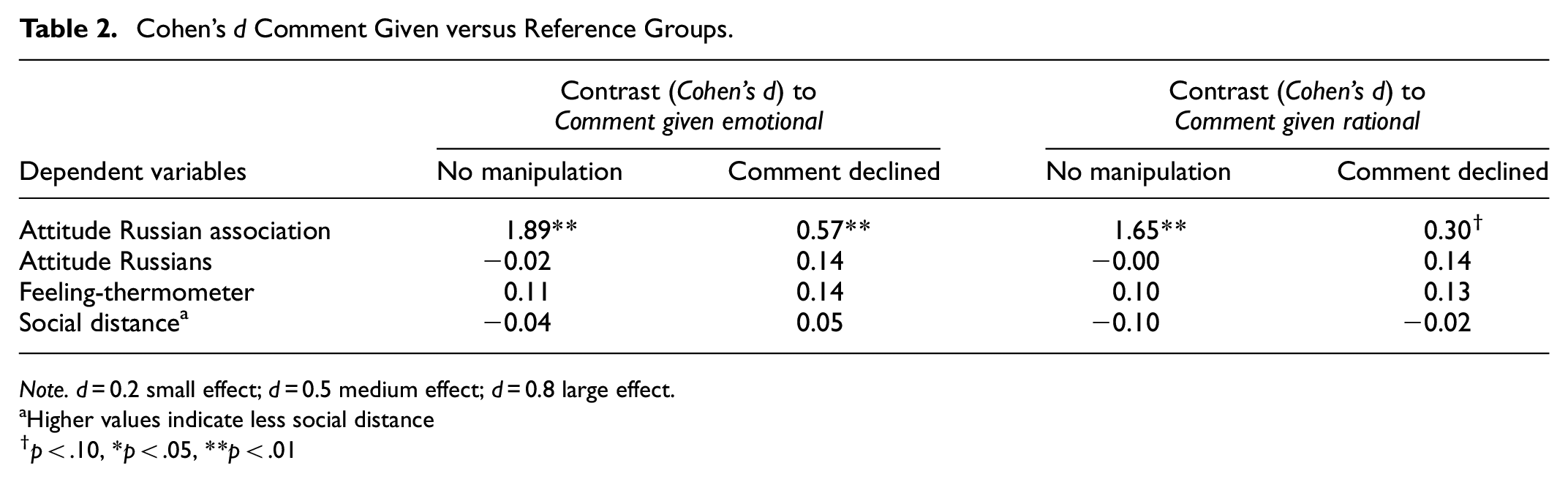
Table 2 shows the effect size Cohen’s d and significance for the comparison of the means between the two Comment given groups and the two reference groups. The results show differences in the mean scores for the variable Attitude toward the Association for the Cultivation of Russian Culture.
Cohen’s d Comment Given versus Reference Groups.
Note. d = 0.2 small effect; d = 0.5 medium effect; d = 0.8 large effect.
Higher values indicate less social distance
p < .10, *p < .05, **p < .01
Figure 2 gives an overview of the mean values on the dependent variables. Participants in the Comment given emotional condition have the most positive attitude toward the Russian association (M = 4.50, SD = 0.93). There are significant mean differences between the Comment given emotional condition and the condition No manipulation (M = 2.69, SD = 1.04, n = 51), t (205) = 11.72, p < .001. The effect size by (Cohen, 1992) is d > 1 which represents a “large” effect. There are also significant mean differences between the condition Comment given emotional and the condition Comment rejected (M = 3.96, SD = 1.06, n = 45), t (200) = 3.37, p = .001. The effect size d = 0.57 represents a “medium” effect.

Mean scores of the dependent variables.
Furthermore, the participants in the condition Comment given rational (M = 4.25, SD = .90, n = 151) showed a more positive attitude toward the Russian association than the participants in the condition No manipulation (M = 2.69, SD = 1.04, n = 51, t (200) = 10.20, p < .001). The effect size by Cohen (1992) is d > 1 which again represents a “large” effect. The Comment rejected (M = 3.96, SD = 1.06, n = 45), on the other hand, is only significantly different from the condition Comment given rational on the variable attitude toward Russian association on a 10-percent significance level, t (194) = 1.77, p = .078.
The results signify that stating a response to the war crimes caused by Russian military in the Ukraine has a buffering effect on the attitude toward the Russian cultural association. Nevertheless, the results indicate that the buffering effect is only effective for the organization making the statement and not Russians living outside their home country.
The Effect of the Crisis Response Strategies
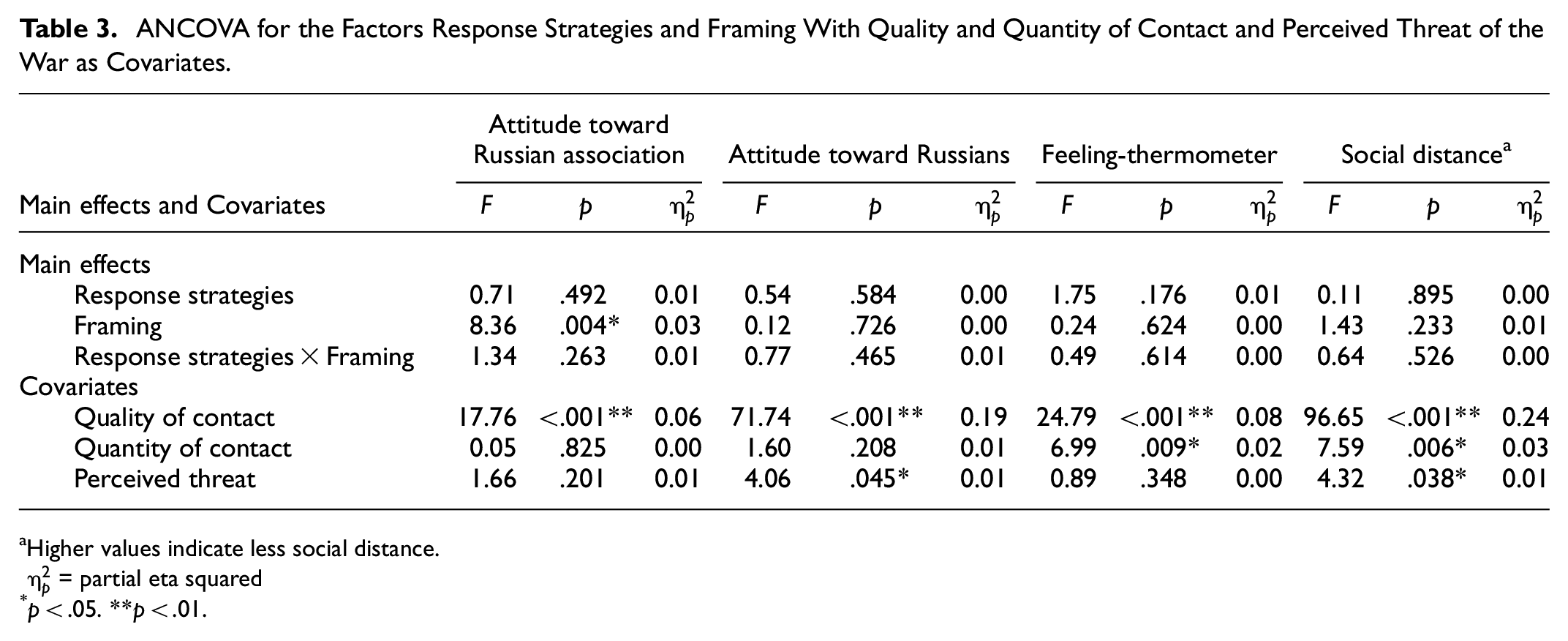
To answer our second research question whether the three crisis communication strategies and framing affect public sentiment, we conducted a 3 (response strategies) by 2 (framing) analysis of covariance (ANCOVA) to compare the mean scores for each condition. We controlled for the quality and quantity of the contact with Russians and the perceived threat of the war in the Ukraine. Every dependent variable showed homogeneity of variances (Levene’s test, p > .05) and we used an alpha level of .05 for all statistical tests.
ANCOVA results (see Table 3) revealed one significant main effect for the independent variable Framing on the variable attitude toward the Russian association, F (1, 302) = 8.36, p = .004, η2 = 0.03. The mean score for the condition emotional framing (M = 4.50, SD = 0.93, n = 157) is higher than the mean score for the condition rational framing (M = 4.25, SD = 0.90, n = 151). No main effect of crisis communication strategy resulted. Furthermore, no interaction effects resulted in significant effects.
ANCOVA for the Factors Response Strategies and Framing With Quality and Quantity of Contact and Perceived Threat of the War as Covariates.
Higher values indicate less social distance.
p < .05. **p < .01.
Moreover, the covariates significantly predict the dependent variables. The covariate, quantity of contact is a significant predictor of the dependent variables feelings toward Russians in Germany (ß = 3.43, p = .009) and social distance toward Russians living in Germany (ß = .14, p = .006). The quality of the contact with Russians significantly predicted all four dependent variables (p < .001). Participants with more contact (quantity) and more positive contact (quality) reported warmer feelings toward Russians living in Germany.
Perceived threat of the war in the Ukraine is a predictor of the dependent variables attitude toward Russians (ß = −.03, p = .045) and social distance toward Russians (ß = −.04, p = .038). Participants who perceived higher threat of the war in the Ukraine reported a more negative attitude toward Russians, as well as higher social distance toward Russians living in Germany.
To have a more comprehensive, look we conducted a second 3 (response strategies) by 2 (framing) analysis of covariance, while controlling for the attitude toward the Russians association. The analysis did not reveal any main or interaction effect for our independent variables. However, it is found that the covariate attitude toward the Russians association significantly predicts attitude toward Russians (ß = .40, p < .001) as well as feelings toward Russians (ß = 7.78, p < .001) and social distance toward Russians (ß = .40, p < .001).
In conclusion, an emotionally framed statement leads to more positive attitudes toward the Russian association compared to a rationally framed statement. Which response strategy - denial, diminish or bolstering—is used, is of less importance if a statement is actually made. The issuing of a statement has no direct effect on the sentiment toward the Russian population living in Germany. Nevertheless, our additional covariance analysis shows that a more positive perception of the Russian association is related to a more positive perceptions of Russians in general. Thus, a positive spillover effect might lead to an indirect long-term effect.
Discussion
The ongoing Russian attacks on the Ukraine have serious implications for neighboring countries. Hostility toward Russians has been a growing problem in Europe since the start of the Russian war of aggression in the Ukraine in February 2022. This study investigates the impact of crisis communication strategies in accordance to the Situational Crisis Communication Theory and framing of the statement on the attitude toward a Russian association and Russians living in Germany.
Results indicate that public sentiment toward the Russian association is more positive when the association delivers a statement responding to the Russian aggression. If the association refuses to give a statement, negative effects on the attitude toward the Russian association result. These findings echo results of previous studies into the negative effect of a “no-response tactic” (Bradford & Garrett, 1995; Coombs, 1998). Nevertheless, issuance of a statement by a Russian association has no direct effect on the perception of Russians living in Germany. This result is not necessarily surprising as the perceptions of Russians, in general, have been influenced by reports about further atrocities happening in the Ukraine. Thus, this established image might be hard to break with just a single statement. Nevertheless, the analysis revealed an association between attitudes toward the Russian organization and attitudes toward Russians in general. It can be assumed that in the case of an ongoing, long-term crisis, an organization might be able to create a positive impact by engaging in continuous crisis communication that is passed onto the perceptions of Russians living abroad. Especially since the long-term economic and social effects of the Russian war in the Ukraine for Germany are yet to be seen, trying to counteract negative sentiments by taking an active stance, Russian associations in Germany can exert a positive influence.
Results indicate that all response strategies have an equal impact on respondents’ attitude toward the Russian association and their attitude toward Russians living in Germany. The value of the matching strategy for restoring organizational reputation is not validated in our experiment. An explanation might be that the SCCT guidelines refer to organizational crises, where the attributed responsibility for a crisis is easier to define. However, we can confirm that giving a statement has a positive impact on people’s perception of the association. Furthermore, in line with previous studies (e.g., Claeys & Cauberghe, 2014), we found that the framing of the statement matters for people’s perception of the association. Emotionally framed statements enhance people’s attitude toward the association compared to rationally framed statements. As the Russian attack on the Ukraine is an emotional issue, a rationally framed statement from the Russian association could be perceived as more distant. With an emotionally framed statement, the Russian organization can display their level of concern more directly.
Furthermore, the covariates significantly predict the dependent variables. Higher quantity and quality of the contact with Russians living in Germany lead to a more positive attitude and less social distance. This finding confirms what is known in previous studies (e.g., Allport, 1958; González et al., 2008; Pettigrew & Tropp, 2006) and shows that a constant and positive exchange with Russian organizations and Russians living in Germany are important to counteract negative attitudes that might arise. In addition, a higher level of perceived threat of the war in the Ukraine leads to a more negative attitude and higher social distance toward Russians living in Germany.
Our study has extended the scope of SCCT and framing theory in the research field of crisis communication to a broader societal context. It has provided indications of effective crisis communication strategies for Russian associations in the context of the ongoing Russia-Ukraine conflict. Our results suggest that Russian associations in Germany can positively influence public sentiment by engaging in crisis communication in response to the Russian war of aggression in Ukraine. The findings highlight the importance of delivering a statement rather than adopting a “no-response tactic” to mitigate the negative effects on the attitude toward the Russian association. Continuous and proactive crisis communication, especially in the context of a long-term crisis, is emphasized as a means for organizations to shape perceptions and counteract negative sentiments.
The results underscore the significance of framing statements in crisis communication. Emotionally framed statements are found to enhance attitudes toward the Russian association compared to rationally framed statements. Furthermore, emotionally framed statements allow the Russian association to convey a more direct display of concern. This insight can guide Russian associations in Germany in tailoring their crisis communication messages to better resonate with public sentiment. Additionally, the research highlights the role of contact with Russians living in Germany in shaping attitudes. A higher quantity and quality of such contact lead to a more positive attitude and less social distance. This suggests that fostering positive interactions and relationships with the Russian community in Germany can contribute to countering negative attitudes that may arise in the context of the Russian war in Ukraine.
Limitation and Future Research
To the authors’ knowledge, this is the first study that examined the effectiveness of SCCT guidelines on crisis communication by a Russian association and Russian individuals since the Russian war of aggression started. Therefore, the limitations offer several relevant directions for future research to deepen our knowledge of the role of crisis communication in this field.
The degree to which participants believe that a crisis response strategy is appropriate could determine an organization’s post-crisis reputation, as Coombs and Holladay (1996, 2008) postulated. The level of perceived appropriateness may provide a better understanding of why no difference between the crisis response strategies was found. Therefore, the perceived appropriateness of the response strategies merits future research attention. Another important factor for the effectiveness of SCCT is the attribution of responsibility (Claeys & Cauberghe, 2014; Coombs, 1995; Coombs & Holladay, 1996). Future research should delve into the attribution of responsibility for war crimes and how it relates to the impact of crisis communication strategies. Understanding the attribution of crisis responsibility for the crisis type and cluster provides initial insights that crisis managers can employ to guide their selection of crisis response strategies (Coombs, 2007).
Furthermore, concepts such as fear toward war and social groups are not static. They evolve based on time, geographical location, and socio-political contexts. Thus, future research may need to adapt item selection to these changing dynamics. As our study took place in Germany with a German sample, future research should reevaluate our item selection depending on time, geography, and social-political context. In addition, the impact of crisis communication on attitudes toward the Russian population should be considered with a different focus, for example, sample (e.g., nationality, age, gender, education) or in different cultures.
Conclusion and Practical Implication
We can conclude that by making a statement the perception of Russian associations can be protected. Our results offer a clear direction for practice. An emotional framing of the statement is advised, while the actual crisis communication strategy used is of minor importance as long as the association delivers a statement. Due to the spillover effect of the attitude toward the Russian association on the attitude toward Russians in general, associations should engage in active crisis communication so they might be able to soften the blow for their community.
Supplemental Material
sj-docx-1-sgo-10.1177_21582440241257982 – Supplemental material for Not Our War: The Effects of Response Strategies and Message Frames From a Russian Association on the Public’s Attitude Toward Russians Living in Germany
Supplemental material, sj-docx-1-sgo-10.1177_21582440241257982 for Not Our War: The Effects of Response Strategies and Message Frames From a Russian Association on the Public’s Attitude Toward Russians Living in Germany by Leoni Schilling, Sabrina Hegner, Ardion Beldad, Elif Durmaz and Gerrit Hirschfeld in SAGE Open
Footnotes
Declaration of Conflicting Interests
The author(s) declared no potential conflicts of interest with respect to the research, authorship, and/or publication of this article.
Funding
The author(s) disclosed receipt of the following financial support for the research, authorship, and/or publication of this article: This research has been conducted with funds from the German Federal Ministry for Education and Science [01UG2038B], our thanks to them.
Ethical Approval
Our online study was conducted in accordance with the Code of Ethics of the World Medical Association (Declaration of Helsinki) for experiments involving humans and the American Psychological Associations’ Ethical Principles of Psychologists and Code of Conduct. Participants were recruited through a commercial German panel provider to secure a completely anonymous online survey. The panel provider reviewed the study and ensured that participants would not be harmed by the survey. Participants were informed about the purpose of the study, gave their consent to data processing for scientific purposes (see S1—code book, section “Voluntariness, anonymity, and data protection”) and were compensated with incentives for participating. Participants could stop the survey at any time. Data were collected and processed anonymously. We did not seek ethics committee approval in this case as data were gathered anonymously and we did not expect any risks of harm for participants.

References
Supplementary Material
Please find the following supplemental material available below.
For Open Access articles published under a Creative Commons License, all supplemental material carries the same license as the article it is associated with.
For non-Open Access articles published, all supplemental material carries a non-exclusive license, and permission requests for re-use of supplemental material or any part of supplemental material shall be sent directly to the copyright owner as specified in the copyright notice associated with the article.
