




Abstract
This cross-cultural study investigates the differential effects of message framing techniques in promoting fair-trade consumption between Eastern and Western cultures. A total of 414 Vietnamese participants from Vietnam and 342 American participants recruited through Amazon Mechanical Turk were randomly assigned to two message framing conditions. It emphasizes the interconnected nature of fair-trade consumption behavior, influenced by message framing, processing fluency, and justice restoration effectiveness. The findings provide practical insights for marketers in effectively engaging consumers in purchasing fair-trade products. This study contributes to the literature by illuminating the impact of message framing strategies on consumer behavior toward fair-trade products in different cultural contexts. Marketers can leverage cultural orientations and message processing styles to develop more effective communication strategies for promoting fair-trade product adoption. Specifically, loss-framed messages may be more persuasive in increasing purchase intention among Vietnamese consumers, while gain-framed messages may resonate better with American consumers. Additionally, messages emphasizing the positive outcomes and benefits of fair-trade products for farmers and producers can enhance consumers’ likelihood of purchasing such products.
Introduction
Fair Trade, which originated in the Netherlands and the United Kingdom in the 1960s, has evolved into a successful social movement since the early 1990s. It has led to increased turnover rates, raised consumer awareness across Europe, and improved the livelihoods of Fair Trade farmers in Southern Europe (Fair Trade Labelling Organizations, 2010). Fair trade extends beyond agricultural products and encompasses handcrafted items made by artisans from marginalized communities. Initiatives supporting fair trade provide artisans with fair wages, promote their cultural heritage, and ensure sustainable production practices. Fair trade and organic farming often go hand in hand, with many fair-trade products grown using organic farming methods, promoting environmentally friendly practices and benefiting farmers and consumers alike. Fair trade aims to educate consumers about the negative consequences of global market exchange (Koos, 2021). As consumer interest in ethical products grows, more businesses are choosing to integrate fair-trade products in their product lines, which can alleviate poverty, support farmers, and ensure fair prices. However, some companies prioritize cutting manufacturing costs, resulting in business inequity and worker harm (Rashid & Byun, 2018). Cost-cutting approaches can lead to practices that compromise worker rights, well-being, and dignity. For example, companies may pay low wages, enforce long working hours, neglect safety measures, or ignore labor standards. These practices create poor working conditions, worker exploitation, and increased vulnerability to health and safety risks. Consumers recognize that purchasing fair trade products contributes to community development initiatives. Fair trade aims to provide farmers, producers, and their families with long-term financial stability and improved working conditions (Wang & Chou, 2020). Fair trade actively supports cooperatives and invests in infrastructure, education, healthcare, and other social initiatives, creating sustainable communities and improving the quality of life for farmers and their families. Ethical attributes often result in higher prices for products, as consumers understand the trade-off between individual-level costs and other-oriented payoffs (Beldad & Hegner, 2018; White et al., 2012) .
Corporate adoption of fair trade practices has also gained attention. Companies like Starbucks and Nestlé have been praised for their corporate social responsibility practices, but their commitment to fair trade has been called into question (Fridell, 2014; Jaffee, 2012). The advertising and communication strategies employed by these companies play a crucial role in promoting fair trade. Message framing is a persuasive technique that emphasizes particular aspects of potential benefits or risks associated with engaging or not engaging in a behavior, making it noticeable to a specific target audience (Wirtz et al., 2015). Previous research has shown that message framing can influence consumer behavior. For example, individuals are more inclined to take action to prevent losses than to attain benefits (Duan et al., 2022). Health communication often uses gain-framed messages to highlight positive outcomes associated with health behaviors, while loss-framed messages underscore negative consequences of not adopting those behaviors (Jeong & Lundy, 2015). Self-efficacy theory suggests that an individual’s belief in their ability to accomplish a task or goal is a key driver of behavioral change (Maddux & Stanley, 1986). Self-efficacy plays a role in the effectiveness of message framing, with high self-efficacy individuals more influenced by loss-framed messages, and low self-efficacy individuals equally influenced by gain and loss-framed messages (; Li et al., 2021; Van’t Riet et al., 2010). The relationship between self-efficacy and message framing can be complex and influenced by factors such as cognitive processing style and cultural background.
Despite research on framing effects in various contexts, there is a scarcity of research on message framing advertising for fair-trade products. In the context of Vietnam, the prevailing tendency among consumers appears to exhibit less concern toward sustainable consumption (Pham et al., 2019) due to the limited emphasis placed on this matter by local firms, coupled with a dearth of advertising efforts aimed at educating consumers in this regard. In contrast, consumers in the United States exhibit a proclivity toward prioritizing this form of consumption as a means to augment the overall societal well-being (T. Chi et al., 2019). Vietnam, as an agrarian nation, has a significant demand for food-related consumption, but effective communication strategies are needed to educate Vietnamese consumers about sustainable consumption. This study aims to investigate the impact of message framing advertising strategies on consumer behavior and attitudes toward fair-trade products. By examining individual psychological factors and cross-cultural differences, we seek to understand how consumers respond to fair-trade marketing. Our research questions focus on the influence of message framing on consumer behavior, the role of self-efficacy, and the impact of cultural orientations in Vietnam and the US. Specifically, we will assess the effectiveness of gain-framed and loss-framed messages in persuading consumers to buy fair-trade products, considering factors such as sweatshop labor and long-term financial stability for farmers, as well as the importance of brand communication in increasing consumers’ willingness to pay for fair-trade products.
Literature Review
Construal Level Theory (CLT) and Prospect Theory (PT)
The Persuasion Knowledge Model aims to elucidate the consumer’s decision-making process, particularly regarding the selection of information and purchase intention (Pektas & Hassan, 2020). For instance, Kapoor et al. (2023) conducted an investigation into how sustainability messages conveyed by social media influencers influence consumers’ inclination toward sustainable consumption. The effectiveness of message appeal in terms of persuasion may depend on consumers’ differences in information processing concerning products (Jäger & Weber, 2020). However, believing in fair-trade products has become increasingly challenging, especially for conservative individuals who are resistant to purchasing without a proper advertising strategy (In 2012, the Sale of Fair Trade Green Beans on Retail Markets was 77,429 Million Tons, 2023). Therefore, the effectiveness of persuasion tactics is crucial in fair-trade advertising (Pektas & Hassan, 2020). Employing persuasive techniques is an effective strategy for fostering a favorable consumer outlook on ethical purchasing (Rabeson et al., 2022). Moreover, further investigation into persuasion knowledge reveals its detrimental effect on customers’ opinions of advertisements and brands, advertisement credibility, inclination to share messages, and purchase intentions (Woodroof et al., 2020). To better comprehend how to persuade individuals to make purchasing decisions, two relevant psychological theories are Construal Level Theory (CLT) and Prospect Theory (PT). According to CLT, people think differently based on their mental representation or construal level (Liberman et al., 2007). Consumers with low construal or a close distance perception perceive objects or messages as being near to them, whereas high construal or psychological distance perception is associated with perceiving objects or messages as distant (Liberman et al., 2007).
CLT and PT provide a theoretical background for understanding how message framing can influence people’s attitudes, beliefs, and behavior. Message framing is typically categorized into gain-framing and loss-framing (Topcuoglu et al., 2022). PT suggests that variations in positive and negative valences of the same content can cause differences in individuals’ behavior or decision-making (Hur et al., 2020). Gain-framing messages emphasize potential benefits or positive outcomes resulting from action, while loss-framing messages focus on potential costs or negative consequences arising from inaction (Topcuoglu et al., 2022). The level of consumer construal, whether concrete or abstract, plays a significant role in determining the effectiveness of framing messages in terms of loss or gain (White et al., 2011). There is a correlation between the valence of message framing and self-construal, where messages highlighting potential gains are more persuasive among individuals with an active, independent self-view, whereas messages emphasizing potential losses are more effective for individuals with an active, interdependent self-view (Pounders et al., 2015) . Despite the distinction between the two types of message framing, both have been shown to produce the same persuasive effect. Persuasiveness plays a critical role in the persuasion process as it effectively elucidates the resulting behavior changes (Oinas-Kukkonen, 2010).
Additionally, CLT proposes that people’s perceptions of events and situations are influenced by the psychological distance between themselves and those events or situations (A. Y. Lee et al., 2010). According to this theory, individuals tend to think about future or distant events and situations in an abstract, general way, while they think about near events and situations in a concrete, specific way (A. Y. Lee et al., 2010). Jäger and Weber (2020) found that messages formulated at a high construal level, using abstract and distant terminology, are more effective in increasing purchase intentions for sustainable car tires compared to concrete, low-construal messages. The appeal of concrete versus abstract consumption goals depends on individuals’ mental representations of events as either concrete or abstract (Ramirez et al., 2015). For example, consumers with a chronic tendency toward low-level construal are likely to perceive a higher willingness to pay a price premium for an environmentally friendly product when its features are framed as helping them attain concrete goals (Ramirez et al., 2015). Both abstract appeals (describing green product features vaguely) and concrete appeals (describing green product features specifically) can motivate consumers to engage in green consumption behavior, such as purchasing eco-friendly products (Yang et al., 2015). The effectiveness of message framing depends on specific contexts, the target audience, and individual psychological characteristics. Gain frames may activate a high construal mindset, emphasizing the attainment of desirable goals that require a broad perspective, while loss frames may activate a low construal mindset, focusing on the specific and narrow approach to address potential losses (S. J. Lee, 2019). By understanding the basic mechanisms of CLT and PT, media professionals can design appropriate messages to persuade target audiences to buy fair-trade products.
Congruence Theory
Congruence theory plays a significant role in understanding the interrelationships between company advertisements, associated brands, and product categories (M. S. Lee et al., 2020). Consumers rely on their existing schemas to assess the congruence or fit of an advertising stimulus. When individuals come across information, including advertisements, they evaluate its relevance and congruency based on their existing schemas and actively seek ways in which the information aligns or “fits” with their pre-existing schema (M. S. Lee et al., 2020). An example highlighted by A. Y. Lee et al. (2010) underscores the significance of the fit between individuals’ regulatory orientation and the construal level of the means of goal pursuit. They found that a match between these factors creates a subjective experience of engagement that intensifies reactions. In other words, when individuals’ regulatory orientation aligns with the construal level of how they pursue their goals, it enhances their level of engagement and responsiveness. Utilizing CLT, Pounders et al. (2015) demonstrated that the experience of “feeling right” directly influences message evaluation, ultimately leading to increased persuasiveness by fostering attitudes congruent with the message. Their findings revealed that individuals with an accessible independent self-view are more likely to express a stronger intention to engage in healthy behaviors when exposed to a distal frame, as opposed to a proximal frame. Conversely, individuals with an accessible interdependent self-view are more inclined to report a greater intention to engage in healthy behaviors when exposed to a proximal frame, rather than a distal frame. By effectively combining these message elements through thoughtful matching, it is possible to enhance the efficacy of health communication campaigns.
Message Framing
Message framing is a communication tactic that aims to shape individuals’ judgment, attitude, and behavior by presenting persuasive arguments through alternative versions, conveyed either in terms of potential gains or losses that could arise from the decision to purchase a product (Su & Li, 2022). Studies have indicated that the effectiveness of message framing in advertising is influenced by individual differences, and when a framed message aligns with an individual’s needs, it is more likely to achieve the desired outcome (Lagomarsino et al., 2020; Su & Li, 2022). Gain-framed messages emphasize the positive and desirable outcomes of engaging in a specific behavior, while loss-framed messages emphasize the negative and undesirable consequences of not engaging in the behavior (O. Chi et al., 2021; O’Keefe & Jensen, 2008). For example, a research study showed that the framing of a message, whether it highlights the benefits of buying organic food or the consequences of not buying organic food, has a significant impact on consumers’ attitudes and their intention to purchase (Shan et al., 2020). Another study utilizing loss framing messages demonstrated that consumers are willing to pay for potential technologies in the beef industry, resulting in the highest WTP for ground beef processed by vaccines or directly fed microbials compared to the control group (Britwum & Yiannaka, 2019). Loss-framed health messages are more effective among females due to their higher sensitivity to health messages and greater health awareness, as well as their greater tendency toward pro-social behavior, such as following a vegetarian diet, resulting in a higher likelihood of reducing meat consumption compared to males (Caso et al., 2023). Manipulating message framing is a common method used to influence consumers’ decision-making (Maheswaran & Meyers-Levy, 1990). Moreover, varying cultures tend to place emphasis on distinct self-construals, with Asian cultures prioritizing an interdependent sense of self and Western cultures prioritizing an independent sense of self. Face-saving messages that emphasize the importance of avoiding loss of face can be particularly effective at dissuading individuals from Asian backgrounds (Wang et al., 2020).
While gain-framed messages may be more effective than loss-framed messages because they increase the perceived impact of helping and avoid triggering reactance, there are also situations where loss-framed messages prove to be more persuasive. For example, positive gain-framed messages were found to be more effective than loss-framed messages in generating favorable attitudes toward organ and tissue donation (Reinhart et al., 2007). Loss-framed messages emphasizing the benefits or costs that would be lost if green consumption behaviors were not adopted are more likely to motivate individuals with an independent self-construal toward green consumption compared to gain-framed messages (Dai et al., 2022). In some health domains, such as oral health, gain-framed messages are more effective than loss-framed messages in prevention communication (Segev et al., 2015).
On the other hand, PT suggests that loss-framed messages, which emphasize avoiding negative consequences, may be more effective than gain-framed messages that highlight approaching positive consequences of equal weight (Xu & Huang, 2020). Loss-framed messages are more effective in promoting behaviors associated with risk or unpleasant outcomes, such as getting an HIV test for those engaging in risky sexual behavior, while gain-framed messages are more effective for behaviors associated with sure gains or benefits, such as tooth brushing (Cao, 2016). Messages that frame the negative consequences of smoking as losses have a stronger impact compared to messages that frame the benefits of not smoking as gains (Zhao et al., 2014). In cases where issue involvement is high, loss-framed messages are more persuasive than gain-framed messages (Maheswaran & Meyers-Levy, 1990). The timeframe of the message presentation also plays a role in its effectiveness. Consumers generally exhibit higher purchase intentions when a loss-framed message is presented with a near future timeframe and when a gain-framed message is presented with a distant future timeframe (Shao et al., 2020).
Overall, the impact of gain and loss-framed messages on consumer perceptions and choices is domain-specific and can be influenced by the elicitation of issue involvement. Understanding the nuances of message framing and its effects is crucial for designing effective communication strategies in various contexts.
Message Processing and Perceived Fit
Message Framing and Mood Effects
Individuals experiencing negative moods tend to respond more favorably to loss-framed messages, while those in positive moods tend to respond more favorably to gain-framed messages (Wegener et al., 1994). These findings suggest that both losses and gains are likely to promote a consistent processing approach based on the individual’s mood state (White et al., 2011). CLT (Construal Level Theory) explains how psychological distance affects an individual’s thoughts and actions (Liberman et al., 2007). The fit between the construal of a message and the processing style of the message receiver results in a sense of “rightness” and a more favorable evaluation of the target (S. J. Lee, 2019). Positive moods promote reliance on existing knowledge structures, while negative moods stimulate attention to details and new situation-specific information (Bless & Burger, 2017). Feelings of happiness lead individuals to utilize the most easily accessible processing style, while sadness suppresses reliance on the accessible processing style (Hunsinger et al., 2012). Framing effects arise due to the differential impacts of gain and loss frames on coping strategies, with gain frames encouraging problem-focused coping strategies and loss frames encouraging emotion-focused coping strategies (Duhachek et al., 2012).
Perceived Fit and Cultural Orientation
Previous research has shown that perceived fit influences consumers’ prosocial behavior (Baxter & Gram-Hanssen, 2016; White et al., 2011) and participation intention in cause-related marketing (White et al., 2011). American consumers tend to prefer products made in the United States due to the association with positive outcomes such as job creation and economic growth (Balabanis & Diamantopoulos, 2004). The fit between gain-framed messages and high-level mindsets has a positive effect on consumers’ recycling intention, while loss-framed messages with low-level mindsets have a positive impact on consumers’ recycling intentions (Chittaro, 2016). The effectiveness of gain-framed or loss-framed messages may differ based on gender, with gain-framing being more efficacious with women and loss-framing being more effective with men (Chittaro, 2016). Individual differences and cultural factors should be considered when examining the convergence of cultural orientations within a country (Yoon & La Ferle, 2018).
Cultural Orientation and Self-Construal
Cultural orientation significantly impacts how consumers process information, with interdependent individuals processing information holistically and independent individuals processing information analytically (van Esch et al., 2021). Cultural differences in self-perception are highlighted by Markus and Kitayama (1991), where the interdependent self-view sees itself as connected to others, and the independent self-view sees itself as separate from others. Consumers in Western cultures perceive themselves as distinct from the social context, while consumers in Eastern cultures perceive themselves as part of a larger social context (Kareklas et al., 2012; Markus & Kitayama, 1991). Individualistic countries like the United States exhibit more independent self-concepts, while collectivistic countries like Vietnam exhibit more interdependent self-concepts (Chu et al., 2016). Vietnamese individuals prioritize social harmony and unity, reflecting a collectivist culture (Truong et al., 2017). Vietnamese individuals adhere to a robust collective ideology, shaped by the influences of Confucian teachings and the emphasis on group dynamics (Truong et al., 2017). This cultural inclination leads them to prioritize social harmony and unity within society. Therefore, the Vietnamese population can be considered representative of a collectivist culture.
Regulatory Fit Theory and Persuasive Messages
Regulatory Fit Theory suggests that people’s motivation to complete tasks is enhanced when they perceive a fit between their main objectives and the tasks they need to undertake (Avnet et al., 2013). Individuals with an independent self-view are more likely to be persuaded by a promotion focus, while individuals with an interdependent self-view are more likely to be persuaded by a prevention focus (Kareklas et al., 2012). The regulatory focus and construal level influence information processing, with individuals primed with a promotion focus processing information at a high construal level and individuals primed with a prevention focus processing information at a low construal level (A. Y. Lee et al., 2010). The congruency between regulatory focus and construal level leads to a higher perception of message relevance, increased attention, and better recall of the message (Cao, 2016). Cultural values, such as maintaining or enhancing face, influence the persuasiveness of message framing, with not-to-lose-face messages being more persuasive in interdependent cultures (Wang et al., 2020). The impact of framing is influenced by cultural values, and cultural emphasis on interdependence differs from Western cultures’ emphasis on independence (Markus & Kitayama, 1991). In a study conducted by Wang et al. (2020), it was demonstrated that not-to-lose-face messages are more persuasive compared to to-gain-face messages in the context of anti-drunk-driving public service advertisements. The impact of framing was particularly prominent among individuals with a more accessible interdependent self-construal, but not among those with a more accessible independent self-construal. The study found that when there is congruency between a not-to-lose-face message and an interdependent appeal, it leads to greater persuasiveness than other available conditions. This can be attributed to the cultural value placed on maintaining or enhancing face. In Chinese culture, for example, people are more concerned about social risks and have a tendency toward loss aversion, where negative outcomes hold greater weight than positive outcomes. Consequently, the fear of losing face outweighs the anticipation of gaining face. This cultural emphasis on interdependence is in contrast to Western cultures, which tend to prioritize independence (Markus & Kitayama, 1991). The present study puts forth two hypotheses regarding the impact of message framing on purchase intention for fair-trade products among Vietnamese and American consumers. Specifically,
Perceived Self-Efficacy
Perceived self-efficacy refers to an individual’s belief in their ability to perform specific actions and achieve desired outcomes (Bandura, 1986). An individual’s evaluation of their cognitive, social, linguistic, and technical abilities can significantly impact their perception of self-efficacy (Lindenmeier, 2008). Bandura (1977) suggests that observing others or being influenced by social groups can also affect perceived self-efficacy. The concept of self-efficacy is the result of complex information processing (Bandura, 1995). Previous research based on construal-level theory has shown that individuals with high self-efficacy are more resilient when faced with obstacles to action compared to those with low self-efficacy (White et al., 2011). However, when efficacy is already high, message framing becomes less influential as individuals engage in less cognitive processing regarding behaviors that are already certain (Block & Keller, 1995).
Efficient information processing plays a crucial role in consumers’ assessments, purchase intentions, and decision-making (A. Y. Lee & Aaker, 2004). In this study, we propose that message framing contributes to processing fluency, which, in turn, enhances perceived self-efficacy. Processing fluency acts as a mediator for the persuasive effect of message framing (gain and loss framing) and has been identified as an important factor in motivating pro-environmental behaviors (Doran et al., 2015; Shahzalal & Font, 2018). When individuals adopt a concrete (abstract) thinking approach, a loss (gain) frame leads to higher processing fluency, resulting in a greater perception of ease in understanding and comprehending the message (M. Y. Lee et al., 2008). White, MacDonnell, and Ellard (2012) suggest that beliefs in justice restoration efficacy, rather than general efficacy, play a crucial role in ethical product consumption. Building on this, we hypothesize that justice restoration efficacy mediates the relationship between message framing and purchase intention for fair-trade products (White et al., 2012). Additionally, we propose that processing fluency also acts as a mediator in this relationship (see Figures 1–3). Therefore, we put forward the following hypothesis:

Conceptual framework.

Gain framed message—English version, Loss framed message—English version.

Gain framed message—Vietnamese version, Loss framed message—Vietnamese version.
Procedure
The participant pool for this study consisted of 414 individuals from Vietnam. To recruit participants, we utilized online platforms, specifically social media, to reach a diverse and representative sample. Additionally, we recruited 342 American participants through Amazon Mechanical Turk. All consenting participants were randomly assigned to one of two message framing conditions, with the advertisement featuring a picture from www.fairtrade.net and the text describing the message framing conditions in a randomized order. The measurements used in this study were translated into Vietnamese using the back-translation method (Chen et al., 2023; M. Y. Lee et al., 2008) (Table 1).
Demographic Information of the Survey Respondents.

Participants first completed the measurement for self construal with seven-point Likert scales, ranging from 1 = strongly disagree to 7 = strongly agree. The measurement is adopted from Hofmann et al. (2021).
In the loss-framed message condition, participants read, “Think about what we will lose if we don’t purchase fair-trade coffee” and “By buying non-fair-trade coffee, the farmers are unfairly compensated for their work.” In contrast, in the gain-framed message condition, participants were presented with positive consequences achievable through purchasing fair-trade products, such as “Think about what we will gain if we purchase fair-trade coffee” and “By buying fair-trade coffee, the farmers are fairly compensated for their work.”
Participants then completed manipulation checks for message framing by responding to measures that assessed their degree of agreement with the following statements: “To what extent did the advertisement focus on what would be gained if people do purchase fair-trade coffee?” and “To what extent did the advertisement focus on what would be lost if people do not purchase fair-trade coffee?” The items were adapted from White et al. (2011).
Participants also completed a measure for processing fluency (α = .830) from White et al. (2011) and justice restoration efficacy (α = .794) using items adapted from White et al. (2011, 2012). Finally, participants reported their purchase intentions (α = .93) for fair-trade coffee by responding to items adapted from White et al. (2012).
Results and Discussion
The findings of the study indicate significant differences in the levels of self-construal between Vietnamese and American participants. Specifically, Vietnamese participants reported a higher level of interdependent self-construal compared to their American counterparts (MVN = 5.82 vs. MUS = 4.80, t (754) = 13.216, p < .001) while American participants reported a higher level of independent self-construal (MVN = 4.74 vs. MUS = 5.42, t (754) = −8.509, p < .001).
Manipulation checks. The manipulation checks revealed that the message framing successfully influenced participants’ attitudes toward the message. Participants in the gain-framed messaging condition reported stronger agreement with the gain-framed manipulation check item (Mgain = 5.47 vs. Mloss = 4.61; t (754) = −7.258, p < .001), whereas participants in the loss-framed messaging condition reported stronger agreement with the loss-framed manipulation check item (Mgain = 4.50 vs. Mloss = 5.31; t (754) = 6.454, p < .001). Thus, the manipulation check was successful.
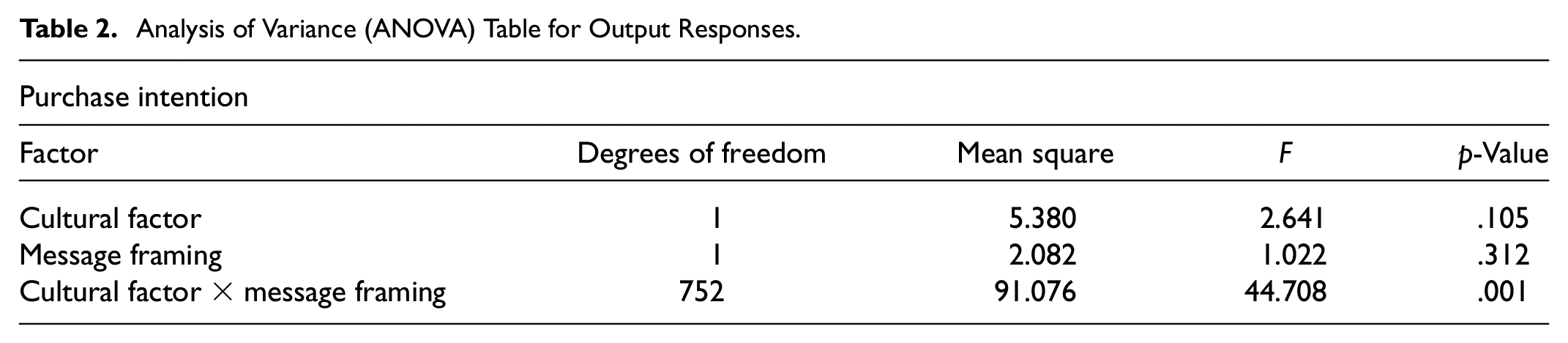
A 2 (Message Framing: Gain versus Loss) and 2 (Cultural factor: Vietnamese versus American) on purchase intention showed that the main effects of cultural factor and message framing on purchase intention were insignificant (F (1, 752) = 2.641, p = .105; F (1, 752) = 1.022, p = .312 respectively). However, the interaction between message framing and cultural factor on purchase intention was significant (F (1, 752) = 44.708, p < .001). Specifically, Vietnamese participants were more willing to purchase fair-trade coffee when the message was framed as a loss (Mloss = 3.83) rather than a gain (Mgain = 3.24; t (358) = 5.355, p < .001). In contrast, American participants were more willing to purchase fair-trade coffee when the message was framed as a gain (Mloss = 3.77; t (358) = −4.306, p < .001) rather than a gain-framed message (Mgain = 2.97). Thus, H1 and H2 are supported.
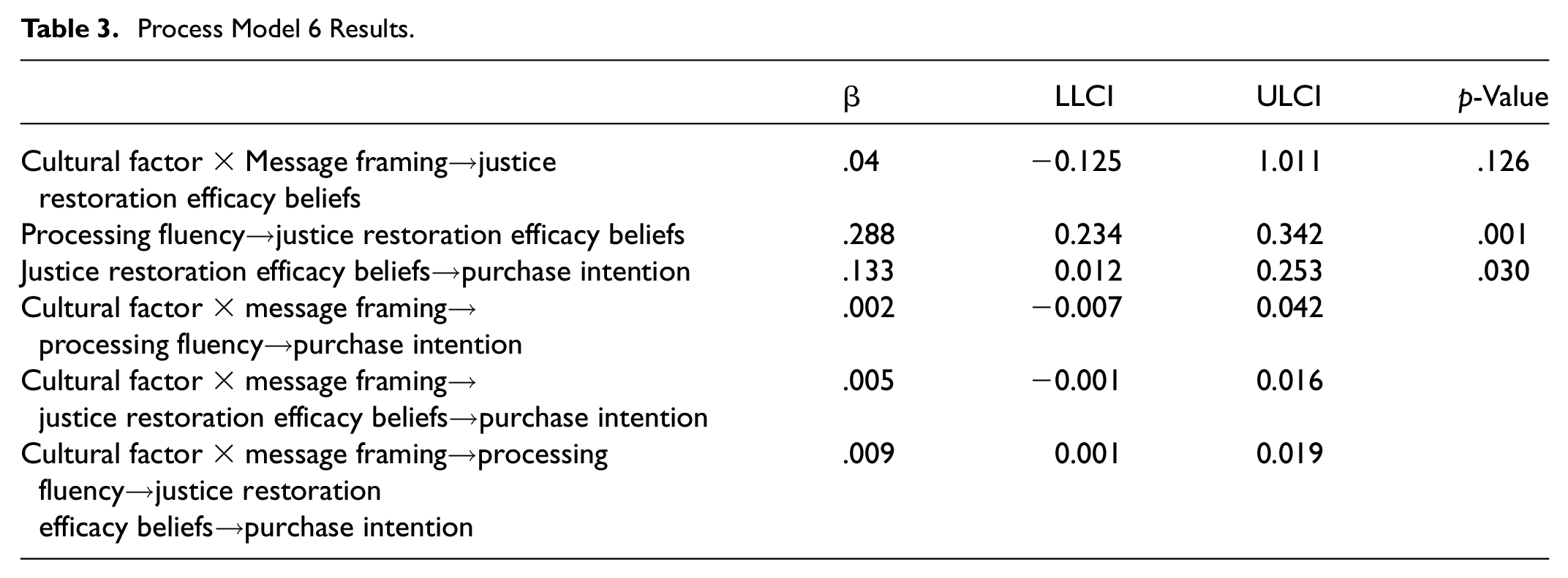
A PROCESS model 6 analysis was conducted to delve into the underlying mechanisms of the interaction effect. The results showed that the relationship between the interaction term and purchase intention was mediated by two factors: processing fluency and justice restoration efficacy beliefs. Specifically, the analysis revealed that processing fluency had a positive impact on justice restoration efficacy beliefs (β = .288; LLCI = 0.234; ULCI = 0.342), which in turn positively influenced purchase intention (β = .133; LLCI = 0.012; ULCI = 0.253). The mediating effect of processing fluency and justice restoration efficacy beliefs was also supported by the results (β = .009; LLCI = 0.001; ULCI = 0.019), ultimately confirming H3. Thus, this study enhances our understanding of how cultural factors and message framing can affect purchase intention through the mediation of processing fluency and justice restoration efficacy beliefs (Figure 4) (Tables 2–4).

The interaction effect of message framing and cultural factor on purchase intention.
Analysis of Variance (ANOVA) Table for Output Responses.
Process Model 6 Results.
Summary of Research Result.

Theoretical Contribution
The study’s findings confirm the importance of considering construal level in message framing. The results demonstrate that congruence between individuals’ cultural orientation and message framing leads to higher levels of engagement and persuasion, supporting the theoretical proposition of CLT. CLT suggests that individuals process information differently based on their psychological distance from the message or object. By adding empirical evidence, this study enhances our understanding that tailoring message framing to individuals’ construal levels can enhance persuasive outcomes.
Additionally, the study’s results provide further support for the application of Prospect Theory (PT) in persuasive communication. The findings reveal that both gain-framed and loss-framed messages can be effective, depending on the context and individuals’ risk perception. This aligns with the theoretical underpinnings of PT, which emphasize the role of framing in decision-making under risk and uncertainty. By demonstrating the effectiveness of gain-framed and loss-framed messages in different scenarios, the study contributes to the practical application of PT in persuasive messaging.
Furthermore, the study’s results reinforce the importance of congruence between individuals’ cultural orientation, construal level, and message framing. The findings show that when there is consistency between these factors, individuals are more likely to respond positively to persuasive messages. This aligns with the theoretical proposition of Congruence Theory, which suggests that individuals prefer information that aligns with their existing schemas and cognitive processes. The study’s results highlight the relevance of congruence in designing persuasive communication strategies and provide empirical evidence to support this theoretical framework.
Overall, the study’s findings contribute to a deeper understanding of the factors influencing persuasion and consumer decision-making. They provide empirical evidence to support the theoretical propositions and emphasize the importance of considering construal level, message framing, and congruence in designing effective persuasive communication strategies.
Implication of the Study
In 2006, roughly 66% of Americans surveyed expressed their willingness to purchase Fair Trade coffee at a premium price, while more than 50% of Germans surveyed indicated their willingness to buy a majority of Fair Trade products (Andorfer & Liebe, 2015). Consumer behaviors toward fair-trade products can be influenced by variations in cultural backgrounds. A common marketing approach for fair trade products is to encourage consumers to choose Fair Trade coffee as a means of supporting the betterment of living standards for coffee bean farmers in low- and middle-income nations (Usslepp et al., 2022). Fair trade products aim to enhance the quality of life and working conditions of laborers and farmers in developing countries, and choosing to support Fair Trade products is considered a prosocial behavior (Yen et al., 2017).
To understand fair trade consumption, this research aims to investigate the role of individual psychological factors and cross-cultural differences in Vietnam and the US. The study highlights the influence of message framing advertising strategies promoting Fair Trade products on consumer behavior and attitudes. For example, a message like “Consumers who do not choose Fair Trade coffee may unknowingly perpetuate the ongoing exploitation of coffee bean farmers in low- and middle-income nations, resulting in the persistence of inadequate living standards and difficult working conditions” can have a significant impact on individuals with interdependent self-views, as prevalent in Vietnamese culture, where they value the interconnectedness of individuals and the importance of collective well-being. By neglecting fair trade choices, these consumers risk compromising their commitment to the betterment of others and supporting equitable trade practices that uplift coffee bean farmers and their communities.
Practical implications relevant to fair-trade marketing managers can be drawn from our findings. Firstly, fair trade consumers are motivated to take ethical action by showcasing cultural differences rather than similarities (Dolan, 2005). Cultural norms and expectations shape consumers’ perceptions of fair-trade products, as they see their own culture as having values or beliefs more aligned with Fair Trade principles. Fair trade consumers who embrace cosmopolitanism aim to engage with other cultures and immerse themselves in them by consuming coffee (Emontspool & Georgi, 2017). By promoting cosmopolitan ideals and encouraging ethical activities such as supporting fair trade and global charitable efforts, CSR initiatives are integrated into brand-building processes to contribute to the creation of brand value and offer opportunities for individuals to cultivate cosmopolitan outlooks, practices, and experiences aligned with the brand, enabling them to “act, feel, and be” cosmopolitan (Bookman & Hall, 2019). Advertisements frequently incorporate details such as a co-operative’s age, location, and ethnic identity, as well as how they profit from fair trade (Sayer, 2000). These depictions and descriptions are intentionally used to create a brand identity for fair trade coffee that can entice more consumers, expand the fair trade market, and extend the advantages of fair trade to more farmers.
Vietnamese consumers are more inclined to buy fair-trade products when they receive a message that highlights potential losses, as opposed to a message emphasizing gains. On the other hand, American consumers tend to be more receptive to messages promoting potential benefits when it comes to purchasing fair-trade products, as opposed to messages that focus on potential losses. Although the production of fair trade coffee in the US is higher than its current sales, there has been comparatively less focus on the emergence of Vietnamese coffee, as opposed to the expansion of fair trade coffee in Vietnam (Fridell, 2014; Jeong & Lundy, 2015). Fair trade principles are not limited to the coffee industry alone but are also being applied to the fashion industry in Vietnam (Nayak et al., 2019). Indigo and Sa Pa Essentials, two fair-trade businesses supporting textile production involving ethnic minorities and non-timber forest products, were facing financial difficulties as of May 2010, while concerns about the authenticity of a larger state-supported “fair trade” organization in Lào Cai province were being raised (Turner, 2012). This indicates that the fair trade approach is receiving increasing attention and being adopted as a prominent strategy. The study’s findings have important implications for marketers seeking to increase fair-trade product consumption in different cultures, including the US and Vietnam. The results suggest that marketers should tailor their message framing strategy to match the message processing style of the target audience. For example, in Vietnamese culture, framing the message in terms of loss may be more effective in increasing purchase intention. On the other hand, American consumers may be more responsive to gain-framing messages.
Secondly, as previous research suggests, African Americans exhibited greater receptivity to a message framed in terms of gains (Lucas et al., 2016). American consumers are more likely to prefer products manufactured in the United States, as they associate such products with positive impacts such as generating employment opportunities and contributing to the growth of the economy (Balabanis & Diamantopoulos, 2004). Nevertheless, consumers tend to have a less positive attitude, lower purchase intention, and reduced trust in a brand that produces its goods in developing countries compared to a brand that manufactures its products in the United States (Rashid & Byun, 2018). According to another research, consumers are highly sensitive to premium prices for fair-trade products made in developing countries. Even a relatively small premium price increase of 15% can decrease consumers’ purchase intention, indicating that the willingness to pay for fair-trade products from developing countries may be limited (Rashid & Byun, 2018). While previous studies suggested that pricing strategies had no significant impact on purchasing decisions for fair-trade products, our research suggests that through fair-trade advertising, we can motivate consumers from different countries and cultures to make purchases. Through our research, we also encourage consumers in Vietnam and the US to increase their motivation to purchase fair-trade products.
Additionally, previous research indicates that when customers make decisions that concern the distant future (e.g., 3 months from now), they tend to employ abstract thinking and rely on metacognitive cues like processing fluency (Zhang, 2014). CLT suggests that near-distant events are depicted by low-level construals, while future-distant events are represented by high-level construals (Pounders et al., 2015). Low-level construals involve more specific and concrete representations that emphasize secondary features, while high-level construals involve abstract and comprehensive representations that prioritize primary features. This holds significant importance in the process of human judgment and decision-making (Trope & Liberman, 2003). The study’s results highlight the importance of processing fluency and justice restoration effectiveness in shaping consumers’ responses to message framing. Marketers should consider these factors when designing and delivering messages about fair-trade products to maximize their impact on consumer behavior. Overall, this study offers practical insights that can help marketers develop more effective communication strategies and enhance the adoption of fair-trade products in different cultural contexts.
General Discussion
The findings of this study contribute significantly to answering the research questions and hypotheses by shedding light on the factors that influence consumer behavior and attitudes toward fair-trade products. The practical implications derived from these findings provide valuable insights for marketers in developing effective strategies.
Firstly, the results suggest that marketers should carefully consider message framing when promoting fair-trade products. Specifically, in the context of Vietnam, a loss-framed message proves to be more persuasive in motivating consumers to purchase fair-trade coffee. This is because Vietnamese consumers find loss-framed messages easier to process, which boosts their confidence in responding to calls for action. On the other hand, American consumers exhibit a greater inclination toward fair-trade products in response to a gain-framed message. Emphasizing the positive consequences and benefits for farmers and producers, as well as highlighting the negative consequences of consuming non-fair-trade products, increases the likelihood of fair-trade product purchases among Vietnamese and American consumers, respectively.
Additionally, this study underscores the importance of considering cultural congruence in message framing. By tailoring messages to align with consumers’ cultural orientations, marketers of socially conscious products can effectively persuade them. Moreover, the findings highlight the role of message framing in enhancing consumers’ self-efficacy and their willingness to pay for fair-trade products. By drawing connections between the results and the research objectives, we demonstrate how these findings contribute to a deeper understanding of consumer behavior and provide actionable insights for marketers.
Limitations
For this study, a total of 414 Vietnamese participants and 342 American participants were recruited. However, in order to ensure the generalizability of the findings, it is advisable to consider a larger sample size, as it can enhance the reliability and validity of the results. This study included a total of 414 Vietnamese participants and 342 American participants. However, to ensure the generalizability of the findings, it is advisable to consider a larger sample size, as it can enhance the reliability and validity of the results. Another limitation is the focus on only two cultural contexts, Vietnam and the United States. Future research could expand the scope by including participants from additional countries and cultures, providing a more comprehensive understanding of the influence of cultural factors on fair trade consumption.
Furthermore, our study primarily examined the role of message framing strategies in promoting fair trade products. Future research could explore other variables or factors that may influence consumer behavior and attitudes toward fair trade. For example, investigating the impact of social norms, personal values, or situational factors could provide valuable insights into how to effectively promote fair trade products.
Footnotes
Declaration of Conflicting Interests
The author(s) declared no potential conflicts of interest with respect to the research, authorship, and/or publication of this article.
Funding
The author(s) received no financial support for the research, authorship, and/or publication of this article.
