




Abstract
Green gas is an attractive option for a local energy transition to combat climate change, notably in rural communities. As local initiatives require local acceptance, the study used a questionnaire methodology to capture opinions and intentions toward green gas in a panel of rural respondents (N = 403) and evaluated the green gas message framing to help improve communication strategies. This survey experiment used four frames in a 2 × 2 setup: an energy value core frame of responsibility for nature versus autonomy and a focus frame emphasizing the collective (i.e., the community) versus the individual (i.e., the household). Our findings highlight that the association with sustainability proves vital for a positive assessment of green gas, but its affordability is an issue. Moderated mediation analysis showed that subjective knowledge moderates between frames and intentions toward green gas: responsibility for nature contributes significantly, but only in the collective focus frame. These results are valuable in creating effective communication strategies about green gas adoption in the future.
Introduction
The latest IPCC report has established that human activity contributes to global warming (IPCC, 2022). Climate change affects many, if not all, regions. Heatwaves, droughts, and water level rise now occur in places that are neither accustomed to nor prepared for such events. Although the tide may still be turned, it will require major efforts, decisions, and actions (Tollefson, 2022); the promise of progress is not overly apparent to all (Mandel & Worland, 2022).
A significant cause of climate change is the release of greenhouse gases into the atmosphere (Shurpali et al., 2019). The primary greenhouse gas, carbon dioxide, is emitted through burning materials for energy, such as fossil fuels (natural gas, oil, coal), solid waste, biomass (wood, other), and various industrial processes. This way, energy use, and climate change are intimately connected (IPCC, 2022). The need to reduce energy-related greenhouse gas emissions implies the reduction, if not complete abolishment, of fossil fuels and the use of more sustainable forms of energy. Such an energy transition will affect the global energy sector and future energy infrastructure.
All available renewable energy options must be explored and developed to combat climate change successfully while maintaining the security of the energy supply our societies expect and have grown used to. Although much emphasis is put on solar and wind power, these may not be enough to fulfill the energy needs of future societies. In 2050, electricity is predicted to be the leading energy carrier (well over 50%), while bioenergy will account for 18% and hydrogen for 12% of the total energy consumption (IRENA, 2021). Bioenergy is thus a vital element in the energy mix of the future. Bioenergy is generated from biomass, the umbrella term for all materials from living and dead organisms (Van Groenestijn et al., 2019). Debates on bioenergy show that it is vital to address and ensure the sustainable use of biomass for bioenergy (IRENA, 2021). Community involvement will likely be essential in accelerating bioenergy deployment while generating local socio-economic benefits (local value chains) and public endorsement for a local energy transition.
For bioenergy, a promising biomass source is waste and residue streams from households and agriculture, notably for local initiatives. Such a stream can be converted to biogas and green gas by first anaerobic fermentation to biogas (Obileke et al., 2021). Often, biogas is upgraded to green gas, that is, the biomethane equivalent to fossil gas suitable for the national gas grid and central heating installations (Van Groenestijn et al., 2019). Biogas is upgraded to green gas by removing carbon dioxide and other contaminants. In the remainder of this paper, we assume the use of green gas. A potentially attractive upgrading method requires green hydrogen, either in chemical factories (Vogt et al., 2019) or by microorganisms (Bekkering et al., 2020). The latter may present an attractive option for local applications. Woody material is unsuitable for biogas production (Camia et al., 2021). Burning wood pellets in coal-fired power plants contributes substantially to the European renewable energy share on paper. Still, much debate exists about the sustainability of such use of woody biomass (Mather-Gratton et al., 2021). The general public has an unfortunate misconception about “biomass” and “green gas.” In public debates, biomass seems to have become a synonym for woody material (Van Groenestijn et al., 2019). Such public debate affects the potential of green gas as an energy source in the future energy mix.
From 1963 on, the Netherlands established and maintained an elaborate infrastructure for gas transport and widespread domestic heating (Grötsch et al., 2011). Nevertheless, the disadvantages of natural gas use beyond climate change have become clear: gas extraction causes earthquakes (Van Thienen-Visser & Breunese, 2015). As a result, the Netherlands has reduced and intends to end the natural gas extraction from its territory and is faced with the need to replace that natural gas. Recently, the country has become a gas-importing country dependent on natural gas from other nations, notably Russia. Recent global developments have urged to reduce that dependency
The European Union has prioritized green gas as a key approach for growth, climate change mitigation, and energy security. More efforts are put into the production of this energy source (European Biogas Association, 2022). More green gas facilities will be built in European communities, with regional differences (Brémond et al., 2021).
Green gas can be a temporary or permanent alternative to natural gas. The latter is especially the case for areas that require major modifications to accommodate options for natural gas, such as rural communities with more considerable distances between homes. Household biogas systems are standard in other parts of the world (Röder et al., 2020), but green gas facilities will be larger than household systems because the green gas is fed into the energy grid. It is assumed that a green gas facility will involve at least three hundred households for a small-scale system and at least five thousand for a large-scale system (TKI Nieuw Gas, 2020).
In rural areas, agricultural feedstocks, such as agricultural residue streams, sequential cropping, manure, and roadside grass, are locally available for green gas production. Agricultural feedstocks have the highest potential for green gas production (Brémond et al., 2021).
Of particular interest is a local green gas facility in which the energy is given back to the same community where the biomass is collected from. This creates a prosumer community for energy, i.e., energy consumers that are also energy producers (Zapata Riveros et al., 2019), similar to the developments with solar panels on rooftops. A prosumer community is a decentralized organization of households that aims to meet energy needs with perspectives for ownership, production, and energy consumption. The success of a prosumer community for green gas can be a positive stimulus to a rural area and potentially improve social acceptance of the energy transition.
A green gas facility has consequences for people’s immediate environment and can be met with resistance in a community (Komendantova & Neumueller, 2020). Therefore, the framing of green gas messages should be considered in communication strategies. Otherwise, a possibly attractive technology for energy transition may be ready, but is not accepted in a community.
This study explores the intentions and perceptions of Dutch rural community members regarding a local green gas facility. It investigates potential communication strategies for implementing such a facility in a rural community. We explore the role of message framing in introducing green gas technology to accomplish support for the production and use of green gas in a local community. We identify the target audience’s characteristics in their perception of green gas and evaluate the effect of message frames on both the subjective knowledge of complex energy technology and the acceptance of such technology in a defined community.
Background
Based on a review of the literature, we have identified three essential issues for the support of a green gas facility: (1) use of biomass as a source of energy, (2) support for a green gas facility in the local environment, and (3) citizen participation.
Use of Biomass as a Source of Energy
The public considers environmental awareness (i.e., the use of waste), practical aspects (i.e., the ease of collection), and ethics (i.e., the competition with food crops) when evaluating biomass as a source of energy (Herbes et al., 2018). The acceptance of biomass for energy tends to be lower than of other forms of renewable energy technology (Boyd et al., 2019): biomass for energy is considered at an average level of sustainability by the public.
Support for a Green Gas Facility in the Local Environment
The acceptance of a local biogas plant differs per country and region and depends on the political and cultural context (Schumacher & Schultmann, 2017). The attitude toward biomass use is an indicator (Dobers, 2019), as is the issue of trust in the (local) organization: presence promotes acceptance (Soland et al., 2013), and absence is associated with a lack of support (Ganzevles et al., 2015). The perceived impact of a biogas plant on the immediate neighborhood (Upreti, 2004) and regional or personal benefits (Kortsch et al., 2015) have all been identified as important. We assume the same will be the case for a green gas facility: the acceptance is influenced by the context and the perception of benefits.
Citizen Participation
Participation by individuals is considered a crucial component of any energy transition project (Germes et al., 2021), so also for a green gas facility. Relevant is the moment of participation in the decision-making process and the nature of that involvement. Citizen participation can begin when considering an energy transition strategy (i.e., selecting the type of energy source) or developing a specific energy implementation, such as a green gas facility (Boyd et al., 2019). It can be involvement in decision-making or participating in the realized project (e.g., the actual energy supply). Residents can participate as decision-makers in the initial development, biomass suppliers, financial contributors, or in different combinations of these roles. Energy cooperatives can help shape citizen participation locally (Germes et al., 2021). Different participation perspectives for individuals in a target community are the starting point for outlining different communication strategies for introducing a green gas facility in our approach.
Communication strategies can influence public opinions in society and decision-making at the individual level. They can thus be relevant to developing or implementing technological innovations in communities and promoting social acceptance (Djerf-Pierre et al., 2016). In devising a communication strategy, the concept of framing (D’Angelo et al., 2019) is used to explore how an issue can be best addressed (Seyranian, 2014). It is currently a prominent area of research in communication science, used to outline a communication strategy’s core objectives or influence information processing (Van de Velde et al., 2010). Understanding the role of message frames for public acceptance contributes to the creation of appropriate communication strategies (Kratschmann & Dütschke, 2021). Framing influences how complex information is received and interpreted. Complex information is information that contains multiple arguments and, in this context, introduces a technology that most people do not understand. More understanding of technology can help to design persuasive messages.
We distinguish between generic and specific framing, of which the latter is the more common (Cacciatore et al., 2016). In specific message framing, the frames investigated relate to a particular topic or objective to link the issue with specific values. Such values can have a psychological grounding and determine an individual choice but can also reflect an ongoing cultural and social debate.
Different values can shape the energy debate. There are “prevalent identifiable cultural resources or collectively imagined forms of social good through which people anchor their understandings and formulate preferences” (Demski et al., 2015, p. 60). Values shape the responses to shifts in the energy system and thus connect various themes and developments related to the theory of universal values (Schwartz, 1994).
We consider values as the differences between the core frames of our message. Seven larger values have been identified in the public debate (Demski et al., 2015), of which we deem two most relevant for framing green gas. First, autonomy in the energy supply connects to “a system that is developed in ways that do not overly threaten autonomy, infringe upon freedoms, or significantly compromise abilities to control personal aspects of life.” (Demski et al., 2015, p. 64). The debate is one of ownership and independence from outside forces. Second, responsibility for nature refers to “a system that uses and produces energy in an environmentally conscious way and does not unnecessarily interfere with, or harm, nature.” (Demski et al., 2015, p. 64). These two values are relevant for communication, and we use them to differentiate our core message frame.
A communication strategy related to message framing emphasizes the difference between the individual or community perspective: the information presented focuses on the individual or the community. We define this dichotomy (Bolsen et al., 2014) as the focus frame. Collective framing resulted in more acceptance of environmental policies (Clayton, 2018).
The conceptual model (Figure 1) describes the assumed relationships between the framing of messages as a communication strategy and the acceptance of a green gas facility, which we assume is mediated by prior subjective knowledge. Subjective knowledge involves an individual’s perception of the understanding of an issue (Liu et al., 2018). Such perception can influence one’s assessment of benefits, costs, and acceptance of a new development or technology (Huijts et al., 2012).
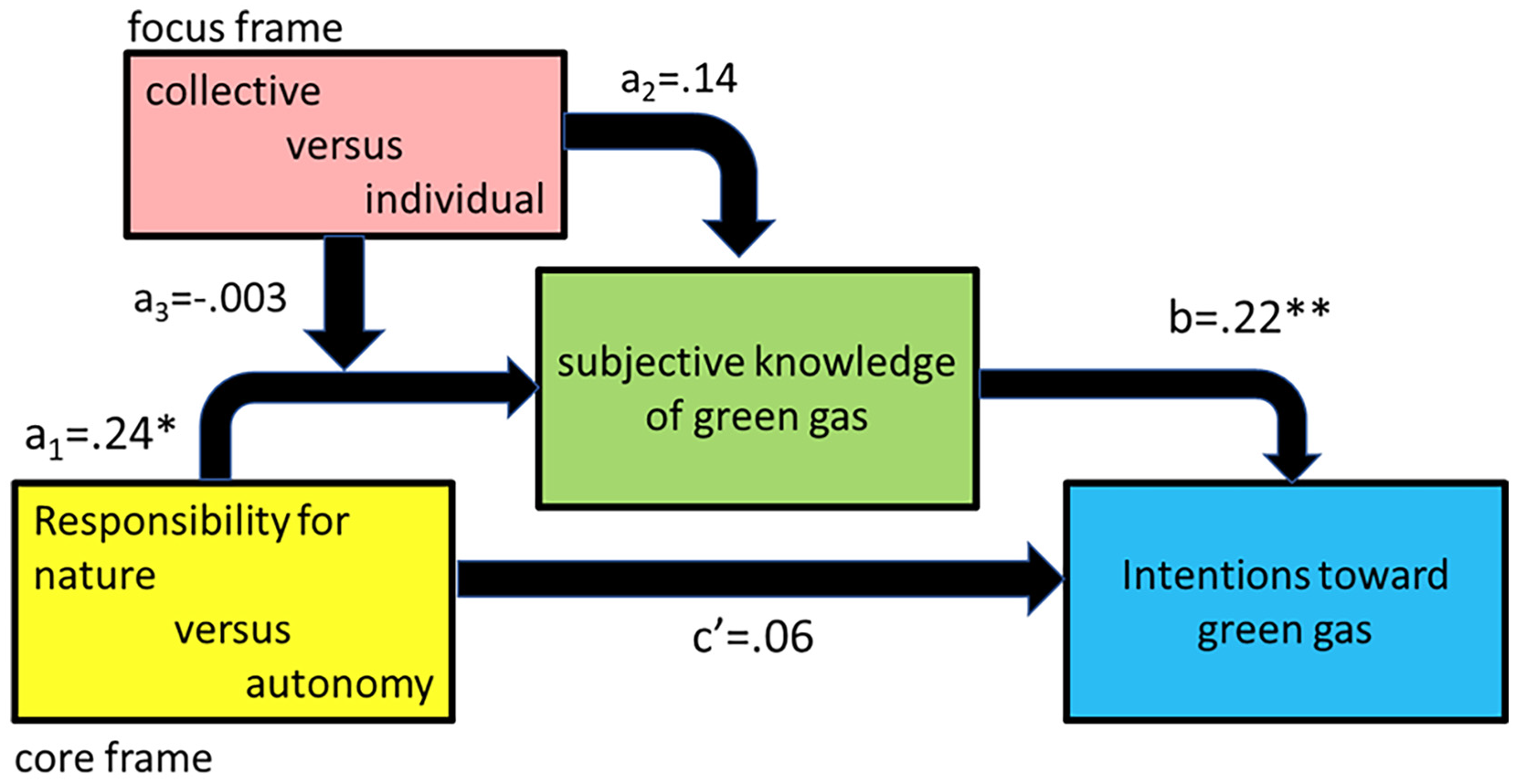
Conceptual model of message framing for the acceptance of green gas technology. The model aims to estimate positive relationships between the concepts. This figure presents the model as well as the estimated parameters resulting from our survey and analyses. The core frame (responsibility for nature versus autonomy) is assumed to positively affect the intentions toward green gas in terms of the intention to accept or to use. The effect is mediated by subjective knowledge of green gas. The focus frame (collective versus individual) is hypothesized to moderate the relationship between the core frame and the personal understanding of green gas. We expect that the focus frame positively affects SK. The symbols used refer to the parameters of the moderated mediation analysis, the main results of which are also given. The full results are presented in Table B2 (Appendix B). The estimates are discussed in the results and discussion section.
We used the model to investigate if and how different types of message framing of green gas technology can contribute to more acceptance of that technology. We explore the acceptance of a green gas facility in a rural environment and investigate the influence of the two different message frames on such acceptance.
Materials and Methods
Sample
The sample for this study was a group of Dutch people, 18 years old or older, living in the countryside. Data on the degree of urbanization of zip code areas were obtained from the Dutch Central Bureau of Statistics and used to select sites that are low urban (500–1000 addresses per km2) to non-urban (<500 addresses per km2). The study was distributed in April 2021 to a survey panel by an independent ISO-26362-certified survey agency.
Participants were selected by zip code area, and one participant per household was allowed. In total, 441 individuals participated in the study. The input of 38 respondents was discarded because it took less than 2 minutes and 30 seconds to complete the questionnaire, indicating poor reading and unreliable answers. Therefore, the survey panel used for analysis consists of 403 respondents. Missing values (in all cases but one ranging from one to seven) were due to a question being skipped by the respondent. Due to a technical issue, from only 275 respondents the precise age was obtained. Therefore, age was not taken into account in further analyses.
Design
All respondents were given general information about a green gas facility. We presented a green gas facility in the idea- and orientation phase: a feasible option that the local community had not yet realized. The contents of the information were checked extensively by both specialists and laypersons to ensure factual correctness and readability. The information started with the need for alternative energy sources for the energy transition, followed by a description of how green gas can be made—from collecting biomass to using green gas at home. The general information ended with the main characteristics and considerations in establishing a green gas facility, presented as pros and cons (presented in Appendix A).
The study utilized a 2 × 2 experimental design. Different general information was provided to the respondents. In the first dimension, the core message differed in the emphasis on green gas. According to the energy value frames identified, two conditions were used: autonomy in energy supply and responsibility for nature (Demski et al., 2015). In the second dimension, the focus frame differed between individual and collective. For the condition “individual,” the message contained “for yourself,”“self,” and “own household.” For the condition “collective,” the message stressed “for the community” and “together.” The collective focus frame emphasized a group and discussed the benefits in terms of the benefit for the community. In contrast, the individual focus framed the text in terms of an individual household.
Measures
The measures used are presented in Table 1. Data include the number of statements and scale points per variable. All variables were measured on a 5-point scale with the inclusion of an “I do not know”-option where deemed appropriate.
Measures, Number of Statements, and Measurement Scales Used.

Note. +, “I do not know” added as a possibility.
To assess the identification with the community (IC) (Kalkbrenner & Roosen, 2016), the statements used were, “I feel strongly about the community where I live” and “I often tell others that my community is a nice place to live.” The view on the importance of the energy transition (IET) was measured by asking about switching to renewable energy sources and the opinion on the importance of national independence (INI) in meeting the future energy demand. Respondents were then asked to indicate agreement with the statements.
The intentions toward green gas (IGG) included statements about the intention to accept a green gas facility in the local community and to use green gas as a consumer (Van Prooijen, 2019). Attitude toward green gas (AGG) encompassed five bipolar terms, such as not affordable-affordable (Neubig et al., 2020).
Subjective knowledge (SK) was assessed with two statements: “I understand the process of biogas plants and green gas production” and “I can properly assess the pros and cons of choosing green gas plants.” (Liu et al., 2018).
Statistical Analysis
All statistical analyses were conducted in SPSS v. 27, using bivariate Pearson correlations. The PROCESS v.3.5 model 7 (Hayes, 2018) was used to assess differences between the conditions in the 2 × 2 design with a moderated mediation analysis using bootstrap with 5,000 resamples (Preacher & Hayes, 2008).
Results and Discussion
Profile of Respondents
The descriptive statistics of the respondents (N = 403) are given in Table 2. All respondents live in rural areas. There is an equal distribution between men (51%) and women (49%). The average age was 61 years, with a standard deviation (SD) of 15, ranging from 18 to 90 years. The Dutch national average age is about 42 years, indicating that people living in rural areas tend to be older than average, in line with the countryside age distributions of other European nations (EuroStat, 2020). About 30% of the respondents have completed an education equal to vocational training, and 33% are higher educated. Most respondents (74%) have an energy contract, including gas, and do not consider their supplier sustainable or “green.” Only four respondents are member of an energy cooperation, and ten respondents heat their home without gas.
Descriptive Statistics. Profile of the Respondents Based on Socio-Demographic Characteristics and the Distribution of the Respondents Over the Four Message Frame Variants.

Due to a technical issue, the age of 275 rather than 403 participants was obtained. Age was measured with an open question and categorized into three groups.
Views on Energy Transition and a Local Green Gas Facility
Data on the identification of the respondents with their community and their views on an energy transition are presented in Table 3. Results show that, on average, respondents identify highly with their community (MIC = 3.8, SDIC = 0.8) and see great importance in an energy transition (MIET = 4.0, SDIET = 1.0) and a national independence of the energy supply (MINI = 4.1, SDINI = 0.9). Communicators should acknowledge that, on average, the target audience recognizes the importance of the energy transition in general, especially concerning national independence. Due to recent geopolitical developments, the latter issue may have become even more critical after completing our survey.
Correlations Between Context Variables.

p < .01.
The variable “intentions toward green gas” (IGG) involves accepting a green gas facility in the local community and the willingness to use gas from such a local gas facility when the opportunity arises. The intentions toward green gas are positive for 36% and 38% of the respondents, respectively (Figure 2). The groups with more negative intentions comprise 29% and 21% of the respondents (Figure 2). Such negative intentions give reason to consider the occurrence of resistance to implementing a green gas facility in a rural community as realistic. This possibility warrants a careful approach when starting a new green gas project. The group with a neutral view is more difficult to assess in advance: people could either be persuaded by possible local benefits or display negative intentions when plans become more concrete, and a location is selected.
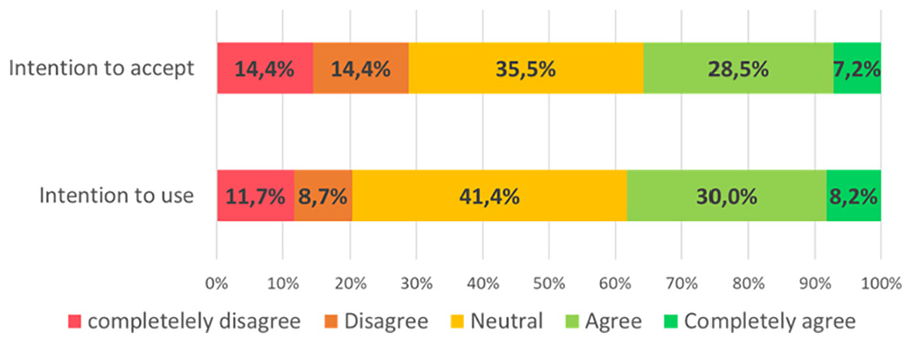
Intentions toward green gas. The variable “intentions toward green gas” is subdivided into the acceptance of a green gas facility in the local community and the willingness to use green gas when available.
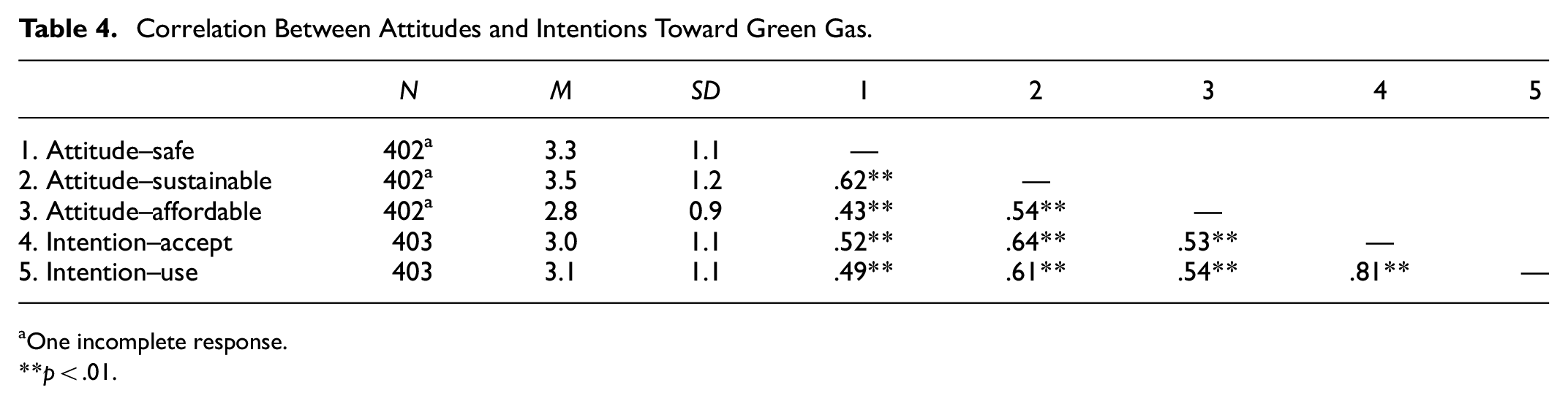
The respondents’ attitudes toward green gas were assessed after reading the green gas information. The attitude toward green gas was investigated by distinguishing three aspects: safety, sustainability, and affordability, and correlated with the intentions toward green gas (Table 4). The analyses show that, on average, the attitude toward green gas being sustainable is the highest (3.5) above the midpoint (Table 4). Furthermore, the significant (p < .01) correlation between attitude–sustainable and the two aspects of intentions toward green gas, acceptance (R = 0.64) and use (R = 0.61), are relatively high (Table 4). The association with sustainability is vital for the intention to accept and consider the use of green gas.
Correlation Between Attitudes and Intentions Toward Green Gas.
One incomplete response.
p < .01.
To further investigate the nature of the intentions toward green gas, we explored the differences between people with dissimilar intentions toward green gas (IGG calculated as the average of the intention to accept and the intention to use) relative to their views on the context variables evaluated above (Table 3). Respondents were split into groups A, B, and C based on their IGG score (Figure 3), and the score context variables and attitude dimensions were plotted. Statistical details are presented in the legend of Figure 3 and Table B1 (Appendix B). There is little difference between the groups in identification with the community, although group C (higher intentions toward green gas) attributes more importance to the energy transition. More differences are apparent in attitudes toward safety, sustainability, and affordability. Group C is particularly optimistic about the sustainability of green gas, whereas group A (lower intentions toward green gas) is particularly pessimistic about the assumed affordability of green gas.

Differences based on the intentions toward green gas (IGG) on a 5-point scale. The mean and standard error of the scores on the intentions toward green gas (IGG) of three groups are plotted for the three context variables and three attitude dimensions. Group A (N = 125; score <3), the lower intentions toward green gas; Group B (N = 177, score 3–4), average intentions toward green gas; Group C (N = 101; score >4), higher intentions toward green gas. Table B1 in Appendix B provides information on the statistical significance of the differences between these groups.
The results show that the target group tends to have neutral to positive intentions toward green gas in their community. There is, however, also a minority group that has a negative connotation concerning green gas. So, initiators of any green gas project in a community should reckon with the occurrence of resistance. All consider the energy transition and a national independence of energy supply as important. Geopolitical developments after the data collection will likely have fueled this feeling of importance. There is, therefore, less need to communicate about the importance of an energy transition.
Moreover, green gas is considered sustainable yet expensive. Green gas is, with the notable exception of 2022, more costly than fossil gas, so communication should be clear on expected costs and revenues and outline the negative aspects and lack of availability of fossil gas relative to alternatives. The attitude that green gas is sustainable is highly correlated with positive intentions toward green gas acceptance and use. Sustainability is, therefore, vital for introducing a green gas facility. It should be a focal point in the information provided to members of a community considering starting a green gas facility. Such sustainability is somehow threatened by opposite information. . In that case, the contradiction is likely to impact the opinion of the group with more positive intentions toward the acceptance and use of green gas.
The Influence of Message Frames on the Intentions Toward Green Gas
Our conceptual model (Figure 1) describes the hypothesized relationships between a message frame context and the subjective knowledge (SK) of green gas as influenced (moderated) by the focus frame. Subjective knowledge (SK) also moderates the intentions toward green gas. We have examined the model using a standard moderated mediation analysis. The main results are given in Figure 1, and all details are presented in Table B2 (Appendix B).
Subjective knowledge is significantly (B = 0.24, p = .04) higher for the core frame responsibility for nature compared to autonomy (Condition responsibility: MSK = 3.68, SDSK = 0.85; Condition autonomy: MSK = 3.45, SDSK = 0.81). No significant difference was seen for the focus frame (B = 0.14, p = .20; Condition individual: MSK = 3.49, SDSK = 0.87; Condition collective: MSK = 3.62, SDSK = 0.80). Also the interaction between core frame and focus frame is not significant (B = −0.003, p = .98). Subjective knowledge has a positive relation with acceptance (B = 0.22, p < .01). It shows that respondents who think they understand the topic well tend to have more positive intentions toward green gas. However, this is a partial moderation because the responsibility for nature core frame shows an indirect effect on acceptance only in case the message is presented with the focus frame “collective” (LLCI = 0.003, ULCI = 0.071): the relationship between core frame and positive intentions toward green gas is only significant in the focus frame “collective.”
The responsibility for nature frame increases the subjective knowledge of green gas. Positive intentions toward green gas are positively related to having more subjective knowledge. This result stress the importance of a core message of responsibility for nature. They indicate that a communication strategy about green gas should emphasize the core frame of responsibility for nature. This suggestion agrees well with recent work on the framing of different energy sources and the overall importance of a sustainability frame (Palomo-Vélez et al., 2021).
The findings regarding the effects of framing may indicate the mechanism of processing fluency (Kim & Jang, 2018). This explains the difference between the core frames by the relative ease of information processing for the individual respondent. The importance of processing fluency was demonstrated for sustainable behavior and other areas of message framing (Huang & Li, 2021). The core frame with a collective focus may make the complex information about a green gas facility easier to process because it presents the respondent’s best-understood and most appealing argument. It shows the value of the approach of message framing in communication research on the energy transition.
The results and recommendations are based on a relatively large (N = 403) survey in a 2 × 2 design with two energy values and a focus frame with two variables. The significant effect of the difference in the core message frame should be confirmed in other studies. Also, message frames based on additional energy values (Demski et al., 2015) and trends could outline the effect of such frames in different stages of establishing a green gas facility. In addition, value congruence with personal values (Van Dijk et al., 2019) or geopolitics could be considered in future studies.
Conclusions and Future Outlook
Evaluation of green gas views can be fruitfully combined with assessing message frames in the same audience for a communication strategy. Given possible resistance to green gas, a careful approach is warranted, notably addressing the -largest- group with a neutral opinion. The association with sustainability in a core message of responsibility for nature promotes accepting and considering using green gas, provided it is presented in a collective frame. Processing fluency may make complex information about green gas easier to process when presented as responsibility for nature with a focus on the collective. As a green gas facility needs the collaboration of numerous households and local entrepreneurs (farmers, landscape managers), it may require additional ways of community engagement. For larger communities, communication will be even more important to create a sense of community and ownership.
Another major challenge is comparing green gas with other strategies for renewable energy, such as electrification or heating grids. Possibilities will depend on local conditions and preferences. For comparisons between renewable energy options, discrete choice experiments help evaluate individuals’ energy choices (Cárdenas-Álvarez et al., 2022). Future research into the best communication methods will be essential in providing the correct information in the best format to aid people in making such choices. A balanced communication strategy will help address the relevant issues by explaining local green gas production’s potential benefits and concerns and how these relate to dominant core values in the energy transition debate.
Footnotes
Appendix A
The text in the last section of the general information about green gas (Table A1; translated from Dutch) features four advantages and four disadvantages of green gas. The first advantage includes the different framings of green gas in the communication.
Appendix B
Table B1 presents the one-way ANOVA analysis of the differences between groups based on their intentions toward green gas (IGG). IGG is shown as the average of intention to accept and intention to use. Respondents are split into three groups based on the IGG score: (1) the group with the lowest intentions toward green gas (MIGG < 3); (2) the group with neutral intentions toward green gas; (3) the group with the highest intentions toward green gas (MIGG > 4).
Acknowledgements
The authors thank Monica Blaga, Astrid Berg, Jan Bekkering, and Robert Goedegebure for discussion and support.
Declaration of Conflicting Interests
The author(s) declared no potential conflicts of interest with respect to the research, authorship, and/or publication of this article.
Funding
The author(s) disclosed receipt of the following financial support for the research, authorship, and/or publication of this article: This work was financed through the RAAKPRO program of the Taskforce Applied Research SIA, part of the Dutch Organization for Scientific Research (NWO). Contributions from GasTerra, Bioclear Earth, Dirkse Environmental Technology, Enki Energy, New Energy Coalition, the Province of Drenthe, RUG, and Hanze University of Applied Sciences to this project are gratefully acknowledged.

Data Availability Statement
Data of this study are available upon request from the corresponding author.