




Abstract
In Korea, there are cases where nurses use abusive language while teaching new nurses. Nursing students who observe and experience this kind of violence question themselves if they will be able to perform well in such an environment. This descriptive research study examined the mediating effect of negative emotions and the regulated mediating effect of resilience in the relationship between indirect experiences of violence and career identity. Junior- and senior-year students in the nursing departments of nine universities located in Gyeonggi Province and Seoul were recruited using snowball sampling from August 1st to August 31st, 2021. A total of 254 participants completed the questionnaire. Data were analyzed using the SPSS PROCESS macro. The factors that affected career identity were indirect experience of violence (β = −.1978, p = .0001), negative emotions (β = −.2364, p < .0001), and resilience (β = .3107, p < .0001). Resilience (β = −.1113, p = .0112) had a moderated mediating effect on negative emotions. The index of moderated mediation of negative emotions and resilience was statistically significant at −0.0284 (95% CI [−0.0549, −0.0046]). As a result of this study, when students see a violent situation, they have negative emotions such as fear of making a mistake, and their confidence in nursing performance decreases. In order to avoid this situation, they avoid their career path. In this study, it showed that the greater the resilience, the greater the ability to overcome it. Violence itself needs to be improved, and resilience strengthening programs are needed for children and women exposed to violence.
Plain language summary
Before 2018, there were incidents in South Korea where service industry workers directly interacting with customers in department stores and large supermarkets took their own lives due to customer harassment. In October 2018, protective measures for employees working in face-to-face customer encounter settings, proposed in the Occupational Safety and Health Act, were legislated in South Korea (the “Third-Party Harassment Protection Legislation [THPL]”). This is a descriptive study to test whether the application of the THPL in the workplace has contributed to the protection of workers’ health. After the adoption of the THPL, the level of implementation in workplaces increased but was still not high. Implementation of the THPL was effective in harassment from customers (RHC) through changes in social awareness (CSA), and reduction in RHC affected the perceived health benefits (PHB). The implementation of the THPL indirectly affected PHB through CSA and RHC. The implementation of the THPL did not directly reduce customer harassment but had an indirect effect through CSA. Based on these findings, laws need to be publicized after their implementation to improve social awareness. It is necessary to promote the voluntary participation of employers in increasing the extent of implementation of the THPL. Government support is required for businesses that are difficult to manage. When implementing policies pertaining to workers’ health, it should also be explored whether workers’ health has improved over time.
During university education, nursing students acquire knowledge, skills, and competencies needed in the clinical field through the study of nursing theory and practical experience. Each nursing student in South Korea is required to perform at least 1,000 hr of clinical training over the course of 2 years during their third and fourth years of study (Korean Accreditation Board of Nursing Education, 2021). Clinical training is an important process for acquiring professional knowledge and skills and for performing and reflecting on actual nursing care in various clinical cases in the field (Shin et al., 2017). Furthermore, by directly observing the attitudes and skills of nurses in clinical training, nursing students can establish their identities as nurses and develop into nursing professionals (H. Lee et al., 2011). It is important for students to adapt to and cope with many scenarios they can encounter in the clinical field. As such, students who fail to respond appropriately using their independent judgment may experience confusion about their identity in the nursing profession, loss of self-confidence, and low satisfaction with clinical training (Yu, 2015).
Nursing students experience various stressful situations not associated with learning in the clinical field (Vignato et al., 2021), including verbal violence from fellow nurses, which is considered a form of “taeum.”Taeum is a term commonly used in the nursing field in South Korea to refer to workplace bullying, which involves harassment or violence among nurses (Choeng & Lee, 2016; Seo et al., 2012). Workplace bullying manifests in the form of violent language, physical violence, public shaming, or personal attacks under the guise of education (D. Kwon & Lee, 2018). Workplace bullying can cause physical symptoms such as psychological intimidation, lethargy, headaches, impaired work efficiency, decreased quality of patient care, and increased turnover intention among nurses (Jeong, 2018).
Indirect experiences of violence negatively affect career identity (Jeon, 2018; Lim et al., 2016), and the formation of negative emotions is a mediating factor in this process. In addition to direct experiences of violence, by witnessing and recognizing workplace bullying by senior nurses in the clinical field, nursing students indirectly experience negative emotions felt by nurses that adversely affect their clinical careers (Oh et al., 2019). In fact, nursing students who have witnessed workplace bullying by nurses in the clinical field often fear future workplace bullying when they become nurses after graduation (D. Kwon et al., 2018). Therefore, witnessing workplace bullying in the clinical field can lead to the formation of negative emotions among nursing students, thereby negatively affecting their career identities.
Despite the negative experiences in clinical training, many nursing students start their careers as clinical nurses after graduation, and resilience is a positive mediating factor. Resilience is a personal developmental process during which one successfully overcomes stressful and difficult situations (Stephens, 2013). Resilience refers to the ability to recover from adversity, bounce back, or successfully cope with adversity, in addition to the ability to use environmental resources effectively and to take advantage of adversity as an opportunity for growth and maturity (Earvolino-Ramirez, 2007). In previous studies of nursing students, those with high resilience had higher satisfaction with their major, practical training, and advanced clinical performance (D. J. Kim & Lee, 2014; Y. S. Park & Kwon, 2013); demonstrated good communication and problem-solving skills (Ji et al., 2013); and had low anxiety and stress (Y. K. Lee & Kim, 2014). The experience of success after developing resilience enhances the adaptive capacity and well-being of nursing students (Gillespie et al., 2007; Stephens, 2013).
Indirect experience of violence in clinical training affects the intentions of nursing students to enter the clinical nursing field. Negative emotions result in negative outcomes, while resilience has positive effects. A previous study aimed to enhance students’ resilience to help them overcome negative psychological experiences (K. T. Kim, 2014), and another suggested that resilience was needed to overcome perceived negative experiences (Jin et al., 2021). In other words, there is a relationship between negative emotions and resilience.
Therefore, this study aimed to investigate whether negative emotions have a mediating effect on the formation of career identity in nursing students and indirect experience of violence during clinical training and whether resilience moderates negative emotions. Through this study, we hoped to provide basic data to develop nursing education programs that encourage positive career identity. The purpose of this study was to identify the mediating effect of negative emotions and the moderated mediating effect of resilience on indirect experience of violence during clinical training and the intention to enter the clinical field among nursing students. The specific goals were as follows:
To identify the magnitude of the indirect experiences of violence, negative emotions, resilience, and career identity in nursing students during clinical training.
To investigate the correlations between the magnitude of the indirect experiences of violence, negative emotions, resilience, and career identity in nursing students.
To confirm the mediating effect of negative emotions and the moderated mediating effect of resilience in the relationship between the magnitude of the indirect experiences of violence and career identity in nursing students.
Methods
Study Design
According to social learning theory, which is a sociopsychology theory, indirect experiences affect learners (Bandura & Walters, 1977). Based on the customer relationship building theory of Noble and Phillips (2004), Ha and Janda (2011) reported that relationship avoidance occurs when expectations are not met at the time of relationship formation.
Based on these two theories, we assumed that negative emotions about becoming nurses can be formed by nursing students in the clinical field just through witnessing violence. Despite these experiences, one factor—resilience—enables students to endure stressful situations and produce original positive results (Liu et al., 2017). Based on these research results, we developed the following research model (Figure 1).

Conceptual model of the moderated mediation analysis.
In this model, negative emotions have a mediating effect on the willingness to enter the clinical field among nursing students who witness the workplace bullying of others in clinical training; resilience, however, moderates the mediating effect.
The specific research hypotheses of this study are as follows:
First, negative emotions will mediate the relationship between indirect violence experience and career identity.
Second, resilience will have a moderated mediating effect between negative emotions and career identity.
Study Participants and Data Collection
Institutional Review Board (IRB) approval was obtained prior to data collection. In this study, which took place from August 1 to August 31, 2021, third- and fourth-year nursing students enrolled in the nursing departments of nine universities located in Gyeonggi Province and Seoul were selected through convenience sampling using the snowball method, in which participants recruited their friends as potential participants. Gyeonggi Province and Seoul have the highest concentration of hospitals and universities in South Korea, especially large hospitals. Therefore, Gyeonggi and Seoul were selected as the survey areas for this study. Based on the structural model requiring a minimum of 200 people and considering potential dropouts, 260 people were selected, and a total of 254 people participated in the survey. If there was a missing answer in the online survey, the survey was considered to have been incomplete, and all 254 participants were included in the analysis. The purpose and methods of the study were explained, and the participants’ informed consent for participation in the study was obtained. The questionnaires were collected through an online survey. A total of 62 questions was included, including general characteristics, and the survey took about 20 min. Since indirect experiences of violence are recognized during clinical training, the participants consisted of third- or fourth-year students, and first- and second-year students who had not experienced clinical training were excluded.
Measurements
Indirect Experiences of Violence
To assess indirect experience of violence among nursing students, we used an instrument originally developed by Lee and Lee (2014) and modified and supplemented by Choi (2020) through in-depth interviews with nursing students. The instrument consisted of 15 questions on verbal/non-verbal violence, workplace harassment, and physical violence. The items were scored on a 5-point Likert scale: 1 point for “not at all,” 2 points for “disagree,” 3 points for “neutral,” 4 points for “agree,” and 5 points for “strongly agree.” Higher scores indicate a stronger indirect experience of violence among nursing students. The Cronbach’s α of the instrument was .890.
Negative Emotions from Indirect Experience of Violence
Through the discussion with experts in the field of psychiatric mental health nursing and researchers, we developed an instrument consisting of four items to evaluate negative emotions experienced by nursing students as a result of indirect exposure to violence: “I am scared to work as a new nurse,”“I am afraid that I may make a mistake as a new nurse,”“I hate working in the hospital,”“I am losing confidence that I can work as a clinical nurse.” The answers were rated on a 5-point scale: 1 point for “not at all,” 2 points for “disagree,” 3 points for “neutral,” 4 points for “agree,” and 5 points for “strongly agree.” The Cronbach’s α of the instrument was .652.
Resilience
Resilience was assessed using the modified version of the Korean Connor-Davidson Resilience Scale (K-CD-RISC) revised by G. S. Lee (2018) after consultation with a nursing professor. The K-CD-RISC was presented by Baek (2010) by adapting the Connor-Davidson Resilience Scale developed by Connor and Davidson (2003).
This instrument has a total of 22 items, including seven items on tenacity, eight on persistence, four on optimism, two on control, and one on spirituality. Each item was scored using a 5-point Likert scale: 1 point for “not at all,” 2 points for “disagree,” 3 points for “neutral,” 4 points for “agree,” and 5 points for “strongly agree.” Higher scores indicate higher resilience. The reliability of the instrument at the time of development was indicated by a Cronbach’s α of 0.89. The Cronbach’s α was 0.94 in the study by G. S. Lee (2018) and 0.804 in the current study.
Career Identity
Career identity was assessed using a 14-item instrument by Y. H. Kwon and Kim (2002), who adapted and revised the career identity test for nursing students created by B. Kim and Kim (1997). B. Kim and Kim (1997) adapted and revised a subscale of the My Vocational Situation survey that included an 18-item career identity test developed by Holland et al. (1980) to measure career identity to reflect the situation of university students in South Korea. The items are rated on a 5-point Likert scale: 1 point for “not at all,” 2 points for “disagree,” 3 points for “neutral,” 4 points for “agree,” and 5 points for “strongly agree.” Due to the negative meaning, the items were measured inversely, with higher scores indicating a stronger willingness to enter the clinical field. The Cronbach’s α was .841 for this instrument.
Data Analysis
The data were analyzed using SPSS for Windows (version 26.0; IBM Corp., Armonk, NY, USA). For the general characteristics and measurement variables of the participants, real numbers with percentages and means with standard deviations were calculated. Cronbach’s α coefficients were used to represent the reliability of the measurement instrument. Differences in career identity according to general characteristics were analyzed using the independent sample t-test and descriptive statistics. The independent sample t-test, one-way analysis of variance, and post hoc analysis were conducted with the Scheffé test for differences in value between the measurement variables according to general characteristics. Pearson’s correlation coefficients were calculated to analyze the correlations between variables.
The SPSS PROCESS macro model 14 devised by Hayes (2017) was used to examine the mediating effect of negative emotions and the moderated mediating effect of resilience in the pathway of indirect experience of violence affecting career identity. To verify the significance of the mediating effect and the moderated mediating effect, a significance test was presented through a confidence interval using the bootstrapping method. In the bootstrapping method, sampling is repeated k times, and it, therefore, does not assume the distribution form of the mediating effects. In this study, the 95% confidence interval (CI) was determined by extracting 5,000 bootstrap samples. To reduce the problem of multicollinearity in the case of a moderated mediating effect and to facilitate interpretation, the measured variables were standardized in the analysis of the mediating effects and moderated mediating effects. In the case of mediating effects of moderated variables, verification was performed at the high, medium, and low levels. The criteria for the three levels were indicated by percentile values of 16, 50, and 84 in PROCESS, which were the values used in the current study.
Results
Demographic Characteristics
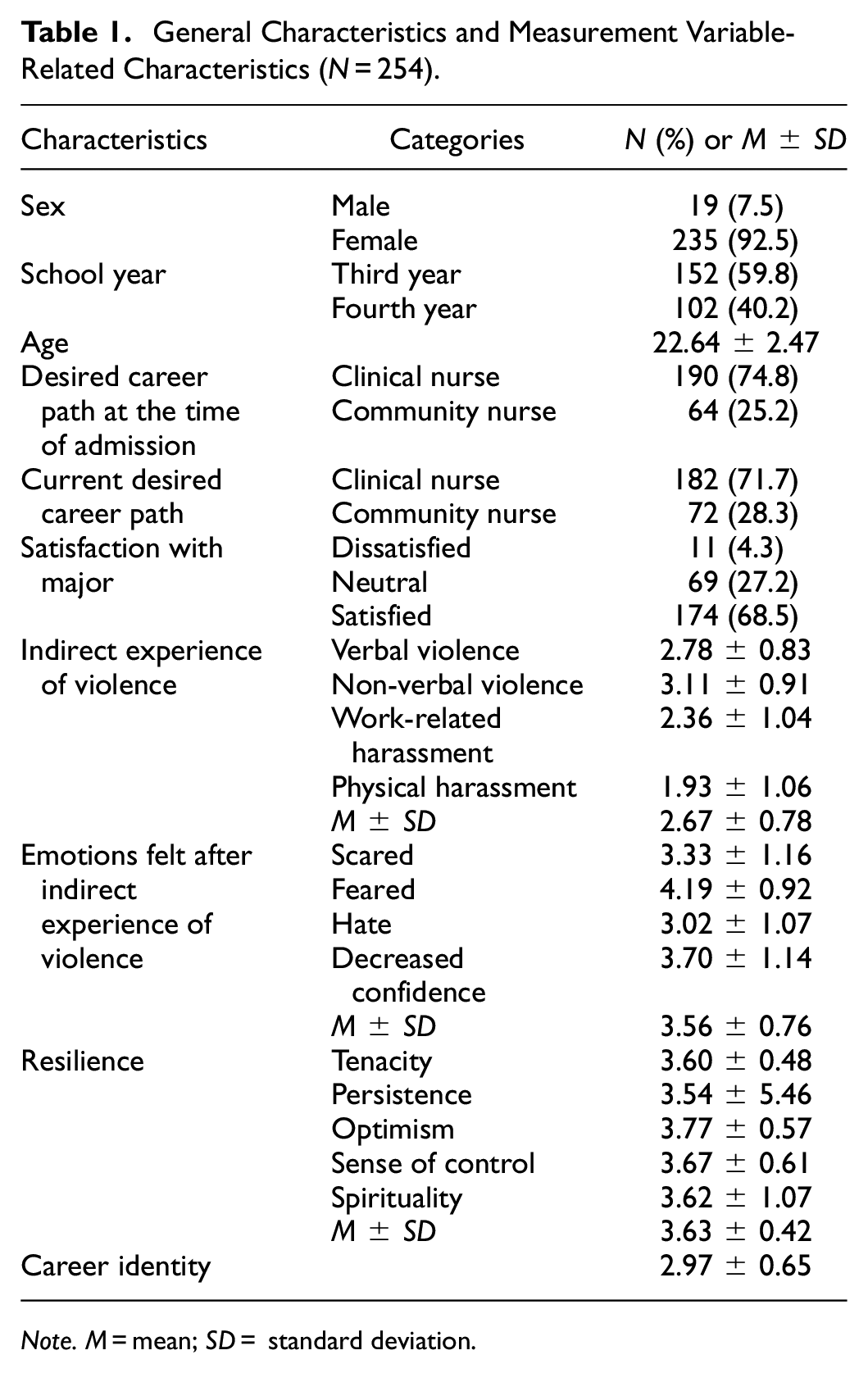
The general characteristics of the participants are shown in Table 1. Women comprised 92.5% of the participants. A total of 59.8% were third-year students, and fourth-year students made up 40.2% of the participants. The average age was 22.46 years. A total of 74.8% of the participants had a desired career path of becoming a clinical nurse at the time of admission, and 71.1% of the participants desired to become a clinical nurse at the time of the survey. Regarding satisfaction with their major, 4.3% of the participants were dissatisfied, 27.2% were neutral, and 68.5% were satisfied.
General Characteristics and Measurement Variable-Related Characteristics (N = 254).
Note. M = mean; SD = standard deviation.
The average overall score for indirect experience of violence was 2.67 points out of 5 points, with average scores of 2.78 points for verbal violence, 3.11 points for non-verbal violence, 2.36 points for work-related harassment, and 1.93 points for physical violence. For the subcategories of resilience, the average score for tenacity was 3.60 points, 3.54 points for persistence, 3.77 points for optimism, 3.67 points for a sense of control, and 3.62 points for spirituality, with an overall average of 3.63 points out of 5 points. The average score for career identity was 2.97 out of 5 points.
Differences in Willingness to Enter the Clinical Field According to General Characteristics
Differences in career identity were observed related to the current desired career path (t = −2.283, p = .023) and satisfaction with their major (F = 20.990, p < .001; Table 2).
Differences in Career Identity According to General Characteristics (N = 254).

Note. SD = standard deviation. Values with superscript letters a, b, and c are significantly different across rows (p < .05).
Correlations of Measurement Variables
The correlations of the measured variables in this study were as follows: indirect experience of violence and negative emotions (r = 0.248, p < .001), indirect experience of violence and resilience (r = −0.170, p = .007), and indirect experience of violence and career identity (r = −0.379, p < .001). There were statistically significant differences between emotions caused by the awareness of workplace bullying and resilience (r = −0.183, p = .003), negative emotions due to indirect experience of violence and career identity (r = −0.446, p < .001), and resilience and career identity (r = 0.491, p < .001; Table 3).
Correlations of Measurement Variables (N = 254).

The Mediating Effect of Negative Emotions and the Moderated Mediating Effect of Resilience on the Relationship between Indirect Experience of Violence and Career Identity
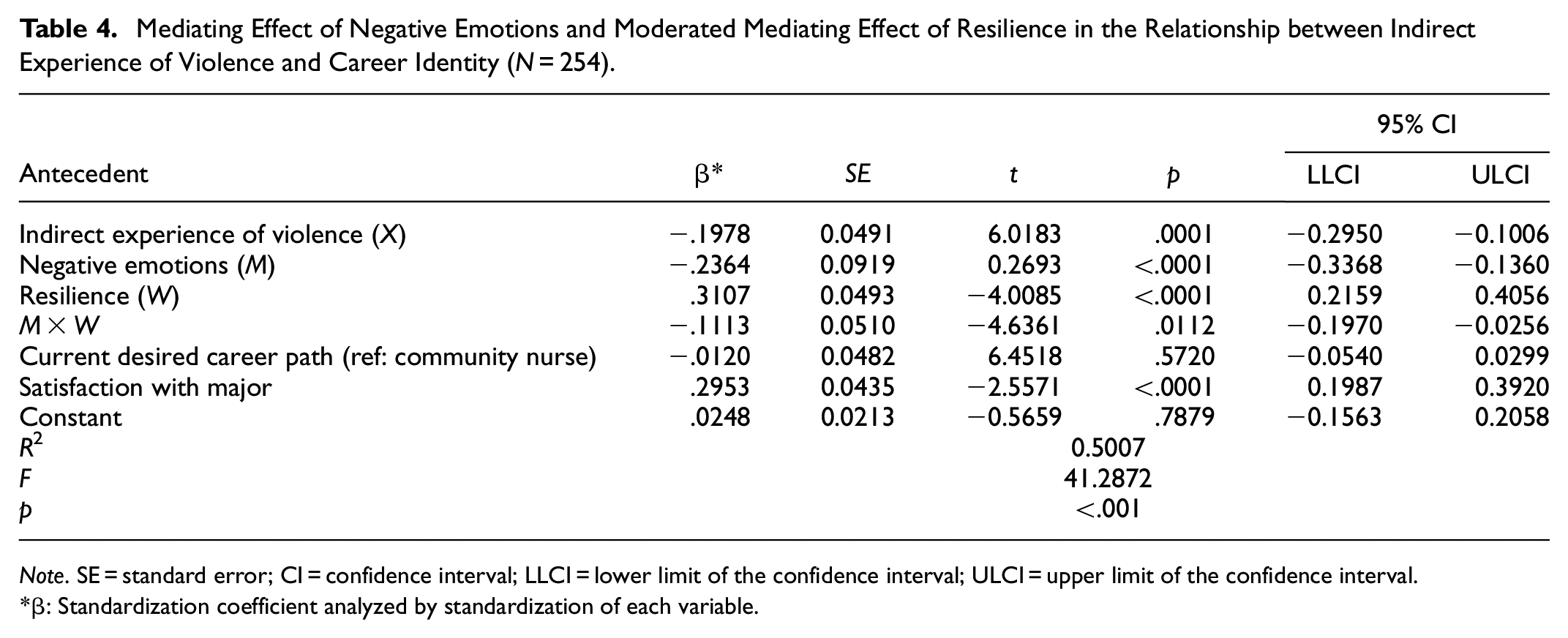
To identify the moderated mediating effect of resilience on negative emotions and career identity, career identity was inserted as an independent variable, negative emotion as a mediation variable, resilience as a moderating variable, and the current desired career path and degree of satisfaction with their major as control variables. Each variable was standardized to reduce the problem of multicollinearity (Table 4).
Mediating Effect of Negative Emotions and Moderated Mediating Effect of Resilience in the Relationship between Indirect Experience of Violence and Career Identity (N = 254).
Note. SE = standard error; CI = confidence interval; LLCI = lower limit of the confidence interval; ULCI = upper limit of the confidence interval.
β: Standardization coefficient analyzed by standardization of each variable.
Negative emotions mediated indirect experience of violence and career identity (β = −0.2364, p < .0001). Resilience had a moderated mediating effect on negative emotions and career identity (β = −.1113, p = .0112). Among the control variables, major satisfaction was statistically significant (β = .2953, p < .0001).
Effects on Career Identity
The direct, indirect, and conditional indirect effects of indirect experience of violence on career identity were identified. To assess the level of the moderated mediating effect, we used percentile values of 16, 50, and 84 provided by the PROCESS macro in the analysis (Table 5).
Direct, Indirect, and Conditional Indirect Effects on Career Identity (N = 254).

Note. SE = standard error; CI = confidence interval; LLCI = lower limit of the confidence interval; ULCI = upper limit of the confidence interval.
To verify the significance of the mediating effect and the moderated mediating effect, a significance test was presented through a confidence interval using the bootstrapping method.
Index of moderated mediation: Negative emotion × resilience.
The direct effect of indirect experiences of violence on career identity was −0.1978. For the indirect effect, negative emotions produced mediating effects on career identity of −0.0329 points when resilience was 16%, −0.0545 points when resilience was 50%, and −0.0884 points when resilience was 84%. Both direct and indirect effects were found to be significant since they did not include 0 in the lower or upper limits of the 95% CIs.
The index of moderated mediation for negative emotions and resilience was −0.0284, which was statistically significant, meaning that resilience had a significant moderated mediating effect. In other words, higher resilience was significantly associated with a greater decrease in the effect of negative emotions on career identity, and lower resilience was associated with a smaller decrease in the effect of negative emotions on career identity (Figure 2).

Interaction effect between negative emotions and resilience.
Discussion
This study was conducted to investigate the mediating effect of negative emotions and the moderated mediating effect of resilience in the relationship between indirect experience of violence and career identity among nursing students. Negative emotions were found to have a negative effect on career identity, and resilience had a moderated mediating effect. That is, as resilience increased, the effect of negative emotions on career identity decreased.
In this study, indirect experience of violence had a negative effect on career identity due to negative emotions. In previous studies, although students did not experience violence themselves, witnessing violence by senior nurses in the clinical field had a negative effect on career identity (Jeon, 2018; Lim et al., 2016), because they become fearful of being bullied in the future (D. Kwon et al., 2018). When students see a new nurse make a mistake, their fear of making mistakes increases, and their confidence in nursing performance declines. Another study reported similar findings showing that, as a result of witnessing workplace bullying among nurses, nursing students came to understand that they could be harassed as new nurses in the future and developed a negative image about their futures after graduation (Jang, 2022).
Even though only a few studies have been conducted on subjects who have experienced violence indirectly, several have reported that witnessing or hearing violence perpetrated by others could affect the posttraumatic stress disorder scores of survey respondents (Lee et al., 2021). According to the social learning theory by Bandura and Walters (1977), behavior is acquired by observing the behavior of others without direct rewards through surrogate learning, which is an indirect experience rather than a direct experience. Therefore, witnessing violence leads to emotional responses through vicarious experiences. Ha and Janda (2011) reported that avoidance occurs when expectations are not met at the time of relationship formation. Accordingly, nursing students who experience indirect violence have negative emotions and often avoid beginning their careers as clinical nurses after graduation.
In addition, according to social learning theory, learners who observe the reinforced behaviors of others through indirect experience often perform the same behaviors over time. In children who experience violence, violence is internalized or externalized (Nowakowski-Sims & Rowe, 2017), and it is believed that indirect experiences of violence are also subject to the same process. Indirect experience of violence can be internalized by nursing students and can lead them to perpetrate direct or indirect violence after becoming new nurses to protect themselves from their colleagues (Rosi et al., 2020). When they become senior nurses, they may recreate the act of workplace bullying when teaching new nurses (S. H. Park & Choi, 2022). In other words, when nursing students witness the verbal/non-verbal violence and work-related bullying perpetrated by senior nurses in the clinical field, a culture of violence in the clinical nursing field begins to form.
Nevertheless, many nursing students go on to become clinical nurses. In our study, resilience in nursing students had a moderated mediating effect. Although only a few studies have been conducted on the effect of resilience on violence, resilience had a greater effect on depression than the experience of violence in nursing students in clinical training (Lee & Jang, 2018). In one study, resilience was shown to have a mediating effect and moderated mediating effect on childhood maltreatment and self-harm (Tian et al., 2021), while another study observed only a mediating effect with no moderated mediating effect related to the relationship between discrimination and depression (Luz et al., 2022). In the current study, resilience showed a moderated mediating effect, the magnitude of negative emotion varies according to resilience between indirect experience of violence and career identity, with stronger resilience in incidents that cause negative emotions resulting in a greater degree of strength to overcome them.
To enhance the resilience of nursing students and the victims of workplace bullying, various aspects of resilience must be examined. Fan et al. (2022) showed that coping strategies had a moderated mediating effect on the relationship between violence and resilience and suggested that coping strategies and personal resources should be fostered to improve resilience from exposure to violence (Howard, 1996). Factors that constitute resilience differ between studies and include coping ability, coping behavior, and positivity in a study by Ahern (2006); personal ability, positivity, self-regulation, and spirituality in a study by Connor and Davidson (2003); and the power of positivity to overcome hardship and suffering in a study by J. H. Kim (2019). Programs designed to strengthen resilience can include various elements, including social and emotional literacy, social and emotional behavior programs (Clarke et al., 2014), coping mechanisms, perceived social support (Dufour et al., 2011), assertiveness, empathy, and collaborative skills (Nielsen et al., 2015). According to a systematic literature review, the program itself, rather than the length of the program, has a positive effect on mental health improvement by facilitating the management of daily stressors (Fenwick-Smith et al., 2018). However, no long-lasting effect after the completion of a program was observed, and strategies to improve resilience should be explored.
This study has some limitations since the survey was conducted during the coronavirus disease 2019 pandemic. As such, the clinical training experience of nursing students was limited, and it is difficult to generalize the findings to situations in general clinical training. However, violence witnessed by students still occurred in the critical clinical circumstances of the pandemic. Another limitation of this study was its cross-sectional design, which constrains the examination of causality. In addition, since the convenience sampling method was used, the possibility of bias about the responses of students who indirectly experienced violence could not be ruled out. Previous research has also shown that adolescents exposed to the experience of witnessing violence between parents (indirect violence) have difficulty controlling emotions and they show increased aggressive behavior compared to those who are not exposed (J. Y. Kim & Lee, 2014). It is also possible that cultural ties unique to South Korea may have influenced the results of the study. Hierarchical relationships are an integral part of Korean culture, and the experience of indirect violence was not perceived to be an isolated one, but one that all new nurses experienced. In other words, we cannot rule out the possibility that resilience is built by being part of the same generation. This may have influenced the way nursing students perceive and respond to workplace bullying. The failure to control for Korean cultural ties is a limitation of this study; therefore, it is suggested that further research be conducted in countries with different cultures in order to generalize this study.
On the other hand, adults want to avoid situations in which they experience violence. Nevertheless, existing studies have said that social support is needed to overcome victims who have experienced violence (Tan et al., 1995), however, this study is significant since it demonstrated that stronger resilience was associated with a greater ability to overcome hardship. It would be best if the violence itself was reduced, but as long as there is violence, indirect experiences are inevitable. In that case, resilience can be key when going through these experiences.
Conclusion
This descriptive research study was conducted to investigate the mediating effect of negative emotions and the moderated mediating effect of resilience in the relationship between indirect experiences of violence and career identity.
In the results of this study, first, the overall score was 2.67 points out of 5 for the recognition of indirect violence, with scores of 2.78 for verbal violence, 3.11 points for non-verbal violence, 2.36 points for work-related bullying, and 1.93 points for physical violence. Second, indirect experience of violence, negative emotions, resilience, and career identity was correlated. Third, indirect experiences of violence, negative emotions, and resilience had significant influences on career identity. Fourth, the index of moderated mediation of resilience for the effect of negative emotions on career identity was significant.
According to the results of this study, although it is most desirable for students not to be indirectly exposed to violence, we propose the implementation of a resilience strengthening program that addresses various factors such as the proper recognition of violence among nurses, social and emotional coping measures, and self-assertion so that nursing students can maintain a positive image of nurses and the nursing profession to help students determine their career paths. In addition, the organizational culture of the nursing field should be improved with regard to violence.
Footnotes
Acknowledgements
Not applicable.
Author Contributions
Study conception and design: EC, Data collection: SK, SP, HS, DL, SL, JL, YC, Data analysis and interpretation: EC, Drafting of the article: EC, JK, Critical revision of the article: EC, JK, SI, Final approval of the version to be published: EC, JK, SI
Declaration of Conflicting Interests
The author(s) declared no potential conflicts of interest with respect to the research, authorship, and/or publication of this article.
Funding
The author(s) received no financial support for the research, authorship, and/or publication of this article.

Data Availability Statement
The datasets generated and analyzed during the current study are available from the corresponding author on reasonable request.