



Abstract
This study examines adolescents’ media use after receiving media education, specifically, media education received through Newspaper in Education (NIE) at school and parental mediation at home. The study verifies whether media education stimulates social participation by analyzing adolescents’ self-expression. Data collected through the Korea Press Foundation’s 2019 survey on media use among students aged 10 to 18 in Korea (N = 1,905) were analyzed. Students who experienced NIE used various types of media to access news and consume news more sensibly. This type of news use influenced adolescents to become more active in self-expression and encouraged social participation. In addition, the relationship between parental mediation and social participation is sequentially mediated by adolescents’ sensible news use and self-expression.
Plain language summary
This study aimed to test the effects of Newspaper in Education (NIE) experience and parental mediation on adolescents’ social participation. More specifically, this study analyzed the mechanisms of the effects of NIE and parental mediation experiences on adolescents’ social participation and presented mediated effects models with multimedia news use, sensible news use, and self-expression to investigate their relationships. This study used survey data from the Korea Press Foundation’s Tweens’ and teens’ media use in Korea 2019 (N = 1,905). The results of NIE experience effects can be summarized below. First, adolescents with NIE experience access to news using not only traditional media such as newspapers, TV, and radio but also various digital media such as portals, news media websites, messenger services, and videos available online. Also, adolescents with NIE experience and who receive parental mediation consume news more sensibly than students without NIE experience. Finally, these results showed that media education utilizing news encourages adolescents to be concerned about public issues, which can increase their interest in news and thus help them consume news more actively and critically. Furthermore, the results of this study confirmed the positive effects of NIE and parental mediation in enhancing adolescents’ citizenship. They not only expressed their opinions but also took part in social issues actively and enthusiastically. In other words, self-expression significantly mediates the relationship between NIE, media use, and social participation.
Keywords
Introduction
The need for media literacy education is being increasingly emphasized in the current media environment, where large amounts of information are being easily and widely dissipated owing to the development of digital technology (Bai, 2014; Mun & Lee, 2015). Scholars in the education and communication fields are attempting to find systematic and effective ways to introduce media education to contemporary adolescents growing up in a digital media environment. Most adolescents are not physically and emotionally mature enough to develop their own values. Therefore, media use may have a huge impact on the development of their world views and self-identity (Cortesi et al., 2015). Education is necessary for adolescents to imbibe the right sense of values with regard to political, social, and cultural issues. The development of a strong value system in citizens is the foundation of a healthy democracy.
Previous research on the effects of adolescents’ media education in South Korea mainly focused on the effect of media education in improving youths’ learning ability (Hwang & Kim, 2016; Kim, 2012). However, media education can yield multidimensional effects in addition to improving learning ability (W. Song, 2020). Therefore, this study aims to supplement research on the socio-political effects of media education by exploring the role of media education in the manifestation of citizenship among adolescents.
As with any type of learning, the media education effect can be maximized when public school education and parental education take place simultaneously. For children in their learning years, home and school both play an important role in psychological and emotional development (Jang & Park, 2016). Therefore, this study aims to find out media education effects under two categories: public education offered by the school system and parental education. More specifically, this study explores the effects of Newspaper in Education (NIE)—the most actively implemented media literacy program in public schools—as well as education at home from parents—focusing on parental mediation on adolescents’ media use—on adolescents’ political social participation.
This study utilizes data from the Tweens’ and teens’ media use in Korea 2019 survey conducted by the Korea Press Foundation to understand how Korean adolescents have been impacted by the NIE program and the level of parental mediation as well as to understand the exact influence these two types of media education may have on adolescents’ media use. Furthermore, we aim to examine the effects on adolescents’ self-expression and social participation. The study also contributes to defining the mechanisms of the effects of media literacy education and parental mediation by exploring the mediated effects of multimedia news use, sensible news use, and self-expression.
Literature Review
NIE and Parental Mediation as Media Education
South Korea guarantees equal opportunity in education for all Korean citizens by stipulating that “all citizens have equal rights to education based on one’s own competency” as written under Article 31 Section 1 of the Constitution. Education can be categorized into two large groups—based on who provides education in fulfillment of students’ right to learn; (1) public education offered by the government and (2) parental guidance carried out at home. Thus, this study also distinguishes between media education provided via public (school) education and parental mediation.
In Korea, some schools have implemented a newspaper application education program called Newspaper in Education (NIE), which provides media education. This method of education began in the 1930s in the United States where The New York Times was utilized as a part of the school curriculum to promote literacy. In Korea, the Korean Association of Newspapers introduced the concept of NIE in 1985, and The Korea JoongAng Daily began servicing NIE in March 1995. The Korean Association of Newspapers states that the main objective of NIE is fostering educated democratic citizens and developing critical reading competency. By learning the process of newspaper production, students can be familiarized with how information can be distorted during the delivery process and how to selectively choose information. Recently, the Korean Association of Newspapers and the Korea Press Foundation have produced and distributed NIE educational materials for students to improve their reading comprehension, analyze, compare, and summarize newspaper articles, develop reading and writing habits, and practice expressing their opinions clearly. In addition, the Korea Press Foundation operates an e-NIE online site (https://enie.forme.or.kr). Previous studies show students in their adolescence who have NIE experience show higher positive attitudes toward news, such as news satisfaction and intention for news seeking, compared to students without NIE experience (H. Lee & Lee, 2011). Oh and Nam (2019) found a difference in overall news use between students with and without NIE experience while verifying the educational effects of NIE. In addition, when adolescents receive media education, its effects are maintained throughout their adult years, with those adolescents showing higher news usage in adulthood (Shehata, 2016).
Parental mediation is the main media education at home (J. Kim & Lee, 2019; Shim et al., 2017; H. Shin & Jeong, 2018). Parental mediation can be defined in terms of parents inculcating an awareness of the negative influences of media use in their children (Meyrowitz, 1999), parental intervention between youth and media interaction to decrease the adverse effect of media use (Davidov & Grusec, 2007), and parents guiding their children with regard to proper media use (R. Lee & Hong, 2014). Given the adverse effect of violent and sensational images, especially those depicting reality, on children and adolescents, the need for media education was suggested with the aim of protecting children. Early media education began discussions on “limiting television use” (Hong & Kim, 2013). Research on the effects of parental mediation on adolescents’ media use also needs to be explored to include various perspectives. Parental mediation is a term used to describe communication or interaction between parents and their adolescent children related to media, with most research centered around television viewing (J. I. Ahn, 2003; Lim & Ryu, 2012). In recent times, as the Internet and digital media became part of everyday life, parental mediation effects studies expanded to cover various types of media including smartphones and games in addition to the Internet (Y. Cho & Bae, 2010; Ko & Bae, 2016; S. J. Lee & Jeon, 2010). J. Lee (2004) commented that because parents may assist their children to develop self-identity and world views and cultivate the ability to self-regulate through media education at home, parents need to provide appropriate guidance and mediation on media content to their children. E. Kim and Kim (2008) found that parents’ demand for media education was higher for children in upper grades and their demand has a positive effect on developing media usage rules for children, prevention of harmful media content, and media application skills.
In general, previous studies on media education and media use show media literacy education at school and parental mediation at home influence adolescents’ media use. It is important to focus specifically on youths’ news media use because of the view that the use of news media is viewed as more than a simple individual’s media consumption activity. News media use can help individuals become aware of important social agendas, form an attitude toward them, and act on certain agendas in the society they live in. In this context, Mun and Lee (2015) consider news as a crucial source for democracy and socialization as it channels public agendas to citizens, thus emphasizing the importance of news media use by the youth.
Media education, such as NIE and parental mediation, focus on (1) a variety of different types of media adolescents use to consume news and (2) how sensibly and critically they accept the news (H. Choi & Sung, 2017; W. Song, 2020; Yang et al., 2015). First, looking at the use of multimedia news, the daily average news media use by Korean youths is approximately 60.4 min, which is a relatively low 16.7% of all media use (Korea Press Foundation, 2019). The contemporary media environment provides diverse media and channels through which adolescents can conveniently access various news, yet news consumption is noticeably decreasing while entertainment consumption, such as news and information on celebrities, sports, and games, is increasing (J. Lee & Lee, 2013). Although most of the research has been conducted with adults, studies show that when audiences are selectively exposed to one’s preferred media or information, society becomes polarized (Y. Kim, 2015; Stroud, 2011). Therefore, encouraging adolescents to consume news using diverse media is one of the critical goals of media education. Consequently, it is important to understand how adolescents combine different media for news consumption (Mun & Lee, 2015; Yang & Lee, 2013). A study looking at U.S. teens found that students who receive media education frequently at school consume news using more diverse media compared to students who did not receive media education, and they tend to consume news in a pattern similar to the one their parents use to consume news at home (for example, watching TV news or accessing mobile news) (Edgerly et al., 2018).
Another line of research in media education focuses on how sensibly adolescents accept news, because thinking independently and having the ability to read and process news information critically as opposed to believing blindly in the news information as given is a valuable trait. According to a study of fifth and sixth graders, 80% of the students believe everything on the news without critical judgment (Seo & Lee, 2014), which proves that considering how today’s media environment is flooded with information, it is even more important for adolescents to have the ability to select which news to read and how. In a study analyzing the effects of media literacy activities on elementary school students’ critical thinking, Byun (2013) found that media literacy activities increase critical thinking skills and disposition. In addition, public education, such as NIE, has a positive influence on not only students’ analytical skills but also news selection, critique, and comparative critical thinking skills because it helps students to read newspapers skillfully (S. Lee & Yang, 2017; W. Song, 2020).
Media Usage Behavior, Self-Expression, and Social Participation
Media Usage and Social Participation
Some scholars express concern over adolescents’ lack of interest in political and social issues or their passive attitude toward social participation in their communities, calling for discussions to find ways for adolescents to form citizenship and promote political and social activities in order to build a healthy democratic society (Hwang & Jeon, 2017; Kim & Kim, 2022; Mun & Lee, 2015). However, others view today’s adolescents as members of society who are already capable of making contributions to the positive advancement of a democratic society by executing important roles in social and political life in an environment where they can directly propose policies and social issues that the political society needs (Cheon, 2013; Yoon et al., 2016). In other words, they are part of the “lifestyle politics” generation, who participate in public issues as part of daily life by using online media and individualize political identity and opinions on social issues by using digital media (Bennett, 2008).
The role of traditional channels, such as family, school, and community, that used to influence an individual’s social participation became relatively smaller. In their place, diverse media, for example, TV, internet, and SNS took on the role of important social informants providing current affairs and political information, thus facilitating citizens’ socialization and socio-political participation (Chun et al., 2014; Wang et al., 2024). If voting was the primary political participatory act as a citizen in the past, today, the scope of individual participation is expanding. An individual’s social and political participatory activities are spread over a wide spectrum, encompassing diverse activities such as expressing political opinions, petitioning, donating, volunteering, or commenting on political or social issues using various media such as the internet and SNS (Keum & Cho, 2015; M. Song, 2020). This means that adolescents, who are not old enough to vote, have several opportunities to take part in new forms of expanded socio-political activities via a variety of media.
Among the use of various media, news media use is considered to be a strong and significant predictor of social and political participation. News allows individuals to experience a variety of social issues and has a positive effect on increasing interest in society as a whole (Keum et al., 2004; McLeod & Detenber, 1999), and this type of news media consumption leads to influencing individuals’ values, political awareness, and political participation methods (Keum & Cho, 2015). Similar trends were found with adolescents in previous studies. Adolescents’ news media use had a positive influence on various social and political factors including political interest, political knowledge, political participation, disposition toward the pursuit of diverse opinions or perspectives, and tolerance. When comparing family, friends, and media influence on individuals’ socio-political factors, media influence was the highest (W. Song, 2019).
Studies on adolescents demonstrate the influence on social participatory activities varied based on the characteristics of the media used (E. Kim & Yang, 2013; S. Lee & Yang, 2017; Mun & Lee, 2015). Specifically, print newspaper usage had a positive influence on increasing adolescents’ social participation, while the consumption of online news provided by portal sites did not help with adolescents’ critical thinking or political participation, and struggled to have a direct influence on forming citizenship (S. Lee & Yang, 2017; Y. Lee & Ha, 2015; T. Shin & Kweon, 2013). Scholars have tried to analyze these results, which can be largely divided into two approaches; (1) the concept of multimedia news use and (2) sensible news use. First, multimedia news use refers to the extent to which people use different types of media to consume news (Chun et al., 2014; Diehl et al., 2019). Looking at studies on the effect of the level of multimedia use on social participation, a study on adults reported that the higher the level of multimedia use, the higher the possibility of becoming aware of different opinions, which promotes individuals’ social participation (E. Cho & Cho, 2013). Diehl et al. (2019) found that adolescents with a high multi-platform news index have a tendency to participate more in protest movements including on- and offline social group activities. A study on Korean middle-school students also found that students who belong to a multimedia user group show higher participation in social activities such as petitions and donations compared to other groups (Yu & Kim, 2020).
Research using the second approach focuses on sensible news use. Sensible news use was defined as a way of evaluating and selecting news and critically accepting news (M. Song, 2020). Yu and Kim (2020) reported that because adolescents sometimes lack the ability to select and critically utilize useful or important information in the process of accessing news via online media, individuals’ understanding of social and public issues decreases, and thus does not affect the formation of citizenship. On the contrary, S. Lee and Yang (2017) reported that adolescents who regularly access news through media literacy education, select useful news, and critically understand news show higher community capacity.
Relationship Between Media Use, Self-Expression, and Social Participation
The core goal of media education is to provide the foundation for adolescents to improve communication skills through the process of using various media selectively and critically, express their thoughts and opinions logically, participate in social activities in the community to which they belong, and play an independent role, who can build a healthy democracy as members of society. Recently, certain Korean government ministries—the Korea Communications Commission and the Ministry of Education—announced the “Comprehensive Plan for Reinforcing Digital Media Communication Competency,” which sees communication competency as an important role in cultivating citizenship.
S. Lee and Yang (2017) emphasized that communication ability is an important competency that aids in cultivating citizenship among adolescents and asserted that media education such as NIE should play a role in promoting social interaction and communication among adolescents. They divided media literacy into four subdimensions—access to news (e.g., frequency of regular news use, amount of public news use), discernment of news content (e.g., selective use, critical use), news utilization (e.g., instrumental use, expanding interests, and career exploration), and news responsibility (e.g., responsible news sharing/production behaviors)—and identified their individual influence on communication capabilities. The analysis found that the group who received news application education scored higher points in media literacy subdimensions compared to the group who did not receive news application education, and most of these subdimensions were found to increase in proportion to their communication capabilities (S. Lee & Yang, 2017). In other words, through media education, improvements occur in adolescents’ use of media, information acquisition, media application, and these improvements positively influence the individual student’s ability to express their opinion.
When adolescents accept diverse information sensibly by learning to use the media accurately through receiving media education—such as the NIE program provided by the school and parental mediation—they naturally develop an interest in various social issues, and this will lead to increasing their interest in those social issues and help build their logical thoughts about the concerns. In turn, these thoughts may increase their motivation to express a personal opinion. However, studies empirically measuring how often adolescents express their intentions are scarce. Therefore, this research examines how media use influences adolescents’ self-expression of intention based on actual experiences of students expressing their opinions in the internet environment. The online environment allows people to express their feelings and thoughts freely while reducing the associated psychological burden (M. Kim & Jang, 2020), and thus enables students to express their opinion more freely, which is why this study focuses on self-expression in an online environment.
Related literature suggests that interpersonal communication or acts of expressing opinions have a positive influence on social and political participation. Studies have found that frequent interpersonal communication promotes on- and offline social and political participation and internet news usage contributes to political participation indirectly by boosting political conversations and online bulletin-board writing (Min, 2008). Compared to adolescents who do not read newspapers, adolescents who read traditional (paper) newspapers show higher social participation awareness where they directly express opinions and have social interests (K. Kim & Kim, 2013). A. Kim (2017) asserted that adolescents who use news online can communicate with others by reading comments on news articles shared online and writing their thoughts and opinions, thus increasing their social participation. In addition, by conducting in-depth interviews with adolescents to analyze the relationship between displaying empathy with comments written on the internet and social participation, scholars found that empathy created in the comment section of online news articles led to actual social participatory actions such as participating in impeachment protests or boycotting corporations that abuse their power (S. Lee & Jang, 2018). S. Lee and Yang (2017) commented that the effects of online news on adolescents’ social and political participation may manifest indirectly through communicating and discussing one’s opinion with others through expression and sharing.
To summarize, students who sensibly use various media through media education at school and home can develop their own logical thoughts on diverse social issues encountered through the media, and may want to form and express their own opinions about those issues. These adolescents’ self-expression can further induce participation in social activities and foster their social responsibilities as members of society. Therefore, this study proposes the following research questions and seeks to explore the mechanisms through which NIE and parental mediation influence social participation.
Research Question 1: Does NIE experience influence social participation indirectly through adolescents’ news use behavior (multimedia news use and sensible news use) and self-expression?
Research Question 2: Does parental mediation influence social participation indirectly through adolescents’ news use behavior (multimedia news use and sensible news use) and self-expression?
Methods
Data and Method of Analyses
This study used the Korea Press Foundation’s Tweens’ and teens’ media use in Korea 2019 survey data to conduct secondary data analysis to examine the research questions presented above. The survey was conducted on students ranging from fourth-graders in elementary school to seniors in high school. This data includes various questions related to media, from students’ media use and news use patterns by different types of media to news usage by type and behavior, as well as social participation.
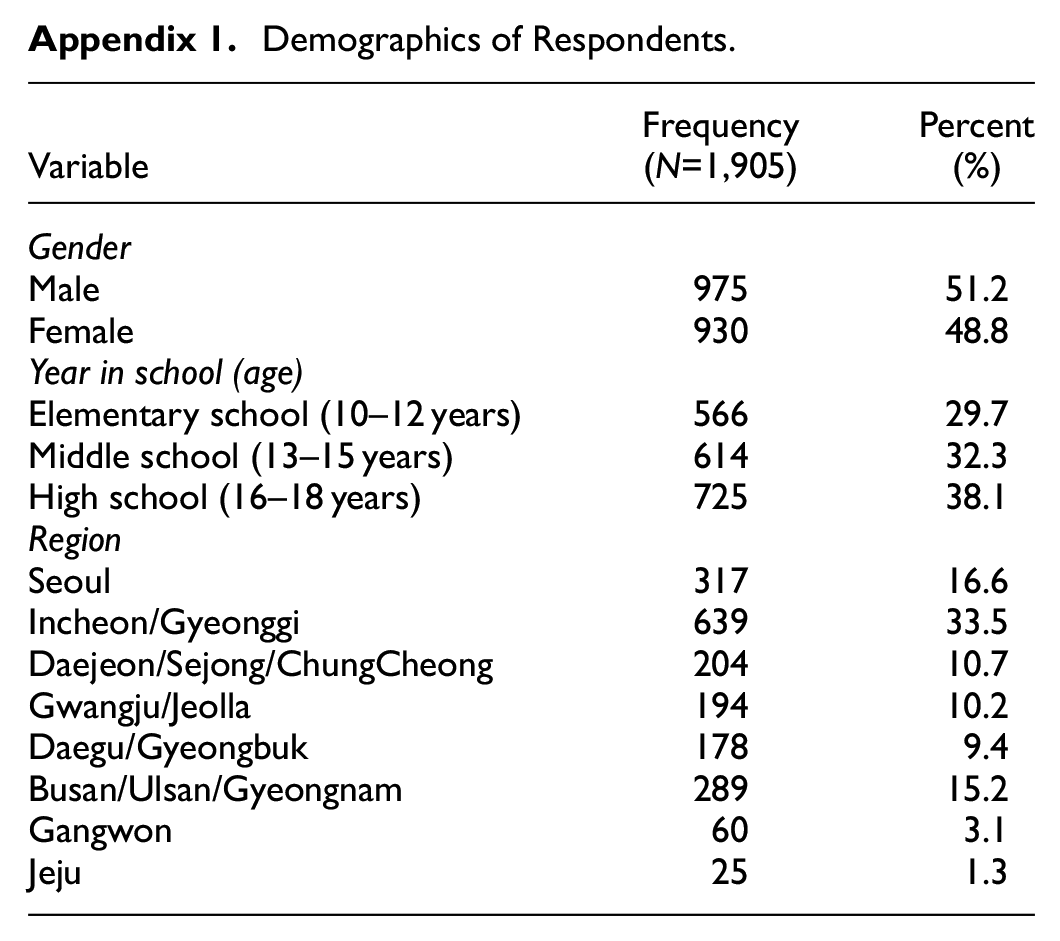
A total of 2,363 elementary, middle, and high school students nationwide participated in the survey, of which 1,905 were included in the analysis after excluding the cases where the answer to the questionnaire on media use was omitted. There were 975 males (51.2%), 930 females (48.8%), 566 elementary school students (10–12 years old, 29.7%), 614 middle school students (13–15 years old, 32.3%), and 725 high school students (16–18 years old, 38.1%). By region, the number of students in Incheon/Gyeonggi (33.5%) was the highest. The specific demographic characteristics of the respondents are provided in Appendix 1.
Using SPSS 25, path analysis (i.e., PROCESS Macro, Hayes, 2012) was conducted to verify the effects of NIE experience and parental mediation on multimedia news use, sensible news use, and self-expression, which then influences social participation. As control variables, this study included gender, age, school year (grade), region, and amount of media news use that can influence social participation.
Measures
NIE Experience
To measure NIE education experience, respondents were asked, “Have you ever received media education like NIE at school?” with 0 corresponding to “no” and 1 corresponding to “yes.” There were 1,058 students (55.5%) with NIE experience and 847 students (44.5%) without NIE experience.
Parental Mediation
Parental mediation, defined by synthesizing previous research (Davidov & Grusec, 2007; R. Lee & Hong, 2014; Meyrowitz, 1999), refers to the extent to which parents intervene in the interaction between children and media, with the aim of recognizing the potential harms of media use and managing and guiding their children’s media activities. Respondents were asked if their parents or guardians limit their television viewing, use of computer content, smartphone use, and use of game content. Using this question, parental restriction on media use was measured with 0 corresponding to “no” and 1 corresponding to “yes.” There were 684 students (35.9%) who experienced parental mediation and 1,221 students (64.1%) who did not experience parental mediation.
Multimedia News Use
Referring to previous research by Chun et al. (2014), this study defines multimedia news use as the tendency to use multiple media to consume news. Respondents were asked, “Have you accessed news through various on- or offline media such as newspapers, TV, radio, magazines, portals, online news media websites, SNS, messenger services, and online videos in the past one week?” with 0 corresponding to “I have not used any” and 1 corresponding to “I have used mentioned media.” For each medium, if a respondent had experience using the medium, 1 point was given; if no experience, 0 was given and overall points were aggregated (M = 3.05, SD = 1.78).
Sensible News Use
Referring to M. Song’s (2020) research, sensible news use was defined as a way of evaluating and selecting news and critically accepting news. Sensible news use was measured using the following five questions using a 5-point scale ranging from 1 meaning strongly disagree to 5 meaning strongly agree. The following five statements were provided: “I choose news that is helpful to me”; “I examine whether the news content is what I need”; “I try to decide whether the news content is accurate”; “I verify the source of the news media outlet”; and “If I don’t understand the news content, I ask around or search for additional information.” Then the points accrued from the five statements were added and averaged to create an index of sensible news use (M = 2.70, SD = 1.09, Cronbach’s α = .88).
Self-Expression
Referring to M. Choi and Na’s (2015) research, self-expression was defined as an expression that reveals one’s emotions and thoughts in order to search for one’s identity and seek one’s true self. In order to measure self-expression, respondents were asked about their self-expression experience using the following items: “I have clicked ‘like’ to the news on the internet”; “I have posted a comment on the news on the internet”; “I have expressed my agreement to the news on the internet”; and “I have shared or sent news on the internet.” Responses measured using 0 meaning “no” and 1 meaning “yes” were then added up (M = 1.35, SD = 1.46).
Social Participation
Referring to a study by Y. Kim (2007), adolescents’ social participation was defined as an explicit and voluntary act where adolescents try to directly or indirectly influence decision-making regarding public issues or the selection of public figures in the public domain. To measure social participation, respondents were asked, “In the past year, have you experienced any of the following actions?” with a list of the following diverse activities: “petition for signature on the street or online,”“donation,”“volunteering,”“participate(create) or agree with the Blue House Petition,” and “participate in social/political campaign.” Responses could be 0, meaning “no, I don’t have experience” or 1, meaning “yes, I have experience,” which were then added up (M = 2.28, SD = 1.55).
Control Variables
In order to control for the individual characteristics of respondents that may affect the relationship between variables, this study applied controls for respondents’ demographic characteristics (see Appendix 1). In addition, news can be consumed through various media, including TV, newspapers, radio, and portals. For example, a portal is a web-based platform that aggregates information and news from multiple sources. Portal sites are one of the main ways of consuming news in South Korea. In this study, we measured the frequency of accessing news through each media (range = 0–5 days per weekdays) and used it as a control variable to control for media use that may affect the dependent variable: TV (M = 2.36, SD = 1.59), newspaper (M = 1.53, SD = .66), radio (M = 2.79, SD = 1.87), magazine (M = 1.76, SD = 1.21 ), PC (M = 2.14, SD = 1.56 ), mobile (smart/tablet PC) (M = 3.30, SD = 1.65), portal (M = 3.22, SD = 1.55), news media website (M = 2.12, SD = 1.64), messenger service (M = 3.02, SD = 1.75), SNS (M = 3.28, SD = 1.61), and video (M = 2.87, SD = 1.66).
Results
Effects of NIE Experience on Social Participation
Research question 1 verifies the effects of adolescents’ NIE experience on social participation through news use behaviors such as multimedia news use and sensible news use as well as self-expression. This study used Hayes’ PROCESS Macro model 6 with a bootstrapping procedure to analyze the effects (Hayes, 2012). For the analysis, this study set NIE experience as an independent variable with multimedia news use, sensible news use, and self-expression as mediators, and finally, social participation as a dependent variable. Gender, age, year in school, region, and the amount of media usage were control variables with bootstrapping of 20,000 samples and a confidence interval (CI) of 95%.
As seen in Figure 1, there was a significant positive relationship between NIE experience and multimedia news use (β = .203, SE = 0.075, p < .001) and NIE experience and sensible news use (β = .214, SE = 0.047, p < .001), and although NIE experience did not have significant effect on self-expression (β = .052, SE = 0.062, p = n.s.), NIE experience did have a significant direct effect on social participation (β = .194, SE = 0.066, p< .001). Additionally, multimedia news use (β = .256, SE = 0.019, p < .001) and sensible news use (β = .132, SE = 0.030, p < .001) showed statistically significant positive relationships with self-expression respectively. Next, multimedia news use (β = .142, SE = 0.021, p< .001), sensible news use (β = .135, SE = 0.032, p< .001), and self-expression (β = .240, SE = 0.024, p< .001) each showed statistically significant positive relationships with social participation.
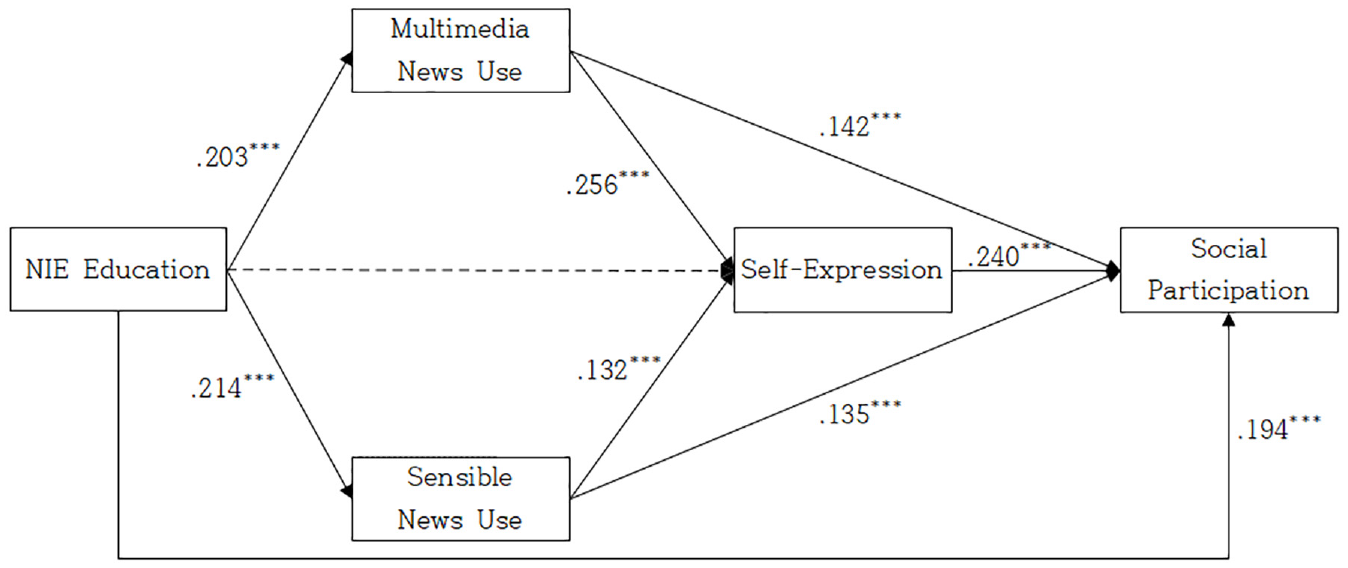
Path analysis for relationships among NIE education, multimedia/sensible news use, self-expression, and social participation.
As presented in Table 1, multimedia news use and self-expression mediating the relationship between NIE experience and social participation show significant indirect effects (β = .021, CI [0.0116, 0.0326]). Sensible news use and self-expression mediating the relationship between NIE experience and social participation also show significant indirect effects (β = .011, CI [0.0059, 0.0186]) (see Table 1, path 4 and path 5).
Path Analysis of the Effects of NIE Experience on Social Participation.

Effects of Parental Mediation on Social Participation
As seen in Figure 2, parental mediation had a significant positive effect on sensible news use (β = .266, SE = 0.053, p < .001), but parental mediation did not have significant effect on multimedia news use (β = .061, SE = 0.087, p > .05) or self-expression (β = .005, SE = 0.071, p = n.s.). Multimedia news use (β = .259, SE = 0.019, p < .001) and sensible news use (β = .135, SE = 0.030, p < .001) also had significant positive effects on self-expression. Second, multimedia news use (β = .150, SE = 0.021, p < .001), sensible news use (β = .145, SE = 0.032, p < .001), and self-expression (β = .243, SE = 0.024, p < .001) each had statistically significant positive effects on social participation, while parental mediation had no statistically significant direct effect on social participation (β = .010, SE = 0.075, p = n.s.).

Path analysis for relationships among parental mediation, multimedia/sensible news use, self-expression, and social participation.
As presented in Table 2, adolescents’ multimedia news use and self-expression did not mediate the relationship between parental mediation and social participation (β = .006, CI [−0.0035, 0.0171]). Sensible news use and self-expression had statistically significant mediating effects between parental mediation and social participation (β = .014, CI [0.0080, 0.0235]) (see Table 2, path 4 and path 5).
Path Analysis of the Effects of Parental Mediation on Social Participation.

Discussion
This study deals with the relationship between variables studied in different topics (i.e., NIE, parental mediation, news use behavior, self-expression, and social participation). First, discussions on the relationship between media use, expression of opinions, and social participation are on one axis. Theoretical discussions on “media and social capital” have previously explained these relationships. In the 1990s, when the Internet appeared, there was a view that increased time spent on the Internet led to a decrease in offline communication, social participation, and social capital (Kraut et al., 1998; Nie, 2001). However, since the 2000s, studies have begun to show that one of the main motivations for using Internet media is social communication and participation (Gross, 2004; Lenhart et al., 2005; Lin et al., 2023). In particular, a comparative analysis shows that Korean college students are more active in civic participation and social movements using the media, and American college students are more involved in social activities with family and friends (Keum, 2010).
Another axis of discussion deals with the relationship between media education (i.e., NIE at school and parental mediation at home) and citizenship. Among various aspects of media education (e.g., media ethics education, media utilization education, etc.), news education, which focuses on the content of news, is a field that needs to deal more heavily with information on public issues and citizen participation than other media education fields (Mihailidis, 2012). Ultimately, media education’s goal is cultivating citizenship by wisely using the news to participate in social issues covered by the news report. Nevertheless, there is a lack of research on how media education ultimately affects’ citizenship and through what processes these effects can occur. In other words, given that previous studies have shown that news exposure may not directly lead to cultivating citizenship (e.g., K. Kim & Kim, 2013; T. Shin & Kweon, 2013), studies that consider other mediating variables are needed to understand better the mechanisms by which media education affects citizenship.
This study, therefore, aims to provide an integrated view of the relationship between media education, news use behavior, self-expression, and social participation, which have been studied separately, and to show the possible relationship between them. More specifically, this study analyzed the mechanisms of the effects of NIE and parental mediation experiences on adolescents’ social participation, and presented mediated effects models with multimedia news use, sensible news use, and self-expression to investigate their relationships.
The results of NIE experience effects can be summarized as below. First, adolescents with NIE experience access news using not only traditional media such as newspapers, TV, and radio, but also various digital media such as portals, news media websites, messenger services, and videos available online. Furthermore, adolescents with NIE experience consume news more sensibly compared to students without NIE experience. These results are in line with previous studies that state that media education utilizing news encourages adolescents to be concerned about public issues, which can increase their interest in news and thus help them consume news more actively and critically (M. Song, 2020).
Most of the previous research focused on the effects of NIE experience on adolescents’ media usage, while this study tried to take it further by exploring the mechanism of how it influences social participation. Results show that multimedia news use and sensible news use promoted by NIE experience have statistically significant positive effects on adolescents’ self-expression. This led to active social participation. Adolescents with NIE program experience consumed news through more diverse media and expressed their opinions more actively based on their news consumption, ultimately turning out to participate more in social issues.
These results indicate that media education through NIE participation is not limited to the use of multimedia news use or sensible news use, but may lead to the active expression of opinions formed by critically consuming diverse information in the online space. The act of expressing one’s opinion involves the process of deliberating information obtained externally. An individual forms and expresses one’s opinion through the process of cognitive elaboration and reasoning that connects news and information obtained from the media to their own experience and prior knowledge (Eveland, 2004). Considering that deliberation and expression of opinion are fundamental competencies for the formation of a public sphere in society (Habermas, 1984), these results present how adolescents may enhance their competency as citizens of a democracy, that is, by improving their self-expression skills through deliberation as they consume diverse and rational news based on their NIE experience.
Furthermore, this study found that adolescents with NIE experience not only express their opinions but also take part in social issues actively and enthusiastically. This confirms that self-expression significantly mediates the relationship between NIE, media use, and social participation. This is similar to research in the political communication field that states that in the process of citizens’ political participation, opinion expression may act as an important mediating variable. Rather than the use of media directly affecting the political actions of citizens, the information acquired from the media can enhance political efficacy through the process of individual elaboration or deliberation and may lead to active political participation (J. Cho et al., 2009; Jung et al., 2011). This emphasizes the role of deliberation and reasoning through the expression of opinions and interpersonal political discussions, which means that this study can contribute to participatory democracy through the process of deliberation and reasoning in terms of adolescents’ citizenship enhancement through public media education.
This study also examined whether parental mediation at home could positively affect adolescents’ citizenship cultivation. To this end, this study analyzed the effect of parental mediation on media use at home on social participation through adolescents’ news use behavior and self-expression. Study results show that adolescents who experienced parental mediation on media use are more likely to sensibly consume news and express their opinions actively and, by extension, participate enthusiastically in social issues. These results confirm that media education in the public domain as well as through parental mediation can have a positive effect and encourage adolescents to be more interested in and participate in social issues through the process of critical thinking and deliberation.
The results of this study confirmed the positive effects of NIE and parental mediation in terms of enhancing adolescents’ citizenship. First, media education was found to have a positive effect on news consumption using diverse media and sensible news use, which means adolescents can actively consume news with an interest in public issues as well as being able to grow as an informed citizen by consuming news critically. In particular, in a media environment where serious social problems occur because of misinformation such as fake news and rumors, the importance of checking whether the contents of news delivered is accurate and searching for additional information needs to be emphasized more than ever as an attitude of a democratic citizen (D. Ahn, 2020). One study found that by searching for additional information one encounters diverse perspectives, which increases the possibility of having a better understanding of different opinions, thus reducing political polarization (B. Kim & Kim, 2019). From this perspective, it can be seen that sensible consumption of diverse information can potentially alleviate social divisions and conflicts.
Above all, this study is significant in that it does not stop at determining the academic effects of NIE or the effect of parental mediation on reducing addictive media use, but also analyzes the mechanisms of the influence of media education in terms of the cultivation of adolescents’ citizenship. Research on NIE thus far has focused on adolescents’ media use behavior and academic effects, which is in line with the NIE program’s objectives (Hwang & Kim, 2016; K. Kim, 2012; Oh & Nam, 2019). Only recently, a study analyzing the impact of NIE experience on adolescents’ political and social participation was introduced, expanding the scope of NIE effects research. However, empirical research explaining the process by which media education influences adolescents’ social participation is still scarce. Research on parental mediation has also been focused on whether parental mediation is effective in reducing addictive media use or how it affects media literacy (Jang & Park, 2016; S. J. Lee & Jeon, 2010), whereas relatively little attention was paid to citizenship aspects such as the adolescents’ expression of opinions or social participation. The significance of this study is that it has expanded previous research by examining the mediating effects of multimedia/sensible news use and self-expression, through which it explained the mechanisms of how media education influences adolescents’ social participation via diverse and critical news consumption as well as the deliberation process of self-expression.
Despite these implications, this study has several limitations. Parental mediation did not appear to have a significant effect on promoting the use of multimedia news, which may be a result of failure to consider different types of parental mediation. There are various types of parental mediation on adolescents’ media use. For example, there are active mediations which point out the good and bad of certain media, shared use by parents and children to find information together, technical mediation that locks computers or checks websites visited by children later (Livingstone & Helsper, 2008), but this study analyzed only the effect of parental mediation, which is considered a passive mediation. As the effects of parental mediation on adolescents’ media addiction differ by the types of parental mediation (e.g., S. J. Lee & Jeon, 2010), it may also have diverse effects on the main variables examined in this study such as multimedia news use, self-expression, and social participation. Therefore, it is necessary for future studies to consider various mediation types suggested by previous research.
Also, unlike NIE, which is media education at school, parental mediation at home is mainly centered on limiting media use from a protectionist perspective in Korea because it is associated with guiding children regarding proper media consumption (Davidov & Grusec, 2007; Hong & Kim, 2013). Previously, parental mediation in media use focused on restricting television use. But in recent years, the concept of parental mediation has been expanded to include various types of media, such as smartphones, games, and the Internet (Ko & Bae, 2016; S. J. Lee & Jeon, 2010). Therefore, parental mediation on media use was measured as comprehensive interventions in this study (i.e., whether parents limit their children’s television viewing, use of computer content, smartphone use, and use of game content). Of course, this may be a limitation of secondary data analysis. In a follow-up study, it may be necessary to examine various types of parental interventions related to game and smartphone use as well as parental interventions related to media content genres such as entertainment content and information or news content media use.
In addition, measuring respondents’ NIE experience by asking a single yes or no question is another limitation of this study. Having an NIE experience is important, but it may have an even more significant effect depending on what medium and which content is used as the main focus of the education. For example, if NIE is utilized to improve student’s reading skills, it will have effects on academic performances such as reading or academic skills, and if NIE is conducted using important social issues, it will promote interest and concern for social problems, which may have further influence on social participation. In future studies, it will be necessary to measure and analyze the NIE experience using more multidimensional and specific methods. By verifying and presenting the differences in effects according to a specific NIE program type, it will be possible to identify which NIE program will be most effective to develop and support.
In order to further expand the understanding of the mechanism by which NIE experience and parental mediation influence adolescents’ social participation, the mediating effects of various variables may be explored. For example, self-efficacy has been suggested as a factor that increases people’s participatory behavior (Jung et al., 2011; Velasquez & LaRose, 2015). Although this study analyzed media education’s influence on adolescents’ social participation with an emphasis on the mediating effect of self-expression, another approach would be to examine the impact of psychological or cognitive factors. We anticipate future studies to present and verify various models of mechanisms that explain the influence of media education on the enhancement of adolescents’ citizenship.
Footnotes
Appendix
Demographics of Respondents.
| Variable | Frequency (N=1,905) | Percent (%) |
|---|---|---|
| Gender | ||
| Male | 975 | 51.2 |
| Female | 930 | 48.8 |
| Year in school (age) | ||
| Elementary school (10–12 years) | 566 | 29.7 |
| Middle school (13–15 years) | 614 | 32.3 |
| High school (16–18 years) | 725 | 38.1 |
| Region | ||
| Seoul | 317 | 16.6 |
| Incheon/Gyeonggi | 639 | 33.5 |
| Daejeon/Sejong/ChungCheong | 204 | 10.7 |
| Gwangju/Jeolla | 194 | 10.2 |
| Daegu/Gyeongbuk | 178 | 9.4 |
| Busan/Ulsan/Gyeongnam | 289 | 15.2 |
| Gangwon | 60 | 3.1 |
| Jeju | 25 | 1.3 |
Acknowledgements
This study was awarded the 2020 Korea Press Foundation’s News Audiences and Journalists’ Statistical Research Award and presented at the 2020 conference of the Korean Society for Journalism & Communication Studies
Declaration of Conflicting Interests
The author(s) declared no potential conflicts of interest with respect to the research, authorship, and/or publication of this article.
Funding
The author(s) received no financial support for the research, authorship, and/or publication of this article.

Data Availability Statement
Data sharing not applicable to this article as no datasets were generated by the authors given that the current study used secondary analysis of data.