




Abstract
Agriculture is the foundation of the national economy, and the issue of food security is the cornerstone of national development. Heilongjiang province is China’s largest commercial grain base. How to achieve the sustainable agricultural development of Heilongjiang province under the problem of food security is of great significance. This article takes the five aspects of population system, social system, economic system, resource system, and environmental system, with a total of 29 secondary indicators as the basis for evaluation, the sustainable development and coordination of agriculture in Heilongjiang from 2005 to 2018 were evaluated by using entropy method and coupling degree model. The evaluation results showed that development methods of extensive agriculture greatly increased the grain output of Heilongjiang province from 2005 to 2007, but the level of sustainable agricultural development continued to decline, and there were also threats to the long-term development of food security. Although the sustainable level had been continuously improved since 2007, the whole system is still in the stage of low-level coupling and serious maladjustment. From the results of each subsystem, the coordination degree of population-environment system continues to decline, and the coordination degree of resource-environment system fluctuates in the low-level coordination state, which indicates that there is an obvious development in coordination among subsystems in Heilongjiang province, which restricts comprehensive and coordinated development of agricultural system. Based on the empirical analysis, this article takes Heilongjiang province as an example, and puts forward suggestions for sustainable agricultural development from the perspective of ensuring food security.
Keywords
Introduction
Food security (FS) is the assurance that sufficient food necessary for survival and health is available and affordable to anyone at any time. In recent years, China’s agricultural development has made great achievements. In 2014, China’s grain production increased historically in eleven consecutive times, but the constraints of agricultural resources have become increasingly tighter, resource pollution is also increasing. Since 2000, the land degradation in the black soil area has attracted people’s attention. Due to unreasonable land use and harsh environment, the soil depth has dropped from 60 to 70 cm in the 1950s to 20 to 30 cm at present (Fang, 2021). Soil erosion is thinning the surface loam layer, lower organic matter content, ground force drops, caused a decline in grain production and micronutrient (Razzaq et al., 2021). Therefore, ensuring food security and promoting the sustainable development of agriculture have become a pair of objective contradictions and must be dealt with well.
The academic circle has made great achievements in agricultural sustainable development and food security evaluation and analysis. In terms of evaluation index system. Luo et al. (2017) have built the evaluation index system of agricultural sustainable development by collecting the obstacle factors of agricultural sustainable development. Sun et al. (2017) constructed an agricultural sustainable development evaluation index system including population, resources, economy, environment, society, 5 primary indicators and 26 secondary indicators under the background of supply-side structural reform. X. Yang (2010) used the target allocation method to evaluate the production, economy, society, resource, environment and technology affecting food security, and constructed a system of 5 primary indicators and 17 secondary indicators. In terms of evaluation method, Chen et al. (2017) used Principal Component Analysis (PCA) to construct DPSIR model to evaluate the sustainable development of agriculture in Tianjin. Ding et al. (2019) evaluated the sustainable development of Gansu agriculture using entropy method and coupled coordination model. Razzaq et al. (2022) uses the binary probit model to explain the contract factors that determine groundwater. L. Yang et al. (2016) used the entropy method and the second-order fuzzy comprehensive evaluation method to analyze the impact of grain production safety, consumption safety, and circulation safety on food security.
It can be seen from the above analysis that the existing research on the index system and evaluation methods of agricultural sustainable development and food security evaluation, most of which only study one aspect of agricultural sustainability and food security, and for agricultural sustainable development, most are analyzed from the overall perspective, and the coupling coordination between subsystems is relatively few (Y. Zhang et al., 2015; D. Zhao et al., 2018). For example, the study found that there will be huge losses after grain harvest. These losses will not only destroy the stability of food supply and reduce food supply, but also lead to economic losses of labor, arable land, water, and fertilizer used in food production (Dai et al., 2023). Therefore, reducing food loss and maintaining quality are crucial for food security and sustainable economic development (T. Li et al., 2021). Therefore, it is extremely important to study the relationship and interaction between subsystems.
The land area of Heilongjiang Province of China is 473,000 square kilometers, of which 39.5 million hectares are available, accounting for 84%, of which 11.9 million hectares, accounting for 30% of the agricultural land area. As the main grain production area in China, Heilongjiang Province has one of the three precious parts of the world’s black land resources. In 2011, Heilongjiang Province became the largest grain production province in China with an annual output of 55.71 million tons (Li et al., 2024; Jiang et al., 2024). The grain output accounted for more than one tenth of the country all the year round and is known as the “big granary of China.” In 2020, the grain output of the province reached 75.41 million tons, an increase of nearly 400,000 tons from 2019, achieving 17 consecutive abundant enterprises, leading the country for ten consecutive years, and making important contributions to ensuring national food security (Jiang & Dai, 2023). However, in recent years, Heilongjiang Province has vigorously promoted the agricultural modernization construction, constantly improved the agricultural supporting setting up, and further released and improved the comprehensive agricultural production capacity of Heilongjiang Province. Due to agricultural development is too dependent on resource consumption, fertilizer application intensity, pesticide application, agricultural plastic film use, agricultural land quality deterioration, agricultural environmental pollution, which will undoubtedly restrict the development of grain production, Heilongjiang Province backward agricultural infrastructure, low food technology content, agricultural industrialization, no industrial chain or too short, while agricultural costs rise, rice, corn, wheat cost increase is 17%, 12%, and 7%, domestic agricultural products and foreign prices, agricultural products appear unsalable (Shi & Dai, 2007). It can be seen that, as a large agricultural province, Heilongjiang Province also has an obvious bottleneck in its sustainable agricultural development (L. Liu & Guo, 2020). Therefore, it will be of great use to study the sustainable agricultural development of Heilongjiang Province under the conditions of ensuring food security.
In order to address population, social, and economic issues, it is necessary to have a deeper understanding of the interrelationships, influencing factors, and coordination mechanisms among various subsystems. For existing research, further research and analysis are needed on the specific operation of the coupling relationship and coordination mechanism between different subsystems. The research and analysis results can provide important references for government decision-making and management. Based on the above research, this paper uses entropy method, coupling degree, and coupling coordination model to measure the level of agricultural sustainable development and coordination between Heilongjiang subsystems, and analyzes the coordination operation mechanism between the two subsystems, analyze and put forward opinions on population system, social system, economic system, resource system, and environmental system, so as to provide optimization ideas for the development of agricultural modernization in Heilongjiang Province of China.
Sustainable Development Evaluation Model Construction
Data Source
The year data of this research index mainly comes from the Statistical Yearbook of Heilongjiang Province from 2005 to 2018 and the statistical communique of government departments. The water consumption per unit area is calculated through the comprehensive calculation of agricultural water consumption and cultivated land area in the statistical yearbook, and the proportion of urban and rural residents is divided by the income level of urban residents and rural residents in the statistical Yearbook (L. Liu & Dai, 2021).
Construction of the Index System
Referring to the current academic research of food security evaluation and sustainable agricultural development, combined with the policy content of the China Agricultural Sustainable Development Plan (2015–2030) and the agricultural characteristics of Heilongjiang Province, the evaluation index system is constructed (K. Li & Sun, 2018). It can be seen from Table 1 that the sustainable development evaluation index system constructed in this paper mainly includes five subsystems: population system, economic system, resource system, social system, and environmental system (Hu et al., 2019). These five systems can not only reflect the sustainable agricultural situation of Heilongjiang Province, but also reflect the food security situation in the province.
Based on the Evaluation Index System of Agricultural Sustainable Development in Heilongjiang Province Under Ensuring Food Security.

Population System
Mainly investigating the current situation of agricultural population in Heilongjiang Province, including the overall population number and the proportion of employed persons in the primary industry, including a total of four secondary indicators. The subsystem is mainly based at the current situation and quality of agricultural employment, and the personnel reserve of agricultural labor force is an important factor affecting the sustainable agricultural development. On the other hand, population is the undertaker of human own production and material materials, which determines that food security should be the balance between population production and food production, population quantity and quantity of food, and population growth and food growth. Therefore, the mastery of the overall population change is of important significance to ensure food security and develop sustainable agriculture (X. Liu et al., 2023).
Resource System
It is a survey of the current situation of cultivated land, electricity and hydraulic means of production in the agricultural resources system of Heilongjiang Province, including five secondary indexes. Resource system is the fundamental of agricultural development. Only by maintaining the health of resource system can the long-term sustainable development of agriculture be guaranteed. Based on the perspective of ensuring food security, the sustainable utilization of natural resources conditions on which food production relies is emphasized (H. Zhang et al., 2018). Because the most important resource in agricultural development is cultivated land resources, and cultivated land security is the first lifeblood of food security, the three indicators are the evaluation of cultivated land resources.
Environmental System
It includes six secondary indicators, among which environmental pollution emission in agricultural production determines environmental pollution. This paper uses pesticide dosage, fertilizer strength, and agricultural plastic film. Agricultural environmental control is an important way to guarantee environmental quality, including the degree of soil and soil loss and the proportion of the affected area. The obvious negative effect between pesticide dosage, fertilizer application intensity, and degree of agricultural plastic film use and agricultural sustainable development. The rise in such index data will not only seriously affect the ecology, but also destroy the environmental buffer capacity, which will pose a threat to both the quality and quantity of food produced (Li et al., 2024; Jiang et al., 2024). Therefore, there is obvious mutual influence and restriction between agricultural environment and agricultural development, and the quality of environmental system directly affects the prospects of sustainable agricultural development and the level of scientific and technological content of the food industry (Xu et al., 2011).
Economic System
It mainly includes seven secondary indicators, and these seven indicators mainly reflect the state of production capacity in agricultural production, such as land productivity, agricultural labor productivity, and the total power of agricultural machinery. Realizing the healthy development of agricultural economy can ensure the rising trend of land output rate. While alleviating the pressure on land, it does not relax the operation of grain production, thus ensuring the availability of grain production resources and the self-development ability of the grain production system. Moreover, the system can also effectively reflect the efficiency of food production, which is the top priority in food security management and is the main source of ensuring food supply (Y. Zhao, 2003). It is generally believed that the higher the economic level, the stronger the available resources and technical ability in agricultural development, and the stronger modern agricultural science and technology and advanced material equipment means must support the benign development of food security. Therefore, so this paper selects agricultural equipment input capacity as the evaluation index to evaluate the economic system.
Social Systems
It is mainly to evaluate the evaluation of rural social and health development level in Heilongjiang Province, including seven secondary indicators, including urbanization level and rural engel coefficient, which are to provide support for the sustainable development of agriculture. Social sustainable development is an important aspect of the agricultural sustainable agricultural development strategy. It emphasizes to meet the basic needs of human beings, the more perfect the social system, the stronger the awareness of sustainable development in agricultural development can the agricultural development planning be long-term and sustainable. For ensuring food security, the first is that food security can continue to meet the social needs for food, and secondly, the social environment for ensuring food security can be achieved benign development (Peng, 2019). To sum up, the study of seven indicators under the social system can provide constructive suggestions on ensuring the sustainable agricultural development under food security. The evaluation system of Heilongjiang Province includes 29 secondary indicators, including 10 indicators and reverse agricultural sustainable development under food security, including natural population growth rate, population density, water consumption per unit area, rural engel coefficient, proportion of rural and urban income level, fertilizer application intensity, agricultural plastic film use, proportion of disaster area, pesticide consumption, and wastewater discharge (S. Yang, 2017).
Determine the Index Weight
The entropy method is chosen as the evaluation of the sustainable development index weight in Heilongjiang Province. The entropy method determines the difference between the index through the discrete degree, which determines the influence degree of the index on the result, and then obtains the weight of the index (Lu et al., 2020; Zhu et al., 2020). The determination of index weights using the entropy method is as follows:
(1)Using the value representing the j index of the i year, the following decision matrix Z can be obtained.

among them, i = 1,2, …, m, j = 1,2, ….n, where m represents the number of years and n represents the number of indicators.
(2)Due to the different units of measurement of various indicators, it is necessary to standardize the data. This paper adopts the extremely poor standardization method to process the data. Because the nature is different in the indicators, the indicators are divided into positive indicators and negative indicators, among which the negative indicators include: C2, C3, C7, C11, C12, C13, C14, C15, C25, C26. Its standardized formula can be expressed as:

where z ij represents the jth original index in the ith year.
(3)Calculate the proportion of the i time period under the j index ij :

(4)Calculate the total contribution for each scheme, which can be represented as (if hij = 0, assuming ln hij = 0):

where represents the contribution of the i scheme under the j attribute,
K = 1/ln m;
(5)Determine the weight of each index:

w j refers to the weight of the jth index.
Coupling Degree Model
Coupling degree, also known as coupling nature, refers to the degree of inter-module correlation in the study, and the higher the coupling degree indicates an orderly development trend between systems, indicating that the stronger the interaction between systems (W. Liu et al., 2018; R. Zhou et al., 2019). This paper reflects the degree of mutual influence among the subsystems by calculating the degree of coupling development between population systems, resources systems, environmental systems, economic systems, and social systems. The coupling degree calculation formula is:

The formula, the contribution of the subsystem to the overall evaluation result and the data after the standardization is as follows:

Where wij represents the weight of j indexes in year i
The larger the coupling value means the greater the coupling between systems, the higher the order. The general coupling segments are shown in Table 2.
Coupling Segment Values.

Coupling Coordination Degree Model
The coupling degree is mainly used to reflect the interaction between the five subsystems of agricultural development in Heilongjiang Province. It is difficult to reflect the coordination degree between subsystems. Because the value size affects the coupling degree, such as the coordination degree of two subsystems in low level stage, the coupling coordination degree model is introduced on the basis of the coupling degree function. The coupling coordination function is:

among them, indicating the comprehensive coordination degree of the five subsystems, the calculation formula is:

Among them, F is the coupling coordination degree of five systems, D is the coupling degree, and T is the integrated coordination index W of five systems representing the weight coefficients of each subsystem. According to relevant studies, F is divided into coordination and disorder stages, as shown in Table 3.
Coordination Degree Segment Value.

Results and Discussion
Comprehensive Evaluation of the Level of Agricultural Sustainable Development in Heilongjiang Province
The entropy method calculates the weight of agricultural sustainability evaluation index in Heilongjiang Province. The results are shown in Table 4. Through the weight of each index and the previous contribution model, the calculation results of the overall system of agricultural sustainable development in Heilongjiang Province are shown in Figure 1.
Calculation Value of the Evaluation Index Weight.

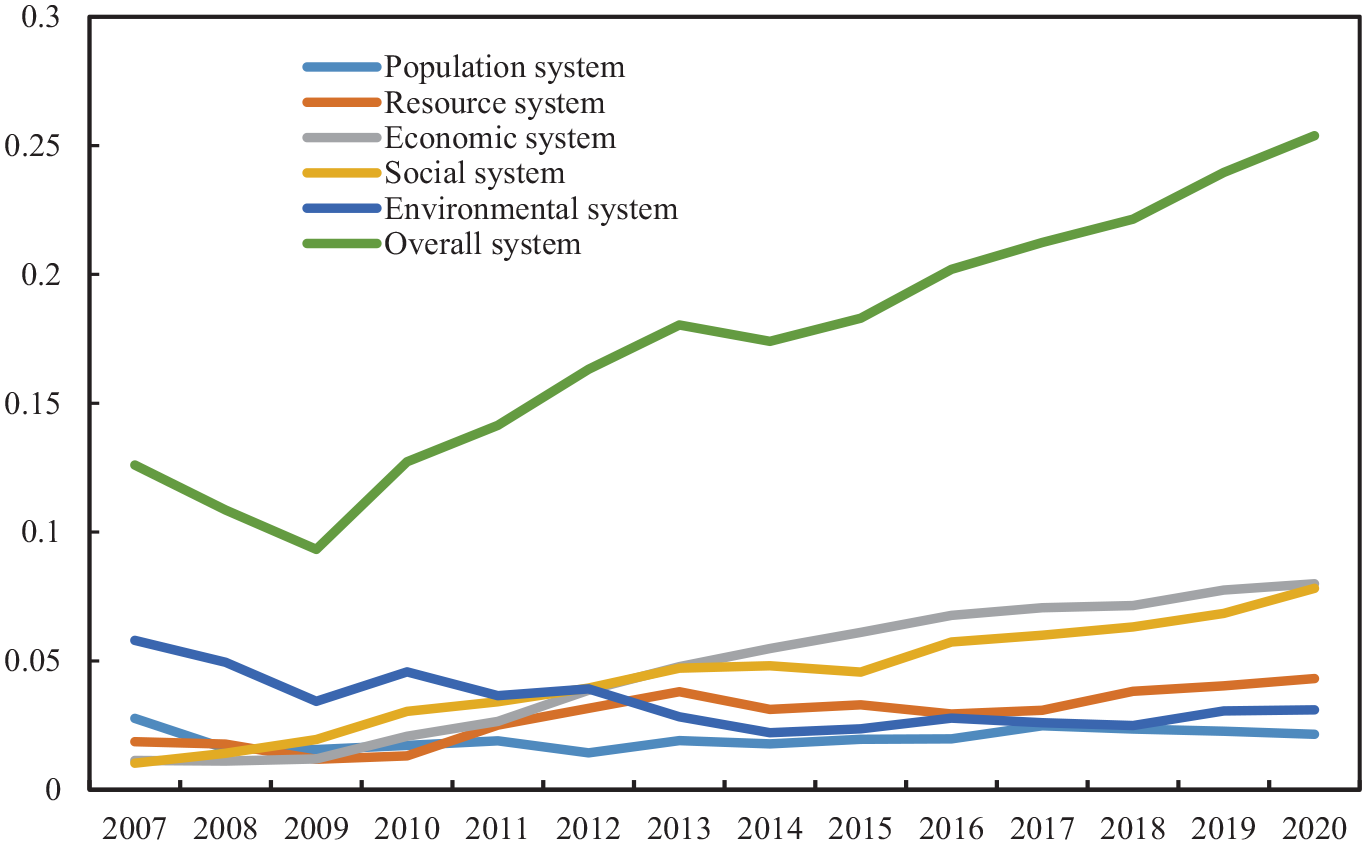
Comparison of the agricultural development overall system and each subsystem evaluation indexes.
Overall System
The overall system showed a downward trend from 2005 to 2007, growth trends starting in 2007 from 0.0933 in 2007 to 0.2538 in 2018, which explains that with the continuous improvement of the supporting subsystems, and the continuous development of agricultural science and technology, the level of food security and sustainable agricultural development in Heilongjiang Province have been continuously improved. From the changes of the subsystems, mainly thanks to the rapid growth of the economic and social systems, among them, the per capital disposable income of rural residents in the economic system maintains a growth rate of 12% per year, the average annual growth rate of agricultural labor productivity has reached 15%, the changes of economic system provide strong support for the efficiency of agriculture and high quality grain development. In the social systems, communication equipment and sanitation conditions for rural residents all grow by 5% annually, the continuous improvement of the social system strongly supports the development level of the overall agricultural system. However, the overall level of agricultural sustainable development in Heilongjiang Province is still lower than 0.3, in the low-level coupling stage, far lower than the agricultural sustainable development level in Gansu Province (0.75), the overall state is poor.
Population System
It can be seen from the change trend of population system evaluation index that the evaluation results of population system in Heilongjiang Province are in a stable state, and the evaluation index of the overall population system is less than 0.1, and the overall level is poor. From the changes of the four indicators, the natural population growth rate from the beginning of 2.67% gradually declines, negative growth appeared in 2015, the natural growth rate into −0.69%, continuous low birth rate leads to Heilongjiang aging, serious phenomenon, coupled with the industrial age has passed, but Heilongjiang has not successful transformation, leading to the province not only low employment rate, wages are generally low, so the population loss is inevitable. The continuous decline of the total population and the rural population has led to the continuous reduction of the primary industry labor force in Heilongjiang Province. In conclusion, it shows that the decreasing population number not only affects China’s food security to a certain extent, but also restricts the further development of the agricultural population system.
Environmental System
From the change trend of environmental system, initially decline from 2005 to 2018, then in a stationary state, down from 0.18 in 2005 to 0.08 in 2011, the decline still exceeded 50% at low levels; From the changes of each index, The disaster area maintains a 49% annual growth rate, it shows that with the development of the overall agricultural system, although the use of production aids such as pesticides, plastic films and fertilizers increases crop production, which led to Heilongjiang Province agricultural environmental system suffered obvious damage, soil erosion area has remained at a level of 10 million hectares per year, and the environmental damage caused by human factors, the hazards is essentially perpetual and irreversible. This poses a serious threat to human food security. In addition, other studies have found that volatile weather changes will also affect crop yields (Elahi et al., 2022), thus affecting the sustainable development of human agriculture. Therefore, solving environmental problems is of great significance to the sustainable agricultural development under the premise of ensuring food security.
Social System
From the social system development level change trend, from 2005 to 2018 presents a slow rising trend, including the main support for the rural residents communication equipment and health level, keep 5% annual growth rate, and urbanization growth is slow and urban and rural residents income gap limits the development of social system, the current rural residents in social level index change ability is limited, need to further improve the urbanization level and rural residents income. Other studies have also pointed out that the opportunities and scope of advisory and credit services provided by public institutions are limited, affecting the productivity of crops (Elahi et al., 2018). Thus affecting the sustainable development of agriculture. In this process, we should strictly implement the responsibility of cultivated land protection, and strive to mobilize farmers’ enthusiasm of farmers in production, so that we can not only ensure the steady development of the urbanization road in the new era, but also make the grain production smooth progress.
Resource System
The resource system of Heilongjiang Province showed certain volatility, stable from 2005 to 2008, slight upward trend from 2009 to 2011, and first decline before stable from 2012. From the change of relevant indicators, annual afforestation area grows by 16%, grain single output maintains a 7% annual growth rate, explain that, despite recent years of continuous efforts. Some results in the acquisition of agricultural resources, but food is not only land-intensive products, also resource intensive such as water products. After data analysis, the irrigation rate, unit electricity consumption from 2005 to 2018, explain that the investment of auxiliary resources in agricultural support is still insufficient. It also makes the contradiction between grain production and water and other resources particularly prominent, there is a certain degree of threat to food security (Dai et al., 2022). The efficient and sustainable utilization of agricultural resources can better inject impetus into the sustainable agricultural development of Heilongjiang Province.
Economic System
From the economic system evaluation index, the economic system index has been showing a growth trend, that with the improvement of economic level, agricultural production capacity, and agricultural production investment level are significantly improved, continuous improvement of agricultural equipment, technical equipment, communication, water conservancy such as agricultural infrastructure, promote the agricultural modernization process, more helpful to the implementation of the “grain, grain in technology” strategy, by strengthening agricultural infrastructure shortcomings, can not only for food security range, but also effectively improve the economic system index level.
Analysis of Timing Evolution of Coupling and Coordination of Agricultural System
Coupling Degree Analysis
By calculating the coupling degree of agriculture “population-resource-economy-society-environment” in Heilongjiang Province from 2005 to 2018, the coupling changes of the subsystems in Figure 2, the change trend of coupling between population system and resource system, economic system and environmental system decreased first and then increased. This illustrates that after a decline in 2005–2007, rising fluctuation trend from 2008 to 2018. But from the change of the coupling degree value, the coupling degree between the population system and other systems in Heilongjiang Province is still in a low-level stage. Among them, the coupling between population and social systems remains on the rise, explain that with the rising population, the supply of agricultural productivity. But the subsequent decline in the upward trend illustrates the extensive agricultural production patterns, make the pressure of agricultural population and agricultural environment increases year by year. In addition, the agricultural employment population changes under the aging of age, increasing food demand, the rate of coupling between population and other systems slowed significantly.

Trend in the coupling degree of population systems and other subsystems.
From the change trend of coupling degree between resource system, economic system, social system, and environmental system in Figure 3, the coupling degree between resource system and economic system and environmental system showed first decreasing, rising, decreasing, and then rising, and the coupling degree of resource system and environmental system showed decline before 2007, mainly due to the extensive agricultural development mode in Heilongjiang Province before 2007. The coupling change trend between resource system and social system increased first, then decreased, and then improved. However, the dual coupling values between the three systems are less than 0.3, indicating that both the resource system and the other subsystems are in the low-level coupling phase.

Trend of the coupling degree of resource systems and other subsystems.
As the result can be seen from the three two-wise coupling degree changes in Figure 4, the overall trend is on the upward trend, among which the upward trend of coupling degree between economic system and social system is the most obvious, indicating that the degree of coordination between economic system and social system is increased significantly. Although the coupling between the two systems is fluctuating upward, and the coordination among the systems gradually changes from disorder to order, it is still in the low-level coupling stage.
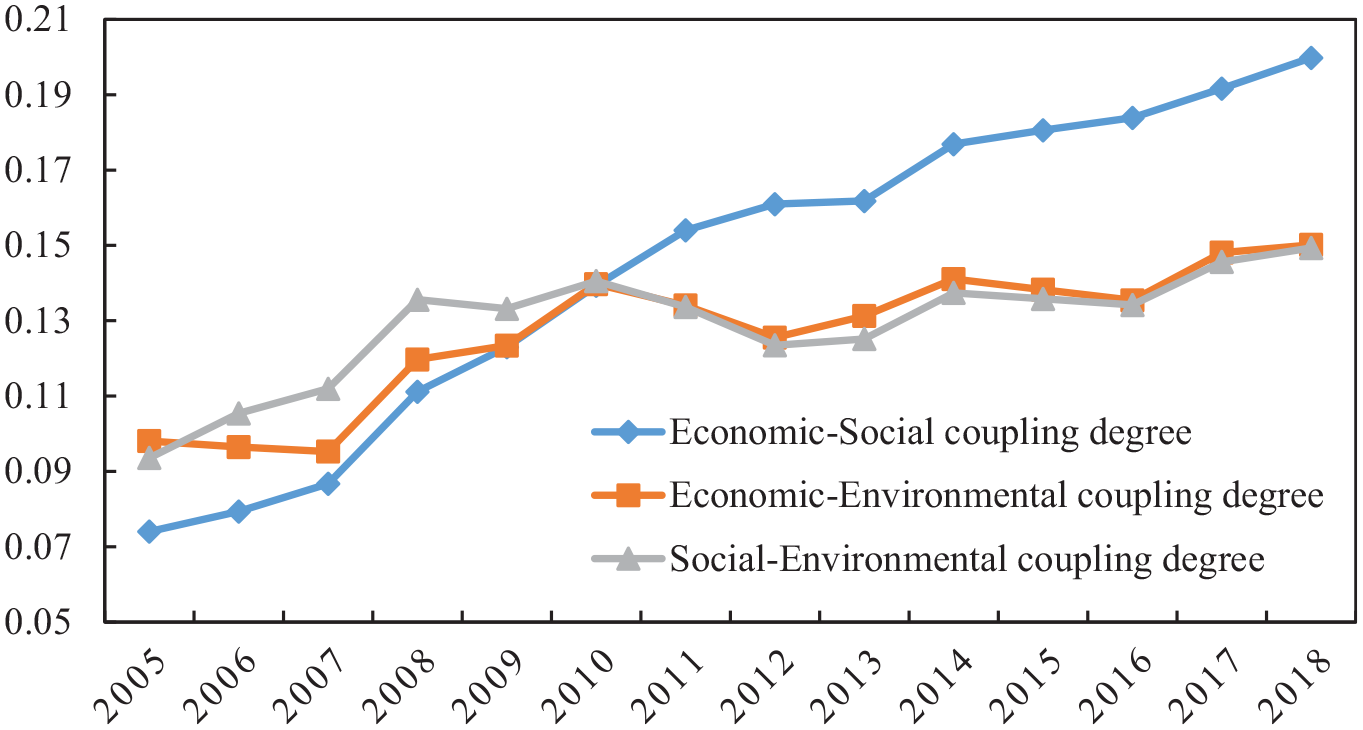
Trend in coupling degree of economic, social systems and other subsystems.
From the change of the coupling degree between the above subsystems, rising coupling degree between the two systems after 2012, it shows that Heilongjiang Province has achieved excellent agricultural and rural work during the “12th Five-Year Plan” period, which lay a good foundation for the economic development of Heilongjiang Province. But the coupling degree is still below 0.2 is in the low level coupling stage, among them, the coupling curve between economic systems, social systems and other systems increased significantly, mainly due to the rapid development of the economic and social system is based on extensive cultivated land development and environmental damage. So the coordination between the two pairs has been in a fluctuating state, as the state has invested in environmental protection after 2010, put the overall coupling degree in a slightly rising state.
Coupled Coordination Degree
From the trend of coupling coordination between population systems and other systems, the coordination between population and environmental systems shows an initial downward trend, a steady fluctuation trend followed, the coordination between population and resources, economic and social systems is decreasing first and rising later in Figure 5. Among these increased from 0.0199 and 0.0221 in 2006 to 0.0539 and 0.0532 in 2018, it can be seen that the coordination between population, economic and social systems grows rapidly, and shows that the development of population system and the social and economic systems are closer. From the coordination values of population and other systems, there is still a serious imbalance between population and other systems (F < 0.2).

Trend in coupling coordination of population systems and other subsystems.
From the change trend of coordination degree of resource system and other systems, the degree of coordination between resources system, social system, and economic system shows a continuous rising trend, indicating that with the development of agricultural science and technology level, the development and agricultural production level in Figure 6, thus improving the level of coordinated development between resources system and other systems, but the whole is still in a serious disorder (F < 0.2).

Trend of coupling coordination of resource systems and other subsystems.
As can be seen from the change trend of coordination level of the three systems in Figure 7, the coupling coordination between economic-social, economic-environmental, and social-environmental systems shows a continuous rising trend. Especially, from 0.020 in 2005 to 0.088, which increased by three times. Although the whole is still in a serious disorder (F < 0.2), it also shows that the development level of coupling between agricultural subsystems in Heilongjiang Province is getting better and better, with great development space and constantly moving forward toward the goal of high-quality coordination state.

Trend in coupling coordination of economic, social systems, and other subsystems.
From the perspective of the above coupling coordination, from 2005 to 2018, except for the growth trend between population-resources and population-environment, the coordination of both systems showed an obvious upward trend, which shows that the development between subsystems has a strong constraint on the overall coordinated development level of agricultural systems, but it should also be noted that all coordination is below 0.1, relative to the mean difference between agricultural subsystems in Gansu Province of China is greatly different (0.507), which shows that the coordination degree of Heilongjiang Province is weak and the coordination role between agricultural systems needs to be strengthened.
Discussions
After 2015, the grain output began to grow slowly or even decline, which seriously hinders the food security and sustainable agricultural development in Heilongjiang province. Elahi et al. (2018) pointed out that agricultural production is not enough to meet the rapidly growing population demand. Population problem is a long-term, global, and strategic problem facing social development. Improper management may aggravate food insecurity. Therefore, Heilongjiang Province should strengthen the management of population and grain production issues to ensure food security. In recent years, Heilongjiang Province agriculture from the extensive development thinking, began to improve agricultural support policies, strengthen science and technology, talents and equipment, constantly improve the coordination between the agricultural subsystems, although make the agricultural sustainable development and food security index, the overall level of agriculture in Gansu Province of China obtained in the study is very different (Ding et al., 2019), indicating that the overall level of current agricultural sustainable development in Heilongjiang Province is still low, and there are still problems in food security guarantee, which is very inconsistent with Heilongjiang’s position in China’s agriculture. As can be seen in the comparison of each subsystem, the development lag of population system, environmental system, and resource system obviously limits the level of agricultural sustainable development from the perspective of food security, mainly reflected in the use of auxiliary resources investment, the income level of rural residents is low, pesticide abuse and resource development (Razzaq et al., 2021).
Improve the policy to encourage fertility, liberalize restrictions on childbirth, and improve the quality of the agricultural population. According to the previous analysis, the coordination between the population system and the environmental system is in a downward trend, which is mainly due to the uncontrolled control of the agricultural population and the low quality of the agricultural population. First, the rural population should be guaranteed, raise birth rate, and ensure sufficient agricultural labor distribution. In recent years, since Heilongjiang is located in the north of China, cold and long winter, and with resource depletion and commodity prices, it has an adverse impact on agricultural development. At the same time, due to the outflow of young labor and aging of agricultural employment population in Heilongjiang province is older, low education, causing low labor skills, so we need to strengthen farmers’ skills training in planting technology, information technology, relying on urbanization to absorb rural surplus labor, promote traditional agriculture and to leisure agriculture, ecological agriculture, smart agriculture, green agriculture, and other agricultural industry mode, promote coordination between Heilongjiang agricultural subsystems (Elahi et al., 2022).
Promote the development of the ecological agriculture model, and speed up the construction of green agriculture industrialization. Ecological environment system and resource and environment system are in a state of slight fluctuation all the year round, which shows that Heilongjiang Province has realized system environmental quality to obtain resources through extensive development before 2007. This mode of sacrificing the environment to achieve the rapid development of agriculture and industry seriously restricts the sustainable development of agriculture in Heilongjiang Province. This paper suggests that the ecological agriculture compensation mechanism should be established, and that the losses suffered from protecting the ecological environment can be compensated through the ecological compensation strategy (T. Li et al., 2021). At the same time, we will extend the industrial chain of green agricultural products, give full play to the advantages of green resources in Heilongjiang Province, rationally allocate resources in grain production, processing, and circulation, and promote the transformation of Heilongjiang from high-yield agriculture to high-quality agriculture (Razzaq et al., 2022).
Conclusions
The overall system in 2005–2007 showed a downward trend from 2008, from 0.0838 to 2008, nearly doubling in 2018. From the changes of the five subsystems, the social system, the resource system, and the economic system are being slowly improving, while the population system is fluctuating and stable, while the environmental system is in a state of continuous decline. In sum up, it can be seen that the population system and the environmental system have become the restricting factors in the level of sustainable agricultural development and the improvement of food security quality in Heilongjiang Province.
In terms of overall coupling and overall coordination trends, 2005–2007 to 0.0489 from 0.0437 and from 0.0785 to 0.0638. This period was mainly due to agricultural demographic changes and agricultural environment deterioration due to population flow and extensive development; and then coupling and coordination increased to 0.0934 and 0.1534, respectively, despite obvious growth rate, but still in the low-level coupling stage (Couple < 0.3; F < 0.2).
From the change, the coordination of population-environment system is in an obvious downward trend, fluctuating and stable low level coordination, which shows that the development of agricultural system, the change of population quantity, and structure cannot support the human needs of agricultural development, the balance contradiction between agricultural environment deterioration and unreasonable development of agricultural resources, and the low rural income restrict farmers’ input capacity in agricultural production.
This study is mainly aimed at sustainable development during non-epidemic period, which can be compared with subsequent relevant studies, such as sustainable development during epidemic period, so as to explore sustainable development in the future and provide some references for future sustainable development decision-makers.
Footnotes
Declaration of Conflicting Interests
The author(s) declared no potential conflicts of interest with respect to the research, authorship, and/or publication of this article.
Funding
The author(s) disclosed receipt of the following financial support for the research, authorship, and/or publication of this article: Start-up Fund project of High-level Talent Introduction research of Heilongjiang University of Science and Technology, “Study on the Income Distribution mechanism of collective Management construction Land entering the market” (HG202012-2). Key Research Incubation Project of Humanities and Social Sciences of Heilongjiang University of Science and Technology, “Comparative Study on Land Circulation in China” (G2020P-1).

Data Availability Statement
All data and related metadata underlying the findings reported in a submitted manuscript should be deposited in an appropriate public repository, unless already provided as part of the submitted article.