




Abstract
The study aimed at investigating the experiences of graduate students who experience, for the first-time, cost-sharing policies in Saudi public universities. The study used the explanatory sequential mixed methods approach, involving a two-phase data collection. First, quantitative data were collected through a questionnaire administered to graduate students of education from 24 out of the 29 public universities, where 384 participants responded. Then, qualitative data were collected through semi-structured interviews conducted with 28 participants who voluntarily signed up for a follow-up interview. The main findings show that 66.4% of participants support the introduction of cost-sharing in public universities. However, there are no student financial aid mechanisms to guarantee equal opportunity for all candidates. Even though 90.4% of participants pay their due shares on time, students who faced financial hardships were not allowed to register for classes until they paid. Further, except for the contract signed during the admission process, there was no informative and accessible cost-sharing policy document to help potential candidates make the right decision before joining a program. Moreover, the cost-sharing programs are not flexible for working students. Participants’ perceptions on cost-sharing and financial aid mechanisms do not differ based on gender and education level but do strongly significantly differ based on cost-sharing policy support. Based on these findings, the researchers suggest five recommendations for policy and practice for the cost-sharing policy to be effective and equitable for all potential candidates.
Introduction
Higher education contributes to economic development with several benefits to individuals and society (Greenaway & Haynes, 2003; Johnstone, 2006; OECD, 2008). It is also associated with non-economic benefits, enriching people’s understanding of themselves and the world through the promotion of critical thinking and active citizenship, and, thereby, improving the quality of people’s lives and leading to broader social and individual benefits (Blondal et al., 2002; UNESCO, 2009). These public and private economic and social benefits come, however, with some costs and the critical question has been who should bear the costs? The answer to this question requires an assessment of its comparative private and social benefits and costs, thereby informing decisions on the distribution of costs between government and non-governmental sources (Alshamy, 2012). In many countries, the traditional answer to who should bear the costs has been the government and taxpayers. These countries view higher education as a public service (Vossensteyn, 2004). Cost-sharing, efficiency, and education as a public good should be key principles driving funding in higher education (Motala, 2023). On the other hand, the World Bank explicitly stated: “Higher education is a private and not a public commodity” (Delgado & Fernandez, 2005, p. 23). Others argue that higher education is a quasi-public good, so, probably situated somewhere between public and private goods or has elements of both (Thomas, 1994).
Gradually, therefore, higher education has increasingly come to be regarded as a shared financial responsibility between students and the society, viewed not only as an investment with economic returns for individuals but also for the wider society (Vossensteyn, 2004). Accordingly, the costs should be shared between the individuals who benefit and the wider society (Barr, 2005; Cheung, 2003; Woodhall, 2007).
The notion of cost-sharing goes by different names with different definitions but Johnstone, one of the leading authors on the subject, made an argument at a cost-sharing conference, according to Woodhall (2007, p. 25), that “If it looks like a duck and quacks like a duck, then it is a duck—whatever it is called.” Therefore, the definition of cost-sharing guiding this study is that of Johnstone (2003) who defined it as “a shift in the burden of higher education costs from being borne exclusively or predominately by government, or taxpayers, to being shared with parents and students” (p. 351).
The interest in sharing the costs in higher education is not new (Fengliang, 2012, Gwosc & Schwarzenberger, 2009; Johnstone, 2003; McMullen, 2000; Ngolovoi, 2007; Rasmussen, 2006; Taylor & Morphew, 2014, Yizengaw, 2007). For example, colleges and universities in the United States (US) are known to receive financial support from government, private sector donations, and individual students and families. This type of cost-sharing, a well-established practice in the US, allows educational institutions to fulfill multiple missions such as educating citizens for civil society, training workers to fill a variety of jobs, and offering competitive advantages and social mobility to individual students (Taylor & Morphew, 2014).
Several countries around the world have experimented with some forms of cost-sharing in higher education in the last few decades. The UK was the first European country to start charging more than a nominal tuition fee in 1997, Australia in 1989 introduced the higher education contribution framed as the fair and equitable way to ensure students contribute toward the costs of their higher education. In much of Latin America and East Asia, public universities continue to offer no or very low tuition fees, but private higher education institutions generate financial resources through tuition fees to support their institutions. In Russia and Vietnam, education—by law—was free of charge but dual majors were introduced to generate higher education revenues through dual track major tuition fees (Johnstone, 2004; Le et al., 2021; Pham & Vu, 2019). A similar trend, according to Johnstone, exists in India (tuition-supported private higher education) and China (tuition fees charged to nearly all students). In the African continent, higher education was completely free of charge after most African countries obtained independence from their former colonies. However, with the increasing demand for higher education, slow economic growth, and pressure from donors in the 1980s and 1990s, many governments realized that relying entirely on government and taxpayers to finance higher education is not sustainable in today’s economy. Thus, many countries in the continent (Tanzania, Kenya, Uganda), have lately introduced strategies to shift some of the costs of higher education to students and their families (Marcucci et al., 2008; Ngolovoi, 2007; Weidman, 1995). A study that looked at cost-sharing from global perspectives rather than evidence from individual countries is that of Callender (2017). Even though this study focuses on funding issues related directly to students, the author provided global perspectives on cost-sharing and student support.
From these examples, it is evident that many governments around the world, with very different political and economic circumstances, are using strategies to shift the financial burden or part of it from governments and taxpayers to students and their families under policies known as cost-sharing in higher education. This is becoming the norm, not the exception. Among countries joining the list, in recent years, is Saudi Arabia, which for the first time in 2018 allowed Saudi public universities to ask, only, graduate students (master’s and PhD) to financially participate in sharing the costs of their studies. However, there is no cap on tuition fees as the level of cost-sharing is left to each university council to decide on (Council of Universities’ Affairs, 2020; Ministry of Education, 2018). Before 2018, Saudi public universities were only allowed to charge tuition fees through dual track policies, where a new admission criterion allowed less qualified students, who could not secure places at the free track, to obtain places by paying tuition fees. Dual track policies were put in place in 2005. Yet, after lots of concerns related to the issues of equity, efficiency and quality, dual track programs were suspended by a Royal Decree in 2008 (Council of Universities’ Affairs, 2020; Ministry of Education, 2018).
The focus of this study, therefore, is to examine the experiences of graduate students of the first cohort of cost-sharing policies in Saudi public universities.
Background and Rationale for Cost-Sharing in the Context of Saudi Arabia
Saudi Arabia is the largest country in the Middle East. The country covers 80% of the Arabian Peninsula with a vast wealth of resources. Revenues generated from these resources allowed the country, until recently, to provide, among other services, free education to its people. Since the start of the higher education sector in 1957, Saudi Arabia has provided free higher education with stipends to its higher education students (Barry, 2021).
As of 2022, Saudi Arabia counts 29 public and 14 private universities. There are also various community colleges, most of them run by the government. In addition, there are 42 specialized private colleges. Overall, the private sector is still small, although private higher education institutions (HEIs) are subsidized by the government through the provision of public land and other measures. Study at public universities is tuition-free for Saudi students but private universities do charge tuition fees . While 95% of Saudi students attend government-funded public universities, the percentage of enrollments in private HEIs has increased by 64% between 2009 and 2018, according to UNESCO statistics (Morad & Zreik, 2020).
As mentioned earlier, in the context of Saudi Arabia, education is free of charge from primary to higher education, including undergraduate and graduate studies. In addition, Saudi Arabia invests a lot in supporting its citizens to pursue education abroad (undergraduate and graduate) by covering both tuition fees, living expenses, and other costs of accompanying family members (Saudi Ministry of Education, 2022).
In recent years, however, with the declining of governmental revenues due to drop in oil prices prior to 2021 (main source of revenue for Saudi Arabia), and Saudi government’s desire for source diversification, the country is introducing new measures in many sectors including education to make the country more efficient and competitive (Ministry of Finance, Saudi Arabia, 2020). The Saudi government stated in its vision 2030 that “The ongoing privatization of state-owned assets, including leading companies, property and other assets, will bring in new and more diverse revenues for the Saudi government” (Kingdom of Saudi Arabia, Vision 2030, 2016, p. 42). These new measures helped increase non-oil revenues by 30% in recent years and this trend is expected to continue in coming years according to the Saudi Vision 2030 document. The introduction of cost-sharing for graduate students in public universities is in line with these new measures, and therefore, the policy is aimed at reforming higher education and support the Saudi government’s Vision 2030. Regarding higher education, the policy is introduced to reduce higher education dependency on government fundings, to make universities more autonomous, accountable for quality and management, more efficient in their operations and program offering.
As this new form of cost-sharing is not accustomed in Saudi public universities, not much is known about how the first cohort experienced it. Therefore, the aim of this study was to examine the experiences of the first cohort of graduate students (in the field of education) on cost-sharing in Saudi public universities. It is hoped that the lessons learned from the first cohort serve as a guide to improve the policy and make it successful in Saudi public universities. Thus, to examine their experiences on cost-sharing policies, the researchers developed six questions framed as follow:
What are the perceptions of graduate students of the first cohort on cost-sharing policies in Saudi public universities?
How do graduate students pay for their studies under the cost-sharing policies in Saudi public universities?
What are the implications of cost-sharing on policy and practice in Saudi public universities?
Are there any significant differences in the perceptions of cost-sharing based on: (a) gender, (b) education level, and (c) support of cost-sharing policies?
What are the perceptions of graduate students of the first cohort of cost-sharing on the possibility of offering student financial aid mechanisms in Saudi public universities as practiced in other countries?
Are there any significant differences in the perceptions on offering student financial aid mechanisms based on: (a) gender, (b) education level, and (c) support of cost-sharing policy?
Literature Review
Studies on cost-sharing are vast and diverse, focusing on a variety of topics depending on countries, contexts, and challenges. For this study, however, review of the literature focused on arguments in favor of and against cost-sharing and student financial aid mechanisms to give an opportunity to anyone who desires to join higher education.
Arguments in Favor of and Against Cost-Sharing in Higher Education
Recognizing the link between higher education and economic development, many countries consider higher education a priority, but public budgets to support it are limited. When public funds are limited, the question that arises is: who should pay for higher education?
Proponents of cost-sharing argue that students and their families who benefit significantly (higher salaries, prestige, better lifestyle, and more) from higher education must contribute to the costs under the scheme of cost-sharing (Psacharopoulos & Patrinos, 2004). This argument becomes stronger when limitations in public funding lead either to restricting the number of students, decline of instructional quality or limited availability of funds for supporting disadvantaged groups. Thus, cost-sharing allows systems to continue to expand with no apparent sacrifice of instructional quality. They may also make institutions more responsive to student needs (OECD, 2008). Additionally, it is stated that when students contribute to their studies, they are motivated to make better and responsible enrollment decisions based on their abilities, interests, and aims (Vossensteyn, 2009). Sharing the costs may also be a greater incentive on students to study hard and graduate on time (Johnstone, 2003; Vossensteyn, 2004). It is also argued that students who contribute to their education ask for efficiency in the management of institutions, quality of teaching and learning, and better services (Yizengaw, 2007). Recent studies support the arguments for sharing the cost in higher education. For instance, Li et al. (2022) analyzed the changing trends of rates of return in higher education to argue that their findings can be new evidence for a market-oriented postgraduate education and support for cost-sharing policy. The argument is for the possibility to develop postgraduate education with market logic that favors the increase in tuition and the scale of postgraduate education. In China, Dong et al. (2022) stated that, one of the principles for higher education expansion is cost-sharing. Under this principle, higher education would increase tuition, fees, direct cost of students’ education, and reduce loan assistance.
Opponents of cost-sharing, on the other hand, contend that cost-sharing prevents some students from entering higher education, particularly students from disadvantaged backgrounds, which may lead to social exclusion. The argument is that countries can generate revenues elsewhere that justify to financially support higher education without requiring students and their families to pay for an education that is in the economic and social interests of a nation (Vossensteyn, 2009).
The study that took both sides into consideration is that of Barr (2005) who stated that the obvious argument against cost-sharing is that it deters students from poor backgrounds. However, the argument is only true for up-front fees, as prospective students without sufficient resources to cover the costs will not be able to enroll. To him, when students go to university for free and contribute only after their graduation, in principle, sharing the costs will not harm access. Thus, the suggestion is that the costs should be covered by a loan with income-contingent repayments.
Student Financial Aid Mechanisms to Pay for Cost-Sharing in Higher Education
Countries that have introduced cost-sharing in higher education also put in place some sort of financial aid mechanisms to help students from poor backgrounds to continue their studies. Thus, in many countries, the costs of higher education are increasingly being shared with students and their families via mortgage-type student loans; income-contingent loans; tuition fees; full cost recovery fees; means-tested grants; and differential tuition fees (Chapman & Ryan, 2005; Guest, 2006; Johnes, 2007; Johnstone et al.,1998). Each one of these financial aid mechanisms has an impact on autonomy, accountability, efficiency, quality, and equity in HEIs (Alshamy, 2012).
The literature documents various students’ financial aid mechanisms for a country in search of a model to adopt or adapt from based on its context, beliefs, values, and economies. For instance, Rasmussen (2006) documented that in Australia, a higher education contribution scheme requiring most undergraduate students to pay an annual fee of 1800 Australian dollar was introduced in 1989. Later, a committee on higher education brought an argument to maintain a 23% fixed rate of the average course cost for an undergraduate instruction. To prevent exclusion of students with lesser means, repayment of the fees was deferred until students graduate or leave the university. Additionally, for those who were able to pay up-front, a 15% discount was offered. Moreover, deferred fees were free of interest, but annual adjustment was made to cope with inflation. To repay, an income-contingent repayment of fees was made through the higher education commission scheme payroll tax. Despite deferring repayment and income-contingent repayment options, Rasmussen highlighted the sociological factor that might stop disadvantaged students from joining higher education, such as their unwillingness to incur significant levels of debt to finance post-secondary education. This argument is supported by Card and Solis (2022) who stated, “A critical question for the design of student aid programs is whether children from lower-income families are less likely to attend university because they lack access to credit, or because they perceive the costs as too high relative to the returns” (p. 20).
Examples of student financial aid mechanisms known in the West include the U.S. Pell grants, the former British mandatory grants, the French bourse sociale, and the German BAfoG. These types of government financial aids give students, particularly from low-income families, the possibility of attending higher education by simply being admitted in a recognized higher education institution and maintain minimum academic standards or progress toward a degree. These types of grants give a lever to students from low-income families as the scholarship from academic merit or preparedness are more likely to favor students from upper income families (Johnstone, 2003). Scholarships based on academic merit or other schemes such as dual track (Kenya, Tanzania, Uganda, and China) provide revenues for higher education institutions, but equity cannot be guaranteed as disadvantaged students might be excluded because free admission is academic merit-based (in favor, very often, of students from upper income families), requiring non-admitted students (mostly from lower income families) to pay for higher education (Ngolovoi, 2007; Vossensteyn, 2009). Therefore, in order to fairly implement cost-sharing and to ensure the necessary financial support for academically qualified students from low-income families, it is necessary to establish scholarship programs and tuition financing mechanisms that make funds available to all students who desire to borrow money for their education (Ngolovoi, 2007; Woodhall, 2004). A great number of institutions and countries have introduced loan schemes which are repaid from subsequent earnings after graduation. Although there is a great variety of lending schemes from an organizational viewpoint, the basic principles remain the same. Students receive loans to cover the direct cost of education (tuition fees and education supplies) and, in some cases, living expenses until they finish their studies. Then, after a short grace period to find a job, usually from 6 to 12 months, the graduate starts repaying the loan on a monthly basis (Salmi, 2003). Loan schemes with repayment plans such as income-contingent loans guarantee that access to higher education is in no way restricted by a student’s financial situation (McDonough & Wright, 1998) as higher education is free at the point of consumption (Barr, 2005; Chapman and Ryan, 2005).
Methods
This section describes the methods used for data collection, data analysis, and how the findings were interpreted to answer the research questions. The study used the explanatory sequential mixed methods approach (Creswell & Creswell, 2018). The approach involved a two-phase data collection in which the researchers first collected the quantitative data, analyzed the data, and then planned the second step (follow-up interviews) based on the findings. In the second phase, qualitative data were collected and analyzed to enable the researchers to explain, in more details, some of the quantitative findings.
Sampling Strategies
For the quantitative part of the study, the entire population of graduate students of education was targeted. The population consisted of all graduate students of education at the master’s and PhD levels in the 29 Saudi public universities that began implementing cost-sharing policies. As for the qualitative part of the study, a combination of two qualitative sampling strategies were used, Criterion and convenient sampling. For the criterion sampling, a participant must be a graduate student at the master’s or PhD level in education, enrolled in a cost-sharing program, and voluntarily sign up for a follow-up interview. Participants were given an option to sign up for a follow-up interview and provide contact information when completing the survey questionnaire during the first phase of the data collection (quantitative). As for the convenient sampling, out of all participants who took part in the survey, only those who agreed to be interviewed were contacted and interviewed.
Instruments of Data Collection
Initially, the study started with reviewing the literature and relevant documents, laws, and policies related to cost-sharing in Saudi Arabia, in addition to analyzing the global trends and models of cost-sharing and financial aid systems. Then, from the accumulated literature on cost-sharing and financial aid systems, the researchers developed a survey questionnaire to collect quantitative data. The initial draft of the survey consisted of three sections in addition to the demographic data. The demographic data consisted of gender and education level (master’s and PhD). The first section is the graduate students’ perceptions on cost-sharing policies, which consisted of eleven items. The second section is the payment options and the implications of cost-sharing on policy and practice in Saudi public universities, which consisted of six items. The last section is the graduate students’ perceptions on the possibility of offering financial aid mechanisms in Saudi public universities, which consisted of 12 items.
Before data collection, the developed questionnaire was refined, and its face validity was tested through seeking a professional judgement on the questionnaire’s content and structure by a panel of five referees in the field of education. A few modifications associated with language and structure were recommended by the panel members, including rephrasing some items, merging similar items together, and removing some inaccurate phrases. As a result of the face validity process, two items were removed from the first section and two from the third section. The scrutiny of the developed questionnaire by the panel of experts for examining its appropriateness to assess suitability for measuring what it claims to measure warranted its face validity.
Afterward, a link to the online survey questionnaire (Google forms) was created and distributed to graduate students in colleges of education in all Saudi public universities via online university channels. The researchers received responses from 384 graduate students of education (master’s and PhD) from 24 out of the 29 Saudi public universities, which recently started implementing cost-sharing in graduate studies. The demographic data of participants are shown in Table 1.
Demographic Data of Participants.

To collect the qualitative data, the researchers used findings from the quantitative data to develop the follow-up semi-structured interview questions. Participants were given an option to sign up for a follow-up interview when completing the survey questionnaire and 28 participants agreed voluntarily to be interviewed to clarify some of the responses from the online questionnaire.
Data Analysis
To analyze the quantitative data, the SPSS (Version 25) was used to compute descriptive (frequencies, means, and standard deviations) and inferential statistics (independent sample t-tests). The descriptive data consisted of computing means and standard deviations to find out participants’ perceptions on the introduction of cost-sharing policies (Research question 1) and the possibility of offering student financial aid mechanisms in Saudi public universities (Research question 5). The researchers computed frequencies to address research questions 2 and 3. The inferential statistics (independent sample t-test) were used to find out if statistical significances existed among participants on questions 4 and 6 based on education levels (master’s and PhD), Gender (Males and Females), and policy support (those who are in favor of the policy and those against it).
The Cronbach’s alpha was used to measure the internal consistency of the Likert scale questionnaire to determine how much the items on each scale (2) measured their dimensions (Laerd Statistics, 2015). The first scale was on the perceptions of participants on cost-sharing in graduate studies, which consisted of nine items. The second scale was on the possibility of offering student financial aid in Saudi public universities as practiced in other countries, which consisted of ten items. After running the Cronbach’s alpha, the findings showed a high level of internal consistency on both scales, as determined by Cronbach’s alpha of .86 for the first scale and .91 for the second scale.
For the qualitative data analysis, the researchers followed the Braun and Clarke (2006) thematic analysis approach. The recorded interviews were transcribed and organized into two columns: the first included the entire transcripts and the second, identifies the main points from the participants’ answers (initial codes). Then the data were organized into retrievable sections. To guarantee confidentiality, a pseudonym was given to each interviewee (GS: Graduate Student) with a file, which helped link pseudonyms to the original informants (e.g., GS-1 means Graduate Student 1). Two main themes emerged from the analysis: disadvantages and advantages of the introduction of cost-sharing policies in Saudi public universities. Under the first theme, four sub-themes emerged and under the second theme, five sub-themes emerged.
Findings
This section presents the main findings from both quantitative and qualitative data. First, the key findings from the quantitative data are presented according to the research questions. The first research question asked participants’ perceptions on cost-sharing in Saudi public universities using a Likert scale, ranging from 1 strongly disagree to 5 strongly agree. The findings are shown in Table 2.
Perceptions of Graduate Students on Cost-Sharing Policies in Saudi Arabian Public Universities.

Table 2 showed that the overall perceptions of the first cohort on cost-sharing in Saudi public universities is inconclusive (neutral perception with a slight edge toward agreeing; M = 3.10, SD = 0.84). Participants, however, strongly disagreed (M = 1.68, SD = 0.78) that the policy on cost-sharing is available, informative, and accessible to candidates. They agreed that cost-sharing helps expand access to graduate studies (M = 3.83, SD = 1.26), supports economic growth (M = 3.68, SD = 1.20), and motives students to be more serious in their studies (M = 3.58, SD = 1.25). Participants were divided between agreeing and disagreeing with a slight edge toward agreeing with regard to the phrases: “I am satisfied with the cost-sharing policy” (M = 3.40, SD = =1.35), “cost-sharing policy improves quality of programs offered by universities” (M = 3.13, SD = 1.28), and “I get value for the money I paid” (M = 3.13, SD = 1.27). They, however, disagreed that paying for my studies is easy (M = 2.72, SD = 1.34) and the cost-sharing policy is fair to everyone (M = 2.72, SD = 1.24).
The second research question asked participants to indicate how they pay for their graduate studies after the introduction of cost-sharing in Saudi public universities. The findings are shown in Table 3.
Funding Sources for Graduate Students After the Introduction of Cost-sharing in Saudi Public Universities.

Table 3 shows that the majority (88.2%) of respondents pay cost-sharing with their current salary, savings, and assistance from parents and relatives. Only 10.5% borrow money and 1.4% rely on scholarships to pay for their studies.
The third research question examined the implications of cost-sharing on policy and practice in Saudi public universities. To answer this question, participants were asked to respond by yes, no, or no opinion on six statements that have implications on policy and practice. Participants’ responses are presented in Table 4.
Implications of Cost-Sharing on Policy and Practice in Saudi Public Universities.
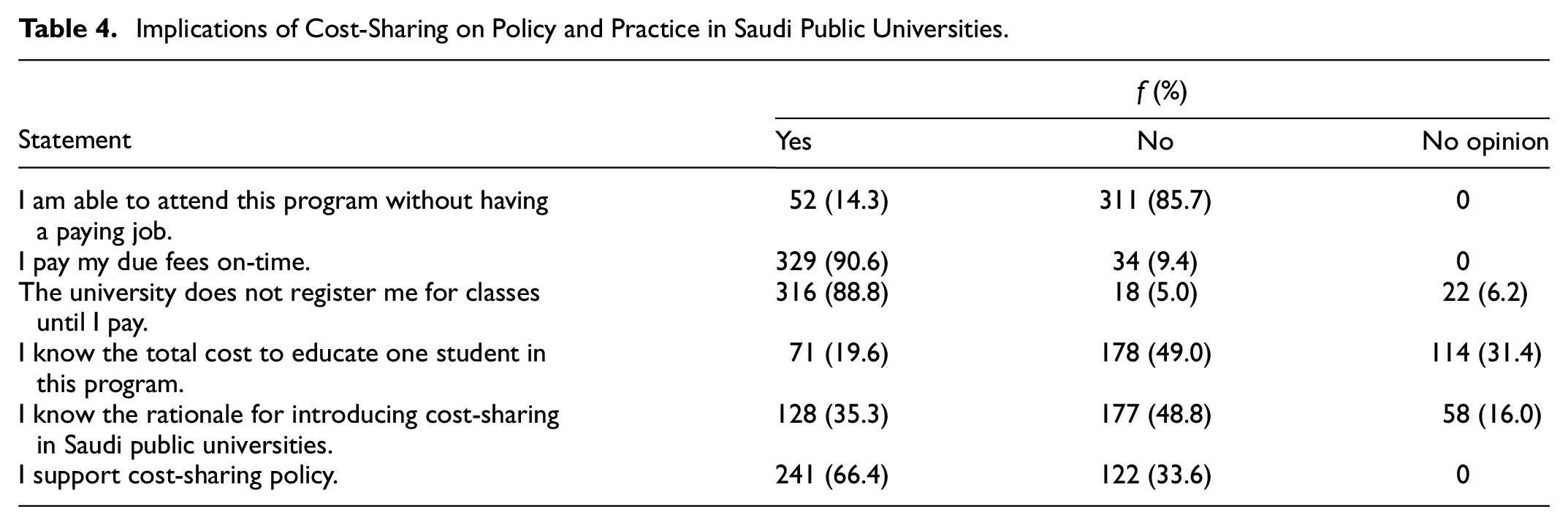
Table 4 showed that 85.7% of participants indicated that without a paying job, they could not attend graduate studies after the introduction of cost-sharing while those who said they could attend represented only 14.3%. It is noted that 90.6% pay their due fees on-time and 9.4% do not. However, the majority of participants (88.8%) said their universities do not allow them to register for classes until they pay their due fees. Few (5.0%) said their universities do allow them to register for classes and continue to study until they pay, and those with no opinion represented 6.2%. The findings also showed that 49.0% do not know how much the total cost (student plus university share) is of educating one student in a graduate study program. As for the rationale for introducing cost-sharing in Saudi public universities, only 35.3% said they know the rationale for it, 48.8% do not know, and 16.0% have no opinion. Despite what precedes, 66.4% said they support the cost-sharing policy while 33.6% oppose it.
The fourth research question tried to find out whether there were statistically significant differences in participants’ perceptions of cost-sharing based on: (a) gender, (b) education level, (c) policy support. The findings are presented in Table 5.
Participants’ Perceptions of Cost-Sharing Based on Gender, Education Level, and Policy Support.

The group comparison analysis (Table 5) showed that there are no statistically significant differences of participants’ perceptions on cost-sharing based on gender (female and male) and education level (master’s and PhD). However, perceptions based on policy support are statistically strongly significant in favor of those who supported the policy versus those who opposed it, t (246.33) = 18.96, p = 0.00.
The fifth research question asked participants to share their perceptions on the possibility of offering student financial aid mechanisms in Saudi public universities as practiced elsewhere, particularly in developed countries. The findings are presented in Table 6.
Perceptions of Graduate Students on the Possibility of Offering Student Financial Aid Mechanisms in Saudi Public Universities.

Table 6 showed that participants have favorable views on the possibility of offering student financial aid mechanisms as practiced in developed countries. They strongly agreed on seven and agreed on three out of the ten possible statements. The overall mean score of their perceptions in this dimension is strongly agree (M = 4.28, SD = 0.70).
The sixth research question tried to find out whether there were statistically significant differences in participants’ perceptions on the possibility of offering student financial aid mechanisms in Saudi public universities as practiced elsewhere based on: (a) gender, (b) education level, (c) policy support. The findings are shown in Table 7.
Participants’ Perceptions on the Possibility of Offering Students Financial Aid Mechanisms Based on Gender, Education Level, and Policy Support.

Table 7 showed that participants do not significantly differ based on education level (master’s and PhD) but slightly differ based on gender (male and female) in favor of females, t (185.94) = 6.37, p = 0.05, and strongly significantly differ based on cost-sharing policy support in favor of supporters of the policy, t (253.48) = 7.03, p = 0.00. Having presented the main findings of the quantitative data, the study moves on to presenting findings from the qualitative data. Two main themes (disadvantages and advantages of cost-sharing) emerged from participants’ answers that explain in detail their perceptions of the introduction of cost-sharing in Saudi public universities. In the first theme (disadvantages of cost-sharing), four sub-themes emerged. The first sub-theme is the fact that the policy violates the principle of equal educational opportunity for all. One interviewee said, “Cost-sharing policy will hinder access for academically able students from less well-of families” (GS-3). The second sub-theme is the belief that Saudi Arabia is a rich country with a population of only about 20 million Saudi nationals. With this regard, one interviewee said, “We live in a rich country, which is able to generate revenues elsewhere to provide free education to all. In addition, the country is spending a lot of money on Saudi students to study abroad, covering tuition fees and living expenses for the students and their dependents. Therefore, it is unfair to impose fees and tuition on those students who study inside the country” (GS-21). Another interviewee said, “the cost-sharing tuition rate imposed in Saudi Arabia is exaggerated in comparison to neighboring Gulf countries with revenues less than those of Saudi Arabia, a known rich country” (GS-28). The third sub-theme is the lack of student financial aid mechanisms to assist pay for the cost-sharing programs. One interviewee said, “The policy of cost-sharing should not be applied in the absence of appropriate financial aid mechanisms” (GS-7). The last sub-theme is the inflexibility of the cost-sharing programs. Since students are relying on their jobs to pay for their education, universities should offer part-time programs. Offering only full-time programs put students with full-time jobs in a very difficult situation. One interviewee said, “If we lose our jobs, we cannot pay for our education and not all employers are flexible in letting their employees leave for their education, particularly those in the private sector” (GS-5).
With regard to the second theme (advantages of cost-sharing), participants cite the following advantages: the necessity for generating financial resources to fund graduate studies; a step toward increasing autonomy of HEIs; the economic and social returns for the individual and the society; the introduction of tuition fees make students more serious in their studies and make universities more efficient and competitive; cost-sharing forces universities to offer quality diversified programs that meet labor demand. With this regard, one interviewee stated, “I think giving students the opportunity to continue their graduate studies with cost-sharing option is better than closing graduate studies doors because of the lack of financial resources” (GS-18). Another interviewee stated, “Through cost-sharing, universities are able to offer several programs on a regular basis” (GS-13).
Discussion
The aim of the study was to investigate the experiences of graduate students who experience, for the first-time, cost-sharing policies in Saudi public universities. This section, therefore, discusses the main findings presented in Tables 2 to 7 for the quantitative data and the main findings from the interviews. From these findings, many lessons have been learned from participants’ perceptions on cost-sharing in Saudi public universities.
As for participants’ perceptions on cost-sharing in Saudi public universities, the researchers learned, from Table 2, that graduate students hold a middle ground level based on their experiences of cost-sharing. This is a positive news for policy makers considering that this is the first cohort of cost-sharing in Saudi public universities. However, a closer look at each statement is needed as the middle ground view position can shift to either direction (favorable to unfavorable or vice versa) depending on how participants’ negative viewpoints are addressed. Participants voiced the absence of a cost-sharing policy document, therefore, there is no clear guidance for potential students. In their views, candidates do not have enough information based on which to make a sound decision to join a program other than their personal interest to further their education and being financially able to pay for their share.
Despite agreeing that cost-sharing supports economic growth and pushes students to be more serious about their studies, they indicated that paying for their studies has not been easy. Participants’ challenges in paying for their studies support opponents of cost-sharing views documented in the literature (Vossensteyn, 2009). Making matters worse is the fact that for some students who missed their payments, they were prevented from registering for the upcoming semester. For this reason, they suggested having a cost-sharing policy document available to future students to help them plan ahead of time and avoid disrupting their studies in the middle of a cohort program.
Findings from the study revealed that only 19.6% of participants know the total cost to educate one student in this program. The only information they know is how much they are contributing through the cost-sharing contract, but they do not know how much the government is contributing to their education. The combination of those who said they don’t know (49.0%) and those with no opinion (31.4%) represented a total of 80.4% of participants who do not know the total cost of the program they are attending. Furthermore, only 35.3% know the rationale for introducing cost-sharing policy in Saudi public universities and 64.8% represented those who do not know or have no opinion. It is, therefore, imperative to produce a cost-sharing policy document that explains the rationale for the policy, rules, and regulations regarding, for instance, attendance, payment options, consequences for non or late payments. Even though the majority of participants (90.6%) said they pay their share on time, there were a few students who could not pay on time (9.4%), and they were prevented from registering for the upcoming semester.
In examining the challenges related to the cost-sharing policy, the researchers noticed that participating students have limited ways to pay for their studies. About 88.2% of participants rely on their current salary, savings, parents, and relatives. Additionally, those who rely on borrowing represent only 10.5%. However, the type of borrowing is not necessarily from a bank or government subsided or un-subsided loan as known in western countries, but from trusted people including relatives and friends. Those who were supported by a scholarship represented only 1.4% of respondents. Based on these findings, it is clear that without student financial aid mechanisms, many eligible students are going to be prevented from attending graduate studies as supported in the literature by Barr (2005) and Vossensteyn (2009). If student financial aid mechanisms are not put in place, the cost-sharing policy in the context of Saudi Arabia is going to confirm the arguments that cost-sharing excludes students from low-income families including the poor and it creates inequality (Barr, 2005; Vossensteyn, 2009). Participants in this study who oppose the cost-sharing policy hold a similar argument that the policy is not fair to everyone.
It was hoped that students who have unfavorable views of the cost-sharing policy would be in favor of it if student financial aid mechanisms are made available to them to help pay for their education at the time of consumption. However, those who oppose the cost-sharing policy still oppose it even if student financial aid mechanisms are proposed. Besides, this view does not differ based on gender and education level, but it differs significantly based on policy support (Tables 6 and 7).
Analyses of the qualitative data from the follow-up interviews showed that those who oppose the policy still believe that in the context of Saudi Arabia, graduate studies must be free for everyone. Therefore, their perceptions on using student financial aid mechanisms as practiced in developed countries did not change participants’ perceptions on cost-sharing.
Those who oppose the introduction of cost-sharing policy in Saudi public universities have provided several reasons why they oppose it. Those reasons support the social factors that might prevent disadvantaged students from joining graduate studies as documented in the literature by Rasmussen (2006) and Card and Solis (2022). The participants’ opposition to the policy is based on the belief that cost-sharing, as implemented in the Saudi context, violates equal educational opportunity as only financially able students can join graduate studies. Besides, the policy does not have a student financial aid mechanism in place to support students pay their share; consequently, many academically able students from less well-off families might be excluded from graduate studies after the introduction of the cost-sharing policy. Furthermore, the cost-sharing tuition rate imposed in Saudi Arabia is exaggerated in comparison to other Gulf countries with revenues less than those of Saudi Arabia. A last point stated is that it is not fair to support graduate students who are studying abroad and charge those who are studying inside the country.
Recommendations for Policy and Practice
Based on findings from the study, five recommendations for policy and practice are suggested. The first recommendation is to produce a document on cost-sharing containing rules, regulations, penalties, total cost of the program, and student share to help potential candidates make a well-informed choice when joining a program or a university. The document could also include information on the rationale for introducing cost-sharing in the context of Saudi public universities. The document can be made available in a hard copy and online to facilitate access. In addition to making the document available, workshops, symposiums, conferences, and raising awareness campaigns must be held to educate students, parents, and the society about the necessity and benefits of introducing cost-sharing in Saudi public universities.
The second recommendation is related to the challenges faced by some students who were late with their payments or could not pay their due share for a semester. To avoid this situation, it is recommended, until student financial aid mechanisms are in place, to let students register and attend classes but hold the grades and degrees until they pay. This arrangement can be made with or without penalties (interest), but students will not miss the learning opportunities and stay with the cohort. This approach is doable now because funds generated through cost-sharing are not the main source of funding for public universities.
The third recommendation is to have student financial aid mechanisms in place to give an opportunity to anyone who desires to further their education to join a program or a university. This approach permits students to receive their education for free at the time of consumption, with the necessity for a mechanism to be put in place for repayment after graduation or leaving the university. Without student financial aid mechanisms, students from disadvantaged families will be excluded and it will create inequalities and a perpetual of “have” and “have not” in the society. A loan mechanism similar to those used in some developed countries (e.g., US and Australia) can be put in place according to the Saudi context, beliefs, and values. Examples of student financial aid mechanisms that might fit the Saudi context include income-contingent loan, or loan forgiveness for specific public services in needed areas of the nation. Government scholarships or scholarships from partnership between the ministry of education and other government or private sector entities are also other options to assist employees attend graduate studies based on specific interests identified by these entities. Furthermore, syntheses on several studies on cost-sharing suggest considering various repayment approaches based on occupation, specialization, employment, income, and destination after graduation (Fengliang, 2012).
The fourth recommendation is to provide part-time cost-sharing programs so that students can maintain their full-time jobs and be able to continue their graduate studies. Part-time programs also allow students to register for fewer courses based on their work schedule, family circumstances, and financial means.
The last recommendation is to address what participants in the follow-up interviews claimed, that the services and learning they are receiving are not different from the ones offered when graduate studies were free of charge. For that reason, it is recommended to make sure that the cost-sharing programs, teaching and learning, and services provided to graduate students are up-to-date and in good quality. In addition, the Ministry of education and university authorities must ensure that faculty members who teach these master’s and PhD programs have the academic and pedagogy qualifications to teach them according to national and international academic standards. Students and their learning must be the first priority for any educational institution in order to well prepare future generations to be ready in todays’ competitive world.
Limitations and Suggestions for Further Studies
There are two limitations that are worth mentioning in this study, which constitute the basis for further studies to support findings from the study. The first limitation is the lack of longitudinal data that allows for analysis overtime (first time and first cohort of cost-sharing in Saudi public universities). Future studies are needed to assess students’ perceptions on cost-sharing overtime. The second limitation is that this study is limited, only, to graduate students of education. Including graduate students in other fields allow to gain a thorough understanding of the cost-sharing experiences in Saudi public universities. In addition to including other fields, a qualitative study involving Saudi public university leaders and faculty members teaching in such paid programs is essential to understand, from their perspectives, the rationale, planning, implementation, evaluation, and challenges associated with the introduction of cost-sharing policy in Saudi public universities.
Conclusion
The experiences of the first cohort on cost-sharing in Saudi public universities yield some findings that can be viewed as positive and some as concerns. On the positive side, when directly asked whether they support or not the cost-sharing policy in Saudi public universities, 66.4% expressed support to the policy. In addition, 90.4% of participants pay their share on time. This is a positive support to the policy considering that this is the first cohort and first time in Saudi public universities. Participants’ justifications for supporting the policy include the reduction of government and taxpayers’ financial burden; the necessity for the universities to generate financial resources to offer more programs and admit more students rather than closing graduate studies’ doors due to the lack of financial resources; and the possibility of making universities more autonomous, efficient, competitive, and more responsive the labor market demands.
On the concerns side, participants voiced the lack of student financial aid mechanisms to make the policy equitable for all potential candidates, the lack of flexible programs (part-time) for working students. The fact that 85.7% of participants relied on their salaries, savings, and assistance from families and relatives to pay their share indicates that potential candidates without those financial means will not be able to attend graduate studies. Additional concerns, cited, include the lack of a policy document informative and accessible to all potential candidates help them know the challenges that may arise during the program such as preventing students who are late or face financial hardships from registering for classes until they pay their share. The study ended up with suggesting five recommendations for policy and practice for the cost-sharing policy to be effective and equitable for all potential candidates.
Footnotes
Declaration of Conflicting Interests
The author(s) declared no potential conflicts of interest with respect to the research, authorship, and/or publication of this article.
Funding
The author(s) received no financial support for the research, authorship, and/or publication of this article.

Data Availability Statement
Data sharing not applicable to this article as no datasets were generated or analyzed during the current study.