




Abstract
Higher education institutions (HEIs) globally heavily depend on the resilience of academic staff members to achieve excellence in teaching and learning. The extant scholarly work on resilience seems to take the relationship between workplace environmental factors (WEFs) and the adverse experiences of resilience among women academics for granted. Using South Africa as an example, this research mainly focused on the WEFs acknowledged as the primary sources of adversity and the overall perceptions and experiences of resilience among women academics in South African HEIs. This research employed a mixed methods sequential explanatory design comprising an online quantitative survey of 135 women academics, and individual in-depth/semi-structured qualitative interviews of 27 women academics. The aim of this article was to illustrate how resilience can shape the way women academics interpret and respond to adversity. More specifically, the mixed-method findings presented in this article thought to document the perceived experiences of PR among women academics in South African Higher Education institutions (SA-HEIs), with a particular focus on the University of KwaZulu-Natal (UKZN) which is located in the province of KwaZulu-Natal in South Africa. The findings unpack how four building blocks of psychological resilience (BBPRs)—neuroticism, mindfulness, self-efficacy, and coping—moderated the effects of WEFs-related adversities; and provide insights into the impacts of human resources management practices (HRMP) on women academics’ resilience. We conclude that a higher self-reported level of resilience is not necessarily indicative of positive experiences of WEFs amongst women academics in South African universities.
Keywords
Introduction and Context
This study’s primary emphasis is on women academics’ psychological resilience (PR); thus, it excludes male academics. Our main rationale to limit this study to women academics only was that the previous literature has revealed that women academics continue to face numerous barriers in institutions of higher education in South Africa, compared to male academics (Bitzer, 2009; CHE: Council on Higher Education, 2016; Idahosa, 2019; Maphalala & Mpofu, 2017; Williams, 2017). In other words, adverse experiences in the work environment are expected to increase levels of negative mental health outcomes (NMHOs) and affect the generalized sense of PR among women academics. In addition, there are limited literature investigating the extent to which work-related barriers (i.e., WEFs) influence PR among women academics. These barriers include, but are not limited to, teaching demands; research demands; administrative demands and skewed workloads; knowledge, skill, and ability (KSAs); professional & personal networking; coaching support; mentoring support; and compensation & rewards. Thus, this study raises serious concerns about the impact of work-related NMHOs on women academics’ PR.
South Africa has a long history of unequal education due to the apartheid system (CHE: Council on Higher Education, 2016; Wolhuter, 2015). Given this reality, the profession of academics is one of the most honorable in South Africa. The South African Department of Higher Education and Training has made some strides in addressing the injustices that had been perpetrated by the apartheid system. For example, Black (African) people are no longer limited to receiving higher education, and there has been an increase in the appointment of women in permanent academic posts (Chigbu & Nekhwevha, 2022; Gumede, 2020). South African HEIs are well-known for their excellence in teaching, learning and research development, despite facing complexities in these areas (including curriculum, quality assessment, student development) (Dipitso, 2022).
The broader literature has highlighted the invaluable role of HEIs in creating an environment for academics to develop personally and professionally, including through teaching, research, and outreach activities (Chigbu & Nekhwevha, 2022; Gorska et al., 2021). In the context of South Africa, however, due to individual attributes, women academics may be more vulnerable to negative events at work, potentially compromising their resilience. If women academics feel that their workplace is not providing them with enough work-related support, they may ascribe their PR to individual characteristics instead of organizational factors. Dependent on demographic characteristics and academic/employment profile, different women academics might perceive/experience PR differently. For example, senior academics might be expected to have higher workloads of teaching and research and be prepared to cope with higher demands than junior academics. However, given contextual experiences of adversity, senior academics might have higher perceived PR and lower perceived NMHOs than junior academics (Fynn & Van der Walt, 2023 ; Naidoo-Chetty & du Plessis, 2021). When work-related support is perceived by the women academics to be present and positive, the results may be demonstrated through lower levels of work-related NMHOs; for example: stress, depression, anxiety, burnout, and compassion fatigue. The broader literature suggests four primary sources for the development of PR: biological, psychological, and social-environmental (Dedoncker et al., 2021; Kuntz et al., 2017; Linge et al., 2021; Rees et al., 2015). The characteristics of the individual (i.e., personalities, attitudes, and values, experiences, and expertise) reflect the dynamic interaction between these different factors which may influence the individual’s perceptions and experiences PR (Kent et al., 2015; Linge et al., 2021). Despite having a positive sense of resilience, without perceived support, women academics may struggle to cope with work-related adversities, resulting in unpleasant experiences or a decline in resilience in the workplace. The inevitable outcome of prioritizing resilience policies and interventions is a positive impact on the attitudes of the workforce toward work-related adversity and NMHOs (Kuntz et al., 2017).
The data suggests that women academics are more at risk of NMHOs related to these WEFs because of the gendered dynamics of academic work. The patriarchal composition of HEIs can explain the prevalence of gendered academic work (Gorska et al., 2021). Despite some progress, studies show that apartheid ideologies persist and women academics in South Africa are still facing the consequences, especially in regard to “academic housework” (Walters et al., 2022). “Academic housework” is a phrase referring to duties and activities in the academic setting that go unrecognized, unpaid, and which are disproportionately performed by women (Walters et al., 2022). Other researchers noted that women academics are more likely to experience adversity due to internalized gender roles and stereotypes, which increase their vulnerability to NMHOs (Parlak et al., 2021). Consequently, HEIs which have adopted resilience-promoting policies and interventions may experience fewer instances of work-related NMHOs reported amongst women academics (Kuntz et al., 2017). This article sets out to address two research questions explored in the current study: (1) What is the general perceived level of psychological resilience among women academics in the context of their workplace environment? and (2) To what extent do women academics experience BBPRs such as neuroticism, mindfulness, self-efficacy and coping in the context of their workplace environment?
The development of these research questions was informed by the relevant literature reviewed, which revealed that the experiences of women academics in HEIs settings vary significantly from those of their male counterparts. There is limited literature that provides empirical evidence on the PR of women in the context of South African Higher Education Institutions (SA-HEIs). To address the gap in the literature, this study examined women academics’ PR vis-à-vis work-related adversities in SA-HEIs. The study is of paramount importance, as it makes significant contributions in terms of methodology, concept/theory, and empirical findings. Methodologically, we employed a mixed method sequential explanatory design, involving the sequential use of quantitative and qualitative approaches to examine the experiences of PR among women academic professionals. This design facilitated a more detailed explanation of the quantitative results through the use of qualitative methods. Our aim was to bridge an existing gap in the literature by demonstrating, theoretically, how multiple WEFs can adversely affect the PR experiences of women academics. The research made a conceptual contribution by acknowledging the limited knowledge concerning the impact of WEFs on the PR of women academics. The current study also introduced a novel definition or conceptualization of PR. The mixed-methods findings of the study, which showed a relationship between WEFs and increased levels of NMHOs, informed the proposed definition of PR. The study makes a substantial contribution to the existing literature in the domains of management, HRM, psychology, mental health, and gender, and is thus a valuable supplement to the literature in these fields.
This study’s research population was confined to the University of KwaZulu-Natal, located in the KwaZulu-Natal province of South Africa. The research participants were women academics from all five (5) campuses, and across the four (4) colleges of the university (i.e., Humanities; Agriculture, Engineering and Science; Health Sciences; Law and Management Studies). Participation reminders were frequently posted on the university’s website in an effort to gather a diverse and substantial group of women academics from the current university. The study adopted the stratified random sampling technique in the first phase and the purposive sampling technique in the second phase for identifying and selecting participants. The selected participants comprised 48.12% lecturers, 13.53% senior lecturers, 15.79% associate professors, 3.76% full professors, and 18.80% categorized as “other” academics, which encompasses individuals such as honorary lecturers, honorary research fellows, and research assistants. The employment contracts held by the participants at the university were divided into three categories: permanent (80.16%), fixed-term (10.32%), and temporary (9.52%).
The study is primarily centered on the PR perceptions and experiences of women academics. The rationale for choosing this specific population is rooted in the need to better understand their perception/experience of PR and its correlation with factors in the university environment. The emphasis on this demographic was determined by the wider literature of SA-HEIs, which suggests that women academics are considerably more prone to report professional obstacles than their male counterparts. Moreover, by targeting this group, university management and HRMPs of HEIs will gain valuable insights into the influence of WEFs-related adversities on the PR of women academics. This knowledge will allow them to be better equipped to make informed decisions to address the issues identified in this study.
Literature Review
Conceptualization of Psychological Resilience
When examining the literature on the concept of PR, often encountered is a heated debate and discussion on what should form primary factors of resilience and how we can nurture or enhance these factors (Jogulu & Franken, 2022; Southwick et al., 2014). The discussions center around the conceptualization of resilience as either an individual quality, a dynamic process, or a positive outcome. Arguably, these perspectives influence how resilience is conceptualized. More recent studies have underlined the importance of conceptualizing resilience holistically, taking into consideration the different person-environment dynamics at play in the experience of resilience (Gajofatto et al., 2019; Jogulu & Franken, 2022; Zhang, 2021). A holistic view of the concept in the context of person-environment interactions requires considering all dynamics, not just traits, process, or outcome (Kuntz et al., 2016; Yost, 2016). Based on this reasoning, the goal of this paper is to uncover women academics’ self-perceptions of resilience and how these perceptions were influenced by WEFs.
The literature reveals that the gendered notion of work has shaped the resilience of men and women in the workplace (Lavee & Kaplan, 2022; McDowell, 2015). Work can be seen as gendered when work disproportionally affects women in terms of amount workloads, pay and benefits, career progression, and work-life balance (Brommesson et al., 2022; Gorska et al., 2021; Milner et al., 2019). The gendered nature of the academic workforce is inextricably linked to work-related adversity and NMHOs. This is evidenced by women’s under-representation in senior academic positions, disproportional research space/output, increased teaching and service activities, longer working hours, and higher burnout due to juggling work and family. The gendered notion of work introduces the gendered notion of PR, which implies that levels of PR are likely to be higher among women compared to men (Brommesson et al., 2022; Gorska et al., 2021; Lavee & Kaplan, 2022; McDowell, 2015). This notion is often reflected in the definitions of resilience, which promote the narrative that resilient individuals do not succumb to adversity. In other words, this idea that somehow people become more resilient when they are faced with significant adversity. When such notions are promoted, not only is the perception that women can cope (no matter the adversity) without the need for external support reinforced, but women are forced internalize constructed gender differences. The fact is that these ideas can aggravate the experiences women have and result in significant negative mental health consequences for women.
There is growing recognition in social sciences that PR models are pivotal to explaining how individuals perceive and respond differently to adverse or challenging events. Our study draws on the model of individual workforce resilience developed by Rees et al. (2015) to advance the argument that a higher self-perceived level of resilience is not always an indicator of positive experiences of WEFs amongst women academics in South African HEIs. PR is a complex, multi-dimensional construct, and a fundamental element of the concept of psychological capital (PsyCap). PR is broadly defined as “the capacity people have to adapt swiftly and successfully to stressful/traumatic events while not reverting to the original state” (Shrivastava & Desousa, 2016, p. 38). To put it differently, it is the capacity to overcome adversity and move forward without being able to control the events that have already occurred. Difficult times can lead individuals to reflect upon their strengths and weaknesses, and give them a greater insight into the events they can and cannot influence. Thus, in this study, PR is described as the “inner” capacity people have to endure adversity, but it is also the ability to recognize adverse situations in life that people cannot endure or control, and to consciously walk away from such situations to cope, survive and protect mental health. In their study of healthcare professionals, Rees et al. (2015) proposed a model of individual workforce resilience, delineating how biopsychosocial factors (i.e., biological, psychological, and social factors) come into play in times of adversity. As illustrated in Figure 1, these concepts involve neuroticism, mindfulness, self-efficacy and coping.

The ICWR-1 model of individual workforce resilience.
Considering the similar work pressures experienced and soft skills used in healthcare and academic settings, this model was deemed appropriate. The work-life of healthcare and academic staff depends on strong soft skills, including adaptability, communication, collaboration, and creative problem-solving. Taking the observable similarities into consideration, it is essential to assess whether the proposed components are of great importance to women academics. For example, previous studies have noted that the significant time, energy, and effort required to achieve excellence in their academic work can lead to negative outcomes. In previous studies, a distinction is made between woman and men academics regarding levels of NMHOs. It is likely that women academics may be more exposed to NMHOs, because of the need to engage with unpaid work (i.e., household chores, childcare, and care work) besides their academic work (Gorska et al., 2021). This means that women academics may be more likely to experience higher levels of neuroticism, and lower levels of mindfulness, self-efficacy, and coping.
While these concepts are significant in HEIs, there is limited research on their effect on women academics’ resilience in South African HEIs using the model of resilience by Rees et al. (2015). To measure and understand women academics’ perceptions of PR in the context of WEFs-related adversities in HEIs, we used the Connor-Davidson Resilience Scale (CD-RISC) (Connor & Davidson, 2003). Researchers and scholars have utilized various resilience measurement scales to study the experiences of PR within the adult population. After an extensive review of the literature, four scales emerged as the most psychometrically sound in evaluating resilience among adults. These are the Resilience Scale (RS), Resilience Scale for Adults (RSA), Brief Resilience Scale (BRS), and Connor-Davidson Resilience Scale (CD-RISC), and are mainly distinguished by their scope, target populations, and conceptual understanding of resilience (Ferreira et al., 2021; Salisu & Hashim, 2017). It is noteworthy that the CD-RISC is unique in that it assesses the concept of resilience by considering biopsychosocial, cultural, and environmental elements, compared to the other three scales. As a result, the 25-item version of the CD-RISC has been found to be the most appropriate for this study. Moreover, the CD-RISC items reflect the biopsychosocial resilience concepts presented in the individual workforce resilience model used in this study as the theoretical foundation. Accordingly, the significance and application of these concepts for women academics are discussed below.
Neuroticism
Neuroticism is described interchangeably with trait anxiety, negative affect or trait negative affect, and refers to the tendency to experience enduring negative emotional states such as anxiety, guilt, anger and depression more frequently, intensely, and readily, and for a more enduring period of time (Rees et al., 2015, p. 3). Neuroticism represents a cornerstone of the “Big Five Personality Traits” (extraversion, agreeableness, consciousness, neuroticism, and openness) (Ikizer et al., 2022). The emphasis of the neuroticism construct is on the degree of emotions the person will display when confronted by adverse situations. It is generally regarded as the degree of emotional stability and impulse control, the tendency to experience negative emotions easily (Maican et al., 2019, p. 119). Hence, people who demonstrate persistent signs of neuroticism are often referred to as neurotic individuals. Neuroticism is linked to an increased risk of exhibiting self-destructive behaviors that interfere with work and personal life (Huang et al., 2023; Rees et al., 2015). There is theoretical and empirical evidence to suggest that the biological make-up of an individual is likely to influence their level of neuroticism (George et al., 2011; Magal et al., 2021). In line with Rees et al. (2015) research, a biological tendency toward heightened emotional reactivity can cause specific mental health disorders such as bipolar disorder, depression, and anxiety. Further studies have revealed a connection between genetics and these two widespread mental health problems (Anagnostopoulos & Botse, 2016; Navrady et al., 2017). Depression is an often-overlooked mental health issue, where the individual may feel overwhelming sadness, a sense of worthlessness, and guilt. Anxiety is classified as a mental illness given its association with worries, agitation, and disquiet in the presence of real or perceived threats. In particular, Merino et al. (2016), proposed that “worry” plays a mediating role between neuroticism and anxious/depressive symptoms. Merino et al. (2016) posit that persons with a predisposition for rumination on unresolvable reflections are more apt to display pronounced neuroticism.
Many studies confirm the potential negative implications of high levels of neuroticism. Vukmirovic et al. (2020) suggest that those with high levels of neuroticism are more likely to have negative reactions to events because of their constant, negative emotional states. The study by Pouratashi and Zamani (2017) with faculty members found that neuroticism had a negative and significant effect on education performance and research performance of faculty members. The authors concluded that, because of high levels of neuroticism, academics had a decreased self-esteem, a negative attitude toward their work and experienced stress, having a negative effect on educational performance and research performance. In a more recent study by Ikizer et al. (2022) which investigate burnout syndrome in academia, it was found that having higher neuroticism was associated with higher stress and loneliness scores. The study by Leavitt et al. (2017) which explored the link between memory and neuroticism, suggests that higher neuroticism in healthy adults can be linked to worse memory and lower neuroticism to better memory.
Furthermore, as evidenced in recent studies, neuroticism can significantly hinder the ability to display resilience (Anagnostopoulos & Botse, 2016; Rees et al., 2015; Robison et al., 2017). The study by Rees et al. (2015), in particular, attempted to recognize the two functions of neuroticism (illustrated in the model of resilience in Figure 1). Primarily, the model proposes that, due to its main feature of increasing an individual’s emotional sensitivity to adversity, neuroticism can have an adverse effect an individual’s psychological adjustment. It is further proposed by this model that neuroticism influences how psychosocial elements, like mindfulness, self-efficacy, and coping, can influence PR levels and result in positive psychological adjustment.
As evidenced by the literature, women academics who report more WEFs-related adversities, tend to exhibit higher levels of neuroticism (Davis et al., 2022; Trusson & Rowley, 2022; Yildirim & Eslen-Ziya, 2020). The broader literature emphasizes the importance of emotional stability in predicting academic work quality (Chigbu & Nekhwevha, 2022; Gorska et al., 2021; Yildirim & Eslen-Ziya, 2020). Subsequently, it is likely that women academics facing work-related adversities may endure emotions associated with neuroticism, which could harm their mental health and the quality of their work. It is critical for universities to have the capacity to provide support to academics who may potentially experience high levels of neuroticism.
Mindfulness
From a psychosocial perspective, mindfulness involves psychological processes that generate conscious awareness and observable behaviors (Rees et al., 2015). The concept has its roots in contemplative practices (for example: Buddhism, Hinduism, Judaism, Islamism, Christianism), and can be defined as the “ability to attend to intentionally and maintain non-judgmental awareness of one’s experience (thoughts, feelings, physical sensations) in the present moment” (Reich et al., 2010, p. 472). This definition encapsulates both trait (i.e., inner factor), state and practice conceptualizations of mindfulness. The trait conceptualization of mindfulness suggests that an individual may have a natural propensity to be mindful. The state mindfulness conceptualization of mindfulness pertains to the degree that an individual is mindful at a singular time point. The practice conceptualization of mindfulness recognizes that mindfulness develops or improves through long-term practice and experience (Charoensukmongkol & Pandey, 2021; Lin et al., 2022). This study attempted to focus on both trait and practice conceptualizations of mindfulness, recognizing that mindfulness practice and training can enhance state mindfulness. Workplaces increasingly indorse the importance practicing mindfulness in a work context, regardless of the form of practice involved (whether religious or secular philosophies are involved). Employers increasingly expect to find employees who can function effectively at work and can handle work-related adversity (Kuntz et al., 2016, 2017). Hence, the concept of mindfulness is both attractive and applied increasingly across different work situations. It has been shown that a higher level of mindfulness is associated with ability to self-regulate attention and emotions.
For instance, mindfulness can promote emotional regulation and concentration, which service industry professionals (including flight attendants, sales agents, and call center agents) require for improved work-related performance and satisfaction (Charoensukmongkol & Pandey, 2021; Charoensukmongkol & Puyod, 2022; Suthatorn & Charoensukmongkol, 2022). For example, in the case of flight attendants, the work requires constant face-to-face interactions with diverse passengers and can sometimes result in emotional exhaustion. It is noted that emotional self-awareness and empathy are essential intrapersonal/interpersonal skills in jobs that require regular human interaction, which can be developed/enhanced with mindfulness practices (Charoensukmongkol & Pandey, 2021; Charoensukmongkol & Puyod, 2022; Suthatorn & Charoensukmongkol, 2022). When practicing mindfulness, one is aware of the present and is consciously aware of both their strengths and weaknesses (George et al., 2011). A mindful state of mind helps increase self-awareness, thereby allowing individuals to cope with stressful situations more positive (Phungsoonthorn & Charoensukmongkol, 2022). For example, during adverse experiences, holding a positive level of mindfulness can stimulate a less apprehensive attitude and instead a more positive and confident outlook toward the issues at hand (Monroe et al., 2021).
Mindfulness researchers and experts also argue that the purpose of mindfulness is not to flood the mind with thoughts and reflections (Chung et al., 2021; Hugh-Jones et al., 2018; Rees et al., 2015; Robison et al., 2017). On the contrary, mindfulness is a practice of letting go of mental/emotional burdens to gain insight and a better understanding of one’s current circumstances (Kersemaekers et al., 2018; Robison et al., 2017). For example, several studies have established that incorporating mindfulness into work routines can lead to reduced stress and greater well-being in the workplace (De la Fuente-Anuncibay et al., 2019; Hugh-Jones et al., 2018; Kersemaekers et al., 2018). To illustrate the impact of mindfulness practice, Hugh-Jones et al. (2018, p. 482) described their research findings as analogous to that of “now being able to see what was happening in their bodies, thoughts and emotions facilitated change, suggesting that their baseline levels of self-awareness were low” (Hugh-Jones et al., 2018, p. 482). This highlights the concept of low mindfulness which is described as “an inability to attain a de-centered perspective on events and a tendency to respond reactively and inflexibly to negative thoughts and emotions” (Teasdale, 1999: cited in Rees et al., 2015, p. 3). For example, women academics with low levels of mindfulness may spend time contemplating unpleasant experiences and worry about the future, and suffer more NMHOs (Phungsoonthorn & Charoensukmongkol, 2022). In other words, women academics higher in baseline mindfulness are more likely to report lower NMHOs (Bartlett et al., 2021). This also suggests that women academics with high levels of mindfulness become less susceptible to work-related NMHOs.
Empirical evidence reveals that Mindfulness-Based Stress Reduction (MBSR) training, which involves mindfulness meditation, mindful awareness, and yoga-based mind-body techniques like posture, slow breathing, and meditation, is effective in fostering mindfulness (Dedoncker et al., 2021; Hugh-Jones et al., 2018; Kent et al., 2015; Phungsoonthorn & Charoensukmongkol, 2022). In addition, based on clinical studies, MBSR appears to have the potential to address mental health issues such as stress, depression, and anxiety (De la Fuente-Anuncibay et al., 2019; Phungsoonthorn & Charoensukmongkol, 2022). Another important aspect of academic work is having the ability to switch attention between multiple tasks. Marais et al. (2020) posited that attention switching can be hindered because of a high level of perceived emergency. According to Marais et al. (2020, p. 1038), “mindfulness could be a means of reducing perceived emergency, which leads from one task to another while sometimes losing track of one’s life goals and priorities.” Women academics experience added challenges within the complex domain of academic work, as restrictive sociocultural gender norms hinder positive mindfulness in the work environment.
The complexity of academic work is evident in the need to have the right academic qualifications, expertise, knowledge, and to be continually striving to improve. It is worth emphasizing that meeting the requirements of academic work can often be an intricate and demanding challenge for certain academics. Mindfulness is significant as its application in educational contexts contributes to improved research and pedagogy outcomes. In this context, for successful academic work, having the capability to incorporate contemplative practices into research and pedagogy is essential. Promoting mindfulness in academic work environment contexts requires becoming less focused on being analytical and more focused on being present. Mindfulness practices strive to reduce the tendency to judge, which can be an unwanted consequence of analytical thinking. According to Brendel and Cornett-Murtada (2019), the development of an analytical habit of mind is an integral part of a professor’s identity, which is achieved through continual critique and discourse that can be a hindrance to mindfulness. The authors posited that developing an analytical and judgmental habit mindset is a critical aspect of being a faculty member. However, this mindset is often inflexible and makes them susceptible to a pride of expertise (or a sense of superiority), thus hindering their capacity to stay present and authentic when engaged in academic work activities. The impact of mindfulness practices on teaching, research, and service in higher education institutions was investigated in an action research study by Brendel and Cornett-Murtada (2019). Their study concluded that professors achieve mindfulness through “objective reframing,” which involves forming new habits based on alternate frames of reference (Brendel & Cornett-Murtada, 2019). Their study illustrated the fundamental role of mindfulness in mindful assessment grading, classroom student awareness, and teaching self-awareness. It can be inferred that low mindfulness reduces academic performance, causes disengagement, and increases risk of errors or accidents (Bartlett et al., 2021). In this respect, HEIs should introduce, implement and enforce mindfulness-based interventions such that women academics report fewer NMHOs and more positive experiences of PR.
Self-Efficacy
A difficulty faced by women academics in relation to experiences of resilience has been a lack of self-efficacy. Given that academic work is characterized by different activities (i.e., teaching, research, administrative and community service work) each of which involving different challenges, a key factor that may mitigate the impact of adversity experienced by women academics is their sense of self-efficacy in their work roles. Self-efficacy is defined as an individual’s belief in his/her own ability to successfully perform a given task (Bandura, 1977). The literature distinguishes two types of self-efficacy: general self-efficacy (GSE) and domain-specific self-efficacy. GSE is the belief in one’s competence to tackle novel tasks and to cope with adversity in a broad range of stressful or challenging encounters, as opposed to specific self-efficacy, which is constrained to a particular task at hand (Luszczynska et al., 2005, p. 80). That is, domain-specific self-efficacy is defined as individual’s belief in their ability to cope with adversity within a specific domain only, and not across different domains. Therefore, given that the aim of this study was to produce an overall picture of the experiences of PR among women academics, the conceptualization of self-efficacy used is in this study is GSE.
The evidence would suggest that self-efficacy is a fundamental dimension of PR because it promotes a greater sense of understanding of one’s own strengths and limitations. It also involves transcending self-limiting beliefs and believing in one’s own ability to influence meaningful experiences in life. As per the seminal work of Bandura (2006), self-efficacy underpins a person’s promptness to engage in constructive behavior and allocate own strengths to thrive. Self-efficacy is considered one of the important personal qualities which individuals are expected to portray in the workplace domain. Particularly, within the context of career women, self-efficacy is often regarded a key personality trait and ingredient for building long-term job security and a steady career progression (Jogulu & Franken, 2022).
From a resilience perspective, individuals whose perceived self-efficacy is positive are likely to display lower levels of NMHOs and are less likely to show intents to exiting their workplace during times of adversities (Kuntz et al., 2016). Hence, in general, individuals who demonstrate a strong sense of self-efficacy when faced with hardships are usually regarded as resilient (Jogulu & Franken, 2022; Yost, 2016). It is necessary to recognize that self-efficacy is an internal factor, however, experiences of self-efficacy in terms of self-belief, attribution, and motivation can be subject to external influences from social, cultural, and environmental sources. Thus, it is expected that workforce resilience interventions can systematically assist women academics in developing/promoting a positive sense of self-efficacy in the face of adversity (Leppin et al., 2014; McDonald et al., 2016; Pieters, 2016; Rees et al., 2015). These could include therapy post-adversities, team building training or self-development programs which aim to strengthen character toward different potential situations. Different dynamics propel the quality to self-efficacy and may include experiences, core beliefs, spiritual beliefs and so forth (Rees et al., 2015; Wołowicz-Ruszkowska, 2016). Thus, educating women on self-efficacy is helpful in influencing how well they manage professional and personal experiences.
To date, there seems to have substantial discoveries measuring a person’s lack of perceived self-efficacy against other workplace variables. Workplace variables are those affecting work performance and health, such as control, influence, collaboration, and professional skills. According to Leppin et al. (2014), developing a strong sense of self-efficacy is most critical for people whose career aspirations are invested in complex and challenging professions. In the context of HEIs, a sense of positive self-efficacy may assist women academics overcome internal and external barriers (Greer, 2011; Sojo et al., 2016). For instance, women may not communicate their expectations effectively and may lack the self-confidence to strive for promotions in top-level positions or be assigned to more desirable academic roles (Dominguez & Diez, 2022; Greer, 2011; Sojo et al., 2016). The preceding section emphasized the importance of academic credentials, expertise, and knowledge for academics to successfully fulfil complex academic roles. A lack of perceived self-efficacy can sometimes be attributed to an absence of the competencies to fulfil certain objectives. Maican et al.’s (2019) study found that senior women academics (compared to men academics) with teaching roles were more likely to avoid technology applications due to feelings of anxiety and a lack of self-efficacy, as they viewed the obstacles as too difficult to overcome. It comes as no surprise that women academics who have a greater sense of self-efficacy are more likely to manage WEFs-related difficulties more effectively, leading to fewer NMHOs.
Coping
Coping can be conceptualized as “a process of adjustment following an adverse event” (Rees et al., 2015). Through the process of coping, individuals strive to make their life experiences more positive, by developing an inspired attitude and taking meaningful actions toward this goal. It describes the process of managing internal and external demands of stressful situations (Greer, 2011; Sojo et al., 2016; Yang et al., 2021). Since, the ability to manage adverse experiences is contingent on the human cognitive process, coping and self-efficacy are found to be overwhelmingly interconnected factors of resilience (Smith et al., 2016). In this context, three core coping styles are known to influence how people are likely to respond when faced with adversity (Lloyd et al., 2017; Rees et al., 2015; Van den Brande et al., 2017).
The first coping style (appraisal-focused) refers to coping which takes place when justified knowledge or solution to manage adversities is not straightforward. Which essentially means that individuals change or reconsider how they think about the situation they are in, to cope with events which they cannot control. The concept of appraisal-focused coping is encapsulated in Viktor E. Frankl’s quote “When we are no longer able to change a situation—we are challenged to change ourselves.” For example, when dealing with bereavement in the family, natural disasters, or societal expectations, appraisal-focused coping is a frequently used strategy. The second coping style (problem-focused) refers to coping which is takes place when people confront adversities head-on, proactively, and optimistically. This coping style is solution-oriented and applied to appraise adversities that are perceived as more manageable. For example, if work overload is a challenge, women academics could learn time management skills to better handle daily activities. The third coping style (emotion-focused) occurs when people attempt to deal with the emotional consequences of adverse events (Rees et al., 2015). This type of coping approach involves altering emotional reactions using techniques such as avoidance, mediation, selective attention, and relaxation. These coping styles are highlighted because they are directly linked to levels of neuroticism, mindfulness, and self-efficacy. For example, high mindfulness and self-efficacy lead to appraisal and problem-focused coping, while high neuroticism leads to emotion-focused coping (Smith et al., 2016). Emotion-focused coping is associated with neuroticism in the form of increased levels of emotional exhaustion, self-destructive behaviors, high states of fatigue (Huang et al., 2023; Van den Brande et al., 2017). The literature suggests that while coping strategies may vary among situations and individuals, combining them can enhance psychological adjustment. These strategies illustrate how people cope differently, despite the utilization of a mix of techniques (Lipshits-Braziler et al., 2016). In fact, studies have shown that positive attitude and self-efficacy affect how people cope with life’s adversities (Phungsoonthorn & Charoensukmongkol, 2022; Shu, 2022; Zhang, 2021).
Holding strong self-efficacy beliefs can enhance individuals’ capacity to promptly engage in active coping behavior or strategies (Lipshits-Braziler et al., 2016). In light of this, it may be assumed that academic women with strong coping skills will see their jobs, work environment, families, and friends as suitable sources of support when faced with challenges. For example, the willingness of women academics to seek social support and display problem-solving skills may be higher than women academics whose perceived self-efficacy or coping capacity is low (Rees et al., 2015). In contrast, in general, individuals who experience negative perceived self-efficacy will likely demonstrate a lower coping ability in the form of passive coping (Gajofatto et al., 2019; Rees et al., 2015; Shu, 2022). As a result of using passive coping mechanisms, women academics may be more inclined to engage in passive behaviors such as denial, avoidance, neglect, and negligent behavior which can influence unreasonable substance use. HEIs must take a more active role in addressing the detrimental effects of WEFs on women academics in order to promote resilience via coping strategies. Organizational interventions that encourage positive coping behavior may prove to have a positive influence on eliciting resilient behavior among women academics (Kuntz et al., 2017). Lian and Tam (2014) noted that workplace interventions toward resilience should emphasize generic working conditions. By adopting practices that promote job autonomy, lower stress, job security, and equal advancement opportunities, organizations can create a more inclusive and supportive environment for women academics (Lian & Tam, 2014).
The ability to manage adverse emotions constructively is a crucial attribute in an academic setting, where emotionally, physically, and psychologically demanding tasks may arise, and academics may be expected to offer emotional and psychological support. Therefore, it may be argued that emotion-focused coping strategies may contribute toward high levels of neuroticism. This is relevant to the HEIs context due to different types of WEFs-related adversities and associated NMHOs experienced by women academics. A high level of neuroticism, for example, may increase the likelihood of experiencing negative emotions. Emotion-focused coping strategies can reduce NMHOs, but not in the medium or long term (Van den Brande et al., 2017). As a result of feeling less capable of dealing with adversity, the emotion-focused coping strategy may not be considered as a dominant strategy for dealing with WEFs-related adversity. Given evidence linking emotion-focused coping to higher NMHOs, appraisal-focused and problem-focused coping are generally viewed as more effective coping strategies for managing WEFs-related adversities as well as promoting PR in the medium and longer term.
Although negative emotions can lead to inadequate coping responses, the use of the emotion-focused coping method is still an essential element in the PR process, primarily because of the relationship between negative emotions and one’s predisposition to neuroticism. The presence of institutional support systems is crucial in promoting positive reframing, positive coping KSAs, and positive PR experiences among women academics grappling with NMHOs. Negative emotions are an invaluable source of information, as they can signal an imminent adversity that needs to be addressed. From a PR perspective, we propose that applying the emotion-focused approach could be advantageous if women academics actively practice mindfulness techniques. For example, mindfulness practices such as mindfulness meditation, mindful awareness, and yoga-based mind-body techniques, are used to potentially bolster PR. Mindfulness may help women academics respond more adaptively under negative situations by seeking or receiving support from others, and thereby potentially reducing the likelihood of experiencing NMHOs.
Whether women academics decide to confront or avoid WEFs-related challenges depends on their self-efficacy beliefs and their actual or perceived support from their HEIs. For example, the lack of university support and the feeling of helplessness toward unfavorable events may lead women academics to adopt maladaptive coping mechanisms to achieve positive PR experiences. Therefore, it is critical that women academics learn and master different coping related KSAs to successfully cope with and respond to work-related adversities. Equally important is for HEIs to provide adequate support for women academics, especially those who experience high perceived WEFs-related adversities and NMHOs. Higher levels of perceived coping related KSAs can lead to the alleviation of NMHOs such as anxiety, stress, and depression, and consequently result in better psychological adjustment and PR.
Research Methodology and Methods
In order to address the research questions, we applied a mixed method sequential explanatory design consisting of a quantitative phase (phase-one) and a qualitative phase (phase-two). The overarching strength of using a mixed method is that it provides a more complete understanding of a research problem than either quantitative or qualitative data alone. Given the nature of this study, a design that facilitates comprehensive exploration of the research problem was favored to enhance the credibility of the findings (Creswell & Creswell, 2018). The study ensured participants’ eligibility criteria by excluding male academics, non-academic staff, and women academics with less than 2 years of academic work experience.
Phase-one involved selecting eligible participants from all four faculties at UKZN using stratified random sampling, and inviting participants to complete a web-based questionnaire. This resulted in this study sampling 135 women academics in the first phase of the study. The participants provided sociodemographic information in terms of age, race, relationship status, number of children, level of qualification, tenure within the industry and the institution, appointment designation, employment contract, and home college at the institution. In phase-two, 27 women academics were selected using purposive sampling and were interviewed individually on the Zoom platform using an in-depth semi-structured approach. The two primary criteria for selecting participants for the second phase of the study were as follows. Primarily, the participants had to be able to relate to one or more of the WEFs featured in the questionnaire as possible factors affecting their PR. Secondly, consistent with the PR theory, the participants were required to rate all BBPRs as per the PR model of Rees et al. (2015).
To address the first research question, we drawn on the original 25 item Connor-Davidson Resilience Scale (CD-RISC) by Connor and Davidson (2003). The items were slightly modified to assess/measure the general perceived level of PR among women academics at UKZN. All 25 items were rated on a 5-point Likert-scale ranging from “not true at all” (1 point) to “true nearly all the time” (5 points) as in the original CD-RISC scale. Each item was a short statement that described the general perceived level of PR among the participants in the context of working at UKZN (for example, “I know where to turn for help during stressful times at UKZN”“I feel in control of my work-life at UKZN”). The 25 items were grouped into five resilience factors (for easiness of presentation and interpretation) namely, notion of personal competence, high standards, and tenacity (factor 1); trust in one’s instincts, tolerance of negative affect, and strengthening effects of stress (factor 2); positive acceptance of change, and secure relationships (factor 3); relates to control (factor 4); spiritual influences (factor 5) (Connor & Davidson, 2003, p. 80). With respect to the second research question, we looked at the BBPRs outlined in the model of individual workforce resilience by Rees et al. (2015). Participants answered this question by indicating the extent to which they experienced each of the BBPRs at UKZN, using a 5-point Likert-scale ranging from 1 “to little or no extent” to 5 “to a great extent.” To foster participants’ understanding and introspection of their PR experiences and reduce potential ambiguities in the questionnaire completion, the definitions of BBPRs concepts were incorporated.
Quantitative Results (Findings)
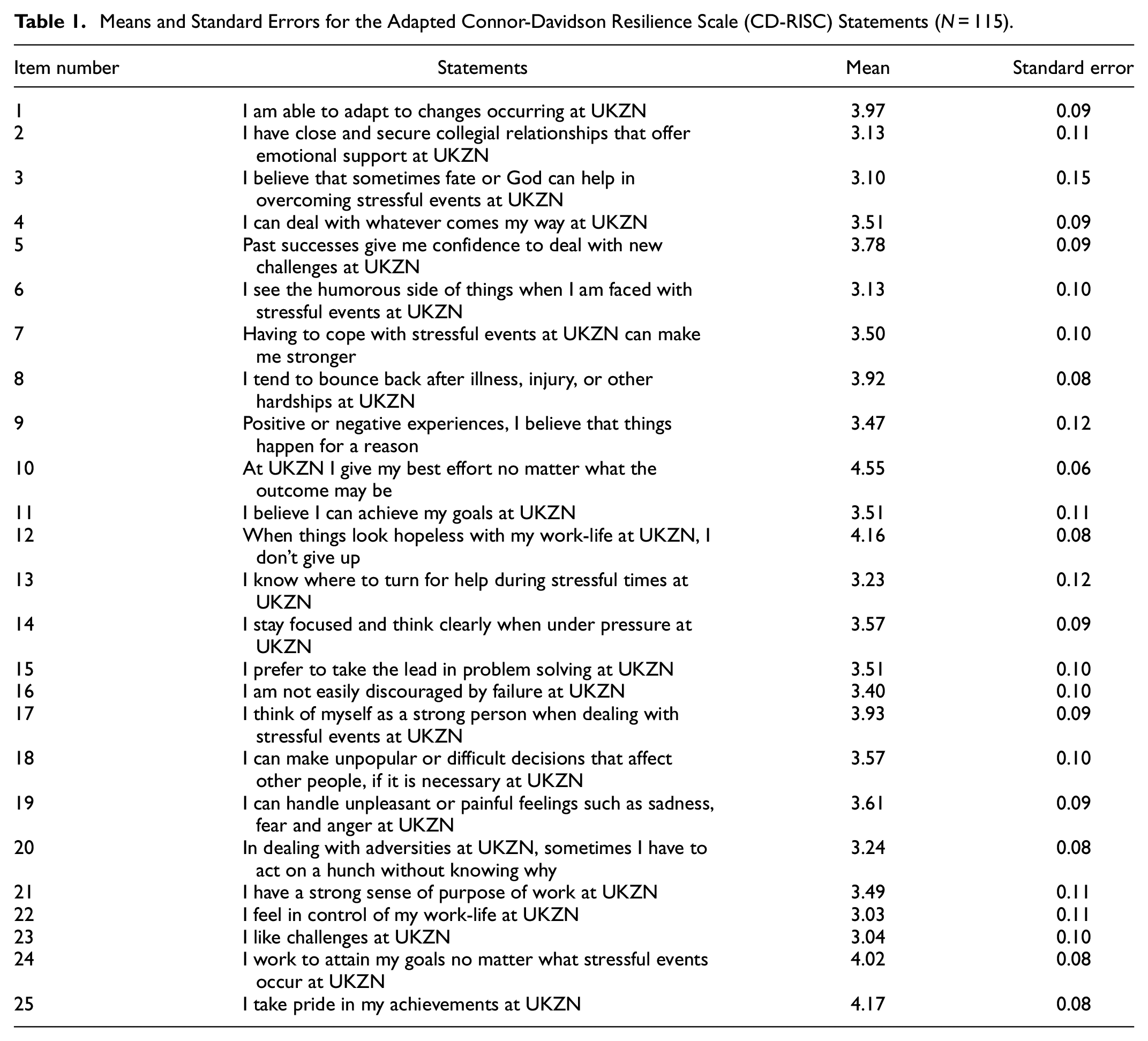
Tables 1 and 2 presented in the next sections below illustrate the first phase quantitative results.
Means and Standard Errors for the Adapted Connor-Davidson Resilience Scale (CD-RISC) Statements (N = 115).
Means and Standard Errors for the BBPRs (N = 112).

The Adapted Connor-Davidson Resilience Scale (CD-RISC)
Table 1 presents the average mean scores and standard errors on the adapted 25 items Connor-Davidson Resilience Scale (CD-RISC) from Connor and Davidson (2003). Respondents’ averages on the CD-RISC’s factor 1 (personal competence, high standards, and tenacity—items 10, 11, 12, 16, 17, 23, 24, and 25) show that on average, respondents scored highest on item 10 (At UKZN I give my best effort no matter what the outcome may be) (M = 4.55, SE = 0.06) and lowest on item 23 (I like challenges at UKZN) (M = 3.04, SE = 0.10). Respondents’ averages on the CD-RISC’s factor 2 (trust in one’s instincts, tolerance of negative affect, and strengthening effects of stress—items 6, 7, 14, 15, 18, 19, and 20) show that on average, respondents scored highest on item 19 (I can handle unpleasant or painful feelings such as sadness, fear and anger at UKZN) (M = 3.61, SE = 0.09) and lowest on item 6 (I see the humorous side of things when I am faced with stressful events at UKZN) (M = 3.13, SE = 0.10). Respondents’ averages on the CD-RISC’s factor 3 (positive acceptance of change, and secure relationships—items 1, 2, 4, 5, and 8) show that on average, respondents scored highest on item 1 (I am able to adapt to changes occurring at UKZN) (M = 3.97, SE = 0.09) and lowest on item 2 (I have close and secure collegial relationships that offer emotional support at UKZN) (M = 3.13, SE = 0.11). Respondents’ averages on the CD-RISC’s factor 4 (control—items 13, 21, and 22) show that on average, respondents scored highest on item 21 (I have a strong sense of purpose of work at UKZN) (M = 3.49, SE = 0.11) and lowest on item 22 (I feel in control of my work-life at UKZN) (M = 3.03, SE = 0.11). Respondents’ averages on the CD-RISC’s factor 5 (spiritual influences—items 3 and 9) show that on average, respondents scored highest on item 9 (Positive or negative experiences, I believe that things happen for a reason) (M = 3.47, SE = 0.12) and lowest on item 3 (I believe that sometimes fate or God can help in overcoming stressful events at UKZN) (M = 3.10, SE = 0.15).
The Building Blocks of Psychological Resilience (BBPRs)
Table 2 presents the average scores and standard errors on the BBPRs, neuroticism, mindfulness, self-efficacy, and coping. Table 2 reveals that on average, respondents had relatively high levels of self-efficacy (M = 3.84, SE = 0.09), followed by high levels of coping (M = 3.72, SE = 0.10), mindfulness (M = 3.34, SE = 0.10) and low levels of neuroticism (M = 2.58, SE = 0.12) at the UKZN workplace environment.
Qualitative Results (Findings)
This section presents the qualitative findings that explain the participants’ self-reported responses related to the BBPRs as shown in Table 2. It underlines the relevance of BBPRS in explaining PR among women academics and the importance of HEIs’ support in shaping perceptions of PR.
Benefits of Promoting Lower Levels of Neuroticism (NMHOs)
The qualitative analysis suggested that social stigma and lack of university support for NMHOs contributed to high neuroticism experiences among some participants.
I think for my work, the main thing would be around the worry of what my future is going to bring…. So, there is definitely a level of neuroticism and I think that again where that idea of what upper management is doing, plays such a role in the mental health of their staff because the sooner a clear plan is communicated, the sooner that element of neuroticism can fade away and then you can get on with planning…. [P9, senior lecturer] ….So, the kind of things that can happen at the university just because of the need for power and for, to push people individually forward they would do anything, people would do anything to actually rob you of your rightful place and then the system doesn’t have anything in place to protect you and certainly my experience has been that I was not protected, I was just looked upon as: ‘shame’“this person has got issues”, and then you get identified as having mental health issues. And the stigma that goes with that as well is very serious. [P24, lecturer]
According to a participant, the performance management system’s lack of support for women academics on maternity leave resulted in increased neuroticism.
So, those [NMHOs] are very much linked. So, the anxiety, that was the fact that you know that stupid system that we have, that performance management system, where I told you I was marked as being underperforming that caused hectic anxiety for me and I was spiralling down into this depression, it was mild depression, it wasn’t real. Also, I was post-natal and there must have been something happening there with the hormones and whatever because it was very out of character for me to feel that way. Normally when something like that happens, I am like ag it happened already let’s move forward. How do we not do it again? And at that point in time, it hit me, and it was something that still upsets me today…. [P2, lecturer]
Benefits of Promoting Higher Levels of Mindfulness
The mindfulness discussion emphasized the difficulties women academics face in balancing work-life, and staying focused, despite flexible academic schedules.
… The notion of flexi hours which is touted as this thing – or even working from home which we’re doing now because of the pandemic - is touted as this thing that is so empowering for women, is also ridiculous in the sense that you actually do work more hours when you’re at home. You cannot be focused working at home and taking care of children and doing all the other care duty, laundry, whatever responsibilities - it’s simply impossible. The fact that you are physically present in the home does not mean that you are mentally and cognitively present when you are working.… Women actually stop working because it’s impossible to do, and so you are still left with this idea that we have flexible hours and that it works and it’s great whereas when you look in practice it is so onerous that where they are able, in other words, their circumstances financially are such that they can choose, women choose to raise children and forgo work just because it is so onerous. [P17, lecturer]
Responses from participants indicated that they were experiencing lack of control of over the workload, and lack of control of emotional reaction to certain WEFs-related adversity and self-doubt themselves as a result.
… It’s very difficult to be mindful in that situation. And even to be there for the students… I didn’t want to engage with the students so much. Because, you know, I felt, you know, so alone, so lonely, you know…. I didn’t feel in control, you know. I felt honestly, like, do your job and get out of here…. [P23, temporary contract lecturer]
Participants recognized the importance of enhancing and practicing mindfulness in the context of academic work. Some found their academic activities helpful to improve their mindfulness abilities.
… the mindfulness has come with training.… For me it comes to training because management and entrepreneurship is all about making the right decision for an organisation to grow. So, it teaches you at a very early stage, it synchronises you even when you studying that decisions are not personal…. And because they are not personal you learn to leave emotions out of them, and I have been lucky, and I say lucky because not everyone has had this experience. …. So, it has helped me manage the ability to be straightforward with the truth. [P4, lecturer]
Benefits of Promoting Higher Levels of Self-Efficacy
For some participants, lower self-efficacy experiences were linked to the lack of benefits in non-permanent contracts. A participant indicated that being permanently employed could have helped strengthened her self-efficacy and resilience:
So, basically you find that I end up being so burnt out because I would have to choose money over your wellness and mental stability because of how if you just decide to say I really need a break, I need to do one, two three and four because being permanent comes with specific benefits if I can put it that way, benefits that actually I think it could improve my resilience if I can put it that way… [P20, fixed-term contract lecturer]
Furthermore, there was a sense among participants on non-permanent posts that they could not afford lacking self-efficacy as fixed-term or temporary staff members. A participant indicated that to her self-efficacy was a self-promoting approach to secure a future work contract renewal.
…. self-efficacy is all about your ability to be able to do a job I will do it very well…. and that is why I want to reiterate right now that… what motivates me and keep me going in the job is that I need to do it and do it properly well so no matter next time I will be able to get the job…. so, it has also helped me to develop more skills…. [P25, temporary contract lecturer]
Similarly, another participant saw self-efficacy as having the ability to exercise self-control over her future work-life experiences.
….as I mentioned, because I sort of stepped in as filling in for people and just doing everything at the last minute for them, you had to be very independent in the way you did things…. It [self-efficacy] helps a lot because in this day and age there’s not a lot of people who are willing to help so you have to be very independent as well… [P21, fixed-term contract lecturer]
Personality self-awareness was identified as a key determinant of one’s self-efficacy in dealing with NMHOs at work.
…so maybe I could take you a step back. I had to undergo this leadership and health professions’ leader course fellowship, and through it we spoke a lot about how your personality influences your decisions and how you work within your environments etcetera. And going through that process it helped me gain better insight to my personality hence you would see I make reference to it quite often in this chat today. An understanding of that side of me has made me then accept that there is some aspect that is still part of who I am, that I can still push to extend those boundaries, but it doesn’t cause any negative feelings of anxiety or inadequacy if I don’t achieve in that area as compared to my colleagues, if that makes sense. [P19, associate professor]
Benefits of Promoting Higher Levels of Coping KSAs
The participants highlighted the significance of the university’s involvement in providing personal/professional coping tools to overcome/manage WEF-related adversity.
I have found myself digging very deeply within myself to cope and there in comes the issue around resilience, personally I have surprised myself about how I could cope and I believe that in this environment and what I went through particularly in the last four years if the individual does not have a personal support system or a personality that can pull them through, it is a recipe for disaster and a complete soul destroying experience I think for women academics if this kind of support system doesn’t exist because in the end it is what you rely on and your core and what you have within yourself. [P24, lecturer] So, it is not a case of not feel…or feeling a lack of confidence in my ability. I feel like I can do my job, I just feel like there are so many external factors that limit me from doing it as well as I would want to. And then coping process of adjustments. I think there again I have said to some extent mainly because I sort of feel like stuff happened and [I] do manage to kind of get back on some sort of even shield eventually. [P1, lecturer]
The importance of leisure and recreation activities as a form of support from the institution (university) came up several times in the interviews with participants. The participants highlighted recreational activities as a useful tool for coping with the demands of their work. A participant summarized the impact of leisure and recreation activities as follows:
I think the other thing that was important from the coping mechanisms, what I really did try to practice although it wasn’t easy because the demands, the hours of work were so great, but I really did try to balance sort of recreational pursuits and stuff as much as I could outside of work where I could and when I could…. it’s not all four in the morning till six in the evening which is literally what some of my days were like and then sometimes on a Saturday too because I had to catch up with marking or publishing, getting a publication out, it [work] doesn’t give you much time for recreation and people really need to because that’s one way of getting rid of all the negative energy and keeping your body fit and that sort of thing so that’s an important resource as well in terms of coping mechanisms. [P22, associate professor]
Discussion and Conclusion
This section aims to advance the literature on PR among women academics in South African HEIs by examining the study’s findings in relation to the two research questions outlined in the introduction. Using a mixed methods sequential explanatory design, this study explored the general perceived level of PR in the context of WEFs-related adversity with a sample survey of 135 of women academics including 27 subsequent individual interviews at the KwaZulu-Natal in South Africa. We designed the study’s data collection instruments based on the Connor-Davidson Resilience Scale (CD-RISC) developed by Connor and Davidson (2003), and the Model of Individual Workforce Resilience developed by Rees et al. (2015). This study demonstrated eight fundamental characteristics or WEFs of South African HEIs that relate to experiences of PR among women academics. These are teaching demands, research demands, administrative demands & skewed workloads, knowledge, skill, and ability (KSAs), professional networking, coaching support, mentoring support, and compensation & rewards. The findings from the study revealed that WEFs-related adversity significantly predict experiences of work-related NMHOs among the women academics in the sampled university. The survey results revealed that women academics experienced much higher levels of NMHOs particularly in relation to teaching demands, research demands, and administrative demands & skewed workloads. Even though these results were significant, they are not deliberated extensively in this paper since the emphasis here is on the perceived PR of participants. Hence, a discussion of the BBPRs follows.
To the best of our knowledge, this is the first study to combine methods in order to assess the self-perceived PR of women academics in SA-HEIs, based on the Connor-Davidson Resilience Scale (CD-RISC) from Connor and Davidson (2003), and the Model of Individual Workforce Resilience from Rees et al. (2015). Our findings are consistent with Rees et al.’s (2015) resilience hypotheses which propose that resilience is influenced by the individual’s biopsychosocial domains whereby individuals score lower in neuroticism levels and higher in mindfulness, self-efficacy and coping levels. As such, in this study, resilience has also been operationalized as a product of four main themes: neuroticism, mindfulness, self-efficacy, and coping. The relatively low score of neuroticism, and the high scores of mindfulness, self-efficacy, and coping reported in this study, may give some creditability to the biopsychosocial resilience theory of Rees et al. (2015). It appears, nonetheless, that WEFs-related NMHOs particularly around teaching, research, and administrative demands & skewed workloads were major PR concerns for the women academics in this study.
Although the quantitative data revealed participants had a generally positive view of BBPRs, the qualitative data suggested that the participants’ backgrounds and academic/employment history impacted the outcome. As stated earlier, the questionnaire contained definitions for the BBPRs concepts, so that participants could contemplate the meaning of these concepts and be introspective when rating their own responses. Therefore, it is possible that participants correlated those concepts to experiences outside the work environment. Positive results in the concepts which emphasize personal identify and personality are found in studies of women in the workplace. However, it should be noted that, given the objectives of this study which aimed to explore the biopsychosocial nature of resilience, the possibility exists that participants’ experiences of resilience outside the workplace domain may have influenced the results. Since it became clear, in the phase-two of the study, that women academics experienced high levels WEFs-related adversities, and that demographic characteristics and academic/employment profile of the women academics played a role in mitigating the NMHOs of WEFs, we suggest that there is the high personal aspect to the levels of PR reported by the women academics in the phase-one of this study.
The results on the levels of NMHOs among the participants were significant in showing not only that the women academics in this study had high levels of NMHOs, but that types of NMHOs differed based on the participants’ academic rank. Our results show that women academics whose academic rank were lecturers and senior lecturers reported higher levels of stress, burnout, and anxiety, compared to associate professors and full professors. Additionally, in women academics that were lecturers, the compassion fatigue level reported was higher, compared to the other women academics in this study. High level of NMHOs is associated high neuroticism, and therefore this implies that levels of PR among women academics in the context of this study is negatively impacted by WEFs. Furthermore, we argue that overall, participants’ level of PR will be considerably higher if they sense their WEFs-related adversities are insignificant. In other words, the PR of women academics depends not just on their biological, social, psychological, and individual factors but also on how well they interact with their work environment.
This study concludes that higher self-perceived resilience among women academics in South African higher education institutions does not always equate to positive experiences of WEFs. This research offers valuable contributions to existing literature by showing that four PR components (i.e., neuroticism, mindfulness, self-efficacy, and coping) had a moderating effect on the negative effects of workplace environmental adversities. This research adopted a mixed methods sequential explanatory design as its research method, offering useful, valuable information from a practical perspective. This study highlights the significance of senior management and HRM practitioners in South African HEIs in acknowledging and addressing factors associated with high NMHOs by supporting and facilitating PR among women academics.
The practical implications of this research extend to a diverse group of readers, including future researchers, policy makers, management/HRM and academics from HEIs globally. By delving into the negative PR experiences of women academics, this study offers valuable insights for readers interested in the building blocks of PR. For example, the conventional wisdom that adverse circumstances inevitably lead to greater resilience is challenged by the findings of this study. In light of this, conducting research on PR among a wider population of women academics across the globe, including South Africa, is recommended to yield more insightful results. Future research should investigate the extent to which WEFs in comparable or diverse workplace settings may adversely impact women’s perceptions and experiences of PR. This will facilitate the further comprehension of this phenomenon.
To adequately support women academics and meet university performance objectives, key stakeholders in HEIs must recognize how WEFs-related adversities affect PR. From a leadership perspective, it is imperative that management/HRM personnel promptly address the concerns raised, by conducting thorough investigations and delivering timely responses. Providing institutional interventions or responses is an invaluable approach to advancing PR, especially in matters that concern mental health.
This study is also expected to provide valuable insights to policy makers and management/HRM practitioners in HEIs. It may equip them with current information on matters concerning women in academia and enable them to identify areas in university settings that require PR interventions.
Resilience-building integration into management/HRM policies and procedures is recommended as a mitigation strategy for WEFs-related NMHOs. To ensure the successful implementation of policies and procedures that prioritize resilience, policy makers and management/HRM practitioners must provide their support. The application of these recommendations may lead to the following positive practical outcomes:
The introduction and implementation of advanced management/HRM systems that can promptly identify and address potential WEFs-related adversities reported by women academics.
The identification of demographic groups of women academics in dire need of resilience support/intervention for particular areas of concern.
The recognition of women academics who are vulnerable to WEFs-related NMHOs, and who may necessitate customized resilience support/intervention in their professional environment.
Finally, the encouragement of resilience training programs that provide guidance and practical resources for the prevention/mitigation of potential WEFs-related NMHOs.
Footnotes
Acknowledgements
Special thanks go to all the research participants, entities, and expert for their contribution and support in various capacities that enabled the accomplishment of this study.
Declaration of Conflicting Interests
The author(s) declared no potential conflicts of interest with respect to the research, authorship, and/or publication of this article.
Funding
The author(s) disclosed receipt of the following financial support for the research, authorship, and/or publication of this article: This research was funded in whole, or in part, by the National Research Foundation (NRF), Grant Number 137983.
Ethical Approval
This study involving human participants were reviewed and approved by the Humanities and Social Sciences Research Ethics Committee of the University of KwaZulu-Natal (Ethics Approval Number: HSSREC/00000022/2019). All participants provided their written informed consent to participate in this study.

Data Availability Statement
The data that support the findings of this study are available from the corresponding author upon reasonable request