




Abstract
This triangulation mixed methods study employed the Technology Acceptance Model (TAM) to investigate the factors affecting continuance intention toward Coursera MOOCs blended learning (CMBL) with undergraduate students at a Vietnamese private higher education institution (HEI). IBM AMOS version 24 was employed, with which Confirmatory Factor Analysis (CFA) and Structural Equation Modeling (SEM) were used to examine the reliability and validity of the data collected from 637 students. Manual coding and thematic analysis of qualitative data collected from 30 interviewees, namely administrators, lecturers, curriculum developers, and students, were also conducted to identify the emerged themes and sub-themes. Content feature, social influence, and perceived usefulness were critical factors influencing the HEI students’ continuance intention to use CMBL. This study makes two significant contributions. First, we contribute to the literature from a theoretical standpoint by comparing factors influencing students’ acceptance of CMBL from critical stakeholders in a higher education institution. Second, our findings have practical implications on increasing undergraduate students’ acceptance of blended learning using MOOCs for the long term, which could provide beneficial pointers for HEIs planning to integrate MOOCs for teaching and learning within the higher education context.
Keywords
Introduction
Blended learning (BL) has been hailed as a successful strategy for capitalizing on students’ lack of exposure to the English language both in and out of the class (Hoang, 2015). As for the pedagogies, the utilization of a BL mode might “enable teachers to respond to a wide variety of students’ learning needs, to scaffold learning processes, and to facilitate active, reflective and collaborative learning” (Hoang, 2015, p. 2). When it comes to establishing a modern education system, the Vietnamese government believes that integrating ICT into education is essential. Notably, Vietnamese higher education has developed and implemented a blended learning model that aims to enhance learning activities in face-to-face classrooms and personalize online learning (Tang & Tien, 2020). A Vietnamese higher education institution has employed a model of integrating Coursera MOOCs blended learning in September 2019. In Coursera MOOCs blended learning (CMBL) model, students must pass to obtain the certificates on Coursera to be qualified for the offline final exams by the HEI.
To the best of our knowledge, there is little research on implementing a model of Coursera MOOCs blended with offline mentoring in developing countries. We also found that there are limited empirical studies simultaneously investigating the perception of stakeholders on students’ acceptance toward blended learning. Therefore, this triangulation mixed methods study focused on investigating how students, administrators, lecturers, and curriculum developers at the HEI in this study perceive key factors influencing students’ growing acceptance of Coursera MOOCs Blended Learning (CMBL) to add value to existing research in the area. Survey data was collected from four campuses of the HEI across Vietnam including Hanoi, Ho Chi Minh, Da Nang, and Can Tho.
Literature Review
The literature review covers the following key sections: benefits and challenges of blended learning, MOOCs for blended learning, factors influencing continuance intention toward blended learning, and underlying theories.
Benefits and Challenges of Blended Learning
Various research has found out that BL has some advantages in increasing students’ outcomes and satisfaction (Bonk & Graham, 2005; López-Pérez et al., 2011; Moskal et al., 2013) or dealing with matters related to cost-effectiveness including infrastructure, faculty development, large-scale classes, etc., (Galvis, 2018; López-Pérez et al., 2011; Torrisi-Steele & Drew, 2013; J.-H. Wu et al., 2010). However, it is necessary to consider its side effects. At the institutional level, administrators must think about how the application of BL will affect infrastructure, program and faculty development, organizational capacity, and strategic planning (Moskal et al., 2013). In terms of students, BL may be difficult for them because of matters related to technology literacy, ICT devices and internet access, and the integration of blended environments (J.-H. Wu et al., 2010). They may cause procrastination and low student outcomes and satisfaction (Bonk & Graham, 2005). Therefore, HEIs need to carefully consider when applying BL that it is based on their capacity and strategy.
MOOCs for Blended Learning
Effective offline teaching combined with MOOCs can assist in raising the educational standards and the quality of education (Virani et al., 2023). According to Firmin et al. (2014), three college courses enhanced with Udacity content proved the need for “consistent student involvement for student success” at San José State University. Similarly, Bruff et al. (2013) mentioned that a model was piloted in which a Coursera MOOC called Machine learning was integrated with a graduate machine learning course at Vanderbilt University. More importantly, according to the research by Israel (2015), students’ achievement when Coursera MOOCs were integrated into traditional classrooms were comparable to or slightly better than those in traditional ones in terms of passing rates and examination scores and grades. In summary, the students provided positive feedback with this model as they might develop their self-paced learning skills. Additionally, there have been several studies on the advantages of blended MOOCs. It is mentioned that well-known universities offer high-quality courseware to students. Noticeably, blended MOOCs might let instructors have more time for classroom activities including discussion, and problem solving (Estévez-Ayres et al., 2015).
Factors Influencing Continuance Intention Toward Blended Learning
There have been some studies using quantitative or qualitative methods that separately examine the factors affecting the continuance intention toward blended learning (BL) from the perspectives of students, lecturers, and administrators (Anthony et al., 2022). First, from the students’ perspectives, the findings illustrate factors related to the online learning system itself, including system functionality (Abbas et al., 2016; Binyamin et al., 2019). Second, the studies on the lecturers’ perspectives toward BL note that other supportive factors are given for continuance intention such as promotion of technology use, colleagues’ peer influence and evaluation, students’ expectations of technology use, curriculum requirement, and content quality (Huang et al., 2019; Porter et al., 2016; Virani et al., 2023). Noticeably, only a few studies examine the administrators ’perspectives toward BL, yet administrators are one of the most important stakeholders. For example, Anthony et al. (2022) identify two main factors that directly relate to administrators, known as purpose and resource support. Importantly, instructors, learners, and management bodies’ perspectives of the higher educational institutes toward MOOCs adoption for blended learning may have the potential to be simultaneously explored in further studies (Virani et al., 2023). Therefore, there is a dearth of empirical studies that simultaneously examine students’ acceptance of blended learning from the perspectives of lecturers, administrators, and students. Moreover, there is little research on the models of MOOCs used for blended learning in general and the model of blended learning using Coursera MOOCs in particular. Importantly, very few universities in Vietnam, and in the world, outsource the learning materials from the well-known MOOC provider Coursera and blend it with offline mentoring in traditional classrooms. In summary, this study should be undertaken to close the gap.
Underlying Theories
Technology Acceptance Model (TAM)
Based on the prior studies on the TAM model, the TAM model should be employed in this study for many reasons. The Technology Acceptance Model (TAM) developed by Davis (1989) has been employed in various research studies, and therefore, it has become quite significant in the literature pertaining to technology acceptance (Chang et al., 2017). Meanwhile, The TAM model has also been used in many contexts and areas to explore user acceptance of information technology (Salloum et al., 2019). Importantly, a systematic review carried out by Al-Qaysi et al. (2020) reveals that the application of TAM in educational technology acceptance has proven to have superior benefits in comparison to other theoretical models. Interestingly, Yeou (2016) notes that TAM is still a solid theoretical model whose validity can be applicable to blended learning contexts.
The proposed research model displayed in Figure 1 has four exogenous variables: computer self-efficacy (CSE), social influence (SIF), system interactivity (SI) and content feature (CF), and three endogenous variables: perceived usefulness (PU), perceived ease of use (PEOU) and continuance intention (CI) toward Coursera MOOCs blended learning. Generally, external variables can affect PU and PEOU. PEOU may affect PU and both PU and PEOU might have further impacts on CI toward blended learning (Davis et al., 1989). As a result, the proposed model is as follows:

Proposed research model.
Self-Directed Learning (SDL)
Self-directed learning is defined as the primary feature of this learning approach and is within the learner’s control (Percival, 1996). Individual adults, according to SDL, can organize, navigate, and analyze their learning on the route to their particular learning goals (Hiemstra, 1994). Additionally, there are five critical factors of SDL including” learner control, self-regulating learning strategies, reflection, interaction with the social environment, and interaction with the physical environment” (Theunissen & Stubbé, 2014, pp. 313–314).
Hypothesis Development
Computer Self-Efficacy (CSE)
Initially, the term “computer self-efficacy” (CSE) refers to a person’s conviction in his or her competence to use a computer (Bandura, 1977). Later, CSE is defined as “a belief of one’s capability to use a computer autonomously and without the assistance of anyone else” (Mikalef et al., 2016, p. 222). As found in the context of e-learning by Khlaisang et al. (2021), CSE has a considerable relationship with PU. Meanwhile, CSE has a positive relationship with PEOU (Ho, Nguyen et al., 2021; Ho, Sivapalan et al., 2021). Importantly, the empirical research of Kanwal and Rehman (2017) and Zheng and Li (2020) have indicated that CSE affects PU and PEOU of the e-learning system and tablet computers. Based on these encouraging findings, it was decided to include CSE into our suggested model with the following hypotheses:
H1: CSE will positively associate with the PU of Coursera MOOCs.
H2: CSE will positively associate with the PEOU of Coursera MOOCs.
Social Influence (SIF)
Kamal et al. (2020) define that social influence (SIF) “is the amount to which a person feels that others, especially his or her friends and acquaintances, think that they should utilize a new system” (p. 3). Interestingly, social influence has a critical impact on the perceived usefulness in both institutions in the study by Ho, Nguyen et al. (2021). In addition, the relationship between SIF and PEOU, despite having been examined less frequently, shows a significant relationship as mentioned in Baki et al. (2018). Consequently, we suggested the following hypotheses:
H3: SIF will positively associate with the PU of Coursera MOOCs.
H4: SIF will positively associate with the PEOU of Coursera MOOCs.
System Interactivity (SIN)
System interactivity (SIN) refers to “the ability of systems to facilitate the interactions among students and between faculty and students” (B.-C. Lee et al., 2009, p. 1322). According to Pituch and Lee (2006), learners are more inclined to use systems if they perceive that the system allows for successful student-student and student-instructor interactions. Similarly, the findings mention that there is a positive relationship between SI and PEOU (Ho, Nguyen et al., 2021; Ho, Sivapalan et al., 2021). SIN, PEOU, and PU are likewise positively correlated, as is seen in previous studies (Anthony et al., 2022; Mailizar et al., 2021). It was found that the e-learning system’s functionality and interactivity might enhance students’ learning; as a result, they may not only see that the system is easier to operate, but also that it helps to obtain knowledge (Trines, 2017). In short, we hypothesized:
H5: SIN will positively associate with the PU of Coursera MOOCs.
H6: SIN will positively associate with the PEOU of Coursera MOOCs.
Content Feature (CF)
Content is known as “technology-based materials and course-related information” that might be useful to students (Bruff et al., 2013, p. 158). Content features include “text, hypertext, graphics, audio and video, computer animations and simulations, embedded tests, and multimedia information” (Bruff et al., 2013, p. 158). More importantly, CF has a positive and significant relationship with PU and PEOU (Ho, Nguyen et al., 2021). Consequently, the hypotheses were given as follows:
H7: CF will positively associate with the PU of Coursera MOOCs.
H8: CF will positively associate with the PEOU of Coursera MOOCs.
Technology Acceptance Model (TAM) Constructs
Perceived Ease of Use (PEOU)
The perceived ease of use (PEOU) of a system is defined as the degree to which a person believes that using a certain technology will be easy (Davis et al., 1989). Noticeably, prior research has established a strong connection between perceived usefulness (PU) and PEOU (Abbas et al., 2016; Chahal & Rani, 2022; Ho, Nguyen et al., 2021; Joo et al., 2016). In addition, numerous research conducted in the past has established a favorable connection between the PEOU and the continuance intention (CI) (Alharbi & Drew, 2014; Fathali & Okada, 2016; Li, 2021; Tarhini et al., 2017). Hence, the following hypotheses were developed:
H9: PEOU will positively associate with the PU of Coursera MOOCs.
H10: PEOU will positively associate with the CI of Coursera MOOCs blended learning.
Perceived Usefulness (PU)
Perceived usefulness (PU) is a concept that relates to a persons’ belief that using a new technology might improve their work performance (Davis et al., 1989). Students will embrace an e-learning system only if they believe that its use will improve their learning performance. There is a strong positive association between PU and CI in previous e-learning research (B. Wu & Chen, 2017; Chahal & Rani, 2022; Li, 2021; Liao et al., 2022). As a result, the proposed hypothesis was given as follows:
H11: PU will positively associate with the CI of Coursera MOOCs blended learning.
Method
Research Design
The present study applied a triangulation mixed methods research design. Morse (1991) says that triangulation is advantageous for “obtaining disparate but complementing data on the same subject” (p. 122). Additionally, it was mentioned that triangulation was typically used when the researcher wished to gather and evaluate “concurrent but distinct” quantitative and qualitative data in the answers to the study questions (p. 64) (Creswell & Plano Clark, 2007). The triangulation approach is used to gain the most complete understanding of the research subject. It is mentioned that triangulation can be classified into four distinct types. The current study employs a methodological triangulation approach using semi-structured interviews and surveys concurrently (Denzin, 2012).
Research Site
The studied higher education institution (HEI) was the first private university established by an enterprise in Vietnam in 2006. The HEI has licenses for bachelor programs including Information Technology (IT), Business Administration (BA), Graphic Design (GD), Linguistics, Multimedia Communication (MC), and Hospitality Management (HM). These programs have been implemented at four campuses: Hanoi, Ho Chi Minh City, Da Nang, and Can Tho with around 21,500 students. In August 2019, the HEI signed a contract with Coursera as an official MOOCs provider. The HEI targets to maximize the use of Coursera MOOCs up to 20% of the academic programs. Since September 2019, every student in the six programs mentioned above must take a Coursera MOOC semester. In this case, the model of Coursera MOOCs blended with offline mentoring, called Coursera MOOCs blended learning (CMBL), has been officially implemented at the studied HEI and aims to develop students’ lifelong learning skills.
Quantitative Data Collection and Data Analysis
Sampling
Due to the large size of the student population at the HEI, it was nearly impossible to develop a sampling frame, which was also seen in Elfil and Negida’s (2017) study. Therefore, cluster sampling was employed in this study. The respondents were undergraduate students from six programs that have implemented a model of Coursera MOOC blended learning since September 2019. The official emails of the undergraduate students from the six programs across the four campuses were obtained. The researchers developed the surveys using Google Forms and sent them to their official emails.
Survey Instrument Design
This study employed a survey questionnaire to collect data from students at four campuses of the studied institute of higher education. The questionnaire includes two sections. The first section is related to the demographic information of the students. The second section of the questionnaire comprises the 18 statements for the variables of TAM known as perceived ease of use, perceived usefulness, and continuance intention, as well as 24 statements for four selected external variables, namely computer self-efficacy, social influence, system interactivity, and content feature. All items were evaluated by using a five-point Likert scale ranging from 1 = Strongly Disagree, 2 = Disagree, 3 = Neutral, 4 = Agree to 5 = Strongly Agree. The survey questionnaire is illustrated in Appendix 1.
Pilot Study and Data Collection
Survey was pre-tested on 54 participants. We used SPSS version 26 to calculate Cronbach’s Alpha. It is found that the Cronbach’s Alpha values were acceptable, ranging from .7 to .8 (Saidi & Siew, 2019). The survey was delivered to undergraduate students from six programs: Business Administration (BA), Information Technology (IT), English Linguistics (EL), Graphic Design (GD), Multimedia Communications (MC), and Hospitality Management (HM). The students were across four campuses located in Hanoi, Can Tho, Ho Chi Minh, and Da Nang and the surveys were sent to their official emails. The surveys were conducted from 2nd June to 22nd June 2021.
Qualitative Data Collection and Data Analysis
Sampling
Creswell and Plano Clark (2011) emphasize the need to identify and select persons who are primarily “knowledgeable” about or have expertise with a “phenomenon of interest.” As a result, this study used purposive sampling to identify interview participants. To find probable responses, snowballing was performed.
Pilot Study and Data Collection
Before the actual interview sessions, the researcher performed pilot interviews with five full-time lecturers at the HEI in March 2021. During the pilot interviews, we were able to assess the clarity and suitability of interview questions, the length of the interview and the researchers’ interviewing abilities. Additionally, they noted the language used in the interview protocols and pilot interviews was easy to understand. Next, online interviews of 10 administrators, 11 lecturers, and 3 curriculum developers were conducted from 12th April to 13th June 2021. Online interviews were conducted with six students who responded to the online survey from 26th November to 28th November, 2021.
Data Analysis
The present study employed thematic analysis for the qualitative data obtained from the interviews. Thematic analysis is “a term used in connection with the analysis of qualitative data to refer to the extraction of key themes in one’s data. It is a rather diffuse approach with few generally agreed principles for defining core themes in data” (Bryman, 2016, p. 717). According to Bryman (2016), thematic analysis illustrates the data in more detail and addresses diverse subjects via interpretations. Most importantly, Alhojailan (2012) notes that thematic analysis provides an accurate determination of the relationships between concepts, then makes a comparison between these concepts and the replicated data. Consequently, the implementation of thematic analysis makes it easier for the participants to connect the different concepts and ideas, and compare these with the data gathered in different situations at different times during the project (Alhojailan, 2012). We followed the six phases of thematic analysis approach by Braun and Clarke (2006). Six phases are listed as follows: (1) Familiarizing with the data, (2) Generating initial codes, (3) Searching for themes, (4) Reviewing themes, (5) Defining and naming themes, and (6) Producing the report (Braun & Clarke, 2006).
Findings and Discussion
Survey Findings
Survey Respondents’ Information
We obtained 637 valid survey responses across four campuses of the HEI. The demographic information of survey respondents is provided in Table 1.
Survey Respondents’ Information.

Confirmatory Factor Analysis: Validity of Measurement Model
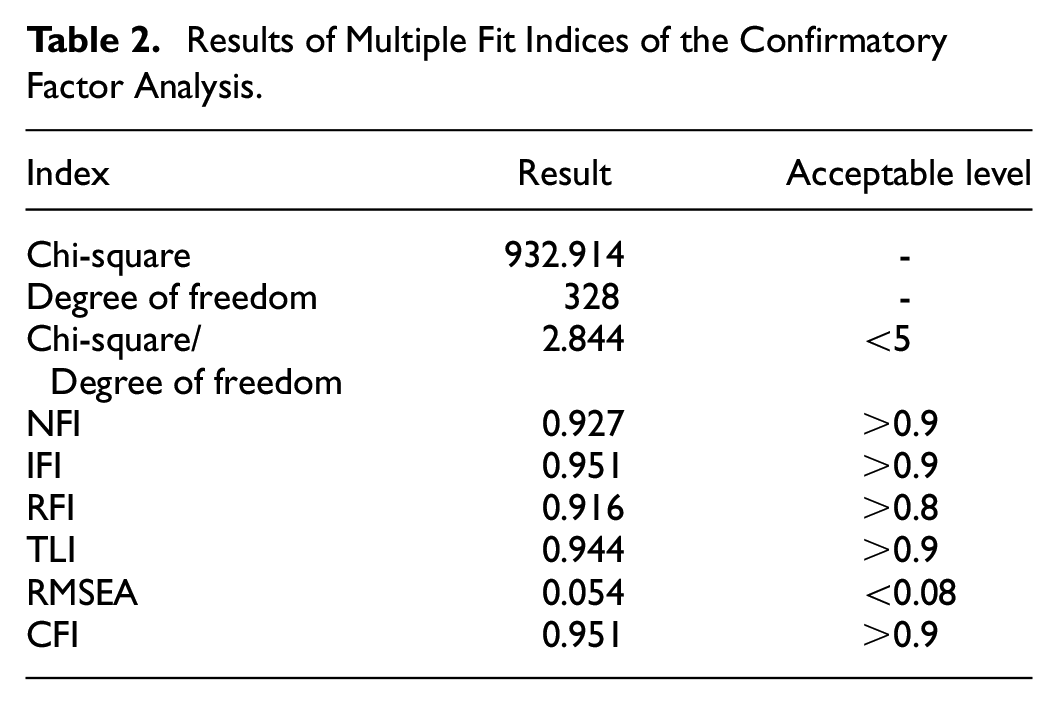
All fitness values are within the acceptable criteria ranges depending on the test, indicating a good model fit. The chi-square/df score is 2.844, which is within the allowed range of 2.0 to 5.0. The extent to which the variables adequately describe our constructs is determined using confirmatory factor analysis (CFA). The most common rules used in performing the CFA for the measurement model include stipulating that The Normed Fit Index (NFI) should be greater than 0.9, Incremental Fit Index (IFI) should be greater than 0.9, Relative Fit Index (RFI) should be greater than 0.8, Tucker-Lewis Index (TLI) should be greater than 0.9, Root Mean Square Error of Approximation (RMSEA) should be less than 0.08, and Comparative Fit Index (CFI) should be greater than 0.9 (Hair et al., 1998). As a result, these findings in Table 2 support the proposed model’s goodness of fit.
Results of Multiple Fit Indices of the Confirmatory Factor Analysis.
Awang (2015) highlights that a factor loading of 0.6 or greater for each item notes a high degree of convergent validity. Thus, the findings in Table 3 depict the high validity of the suggested model. Importantly, almost all factor loading values are greater than the ideal threshold of 0.7.
Results of Factor Loading for Confirmatory Factor Analysis.
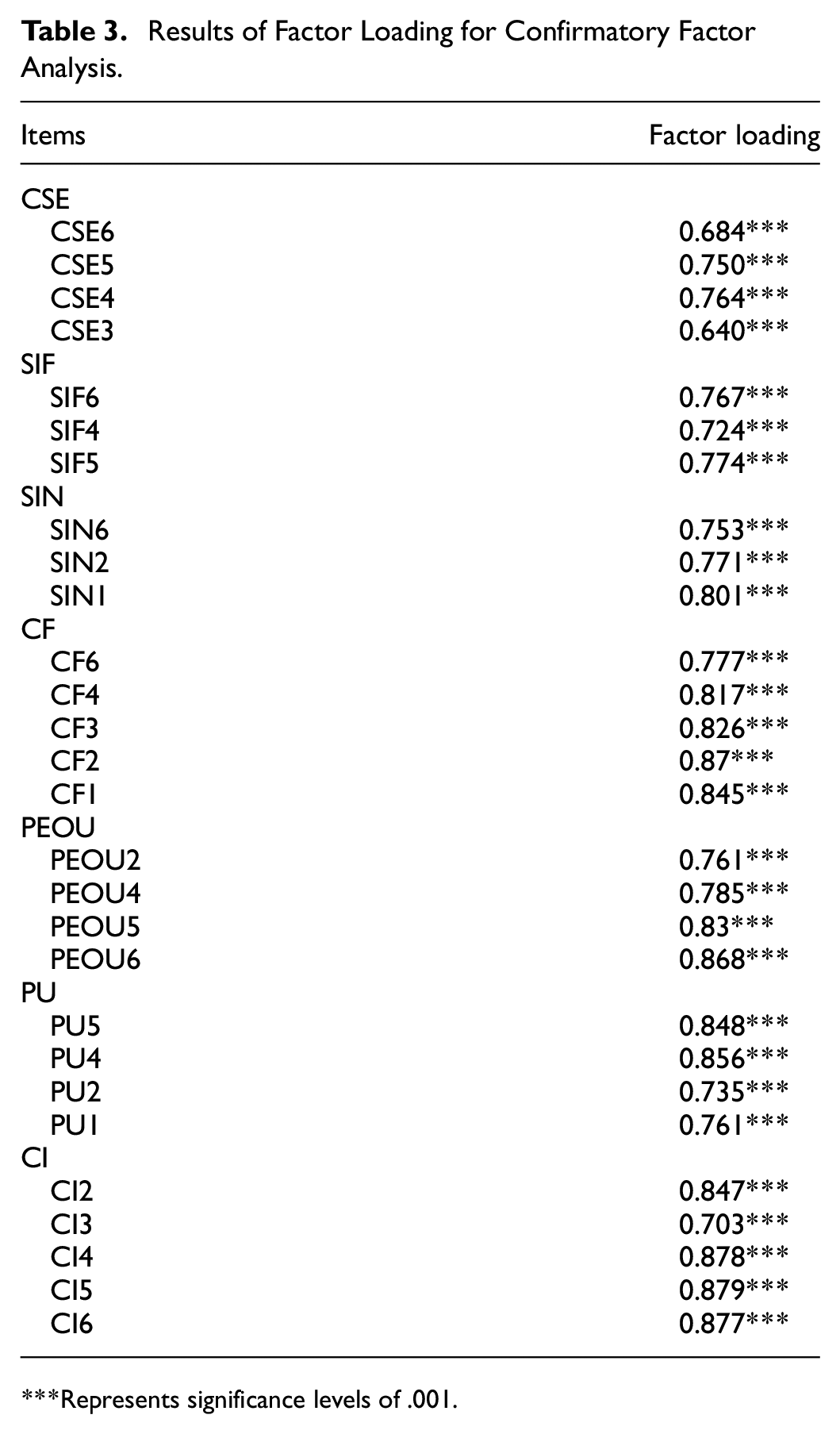
Represents significance levels of .001.
Composite reliability (CR) should be greater than 0.7 while the average variance extracted (AVE) is greater than 0.5 for all constructs. The crossline value is the square root of average variance extracted (AVE). These findings in Table 4 meet this condition. Consequently, the measurement model shows both convergent and discriminant validity (Hair et al., 1998).
Convergent and Discriminant Validity.

Note. CR = composite reliability; AVE = average variance extracted; MaxR(H) = maximum reliability; CSE = computer self-efficacy; SÌF = social influence; SIN = system interactivity; CF = content feature.
Bold entries indicate square root of AVE. ***indicates the p value of the correlation between variables.
Structural Equation Model
The indexes demonstrate the model fit for the structural model, as mentioned in Table 5. The values of these indexes belong to the acceptable range as noted in the research of The Normed Fit Index (NFI) and should be greater than 0.9, the Tucker-Lewis Index (TLI) should be greater than 0.9, the Root Mean Square Error of Approximation (RMSEA) should be less than 0.08, and the Comparative Fit Index (CFI) should be greater than 0.9 (Hair et al., 1998).
Results of Multiple Fit Indices of the Structural Equation Model.

Bold entries indicate the acceptable level.
Table 6 illustrates the significant structural relationships among the constructs of the proposed model. Hypotheses 1 and 2 postulate that computer self-efficacy (CSE) has a positive influence on perceived usefulness (PU) (H1) and perceived ease of use (PEOU) (H2) of the Coursera MOOCs. CSE has a negative influence on PU (β = −.078, p < .05). On the contrary, CSE has a favorable and substantial influence on PEOU (β = .199, p < .001). Therefore, H2 are supported whereas
Results of Structural Equation Model.

Note. CSE = computer-self efficacy; SIF = social influence; SIN = system interactivity; CF = content feature; PEOU = perceived ease of use; PU = perceived usefulness; CI = continuance intention.
Represents significance levels of .001. Bold entries emphasize the “Not Supported” Hypotheses.
The third and fourth hypotheses examine the association between social influence (SIF) and the PU (H3) and PEOU (H4) of the Coursera MOOCs offered at the examined HEI. SIF, nevertheless, has a negligible influence on PEOU in the examined HEI (p >> .05). As a result,
Hypotheses 5 and 6 examine the impact of system interactivity (SIN) of the Coursera MOOCs on PU (H5) and PEOU (H6). SIN has a non-significant effect on PU, with a p-value of .795 >> .05. As a result,
The hypotheses assume a link between the content feature (CF) and PU (H7), and the content and PEOU (H8). The influence of CF on both PU and PEOU is found to be very strong and significant at the studied HEI, with β ranging from 0.321 to 0.334 and p < .001. As a result, both H7 and H8 are strongly supported. Compared to other constructs, CF has the strongest impact on PU and PEOU.
The hypothesis investigates the effect of PEOU on PU (H9). The result demonstrates that the effect of PEOU on PU of Coursera MOOCs at the studied HEI is very positive and significant with β = .5 and p < .001. As a result, H9 is strongly accepted.
Importantly, the effect of PEOU on CI is negative and insignificant in the studied HEI with β = −.119 and p = .087 > .005. As a result,
Interview Findings
Interview Respondents’ Information
Initially, 24 respondents participated in the online interviews from April to June 2021. The 24 interviews at the HEI were conducted across four campuses and included 10 administrators, namely the vice-rector, two academic directors, seven heads of departments, three curriculum development officers, and 11 lecturers. After completing the processing of survey data, the research team also interviewed six students who responded to the online survey in November 2021.
Four themes and 19 sub-themes in Table 7 were listed as the criteria to identify key factors influencing students’ acceptance toward Coursera MOOCs blended learning.
Factors Influencing Students’ Acceptance Toward MOOCs.

Bold entries represent the themes of key impact.
Interview Results
Within the scope of this paper, we only show the results of some key sub-themes:
Content Feature (CF)
Concerning the content feature, the Head of the Business Management Department, Ho Chi Minh campus (H2) notes:
Content – whether it is meaningful or valuable to students. The content, including the level of difficulty, should be taken into account. If the difficulty level is too high, students might drop the course and if it is too low, students might get bored. Is the course content quickly updated? Therefore, course producers need to provide up-to-date content. At that time, students find these courses relevant and valuable, so they accept these courses.
Two students from Multimedia Communications and Graphic Design programs shared the same point of view on the role of the content feature:
In my case, when I learn anything, the content marks the importance. When the content is interesting and clear, learners will be more motivated, that’s why we pay more attention to the content than to any other features. (S3)
The content feature will determine whether I want to choose that specific course to take or not. If the content of the course is not interesting enough, then it will not motivate me and as a result, I won’t be interested in taking it. Online learning requires a lot of self-discipline. You have to adjust your time and take care of your studies all alone. When the learning content is not interesting, I find it even more difficult to do all of this. (S5)
Not only two representatives of the Curriculum Development Office but also two students from Business Administration and Hospitality Management programs provide positive comments on the content of Coursera MOOCs:
The course’s content and outstanding features: the knowledge is explored from a different perspective compared to the traditional course, having interesting assignments and problems. (CD1)
A reputable learning source was widely recognized. (CD3)
Subjects like academic skills for university success, introduction to project management were rather okay because there were lots of theories, I could understand them well. (S6)
Especially when you study online, you can always get back to check what you did not understand in the materials. (S1)
Conversly, the English Linguistics lecturer shares negative feedback about the content:
Regarding Coursera learning materials in my course, however, students have not decided on whether they are good or not because the lectures only contain pre-recorded videos. There are not many differences compared to the traditional classroom. (L3)
At the same time, the student from the Business Administration program also shows the limitation of the content in her MOOCs:
Their learning contents were designed to be used in the US. Digital marketing in Vietnam for the moment is concentrated on Facebook and TikTok. The learning content focused on Twitter while here in Vietnam we cannot apply it very much, even though the content is updated in 2021. (S6)
Social Influence (SIF)
Concerning the social influence, the Academic Director of the Can Tho Campus highlights how the HEI has an impact on students:
Whether students accept it or not partly depends on how we affect their awareness. The important stage is to make students aware of blended learning. We let them see the advantages this method brings to them. The key to success is that I usually hold an orientation for students about how to learn effectively before they start their MOOCs on Coursera. (AD2)
The Head of the Business and Management Department at the Can Tho Campus also adds more about the role of the university in communicating with students:
Orientation sessions introduce online learning programs that become the future trend. These programs can be learned anytime and anywhere to update and upgrade knowledge. This positively influences students to take their time to discover and engage in such a blended learning method. (H6)
However, there are other comments on the university’s impact:
Honestly, the first factor is the university’s policy. Students are required to take MOOCs regardless of their interests. (L3)
Students have to accept MOOCs due to the university’s policy. At first, they did not like it. However, they have to follow the mandatory policy. (L4)
The role of the HEI lecturer is accounted for in the students’ acceptance toward Coursera MOOC blended offline mentoring:
If in offline sessions, the instructors re-teach the entire content of the MOOC, the original idea of the method will be distorted, driving students to rely on the offline sessions only without viewing online lectures. Therefore, the instructor’s role is also a factor affecting students’ acceptance. (L6)
But it is noted that the HEI lecturer has significant and insignificant impacts on students’ acceptance:
My lecturer told me to take Coursera MOOCs that were produced by many different prestigious universities. (S1)
Students do not see the value of those offline mentoring sessions nor feel the need to see the mentor. When asking questions, students care about the learning techniques rather than the course content. The mentor’s impact on the students is limited. (H2)
Not only the head of departments but also the students from Hanoi and Ho Chi Minh campuses realize the significant role of the peer:
Peer pressure is also relevant in this case because students will feel the need to succeed if their peers do so and support each other to do so. (H2)
Depending on the 1st generation of students. They are the pioneers experiencing this new approach. The next generations will listen to the first generation’s experiences and feedback. (H1)
Friends have much more influence on me because we are from the same generation. We have very similar interests and hobbies. Therefore, when they like something to learn, I may like it too. (S3)
What my friends are studying, and researching is also what I’m researching. This creates a mutual influence. (S4)
Competence
Concerning computer self-efficacy, students share different opinions. Particularly, they agree that computer self-efficacy has a great influence on students’ acceptance:
If I was not using a computer I wouldn’t be motivated to study and investigate. (S1)
We, information technology majors, have the advantage that we are used to a lot of software and we do our own research on software; therefore, we find it easier to manage our study with MOOCs. (S4)
Nevertheless, some students disagree with the opinion mentioned above:
Computer self-efficacy has very little impact because I think I don’t need to know too many computer skills to use Coursera MOOCs. (S2)
About the factor of computer self-efficacy, because what I study is related to technology, I always get myself ready for different kinds of computers, that’s why I don’t find this factor important. (S5)
Interactivity
As for the interactivity, the HEI lecturers put in a lot of effort to interact with students whereas the HEI students are not quite as active in this interaction:
Vietnamese students are still passive in interacting with the instructor. I have openly assured my students that I only wanted to be a friend who would support them, not a mentor who would judge them. However, they still neither understand clearly about this concern nor ask for direct help. (H2)
They also interact with students on social media. The lecturers create groups on Zalo or Facebook to follow students. (AD2)
However, students do not pay attention to interacting with their mentors and classmates in the system to discuss and exchange knowledge:
Well, most of the time just to look for someone who can grade my work, when I have time then I read people’s chats in the forum. (S3)
I don’t usually interact in the forum. I don’t use Coursera very often because I don’t really need it. (S5)
Perceived Ease of Use (PEOU)
There are several positive comments on the perceived ease of use toward Coursera and MOOCs:
I started owning a laptop and using it when I started university. Of course, you need time to get used to the features, but the Coursera’s interface is easy to use. (S2)
When you go into the Coursera MOOCs, there are no problems. It’s very friendly to users. (S3)
Coursera is designed to be friendly to users from the first day it made its appearance (S4)
There is a positive relationship between perceived ease of use and the system interactivity:
The perceived ease of use is also important. Ease of use also means it’s useful for system interactivity. (S5)
There are still few statements supporting the relationship between the perceived ease of use and student’s continuance intention:
When you use a website and find it too complicated, you will feel very discouraged. Every time you don’t know how to use it, you will be fed up with it. For those students who don’t like studying online, this problem is more serious. (S4)
The factor perceived ease of use is the one that determines whether we will keep on with MOOCs or not. Even if the learning content is great, it’s difficult to interact and to look up lessons. As a result, we will probably quit after a few days. (S5)
Perceived Usefulness (PU)
Most importantly, the perceived usefulness is evaluated as the most influential factor contributing to students’ continuance intention toward Coursera MOOCs blended learning among the administrators, the lecturers, and the students.
They can gradually form a lifelong learning habit step by step. They can be active in their own learning. They are prepared for lifelong learning, which is an important skill of education in the 4.0 era. (AD2)
The method’s values that are recognized by student’s post-implementation: students’ self-study skills have improved; they know how to manage their own studies and prioritize the content to study to complete Coursera MOOCs (H6)
They view Coursera as the vault of knowledge for them to explore and research to get the professional certificates (L1)
After studying with this method for one semester, students can see that they have developed decision-making, self-discipline, and time management skills. They also develop other skills through MOOCs so they accept them. (L9)
After I get used to it, whenever I encounter any problems or anything at all I can find a solution. Therefore, I think to evaluate the continuance intention I only need to consider the perceived usefulness. (S2)
The fact that perceived usefulness makes people have continuance intention. The perceived ease of use is not important. (S3)
Survey and Interview Discussion
Discussion
First, the survey results mention that the content feature (CF) is the most important element among the four external variables that influence students’ acceptance toward Coursera MOOCs at the HEI. CF, in particular, has a significant influence on PU and PEOU with p = .321 and p = .334, respectively. Similar to the survey results, the interview results note that content feature is one of the most important factors influencing students’ acceptance toward Coursera MOOCs blended learning (CMBL). However, the interview results also show that there are positive and negative comments on the content of Coursera MOOCs. If a student, a potential user of the system, believes that the Coursera MOOCs system has high-quality content, a student is more likely to view the content as having a good impact on learning. As a result, he/she strongly accepts using the Coursera MOOCs system. These findings align with the findings of Cheng (2011) and Khor (2014), which demonstrate the positive effect of CF on PU and PEOU. Interestingly, the findings underline the critical role of “reputation” in explaining the perceived usefulness of MOOCs and “openness” in predicting the perceived ease of use of MOOCs (B. Wu & Chen, 2017).
Second, findings from the survey and interview both recognize the relationship between perceived usefulness and social influence. In particular, the interview results list the social influences, including the influence of the university, the lecturer, and their peers. These findings are consistent with the results of Shen et al. (2006) and Y. Lee (2006). In this study, SIF refers to the impact of HEI, lecturers, friends, classmates, experts, and mass media on the acceptance toward Coursera MOOCs. Similarly, Shen et al. (2006) note that the influence of instructors and mentors has a major impact on students’ perceived usefulness of the course delivery system. This indicates that the administrators of the HEI should be aware of the impacts of social influences on students and take advantage of such effects. On the contrary, social influence (SIF) has an insignificant effect on perceived ease of use (PEOU) in the studied HEI. This result also agrees with the result of Shen et al. (2006). It is a fact that the HEI students depend on their own capability of using computers to become familiar with the Coursera system and Coursera MOOCs. Therefore, HEI students find that social factors including social media, the university, peers, and lecturers might have an insignificant impact on the perceived ease of use of Coursera MOOCs.
Third, the findings from the surveys and interviews show a positive relationship between computer-self efficacy and the perceived ease of use toward CMBL. This result is consistent with the findings of prior research in developing countries such as Thailand and Pakistan (Kanwal & Rehman, 2017; Khlaisang et al., 2021). The possible explanation for this result is that all HEI students have their own laptops and have to use themin their learning activities and final exams. Therefore, HEI students’ computer self-efficacy is good. HEI and their high level of computer self-efficacy results in greater ease of use of the Coursera MOOCs and the Coursera platform. It is explained that individual adults like HEI students, according to self-directed learning (SDL), can organize, navigate, and analyze their learning on the route to their particular learning goals. As a result, HEI students are active in exploring and they get accustomed to Coursera MOOCs easily. Meanwhile, these findings also note that CSE does not associate with PU. This result completely aligns with the result of Ho, Nguyen et al. (2021). In this case, students at the studied higher education institution perceived that their high or low level of computer self-efficacy do not really influence how they find Coursera MOOCs useful for their study.
Fourth, findings from the survey and interview both point out that system interactivity has a rather significant impact on the perceived ease of use toward CMBL. These results are consistent with the findings of Binyamin et al. (2019) and Ho, Sivapalan et al. (2021). Accordingly, the interaction between Coursera staff and students, HEI mentors and students, and among the peers is critical during each semester as it allows students to seek assistance if they encounter challenges. Thus, PEOU will be considerably influenced by their ability to interact effectively with others within the Coursera MOOCs. Interestingly, SDL theory is appropriate for this situation because the primary feature of the SDL approach is the learner’s control. In particular, the HEI has been employing the Coursera MOOCs to accommodate self-learning and provide communication tools to mutually interact as necessary. However, HEI students perceive that there is an insignificant relationship between SIN and PU, contradicting the result of Binyamin et al. (2019). It might be a possible explanation that according to HEI students, they have not frequently used the communication tool as the forum during their MOOCs. They sometimes join the forum seeking someone to review their assignments. As a result, they have not yet perceived the usefulness of Coursera MOOCs for their interactivity.
Fifth, the survey results note that PEOU has a positive correlation with PU, consistent with previous research (Abbas et al., 2016; Joo et al., 2016). This finding depicts that students who can easily utilize the Coursera MOOCs exhibit a high level of perceived usefulness for Coursera MOOCs. If they find it complicated and challenging to use the Coursera platform, they might soon give up on joining their MOOCs.
Last but not least, the survey results show that perceived usefulness (PU) predicts continuance intention (CI), whereas perceived ease of use (PEOU) has no impact on the continuance intention of Coursera MOOCs blended learning. These survey results agree with Joo et al.’s (2016) study, whereas they disagree with the studies by Abbas et al. (2016) and Joo et al. (2018). In the meantime, only a few findings from interviews mention the positive relationship between perceived ease of use and continuance intention. These interview findings also align with the previous studies that established a favorable connection between the PEOU and the continuance intention (CI) (Alharbi & Drew, 2014; Fathali & Okada, 2016; Li, 2021; Tarhini et al., 2017). In this situation, it is explained that what students can get after completing Coursera MOOCs and what they might apply for their future jobs will have a stronger impact on their continuance intention.
Implications
Practical Implications
In terms of content features, the advice for the HEI is to carefully select and offer Coursera MOOCs modules that are not only of high quality but also practical for students to apply in a Vietnamese context. The curriculum development office should work with related parties to review whether or not current courses are appropriate to be implemented in the format of Coursera MOOCs blended with offline mentoring. Up to now, the HEI’s curriculum developers, lecturers, and academic directors have worked together to develop the Coursera MOOCs curriculum. Nevertheless, they have not yet involved students as a key stakeholder in curriculum development. Therefore, it is implied that HEIs should conduct student surveys before Coursera MOOCs selection. As a result, this might enable students to have better perception toward CMBL
Most noticeably, the university requires every student from batch 15 to take a Coursera MOOC per semester. Regarding the social influence, it is strongly implied that a positive feedback loop for students’ perception toward Coursera MOOCs’ usefulness can be created by using the effects of social factors, which include communication between the university and students, communication between lecturers and students, expert opinions, news reports, and mass media reports on using Coursera MOOCs, to further facilitate students’ continuance intention toward CMBL. In particular, the HEI and Coursera should collaborate to organize the MOOCs orientation for new students per semester.
As for computer-self efficacy, it is implied that the HEI should continue promoting the number of Coursera MOOCs blended courses every semester so that HEI students have more chances to strengthen their computing skills and become familiar with self-studying MOOCs.
Regarding the system interactivity, it is implied that the HEI should continuously seek effective solutions for the mutual interaction among Coursera staff, HEI mentors, and students within the Coursera MOOCs system. In offline mentoring, the HEI mentors should guide students to use the Coursera forum and interact with Coursera support staff more effectively to deal with related issues such as registration, assignment submission, plagiarism, the certificates, etc., At the same time, students are motivated to actively interact with their mentors beyond their class to complete their MOOCs just in time and get good results in the final exams.
Concerning the perceived ease of use, it is thus implied that the few students who have low computer self-efficacy and little learning experience with Coursera MOOCs should receive periodical training from the HEI and Coursera. It is a fact that the more MOOCs learning experience they have, the ease of use they perceive.
To promote the impact of perceived usefulness on continuance intention (CI), the HEI should set up Coursera MOOC orientation every semester to assist students to handle issues during their MOOCs. More importantly, Coursera is suggested to improve the functions of the plagiarism checkers and the learning content. These improvements are significantly influential to HEI students. Last but not least, to promote the support of HEI mentors for students, the HEI should consider adjusting the following items: (1) move from optional to mandatory attendance for offline mentoring sessions, (2) move from Saturday to weekdays for scheduled offline mentoring.
Theoretical Implications
There have not been many recent mixed method studies to explore key stakeholders’ perspectives of institutions of higher education on both student acceptance toward blended learning in general and student acceptance toward Coursera MOOCs blended learning in particular. Therefore, the integration of survey and interview results will provide contribution to the literature by comparing factors that influence students’ acceptance of CMBL from key stakeholders in the higher education institution, including the administrators, lecturers, curriculum developers, and undergraduate students. The key factors are emphasized in the findings of the survey and the interview such as, content feature, social influence, interactivity, competence (computer self-efficacy), perceived usefulness, and perceived ease of use. Furthermore, this study also proposes other factors comprising the price, experience, assessment, expectation, and grades when any higher education institution adopts blended learning using MOOCs.
Conclusion
The findings of the mixed method study showed that in the higher education, students’ continuance intention to use Coursera MOOCs blended learning was influenced by key factors, including content feature, social influence, and perceived usefulness. This research makes two important contributions. First, we make a theoretical contribution to the literature by comparing factors influencing students’ acceptance of CMBL from key stakeholders in the higher education institution. Second, our findings have practical implications for enhancing undergraduate students’ long-term acceptance of blended learning utilizing MOOCs, which could give useful guidance for HEIs aiming to incorporate MOOCs for teaching and learning within the higher education environment.
This study contains the four following limitations. First, it focused only on undergraduate programs at a single Vietnamese university. Second, it investigated a specific case with the provider Coursera. Consequently, we propose that further research might study other programs such as vocation and postgraduate programs and examine cases of other popular MOOC providers. Third, between SIF and SIN, the correlation is .801 whereas the diagonal element corresponding to SIN is 0.775 in this study. This result might partly influence the discriminant validity of this model. Last but not least, the theoretical integration was not included in the underlying theories to provide for the replication of the analysis procedures.
Footnotes
Appendix 1
Appendix 2
Interview Protocol.
Role of the interviewee:
Location of the interview: ……………
Date of the interview: ……………… Time of the interview: ………………..
Thank you for participating in this study. The purpose of this research is as follows:
The interview should last approximately 30 to 60 min. Some follow-up questions might be inquired for additional clarity during the interview. This interview will be recorded and later transcribed by the interviewee
Author Contributions
Conceptualization, Nguyen Thi Thao Ho, Subarna Sivapalan, Hiep-Hung Pham; Methodology, Nguyen Thi Thao Ho, Subarna Sivapalan, Hiep-Hung Pham; Data Collection & Transcript Translation, Nguyen Thi Thao Ho, Huyen Khanh Pham, Linh Thi My Nguyen; Data Analysis, Nguyen Thi Thao Ho, Hung-Viet Dinh; Writing—Original Draft Preparation, Nguyen Thi Thao Ho, Huyen Khanh Pham, Linh Thi My Nguyen; Writing—Review And Editing, Subarna Sivapalan, Hiep-Hung Pham, Muhammad Ridhuan Tony Lim Abdullah, Hairuzila Bt Idrus; Supervision, Subarna Sivapalan, Hiep-Hung Pham, Muhammad Ridhuan Tony Lim Abdullah, Hairuzila Bt Idrus. All authors have read and agreed to the published version of the manuscript. We also all agree to be accountable for all aspects of this work.
Availability of Data and Materials
Not applicable.
Declaration of Conflicting Interests
The author(s) declared no potential conflicts of interest with respect to the research, authorship, and/or publication of this article.
Funding
The author(s) received no financial support for the research, authorship, and/or publication of this article.
