




Abstract
To explore the influencing factors of college students’ learning intention to online teaching videos during the pandemic, this study considered 696 college students from Huangshan University in China. The T-test and ANOVA were utilized to analyze gender, grade, and discipline on college students’ learning intention, and the regression analysis was utilized to explore four aspects including performance expectancy, effort expectancy, social influence, and facilitating conditions on college students’ learning intention. The results indicate the following: first, using descriptive analysis, it is observed that college students did not exhibit a positive learning attitude toward online teaching videos during the pandemic. Second, the t test and one-way analysis of variance indicate that grades between freshmen and seniors significantly influence the learning intention of college students to online teaching videos, whereas genders and disciplines do not. Third, through regression analysis, it is observed that performance expectancy, effort expectancy, social influence, and facilitating conditions significantly influence college students’ learning intention to online teaching videos. This study stipulates the following research proposals: resource construction, the optimization of the online teaching environment, advanced technology and psychological counseling. It is expected that the findings will provide references for studies on online teaching resources and online learning.
Keywords
Introduction
Due to the outbreak and rapid spread of the corona virus, which began in January 2020, the city of Wuhan in Hubei province was closed for 76 days. Chinese residents were subjected to home-based isolation, and they reduced their outdoor activities. Moreover, all schools chose online teaching; thus, they could complete their educational tasks in the new semester. A Meta-Narrative Review conducted by Bozkurt et al. (2022) also highlighted the affordances of emergency remote education. Higher education institutions should develop a plan and strategy for practical e-learning sessions, which encompass the integration of blended learning, flipped classrooms, and the establishment of a systematic online assessment process (Fauzi, 2022). The Ministry of Education provided high-quality online courses and virtual simulation-based experimental teaching resources to colleges and universities across the country at no cost. Moreover, in regard to the original 22 online course platforms, a batch of carefully screened platforms, including massive online open courses (MOOCs), were launched. Furthermore, virtual simulation experiment courses were provided to college-based and university-based teachers and students; thus, they could liberally choose their teaching plans and syllabus (State Department, 2020). Because the colleges and universities were opened in March, during which the pandemic was prevalent, online teaching was thoroughly tested. The Ministry of Education revealed that 1,454 regular colleges and universities nationwide conducted online teaching, and that more than 950,000 teachers opened 942,000 online courses; the study noted 1.18 billion times of students’ participation in online courses from the beginning of the semester to April 3rd, 2020 (Ministry of Education, 2020). In the first quarter of 2020, the number of students participating in online courses for three consecutive Mondays attained 36.56 million, 58.32 million, and 60.74 million (Xiong et al., 2021). In March 2020, 422.96 million users utilized online education, accounting for 46.8% of the citizens’ utilization rate. Moreover, with respect to online courses, there were 420.23 million mobile users, which accounted for 46.9% of the utilization rate of mobile Internet users, a 116.4% increase compared with December 2018 (CNNIC, 2021). The aforementioned statistics, which were provided by the Ministry of Education and the China Internet Network Information Center (CNNIC), reveal that numerous online users participated in online learning, and this observation indicates that the utilization of instructional videos in online courses has become a main teaching method for colleges and universities in China. There are three main forms of online teaching videos which are supported by Wang et al. (2022). The first is described as follows: teachers utilize a live webcast to transmit the teaching content from the classroom to students. The second entails utilizing instructional videos or pre-class recordings for online teaching, such as boutique courses and MOOCs. The third, which exhibits interactive and integrated features, entails combining the online live teaching and instructional videos to fulfill the teaching task. By utilizing multimedia education tools such as audio–video methods and animations, students can effect self-learning; thus, their motivation and understanding is increased, and their awareness of self-learning is promoted (Kapi et al., 2017). Here are the advantages of online teaching that distinguish it from classroom teaching for students. The following research questions, which need to be analyzed in-depth, are crucial: (1) During the pandemic, does learning from online teaching videos (i.e., the main tool of online learning for students) enhance college students’ satisfaction? (2) Nevertheless, what are the differences in college students’ intention to learning from online teaching videos? (3) Furthermore, during the pandemic, what are the influencing factors of students’ learning intention to online teaching videos? (4) What implications does this research bear for online video teaching after the epidemic? Therefore, this study aims to answer these questions by analyzing the Covid-19 period.
Literature Review
Online teaching videos are a digital and visual instructional resource. Academic research mainly focuses on the learning motivation of instructional videos in the online teaching environment. For example, Choi and Johnson (2005), who considered online master’s degree program students based in the United States, analyzed the learning effects and motivations of video content teaching and traditional text teaching in an online learning environment. The results indicated that content-based video teaching could potentially enhance the learning memories and learning motivations of audiences. On the other hand, some studies, which considered the online teaching environment focused on the interaction and effects of teaching videos. Tiernan and Farren (2017) analyzed how to utilize a customized video retrieval system (VRS) as a means of enabling first-year college students to utilize online videos for course learning, and the research results indicated that students demonstrated the ability to successfully integrate online videos into their personal assignments. Likewise, D. Zhang (2006) analyzed the impact of interactive videos on learning outcomes and learner satisfaction in an online learning environment in United States. The experimental results indicated that the effectiveness of video-based learning depended on interactivity, and that the learning effect of videos was significantly more optimal; furthermore, they indicated that the learner’s satisfaction was higher in the interactive network learning environment. Moreover, Yang (2014), who analyzed instructional video learning in online video courses, explored the interactive influences of the clue type and the learners’ previous knowledge and experience on the learning effect in central China; the experimental results indicated that there was an apparent interaction between the type of clues along with the level of learners’ prior knowledge and experience, and the learning satisfaction together with learning effects. Furthermore, Duan and Hong (2019) focused on 544 college students’ participating in online video courses from two Wuhan-based universities. The results indicated that online teacher–student interaction, online learning self-efficacy, online learning motivation, and online learning performance were all significantly and positively correlated with each other, and that the direct and indirect effects of online teacher–student interaction on learning performance were both significant.
Currently, research on the influencing factors of learning intention mainly consider the perspectives of various fields, such as online learning, mobile learning and virtual learning environment. On one hand, some researchers analyzed the influencing factors based on the technology acceptance model (TAM). For instance, Tan and Sim (2012) analyzed the influencing factors pertaining to the acceptance of online learning by Malaysian learners. Furthermore, Mo et al. (2021) who utilized the TAM model, explored the continuance intention of online learning during the COVID-19 pandemic and Al-Hamad et al. (2021) who considered the utilization of online learning in higher education during the COVID-19 pandemic, explored the students’ behavioral intention. Based on the TAM model, Alturki and Aldraiweesh (2022) explored factors influencing mobile learning in higher education in Poland. Bailey et al. (2022) utilized the TAM model to explore the intention of video conferencing tools in the e-learning context. On the other hand, some researchers analyzed the influencing factors based on the Unified Technology Acceptance and Use Theory model (UTAUT). For instance, E. Ö. Kurt and Tingöy (2017), who focused on higher education in Turkey and the United Kingdom, analyzed the acceptance and utilization of a virtual learning environment, and in regard to two nations, they observed that the BI and use behavior were different. Dajani and Hegleh (2019), who utilized the Unified Technology Acceptance and Use Theory model (UTAUT2), analyzed the factors that affected animation-usage BI among university-based marketing students, and they observed that hedonic motivation, performance expectancy, students’ innovations, learning value, and effort expectancy significantly affected animation-usage BI. With respect to UTAUT, Xu and Zheng (2013) analyzed the factors that influence college students’ acceptance of mobile learning in Beijing, China. The results indicated that achievement value, performance expectancy, use experience, perceived entertainment, and social influence significantly influenced college students’ acceptance of mobile learning. Similarly, some studies focused on the learning intention of online learning during the COVID-19 pandemic. For instance, Perera and Nalin (2022), who considered management studies, analyzed the factors influencing learners’ intention to e-learning during the COVID-19 pandemic. The results indicated that performance expectancy, effort expectancy, social influence, and service quality significantly affected learners’ intention to e-learning.
Some scholars have explored the factors influencing the learning intentions of online courses, micro-courses, audio-video materials, and online videos. By utilizing the TAM model, Al-Maroof et al. (2022) explored the factors influencing the acceptance of audio–video material. Meanwhile, Wang et al. (2022), who focused on the COVID-19 pandemic, considered students from Grade 4 to 9 to explore continuance intention for three types of online video learning using the TAM model. Furthermore, by utilizing the grounded theory approach, Liu et al. (2022) explored the factors for the effective teaching evaluation of massive online open courses (MOOC) during the COVID-19 pandemic. The results indicated that effective teachers, tuition, communication, active online learning, social support guarantee, and online course design exerted a significantly positive influence on effective teaching. However, by utilizing the UTAUT model, Wijaya and Weinhandl (2022) explored continuous intentions for utilizing micro-lectures at one public junior high school in Bandung in the post-COVID-19 period, and the findings indicated that performance expectancy, effort expectancy, social influence, facilitating conditions, and price value did not significantly affect students’ continuous intention to utilize micro-lectures.
Through combing, it is observed that the research focused on the motivation, interaction, and effects of instructional videos (Duan & Hong, 2019), whereas the research on learning intention focused on the analysis of influencing factors in the field of online learning (Perera & Nalin, 2022). Some researchers analyzed the MOOC influencing factors (Liu et al., 2022; Wijaya & Weinhandl, 2022) and the online teaching video influencing factors below Grade 9 students (Wang et al., 2022); however, with regard to online-based teaching videos, research on the learning intention influencing factors among college students in China during the pandemic is insufficient. The UTAUT model was utilized in various information technology-related research fields (Dajani & Hegleh 2019; E. Ö. Kurt & Tingöy, 2017). Because videos exhibit a certain capacity to enhance learner motivation, engagement, and to offer a more accessible learning approach, it is imperative to explore users’ acceptance and attitudes toward video-based online learning (Wang et al., 2022). Therefore, this study adopts UTAUT as the basic theoretical model; thus, it conducts confirmatory research on college students’ learning intention to online teaching videos during the pandemic in China.
Proposed Model and Hypothesis
Venkatesh et al. (2003) proposed the unified technology acceptance and use theoretical model (UTAUT). The evidence provided by Venkatesh et al. (2003) indicated that the UTAUT model could explain the strength quite effectively, and it enabled researchers in different fields to test and verify this model. UTAUT has been utilized to assess a variety of novel educational technologies, such as online learning and mobile learning (Perera & Nalin, 2022; Xu & Zheng 2013). The study conducted by Venkatesh et al. (2003) revealed that the UTAUT model integrated eight theoretical models and exhibited higher explanatory power. Several researchers expanded the UTAUT model to investigate the behavioral intention (BI) of online courses or online videos (Liu et al., 2022; Wijaya & Weinhandl, 2022). Since college students utilized computers or mobile phones to learn online teaching videos during the pandemic period, this study can be categorized as information technology research. The UTAUT model is not only the “authoritative model” in the field of information technology but also the most suitable for analyzing the learning intention to online teaching videos.
From the UTAUT model, the use behavior is directly affected by the intention and facilitating conditions, and the intention is directly affected by the performance expectancy, effort expectancy, and social influence. The four moderator variables, namely gender, age, experience, and voluntariness, exert a moderating effect on the learning intention and use behavior of different dimensions. Learning intention on online teaching-based instructional videos can be categorized under the IT educational field. Therefore, in combination with related literature research and university student group factors, this study adopts the UTAUT model as the main theoretical framework, and expands the existing UTAUT model by changing “age,”“experience,” and “voluntariness” into the following control variables: “grade” and “discipline.” The specific model to be analyzed is depicted in Figure 1, and considers the impacts of various variables on college students’ learning intention to online-teaching based instructional videos. It is assumed that performance expectancy, effort expectancy, social influence, and facilitating conditions are the determinants of the college students’ learning intention to online-teaching based instructional videos. Moreover, it is assumed that gender, grade, and discipline exert interference effects on the intention of college students to learn from teaching videos. Therefore, an initial model that analyzes the influencing factors of college students’ learning intention to online teaching videos is constructed, and the model comprises performance expectancy, effort expectancy, social influence, and facilitating conditions, along with three controlling factors, namely gender, grade, and discipline.

Conceptual framework.
Learning Intention (LI)
Behavioral intention (BI) refers to the extent to which customers intend to utilize a certain technology or device (Venkatesh et al., 2003). The scholars verified that the UTAUT model was applied to various fields, such as economics (Pratama & Zhou, 2019) and e-government services (Alabboodi & Nashowan, 2019). Moreover, this model is suitable for both information technologies and education. For instance, Boca (2021) explored the factors affecting students’ behavior and attitude toward online education during the COVID-19 pandemic. Moreover, some studies focused on the intention to e-learning (Perera & Nalin, 2022), or they adopted micro-lectures (Wijaya & Weinhandl, 2022). BI affects the actual behavior (Venkatesh et al., 2003); in regard to online learning, if students exhibit a high intention, they will be more involved in the learning process. This study analyzes the influencing factors of college students’ learning intention to online teaching videos during the COVID-19 pandemic.
Performance Expectancy (PE)
PE refers to the level of benefits that consumers expect from utilizing novel technologies (Venkatesh et al., 2012). Performance expectancy is the degree to which users perceive that a specific technology application can meet their needs and enhance their work efficiency; if students believe that learning via online teaching videos can enhance their academic performance and learning effect as well as solve the problems encountered in learning, they will exhibit a stronger intention to learning from an online teaching video. E. Ö. Kurt and Tingöy (2017) analyzed the virtual learning environment (VLE) in higher education, and the results indicated that PE was a crucial predictor of behavioral intention, which indicated that they intended to utilize the VLE as a means of obtaining more optimal grades. Previous studies indicated that PE positively influenced behavioral intention in different contexts (Alabboodi & Nashowan, 2019; Holzmann et al., 2020; Liang et al., 2020; Pratama & Zhou, 2019). However, PE did not significantly impact students’ continuous intentions for utilizing micro-lectures (Wijaya & Weinhandl, 2022). Thus, PE is a key factor that influences the learning intention to online teaching videos. Therefore, this study proposes the following hypothesis:
H1. PE significantly affects learning intention to online teaching videos.
Effort Expectancy (EE)
EE refers to the extent of ease related to the suitability of the system (Venkatesh et al., 2003). Efforts expectancy indicates the difficulty with which students perceive a certain technology; if the students do not need to overcome too many difficulties in applying the online teaching video to learn, and if this technology can conveniently and quickly meet the students’ learning needs as well as enable them to fulfill learning outcome, the learner may increase the intention to learning from the online teaching video. Alabboodi and Nashowan (2019) observed that EE, a crucial factor, affected the intention of staff to utilize e-government services. The literature revealed that EE exerted a significant impact on behavioral intention to utilize the technology (E. Ö. Kurt & Tingöy, 2017; Pratama & Zhou, 2019). Therefore, the following hypothesis is proposed:
H2. EE significantly affects learning intention to online teaching videos.
Social Influence (SI)
SI refers to an individual who was affected by others in utilizing the technologies or system (Venkatesh et al., 2003). For college students, the main social influence is occasioned by the more crucial classmates, teachers, relatives, families, and friends around them. Their SI crucially affects their learning intention to e-learning (Niu & Wu, 2022). If these people support learning based on online teaching videos, the students may be more willing to accept this novel learning method, and they may exhibit a higher willingness to learn from the aforementioned method. Previous studies indicated that SI significantly affected the BI pertaining to the utilization of smartphone fitness applications (Vinnikova et al., 2020) and e-government services (Alabboodi & Nashowan, 2019). SI did not significantly impact students’ continuous intentions to utilizing micro-lectures (Wijaya & Weinhandl, 2022). However, SI significantly affected learners’ behavior intention to utilize e-learning (Niu & Wu, 2022). Consequently, with regard to influencing the intention to learn using online teaching videos, SI is a key factor. If we consider SI as a key factor influencing the LB from the online teaching video, the following hypothesis is postulated:
H3. SI significantly affects learning intention to online teaching videos.
Facilitating Conditions (FC)
FC refers to consumers’ perceptions of the resources and support available to perform a behavior (Venkatesh et al., 2003); if the students receive numerous support, their attitude toward online learning becomes positive. FC is a key predictor affecting learners’ behavior intention to utilize e-learning (Niu & Wu, 2022). With regard to the usage of novel technology, the existing literature revealed that FC positively influenced behavioral intention (Alabboodi & Nashowan, 2019; Holzmann et al., 2020; Pratama & Zhou, 2019). However, FC did not significantly impact students’ continuous intentions to utilize micro-lectures (Wijaya & Weinhandl, 2022). Hence, with regard to learning from online teaching videos, FC is the key factor. Likewise, with respect to learning from online teaching videos, this research treats FC as an incentive factor. Because the functions and facilities are both available on computers or smartphones, students can learn from the online teaching video. Thus, this study postulates the following hypothesis:
H4. FC significantly affects learning intention to online teaching videos.
Control Variables
In regard to the research conducted by Venkatesh et al. (2003), gender and age are the key factors of behavioral intention to utilizing technology. Likewise, there are some differences in learning gains from instructional videos among different gender learner groups (Schrader et al., 2021). Compared to female students, however, male students felt less unsatisfied with the effect of online teaching and were subjected to less psychological pressure in regard to online learning (Yu et al., 2021). Moreover, Ncube and Koloba (2020) indicated that although the education level significantly affected the intention to utilize brand mobile apps, gender did not. However, the findings of studies indicated that sex, grade, and education major did not significantly influence the intention to online learning (Bao, 2017; Lin et al., 2021). Furthermore, in the study conducted by Ewelina et al. (2021), gender, age, and type of studies exerted no significant influence on students’ communication with colleagues and teachers; however, age and type of studies exerted a significant influence on students’ collaboration in distance learning during the COVID-19 pandemic. In summary, gender, grade, and discipline are the factors affecting students’ intention on online learning. Because the subject of this study is the influencing factors pertaining to college students’ BI to learning from the online teaching videos during the COVID-19 pandemic, the control variables are gender, grade, and the discipline of college students. Therefore, the following hypotheses are proposed:
H5. Gender significantly affects learning intention to online teaching videos.
H6. Grade significantly affects learning intention to online teaching videos.
H7. Discipline significantly affects learning intention to online teaching videos.
Methodology
Research Location
Huangshan University, located in Huangshan City, Anhui Province, is a comprehensive provincial undergraduate institution. The university offers 57 different academic programs, enrolling over 18,000 students, with disciplines spanning eight major academic categories, namely engineering, management, literature, economics, arts, education, natural sciences, and agriculture. The chosen study location meets the sample selection criteria for college students. Video course platforms included the Chinese university MOOC platform, iCourse, and Huangshan University’s online teaching platform. Teachers taught online and played videos through live online teaching platforms, including Tencent Conference, Dingtalk, and Chaoxing Xuexitong. Simultaneously, college students combined the online video course platform with the live online teaching platform for online learning. According to the statistics (survey period: February 1, 2020 to June 15, 2020), Huangshan University’s online teaching platform comprised a total of 390 teachers who taught 827 online courses in the research college. The total number of course resources including videos and digital documents by different schools was 87,650, and the percentage of the total resources by school in Huangshan University during COVID-19 pandemic is depicted in Figure 2. The total time of uploaded instructional videos is 438,527 min (approximately 7,309 hr), and the learning scenario of students in each faculty is satisfactory. Because the school officially commences on February 24, the average number of online-based students approximates 11,000 per day, and the average daily visits has attained more than 5 million times. The total number of hits for 827 courses has been 11,402,359 (Jiang, 2020), which reflects that students’ enthusiasm for learning using the online teaching platform has not been dampened during the pandemic. After categorizing the school’s online teaching scenario, especially during the pandemic period, classroom teaching was replaced by online teaching. Simultaneously, it is suitable to select this university for exploring the factors affecting college students’ intention to learning from online teaching videos.
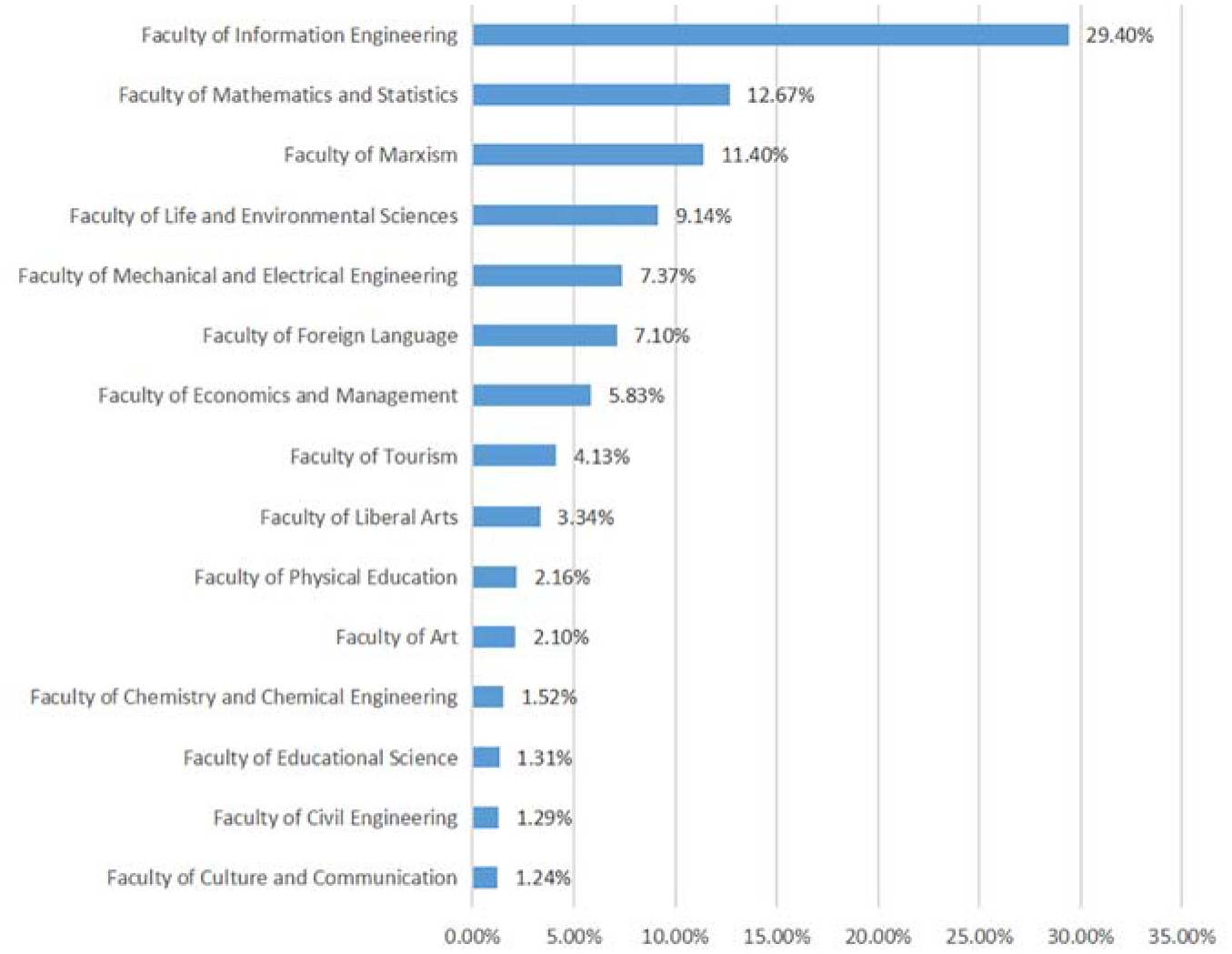
The percentage of the total resources by school in Huangshan University during the pandemic.
Questionnaire Design
Herein, a questionnaire based on the related research results of the UTAUT model was designed (Venkatesh et al., 2003). To enable the interviewees to obtain a clear understanding of this research, the questionnaire comprises three parts. The first part mainly elaborates the connotation of learning from online teaching videos; thus, the participants gain an understanding of why they should start the questionnaire. Initially, to enhance the accuracy and validity of the questionnaire, there is a clear description of the survey content. In the second part, the designed content mainly considers the controlling factors that affect this model, such as gender, grade, and discipline. In the third part, the designed content mainly focuses on four variables of learning intention to instructional videos, each with three questions, and a total of 15 questions are designed. Herein, the Likert five-level scale was utilized to measure the variables, and respondents were requested to indicate their attitudes with “completely disagree” for 1 point, “comparatively disagree” for 2 points, “agree” for 3 points, “comparatively agree” for 4 points, and “completely agree” for 5 points. In the process of creating the initial questionnaire, three experts were consulted to assess its content validity. Following this endeavor, the researcher invited 50 students to participate in a preliminary test, which yielded a reliability score of 0.976.
Issuance and Recovery of Questionnaires
For the distribution of the questionnaire, the Internet was mainly utilized for random sampling. The research sample comprised Huangshan University students who studied using an online teaching method during the pandemic. The Questionnaire Star website was utilized to produce the questionnaire, and to disseminate it to different students through media such as WeChat, QQ, and Email. The study conducted surveys and collected the replies through the Internet. Based on study conducted by Israel (1992), the sample size was set at 392 for a population of 18,000. Furthermore, the sample size exceeded 300 when there were fewer than seven variables, and some of these variables exhibited fewer than three items (Hail et al., 2010). Herein, a total of 760 questionnaires was selected to meet the requirements of the aforementioned study. After carefully screening the questionnaires and excluding invalid results such as regular and inadvertent responses, 696 valid questionnaires replies were obtained.
Analysis of Demographic Data
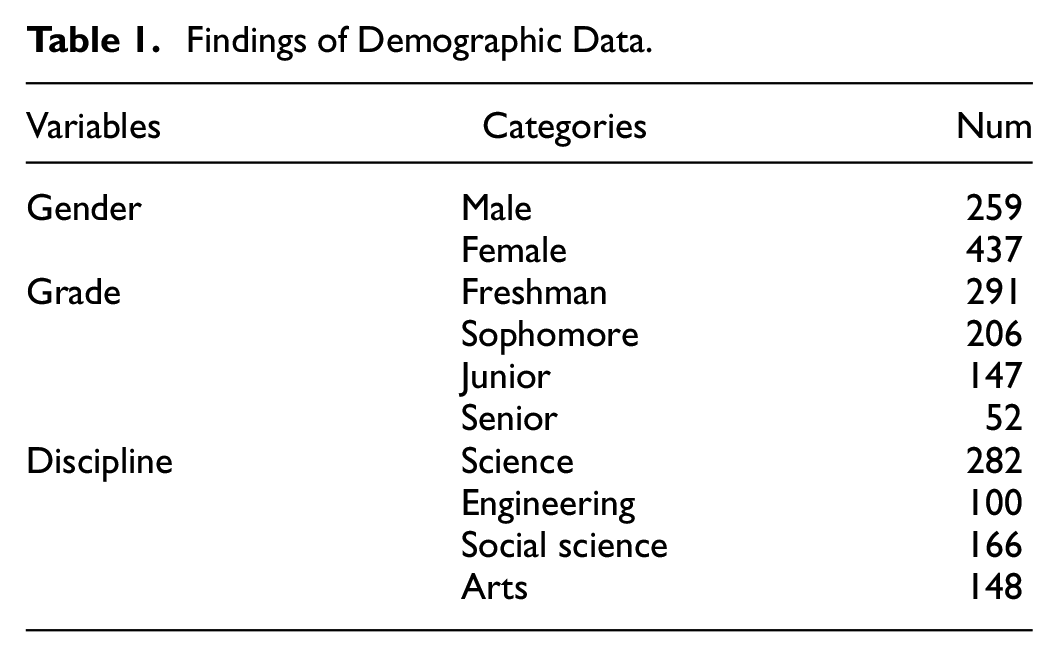
In regard to the samples, the following information was considered: gender, grade, and discipline. In regard to gender, women accounted for a relatively high proportion of objects compared with men. In regard to grades, the number of freshmen, sophomores, juniors, and seniors was depicted in Table 1. With regard to the number of grades, a certain difference was observable, which can be rationalized as follows: because there was less online teaching for seniors during the pandemic, the main research object was in other grades. In regard to disciplines, the number of science, engineering, liberal arts, and arts subjects was illustrated in Table 1. Although there were slight differences in the number of subjects, their overall proportions were relatively balanced.
Findings of Demographic Data.
Reliability Analysis
According to Taber’s (2018) study, a Cronbach Alpha (CA) value between 0.71 and 0.91 indicates satisfactory reliability. The reliability evaluation of the questionnaire indicated that the Cronbach Alpha value of the total variable is 0.924, and that the reliability level is quite high, which indicates that the overall reliability of the questionnaire is satisfactory. The Cronbach Alpha value of all variables are different: .887 for performance expectancy, .863 for effort expectancy, .715 for social influence, .815 for facilitating conditions, and .881 for learning intention. If the value of various variables is considered, social influence exhibits the lowest reliability value. The Cronbach Alpha value is .715, which also exceeds .7. By contrast, the Cronbach Alpha value of other variables all exceed .8, which indicates that the reliability of these variables is relatively high. In summary, the questionnaire designed for this study is ideal and can be accepted (Table 2).
Findings of Reliability and Validity Analysis.

Validity Analysis
In Kaiser and Rice’s (1974) study, the KMO value (>0.9) was exceedingly considerable, which indicated the data was acceptable. Herein, the KMO analysis result and Bartlett sphere test is 0.904, which exceeds 0.9, and the significance test pertaining to the Chi-square statistic value of the Bartlett sphere test is 0.000; thus, the data is suitable for factor analysis. For the four variables in the questionnaire, the principal component analysis method was utilized to test the interpretability of the items. The extraction load of each factor was as follows: 0.7 for performance expectancy, 0.721 for effort expectancy, 0.551 for social influence, 0.711 for facilitating conditions, and 0.736 for learning intention. Moreover, the initial value of each factor is 1, and the factor load of each factor exceeds 0.50, which indicates that the extracted common factors can effectively explain the original index variables. Because most of the information exhibits a strong interpretive potential, this study retains all the items in the subsequent data analysis.
Data Analysis and Results
Descriptive Analysis
With respect to the descriptive statistical analysis, the main measurement indicators are the mean and standard deviations of the variables. This study, which considered college students, conducted a descriptive statistical analysis of the learning intention to online teaching videos, and it was based on four independent variables, namely performance expectancy, effort expectancy, social influence, facilitating conditions, and learning intention. The results are depicted in Table 3. According to the data analysis outcomes, it can be observed that the average value of each variable is less than three, which indicates that college students are dissatisfied with learning from online teaching videos during the COVID-19 pandemic.
Findings of Descriptive Statistical Analysis.

Difference Analysis
In regard to college students, gender, grade, and discipline were utilized as the factors affecting students’ learning intention to online teaching videos during the COVID-19 pandemic. An independent sample t test was performed to analyze gender, and the one-way analysis of variance (ANOVA) was performed to analyze grade and discipline.
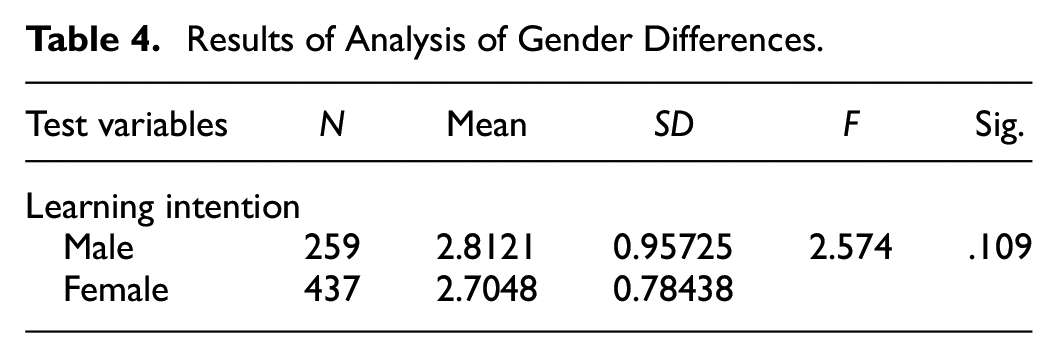
First, the study assumed that the undergraduates’ gender—both male and female—represented the independent variables (IV) and that their learning intentions were the dependent variables (DV). Moreover, an independent sample t-test was utilized to explore the impact of students’ learning intention—among different genders—toward online teaching videos. The value pertaining to the homogeneity of variance test are F = 12.565 and p = .000 (p < .05), which indicates that the learning intentions results exhibit significant differences and do not meet the test conditions. Using the Welch’s test, the findings reveal that F = 2.574 and p = .109 (p > .05), which indicates that different genders do not significantly influence the learning intention to online teaching videos during the pandemic (Table 4).
Results of Analysis of Gender Differences.
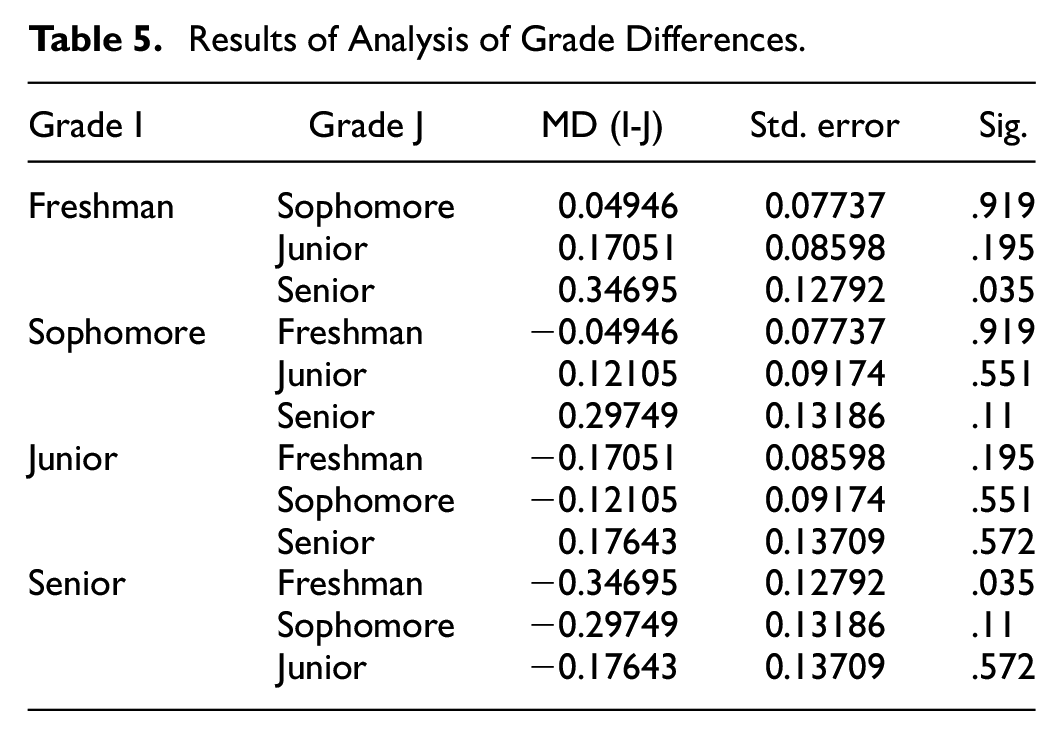
Second, taking different grades as IV and learning intention as DV, the ANOVA was utilized to explore whether different grades significantly influence the learning intention to online teaching videos. The value pertaining to the homogeneity of variance test was F(3,692) = 1.267 and p = .284 (p > .05), which indicates that the results do not exhibit significant differences and are suitable for the homogeneity of variance test conditions. Furthermore, the ANOVA reveals that F(3,692) = 3.212 and p = .023 (p < .05), which indicates that the mean of different grades significantly influences the learning intention to online teaching videos during the pandemic. Table 5 reveals the following: post-hoc comparisons that utilize the Tukey HSD test indicate that there was a statistically significant mean score between the freshman and senior groups. Meanwhile, the mean of freshman group’s learning intention exceeds that of the senior’s. However, there is no difference in other grades. The learning intention mean in different disciplines can be ranked as freshman (2.8213), sophomore (2.7718), junior (2.6508), and senior (2.4744) in descending order.
Results of Analysis of Grade Differences.
Third, the study utilized different disciplines as IV and learning intention as DV, and the ANOVA was utilized to explore whether different grades significantly influence the learning intention to online teaching videos. The value pertaining to the homogeneity of variance test was F(3,692) = 0.754 and p = .520 (p > .05), which indicates that the finding does not exhibit significant differences and meets the inspection conditions. The finding of the ANOVA revealed that F(3,692) = 0.810 and p = .489 (p > .05), which indicates that the mean of different disciplines does not significantly influence the learning intention to online teaching videos during the pandemic. As per Table 6, post-hoc comparisons utilizing the Tukey HSD test indicated that there was no statistically significant mean score among different disciplines. The findings reveal that the learning intention mean of students in different disciplines can be ranked as follows: engineering (2.8300), science (2.7707), social science (2.7068), and arts (2.6802) in descending order.
Results of Analysis of Disciplines Differences.

Regression Analysis Pertaining to the Influencing Factors of College Students’ Learning Intention to Online Teaching Videos
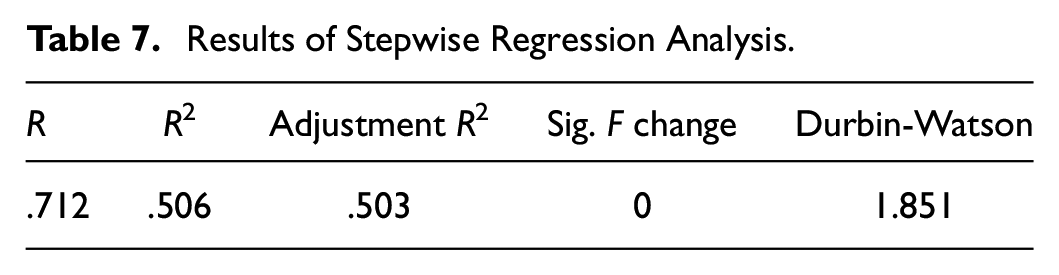
Herein, to explain college students’ learning intentions toward online teaching videos during the COVID-19 pandemic, four variables are set. Because the influencing factors are not unique, multiple linear regression equations are utilized for analysis. Table 7 depicts the results of the stepwise regression analysis of college students’ learning intentions toward online teaching videos; four variables, namely performance expectancy, effort expectancy, social influence, and facilitating conditions entered the regression model results. This observation indicates that the college students’ learning intention to online teaching videos exhibits a significantly predictive value of Sig. F = 0.000. Simultaneously, the R-square value of this study is 0.503, which indicates that the model exhibits satisfactory fitness, and these four variables exhibit a strong explanatory effect on the learning intention of college students toward instructional videos. In addition, as per Table 7, the Durbin–Watson statistic value is 1.851, which indicates that the correlation coefficient is close, and that there is no auto correlation among the residuals. The standard deviation error is between 0 and 2, which indicates that there are no outliers. The value of the variance inflation factor (VIF) in Table 8 is less than 3.3; because the obtained value is a recommended threshold (Kock, 2015), the VIF does not exhibit collinearity.
Results of Stepwise Regression Analysis.
Coefficient of Stepwise Regression Analysis.
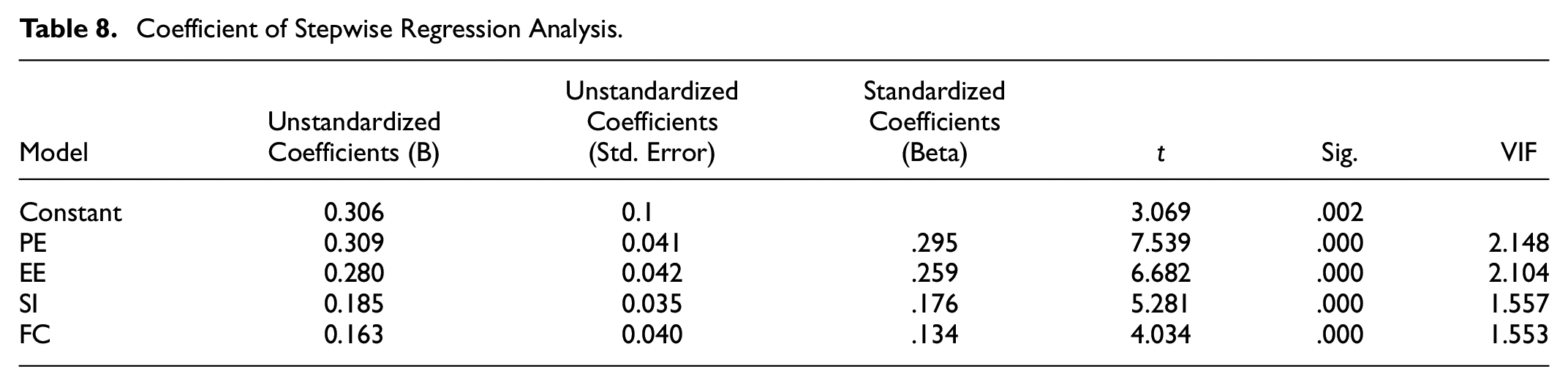
Based on the standardized regression coefficients in the stepwise analysis results of the college students’ learning intention to online learning-based instructional videos (Table 8), it can be observed that the ß values of the four predictor variables in the regression model are as follows: 0.295 for performance expectancy, 0.259 for effort expectancy, 0.176 for social influence, and 0.134 for facilitating conditions. The ß values are all positive, and Sig. = .000, which indicates that the predictor variables exert positive effects on college students’“learning intention” toward online teaching videos. Thus, the following formula is utilized: learning intention = 0.309 × performance expectancy + 0.280 × effort expectancy + 0.185 × social influence + 0.163 × facilitating conditions + 0.306. Through the preceding regression analysis of the variables, it can be observed that the performance expectancy ß value is the highest, followed by that of effort expectancy, social influence, and facilitating conditions.
Discussion
Descriptive Analysis Pertaining to Influencing Factors of College Students’ Learning Intention to Online Teaching Videos
Through descriptive analysis, it was observed that during the pandemic, college students did not exhibit a positive attitude toward learning from online teaching videos. The results are not consistent with that of Shah and Khan (2015) and Salas-Pilco et al. (2022), which indicate that students exhibited enhanced attitudes toward science due to the utilization of multimedia-aided teaching. The highest facilitating condition is 2.7639, which indicates that during the pandemic, college students certainly expected to acquire knowledge from online teaching videos. Subsequently, F. Zhang’s (2012) study indicates that students’ demands for personalized learning could be satisfied by the multimedia platform. Interviews with numerous teachers and students revealed that most of the online teaching was based on instructional videos, and that to achieve the classroom teaching effect, college students should learn from online teaching videos. The aforementioned method is the only path to complete classroom teaching during the pandemic. Because the school was not fully prepared to address the obstacles occasioned by the epidemic, including insufficient online teaching resources and teachers’ unfamiliarity with online teaching models, college students’ attitude toward learning online teaching videos was not quite positive. The average value of the factors is less than three, which indicates that college students are not highly motivated to learn using online teaching videos during the pandemic, and that the learning effect of college students on online teaching videos is not effective.
Analysis of Differences in Factors that Affect College Students’ Learning Intention to Online Teaching Videos
The findings of the control variables indicated that gender and disciplines did not significantly affect students’ learning intention to online teaching videos, which is consistent with study conducted by Lin et al. (2021) and Bao (2017). In regard to their intention to learn online teaching videos, students exhibit relative similarity; however, teachers should consider the different gender and disciplines characteristics of college students. For instance, because students in different disciplines exhibit different learning methods and knowledge construction processes, such as the theoretical teaching courses of liberal arts and sciences, the grades characteristics must be utilized for applying online teaching videos. Teachers should emphasize the knowledge construction process; engineering courses exhibit more practical operation courses, which should strengthen the training of hands-on operational abilities, and art teaching should focus on artistic accomplishment and emotional influence. The findings indicate that grades significantly impact learning intention to online teaching videos; however, the findings do not support the study conducted by Lin et al. (2021) and Bao (2017). Because students in different grades possess different knowledge reserves and learning abilities, especially between freshmen and seniors, it is necessary to consider the characteristics of different grades; thus, students can be taught in accordance with their aptitudes. During the epidemic, a larger number of first-year students opted for online classes, whereas a considerably limited number of senior students undertook courses, and in many cases, they undertook none whatsoever. Furthermore, first-year students were exceedingly reliant on online learning to supplement their knowledge and skills, leading to high learning intentions. Conversely, senior students were primarily involved in internships and job placements. When confronted with the epidemic, they became confined to their homes. Consequently, a notable disparity exists in their attitudes toward online teaching videos.
Regression Analysis Pertaining to the Influencing Factors of College Students’ Learning Intention to Online Teaching Videos
Through regression analysis, it is observed that four factors significantly impact college students’ learning intention to online teaching videos. Wijaya and Weinhandl’s study contradicts the aforementioned findings, which indicates that performance expectancy, effort expectancy, social influence, and facilitating conditions did not affect the intention to utilize micro-lectures (Wijaya & Weinhandl, 2022). However, the results somewhat align with Perera and Nalin’s (2022) study. The findings of UTAUT are verified herein (Venkatesh et al., 2003). During the pandemic, therefore, it is necessary to consider the influences of four factors on college students’ learning intention to online teaching videos; thus, researchers can ensure the learning effects of online teaching and online learning.
First, FC significantly impacts the learning intention to online teaching videos during the pandemic, which indicates that college students exhibit strong curiosity about teaching videos and desire to utilize novel technologies and tools through which they can learn from instructional videos. The results are not consistent with Wijaya and Weinhandl’s (2022) observations pertaining to the usage of micro-lectures in the post-COVID-19 period; however, they supported the previous studies, namely (Alabboodi & Nashowan, 2019; Holzmann et al., 2020; Pratama & Zhou, 2019). Especially during the pandemic period, it has been indicated that facilitating conditions exerted a more significant impact on the learning intention of college students to online teaching. Due to the COVID-19 pandemic, college students are confined to their homes, and the technical conditions of home networks vary across different regions. For instance, internet speeds in rural areas differ significantly from those in cities. Consequently, these factors can influence their motivation to study. Additionally, a large number of novel courses can meet the teachers’ needs for online teaching, and students quickly accept this method by utilizing the online teaching videos. Currently, online courses generally consist of courses such as national, provincial, or school-level quality courses and resource-sharing courses, which are built in the early stage. Some teachers utilized equipment such as computers and mobile phones to record video courses during the pandemic. However, the construction of video resources in various professional courses differs, leading to distinct learning outcomes for college students, thereby significantly affecting their intention to learn.
Second, PE significantly impacts the learning intention to online teaching videos during the pandemic. The results are consistent with those of previous studies, namely (Alabboodi & Nashowan, 2019; Holzmann et al., 2020; Liang et al., 2020; Pratama & Zhou, 2019). The preceding observation indicates that college students expect to enhance their academic performance, learning efficiency, and problem-solving ability. To achieve online teaching in a particular period, many college students, who are subjected to novel teaching methods, are willing to enhance the learning effect through learning from online teaching videos; thus, they can obtain corresponding satisfaction and meet expectations. College students are adjusting to in-person classroom teaching and may not be highly adaptable to comprehensive online learning, which can impact their learning outcomes. Online learning presents different expectations for college students compared to traditional classrooms, further influencing their willingness to learn.
Third, EE significantly impacts the learning intention to online teaching videos during the pandemic. The results are consistent with previous studies (Alabboodi & Nashowan, 2019; E. Ö. Kurt & Tingöy, 2017; Perera & Nalin, 2022; Pratama & Zhou, 2019). The preceding observation indicates that to learn from online teaching videos, it is not necessary for students to overcome numerous difficulties, and that they wish to meet their learning needs quickly and easily to obtain learning results. When college students encounter problems in online learning, they adopt a positive attitude and become willing to overcome difficulties and address challenges. However, unstable internet connections can disrupt college students’ ability to study effectively in online teaching, leading to the need for increased effort to understand and learn the material. Therefore, EE is a significant factor that affects their willingness to learn.
Finally, SI significantly impacts the learning intention to online teaching videos during the pandemic. The results are consistent with those of previous studies (Alabboodi & Nashowan, 2019; Perera & Nalin, 2022; Vinnikova et al., 2020), which indicates that college students are susceptible to the attitudes toward online teaching videos from classmates, teachers, parents, and friends, which exert a subtle influence on their learning intention. During the pandemic, long-term online teaching exerted many physical and psychological effects on college students, such as separation from teachers and friends. Students desired to obtain more support from families, friends, and teachers, and all these groups significantly affect students’ learning intention. Moreover, college students can utilize social media as a method of alleviating stress and negative emotions, enabling them to revert to their regular study routines.
Practical Implications
For college students to enhance their learning effect through online teaching videos, this study proposes practical implications from the following perspectives: the establishment of correct psychological counseling mechanisms, the design of online teaching using the cognitive load theory, the ADDIE model and multimedia learning theory, the creation of an effective online teaching environment, and the enhancement of information technology and high-quality online video resources.
First, it is imperative that effective psychological counseling mechanisms be established to support students. Although college students may not always exhibit a positive attitude toward online learning videos, it is crucial that they actively engage with these resources (Brame, 2016). Teachers should also focus on enhancing students’ satisfaction with online teaching (F. Zhang, 2012). Additionally, during the pandemic, social influence (SI) significantly impacts students’ learning intentions for online teaching videos, and instructors’ attitudes and family support crucially influence students’ ease of utilizing online learning (Mo et al., 2021). Therefore, it is imperative for teachers and families to support students in their online learning journey. Furthermore, with regard to the utilization of social media, students’ communication and collaboration affect the continual utilization of online learning methods (Ewelina et al., 2021). Therefore, for effective inter-student cooperation during online learning, social media can be utilized. However, it is crucial to acknowledge that long-term online teaching and remote distance learning may lead to psychological challenges such as learning anxiety, confusion, loneliness, and self-doubt. Emotional support was necessary for college students owing to the stress and anxiety occasioned by the pandemic Salas-Pilco et al. (2022). For rural students to relieve their learning pressure, psychological counseling should be enhanced (Yu et al., 2021). Hence, to address these issues, colleges and universities should establish a well-structured psychological counseling mechanism to facilitate the alleviation of students’ long-term psychological stress, boost learning satisfaction, and guide them in effective online learning.
Second, EE significantly influenced the learning intention to online teaching videos during the pandemic, which indicates that by using online teaching videos, students can utilize less effort to finish the task. To enhance engagement with online teaching videos and reduce students’ effort, teachers should consider integrating the cognitive load theory, ADDIE model, and multimedia learning theory into the design of their online videos. The cognitive load theory proposed that practical learning experiences should minimize extraneous cognitive load, optimize germane cognitive load, and manage intrinsic cognitive load (Brame, 2016). Online teaching videos should be concise, preferably less than 6 min in length, and free of complex backgrounds and distracting music. Furthermore, the ADDIE model comprises the analysis, design, development, implementation, and evaluation stages as an instructional systems design (ISD) framework. Many instructional designers utilized the model to develop teaching courses (Morrison et al., 2010). For the promotion of learning, the e-Tajweed Yaasin software, which was developed using the ADDIE model and an audio–visual animation, is more effective than text-only method (Kapi et al., 2017). S. Kurt (2017) utilized the ADDIE model to conduct an instructional design and combined different types of compatible media. By utilizing this model and incorporating multimedia technology, online teaching videos can be created to reduce cognitive load and enhance students’ understanding of course content. Additionally, this integration of ADDIE and multimedia technology aligns with the cognitive theory of multimedia learning (Mayer, 2009), which emphasizes various elements such as multimedia presentation, sensory memory, working memory, and long-term memory. Mayer’s (2009) 12 principles of multimedia design can guide instructional designers in reducing extraneous processing, managing essential processing, and promoting generative processing, ultimately leading to more effective instructional materials and learning experiences. Ibrahim (2008) designed a teaching video based on the cognitive theory of multimedia learning. Consequently, it is advisable for instructional designers to consider integrating the cognitive load theory, ADDIE model, and multimedia learning framework conducted by Mayer (2008) to enhance the design and development process. This integration can lead to more effective instructional materials and learning experiences.
Third, PE significantly impacts the learning intention to online teaching videos during the pandemic. The creation of an effective online teaching environment is vital for enhancing the learning experience, which entails active engagement from students within the online environment (Brame, 2016). The results indicate that teachers or video producers should package videos with interactive questions, incorporate features that provide students with control, and integrate videos into broader homework assignments (Brame, 2016). Additionally, online learning enables teachers to interact with students, and it increases their engagement and interest in learning (Irida et al., 2022). In this context, teachers should actively interact with students, identify learning difficulties, and monitor their progress. High student satisfaction is often associated with online platforms that offer interactive and integrated features (Brame, 2016). Therefore, it is crucial for teachers to rationally and effectively design the online teaching environment, taking into account methods for promoting learning effectiveness and ensuring orderly progress based on performance expectations.
Finally, FC significantly affects college students’ learning intention to online teaching videos. Consequently, to further support college students’ learning intentions for online teaching videos, it is essential to enhance facilitating conditions, such as the speed of internet technology and the quality of teaching videos. On one hand, the task-technology fit significantly affects the perceived ease of utilization and perceived usefulness of online learning (Mo et al., 2021). The widespread adoption of 5G technology is crucial in facilitating seamless online teaching, particularly in regions with heavy data traffic and real-time requirements (Xiong et al., 2021). For smooth online teaching, 5G wireless Internet should be popularized in some regions, and China’s national network bandwidth should be increased. As of June 2022, China has built and launched 1.854 million 5G base stations, covering 455 million 5G mobile phone users. The country has built the largest 5G network worldwide; thus, in regard to 5G standards and technologies, it is one of the global leaders (CNNIC, 2022). Consequently, efficient network technology guarantees online teaching. On the other hand, high-quality technology should be utilized in online teaching videos, such as production technology of MOOC, and online learning platforms should be extensively utilized in online teaching. In summary, it is recommended that qualified colleges and universities adopt high-definition recorders, hire professional teams to produce high-quality video resources, eliminate inappropriate courses that cannot address teaching needs, and build a group of elite courses that can ensure appropriate online teaching for the different grades and disciplines. In March 2022, the National Smart Education Public Service Platform, which integrated resource service platforms such as the National Higher Education Smart Education Platform and the National 24365 College Student Employment Service Platform, was officially launched. Furthermore, it has combined 34,000 basic education course resources, 6,628 online quality courses on vocational education, and 27,000 high-quality courses on higher education (Xinhua News Agency, 2022). Similarly, China Unicom provides 5G network that supports the real-time interactive transmission of 4K ultra-long-distance videos between teachers and students, with a less than 38 ms multi-site collaborative experiment delay (Phoenix Business, 2020). Hence, to address the online teaching and learning needs, governments and universities should invest in efficient network technology to guarantee the quality of online video teaching.
In summary, this study outlines practical implications to enhance college students’ learning effectiveness through online teaching videos, addressing the importance of psychological support, efficient course design, interactive online environments, and advanced technology. These recommendations aim to enhance the quality and impact of online education.
Research Conclusions
This study has successfully identified the key factors influencing college students’ learning intention toward online teaching videos during the pandemic. Based on the survey data, college students’ learning attitude toward online teaching videos is related to learning effectiveness. From the perspective of the UTAUT model, factors exert different impacts on the learning intentions of online teaching videos. The conclusions drawn from the results and discussions are as follows: First, it is observed that college students do not exhibit a positive attitude toward online teaching video learning. Second, unlike the disciplines and genders, the grades between freshmen and seniors significantly influence the college students’ learning intention to online teaching videos. Finally, performance expectancy, effort expectancy, social influence, and facilitating conditions significantly influence college students’ learning intention to online teaching videos. According to the combination of the research results and the standard coefficient values pertaining to the regression analysis, the model is revised as depicted in Figure 3.

Results pertaining to the influencing factors of learning intention to online teaching videos.
Limitations and Contributions
This study exhibits several limitations that are indicative of potential directions for future research. First, because the study’s focus on only one university, it might not comprehensively represent the diversity of learning intentions among Chinese college students. Second, as a cross-sectional survey, it lacks long-term follow-up data. Third, it exclusively examines college students’ learning intentions from a quantitative standpoint, without delving into the underlying qualitative factors and their effects. Researchers aim to explore the impact of online teaching videos on learning in various scenarios, encompassing online teaching, classroom-based instruction, and self-directed learning.
With respect to educational technology, this study offers the following contributions. First, it aims to attract the attention of the Chinese network department; thus, the department focuses on the construction of the online teaching network environment (i.e., the acceleration of 5G construction, gigabit fiber broadband network coverage, and services power; CNNIC, 2022). Second, this study is consistent with the national curriculum resource construction scope; the national smart education public service platform provides strong support for promoting the digital transformation of education in China (China Education News, 2022). Finally, this study responds to relevant national policies; Chinese President Xi Jinping proposed the following: the government should promote the digitization of education and build a learning society and a learning country in which all individuals learn for life (Xi, 2022).
Footnotes
Appendix
Author’s Note
This research was conducted while Hao Yinhua was at Huangshan University of China. He is now a PhD candidate at Universiti Putra Malaysia and may be contacted at yinh-2005@163.com.
Declaration of Conflicting Interests
The author(s) declared no potential conflicts of interest with respect to the research, authorship, and/or publication of this article.
Funding
The author(s) disclosed receipt of the following financial support for the research, authorship, and/or publication of this article: Project Title 1: Production and Research of Enterprise Promotion and Educational Videos; Project Number 2: hxkt2024118. Project Title 2: Anhui Provincial Department of Education Outstanding Talent Project Fund; Project Number 2: YQYB2023036.

Data Availability Statement
If readers need the data of this study for research and verification, please contact the first author at