




Abstract
Effective knowledge sharing among software developers is crucial for maximizing software development output throughout the software development lifecycle. Building upon Triandis’ Facilitating condition, this study explores the moderating impact of two factors, namely Organizational support and Technological support, on the relationship between knowledge sharing intentions (KSI) and knowledge sharing behavior (KSB). Specifically, the study investigates the impact of KSB on individuals’ job performance in global software development organizations. A self-administered questionnaire was used to collect data from 302 Malaysian participants working on global software development projects. The collected data was analyzed using Structure Equation Modeling (SEM) through SmartPLS. The results reveal that only organizational support, among Triandis’ Facilitating conditions, moderates the relationship between KSI and KSB. Moreover, the study finds that KSB mediates the relationship between knowledge sharing intentions and job performance. The findings of this study provide practical and theoretical implications for software developers.
Plain Language Summary
This study examines the impact of organizational and technological support on knowledge sharing intentions and behavior among software developers in global software development organizations. Using a self-administered questionnaire, data was collected from 302 Malaysian participants, which was then analyzed using Structure Equation Modeling (SEM) through SmartPLS. The study finds that only organizational support has a moderating effect on the relationship between knowledge sharing intentions and behavior. Furthermore, knowledge sharing behavior was found to mediate the relationship between intentions and job performance. These findings have practical and theoretical implications for software developers, highlighting the importance of organizational support in fostering knowledge sharing behavior and ultimately improving job performance. However, the study is limited by its sample size and geographic scope, which may impact the generalizability of the findings.
Keywords
Introduction
Efficient knowledge management and sharing are pivotal for the success of software development in the global software development industry. The convergence of specialized knowledge is indispensable for the seamless execution of software projects (Anwar, Rehman, Wang, & Hashmani, 2019; Anwar, Rehman, Wang, Hashmani, & Shamim, 2019). Knowledge sharing has become an imperative for organizations as it serves as a source of novel ideas (Islam et al., 2022) and drives competitive advantage (Khatoon et al., 2022). In the digital era, knowledge sharing is a strategic component for organizational operation and has a direct impact on organizational performance (Islam et al., 2021). In a fiercely competitive and innovative industry like software, launching cutting-edge products is crucial to maintain competitiveness (Anwar et al., 2018). However, despite the numerous advantages of global software development, such as cost-effective resource utilization, round-the-clock development, and access to expert talent from different regions, knowledge sharing across diverse team members continues to be a significant challenge for organizations (Anwar, Rehman, Wang, & Hashmani, 2019; Anwar, Rehman, Wang, Hashmani, & Shamim, 2019; Zahedi et al., 2016).
The exchange of knowledge among employees is a crucial process that fosters creativity and innovation in the workplace (Islam et al., 2021, 2022). Known as knowledge sharing, this process involves employee-to-employee learning that supports individual potential enhancement, problem-solving, and overall work performance (Nguyen et al., 2020). Knowledge sharing comprises the transmission, transfer, and dissemination of knowledge within and between organizations (Chaudhary et al., 2023). Previous research suggests that tacit knowledge sharing is critical for job performance and leads to improved performance (Huie et al., 2020). However, it remains an understudied area, specifically in global software development teams, and further investigation is necessary to understand how knowledge sharing intentions and behavior influence employees’ job performance. A study in the media industry explored the relationship between knowledge sharing activities and individual job performance (Kwahk & Park, 2016). Thus, there is a literature gap concerning the impact of KSB on job performance outside of this context. The purpose of this study is threefold: First, to examine how knowledge sharing intentions influence job performance. Second, to identify moderators and mediators to comprehend the underlying mechanisms in the knowledge sharing intentions—job performance relationship. Third, to investigate how two moderators, organizational and technological factors, influence the knowledge sharing intention-knowledge sharing behavior relationship.
The effective sharing of knowledge among software developers is of critical importance for the success of software development projects (Zahedi et al., 2016). KSB factors can be categorized as either barriers or facilitators, with the latter including organizational support, technological support, cultural, and geographical factors (Anwar, Rehman, Wang, & Hashmani, 2019; Anwar, Rehman, Wang, Hashmani, & Shamim, 2019). This study focuses on two key facilitation conditions of KSB, namely organizational support and technological support, which are selected as moderators for two primary reasons. First, the success of global development teams depends largely on their ability to overcome technological challenges. The use of technology is crucial in facilitating effective communication, collaboration, and knowledge sharing among global development teams. Secondly, the success of global development teams is dependent on various organizational factors such as leadership, team structure, cultural diversity, and communication. By examining the impact of organizational support and technological support on knowledge sharing behavior, we can identify strategies and best practices to enhance the efficiency and effectiveness of global software development teams.
In summary, comprehending the factors that influence KSB and creating a KSB framework for software developers working in GSDOs is crucial for managers to reduce challenges and complexities in the KSB process and enhance job performance. This study utilizes the TFC approach to examine the impact of KSB on JP among software developers in GSDOs in Malaysia, which has not been previously employed for this purpose.
Hypothesis Development
Knowledge Sharing Intention and Behavior
The Triandis model offers an explanation and prediction of intention and behavior. The model proposes that “intention represents an individual’s conscious plan or self-instruction to carry out a behavior.” Several studies have demonstrated that intentions accurately predict behavior, and according to Triandis, intentions are direct antecedents of behavior. Triandis (1977) further posits that behavioral intentions refer to instructions given to individuals to behave in a particular manner in specific situations.
The emergence of Information Technology (IT) has revolutionized the capture, storage, processing, retrieval, and communication of knowledge. However, limited understanding exists regarding how knowledge is shared among individuals. A significant challenge in Knowledge Management (KM) is the consolidation of information from diverse sources into a coherent knowledge base. Implementing and maintaining KM systems can result in improved decision making, faster turnaround times, better organizational communication, and increased cooperation and interaction among personnel. IT has the potential to overcome barriers to knowledge sharing by facilitating the dissemination of information and fostering collaborative efforts among personnel. However, further research is required to identify the most effective strategies and best practices for KM implementation and maintenance to ensure successful outcomes.
Reychav and Weisberg (2010) suggest that a positive interconnection between knowledge sharing intention and behavior is crucial for learning and provides economic advantages to organizations. Additionally, Kim et al. (2020) argue that an individual’s characteristics play a significant role in influencing knowledge sharing behavior with respect to knowledge sharing intentions. Thus, we propose that a positive intention toward sharing knowledge creates a conducive environment for knowledge sharing behavior among employees. Based on this, this study proposes the following hypothesis:
H1: Knowledge sharing intention will positively affect knowledge sharing behavior of software developers working in GSDOs.
Knowledge Sharing Behavior and Job Performance (JP)
An individual’s knowledge sharing intention can explain and predict their knowledge sharing behavior. Moreover, Kang et al. (2008) argue that knowledge sharing allows for the exchange of ideas and improves learning capabilities, which eventually enhances job performance. Job Performance (JP) refers to the overall expected value of employees’ behaviors carried out over a specific period. JP is a multidimensional concept (Sonnentag et al., 2008), consisting of indicators that can be directly measured (Koopmans et al., 2011). Knowledge sharing enables the exchange of ideas, leading to improved learning capabilities and, consequently, enhancing job performance (Kang et al., 2008). Additionally, knowledge sharing improves performance by providing innovative solutions to business problems (Hansen, 2002; Huie et al., 2020).
Hoopes and Postrel (1999) conducted a study that demonstrated the influence of “shared knowledge,”“collegial cooperation,” and “project coordination” on “staff performance” in product specifications. J.-G. Park and Lee (2014) investigated the impact of “dependence” and “trust” on knowledge sharing in information systems projects. They collected data from 135 project teams from two large Information Technology firms and observed that dependence and trust had a strong impact on knowledge sharing, leading to good team project performance (Rehman et al., 2022). Chang et al. (2020) conducted a study to determine the impact of “cultural difference” on knowledge sharing in IT-based service outsourcing. The respondents were employees involved in outsourced projects, and the results indicated that a shorter “cross-cultural distance” positively impacted knowledge sharing in “trust building,” and stronger “relationship quality” and knowledge sharing improved outsourcing performance. X. Chen et al. (2017) conducted a study to analyze the impact of implicit and explicit knowledge sharing on the performance of Open-Source Service (OSS) projects in the Chinese context. The results showed that knowledge sharing had a positive relationship with the performance of OSS projects, and explicit knowledge sharing had a significant effect on “innovation speed” and “financial performance,” while tacit knowledge sharing had a more significant effect on “innovation quality” and “operational performance” (Z. Wang & Wang, 2012).
The literature suggests that in the context of GSD, the relationship between KSB and JP has been largely unexplored, with most studies focusing on project performance, outsourcing performance, and operational performance. However, according to employee opinion, JP is fundamentally the outcome of a series of behaviors. Therefore, there is a need to investigate the impact of KSB on the job performance of software developers. To address this gap, the current research focuses on the KSB of software developers and aims to examine the impact of KSB on individual job performance. The conceptual frameworks incorporate job performance as an outcome of KSB (as shown in Figure 1). Hence, this study formulates the following hypothesis:
H2: Knowledge sharing behavior will positively relate to the individual’s job performance of software developers working in GSDOs.

Research framework.
Knowledge Sharing Behavior as Mediator
In today’s competitive environment, knowledge is considered a critical resource and asset for any organization (Charterina et al., 2017). Efficient knowledge sharing within organizations can help them manage knowledge effectively and assist employees in achieving their goals (Lei et al., 2017). Knowledge sharing in the workplace involves the exchange of expertise, experiences, work-related documents, know-how, and procedures among workers (Lu et al., 2006). Previous research has demonstrated that knowledge sharing involves the exchange of knowledge and expertise, leading to the generation of new ideas and skill sets that can help organizations achieve their aims and objectives (Liao et al., 2007; Lin, 2008; Van Den Hooff & De Ridder, 2004).
Research suggests that employees with stronger intentions to share knowledge are more likely to engage in knowledge sharing behaviors, which leads to higher job performance. Conversely, weaker intentions to share knowledge negatively impact knowledge sharing behaviors and job performance. Reychav and Weisberg (2010) have emphasized the positive relationship between knowledge sharing intention and behavior. Kim et al. (2020) found that KSB mediates the relationship between knowledge sharing, individual characteristics, and knowledge sharing behavior. In a study conducted in Chinese firms, Z. Yang et al. (2018) found that knowledge sharing acts as a mediator between collaborative culture and innovation capability. Similarly, Ma et al. (2013) found a direct relationship as well as an indirect relationship between ethical leadership and employee creativity via knowledge sharing. Thus, it can be argued that a stronger knowledge sharing intention will likely enhance knowledge sharing behavior, which in turn boosts employees’ job performance.
Hence, we hypothesized that:
H3: Knowledge sharing behavior mediates the relationship between knowledge sharing intention and job performance.
Technological Support as Moderator
Raza and Awang (2020) and Anwar, Rehman, Wang, and Hashmani (2019) have highlighted three types of knowledge sharing barriers, namely individual, organizational, and technological. According to Triandis (1977), geographical barriers can also create hurdles in planned actions. To overcome this problem, the proposed model incorporates “facilitating conditions” to predict behavior. “Facilitating conditions” refer to the extent to which an individual perceives the technological and organizational infrastructure required to use an intended system (Thompson et al., 1991). Triandis’ (1977) model suggests that an individual’s reaction to a situation is directly related to their intentions, which are influenced by social and psychological factors. Additionally, this model acknowledges that facilitating conditions predict behavior, so hindrances can have a significant impact despite high intentions. Therefore, this study proposes that “facilitating conditions,” including technological support (TS) and organizational support (OS), can enhance knowledge sharing intentions and knowledge sharing behavior.
Based on the above rationale, it is hypothesized that high levels of technological support will moderate the relationship between KSI and KSB, strengthening the positive relationship between the two variables among software developers working in GSDOs. This hypothesis is supported by previous research that has highlighted the critical role of technology in facilitating communication and knowledge sharing in geographically dispersed teams. Additionally, when employees perceive that the organization provides adequate technological support, they are more likely to engage in knowledge sharing behaviors. Therefore, it is expected that higher levels of technological support will enhance the motivation of software developers to engage in knowledge sharing behaviors, leading to higher levels of KSB, and ultimately better job performance.
Hence, it can be hypothesized that:
H4: Technological support will moderate the relationship between knowledge sharing Intention and knowledge sharing behavior of software developers working in GSDOs.
Organizational Support as Moderator
Various studies have shown that organizational support is a crucial factor in facilitating knowledge sharing behavior (KSB), as it provides suitable infrastructure for knowledge sharing. This includes a well-defined organizational design that clearly defines employee roles and responsibilities, management support, and a flexible communication and team structure (X. Zhang et al., 2020). Individual freedom at the workplace also leads to frequent communication, enabling the exchange of knowledge. In addition, common chat rooms and documentation, such as business documents, systematic reviews, codification, and artifacts, serve as a foundation for communication and knowledge sharing. Proper infrastructure, such as the aforementioned factors, facilitates KSB and contributes to the success of global software development (GSD) teams (Attar, 2020).
Effective knowledge transfer processes can be facilitated by utilizing available infrastructural assets before the commencement of a project. Supportive management and leaders also play a significant role in promoting knowledge sharing behavior within organizations (Peñarroja et al., 2019). Organizations with a higher tolerance for failure may provide individuals with opportunities for easier knowledge exchange. However, the positive relationship between organizational support and knowledge sharing may vary based on specific situations and certain types of employees (H. Yang et al., 2020). Policies that support knowledge transfer between “old employees” and “new employees” can also facilitate knowledge sharing. Onshore managers can reduce misunderstandings among offshore employees by avoiding assigning complex domain knowledge tasks to them. When software developers in GSDOs perceive high levels of organizational support, they may be more motivated to engage in knowledge sharing behaviors, which can strengthen the relationship between KSI and KSB.
Thus, this study proposes the following hypotheses:
H5: Organizational support will moderate the relationship between knowledge sharing Intention and knowledge sharing behavior of software developers working in GSDOs.
Research Methodology
The research philosophy adopted in this study is positivism, which allows the researcher to observe a social behavior or condition, develop hypotheses, test them, and analyze the results (Saunders, 2011). To analyze the survey data, the Partial Least Squares-Structural Equation Modeling (PLS-SEM) technique has been used, as it provides a robust way to analyze complex cause-effect relationship models (Henseler et al., 2009; Lowry Gaskin, 2014). SmartPLS software was chosen as it does not require large sample sizes or specific data distributions (Chin, 1998) and can measure both the measurement and structural models simultaneously (Cheung et al., 2015). This approach has been supported by previous studies that have used SmartPLS for similar research purposes.
Population and Sampling
The study collected data from global software development organizations (GSDOs) with the sampling frame obtained from Malaysia Digital Economy Corporation (MIDEC). Simple random sampling (SRS) was used to identify individuals working in GSDOs as the sampling units. The recommended minimum sample size varies across studies, with some suggesting a minimum of 100 (Gorsuch, 1983; Hair, 2009), while others suggest 150 or 200 (Guilford, 1954). However, this study used a sample size of 300, exceeding the minimum required sample size in the literature. To maximize response rate, 600 companies were contacted, and a self-administered questionnaire was used to collect data through personal visits, mail, and online. Out of the 600 questionnaires sent, 243 respondents refused to participate, 55 incomplete surveys were returned, and 302 valid responses were collected, with 34% of responses collected through online surveys and 56% through hard copy.
Instrument Development
This study is using five variables which are knowledge sharing intention, knowledge sharing behavior, job performance, technological support and organizational support. Questionnaire items for these variables were adapted from the existing literature. Table 1 presents the source of variable items used in this study.
Questionnaire Development.

Demographic Details
Data were collected from GSDOs working on global projects but based in Malaysia. Both online and physical visits methods were used to collect the response. Total 302 surveys were received. Survey was conducted from January 2017 to May 2017. Majority of the respondents were male, having bachelor’s degree, with less than 5 years of working experience. Table 2 presents the details of participants “age group,”“education level,” and “work experience” and “organization size” respectively.
Demographics.

Results
This research used Smart PLS 3.0 for data analysis. Convergent validity assesses the level of correlation of multiple indicators of the same construct. In this research “average variance extracted (AVE),”“composite reliability (CR),” and “Cronbach’s Alpha (CA)” were calculated to determine the convergent validity. The recommended minimum value for AVE is .50 and for CR is .6 (Hair et al., 2006). For Cronbach alpha any value that range between .5 to .7 is considered to provide moderate reliability (Hinton et al., 2004; Loewenthal, 2001). Table 3 presents AVE, CR and CA of the latent variables. KSB has the highest AVE (.716) whereas KSI had the least AVE (.624) as compared to other variables. Results indicate that all AVE values are greater or equal to the threshold value which is .6 as mentioned in Hair et al. (2006). This shows that the suggested constructs explained more than half of the variance of its indicators.
Convergent Validity.

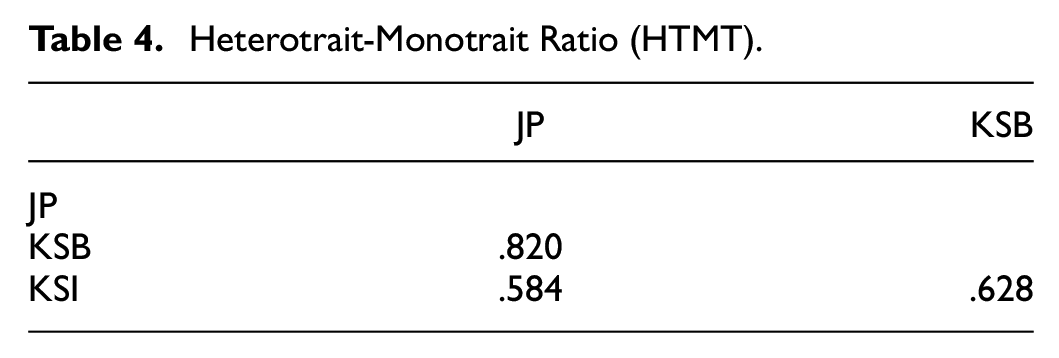
To determine discriminant validity, the Heterotrait-Monotrait (HTMT) ratio was used. It is suggested that if HTMT value is below .90, discriminant validity has been established between two reflective constructs (Henseler et al., 2015). Table 4 presents HTMT values of reflective constructs that fulfil the criteria for establishing discriminant validity.
Heterotrait-Monotrait Ratio (HTMT).
Variance Inflation Factor (VIF) was used to detect multicollinearity. All values of VIF equal or above 10 can be seen as a cause of concern, and may require further investigation (Ho, 2006). The results for all VIF values were found to be less than 10 thus there is no concern for multicollinearity issue.
For PLS-SEM, common method bias (CMB) is detected through a “full collinearity” assessment method. Full collinearity (VIF) tends to increase with the complexity of the model, in terms of number of latent variables in the model. It suggests that VIF value of 5 could be employed when algorithms that incorporate measurement error are used (Kock, 2015) . Table 5 shows all VIF values are less than 6. This indicates that the model is free from “common method bias.”
Full Collinearity Tests

Hypotheses Testing
Initially, the direct relationships H1 and H2 were examined. The results shows that the Knowledge Sharing Intentions lead to Knowledge Sharing Behavior. Moreover, the Knowledge Sharing Behavior predicts the Job performance. After verifying the direct relationship, the mediating effect of Knowledge Sharing Behavior between Knowledge Sharing Intention and Job Performance has been tested through Smart PLS. The bootstrapping technique was used to measure the indirect effect of Knowledge Sharing Behavior. Results confirm the mediation with t-statistics 3.638 and p-value .000. Whereas the beta value is calculated as .137 which shows the strength of effect. Additionally, to check whether it is full mediation or partial mediation, the additional relationship between Knowledge Sharing Intention and Job Performance has been examined. The result confirms the full mediation with direct relationship of Knowledge Sharing Intention to Job Performance is insignificant and indirect effect of Knowledge Sharing Behavior found significant. The summary of mediation analysis has been presented in Table 6.
Direct and Indirect Analysis.

Interpreting Moderating Effects
The interaction model was tested using the following steps by Fassott et al. (2016):
Determining whether the moderating effects really exist or not? For this step path coefficient was checked to capture the moderating effect
Moderating effect strength was determined
Moderating effect strength was assessed by doing a comparison of the proportion of variance explained using R2 values (Fassott et al., 2016). Table 7 provides a comparison of R2 values with moderating effects.
R 2 Values Comparison.

This framework tested all hypotheses simultaneously along with the combined moderating effect of technological support and organizational support. The technological support moderating effect had an insignificant value of 1.484 and organizational support moderating effect had a significant value of 2.483. Table 8 summarizes the results of the moderating hypothesis.
Moderation Analysis.

The effect size f2 of the moderator has been determined by the following formula (Cohen, 1988).

For this framework, f2 is .302 which is indicated as a strong effect size. In Chin et al. (2003), it is mentioned that a lower value of f2 (effect size) does not essentially suggest that the moderator effect is insignificant: “Even a small interaction effect can be meaningful under extreme moderating conditions, if the resulting beta changes are meaningful, then it is important to take these conditions into account” (Chin et al., 2003).
The moderating interaction graphs for TS and OS are presented in Figures 2 and 3 respectively.

TS moderating effect.

OS moderating effect.
Discussion
The results of this study support the proposed research framework, with the direct effect of Knowledge Sharing Intention and Knowledge Sharing Behavior (H1) being accepted. This finding is consistent with previous research by Safa and Von Solms (2016) and Ajzen and Fisbbein (1974), which suggest that intentions are significantly related to behavior. However, the introduction of “organizational support” and “technological support” did not have a uniform impact on the relationship between KSI and KSB. Future research can explore this further by examining the varying impacts of different facilitating conditions on the KSI-KSB relationship.
On the other hand, “job performance” was included as an outcome of software developers’ KSB. Hence, KSB had a strong significant impact on JP of software developers working in GSDOs with a path coefficient of .464 and t-stats 7.195. This highlights the importance of management emphasizing KSB in order to enhance employee performance. The results are consistent with prior research which has shown that effective knowledge sharing is essential for individual performance. The study also suggests that software developers share knowledge in order to perform well in their respective jobs (Akram & Bokhari, 2011). These findings are consistent with previous research by H. Park and Im (2001) and Hoopes and Postrel (1999).
The second hypothesis (H2) of this study, which proposed a direct relationship between knowledge sharing behavior (KSB) and job performance (JP), was strongly supported by the data. This finding is consistent with previous research suggesting that software development is a knowledge-intensive activity, heavily influenced by human factors and cognitive abilities, and that KSB has a significant impact on individual performance (Akram & Bokhari, 2011; de Barros Sampaio et al., 2010; Khan et al., 2011; Zahedi et al., 2016). Given that software developers are creative human beings, the current study aimed to analyze psychological aspects to determine KSB and its resulting impact on JP, in light of the lack of relevant studies in software engineering research that frequently ignore the human aspects of software development (Dyba, 2000; Graziotin et al., 2014a, 2014b).
In this context, KSB is seen as a vital practice for global software development organizations (GSDOs) as it positively affects JP, which in turn impacts organizational stability and productivity (Munisamy, 2013; Rasch & Tosi, 1992; Senge, 1997). Employees, as the basic building block of any organization, play a crucial role in achieving organizational goals. Higher levels of job satisfaction and motivation can lead to improved performance and increased knowledge sharing, resulting in innovative solutions (Hansen, 2002). The current study’s results provide practical insights for GSDO managers, emphasizing the importance of promoting KSB and supporting employee job satisfaction and motivation to enhance organizational performance.
The study utilized mediation analysis to examine the importance of Knowledge Sharing Behavior. The results showed that Knowledge Sharing Behavior partially mediated the relationship between Knowledge Sharing Intention and Job Performance (H3). This suggests that job performance is closely related to knowledge sharing, and that both intentions and behaviors of sharing knowledge are crucial for effective job performance. In software organizations, where knowledge is critical and new updates constantly arise, knowledge sharing is considered essential for survival. The knowledge gained by an individual should be shared to make it organizational knowledge in the long term. Knowledge Sharing Behavior is categorized to enhance the ability to solve issues (H. A. A. Ali et al., 2016). Therefore, software organizations should promote a knowledge-sharing culture through training, awareness processes, or intrinsic and extrinsic rewards to improve job performance through hands-on experience and practice.
Another contribution is the confirmation of Knowledge Sharing Behavior (KSB)’s act as a mediator between Knowledge Sharing Intention (KSI) and Job Performance (JP). The results suggest that KSB is essential in achieving both individual and organizational goals. This finding is consistent with previous research that highlights the positive impact of KSB on job performance (Natalia & Sandroto, 2020; S. Wang & Noe, 2010). Additionally, fostering a knowledge sharing culture within organizations can help employees solve problems more effectively, leading to improved individual and organizational performance. The full mediation effect of KSB between KSI and JP is a noteworthy contribution of this study.
This study highlights the importance of using TFC to determine KSB in GSDOs and analyzing its role in the job performance of software developers. The study used the “facilitating conditions” component from the Triandis model and introduced two moderating variables, “organizational support” and “technological support,” to determine their impact on KSB. However, the results showed that technological support had an insignificant impact with a path coefficient of .089 and t-stat value of 1.484. There are several possible reasons why technological support did not have a significant impact on KSB. One explanation is that simply having access to technological support does not guarantee its effective use. As noted by Senge (1997), an individual may receive information through technological support, but they may not have the skills needed to apply that information in a productive way. Additionally, when there are differences in domain knowledge across countries or locations, misunderstandings can arise and impede effective use of technological support (Betz et al., 2014). Furthermore, studies have shown that even with access to technological tools and resources, individuals may not use them effectively (Al Attar & Shaalan, 2016; Ghobadi & Mathiassen, 2016; Kroll et al., 2016; Kukko, 2013; Razzak & Ahmed, 2014; Zahedi et al., 2016). Finally, a lack of suitable KS tools in distributed teams may also contribute to the lack of impact from technological support on KSB.
Insufficient knowledge about collaborative technologies can have a negative impact on knowledge sharing, as reported in Ghobadi and Mathiassen (2016). Kukko (2013) also found that tools like “wiki pages” were frequently underutilized or did not deliver appropriate information. As GSDOs require specific tools for collaboration, the lack of these tools, particularly those used for managing architectural knowledge in a global working environment, can be challenging (N. Ali et al., 2010). In addition, because software development is an innovative process, not providing regular training for both new and senior employees can cause issues (Alam et al., 2012; Kukko, 2013). Therefore, if the usage and understanding of technology is too complex and requires extensive training, technological support can become an obstacle that prevents software developers from sharing knowledge. This suggests that in this study, software developers did not rely on technological support to share knowledge with their colleagues.
This study found that OS had a positive moderating role between KSI and KSB. The impact of OS on KSB of software developers in GSDOs was significant and high, with a path coefficient of −.157 and a t stats value of 2.483. This result is consistent with previous literature (Al Attar & Shaalan, 2016; Betz et al., 2014; X. Chen et al., 2017; Ghobadi, 2015; Iskoujina & Roberts, 2015; Kroll et al., 2016; Noll et al., 2010; Šmite et al., 2017; Zahedi et al., 2016). Authors in King and Marks (2008) suggested that a high level of organizational support creates a feeling of obligation among employees to support organizational goals, leading to a willingness to share knowledge with those who would benefit the organization most. This study supports the hypothesis that organizational support plays a significant role in promoting KSB, thus supporting H5. It can be concluded that the intervening effect of KSB and organizational support is significant in aiding software organizations.
This study introduced two moderating factors to determine the impact of KSB on JP, but only “organizational support” was found to be a significant factor in predicting KSB for software developers working in GSDOs. The insignificance of technological factors suggests that this sample of software developers did not depend on technological support to share knowledge with their co-workers. This implies that having the latest technological support in a GSDO may not necessarily result in effective knowledge sharing, unless all software developers are properly trained to use the technology.
Based on this explanation, management of GSDOs can understand the flow to enhance software development productivity, which is summarized in the Figure 4.

Knowledge sharing behavior outcomes.
Theoretical Implications
The present study has important theoretical implications. Specifically, we have utilized Triandis’ theory of interpersonal behavior and combined it with unique facets of knowledge sharing literature to propose a novel framework that illustrates how knowledge sharing intentions enhance job performance via knowledge sharing behavior. This framework adds to the work of Kwahk and Park (2016) by examining the relationship between knowledge sharing activities and job performance in the context of GSDOs. Furthermore, this study investigates the impact of two moderators, namely “technological support” and “organizational support,” on the relationship between KSI and KSB in GSDOs. By exploring the boundary conditions of facilitating conditions, this study enhances our understanding of knowledge sharing in the context of GSDOs in a developing country.
Practical Implications
This study has several practical implications for managers of GSDOs. Firstly, managers should focus on promoting KSB, as its outcome has a strong impact on software developers’ job performance. This can be achieved by having humble and motivational leaders who create a positive environment for employees who intend to share knowledge within the organization (Nguyen et al., 2020). Leaders can provide incentives and appreciation for employees who engage in knowledge sharing activities. Additionally, involving employees in important decision-making processes can enhance their sense of empowerment and attachment to the organization, leading to increased knowledge sharing behaviors (Abbasi et al., 2020). HR also plays a crucial role in supporting employees by creating flexible and employee-friendly policies, both ethical and financial, to help employees adjust to the organization’s environment and feel supported (Zagenczyk et al., 2020). To ensure that technological support aids in knowledge sharing among co-workers, it is necessary to train all software developers in the technology being employed. Finally, arranging seminars and training programs to develop trust among employees can enhance job performance in the presence of a knowledge sharing environment. These practical implications provide a roadmap for managers to enhance KSB, promote job performance, and foster a knowledge-sharing culture within GSDOs.
Limitation and Future Work
In the future, researchers may consider incorporating the full Triandis theory of interpersonal behavior (TIB) to determine KSB. In addition, a comparative study may be conducted to explore the impact of KSB using various behavioral theories such as Theory of Planned Behavior (TPB), Social Cognitive Theory (SCT), Theory of Reasoned Action (TRA), and Social Exchange Theory (SET). This would provide a comprehensive analysis of the components of these theories and their individual impact on KSB. Furthermore, future studies may investigate KSB by incorporating additional facilitating conditions such as “trust” and “social influence.”
Footnotes
Declaration of Conflicting Interests
The author(s) declared no potential conflicts of interest with respect to the research, authorship, and/or publication of this article.
Funding
The author(s) received no financial support for the research, authorship, and/or publication of this article.

Data Availability Statement
Data sharing not applicable to this article as no datasets were generated or analyzed during the current study.