




Abstract
Although research acknowledges the role of digital entrepreneurship in driving corporate innovation, digital entrepreneurial orientation (DEO) remains limitedly explored. Based on resource-based view (RBV) and social network theory (SNT), we developed a model to examine the role of cross-organizational improvisation (COI) and social ties (specifically, business and political ties) in the relationship between DEO and green innovation (GI). Survey data from 217 start-ups support the findings that (a) DEO positively influences green innovation, (b) COI mediates the link between DEO and GI, and (c) business ties (BT) moderate the relationship between DEO and GI; however, the role of political ties (PT) requires further investigation. This study not only contributes to the research on digital entrepreneurship and green innovation, but also enhances our understanding of the path from digital strategy to GI. The insights gained hold significant value for managers seeking to leverage a digital entrepreneurship orientation to foster GI.
Keywords
Introduction
Human society is gradually transitioning from an industrial to a digital economy (Hervé et al., 2020; Ritala et al., 2021). With a sluggish global economic recovery and a deceleration in global service flows, the fast-growing digital economy is regarded as a new leverage to boost the global economy. The rapid development of digital technologies has profoundly altered the competitive environment (Ritala et al., 2021; Soluk et al., 2021), and start-ups are facing a new revolution: the digital revolution (C. Fernandes et al., 2022; Kraus et al., 2018). Previous studies have revealed a success rate of less than 30% for digital transformation (Wang et al., 2022), compelling firms to actively adopt digital technology as a core component in their entrepreneurial activities (Yakubi et al., 2022), given that the uncertainties inherent in business processes and outcomes are being transformed by digital technologies (Chalmers et al., 2021; Proksch et al., 2024; Soluk et al., 2021). However, achieving organizational improvement through digital transformation involves numerous risk factors, including volatility, ambiguity, complexity, and uncertainty (VUCA) (Mohanta et al., 2020; Stein, 2021). “VUCA” has been used by management and some scholars to denote the characteristics of the “new normal” world and its impact on business (Tulder et al., 2019), where volatility (V) indicates that changes are frequent and unpredictable, uncertainty (U) indicates a lack of understanding toward business rules and strategies, complexity (C) indicates the intricacies of the operating environment, and ambiguity (A) indicates unknown outcomes (Bennett & Lemoine, 2014). In the VUCA environment, especially given the context of China’s economic transformation and advancement period, numerous overlapping challenges are inevitable (Van Berkel & Manickam, 2020). These include global health challenges, such as COVID-19, as well as ecological (e.g., biodiversity loss, extreme weather), social (e.g., food and water shortages), and economic (e.g., underemployment/unemployment) challenges. Therefore, accelerating the shift to economic activities, with the digital technology industry as a key component in the context of VUCA, has become an increasing concern for China’s economic development.
Recently, some studies have focused on addressing the convergence of digitalization and entrepreneurship (Hervé et al., 2020; Soluk et al., 2021; Zaheer et al., 2019). Digitalization has led to changes in entrepreneurial behavior and innovation performance, including reducing the exogenous crises faced by start-up entrepreneurs (Giones & Brem, 2017), affecting the overall performance of SMEs (Chatterjee et al., 2021), and increasing the frequency of interactions between community members (Soluk et al., 2021). These positive changes require firms to actively adopt digital technologies, defined as the use of computer-based solutions related to businesses (A. S. Bharadwaj, 2000; Urbinati et al., 2020), to navigate uncertainty and continuously pursue opportunities for entrepreneurial activities (Wang et al., 2022; Wiklund & Shepherd, 2005). This active pursuit, known as digital entrepreneurial orientation (DEO), can propel firms to achieve their entrepreneurship goals (Wang et al., 2022). Combining the existing literature on entrepreneurship orientation (Guo & Wang, 2022; Halberstadt et al., 2021; Hervé et al., 2020) and digitalization (George et al., 2021; Wang et al., 2022), this study defines innovation, initiative, risk taking, and market response agility the characteristics of DEO.
Existing research outlines DEO’s origin and characteristics, covers topics related to digitalization, systems, as well as organization, and preliminarily verifies the impact of the integration of digitalization and entrepreneurship on strategic decision making in foreign markets (Hervé et al., 2020), the positive relationship with innovation (Wang et al., 2022), and the interaction with consumers (da Fonseca & Campos, 2021), and so on. Digital strategies are increasingly contributing to sustainable development (Ritala et al., 2021). For example, leveraging digital technologies allows entrepreneurial firms to address critical challenges, such as climate change (George et al., 2021), and facilitate green growth (C. I. Fernandes et al., 2021), as firms can rethink their business models through digital technologies (Kraus et al., 2021). However, studies that have relied on empirical evidence to examine the impact of digital entrepreneurship on green innovation (GI) from a micro perspective remains scant, and even fewer studies have integrated the concept of entrepreneurial orientation into this issue. To fill this research gap, this study empirically examines the impact of DEO on GI.
Green innovation (GI) refers to innovations, such as new or improved systems, marketing, practices, processes, and products that benefit the environment (Guo & Wang, 2022; Oltra & Saint Jean, 2009). Compared to general innovation, GI is more complex and demanding (De Marchi, 2012; Guo, Wang, & Chen, 2020). Consequently, start-ups face enormous challenges in successfully implementing GI (Lingane & Olsen, 2004; Schneider & Veugelers, 2010) owing to their limited resources and understanding of the market (Skala et al., 2019), continuous evolution of technologies, products, and services, (Picken, 2017), and high cost of research and sunk in GI (Yang et al., 2021). In the VUCA era, the market environment is dynamic, complex, and ambiguous, and firms must respond to opportunities and threats arising from environmental changes timely. However, companies struggle to “plan ahead” for innovation in green products, which requires organizational improvisation while opportunities arise. Combined with the modern economic environment, the business activities of start-ups are characterized by cross-organizational integration. Thus, GI is inseparable from the close participation of supply chain partners (Guo, Wang, & Chen, 2020), and its success requires the collaborative improvisation of supply chain members, that is, cross-organizational improvisation (COI). In addition, the smooth implementation of digital strategies is fraught with challenges, which often require cross-organizational support and learning (George et al., 2021). However, the existing literature on digitalization focuses on internal processes and strategies (Wang et al., 2022), and rarely discusses the digitization of cross-organizational management. Therefore, this study revealed the mechanism by which DEO affects GI from the COI perspective.
The pervasiveness of ties in emerging markets (e.g., blat in Russia and guanxi in China) (Huang et al., 2016) lends credence to the social network theory (SNT) proposition that firms’ economic actions are deeply embedded in networks and ties of interpersonal relations (Y. Gu & Su, 2018; Uzzi, 1997). In the context of China’s emerging economy, Guanxi has always been the lifeblood of interpersonal relations and business behavior in Chinese society (Xin & Pearce, 1996), and enterprises rely heavily on the relationships of various stakeholders to conduct business and facilitate communication (Y. Gu & Su, 2018; Li et al., 2008; Wu, 2011). Managers’ social ties have become essential for Chinese firms to obtain innovation resources (Park & Luo, 2001; Power et al., 2010). Social ties are crucial for firms to achieve GI (Guo, Wang, & Yang, 2020) and enhance proactive and risk-taking behaviors to achieve strategic digital goals (George et al., 2021), thus preparing for the next exploration of improvements (Mom et al., 2015). In China, managers establish relationships not only with managers of other companies (i.e., business ties (BT)) but also with government officials (i.e., political ties (PT)) (Peng & Luo, 2000). However, few studies have examined how the two types of social ties affect the role of DEO in corporate green innovation; therefore, we incorporate these two social ties into our model framework.
This study examines the mediating role of COI in the influence of DEO on GI, as well as the contingent influence of social ties, including BT and PT In recent years, several studies have explored the role of digitalization in green growth (Andersson et al., 2014; C. I. Fernandes et al., 2021); however, the potential role of COI and social ties in how DEO affects GI has been unexplored. Thus, this study contributes to research by investigating this role.
Theoretical Background
Digital Entrepreneurial Orientation (DEO)
DEO lacks a precise and commonly agreed-upon definition. Drawing on previous literature (Giones & Brem, 2017; Guo, Wang, & Chen, 2020; Nambisan, 2017), we define DEO as the proactive utilization of digital technology by firms in entrepreneurial activities aimed at navigating business uncertainty and constantly pursuing new opportunities. It emphasizes a firm’s four capabilities: innovation, initiative, risk taking, and market response agility (George et al., 2021; Guo, Wang, & Chen, 2020). DEO organically combines digital entrepreneurship and entrepreneurial orientation. DEO requires firms to implement digital technology at the organizational level and reshape traditional business strategies and processes, while following continuous forecasting and action in response to changes in the external competitive environment, as well as the willingness to invest with uncertain results (Guo, Wang, & Chen, 2020; Hervé et al., 2020).
Cross-Organization Improvisation (COI)
In the VUCA era, organizational improvisation is considered an effective method for firms to adapt to rapid changes and seize unexpected opportunities in complex and changeable environments (Vera et al., 2016). However, achieving GI solely within the confines of a single organization is difficult, thereby necessitating cooperative efforts with related entities to create valuable, environment friendly products and services (Guo, Wang, & Chen, 2020). As an execution method for new product development strategy, improvisation must span a single firm and be embodied in the collaborative improvisation of supply chain members, that is, COI (Ruan et al., 2021). Based on previous studies (Pavlou & El Sawy, 2010; Vera et al., 2016), this study defines COI as the behavior of supply chain members in cooperating spontaneously and creatively using new methods to deal with urgent and unexpected events in operations.
The current research on organizational improvisation holds thee shortcomings. First, scholars mostly focus on the results of organizational improvisation and neglect the influencing factors of organizational improvisation. Second, in the study of how to form organizational improvisation, theoretical analysis predominates over empirical research (Hains-Wesson et al., 2017; Trotter et al., 2013). Third, existing improvisation research mainly focuses on the three levels of individuals, teams, and organizations; expanding the level of improvisation can provide a new perspective for exploring the relationship between improvisational behavior and GI.
Green Innovation (GI)
GI refers to the reduction in negative environmental impacts and resource utilization resulting from business innovation in products, processes, societies, systems, or organizations (Borghesi et al., 2015). Similarly, Bossle et al. (2016) believe that GI encompasses technological advancements and innovative approaches through which firms can mitigate environmental harm in their production and service processes (Bossle et al., 2016). This paper adopts the definition of GI by OECD, which incorporates the development of new or improved products (goods and services), processes, marketing approaches, organizational structures, and institutional arrangements with a reduced negative environmental impact compared to other practices.
From a strategy-oriented perspective, recent research has found that the smooth implementation of GI cannot be separated from the support of internal strategic resources (Guo & Wang, 2022; Mirahsani et al., 2023) (such as DEO) and from the strategic reform and new value integration of firms (Slevin & Terjesen, 2011). This, coupled with the inherent complexity and uncertainty of GI (Guo & Wang, 2022; Spence et al., 2011), renders the collaboration of supply chain members indispensable for successful implementation.
Resource-Based View (RBV)
The resource-based view (RBV) argues that a firm’s sustainable competitive advantage is obtained through unique resources that are valuable, rare, non-replicable, and imitable (Barney, 1991). As a strategic cultural resource that emphasizes the environment (Guo, Wang, & Yang, 2020; Guo & Wang, 2022), DEO can be identified as an important intangible resource for firms to achieve environmental goals (Zaheer et al., 2019). As an entrepreneurial orientation, firms with DEO are often in urgent need for external resources (Grimsdottir & Edvardsson, 2018; Teng, 2007). Concurrently, the RBV can explain DEO’s optimization of internal and external resources and shape new value propositions with greater flexibility and responsiveness (Hervé et al., 2020), which is necessary for firms to improvise across organizations and promote GI by reshaping the opportunity space for the ecosystem through COI (Nambisan, 2017). In this study, RBV theory helps generate new insights into the relationship between digital entrepreneurship and GI from a strategic perspective.
Social Network Theory (SNT)
Social network theory (SNT) emphasizes the important role of social ties in helping firms access scarce resources and data owned by their counterparts (Peng & Luo, 2000). SNT belongs to economic sociology, which emphasizes social governance to explain interpersonal relationships, wherein social ties as part of a broader concept of social capital; it refers to the nature and quality of connections between individuals within an organization (Edelman et al., 2004; Nahapiet & Ghoshal, 1998). Simultaneously, SNT posits that the roles of various network ties differ, and the differentiated effects of various types of network relationships must be considered (Wu, 2011). In China, businesses form a vast and complex network of partnerships. Given that China’s transition economy is a combination of planning and market trading mode (Peng & Luo, 2000), managers establish BT with suppliers, buyers, and competitors, as well as PT with government regulators (Peng & Luo, 2000). The types of social ties within the SNT framework employed in our study include BT and PT (Peng & Luo, 2000), which are essential types of interpersonal ties. BT refer to personal ties established by firms with business entities, such as customers, competitors, and suppliers (Peng & Luo, 2000; Wu, 2011), and allow managers to obtain resources and knowledge from external organizations (Petruzzelli, 2011; Wu, 2011). PT refer to personal ties established by firms with government agencies and regulators at all levels (Lin et al., 2014). They provide managers access to scarce government resources, such as contract enforcement, bank loans, tax breaks, permits, land, and subsidies (Kozhikode & Li, 2012; Li & Zhou, 2010). Therefore, firms’ social ties increase opportunities for cross-organizational learning and activities, empowering them to acquire knowledge and scarce resources (Schweer et al., 2012), thus enhancing the facilitative role of DEO in COI.
Hypothesis Development
Digital Entrepreneurial Orientation and Green Innovation
DEO is an important driving force of GI. First, DEO can promote firms’ focus on and responses to GI. Organizational forms, such as digital platforms advocated by DEO, are conducive to forming a circular economy business model and enabling surplus resources to circulate among different stakeholders, thereby achieving resource efficiency (Ciulli et al., 2020) and supporting sustainable business models (George et al., 2021). Moreover, entrepreneurial firms can leverage digital technologies to embrace major challenges, such as climate change (C. I. Fernandes et al., 2021), and further implement environment friendly strategies for green growth (Andersson et al., 2014). Second, DEO can enhance GI capabilities given that they focus on the active use of digital technologies. Digital technologies have new capabilities and help firms transcend traditional business strategies and processes (A. Bharadwaj et al., 2013), change existing entrepreneurial opportunities, or generate entirely new opportunities. Consequently, DEO empowers start-ups to reshape the opportunity space, enabling them to create new value by improving existing pathways or opening new ones. Third, the variability and agility of DEO allow firms to effectively avoid the path-dependent innovation trajectory (Parker & Choudary, 2016), rendering DEO a key strategic tool for promoting GI among firms (C. I. Fernandes et al., 2021). Thus, we propose the first hypothesis.
Digital Entrepreneurial Orientation and Cross-Organization Improvisation
DEO is a combination of entrepreneurship orientation and digital entrepreneurship, which can positively influence COI. On the one hand, as an entrepreneurial orientation, DEO leads to a dearth of corporate knowledge resources, compelling firms to actively seek external resources (Guo & Wang, 2022). In addition, digital technology emphasized by DEO facilitates collaboration between firms and supply chain members frequently and conveniently. The development of digital technologies and platforms has created new communication principles between firms and supply chain members (Bennis, 2013), such as blockchain, artificial intelligence, and other digital technologies, which have spawned new avenues of collaboration for firms, helping start-ups share resources, product/service design, and other information with other organizations (Markus & Loebecke, 2013). Digital technologies can facilitate frequent interaction between community members (Soluk et al., 2021), and new digital infrastructures (e.g., crowdfunding systems and digital makerspaces) create more collective ways for firms to pursue entrepreneurial orientation (Mollick, 2014). Hence, firms can better rely on or support their supply chain partners. On the other hand, firms’ active use of digital technology increases the possibility of engaging in improvisational behavior in the entrepreneurial process. Digital platforms allow elements to be reorganized as well as function assembled, improving the ability of firms to expand and reallocate resources (Yoo et al., 2010); Concurrently, firms must gain access to the information of supply chain members and collect data as quickly as possible (Mazzei & Noble, 2017), which provides favorable conditions for promoting COI. As Cunha et al. (2012) points out, the faster a firm builds an organization, the more inclined it is to engage in improvisation. Thus, we propose the second hypothesis.
Mediating Role of Cross-Organization Improvisation
Note that start-ups can promote GI. First, managers are reducing the time lag between “decision” and “action,” often “taking one step and looking at one step.” Improvisation enables firms to respond in impromptu, especially when a pre-established response is unlikely (Vera et al., 2016). It also improves firms’ ability to respond rapidly and decisively to new environmental information (Hughes et al., 2018). Therefore, improvisational behavior facilitates firms’ ability to overcome their initial path dependence and support GI. Second, COI and GI emphasize the synergy between supply chain participants (Guo, Wang, & Chen, 2020). Supply chain members spontaneously and creatively collaborate in the face of urgent events, a process that involves learning among alliance partners. Inter-organizational learning is considered a powerful stimulus for firms to improve their GI ability and innovation efficiency (Jean et al., 2017; Tajeddini et al., 2020). Other studies have found that supply chain member collaboration can help in overcoming limited green knowledge systems, generating innovative ideas, and developing valuable green products/services (Guo, Wang, & Chen, 2020). Thus, firms can improve across organizations to achieve the circulation and sharing of green knowledge resources, real-time analysis, utilization of environmental protection information, and promote the identification of green opportunities to facilitate GI development.
Thus, COI can help firms benefit from their entrepreneurial orientation, especially in the context of rapidly changing circumstances (Garud & Karnoe, 2001; Guo, Wang, & Chen, 2020). According to the RBV, COI is regarded as a resource associated with corporate strategic behavior, playing an intermediary role in the relationship between DEO and GI. COI helps firms shape new value propositions with greater flexibility and responsiveness, which is critical for firms integrating their DEO. Therefore, a firm with a strong DEO promotes GI. Hence, this study argues that the successful transformation of DEO into GI occurs through the COI mechanism, leading us to propose the third hypothesis.
Moderating Role of Social Ties
Firms are more or less embedded in and benefit from social networks inside and outside the organization (George et al., 2021). Particularly, start-ups themselves have nascent disadvantages (e.g., lack of credibility and legitimacy as well as a high degree of uncertainty) (Baum & Silverman, 2004), which make it necessary for start-ups in the context of transition economies to seek help from BT and PT.
In terms of BT, tight BT can enhance the role of DEO in promoting improvisational behavior across organizations. First, BT enable companies to access a wider range of knowledge and resources, which can facilitate cross-organizational resource integration. Studies argue that BT can promote knowledge and information exchange between partners (Ang, 2008), enabling enterprises to obtain complementary, diversified, and innovative market resources (Silva et al., 2017) as well as technological capital (Shi et al., 2014) from outside, which provides favorable conditions for enterprises to improvise across organizations. Second, BT help firms develop and strengthen their internal organizational capabilities. Enterprises may strengthen cooperation with partners through close BT and obtain feedback from partners (Uzzi, 1997), which helps them improve organizational learning and solve future problems (Liu, 2017). In addition, BT can reduce market opportunity behavior, enhance trust among supply chain members, and assume the function of “structural vulnerability” in the entrepreneurial process (Guo, Wang, & Chen, 2020), ensuring that firms can respond quickly and flexibly to rapid environmental changes, as well as provide good support for rapid and flexible COI. Therefore, we propose the fourth hypothesis.
In terms of PT. Close PT can enhance the role of DEO in promoting COI. First, PT is conducive to enterprises obtaining scarce resources and information on government regulations (Lin et al., 2014). PT can help enterprises interpret policy information accurately, determine market trends, reduce the policy uncertainty encountered in business activities (Wu, 2011), and provide favorable conditions for enterprises to improvise across organizations. Second, in the context of a transition economy, PT can be used as an important way for enterprises to adapt to institutional and market environments. Research has shown that companies can administratively channel or control the media to protect their reputation (Faccio, 2006; Hamilton, 1993), whereas others believe that a good political association is an important reputation capital of enterprises, which can enhance their policy influence of enterprises (Yiu & Lau, 2008) and help enterprises obtain higher legitimacy (Rao et al., 2008). Equally important, PT is an imitable and valuable resource that can be used to neutralize, facilitate, or otherwise manage external supporters (Lin et al., 2014), and thus can translate into positive effects of corporate COI. Therefore, we propose the fifth hypothesis.
The structural model of this study, along with all the hypotheses, is shown in Figure 1.

Theoretical Model.
Method
Questionnaire Design
The survey questionnaire comprised questions on corporate characteristics (e.g., industry sector, year founded, and number of employees), DEO, GI, BT, PT, and COI. Established measurement scales aligned with the research context were used to ensure reliability and validity. The questionnaire was initially prepared in English and then back translated into Chinese. Eight practitioners and scholars in the field reviewed and refined the survey items to ensure clarity and comprehension. A further pre-investigation was conducted with mid- or top-level decision makers, graduate students, and professors specializing in environmental management to provide valuable feedback, based on which the questionnaire was revised.
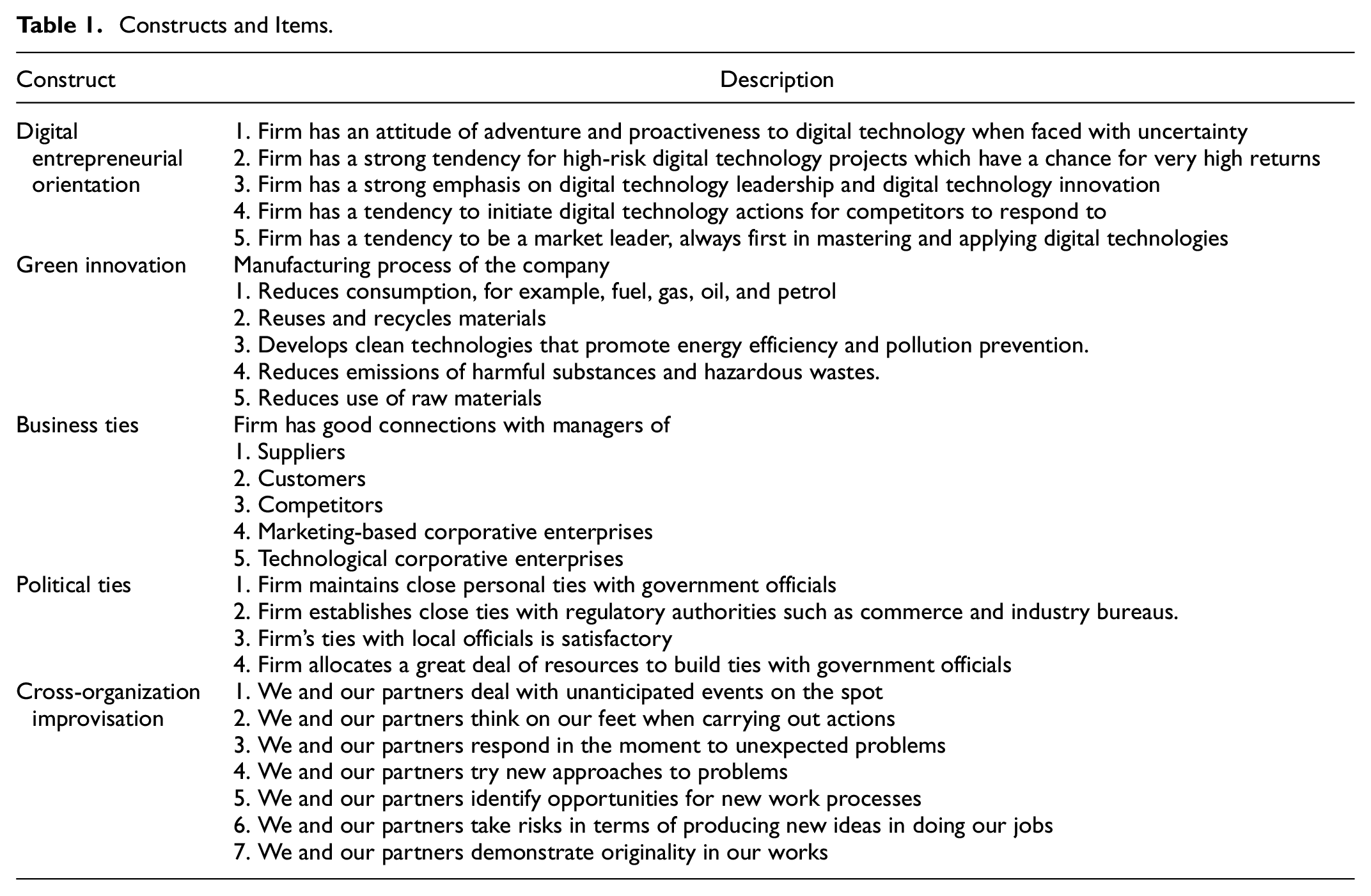
DEO was measured using a five-item scale developed by Zhao et al. (2011) and Guo and Wang (2022), which comprised five items. COI was assessed using seven items adapted from Moorman and Miner (1998) and Ruan et al. (2021). In the existing literature, GI was measured using patents (Li D. et al., 2017; Ioppolo et al., 2019), ISO14001 (Li Y. et al., 2018; Lin et al., 2014), or survey items (Cai & Li, 2018; Chang, 2011; De Marchi, 2012). In this study, survey items were used to collect data on GI and other constructs in the conceptual model, following Chang (2011), De Marchi (2012), and Cai & Li (2018). In terms of social ties, five items were used to measure BT, and another four were used to capture PT, as adapted from Sheng et al. (2011) and Peng and Luo (2000).
Control variables, including age, size, and industry type, are known to affect GI (Liao Z., 2016). Firm size was categorized into five levels based on the number of staff members (Dibrell C. et al., 2011; Liao, 2016), whereas firm age was categorized into four levels in terms of years since foundation (Liao, 2016). The industry type was categorized as pollution intensive or non-pollution intensive, considering the different pollution potentials associated with each sector. All key constructs were measured using a seven-point Likert scale, as summarized in Table 1.
Constructs and Items.
Data Collection
The data in this study were collected from four provinces and cities in China, Shaanxi, Guangzhou, Jiangsu, and Tianjin, which represent the industrial centers of western China, the Pearl River Delta, the Yangtze River Delta, and the Bohai Rim. Concurrently, these cities can reflect the level of digital technology and GI in Mainland China to some extent, which is what we plan to study. Our research sampling framework included firms that were established within 5 year and listed in the directory of enterprises in China. The planned sample was obtained from this database using a stratified random sampling method based on firm size and industry, with a total of 633 companies. Key informants (generally the president, vice president, green manager, or CEO) with in-depth knowledge of their firm’s GI practices were identified for each participating firm. Permission was obtained via email or telephone calls before mailing the questionnaires, each with an attached purpose and confidentiality statement. The respondents were informed that they would receive the final results after completing the questionnaire. Within 2 week, the target firms received follow-up calls and mailings from our research team to improve the effective response rate for the survey. To ensure confidentiality of the survey, questionnaires were sent directly to us upon completion. Data were collected between September 2021 and June 2022. Of the 305 questionnaires received, 217 were deemed complete and acceptable, resulting in a response rate of 34.3%. The firm characteristics are summarized in Table 2.
Sample Demographic Characteristics.

To assess potential non-response bias, the differences in the mean values of the respondents and non-respondents were compared based on firm age and number of employees using a t-test. No significant differences were identified between the groups. T-tests were also conducted to compare the independent variables of the early responding companies (138) with those of the later responding companies (79) in both groups’ data. The t-test results show no significant differences in terms of the characteristics of firm statistics when p < .05. Therefore, the non-response bias did not influence the analysis of the paper (Armstrong & Overton, 1977).
Considering that cross-sectional survey data collected from a single informant at each firm were used in this study, our findings may be influenced by common method variance (CMV). Therefore, the risk of CMV must be addressed, which represents the correlation of measurement errors across the measurements of different variables (Podsakoff et al., 2003). To determine the presence of CMV among the variables, Harman’s single-factor test was performed as suggested by Harman (1976). First, exploratory factor analysis (EFA) was conducted to assess the factor structure of the variables in this study (Podsakoff et al., 2003). The results demonstrated that all items in the model were categorized into five constructs, and the first construct explained 25.69% of the total variance, which is lower than 40% (Hair et al., 2016), indicating that CMV is unlikely to distort our analyses. Second, CFA was conducted for Harman’s single-factor analysis (Podsakoff et al., 2003). The results revealed that five-factor model neatly fit the data (χ2/df = 1.185, RMSEA = 0.029, RMR = 0.036, IFI = 0.989, CFI = 0.989, GFI = 0.932), whereas the one-factor model was unacceptable. Therefore, potential CMV was not a serious concern in our study and only slightly influenced the hypothesized relationship.
Analysis and Results
Reliability and Validity
Using a sample of 217 respondents, we conducted EFA in SPSS 22.0 on all items for factor structure assessment. The initial solution yields four factors with eigenvalues exceeding unity. Subsequently, a five-factor solution for the 26 items emerged from the EFA and accounted for 68.1% of the explained variance. The purified list of 26 items with a clear factor structure among the five factors from the EFA results is presented in Table 3. The five extracted factors are DEO, COI, BT, PT, and GII.
Exploratory Factor Analysis.

Note. Extraction method: Principal component analysis. Rotation method: Varimax with Kaiser normalization. Underlined values indicate the highest loadings. The Rotation converged over six iterations.
Cronbach’s alpha was used to evaluate data reliability. A reliability coefficient of .7 or higher indicates reliability (Hair et al., 2010). Table 4 presents the Cronbach’s alpha for the scale calculated using SPSS 22.0. The reliability coefficient of each construct exceeded the threshold of 0.7. Hence, we concluded that the theoretical constructs of this study were internally consistent.
Convergent Validity and Reliability.

Structural and content validities were assessed to ensure data validity. Our questionnaires provided instructions on the cover to respondents about the research purpose, which focused on analyzing corporate GI practices and outcomes. The confidentiality of the respondents’ data was guaranteed. Moreover, in-depth managerial interviews and a pre-test were conducted to refine the measurement items and ensure their relevance in capturing the constructs of interest. Therefore, the scale used in this study demonstrated good content validity.
The construct validity encompasses convergence and discrimination. In this research, CFA was employed using AMOS 22.0 to confirm construct validity. The fitting results of the model were as follows: CMIN/DF = 1.185, goodness-of-fit index (GFI) = 0.932, comparative fit index (CFI) = 0.989, incremental fit index (IFI) = 0.989, Tucker–Lewis index (TLI) = 0.987, and root mean square error of approximation (RMSEA) = 0.029. These results indicate a good fit for the measurement model (Hu et al., 1992). Convergent validity refers to the degree of agreement between multiple attempts to measure the same concept using different approaches (Phillips, 1981). As shown in Table 4, all scales’ AVE exceeded 0.5, all scales’ CR were above 0.7, and all factor loadings were greater than 0.7, suggesting acceptable convergent validity for all constructs.
Regarding discriminant validity, Table 5 presents the correlation matrix, in which the diagonal elements in bold represent the square roots of the AVE for each construct. These diagonal elements were significantly higher than the off-diagonal elements, satisfying the criterion for discriminant validity proposed by Fornell and Larcker (1981).
Means, Standard Deviations, and Correlations.

Note. (a) The diagonal elements in bold are the square roots of the AVE, and (b) the off-diagonal elements represent the correlations between constructs.
p < .05. **p < .01.
Hypothesis Testing
To achieve the research objectives, we conducted hierarchical multiple regressions to test Hypotheses 1 to 3 and hierarchical moderated regressions to test Hypotheses 4 and 5.
Direct Effects
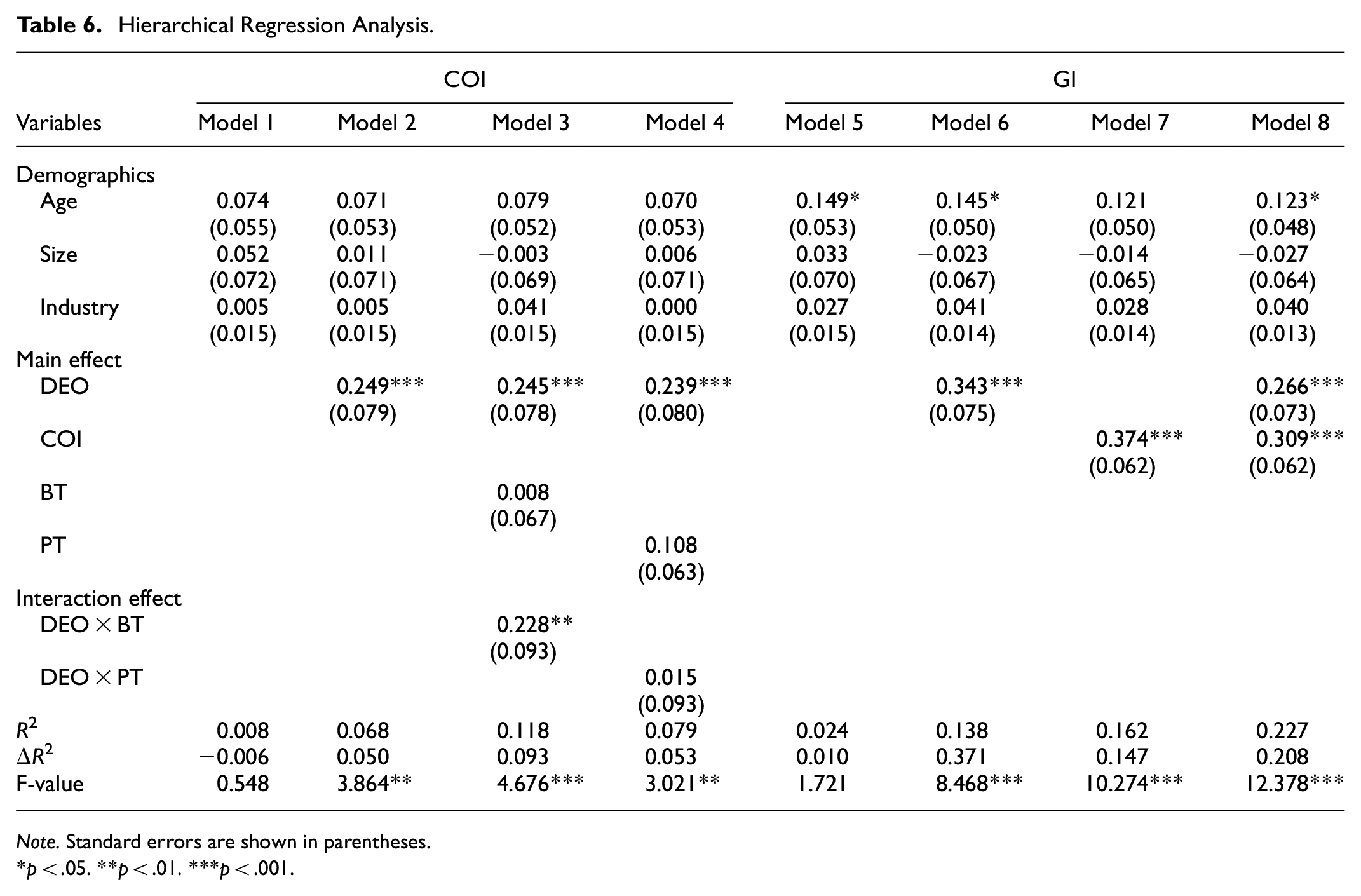
To test the direct effects, Table 6 illustrates the normalization coefficient of the structural path and its associated significance values generated using SPSS 22.0. Models 5 and 6 show that DEO has a significantly positive impact on GI (β = .343, p < .001). Thus, H1 is supported. Models 1 and 2 demonstrate that DEO has a significant positive impact on COI (β = .249, p < .001). Thus, H2 is supported.
Hierarchical Regression Analysis.
Note. Standard errors are shown in parentheses.
p < .05. **p < .01. ***p < .001.
Mediating Effects
To assess the mediating effect, a hierarchical regression analysis was conducted using SPSS22.0 software, combined with bootstrapping technique using AMOS22.0 software.
Two requirements exist for assessing the mediating effects in Preacher and Hayes’ (2008) research, which include the following four steps. Hypothesis 1 is verified, that is, DEO positively affects COI, and the first step is supported. Hypothesis 2 is verified; that is, DEO positively affects COI. Hence, the second step is supported. For the third and fourth steps, we conducted a regression analysis to examine how GI was influenced by the control variables, DEO and COI. In Model 7 of Table 6, COI positively affected GI (β = .374, p < .001) and DEO positively affected GI, whereas the correlation coefficient dropped to β = .266 (p < .001) from β = .343 (p < .001). Hypothesis 3 is preliminarily supported.
To further validate Hypothesis 3, we used bias-corrected bootstrapping using AMOS software to assess the significance of the mediating effect (see Table 7). The estimation results of the 95% bias-corrected confidence interval (BC-CI) for the direct effect of DEO on GI revealed a nonzero exclusion range of [0.144–0.494], indicating a positive correlation between DEO and GI. Moreover, the estimated outcomes of the 95% BC-CI interval for the direct effect of DEO on COI displayed a nonzero exclusion range of [0.157–0.534], implying a positive association between DEO and COI. The estimated 95% BC-CI interval for the direct effect of COI on GI, ranging between [0.138–0.473], further supports the notion that COI is positively linked to GI. Meanwhile, the 95% BC-CI interval for the indirect effect of DEO on GI via COI, estimated to be [0.041–0.205], indicates a significant and partial mediation of the effect of DEO on GI by COI. Consequently, these findings provide additional support for Hypothesis 3.
Bootstrapping Analysis.

Note. Bootstrapping sample = 1,000.
Moderating Effect
Hypothesis 4 proposes the moderating effect on the relationship between DEO and COI. From Model 3 in Table 6, we observed that the interaction term “DEO×BT” exhibited a positive relationship with COI (β = .228, p < .001). This finding suggests that BT positively moderates the relationship between DEO and GI. Therefore, H4 is supported.
In accordance with Hypothesis 5, we hypothesized that PT would moderate the relationship between DEO and COI. However, upon examining Model 4 in Table 6, we found that the interaction term “DEO × PT” did not display a significant relationship with COI (β = .015, p > .05), which indicates that PT’s moderating role in the relationship between DEO and COI is not verified, Thus, H5 is not supported.
Additionally, the moderating effect analyses’ results are illustrated in Figure 2, which were created according to the procedures suggested by Aiken and West (1991), are illustrated. A graph was constructed by plotting the relationship between DEO and COI under high (one standard deviation above the mean) and low (one standard deviation below the mean) BT levels ( Figure 2). Red silk lines indicate a high level of BT, whereas blue silk indicates a low level of BT. The results depicted in Figure 2 reveal that when BT was high (one standard deviation above the mean), the relationship between DEO and COI exhibited a positive and significant trend. However, when BT is low (one standard deviation below the mean), the relationship between DEO and COI becomes insignificant and flat, implying a stronger positive relationship between GEO and COI at a higher level of BT. Hence, Hypothesis 4 is confirmed.
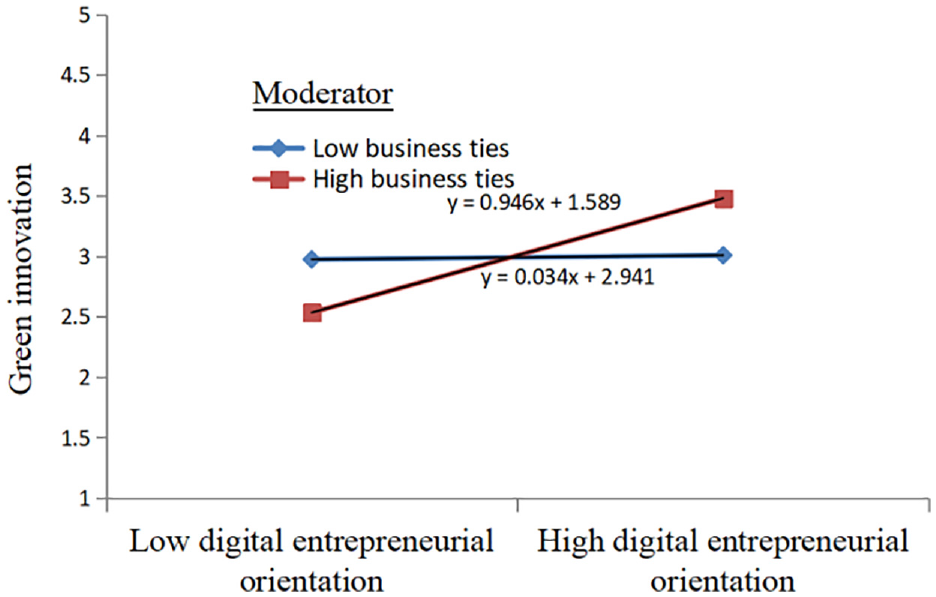
Moderating effect of business ties.
Moreover, in line with Aiken and West’s (1991) recommendations, we created a visual representation, namely, Figure 2, to illustrate the moderating effect of BT. High and low BT values were obtained by manipulating the average BT value by adding or subtracting one standard deviation. We then performed a regression analysis of DEO on COI at high and low BT levels. The results depicted in Figure 2 reveal that when BT was high, the relationship between DEO and COI exhibited a positive and significant trend. However, when BT is low, the relationship between DEO and COI becomes insignificant and flat, implying a stronger positive relationship between GEO and COI at a higher level of BT. Hence, Hypothesis 4 is confirmed.
To explore the differences, the samples were further categorized into pollution-intensive and non-pollution-intensive sectors. The mediating and moderating tests were conducted separately for each group. The results show differences between the two sectors. In pollution-intensive sectors, COI has a partial mediating effect between DEO and GI, which is consistent with the overall model. Conversely, the mediating effect is fully present in non-pollution-intensive sectors.
Discussion
Theoretical Implication
This study extends the RBV literature by introducing two organizational resources, DEO and social ties, and their relationships with COI and GI. From a theoretical perspective, digitalization, or the digital economy, is a hot topic in current research. Many enterprises are aware of the important role of integrating digitalization and entrepreneurship in the VUCA era; however, research lags far behind practice. Literature on digital entrepreneurship mostly focuses on the system level, such as the digital entrepreneurship ecosystem (Sussan & Acs, 2017; Elia et al., 2020), the digital platform economy (C. Fernandes et al., 2022), and so on. However, micro-level methodological research remains lacking (Sahut et al., 2021). As noted by Nambisan (2017), existing research has a limited understanding of the role of digital technologies in entrepreneurship; particularly, few studies have focused on the role of DEO at a strategic level. This study uses RBV theory to construct a conceptual model linking DEO with COI behavior and GI, and validates a conceptual framework to extend existing knowledge. This framework integrates digitalization and enterprise entrepreneurship orientation as an organizational resource at the strategic level (i.e., DEO) and bridges the research gap by empirically verifying the importance of DEO in promoting COI and improving GI, which supports the RBV theory proposed by Barney (1991).
Previous studies examined the drivers of GI in companies. Some studies discuss the level of internal resources, such as green organizational culture (Mirahsani et al., 2023) and green entrepreneurship orientation (Guo & Wang, 2022); however, this is less understood from the perspective of digital entrepreneurship, and empirical models of DEO and GI have not yet been constructed. Some scholars have examined the impact of human-related factors on service innovation (e.g., Tajeddini et al., 2020), but few studies have examined the impact of cross-organizational interaction with external groups, such as customers and suppliers on GI, from the supply chain perspective. This study attempts to construct an empirical model of DEO and GI and investigate the mediating role of COI in DEO and GI in the supply chain context to enrich research on the role of digitalization. Additionally, expanding the level of organizational improvisation to COI provides a new perspective for exploring corporate improvisation.
Based on SNT, this study extends the existing literature by describing the different roles of two extremely different social ties: BT and PT. In the context of a transitional economy and in the face of imperfections in the market and institutional systems, managers tend to use their social ties to solve this dilemma. Recent studies on SNT suggest that the roles of different network relationships differ (Najaf & Najaf, 2021; Sheng et al., 2011), and the differential effects of different types of network relationships must be considered (Zaheer et al., 2010). However, previous research has tended to view BT and PT as identical (Peng & Luo, 2000), or capture only one dimension of social ties (F. F. Gu et al., 2008; Li et al., 2008). Few existing studies have explicitly discussed or distinguished between the impacts of BT and PT, and none have studied bringing BT and PT into the research areas of digital and green innovation. This study enriches the theory of social ties by distinguishing whether BT and PT play different roles in the GI of emerging economies. This distinction is vital given that BT and PT cover two different aspects of social ties and provide access to different resources, which play different roles in the relationship between digital entrepreneurship and GI.
Practical Implications
This study provides practical insights for start-up managers during the VUCA era. First, the results demonstrate that DEO can significantly drive COI and GI. The rapid popularization of digital technology has changed the competitive environment, and entrepreneurial orientation is no longer a unique advantage for entrepreneurial firms. The COVID-19 pandemic has accelerated digitalization among different types of firms, and the need for digital strategies in start-ups is particularly important. The findings of this study encourage the integration of digitalization and entrepreneurial orientation, remind managers to be cautious when using digital platforms and technology, and fully utilize the internal DEO mechanism.
Second, the results show that COI plays a mediating role between DEO and GI. This reminds managers that improvisation is not only an effective mechanism for firms to respond to emergencies but also plays an important role in the GI of new start-ups. Managers must recognize that the successful implementation of a digital strategy requires support and learning across the organization. Especially in the context of VUCA in China, where start-ups are trapped in a changing “new normal” world, specific strategies must be developed to overcome the challenges posed by the four main characteristics of VUCA. The characteristics of VUCA often manifest in some combinations; for example, new product markets may be volatile and uncertain, or expansion into new areas in a comprehensive government change may be complex and ambiguous. In terms of volatility, when it is expected that there may be unstable changes, the best way to prepare is to increase the agility of the organization, and star-ups should take full advantage of the essential characteristics of COI agility, including storage resources; to cope with the complexity, start-ups can reorganize internal operations through COI to match external complexity, so that the structure of the organization is aligned with the complexity of the market environment; in terms of ambiguity, start-ups can use COI to experiment with different supply processes and partners, for example, individual features from new products can be introduced into existing products, experimenting with customer acceptance. Therefore, in the VUCA context, DEO can realize real-time collaboration between upstream and downstream firms in the supply chain through COI, creatively solve unexpected situations, and promote GI. Thus, COI is an important path for corporate digital strategies to promote GI.
Third, the findings reveal that these two very different social ties play different roles in corporate digital strategies. On the one hand, efforts to develop BT reinforce the benefits of DEO to COI, thereby promoting GI in businesses. Therefore, we encourage entrepreneurs to utilize BT and earn greater returns from outside their complementary and market-based resources. Firms should facilitate cross-organizational and commercial connections between managers and other firms and organize social events, such as seminars, training sessions, or exhibitions, to help managers build personal connections with colleagues, suppliers, customers, and competitors. In addition, enterprises can establish common cognitive capital with their partners through investments. For example, businesses can develop formal and informal organizational procedures that establish a shared vision, compatible values, similar cultures, and a common language and code with their partners. Especially in the VUCA context in China, to reduce uncertainty about expected outcomes, it is critical for start-ups to gather information. COI should be used to reach customers, researchers, trade groups, partners, and even competitors to gain access to information networks and data sources that go beyond the existing ones. On the other hand, although PT can bring some institutional support to enterprises, its role in DEO and COI has not been proven. When companies try to promote COI through DEO, they are not required to identify ways to establish or rely too heavily on PT with government agencies and officials. For example, corporate investments in building personal relationships with political leaders of central or local governments, as well as with officials in departments such as industrial bureaus, tax bureaus, and state-owned banks, may not have a positive impact on COI. Thus, companies should balance BT and PT, actively develop cognitive capital, and seek institutional support for COI.
Conclusion
This study uses the RBV and SNT to establish a link between organizational strategic orientation (DEO) and GI. The study, which was empirically tested using data collected from 217 companies, yielded a positive and convincing relationship between DEO and GI. This result shows that DEO is a good strategic resource for reporting on GI. In addition, COI plays a partial role as a bridge between DEO and GI, BT plays an active moderating role in the process of DEO-promoting green innovation, whereas PT does not. These results can help guide managers in specific initiatives to maximize COI and GI when supporting digital entrepreneurship.
Although our study makes valuable contributions to the understanding of how DEO influences GI, it has some limitations that must be addressed. First, our empirical analysis was confined to samples from China, which raises concerns about the generalizability of our findings to countries with different institutional backgrounds. Future studies should conduct broader comparisons to enhance the generalizability of our research model. Second, in terms of data processing, the data used in this study were cross-sectional, and further studies should use longitudinal data or case data to verify causality in the model. In addition, in this study, the path mechanism between DEO and GI was discussed from the perspective of COI in the context of VUCA, and the roles of other path mechanisms were not examined. Future research should explore alternative perspectives, such as examining firms’ internal activities or employees’ behaviors, to shed further light on this topic.
Footnotes
Acknowledgements
We are very grateful to editors and anonymous reviewers for their constructive comments. This work was supported by the “Yanta Scholars” Program of Xi’an University of Finance and Economics.
Declaration of Conflicting Interests
The author declared no potential conflicts of interest with respect to the research, authorship, and/or publication of this article.
Funding
The author disclosed receipt of the following financial support for the research, authorship, and/or publication of this article: This research was supported by the National Social Science Foundation of China (grant 20XGL008). This research was supported by “Yanta Scholars” Program of Xi’an University of Finance and Economics.

Data Availability Statement
Data sharing not applicable to this article as no datasets were generated or analyzed during the current study.