




Abstract
The impact of KIC (knowledge infrastructure capability) on KAC (knowledge absorption capacity), KIC on KAC, and AIN (ambidextrous innovation) on SCA (sustainable competitive advantage) has been studied in different contexts and countries, yielding varying results. Therefore, the generalizability of research findings should be carefully scrutinized. As far as the researchers know, empirical research on a theoretical framework on the effect of KIC and SCA mediated sequentially by KAC and ambidextrous innovation (AIN) remains lacking. This study investigates the impact of KIC, KAC, AIN, and SCA. A theoretical framework was built to empirically test the impact of KIC on SCA mediated by KAC and AIN. A survey used a saturated sample of 55 multi-raters from non-vocation private tertiary education institutions unit of analysis in Indonesia. Partial least squares structural equation modeling (PLS-SEM) is a statistical technique utilized to evaluate and test hypotheses within a particular theoretical framework. The study results indicate a positive and significant influence sequentially between KIC on KAC, KAC to AIN, and AIN to SCA. Knowledge management produces innovations that ultimately increase competitiveness. The findings of this empirical study establish a basis for future research that will demonstrate the direct causal relationship between KIC, KAC, and AIN within the context of the Indonesian non-vocational private tertiary education sector (INVPTES) in the province of West Java. Sequentially, KIC, KAC, and AIN are the keys to improving SCA.
Plain language summary
Purpose: This study investigates the impact of KIC (knowledge infrastructure capability), KAC (knowledge absorption capacity), AIN (ambidextrous innovation) and SCA (sustainable competitive advantage). Methods: A survey used a saturated sample of 55 multi-raters from non-vocation private tertiary education institutions unit of analysis in Indonesia. Partial least squares structural equation modeling (PLS-SEM) is a statistical technique utilized to evaluate and test hypotheses within a particular theoretical framework. Conclusions: The study results indicate a positive and significant influence sequentially between KIC on KAC, KAC to AIN, and AIN to SCA. Knowledge management produces innovations that ultimately increase competitiveness. Implications: The results of this study support the RBV theory, which states that to be sustainable competitive, non-vocational PTS organizations must have VRIN resources and capabilities. This research also presents some practical implications for INVPTE leaders in West Java and decision-makers at the regional level (LLDikti Wilayah 4) and the national level (Kemenristekdikti/Kemendikbud Ristek). INVPTE in West Java should pay attention to KIC. Limitations: The first limitation of the research is a lack of generalization of the research results, which are only in the context of INVPTES (single sector). Second, the data of this study are cross-sectional, so future research agendas have the potential for longitudinal analysis. Third, the minimum number of samples for this research is 55 INVPTE organizations that have met the rule of thumb for PLS-SEM processing. The larger the number of samples, the greater the statistical power, affecting the hypothesis testing results. Fourth, the context of this research is only on NVPTE. The gap is open for future research with a broader context, namely, for vocational and public higher education institutions. Furthermore, the theoretical framework employed in this study does not encompass an analysis of the intricacies of the organizational environment.
Keywords
Introduction
The Indonesian non-vocational private tertiary education sector (INVPTES) in West Java has faced several challenges in recent years, including (1) INVPTE institutions are more numerous than public non-vocation tertiary education institutions (PbNVTEI). (2) However, University ranking data indicate that the number of INVPTE institutions that are in the top 100 national university rankings remains lower than that of PbNVTEI, and no INVPTE institutions have entered the top 14 positions or entered cluster 1 (Biro Kerjasama Dan Komunikasi et al., 2019). The ranking position of universities, according to Kemendikbudristek (The Indonesian Ministry of Education, Culture, Research, and Technology), is important and shows the competitiveness of a university. The university ranking element utilized by Kemendikbudristek is grounded in the construct of competitiveness as outlined in the resource-based view (RBV) philosophy (J. Barney, 1991; Coates, 2017; Pengetahuan, 2015; Riset et al., 2018; Wernerfelt, 1984). Kemendikbudristek’s ranking of INVTE institutions measures the competitiveness of INVPTE institutions in this study. Organizations need resources and capabilities to establish sustainable competitive advantage (SCA) in their field (J. Barney, 1991). One of the most essential forms of resource is knowledge (Grant, 1996). An organization’s knowledge infrastructure capability (KIC) refers to its ability to manage knowledge effectively that can be used to achieve the SCA (Gold et al., 2001; Pangarso et al., 2020b). One of the least researched topics is how the KIC process can affect SCA.
Several previous studies have investigated the effect of (1) KIC on knowledge absorption capacity (KAC), such as W. Chen and Hatzakis (2008) and Sun (2010). W. Chen and Hatzakis (2008) state that organizations must manage structure, culture and technology to create new knowledge. Sun (2010) says that to manage KAC as an organizational routine, three contexts are needed, one of which is the cultural, process and structural context. Within the cultural context is organizational culture, and within the process and structural context are organizational structure and technology. What exists in these three contexts is the KIC, so KAC as an organizational routine is influenced by the context in which it is part of the KIC. (2) Several previous studies have investigated the effect of KIC on KAC, such as Božič and Dimovski (2019), Kostopoulos et al. (2011), and Lo and Tian (2020). Božič and Dimovski (2019) stated that KAC positively and significantly affects innovation for a sample of 97 companies in Slovenia from 12 business sectors. Kostopoulos et al. (2011) examined the role of absorptive capacity in identifying and translating external knowledge flows into tangible benefits, which in turn can lead to superior innovation and financial performance based on RBV theory. Lo and Tian (2020) examined the significant influence of absorption capacity on innovation in Asia’s higher education context. (3) Two studies by Jurksiene and Pundziene (2016) and Preda (2014) propose theoretical propositions that establish the correlation between innovation and competitiveness. The research agenda of both studies implies the need for further empirical and theoretical research to explore the impact of innovation on competitiveness. These previous studies were also carried out in various settings and countries, so the research results about generalization should be questioned. As far as the researchers know, empirical research on a theoretical framework on the effect of KIC and SCA mediated sequentially by KAC and ambidextrous innovation (AIN) on INVPTES remains lacking.
To fill this gap, this research investigates KIC and its effect on KAC, AIN and SCA. Given that the mediating effect of KAC and AIN has not been investigated in previous studies, the importance of the research objective is to examine the research gap. (a) Does each KIC have a significant effect on KAC and SCA? (b) Does KAC have a significant effect on AIN and SCA? (c) Does AIN have a significant impact on SCA? (d) Does KIC have an indirect impact on SCA?
Knowledge of Higher Education Institutions and Theoretical Foundation
Knowledge is an essential resource for SCA for higher education institutions. At the organizational level, knowledge exists within organizations and between organizations. In the organization, knowledge can be known from the organizational culture. At higher education institutions, knowledge at the organizational level can be seen, such as collaborative research and consulting services with campus partners (such as the government, industries and community institutions). The leading theory underlying knowledge as a resource at higher education institutions was initiated by RBV (J. Barney, 1991). The RBV theory asserts that to achieve an SCA, organizations must possess unique resources and capabilities known as VRIN (valuable, rare, inimitable, non-substitutable). Another theory that highlights the significance of knowledge as a crucial resource for organizations to remain competitive is the knowledge-based view (KBV), as proposed by Grant (1996).
The emergence of the dynamic capability theory enables organizational competitiveness in dynamic external environments (Teece et al., 1997). The theory refers to “how firms integrate, build, and reconfigure their internal and external firm-specific competencies into new competencies that match their turbulent environment.” The emphasis of dynamic capability theory is more on capabilities than on resources. The theory of competitiveness underlies various research publications and remains dominated by research in business settings. However, competitiveness is still minimal for higher education settings (as not-for-profit-oriented organizations).
Literature Review and Hypotheses Development
Knowledge Infrastructure Capability (KIC)
In higher education, infrastructure is vital to knowledge management (Bogdandy et al., 2020). Universities must manage digital infrastructure as a crucial knowledge infrastructure (Zarifis & Efthymiou, 2022). Technology is an essential knowledge infrastructure in higher education and is vital in the digital transformation (Tóth et al., 2022). KIC pertains to an organization’s capacity to handle knowledge-related factors that influence its competitiveness effectively. These factors encompass the organization’s structure, culture, and technology (Gold et al., 2001). The concept of KIC begins with the idea that organizations must be able to manage knowledge-related matters well to be competitive. KIC is also related to KBV theory, which states that knowledge is an essential organizational resource that must be appropriately managed to compete sustainably. Alghail et al. (2022) have researched KIC in the higher education institution context but specifically in the context of project management (unrelated to SCA).
Sustainable Competitive Advantage (SCA)
There is a distinction between competitive advantage and SCA. The critical difference is that while competitors can copy a company’s unique value strategy to gain a competitive advantage, they will find it challenging to replicate an SCA. Therefore, SCA is a type of competitiveness that is hard or impossible for rivals to reproduce (J. Barney, 1991). Achieving SCA occurs when a business owns resources and capabilities that are valuable, rare, difficult to mimic, and non-substitutable (VRIN) (J. B. Barney & Clark, 2007). There are several organizational resources and capabilities in RBV, including culture, trust, information technology, and human resources (J. B. Barney & Clark, 2007).
Several studies have been conducted on the competitiveness of universities in Indonesia by Barusman (2013), Toni Herlambang et al. (2013), Indiyati (2015), Kurniaty et al. (2015), Sriwidadi et al. (2016), Sudiyatno and Wibowo (2017), and Suherlan (2017). However, research in the area of organizational governance is still limited, while most of the studies have been focused on the marketing aspects. Agyei et al. (2023), Mbango (2022), and Kankhuni et al. (2023) have also examined SCA in the context of universities more from the point of view of student satisfaction, which does not discuss it in terms of overall campus management. In international settings, research on competitiveness in universities internationally has been carried out, among others, by Aydin (2013), Chawla and Lenka (2015), I. S. Chen and Chen (2013), de Haan (2015), Driscoll et al. (2013), Mahdi et al. (2019), Mahdi and Almsafir (2014), Mathooko and Ogutu (2015), Nderitu (2016), and Rodríguez-González and Segarra (2016).
Previous research by Shih and Tsai (2016) found a direct effect of KIC on school effectiveness. Thus, KIC in a higher education setting, as far as the authors are aware, has never been tested empirically in an INVPTE setting for its effect on competitiveness. Research by Nguyen (2010) states that KIC has an insignificant impact on competitiveness; this is inconsistent with KBV theory. A study by Sulistyo (2020), Ling et al. (2014), and Mao et al. (2016) only examines the influence of KIC in terms of technology. It does not discuss the organizational structure and organizational culture as a unit forming KIC. The inconsistency of the results shows that there is still a need to re-examine the effect of KIC on SCA. It will become more competitive if an organization can effectively manage its knowledge infrastructure.
Knowledge Absorption Capacity (KAC)
KAC refers to an organization’s ability to acquire, incorporate, create, and apply new knowledge to solve relevant problems related to the innovation (Cohen & Levinthal, 1990). Innovation and effectiveness are part of the organizational competitiveness (Zahra & George, 2002). The KAC concept is related to KBV theory and dynamic capability theory. KAC serves as a boundary between dynamic capability theory and the knowledge management field (Vera et al., 2003). Apriliyanti and Alon (2017) stated that KAC research is a fascinating topic to study because the trend increased from 1990 to 2015, and they reached nearly 3,500 publications.
KIC is an internal part of an organization that influences the process of creating new knowledge due to knowledge absorbed from the external environment and assimilated with existing knowledge within the organization. Roberts (2015) has stated that KIC is part of organizational capability from a knowledge management perspective.
W. Chen and Hatzakis (2008) stated that to realize the emergence of new knowledge, the organization must carry out organizational structure, organizational culture and technology management these three concepts form KIC. Sun (2010) states that KAC as an organizational routine is influenced by the context in which it is part of KIC. Jasimuddin and Naqshbandi (2019) also said that KIC positively and significantly affected KAC. Therefore, a better KIC results in the increasing ability of the organization to absorb knowledge from outside the organization. Riccio et al. (2022) have researched that absorptive capacity has been widely researched in higher education empirically with PLS-SEM. Chao and Yu (2022) and Lim et al. (2023) have researched the effect of absorptive capacity on student competence in private universities.
The effect of KAC on competitiveness includes dynamic capability theory. Zahra and George (2002) state that competitiveness is the output of KAC (Jansen, Van Den Bosch, & Volberda, 2005). Sriwidadi et al. (2016) and Lo and Tian (2020) found an insignificant effect between KAC and competitiveness. This is not by dynamic capability theory, which states that KAC, as a form of dynamic capability, affects competitiveness The research conducted by Lo and Tian (2020) contradicts the findings of several other studies, including those by Chuang et al. (2016), Delmas et al. (2011), Liao et al. (2017), and Sulistyo (2020). The latter studies have found that KAC positively influences competitiveness. Chuang et al. (2016), Delmas et al. (2011), and Liao et al. (2017) the research was conducted with a limited scope of generalizability. KAC’s low generalizability necessitates analyzing its direct influence on competitiveness across different industries and nations. Fogg (2012) has limitations which state that empirical quantitative research is still necessary to examine the effect of KAC on competitiveness. Thus, if an organization can absorb knowledge from outside and form new understanding adapted to its conditions, it will increase SCA.
Ambidextrous Innovation (AIN)
The study examines innovation through the lens of organizational ambidexterity. The concept of organizational ambidexterity is often divided into structural ambidexterity and contextual ambidexterity (Gibson & Birkinshaw, 2004; March, 1991). Kortmann (2012) stated that organizational ambidexterity was classified into four categories: innovative and sequential. AIN is the most appropriate type for an organizational unit of analysis (Čirjevskis, 2016). The concept of innovation is consistent with dynamic capability theory when viewed through the lens of ambidexterity (O’Reilly & Tushman, 2008).
The topic of ambidexterity, in general, remains unexplored (Simsek, 2009). AIN means: (1) To achieve innovation’s full potential and pursue gradual and abrupt forms simultaneously. It helps to improve current products and explore new ideas that can take business to new heights. Following both conditions can lead to more tremendous success and help you dominate the industry (Jansen, 2005). (2) To achieve sustainable superior performance, combine exploratory and exploitative innovations (Kortmann, 2015). (3) The ability to simultaneously develop both exploratory and exploitative capabilities for incremental and radical innovation is critical for companies to remain competitive and adaptable to changing market conditions (L. Zhang et al., 2016). (4) Organizational use of both exploratory and exploitative innovation simultaneously (Lee et al., 2017). (5) To succeed, organizations need two innovation capabilities: explorative and exploitative. The former involves discovering new opportunities and experimenting with new ideas, while the latter optimizes existing processes and products. They help organizations balance exploring new possibilities and exploiting current strengths (J. A. Zhang & Cui, 2017).
Several studies have been conducted on organizational ambidexterity in the university domain. These studies were carried out by various researchers such as Ambos et al. (2008), Chang et al. (2009), Rezende et al. (2016), Ripkey (2017), Sengupta and Ray (2017), Soares et al. (2018), Stokes et al. (2017), and Tahar et al. (2011). Mazon et al. (2023) found that in the context of universities in Brazil, absorptive capacity and innovation services from a green economy perspective affect sustainable competitive advantage. The average research on ambidexterity at universities is in research-based and entrepreneurship-based universities that tend to exist in developed countries. Research in the higher education domain tends to use the types of structural and/or contextual ambidexterity as has been done by Chang et al. (2016), Rezende et al. (2016), Sengupta and Ray (2017), Tahar et al. (2011), Kusumastuti et al. (2017), Dyah and Almahendra (2017). As far as the researchers know, no studies have used the AIN approach to INVPTES.
The concept of ambidexterity tends to be more suitable for organizations with dynamic non-manufacturing environmental changes, such as in organizations with knowledge-intensive services (Junni et al., 2013). The emergence of the innovation factor as a matter to be considered in the ranking of Kemendikbudristek starting in 2018 further supports the exciting opportunity to research the concept of innovation, especially from an ambidexterity perspective. The discourse about innovation frequently revolves around KAC (Saatçioğlu et al., 2016; Zou et al., 2018). Numerous research endeavors have been undertaken to examine the use of KAC within the realm of higher education, by Belderbos et al. (2016), Dell’Anno and del Giudice (2015), Kobarg et al. (2018), Pangarso et al. (2020a, 2020b, 2020c) and Pangarso, Astuti et al. (2022), Pangarso, Winarno et al. (2022). Belderbos et al. (2016), and Kobarg et al. (2018) conducted quantitative research on KAC acting as a mediator on the influence of university and industry relations on innovation performance. Meta-analysis results from Zou et al. (2018) stated that KAC is a strong predictor of innovation performance. Some recent studies suggest that absorptive capacity has a positive and significant effect on various forms of innovation, including academic creativity in public universities in Iran (Al-Husseini, 2023), librarian innovation in universities in Iran (Kaffashan Kakhki et al., 2022) and collaboration performance for campus-industry creation in five coastal provinces of China (X. Chen et al., 2022).
Jurksiene and Pundziene (2016) underscore the significance of undertaking supplementary empirical investigations about the impact of knowledge absorption capacity (KAC) on the process of innovation. In general, innovation and ambidexterity are the outcomes of KAC (Jansen, 2005). KAC enables organizations to develop innovation concurrently through radical exploration and incremental exploitation (M. Zhang et al., 2018). Klinger (2016) concluded that the higher the KAC, the better each ability to innovate through exploration and exploitation.
The KAC idea emphasizes the significance of absorbing information from outside the organization to maintain an organization’s flexibility and ability to innovate (Miles, 2012). Božič and Dimovski (2019), Kostopoulos et al. (2011), and Lo and Tian (2020) stated that KAC had a direct and significant effect on innovation. A research limitation of Božič and Dimovski (2019), Enkel et al. (2017), Jansen (2005), Jasimuddin and Naqshbandi (2019), Kohlbacher et al. (2013), Kostopoulos et al. (2011), Limaj and Bernroider (2019), Lo and Tian (2020), and Zou et al. (2018) is it did not examine the effect of KAC on AIN for the INVPTE setting. If an organization absorbs knowledge from outside and forms new expertise due to assimilation with existing knowledge, this can increase the organization’s ability to innovate exploratively and exploitatively.
Innovation is crucial because it affects competitive resources (Preda, 2014). The empirical effect of innovation on competitiveness was not tested in Preda’s (2014) and Jurksiene and Pundziene (2016) research. The research limitation of Burhanuddin (2019) and Lo and Tian (2020) is that they did not examine the effect of AIN on competitiveness for the INVPTES research setting. If an organization can innovate through exploitation and exploration simultaneously, it will result in SCA.
The Mediating Role of KAC and AIN
For organizations to improve SCA, innovation is needed through exploration and exploitation simultaneously. To carry out such innovation, the organization must have new knowledge from absorbing knowledge from outside the organization, which is mixed with existing knowledge. For an organization to have further knowledge resulting from the absorption of knowledge from outside the organization, which is combined with existing knowledge, an ability to manage the knowledge infrastructure is needed.
The constructs form the theoretical framework: KIC, KAC, AIN, and SCA based on the theory of RBV, KBV and dynamic capability. The theoretical framework for this research is presented in Figure 1, which includes formulated hypotheses between constructs.

Theoretical framework.
Research Methods
Sample and Data Collection
INVPTES is considered a knowledge-based organizational analysis unit. The research population framework is INVPTE institutions in West Java with as many as 250 organizations. The sampling technique used a non-probability sampling method, namely, a purposive sample based on the consideration that Bandung Raya could represent the province of West Java.
There are as many research samples in INVPTES as many as 81 INVPTE institutions in Greater Bandung. Guidelines for the minimum number of samples use the inverse square root method (Kock & Hadaya, 2018) based on the table by Hair et al. (2021) Assuming minimum path coefficients (pmin) = 0.21–0.3 and significance level 10%, then the minimum number of samples is 51. Research respondents for each research sample use multi-raters. Each INVPTE institution is represented by three respondent categories: leaders, permanent lecturers and staff (special education personnel at the university level quality department).
Before data collection, validity and reliability tests were carried out using SPSS. Forty questionnaires were distributed to 40 INVPTE institutions in Greater Bandung with one respondent representative. The validity test results for all questionnaire items are both reliable (Cronbach’s alpha > .7) and valid (R-value > R-table).To minimize common method bias (Podsakoff et al., 2012; Podsakoff & Organ, 1986), the preparation of the questionnaire items was consulted with experts in easy-to-understand and straightforward sentences. Furthermore, the questionnaire items were unrelated, research participants provided informed consent, and data was collected from multiple sources (multi-raters). No personal information was collected, and there were no right or wrong answers (Pangarso, Astuti et al., 2022). To minimize non-response bias in the research spread utilizing the assistance of enumerators, permission was obtained with an official written letter to conduct research. In addition, filling out the questionnaire only takes minimal time, and, at the start of the questionnaire, a statement was given that agreeing to be a research respondent would contribute to increasing the competitiveness of the institution (Fuchs et al., 2013).
The duration of cross-sectional data collection was carried out for 4 months. Self-administrated questionnaires were distributed in hardcopy and softcopy (Google Forms distributed via institutional emails or WhatsApp groups and institutional social media) according to the preferences of each INVPTE institution. Collected questionnaire data were checked correctly without duplication, resulting in as many as 220 respondents for 55 INVPTE institutions in Greater Bandung. The response rate is 68% and has met the minimum number of samples required, collected, eligible for processing and free from outliers.
Measures
The researchers adopted and made modifications to a first-order formative questionnaire consisting of 15 items, to assess the construct of KIC. These modifications were based on the works of Awaja et al. (2018), Gold et al. (2001), and Nguyen (2010). Four items of a first-order reflective questionnaire for the KAC construct were adopted and modified according to Camisón and Forés (2010). Four items of a first-order reflective questionnaire for AIN constructs were adopted and changed according to Sengupta and Ray (2017) and Soares et al. (2018). Sixteen items of a first-order formative questionnaire for the SCA construct were adopted and modified according to Mahdi et al. (2019) and Kementerian and Teknologi (2017). The questionnaire items were translated into Indonesian and back into English to minimize translation biases (Brislin, 1970). The research construct is measured using a five-point Likert scale ranging from strongly disagree to agree, as shown in Table 1.
Operationalization and Measurement of Research Constructs (formative, Reflective), adj R2.

Analysis Methods
To test the hypotheses in the theoretical model, this study uses the partial least squares structural equation modeling (PLS-SEM) data processing technique. Sarstedt et al. (2022) stated that PLS-SEM is suitable for research with abnormal data and a relatively small sample size. The measurement model and structural model are processed using SmartPLS 3.2.7 software. The constructs of KAC and SCA are formative, so the measurement model uses convergent validity, multicollinearity and weight relevance significance. The constructs of KAC and AIN are reflective, so the measurement model uses factor loading, composite reliability (CR), average variance extracted (AVE) and discriminant validity. The structural model is evaluated based on the value of the coefficient of determination and the significance of the hypothesis test.
Results and Findings
Demographics
The organizational characteristics of INVPTE consist of (1) the type of INVPTE: 36 colleges, 17 universities, and 2 institutes, (2) dominated by INVPTE, established for 13–22 years, (3) the ratio of permanent lecturers to students is dominated by INVPTE with a ratio of 4.2 − 17.5 = 12, 17.6 − 30.9 = 16, and 31 − 44.3 = 19, (4) dominated by INVPTE with accreditation B & C (medium and low level higher education institution accreditation) and (5) number of students per INVPTE is dominated by the grouping of 88 to 2,744 students.
Results
Tables 1 and 2 conclude all the results of the measurement model examination based on Hair et al. (2019). First, for the formative construct, (1) has met the cut-off value because the redundancy test with the path coefficient cut-off is more than 0.70. (2) The examination of the outer VIF value has met the requirements because it has a value of <5. (3) The check for the p-value loading of item factors through the bootstrap process has fulfilled the requirements because the p-value is less than .05.
Characteristics of Organization.

Second, for reflective constructs: (1) all items have met the requirements for factor loading > 0.708. (2) The CR value has been at the acceptable threshold of 0.70 < 0.950. (3) The AVE value is considered acceptable if greater than 0.5. Table 3 shows that all heterotrait–monotrait values are below the 0.90 threshold. The measurement model examination has passed the test, so it continues on the structural model examination.
Discriminant validity.

Table 4 shows that all the inner VIFs are between 0.20 and 5, indicating no problems related to collinearity. Next, for the adj. value R2, Table 1 shows that the coefficient of determination is in the range > .5, which means that the structural model associated with endogenous constructs has strong explanatory power.
Structural Model Collinearity (inner VIF).

Figure 2 shows the structural model results using the BCA confidence intervals for a one-tailed bootstrap method with 5,000 samples. The effect of KIC on SCA is not significant, so hypothesis 1 is not supported. KIC positively affect KAC (ß = .833, p < .05), so hypothesis 2 is supported. KAC is not a significant predictor of SCA, so hypothesis 3 is unsupported. A significant association of KAC with AIN has been proven, so hypothesis 4 is supported (ß = .766, p < .05). The relationship between AIN and SCA is significant, so hypothesis 5 is supported (ß = .251, p < .05). KAC and AIN mediate the effect of KAC on SCA, so hypothesis 6 is supported (ß = .269, p < .05). Table 5 presents a comprehensive summary of the results obtained from evaluating each research hypothesis.
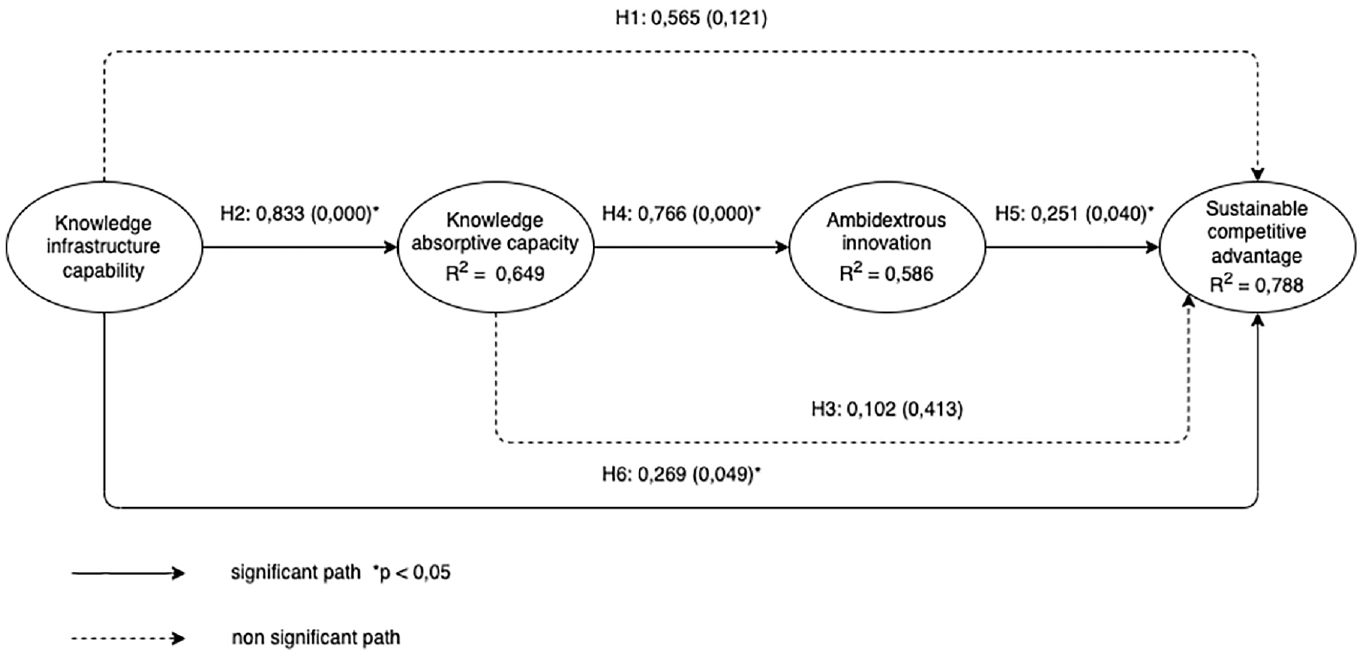
Result of the structural model.
Hyphotheses Testing Result.

Discussion and Implications
Discussion of Findings
The effect of KIC on KAC supports the research by W. Chen and Hatzakis (2008), which states that to realize the emergence of new knowledge, the organization must manage the organizational structure, organizational culture and technology. Next, Sun (2010) stated that KAC as an organizational routine is influenced by the context in which it is part of KIC. Jasimuddin and Naqshbandi (2019) found that KIC had a significant impact on KAC and addressed the research gap identified by Roberts (2015).
The insignificant effect of KIC on SCA is supported by previous research, such as Nguyen (2010). Furthermore, the conclusion that KAC is not significant to SCA is supported by Lo and Tian (2020). Zahra and George (2002) stated that KAC affects SCA, where innovation is part of competitiveness. To increase the competitiveness of KAC, an actual output (innovation) must be produced by dynamic capability theory. The new knowledge generated because it is absorbed and mixed with existing knowledge becomes the “raw material” to stimulate innovation. Such innovation affects competitiveness.
The effect between KAC and AIN is significant, this finding also supports previous research by Božič and Dimovski (2019). The results of this study also support Lo and Tian (2020) conducted in the context of higher education in Asia. The impact of AIN on SCA on INVPTES is a significant area of research. This study aims to address research gaps identified by Preda (2014) and Jurksiene and Pundziene (2016) by demonstrating the significant impact of AIN on SCA and INVPTES. This finding also supports Burhanudin et al. (2019) with the same results with different research objects and locations.
Through indirect effect testing, it was discovered that a pathway starts from KIC and positively and significantly impacts KAC. This, in turn, has a positive and significant effect on AIN, ultimately resulting in a positive and significant impact on SCA. The discovery that KIC, KAC, AIN, and SCA are positively significant is a new contribution to the field of knowledge management, especially regarding KBV and dynamic capability. This finding highlights the importance of managing knowledge infrastructure as a vital resource for private higher education institutions. By doing so, these institutions can significantly increase their SCA by gaining the ability to absorb organizational knowledge and create innovative capabilities.
The study’s results demonstrate the role of knowledge infrastructure on the competitiveness of non-vocational private universities in West Java, mediated by knowledge absorption capacity and innovation. Non-vocational private universities in West Java require knowledge infrastructure to improve competitiveness and knowledge absorption. After knowledge is absorbed and new knowledge is formed, it will affect the increasing innovation of nonvocational private universities in West Java. This innovation directly and significantly affects the competitiveness of non-vocational private universities in West Java. There is still “homework” that is logically measurable in time to improve and/or increase knowledge infrastructure, knowledge absorption capacity and innovation for non-vocational private universities in West Java. Organizationally, non-vocational private universities in West Java require improved knowledge infrastructure and absorption capacity. This means that there is a vital role of knowledge as a resource and capability to manage knowledge.
Implications for Theory and Practitioners
The results of this study support the RBV theory, which states that to be sustainable competitive, non-vocational PTS organizations must have VRIN resources and capabilities. The resources in question are knowledge that must be managed as optimally as possible by paying attention to the infrastructure, so this also supports the KBV theory. The capability to manage the knowledge in question is dynamic in the form of the capacity to absorb knowledge and produce innovation ambidextrously. The results of this study also support the dynamic capability theory, which states that to excel in vigorous competition, organizations must be able to form capabilities and configure internally and externally to develop new capabilities. This is because dynamic capability theory emphasizes only organizational capabilities.
This research also presents some practical implications for INVPTE leaders in West Java and decision-makers at the regional level (LLDikti Wilayah 4) and the national level (Kemenristekdikti/Kemendikbud Ristek). INVPTE in West Java should pay attention to KIC first. At the organizational level, each INVPTE in West Java needs to develop values related to cooperation. Such efforts can manifest in the collaboration between universities and industry to produce innovations (Aldabbas et al., 2020) and between parts of the organization (Alsheyadi & Albalushi, 2020). An organizational structure based on knowledge management is needed. Therefore, entrepreneurial behavior is required from organizational members (Sienkiewicz & Kijeńska-Dąbrowska, 2013). Every INVPTE in West Java needs (1) technology that can be used to retrieve knowledge in the context of higher education, including access to Google Search (Krishnamurthy & Shettappanavar, 2019; Vasilyeva & Vasilyeva, 2019), and mobile technologies such as smartphones, iPods, MP3 players and tablets (Abata-Ebire et al., 2019) and (2) technology related to learning interaction, such as technology-enhanced learning (Alexander et al., 2019) and technology-enhanced active engagement (M. A. Chen et al., 2019; Thomas & Thorpe, 2019). The results of this study contribute to policies made by the government through Kemendikbudristek regarding the importance of the role of KIC INVPTE in increasing KAC, AIN and SCA. Kemendikbudristek through LLDikti Region 4, can identify the extent of KIC, KAC, AIN and SCA INVPTE in West Java. Then, LLDikti region 4 can focus more on taking concrete steps and solutions related to KIC for INVPTE in West Java.
Conclusion, Limitations, and Directions for Future Research
The results of this research offer empirical support for the mediating influence of knowledge acquisition capability (KAC) and ambidexterity of innovation (AIN) on the connection between knowledge integration capability (KIC) and strategic competitive advantage (SCA). This study’s findings support the theoretical underpinnings of the knowledge-based view (KBV) and dynamic capability theories. Increasing competitiveness is influenced by resources (knowledge) and dynamic capabilities related to the internal organization. Knowledge management produces innovations that ultimately improve competitiveness. The empirical findings of this research provide a basis for further investigation that will provide a clear causal pathway originating from KIC, extending to KAC, and ultimately affecting AIN. Sequentially, KIC, KAC, and AIN are the keys to improving SCA. Recommendations from the results of this study are that the government (represented by LLDikti 4) and managers of nonvocational private universities in West Java are advised to focus on prioritizing, examining, preparing, and improving the condition of their knowledge infrastructure first. The knowledge infrastructure that is suggested to be read for non-vocational private universities in West Java
The first limitation of the research is a lack of generalization of the research results, which are only in the context of INVPTES (single sector). INVPTES’s characteristics differ from other sectors by location and country, as well as in competitive traits. Future research is needed to test the theoretical framework of this research with research contexts in different sectors and countries. Second, the data of this study are cross-sectional, so future research agendas have the potential for longitudinal analysis. Third, the minimum number of samples for this research is 55 INVPTE organizations that have met the rule of thumb for PLS-SEM processing. The larger the number of samples, the greater the statistical power, affecting the hypothesis testing results. A more significant number of samples is recommended for future work.
Fourth, the context of this research is only on NVPTE. The gap is open for future research with a broader context, namely, for vocational and public higher education institutions. Furthermore, the theoretical framework employed in this study does not encompass an analysis of the intricacies of the organizational environment (Dess & Beard, 1984). Suzuki (2019) and Wang and Wang (2017) state that the dynamics of the organizational environment have no significant effect on KAC by stimulus–organism–response theory. Future research is needed on the influence of the dynamics of the knowledge environment on KAC, which is supported by previous research. (1) According to Rojo et al. (2018), no empirical investigation has been conducted to examine the impact of the dynamics of the organizational environment on KAC. (2) The studies conducted by Ali et al. (2018), Roberts (2015), and Li and Liu (2014) have several limitations have been highlighted that require further exploration into the impact of knowledge acquisition and creation (KAC) on the dynamics of the organizational environment.
Footnotes
Acknowledgements
LPDP as research funder and LPPM Telkom University as research publication funder.
Author Contribution
Astadi Pangarso: Conceptualization; Methodology; Investigation; Writing – Original Draft; Writing – Review & Editing. Endang Siti Astuti: Conceptualization; Methodology; Writing – Review & Editing; Supervision. Kusdi Raharjo: Conceptualization; Methodology; Writing – Review & Editing; Supervision. Tri Wulida Afrianty: Conceptualization; Methodology; Writing – Review & Editing; Supervision.
Declaration of Conflicting Interests
The author(s) declared no potential conflicts of interest with respect to the research, authorship, and/or publication of this article.
Funding
The author(s) disclosed receipt of the following financial support for the research, authorship, and/or publication of this article: LPDP funded this research.

Data Availability Statement
Data sharing not applicable to this article as no datasets were generated or analyzed during the current study.