




Abstract
Given the importance of recreationists’ environmentally responsible behavior (RERB) to the sustainability of the scenic spots, this study uses person-environment fit as the theoretical basis and place attachment and novel experience as mediating variables to explore the mechanism of recreationist-environment fit (RE-fit) on RERB. This study’s main objective is to investigate RERB enablers in scenic spots; therefore, data from 588 recreationists of Mount Huang scenic spot were collected using a questionnaire. The results of this study, through structural equation modeling, showed that both place attachment and novel experience had a significant positive effect on RERB; however, novel experience had a greater effect on RERB compared to place attachment. Moreover, the analysis also found that RE-fit mediated the effect of RERB through place attachment and novel experience. This study examined the antecedents that influenced RERB in scenic spots and provided theoretical implications for the environmental management of scenic spots from the perspective of RERB. This study provided practical implications for the construction of recreationists’ place attachment and novel experience in scenic spots. This research recommends that recreational site providers should offer their recreationists sustainable and environmentally friendly experiences, activities, and interpretations to enhance their attitudes and recreational environmentally responsible behavior. This will reduce the ecological impacts produced by recreationists at various recreational locations, hence, promoting sustainable tourism.
Plain Language Summary
This study aims to signify the importance of sustainability and pro-environmental behaviors of recreationists on recreation spots. This study collected data from recreationists in Taiwan with the help of questionnaires. According to the findings of the study, recreationists’ skills and abilities fit will impact their environmental responsibility behaviors. Furthermore, the aforementioned impact can be influenced by the emotional attachment of recreationists to a scenic location. This study provides various implications for research in the sustainable context of tourism. Finally, this study offers several recommendations and suggestions for recreation spot managers to improve recreationists’ environmentally friendly conduct.
Keywords
Introduction
In modern society, the pace of life is generally accelerating, the pressure is increasing, and the competition is becoming more and more fierce, resulting in various kinds of mental fatigue and mental illnesses, which are common problems in today’s society (Connaughton et al., 2014). The scenic spot, as a “healthful resource,” has become a topic of concern for scholars (Khew et al., 2014; Krzywicka & Byrka, 2017; Van den Berg et al., 2003) and its effectiveness in promoting people’s mental health is gradually gaining attention from scholars (Lachowycz & Jones, 2014; Orban et al., 2017). However, studies have found that the problem of serious environmental pollution of scenic spots is an important issue for tourism and leisure activities (Sanders et al., 2018; Wassenberg et al., 2015; S. J. Williams et al., 2015). Therefore, strengthening the ecological protection of scenic spots is not only a requirement for the harmonious interaction between humans and nature but also an inevitable requirement for the healthy and sustainable development of scenic spots. Recreationists, as the main source of recreational activities conducted in scenic spots, put great pressure on the scenic spot environment (Chiu et al., 2014; Wang et al., 2019). Although the regulations of scenic spots adopt restrictions and disciplinary measures to restrain and warn recreationists, the disciplinary and regulatory measures are insufficient and, therefore cannot effectively restrain all destructive behaviors (Hansen et al., 2023). Therefore, against the background of the weakness of the external system, the study of the influencing factors and mechanisms of the recreationists’ environmentally responsible behavior (RERB) from within recreationists has become a trending topic of academic attention (Chiu et al., 2014; Kuo et al., 2021; T. H. Lee & Shen, 2013; Poudel & Nyaupane, 2017).
The notion of fit has been famous and prominent in management sciences for the past five decades. The study concerned with person-environment fit (PEFIT) is usually linked with creating a fit between various working environments provided by firms and their workers. Previously, the concept of fit was related to organizations, and these fits were divided into two kinds, including complementary and supplementary fit (Kristof, 1996). Some researchers focused on the concept of fit in the residential concept rather than focusing on the traditional organizational way (Tsaur et al., 2014). The PEFIT can be linked to satisfaction and well-being in the residential context (Kahana et al., 2003). Furthermore, the concept of organizational fit was transformed into recreational fit (RE-FIT) by some researchers, who linked the fit between the recreation environment and recreationists (Tsaur et al., 2012). In comparison, place attachment indicates the emotional links of individuals with environments. It is also related to the maintenance of these emotional links (Tsaur et al., 2014). Hence, previous research found an association between place attachment and RE-fit. For instance, recreationists identify themselves with a certain place (place identity) and have satisfaction when visiting that place (place dependence). Hence, this study aims to find the relationship between RE-fit and place attachment.
Novel experience has been of interest to the tourism community for many years as a key factor influencing the decision-making of recreationists. It is an experience and perception of recreationists that has a variable origin and disappearance time. However, if it is remembered by the recreationist, the influence on the recreationist’s behavioral intention will be stronger (Sharma et al., 2022). Studies also suggest that RE-fit can positively stimulate recreationists’ perceptions of leisure activities, resulting in positive and memorable emotions and feelings that translate into novel experiences (Altunel & Erkurt, 2015; Richards, 2018). Therefore, this study aims to analyze the association between RE-fit and novel experience.
Studies have shown that personal characteristics such as the recreationists’ attitudes, knowledge, personal abilities, norms, beliefs, contextual factors, and habits influence their sense of environmental responsibility (Mojtabavi et al., 2022). Local characteristics (scenic spot atmosphere, public services, tourism services, and scenic spot environment) of good scenic spots also drive RERB (T. H. Lee & Jan, 2019). Prior research on the formation mechanism of RERB, the influence of personal and local characteristics on such behavior have been revealed separately in two aspects and have not been explored at the level of individual-environmental fit (Farhad et al., 2021). It has been shown that personal fit with the environment will positively influence recreationists’ place attachment and behavior (Selmer et al., 2015). Place attachment (PA), as an emotional connection between people and places (Song et al., 2022; Stylos et al., 2017), plays a key role in shaping RERB (J. Lee et al., 2012). The higher the level of recreationists’ attachment to the environment, the more they tend to actively implement RERB (T. H. Lee & Jan, 2019; Zhang et al., 2017). In other words, the higher the fit between recreationists and the environment, the more consistent the recreationists are with the environment, and the more recreationists increase their attachment to that scenic spot and tend to reduce environmentally destructive behaviors. As a result, based on existing relevant studies, this study examines the potential mediating mechanism of RE-fit influencing RERB from a place attachment perspective and provides relevant empirical research support.
Novel experience has gradually been noticed by experts and scholars from multiple fields. Studies have concluded that novel experience can effectively predict RERB (Hosany et al., 2022; Kim, 2014; Sthapit & Coudounaris, 2018). However, although scholars have achieved some consensus on the benefits of novel experience, they have not yet explored in depth the intrinsic mediating mechanism of novel experience in the relationship between RE-fit and RERB. In view of this, this study further discusses the potential mediating mechanism of scenic spot RE-fit affecting RERB from the perspective of recreationists’ novel experience through empirical analysis in order to discover the role mechanism of RERB and provide relevant empirical studies to give a theoretical basis for scenic spot environmental protection.
Therefore, this paper explores the relationship between RE-fit, novel experience, place attachment, and RERB from a new perspective of person-environment fit and then explains the mechanism of RE-fit’s effect on RERB through novel experience and place attachment (Figure 1). This study aims to improve theoretical understanding of the formation mechanism of RERB, so as to better explain, predict and control it, and thus provide theoretical guidance for scenic spot managers to take effective measures and guide RERB in practice.

Theoretical framework.
Literature Review
Person-Environment Fit and Its Development and Application
Person-environment fit is an important theory for the study of “person-environment” interaction, reflecting the degree of consistency and fit between individuals and their environment (Kristof, 1996). Based on this, person-environment fit has been further applied to RE-fit and is used to describe the interaction and compatibility between recreationists and the environment (Tsaur et al., 2012). RE-fit comprises six dimensions: natural resources, facilities, environmental functions, interpersonal opportunities, activity knowledge/skills, and operation/management. The first four dimensions reflect the need-supply fit dimension, which measures whether the supply of recreation environment is consistent with the needs of recreationists. Activity knowledge/skills reflect the requirement-ability fit level, which measures the ability of recreationists, such as knowledge, skills, etc., and whether the recreation environment requirements match. Operation/management is a complementary fit, which is to measure whether the recreationists agree with the operation and management of the recreation environment manager (Tsaur et al., 2012).
The RE-fit has been widely used and developed, and related empirical studies have focused on mining its antecedent and outcome variables. The explored antecedent variables can be divided into two categories: personal antecedents and environmental antecedents. Personal antecedents include familiarity and self-efficacy (Tsaur et al., 2014), and environmental antecedents include restorative environmental characteristics and recreational environmental distress (Tsaur et al., 2014). The proven outcome variables focused on the individual affective level, mainly immersion experience (De Jong et al., 2005; Soliman & Abou-Shouk, 2017), contextual involvement (Naylor & Havitz, 2017), place attachment (Chung et al., 2015; Lu et al., 2018) and recreation satisfaction (Hosany et al., 2017; Tsaur et al., 2014). Some studies have also noted the effects on individual behaviors (intentions), such as scenic spot loyalty (Tsaur et al., 2014), willingness to revisit (Soliman & Abou-Shouk, 2017), and enjoyment (Tsaur et al., 2014).
Thus, although RE-fit theory has received active attention and application from scholars, these studies have shown that individual-environment fit will lead to positive emotions, attitudes, and behavioral intentions toward the environment. More importantly, studies examining the relationship between RE-fit and RERB in scenic areas are limited. Hence, exploring RE-fit as a driver of RERB to scenic areas is an important topic worth exploring. This study introduces RE-fit into the study of influencing factors of RERB and expands its application in the field of cultural industry management, explaining and predicting RERB from the RE-fit perspective.
Hypotheses Development
Place Attachment and RERB
Place attachment is defined as the degree of value and identification of an individual perception of a particular place, a positive emotional connection or bond between an individual and a particular environment (Kyle et al., 2005; D. R. Williams et al., 1992). D. R. Williams et al. (1992) proposed that two-dimensional place attachment is widely accepted and agreed upon. That is, place attachment consists of a functional “place dependence” and an emotional, symbolic “place identity” (Song et al., 2017). Therefore, this study explores the effect of place attachment on RERB based on D. R. Williams et al.’s (1992) definition. Place attachment is widely used in studies on the emotional connection between recreationists and scenic spots, and scholars have used place attachment as an outcome variable, and other variables such as perceived cultural originality (Manthiou et al., 2018; Stylidis, 2018), recreationists’ emotional experience (Ram et al., 2016; Servidio & Ruffolo, 2016) on place attachment levels are predicted. RERB refers to personal behavior implemented by recreationists in the tourism environment that contribute to environmental sustainability and minimize negative environmental impacts (T. H. Lee & Jan, 2019; Wang et al., 2019). Among them, place attachment has frequently appeared as a key antecedent variable in recent years’ research on RERB, and related studies have explored the relationship between tourism place imagery, place attachment, and RERB (He et al., 2018). Other studies have examined the effects of tourists’ environmental knowledge, environmental sensitivity, and place attachment on RERB in island tourism, and the results suggest that place attachment is an effective predictor variable of RERB (Kilbourne & Pickett, 2008; Snider et al., 2018). Therefore, this paper argues that place attachment is an important predictor of RERB of recreationists to scenic spots, and thus proposes the following hypothesis.
H1: Place identity has a positive influence on RERB.
H2: Place dependence has a positive influence on RERB.
Novel Experience and RERB
A novel experience is defined as a travel experience that is positively remembered and memorable after the event, the key components of which are positive emotions and feelings associated with the experience (Chandralal & Valenzuela, 2015; Kim, 2014; Oh et al., 2007; Tung & Ritchie, 2011). Currently, the formation mechanism of novel experience on RERB and the influencing factors have become an important topic of research due to the importance of sustainable development in scenic areas(Liu et al., 2021). Studies have been conducted to explore the relationship between tourism involvement, tourism experience, and RERB, and the results show that tourism experience has a direct and significant effect on RERB and suggest that ecological recreationists, when they experience satisfactory natural resources, good management, and facilities, will tend to protect the resources of the wetland ecotourism scenery, that is, the positive experience of recreationists in wetlands help to increase the environmental awareness of recreationists and promote the implementation of environmental behaviors (Chiu et al., 2014; Han et al., 2016; He et al., 2018; Y. Li et al., 2018). While novel experience, as positive tourism experience that is consistently remembered by recreationists, will have a more significant positive impact on recreationists’ behavioral intention (Ali et al., 2018; Bigné et al., 2005; Lim, 2014; Zhang et al., 2017). Therefore, this paper considers novel experience as an important antecedent to predict RERB towards scenic spots and then proposes the following hypothesis.
H3: Novel experience has a positive influence on RERB.
RE-Fit and Place Attachment
Place attachment implies an effective connection between a person and his or her surroundings, while RE-fit describes the compatibility between the recreationist and the environment (Budruk & Stanis, 2013; Günther, 2009; Kil et al., 2021). Place dependence is a functional dependence that refers to the ability of the environment to provide the resources the individual needs to perform a specific activity, which falls under the need-supply fit dimension of the RE-fit. Place identity, on the other hand, is the emotion that recreationists generate within themselves towards the place and its symbolic meaning to the individual, and the fact that recreationists achieve a fit with the environment enhances the sense of involvement, generates an immersion experience, and promotes the emotional attachment to the environment, thus generating place identity (Chavous, 2000; Taylor et al., 2019). Moreover, Esfandiar et al. (2019), Chung et al. (2015), Hui et al. (2007), and Um et al. (2006) also suggest that RE-fit has a significant positive effect on place attachment. Based on this, this paper hypothesizes that RE-fit is a key prerequisite for recreationists to form place attachment to scenic spots and thus proposes the following hypothesis.
H4: RE-fit has a positive influence on place identity.
H5: RE-fit has a positive influence on place dependence.
RE-Fit and Novel Experience
Although the relationship between RE-fit and novel experience is not proven, the production of novel experience is influenced by the psychological factors of the recreationists and the factors of facilities or services in the environment (de Freitas Coelho et al., 2018; Vada et al., 2019). In parallel, the RE-fit represents the degree of matching between the recreationists and the scenic spot environment, so it can ideally reveal the formation process of novel experience. Meanwhile, according to stimulus load theory (Günther, 2009), if the supply of the scenic spot environment meets the needs of the recreationists, the requirements of the scenic spot environment, the abilities of the recreationists, and the values of the recreationists. In that case, the environment managers can achieve a mutual fit, strengthening the recreationists’ positive stimuli. This will result in positive and constructive emotions and feelings, which will in turn be translated into novel experience (Altunel & Erkurt, 2015; Richards, 2018). In light of this, this paper proposes the following hypothesis.
H6: RE-fit has a positive influence on novel experience.
The Mediating Role of Place Attachment
RE-fit mainly reflects that recreationists’ expectations and needs can be met by the environment and thus feel satisfied with the environment (Tsaur et al., 2014). Studies have shown that recreationists’ satisfaction is positively associated with RERB, that is, recreationists’ satisfaction with the environment motivates their willingness to protect the environment (Chiu et al., 2014; Liobikienė et al., 2017; Wang et al., 2019). Roy et al. (2013) as well as Hoyer and Stokburger-Sauer (2007), confirm that place attachment is an important prerequisite for scenic spot loyalty and that recreationists’ activity involvement, satisfaction, perceived attractiveness, and motivation are important factors in shaping place attachment. In fact, the study of place attachment as a mediator of the relationship between recreationists’ attitudes and behaviors (intentions) has received scholarly attention. On the one hand, Tsaur et al. (2014) pointed out the influential relationship between RE-fit and place attachment and that RE-fit had a significant positive effect on both place identity and place attachment (Tsaur et al., 2014). On the other hand, the degree of recreationists’ environmental attachment is positively correlated with the willingness to protect the environment, and the deeper the degree of environmental attachment, the higher their commitment to environmental protection and the more inclined they are to actively implement RERB (Han et al., 2016; T. H. Lee & Jan, 2015a, 2015b; Su & Swanson, 2017; Wang et al., 2019; Zgolli & Zaiem, 2018). From this, it can be inferred that place attachment plays a mediating role in RE-fit driving the formation of RERB of recreationists, leading to the following hypothesis.
H7: RE-fit affects RERB through place identity.
H8: RE-fit affects RERB through place dependence.
The Mediating Role of Novel Experience
RE-fit means that the recreationist’s own ability matches the requirements of the environment. Therefore, the more fit the recreationist is with the environment, the more he or she can gain confidence, competence, and fulfillment in the environment, thus increasing awareness of environmental protection, cherishing the various resources in the environment, and doing one’s part to protect the environment (Chen & Dwyer, 2018; T. H. Lee & Shen, 2013; Lu et al., 2018). The RE-fit reflects that the novel experience gained by recreationists during tourism immerses them in the environment (Loureiro, 2014) and provides a high level of satisfaction, which predisposes them to form RERB towards the place and enhance their conservation behavior towards the environment (Tsai, 2016), while novel experience is the memories that recreationists construct to consolidate and strengthen their pleasant memories of the scenic spot experience based on their assessment of the experience, and is therefore positive recreationist experience. Therefore, this study argues that the novel experience formed by recreationists to scenic spots mediate the effect of RE-fit on RERB, and thus proposes the following hypothesis.
H9: RE-fit affects RERB through novel experience.
Research Methodology
Recreationists to Mount Huang’s scenic spot were selected as the target population. Mount Huang is a World Cultural and Natural Heritage Site, which has a high reputation and influence in the world. There are many recreationists to Mount Huang during the tourist season, which puts a lot of pressure on ecological protection. Therefore, we chose recreationists to Mount Huang as the research object to better analyze the influence mechanism of their environmental responsibility behavior.
The questionnaire used in this paper contains variables related to influencing factors affecting RERB, mainly the measures of RE-fit, place dependence, place identity, novel experience, and RERB, each of which was measured using the Likert 7-point scale method. The questionnaire was administered from October 10 to November 23, 2022, and the survey was conducted online using Questionnaire Star. Before the survey started, trap questions were used to exclude the subjects that were not eligible. The two trap questions were “In the past three years, have you visited any scenic spot?”“Have you visited Mount Huang, and what is your experience with scenic spot?” Only subjects who passed both questions were allowed to answer the questionnaire formally.
The total number of questionnaires collected in this study was 637, excluding those with too little time to fill in and those with consistent answers, 588 valid questionnaires were obtained, with an effective rate of 92.31%, and the sample size met the requirements of statistical analysis on data size.
Data Analysis
Descriptive Analysis
The descriptive statistical analysis of the questionnaire data was carried out as follows. The percentage of males was 45.2% (266 respondents). Specifically, the largest number of subjects were aged 18 to 29 years, 270 or 45.9%. This was followed by respondents aged 30 to 39 years old, with 193 respondents (32.8%).
Lastly, respondents aged 40 to 49, 50 to 59, and 60 or older had 79, 32 and 14 respondents, respectively. The married group had up to 284 participants (44.5%), the unmarried group had 281 participants (44.1), and the divorced group had 23 participants (11.4). In terms of consumption, the below 3,000 (RMB) group accounted for 24.1%, the 3,000 to 4,999 (RMB) group accounted for 27.6%, the 5,000 to 6,999 (RMB) group accounted for 20.6%, and the 7,000 or more (RMB) group accounted for 27.7%.
Convergent and Discriminant Validity
RERB was measured by four items according to Vaske and Kobrin (2001), Fan et al. (2014) and Xu et al. (2018). These measurement questions were used to measure the subjects’ personal behavior of promoting environmental sustainability and minimizing negative environmental impacts (Steg & Vlek, 2009). Two of the four items were “I would talk to friends or relatives about environmental issues.” and “I would report it to Mount Huang managers if I spotted improper behaviors.” The values of Cronbach’s alpha, CR and AVE for RE-fit were .947, .918, and .656, respectively.
A number of measurement items were used to assess aspects of RE-fit. The questionnaire was developed on the foundation of the literature review for this study. The RE-fit is measured using six subscales: natural resources, facilities, environmental functions, interpersonal opportunities, and activity knowledge/skills operation/management (Kristof, 1996; Tsaur et al., 2012). The RE-fit scale developed by Kristof (1996) showed high reliability and strongly predicted the subjects’ perceptions of RERB. Questionnaire items included “The terrain is suitable for this activity.”“The public facilities provided by this environment meet my expectations.”“This environment provides me with a channel to release pressure.” Nineteen questions were used to measure RE-fit, including three natural resources items, three facilities items, three interpersonal opportunities items, three environmental functions items, four activity knowledge/skills items, and three operation/management items. The values of Cronbach’s alpha, CR, and AVE for RERB were .953, .954, and .837, respectively.
The present study measured place attachment based on Kyle et al.’s (2005) scales, which contain two dimensions, place attachment, and place identity, respectively. The study by Song et al. (2017) confirmed the reliability and validity of D. R. Williams et al.’s (1992), and Kyle et al.’s (2005) proposed place attachment Scale that place dependence and place identity were considered to be valid measures of people’s relationship with place maintenance. A sample question for place identity is “I identify strongly with Mount Huang tourism destination.” A sample question for place dependence is “I enjoy hiking along the trails of Mount Huang tourism destination more than any other trail.” Place attachment consisted of 10 items (five items for place identity and five items for place dependence). The values of Cronbach’s alpha, CR, and AVE for place dependence were .936, .936, and .746, respectively. The values of Cronbach’s alpha, CR and AVE for place identity were .937, .937, and .750, respectively.
The novel experience was measured by four items that corresponded to Chandralal and Valenzuela’s (2015) work (providing tourists with memorable travel experiences) and were primarily used to measure the fond memories individuals made about positive things about their travel (e.g., certain experiences becoming special, spectacular, and appropriately memorable), and unforgotten travel experience (Kim et al., 2012; Oh et al., 2007; Tung & Ritchie, 2011). Two of the four items were “Many aspects of the trip were novel to me.” and “The trip provided unique experience for me.” The values of Cronbach’s alpha, CR and AVE for novel experience were .932, .933, and .777, respectively.
Table 1 presents the means, standard deviations, correlations and the square roots of average extracted variance (AVE) among the variables for our samples. From the results in Table 1, it can be observed that the square root of AVE (represented by the bold values on the matrix diagonal) is greater than the correlation coefficients between constructs. This result indicates discriminant validity among these constructs. Before testing the hypotheses, we conducted confirmatory factor analyses (CFA) to examine the distinctiveness of the latent variables. The results showed that the proposed model provided a better fit to the data (MLχ2 = 880.331, DF = 582, Normed χ2 = 1.513, RMSEA = 0.030, TLI = 0.987, CFI = 0.985, GFI = 0.958, AGFI = 0.951).
Means, Standard Deviations, and Correlations.

Empirical Results
Hypothesis 1 states that place identity and place dependence are positively related to RERB. The relationship between place identity and RERB and between place dependence and RERB exhibit a positive trend (b = .101, p < .05; b = .127, p < .001). This finding suggests that place identity and place dependence significantly and positively influence RERB. Thus, Hypothesis 1a and Hypothesis 1b are supported (as shown in Table 2).
Structural Model.
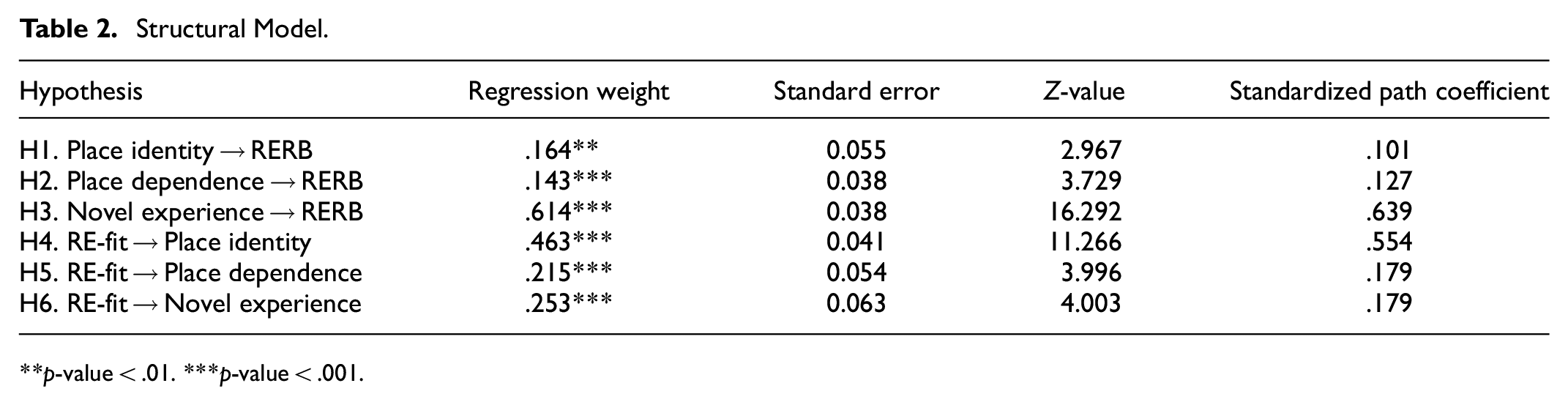
p-value < .01. ***p-value < .001.
We then test Hypothesis 2, which proposes a positive relationship between novel experience and RERB. As shown in Table 2, we find that novel experience is significantly and positively related to RERB (b = .639, p < .001), thereby supporting Hypothesis 2. Hypothesis 3 states that the higher the degree of RE-fit, the greater the recreationists’ place identity and place dependence. The linkage between RE-fit and place identity and between RE-fit and place dependence exhibits a positive trend (b = .554, p < .001; b = .179, p < .001). This finding suggests that RE-fit significantly and positively influences recreationists’ place identity and place dependence. Thus, Hypothesis 3a and Hypothesis 3b are supported. Hypothesis 4 proposes a positive relationship between RE-fit and novel experience. We find that RE-fit is significantly and positively related to novel experience (b = .179, p < .001), thereby supporting Hypothesis 4. Hypothesis 5 posits that RE-fit has a negative indirect effect on RERB via place identity and place dependence. Hypothesis 6 posits that novel experience mediates the relationship between RE-fit and RERB.
Furthermore, we examined Hypothesis 5 and Hypothesis 6 using the method developed by Hayes and Scharkow (2013) in conjunction with a bias-corrected bootstrapping procedure. The bootstrapping analyses with 5,000 resamples showed a significant indirect effect. The coefficient for the indirect effect of place identity is 0.076 (SE = 0.033), and the bias-corrected 95% confidence interval (CI) does not include zero (95% CI = [0.013, 0.146]). Thus, Hypothesis 5a is supported.
Table 3 presents the indirect effect. The coefficient for the indirect effect of place identity is 0.076 (SE = 0.033), and the bias-corrected 95% confidence interval (CI) distinctly excludes zero, lending support to H7. Similarly, the coefficient for the indirect effect of place dependence stands at 0.031 (SE = 0.014), with the bias-corrected 95% CI ([0.009, 0.065]) confidently excluding zero, thus substantiating H8. Furthermore, the coefficient for the indirect effect of novel experience, quantified at 0.155 (SE = 0.050), enjoys robust support, as the bias-corrected 95% CI ([0.070, 0.265]) conclusively rules out zero, corroborating H9. These findings underscore the significance of these factors in the context of our analysis.
The Analysis of Indirect Effect.

p < .01. *p < .05.
Theoretical Implications
This study offered various research contributions for the research related to RE-fit, RERB, and place attachment. Nevertheless, previous research has theoretically agreed on the direct associations between place attachment and RERB (Cheng & Wu, 2015; Cheng et al., 2013; Kuo et al., 2021; Q. Li et al., 2023), yet only a small number of research focused on the role of place attachment in a mediating framework. Hence, to cover the previous theoretical gaps, this study employed place attachment and novel experience as mediating variables for the relationship between RE-fit and RERB. This study provided theoretical contributions by studying the structural relationships of these variables. Consequently, this research theoretically contributes to behavioral research and sustainable tourism.
The theoretical contributions of this paper are mainly in the following three aspects. First, it enriches the research on the influence effect of scenic spots on RERB and digs deeper into the influence path of RE-fit on scenic spot RERB from the perspective of person-environment fit. Regarding the research on scenic spot RERB, scholars have mostly discussed the effect of RE-fit on its direct effect (T. H. Lee & Jan, 2019; Zhang et al., 2017), while the impact of RE-fit on the indirect role of scenic spot RERB has not been clearly explained and tested. This study explores the mediating role of place attachment and novel experience between the two and uncovers the mechanism of RE-fit on scenic spot RERB.
Second, it is valuable to the application of the person-environment fit theory in management. Among the studies on person-environment fit theory, although researchers have indicated that the matching of demand and supply between recreationists and environment would be beneficial for scenic spots to solve environment-related problems (Englert et al., 2020; Selmer et al., 2015), this study promotes a systematic understanding of the relationship between RE-fit and RERB by examining different mediating roles and empirically testing the impact and mechanism of action on RERB, a micro level, and to a certain extent expands the application value of person-environment fit theory.
Third, existing studies focus on the phenomenon of scenic spot RERB, and the discussion of the drivers of RERB is inadequate. Therefore, this paper analyzes the drivers of scenic spot RERB from place attachment and novelty experience and proposes that place attachment and novelty experience can have an impact on scenic spot RERB. It also proves that novelty experience has a greater effect on scenic spot RERB than place attachment through empirical testing, thus expanding the study of individual-level antecedents of scenic spot RERB.
Practical Implications
This study has the following management implications for the scenic spots. First, scenic spot managers can ensure ecological protection and sustainable development of scenic spots by establishing a fit between recreationists and the environment so that recreationists can spontaneously generate RERB. Specifically, when planning and designing the landscape, scenic spot managers should consider people’s needs and preferences for environmental resources and functions and build or improve the environment according to recreationists’ needs to enhance their emotions and recognition of the landscape, thus producing the effect of attention restoration. Therefore, enhancing the maintenance and construction of environmental facilities, creating a better fit between recreationists and the environment, and incorporating more constructive opinions of recreationists in management decisions are the critical directions for scenic spot managers to improve in the future (Jilson, 2023).
Second, scenic spot managers can indirectly promote recreationists’ awareness of environmental responsibility by managing recreationists’ place attachment and novel experience. Among them, novel experience can influence the implementation of future RERB for recreationists. It is the positive emotions and feelings associated with the experience that are the key components of a novel experience, and it is these emotions and feelings that contribute to the environmental awareness of the experience (Patwary, 2023). As a result, the positive emotions and feelings obtained by recreationists in the field, which are important representations of novel experience, are still valid for predicting the RERB of recreationists in the field. Therefore, novel experience can effectively guide the environmentally responsible behavior of recreationists.
In addition, this study explores the driving mechanism of RERB from the perspective of recreationists’ fit with the environment. In addition to the “local attachment and novelty experience” rooted in recreationists’ hearts, it stimulates recreationists’ sense of care and responsibility for the environment, and they actively regulate themselves and even assist the scenic spot managers in maintaining the environment (Tsaur et al., 2014). The scenic spot should further establish and improve the rules and regulations and punish the recreationists’ misbehavior in environmental protection through the rules and regulations to regulate the recreationists’ behavior in the environment from the legal level. Moreover, the rules and regulations should be made more popular and mandatory so that recreationists can be aware of environmental protection from the inside.
Fourth, this study also provides implications for the practitioners managing various locations. The study recommends the decision-makers to provide recreational services to visitors according to their needs and requirements (Tsaur et al., 2014). These recreational services can help the recreationists to improve their level of fit and, in turn, improve their RE-fit. Furthermore, the improvement in this level of fit can also enhance the place attachment. Appropriate strategies can be adopted to improve the level of fit, increasing the level of place attachment.
Finally, in accordance with the place attachment impacting RERB, the practitioners are recommended to build affectionate links between recreationists and recreation sites (Kuo et al., 2021). For instance, practitioners are advised to conduct in-depth marketing research on recreationists to acquire knowledge about the place dependence and place identity of recreationists’ RERB. This in-depth analysis will also uncover the emotional evaluation of recreationists regarding the recreation location and, hence, help to shape the identity and enhance place attachments (Baloglu & McCleary, 1999). Hence, practitioners are recommended to improve and enhance a few key features like facilities, environment, and products related to the recreational site. The enhancement in key features will also help enhancing the revisit intention of recreationists to recreation locations (Clarke et al., 2018).
Conclusion
First, RE-fit directly, significantly, and positively affects novel experience, which is consistent with the findings of Snider et al. (2018) and Kilbourne and Pickett (2008). RE-fit significantly and positively affects place attachment, and the findings are consistent with Ali et al. (2018), Zhang et al. (2017), Lim (2014), and Bigné et al. (2005).
These findings suggest that the higher the fit between the recreationists and the environment, the more likely the recreationists are to have novel experiences and place attachment. Specifically, the stronger the RE-fit, the stronger the match between recreationists and the resources and activities provided by the scenic spot, and the stronger the positive feelings of the leisure activities that recreationists participate in at the scenic spot, resulting in positive and constructive emotions and feelings, which are then transformed into a novel experience. Moreover, the higher the RE-fit, the more pronounced the emotions generated within the recreationists towards the place as well as the symbolic meaning to the individual. The higher the RE-fit, the stronger the emotional ties of recreationists to the scenic spot, promoting place dependence and place identity.
Second, the RE-fit indirectly influences RERB through place attachment and novel experience, suggesting that place attachment and novel experience play a mediating role. The indirect effect of novel experience (SE = 0.050) is slightly larger than the indirect effect of place attachment (SE = 0.033) and larger than the mediating effect of place attachment (SE = 0.014). The mediating effect of place attachment reflects that scenic spot managers must pay attention to the shaping effect of place attachment on RERB. Most importantly, the relationship between RE-fit and RERB is most significantly influenced by novel experience. RE-fit represents recreationists’ match with the scenic spot. It influences the psychological response of recreationists to the facilities or services in the environment and ultimately enhances the effect of RERB.
Third, both novel experience and place attachment have significant positive effects on RERB, but novel experience has the greatest effect (b = .639), followed by place dependence (b = .127), and finally, place identity (b = .101). The positive feelings and memorability formed by novel experience contribute to the extremely strong emotional connection and psychological identification of recreationists to the scenic spot, and thus its ability to generate the most RERB of recreationists. Place attachment, especially the creation of place identity, which represents emotional and symbolic meaning, connects recreationists to the scenic spot in a deeper emotional bond; and place dependence, which provides recreationists with the resources they need to carry out specific activities, not only promotes recreationists’ emotional attachment to the environment but also to the immersion experience. Thus, place dependence is a stronger driver of RERB than place identity.
Limitations and Future Research Directions
The present study offers a few limitations and future research directions to overcome these barriers. First, this research aimed to gain insights regarding causality, and hence, to improve the results regarding causality, future researchers are advised to collect data at different points in time. Thus, longitudinal research methodology is proposed to improve the current research results. In addition, this research analyzed the relationship between RE-fit and ERB with place attachment and novel experience as mediators with reasonable methodology. However, to improve and gain further insights, future researchers are advised to include further variables related to activity like recreational specialization. This study can also include variables like communication satisfaction or additional management-related variables, widening the range of ERB and RE-fit research. Additionally, this research used a mediation framework; future researchers can include moderating variables like visiting frequency to offer further insights. Finally, this study was based on a specific geographical location. Future researchers can conduct this research in other settings to gain further insights regarding different cultural contexts. Further, future researchers can also conduct a comparison research with the results of the current study.
Footnotes
Authors Contributions
Conceptualization, LZ, JZ and JW; formal analysis, LZ and JW; investigation, LZ; writing original draft, LZ, JZ and JW; writing-review & editing, LZ, JZ and JW. All authors have read and agreed to the published version of the manuscript.
Declaration of Conflicting Interests
The author(s) declared no potential conflicts of interest with respect to the research, authorship, and/or publication of this article.
Funding
The author(s) disclosed receipt of the following financial support for the research, authorship, and/or publication of this article: This research was supported by Young Teachers of Colleges and Universities in Henan Province (No. 2020GGJS214), Research and Practice Project of Undergraduate Research Teaching Reform in Henan Province (No. 2022SYJXLX097), Henan Province Vocational Education Teaching Reform Research and Practice Project (No. [2023]02997), Doctoral Fund of Henan Institute of Engineering (No. D2022036), 2024 Henan Province Soft Science Application (No. 242400410470), Research Project on Industry-Education Integration in Undergraduate Colleges of Henan Province in 2024 (No. 2023348073), Title Submission for Soft Science Research Projects in Henan Province in 2024 (No. 242400411147), Undergraduate Education Teaching Reform Research and Practice Project at Henan Agricultural University (No. 2024XJGLX002), Philosophy and Social Science Planning Project of Guangzhou (No. 2022GZGJ313), Innovative Projects of Educational Department of Guangdong Province (No. 2023ZDZX402), and Key Research Topics of Fuzhou Public Service Advertising Innovation Research Center in 2023 (No. GY-S23177).

Data Availability Statement
Data sharing not applicable to this article as no datasets were generated or analyzed during the current study.