




Abstract
The gender gap in political/ideological self-positioning literature usually considers that Spain is stagnant within traditional parameters, where women are more right-wing than men. However, an analysis of more than 87,000 opinion polls collected by the CIS over a period of almost 40 years shows that Spain is moving toward the modern gender gap, although following a particular path conditioned by its own history of the 20th century. These findings disagree with the conclusions reached by Inglehart and Norris about Spanish women in their study about the development of modern gender gap. Our research investigates the impact of cohort and period effects on the population aged over 64, whose political identity, in accordance with the theories of political socialization, was formed in a context alien to the modernization process, largely coinciding with the Franco dictatorship in Spain.
Plain Language Summary
During the final years of the twentieth century, Inglehart and Norris proposed a theory regarding the observed evolution of the gender gap in political/ideological self-placement in Western countries that let Spain out of this trend. They argued that when democracy, economic growth, and modernization are present, societies experience the emergence of new post-materialist values that lead to a realignment of women and men traditional positions on the ideological scale, with women tending to move towards the left and men towards the right. They also suggest that a generational replacement is necessary for the realignment process to be completed. This research examines over 87,000 opinion polls collected by CIS over nearly 40 years, demonstrating that Spain is not unaffected by this evolution but follows its unique trajectory. It shows that Spain has undergone a stage of realignment in ideological preferences along gender in accordance with Inglehart and Norris’s developmental theory of the gender gap. Our study specifically investigates the impact of cohort and period effects on the population aged over 64, whose political identity was shaped before the advent of current democracy, aligning with theories of political socialization. Contrary to Inglehart and Norris’s conclusions, our findings position Spain as a singular case. The analyses reveal that the realignment process began within a context of dictatorship and later experienced accelerated changes, surpassing the need for generational replacement by younger cohorts born in a democratic era. Overall, this research contributes to our understanding of the political system’s dynamics and the role of women.
Introduction: A Different Path
Since the 1950s, research on the gender gap in political behavior has proliferated (Almond & Verba, 1963; A. Campbell et al., 1960; Duverger, 1955; Lipset, 1960). The gender gap concept “concerns a multidimensional political phenomenon that can refer to any political differences between men and women, such as in their voting behavior, partisanship, attitudes and opinions, or civic engagement, at mass or elite levels” (Inglehart & Norris, 2000). Most of the early research, focused on the electoral gender gap (A. Campbell et al., 1960; Chaney et al., 1998; Duverger, 1955; Lipset & Rokkan, 1967; Norris, 1996a, 1996b), concludes that women traditionally express more conservative positions through their voting choices than men. However, since the 1980s, a change in the trend of the female vote has been observed in the United States (Chaney et al., 1998; Manza & Brooks, 1998; Shapiro & Mahajan, 1986). A change which has been reproduced in other Western countries, such as the Netherlands or the former West Germany (Giger, 2009; Inglehart & Norris, 2000, 2003; Norris, 1996a, 1996b, 1999, 2003). The female vote grew to the left, while the male vote increased toward the right. After a period of dealignment, where the differences narrowing between men and women, the traditional gender gap reversed. The modern gender gap has begun to emerge in which women lean more to the left on the political spectrum than men. According to various authors, however, Spain seems oblivious to this evolution of the gender gap (Giger, 2009; Inglehart & Norris, 2000). In this paper, we study whether this is actually the case.
The aim of this research is to show that Spain is actually moving toward the modern gender gap by focusing our analysis on ideological self-placement in the population group aged over 64 years. This older group is theoretically the most reluctant to change, needing more time to abandon the traditional gap model (C. Campbell & J. Pearlman, 2013; Dassonneville, 2021; Harsgo, 2018; Inglehart, 1991, 1993; Lorente, 2017). We view Spain as a singular case in the Western world in its evolution toward the modern gender gap, according to the developmental theory of the gender gap by Inglehart and Norris (2000, 2003). Our main hypothesis (H1) is that in Spain this change has started later, at the end of the 20th century, but it is much faster. This compares to other Western countries where as can be seen in Table 1 this process begins and culminates sooner. By showing that Spain does not remain aloof to the modern gender gap, this paper complements previous literature, where this process is not identified for Spain (see Table 1).
Gender Gap Patterns Identified by Decade in Western Countries in Previous Literature.

Western countries refer to different countries in each study. Belgium: Duverger (1955); Inglehart (1977); Jelen et al. (1994); Inglehart and Norris (2000); Inglehart and Norris (2003); Dassonneville (2021). Canada: Inglehart and Norris (2000). Denmark: Jelen et al. (1994); Inglehart and Norris (2003); Dassonneville (2021). France: Inglehart (1977); Jelen et al. (1994); Inglehart and Norris (2000); Dassonneville (2021). Ireland: Jelen et al. (1994); Inglehart and Norris (2000); Dassonneville (2021). [Western] Germany: Abendschön and Steinmetz (2014); Almond and Verba (1963); Inglehart (1977); Rusciano (1992); Jelen et al. (1994); Inglehart and Norris (2000, 2003); Borja and Muxí (2003). Greece: Jelen et al. (1994). Italy: Almond and Verba (1963); Inglehart (1977); Inglehart and Norris (2000, 2003); Dassonneville (2021). Luxembourg: Jelen et al. (1994); Borja and Muxí (2003). Mexico: Almond and Verba (1963). Netherlands: Abendschön and Steinmetz (2014); Inglehart (1977); Jelen et al. (1994); Inglehart and Norris (2000, 2003); Dassonneville (2021). New Zealand: Vowles (1993). Norway: Abendschön and Steinmetz (2014). Nordic countries: Oskarson (1995). Switzerland: Abendschön and Steinmetz (2014). UK: Abendschön and Steinmetz (2014); Almond and Verba (1963); Inglehart (1977); Jelen et al. (1994); Inglehart and Norris (2000, 2003); Dassonneville (2021).
In addition, we also state that the generation aged over 64 has moved to the left without a generational replacement by younger cohorts. Younger cohorts whose political socialization has been developing, according to the theory of political socialization of Mannheim’s impressionable years (1927), since the 80s, within the framework of modernization of the country through democracy. This second hypothesis (H2) considers that this change of political preferences between men and women in old people in Spain has followed another process that is far from the generational replacement. The Spanish social change is the result of the modernization process following Inglehart (1991), but this process operates differently in Spain due to the role of its singular historical and cultural tradition in this changing process (Inglehart & Welzel, 2006). In other words, H2 establishes that in Spain the change mechanism is not the traditional generational replacement (Abramson & Inglehart, 1992; Norris, 1999; Shorrocks, 2018; Vallée-Dubois et al., 2020) because of the social and political impacts of Francoism regime.
To corroborate or reject these hypotheses—that is, to confirm or refute that the gender gap in self-placement in Spain is also following the modern parameters, like other Western countries—, we work on empirical data. On the one hand, we study the evolution of political preferences (measured by ideological self-placement) by analyzing averages and full distributions by sex and perform ANOVA tests to identify significantly differences, also controlling by municipality size. On the other hand, we use graphical analysis to compare over time education and religiosity distributions of total population and women over 64 years of age to explain the striking change we observe, without a complete generational replacement, in the ideological self-placement of the older female cohorts in Spain. Furthermore, all aggregate results are confirmed at the micro level using regression models with ideological self-placement as response variable. Empirical evidence is provided through the analysis of 87,063 responses collected in public opinion surveys by the Sociological Research Centre (CIS) during the years 1982, 2000, and 2018. The choice of these years, which covers a broad period of almost 40 years, reflects the interest in knowing the possible interaction between gender and historical conjuncture in the older population group, corresponding to those born before 1918, 1936, and 1954, respectively.
This Spanish singularity rests on two distinctions. Firstly, unlike the United States, the Netherlands, or Germany, no democracy was established in Spain after the Second World War. The national-Catholic dictatorship, which rose with the Civil War of 1936, lasted until 1975. The current democratic era, with its roots in the democratic transition, began in the 80s and delayed the transformation of the country into a post-military industrial nation until the 1990s (Carr, 2009; Cuadrado, 2016a, 2016b; Gómez, 1991), just when most Western countries had already consolidated the modern gender gap (Dassonneville, 2021; Giger, 2009; Inglehart, 1991, 1993; Shorrocks, 2018).
Secondly, the non-need for generational replacement, which normally accelerates the process of change, is thought to be because, from the year 2000 onward, the population cohort of over 64 years of age includes those individuals who were involved in the street mobilizations in defense of freedom during the final years of the dictatorship, before the democratic transition. As young adults they socialized in a unique context of political protests and economic changes, characteristic of the end of the Franco regime. This is a generation that greatly values freedom, being deprived of it in their youth due to a totalitarian system. Despite suffering material deficiencies, typical of an undeveloped country like Spain at the end of the Franco regime, this is a generation that lives better than its predecessors due to the economic growth enjoyed throughout the 60s fomented by a new economic policy. The process of political socialization at a time of change, which they experienced as young adults, introduced post-materialism values in a country undergoing economic, political, and social development. These values modulated their patterns of political behavior toward the left or the center-left and, according to the impressionable years’ theory, this would persist throughout their life (Dinas, 2010; Mannheim, 1927; Torcal, 1989).
In short, H1 considers that, in Spain, the move toward the modern gender gap has started, but much later in comparison with other Western countries. In Spain it would be at the end of the 20th century, meanwhile in other Western countries it was after the Second World War, in mid-century. H2 formulates that this change process is faster in Spain because it does not need the implementation of the generational replacement mechanism to transform materialist values into post-materialist ones (Abramson & Inglehart, 1992). With this in mind, the study is focused on the population over 64 years of age. Typically, these people comprise the individuals who take the longest to move from the traditional gender gap to a modern one. In theory, a political shift generally only comes about when these aged people die and are replaced by younger generations. Both hypotheses fall within the paradigm of developmental theory of the gender gap by Inglehart and Norris (2000, 2003), which explains the transformation of the traditional gender gap into the modern gap as a consequence of the modernization process.
Until now different studies performed for Spain have focused on the gender gap in political attitudes, political knowledge, and political participation, but as far as we know not one of them analyzes the Spanish gender gap of left-right self-placement on people aged over 64 from a longitudinal perspective and considering the mechanism of generational replacement. Fraile and Gómez (2017), Fraile and Sánchez (2019), and Ferrín et al. (2020) show and explain the differences between men and women in politics interest. Ferrín and Fraile (2014) and Roig et al. (2020) focus on the gender gap in political knowledge. Morales (1999) analyses and explains the factors impacting on the gender gap in political participation. Jiménez (2009) is limited to study the relationship between women and decision-making participation within rightist parties in Portugal and Spain. Verge and De la Fuente (2014) center on the institutionalized political participation and the role of gender quotas. Concerning elders and politics in Spain, Serrat et al. (2016) explore their political participation, but in terms of political organizations. This work pretends to contribute to the existing literature focusing on the role of the modernization theory (Inglehart & Welzel, 2006) and the impressionable years’ theory (Mannheim, 1927).
Older Cohorts and Drivers of Modernization
Modernization is understood as the economic development processes linked to political and cultural changes that are causally interrelated. The transition from a traditional society to a modern society, and eventually to a postmodern society, brings about a series of socio-structural changes that have a profound impact on cultural patterns. These changes, in turn, influence political values and behaviors. Notable transformations include the increased participation of women in the labor market, their access to higher education, the emergence of alternative family organization, such as single parenting, and the process of secularization. These factors contribute to the rise of post-materialist values, which place freedom, self-expression, and gender equality as priority values (Inglehart, 1991, 1993). Consequently, new gender roles are shaped for men and women within both the family and society (Abendschön & Steinmetz, 2014). New roles that are translated into new patterns of political behavior. This is driven, directly, by individual changes and, indirectly, by collective transformations (Roig et al., 2020), with a female population that moves to the left while, on the contrary, the male population moves to the right.
Traditionally, the sociological and political perspectives maintain that the older population is oblivious to the structural changes that the modernization of a country entails, such as secularization. Age appears as a conservative factor in the change of values and, therefore, in the patterns of political behavior. According to theories of political socialization, such as Mannheim’s impressionable years hypothesis, fewer changes are introduced at an older age and the values acquired in young adulthood persist; hence the importance of delimiting the study to the population over 64 years of age, the one most impervious to changes.
To learn more about the effects of modernization on the evolution of the gender gap in ideological self-positioning in Spain, we also study its relationship with other indicators of the modernization process. Classic sociodemographic variables such as the level of education, the degree of religiosity, or the size of the municipality.
The level of education proxies the availability of cognitive resources, such as the analytical capacity to understand the complexity of the political system; which help to shape a political identity. Female access to university studies is viewed as a driving force for the development of more liberal attitudes. From the classical approach, the increase in formal education for the masses is considered a modernization syndrome. By studying the variable religion, the process of secularization of the country can be assessed and the degree of openness toward post-materialist values evaluated. The size of the municipality is also introduced as a variable because it is assumed that rural environments tend to be more conservative, while urban centers are more open and prone to change. As large urban concentrations in Spain grow, post-materialist values are expected to expand while, in rural areas, materialism is likely to predominate, based on Inglehart’s theory of social change (Inglehart, 1991, 1993). Urbanization emerges as another of the modernization syndromes. These three variables, therefore, can provide information on the degree of openness toward post-materialist values and gender equality (Inglehart & Norris, 2000, 2003).
In short, this study aims to study whether and how the gender gap of traditional ideological self-location in cohorts over 64 years of age in Spain has evolved since the end of the 20th century. Several agents can be interested in the answers to these questions. Interest is shown in deciphering these political preferences by academics in order to understand the logic of the political system, by political parties in order to develop their electoral strategies and governance, and by technicians as an instrument that allows them to formulate and implement public policies. But perhaps the most important consideration is the chance to acknowledge the voice of these women in the process of building a sustainable society articulated around the principle of gender equality, in accordance with SDG.5.4 of the UN 2030 Agenda. The political context following the end of the Franco regime engenders a political generation that flies the flag of freedom which, in the democratic period, includes the oldest group.
Another consideration is the accelerated aging of the demographic structure of Spain. In 2020, adults over 64 years of age represented 20% of the population and projections indicate that this could reach more than 31% by 2050 (INE, 2020). In effect, this demographic weightiness caused by the older group will condition the evolution of Spanish democracy in the coming decades (Aybar et al., 2020), hence the relevance of focusing studies on the political behavior of those people who will shape the political future.
The next section discusses the process of modernization of Spain and the generational mechanism of change. Then, the political cohorts are defined. Lastly, the empirical data are analyzed and a series of final reflections presented.
Theoretical Framework Approach of Modernization
In order to address the effects of modernization on the gender gap in political self-placement, we first need to know how the modernization process operates according to Inglehart’s theory of social change (Inglehart, 1991) to then determine what its effect is on the different political preferences between men and women (Inglehart & Norris, 2000, 2003).
The Concept of Modernization
According to Inglehart (1993), the concept of modernization refers to socio-economic development that implies a change in the value system from materialism to post-materialism. In those countries where a high level of economic prosperity has been achieved, with a material security for the majority of the population for the foreseeable future guaranteed, the prevailing value and belief system is transformed. In this scenario, people place emphasis on quality of life, on the different social, political, economic, and aesthetic aspects of life, instead of worrying about meeting the basic material needs for their physical and economic survival. More relevance is given to freedom of choice, autonomy, and human creativity. The value system is redirected toward satisfying other non-material needs. The values of self-expression prevail, which questions authority, and autonomy is pursued.
This mutation from materialism to post-materialism directly affects gender roles and political behavior, the impact of which is reflected in the modulation of political preferences according to gender (Inglehart & Norris, 2000, 2003; Inglehart, 1991; Norris, 1996b, 2003). Post-materialism facilitates an understanding of women’s desire for self-fulfillment beyond the scope of the family unit, as well as toward equality between men and women (Bergh, 2007).
From Materialism to Post-Materialism
This transformation occurs in two phases. First, the move is from traditional to industrial society, where the change from an agricultural economy to an industrial one leads to new worldviews, articulated around secular-rational values. Material shortages translate into enthusiasm for economic growth as a way of achieving the physical security necessary to survive.
In a second stage, the industrial society is replaced by the post-industrial society, with a greater emphasis on the service sector. This change is reflected in a new system of values and beliefs, which emphasizes individual autonomy, self-expression, and free choice. The emergence of post-materialist society engenders a new perception of the world that prioritizes human emancipation and the values of self-expression over the values of physical and economic security, typical of industrialization. High levels of economic growth reduce the previous constraints on material survival while material, social, and cognitive resources increase. Hand-to-mouth existence is increasingly a thing of the past, as is the shortage of food and goods. This is the so-called Cultural Revolution from materialism to post-materialism.
Interrelationships Between Economic Development and Cultural and Political Changes
There is a coherent inter-causal relationship between economic development and cultural and political changes. Socio-economic development leads to a series of changes in the value system which, in turn, has a reciprocal effect on the economic and political system. Modernization is linked to the so-called Change Syndrome that encompasses urbanization, industrialization, labor specialization, mass formal education, bureaucratization, and communication development (Díez & Inglehart, 1994), which modifies the political, economic, and cultural system.
While it is true that a strong relationship is established between economic development and post-materialism, various studies also show that this is insufficient. Economic development and cultural and political change are closely related through a reciprocal causal relationship. All economic, cultural, and political factors are decisive and viewed as making up an interdependent system of causes.
The Role of the Historical and Cultural Tradition
The revised version of modernization theory by Inglehart himself together with Welzel (Inglehart & Welzel, 2006) served to underline the role of the historical and cultural tradition of each society in this process of change in the value system. A Catholic, Protestant, Confucian, or Communist heritage, to name but a few examples, leaves its mark on the worldview of that society. Cultural history determines and shapes the modernization process. While a shift toward post-materialism may be desirable, the pace of societal transformation toward this new belief system can vary due to distinct historical and cultural factors inherent to each country. These factors contribute to the unique background that shapes the process of change.
The Scarcity and Socialization Hypotheses and the Generational Gender Gap
Inglehart’s modernization theory explains the process of change of the prevailing value system from materialism to post-materialism based on the scarcity hypothesis and the socialization hypothesis. Material scarcity can be summed up as the natural concern of any human being for his/her physical and economic survival. The second hypothesis points out that the younger cohorts are those with the highest levels of post-materialism because their growth takes place in a context of economic and physical security. The abundance of material resources and the absence of war mean they do not feel exposed to risk.
Generational exchange emerges as the engine of change in the system of values and beliefs (Vallée-Dubois et al., 2020). The younger generations, whose socialization takes place in a very different environment to that of the older generation, generate new value priorities that progressively replace the values held by older people. Generational replacement explains the consolidation of new priorities, values, and behaviors which lead to the new gender gap model (Harsgor, 2018; Norris, 1996b, 1999, 2003; Shorrocks, 2018). “Those generational differences originate in the fact that ideological change reflects changing values in society and a trend toward more post-materialism” (Dassonneville, 2021). This phenomenon is known as the “generational gender gap” (Dassonneville, 2021; Inglehart & Norris, 2000, 2003; Inglehart, 1991; Shorrocks, 2018). It explains how cohorts contribute to the formation of political positions by linking the differences between generations to the historical context in which political socialization occurs (Lorente, 2017).
The Lacuna of Francoism
Having defined the theoretical framework on modernity, we now take a closer look at the modernization process in Spain.
The Origin of the Spanish Singularity
Different empirical studies (Dassonneville, 2021; Giger, 2009; Inglehart & Norris, 2000, 2003) have shown that, after the period of economic prosperity which began in the West at the end of World War II, a change occurred in the dominant value system. Strong economic growth, together with the consolidation of liberal democracy and the welfare state, influenced most people’s perception that once guaranteed basic material needs, they could afford to direct their attention toward other concerns, such as freedom or gender inequality (Inglehart & Norris, 2000).
In Spain, however, after the Civil War (ended in 1939), a totalitarian regime was established. The new regime, which lasted for almost 40 years, took the country in a direction away from modernization. It was not until the death of the dictator Francisco Franco in 1975 that the country set out firmly toward its political, economic, and cultural modernization. This modernization culminated in the 80s, with the transformation of the political system into a liberal democracy, with its own welfare state, similar to its European neighbors and that opened the way for Spain’s entry into the European Union in 1987.
The First Stages of the Franco Regime
In the first stage of the Franco regime, the autarchic policy together with the international isolation suffered by Spain, due to its position in defense of the Axis powers during World War II, plunged the country into a serious economic and social depression. Poverty coexisted alongside a scenario of harsh political repression in which the army acted as enforcers, silencing any critical voice of the regime. Fear and hunger returned to Spanish society, whose economic structure revolved around agriculture and a value system based on traditional and rural life, where material scarcity prevailed (Carr, 2009).
The 1950s marked a significant turning point (García, 1990a, 1990b) characterized by political, economic, and social transformations. This period represented the end to the autarchic period and the hardship that began with the Civil War. In this period, a new era of developmentalism and rapid economic growth started.
The end of international isolation was the catalyst for economic openness, advocated by the newly appointed Minister of Commerce, Arburúa, coupled with the signing of the so-called Madrid Pact between Spain and the United States in 1953. Through the Pact, the United States included Spain in the group of allies which formed the western bloc against communism, led by the former USSR. The revision of the North American strategy toward Spain entails the lifting of political and economic sanctions in exchange for the establishment of military bases in Spanish territory, opening the doors of the economy to a market economy (Piñeiro, 2006).
The Economic Openness Process
This first liberalization succeeded in boosting industry, which became the main economic sector, relegating agriculture to second place. However, the industrialization process continued to respond to the Franco regime’s protectionist and nationalist production model, embodied by the National Institute of Industry (INI) with its policy of industrialization by substitution through imports. The problems of the Spanish economy worsened. The huge deficit in the current account balance of payments with massive imports and depleting reserves, together with exorbitant inflation, were cause for concern both within the government and outside the country. Technocrats in the executive authorities defended the market economy (García & Myro, 2005) and the United States lobbied for a change in the production model.
Faced with virtual bankruptcy in 1957 and the fear of an economically and socially unsustainable scenario, there was a political shift in the regime (Cavalieri, 2019). Franco incorporated representatives of the most liberal economic wing of the regime in his government. With the approval of the Decree-Law of Economic Regulation, of July 21, 1959, the Stabilization Plan, which contained a program of structural reforms, the anti-liberal and protectionist economic model was definitively abandoned by the Franco regime, showing, instead, a commitment to economic openness (Chueca, 1989; Núñez, & Ortega, 2009).
The Modernization of Spain
Economic liberalization kick-started a stage of exceptional economic growth in an expanding international market: Spain embraced developmentalism. The arrival of foreign capital, the devaluation of the currency, and the emergence of tourism, among other factors, resulted in an improvement in the standard of living of citizens brought about by an increase in wages and basic income. This was accompanied by the emergence of the middle class.
Along with economic development, there were major socio-demographic transformations, such as a rural exodus, the development of a consumer society, urbanization, and an awareness of other cultures and lifestyles through contact with international tourists. The switch to a service economy advanced massively and, in the mid-60s, the service sector surpassed the industrial sector (Alcaide, 2003; García & Myro, 2005). The modernization of Spain had resumed after an interruption of some two decades following the victory of the military uprising in 1936 (Moradiellos, 2000).
According to Inglehart’s social change theory (Inglehart, 1991, 1993), the improvement in the economic and social situation of the 1960s is likely to contribute to cultural change in the younger generations. The feeling of better economic and physical security redefines people’s value priorities, previously framed within a dictatorship, and political freedom is increasingly desired according to popular sentiment (Benedicto, 1989; López, 1982; López & Buceta, 1975; Martín, 2004). Indeed, anti-Franco demonstrations proliferated. Opposition to the regime was organized through the labor movement (the CCOO union), the student movement (the SEU union), or other entities, such as neighborhood associations (Álvarez, 1994).
The Rise of New Post-Materialism Values
In the 1970s, the contradiction between liberal economic policy and the lack of political freedom was increasingly unsustainable (Del Campo, 2001; Julià, 1999). Social imbalances were widening within large cities, and between the urban and rural world. Social conflict multiplied. The student protest movement was also expanding, pushing the Franco regime to declare a state of exception for 2 months throughout the country in 1969.
In the government, hardliners, along with Vice President Carrero Blanco, advocated for the immobility of the regime and repression with summary trials, such as that of the Burgos War Council in 1970. The outbreak of the international oil crisis in 1973 again represented a setback in Franco’s economic policy, and social unrest ran through the streets of the main cities. The death of the dictator was a turning point. Society was crying out for change, evidenced by the overwhelming demonstrations that swept across the country. A more pragmatic part of the government also favored economic and political modernization (Mateos, 2001; Moradiellos, 2000; Powell, 2001; Tussell, 1997). But the convergence with Europe did not arrive until the 80s, after a short political and economic transition. This transition laid the groundwork for the establishment of a consensus that formed the foundation of Spanish liberal democracy, transforming Spain into a modernized country and an official member state of the European Union.
In summary, modernization as an economic, social, and political change did not reach Spain until the end of the 20th century. The Franco regime delayed this transformation in comparison to other countries, such as Germany where, after the Second World War, a liberal democratic system was installed, and German society was immersed in modernization (Inglehart, 1991; Inglehart & Welzel, 2006). Consequently, Spain joined the modernization process much later. In fact, the data analysis section points out that this process in Spain moved at a different pace and, consequently, the rate of evolution in the gender gap in ideological self-placement was also different.
Three Cohorts
By focusing the research sample on the population group over 64 years of age, our intention is to corroborate whether older women place their political identity on the right of the ideological scale and, therefore, whether the gender gap responds to the traditional model for this cohort. By doing this, the aim is to avoid underestimating the differences between gender gaps by generation. As Shorrocks (2018) or Inglehart and Norris (2000) point out, an aggregate-level analysis of all generations of men and women runs the risk of canceling out the differences between generations, with the youngest following the modern model and the older ones the more traditional model.
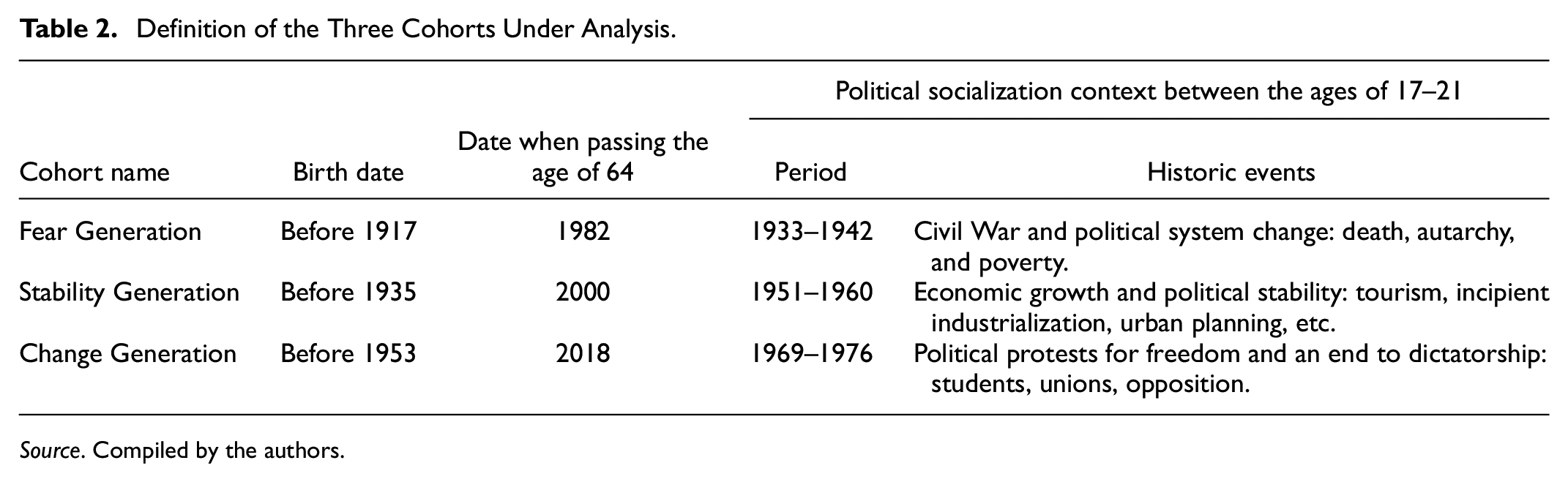
To obtain the global trend of the gender gap in ideological self-placement and given the insufficiency of empirical data before the 1990s due to the scarcity of opinion poll records, we choose three cohorts whose political identity was forged prior to contemporary modern society, in three moments of key historical change in Spain during 20th century: the Civil War, the economic opening and development, and the end of the Franco regime (see Table 2). “We define the ‘cohort’ as that generation of individuals whose socialization and values are conditioned by one or more historical events that mark it in a unique way and that, therefore, differentiate it from the others” (Torcal, 1989). The analysis focuses on those cohorts of 64 years of age or older, alive once Spain arrives to democracy. The denomination of each generation is determined by the political-economic context in which the political identity of its members is configured (Martín, 2004).
Definition of the Three Cohorts Under Analysis.
Source. Compiled by the authors.
This delimitation is based on the impressionable years’ theory (Mannheim, 1927), according to which political identity is forged in early adulthood and lasts throughout life. In this study, the process of construction of political preferences, which are determined by the political, social, and economic circumstances in which each individual grows up, takes place around the age of 17 to 21 years (Dinas, 2010, 2013). From that age onward and with the passing of time, people are increasingly reluctant to change their political positions. The historical events, therefore, are directly linked to the socialization process which conditions preferred values and, therefore, the transition from materialism to post-materialism. Between each cohort group there is a difference of 18 years, which leaves enough margin to notice change despite the short age span of 5 years, from 17 to 21 years of age, analyzed in the literature. This allows us to introduce flexibility and consider our cohorts in a broader sense. The three cohorts under study are delimited by historical and political criteria which help to determine when socialization occurs and to identify the political contexts that may have influenced the formation of political ideology.
The first generation under study is what we call the Fear generation, which survives the drama of war and material scarcity that ensues. Their political socialization and progression to adulthood occurred during the Civil War (1936–1939) and the first years of the dictatorship, a time marked by conflict, the replacement of democracy by a totalitarian political system, death, material scarcity, and failure of the autarchic economic policy. Their value priorities remain at the scarcity end on the material-welfare axis of Inglehart’s modernization theory (Inglehart, 1991), who, according to Maslow (1987), considers that what is lacking is yearned for and becomes a necessity. This generation was born before the end of the First World War, turning 64 or older in 1982.
We call the second cohort under analysis the Stability generation. Its members were born before or in the middle of the Civil War and reached 64 years of age or more in the year 2000. The economic opening of Spain inaugurates a stage of growth and political stability, not seen since before the war, and this ends the great economic and social depression in which the country had been immersed since the beginning of the war in the 30s. International tourism, incipient industrialization, urbanization, and the development of the middle class, among other phenomena, mark the beginning of political socialization of this cohort, which experiences greater material security than its predecessors. This socio-economic development is linked to the start of cultural and political change that crystallizes in the reactivation of the opposition to the regime under the banner of greater freedom (Benedicto, 1989; López, 1982).
The so-called Change generation refers to these people who reached 64 years of age in 2018 and were born at the beginning of the 1950s, which marks a period that began with the signing of the so-called Madrid Pact of 1953 between the United States and Spain, considered the first step toward the end of the country’s international political and economic isolation. Their political socialization takes place between 1969 and 1976. It is another historical moment, but from a different perspective. Political protests for freedom and dictatorship proliferate, led by either students, unions, or the opposition. This generation also lives in the period of greatest economic expansion of the Franco regime before the collapse of the dictatorship in the mid-1970s. Their desire for freedom and political change, together with a perception of better physical and economic security, modifies their preferences for material values toward those of well-being, according to Inglehart’s paradigm of cultural change (Inglehart, 1991).
Toward the Modern Gender Gap
Historically, Spanish women have been considered to be significantly more to the right than men. The traditional weight of the Catholic Church and a rural society have generated this image of Spain. In fact, prior to the approval of women’s suffrage in Spain in 1931, the Radical Socialist Party, with the parliamentary member Victoria Kent at its head, opposed the recognition of the right to vote for women on the grounds that women were under the control of the conservative ecclesiastical power.
The enduring regime of the Franco dictatorship, with a strong Falangist-based patriarchal ideology, also helped to build this perception and reinforced it for 40 years. The regime dedicated enormous efforts to upholding the subordinate position of women with respect to men and their obligation to the family arena. From different instances and with different instruments, such as the Women’s Section of the Spanish Falange or even in school, a differentiating and conservative gender discourse was projected.
This discourse has a main axis a traditional division of labor based on gender in the family unit. Thus, men assumed the role as breadwinners while women were assigned the role of caregivers (Lewis, 2001). While the male population developed in the public space, the female population was confined to the private space, with family and home, and where the morals of the Catholic Church governed under the direction of the regime (Simó-Noguera et al., 2020).
Ideological Self-Placement of the Population
However, and despite all the educational and social conditioning experienced by women, when we measure the political position of groups over 64 years of age whose political socialization took place during the dictatorship, we observe an ideological shift to the left in the case of women, which contrasts with the path followed by men of the same age, who show a certain tendency to place their self-placement to the right (see left panel of Figure 1). In fact, on a scale where 1 represents the extreme left and 7 the extreme right, with 4 being the center, women over 64 years of age evolve from 4.18 in 1982 to 3.76 in 2018, differences statistically significant (see Table 3). The former group was born before 1917 and reached adulthood in full Francoism, while the latter was born before 1953 and reached adulthood in the so-called late-Franco regime which was paving the way toward liberal democracy.

Evolution of political preferences (measured by ideological self-placement) in the Spanish population. Means and distributions of ideological self-placement densities of women (upper panels) and men (lower panels). The variable of interest is ideology, whose scale ranges from 1 to 7 (1 being the extreme left, 4 being the center, and 7 being the extreme right). The sample sizes corresponding to each age group as well as the results of the ANOVA tests can be consulted in Table 3.
ANOVA Tests for Ideological Self-Placement by Gender and Age Group.

The ANOVA tests corresponding to each group support the rejection of the hypothesis of equality of the means with p-values less than .0001 in all cases except in young men, where for the usual levels the hypothesis that the means are equal cannot be rejected, p-value .1860.
The previous results are in line with those observed when the evolution of women in other age groups is analyzed (see upper central and right panels of Figure 1 and Table 3). Women over 64 years of age are the ones with the greatest ideological evolution and the female population under 35 years of age makes a less intense change. In the case of men, movements in the opposite direction are even observed (see lower panels of Figure 1), with movements from left to right in the youngest age group.
In contrast to the developmental theory of the gender gap (Dassonneville, 2021; Giger, 2009; Inglehart & Norris, 2000, 2003; Shorrocks, 2018), this ideological shift has happened without a generational replacement. This study looks at three generations who built their political identity prior to the contemporary democratic period. According to the impressionable years thesis, which places the construction of political identity in early adulthood at around the age of 17 to 21 years old, the first cohort of more than 64 years of age socialized in the current democracy would have been born in 1966.
These data corroborate the idea of Spanish singularity in this process of development of the modern gender gap in ideological self-placement, with this being forged before the advent of democracy. Franco was a breach which stopped the cultural transformation of Spanish society in its early stage. However, economic liberalization represented a socio-economic change accompanied by a cultural change which conditioned the guidelines of political behavior and redefined the traditional parameters of the gender gap in ideological preferences. Between the 60s and 70s and in parallel with the transformations that the Francoism was experiencing, particularly in its final stage, the gender gap gradually evolved toward the modern model of differences between men and women.
Elements of Change
This striking change observed in the ideological self-placement of the older female cohorts, without a complete generational replacement, can be explained by the enormous changes experienced in Spanish society. A gradual increase in the levels of female education promotes the access of this group to the labor market and an accelerated secularization process. This helps to rapidly modify the social context, indirectly causing changes even in those women who do not have access to the job market, or to a secondary or higher education.
The introduction of the variable level of studies enables us to relate the ideological shift of women over 64 years of age to the modernization stage of Spanish society that began in the 1950s. One of the classic consequences of modernization is the greater access of the population to formal education. Providing citizens with cognitive skills is key to advancing socio-economic development and cultural and political changes, although the latter tend to require more time due to the need for generational replacement, according to the hypothesis of socialization of the population of Inglehart’s social change theory.
The greater capacity for analysis that education provides increases the interest in what is happening in the local environment, as well as further afield, and this leads to consideration of issues of an intangible nature, such as freedom of thought, equality between men and women or the fact of voting (Delli Carpini & Keeter, 1996, 2000; Roig et al., 2020; Santana & Aguilar, 2021; Verba et al., 1997).
Education also signals the quality of human capital, which directly affects the modus operandi of the economy and salary remuneration. The higher the educational level, the higher the expected economic rate of returns. From the perspective of non-discrimination based on sex and gender, more income is associated with more freedom for women, who no longer must depend on their partners for financial support for them and their families (Larraz et al., 2019, 2021). Upon gaining economic autonomy, their desire to be recognized as a political, legal, and economic subject in equality with men grows, and their perception of the value of freedom and gender equality increases.
According to the data in the left panel of Figure 2, from the post-war period to the end of the Franco regime, the level of studies in Spanish society improved quantitatively and qualitatively. The greater access of the population to formal education is clearly reflected in an increase by more than 10 percentage points in people with university studies of the so-called generation of fear, born before 1917, compared to the so-called generation of change, born before 1953, in which 22% of people have studied at university.

Distributions of educational levels (left panel), and religiosity and frequency of attendance at religious events (right panel) for the total population and women over 64 years of age in different years. The sample sizes by period and group in the left panel are, respectively, n111 = 3,933, n112 = 20,632 and n113 = 23,585, and n121 = 202, n122 = 1,951, and n123 = 2,951; while in the right panel they are n211 = 4,868, n212 = 4,922, and n213 = 20,618, and n221 = 202, n222 = 1,951, and n223 = 2,951.
A detailed analysis by gender reveals the change more clearly. Women over 64 with higher education go from being less than 2% to representing more than 10%. Despite this relatively low percentage, these women (and some younger ones) act as role models for the rest of the women of their generation who copy the ways and ideas of their more educated peers, accelerating the modernization process.
The process of secularization, a further identifier of the level of modernization of a country, is driven by these changes and reinforced by the rebound effect of the end of the national-Catholic regime that characterized the Franco dictatorship. This study assesses the level of religious activity to measure this phenomenon. The CIS question regarding the frequency of attendance at religious events is analyzed as a proxy for the level of religiosity. Note that this analysis does not include the year 1982, due to lack of data, so the values collected in 1984 are used as a proxy. The right panel of Figure 2 shows the religiosity of the population that, as can be seen, clearly decreases both at the aggregate level (the entire population) and at the disaggregated level (for our target cohorts).
With the end of the autarchy and the beginning of economic liberalization, economic prosperity arrives in Spain together with an incipient system of social protection of a welfare nature (Rodríguez, 1989) that reduces the feeling of economic vulnerability in society. The perception that the destiny of everyone does not depend on unpredictable forces contributes to reducing the role of religion as a source of a sense of security, typical of traditional agrarian societies (Inglehart, 1991). Specifically, at the beginning of the 80s only 11% of women over 64 years of age stated that they did not follow any religious routine, with 60% attending mass at least once a week. However, in 2018, these percentages were around 40%.
According to Inglehart’s socialization hypothesis, this change in religious values reflects the prevailing conditions during the formation of political identity of young adults whose values tend to endure and mark the differences between generations (Petterson, 1994). So, industrialization and the rise of the tertiary sector, together with the great socio-economic structural transformations, such as a consumer society, are considered to have reshaped spiritual orientations.
This change acquires greater importance if one takes into account that the population under study is the oldest, which lived under the control of the national-Catholic dictatorship. During the 40 years of Franco’s reign, political power relied on military and religious power to maintain control of society. The symbiosis between political, military and religious power facilitated and reinforced the infiltration of the church in Spanish society, with its own morality built on the ideal of woman as a subordinate subject, as a caregiver (Mayer & Smith, 1985; Ortiz, 2006; Rabazas & Ramos, 2006). In this sense, the modernization process is interpreted as a revolt in terms of religiosity by turning toward secularization, which, unlike Catholicism, allows other perceptions about the role of women as individuals equal to men (Woodhead, 2008). The reduction in support for Catholic values helps explain the new direction of the gender gap.
Finally, we address the relationship between the level of urbanization and the gender gap in political self-placement. According to Berman (1982), the city is the preferred setting for modernity. The socio-economic development that industrialization entails promotes a transformation of the territory with large demographic movements toward the economic centers, leading to an agglomeration of people in urban areas and the depopulation of the rural communities. Large urban centers reflect diversity and plurality, breaking with the cultural homogeneity of the traditional city (Borja & Muxí, 2003).
This urbanization brings with it a boom in services and a transformation of the social structure. The improvement in income drives the expansion of the middle class, which mirrors the growing confidence in the progress and the processes inherent in any modernization (Berman, 1982; Pinzón & Andrés, 2012a, 2012b). New social dynamics are being established, with individualism at the fore. This moves away from the traditional rural society typical of towns and villages where division of labor by gender governs and determines the distance between men and women in terms of cultural values and, consequently, in the patterns of political behavior (Inglehart & Norris, 2003).
From this perspective, urbanism is interpreted as an effect of modernization as well as a driving factor of modernization because it engenders new ways of living and, therefore, new cultural patterns. It is another of the syndromes of modernization (Díaz & Inglehart, 1994), which acts as a motor of change just like secularization (Germani, 1977).
Crossing the variable political preferences with gender and habitat for the population over 64 years of age shows that people who reside in an urban environment are located closer to the center-left than those who come from a rural environment. In urban areas, women in this age group move from a more conservative position to a more center-left position, jumping from 4.03 to 3.71, while men take the opposite direction from left to right, going from 3.14 to 3.48 (see the top panel of Figure 3), with these numbers being statistically different (see Table 4).

Evolution of political preferences (measured by ideological self-placement) in the Spanish population over 64 years of age. Means and distributions of ideological self-placement densities of residents in urban areas (upper panels), with more than 400,000 inhabitants, and rural (lower panels), localities with less than 10,000 inhabitants. The variable of interest is ideology, whose scale ranges from 1 to 7 (1 being the extreme left, 4 being the center, and 7 being the extreme right). The sample sizes corresponding to each territorial size as well as the results of the ANOVA tests can be consulted in Table 4.
ANOVA Tests for Ideological Self-Placement by Gender and Size Area for the Oldest People.

Note. The ANOVA tests corresponding to each group support rejection of the hypothesis of equality of the means with p-values less than .0001.
In rural areas, the trend for both men and women over 64 is a shift from more conservative political preferences toward those closer to the center-left. The female population evolves dramatically, going from 4.51 to 3.95, while the male population moves from 3.92 to 3.83 (see the lower panel of Figure 3 and Table 4). In both cases, women are more to the right than men, but the convergent trend between genders is apparent in both urban and rural habitats. In other words, the direction of the gender gap in Spain is toward the modern pattern that has characterized other countries, such as Germany or the United States, for years.
All aggregate results above are confirmed at the micro level. Fitting a regression model with ideological self-placement as response variable, we find that the process of leaning toward left-wing ideological positions accelerates over the years in the case of women over 64 years of age. Even controlling for other variables, such as age, marital status, size of the municipality and level of studies, which have been revealed in the literature as determinants of ideology, the coefficient associated with the cohort decreases (it moves to the left on the ideological axis) with the years. The coefficient for the year 2000 (where the year 1982 is taken as a reference) is −0.2780 (p-value < .00001) and that of 2018 is −0.4754 (p-value < .00001). This result contrasts with that of a model fitted for the entire population, in which the coefficient associated with the year 2000 is not statistically significant and in 2018 is −0.2257 (p-value < .00001), less than half that of women over 64 years of age.
Conclusion
In summary, when analyzing the relationship between the gender gap in political preferences and the main indicators of modernization in the older group (access to formal higher education, secularization, and urbanization) it can be seen that throughout the process of modernization of Spain the patterns of political behavior are redefined, following with the worldwide trend, although in the case of Spain this is later, happens more quickly and with its roots being able to be traced before the advent of democracy.
Women move from the right to the left on the traditional ideological scale, while men also move, but toward the center: slightly from the left to the right. The convergence between men and women translates into a decrease in the gender gap. The empirical evidence shows that Spain is in a stage of realignment of ideological preferences by gender, according to the developmental theory of the gender gap by Inglehart and Norris (2000).
The scenario revealed in analyzing the population over 64 years of age also proclaims the role of the so-called bandwagon effect, which is not addressed in this research. Women who modernize toward more liberal positions and turn to the ideological left from the right become a reference for most of their counterparts, who did not have access to formal higher education. This is what Gladwell (2018) identifies as contagion of behaviors. As Aristotle intimated, the human being as a social animal tends to mimic the behavior patterns of peers with whom he/she interacts. To use a simile, it is very likely that people who are exposed to other individuals who have a certain disease will become infected. The influence via peers modifies the environment, modulating the behavior patterns of the people who are members of the same circle, group or society. A further study to analyze this so-called contagion effect would be interesting in order to understand the differences between men and women in terms of political behavior, and to further the debate on the construction of an equal and inclusive society in which gender is not a discriminatory element, according to SDG 5 of the 2030 Agenda in the pursuit of a fully sustainable world.
Although we have constrained ourselves on purpose to the oldest groups to more clearly show our thesis, avoiding the risk of the emergence of canceling out effects, this election is not inconsequential. It entails that the attained results cannot be generalized to other age groups. They are limited to Spanish people over 64 years old. This choice, however, is not capricious, but it is grounded on both theoretical and methodological considerations. From a theoretical perspective, we rely on the Mannheim’s impressionable years hypothesis (Mannheim, 1927) which states that the political identity is built during the young age and (almost) lasts until the end of our life. Mannheim’s thinks that the older we are, the more impervious to change we are. Furthermore, from a methodological perspective, we follow Inglehart and Norris (2000), Shorrocks (2018), and Dassonneville (2021), who warn about the dangers of the unnoticed implicit hypothesis that entail aggregate population analyses. An aggregate-level analysis of all generations can imply an underestimation of differences between gender gaps by generation and implicitly involves assuming similar patterns for the youngest and the oldest.
Footnotes
Acknowledgements
The authors wish to thank four anonymous referees and the editor for their valuable comments and suggestions and M. Hodkinson for translating the paper into English.
Declaration of Conflicting Interests
The author(s) declared no potential conflicts of interest with respect to the research, authorship, and/or publication of this article.
Funding
The author(s) disclosed receipt of the following financial support for the research, authorship, and/or publication of this article: Conselleria de Hacienda, Economía y Administración Pública, Generalitat Valenciana HIECPU/2023/2 Ministerio de Ciencia e innovación PID2021-128228NB-I00 Conselleria de Educación, Cultura y Deporte, Generalitat Valenciana AICO/2021/257 Fundação para a Ciência e a Tecnologia PTDC/IVC-CPO/3098/2014 European Union’s Horizon 2020 research and Innovation program MSCA-RISE Scheme 872299
Data Availability Statement
The data (surveys) that support these study’s findings are property of CIS and are, in the great part, publicly available in the CIS repository:  , with identifiers 2381, 2383, 2387, 2389, 2392, 2394, 2396, 2398, 2400, 2402, 2405, 3203, 3205, 3207, 3210, 3213, 3217, 3219, 3223, 3226, 3231, 3234. The surveys 1320, 1326, and 1327 are available upon reasonable request to CIS and after previous payment to CIS.