




Abstract
Policies and strategies to fight global environmental degradation, gender inequality, and poverty are often inadequate, ineffective, or insufficient. In response, this article seeks potential synergies and leverage points between three significant interrelated discourses that are often treated separately—development, gender, and environment. Proceeding from a brief history of development thinking and poverty definitions, I describe indicators, strategies, and approaches to poverty reduction and gender equality. Second, I analyze how targeting, mainstreaming, and market-based initiatives all fail both to distinguish empirical from analytical gender and to incorporate environment and gender into development policy and action—despite their key role in meeting the normative goal of poverty reduction. Third, through a political-ecology lens, I suggest an integrated approach to poverty, inequality, and socioenvironmental challenges that arise at the intersections of development, gender, and environment, and for that, I draw examples from research on social and environmental change and action in sub-Saharan Africa.
Introduction
The dual ambition in this article is to trace how three different but interlinked discourses—development, gender, and environment—came together historically in ideology, theory, and practice to promote poverty reduction, and to identify emerging and contemporary synergies between them in that effort. There are several reasons why one should study it, the main being that—despite real accomplishments—poverty reduction efforts in the past have been “too few, too slow, and inept” (Agola & Awange, 2013). Furthermore, people who are poor often depend on environmental resources for their survival and, while many users are women, few control the resources on which they depend, as partly, but not solely, explained by existing gender regimes (D. Rocheleau, Thomas-Slayter, & Wangari, 2013; World Bank, 2012).
As a major historical project, development is criticized for not having delivered what it promised in terms of economic growth, political freedom, poverty reduction, and social change (Isbister, 2006). Repeatedly, feminists have criticized development for its insufficient analysis of women, gender, and intersectionality (Elson, 2009) and for dichotomizing women into either marginalized and vulnerable victims or agents of change (Razavi, 2012), representing an “untapped resource” for development (Moser, 2012). Although efforts to engender theory and policy gave rise to “gender and development” as an institutionalized field, it has been, and still is, a contested subdiscipline (Benería, 1995; Cornwall, Harrison, & Whitehead, 2007). At present, in times of global environmental change, development is criticized for its incapacity to redefine development beyond conventional economic growth and for not taking environmental degradation and ecological limits seriously enough (Olsson et al., 2014; Stiglitz, Sen, & Fitoussi, 2009). Hopes are, therefore, high that climate change responses informed by sustainability will embody institutional, structural, or transformational opportunities to reduce poverty and turn vulnerability into well-being—no longer should poverty be addressed only as a core element of development but also, or more so, as a persistent social problem intertwined with global inequality and environmental change.
The current analysis draws on scholarly work that is purposively sampled with the dual ambition in mind. It is focused on the three discourses of development, gender, and the environment. All three are particularly relevant to poverty and inequality but are rarely brought together under joint scrutiny, although that is called for and becoming more frequent in critical geography (Sultana, 2014), feminist political ecology (Elmhirst, 2011; Nightingale, 2011; D. Rocheleau et al., 2013), and gender and sustainability debates (Cruz-Torres & McElwee, 2012; Meinzen-Dick, Kovarik, & Quisumbing, 2014). In search of synergies, I situate the analysis within the scope of political ecology serving as an overall lens to examine how the three selected discourses have already, and may further, converge on poverty reduction strategies while taking global-to-local inequality and sustainability seriously. As a critical problem-solving approach with policy implications for integrated social and biophysical phenomena, political ecology is shaped by several distinct features such as multiple audiences, methods, objectives, and scales focusing on chains of explanations in local to global agency and structures (D. E. Rocheleau, 2008).
The text is outlined as follows. First, I offer a succinct introduction to the main ideas of development as a major historical and international project. I include a short review of how poverty as a key issue is defined, understood, and tackled in development theory and practice. Second, and as another key issue, I review how initiatives on “women” and “gender” were mainstreamed into development, and how women, gender, and the environment were first ignored or neglected but later became core categories in policies and interventions on poverty reduction. Third, I turn to how environmental concerns gained attention in the global debate, how development and environment come together in theory and practice in ecological modernization, and how poverty reduction policies were later formulated in line with that, often with market-based instruments as a solution despite their limitations. Finally, I seek leverage between the discourses and discuss how research can draw on integrated approaches as a way forward to invigorate strategies and action. For that, I offer a chart of empirical examples drawing on sustainability science research in sub-Saharan Africa.
As a cautionary remark to the informed reader, I should point out that by tracing debates over time and by placing the current state of the subject matter into an historical frame, it becomes clear that some aspects and arguments have not changed considerably over the last decade or more. In particular, it is worth mentioning that neither the grounding narrative on gendered perceptions and experiences of poverty in the global South nor the methods for observing, documenting, or analyzing such data from a gendered perspective have changed much. In the current analysis, that is a finding in itself.
Development and Poverty in Theory and Practice
In theory and practice, development is a problem-based, normative, and solutions-oriented discourse (Pieterse, 2010). Rooted in political ideology, it entails policies, strategies, and interventions of every shade from Marxism to liberalism, from neo-Marxism to neoliberalism, from ecologism to feminism, to postdevelopment. It was long understood as developmentalism—a process of social change that can be thought of, planned, and implemented as a top-down strategy of policies and interventions. In the 1970s, this was paralleled or replaced by participatory and people-oriented approaches emphasizing ownership and partnership (Brohman, 1996).
As a postwar project for poverty reduction and political independence, development turned into an endeavor of nation-building and economic growth (Sumner & Tribe, 2008). It gave rise to a huge institutional and organizational apparatus of global initiatives, international agencies, national authorities, and local organizations—all aiming for a better future in the global South. In the quest for freedom and well-being, the development project attracted massive flows of capital and technology not only from the global North to the South but also between countries in the global South (Jönsson, Jerneck, & Arvidson, 2012). Furthermore, industrialized countries in the North promoted nation-building in the South around the institutions of an open market economy and multiparty democracy but with greater weight attached to the former on the basis that democracy would follow from market-based economic growth. The newly independent countries were, however, disadvantaged in their economic transformation by having to compete in open markets with the North and often having to take on significant public debts for infrastructure-building and other projects; this had the effect of perpetuating the adverse terms of trade and high levels of economic dependence on primary exports that had been features also of the colonial period (Singer, 1950). Ambitions to alleviate entrenched poverty were, therefore, hard to fulfill (Isbister, 2006).
Poverty Reduction in Development Discourses
As a widespread, persistent, and deeply rooted social and historical problem, poverty has been addressed, defined, and debated for centuries (Ravallion, 2011). It has been bound up with the development discourse since the very start, and its alleviation is often seen as an outcome of economic growth (Rist, 2002). However, in the literature, there is broad agreement that poverty reduction also requires an effective state (Leftwich, 2005). Currently, poverty is generally understood in terms of multicausal origins, multidimensional features, and multiscalar effects (United Nations Development Programme, 2010). This means that poverty is not only about destitution or maldistribution of material and immaterial assets and resources but also about social exclusion, cultural marginalization, and the process of being deprived of prospects and opportunities.
Definitions of poverty are abundant and varied. Poverty can be absolute or relative, individual or systemic, material or symbolic, objective or subjective, descriptive or explanatory. It is not fixed in time or space and not easily captured in a single dimension or definition. It shifts between seasons and settings; is temporary or transient over the life cycle of a person, family, or community; and varies across gendered and generational boundaries within the same household (Jönsson et al., 2012). Although often presented as a monetary or social proxy measured in access to education, health facilities, and other services (Intergovernmental Panel on Climate Change, 2014), it is also a multifaceted lived experience involving individual, cognitive, and emotional experiences (Olsson & Jerneck, 2010). Beyond that, poverty is relational and systemic, ranging from agency to structure and from changes in individual practices to altered institutional arrangements. Successful poverty reduction efforts thus involve complex politics necessitating economic, political, and social initiatives and interventions, as we will see below.
The understanding of poverty reduction and of how it depends on economic growth and (fair) distribution has varied historically and theoretically across the boundaries of competing development schools and ideologies (Hulme, 2013). In the early decades of development (1950-1980), modernization theory advocated international economic integration and predicted broad-based economic convergence. According to projections, economic growth would deliver poverty reduction and rising living standards to close the gaps between North and South, rich and poor, urban and rural, men and women. Proponents of modernization theory believed that economic growth would “trickle down” from North to South—via trade, technology transfer, and other transactions—and spread widely in societies in the South. After the economic crisis in 2009, the effectiveness of the mechanism was finally refuted (Quiggin, 2009) but before that, it was already highly contested by critics (some of whom are feminist) who observed how inequality is rooted in class, race, gender, and space (Agarwal, 1986) and in remaining colonial structures (Brohman, 1995).
In parallel, and in contrast to modernization theory, structuralist researchers calculated how international trade resulted in divergence and thus advocated protectionism and the promotion of massive private and public investments in state-directed industrialization to “catch up” with technological change, economic growth, and rising living standards in the West (Singer, 1950). Scholars of dependency theory went even further, proposing a radical reorientation and “delinking” from the prosperous Center (North) to reduce further exploitation of the “underdeveloped” Periphery (South), which had already for centuries been deeply penetrated and transformed. While liberal thinkers considered trade to be a superior means to integrate the South further into the world market and thus reduce poverty through convergence, Keynesian scholars stressed that aid and assistance are crucial to bring about growth and social change. In opposition, postcolonial thinkers shifted the focus not only from aid versus trade but away from poverty altogether to critically scrutinize the power of the dominant Western discourse for its “colonization of the mind.” And while human rights–based approaches called for the recognition of rights and concrete outcomes to overcome local to global injustice and inequality, postdevelopment scholars went even further to think beyond the development project altogether.
Economic divergence continued to increase despite new policy frames, forceful development strategies, and massive investments in extractive industries. The international community and many national governments, therefore, had to intensify their fight against poverty. This was done by focusing directly on “the poor” in initiatives that still assumed convergence but were designed to promote participatory pro-poor growth processes. As examples of the major top-down or bottom-up international efforts, the United Nations launched a program in 1974 for establishing a New International Economic Order (United Nations, 1974; White, 1975), the International Labor Organization (ILO) designed a Basic Needs Approach in 1976 (ILO, 1977; Singh, 1979), and in 1980, the esteemed development thinker Robert Chambers suggested a participatory method for rapid rural appraisals to be used both in research and in policy initiatives for rural poverty alleviation and agricultural development (Chambers, 1981). His method gave prominence to what people have and do, thus shifting the focus from human incapacity to human assets and activities. Later on, it developed into the agency-based sustainable livelihoods framework (Chambers & Conway, 1991). Also neoliberalism as the emerging world order advocated special policies for “pro-poor growth” but as often confirmed in development practice, the “poorest of the poor” are difficult to attract, reach, and involve in targeted efforts due to their marginalized position in the economy and in society at large (Jerneck & Olsson, 2010; Olsson et al., 2014).
Indicators and Imagery of Poverty
The many above-mentioned efforts and initiatives to speed up poverty reduction are associated with different attempts to assess and measure poverty and inequality. In the 1990s, Amartya Sen and Martha Nussbaum suggested a Human Development Index (HDI) and a Gender Development Index (GDI) as composite indicators for the Human Development Reports published by the United Nations (Nussbaum, Sen, & Sugden, 1993). In 2000, the World Bank launched a three-pronged bottom-up approach to promote socioeconomic opportunities and facilitate empowerment while enhancing security for the sake of poverty reduction (World Bank, 2000). In parallel, the World Bank initiated the project, Voices of the Poor, to map and explain drivers of poverty as experienced by and heard from 60,000 people in the global South (Narayan, Chambers, Shah, & Petesch, 2000). This was also the time of the global partnership of the Millennium Development Goals (MDGs) established for 2000 to 2015. Given that the MDGs missed the opportunity to fully integrate human rights and environmental concerns into poverty reduction strategies, efforts are strengthened in the succeeding Sustainable Development Goals (Biermann et al., 2014).
As particular indicators, quantitative aspects are seen as useful to compare the magnitude of poverty over time and between countries, whereas qualitative aspects are needed to identify causal mechanisms and how poverty is experienced in various settings (Jönsson et al., 2012). To compare poverty lines and purchasing power parity across borders, some scholars and practitioners prefer universal indicators expressed in what they see as objective figures and frequency. To explain recurring periods of hardship and recovery in the everyday life of those who are under pressure from multiple stressors, others engage with stakeholders and use qualitative methods to map, depict, and discuss daily, seasonal, or annual predicaments (Gabrielsson, Brogaard, & Jerneck, 2013; Jerneck & Olsson, 2013; Olsson et al., 2014) that often arise from a combined food, health, and gender imperative (Gabrielsson et al., 2013; Jerneck & Olsson, 2013). Hence, aggregation in numbers is necessary to compare the incidence of poverty over time and across borders whereas disaggregation is needed to locate poverty dynamics at individual, household, or community levels and for understanding causes and consequences (Hulme & Shepherd, 2003).
As reflected in the many varied approaches that policy makers and practitioners draw on in their design of poverty reduction strategies, the imagery of “poverty and the poor” as expressed in definitions, in metaphors, and in myriad social relations to richer worlds has changed over time and arguably varies at any one time (Dogra & Cohen, 2012) but there are constants, too. To sum up thus far, while some look for a monetary proxy or a single index of welfare, others seek pathways to expand capabilities, entitlements, and freedom (Sen, 2013), and others, again, call for antidiscrimination policies to fight exclusionary dynamics in society (Laderchi, Saith, & Stewart, 2003) such as racism and sexism.
Strategies and Policy Approaches to Reduce Poverty
Strategies for poverty alleviation can, for instance, be classified into the four types of state-directed, market-based, social-movement-based, or status-quo-based approaches (Satterthwaite & Mitlin, 2014). To exemplify, state-directed policies may include participatory governance, rights-based initiatives, urban management, and welfare assistance. Status-quo-based interventions may draw on existing informal institutions such as “aided self-help” or clientelism that build on protection and exploitation, thus offering only limited and rather conditional benefits (Satterthwaite & Mitlin, 2014).
Approaches to measure and compare poverty over time can be classified into four types: monetary, capability, participatory, and social exclusion, each of which draws on a particular construction of reality with its own particular limitations (Laderchi et al., 2003). The monetary approach is easily turned into numbers but is one-dimensional and may conceal other aspects. The capability approach is agency-based and captures multiple dimensions but is difficult to aggregate because it builds on individual and personal rather than collective experiences (Rist, 2002). Participatory approaches are place-based and grounded but use context specific indicators that may prevent comparisons between settings (Laderchi et al., 2003). The social exclusion approach captures multiple dimensions of social inequality but refers mainly to excluded groups and segments in society such as the aged, the disabled, ethnic minorities, and so on, thus taking a too narrow view. As yet another aspect of poverty, there is call for critical urban research and action as policy tends to underestimate the growing magnitude and impact of urban poverty (Banks, Roy, & Hulme, 2011).
A radical shift away from existing approaches would be to focus less on poverty and people who are poor and more on wealth and riches (Lister, 2004). The latest Intergovernmental Panel on Climate Change (IPPC) assessment report has widened the social science scope and seeks to investigate and illustrate inequality in more depth (Olsson et al., 2014). Policies emerging from such research would require structural and institutional changes toward a fairer distribution of public goods and services and a more equal provisioning of education, health care, water, and environmentally sound and safe energy and sanitation (Laderchi et al., 2003). But this is at odds with neoliberalism as the dominant paradigm of our time and would demand a repoliticization of poverty (Béné, Wood, Newsham, & Davies, 2012) rather than the current trend to simplify and depoliticize it (Barrett & Constas, 2014).
Women (Not Gender) at the Core of Poverty Reduction Policy
In response to persistent poverty and inequalities, gender-sensitive and people-centered approaches moved to the core of development from the 1970s (Jackson, 1996). Inspired by research on equality and in an effort to promote women’s opportunities and well-being, a network of Washington-based development professionals and practitioners coined the term WID—“women in development” (Tinker, 1990, p. 30). Embedded in modernization theory and rooted in liberal feminism and neoclassical economics, it suggested a focal shift from reproductive to productive work (Wilson, 2011). In line with development policies on economic efficiency and equity in opportunities, the WID norm supported “small-scale income-generating women-only projects” more than it criticized existing inequalities between women and men (Krook & True, 2012). Due to the prime focus on “women” as an empirical category and based on a simplified understanding of gender, the structural inequality between women/men and the discursive meaning of femininity/masculinity were made invisible and lost in the WID initiative. In retrospect, it has been pointed out that WID, intentionally or unintentionally, stimulated the efficiency norm and approach to “invest in women” and in women’s production, reproduction, and motherhood for the benefit of general social gains such as improved child health, higher levels of food security, and increasing well-being. In consequence, women ended up serving development more than development served women. Later, the efficiency approach to women’s agency and women’s capacity to work gained prominence as “smart economics,” which has since then been propagated by several international organizations (Chant & Sweetman, 2012).
Women as Agents of Change
In the 1980s and 1990s, in the wake of the world economic crisis and the widespread structural adjustment programs promoted by the World Bank and the International Monetary Fund (IMF) in tandem, cuts in government spending in many developing countries resulted in tight household budgets especially in the urban context (Rapley, 1997). To alleviate economic difficulties, the strategy of conditional cash transfer (CCT) was launched as a public policy to fight poverty and social exclusion (Rawlings & Rubio, 2005). It offers opportunities for women as a targeted group but builds on maternalist gender stereotypes of women working in the service of others, mainly their children and families, in a form of “female altruism” (Molyneux, 2006). Hence, women were cast as agents of change responsible not only for the betterment of themselves and the survival of their families but also for the recovery of the economy (Chant & Sweetman, 2012). Similarly, the widespread but controversial system of micro-finance (Hulme, 2000) targets women on the assumption that they use money wisely and ultimately pay back loans. But antipoverty strategies offering land rights and labor market opportunities to women are both fairer and more effective than micro-credit loans that are often controlled by men while signed in the name of women, who thus become responsible for paying back the loans (Balasubramanian, 2013). Some critics even suggest that micro-credits should be called micro-debts (Bamford, 2000).
Productive and Reproductive Work
Access to income-generating resources and livelihood opportunities is governed by social relations manifested through institutions, organizations, and decision-making power, and is often found to be at the core of poverty alleviation (De Haan & Zoomers, 2005). But as often noted in the development literature, women have multiple reproductive responsibilities besides their productive tasks and “every dawn brings with it a long march in search of fuel, fodder and water” (Dankelman, 2002, p. 23). To fulfill such gendered productive and reproductive responsibilities and obligations, women often depend on and have the capacity to manage energy needs and natural resources while having neither the right to nor control over these same resources (Ryan, 2014). In many fishing, farming, or forestry communities, this is illustrated by how women participate in, contribute to, and arrange production activities while having less (secure) access not only to natural resources, in terms of land, but also to social resources such as capital, education, and information (Cruz-Torres & McElwee, 2012). However, the dual responsibility of having to tend to both reproductive and productive activities may, in fact, enhance women’s bargaining power as well as their capacity to meet not only basic needs in the family but also their own strategic needs (Kabeer, 2012).
Targeting Women or Mainstreaming Gender
Feminists and other critical thinkers have examined how development and poverty reduction are associated with particular notions or chains of notions tying one term to another, such as “women and work” (Jackson, 1996); agency, efficiency, and entrepreneurship (Wilson, 2011); and participation and empowerment (Cornwall & Brock, 2005; O’Meally, 2014). Many have noted that while some programs “target” the poor specifically (as a group) others “mainstream” poverty and gender (as social relations) into development policies. Both perspectives are problematic. Targeting means portraying and addressing people who are poor (often women) as victims and/or beneficiaries whereas gender mainstreaming often means seeing women (but rarely men) as agents not only contributing to but also being responsible for the survival and well-being of their families, communities, and whole economy. For a long time, investments in generations of women as mothers, community builders, and “agents of well-being” have run as a common thread through development initiatives. By linking the domestic to the public sphere, while separating the domains in intricate ways, women are made liable for the well-being of others (Tabbush, 2010), and work burdens are reinforced (Blackden & Wodon, 2006).
Instrumental or Intrinsic Value
Critiques have also argued that “positive” representations of women as entrepreneurs and educators of their children are associated with a notion of agency that is both consistent with and necessary for neoliberal capitalism (Wilson, 2011, p. 328). But if poverty is a classed and gendered experience, then policies to reduce poverty “are not necessarily appropriate to tackling gender issues”—especially if poverty reduction is prioritized while gender discrimination, oppression, and violence are neglected (Jackson, 1996, p. 501). Notably, the first World Development Report ever to focus on gender recognized that besides its instrumental value for economic growth and poverty reduction, as discussed above in terms of women as agents of development, gender equality has intrinsic value as “a core goal in and of itself” (World Bank, 2011, p. 3). Critical perspectives would prioritize the intrinsic value of strengthening women (and men) in their own right, but warn against initiatives based on the instrumental value of making women into a means to control fertility (to stabilize population growth) while reducing poverty and achieving sustainability (Elson, 2009; Razavi, 2012).
To sum up thus far, the focus in poverty reduction policies and strategies has shifted over time from specific development aspects—basic needs, gender equality, rural development—to more diffuse (neo)liberal notions such as “equity in opportunities” (World Bank, 2005) only to drift back again to specific aspects such as education, human security, public health, and reproductive rights. Policies have varied from including and targeting “women” to “mainstreaming gender” while becoming increasingly diffuse in goal and means, and from prioritizing the efficiency gained from the instrumental value of women’s contributions to underlining the intrinsic value of gender equality.
From Counting to Critical Reflexivity—From Empirical to Analytical Gender
In relation to policy, it is a long-standing feminist argument that gender is not adequately conceptualized or represented in decision-making arenas (Kettel, 1996). This is unfortunate given the fact that the feminist lens on development has shifted from “women in” or “gender and” to the “gendering of” social relations. This methodological turn from individual to relational helped identify how economic, political, and social institutions contribute to reproduce and reinforce gender regimes and practices. In development policy and practice, there are, in principle, four broad approaches for how to address gender, each of which has its own particular focus, issues, and methods. Accordingly, gender studies have changed from measuring variables to seeing gender as a fundamental analytical category and as part of higher order processes in society. With that, gender has shifted from studies of patriarchy and subordination toward studies of complex social institutions, practices, and structures that span the public–private divide. In addition, gender is often found to be dynamic and continuously negotiated in processes that are embedded in norms and values influenced by diffuse and widely dispersed power (Kenny, 2007). Four typical approaches can be distinguished here: counting women and men, analyzing gender as social relations, explaining identity and diversity beyond gender and into intersectionality, and reflexive questioning of knowledge production (Reed & Mitchell, 2003).
First, and to illustrate this further, the counting approach includes individuals (women and men), gendered activities, and gendered contributions from that. Although it challenges gender-neutral categories, it may overstate women’s uniform conditions and only suggest corrections to existing practices rather than promoting profound (and necessary) structural change in social norms (Marchand & Parpart, 2003). The second approach, which analyzes gender as a relational construct, includes the study of social norms and the dynamics of gendered regimes while focusing on how institutions are numerically and culturally dominated by men and male norms. This approach seeks to explain gendered differences and inequalities in power but not necessarily how gender and other social dimensions intersect to create asymmetric and ever more complex power relations.
The third approach recognizes that gender intersects with other social categories, thus being diversely experienced and going beyond essentialism. This approach is, however, less able to seek unity across diverse interests or to offer general statements that may serve policy making. The fourth approach stresses partiality, subjectivity, and reflexivity and is concerned with feminist critique of epistemologies. It deals with questions such as what counts as knowledge and how is knowledge legitimized, produced, and represented? The challenge here is to recognize fluidity in identity and subject formation while seeking to make claims that are precise enough to be policy relevant. Importantly, and to sum up, the meaning of gender, also in the context of development, must be understood along at least two different lines—the empirical meaning referring to the categories of women and men and how they are differently affected by or affect social change, and the analytical meaning referring to the dimensions of femininity and masculinity in how power is produced in social relations and in language (Peterson, 2005). To consider both is an attempt to avoid simplification and deepen the understanding—but also the complexity—of gender.
Recoding Gender in the Quest for Development
As regards flexibility in how to interpret and reinterpret gender, culturally contingent norms are often contested, challenged, or changed in times of major technological transformation or social upheaval such as agrarian reform or revolution, economic boom or crisis, war or postconflict recovery, natural disaster or climate change events. Asia and Africa exhibit interesting and well-known historical examples of such events and processes characterized by fluidity in gender. In socialist China, women would “do everything that men could do” in productive labor during the intensive political mass mobilization of peasants in the 1950s and 1960s. In rapidly industrializing and modernizing postwar Japan, many women left the domestic sphere to enter the labor market in the economic boom of the 1960s. In conflict ridden Vietnam, women gained higher administrative and political positions when men were mobilized in war in the 1960s; and in postconflict Rwanda, women won every second parliamentary seat based on the new 2003 Constitution.
These major transformative gains may be unintended and unexpected and also fragile and short-lived. After an “event,” things may soon revert to “normal.” In Japan, many women returned to the domestic sphere when the economic boom slowed down into a recession in the 1990s; in Vietnam, women lost their prominent positions at the end of the war in 1975 when men demobilized and reentered the administration; and women who were active in the social movement of the Arab spring in 2011 lost their seats in the reform committees set up after the revolution (Hassan, 2012). The position of women (and men) in the economy and society is thus reinterpreted over time often in line with the dominant discourse. Kabeer (2011) argues that although empowerment processes are path dependent, there is scope for people’s ability, capacity, and willingness in a given setting or situation to adapt to, react against, or alter the social constraints and gendered norms to which they are subject. Kabeer (2011) speaks of women’s ability to participate on equal terms with men in reshaping society, women’s capacity to exercise strategic control over one’s life, and women’s willingness to question one’s position in society. As a gender-sensitive typology that may serve to deepen the analysis on such power in social relations, it covers four varieties: “power to,” meaning the ability to adapt, improve, or transform; “power with,” involving a joint action with other people; “power over,” in the sense of challenging and overcoming subjugation; and “power within,” as an individual cognitive process of confidence and consciousness (De Haan & Zoomers, 2005).
“Involving women while ignoring gender”
Ester Boserup (1970), an early proponent of gender equality in development, argues that women should be (better) integrated into the economy to reap (more) benefits from modernization. Against this, radical feminist scholars argued that women were already integrated in the economy as seen in their contribution to production and reproduction (Benería & Sen, 1981), often to the extent that their labor was exploited in low-paid wage work and through time-consuming gendered obligations in reproduction—thus a heavy workload and literally a double burden. It was argued that interventions seeking to involve women often ignore gender, thus seriously overlooking the role of men and masculinity in the economy and society. This is exemplified by how women who enter public positions and productive work often remain in charge of reproductive work as these are more resistant to change or recoding (Resurreccion, 2011). In consequence, the many concerns around women’s workloads, “care loads,” and time poverty have gradually been gender mainstreamed into development thinking and practice (Blackden & Wodon, 2006) but often with a focus on what women do rather than on what men could do to contribute to productive and reproductive work.
To sum up, we have seen how the notions of “women” and “gender” emerged and were used interchangeably or even ambiguously in development initiatives. We will now turn to how the gendering of social and natural resources in the environment debate started to be incorporated into the development discourse, first with an emphasis on women and then shifting the emphasis to gender (Jackson, 1998; Leach, 2007).
Starting to Identify the Dynamics: Development, Gender, and Environment
In the gender literature, it is argued that vulnerability (and adaptive capacity) in relation to natural disasters is neither a fixed nor an intrinsic characteristic of certain people or groups of people (Enarson, 1998) or derived from a single social dimension like being poor, rural, woman, or part of a particular (or marginalized) community (Blaikie et al., 1997). If vulnerability is associated with differentiated and changing circumstances before, during, and after a disaster (Blaikie et al., 1997) and depends on historically or culturally determined conditions (Enarson, 1998), then it is less of an individual or personalized characteristic and more of a structural, relational, and process-oriented condition. The capacity of women and men to reduce their respective vulnerability may depend significantly on gender norms and rules that define and regulate the use of space and other resources, including the power and control associated with that; but when established norms clash with emerging needs in households that are poor, vulnerable, or exposed to multiple stressors, this may create space for negotiation of and fluidity in gender (Jabeen, 2014).
“Being Close to Nature”—In Ecofeminism and WED (Women, Environment, Development)
In the development and environment debate, especially within ecofeminism and WED, it has often been argued that “women are closer to nature, are hardest hit by environmental degradation, and have special knowledge of natural resource systems” (Resurrección, 2013, p. 33). From this follows that women run the potential risk that development interventions will pass the burden of conservation on to them as main caretakers, protectors, or even saviors of natural resources and the environment (Resurrección, 2013). But ecofeminist notions seeing women as per definition naturally connected to nature or having special skills and knowledge to manage environmental resources (Shiva, 1988) have been criticized by feminist scholars, some of which feel an “intellectual unease” with the idea of a single “feminine subject” who is “close to nature” (Resurrección, 2013, p. 33). In contrast, critics see identity and subjectivity as fluid, fragmented, multidimensional, and constituted of age, class, race, place, and other axes of power rather than as fixed, centered, and one-dimensional (Elmhirst & Resurreccion, 2008). A better understanding of agency could emerge from an intersectional analysis of natural resource management and environmental recovery, and such studies of flexibility in gender in relation to nature are now seen in the literature on forestry and water management (Leach, 2007). Here, “situated knowledge” and “social reproduction” are useful concepts to help reveal how spatial locations shape everyday activities and practices and how that relates to what people know about the environment and how they respond to environmental stressors (Bee, Madge, & Wellens, 1998). Social inequality in resource management and climate change responses may not only be reinforced but, thus, also contested and changed when social meanings of identity are played out and power is performed (Nightingale, 2009). In the following, I will examine how development engages with debates on environment and sustainability and how ecology and economy get intertwined in initiatives on poverty reduction.
The Rise of Ecological Modernization
The coevolution of development and environmental concerns can be summarized in three important waves (Mol, 1997). In the 1960s, the first wave was concerned with the degradation and pollution of natural landscapes seeing nature conservation as the main policy response. In the 1970s, the second wave was manifested in the UN Conference on the Human Environment in Stockholm (in 1972). This made it obvious that environment and development could no longer be treated separately but had to be addressed simultaneously. In parallel, a more radical and socially informed wave made a plea for an ecologically sound society but achieved very little in terms of institutional change. In the 1980s, the third and most influential wave coincided with the publishing of the politically commissioned report Our Common Future (World Commission on Environment and Development, 1987) wherein ecology and economy were integrated into a common frame that later became known as ecological modernization (Jänicke, 2008). Its main assumption, that economic growth can solve both poverty and environmental degradation, was epitomized by the UN Conference on Environment and Development in Rio de Janeiro, Brazil, in 1992 and Agenda 21 as a first major initiative to combine poverty reduction with environmental conservation, especially in the local context. This reflects how environmental concerns were mainstreamed into modernization theory as the dominant development theory.
Even if meanings differ among and between scholars, four main traits are important to ecological modernization. First, modern science and technology is important for ecologizing the economy. Second, it is argued that since there is no inherent conflict between the economy and the environment, we should harness market instruments for sustainable development by internalizing externalities in a commodity approach—economizing ecology. Third, the state should enter public–private partnerships and become proactive in mobilizing private actors to take initiatives toward sustainability such as in strategies on corporate social responsibility. Fourth, social movements will have to change from primarily being watchdogs to become active participants in and agents of sustainable development (Mol, 1997).
Ecological modernization as theory and practice emerged in tandem with the neoliberal ideology and the match between them paved the way for liberal environmentalism or “green neoliberalism” (Bakker, 2010). In the context of development, this is illustrated by the outcome of the Rio+20 conference reiterating the need to promote initiatives on sustainable development that “contribute to eradicating poverty as well as sustained economic growth . . . while maintaining the healthy functioning of the Earth’s ecosystems” (United Nations, 2012, Section III, para. 56). Concretely, this thinking is evident in how the World Bank shifted from imposing structural adjustment programs and austerity in the 1980s to promote a green economy in the 1990s—defined as a clean, resource-efficient, and resilient economy (Hallegatte, Heal, Fay, & Treguer, 2012). The change in World Bank policy was seen as necessary, efficient, and affordable (Fay, 2012) and as of late, it is taken further toward equity goals by becoming “inclusive green growth” (Fay, 2012). Dominant international players thus have the power to set the agenda by mainstreaming ideas on development, fairness, and the environment and pair it with a matching vocabulary with political implications such as “green growth,” “equity in opportunities,” “inclusive green growth,” or “resilience” (Olsson, Jerneck, Thoren, Persson, & O’Byrne, 2015).
Ecology and Economics Coming Together
The evolution of the concept of ecosystem services may exemplify how scientific thinking about the environment and development is affected by neoliberalism. In the late 1970s, the concept was launched to increase the public awareness of biodiversity conservation. In the 1980s, it was mainstreamed into the environmental policy literature and operationalized by the Millennium Ecosystem Assessment (Reid et al., 2005) to subsequently be implemented as Payment for Ecosystem Services (PES) in the 2000s (Gómez-Baggethun, De Groot, Lomas, & Montes, 2010). Many ecologists uncritically embraced the integration of ecosystem services into a neoliberal agenda that promoted market-based instruments (Daily et al., 2009; Jones-Walters & Mulder, 2009; Kumar, 2010). And, to be noted here, environmental protection and poverty strategies now shifted from state to market, implying a major change in authority and institutional arrangements from state regulation to market-oriented solutions justified by the long-term need to tackle poverty and foster development (Ten Brink, 2011). Similarly, the concept of social-ecological systems (SESs) emerged in response to the need to improve management and governance of degrading ecosystems (Berkes, Colding, & Folke, 2003). Here, the stress on self-organization and resilience provided a smooth link to the neoliberal idea of free markets (Walker & Cooper, 2011). Speaking of resilience, the concept generally refers to how systems manage, persist, or even thrive in a world of unforeseeable socioecological events or disruptions, and as such, it has gained prominence while also being subject to severe critique for not being an effective analytical tool to capture or address the dynamics of poverty (Béné et al., 2012).
Combining Development and Environment in Market-Based Instruments
PES is a paradigmatic image of how environmental management and poverty reduction can be promoted in the global neoliberal economy. It is a voluntary transaction wherein a well-defined environmental service or a land-use activity likely to secure that service is bought by one or several service buyers from one or several service providers, if, and only if, the service providers secure service provision (Wunder, Engel, & Pagiola, 2008). Inspired by a large-scale scheme in Costa Rica, Pago por Servicios Ambientales, PES received much attention as a market-based instrument for efficiency and effectiveness in environmental management in developing countries (Pagiola, 2008). Besides, it is often assumed that PES can contribute to reduce poverty even if it was not primarily designed for that (Pagiola, Arcenas, & Platais, 2004) and even if empirical evidence is lacking (Ingram, 2012).
While environmental sciences seem enthusiastic about the prospects of combining social and environmental benefits (Wunder, 2005), development scholars are cautious (Daw, Brown, Rosendo, & Pomeroy, 2011) or outright negative in that they see PES as neocolonial resource appropriation or “green grabbing” (Fairhead, Leach, & Scoones, 2012). PES builds on globally dominant conceptions of environmental justice that are not necessarily aligned with those of local stakeholders (Martin, Gross-Camp, Kebede, McGuire, & Munyarukaza, 2014), and although PES primarily has an environmental rather than a social focus (Wunder, 2008), its socioeconomic effectiveness is influenced not only by ecological conditions but also by social relations (Adhikari & Boag, 2013).
The potential of PES to reduce poverty is heterogeneous and always context-dependent (Adhikari & Boag, 2013). The chances to achieve the dual policy goal of poverty alleviation and environmental protection, by using PES in integrated approaches, depend on the coincidence of at least three interrelated spatial and social conditions: people who are poor must have access to ecosystems with a potential to deliver high-value ecosystem services, opportunity costs in delivering these services must be low, and the scope to introduce perverse incentives in the PES scheme must be limited—for example, in shifting environmental stress from the areas covered by the PES scheme to areas that are not covered, in the sense of saving one forest while cutting down another, that is, the notion of leakage (Allwood, Bosetti, Dubash, Gómez-Echeverri, & von Stechow, 2014). It is possible that these eligibility criteria will limit the potential effectiveness of PES schemes. In addition, empirical evidence from Brazil indicates that law enforcement is more effective to reduce deforestation than market-based initiatives (Arima, Barreto, Araújo, & Soares-Filho, 2014; Gibbs et al., 2015; Lapola et al., 2014; Nepstad et al., 2014) but as of yet, there seems to be little gender differentiated evidence. In addition, power asymmetries in access to natural resources and services may contribute to reproduce existing inequalities (Kosoy & Corbera, 2010; Krause & Loft, 2013), and as regards gender and PES, there is need for more research on how gender regimes matter in the context of access to, dependence on, and use of land and labor as socioecological resources.
From a gender perspective, and as pointed out by Baruah (2015), green growth policies will have to consider that women generally have weaker access to new technologies and more often are poorly represented in construction, infrastructure, and renewable energy. For a green economy to be equitable and vibrant, it will have to avoid curtailing the access to public commons and instead involve people who are poor and engaged in the informal economy or otherwise disenfranchised in society (Tandon, 2012). Doing so, it will have to consider their perils and priorities in how they depend on and use resources (Tandon, 2012). For this to happen, and to be sustained, it is not enough to facilitate entry into a green economy, it is also necessary to back the entry up by wider and socially progressive policies including access to public services in general.
Contrasting Arguments
In times of both economic and ecological crises (Jessop, 2012), polarization is increasing between two competing discourses that both claim sustainability with poverty reduction. The dominant discourse of ecological modernization, led by the United Nations and the World Bank, reiterates the need for sustainable development by “promoting sustained, inclusive and equitable economic growth” (United Nations, 2012, Article 4) as echoed by the World Bank promoting “green growth” (Dercon, 2012). In reaction, a growing critical scholarly debate, inspired by ideas from Marx and Polanyi, argues for counterbalancing forces that operate against the increasing reliance on markets in environmental governance (Arsel & Büscher, 2012). Likewise, the critical concepts of postdevelopment and degrowth are gaining traction both in academia (Kallis, 2011) and as a source of social movements (Demaria, Schneider, Sekulova, & Martinez-Alier, 2013). The highly divisive debate on food regimes may serve to illustrate this polarization between mainstream depoliticized pleas for technology driven food security (Godfray et al., 2010) versus politically transformative peasant movements to achieve sovereignty (Holt-Giménez & Altieri, 2013).
Conclusion
The aim of the article was to identify and compare approaches and policies to poverty eradication in three different but interlinked debates—development, gender, and environment—and to investigate the continuity and change in arguments over time while also looking for synergies across debates. The analysis makes it clear that although foci and visions may shift over time, certain aspects and institutions remain constant. To exemplify, framings of women and gender in the poverty alleviation and development debate are reproduced throughout the environmental debate despite repeated critique from feminist, political ecology, and other critical perspectives.
Summing Up the Argument
Three major processes have influenced development theory and practice over time, the radicalization in the late 1960s, the gendering of development in the 1970s, and the greening of development in the 1980s. At the time of the economic crisis in the 1980s, there was a conservative pendulum swing, and neoclassical economics resurged to fit into the emerging neoliberal ideology that has dominated ever since. Owing to competing perspectives on the core development issues of economic growth, poverty reduction, and social change, many concepts have been contested, revisited, and reconsidered while some remain over time. From the discussion, I sum up three main points on poverty, gender, and environment, and how they come together in poverty reduction in the development field.
First, on poverty, knowledge expanded over time from growth-oriented and monetary-based approaches to multidimensional perspectives emphasizing how human development is gained in processes of capacitation, participation, empowerment, and distribution of rights. The necessity to expand definitions on poverty beyond economic aspects is widely recognized in the debates on development and gender. The importance of (and controversies around) the many varied processes involved in poverty reduction strategies such as capacitation, empowerment, and participation—and how they involve gender—is also recognized. Despite this broader view, poverty reduction policies are still often expressed in narrow monetary and measurable terms emphasizing economic growth, quantitative indicators, and specific targeting of marginalized groups.
Second, on women and gender, knowledge has changed from counting women, observing women’s practices, and measuring women’s work to theorizing how social relations, institutions, and practices are gendered at all scales from everyday life to higher order processes in society. Despite a broader view, poverty reduction policies are (again) often directed or targeted at women as vulnerable victims of poverty, ill-health, conflict, and disaster or as resourceful agents providing for their families, communities, and beyond. What is lost in that analysis is not only the scrutiny of men and masculinity in development but also how processes of power, dispossession, and deprivation intersect with other major processes in society of great importance for social change.
As regards women, gender, and environment, the focus on women’s work and the weight of dual or triple workloads is now also expressed in relation to populations exposed to global environmental change and disasters. This reflects (and repeats) how development policy has interchangeably spoken of women as a targeted group of either victims and beneficiaries or agents of social change (or both) rather than of gender as fundamental to social relations of diversity and inequality and thus in need of further critical scrutiny (Sultana, 2014). This is partly explained by the fact that mainstreaming ends up diluting or distorting the radical edge of new initiatives as seen when the emphasis on gendered responsibilities (rather than rights) is continuously reproduced and reinforced not only in the development discourse but lately also in response to climate change.
Third, on environment, knowledge has evolved from documented observations of pollution, environmental degradation, and overuse of natural resources to a deeper understanding of the need to reverse these processes through conservation, preservation, restrictions, and regulations while also considering mitigation of and adaptation to climate change. Environment has become subject to processes of marketization and the use of market-based instruments (such as PES), which are problematic for several reasons. Not only is the pricing and the setting of discount rates on nature including the atmosphere and the oceans a complex process, it is also a way to exclude social groups who have poor access to markets or who are deprived of rights to resources. In response to climate change as well as to environmental degradation and pollution, there is scope for synergies between poverty reduction and environmental concerns but not necessarily via commodification of nature because it may imply an excessive focus on market forces in poverty reduction policies. Many people who are poor depend for their living on natural resources and the environment while often being disfavored by markets (Jerneck & Olsson, 2014; Olsson & Jerneck, 2010). Even if markets can liberate some, they neglect others such as the chronic poor who need access to social support and social change (Hulme & Shepherd, 2003), implying a wide range of public services constituting both the basis of and the frame within which market incentives may play a role—but not the only role. Given these conditions, market-based instruments in the context of climate change and environment—Clean Development Mechanism (CDM), Reducing emissions from deforestation and forest degradation(REDD+), schemes for voluntary carbon markets, and so on—are clearly problematic tools in poverty reduction (Olsson et al., 2014).
Illustrating Potential Social Change
Collective action or community-based initiatives are not always sufficient or necessary measures, and, in some instances, they are even contested, but under certain conditions they can be an alternative to conventional development interventions. Collective action informed by gender has often shown to be effective—especially when people who have lower capacity to accumulate resources and/or limited physical mobility due to gendered reproductive tasks are motivated to develop and enhance their social capital by building and nurturing localized networks (Agarwal, 2000). If gender-sensitive initiatives and environmental innovation are included, then synergies with development may emerge.
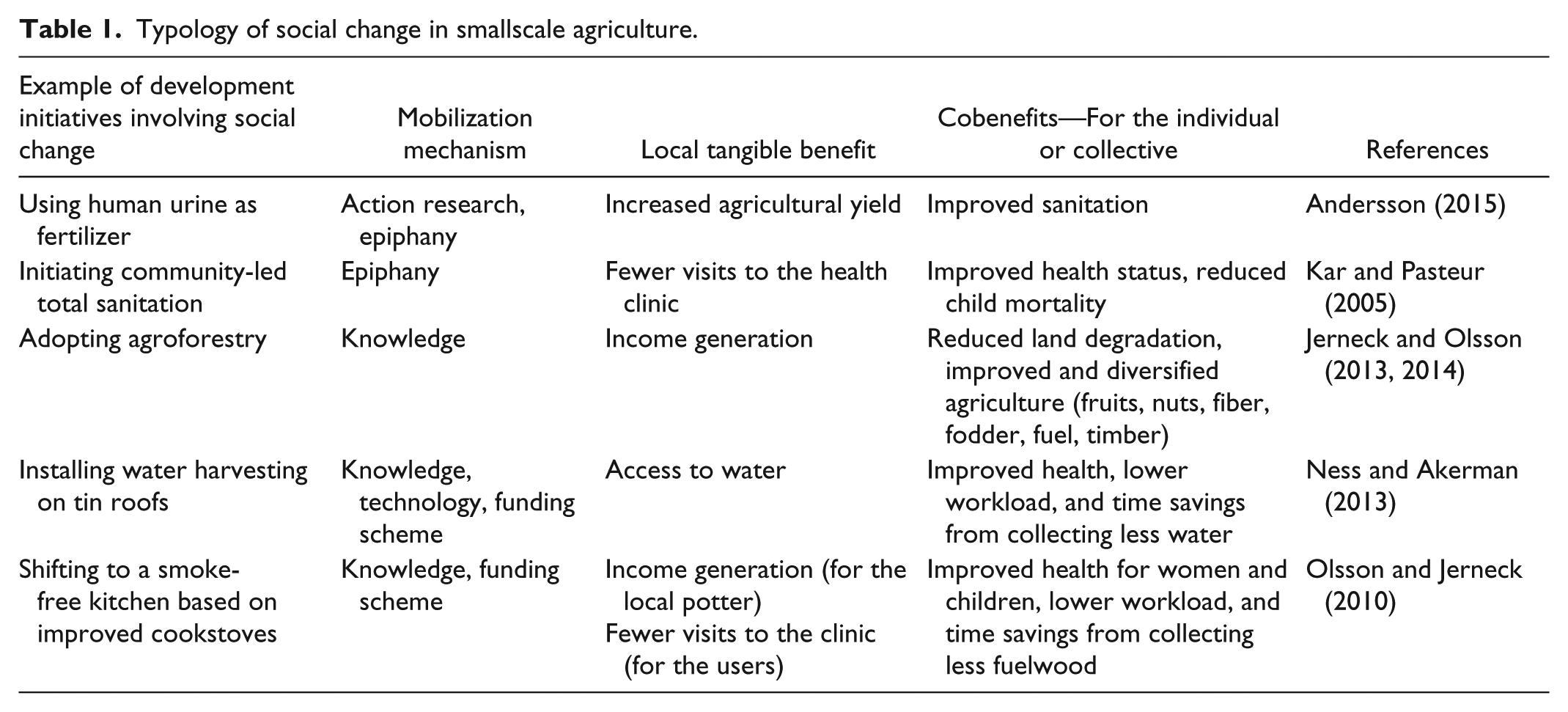
In the context of small-scale agriculture in sub-Saharan Africa—characterized by the food imperative, the health imperative, and the gender imperative—recent research in sustainability science has identified and analyzed such shared initiatives and action, be it in collective efforts to jointly pool and use human urine as a valuable resource to improve soil infertility (Andersson, 2015), in local organization in communities of practice where mainly women farmers get together to start saving funds and income-generating activities in agriculture and agroforestry (Andersson & Gabrielsson, 2012; Jerneck & Olsson, 2014), and in entrepreneurial initiatives aiming at water harvesting (Gabrielsson & Ramasar, 2013). Facilitation skills are important in such research but “having the right attitude and the enthusiasm to mobilise the local community” (Kar & Pasteur, 2005, p. 2) is found to be the most crucial aspect.
In summary, such research gives prominence to two conditions that are necessary to enable successful social change with environmental benefits in the context of poverty and multiple stressors: the existence of local and tangible benefits from development initiatives and interventions (Jerneck & Olsson, 2013) and the presence of entrepreneurially oriented individuals who can act as catalysts for collective action and social change (Jerneck & Olsson, 2014). Table 1 builds on research in sustainability science and represents a typology of mobilization mechanisms for social change where the two above-mentioned conditions helped pave the way for transformation. The first column provides five examples of social change initiated through a certain kind of mobilization mechanism, indicated in the second column, which in turn generated both direct local benefits and further cobenefits, as seen in the third and fourth columns.
Typology of social change in smallscale agriculture.
Pointing at Ways Forward
What are the ways forward when unequal power relations are embedded and inscribed in land, water, and other natural resources (Bryant, 1998) and gender regimes influence access to and use of natural resources (Agarwal, 2003; Sultana, 2014)? One option is to use a political-ecology lens allowing a feminist epistemology and a global-to-local perspective (D. Rocheleau et al., 2013). That may provide an integrated focus on how socioecological challenges, in small-scale farming, create multiple interacting stressors for people who are poor and depend on the environment for their survival (Andersson, 2014; Jerneck & Olsson, 2013, 2014). Political ecology directs attention not only to the persistent social problems of poverty, dispossession, and unequal resource distribution but also to the politics of environmental degradation, social justice, and the neoliberalization of nature (Elmhirst, 2011). In addition, feminist political ecology goes beyond targeting and mainstreaming to consider the gendering of decision-making processes in relation to resource use, land titling, and tenure arrangements, and do so with social, spatial, temporal, and (thus) intersectional inequality in mind (Nightingale, 2011).
Development theories and practices are not only gendered but also intertwined with other social and socioecological processes and relations calling for intersectional perspectives that address multiple aspects of identity. As a dynamic theory emerging from feminist research, intersectionality may spark further inquiry into poverty and riches in relation to the governance of global environmental change and poverty reduction (Kaijser & Kronsell, 2014). It uses deconstructive moves to uncover and analyze multiple intersections of power and inequality in social relations while challenging the notion of sameness (as in “the poor” and “women”) and the notion of difference as often used in “developed” versus “developing countries” or in “women versus men” (Cho, Crenshaw, & McCall, 2013). As a heuristic, its methods can be used to increase knowledge and understandings of how power works through time and space—via norms, scales, and structures—to create overlaps and intersections between identity categories such as age, class, ethnicity, gender, place, race, and sex. It may reveal not only how legal, political, spatial, or other types of inequality or discrimination are shaped and reproduced but also how social and environmental justice can be promoted in fair and gender-sensitive global environmental governance. Given that policy intervention often goes beyond geographical and sectorial borders to spread quickly throughout a globalized world (Weaver, 2014), intersectionality could serve as an important critical lens.
Concluding Remark
The world and its problems extend across disciplinary boundaries and have to be understood beyond disciplinary perspectives. The development field including all its varied aspects, concepts, tools, and visions is explicitly interdisciplinary and a clear example of how competing ideologies, theories, and practices coexist within the same and inescapably political discourse (Leftwich, 2005). Theory and action on development, gender, and environment share not only the same aspiration of profound social change but also the many continuously contested political means and objectives of transformation (Cornwall et al., 2007). A critical scrutiny of how development, gender, and environment are intertwined in poverty reduction efforts, and how inequality is a matter of politics rather than of economics and culture only, may thus contribute a better understanding of the dynamics of policy making and allow fairer governance and outcomes of human–nature interactions.
Footnotes
Acknowledgements
I would like to thank Paul Weaver and anonymous reviewers for constructive comments on a previous version of the article.
Declaration of Conflicting Interests
The author(s) declared no potential conflicts of interest with respect to the research, authorship, and/or publication of this article.
Funding
The author(s) disclosed receipt of the following financial support for the research and/or authorship of this article: I would like to acknowledge the financial support from the European Union (EU) 7th Framework Programme project GLOBIS (Contract No: 227055) and the collaboration with colleagues in Europe. At Lund University, I have also benefited greatly from the intellectual inspiration provided by the Linnaeus Centre LUCID financed by the Swedish research Council Formas.