




Abstract
This paper aims to propose a typology of Czech consumers with respect to their attitudes toward the country of origin when purchasing beverages. Attention is paid to four commonly purchased beverage categories: beer, wine, tea and coffee. Using the Computer Assisted Web Interviewing method, the total number of fully completed questionnaires obtained was 396. The selection of respondents was determined by gender and age quotas. The measurement of attitudes involved utilizing a set of 22 statements concerning the beverage origin which were evaluated on a five-point scale. As confirmed by the research results, in each beverage category, the country of origin influences consumers’ purchasing decisions differently. When purchasing wine, Czech consumers most commonly verify the country from which it originates. The origin is also important to them when it comes to beer, with the strongest preference for beer produced in their own country. The country from which the beverage originates has a considerably lower importance for coffee and is the least important when buying tea. Based on respondents’ attitudes toward the country of beverage origin, four consumer segments were identified, namely “Experimenters,”“Picky consumers,”“Patriots,” and “Pro-European consumers.” Factor and cluster analysis were used for this purpose.
Keywords
Introduction
Consumer behavior in the beverage market is a very broad topic that offers many possibilities for investigation. In the current globalized environment, consumers encounter various factors when purchasing beverages, and one of the significant aspects is the country of product origin. Consumers care about the product’s origin as it guarantees a certain product quality and safety, some of them want to support domestic products or avoid products from specific countries. Consumer interest in the country of product origin issues is growing, and engagement in this area has increased during the Covid-19 pandemic. A thought-provoking perspective involves developing a consumer typology that portrays consumer attitudes toward the country from which a beverage originates, as current approaches to beverage market segmentation do not consider this factor.
Previously published studies focus mainly on sub-typologies in a sub-market, examples being typologies in the wine market (Lockshin et al., 2000; Lockshin & Corsi, 2012) or typologies in the beer market (Calvo-Porral et al., 2018; Gómez-Corona et al., 2016; Jaeger et al., 2020). However, the average consumer does not buy just one beverage category, there are usually several categories of beverages in their shopping basket. Moreover, these typologies are based on different criteria, such as the consumer’s shopping habits (Tokinomo, 2022) or the consumer’s responsibility for family food purchases (The Food Industry Association, 2015). There is no other previous segmentation study that focuses directly on the extent to which the country of origin affects the consumer’s decision-making process when purchasing beverages. Consequently, this paper aims to fill the research gap in this field and to find out different segments of Czech consumers in the beverage market based on the influence of the country of beverage origin.
The four beverage categories, namely beer, wine, coffee and tea were selected for this study as the four most regularly and frequently purchased beverage categories by Czech consumers. In addition, these categories were chosen as it makes sense to examine for them the influence of the country of origin in purchasing decisions. In contrast, for juices or mineral waters, the country of origin is usually not so diverse and determinant.
The scientific contribution of this study is mainly connected with the extension of the existing research methodology, the development of a new methodology and the associated creation of statements used in the questionnaire focused on the relationship between the country of origin and the four beverage categories. The research therefore provides a deeper and more comprehensive insight into consumer decision-making.
Knowledge of consumer segments in the beverage market based on their attitudes toward the origin of the product can be a basis for retailers to make decisions about the product assortment offered. This will allow retailers to select the beverage portfolio that the consumers will be most interested in, which will help sellers potentially reduce inventory and increase turnover as well as profit. Therefore, this paper aims to create consumer typology on the beverage market in the Czech Republic and describe the differences between individual consumer segments with respect to the importance of the beverage origin.
Literature Review
In light of the paper’s objective, an explanation is provided of how consumer purchasing behavior is affected by the country of origin. Furthermore, the specificities of the country of origin effect with regard to product categories are described, with a focus on the above-mentioned beverage categories. Attention is also paid to the typologies of consumers in the market under study.
Country-of-Origin Effect
The country of origin (COO) effect explains the impact that the origin country of a product, including its manufacturing, assembly, or design, has on how consumers perceive and assess the product. (Javed & Hasnu, 2013; Morton et al., 2004). “This phenomenon occurs when consumers infer that the characteristics of a country transfer onto a product or a brand” (Velčovská & Švajdová, 2022). However, the concept of the COO effect is becoming increasingly complex.
Consumers often associate certain countries with specific product quality or product characteristics, which may influence their attitudes and behavior. The impact of a COO differs according to several variables involving the perception of the country image, prevailing national stereotypes, consumer ethnocentrism, familiarity and experience with the brand or product category, and the level of involvement with the product (Lee & Lee, 2009, in: Pharr, 2005; Rezvani et al., 2012; Velčovská & Švajdová, 2022; Yang et al., 2016). Some studies have proven that consumers exhibit a tendency to either favor or avoid products based on the country they associate those products with, due to the influence of the country image (Oberecker et al., 2008). Based on consumers’ associations or stereotypes with a given country, they often assign positive or negative characteristics to specific products (Astapchyk & Strezhnev, 2016). In general, products manufactured in less developed countries are often considered as having higher risks and inferior quality when compared to products produced in more developed countries (Huddleston et al., 2001; Kalicharan, 2014). Thus, the likelihood of buying a product produced in a country with a favorable reputation is greater (Kalicharan, 2014).
The connection between the image associated with the country of origin, the perceived quality and price of a product, and the intention to purchase it was confirmed in a study by Merabet (2020). The country of origin can influence the pricing of the product and the resulting willingness of the consumer to pay that price. Zhang et al. (2020) revealed in their study that both macro and micro-level dimensions of the country-of-origin image (COI) affect Chinese consumers’ willingness to pay (WTP) for milk beverages. They confirmed that three dimensions (macropolitical, microtechnology/quality, and microdesign/package) have a positive impact on evaluating milk from different countries, with the higher the perceived COI, the higher the consumer’s WTP.
It is clear that the impact of the country where a product originates has noticeable effects on the attitudes of consumers and their purchasing decisions. A positive COO effect can enhance the perceived quality, value, and credibility of a product, while a negative COO effect can lead to skepticism, doubt, and avoidance of buying the product.
However, although certain countries are generally viewed positively, there are still consumers who exhibit ethnocentrism and favor their country’s products because they wish to contribute to the local economy or hold the belief that domestic brands possess superior quality, greater credibility, and better align with consumer needs and preferences (Astapchyk & Strezhnev, 2016; Kalicharan, 2014; Velčovská & Švajdová, 2022; Yang et al., 2016). Yang et al. (2022) found that “the importance of country-of-origin in product evaluation is not necessarily driven by consumer ethnocentrism or animosity.” Only in the case of frequent buyers, a stronger degree of favoring products from their own country and rejecting products from other countries correlates with a greater emphasis on the country of origin in assessing products. Vrontis and Basile (2022) focused on how social media can improve and enhance the connection between the country-of-origin effect and consumer behavior. They conclude that consumer’s experiences are essential variables when considering the COO conditions. Therefore, to build a relationship between consumers and products coming from abroad, it is necessary to integrate digital forms and live events.
Another aspect related to the COO effect concerns the so-called hybrid or multinational products that arise in the context of open borders, international trade, and globalization. These are products whose development and production take place in more than one country (Crouch et al., 2016; Rezvani et al., 2012; Zamazalová, 2010). Therefore, within the European Union (EU), one can often encounter a scenario in which a product is marked with the label “Made in the EU.” However, due to the diverse nature of EU members, this label often leaves consumers with somewhat ambiguous information about the product’s actual origin. This label is often used by countries with lower quality standards, and with this unspecific origin, they minimize the potential risks that the origin of the product will discourage consumers from buying it (Štrach, 2009).
The Relationship Between Product Category and the Country of Origin Role
To understand the influence of the country of origin, it is crucial to differ between different product categories (Velčovská & Švajdová, 2022). This is because the COO effect is not universal (Javed & Hasnu, 2013). The heritage, culture, or lifestyle of certain countries are inherently linked to specific products, resulting in an automatic perception of them as premium quality, for example, French wine, Czech beer, German cars, Netherland cheese, or Belgian chocolate. Hence, consumers’ perceptions and expectations vary based on the product category and the country of origin, leading to a preference for products originating from specific countries. Conversely, preconceived stereotypes associated with certain countries may dissuade consumers from making a purchase if there is a mismatch with the product category (Crouch et al., 2016). This phenomenon is referred to as a product-country image by Roth and Diamantopoulos (2009).
In terms of product categories, consumers from some countries show a strong preference for foreign products, while consumers from other countries are more loyal to local products. (Astapchyk & Strezhnev, 2016; Papadopoulos et al., 1990) According to The Nielsen Company (US)’s (2017) global research, consumers from various regions worldwide, especially in the tea, mineral water and coffee categories, are inclined to buy global brands instead of locally produced products. In the category of alcoholic beverages (including beer), the survey revealed a preference for local brands among Czech residents. The degree of ethnocentrism in beer in the Czech Republic has also been investigated by Wanninayake and Chovancova (2012). The research clearly showed that Czech consumers prefer Czech beers to foreign brands. The degree of preference for local products and the rejection of foreign products is therefore influenced by the type of product.
Khan et al. (2017) conducted a study on the COO effect within the beer market, specifically examining how the demographic characteristics of consumers in New Zealand impacted their perception of the quality of imported beer.
Several foreign studies have been carried out to examine the COO role in consumer wine-buying behavior. Bruwer et al. (2024) investigated the effects of several independent factors on COO product category assessment when buying wine. They found out that consumer ethnocentrism, product involvement, purchasing experience and travel exposure strongly affect COO product category ratings. Deans et al. (2014) discovered that, for UK consumers, the country from which a wine originates is the second most crucial factor (after price). Crouch et al. (2016) hypothesized that if a positive perception is associated with a certain country, it would positively affect the evaluation of wines from that particular country. The assumption was confirmed, as it was found that respondents rated wines from those countries with which they have associated positive emotional reactions better. People from different countries around the world consider France and Italy to be the best wine producers. Based on his research, Tamaş (2016) reached similar findings, namely that France, Italy, and Spain are perceived as the best wine producers in the eyes of consumers.
The study conducted by Veselá and Zich (2015) aimed to understand the factors that influence Generation Y when purchasing wine, specifically examining the significance of the country of origin. The research showed that the majority of respondents base their purchasing decisions on three main factors: country of origin, wine brand, and price. As expected, French wines were rated as high quality, with similar results for Czech wines. In another study, authors examined how the country-of-origin effect influences millennials’ wine preferences (Foroudi et al., 2019). The results show that many participants who preferred a particular wine at the beginning of the experiment (especially on the basis of the COO reputation), moved their preference to another wine in the end, after having more knowledge about it. The authors consequently suggest that increasing knowledge could help to change former prejudice.
In their systematic review, Giacomarra et al. (2020) aimed to investigate how geographical cues and country of origin influence wine consumers’ behavior, with reference to the New and Old Worlds. The authors concluded that geographical cues and country of origin alone are not enough of a factor in purchasing decisions. Consumers from both worlds consider also other factors together such as wine knowledge, socio-ethno-demographic factors, consumption habits, labeling strategies and the use of medals and awards on labels. In addition to these findings, Galati et al. (2018) revealed in their study that wine origin (COO), identified in particular through the Designation of Controlled Origin (DOC) information, has a significant influence on the pricing of the wine, especially on premium price.
The link between the country of origin and consumer coffee and tea purchasing behavior has received comparatively little attention. The majority of the research conducted in this field has addressed factors such as the effect of these beverages on people’s health, taste, aroma, quality, price, brand, etc. However, there are still references and information available in the literature that discuss the country of origin and its significance in the selection of coffee and tea.
Studies on beverage purchasing behavior have revealed that while coffee quality remains a primary consideration in the decision-making process (Foret, 2005), country of origin information also holds significant importance for many consumers, with a preference for single-origin coffee, that is, coffee that comes from only one country or region (Minchin, 2022). Cok (2016) analyzed the significance of the country of origin for coffee in Italy and concluded that quality is the most crucial aspect in evaluating coffee. Brand, price, and country of coffee origin are comparatively less influential.
If we focus on Czech consumers, they consider Czech products to be as good as foreign ones, one-fifth perceive them as having a higher quality. Czechs prefer groceries from domestic, regional or local producers and believe in their quality (Velčovská & Valečková, 2018). However, it is not known to what extent these domestic product preferences vary by product category, specifically in the beverage market.
Consumer Typologies
The typology of consumers in food and/or beverage markets is also the subject of research studies. To create typologies, authors consider different perspectives, such as customers’ shopping habits (Tokinomo, 2022), or consumer’s responsibility for family food purchases (The Food Industry Association, 2015). Other authors then elaborated on specific typologies in the food market, for example in terms of attitudes toward organic food (Gumber & Rana, 2021; Peštek et al., 2018). Most typologies, however, focus on food, rather than beverages separately.
Regarding beer consumer typology, Jaeger et al. (2020) examined craft beer flavor preference. In this context, they defined beer consumers who desire richer and more intricate flavors, as well as consumers who prefer more traditional flavors. Calvo-Porral et al. (2018) used consumption behavior, patterns and preferences as segmentation criteria and categorized beer consumers into five distinct groups (“beer lovers,”“circumspect seniors,”“social drinkers,”“homelike women,” and “beer to fuddle”). In another study, Gómez-Corona et al. (2016) classified beer consumers into “craft,”“industrial” and “occasional” based on their demographic characteristics and beer consumption habits. Calvo-Porral et al. (2020) focused their segmentation study on the beer market as well and created three main clusters based on the level of involvement with beer (“highly involved consumers,”“medium involved consumers,” and “low involved consumers”).
There are also several studies focusing on consumer segmentation and typology in the wine market. Lockshin and Corsi (2012) explored gender differences among customers in the wine market. Lockshin et al. (2000) refer to McKinna’s study, which utilized benefit-based criteria for segmenting wine consumers and work with four distinct segments of wine consumers (“connoisseurs,”“aspirational drinkers,”“new wine drinkers,” and “beverage wine consumers”). Spáčil et al. (2022) confirmed these findings and demonstrated that the structure of wine consumers varies according to consumers’ attitudes and socio-demographic characteristics. They also revealed significant cross-cultural differences among customer segments.
Typologies that focus on the coffee market are very rare. Carvalho et al. (2015) divided Brazilian consumers in the coffee market into three groups based on the factors that motivate respondents to consume coffee. “Group 1” is mostly driven by psychological, everyday manners and social factors, in contrast to “Group 2” which is unaware of social effects, and “Group 3” is motivated by daily habits and psychological outcomes. There is no previous recent study from reputable sources that focuses on the segmentation of the tea market.
The list of previously assessed typologies on the beverage market according to major studies from the last 8 years (2015 until now) is visible in Table 1.
Typologies on the Beverage Market According to Major Studies (From 2015 Until Now).

Source. Own elaboration.
There are not many available typologies on the beverage market from reputable journals over the last 8 years. Mentioned typologies focus only on specific foreign markets and specific beverage categories, none of them takes into account several beverage categories at the same time. Most of these segmentation studies consider the typical consumer of a certain type of beverage when selecting the sample of respondents, rather than the average consumer who purchases multiple types of beverages in a single household purchase. Moreover, no typology takes into consideration the country of beverage origin. In addition, it seems that there does not exist any methodology to fully rely on, each author uses different sampling approaches and different sizes of the sample. Nevertheless, all authors used a questionnaire (online or paper) to collect data for their segmentation study.
Consumer typologies in the Czech market do not directly target the beverage market but generally focus on the food or FMCG category, which includes beverages. In the typology of Czech consumers according to the Focus Agency from 2015, the segments are profiled primarily based on quality preference or low food prices and also on the degree of interest in information on the origin of purchased food with an emphasis on interest in organic food (Czech Agriculture and Food Inspection Authority, 2016). The GfK Shopper Typology 2018 study on the FMCG market monitors consumer attitudes to shopping, key factors when choosing a store, and their relationship to Czech and regional food (GFK, 2022). Velčovská (2018) and Sadílek (2019) proposed a typology of consumers coming from consumer perception of quality labels in the food market. None of the typologies specifically focus on the beverage market or take into account the COO role.
Based on the aforementioned findings, it can be concluded that no consumer typology within the beverage market considers multiple beverage categories and explores the COO role in consumer purchase behavior. Therefore, this study aims to fill this research gap in this field, to determine several different segments of Czech consumers in the four-category beverage market based on the influence of country of product origin and to bring new methodology with respect to already existing methodologies in this market, including the formulation of the statements in the questionnaire, which will enable the fulfilment of the research objective.
Methods
The objective of the research study was to segment Czech consumers in the beverage market and suggest a consumer typology that considers the COO role in their purchasing decisions. Four beverage categories (beer, wine, tea, and coffee) as representative beverages commonly consumed in the Czech beverage market were selected for the research. Country of origin was mainly divided into three branches—the Czech Republic, the EU, and outside EU-made beverages.
To obtain primary data, quantitative research was used. Data were attained through an online questionnaire survey, more precisely using the Computer Assisted Web Interviewing method. The questionnaire was distributed using e-mail and social networks, mainly to specified online forums and groups concerning beverage and grocery shopping. This method was chosen to secure a larger sample of respondents resulting in better explanatory power of the obtained information. The structured questionnaire included a battery of 22 statements concerning the beverage origin. These statements were partially created according to the CETSCALE (Consumer Ethnocentrism Scale), which is a unique multi-item scale that is used to measure consumer’s ethnocentric tendencies that are related to the purchase of domestic and foreign products. The CETSCALE was first introduced and validated by Shimp and Sharma (1987). The statements were subsequently modified according to the needs of this research to measure consumer preferences toward domestic beverages, the country of origin in general and finally to explore respondents’ perception of selected countries of origin (EU-made and outside EU-made beverages) in four beverage categories. To evaluate these statements, a five-point Likert-type scale of agreement was used, which allowed for the subsequent use of factor and cluster analysis and the creation of a typology. The research was carried out in 2022.
The research population included individuals aged 20 and above residing in the Czech Republic. The sample was determined using a non-probability sampling method—a quota sampling technique according to the gender and age structure of the Czech population (aged 20+) in order to secure the representativeness of the sample. Also, the highest achieved education level of respondents was monitored in the research. A total of 396 respondents participated in the research (Table 2).
Structure of the Sample and the Czech Population (%).

Source. Czech Statistical Office (2023) and own research.
Not monitored by the Czech Statistical Office.
Data analysis was conducted utilizing IBM SPSS. Additionally, to standard analytical procedures, factor and cluster analyses were applied to perform the segmentation and to create customer typology. Factor analysis is used to reduce data by creating a smaller number of new variables (factors) from many original ones. For factor analysis to be used, several conditions must be met. Firstly, the internal consistency of the battery must be verified to confirm whether the entire battery of items is continuous and whether these items are related to the battery. The resulting coefficient ranges from 0 to 1. A minimum value between 0.6 and 0.8 is recommended, and coefficients that are less than 0.5 are usually unacceptable (Goforth, 2015). Another condition is the value of the KMO index, which must be greater than 0.6, but ideally greater than 0.7. In the next step, the attention is focused on Bartlett’s Test of Sphericity. This test indicates whether factor analysis can be used—if there is a correlation between the variables (Malhotra, 2010).
Among the basic approaches to factor analysis are principal component analysis and common factor analysis. The number of factors that will be created can be determined a priori, based on eigenvalues higher than one (Kaiser’s rule), scree plots, percentage of variance or significance tests. The output of the factor analysis and the basis to interpret the factors is a factor matrix. The initial unrotated factor matrix shows relationships between the factors and individual variables, but most factors cannot be easily interpreted using the unrotated solution. For this reason, rotation is applied to transform the factor matrix into a matrix that can be simpler and easier to interpret. The Varimax procedure is the most used method of rotation, it results in orthogonal factors (Sürücü et al., 2022).
The purpose of the cluster analysis is to group respondents into segments (clusters) based on their similarity. Objects with a smaller distance between them are more similar to each other than objects at larger distances. The most used measure of similarity (dissimilarity) is the Euclidean distance according to Hendl (2009).
Clustering procedures are divided into hierarchical and non-hierarchical. For hierarchical clustering the development of a treelike structure is characteristic. Hierarchical methods are agglomerative or divisive. Agglomerative methods are more commonly used in marketing research, they include linkage methods, variance methods and centroid methods. The most frequently used is the variance method, more precisely Ward’s procedure. The non-hierarchical methods are also called K-means clustering (K = number of clusters). As main disadvantages of the non-hierarchical clustering can be considered a fact, that the number of clusters must be pre-specified, and that the selection of cluster centers is arbitrary. It is possible to combine hierarchical and non-hierarchical methods, first using hierarchical clustering and then continuing with a non-hierarchical procedure (Everitt et al., 2011). The final number of clusters should be validated based on the results of the ANOVA test.
Using factor analysis, original statements were reduced to a just few new factors. The principal components method and the Varimax procedure were used to obtain the minimum number of rotated factors and to explain the maximum variance in the data. After defining new factors, the cluster analysis method was employed to establish distinct consumer clusters based on responses to the attitudinal questions. Firstly, hierarchical clustering was applied, specifically Ward’s method (the Euclidean square distance). This was followed by non-hierarchical clustering (K-means method), where the determination of the cluster number was set according to the outcomes of hierarchical clustering. The resulting number of clusters was validated through the ANOVA test. The dependencies between the consumer segments and the socio-demographic characteristics of the respondents were examined by Pearson’s chi-square test. All testing was performed at a 5% level of significance.
Results
In the first section of the research results, consumer attitudes toward the beverage origin are analyzed. Then in the second part, respondents are divided into several segments (clusters) based on their expressed attitudes. Characteristics of consumer segments according to socio-demographic factors are presented in the third section.
Consumer Attitudes Regarding the Beverage Origin
Respondents evaluated a total of 22 statements concerning their attitudes toward the beverage origin. For the evaluation, a Likert five-point scale was used (1 means strong agreement, 5 is strong disagreement). The mean scores indicating the level of agreement with the claims are shown in Table 3.
Mean Scores of Agreements With the Statements Related to the Beverage Origin.


Source. Own research.Note. The darker the shading of the cell with mean score, the stronger the disagreement of respondents with the statement.
The respondents most strongly agreed with the statements indicating their preference for beer that is made in the Czech Republic (average value 1.3) and that they consistently consider the country of origin when purchasing wine (average value 1.8). Respondents also mostly agreed with claims that they prefer buying wine which is made in the Czech Republic, they are open to trying coffee and tea produced abroad, and when buying a beer, they always check its origin. They also exhibited a tendency to agree that the country from which the beverage originates is an indication of its quality. On the contrary, participants in the survey were more likely to disagree with claims that they would like to try a beer made abroad (average value 3.5) and that they would buy wine that is made outside the EU with confidence (average value 3.6). Respondents disagreed to the biggest extent with the statement concerning buying beer that is made outside the EU with confidence.
Consumer Typology by the Attitudes Toward the Beverage Origin
First, a factor analysis was performed on a set of 22 statements related to beverage origin. The purpose was to simplify the statements into a smaller number of factors making it more convenient to apply and interpret ongoing cluster analysis. Also, the conditions for the use of factor analysis were verified through the calculation of Cronbach’s Alpha coefficient, the Kaiser-Meyer-Olkin (KMO) index, and Bartlett’s sphericity test.
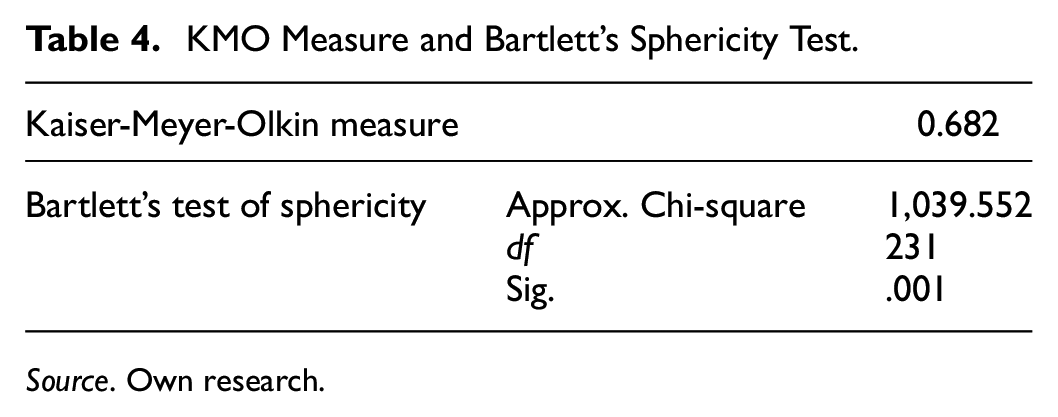
The Cronbach’s Alpha coefficient is .626, which can be considered a satisfactory result. The initial requirement for conducting factor analysis was fulfilled. Subsequently, the KMO index value was calculated. Its value was equal to 0.682, which is an acceptable result (see Table 4). Lastly, it was needed to verify the result of Bartlett’s Sphericity Test, which indicates whether factor analysis can be utilized or not.
KMO Measure and Bartlett’s Sphericity Test.
Source. Own research.
The resulting significance was equal to .001 (Table 4), confirming the presence of a correlation between the variables. Therefore, it can be affirmed that factor analysis can be employed.
The principal component method, Varimax rotation, and Kaiser’s rule (the value of “Eigenvalues” is greater than 1) were utilized to perform the factor analysis. The initial set of 22 statements was transformed into six new factors (see Table 4). These six factors explain more than 60% of the variance of the entire battery.
As can be seen in Table 5, the rotated matrix contains several cross-loadings. A “cross-loading occurs when variable loads at 0.32 or higher on two or more factors” (Costello & Osborne, 2005). In this case, a complex structure is formed. All variable loads higher than 0.3 in absolute value were shaded in order to see occurring cross-loadings, these shaded entries are visible in Table 5. There are several ways how to deal with cross-loadings and create a more simple structure. According to Hair et al. (2010), cross-loadings lower than 0.35 (in some cases lower than 0.4) are not significant, especially when there is a difference of 0.1 or more between the cross-loads. Therefore variable “I like to try coffee that is made abroad” was assigned to Factor 2 and the variable “I will purchase coffee produced outside the EU with confidence” was allocated to Factor 5. Sürücü et al. (2022) suggest that when the cross-loading value is more significant and there is not a difference of 0.1 or more between the cross-loads, it is recommended to remove the problem variable from the analysis. However, the authors explain that it depends on the design of the study, cross-loading items may not be excluded from the analysis based on the main assumption that it is the latent nature of the factor involved. It applies when the higher factor load of the variable is under the right factor in terms of the logical relationship between the variable and the factor. This approach has been used in the case of dealing with remaining cross-loadings. By the variables “I will purchase beer produced outside EU with confidence” and “I will purchase wine produced outside EU with confidence” there are significant cross-loadings to Factors 2 and 5. These variables were not excluded from the analysis as they have been assigned to Factor 2 due to their logical relationship with this factor and due to having the highest load with this factor. Variable loads that were ultimately assigned to each factor were highlighted in bold and darker shading (see Table 5).
Rotated Component Matrix With Factor Loadings.


Source. Own research.
Note. F = factor.
The first new factor was given the name “Confidence in EU-made beverages” (Factor 1). It includes a total of four original statements, which indicate that consumers would confidently buy all four beverages (wine, coffee, beer and tea) that are made in the EU. The second factor was called “Testing beverages made abroad” (Factor 2) and includes a total of six original statements. These claims mainly express interest in trying beer, tea, coffee and wine that are made abroad. Two other statements are included in this factor, they relate to the willingness to buy wine and beer that are made outside the EU. The third factor was marked as “Preference for domestic beverages” (Factor 3) and includes four original claims that indicate a strong preference to purchase beverages that are made in the Czech Republic. The next factor was called “Importance of country of origin” (Factor 4) and contains four original statements as well, they indicate that consumers look at the country of origin when buying these beverages. The fifth factor was named “Confidence in coffee and tea made outside the EU” (Factor 5). It includes two original claims that relate to the willingness to buy coffee and tea that are made outside the EU. The last factor was marked as “Quality based on country of origin and certification” (Factor 6) containing two statements indicating that the country of origin is a sign of the beverage quality and that when buying beverages, consumers prefer a beverage with certification of origin.
Afterward, a cluster analysis was performed using six newly formed factors (output of the factor analysis). First, hierarchical clustering was performed by applying Ward’s method and Euclidean square distance of similarity measure. Using the hierarchical clustering method, the number of clusters was set at four.
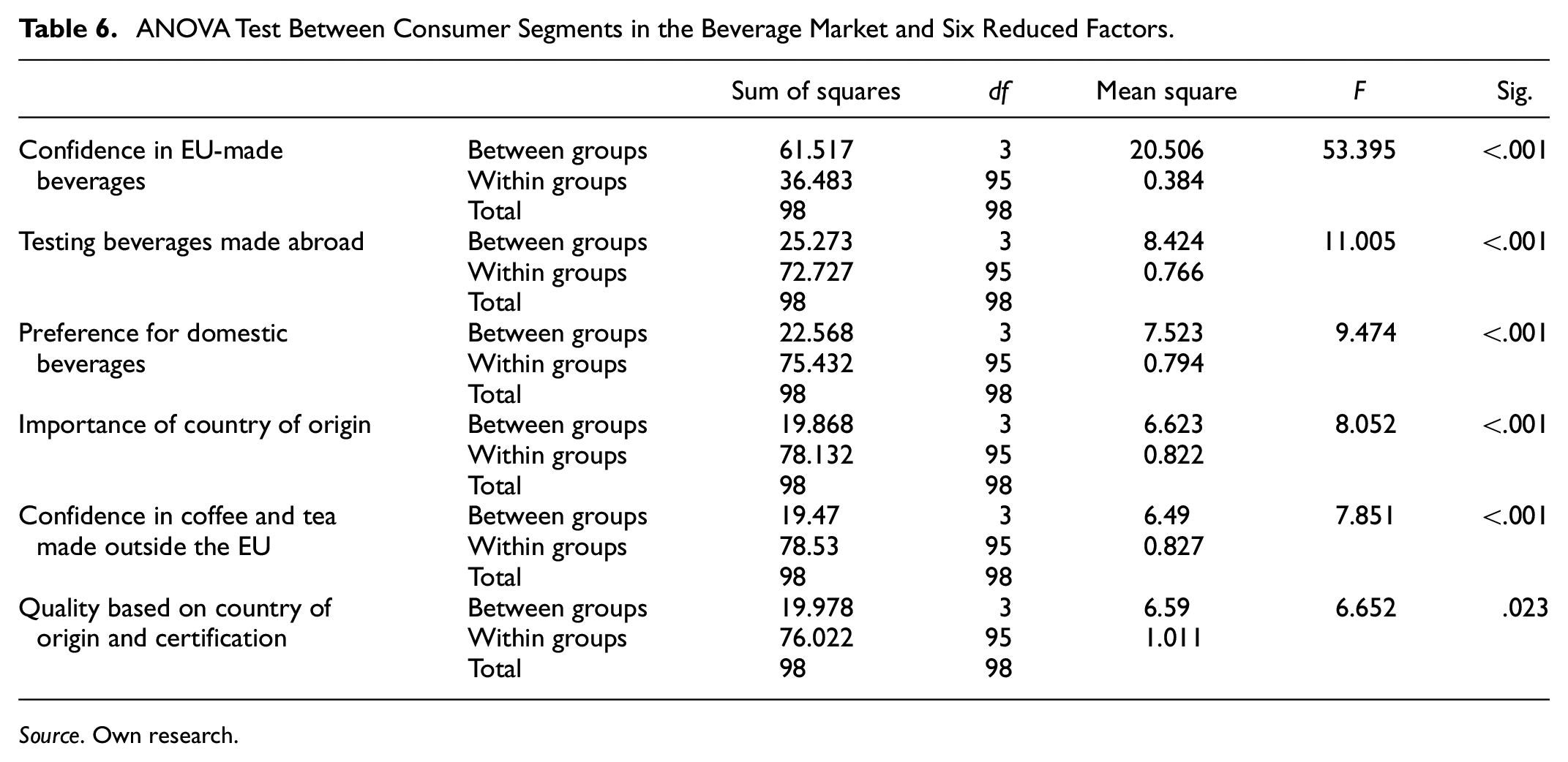
Next, these four clusters were created not only using hierarchical clustering but also through the non-hierarchical clustering method, specifically using the K-means method. The results of both approaches were compared. The non-hierarchical approach (K-means) was chosen for the final clustering because more logical, equally sized and more interpretable clusters were created. Finally, these four clusters were validated using the ANOVA test (see Table 6) to confirm whether the mean values of variables for the observed cluster are identical or not. The obtained findings indicate significant differences regarding the mean values of variables. It follows that the number of clusters can be considered definite and confirmed.
ANOVA Test Between Consumer Segments in the Beverage Market and Six Reduced Factors.
Source. Own research.
The newly formed clusters were named according to the mean values of the factor scores shown in Table 7, which express the attitude of the individual clusters toward the newly created factors. Minus values of the factor scores indicate that the segments evaluate these factors positively. Conversely, plus values mean that clusters assess these factors negatively. Loadings near −1 or 1 indicate a strong influence of the factor on the variable, while values near 0 mean a weak effect on the variable.
Factor Scores in Particular Clusters.

Source. Own research.
The first segment was called “Experimenters” and includes 92 respondents (23.2%). The second group was entitled “Picky Consumers”. This segment has 84 respondents (21.2%). The third cluster was given the name “Patriots” and incorporates 96 interviewed people (24.2%). The last, fourth segment, was called “Pro-Europeans” and includes 124 respondents (31.4%).
Experimenters are characterized by the fact that they like to try beverages that are made abroad. This characteristic is the most significant for them. They would buy beverages made in the EU with confidence. These consumers are also not averse to buying coffee and tea that are produced outside the EU. They are also characterized by being the least likely to prefer beverages that are made in the Czech Republic. The importance of the country from which the beverage originates is average.
The most striking feature of Picky consumers is the significance of the country of origin. They consistently consider the country of origin when purchasing beverages. This is also reflected in the ratings of the other factors. Confidence in EU-made beverages is low, these consumers also do not strongly prefer domestic beverages, but they slightly trust coffee and tea from non-EU countries. It can be assumed that they usually decide according to the specific origin of a particular beverage.
Patriots prefer beverages made in the Czech Republic, compared to the remaining segments. The most typical feature of this segment is that they would not buy EU-made wine, beer, coffee or tea with confidence. At the same time, they are not very confident in buying coffee and tea made outside the EU either. In addition, the COO role is not very crucial for them.
For Pro-Europeans it is characteristic that they will confidently buy coffee, tea, wine and also beer made in the EU. Compared to other segments, they agreed with these claims to the biggest extent. On the contrary, they would not buy coffee and tea made outside the EU. They rather prefer domestic beverages as well. These consumers do not like to test new beverages that are made abroad, they do not like to experiment. As this segment heavily prefers EU-made beverages; they have been called “Pro-Europeans.”
Characteristics of Consumer Segments by Socio-Demographic Factors
Four newly created consumer segments in the beverage market were further described and profiled according to socio-demographic variables (see Table 8).
Socio-demographic Characteristics of Consumer Segments in the Beverage Market.

Source. Own research.
Experimenters are for the most part women (60.9%), which distinguishes them from the other segments, where both genders are more equally represented. This segment is represented by a rather younger population, almost 90% of this segment are consumers aged 20 to 54. Consumers over the age of 65 are the least represented here out of all other segments. The majority of Experimenters have a college degree (60.9%), and people with compulsory education are the least represented. This segment is therefore the most educated. Their average net monthly income is also the highest compared to other segments with 13% of respondents with income higher than 40,000 CZK.
The Picky consumer segment is made up of 52.4% women and 47.6% men. Almost 62% of this segment are younger consumers aged 20 to 44. The vast majority have high school diploma (57.1%), but also consumers with a college degree are strongly represented in this segment (28.6%). The smallest part of this segment includes people with compulsory education. In terms of net monthly income, consumers with average incomes ranging from 20,000 to 40,000 CZK are mostly represented here.
Patriots are 50% male and 50% female. The biggest part of this group are consumers over 65 years old (25%), and the youngest generation is the least represented. Middle-aged consumers are also heavily represented here. Half of this segment has a high school diploma, another 25% of these consumers have compulsory education and the last 25% have a college degree. The net monthly income of the majority of patriots ranges from 10,000 to 20,000 CZK (37.5%) and between 20,000and 30,000 CZK (29.2%). Their incomes are lowest compared to other segments.
The Pro-Europeans segment is made up of 51.6% women and 48.4% men. For this segment is typical that these are mostly consumers over 65 years old (35.5%) and consumers aged 55 to 64 (19.4%). Concerning education level, the biggest part of this segment has a high school diploma (54.8%) and compulsory education (25.8%). Consumers with college degree are the least represented in comparison with three other segments. Pro-Europeans have average net monthly incomes, mostly between 20,000 and 30,000 CZK (41.9%) and between 10,000 and 20,000 CZK (25.9%).
Dependencies between consumer segments and socio-demographic characteristics including gender, age, education and net monthly income were tested using Pearson’s chi-square test.
Obtained findings support statistically significant differences regarding the consumer’s education level, however, the findings do not indicate significant differences between clusters regarding consumer’s gender, age, and income (Table 8).
Discussion
This study aimed to define consumer typology in the beverage market in the Czech Republic and describe the differences between individual consumer segments with respect to the influence of the beverage origin on consumer’s decision-making process. The four beverage categories (beer, wine, coffee, and tea) were selected for this study as the four most frequently purchased beverage categories by Czech consumers. It is also meaningful to examine the effect of the country of origin in these beverage categories. Furthermore, these beverages usually come from many different countries and the selection on the market is very diverse.
Results of the research show that consumers consider the country of beverage origin to be important, but consumer attitudes toward beverage origin significantly differ according to the beverage category. When it comes to domestic beverages, consumers have a strong preference for Czech beer. The second strongly preferred category, which is of domestic origin, is wine. On the other hand, results confirm that Czech consumers also like to try beverages made abroad. Two categories of beverages that respondents prefer made in foreign countries, even outside the EU, are tea and coffee. On the contrary, beer was identified as a beverage that respondents would least buy if produced abroad.
Drawing from the respondents’ perspectives on the country of beverage origin, four consumer segments were identified, namely “Experimenters,”“Picky Consumers,”“Patriots,” and “Pro-Europeans.” These segments significantly differ in their attitudes toward the country of beverage origin. Experimenters are characterized by the fact that they like to try beverages that are made abroad and are least likely to prefer beverages made in the Czech Republic. The most striking feature of Picky consumers is their emphasis on the country of origin. They consistently prioritize considering the country of origin when making beverage purchases. Patriots prefer beverages made in their domestic country in comparison to other segments. For Pro-Europeans it is characteristic that they will confidently buy coffee, tea, wine and beer made in the EU when compared to other segments.
When comparing these results to other previously published studies, numerous similarities are noticeable. The Nielsen Company (US)’s (2017) global research shows that when buying some categories of beverages such as tea, coffee and mineral water, consumers choose global brands and products made abroad instead of buying domestic beverages. The survey also revealed that in the category of alcoholic beverages, including beer and wine, there is a strong preference for local and domestically made brands among residents of the Czech Republic. Similar conclusions were reached by Wanninayake and Chovancova (2012), who found that Czech consumers fully prefer Czech beer to foreign brands.
The results in this paper partially confirm these findings, but it must be stated that not all consumers have the same preferences. Therefore, the segmentation was done to understand how the country of beverage origin influences different groups of consumers. Additionally, this paper provides a more comprehensive view of consumer beverage purchasing behavior as it examines four beverage categories simultaneously. According to the research results, there are two segments (Experimenters and Picky consumers) that mostly prefer all beverages from abroad, even beer or wine. On the contrary, it cannot be assumed that all consumers would rather buy coffee and tea from abroad. Results prove that Pro-Europeans do not favor beverages from countries outside the EU, more precisely they are least confident in coffee and tea from outside EU production. It can be also stated that the level of consumer ethnocentrism is influenced not only by the type of the product, in this case by the beverage category (confirmed also by existing studies) but by the consumer segment as well (empirical evidence of this research).
In our research, respondents also expressed that they consistently consider the country of origin when purchasing wine. These results correspond with the UK study, that was carried out by Deans et al. (2014) who revealed that, when purchasing wine, the country of origin ranks as the second most significant attribute, with price coming first. These findings show that especially when buying wine, country of origin can be a crucial factor that influences consumer decisions. Bruwer et al. (2024) state that for wine purchases, the resulting COO effect is influenced by consumer ethnocentrism. Similar results were achieved in the research in this paper, as the highest degree of ethnocentrism is shown by the segment of patriots who exclusively prefer beverages originating from the Czech Republic, including wine. Moreover, Galati et al. (2018), point out that in the wine category country of origin (COO effect), identified through the DOC/DOCG appellation, has a significant influence on the pricing of the wine, especially on premium price. It can be considered by sellers in their price strategy.
In contrast to other previously published studies, the typology which was executed in this paper is specific because it considers multiple beverage categories and examines the COO influence on consumer behavior. To create typologies, other authors consider different perspectives, their research is focused on specific foreign markets and one specific beverage category without considering the country of product origin. However, the average consumer does not buy just one beverage category, there are usually several categories of beverages in their shopping baskets. In real shopping conditions, consumers buy different beverages, and their decision-making process can differ from one category to another. Therefore, the purpose of this study was to approach real-life conditions and to segment consumers based on the influence of the COO effect when buying multiple categories of beverages. The findings of segmentation in this research cannot be directly compared to any other segmentation study on the beverage market, as none of them focus on either the COO effect or on several categories of drinks at the same time.
Conclusion
The role of product origin is especially relevant in international business, where firms try to leverage the country of origin as an advantage over the competition or to overcome negative stereotypes or biases. A key contribution of this study is the empirical evidence that the COO effect is not universal but varies across product categories and consumer segments as well. More precisely, the research results show that when considering beer and wine purchases, Czech consumers are very ethnocentric, and the country of product origin plays a big role in their decision-making process. Conversely, the COO effect is not as strong when buying tea or coffee; consumers are happy to buy products of foreign origin, from different countries, even outside the EU. The results further show that there are several segments in the beverage market, each of which is influenced by the country of origin to a different degree. A quarter of the market is occupied by the Patriots segment, who exclusively prefer beverages originating from the Czech Republic and the COO role is not so important for them. On the other hand, an equally large group consists of Experimenters who prefer foreign production, and the beverage origin is relatively important for them. However, the country of origin is the most important factor for Picky consumers. Finally, the Pro-Europeans, who are the largest group in the beverage market, buy both domestic and European production and are not much driven by country of origin, similarly to Patriots.
The COO effect can shape consumer attitudes and influence consumer behavior toward products and brands. More in-depth knowledge about how the country of product origin influences buyer behavior is of great importance for the beverage industry to increase its completeness. Companies can exploit this knowledge by emphasizing the positive attributes associated with their country of origin or by trying to overcome negative stereotypes or biases associated with certain countries.
Therefore, companies need to take the COO effect into account for each beverage category, when developing marketing strategies that leverage its impact, especially in the context of beer and wine sales. As Foroudi et al. (2019) confirmed in their study, increasing the knowledge of consumers could help to change their former prejudice against a particular country of origin. At the same time, they should also consider the differences between consumer segments, which attach different degrees of importance to the country of product origin. It can be concluded that almost half of Czech consumers consider the country of origin when purchasing beverages and are driven to some extent by this factor. In addition, the knowledge of the COO effect in the beverage market and how it influences consumers can help retailers make decisions about the product assortment offered and select the beverage portfolio that consumers will be most interested in.
The scientific contribution of this study is mainly connected with the identification of a research gap in the existing literature and the proposal of segmentation based on new criteria—the country of product origin as a determinant influencing consumers in the beverage market. Followed by the creation of novel methodology, while extending existing methodologies. The research therefore provides a deeper and more comprehensive insight into consumer decision-making when buying multiple beverage categories with respect to the COO role.
This study has potential limitations, these are mostly connected with sample and selection bias. The sample does not perfectly reflect the general population, only gender and age match the structure of the Czech population. There are visible limitations in terms of the education structure of respondents. Additionally, there was no access to the geographic scope of respondents, therefore it is possible they were not evenly distributed from the geographic point of view. Another possible limitation can be due to the absence of previous research studies concentrating on consumer typology in the beverage market when considering attitudes toward beverage origin. The results of this study are relevant to the Czech market, it can not be proven that they are applicable internationally. Future research will be focused on overcoming these limitations and examining the typology of consumers in the beverage market from other perspectives as well. Finally, future studies could focus on consumers from other countries as well. It would be interesting to see how the country of beverage origin influences consumers abroad, in order to be able to establish universal conclusions applicable and international consumers.
Footnotes
Declaration of Conflicting Interests
The author(s) declared no potential conflicts of interest with respect to the research, authorship, and/or publication of this article.
Funding
The author(s) disclosed receipt of the following financial support for the research, authorship, and/or publication of this article: The study was developed with the support of the SGS project provided by VSB – Technical University of Ostrava No. SP2023/052 “Determinants of Consumer Behavior and their Influence on Typology.”
An Ethics Statement (Including the Committee Approval Number) for Animal and Human Studies
It is not applicable.

Data Availability Statement
Data sharing not applicable to this article as no datasets were generated or analyzed during the current study.