




Abstract
This article aims to achieve an experiential study of cinematic representations of females in Chinese films through quantitative narrative analysis. Applied to a census of 360 Chinese films across various genres produced across 18 years (2001–2018) systematically selected on Mtime, we ask to what extent female characters in Chinese films are empowered? How is their power exercised? And what socio-cultural implications can be detected from the cinematic representations of women in the contemporary Chinese gender discourse? We aim to fill in the gap in Chinese cinema studies in which most scholarships focused on pre-2000 works, adopted qualitative textual and narrative analysis to interpret the representations of women in a particular genre or in typical cases, leaving the quantitative approach, particularly focusing on the post-2000 films, all but absent. We develop a systematic set of typologies, including 4 major power-level categories (power-over, power-to, power-with, and no-power) and 12 deuterogenic ones, which can be applied for future research on Chinese film and media studies. While women’s career success has been articulated with empowerment, independence, subjectivity, and ambition in the neoliberal rhetoric, our research reflects a more intricate relationship between cultural representations of women and power in contemporary Chinese films.
Introduction
The issues of gender inequality have attracted considerable attention in the fields of Chinese media, film, and cultural studies, especially in the 21st century, where Confucianism has continued to be upheld by the People’s Republic of China (PRC hereafter) as an essential component of Chinese culture, including in a commercial context (R. Chen, 2011; Song, 2003). This re-engagement with Confucian values furthers the political purposes of the Communist Party in myriad ways, one of which involves advocating women’s domestic roles and marriage to men as a necessary measure to preserve social stability (R. Chen, 2011; Song, 2003). From another perspective, the development of marketization and privatization in contemporary consumerist China has led to an emergence of (post-)feminist discourses, becoming highly visible, especially in Chinese media and film, where many female characters are seemingly represented as independent and powerful (T. Hu, 2019). Thus, we are interested in whether portrayals of women in Chinese films are truly empowered, and if so, how said power is exercised.
Literature Review
The female figure has been a popular research focus in Chinese cinema studies. One of the most frequently adopted perspectives pays attention to prominent films made by female directors (e.g., Berry, 1988; L. Hu, 2017; Wang, 2011), particularly films by Ann Hui (e.g., X. Sun, 2010) and Sylvia Chang (e.g., T. Cai, 2014), as well as by male directors, such as Stanley Kwan, who have focused on portrayals of women (e.g., Zheng, 2010). Representations of the female victim and the female warrior have attracted considerable scholarly interest, particularly the woman warrior in martial arts (wuxia) films, most of which works adopt the film cases before 2000.
Studies of the female victim have primarily examined either the ways in which women have been victimized by the feudal or patriarchal system (Cornelius & Smith, 2002), or the relationship between the female victim and the nation (Cui, 2003). For instance, by studying Shuqin Huang’s prominent film Human, Woman, Demon 1 (人鬼情, 1987), one of the leading female directors among the fourth generation of film filmmakers, 2 Dai (1989) argued that female characters in the fourth-generation filmmakers’ works were generally placed somewhere between beautiful goodness and sacrificial offerings, and represented as sexless or de-gendered. Berry and Farquhar (2006) have similarly argued that the representation of the female victim can be seen as a symbol of national crisis or progress. Exemplified by the characters that have been portrayed by the iconic Chinese actresses, Lingyu Ruan 3 and Li Gong 4 in the 1930s and 1990s films.
The literature on women warriors, mostly in the pre-2000 film works, including the woman warrior in martial arts films (R. Cai, 2005; Y.-c. Chen, 2012; Edwards, 2011; Funnell, 2014), the Maoist socialist female soldier (Y. Chen, 2008; W. Sun, 2008), and the Chinese Bond girl in Hollywood (Khoo, 2007), have focused on female identities, their social missions, and connections between the representations of women and socio-cultural discourses. To be specific, one of the most famous female warriors, who has been frequently been represented in various media formats, including films, TV serials, and cartoons, in China and overseas, is Hua Mulan, 5 a fictional female figure in the narrative poem, The Song of Mulan (木兰辞), written during the Northern and Southern Dynasties (AD420-589). 6 As a classic woman warrior, Mulan’s story has been the basis for many writers, critics, and audiences to debate key features of “the Chinese moral and social universe,” as Edwards (2010, p. 177) called it, particularly in regard to how individuals manage competing demands from their families and the central state. By focusing on Ang Lee’s Academy Award-winning film, Crouching Tiger, Hidden Dragon (卧虎藏龙, 2000), R. Cai (2005) has argued that the martial arts world does not exist in a social or ideological vacuum; its wildness and irregularity are recognized and verified through interaction and negotiation with social expectations, especially in relation to gender norms. In the Maoist era, from 1949 to 1976, cinematic representations of the woman warrior mainly served the political requirements of the CCP, depicting women as revolutionary soldiers, and supporters or builders of socialism who were saved or liberated by the CCP. In this period, revolutionary films were a major source of the great body of cultural and artistic creations aimed at “indoctrinating” people into socialist norms through entertainment (W. Sun, 2008, p. 97). Later in the 1960s and 1970s, during the decade-long Cultural Revolution, women were further politicized and militarized to be constructed as the CCP’s loyal soldiers, who, like their male counterparts, were seen fighting or sacrificing their lives for the nation. This shift was due to the CCP government’s promotion of women’s liberation, with women seen as potential workers in the new economic system, though inequalities in employment opportunities and payment continued to exist (Cornelius & Smith, 2002).
Besides a large amount of scholarship on the representation of the female victim and warrior in pre-2000 Chinese cinema, sporadic studies have paid attention to some other female representations across various media forms, including the female migrant worker in mass media (W. Sun, 2004), the white-collar worker (Yu, 2018), the divorced woman in TV dramas (S. Cai, 2016), the woman seeking love (Li, 2016), the single woman in news media (Gong et al., 2017), and the urban woman in Chinese magazines (S. Sun & Chen, 2015). However, most of these studies have focused on pre-2000 works, and adopted qualitative textual and narrative analysis to interpret the representations of women in a particular genre or in typical cases, leaving the quantitative approach, particularly focusing on the post-2000 films, all but absent in Chinese cinema studies.
Particularly for research that specifically examines the representations of cinematic women and their power relations with men in post-2000 Chinese cinema, T. Hu’s (2021) monograph has identified three major representations of women in crime films including the female victim (who suffers from violence), the female perpetrator (who uses violence to defense), and the female professional (who tend to be kept away from victimization and perpetration) to show up passive and active, all of which reinforce a sense of male dominance and patriarchal power. Given T. Hu’s (2021) book adopts a qualitative narrative analysis, she only focused on three major types of female representations engaging in violence, particularly in the genre of crime films, by analyzing 10 films as case studies. Thus, developed from her typology, this study utilizes a quantitative method of narrative analysis to investigate the cinematic representations of women across various genres and the ways they use power in the narrative context of Chinese films. It does not only attempt to achieve a methodological innovation in Chinese cinema studies by calling for quantitative research but also tests Hu’s arguments in a broader film database and explores more different types of female representations beyond Hu’s typology.
The new market-driven economic reconstruction in post-Maoist China is closely related to the gender/feminist politics in China and leads to an increase in women’s studies in China along with the growing impact of Western theories and ideas in the post-reform era. Spakowski (2011) notes that one of the hallmarks of feminism in China is the pursuit of a global identity for Chinese feminism, indicating how feminists in China respond to the importation of western feminist ideas (p. 33). The theoretical writing of women framed a new platform for academic research as well as critical reflection on the changing situation of Chinese women.
Women’s agency has become an important focus of studying Chinese women and feminism under the influence of western feminist theories. Women’s subjectivity has been advocated and appreciated to challenge the neutralized gender ideology previously imposed in Mao’s era. Particularly, women’s public participation has been improved in Post-reform China. By 2020, women made up 67.794 million of the workforce in metropolitan areas, an increase of 39.5% from 2010. In general, 43.5% of women in the workforce are female, and also an increasingly significant role for women in business management (National Bureau of Statistics of People’s Republic of China, 2021). Yet, women are still expected to undertake double roles in both the public and private spheres.
However, under Xi’s power consolidation in his third term, traditional roles of women are likely amplified in contributing to the traditional family virtues of the Chinese nation. Along with the required 30-day “cooling off” period for couples seeking a divorce, the recently passed Family Education Promotion Law, and the three-child policy, the Party-State appears to favor paternalistic agendas aimed at women. The focus on “women’s particular role in fostering family virtues” is increasing the essentialism of women’s domestic gender roles and further disadvantages women from participating in politics in the face of more tangible obstacles. The domestic role of women has been consistently promoted through re-engaging Confucian traditions in ways that fit the Party-political State’s ideology, so upholding the conventional belief that marriage and women’s subservience to males ensures social stability. Even though the actual burden of domestic affairs on women has not been reduced by any significant level at any period of time, the political rhetoric has been able to alter its value for political interests.
In light of the previous conceptualization and theorization, we ask to what extent female characters in Chinese films are empowered? How is their power exercised? And what socio-cultural implications can be detected from the cinematic representations of women in the contemporary Chinese gender discourse?
Theoretical Framework
We draw on Sutherland and Feltey’s (2013) framework for the representations of power and powerful women in films, which originated from Allen’s feminist concepts of the interrelated triad of domination (power-over), empowerment/resistance (power-to), and solidarity-coalition (power-with) (1998). To be specific, Allen (1998) respectively defined “power-over”“power-to,” and “power-with” as “the ability of an actor or set of actors to constrain the choices available to another actor or set of actors in a nontrivial way” (p. 33), “the ability of an individual actor to attain an end or series of ends” (p. 34), and “the ability of a collectivity to act together for the attainment of a common or shared end or series of ends” (p. 35). Sutherland and Feltey (2013) developed these three concepts into a systematic framework for examining women and power in feminist films (see Table 1).
Power and Powerful Women in Film (Sutherland & Feltey, 2017).

Although Sutherland and Feltey’s framework was established in the Western context, we consider it to also be applicable to the contemporary Chinese context. Within the market-orientated and globalized contemporary society, current feminist discussions in the Western context share many common features with socio-cultural discourses in China, where young women have attracted considerable attention along with increasing visibility in various public arenas. With the keywords of women’s power and free choices, contemporary China has engaged with many global (post-)feminist ideas, including discourses around women’s visible femininity, sexiness, and individualistic behaviors. As such, this study considers what cultural insights can be gained by applying a feminist theoretical framework to analyze female representation in Chinese films.
As the chosen Chinese films portray many female characters that lack the requisite power to be considered under the three classes of “power-over” (PO) “power-to” (PT) and “power-with” (PW), we add one more category of “no-power” (NP). To detect how women’s power levels may change in the film, we also add 12 deuterogenic categories: PO to PT, PO-PW, PO to NP, PT to PO, PT to PW, PT to NP, PW to PO, PW to PT, PW to NP, NP to PO, NP to PT, and NP to PW. The clarification and validation of the dimensions and categories used to build typologies serve as the starting point for further articulation of Sutherland and Feltey’s framework. In this vein, our comparative film research has clear aspirations not only to strive for explanation over mere description, but also to expand upon current frameworks. Typology has great conceptual power, derived from its ability to summarize complex patterns of similarities, differences, and relationships. However, its capacity to simplify the complicated phenomenon, structure, and relationships can be potentially problematic in that it can become reified, obscuring the more complex analysis it was supposed to summarize. We do not wish to encourage the reduction of comparative analysis to a categorization of cases, in which a label becomes a substitute for a more concrete explanation. Rather, we wish to detect the changes and tendencies in patterns of film structure; the models are meant to draw attention to these patterns and to pose the questions of why and how filmic representations take the forms they do. Often scholars working on individual cases would have idiosyncratic explanations for the patterns found in that system. Yet, once we identify the patterns of the female characters’ power levels in our selected films, we can begin to conceptualize and explain them more symmetrically.
In doing so, we attempt to contribute to Chinese film and media studies in four aspects. First, we hope to achieve the first experiential study with quantitative narrative analysis of women in Chinese films, in order to break the inertial limiting of Chinese film analysis to a series of individual case studies. Second, as we explore 425 female characters in 360 Chinese films produced across 18 years (2001–2018) across various genres, of which 35 had more than one leading female character, we aim to examine the cinematic shifts in representations of women and female power as they relate to concurrent social change and gender-related policies. Third, we develop a systematic set of typologies, including 4 major power-level categories and 12 deuterogenic ones that may be applicable to future research on Chinese film and media studies. Lastly, we attempt to merge well-established Western feminist theories with the contemporary consumerist Chinese discourse in order to advance Allen’s (1998) and Sutherland and Feltey’s (2013) theories and engage Chinese film studies in the global feminist debates.
Research Methods
This study utilizes a quantitative narrative analysis, applied to a census of 360 Chinese films, to analyze the representations of women across various genres. Based on a purposive sampling approach, the first stage was film selection: selecting China-made films from 2001 to 2018 on Mtime. 7 “China-made” here primarily refers to films with mainland China-led production, which also widely involve coproduction with other regions and countries (e.g., Hong Kong, Taiwan, Korea, Singapore, etc.). We chose 2001 as the start of the timeframe due to the 21st century reflecting an era of prosperity in the Chinese film industry, with high production values, impressive artistry, and a substantial box office within Greater China and overseas. China joining the World Trade Organization (WTO) in 2001 spearheaded a new epoch in the development of Chinese films by opening the Chinese film market to the world and allowing more frequent cooperation with international studios. Concurrently, Chinese cinema has gradually become a regular participant in various international film festivals.
Mtime is an IMDb-like film database, and one of the most popular film rating and ticket-selling websites in mainland China. We chose to select films from Mtime primarily because we aim to examine films that are considered mainstream Chinese dramas. In the most general sense, mainstream drama typically seeks to reflect a seamless cinematic reality that does not attempt to deconstruct or call overt attention to the process of filmmaking as an exercise in the (re)production of reality. In other words, mainstream drama invites the audience to engage in the film world and imagine themselves in it. As Hole and Jelača (2018) have suggested, the narrative imperatives of mainstream drama are generally premised on offering closure and normativity, which is different from art cinema’s conventions of embracing ambiguity. Consequently, mainstream drama is designed to appeal to broad audiences, and is regarded as an effective way of introducing the audience to widely perceived perspectives on social issues, and particularly to, as Hole and Jelača (2018) have indicated, patriarchy and women’s position in society on a transnational scale. This key link between film and social education underpinned our decision to focus on popular films from mainstream drama as the lens through which to explore gender norms in mainstream Chinese discourse.
Following the selection of China-made films from 2001 to 2018, we ranked these films by their numbers of raters, as this essentially indicates a film’s popularity and the amount of attention it has garnered. We then reviewed all the film synopses, excluding children’s films and costume films, and for each year selected the top 20 films with at least one female leading role who has a significant impact on the plotline. The final pool consisted of 360 Chinese films. We exclude children’s films and costume films because we aim to explore the socio-cultural implications embodied in the cinematic representations of women in the contemporary Chinese gender discourse, which leads us to focus on film stories that happened in contemporary society rather than the ancient times or the fantasy world, which are usually the backdrops in children’s films and costume films.
The second stage adopted a narrative analysis method, involving human coding based on a pre-developed codebook and coder training. We draw on the three steps from De Fina et al.’s (2015) theory of narrative analysis, in which a narrative is defined as “a chain of events in a cause-effect relationship occurring in time and space” (Bordwell et al., 2004, p. 69). The first step is to identify the interactions between characters, such as between male and female characters, in the context of plots. Second, the power of narratives is contextualized—in this case, gender relations are considered in relation to socio-political, hegemonic, and patriarchal norms. Third, the narrative is considered in relation to social theoretical concerns—in this case in relation to feminist and postfeminist theories. The codebook was developed to assess each leading female character assigned through viewing. The four major categories include power-over (PO), power-to (PT), power with (PW), and no power (NP), which are defined according to Table 2. Since many female characters’ lives, attitudes, and values may change with the storyline’s development, we add 12 deuterogenic categories to demonstrate every possibility of the transition of their portraits from one above-defined power level to another. These subcategories include PO to PT, PO-PW, PO to NP, PT to PO, PT to PW, PT to NP, PW to PO, PW to PT, PW to NP, NP to PO, NP to PT, and NP to PW, while their meanings correspond to the four major categories.
Power and Powerful Women in Chinese Films.

In addition, the analysis involves four descriptive indicators of the leading female characters, including their work status (e.g., being a professional, housewife, or not mentioned), family ties (e.g., parents, siblings, children, husband, etc.), relationships with the leading male roles (e.g., lovers, friends, colleagues, enemies, etc.), and their end-of-film mortality or consequences (e.g., being dead, together with their lovers, defeating the enemies, etc.) (Neuendorf et al., 2010). We present our findings regarding power dynamics in relation to these four aspects in order to gain some insights into the represented power levels of women in Chinese films, and the ways in which their power levels are associated with men, family, and professionalism.
The team of coders consisted of two graduates and one postgraduate student who had undertaken 10 hr of training on the codebook. Adjustments were made in the coding scheme before final coding commenced. To be specific, the first author and the three research assistants did the first intercoder reliability test by coding 10 randomly selected films (which are not a part of this study) and comparing the power-level categories in that they placed each leading female role. By taking detailed notes, exchanging opinions and reconsidering the power-level definitions (as discussed above), especially when researchers diverged for particular characters’ categorization, this process helped consolidate the evaluation criteria and diminish the differences in perspective generated by subjective film viewing. After the stories were coded and disagreements were discussed, the codebook was refined before moving on to the second intercoder reliability test. This process was repeated three times until the intercoder agreement exceeded 85% for all variables. Then, the three research assistants divided the 360 selected film workload equally (120 films per person). To ensure their intercoder agreement, the research assistants met regularly to share the coding results each time when they finish reviewing 30 films. When differences arose between them, they approached the researcher for further clarifications or a tie-break.
Findings
We were able to identify a total of 425 female characters in 360 films, of which 35 had more than one leading female character. Based on the specificity of the data, we processed our raw data following two objects of extraction. The first data extraction took the female character as the object of study. For the sake of the accuracy of our analysis, we only included those with distinct female power representations in the analysis of power-level distribution. For the second fold of extraction, the film was taken as the object of study, based upon the 325 films without multiple female leads. Considering that the representation of the leading female’s power was the sole efficient ground upon which power level was ascribed to a film, we decided to tailor the films with multiple female leads by removing the ones with dispersive power levels in our final samples. 8 Our aim was to include as many characters as possible from our raw data in the statistic, while still taking film as the object of study. Eventually, we were able to cover 24 films with multiple female leads in the statistic, which culminated in 349 films in the final statistic. The finding and discussion below are based on the overall extraction.
Overall Distribution of Power Levels
Within the four major power-level spectrums, the distribution showed significant imbalances (see Figure 1). Overall, 72% of female characters in films released between 2001 and 2018 were categorized as powerless, while only 12% of the total 425 female characters processed showed a certain degree of self-efficacy (Power-to) (see Figure 2). We also found female solidarity and sisterhood to be barely represented. Of the six films in which female characters engage in collective action with female solidarity, five of them featured more than one leading female character. As for the 15 films showcasing powerful female characters (Power-over), 7 were action films and 3 were labeled as a crime. In general, themes of empowerment and/or resistance to patriarchal power were most commonly represented as females struggling to establish their subjectivity outside of social norms such as marriage and traditionally female-dominant labor forces. According to Figure 1, outside of the four major power levels, two kinds of power transformation, Power-to to No-power and No-power to Power-to, were detected in 29 films. Specifically, characters who experienced power transformation were more likely to end up losing their power entirely, with the theme of PT-NP representing around 72% of total power transformations. Female characters in the remaining eight films were all more or less empowered at a certain stage.

Distribution of power levels (female character).

Distribution of power levels (films/years).
The data also shows some interesting changes in power representations across the films’ 18-year span. First, there was no significant increase in representations of female empowerment; from 2001 to 2008 NP films consistently represented over two-thirds of the data set, with representations of other power levels remaining unchanged. While female empowerment was represented in at least one film each year from 2009 to 2013, the complete absence of any form of empowerment in any single-female character film in 2014 was conspicuous. However, a rebound of PT film occurred in both 2016 and 2017, suggesting that cinematic representations of female power could have been affected by the concurrent policies related to media and popular culture. However, this gap narrowed almost to a vanishing point in 2017, with NP film reaching its lowest point and PT film reaching its highest.
Power Level in Relation to Each Category
Work Status
Overall, over 70% of the films clearly signified the working status of leading female characters. Forty-three percent of the female characters were categorized as working professionals, while a similar proportion’s employment status was unspecified. Only 14 women out of the 425 total female characters studied were portrayed as housewives. Interestingly, the proportions of lead females’ working statuses remained consistent within each power level category. For instance, among 308 no-power women, 120 of them held professional jobs, accounting for 39% of the total (See Table 3). Women whose work status was unspecified made up a similar proportion to those with professional occupations, though a small number of them were mentioned to be students. While similar cases can be found in most of the power level categories, work status was shown to be least important for the storylines of female characters in the PW category. On the contrary, films with a strong representation of female power tended to have a clearer description of women’s working status; the occupational setting was highlighted in all of the PO women’s storylines but one. Among over 150 different jobs on the record, white collar, writer, and celebrity were the most common occupations. The overall data indicate a distinct correlation between power levels and women’s professionalism. While female representation in the public sphere is widely recognized in consumerist China, we found interesting intricacies in the relationship between power and occupational gender distribution. Despite that females were represented in some of the traditional male-dominant occupations such as police officer, signifying power and authority, the majority of these women were nonetheless shown to possess no power.
Work Status.

Family Ties
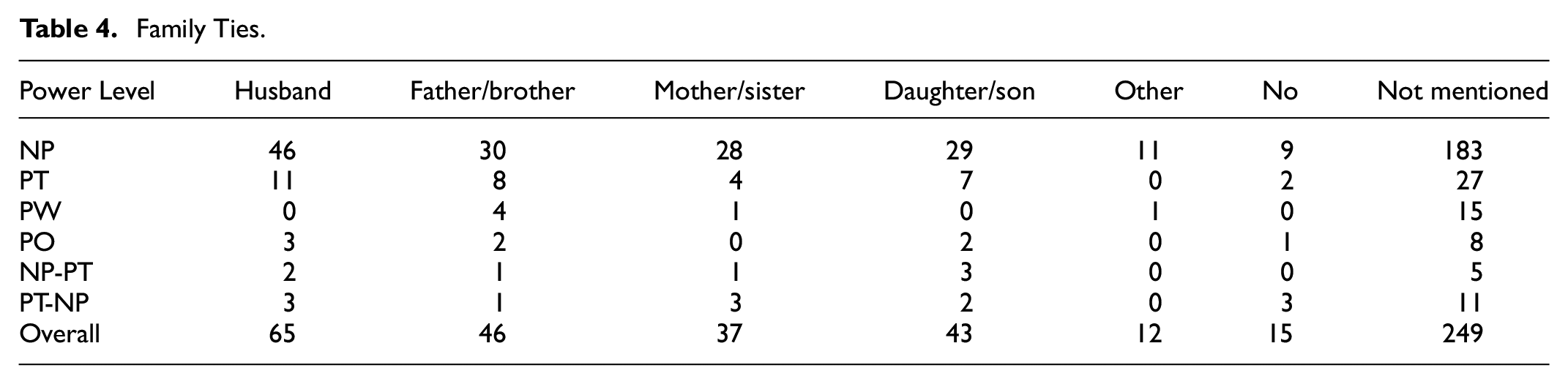
Table 4 presents different tpes of family ties that female characters had in the selcted film. In general, family ties were shown to be considerably less important, in that they were omitted from the storyline of all the selected films. 9 Women in the selected films had few family members with whom to struggle over their work. While over half of the female characters’ family relations were unspecified, 14% were portrayed with spousal relationships.
Family Ties.
Relationship with Men
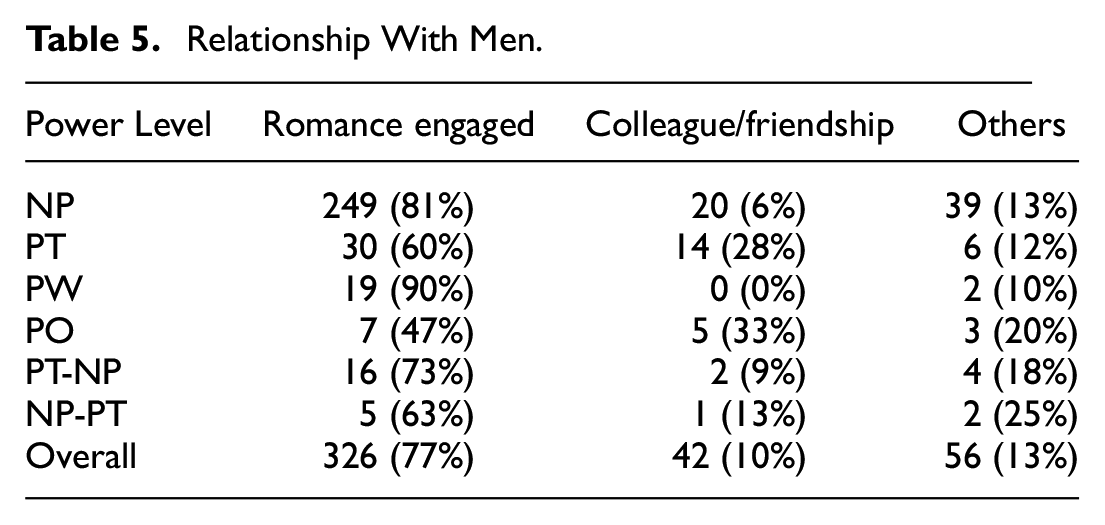
According to Table 5, romantic engagement between the female characters and the leading male characters was shown to be a predominant relationship in all selected films. Among the major categories, a slightly higher percentage of female characters in the PO movies and the PT movies showed a non-romantic relationship with men who were either their friends or colleagues. There was only one alternative in the PW films, where the lead female engaged in a romantic relationship with another woman. This suggests that on-screen heterosexual relationships might be consistently dominant across genres.
Relationship With Men.
Endings
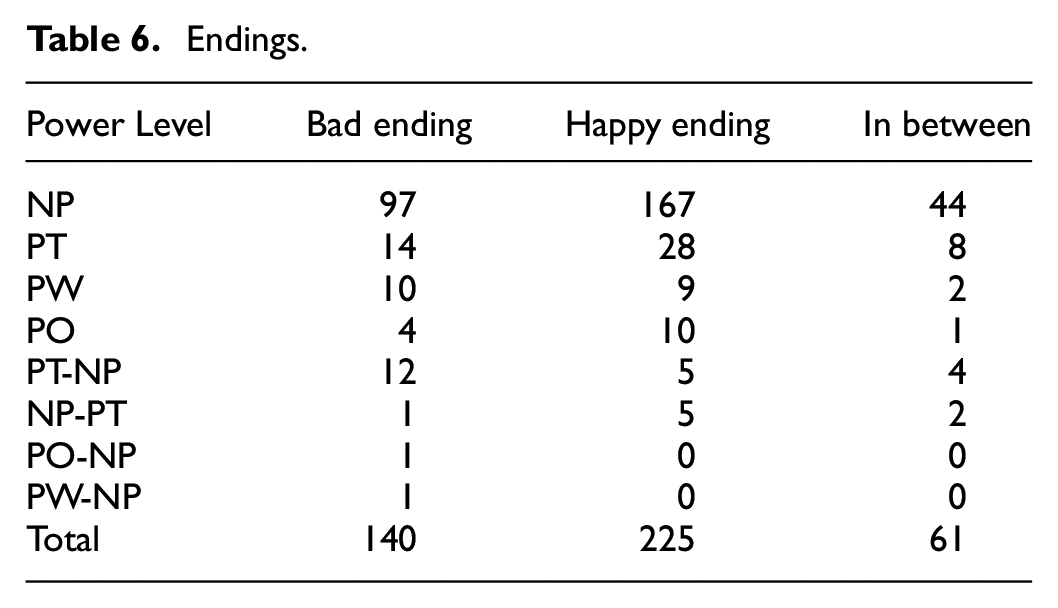
Overall, 53% of the female characters received a happy ending in their storyline. Sixty percent of these happy endings involved romance. While over half of the total female characters achieved happy endings, storylines in the categories of PW and PT-NP showed the opposite (see Table 6). Women who were empowered by female solidarity, or denied power during the power transition, were more likely to be suppressed, with most of them ending up either dead or victimized.
Endings.
Discussion and Implication
Taken together, our study shows that female representation remains in a disadvantaged position in contemporary Chinese films, which overwhelmingly portray men as the central hero of the narrative. While women’s career success has been articulated alongside empowerment, independence, subjectivity, and ambition in the neoliberal rhetoric, our research reflects a more intricate relationship between cultural representations of women and power in contemporary Chinese films.
The high frequency of professional female representation in contemporary Chinese films shows that women’s social status is currently highly recognized and paid attention to. Yet, power-over is hardly seen in our data, mostly appearing when women exhibit a degree of toughness in terms of performing female masculinity or positioning in men’s world. Indeed, of the 15 most powerful women identified, most of them were shown in jobs related to the army or police, in either crime or action films. To some extent, the visibility of female representations in these male-dominated occupations seems to break the gender segregation in work by portraying the professional and physical competence of women; after all, women are dramatically underrepresented in Chinese law enforcement and army in the reality. However, as we investigated these 15 crime/action genre films featuring powerful women, we found that all of them were screened between 2008 and 2018, with 6 being screened after 2013. More importantly, all these films presented a strong theme of patriarchal nationalism.
The increase of nationalist films from 2008 to 2018 suggests that the cinematic representations and the preferences of the genre could have been affected by the political discourse at the time. After Xi Jinping came into power in 2013, he was built up in the media as a strong leader, as the father of the nation who presides over the family-nation. In other words, the nation has been regarded as a big, male-dominated family that needs strong, masculine leadership in the form of Xi as “the paternalistic patriarch” (Fincher, 2018, p. 65). Xi has embraced this nationalist fervor as a sense of “national self-confidence and feeling of pride,” captured in Xi’s signature political campaign, “The Great Rejuvenation of the Chinese nation” (Peters, 2017). In this respect, more patriotic movies were screened in order to whip up nationalistic fervor. On the other hand, this suggests that the presence of powerful female representations in the film is accommodated in a broader political and cultural context. After we traced the total 24 female police officers and soldiers in all films, we found that one-third of them are in fact powerless in their storylines—a much higher proportion than those empowered. In other words, placing female characters in traditionally male-dominated jobs like a police officer, which often appears as a signifier of power and authority, does not automatically mean that the female character is empowered.
Traditional Chinese culture reads masculinity as connoting “a set of noble, moral and spiritual qualities that women were generally regarded as lacking—heroism, ambition, high-minded patriotism and courage of conviction” (Edwards, 2016, p. 59). The strong females presented on-screen do not significantly subvert such stereotyped gender ideals for women. Rather, there is a teetering balance between the masculine and the feminine that underlies strong on-screen female professionals. They could be tough but are also more vulnerable compared to their male counterparts. Their performance in work might be proficient but is often less competent as compared with their male counterparts. As a consequence, a supposedly strong female professional will often experience disempowerment in her storylines, reminding the audience that being female is an inherently fragile position. Such finding echoes what T. Hu (2020) argues in her study of policewomen in Hong Kong films that the gender hierarchy remains solid even in the representation of working women’s increasing status, as women are often placed in a “proper” position to allow their expertise only under male authority (p. 12). However, gender hierarchy in media representation is commonly manifest not merely in Chinese cinema but in a global scale. In Wilson and Backbrun’s (2014) study of female officers in over 100 police films between 1971 and 2011 collected from the Internet Movie Database Power Search (IMDbPS), they found that only 15 films featured female officers in a sole or co-leading role (p. 95).
This is of course not terribly surprising, given the fact that police work is still considered as men’s work—a fact that is fully reflected in on-screen settings. The problem is that shaping these seemingly strong female characters in films creates an illusion that said films make space for female experiences and feature representations of women that differ from their stereotyped gender roles. However, the rising visibility of female professionalism on screen is less subversive than expected. Many films with professional female protagonists portray superficially feminist representations by showing an empowered woman succeeding in traditionally male professions. However, such positive depictions of women do not override the vulnerability resultant of stereotyped feminine characteristics, nor do they lead to a transformation that challenges gender hierarchies. In this respect, the audience is encouraged to accept the current female condition of being proud of ascending to professional roles accommodated within a patriarchal hegemony.
Indeed, our findings reflect the cultural strategy of the post-feminist masquerade of female agency. This implication brings to mind the definition of post-feminism and the post-feminist media discourse, as discussed by McRobbie (2004, 2009), Schreiber (2014), Rosalind Gill (2007, 2017), and others. One similarity between neoliberal and postfeminist discourses is that they both emphasize the centrality of individuals and reject ideas of the social or political (Gill & Scharff, 2011). Post-feminist ideology is an exchange process that “comprises the co-existence of neo-conservative values in relation to gender, sexuality and family life … with processes of liberalization in regard to choice and diversity in domestic, sexual and kinship relations” (McRobbie, 2009, p. 12). According to McRobbie (2009), depicting females in postfeminist media as sexually confident and financially assertive serves to affirm the individualistic rhetoric of empowerment and choice in a consumerist culture (as shown in films featuring professional women) while simultaneously distances feminism as a social fight (as seen in films depicting women’s personal difficulties in which women remain stuck). Representation is no doubt a crucial first step, but the superficial, token-on-screen female only reinforces rigid gender roles and stereotyped constructions of masculinity and femininity. The socially recognized characteristics of masculinity as strong and able are idealized in the process of female characters’ affirmative performance of stereotypical masculinity; the hegemonic construction of femininity as weakness is not being challenged or changed (Özkan & Hardt, 2020, p. 175).
Another notable implication of our findings is the trend of dismissing women’s familial engagement in storylines. In most of our selected films, female characters do not struggle with family members over their work. This is largely due to the fact that they have few family members with whom to conflict. This finding is interesting given that the obligation for women to shoulder two burdens, labor production and childcare, has been prevailing over the past decades in China. Back in the 1950s, in the socialist rhetoric of women’s liberation, women’s agency was articulated around their capacity to contribute to social development in the public sphere, while simultaneously fulfilling their essential roles in the domestic sphere; reaching every aspect of matters in both domestic and public spheres was glorified as the role of “new women” by the state (Ou, 1988, pp. 30–31). In the debates around women’s participation in the public sphere, scholarship on Chinese women’s history shares the proposition that women were not liberated, but burdened by a socialist state’s demands of their contribution to the socialist construction (Andors, 1983; Barlow, 2004; Croll, 2011; Evans, 1997; Rofel, 1994).
The idea of jiaguo tianxia (family-state under heaven) has been highlighted by Xi’s administration. In Chinese news, reporting, and scholarly writing, Xi’s statement that “a family is the smallest unit of a nation while a nation is thousands of families united together” has received extensive citations. The Party-State has increased its interference in marriage and family as a result of Xi’s emphasis. Family-centered discourses have now taken the lead in China following Xi’s focus on “the distinctive role of women in the family.” It would be not surprising to see that the patriarchal family structure is reinforced by reconstructing the domestic role of women and reinforces traditional gender norms in the future cinema.
While the relationship between women and their family members seems to be downplayed in mainstream films, their love lives are largely highlighted. Women’s presence in various social institutions is seen as evidence of female success, in terms of their individual agency and ability to choose what they want without a significant structural constraint, as in McRobbie’s (2004)“female individualisation” (p. 260). In the same vein, one could argue that placing women’s autonomy and free choice in their love life at the center of their narrative also to some extent outwardly presents women’s agency. However, romantic engagement with men is overwhelmingly predominant in the studied characters’ storylines, regardless of how successful or accomplished they are portrayed. Even the female characters who enjoy the highest level of power in the PO films, of which none belong to the romance genre, are routinely depicted as having a romantic relationship with the leading male character. This finding reveals that the core representation of females in Chinese film shifts from their multiple domestic subject positions such as wife/girlfriend, daughter, mother, etc., to the singular emphasized subject position of wife/girlfriend. In this respect, even for the female characters who enjoy the highest level of portrayed power, romantic engagement with the male characters still asserts a dominant position in their narratives. This, to some extent, recalls Schreiber’s (2014) characterization of the post-feminist movie, which simultaneously espouses conservative and liberal values in relation to gender, family, sexuality, and romance (p. 20).
Such amplification of heterosexual relationships in on-screen women’s narratives to some extent corresponds with the PRC’s official discourse on gender and family. The PRC has utilized the favorable content of Confucianism, such as social harmony, respect for authorities, obedience to superiors, devotion to the state, and protection of the family to stabilize the society and regulate the people (Song, 2003). By re-engaging Confucian values in a way that supports the party-state’s political ideology, women’s domestic roles have been advocated in order to encourage a retreat into the family, reinforcing the traditional idea that women’s marriage to men is a necessary measure to preserve social stability. Under Confucian values, taking care of domestic affairs is viewed as a natural, bonded, and fixed duty of women within an essentialist terrain; this means that any other subject position for women could be deprived and eliminated for compromise. In this respect, the absence of familial relationships does not mean women are free from their domestic role; it is just that “the domestic” has been reconstituted by placing heteronormativity at the center of China’s modern private sphere. Intimate relationship has surpassed the traditional “big family” and become the new site of patriarchal embodiment. As Fincher (2018) suggests, married women are seen to provide an outlet for men’s violent urges, perform unpaid labor at home, breed babies, which helps to relieve the aging population and shrinking workforce, and take care of the elderly, which reduces the financial burden on the government’s welfare program. This is consistent with the postfeminist media discourse in advocating women’s social roles in the public sphere only on the condition that they do not challenge masculine power.
The inviolable connection of female characters and their love lives is also manifested in their endings, across the genres, as their ultimate happiness tends to be determined by their romantic relationship. While female characters achieved happy endings in almost all the films studied, over half were based upon the character’s success in love. In comparison, bad endings involved a variety of scenarios, including illness, betrayal, victimization, and death; romance occupied a very small proportion of bad endings. This contrast illuminates a patriarchal society’s limits on women’s desires, constraining them to happiness through “having a thoughtful boyfriend” or “marrying a good man.” This over-representation of women in heterosexual relationships is unsurprisingly situated under a disparity of gender power, where women are still represented as passive agents subjected by men.
While empowerment is often preferable over those of them in a position of powerlessness in the film, representation of female collectivity is considered for providing the possibility of communities coming together in support of social change. However, our findings, to some extent, raise the question of how female collectivity should be comprehended. Even in films where women show power and strength through female solidarity, the story tends to articulate its way back to either drama between them or to the development of the male-female romance. If female solidarity is simply presented as a way of meditation, to cope with the characters’ feminine emotions and weaknesses in their romantic relationships, what is the feminist signification of framing a female collectivity? This misrepresentation re-signifies the meaning of female solidarity by disarticulating it from empowerment and limiting its potential power to subvert the site of patriarchy. As Przybylowicz (1989) reminds us, the establishment of women’s collectivity could be essential for “an effective antihegemonic movement.” (p. 282). However, none of the selected films gives insight into sisterhoods’ struggle for empowerment, let alone the act’s significance in imagining an alternative space beyond women’s subordination in the patriarchal society. Indeed, in our selected films, the possibility of a collective of women subverting the masculinist hegemony is entirely missing.
Finally, the variety of female characters’ bad endings signifies an intolerant attitude toward women’s transgression and empowerment. While in most of the films women are depicted as progressive and empowered in their professions, they very rarely break through patriarchal constraints; when it comes to the women who become stronger, or experience a power-level transition, they are far more likely to be suppressed. As Bielby and Richards (2010) have argued, “the alignment of women with death can be attributed to the “unknowable” quality of each for the male sex.” Representing the death of women allows male authors or filmmakers, in this case, to express the fascinating and threatening quality of the mystery of women, and to contain it (Bronfen, 1992). In respect to power levels, although less than one-third of the powerful women suffered a bad ending at the culmination of their story, all of them die in the end but one. These powerful characters are all soldiers, agents, or police officers—male-dominated arenas—and their deaths are depicted as heroic sacrifices on the job. Such depictions echo the interpretation of female masculinity discussed above: that female strength is exhibited through the characters’ affirmative performance of the heroic death as a masculine action. Yet, such “heroic masculinist death” by no means indicates meaningful empowerment—only a false impression of the embodiment of gender transgression. Their toughness and muscular aggression cannot prevent them from inevitable death, which immediately reminds us that female violence and rebellion lead to a punishable and lethal end. Ultimately, their deaths depict punishment for female boldness and aggression.
Conclusion
This study fills the absence of quantitative projects in Chinese cinema studies by utilizing a quantitative method of narrative analysis to investigate the cinematic representations of women and the ways in which women use power in the narrative context of Chinese films. Drawing on Sutherland and Feltey’s (2013) framework on the representations of power and powerful women in films, which originated from Allen’s (1998) feminist concepts of the interrelated triad of domination (power-over), empowerment/resistance (power-to), and solidarity-coalition (power-with), we add one more category of “no-power” and another 12 deuterogenic categories, which can be regarded as a systematic set of typologies applicable for future research on Chinese film and media studies, and cohere the well-established Western feminist theories with the contemporary consumerist Chinese discourse in order to advance Allen’s (1998) and Sutherland and Feltey’s (2013) theories and engage Chinese film studies into the global feminist debates.
Although our findings do not challenge the long-lasting perception of male dominance in cinematic narratives, we did detect that female characters’ professional competence has been articulated with empowerment, independence, subjectivity, and ambition in the neoliberal rhetoric in the Chinese cinematic context. While mostly being found within films with the nationalistic sentiment, and despite the high visibility of female professionals, women’s highest power level (power-over) only appears when women exhibit a degree of toughness in terms of performing female masculinity or positioning in male-dominated arenas. This constructs women as a signifier of power and authority, even in a masculinist patriotic plot, but does not necessarily make the female character empowered. This conveys the ostensible impression that female power is represented by placing an empowered woman in male-dominated professions; however, these women do not overcome stereotyped feminine characteristics, but rather fail to transform to any degree that challenges the gender hierarchy.
Furthermore, the strong tendency of Chinese films to downplay women’s familial connections and emphasize their heterosexual relationships implies a shift from women’s multiple domestic subject positions to the singular emphasized subject position, in particular, wife/girlfriend, which echoes the PRC’s official discourse on gender and family in concordance with the revived tenets of Confucianism. To some extent, the heterosexual relationship has surpassed the traditional “big family” and become the new site of patriarchal embodiment. This not only maintains the male-dominated status quo, but also delegitimates female solidarity. This construction of the gender discourse can also respond to the long-lasting absence of queer representations in Chinese media, which may be of interest to future research. Thus, we think future research could yield a deeper understanding of the portrayal of minority groups in Chinese films and other forms of media narratives, and compare different groups’ representations in order to render more insight into how Chinese film and media reflect or are shaped by socio-cultural contexts. In addition, besides canvassing the media content only, it would also be worth exploring the audience’s perception toward these different groups’ representations in order to understand to what extent the culturally and socially constructed media narratives are interpreted by the viewers, how they respond to the represented gender issues, and in which ways cultural productions can resist, challenge, and change the existing systems of inequality in China.
Footnotes
Declaration of Conflicting Interests
The author(s) declared no potential conflicts of interest with respect to the research, authorship, and/or publication of this article.
Funding
The author(s) disclosed receipt of the following financial support for the research, authorship, and/or publication of this article: The project is supported the XJTLU Research Development Fund RDF-22-01-079, Xi’an Jiaotong-Liverpool University.

Data Availability Statement
The data supporting the findings of this study are available upon request from the corresponding author, Dr Junyi Cai.