




Abstract
Since 2009, de Munck, Korotayev, and Khaltourina’s pioneering survey has been used to investigate the cognitive qualities of love across cultures, including Russia, Lithuania, the United States, and China. To date, this survey has not been used to probe these values at a subcultural level. Mothers and childfree women were surveyed with an expanded version of the original survey designed to target potential variations in ideology based upon parental status. Both mothers and childfree women reportedly adhere to the cultural norms of romantic love previously found in the United States, but childfree women were more likely to value pragmatic characteristics of love (p = .011). Despite this, both groups disagreed with the statement “Career is more important than love,” suggesting norms of romantic love overcome feminist ideals. This is further supported by agreement from both groups on the previously identified “core attributes” that correspond with Fisher’s affective traits of romantic love.
Introduction
It has been established that romantic love is a cultural universal, albeit not everyone in a given society can express it in the same way (Buss, 2006; Jankowiak, 2008; Jankowiak & Fischer, 1992). Accordingly, psychophysiological characteristics have been documented by evolutionary psychologists (e.g., Fisher, 2004; Loving, Crockett, & Paxson, 2009; Stanton, Campbell, & Loving, 2014) and efforts have been made to identify common cross-cultural characteristics. In 2009, de Munck, Korotayev, and Khaltourina launched a survey that discovered a “common core” in perceptions and ideologies regarding romantic love between the United States and Russia. Since the first study, this survey has been utilized to investigate Lithuania (de Munck, Korotayev, Khaltourina, & de Munck, 2010) and China (Jankowiak, Shen, Yao, Wang, & Volsche, 2015), providing further evidence that romantic love, at its core, is perceived similarly across cultures. Rather, it is in the details of practice that variation asserts itself.
Fisher’s (2004) interdisciplinary model detailed 12 psychophysiological characteristics behind the affective experience of romantic love in the United States. These are (a) “thinking that the beloved is unique”; (b) “paying attention to the positive qualities of the beloved”; (c) “feelings of exhilaration, increased energy, heart pounding, and intense emotional arousal induced by being in contact with, or thinking of, the beloved”; (d) “feeling even more connected to the beloved in times of adversity”; (d) “intrusive thinking”; (f) feeling possessive and dependent on the beloved”; (g) “desiring ‘union’ with the beloved”; (h) “having a strong sense of altruism and concern for the beloved”; (i) “reordering one’s priorities to favor the beloved”; (j) “feeling sexual attraction for the beloved”; (k) “ranking ‘emotional union’ as taking precedence over sexual desire”; and (l) “passionate love is ‘involuntary’ and not controllable.” Interestingly, Fisher, Aron, and Brown (2005) found that neurological and brain pattern changes can also be observed when someone is sexually or romantically aroused. This supports the idea that romantic love is not entirely a social construct by providing evidence of an underlying biological process.
The biopsychological literature has continued to expand in the last decade. Loving et al. (2009) investigated cortisol levels in women when thinking about a romantic partner compared with a cross-sexed friend. The results indicated that cortisol levels increased when women indulged in thoughts about their romantic partner, suggesting arousal. This was confirmed with a notable decrease when the women were asked to switch their thoughts to a cross-sexed friend.
Likewise, Stanton et al. (2014) found that blood glucose levels increased when participants were asked to reflect upon their romantic relationships when compared with friend and routine control groups. This increase in blood glucose level was associated with positive affect as reported by participants. What is also quite interesting about these findings is that the average length of the relationships reported by participants was longer than previous work, suggesting that the psychophysiological influences of romantic love may be maintained beyond the “honeymoon” phase of a relationship.
With a biological foundation established, it should further be expected that common core perceptions can be identified across cultures, while variation in practice may exist. In their pioneering studies, de Munck et al. (2009; de Munck et al., 2010) investigated the underlying beliefs, assumptions, and attributes that Americans, Russians, and Lithuanians associate with being in romantic love. These studies established a core survey that could further be built upon to investigate cultural variations in ideology while validating further existence of the core universal presence of romantic love. It is important to note that the original survey populations showed consistent cultural agreement, with national differences showing a stronger effect than gender.
The purpose of the current study was to further validate the usefulness of the original de Munck et al. survey in investigating universal perceptions of romantic love. Questions were added to the survey to determine if its usefulness remained when investigating practical differences between subcultures, namely, parents/intended parents (hereafter, “parents”) and the voluntarily childless (hereafter, “childfree”). As with the previous studies, I found that the overarching cultural conception of romantic love remained. However, practical variation between parents, specifically mothers, and childfree women did present themselves in the factor analysis.
Among the de Munck et al. survey questions, five repeatedly present as core, shared attributes of love that closely align with affective traits described by Fisher (2004). They are as follows: (a) “I will do anything for the person I love” (altruism); (b) “I constantly think about the person I am in love with” (intrusive thinking); (c) “romantic love is the supreme happiness of life” (self-actualization); (d) “my love will make my partner a stronger and better person” (emotional fulfillment); and (e) “sexual attraction is necessary for love” (biology). All five of these attributes held strong cross-cultural agreement between the United States, Russia, and Lithuania (de Munck et al., 2009; de Munck et al., 2010), despite recorded differences in expression (e.g., see de Munck, 2008). In addition, the later data on blood glucose levels, positive affect, and increased cortisol further support the feelings of exhilaration, arousal, and emotional fulfillment that come with these five shared attributes of love.
Further validating the cross-cultural salience of the survey, Jankowiak et al. (2015) provided the first dataset from an Asian culture. Reporting on a sample from Fudan University, Shanghai, the authors found that the youth of urban China hold many of the same perceptions of romantic love as do their Western counterparts from the previous studies. The question of sexuality was not asked (“sexual attraction is necessary for love”). However, of the remaining four core attributes aligned with Fisher’s (2004) work, the youth of China remain in high agreement with their Western counterparts. It is hypothesized from ethnographic observations that Chinese youth would agree on this fifth statement if asked (W. Jankowiak, personal communications, April 20, 2016).
An additional component was added to the analysis of the Fudan University study (Jankowiak et al., 2015). After completing a factor analysis of the responses, the authors found that participant responses loaded into two primary factors. Factor 1 correlated to statements regarding the idealization of romantic love, including statements such as “love is the supreme happiness of life,” “romantic love can last forever,” and “my love will make my partner stronger.” Factor 2 correlated with statements of pragmatism, including “romantic love needs strong economic support” and “companionship love can last longer than romantic love.” There was no statistically significant difference between male and female responses when comparing the factors with a Mann–Whitney U test.
It is noteworthy that there were strong gendered differences on two specific questions during the Fudan study. In response to the question “sex without love is sadness,” more females than males agreed (p = .003). Conversely, more males than females agreed with “I will do anything for my lover” (p = .003). This is consistent with de Munck et al.’s (2009) original findings with the U.S. and Russian samples, suggesting that females show stronger connections between romantic love and sexual activity than males. Evolutionary psychology research suggests women are more selective in sexual activity and are more keen on eliciting evidence of higher emotional investment (Gray & Garcia, 2013; Symons, 1979). These findings provide conceptual evidence to support that premise.
While the survey has been validated cross-culturally, little has been done to confirm whether it can be utilized for subcultural investigation. To this end, I surveyed a sample of childfree individuals and parents as a way to explore whether ideologies on romantic love were underlying factors that may promote willingness to forgo children. Demographic transition theory suggests that industrialization and a move from rural to urban life results in reduced overall fertility of a culture (Goode, 1970). However, it was predicted that fertility would stabilize once equilibrium was reached (total fertility of 2.1 children per woman). In contrast to this expectation, fertility rates continue to decline in many countries, including the United States (U.S. Census Bureau, 2014). Lesthaeghe (2014) suggested a second demographic transition. Despite refraining from an explicit explanation, Lesthaeghe hypothesizes an emphasis on self-actualization, with the conjugal bond being an end goal in and of itself, may be driving the persistence of the global fertility decline.
One factor, noted in earlier research conducted among childfree couples, is the value placed on the conjugal bond. For example, Blackstone (2014) found that childfree couples are more likely to have an egalitarian division of labor within the home. Emphasizing skill and free time as a nongendered means of distributing tasks, they are less likely to be concerned with “male” tasks versus “female” tasks. Callan (1987) found that the childfree reported more time with their husbands and an increased exchange of ideas and consensus. In considering post-menopausal regret, Jeffries and Konnert (2002) found that childfree women reported little to no regret for their choice. In fact, there was a population of women who were involuntarily childless but chose the childfree lifestyle as a positive response to their infertility.
There is an assertion among the childfree that they have more intimate, romantic relationships (Carroll, 2000; S. Volsche’s personal observations of online communities, 2016). This is supported by a 2013 survey in which relationship quality, relationship maintenance, and relationship satisfaction were reportedly higher among the childfree than heterosexual parents, with nonheterosexual parents reporting in the middle (Gabb, Klett-Davies, Fink, & Thomae, 2013). However, the question remains open as to whether this is a fundamental difference in approach or a result of the available time to invest in what Lindholm (2006) referred to as the “fetishizing” of the romantic pair bond. The current study hypothesized that a fundamental difference would exist between the childfree and parents, with parents holding more pragmatic perceptions of romantic love ideals. In addition, I hypothesized that there would be consensus on the five core characteristics that align with Fisher (2004).
Method
This study utilized a survey format that included applicable demographic questions, de Munck et al.’s (2009; de Munck et al., 2010) questionnaire, and three open-ended questions. The survey took place completely online utilizing social media and snowball sampling via public Facebook shares. Recruitment focused on adults (age 18+) living in the United States. Though responses were received from outside the United States, they were removed from the dataset before analysis was initiated. In accordance with UNLV Social/Behavioral IRB Protocol #838581-1, participants were provided with an online informed consent before any survey questions were presented. As such, the survey was voluntary and participants could opt out at any time by closing their web browser.
Demographic questions included categorical inquiries such as “what is your sex?” (male, female, or transsexual) and “what is your age range?” (18-24, 25-35, 36-45, 46-60, and 60+). In addition, “what relationships with children do you have in your life?” was asked to determine parental status. The options “I do not want children, now or in the future” and “I identify as childfree” were both coded as “2 = childfree” for analysis. All other options were coded as “1 = parent” in that the respondent either had biological children, stepchildren, foster/adopted children, or intended to be a parent in the future.
Initially, both men and women were asked to complete the study. However, due to a small percentage of men responding (n = 51), I removed the men from analysis to avoid gender as a confounding variable between parents and childfree. Therefore, this study focuses on a comparison between mothers/intended mothers (hereafter, “mothers”) and childfree women (hereafter, “childfree”). Likewise, while the initial survey included options for an unattached relationship status such as “single and not looking” or “dating but not committed,” these data were removed for the following factor analysis to avoid relationship status resulting as another confounding variable. As such, all individuals contained in the sample population are in committed relationships or married.
To be consistent with previous efforts (de Munck et al., 2009; de Munck et al., 2010; Jankowiak et al., 2015), I used a forced choice format measured on a Likert-type 4-point scale. Responses were as follows: 1 = strongly agree, 2 = somewhat agree, 3 = somewhat disagree, and 4 = strongly disagree. This helped remove potentially ambivalent responses. In addition, the original de Munck et al. questionnaire was expanded upon to delve deeper into the nuanced variation between parents and childfree. Questions such as “Having children is the ultimate display of love between two people” and “Children complete a marriage” were used to validate the differences between mothers and childfree.
After coding all data in an Excel spreadsheet, they were transferred to SPSS V.22 for statistical analysis. This included an initial factor analysis on all 40 questions. Mothers and childfree women were then compared on the resulting factors using a Mann–Whitney U test. Finally, a chi-square test of independence was completed on each of the original questions from de Munck et al.’s (2009) questionnaire, including the five questions that align with Fisher’s (2004) core characteristics.
Results
Initially, a total of 712 respondents participated in the survey. As mentioned above, I removed all non-U.S. residents before completing analysis. Given that only 51 men responded, I removed these data to reduce the confounding variable of gender. Likewise, given that the initial rational for the chosen subcultures focused on parental status, I further removed individuals who did not respond as being married or in a committed relationship to avoid singlehood as a confounding variable. The remaining sample consists of 541 women living in the United States who are married or in committed relationships. This includes 425 childfree and 116 mothers.
Participants were asked general demographic questions regarding age range, income, ethnicity, and relationship length and type. Nearly half (49.7%) of the respondents were between the ages of 25 and 35 years, yet there were respondents from all age ranges (18-24 through 65+). The mean income was approximately US$102,000 per year, with a range across all standard tax brackets. The sample was primarily White (88.9%), married (65.2%), and in relationships longer than 1 year (90.2%). Potential limitations of the heterogeneity of the sample population are discussed in the “Discussion” section.
The questionnaire responses loaded into two primary factors. Factor 1 emphasized statements idealizing romantic love such as “A loveless life is worse than death,” “Love is the supreme happiness of life,” and “Romantic love can last forever.” In addition, three statements were negatively correlated in Factor 1, suggesting a disagreement with these statements. These are “Romantic love is a fantasy,” “Romantic love is temporary,” and “Career is more important than love.” This last statement regarding career is particularly interesting given the cultural ideology of women in the workforce that pervades the United States and is considered further in the “Discussion” section. Factor 1 has been labeled “Idealized characteristics of the practice of love.”
In contrast, Factor 2 emphasizes pragmatic statements such as “Romantic love needs strong economic support,” “Love is lust concealed,” and “To burn with love is to be cast down to hell sooner or later.” These statements focus on the potential negative emotional outcomes and economic needs of a relationship. Factor 2 has been labeled “Pragmatic characteristics of the practice of love.” Table 1 provides a complete list of the factors, their corresponding statements (both positive and negative correlations as appropriate), and the individual scores from the factor component matrix.
Questions as Loaded Into Factors 1 and 2.

Note. Factor loading was accepted with a score ≥ (±).400.
To compare the overall difference between mothers and childfree, a Mann–Whitney U was used to compare the two U.S. subcultures’ scores on the resulting factors. Given the cultural importance of financial support and emphasis on children within the home, I hypothesized that mothers would be more likely to agree with Factor 2 (pragmatic characteristics) and childfree would be more likely to agree with Factor 1 (idealized characteristics). Contrary to my hypothesis, there was no statistically significant difference between mothers and childfree on Factor 1, while childfree were more likely to agree with statements in Factor 2 than mothers (p = .011). Potential explanations for this are considered in the “Discussion” section.
Finally, I ran a chi-square test of independence on each of the original questions from de Munck et al.’s (2009) questionnaire, focusing on the five questions that align with Fisher’s core characteristics (see Table 2 for a comparison with previous studies). Mothers and childfree agreed on four of the five questions, with disagreement on “When I am in love, I constantly think about the person I love” (χ2 = 8.814, p = .032). Upon closer investigation, childfree women are more likely to disagree with this statement than mothers. However, as a total group, there are still more childfree who agree with this statement (79%) than do not (21%). For this reason, I suggest an artifact in the chi-square, perhaps as the result of the proportion of mothers and childfree in the total sample.
Four Nation Cultural Sample With Current U.S. Subpopulations: Universal Agreement on the Core Features of Love.
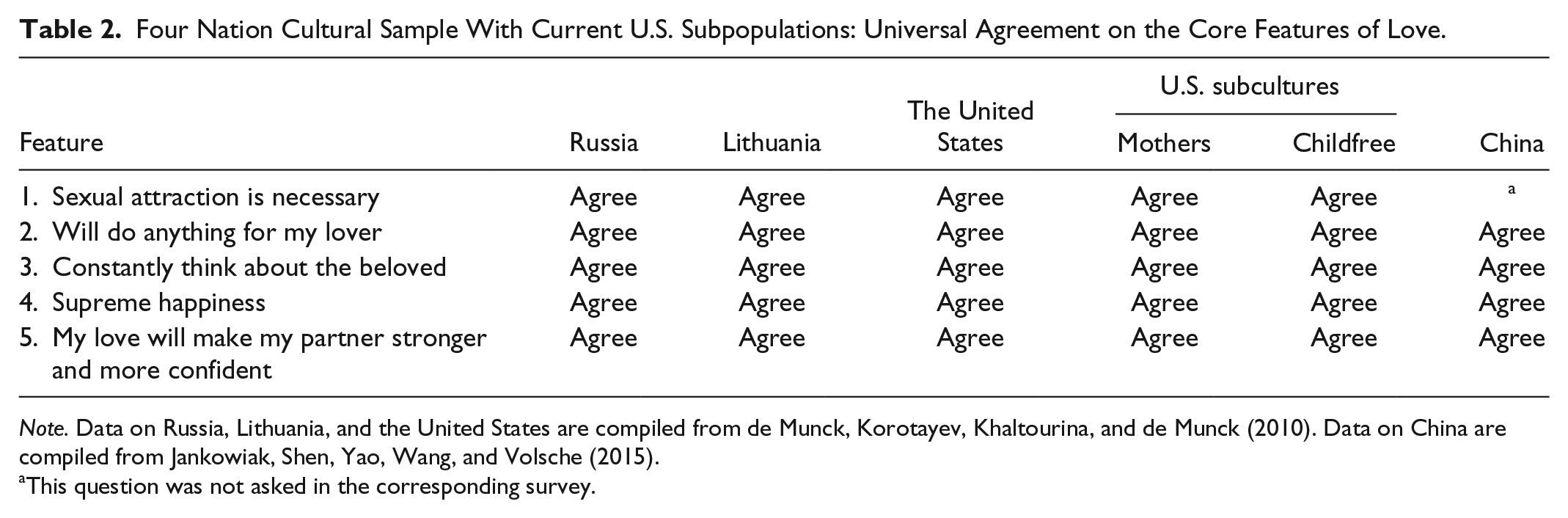
Note. Data on Russia, Lithuania, and the United States are compiled from de Munck, Korotayev, Khaltourina, and de Munck (2010). Data on China are compiled from Jankowiak, Shen, Yao, Wang, and Volsche (2015).
This question was not asked in the corresponding survey.
Discussion
The current study utilized an established survey to investigate subcultural differences between U.S. mothers and childfree women on core characteristics of romantic love. The survey responses loaded into two factors, identified as idealized characteristics (Factor 1) and pragmatic characteristics (Factor 2) in the practice of love. If childfree claims of enhanced feelings of intimacy and romance in their relationships are true, one would expect that childfree women would be more likely to agree with statements in Factor 1 (idealized characteristics) and mothers, focusing on the financial and emotional needs of parenting, would be more likely to agree with Factor 2 (pragmatic characteristics). Unexpectedly, there was agreement on Factor 1, and childfree women were more likely to agree with Factor 2 than mothers (p = .011). This suggests that the previously documented U.S. cultural norms emphasizing the conjugal bond continue to dominate the ideologies of both groups of women, while variations in practical considerations warrant deeper examination.
Perhaps the difference is not in ideology but in the ability to put ideology into practice. It has been found that the romantic relationship of parents often suffers after having children due to increased stress and a reduction in time for bond maintenance (e.g., Gabb et al., 2013). The current study suggests that mothers and childfree women share an ideology of intimacy, closeness, and enduring love. However, ideology alone is not sufficient. Time must be available or scheduled to maintain relationship satisfaction. Callan (1987) found that childfree women reported more time with their husbands and an increased exchange of ideas and consensus. Likewise, Blackstone (2014) found that childfree couples report a desire to emphasize the conjugal bond as reasons for not having children. Childfree women may enjoy more romantic relationships simply because they have the available time to focus on their partner.
Though it appears that no studies have directly sought to compare divorce rates between parents and childfree, Somers (1993) found that childfree couples were more dyadic, quarreled less, and reported fewer threats of divorce during disagreements. Again, this is repeated in Blackstone’s (2014) study in which childfree couples report dyadic discussions on decision making and an egalitarian distribution of labor within the home. This difference in approach to balancing duties in the home and decision making may further explain why the childfree perceive they have a more intimate relationship. Perhaps this focus on partnership among the childfree is further highlighting the dissimilarity in the practice of romance between the mothers and childfree participants. Satisfaction in the mundane relationship likely translates to increased display of romantic feelings, as well.
The findings that childfree are more focused on egalitarianism and dyadic decision making may also explain why the childfree respondents were more likely than mothers to agree with the pragmatic characteristics (Factor 2, p = .011). Childfree women tend to hold less traditional values. Bram (1984) reported that childfree women were less traditional overall, with a stronger emphasis on achievement and professional goals. Likewise, childfree women were more likely to mention companionship as a reason for marriage. Keizer, Dykstra, and Jansen (2007) also found that women in a stable career were less interested in parenthood, and Stacey (1996) suggested that women in traditionally male gendered careers would also be less likely to emphasize motherhood. Given that there is a chronological link between key feminist movements and drops in overall fertility in the United States (see May, 1995, 2010, or Coontz, 2011, for further discussions), as well as the previously mentioned emphasis on egalitarianism, it stands to reason that childfree women would place higher value on a mate who is financially and emotionally self-sufficient.
Initially I hypothesized that mothers would be more likely to agree with pragmatic statements such as “Love without money is not good” or “Love is lust concealed” given the importance of financial support and emotional stability for children. As this is not the case, perhaps the pragmatic choice for mothers is to emphasize the family unit, ignoring or denying a lack of romantic attention from their partner. The edited volume The Secret: Love, Marriage, and HIV (Hirsch et al., 2010) suggests that men’s infidelity is common practice in many cultures. However, for multiple reasons, including the financial support of children, women may ignore or deny their spouses infidelity. While the current study did not ask questions regarding infidelity or other marital stressors directly, it makes sense that a similar mechanism is at play regarding finances, romantic attention, and emotional support.
In the presence of data suggesting childfree women emphasize professional and educational attainment, it is particularly curious that both mothers and childfree women disagree with the statement “Career is more important than love” (86.3% of mothers and 84.2% of childfree). Traister (2016) explained that the proportion of unmarried American women has fallen below 50%, and that the median age of first marriage has increased significantly for those who do eventually marry. Combine this with feminist ideologies regarding women in the workplace and female independence, it seems counterintuitive that childfree women, with their nontraditional views, would prioritize love over career. Childfree women often state that the “right” man is supportive of their educational and career goals (Koropeckyj-Cox & Pendell, 2007; S. Volsche’s personal observations of online communities, 2016).
This seeming contradiction is less so when considering the overall agreement with the five questions that correlate to Fisher’s (2004) core affective traits: “I will do anything for the person I love” (altruism); “When I am in love, I constantly think about the person I love” (intrusive thinking); “Love is the supreme happiness of life” (self-actualization); “My love will make my partner stronger” (emotional fulfillment); and “Sexual attraction is necessary for love” (biology). In light of these questions, and given the universality of the idealized characteristics of romantic love, it appears the pragmatic childfree respondents of this survey continue to highlight the conjugal bond. This may be the result of narrowing our field of respondents to women in relationships or it may suggest that cultural norms overcome feminist ideologies.
Limitations and Future Research
As with any research, there are limitations to this study. Perhaps the most obvious is the use of a self-report survey format. While it was my intention that an online, anonymous format would result in more genuine feedback, there is always the possibility that participants reported what they wanted to be perceived as believing. Given that the survey asks about ideologies and does not necessarily seek to deconstruct daily practice, this seems like a negligible concern. However, self-report surveys are also susceptible to the pit falls of a self-selecting population. This makes it more difficult to generalize the results to individuals outside the demographics of the study.
The demographics of the population present another possible limitation. Nearly half (49.7%) of the respondents were between the ages of 25 and 35 years. In addition, the majority of the sample was married (65.2%) for over 1 year (90.2%), upper middle-class (mean income = US$102,178) and White (88.9%). Clearly it would be difficult to utilize these results when discussing nonmarried ethnic women, particularly of lower socioeconomic status. For example, the luxury of idealizing romantic love or privileging love over career may not be a viable option when an individual must work multiple jobs to clothe and feed her children.
In addition, there was a disparity in the proportions of mothers (n = 116, or 21.4%) and childfree (n = 425, or 78.6%). It is possible that this disparity affected the results. However, given that the results were contrary to the hypothesis, yet in many ways consistent with previous research, I feel confident that this disparity was negligible. Finally, as the sample focused on women who were either married or in committed relationships, these results should not be generalized to women who are not in a relationship or men of any relationship status without further investigation.
It has also been suggested that mothers participating in the survey may have confounded their feelings of romantic love for their partner with feelings of maternal love for their children. While this is certainly a possibility, the language of the survey specifically asked participants to answer questions on “love, relationships, and marriage” focusing on the “most recent committed relationship.” Other questions clearly spoke to romantic partners including questions of sexuality, and the presence or absence of children in the relationship. If participants did, at some point, include feelings directed toward their children when answering this survey, I would propose that those individuals see their children as an extension or expression of the conjugal bond they have with their spouse or partner. Thus, it is unlikely the mothers were referencing their children when answering the survey.
Future research should seek to investigate if ethnicity, socioeconomic status, or relationship status (including those who are single and not looking) affects perceptions of the core characteristics of romantic love. In addition, this study may provide deeper results should questions be asked to parse out the influence of ages and residence of children, as the time constraints on maintaining the conjugal bond decrease as children in the home age and become more independent. Finally, given the increase in voluntary childlessness and other expressions of individualism worldwide, future studies should focus on subcultural comparisons cross-culturally to see how globalization is influencing the human universal of romantic love.
Conclusion
This survey was initiated (a) to confirm whether the original de Munck et al. (2009) survey could be utilized to investigate subcultural variation and (b) to investigate alleged differences in the ideologies of romantic love between mothers and childfree women. The results of this survey suggest that the universality of romantic love persists, despite emic reports from observed groups that intimacy is stronger in childfree compared with mothers. Given that the survey addresses ideology and not practice, it is likely that variations in practice of intimacy are the result of time constraints on parents, especially those with young children. This survey also found that childfree women, with their less traditional views, place more, not less, emphasis on pragmatic considerations within a relationship. It was proposed that this is the result of mothers ignoring or denying reduced emotionality in an effort to prioritize family success over romance or perhaps childfree women seeking an autonomous mate.
Regardless of these differences, both groups of women stated disagreement with the statement, “Career is more important than love.” Though this may be a by-product of focused sampling on individuals in long-term, committed relationships (most of whom were married), it is also possible that despite nontraditional, feminist ideation, childfree women still hold to the U.S. cultural norm of “fetishizing” the pair bond.
Interestingly, the more de Munck et al.’s (2009) survey is utilized to investigate perceptions and characteristics of romantic love, the more universal many of the factors seem to be. Each group studied thus far adheres, at minimum, to agreement on the five statements that align with Fisher’s (2004) affective traits of romantic love. As research continues to shed light on the idealized and pragmatic characteristics of romantic love, one thing seems to remain constant—while the details may change, it is human to fall in romantic love.
Footnotes
Acknowledgements
The author would like to thank Dr. William Jankowiak for his guidance and support on this project.
Declaration of Conflicting Interests
The author(s) declared no potential conflicts of interest with respect to the research, authorship, and/or publication of this article.
Funding
The author(s) received no financial support for the research, authorship, and/or publication of this article.