




Abstract
There have been very few studies in the process of feminization of agriculture in Nepal. The overall purpose of this study was to analyze the changing role of women in high-value agriculture in the postconflict context of Nepal. In this study, we applied qualitative research tools: focus group discussion, key informant interview, on-site observation, and descriptive and interpretative analysis. The study found that after the peace agreement of 2006, the engagement of women in high-value agriculture such as large cardamom and ginger increased rapidly and contributed to the empowerment of women. The study reveals that rural women’s engagement in “women cooperatives” provided them social, economic, and political recognition and decision-making space. However, they are facing additional challenges and risks related to marketing, crop protection, and export to international markets. Though recent policy changes are favorable to address risks and challenges, their effective implementation is yet to be fully realized. This article concludes that the changing political context in Nepal has provided space for women to engage in high-value agriculture. However, women’s engagement is limited to production and primary processing, while further along the value chain, where more profits are made with less risk, women tend to acquire less benefits. The government needs special policy and regulatory provisions and institutional arrangements to address (a) the problem of international export market and (b) the problem of crop protection measures.
Introduction
Agriculture is one of the major contributing sectors to the national gross domestic product (GDP). Even though agriculture provides a significant contribution to the Nepalese economy (Ministry of Finance, 2014), the decade-long (1996-2006) armed conflict severely affected agriculture and rural demography as huge numbers of rural men emigrated elsewhere (Pyakuryal & Upreti, 2016; Upreti & Shrestha, 2016). However, after signing of the Comprehensive Peace Agreement, the situation changed. The CPA has envisioned broad social changes (addressing land and agriculture related issues) and emphasized provisions for inclusion of women (Upreti, 2009) that facilitate higher participation of women in decision making. It also contributed to change the existing landscape of women’s engagement in the political and economic spheres (Upreti, Ghale, & KC, 2016). Women in some areas have used the favorable environment created by the CPA to move to high-value agriculture such as large cardamom (Amomum sabulatum) and ginger (Zingiber officinale), production and marketing (Upreti, Ghale, et al., 2016) which is the focus of this study.
Even though the out-migration was a phenomenon in Nepal once the country opened up to the outside world in 1951 and later due to globalization, the start of the armed conflict in 1996 accelerated migration of male members from rural households to foreign countries for wage labor because they feared both state security forces (who could arrest them if they were suspected of being rebel supporters) and the Maoists (who forced each household to contribute at least one member to the militia). This resulted in females taking sole responsibility of households and agriculture, thus contributing to the feminization of agricultural tasks (Falch, 2010; Upreti, Ghale, et al., 2016). However, as a result of feminization, their work load as well as responsibility is increased, and they are constantly facing time pressures and tension between managing the new responsibilities and performing their traditional roles (KC, Upreti, & Subedi, 2016; Maharjan, Bauer, & Knerr, 2012).
Agriculture made up 33.87% of the GDP in the fiscal year 2012-2013 (Ministry of Finance, 2014), where cash crops were significant contributors. Cash crops have also significantly helped to improve the livelihood of rural women farmers. For Nepal, large cardamom is one of the most important exportable cash crops. Nepal is the third largest exporter of cardamom and one of the largest producers of large cardamom in the world. Nepal exports 90% of the large cardamom to India. India exports it to other countries such as Pakistan and the UAE (International Trade Centre, 2007). Ginger is another important exportable cash crop of Nepal. Nepal is among the top 15 exporters of ginger. According to Trade and Export Promotion Centre (TEPC) data, Nepal exported 2,914.47 Mt. of large cardamom worth US$23.7 million and 27,824.77 Mt. of ginger worth US$6.1 million in 2013. The Trade Policy of 2009 has aimed to implement programs for the commercialization of farming of large cardamom and ginger (Ministry of Commerce and Supplies, 2010) in Nepal.
Table 1 indicates the distribution of workload by male and female involved in part-time work outside home.
Distribution of Employed Individuals by Number of Hours Worked (During Last 7 Days) in Nepal.
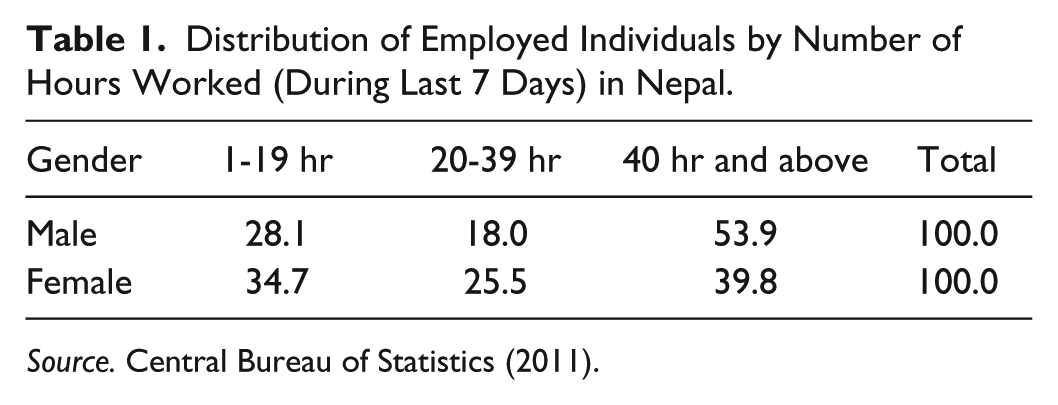
Source. Central Bureau of Statistics (2011).
According to the World Bank record 2016 (reported by the globaleconomy.com) the data from 1990 to 2016 shows that the average value for female labor force participation was 80.54% with a minimum of 79.21% in 1990 and a maximum of 82.75% in 1995. The main employment activity for both male and female is still self-employment in agriculture, which is shown in Table 2.
Distribution of Employed Individuals by Main Sector of Employment in Nepal (During Last 7 Days) (In %).

Source. Central Bureau of Statistics (2011).
According to the Central Bureau of Statistics (CBS; 2012) report, female-headed households stood at 25.73% in 2011, having increased from 14.87% in 2001 mainly due to conflict related displacement and migration of male youth. The policy introduced by the government provided landowners a tax exemption for land registered under the ownership of women. This provision has also contributed to increase women’s access to land.
Even though some recent policy documents like Agriculture Development Strategy, 2014 and Nepal Trade Integration Strategy, 2016 are more reliable and authentic, one of the inherent problems observed in Nepal is the authenticity and reliability of the data generated by different sources, which are sometimes even contradictory. Therefore, relying on secondary data is bit tricky, therefore we mostly used qualitative information in this article.
This rest of the article is organized as follows: Section 2 presents a brief review of the feminization process in Nepal. Section 3 outlines research objectives and methods. Section 4 offers results and discussion. Finally, the Section 5 presents conclusions of the study.
Literature Review: Feminization of Agriculture in Changing Context of Nepal
For the purpose of this article, feminization to agriculture is defined as, “observed process, procedures and practices of enhancement of participation of women in agricultural activities, workforce and decision-making, including its effects on women and existing gender relations.” Studies of De Schutter (2013), Bieri (2014), Food and Agriculture Organization (FAO; 2010a) and Upreti, Ghale, et al. (2016) show that the feminization process is advancing over time. The debate of feminization first used in relation to the feminization of industrial labor was later applied to agriculture (De Schutter, 2013). Feminization became prominent with changes being observed in smallholder agricultural production shift to wage orientation from subsistence farming. Bieri (2014) argues feminization became a catchphrase to characterize the “new ruralites” in high-value crop production as an expression of agricultural transition in the Global South. FAO (2010b) highlights that feminization has changed the socially ascribed traditional less-rewarded role of women. However, the previous studies (J. Adhikari & Hobley, 2011; Gartaula, Niehof, & Visser, 2010; Maharjan, 2010) show that feminization processes in agriculture are, as of yet, not very well documented and systematically analyzed, especially in assessing the role of women in cash crop value chain.
Civil war, armed conflict, and political instability are observed as some of the main contributing factors of feminization (Castillo, 2009; Upreti, Subedi, KC, Ghale, & Shivakoti, 2016). In Nepal, a large number of people (especially male) left the villages during the time of the armed conflict, which has changed the rural labor dynamics added prominent role to women in agriculture. The scoping study of Ghale (2008) also shows that due to the absence of male members in the village, there was not only shift in the labor role of women but also women took leadership roles in the agricultural sector in Nepal, as they were involved in many nontraditional areas like negotiation and household resource allocation. Increasing level of engagement of women in agriculture are observed in the postconflict context because of women’s empowerment and male out-migration (KC et al., 2016; Upreti, Subedi, et al., 2016). The District Agriculture Development Office Ilam (2014) highlights the shift of farmers from other crops to cardamom and ginger because of available space for women in the changing political context of Nepal (Falch, 2010; Upreti, 2009). The study of Upreti, Subedi, et al. (2016) shows that the recent constitutional provisions, institutional arrangements, and policies have provided more opportunities for women to engage in agriculture even when the postconflict situation is theoretically challenging for sustainable agriculture (Ozerdem & Roberts, 2016). Hence, it is important to look at the contribution of the “conflict context” for the feminization of agriculture.
Massive outmigration of male population from villages of rural Nepal added responsibilities to women in managing land and agriculture (Lahiri-Dutt & Adhikari, 2015; Tamang, Paudel, & Shrestha, 2014). Previous studies (J. Adhikari & Hobley, 2011; T. K. Adhikari, 2013; CBS, 2009; Ghale, 2008; Halbrendt et al., 2014; International Labor Organization [ILO], 2014; Neupane & Slade, 2016) show changes in agricultural labor relations after migration of male members. The study of J. Adhikari and Hobley (2011) in Khotang district of the Eastern Hills shows that a large number of men went abroad to work in the Gulf region and Malaysia, which resulted in women taking up the lead role in agriculture. The ILO (2014) in its Nepal country report as well as the National Labour Force Survey (CBS, 2009) show that labor market has changed and women’s engagement beyond traditional household level domestic work has expanded scope for employment and livelihood situations of women and changed their economic stakes (Vepa, 2004) and also added extra work burdens (Lokshin & Glinskaya, 2009; Maharjan et al., 2012). Studies of Maharjan (2010) in the Mid Hills and Gartaula et al. (2010) in Eastern Nepal vividly document evidences of feminization of agriculture leading to agrarian change (Reddy & Mishra, 2009) and alteration in power relations. However, there is less documentation on the analysis of feminization of agriculture on the work burden, physical stress, and psychological hardship of women. Feminization of agriculture has also altered the existing gender relations (Rao, 2012) as well as provided space for women to be rural agriculture entrepreneurs in crops like cardamom (Partap, Sharma, Gurung, Chettri, & Sharma, 2014) and thereby, improved their livelihoods (Avasthe, Singh, & Tomar, 2011; Tugault-Lafleur & Turner, 2009).
Research Objective and Methods
Objectives of the Study
The general objective of this study is to examine the feminization process by assessing engagement of women in large cardamom and ginger farming in Eastern Nepal. The specific objectives of the study are (a) examining the relationship between the conflict context and the process of feminization, (b) assessing the role of out-migration in the feminization of agriculture, (c) examining contribution of awareness in the engagement of women in cash crops, (d) assessing the benefits women get form cash crops, (e) exploring the role of space/mechanisms in women’s engagement in cash crops and associated benefits, (f) relationship between land ownership and feminization of agriculture, and (g) identifying challenges and risk for women producing cash crops.
Study area: The study site is Ilam district. Total population of the Ilam district is 290,245, with 141,126 (48.62%) males and 149,128 (51.38%) females (CBS, 2012). According to the District Agriculture Development Office (DADO; 2014), Ilam is the highest cardamom-producing district in Nepal. In recent years, women’s participation in large cardamom and ginger production in the Eastern Hills in general and Ilam in particular is increasing (CBS, 2009; District Agriculture Development Office Ilam, 2014). This area is climatically most suitable for large cardamom and ginger and therefore almost every household cultivates these two cash crops in the district. Furthermore, the participation of women in cardamom, ginger, and broom-grass production is high in the study area as an outcome of the government’s emphasis in promoting cash crops in this region. Ilam district ranks third highest among the 75 districts of Nepal in terms of social and economic indicators (CBS, 2012). As Ilam is the highest cardamom and one of top ginger producing districts, it was selected for the study.
Research Methods and Data Analysis
In this study, we applied qualitative research methods to collect primary data from July 2014 to April 2015 to capture in-depth information. In addition, we have also used some of the information collected from the quantitative survey conducted from September to December 2015. The following table shows the main methods used to collect the qualitative data and their relations with the research result.
We opted for a narrative approach (Czarniawska, 2004) because of its ability to capture the experiences through stories and narrative description from individuals and groups of respondents. The information was collected within the following interrelated seven thematic groups in relation to female engagement in the cash crops: (a) armed conflict and effects, (b) out-migration, (c) awareness of women on cash crops, (d) commercialization of cash crops and benefits for women, (e) spaces available for women’s engagement, (f) women’s land ownership and feminization, and (g) risks and challenges. We conducted interviews using detailed checklists, observation and key informant interviews in the former Jirmale Village Development Committee (currently Rong rural municipality), where both cardamom and ginger production is concentrated. In addition, we have used information collected from the household survey conducted in September to December 2015 for broader context. The 513 respondents (59.6%male and 40.4% female) who were surveyed represented cash crops nursery owners/growers, traders, and exporters. During the course of the survey, we also collected specific qualitative information related to the feminization process of agriculture, which is used in this article. Among the respondents, age ranged from 18 to 70 and more than 90% of the respondents were literate.

Key Informant interviews were conducted with officials from Ilam Agriculture Development Office, Cardamom Development Centre—Phikkal, Ilam Chamber of Commerce and Industry (ICCI), and cardamom and ginger traders and exporters from Birtamod Municipality of Jhapa District. Furthermore, we collected information from Village Development Committees (VDC), district based statistics offices, cooperatives and farmers’ associations. We also extracted data from secondary sources. Research ethics and safety and security training was provided to all researchers. We maintained strict confidentiality of the collected information from the respondents.
The most important challenge we faced during the field research phase was the difficulties created from the Indian blockade (late September 2015 to April 2016, when the second round of fieldwork to collect data was ongoing) that caused fuel scarcity and the consequent shut down of public transport.
Results and Discussions
In this section, we present the analysis of empirical evidence supported by relevant literature. In this article, we have introduced relevant themes generated from the field research, which are analyzed by using the simple descriptive and interpretive methods. These themes are related to (a) armed conflict and policy responses (b) out-migration, (c) awareness of women about cash crops, (d) commercialization of cash crops and benefits for women, (e) spaces (specific forums and mechanisms such as farmers groups and women’s cooperatives) available for women’s engagement, (f) women’s ownership in land and feminization, and (g) risks and challenges. These interrelated themes are shaping feminization of cash crops in particular and agriculture in general. In this context, in the following sections we discuss major factors/themes (and their magnitudes) contributing to feminization.
Armed Conflict and Feminization of Cash Crops
During the armed conflict, there was massive displacement of male members and consequently female members had to take responsibility of agriculture. The Maoist had vehemently raised concerns over discrimination over lower wage rates to women. Immediately after the peace agreement (2006), many activist women organizations, nongovernmental organizations (NGOs), development donors and political parties also raised the need for giving more space for women in decision-making for empowerment. In response to these concerns raised by different groups, the Interim Constitution of Nepal which was promulgated in 2007 guaranteed 33% women’s participation in all state structures. Many laws and policies have begun to be amended in line with the spirit of the Interim Constitution. The favorable provisions of the Interim Constitution were carried onto the Constitution of Nepal, 2015. Consequently, large numbers of women are present in the parliament, many in senior government positions and women even became the Head of State, Chief Justice of the Supreme Court and Speaker of the Parliament, which has great psychological and administrative implications for the promotion of women’s participation in state structures. Likewise, Agriculture Policy of Nepal and Agriculture Development Strategy (2015-2035) have strong provisions for women’s inclusion in agricultural structures and services. However, the situation of women in rural and remote areas and from marginalized communities is not the same as they are still struggling to fully enjoy constitutional rights and provisions.
Operationally, the traditional roles performed by male members of society and domains of decision making shifted to women once the male members emigrated. The respondents said that their mobility increased, decision making in household issues increased, and the space for dealing with government, market, and political forces also increased. Hence, even if women had more physical work to do, they took decision-making roles and obtained social spaces for negotiation that ultimately empower them socially and economically.
In case of cash corps, often men were engaged with cardamom and ginger collectors and traders in price negotiation. The respondents said that the main reason in the past for not women being engaged with the cardamom traders was their weak bargaining skills. However, this situation has changed. Now women are engaged in price negotiation and other postharvest activities, especially after signing of the peace agreement in 2006.
The respondents frequently shared their observation about changing gender roles in this society. One female respondent said, When I was a young girl, my father and brothers were performing cardamom related tasks because it was cultivated under tree shades in forest-lands and on swampy lands, which was considered as a difficult job for women. However, this practice has changed completely and now all women of our village are performing all cardamom production related activities. This is most evident since the Maobadi dunda (Maoist conflict). (Interview, March 31, 2015; Ilam Bazar)
Another female respondent reflected in this context, “In our village, cardamom was a sole business of my father when I was a child, around 22 years ago. Now I am also actively engaged in cardamom production. However, marketing is still men’s domain as they have more information and networks” (Interview March 30, 2015; Barbote).
The conclusion of our focus group discussion was also similar to the observation/experiences of the key informants whom we interviewed. The male dominated character of cardamom business is changing especially in the production part of the value chain but the marketing part is still largely the men’s domain. The character of Nepali society changed once the Maoists insurgency took coercive approach (physical punishment and threat to the abusers) over discriminatory practices against women. As a result, gender relations started to change and women’s leadership started to emerge and increase (Ghale, 2008).
Furthermore, the key informants and the respondents of the focus group discussion reflect that government policy to enhance the access of women to cash crops, farmers’ strategic choice to move to less labor and irrigation-intensive crops like cardamom and ginger were important factors contributing to the shift to cash crops as well as the feminization of agriculture.
More than 80% of the respondents expressed that there is a change in gender relations in their villages. Before the armed conflict, women were less confident in dealing with economic affairs. After the peace agreement, different provisions have favored women’s active participation. One of the main contributors of such changes was the government’s land administration policy. This policy provides tax exemptions to the purchase of land under women’s ownership, which ranges from 25% in Terai and all municipalities, 30% in hill and 40% in mountain areas and 35% for widows, full waiver for martyrs, identified landless men and women, and 50% for senior citizens over 70 years of age. As Ilam is a hill district, women of this district get 30% tax exceptions. Nevertheless, the common response of all respondents was that they are still lagging behind in deciding cardamom and ginger marketing, especially because of sophisticated and opaque type of trade practices.
Our findings of this study on changing role of women after the peace agreement in 2006 confirms the finding of the recent study of Acharya et al. (2015). They had examined the change in women’s status from 1995 to 2015 and concluded that Over the past two decades, the Government of Nepal has carried out substantial legal reforms to eliminate discrimination against women in the country’s constitutional and legal frameworks. The Interim Constitution’s guarantee of fundamental rights to Nepalese women, including the right to freedom, equality and social justice, presented a particularly important milestone. (Acharya et al., 2015, p. 6)
Acharya (2014) has also argued that the situation of women is changing overtime but there is still a long way to go.
Out-Migration and Feminization of Cash Crop Production
In the past three decades, there was massive conflict-induced displacement and out-migration in Nepal, leading to changes in the social characters of Nepali society. The character of migration was from hill to Terai, from rural to urban and out-migration (for seasonal work to India, and unskilled work to the Middle East and Malaysia). Other push and pull factors contributing to outmigration were unemployment and underemployment, better opportunities and better earning (Upreti & Shrestha, 2016) that ultimately shifted additional agricultural responsibilities toward women.
It is worth noting the statement of one respondent: My husband was not at home for a few years and I had to deal with all issues related to the small area on which we grew cardamom. Production was not difficult but selling at a good price was quite difficult because the cardamom collectors create confusions about the market problems that I did not know about. Therefore, I was in weak position to negotiate. Once my husband came home he took the responsibility of marketing. (Interviewed, April 9, 2015; Godak Village, Ilam)
The study found that women’s roles in cardamom and ginger farming are now visible. Tasks conventionally performed by men, such as land preparation for cardamom and ginger, cutting cardamom flowers from the stem, and drying are now largely performed by women. However, the higher part of the value chain such as engagement in cardamom and ginger price negotiation and marketing are still the domains of male members if they are at home.
One producer and trader of cardamom from Ilam, who has been engaged in this business for more than 27 years, shared his observation about the changes in the cardamom business. His view is that even when women are well engaged in the production side, their engagement in marketing and trade side of cardamom business is still weak. He said, 30 years ago cardamom was a marginal crop and solely the business of male members. Female rarely took part in the production and marketing of cardamom. Once the armed insurgency escalated and the male members of many houses had to leave home from the fear of Maoist threats (forced donation, eviction from home, compulsory sending one fighter from each house, etc.), women had to either take sole responsibility of cardamom business or to shift to other crops. In this situation, many women continued cardamom and ginger farming and they even dealt with its marketing. In my area, I have helped them get fair price with Indian collectors. However, cardamom trading is a very tricky task. Being updated about the market price in Calcutta and other major cities of India, contacting the big traders, dealing with advance payments, negotiating with the traders, often in very informal settings like in the evening at hotels or far away from home like in Birtamod—all this proves very difficult for women to accomplish. Such are the barriers that hinder women from engaging in trading. Nevertheless, institutionalization of cardamom selling via women groups, and coordinated by the Large Cardamom Entrepreneurs Association of Nepal is helping women to participate in cardamom and ginger trading. (Interview, June 26, 2017; Ilam)
It was also noted that male migration had created labor shortages in labor-intensive crop production and therefore people seek other alternative options. High-value cash crops became one of the best options (Upreti, Ghale, et al., 2016) that have influenced agriculture practices (shifting from cereal crops to cash crops) and land management (Schwilch et al., 2016).
In summary, the changes observed in the agriculture sector are the combined effects of (a) contribution of the armed conflict (household role changed while male members displaced from their home/migrated and female members have to take all household related decisions), which was continued in the form of out-migration, and (b) the gender-sensitive policies of the government after the peace agreement.
Women’s Awareness and Their Engagement in Cash Crops
In the past three decades, the level of awareness among the men and women about the need for participation of women is rapidly increasing due to dedicated campaigns, media coverage, women activists, advocacy of the Maoists, and efforts of government and NGOs. Consequently, women’s participation in agricultural affairs increased and they engaged more in cash crop production as an alternative to “traditional agriculture” (DADO, 2014).
In this context of changing roles, a female respondent said: I’ve observed changes in the gender roles in our community. Earlier, male members were responsible for the economic side of the household affairs and activities of female members were limited to domestic care-related activities. However, this situation is changing and both male and female are often taking joint responsibility. Over time, male members of our village have come to understand and acknowledge the crucial role of women in household activities as well as agriculture. Hence, women in our village are supported so that they can actively engage in high value agricultural products like cardamom, ginger, broom grass and fresh vegetables. When male members left for work, women had to continue all activities performed earlier by men. This has drastically changed the livelihood status of households in our village. (Interview, March 30, 2015; Phikkal Village of Ilam)
Key informants’ conclusion on awareness was that women are more assertive in seeking their position in local affairs like agriculture, groups formation or other social activities despite their busy workloads. Regarding the issue of more workload for women engaging in social affairs, one gender and agriculture expert (one of the key respondents) said, Based on my observation and intimate engagement with women in the past 18 years, I have clearly observed that despite increased workloads, women are happy as they become recognized in society and their voices are heard once they are in different committees and positions. (Interview, January; 2017; Kathmandu)
The respondents share that this change in household gender relations is contributed by combination of different reasons such as society’s acknowledgment of women’s role in the social change in their villages, legal provisions, political recognition of the role of women, and proactive engagement of the younger generation of women in household decisions. Nevertheless, increased engagement of women in socioeconomic affairs has some costs in terms of additional workload, time constraints/pressure, which women are taking as consequences of empowerment.
Commercialization of Cash Crops and Benefits for Women
The key informants reflect that the pace of commercialization of cash crops in the study area has changed over time. Until 1990, women did not feel comfortable to engage in trading high-value commercial crops due to their lack of proper knowledge of market prices. A 78-year-old female respondent recalling the past seven decades concluded that the dominant social practice of male members dealing with males and females dealing with females has drastically changed over time, especially in the past three decades. Another important contributor to the increased role of women in commercial agriculture was their involvement in cooperatives. The respondents of the focus group discussion frequently refer that participation of women in forums or mechanisms like “women’s agriculture groups,” “cooperatives,” “users groups,” and so on, greatly helped women in their area achieve other social and economic benefits and recognitions such as nomination in leadership positions or in getting loans from banks or representation in development-related meetings.
Rural women who were not engaged earlier in cash crop production as owners have also secured employment opportunities in cardamom and ginger. The daily wage of women working in cash crops was Nepali Rupees (Rs) 400 to 500, which is almost double the prevailing rate in Ilam.
An important driver for women’s engagement in cardamom and ginger was the start and expansion of commercialization of the cash crops themselves because of higher demand. The following statement of the chairperson of the Cardamom Traders Association in Barbote of Ilam District is worth mentioning. He said: In the past, women’s involvement in cardamom marketing was negligible. The traders were men and therefore women felt uncomfortable to deal with male traders. However, the situation has changed now. Engagement of female farmers in cardamom and ginger business has increased and they are developing access to urban markets. Market centers are also expanding and now women can easily access local markets than in the past. (Interview, April 1, 2015; Barbote, Ilam)
Previous studies (CBS, 2011; Federation of Large Cardamom Entrepreneurs of Nepal, 2014; Tamang et al., 2014) have also highlighted the process of feminization of agriculture and its benefits to women. Change in the gender role was one, which was frequently indicated by most of the respondents. The respondents share that cardamom and ginger crops have played a significant role in enhancing their livelihoods, generating employment opportunities, increasing purchasing power of the rural farmers and consequently supporting their asset building. Some of them highlighted their engagement in cash crops had somehow increased workloads as they face time pressure; but they also said that the benefits were worth the workload and lack of time.
Cardamom and ginger are major sources of income and important bases for livelihoods in the study areas (District Agriculture Development Office Ilam, 2014). Farmers in Ilam district were growing Jogmai, Bharlange, Ramsai, Golsai, Chibesai varieties of cardamom for a long time for domestic consumption. However, in the past decade these varieties were heavily infested by Chhirke and Phurke (spots and leaf-shattering) diseases. In this context, one respondent said, “We do not know what evil eyes have been cast on our cardamom field. We used to produce thousands of kilograms. It was enough to feed the family with the proceeds from the sales. Sadly, it is all gone. We did not expect that our ancestors’ crop would suffer this fate,” said an 87-year-old man from Chamaita VDC (Interview, April 8, 2015; Chamaita). Similarly, another respondent added, “The land we used to farm cardamom is not suitable now to grow cardamom anymore. We have to plant the new sapling of cardamom in a new land where we have never planted before.” A recent assessment of Nepal Agricultural Market Development program highlights that the severity of the cardamom disease has been recognized by the government and a new strategy is under finalization to address this problem (Nepal Agricultural Market Development Programme, 2016). Crop protection became another major challenge to cardamom growers after the export market and that has become an added insecurity for women farmers.
Even though cardamom and ginger farming were affected in some areas, farmers have adopted coping strategies: practicing mixed crops, planting other cash crops, altering time of plantation and crop rotation to ensure profits they were earning from the cardamom and ginger. One male respondent from Naya Bazar said, “We have now been planting ground apple, tea along with cardamom in 100 ropanis of land to minimize the risks of producing cardamom alone.” Similarly, a female respondent from Jirmale said, “We are more focused into producing oranges in addition to cardamom as oranges are becoming popular and customers are coming from India” (Interview, April 5, 2015; Nayabazaar, Ilam). The respondents indicate that crop diversification has become an effective coping strategy. This practice is quickly expanding to other cardamom and ginger growing areas too.
Crop diversity and crop rotation was a common coping strategy adapted by cardamom farmers and women were key in devising and implementing this strategy. In this context, one respondent from Godak village said, Our area is suitable for ginger production and therefore almost all farmers from our area are producing ginger and selling it at a good price. So, women were actively engaged and benefitted from ginger. However, since the last few years our gingers rhizomes were rotten and did not sell. Hence, women started other coping strategies such as changing cultivation sites, using crop rotation and planting ginger in new areas. Now this strategy is successful and we are able to continue growing ginger with these practices. (Interview, April 10, 2015; Godak)
Even though the engagement of women in the lower side of the value chain (production and preliminary processing) is increased and women did get benefits, their meaningful engagement in the upper part of the cardamom and ginger value chains (especially marketing) is still low. Even when some women are engaged in marketing, there is a high risk associated as the export market is entirely based on international demand, which often fluctuates because it is controlled by Indian traders. Women are less familiar with market volatility. Fluctuation, unfavorable environment for price negotiation (often far away from where they live, unsuitable times like late nights and at unsuitable places like hotels and restaurants) for women and also the attitude toward women of Indian traders (who prefer to negotiate with men), nature and volume of money transaction (agreeing to give products without getting full price, large amount required, no formal documents of price negotiation, etc.) are some of the main constraints women are facing in cardamom and ginger trade. Furthermore, the Government of Nepal is not yet able to ensure direct export of cardamom and ginger to internal markets and women farmers have to rely on Indian traders, which always has the risk of uncertainty. As cardamom trading is an expensive venture, market fluctuation and failure cause severe risks to women. Our respondents repeatedly emphasized during interviews and discussions that the Government of Nepal must facilitate third country export of cardamom because that will not only end the monopoly of Indian traders but also help get better prices and minimize risk (of not having to sell to Indian traders). Hence, engaging women in the higher side of cardamom and ginger value chain alone will not solve the problem until and unless the Government of Nepal facilitates direct third country export.
The respondents frequently related that women are less benefited from the higher side of value chain of cardamom and ginger. Even when women were more active in the lower side (production part) of the cardamom and ginger value chain, women have not benefited from the upper side of the value chain (marketing and benefit handling) of cash crops. However, collective and individual forms of engagement of women in shaping the value chain beyond immediate production of cardamom and ginger is not properly understood yet. This is the key issue as most of the benefits from the cash corps lie in their marketing. During the study period, one common concern expressed by the respondents was about how women could be promoted to engage in the higher side of value chain. In this context, one of the respondent said: Dealing with different aspects of marketing (knowing the latest market price, taking risks of withholding or selling the product at particular time and a particular price, engaging with Indian traders in price negotiation which often takes in off hours and even in hotels where it is not feasible for women to go, etc.), is difficult for women than men. Therefore, often I prefer to send my husband to make such deals. The government must bring a policy and supportive environment to directly export cardamom and ginger to third countries, which would minimize the monopoly and manipulation of Indian traders. (Interview, June 28, 2017; Ilam Bazar)
In the discussion with government officials about the problem of direct export to third countries, they accepted the challenge and hoped that implementation of the recent “Agricultural Development Strategy 2015-2035” in the coming years would address this challenges.
Space for Women to Engage in Cash Crops and Feminization
In the study area, the respondents frequently said that once the number of female farmers’ participation in high-value cash crop production increased, they started establishing their own mechanisms such as “women groups” and “women cooperatives” to support their work. They were engaged in saving and credit activities, and were able to collect and deposit money and invest in cardamom and ginger. These institutional mechanisms were instrumental for women to advance their sociopolitical positions in society.
While visiting different cooperatives in the study areas, we felt the need to conduct in-depth studies and therefore selected Sahara Cooperative, Jivan Bikas Cooperative, Jirmale Krishi Sahakari Sastha Limited (Jirmale Agricultural Cooperative) and Sumaduwa Alaichi Utpadak Sahakari Sastha Limited (Sumaduwa Cardamom Production Cooperative) for our in-depth study. All four cooperatives were active in saving and credit programs like collection and deposit of money, investment in agriculture such as cardamom, ginger, and broom grass production, income diversification actives like poultry farming, capacity building of women members through skill development. One of the cooperatives, Sumaduwa, is dedicated to promote income generation explicitly for women by investing in orange, honey cardamom and ginger in Jirmale. In the study area, the Jirmale Mahila Krishi Sahakari Sastha is an exclusive women’s cooperative with 492 members working for the development of women. More than two thirds of all cooperatives members are married and only unmarried women over the age of 30 are eligible to be members.
These cooperatives have good network and are able to get support from the DADO, Cardamom Development Centre, Chamber of Commerce-Ilam, Federation of Cardamom Growers-Birtamod and officials of the Village Development Committee, as well as the Women’s Development Office.
Mrs. Maisang Tamang, Chairperson of the Jirmale Mahila Agriculture Cooperative, said that they have been able to change the status of women through investment in ginger, cardamom, broom grass and orange farming. The main factors contributing to this change are collective efforts and concerted actions, which has motivated their male members to support the initiatives of women. Consequently they were able to get government support, develop collective bargaining power while negotiating the prices of cash crops, get recognition from state agencies and private sector and finally they were able to achieve economic empowerment though income generation of their members.
Cooperatives in the study areas have realized cash crop price manipulations by the collectors and traders (mainly local representatives of the Indian traders) is a problem. Hence, they started to sell the products of their members through the cooperatives to minimize manipulations and to bargain collectively for better prices at the village level. However, the situation is not too different at higher-level cardamom and ginger marketing.
The interviewed members of cooperatives highlighted the instrumental role of “women cooperatives” for the empowerment of women. In this context, during our interview, one of the male farmers from the then Nayabazar VDC, who is also a school teacher, said: Earlier, even educated women were not assertive enough to take independent decisions in their family. However, this situation has changed now and often they are able to take independent decisions . . . at least joint decisions between the wife and husband are now common. (Interview, April 5, 2015; Nayabazaar)
We observed that women used opportunities brought by political change to engage in broader socioeconomic spheres and establish mechanisms to debate and discuss issues of their concerns and take decisions. The “women agriculture cooperatives” were formed and became an effective mechanism for socioeconomic empowerment of women. A female member of Jirmale Women Agriculture Cooperative said, “The establishment of our agriculture-related ‘Women’s Cooperative’ in our village has helped the social, economic and political empowerment of women members of the cooperative” (Interview, June 28, 2015; Jirmale Village).
Women agriculture cooperatives, mothers’ groups, and women’s associations active in cash crop production in the study area became instrumental in providing training on crop farming, plantation and crop protection to women. Furthermore, women were able to take household level decisions. One of the most frequently cited areas of decision was investment of earnings by women in the education of their daughters. In this context, the head of the Jirmale Women Agriculture Cooperative said, “We don’t give dowry to our daughters but educate them and make them stand on their feet. Therefore, the members of our cooperative have invested a fair amount to educate their daughters.” Similarly, a male farmer from Jirmale VDC stated, “These days we invest more in daughters, we do not differentiate between sons and daughters . . . in the village, people have also started to open a bank account in the name of their daughters’’ (Interview, June, 28, 2015; Jirmale).
The constitutional and legal environment of the country after the end of the decade long armed conflict was favorable for women’s engagement in socioeconomic affairs (Upreti, 2009) and consequently women’s participation in cash crops, which changed the role of women in agriculture (Upreti, Subedi, et al., 2016).
Women’s cooperatives have contributed to raising awareness about the role and contribution of women in producing and processing cash crops and generating employment opportunities. The cooperatives organized a series of local level meetings, discussions, and interactions. In this context, the Chairperson of Jirmale Women Agriculture Cooperative said, When we started mass awareness programmes a decade ago, women attendees were not even able to introduce themselves. Now they have become more vocal and are able to speak up at meetings and programmes alongside men. Many women are members of the executive committee and represent our cooperatives at various forums. (Interview, June, 29, 2015; Jirmale)
When we discussed this with Ms. Sushila Sapkota, Chairperson of the Ilam Chambers of Commerce and Industries (ICCI), she shared a similar observation across Ilam district. She said, “Users’ committees, women’s agriculture and saving cooperatives and mothers’ groups have played an important role in creating awareness and encouraged rural women to engage in economic, social and political activities. By doing so they were able to empower rural women” (Interview, June 28, 2015; Ilam Bazzar).
It is concluded that mechanisms like “women agriculture cooperatives,” “mothers’ groups,” and “women’s groups” are crucial for the empowerment of women, employment generation, engagement in price negotiation and minimizing potential risks. As shown by previous studies (T. K. Adhikari, 2013; District Agriculture Development Office Ilam, 2014; Neupane & Slade, 2016), the role of women is noticeably increasing and forums and mechanisms are important means to achieve women’s capacity building, as well as their social, political, and economic empowerments.
Women’s Land Ownership and Feminization
Historically, land ownership was under the control of male members of society and women were having land ownership (Pyakuryal & Upreti, 2016) only rarely. Even when there was land under women’s ownership, it was largely symbolic because it was not possible for women to take independent decisions on land and they had to rely on the decisions of male members of family (Upreti, 2009). However, this situation changed after the peace agreement because of (a) positive response at political level on women’s land rights and ownership, (b) increased awareness on women’s access and control of land resources, (c) government policy to provide subsidy in the registration fees if the land was registered under the ownership of women, (d) registering the land under the ownership of wives by the well-off brothers to hide property to be divided equally among all brothers of a family, and other various reasons. Regarding the relationship between women’s ownership of land and feminization of agriculture, our study did not find direct relation (e.g., more feminization with high ownership of women and vice versa). Nevertheless, feminization is more linked with the access of women in land than ownership.
Risks and Challenges for Women
Major challenges and associated risks reported by the respondents can be categorized into the following categories: (a) market price volatility, (b) severity of crop diseases, (c) balancing changed workloads, and (d) sustainability of the commercialization of cash crops. One of the most important risks or challenges in cardamom and ginger farming in general and for women farmers in particular as reported by the respondents is market volatility and its potential risks. We observed that cardamom market so far is totally controlled by the Indian traders and there are obvious price manipulations. This problem can’t be tackled by women farmers alone because it is linked with state policy of cardamom and ginger export. The Government of Nepal has started policy change to promote third country cardamom export but has not yet been able to implement it. Hence, cardamom growers have to totally rely on the Indian traders currently. So, farmers are not able get stable prices as it fluctuates every year. This could be minimized by developing appropriate warehouses to collect and store the product and sell when market price is better. This is yet to be realized.
A major challenge frequently referred to by respondents is the spread of crop diseases and insects. In the study areas, respondents reported problems of seedling rot (leaves turning to pale with yellow tips and wilting of seedlings); Chirkey disease (mosaic appearance on leaves with pale green to yellow longitudinal strips running parallel); Phurkey disease (leaves become small and lightly curled and turn pale green in color; development of stunted shoots that do not flower); and leaf blight (water-soaked lesions form on leaf margins and/or the tips of the leaves which rapidly enlarge, coalesce and cover the entire leaf lamina giving blighted appearance).
Similarly, another challenge for women in the study areas was balancing existing workload and new roles. Women in the past two decades were heavily engaged in the new roles like household level decision making, dealing and negotiating with the state, community, political parties, private sectors in setting activities related to their lives and livelihood, and social affairs like children issues in schools, health, and livelihoods. However, compared to the workload and the lack of time they face from the changing roles, women were able to realize the advantages and skillfully balance the two.
Conclusion
Nepal’s agriculture in general and cash crops in particular is in the process of transition from self-employed subsistence farming to wage-labor based high-value agriculture like cardamom and ginger. Different factors affected the change in agriculture in general and high-value agriculture in particular in relation to participation of women. They are (a) armed conflict (one of the focuses of Maoist was to empower women), (b) change in role of women due to male displacement from the armed conflict, (c) massive male out-migration for work, (d) massive awareness on issues of gender mainstreaming, inclusion of women, by different social and political actors, (e) responsive policies of the government to address gender concerns (e.g., mandatory provision of allocation of resources for women in local level planning), and (f) the new constitution which has constitutionally guaranteed minimum 33% representation of women in all state structures.
Women have multiple roles within the household, community, and society. Political changes have provided favorable environment to redefine their roles. Participation in social affairs, engagement in specialized platforms like cardamom producers’ groups, leadership structures in community associations, access to financial resources and political spaces, enhanced income generation capacities have contributed to women’s empowerment in the study areas. However, the situation in the more rural remote areas without cash crops production can be different and therefore the findings of this study cannot be generalized to the whole country. Furthermore, as women had performed diffident roles in their households, community, and society, their workloads were increased and consequently faced time constraints. Nevertheless, women respondents frequently related they had gained more through their engagement in cash crops than they lost through increased workloads and roles they experienced daily. Women respondents concluded that being members of cooperatives enhanced their position than being individual ginger and cardamom producers.
However, women were also facing several challenges and encountered risks while engaging in high-value cash crops. The most noted challenge and risks were related to market volatility and manipulation by Indian traders, lack of opportunity to directly export their products to third countries, severe problems of disease and insects, workloads and difficulties in managing multiple tasks in their households, community, and society. Finally, sustainability of the progress made so far in terms of women’s sociopolitical advancement and empowerment is a major challenge.
Footnotes
Acknowledgements
Our sincere thanks to the respondents for valuable information and their precious time. In addition, we express gratitude to Mr. Basu Subedi, Prof. Dr. Heinzpeter Znoj, Dr Sabin Bieri, Department of Agriculture and Ilam District Agriculture Development Office for their support during the different stages of this study. We appreciate the valuable comments and suggestions of anonymous reviewers. We extend our gratitude to the Swiss National Science Foundation and Swiss Agency for Development and Cooperation under the Swiss Programme for Research on Global Issues for Development (r4d program) for providing financial support to conduct this study. Special thanks for the English Language editor Mr. Sunir Pandey.
Declaration of Conflicting Interests
The author(s) declared no potential conflicts of interest with respect to the research, authorship, and/or publication of this article.
Funding
The author(s) received no financial support for the research, authorship, and/or publication of this article.