



Abstract
Myths have always been a source of inspiration for literary and artistic creation because of their surreal image and idealized vision. To inherit the national culture and the spirit, many films eastern and western take mythical elements as a medium of meaning. So, has the appearance of mythical elements in the films received a positive response from the audience? Based on the films (n = 919) released in mainland China cinemas from September 2015 to September 2018, this article uses the method of regression analysis and Latent Dirichlet allocation topic model to verify the relationship between mythical elements and audience acceptance. The results show that (a) mythical elements have no significant impact on the box office revenues; (b) and have no positive impact on the film ratings; (c) there is no significant mythical topic in the film reviews of mythical films, which shows that the public in modern society does not show sensitivity to the mythical elements in films. Finally, we discuss the possible causes of the results and put forward corresponding suggestions for the producers of mythical films.
Introduction
China’s film industry has achieved a transition from rapid growth to steady growth with the help of the boom in the cinema consumer market since 2015. In terms of product supply, film output and the number of screens have both increased to varying degrees; in terms of film consumption, watching films frequency has increased year by year, and consumer groups have shown differentiated and diverse characteristics in dimensions such as age, class, and taste. It can be seen that animation and fantasy films are important types that cannot be ignored in the film market in recent years, and these two often use myths to shape characters, design plots, and sublimate themes.
Myths are “Anonymous stories and legends based on the primitive understanding of the world by people of various ancient races and nationalities. They use supernatural events as a means of explaining natural phenomena and strive to form a specific and special understanding of human beings and the universe” (Lin, 1989, p. 292). These show the awe of people and their struggle against and worship of supernatural powers in ancient times. Myths have always been a source of inspiration for literary and artistic creation because of their surreal image and idealized vision. To portray the national culture and the spirit, many eastern and western films use these elements to communicate their message, such as through the portrayal of Athena, Gaia, and other goddesses of creation, animal totems such as glutton (饕餮), black dragon (苍龙), tortoise (玄武), and heroic images such as Nvwa (女娲), Prometheus, and the Monkey King (孙悟空). Through a series of re-creations such as the misappropriation, adaptation or extension of the characters and story plots in ancient myths, mythical films have realized the infinite possibilities of creativity in character modeling and film narration, presenting the audience with stunning and shocking views. At the same time, the national spiritual core and traditional cultural connotations are embedded in the film, which entrusts the aesthetic appeals, values, and spiritual pursuits of individuals in different eras.
Although these mythical elements appear frequently in film communication, do they get a positive response from the audience? Our goal in this article is to explore the relationship between the mythical elements in the film and the audience’s acceptance. As has been established, communication effects audiences at three levels: cognition, attitude, and behavior. In traditional journalism and communication research (including film and television research), the impact is often measured by “circulation,” “audience rating,” “box office,” and so on, which are at the level of the cognition and attitude of the audience. However, in recent years, the development of big data technology has provided a more comprehensive and accurate measurement method of communication effects, which makes it possible to effectively measure the impact of this communication at the behavioral level. Box office revenues, film ratings, and film reviews are important indicators that measure audience acceptance in film communication. This article focuses on these three indicators as explained variables to explore the audience acceptance of mythical elements in film communication.
Literature Review and Hypothesis Development
Studies on the Film Communication of Mythical Elements
There is abundant research related to mythical films or films containing mythical elements. The existing relevant literature primarily includes the following three aspects: the study of the elements contained in the film, the metaphorical meaning of the mythical image, and the cultural connotation and aesthetic characteristics of the film. First, the study of the elements in the film involves analyzing the mythical stories (Pan & Wu, 2017), the narrative (B. Li, 2018), special effects, styling features (Xu, 2014), and marketing strategy research at the stage of release. Second, the metaphorical analysis of mythical images is conducted through the interpretation of the mythical hero image in the film and the explanation offered through the media and its linkage with the phenomena and problems of the modern society (Zou, 2012). Based on this, scholars have also studied the modern deduction and practical significance of these films. Third, the study of cultural connotations (Zhang, 2018) and aesthetic characteristics (Kang & Zhou, 2016) that are a part of the films involves the study of different cultural connotations and aesthetics conveyed through the mythical elements related to different nationalities in the film and television deduction. Each nation has its unique myth totem, and its representation in films and television works as a tribute to and an inheritance of the national culture.
Overall, the study of myths in film communication draws on the general rule of heroic adventure summarized by the American mythologist Joseph Campbell in theory, that is, the growth ceremony of heroes is divided into three acts, departure, enlightenment, and return. Scholars often use this to explain the narrative pattern of these films. In terms of research methods, qualitative research, including case studies and comparative studies, are primarily used. Most comparative studies analyze the ideological, historical, and cultural differences and the myth-related thought processes in different ethnic groups through the comparison of these films based on different nationalities. For example, the study by Huang (2019) compares the application of myth elements in Chinese and foreign animated films to reveal different national cultures, values, and aesthetic spirit. A few studies also explore the audience’s acceptance of the mythical elements in films. However, it is important to consider that the audience play a key role in film communication, and film producers should focus their attention on the audience’s attitude toward the mythical elements. This also needs to be examined in film communication research.
Study of the Box Office Revenues Model
The earliest box office revenue study was titled, Predicting Financial Success of Motion Pictures: The 80’s Experience, and was conducted by Litman and Kohl (1989) in the late 1980s. The research found that the independent variables which influence the economic success of film production can be segregated into the originality of content, the release, and marketing. The regression equation obtained is as follows:

The results show that factors including top directors and stars have a significant impact on the economic success of films, science fiction films have a significant positive impact on box office, and feature films have a negative impact on box office. At the release stage, the summer schedule instead of the popular Christmas schedule is considered a positive factor. In addition, big distribution companies, film nominations, and professional film reviews can lead to the economic success of films.
Litman’s classical model of box office prediction provides a basic framework for box office revenue research, and many subsequent studies have been based on that model with certain local adjustments and optimizations. For example, the film industry in the United States has a grading system, hence some scholars have studied the effect of film grading on box office revenues (Peng & Shi, 2018; Ravid & Basuroy, 2004). In addition, film production costs (Basuroy et al., 2003; Chang & Ki, 2005), advertising (Hua et al., 2019), the number of screens (Elberse & Eliashberg, 2003; Sochay, 1994) or the number of cinemas (Ding et al., 2016), film ticket prices (X. H. Wang & Wang, 2015), residents’ income (Z. Wang & Xu, 2013), and other factors are also included in the box office model for analysis.
There are also studies that have refined the measurement of box office revenue by segregating it into the opening week box office and the total box office revenue (Mark et al., 2013), or by using the opening week box office revenue as an independent variable to analyze its impact on the total box office revenue (J. H. Wang et al., 2016).
In recent years, some studies have also explored the factors from the perspective of audiences, such as the predictive effect of internet search on box office (L. Wang & Jia, 2014), that have an impact on box office revenues. It has been observed that the frequency of internet searches and the growth trend can be used to predict the film’s opening week box office revenue. Furthermore, some studies (X. Li & Wu, 2016) have found that consumers’ social sharing is an important factor that has an impact on the box office revenue of Chinese films. Social sharing refers to the behavior of consumers related to sharing film trailers on social media such as Weibo, QQ friends, Wechat, and Qzone.
In general, scholars believe that actors, film schedules, directors, film types, word of mouth, advertising and publicity costs, the number of screens (or release scale), and the film format are important factors that affect the box office. Among them, film format and advertising have a significant positive impact on the box office, but the impact of the screening schedules and film type on the box office have a negative impact. However, researchers have different perspectives regarding the influence of directors and actors on box office revenue. Sochay (1994) stated that the director of the movie has no significant influence while the stars have a significant positive impact on the revenue. However, Prag and Casavant (1994) disagree with this perspective. It should be taken into consideration that scholars may have come to different conclusions because of differences in research methods or sample selection.
Film Word-of-Mouth Advertising
The importance of film word-of-mouth lies in the fact that modern audiences often base their judgment regarding watching a film on other people’s collective comments regarding the film or the overall rating of the film. Furthermore, certain key critics and reviewers may serve as market gatekeepers (Boatwright et al., 2007). Most of the studies on film word-of-mouth focus on online word-of-mouth (iWOM or eWOM) advertising, which includes the understanding, opinions, and emotional attitudes of the audience that are expressed through online platforms or channels. This article focuses on two aspects: the relationship between film word-of-mouth and box office revenue, and the content analysis of film review texts.
The impact of film word-of-mouth on box office has always been the focus of scholars’ attention, but there is no unified conclusion on the relationship between the two. In general, the impact of film word-of-mouth is based on the number of internet searches (Huang, 2016; L. Wang & Jia, 2014), the number of ratings received (Duan & Whinston, 2008; Y. Liu, 2006), the rating of films (Z. S. Liu, 2016), the number of film reviews (Y. Wang, 2014), the emotional inclination of film reviews (Hao et al., 2009; C. P. Ma & Chen, 2017), and so on. The number of internet searches and reviewers reflect the attention that the film has received, while the rating and content of the film reviews are based on the audience’s visual evaluation of the quality of the film, which cannot be neglected for this purpose. De Vany and Walls (1996) believe that word-of-mouth communication is an important factor for box office success. Dellarocas et al. (2007) stated that online ratings have a significant positive impact on box office revenue, while Z. S. Liu (2016) suggested that these ratings have a significant impact on box office success, but the coefficient is negative. Zhou (2011) used linear regression to verify that the association between the box office revenues and network ratings is not significant. Duan et al. (2008a) also stated that there is no significant relationship between the daily box office revenue and audience ratings. However, Y. Liu (2006) suggests that the impact on box office revenue is based on the volume of film word-of-mouth, rather than the valence of word-of-mouth. A number of studies (Duan et al., 2008b; Godes & Mayzlin, 2004) have supported that an increase in the number of films word-of-mouth will increase awareness regarding the film, which will have an impact on the box office revenue as well.
Studies regarding the text or content of film reviews focus on the analysis of the emotional perception and the usefulness of these reviews. This implies that the research focuses on emotional perception (including positive and negative reviews) that is reflected in the content, and the exploration of the usefulness of the content for other viewers to make a decision to watch the film (Yan & Meng, 2013). For example, Hao et al. (2009) analyzed the impact of different emotional perception regarding the film reviews on box office revenue, and stated that different reviews based on varied perceptions lead to different impacts on box office revenue. It has been observed that the positive impact of extremely positive reviews is greater than the negative impact of extremely negative reviews, and the reviews which do not fall into either category have no significant impact. Studies (S. Y. Ma & Xu, 2016) have also analyzed the correlation between the evaluation of ratings and comments, that is, the relationship between different measurement dimensions regarding film word-of-mouth. It is believed that the comprehensive emotional value of comment evaluation is highly correlated with the rating evaluation, and the rating grade can be predicted by the former. Yue Guo et al. (2017) identify the key dimensions of customer service voiced by hotel visitors use a data mining approach, Latent Dirichlet allocation (LDA). In this article, the Latent Dirichlet Allocation algorithm has been used to construct the topic model for analyzing film reviews. There are a limited number of quantitative studies on film review texts. This could be attributed to the difficulty in obtaining data regarding film review texts.
Other studies (Qi, 2015) have used qualitative methods to study the existing situation and problems related to film word-of-mouth, such as the discussion regarding the algorithm fairness of the scoring mechanism (W. Wang, 2017), marketing chaos caused by film scoring (“negative reviews”), or regarding the “water army” phenomenon in film reviews.
Considering these, mythical film communication has been primarily studied from the cultural perspective in the film industry and seldom involves economic research. Based on the above research results, this article proposes the following research hypotheses:
On the basis of verifying the above hypotheses, this article attempts to explore the relationship between the mythical elements in films and the audience acceptance, and explores if these elements are likely to have an influence on the box office revenue and film ratings. Through the analysis of the content of the film reviews, this article examines the audience’s perception and attitude toward the mythical elements portrayed in the films.
Method
Design
This study intends to adopt a mixed-method including linear regression analysis and text analysis to explore the audience’s acceptance of mythical elements in films. The specific design is divided into the following two parts:
First, establish the film box office revenues regression model (Model 1) and film ratings regression model (Model 2), where the variable design is shown in Table 1, and the econometric model is designed as follows:


lnbox represents the logarithm of box office revenues, Eva represents the film ratings, xi represents the ith independent variables (for mythical elements and the control variables),
Variables Design.

Second, to examine the audience’s perception and attitudes toward the mythical elements in films, this research is based on the film review texts containing mythical elements, and uses R software to generate word frequency tables and word cloud diagrams about film reviews, and construct an LDA topic model to extract topic words of the film review texts, aiming to find out the specific evaluation of mythical elements by audiences in film reviews.
Data Sources and Sample Frame
This research encodes the box office revenues, film ratings, film genre, and other information of 1,217 films that were released in mainland China cinemas between September 2015 and September 2018. The reason for selecting the sample of this period is as follows: as of 2018, China’s fantasy and animation film production containing mythical elements is still in the exploratory stage of the film industrialization process, and it often learn from the experience of other countries with developed film technology in the world, no matter in the aspect of special effects production or post synthesis, without forming a unique and perfect system. So, there is a certain blindness and immature in the myth film market during this period, and it has relatively stable characteristics in film production and audience acceptance. Some samples that lack key information (such as film ratings) have been excluded. Furthermore, to eliminate the influence of the extreme value of box office revenues, this article has not taken into consideration films that have box office revenues below 2,000 yuan. Finally, data from 919 films has been analyzed. Variable definition and data source are shown in Table 2.
Variables Description.

Among the 919 films mentioned that were taken as samples, we chose 38 films, that contain mythical elements, as the research sample. The Douban Film Review is the data source, R software has been used to capture the user’s reviews of these films, and the top 500 popular short reviews (all crawled less than 500) of each film have been selected. Consequently, a total of 4223 reviews were selected, which is more than 700,000 words.
Mode of Analysis
Linear regression analysis
To clarify the correlation between mythical elements and film box office revenues and film ratings, this study intends to use the method of linear regression to analyze. Linear regression can reveal the interdependence between two or more variables, but the implementation of linear regression needs to satisfy the following basic assumptions: the sample data need to meet the normal distribution and equal variance; there is no collinearity between independent variables. Among them, the normal distribution can be tested by drawing the normal distribution P-P diagram of regression standardized residuals. If the distribution of each point in the diagram is closer to the diagonal, it indicates that the data are closer to the normal distribution; the equivariance can be tested by the scatter diagram between the standardized residuals and the standardized predicted values, and the uniform distribution of each point means that the regression has equivariance. There are the “rules of thumb” that suggest that variance inflation factors (VIFs) less than 5 or as accepted by some scholars, less than 10 are not too extreme (do not show serious multicollinearity). In addition, the calculation of regression analysis in this study was completed by software SPSS 23.
Text analysis
For text analysis of film review texts, this article has adopted the LDA Potential Dirichlet Distribution Model that has been proposed by Blei et al. (2003). It is a three-layer Bayes probability model that includes documents, topics, and words. Topic models are algorithms that are used for discovering the main themes that pervade a large unstructured collection of documents. These organize the collection according to the discovered themes and are statistical methods that analyze the words in the texts to discover the topics. Furthermore, this is a “bag of words” model, which assumes that all the words within a document are exchangeable. Figure 1 (Titov & McDonald, 2008) is the Bayes network graph of LDA model. Here, M is the total number of corpus documents, while n represents the number of feature words in documents, θ and φ refer to the Dirichlet prior distribution subject to super parameters α and β, θ represents the subject probability distribution of documents, φ indicates the feature word probability distribution subject, and z and w represent the subject vector and feature word vector of corresponding documents, respectively (L. Li et al., 2018).

Bayes network graph of LDA model.
The application of the topic model can enable researchers to capture the information they want from the massive text data, reduce the complexity of data analysis, and interpret it with statistical significance (DiMaggio et al., 2013). This study uses the LDA topic model to mine and analyze the topics in Douban film reviews text data of 38 films with mythical elements.
Result/Analysis
Fitting Results of Regression Model
Normality (Figures 2 and 4) and equivariance tests (Figures 3 and 5) have also been performed for linear regression. The fitting results of the box office revenues model and film ratings model are shown in Tables 3 and 4.

Normal P-P of regression standardized residual (lnbox).

Scatterplot (lnbox).

Normal P-P of regression standardized residual (Film Ratings).

Scatterplot (Film Ratings).
Regression Results of Box Office Revenues.

Note. VIF = variance inflation factor.
Regression Results of Film Ratings.

Note. VIF = variance inflation factor.
From Figure 2 and Figure 4, the normalized residuals of the regression model approximate a normal distribution, which reinforces the assumption that the linear regression data are normally distributed. In Figure 3 and Figure 5, the distribution of each point is relatively uniform, indicating that the regression meets the assumption of equal variance. In Tables 3 and 4, it can be seen that the VIF value of each independent variable is lesser than 10; hence, there is no serious collinearity among the independent variables.
According to the fitting results in Table 3, the mythical elements have no significant influence on box office revenues. That is, whether the mythical elements are included or not has no effect on the box office revenue of the film. Therefore, H1 has not been verified. From the above regression results, it can be concluded that the variables that have significant influence on the box office revenue include the director has won an award, actor popularity, story familiarity, and film ratings. Similarly, in terms of release schedules, taking other schedules as the reference group, the results indicate that the Lunar New Year schedule has a significant impact on the box office revenue. In terms of film types, action films, comedy films, feature films, documentaries, fantasy films, and crime films have a significant positive relationship with the box office revenue. Regarding the film format, 3D or IMAX films have a positive impact on box office revenue and the regression coefficient is positive. The above results partially coincide with Litman & Kohl’s (1989) and Sochay’s (1994) research results.
As can be seen from Table 4, the regression coefficient of mythical elements is negative and significant at the 5% level. In other words, mythical elements are negatively correlated with film ratings; this indicates that these elements in films have a negative impact on film ratings and can lower the ratings of the film on the network platform. Thus, H2 is rejected. At the same time, when the test level is 1%, factors like the director has won an award, the film wins an award before its release, summer schedule, Chinese National Day schedule, animated films, feature films, documentary films, fantasy films, and the IMAX film format have a significant positive impact on the film rating. When the test level is 5%, considerations like actor popularity, romantic films, adventure films, and crime films have a significant positive impact on film ratings.
Topic Model
Before the construction of the topic model, it is necessary to pre-process the text data of film reviews. First, jiebaR package is run in R language to segment the film review texts and to transform it into word phrases. Second, stop words are removed and meaningless words (such as prepositions, conjunctions, expressions, and so on) are added to the stop words dictionary to achieve proper filtering.
Frequency and cloud of words
The initial analysis of the data is carried out after inputting the film review texts file in R language, and the frequency of the processed words is calculated. Based on the results, a high-frequency vocabulary list (Table 5) and a word cloud diagram (Figure 6) are created. From these, it is evident that the film reviews contain the attitude vocabulary of the audience regarding the content, actors, and plot of the film. Discussion regarding the mythical elements in the films is faintly visible in the word cloud diagram, such as in “Monkey King,” “River God,” “Glutton,” “Saint Fighter,” and so on. As the frequency of usage is low, the representation of these words in the word cloud diagram is smaller.
Keywords Frequency of Film Reviews.

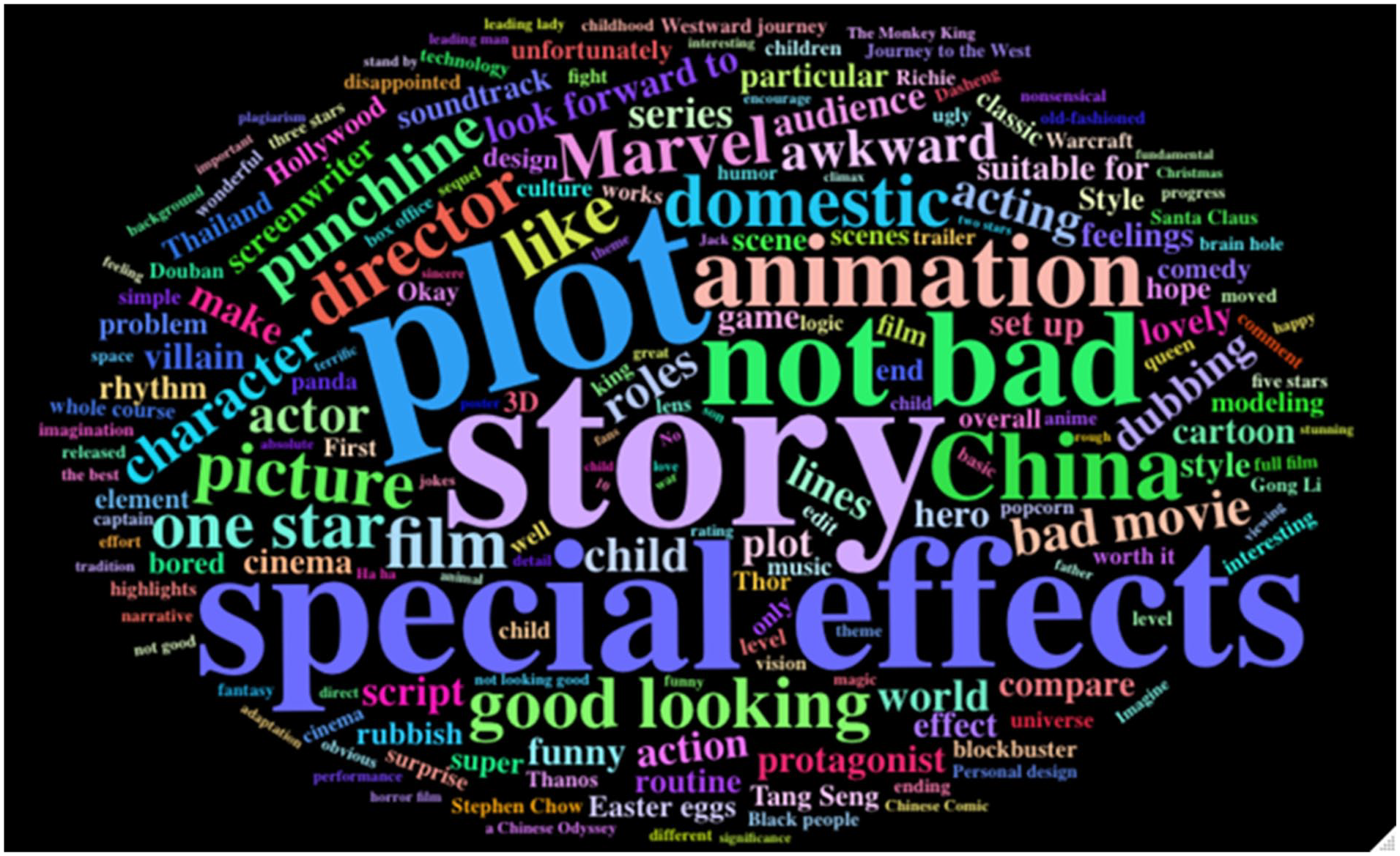
Word cloud diagram of film reviews.
However, it can be seen from the word cloud diagram that audiences have shown deep interest in the plot, story, special effects, and animation of the reviews on the mythical films. Therefore, we can reasonably speculate that the discussion of the above film elements involves more or less the content related to the mythical elements, which may be the discussion of the relationship between the mythical story and the film plot. It may also be about the evaluation of the use of special effects and animation to show the mythical situation, because the characteristics of the mythical film different from other types of films lie in the framework of the mythical story, the fascinating plot, the visual attraction of special effects or animation, and so on.
Topic and keywords distribution
In the LDA model, the hyperparameters α and β are artificially set through experiments. The Gibbs sampling method has been proposed to approximate the values of these two parameters (Estabrooks et al., 2004). The parameters of this experiment refer to the method of Gibbs, with hyperparameters α = 1, β = 0.01(Porteous et al., 2008). The optimal number of topics in the model calculated is 4, which is the minimum number of topics corresponding to Perplexity. Following this, the LDA model is used to extract topic words from the film review texts (Table 6), and 10 keywords are selected to represent each topic. Ultimately, based on the keywords subordinate to each topic category, specific connotations of the four topics are summarized through manual annotation.
Topics and Keywords Distribution.
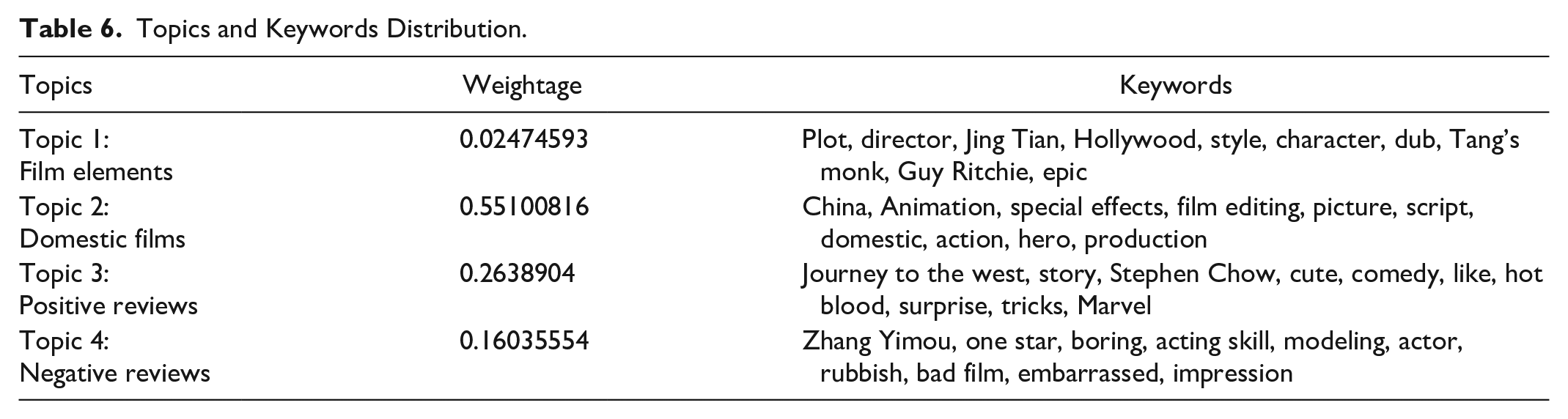
From the table of topic words, it can be seen that in the film reviews containing mythical elements, the topics identified by the LDA algorithm can be divided into the four categories which are film elements, domestic films, positive reviews, and negative reviews. It is evident that each topic is given different weightage in the entire film review text. Topic 1 is film elements, which accounts for the smallest proportion in the overall film review texts, and most of the keywords are nouns. The discussion of director, character, dubbing, and other film basic elements is the topic that all film reviews may involve and often accompanied by the keywords in other topics. Domestic films, Topic 2, have the highest weightage, accounting for more than half of the original document content. Therefore, it can be concluded that this is the core topic of film reviews. The increase of domestic film share and the improvement of competitiveness are the significant characteristics of the development of China’s film industry from 2015 to 2018. From the positive discussion of domestic films in the above film review text, we can see that the online users’ attention is the same as the development and change of the film industry. Topic 3 is positive reviews, highlighting the discussion of “comedy.” Cute, like, hot blood, surprise, and other words express online users’ positive feelings for the film. The key word “journey to the west” reflects the online users’ attention to the mythical elements in the film and also proves that journey to the west, the biggest myth IP in China, has an irreplaceable influence on literary and artistic creation. Topic 4 is negative reviews. Online users often use adjectives such as “boring,” “embarrassed,” and “bad” to express their dissatisfaction with the film, and point out their specific comments on acting skill, modeling, and actor. On the whole, it is imperative to take into consideration that the data source of these four topics are film review texts of films that have mythical elements, but the topics and the distribution of high-frequency keywords does not clearly reflect the audience’s mention and discussion of myth related content. This indicates that modern audiences are not sensitive toward the mythical elements in film communication. Therefore H3 is not valid.
Conclusion and Discussion
Mythical elements bring a fantastic and mysterious meaning to the creation of films, but the attitude of the audience toward these elements is relatively negative. This article explores the relationship between these mythical elements in film communication and audience acceptance through regression analysis and topic model. The research conclusions can be summarized as follows:
Mythical Elements Have No Significant Impact on Box Office Revenues
Upon incorporating the mythical elements into the box office model, it was found that these elements have no significant impact on the box office revenues, which indicates there was no statistically significant correlation between the two. Therefore, from the perspective of box office revenues alone, whether the film contains mythical elements or not does not have an effect on the audience’s film consumption behavior. In other words, the audience will not pay to watch a film only because of the mythical elements portrayed. However, the box office model of this article does not involve the influencing factors of the film marketing stage, such as the frequency and form of advertising, but from the literature review, we can see that the influencing factors of the film box office involve many levels, so in the future research, the further revision and optimization of the box office model may result in corresponding changes.
Mythical Elements Have No Positive Impact on Film Ratings
Through regression analysis, the linear test of mythical elements and film ratings indicates that there is a significant negative correlation between mythical elements and film ratings. That is, these mythical elements in the film may have a negative impact on film ratings, which is an unexpected result. However, film ratings largely depend on the audience’s acceptance of the film and the quality of the film itself. Therefore, a film with mythical elements may receive a lower rating because the audience is not interested in the elements portrayed in the film, or because the elements are not presented satisfactorily in the film. Of course, our research focuses on mythical films in a certain period, so it can only explain the audience acceptance of mythical elements at this period. Therefore, to explore the relationship between the two in more depth, future research can incorporate more extensive and recent samples.
No Significant Mythical Topics in the Film Review Texts
Based on the content analysis of reviews of film with mythical elements, the results of LDA topic model indicate that there are no significant mythical topics mentioned in the reviews. The source text from the distribution of topic words and keywords related to mythical films cannot be distinguished, which indicates that these elements do not attract the attention of audiences and do not lead to any discussions. Therefore, it can be concluded that the audience is not sensitive to the mythical elements in the film. In the future, the related research can increase the analysis of audience attributes, distinguish the online user groups that release film reviews, and understand the preferences and demands of audiences of different ages, genders, regions, and so on in the consumption of mythical films through the content of film reviews, so as to provide feasible suggestions for film production and marketing. In addition, the evaluation of the film at different stages such as before the release, the first day of release, and within a week of release may change. In addition, the evaluation of the film at different stages such as before the release, the first day of release, and within a week of release may change. Therefore, the analysis of the theme characteristics of the film review texts at different stages can explore the audience’s attention shift over time and can also explore whether the film responds to the audience’s expectations by comparing the changes in the audience’s attitude before and after the release of the film.
In short, we found that the mythical elements contained in films have not received positive responses from the audience. Similarly, Yin et al. (2019) pointed out in the development memorandum of China’s film industry that realistic films have been favored by both film creators and audiences, but fantasy films have encountered market collapse, and fantasy films often involve mythical elements. The combination of classical mythical story framework and modern film and television technology seems to be wonderful, but the audience’s acceptance is not satisfactory, which shows the dilemma of mythical film creation. This article believes that there are three reasons for this phenomenon: First, the limited number of traditional classic myths puts forward higher requirements for the innovation of myth film narratives. For example, the classic mythical prototype Monkey King repeatedly appears on the big screen and is molded into the image of justice, amorous, rebellious, or free, which makes it more difficult to find breakthroughs in the production of similar themes afterward. Second, most of the ancient myths are well known to the audience, so film creation needs to seek a balance between the inheritance and innovation of classics, which is undoubtedly the difficulty of myth film creation. Third, mythical film is a fierce collision between ancient myths and modern film media. This collision requires a certain bridge connection to burst out brilliant sparks, and the bridge is the contemporary spirit. Only by integrating the spirit of the times into the framework of mythical stories can the modern transformation of mythical prototype be realized.
It can be seen that the mythical elements in the film have not received the active attention of the audience, which is related to the creation dilemma and presentation level of the myth film, and also has a lot to do with the production logic of the film industry such as commercialization and mass production in the industry environment. Therefore, for the producers of mythical films, on the one hand, they should make innovative design for the presentation of mythical elements in the creation stage, so as to refresh the audience while carrying forward the classical national spirit. On the other hand, they should respond to the value appeals and aesthetic expectations of the modern public in the theme expression of the film works, and give full play to the narrative advantages of myth in the current social context.
