




Abstract
In family businesses, as in other organizations, an informal organizational culture is formed. The purpose of the research was to determine if there is a relationship between intra-family relationship and the type of organizational culture. Quantitative research has been conducted. The OCAI questionnaire was used as well as a set of questions from the authors who called it the Family Involvement Model. Data were obtained from 860 respondents, family business owners. Key findings that the values of family members are not consistent with the organizational culture in their business have been statistically confirmed. Only the hypothesis of the consistency of family values and clan organizational culture was confirmed. The study contributes to the study of family involvement in family business. Practical implications for family business owners can be seen in the building of positive influence on the creation of the organizational culture in their business. The study addresses the nature of organizational culture and the values of the family what is the originality of the research.
Plain Language Summary
Findings of the research have shown that the behaviours and attitudes inside the family do not necessarily match the nature of the organizational culture in their company. This hypothesis was confirmed only for the clan culture. This research study suffers from several limitations. The study has limitations in generalizability. The research was carried out in one country, a country with a relatively short history of family business. Families and their businesses do not yet have as much knowledge and experience as family businesses with a long tradition. However, the results obtained offer an opportunity for comparative research in countries where family business has a long tradition. This study assumes a direct relationship between family values and organizational culture. There is the possibility that there are other relationships that could be considered as other mediating variables not considered in this study. For this reason, more research could focus on a more robust understanding of relationships within families and how they influence culture in their business by including mediators that incorporate the influence of, for example, strategic decision making or business model development. The complexity of the respondents’ position may not have yielded reliable results. The complexity of a situation where a respondent identifies the relationships and values of their own family members and then values within their business, often perceived as a second family, can jeopardize the reliability of the answers. A limitation could be seen in the F-PEC model used. Some contemporary authors argue that Klein et al.’s F-PEC scale defines only a very specific type of family business. There are other types more conceptually and empirically, as also affirmed by Gupta and Levenburg. However, the structure of this model has been shown to be a suitable choice for the family model contoured here. FIM - formulated questions or group assignments may be submitted for discussion. The authors do not claim that the FIM is a final closed model. It will certainly require further elaboration or refinement. The authors welcome any comments. Research implications: By providing a clear and predictable relationship between the intensity and nature of family members’ relationships with each other and with the family business and the formation of organizational culture, the study contributes to family business theory, contributing to the study of family involvement in family business in terms of creating and maintaining the informal intangible aspects of organizational culture. Practical implications: for family business owners, it could provide impetus for establishing policies, rules, or roles within the family so that their involvement in the family business positively influences the creation and behaviour of the organizational culture in their business. Social implications arise from the importance of the existence of family firms that are significant in the economy. Not only the owners of family businesses, but also policymakers and regulatory authorities should contribute through their initiatives to promote the informal organizational culture that is a prerequisite for the growth and sustainability of family businesses, which are typically the largest employment generators in most economies. Originality/value/theoretical contribution: the study addresses the nature of organizational culture and the “character” of the family. By the “character” of the family is meant the relationships between family members and the relationships of family members to the family business. Relationships within the family and the relationship of family members to the family business are undoubtedly reflected not only in the formal structure, but also in the informal culture. The study reveals how these two “characters” are not/related.
Introduction
Family, from a sociologistic point of view, is a basic building block of any society (Petrusek, 1996). But not only sociology claims its utmost importance, also economical significance is undeniable, especially considering family business. Ransburg et al. (2016) state that family values, vision, and purpose influences culture in the family-owned business. This organizational culture (OC) is an important subsystem of an organization, a determinant of organizational effectiveness and the quality of work life of organizational members (e.g., Cameron & Quinn, 1999; Deal & Kennedy, 1982; Miranda-Wolff, 2022; Schein, 1992; Schein & Schein, 2016; Trice & Beyer, 1990). Organizational culture is defined as a phenomenon consisting of individual elements, such as the core values, beliefs, and opinions that exist in the organization, the patterns of behavior, and the symbols that express the connection between the beliefs, values, and behaviors of the members of the organization (Denison, 1990; Schein, 1992 and others). Organizational culture is the result of the accumulation of experiences passed on to individuals through the socialization process; it provides continuity, reduces employee uncertainty, and affects their job satisfaction and emotional well-being; it is a source of motivation, and can be a competitive advantage (Lukášová, 2015).
Organizational culture is created in all types of organizations, corporates, governmental, and nongovernmental organizations and above-mentioned family businesses as well. A family business is different from a conventional business in many ways. This difference may also influence the nature of organizational culture. A family business can be characterized as a combination of two systems of values, expectations, and rules—of the family and of the business (Baron & Lachenauer, 2021). Differences from non-family businesses appearing in organizational culture may lie, for example, in the area of social ties, where a greater sense of social feeling is often found in family businesses (Soluk et al., 2021). There is a strong emphasis on quality, as the reputation of the business and the family is at stake (Chan et al., 2020). There is much more support for other family members to be involved in the running of the business and its management, as one of the main goals of a family business is to pass the business on to the next generation (Drewniak et al., 2020). Of course, negatives arising from family involvement in the business. These may include nepotism, the transmission of family conflicts to the business and vice versa, an imbalance between the goals of the family and the business, and others (Craig & Newbert, 2020; Vergara et al., 2020). Family involvement influences business performance (Memili et al., 2015) and strategy (Minola et al., 2016). Family involvement in a business can be a competitive advantage, but also a cause of failure that can lead not only to premature business exit but also to rifts between family members (Garcia et al., 2018).
As can be seen from the previous and the following theoretical background text, there are a number of studies dealing with the features of entrepreneurial families as well as family businesses. But do we know to what extent the “character” of the family and the mutual relations of family members is reflected in the “character” or culture of their business? Do friendly relationships in the family also mean a friendly environment in the business? How competition between family members affect the organizational culture of their business?
Here, the authors state a research problem. A research question was formulated: Are the values and behaviors of family members consistent with the informal environment of their business?
In order to answer the research question, research sub-questions were formulated and within them hypotheses were formulated as well. To answer them, the outputs from used models will have to be processed.
The processing procedure is as follows. First, theoretical attention must be given to the areas that are treated in the presented research. The purpose of this section is to highlight the differences between a family business and a non-family business, and to explain the F-PEC model, the essence of which will be applied. Then the key role of organizational culture, the explaining of the Cameron and Quinn model that will be applied in the research are described.
In the following section, the methodology, and methods used are described. The results obtained from the questionnaire survey in family businesses are statistically processed, presented, and discussed. Finally, the key results of the research are summarized and the limitations and benefits of the research are mentioned.
Theoretical Background and Hypotheses Development
In the following section, two main aspects of this article will be described—family business and organizational culture. Organizational culture arises in all types of organizations. Even in family businesses. The link between these two topics is well defined: family, a nucleus of every family business, influences its culture, that further influences the whole organization (Ransburg et al., 2016). Family business has a number of unique characteristics reflecting its nature. How can a family firm be distinguished from a non-family firm?
Family Business
A key aspect that distinguishes family firms from non-family firms relates to the element of family and family culture and the interrelationship between the family and the firm within an economic, managerial, and sociological framework (Davis, 2001). The definition of a family firm varies from country to country, but always refers to the dominance of family ownership, family representation in top management, controlling bodies, and, above all, the intention to pass the business on to the successor generation.
The family is at the center of the company. This results in two structures encountering each other, namely, the family and the business, increasing the potential for conflict which affects both the family and the business sphere. Families are governed by equality, inclusion, and caring feelings. Businesses, on the other hand, are governed by meritocracy, selectivity, and critical analysis. These fundamental differences create opportunities for conflict in decision-making, employment, compensation, reinvestment, etc. Should such decisions favor the welfare of the family or the welfare of the business?
A consensus must be found for the different values and relationships that work in the family and in the company. The introduction of rules and roles between family-business relationships is essential for maintaining harmony in the family and at the same time for the successful development of the business (Figure 1).

Rules for families and businesses.
In what follows, we focus on the features of family businesses that are related to the questions in the Cameron and Quinn (1999) questionnaire.
Family businesses face complexities when it comes to the involvement of family members. Family members may be heavily favored, non-family members may perceive injustice in this way. This leads to a weakening of organizational culture, resulting in poor economic performance. In another situation, family members are expected to perform better than non-family members. Thus, family members may suffer from reverse nepotism, which is also negatively reflected in OC. It is indisputable that fairness in treatment, quality care, and concern for employees are closely related to their loyalty, which influences organizational culture (Schuman & Ward, 2017).
The willingness to take risks is typical of the founding generation, where it has become its motivator (Llanos-Contreras et al., 2021). Urbanikova et al. (2020) state that the second generation is considered more innovative than the first generation. Internal and external knowledge is identified as one key factor in deep understanding the ability of the family to innovate (Becerra et al., 2020; Del Vecchio et al., 2019). Not only knowledge of managers, but also wise leadership has a significant, positive indirect effect on stimulating open innovations due to its influence on workplace friendships (Abdulmuhsin & Tarhini, 2022).
The economic and business performance related issues and their solutions are interlinked with ethical values. Vazquez (2018) concluded that family businesses are vastly different from non-family businesses, which, as one can assume, will also influence their attitude toward organization culture. Other authors see the sources of this difference in the family’s own involvement (Sharma & Sharma, 2011), the personalities of the founder and his/her successors (McMullen & Warnick, 2015), the interpersonal relations and communication (Campopiano & De Massis, 2014), or in the social relations and emotions (Cennamo et al., 2012).
Another element influencing the organization culture is the company’s relationship with its stakeholders. In their study, Poech and Kriwanek (2011) concluded that family businesses are more respectful of the rights of stakeholders than non-family businesses. A responsible approach to stakeholders was also identified by for example, Barakat et al. (2020) or Chaudhary and Saxena (2022).
A strength of family businesses is their socio-emotional wealth (SEW). The complex relationships between different socio-emotional wealth goals are a frequent focus of research (e.g., Cleary et al., 2019; Dou et al., 2020; Weimann et al., 2021). It can be concluded that family control and influence, family members’ identification with the firm, binding social ties, emotional attachment, and the renewal of family ties to the firm through dynastic succession are important elements that can contribute to the creation of a strong organizational culture.
When the founder generation becomes involved in the form of sibling and cousin teams, it is difficult to escape the complexities that come with diverse personalities, values, and perceptions of what vision is best for the business and for the family (Aronoff et al., 2011). Formal policies (i.e., shareholder agreement, code of conduct, policy on employment of family members, on marriage prenuptial, on retirement) and family institutions (family meeting, family assembly, family council, family office, etc.) governing the relationship between the family and the business are important to any family business because they help avoid problems and conflicts before they happen (Craigh & Moores, 2017).
The way in which they interfere with the family is a constant problem. How to determine the extent of the family’s impact on the business? Several models are created.
Barney (1991) divided six dimensions of OC into three groups: human resources, organizational resources, and process resources. Its division inspired Irava and Moores (2010). Rutherford et al. (2006) examine degrees of family involvement through the number of generations, ownership, and a host of family involvement variables. The model of Pearson et al. (2008) explores only the internal view of a company and a family. Danes et al. (2009) monitored the relationship between family and business on the level of the availability of resources and the existence of restrictions. Baños-Monroy et al. (2015) proposed three dimensions of familiness as process, human, and organization resources. Frank et al. (2017) defined a multidimensional scale (Family Influence Familiness Scale [FIFS]) comprising six dimensions. Cano-Rubio et al. (2017) propose a composition of familiness that considers family capital, bonding social capital, and bridging social capital of the FB.
In conclusion, it can be summarized that family influence is used as a unique element that differentiates between family and non-family firms and differs performing family businesses from underperforming ones (Pearson et al., 2008) and that it can be a source of competitiveness.
For the purpose of the presented research, the F-PEC model by Astrachan et al. (2002) is used. They defined family involvement (F) in three dimensions: P—power (the influence of the family on the ownership, control, and management of the firm); E—experience (the information knowledge, judgment, and intuition that comes through successive generations); and C—culture (the alignment of the family’s goals with the firm’s goals). Their F-PEC scale is widely accepted in the literature (Rutherford et al., 2008).
Power
The positive effect of ownership and management on firm performance is generally reported especially in later generational stages (Azizi et al., 2021; Blanco-Mazagatos et al., 2016). The involvement of non-family members in management is related to personal values in family firms, and, consequently, on organizational culture (Camfield & Franco, 2019; Schepers et al., 2021). Other dimensions are formulated as professionalization and formalization, not only of the organizational structure, and processes, but also of the family relationship with the company (Polat, 2020; Razzak et al., 2021).
Experience
By successfully passing on the family business to the next generation, the experience related to how to reconcile family life with the business grows (Hillen & Lavarda, 2019). Therefore, planning and executing the succession process seems crucial (Drewniak et al., 2020). Each of the barriers to a successful handover (family disagreements, dissatisfaction of key employees, not preparation of the next generation, etc.) can be overcome by using strategies designed specifically for the business and family themselves (Botella-Carrubi & González-Cruz, 2019; Collingsworth-Crusse, 2021).
Culture
In the context of family business culture, the main theme is socio-emotional wealth (SEW). SEW is a key factor that differentiates family businesses from other types of businesses. Family culture influences the psychological ownership of family members. Creates opportunities for communication between family members, reinforces shared family values, aligns family and firm expectations, and promotes identification with the firm (Vergara et al., 2020). Sharing values, beliefs, company mission, etc. provides a competitive advantage (Soluk et al., 2021).
The authors did not directly use this model in their research. However, its structure was the inspiration for formulating and classifying questions for their research. Further information can be found in the section Methodology.
Organizational Culture
Interpersonal relationships, workplace environment, human fulfillment and human personality development, employee performance and satisfaction, corporate image, and brand, all of these are corporate culture. Corporate culture is associated with management behavior and attitude, organizational performance, firm, and employee behavior (see, e.g., Brown, 1995; Denison, 1990; Drennan, 1992; Gordon, 1991; Hall, 1995; Sackmann, 2006; Schein, 1992).
A number of researchers have concluded that organizational culture, together with leadership, plays an important role in building social sustainability. Combining these two components maximizes the potential of sustainability for the future (Bagga et al., 2023; Belay et al., 2023; Suaidy & Manurung, 2023). Yunita et al. (2023) focused on finding relationships between other components or subsystems of an organization. Their findings revealed that organizational culture and technological capacity have a beneficial effect on organizational ambidexterity. A well-chosen and well-set organizational culture supports creativity and innovation (Choi et al., 2023; Villanueva Peve et al., 2023).
Organizational culture is closely related to employee engagement both in periods of economic stability and in times of threat (Bui & Le, 2023; Lombongadil & Djamil, 2023; Rožman et al., 2023; Wu et al., 2023). Organizational culture affects job satisfaction (Fauzan, 2023), employee performance (Elifneh & Embilo, 2023; Mulyadin et al., 2023; Supriyanto et al., 2023), as well as financial performance in an organization (Savić et al., 2023).
To effectively lead their organization while taking cultural factors into account and actively influencing the cultural environment to enhance performance, managers must possess a thorough understanding of their organization’s culture (Lukášová, 2015). They can identify strengths and weaknesses based on their knowledge of the content of the culture and also purposefully choose effective management tactics.
The term organizational culture is, in this research, understood as a set of basic assumptions, values, attitudes, norms of behavior that are shared all around an organization and that are apparent in the thinking, feeling, behavior of organizational members and in artifacts of material and immaterial nature.
The elements of organizational culture are interrelated and interact. Schein’s (1992) model is well known, where organizational culture was structured into three levels (artifacts, values and norms, core beliefs). Many authors identify with this concept (e.g., Schneider & Barsoux, 1997). Some elaborate it further, such as Lundberg (1996). Other authors structure the content of organizational culture in a different way (e.g., Denison, 1990; Hall, 1995; Hofstede, 2001; Kotter & Heskett, 1992).
The typologies of organizational culture are based on different foundations. There are typologies formulated in relation to organizational structure (e.g., Handy, 1993; Harrison, 1972; Trompenaars, 1993), environmental influence, and organizational response to the environment (e.g., Ansoff et al., 2018; Deal & Kennedy, 1982; Miles & Snow, 1978), the stage of organizational development (e.g., Bridges, 1992), organizational behavior in the marketplace (Bridges, 1992; Hall, 1995), and in the behavior of employees toward each other and toward their organization (Goffee & Jones, 1998). One can also mention the compass model by Hall (1995), the Organizational Character Index (OCI) by Bridges (1992), or the “double S cube” by Goffee and Jones (1998). In their Organizational Culture Transformation Model (OCTM), Ipinazar et al. (2021) placed Total Employee Ownership (TEO), Total Employee Involvement (TEI), and Leadership (L) as three design elements for a high performance organization. Omanovich et al. (2021) noted the attractiveness and motivation of the work of researchers, differences in goals, mission, and features of their activities. These specifics were included in the development of a multi-model of the organizational culture of scientific institutions.
For the purpose of the research, the model of Cameron and Quinn (1999) was chosen, which is based on the Competing Values Model (Quinn & Rohrbaugh, 1983). This model captures the prevailing organizational values, the associated strategic priorities in different types of culture, captures the atmosphere in the organization, leadership style, and the success criteria of the organization.
The basic dimensions of that module are flexibility in opposition to stability and control. The other axis displays external versus internal focus. As a combination of these two dimensions four culture styles are identified—clan culture, adhocracy culture, hierarchy culture, and market culture.
Each type is characterized by the goals the organization is working toward and the tools it uses to achieve them.
The clan culture embodies a warm and welcoming work environment, where shared values and objectives foster a strong sense of teamwork. Rather than a strictly business-oriented entity, it resembles an extended family. Employee commitment to the organization is notably high. The emphasis lies on individual growth and development, with a focus on customer satisfaction by viewing them as partners. Teamwork, active participation, and achieving consensus are considered essential pillars within the organization.
The hierarchy culture is characterized by a highly formalized and structured work environment, where adherence to procedures and regulations is central to its functioning. Formal rules serve as the unifying force within this culture. The organization prioritizes smooth operations, striving for stability and efficiency. Success is measured by the reliability of deliveries, meeting deadlines, and maintaining low costs. Employee management primarily revolves around ensuring employee security and stability within the organization.
The adhocracy culture cultivates a dynamic and entrepreneurial work environment that encourages creativity and innovation. Individuals within this culture are willing to take risks and explore new approaches. The organization thrives on being at the forefront of its field, developing new products and engaging in experimentation. In such a culture, managers play an important role in fostering individual initiative and nurturing creativity. However, it is important to note that while adhocracy pushes boundaries, it can also encounter resistance from employees and the market as a whole.
The market culture is defined by a results-oriented organization where individuals are driven by competition and dedicated to achieving their goals. The organization’s cohesion is rooted in a collective focus on winning, with success measured by gaining a larger market share. Long-term strategies are consistently shaped by attention to competition, fierce competitiveness prevails.
Hypotheses Development
The solution of the stated problem formulated in the introduction (Are the values of family members consistent with the informal environment in their company?) was divided into the following sub-questions:
(1) Is there a strong positive correlation between organizational clan culture and commitment to the firm, sharing of goals and values among family members?
(2) Is there a strong positive correlation between organizational culture of hierarchy and defining formalized rules for family members’ involvement in the family business?
(3) Is there a strong positive correlation between market organizational culture and prioritizing the needs of the business over the needs of the family?
(4) Is there a strong positive correlation between the organizational culture of adhocracy and family members’ understanding of their business as a source of profitability and therefore a necessity to ensure its competitiveness?
In order to answer the research questions and sub-questions, the following hypotheses were formulated. The hypotheses are supported by the arguments of the authors and for greater comprehensibility they are supplemented with tables where the features of both examined models are presented (Tables 1–4).
H1: There is a strong positive correlation between the organizational culture of the clan and the commitment to the firm and the sharing of goals and values among family members.
Clan.

Source.Cameron and Quinn (1999) and own research.
Hierarchy.
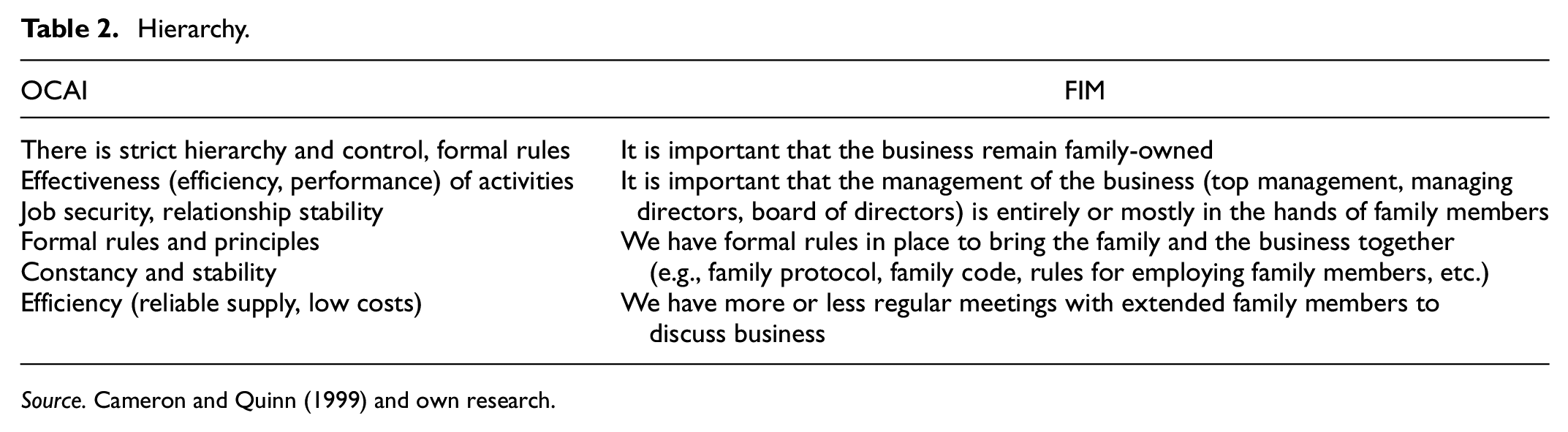
Source.Cameron and Quinn (1999) and own research.
Market.

Source.Cameron and Quinn (1999) and own research.
Adhocracy.

Source.Cameron and Quinn (1999) and own research.
The authors hypothesize that, if the respondents feel the organizational culture at their workplace as friendly, full of cooperation and exchange of experiences, and concern for their wellbeing, it is also due to the attitude of family members who maintain harmony in the family by sharing common goals and values.
H2: There is a strong positive correlation between organizational culture hierarchy and defining formalized rules for family members’ involvement in the family business.
The authors hypothesize that a culture of hierarchy, which is characterized by order, rules, stability, is supported by family rules, such as rules for employing and rewarding family members, family protocol, etc.
H3: There is a strong positive correlation between the organizational culture of the market and the prioritization of business needs over family needs.
The authors hypothesize that a results-oriented and competitive market culture is influenced by the values of family members, where a business first approach prevails.
H4: There is a strong positive correlation between the organizational culture of adhocracy and family members’ perception of their business as a source of profitability, and therefore the need to ensure its competitiveness.
The authors hypothesize that the dynamic creative environment of the adhocracy culture is strongly positively correlated with the fact that the family understands the need to ensure the competitiveness of their company as a source of its existence, by encouraging the search for new products, approaches, etc.
Methodology and Methods Used
The basis for obtaining answers to research questions and hypotheses was quantitative research.
Survey Design
Two questionnaires were used. The first questionnaire (OCAI), already used in a number of sectors, was used in its original form. The second questionnaire (FIM) was created by authors inspired by the existing F-PEC model.
The Organizational Culture Assessment Instrument (OCAI)
The Organizational Culture Assessment Instrument (OCAI) questionnaire by Cameron and Quinn (1999) was used to identify the type of organizational culture. The content of the organizational culture within the firms under study is determined by evaluating six key components, which form the basis of the questionnaire. These components are as follows:
Dominant features of the organization (characteristics of the environment and atmosphere prevailing in the organization)
Leadership style in the organization (what is meant by leadership in the company, what are considered leadership skills)
Management of employees (what is characteristic of the management style, what methods are used)
Cohesion of the organization (what ensures the cohesion of the organization)
Priority strategic factors (what is emphasized in the organization, what is the focus of the organization)
Success criteria (how success is defined in the organization).
For each of the components, four statements are presented, each of which characterizes one of the four types of culture listed above. The respondent is asked to divide a total of 100 points among these statements based on the extent to which each statement describes the organization. The questionnaire is simple in terms of administration. Its shortcoming is considered to be that it is imprecise (Sackmann, 2006). However, it is suitable for analyses that focus on the strategic aspects of an organization’s culture. The text of the questionnaire is given in the Appendix A.
Family Influence Model (FIM)
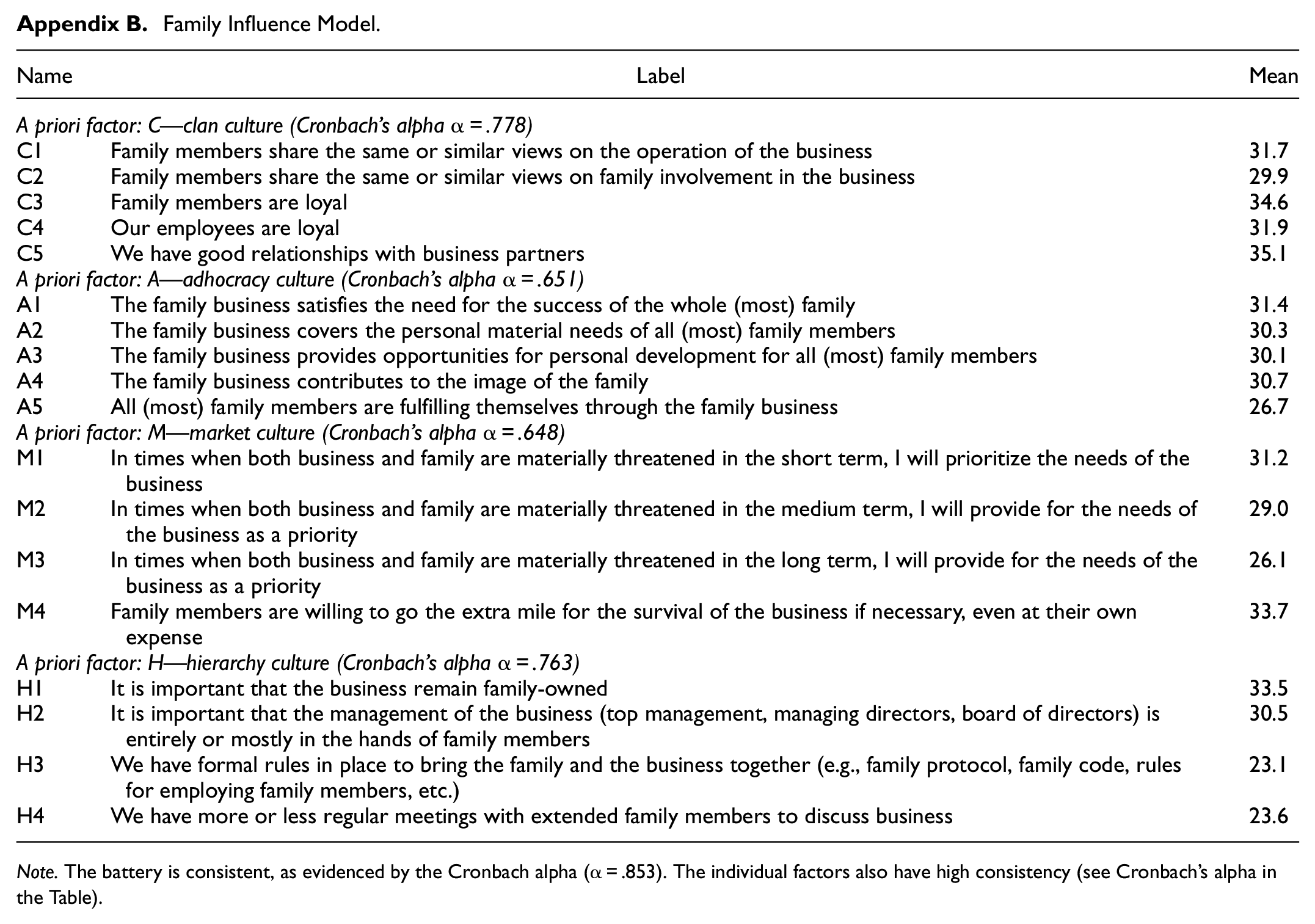
The authors were inspired by the F-PEC model (Astrachan et al., 2002) and findings from literature research to determine the attitudes of family members toward each other and the firm. In addition to questions related to power, questions related to the experience and culture of the company were formulated. These questions are closely related to SEW. In the end, 18 questions were formulated in consultation with experts in communication, management, economics and psychology, and family business owners. Experts and family business owners evaluated the relevance and face validity of the questions and divided them into four groups that characterize the types of organizational culture mentioned above. The assignment of individual elements to groups was confirmed by factor analysis (Appendix B). The Cronbach coefficient α determines the internal consistency of the instrument and can take values in the range of ←.1→, with generally acceptable coefficient values between .7 and .95 (Tavakol & Dennick, 2011). The battery is consistent, as evidenced by the Cronbach alpha (α = .853). The individual factors also have high consistency (see Cronbach’s alpha in the Appendix B).
A 4-point scale was established for the responses. For research purposes, the authors called this the Family Influence Model (FIM). The text of the questionnaire is given in Appendix B.
Basically, the respondents evaluated their relationships with each other as family members as well as the informal climate in their family business. In neither questionnaire did the respondents know which type of organizational culture was characterized by which question.
Participants
The respondents are family business owners from all over the Czech Republic regardless of the industry in which they operate. There is no official database of family businesses in the Czech Republic. The authors used their own database of 4,000 respondents, 860 valid responses were obtained.
A pilot survey of 20 family businesses verified the comprehensibility of the questionnaires. Data were collected using computer-assisted web interviewing (the CAWI method) in May 2022.
Data Analyses
By means of descriptive statistics, businesses (history, turnover, number of employees) and families (the involvement of family members in the activities of the family business) were characterized.
This was followed by an evaluation of the outputs of both models. First, the average rating of individual cultures in both models (means and rank) was identified. Using the IBM SPSS program, the prevailing culture in both models was found. The McNemar-Bowker symmetry test was used to test the consistency of the two models. A correlation analysis (Sig. 2-tailed) was conducted to determine the existence of a relationship between the value attitude of family members and the informal culture in their business. On the basis of this, using correlation analysis it was possible to test the hypotheses.
Results
The basic characteristics of the respondents are shown in Table 5 and the characteristics of the position of family involvement in the company in Table 6.
Characteristics of Respondents.

Source. Own research.
Respondent Characteristics—Family Involvement in Family Business.

Source. Own research.
Production firms predominate in the set (75.3%). Firms with 11 to 100 employees are the most represented (46.5%). A total of 88.2% of the firms have a maximum of 100 employees. Most businesses have an annual turnover of 0.4 million to 2.0 mil. EUR (47.4%). A total of 83.3% of businesses have a turnover of less than two million EUR. 57% of the firms have been in business for 10 years or less.
Almost 60% of businesses are owned by the first generation, that is, the founders. More than half of the businesses (51.3%) are managed by the first generation, that is, the founders. The company’s supervisory board is mostly dominated by the first generation, that is, the founders (45.6%).
Summary of the Model Outputs
The results of the evaluations of the respondents are statistically processed. The mean values from the OCAI model (Appendix A) and then from the FIM model (Appendix B) are presented.
Organizational Culture Assessment Instrument (OCAI)
People in the workplace share their knowledge and experience, work in teams, participate in decision making, and their relationships are stable as well as job security. There is no need for them to compete with each other or be innovative on a larger scale. Their loyalty brings the company together. Despite the fact that employers pay little attention to their development from a strategic point of view, they consider their commitment as a measure of the company’s success.
From a strategic point of view, constancy and stability are the most important to the company, followed by the search for new resources and opportunities. Efficiency is considered success. The effective execution of tasks and the assurance of the smooth running of the business are supported by an attitude of leadership.
Family Influence Model (FIM)
FB owners value good relationships with business partners the most, as well as the loyalty of family members. Employee loyalty is valued second only to the loyalty of family members. Even though family members are considered loyal, respondents are not so sure about their shared view of the operation of the business and the family’s involvement in the business.
In terms of the contribution of the family business in providing for the material needs and personal development of family members, including image building, the rating is almost at the same level. However, although respondents claim that the family business fulfills the need for success of family members, on the other hand, they claim that their involvement in the family business does not completely fulfill them.
Family members are willing to work hard for the survival of the family business, even at their own expense. Their willingness to consider the rescue of the family business as a priority decreases as the period of threat to the business and the family increases.
Family members place a premium on keeping the business in the hands of the family. They are willing to bring in outside managers, but the involvement of family members is dominant. Alarmingly, very little attention is paid to the creation of family rules and family institutions.
Factors will be replaced by factor variables with values equal to the averages of the individual factor items.
Comparison of Data From Both Models
The results of the two models are compared in the following tables (Tables 7 and 8).
Average Rating of Individual Cultures in Both Models.

Source. Own research.
The Predominant Form of Organizational Culture in Both Models.
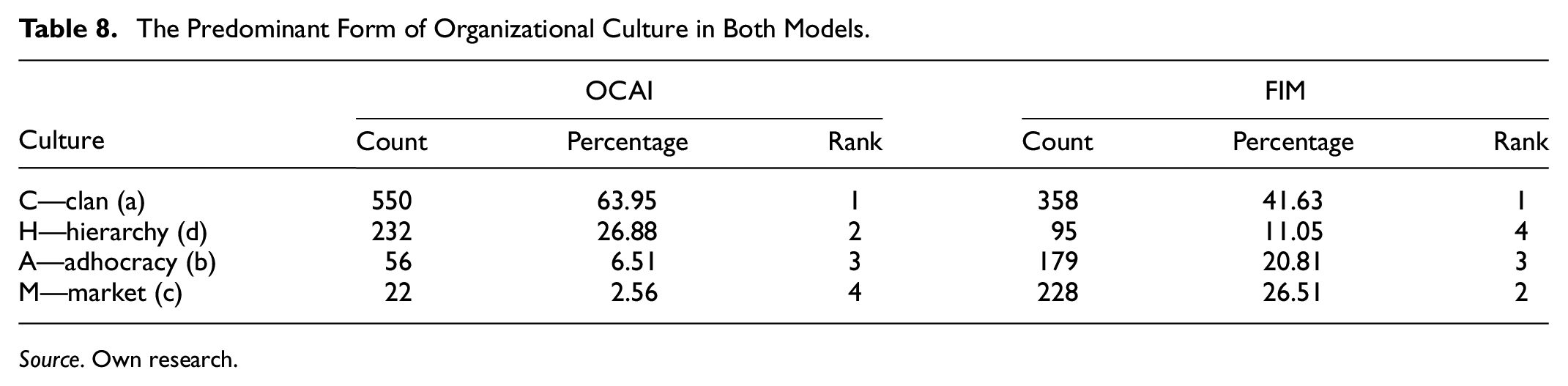
Source. Own research.
The friendly environment and information sharing typical of a clan-type organizational culture has the highest mean rating in the OCAI model (mean 35.89), as do the friendly relationships and mutual loyalty among family members in the FIM model (mean 32.6).
The stated desire of family members to prioritize business over family, to support the business at the expense of the family in the FIM model (mean 30.0) is at odds with the ratings in the OCAI model, where the organizational culture is marked by little employee competition, with little desire to win in the marketplace (mean 17.17). The difference between the ratings is striking. The difference suggests that a family’s efforts to go the extra mile for their business fail to motivate employees to be more active.
The preferences of each type of organizational culture can be shown graphically (Figure 2). The data used to construct the graph are presented in Table 8.

Types of organizational culture: OCAI and FIM models.
In both cases, the clan culture clearly prevails. In the OCAI model, the friendly environment, sharing of knowledge and experience, and care for employees are linked to job stability and rules (hierarchy). The model has a clear internal focus (see Figure 3). In the FIM model, clan culture is associated with a drive to innovate (market), accompanied by risk-taking and a focus on results (adhocracy) and is externally oriented (see Figure 3).

Competing values model.
The organizational culture in companies is not unambiguous, it is a combination of all four types of cultures. The following tables show the representation of each culture in all four types of firms (OCAI) and the values of the factor variables coming from the family influence model (FIM) corresponding to this situation (Table 9).
Prevailing Culture.

Source. Own research.
The form of the prevailing organizational culture does not match the attitudes that come from the family influence model. Only in the case of a clan-based organizational culture is there consistency between the two models.
Correlation Table Between Models
The previous finding of inconsistent values of family business owners and identified organizational culture will be un/confirmed statistically. The correlation between the results of the two models is shown in the following correlation table (r = correlation coefficient, p = significance). Significant relationships are highlighted in color (Table 10).
Correlations—Models.
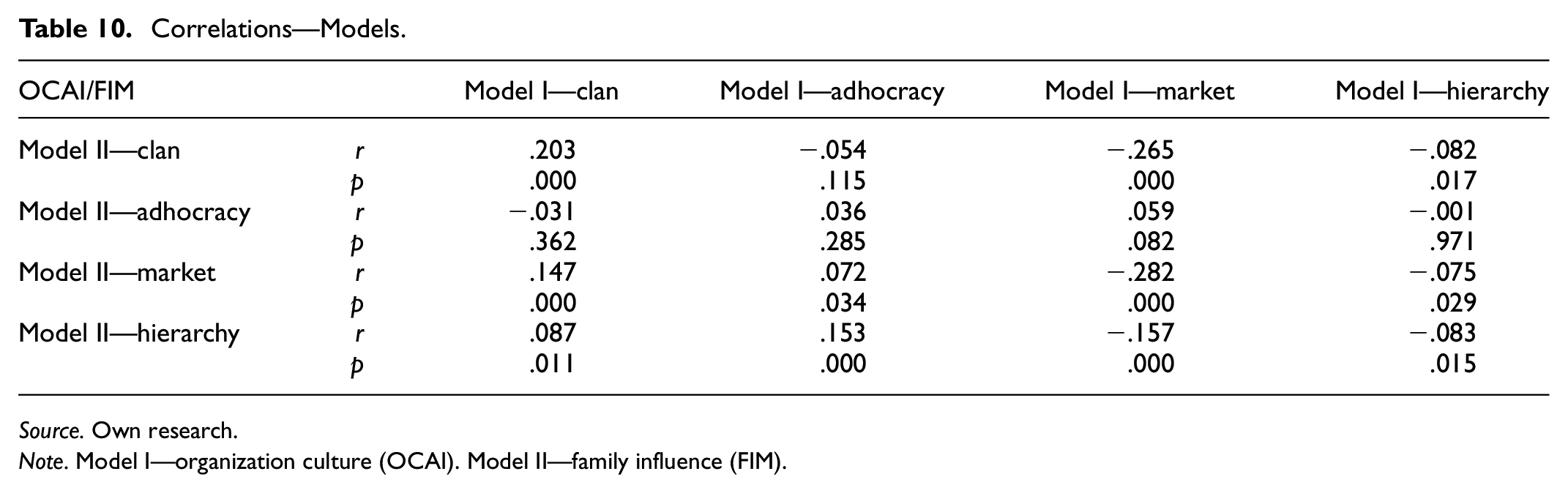
Source. Own research.
Note. Model I—organization culture (OCAI). Model II—family influence (FIM).
The correlation between the two models was also examined using the McNemar-Bowker symmetry test (Tables 11 and 12):
Default Contingency Table.

Source. Own research.
Test Results.
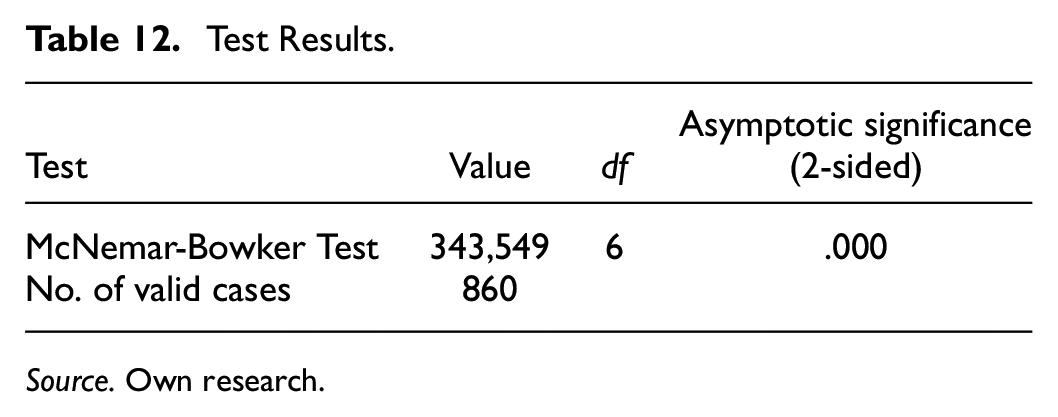
Source. Own research.
H0: The distribution in both models corresponds to each other.
H1: The distribution in the two models does not correspond.
Significance <.05, which means that the two models do not correspond. Hypotheses H1 cannot be rejected. The results presented in Table 5 were statistically confirmed. The values of family members (FIM) and organizational culture (OCAI) are not consistent, they’re splitting up.
Hypotheses Testing
Hypotheses were formulated to statistically assess the no/existence of the compliance studied in each type of organizational culture.
H1: There is a strong positive correlation between organizational clan culture and commitment to the company, shared goals, and values among family members.
H1 responds to the battery questions C1, C2, C3 (Table 13).
Correlations—Clan.

Source. Own research.
All three correlations are positive and statistically significant. Answer: Hypotheses H1 cannot be rejected. It can be argued that the mutual respect, tolerance, loyalty of family members is positively transferred to the culture of their company. This connection can be a competitive advantage for the family business. This type of culture in a business increases employee loyalty and promotes their willingness to share knowledge, learn new things and be high performers.
H2: There is a strong positive correlation between organizational culture of hierarchy and defining formalized rules for family members’ involvement in the family business.
H2 responds to the battery questions H1, H2, H3 (Table 14).
Correlations—Hierarchy.

Source. Own research.
None of the correlations are statistically significant or positive. Answer: Hypotheses H2 cannot be confirmed.
Only very small companies can operate successfully without a formal organizational structure, job descriptions, established rules, etc. As a business becomes larger and more complex it must introduce formal rules. Similarly, we can talk about business families. Entrepreneurial families can successfully own and manage their businesses without having formal documents in place (e.g., family constitution, rules for employment and remuneration of family members, succession plan, etc.) take only in the early stages (only 7.2% of businesses under 5 years old were included in the research). No statistically significant relationship was confirmed between formal corporate structure and formal family rules. The authors’ reasoning that the desire of family business owners to introduce formal “order” into their business, which they will sooner or later come to, will be positively correlated with the desire to formally ensure “order” in the business family, was not confirmed.
H3: There is a strong positive correlation between market organizational culture and prioritizing the needs of the business over the needs of the family.
H3 responds to the battery questions M1, M2, M3 (Table 15).
Correlations—Market.

Source. Own research.
None of the correlations are statistically positive significant. They are statistically significant but negative. Answer: Hypotheses H3 cannot be confirmed.
The finding is related to the results in Table 3, where large differences in ratings of market-type traits were found in both models (mean 30.0 for FIM, mean 17.17 for OCAI).
The family is willing to prioritize the interests of the business in times of business and family threat, even in the long term (business first approach). Declared efforts to preserve the business, however, are counterproductive in relation to the informal culture. Employees lose interest in their tasks and the workplace becomes less competitive. The situation may be influenced by the fact that the employees themselves feel that the company and therefore their jobs are under threat. If they are not sufficiently loyal, they risk leaving the company, which increases the degree of threat to the very existence of the company. Another possible explanation for the situation is that the family, in this time of threat, centralizes the decision-making and management previously delegated to them. Employees, thus deprived of their competences, lose their motivation to be proactive.
H4: There is a strong positive correlation between the organizational culture of adhocracy and family members’ understanding of their business as a source of profitability and therefore a necessity to ensure its competitiveness.
H4 responds to the battery questions A1, A2, A3 (Table 16).
Correlations—Adhocracy.

Source. Own research.
Only one correlation is significant and positive. Another correlation is significant, but negative. Answer: Hypotheses H4 cannot be confirmed. There is a partial positive correlation.
Signs of a culture of adhocracy such as seeking new markets, products, pursuing innovation, or willingness to take responsibility for risk are consistent with presenting the family business as an opportunity for personal development for family members. On the other hand, when investing in product innovation, finding new markets, etc., resources are reinvested back into the business. Logically, this reduces the amount of money that can be paid out to family members.
Discussion
Research Question
It can be stated that the values of family members are not consistent with the informal organizational culture in their company. The models examined do not correspond to each other.
The following is a comment on non/conformance in each type of organizational culture.
H1: Clan
There is a strong positive correlation between the organizational culture of the clan and the commitment to the firm and the sharing of goals and values among family members (Figure 4).

Clan culture.
Friendly workplace environments are characteristic of small businesses, start-ups, or early-stage enterprises (Horváthová et al., 2016), which is also true for families starting to build their businesses (Rydvalová et al., 2022). This statement is matched by the age composition of the companies surveyed, with 57% having been in business for a maximum of 10 years.
H2: Hierarchy
There is no strong positive correlation between organizational culture hierarchy and the definition of formalized rules for family members’ involvement in the family business.
Small businesses with a small number of employees (the majority of respondents) do not yet need to formalize and bureaucratize their operations. Their operations are driven by the creative enthusiasm of the founders transferred to the employees (Horváthová et al., 2016). However, as business grows, formal rules and management systems must be in place to ensure business operation. It could be logically assumed that as the number of family members involved increases, the family will require the creation of family institutions and family rules. The finding that family business management underestimates the importance of having family rules is not surprising (see, e.g., Schuman & Ward, 2017). What is important is the finding that the more formalized the operation of the business (OC hierarchy), the less formalized the relationship between family members with each other and with the business and vice versa. If the formalization of rules in the business and in the family is not in harmony, it means a threat to both the business and the harmony in the family (Carlock & Ward, 2001).
H3: Market
There is a strong negative correlation between market organizational culture and prioritizing the needs of the business over the needs of the family (Figure 5).

Market culture.
Hard competition inside and outside the company, where attention is paid to employees simply by watching them perform tasks, and where success is about achieving market share, is contrary to the values of family members. Family members are willing to prioritize the business over the family in times of emergency, even in the long term (e.g., Koráb, 2021; Rydvalová et al., 2022). However the more competition and a focus on achieving results is encouraged, the less willing family members are to step back from the demands of the family and accede to the demands of the business and vice versa.
H4: Adhocracy
There is no strong positive correlation between an organizational culture of adhocracy and family members’ understanding of their business as a source of profitability, and thus the need to ensure its competitiveness. However, the results are inconsistent.
A dynamic and creative environment with a focus on innovation, new product development, and technology provides opportunities for the personal development of family members (Rondi et al., 2019; Rožman et al., 2023; Villanueva Peve et al., 2023; Yunita et al., 2023). However, it is negatively correlated with the material requirements of the family. This may be due to the fact that the innovation requires financial resources that could otherwise be squandered off by the family (Rydvalová et al., 2022).
Conclusions
A family business has a unique feature that distinguishes it from non-family businesses, namely the involvement of family members in a joint family business. At the same time, as in all other organizations or institutions, an informal organizational culture is formed in the family business. The purpose of the present research is to determine whether there is a congruence between the values of family members who own the business and the organizational culture in their business.
Findings of the research have shown that the behaviors and attitudes inside the family do not necessarily match the nature of the organizational culture in their company. This hypothesis was confirmed only for the clan culture.
This research study suffers from several limitations. The study has limitations in generalizability. The research was carried out in one country, a country with a relatively short history of family business. Families and their businesses do not yet have as much knowledge and experience as family businesses with a long tradition. However, the results obtained offer an opportunity for comparative research in countries where family business has a long tradition.
This study assumes a direct relationship between family values and organizational culture. There is the possibility that there are other relationships that could be considered as other mediating variables not considered in this study. For this reason, more research could focus on a more robust understanding of relationships within families and how they influence culture in their business by including mediators that incorporate the influence of, for example, strategic decision making or business model development.
The complexity of the respondents’ position may not have yielded reliable results. The complexity of a situation where a respondent identifies the relationships and values of their own family members and then values within their business, often perceived as a second family, can jeopardize the reliability of the answers.
A limitation could be seen in the F-PEC model used. Some contemporary authors argue that Klein et al.’s (2005) F-PEC scale defines only a very specific type of family business (Gupta & Levenburg, 2012). There are other types more conceptually and empirically, as also affirmed by Gupta and Levenburg (2010). However, the structure of this model has been shown to be a suitable choice for the family model contoured here.
FIM-formulated questions or group assignments may be submitted for discussion. The authors do not claim that the FIM is a final closed model. It will certainly require further elaboration or refinement. The authors welcome any comments.
Research implications: By providing a clear and predictable relationship between the intensity and nature of family members’ relationships with each other and with the family business and the formation of organizational culture, the study contributes to family business theory, contributing to the study of family involvement in family business in terms of creating and maintaining the informal intangible aspects of organizational culture.
Practical implications: for family business owners, it could provide impetus for establishing policies, rules, or roles within the family so that their involvement in the family business positively influences the creation and behavior of the organizational culture in their business.
Social implications arise from the importance of the existence of family firms that are significant in the economy. Not only the owners of family businesses, but also policymakers and regulatory authorities should contribute through their initiatives to promote the informal organizational culture that is a prerequisite for the growth and sustainability of family businesses, which are typically the largest employment generators in most economies.
Originality/value/theoretical contribution: the study addresses the nature of organizational culture and the “character” of the family. By the “character” of the family is meant the relationships between family members and the relationships of family members to the family business. Relationships within the family and the relationship of family members to the family business are undoubtedly reflected not only in the formal structure, but also in the informal culture. The study reveals how these two “characters” are not/related.
Footnotes
Appendix
Family Influence Model.
| Name | Label | Mean |
|---|---|---|
| A priori factor: C—clan culture (Cronbach’s alpha α = .778) | ||
| C1 | Family members share the same or similar views on the operation of the business | 31.7 |
| C2 | Family members share the same or similar views on family involvement in the business | 29.9 |
| C3 | Family members are loyal | 34.6 |
| C4 | Our employees are loyal | 31.9 |
| C5 | We have good relationships with business partners | 35.1 |
| A priori factor: A—adhocracy culture (Cronbach’s alpha α = .651) | ||
| A1 | The family business satisfies the need for the success of the whole (most) family | 31.4 |
| A2 | The family business covers the personal material needs of all (most) family members | 30.3 |
| A3 | The family business provides opportunities for personal development for all (most) family members | 30.1 |
| A4 | The family business contributes to the image of the family | 30.7 |
| A5 | All (most) family members are fulfilling themselves through the family business | 26.7 |
| A priori factor: M—market culture (Cronbach’s alpha α = .648) | ||
| M1 | In times when both business and family are materially threatened in the short term, I will prioritize the needs of the business | 31.2 |
| M2 | In times when both business and family are materially threatened in the medium term, I will provide for the needs of the business as a priority | 29.0 |
| M3 | In times when both business and family are materially threatened in the long term, I will provide for the needs of the business as a priority | 26.1 |
| M4 | Family members are willing to go the extra mile for the survival of the business if necessary, even at their own expense | 33.7 |
| A priori factor: H—hierarchy culture (Cronbach’s alpha α = .763) | ||
| H1 | It is important that the business remain family-owned | 33.5 |
| H2 | It is important that the management of the business (top management, managing directors, board of directors) is entirely or mostly in the hands of family members | 30.5 |
| H3 | We have formal rules in place to bring the family and the business together (e.g., family protocol, family code, rules for employing family members, etc.) | 23.1 |
| H4 | We have more or less regular meetings with extended family members to discuss business | 23.6 |
Note. The battery is consistent, as evidenced by the Cronbach alpha (α = .853). The individual factors also have high consistency (see Cronbach’s alpha in the Table).
Declaration of Conflicting Interests
The author(s) declared no potential conflicts of interest with respect to the research, authorship, and/or publication of this article.
Funding
The author(s) disclosed receipt of the following financial support for the research, authorship, and/or publication of this article: The research was supported by the project VSB-Technical University of Ostrava, Grant no. SP 2023/025 A family business: An analysis of factors influencing employee attitudes in employer selection.

Data Availability Statement
Data sharing not applicable to this article as no datasets were generated or analyzed during the current study.