



Abstract
Organizational culture is crucial for all living institutional structures and has become a critical research topic. Although different variables have been investigated in the literature as predictors of organizational culture, to our knowledge, the role of social values and life skills as mediators hasn’t been investigated before. This study, therefore, aims to investigate the role of social values and life skills as mediators of organizational culture. The hypotheses of the research were tested in the context of this research aim. The present study, which is in the relational survey model, included 370 participants consisting of teachers and school leaders working in 22 different educational institutions. The findings showed that teachers and school leaders had high levels of organizational culture, social values, and life skills. The relationship of organizational culture with social values and life skills is meaningful and high. Also, the findings indicate a partial effect on mediating organizational culture between social values and life skills.
Introduction
In many studies conducted in the field of education, the characteristics of educators were examined many times with the help of different variables. Within the variables of these studies, the concepts of culture and organizational culture are very much involved (Assay et al., 2019; Balcı, 2007; Bolat, 2016; Buluç, 2013; Deal & Peterson, 2016; Dongjiao, 2015; Gezon & Kottak, 2016; Güvenç, 2011; Hugman, 2013; Keçeci Kurt et al., 2014; Lunenburg & Ornstein, 2013; Markos et al., 2019; Mintzberg, 2015; Robbins & Judge, 2013; Schein & Schein, 2017; Serdenciuc, 2016; Somprach et al., 2015; Sparre, 2020; Ulrich et al., 2009; Vilcea, 2013; Yazıcı, 2014).
Culture is a concept that makes sense through the existence of human beings. People come together and can affect the formation of organizational culture by influencing the communities with their cultural characteristics within the structures they create. In this respect, when culture and organizational culture have a very broad meaning, it is possible to make many definitions on this subject. We are given a set of cultural defining characteristics that we are expected to adapt to in social life. For these characteristics, many of us live by either having little choice or ignoring the obligations given to us by birth, such as gender, race, and nationality (Richardson, 2001). Tylor culture describes human skills and habits as a complex whole based on community-specific characteristics such as faith, art, morality, law, and tradition (Gezon & Kottak, 2016). Güvenç (2011) describes the culture, which, in contrast to what nature creates, refers to as everything created by human beings, as a function of the complex relationships between variables such as society, human beings, educational process, and cultural content. In essence, culture can be expressed as the total of human beings brought from the past. However, Jenks (2004) describes the birth of the concept of culture according to a four-way typology. First, culture is a state of mind as a rational or strictly cognitive concept. Perfection is a goal or an idea of success and redemption. Thus, it symbolizes the superiority or electability of humanity concerning its characteristics and diversity. In another approach, culture as concrete and collective is a state of intellectual and moral development in society, which relates the concept of culture to the idea of civilization. Thus, it takes culture to the center of collective life rather than individual understanding. In the third view, culture as a descriptive and concrete category is seen as the collective body of art and intellectual work in any society. This is the use of the term culture in everyday language. It carries with it the tools of specificity, exclusivity, selectivity, expertise, education, and socialization. Despite the Western symbols of society, it is a settled concept as a produced and purified space. As a social category, culture is considered the whole way of life of a person. Thus, it potentially means more democratic and pluralistic.
Culture seems to gain more power in different temporal situations (Serdenciuc, 2016). This temporal state power state can consist of different components. As a historical phenomenon, culture, which has a holistic characteristic because it covers groups rather than individuals, is transferred to new generations with the help of traditions and customs. As a consequence of positive and negative experiences as a product of experience, the concept that is specific to groups that coexist insufficient periods may occur at all hierarchical levels within organizations, from the bottom to the top, vertical and horizontal. The culture of the human being, which is a social entity, can also be shared by other groups through humans (Buluç, 2013). Culture can be expressed as a multicomponent thing or thing that an institution or organization wants to be known to customers. As most leaders know, culture affects employee performance. Success is inevitable for corporate leaders who form a constructive culture (Ulrich et al., 2009). It should also be noted that teaching culture will help individuals expand their worldviews by understanding themselves and others (Assay et al., 2019).
Literature Review
The organizational culture
Organizational culture refers to the system of meaning shared by the members of the organization that distinguishes one organization from the other. Organizational culture exists out of nothing, and after it is formed, it does not disappear easily. The basis of the formation of organizational culture is the existing traditions, customs, and general way of doing things that are manifested in successful results depending on previous experiences. In this respect, the founders of an organization can be shown as the main factor in the formation of the culture there (Robbins & Judge, 2013, p. 520). Members who form an organization develop their organizational culture by constantly reinterpreting their work areas and environments (Usman, 2019). Besides, in line with the systematic assumptions, such as beliefs, emotions, behaviors, and symbols, that are put forward by the group to ensure compliance with the environment and internal integrity, the whole of the characteristics of an organization constitutes the organizational culture of that organization. Organizational culture is explained as the order of widespread beliefs and values formed within the organization (Reichers & Schneider, 1990). Thus, with these judgments and beliefs emerging in the organization, the individual recognizes and makes sense of the norms related to organizational functioning and behavior. To explain more clearly, organizational culture is a shared worldview, ideology, belief, feeling, assumption, expectation, norms, and values (Eren, 2001, p. 135; Lunenburg & Ornstein, 2013, p. 55). Sparre (2020) does not see organizational culture as something we have around us but rather as an element that individuals communicate with each other every day through our interactions and language. Although organizational culture is treated as a soft concept in definitions in the literature, which may have a harsh, concrete result on the performance of the organization (Hofstede & Hofstede, 2005).
One thing that traditional opinions regarding organizational culture have in common is that it specifically defines culture from the inside out, with the help of questions, for example, “Who are we?” “What can we do?” and “How do we?” (Ulrich et al., 2009, p. 21). Besides, it is crucial to define and shape culture from the outside. While each organizational culture intertwines with the other culture within the organization, larger cultures influence the character of the other. In each subculture, the task force or working group grows intertwined with larger cultures that influence them. There are some signs in a group or organization where you can observe cultural characteristics: (a) rules of behavior observed in interpersonal interaction, (b) climate, (c) official ceremonies and celebrations, (d) adopted values, (e) official worldview, (f) group norms, (g) informal rules, (h) images of identity and self, (i) real skills, (j) thinking habits, (k) mental models, (l) linguistic paradigms, (m) shared meanings, and (n) basic metaphors or integrative symbols (Schein & Schein, 2017, pp. 3–5). With these characteristics, people may have the first impression of the culture of an organization. Also, Kunjufu (2013) emphasizes that there are multiple and interrelated features in an institution that relates to low or high culture.
Educational organizations, which are structured institutions formed by human beings, are both influenced and affected by social culture. Thus, it can be stated that educational organizations differ from other organizations due to this characteristic. The interaction of educational organizations with this general culture, as well as their organizational culture, provides people with a perspective on organizational characteristics concerning the functioning of the school. Therefore, as a result of a reflection of the cultural characteristics of the school, it is possible for people’s perceptions of the school to differ. The transformation power of the school as a community is explained as the symbol of culture, objects, architectural structures and habits, the value of knowledge and tradition in historical terms, myths reflecting the spirit of the school, vision and values, stories and stories affecting vision, ceremonies, and traditions involving purpose and intention, and cultural action (Deal & Peterson, 2016). School culture with an organizational structure is a spiritual guiding force, a characteristic system, and behavior (Dongjiao, 2015, p. 5). Also, organizational culture is based on shared beliefs throughout the organization (Reichers & Schneider, 1990).
The school, which is an educational organization, has been created by people for education and training and has its own unique culture. When you tell people where you work, they will ask questions as follows:“What’s it like there?” The definition you give will be mostly related to organizational culture you experience. When determining your answer to the question, you will describe the people who work at your school or in your school district. You will describe the working atmosphere on a normal day. You will probably tell us about the opportunities at work and how people feel about the way they’re treated. Most likely, you will portray what is described as “success” in your school or school district. These answers will give outside people tips on understanding what your school or school district culture is like (Lunenburg & Ornstein, 2013, p. 55).
The organizational culture of the school can be seen as a lifestyle that originally emerged over time in the school through employee characteristics and the interaction of the school’s past with each other. Norms, beliefs, attitudes, expectations, behavior, and tendencies in the school are the principles that make up this culture. In line with these principles, the school’s educational activities and what teachers and students need to do are a reflection of the school culture. The effectiveness of the school can be explained by the presence of an effective culture. An effective school culture supports both the development of the individual and the educational processes of the school. As an education leader, the responsibility of the school administrator is paramount in the formation and sustainability of this culture (Balcı, 2007, p. 187). Executive merit is important here. Experience, learning, and teaching are a mutual process. School leaders should be able to establish core values for effective school culture, such as being close to students, striving for academic excellence, high but realistic expectations of performance, being open in relationships, trust in colleagues, and being professional (Mintzberg, 2015, p. 172). Leaders of merit organizations are expected to care about values and create values while creating an effective school culture.
Social values
Values can be explained as principles that shape people’s view of life, their understanding of life, their goals, their decisions, and reflect their behavior and attitude. The values developed concerning the material and spiritual situations faced by the individual in society are the whole of the principles that provides meaning to the lives of the people (Bolat, 2016). In short, the value system constitutes the basis of human existence. The feelings and thoughts that we have as an advanced being and that are formed by interacting with life form a view and posture toward life. This intellectual approach shapes man’s perception of value. This perception of values formed in the individual is spread among people as a result of the interaction of people who are social beings with each other and forms the whole of values. The whole of values finds its place first in the communities formed by a man and then in societies. In this way, the values system of the society or organization is formed (Aktepe & Yel, 2009; Bolat, 2013, 2016). The concept of value can be explained as fundamental beliefs that may cause a certain form of behavior or a stance to be individually or socially preferable to an opposite or opposite form of behavior or a stance (Durdukoca, 2019; Robbins & Judge, 2013; Rokeach, 1973). Values are what people think is important in life. To put it bluntly, values cover all material and spiritual elements that people in life think are important “for their own sake” (Hugman, 2013).
The significance of the concept of value in philosophy and social sciences stems from that it is fundamental to explaining human behavior. Social values consist of general beliefs that come to life as a consequence of the interfacing of individual values and the intersection of common feelings and thoughts and the participation of the individual as a social entity in a group or community. These values are effective in one’s opinions, attitudes, and behaviors as a criterion (Yazıcı, 2014). There are cultural differences in social structures, along with the existence of an upper cultural structure. Despite this diversity, social values are universally formed within cultures. Social change in a global context and the direction of this change can be predicted with the help of social values. Therefore, the change in the values of society is indicative of the change in the social structure. From time to time, commitment to some values decreases, while others increase, which is the outcome of social change. In this process of change, the old values and norms are not completely lost, while the new values go into the new adoption phase. With the complete adoption of their new values, the old values may disappear and change takes place. Although the family institution ensures the transfer of values in society, the main task falls to the school and the educators. The reason for this is that in the educational environment in the family, the individual may not gain enough values for the needs of society and himself. Scientific and technological developments and the differentiation of an individual’s expectations and needs can only be met with qualified educational activities that will respond to the needs of the time.
By updating the education to meet the needs, the individual and the social negative effects that may occur in the process of change can be eliminated. Therefore, values education and social values transfer studies are conducted within the educational process (Keçeci Kurt et al., 2014). Efforts to create social value, especially in institutions where differences are concerned, are broad, so they are not restricted to business and management. Various fields, including environmental studies, development studies, business ethics, economic geography, and human rights law, may involve in this process (Sinkovic & Archie-acheampong, 2020). There can be a mutual interaction between the values as a consequence of the development and transformation in the world and societies and the vertical and horizontal mobility taking place at global and local levels. In this context, universal principles and values may exist.
The importance of values for educational management is undeniable. Schools, which are educational institutions structured on values, are structures like a living space and learning center. Through these structures, values are imparted to the individual. Values affect people’s preferences and behavior. Therefore, the study of values was considered important for continuous research by social sciences. They form their value system in schools, such as the values judgment of society and the individual. Thus, the individual is surrounded by values both through social and educational institutions. In this way, the individual is kneaded by the values of society and the school, while his values shape the values of the school and society. While school life is built on values accepted by everyone, socially accepted values constitute the standard of relationships around people. The educational quality of the school finds its place in society with the characteristics of the values that are reflected in the individual as output (Turan & Aktan, 2008). Values are general criteria, standards, or principles that guide the behavior of members of the organization. Educational institutions can achieve success only through the presence of shared values among group members (Lunenburg & Ornstein, 2013). The culture and values that society creates permeate the individual within society and shape one’s life skills.
Life skills
People may face many different situations in their life experiences. Therefore, it is necessary to manage these situations and to cope with the challenges. In the community where the human being is a social being, he encounters with such phenomena as stresses, conflicts, and moments of decision. The individual should be able to adapt to these situations and manage these processes as a requirement of coexistence with humans. In this context, it needs some life skills to ensure this (Ümmet & Demirci, 2017).
Interest in life skills has steadily increased over the past two decades. Especially today, communication, interpersonal communication, self-awareness, and decision making are common life skills. People need life skills that depend on their developmental period and special circumstances. Life skills are defined as the necessary life coping skills in harmony with the developmental tasks of the basic development processes of human beings, namely psychological, physical, sexual, occupational, cognitive, moral, self, and emotional development by a certain age and gender periods. Also, teaching the skills necessary to survive, live with others, and succeed in a complex society is essential for life skills training.
WHO (2003) defines “life skills as adaptive behaviors that enable individuals to effectively deal with the demands and challenges of everyday life” (p. 3). From this perspective, analyzing information, and using cognitive skills, self-managing to communicate and interacting effectively with others, and individual activities to improve personal skills and interpersonal skills are divided into three categories. Positive behaviors and the characteristics that facilitate adaptation to tackling challenges and obstacles in life can be expressed as life skills (Bolat & Balaman, 2017).
Life skills are adaptability and positive behavioral abilities that enable them to effectively deal with their basic needs and the different needs and challenges that appear in daily life. When described in this way, the skills that are considered life skills are many. However, the analysis of the field of life skills, health and welfare of the person for the promotion of skill-based initiatives located in the heart of “decision making, problem-solving, creative thinking, critical thinking, effective communication, interpersonal relationship skills, self-awareness, empathy, coping with emotions and coping with stress” are one of a series of basic skills shows that (Sancassiani et al., 2015, p. 22). Also, WHO (1990) has identified five key areas of life skills related to cultures. These skills are “(I) Decision making and problem-solving, (II) creative thinking and critical thinking, (III) communication and interpersonal skills, (IV) self-awareness and empathy, (V) coping with emotions and coping with stress” (WHO, 1999, p. 14).
Life skills are part of a holistic concept of competence that includes the ability and capacity to execute processes and use knowledge responsibly to achieve a goal, and the mobilization of knowledge, skills, attitudes, and values to satisfy complex demands (Organisation for Economic Co-Operation and Development [OECD], 2019, p. 4). According to Kivunja (2014, 2015), life skills components of the field, flexibility and adaptability skills, entrepreneurship and self-direction skills, social and inter-cultural skills, productivity and accountability skills, leadership skills and responsibility, cooperation and teamwork, career, and learning to trust yourself as seven different categories of skills from a broad perspective occur. Policy makers, researchers and educational organizations point to novel education policies aimed to develop broad, transferable skills and knowledge, often referred to as “21st Century Skills.” Three areas of competence, cognitive, internal, and interpersonal, constitute the first step in defining the skills of the 21st century (National Research Council, 2012, pp. 16–21). The OECD has identified three distinct types of skills (OECD, 2018, p. 13) as follows:
Cognitive and metacognitive skills, which include critical thinking, creative thinking, learning to learn, and self-regulation,
Social and emotional skills, including empathy, self-efficacy, responsibility, and collaboration,
Practical and physical skills involving the use of new information and communication technology devices.
Today’s everchanging home life may cause many students to be absent from a scaffolding structure at home to learn the life skills needed to succeed after graduation. However, educational organizations have a fundamental goal of preparing students to become autonomous and accountable members of society. Although standards and curriculum alter over time, what remains unceasing is the need for life skills for the future. Today, however, schools are traditionally focused on meeting standards, teaching from a written curriculum, and meeting testing criteria. In schools, students are taught to reproduce information rather than thinking critically, designing, and acting autonomously. However, life skills will play a critical role in students’ future success. Thus, education is not just for academic achievement. As students grow, they are expected to acquire concepts, such as communication skills, goal setting, meal preparation, budgeting, and time management (Cassidy et al., 2018). For this purpose, life skills tasks should be prepared according to each development period. This is how the individual can prepare for life.
The skills of our age have been relatively differentiated from the previous century and similar characteristics have been combined and categorized by different organizations. In addition to today’s life skills, such as citizenship, professionalization, and self-realization, teachers need to have the necessary knowledge and skills to adapt to these new conditions with effective teaching in line with expectations that will change over time. The success of the teacher is open to change, self-renewal, and effective use of the acquisition in this process, and this to the opposite side—that is, the students will be able to reflect that degree (Korkmaz, 2019). In the context of social learning theory, students can develop the desired life skills by observing the teachers and become role models. In this context, the responsibility of teachers is an undeniable issue in the 21st century when students acquire life skills. The teacher can acquire these skills.
The organizational culture for teachers and school leaders
Although organizational culture is well known as a concept, there is a lot of work in the literature trying to define it. Organizational culture is subject to increasing attention in different areas. Another source of interest is educational sciences (Markos et al., 2019). All educational institutions, including higher education institutions, have a corporate culture (Vilcea, 2013). Teachers and school leaders work in educational organizations created with organizational culture components (Somprach et al., 2015). These institutions demonstrate the behavior of accepting the organizational culture. Because the culture that constitutes organizations has a dynamic structure, this structure is related to all the components that make up the institution (Serdenciuc, 2016).
In a healthy organizational culture, the harmony of teachers and school leaders and the values of the organization are of considerable importance. Interaction resulting from communication between teachers and school leaders and other stakeholders is a determinant of school culture. Indeed, according to teachers, school leaders are official representatives of school culture. Therefore, the main element that allows administrators and teachers to act jointly in schools is school culture (Şahin-Fırat, 2010). Principals who have a strong influence on teachers and students through their presence play a critical role in providing of a positive climate and culture. Principals may affect school culture and organizational competence by creating a safe environment, supporting teachers and learning, establishing positive relationships, creating a sense of family, truly valuing every child and adult in the institution, and instilling a sense of value and care for all stakeholders (Spicer, 2016).
Once school leaders understand the school’s current lifestyle, they can reshape and improve it. They support the customs, values, and beliefs that make up the culture with the main duty and aims of the school. By maintaining ceremonies and rituals, they form commitment, provide motivation, and share leadership. The administrator tries to recognize the social and normative part of the school in creating the culture of the school. He explores the current sequence of cultural traditions, values, and beliefs. He works with others, such as school environment leaders, in shaping the character of the school. He confirms some values through behavior, actions, dress, and routines. He shapes the school through networks of ceremonies, traditions, heroes, symbols, and rituals. He hires staff who shares core values. It uses expressive language and images to strengthen values and maintain the best image of the school itself. It creates the potential dramas, entertainments, and tragedies of the school. It oversees and improves transitions and changes, conflicts and losses, missed opportunities, and blocked efforts (Deal & Peterson, 2016, pp. 226–228).
Currently, individuals who work in an educational environment are heterogeneous due to their differences, such as the style of upbringing, education, ethnicity, and cultural characteristics. The main feature that will transform this heterogeneous structure into a homogeneous structure and eliminate differences is culture. Therefore, there is an important connection between organizational culture and leaders. School leaders are influenced by school culture while influencing school culture. Successful and effective school leaders help shape culture, and culture helps shape employees (Okçu et al., 2018). In addition, academic interests in the institution and characteristics specific to the type of school may also affect the culture of the school. Education managers should be aware of the characteristics that make up different organizational cultures and focus on an organizational culture that meets the needs and expectations of their organizations, which can create common perceptions in the minds of stakeholders (Sabancı et al., 2017).
In educational organizations, efficiency is achieved not by machine, but by a human. For efficiency and effectiveness, only the physical presence of the human element is not enough. Employees of the organization should have positive feelings and opinions about their work and organizations. Teachers’ perceptions of school culture are emerging as a meaningful predictor of their level of motivation. A teacher with a high level of motivation will devote himself more to his work, and he will achieve higher efficiency and success. Thus, education organizations and administrations should prioritize the development of school culture. School administrators who want to create a strong school culture can perform the work of creating culture together with the participation of all employees in the institution (Çevik & Köse, 2017). School culture is a significant variable that predicts the organizational commitment of teachers (Sezgin, 2010). School culture positively affects classroom management and teacher performance. Because school culture shapes the teacher’s approach to the student, human values, and features, such as perspective, it also falls to managers to improve the performance of teachers. Administrators should motivate and increase teachers’ motivation, improve processes, provide the teacher with the necessary support, and use an effective reward system to reward teachers as a result of their achievements (Deniz & Demirdağ, 2020).
School culture is influenced by the school climate, and the source of this is the shared mission and vision in the school. Positive relationships among employees in schools where there is strong harmony and unity leadership behavior is displayed, teachers and administrators will behave and work in accordance with shared values and beliefs. School culture is important to ensure effective leadership and adequate support in building a positive working environment in the school, from school support services to technology integration and technological leadership (Gürfidan & Koç, 2016).
School culture in a sense reflects the character of the school, allowing differences in culture and achievement between schools to arise. Schools with a strong culture put pressure on administrators to perform more and better, and teachers are willing to teach, students are willing to learn, to be more successful. With the positive school culture created, school administrators and teachers are supportive in collaboration for the development of students’ development and the development of the investigative aspect, while encouraging them to reveal the creative opinions of the students (Tarım, 2020).
Research Aim
Organizational culture is significant for all living institutional structures and has become an important study topic of researchers. Although different variables have been investigated in the literature as predictors of organizational culture, to our knowledge, the role of social values and life skills as mediators has not been investigated before in the literature. The focus of this study is to emphasize the organizational culture and social values and life skills of educational institutions that have a say in raising children who will be a nation in essence and in general the world of tomorrow. In this research, social values and life skills as a predictor of organizational culture are examined according to the views of teachers and school leaders.
Method
Research Model
This study aims to examine social values and life skills as a predictor of organizational culture according to the views of teachers and school leaders. Thus, in this study, the role of organizational culture as a mediator in the relationship between social values and life skills was investigated. The relationship between two or more variables can be interpreted numerically when examining the variation between two or more variables in relational survey models (Karasar, 2010; Lodico et al., 2010). This study included three variables as follows: Organizational Culture (OC) (independent variable), Social Values (SVs) (dependent variables) and Life Skills (LSs) (dependent variables).
Hypotheses
The null hypotheses and alternative hypotheses were created for this research. The null and alternative hypotheses that were tested in this research process were as follows (see Figure 1):
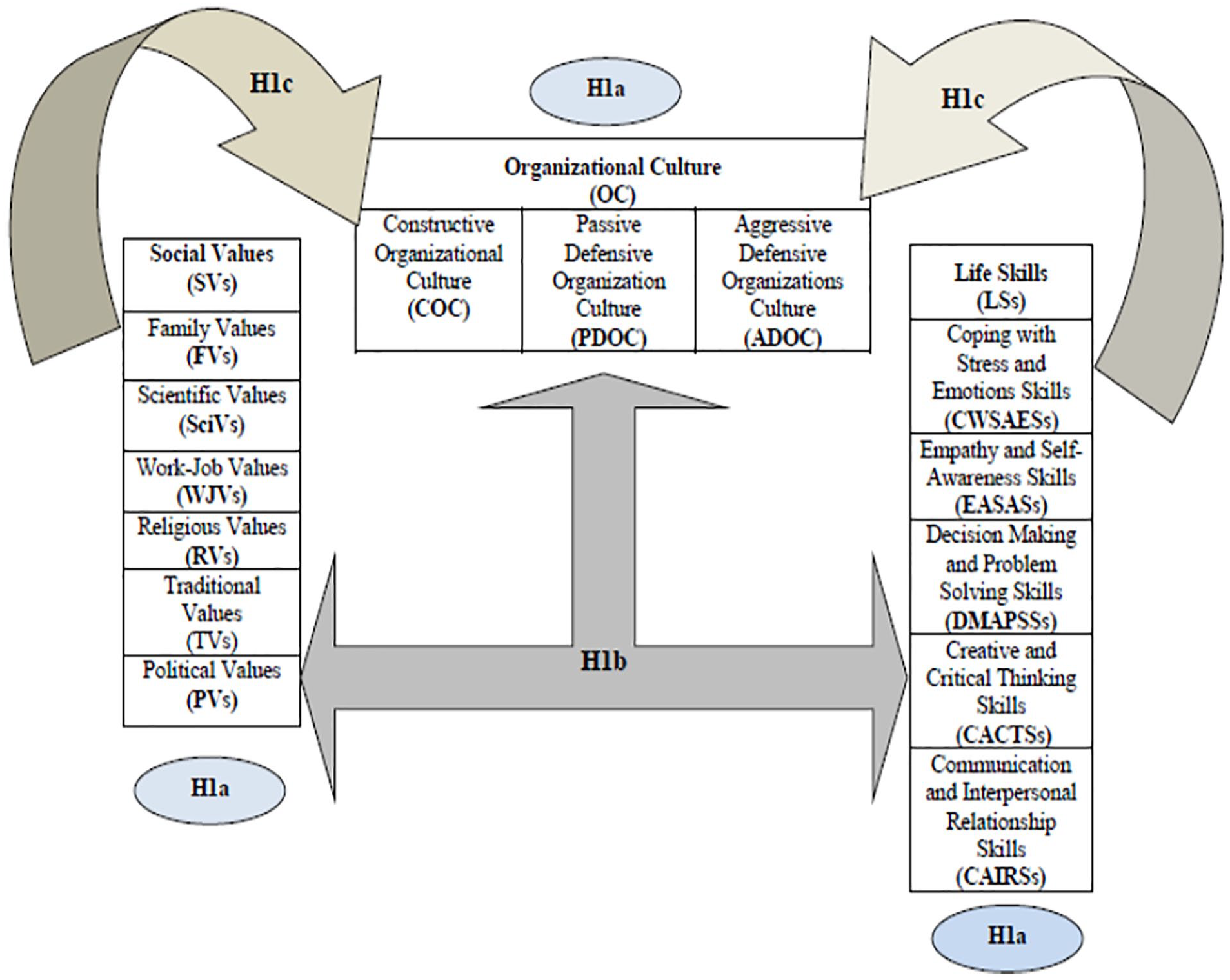
Research hypotheses.
Population and Sample
The population of this research consisted of 4,652 teachers who worked in 233 different schools in the Antakya district of Hatay province in the 2018–2019 academic year. A sample of 378 teachers representing this universe, at least 5% or more, made up the sample. In this study, we decided that 378 participants and 22 different educational institutions could represent the respective universe, which was suitable for a 5% sample error for the size of the universe consisting of 5,000 and fewer individuals (Yazıcıoğlu & Erdoğan, 2004). Of the study’s sample participants, 208 (55.03%) were women and 170 (44.97%) were men. Among the 378 participants, there were 22 school leaders and 356 teachers working in different branches. Among the 22 school leaders, there were16 deputy principals and six school principals. Twenty of the school’s leaders were male and two were female. Seventeen of the school’s leaders had undergraduate education and five had graduate education. It was determined that 341 of the participants received undergraduate (90.21%) and 37 received postgraduate education (9.79%). Of the educators who participated in this study, 34 (8.99%) had professional experience between 0 and 5 years, 62 (16.40%) had professional experience between 6 and 10 years, 143 (37.84%) had professional experience between 11 and 15 years, 105 (27.78%) had professional experience between 16 and 20 years, and 34 (8.99%) had professional experience between 21 years and above.
Data Collection Instruments
The set of data collection instruments of this research consisted of four different data collection tools. (a) The Organizational Culture Scale (OCS), (b) the Multidimensional Social Values Scale (MDSVS), (c) the Life Skills Scale (LSS), and the personal data form constituted the data collection tools of this research. Information about related data collection instruments in this study is provided below.
The Organizational Culture Scale (OCS) consists of 24 questions, which has been developed by Kılıç (2006) in his doctoral dissertation. Out of the 24 questions that make up this scale, eight questions define Constructive Organizational Culture (COC), eight questions define Passive Defensive Organizational Culture (PDOC), and eight questions define Aggressive Defensive Organizational Culture (ADOC). The reliability of the scale developed on organizational culture is 0.87.
Teacher and school leaders’ views on social values were obtained using the Multidimensional Social Values Scale (MDSVS) developed by Bolat (2013). As a result of the validity and reliability study, the scale is divided into six different dimensions and there are 42 expressions of social value distributed within these dimensions. The scale has a multidimensional structure due to the diversity of social structures that constitute social values. Related dimensions are (a) Family Values (FVs), (b) Scientific Values (SciVs), (c) Work-Job Values (WJVs), (d) Religious Values (RVs), (e) Traditional Values (TVs), and (f) Political Values (PVs). The Cronbach’s alpha internal consistency values of the subdimensions that make up the scale are calculated to be .71, .73, .78, .72, .70, and .76, respectively. These values show sufficient internal consistency to MDSVS. MDSVS responses to the social values are used to measure levels of the social value of the participants according to the values from 1 to 5. In The Multi-dimensional Social Values Scale (MDSVS), “(1) strongly disagree,(2) less agree,(3) agree medium,(4) agree quite and (5) totally agree” are located statements (Bolat, 2013, pp. 24–25).
The Life Skills Scale (LSS) developed by Bolat and Balaman (2017) consists of 30 items and five dimensions. The Cronbach’s alpha internal coefficient of the scale is 0.90. Coping With Stress and Emotions (CWSEA), Empathy and Self-Awareness (EASA), Decision Making and Problem Solving (DAMPS), Creative and Critical Thinking (CACT), and Communication and Interpersonal Relationship (CAIR) constitute the subdimensions of the scale. (χ2 = 886.80; p < .05; SD = 719; χ2/SD = 2.24; root mean square error of approximation = 0.051; standardized root mean square residual = 0.052; normed fit index = 0.93; nonnormed fit index = 0.95; comparative fit index = 0.96; incremental fit index = 0.96; goodness of fit index = 0.89; adjusted goodness of fit index = 0.87). Life Skills Scale (LSS) was developed while exploratory factor analysis and confirmatory factor analysis were conducted. The Cronbach’s alpha internal coefficient of subdimensions were calculated as 0.82 for CWSEA, 0.77 for EASA, 0.72 for DAMPS, 0.73 for CACT, 0.66 for CAIR. In The Life Skills Scale “(1) strongly disagree, (2) less agree, (3) agree medium, (4) agree quite and (5) totally agree” are located statements (Bolat & Balaman, 2017, p. 25).
Data Analysis
The teachers who made up the sample of this study were asked to provide answers to these measurement tools by presenting the measurement tools to the teachers during the time left over from their workload and work responsibilities. The average response times of these scales varied between 10 min and 16 min. It was decided not to include eights scales from the measurement tools answered by 378 teachers. Since the total number of school leaders (n = 22) among participants was small compared with the overall number of participants, the opinions of school leaders were evaluated together with the overall participants in the analysis.
The data collected from the measurement tools were then uploaded to the computer. The normality distribution was analyzed using the Kolmogorov–Smirnov Normality Test. At the end of the analysis, for MDSVS (−.52 to −.49), for LSS (−.49 to −.11), and for OCS (−.37 to .10) since it was determined that these values were between −2 and +2, it was concluded that they were within normal limits (Kalaycı, 2014). Thus, descriptive analysis, correlation, and regression analysis were performed on the data acquired using the data collection instruments. The results were interpreted by considering the lower problems.
Findings
Teachers’ and School Leaders’ Perceptions of Organizational Culture, Social Values, and Life Skills (H0a and H1a)
Descriptive analyses were conducted to investigate teachers’ perceptions of OC, SVs, and LSs with the help of data collected from the data collection instruments used in this research. Table 1 provides information on descriptive analyses.
Descriptive Analysis of Teachers’ and School Leaders’ Perceptions of OC, SVs, and LSs.

N = 370 (teacher:348, school leaders: 22).
When Table 1 is examined, we can see how teachers and school leaders perceived OC, SVs, and LSs. Teachers and school leaders had close values in the context of OC (X = 3.42), SVs (X = 3.51), and LSs (X = 3.35). In the context of value size, however, the findings showed that the SVs of teachers and school leaders had higher than their LSs and OC. Among these three variables, second place was OC, and third place was LSs.
Teachers and school leaders had a high level of perception of OC (X = 3.42). Within the dimensions of OC, COC (X = 3.95) was taken its place in a very high-value range. While PDOC was important in the second place (X = 3.32), ADOC, which was included in the dimensions of OC, was in the third place (X = 3.01).
When the SVs of teachers and school leaders were examined, the highest value in the SVs dimensions was related to the FVs dimension. The findings suggested that teachers’ FVs were quite different from other value sizes and were in a very high-value range. While SciVs (X = 3.72) were of importance in the second place by teachers, the findings showed that WJVs (X = 3.48) were in the third place. Also, they included TVs (X = 3.29), RVs (X = 3.26), and PVs, respectively (X = 3.24). In this context, participants found traditional, religious, and political values less important than social values.
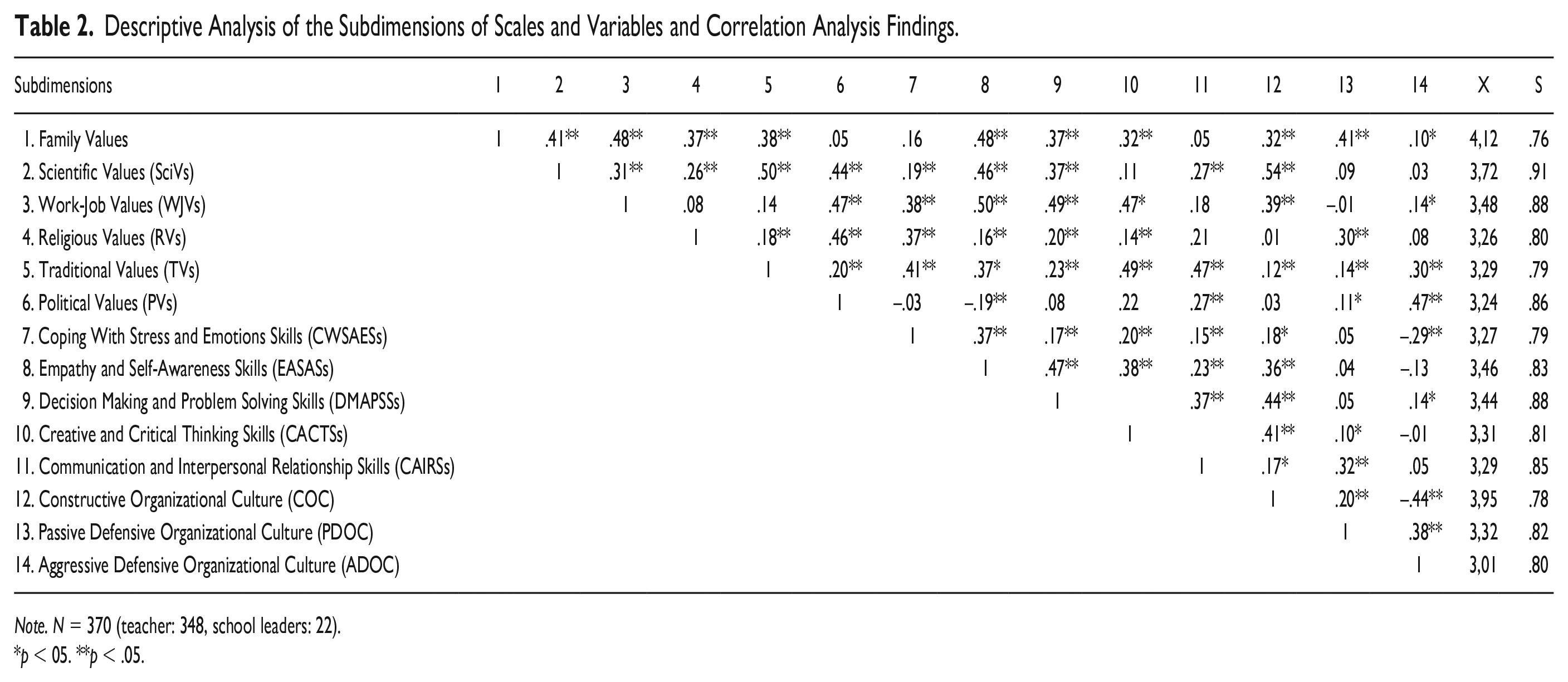
Teachers’ and school leaders’ perceptions of their LSs were identified. As shown in Table 2, the highest value in the participants’ LSs was the size of Decision Making and Problem Solving Skills (DMAPSSs) (X = 3.46). Creative and Critical Thinking Skills (CACTSs) (X = 3.44) were important in the second place, taking the value close to this. Empathy and Self-Awareness Skills (EASASs) (X = 3.31) was the third skill dimension, while Communication and Interpersonal Relationship Skills (CAIRSs) (X = 3.29) were the fourth, and Coping With Stress and Emotions Skills (CWSAESs) (X = 3.27) were the fifth and final skill dimensions.
Descriptive Analysis of the Subdimensions of Scales and Variables and Correlation Analysis Findings.
Note. N = 370 (teacher: 348, school leaders: 22).
p < 05. **p < .05.
Relations Between Organizational Culture and Social Values and Life Skills Scales (H0b and H1b)
For the second subobjective of this study, we examined whether there was a meaningful relationship between OC, SVs, and LSs. Therefore, descriptive and relational analyses of scales, scale subdimensions, and variables were performed with the help of the data collected in this study. These analyses are presented in Table 2.
As shown in Table 2, teachers and organizational leaders had a very high perception of COC (X = 3.95), a relatively high perception of PDOC (X = 3.32), and a moderate perception of ADOC (X = 3.01). However, in these three dimensions of OC, when the standard deviation values were compared, it was the COC dimension of the most homogeneous distribution that had a very high level of perception (S = .78).
Table 2 examines some relationships between OC subdimensions and SVs subdimensions and LSs subdimensions. The relationships identified were as follows: COC with SciVs (r = .54; p < .01), PDOC with FVs (r = .41; p < .01), ADOC with TVs (r = .30; p < .01), COC with WJVs (r = .39; p < .01), PDOC with RVs (r = .35; p < .01), ADOC with PVs (r = .47; p < .01), COC with DMAPSSs (r = .44; p < .01), PDOC with CAIRSs (r = .32; p < .01), ADOC with CWSAESs (r = −.29; p < .01), COC with EASASs (r = .36; p < .01), COC with CACTSs (r = .41; p < .01).
However, when these relationships were examined, COC with SciVs, PDOC with FVs, COC with WJVs, religious values with PDOC, ADOC with PVs, COC with DMAPSSs, and the relations between COC with CACTSs were seen to be in a high level and positive direction. The relationship between ADOC and TVs was positive and moderate; the relationship between ADOC and CWSAESs was negative and low.
Predictor Effect of Social Values and Life Skills on Organizational Culture (H0c and H1c)
In the context of the views of teachers and school leaders, which constituted the third subobjective of this study, the predictor effect of SVs and LSs on OC was examined. To establish a meaningful predictor in this context, the results of the analysis are given in Table 3 by regression analysis.
Regression Analysis and Results on Predictor of Social Values and Life Skills on Organizational Culture.

Note. FV = Family Values; SciV = Scientific Values; WJV = Work-Job Values; RV = Religious Values; TV = Traditional Values; PV = Political Values; CWSAES = Coping With Stress and Emotions Skills; EASAS = Empathy and Self-Awareness Skills; DMAPSS = Decision Making and Problem Solving Skills; CACTS = Creative and Critical Thinking Skills; CAIRS = Communication and Interpersonal Relationship Skills.
N = 370 (teacher: 348, school leaders: 22).
Table 3 contains some relationships between variables related to OC dimensions. COC (R = .59; R2 = .54; F = 17.04; p = .00), and there were a moderate and meaningful relationship between SVs and LSs variables. When we looked at the relevant predictability variables, it was seen that 54% of the variance in COC was explained. When the regression analysis results in Table 3 were examined, SciVs (t = 2.83; p < .01), CACTSs (t = 2.74; p < .05), DMAPSSs (t = 2.60; p < .01), EASASs (t = 2.41; p < .01), WJVs (t = 2.05; p < .01) with CAIRSs (t = 1.34; p < .01) showed that COC was a meaningful predictor. Since the standardized regression coefficient (β) revealed the order of importance of variables, the scientific values (β = .85), creative and critical thinking skills (β = .71), decision-making and problem-solving skills (β = .67), empathy and self-awareness skills (β = .54), work-job values (β = .47), communication and interpersonal relationship skills (β = .13), coping with stress and emotions skills (β = −.11), family values (β = .07), traditional values (β = .04), political values (β = −.03), and religious values (β = −.01) formed the order of relative importance.
PDOC (R = .48; R2 = .44; F = 10.76; p = .00) and there was a moderate and meaningful relationship between SVs and LSs variables. When we looked at the relevant predictability variables, it was seen that 44% of the variance in PDOC was explained. When the regression analysis results in Table 3 were examined, FVs (t = 3.11; p < .01), CAIRSs (t = 2.62; p < .01), TVs (t = 1.93; p < .05), RVs (t = 1.27; p < .01), WJVs (t = .91; p < .05) showed that PDOC was a meaningful predictor of behavior. Since the standardized regression coefficient (β) revealed the order of importance of variables, the FVs (β = .58), CAIRSs (β = .47), TVs (β = .39), RVs (β = .23), WJVs (β = .12), PVs (β = .08), EASASs (β = .04), CWSAESs (β = −.03), SciVs (β = .03), and DMAPSSs (β = .02) with CACTSs (β = .01) formed the order of relative importance.
ADOC (R = .57; R2 = .53; F = 15.22; p = .00) and there was a moderate and meaningful relationship between SVs and LSs variables. When we looked at the relevant predictability variables, it was seen that the variance of ADOC accounted for 53%. When the results of regression analysis in Table 3 were examined, TVs (t = 2.62; p < .01), PVs (t = 2.31; p < .01), FVs (t = 2.13; p < .01), RVs (t = 1.03; p < .01), WJVs (t = .98; p < .01), CWSAESs (t = −77; p < .01) showed that ADOC was a meaningful predictor of behavior. Since the standardized regression coefficient (β) revealed the order of importance of variables, TVs (β = .65), PVs (β = .57), FVs (β = .44), RVs (β = .25), WJVs (β = .17), CWSAESs (β = −.06), CACTSs (β = −.05), SciVs (β = .03), DMAPSSs (β = .01), CAIRSs (β = .01), and EASASs (β = −.01) formed the order of relative importance.
Discussion
In this study, first, we investigated how teachers and school leaders perceived OC, SVs, and LSs. The findings showed that the views of teachers and school leaders have close values in the context of OC, SVs, and LSs. This result confirms H1a of this research. In other words, the findings obtained in this study suggest that teachers and school leaders’ perceptions of OC, SVs, and LSs are adequate. However, within these three variables, SVs were higher concerning value size than in LSs and OC. In this context, teachers and school leaders seem to care more about SVs. This conclusion we reached regarding the importance of SVs are similar to the results of the study conducted on teacher candidates by Karasu Avcı and Faiz (2019). In the context of variables, the participants showed no significant difference in their SVs and had high SVs. However, it can be said that the results obtained by Dinçer et al. (2019) regarding the values of having SVs in the study of teacher candidates support the order of importance of SVs in this research. Also, a study conducted by Çalışkan et al. (2017) in the relevant literature shows that the social values of teacher candidates “quite agree” with the high level of SVs depiction is similar to this research.
RVs, and PVs less important than SVs. This conclusion of the research differs from the SVs ranking in the research by Keçeci Kurt et al. (2014) in which the social values of social studies teacher candidates are examined. Contrary to the results of our research, Keçeci Kurt et al. (2014) identified RVs as important SVs in the first and TVs as important SVs in the second, while PVs were ranked last in the same research as the result of our research. In a study conducted by Kheir-Faddul et al. (2019), with local values, such as telling the truth, preserving traditions, the dignity, and dignity of others; respect, order, loyalty, inclusion and understanding of others, fairness, flexibility, ownership, commitment, conscience, consistency, forgiveness, honesty, to tell the truth, professional ethics, responsibility to determine the limits, striving for excellence, teamwork, tolerance, trust, goodwill, the ability to export, import and export between equality, membership, and group on universal values, such as the importance of teachers and school leaders, have been shown that two types of value. Also, the dominant perception of value with that school leaders have emphasized that the relationship between school culture. However, the justifying secondary school principals, values, and application forms are perceived in a very strong way and have a high awareness of the situation in schools. Sunley and Locke’s (2012) work in the professional role of teachers has revealed the relationship between the dominant values. It is also noted that the school types and connections between the dominant value.
Teachers’ and school leaders’ perceptions of their LSs have been identified. When the LSs of the participants were examined, it was concluded that the highest value belonged to the dimension of CACTSs. DMAPSSs were important in the second place. EASASs have formed the third skill dimension, while CACTSs have taken their place as the fourth skill dimension in the last order of CWSAESs. In general, the average level of LSs of teachers is shown to have moderate LSs. It can be said that our research carries similar values with the state of having the LSs revealed in the research conducted by Balaman et al. (2018) with teacher candidates. However, it seems that the candidates have a slightly higher level of LSs than the teachers. It is the individual capital of life skills that increases individuals’ level of well-being and happiness (Bailey et al., 2013). This important capital will inevitably have a positive impact on the institutions and organizations that individuals serve.
According to the results of research by Kaur and Sandhu (2016) conducted by female teachers than their male counterparts, they have significantly higher LSs, LSs among teacher candidates also “effective communication” and “problem-solving” the size of risk-taking behavior had significant and positive correlation was revealed. Teacher candidates’ risk-taking behaviors with a total of life skills and life skills critical thinking, decision making, empathy, coping with emotions, self-awareness, and coping with stress interpersonal relations have a significant and negative relationship between skills and creative thinking skills while a significant correlation has been found between. The effective communication dimension of life skills and life skills as a whole is the most important predictors of the risk-taking behavior of prospective teachers. Indeed, LSs are also associated with teaching performance. Jayachithra (2015), which examines the relationship between the LSs of teacher candidates and their teaching performance, states that teaching performance is related to LSs. According to this, teachers’ teaching performance can be explained separately and as a whole by each dimension of their LSs in line with the dimensions of emotional intelligence, stress management, tension management, and conflict resolution. It is also emphasized that research findings show that life skills should be heavily involved in teacher training programs. At the same time, the acquisition of LSs as a professional responsibility also improves the mental health of teachers. Similarly, teachers’ awareness of LSs is important in the professional process. In a study on teacher training to place LSs in vocational teaching conducted by Simona (2015), it is stated that the importance of teachers’ participation in imparting LSs in schools is at 50% level. In contrast, 68% of respondents emphasized that vocational education teachers need special training in developing LSs in vocational learning. This research reveals the importance of teacher training to place LSs into teaching. Training is needed for professional teachers, particularly in relation to communication, problem solving, literacy, attitudes, and resilience, and to increase students’ autonomy, promote personal development, develop self-management, work, and self-assessment skills. Dinçer et al. (2019) research conducted with guidance teacher candidates found that there was a negative and low-level meaningful relationship between critical thinking standards and social value perceptions. When the results of these studies mentioned in the literature are considered as a whole, the importance of LSs for teachers and school leaders is revealed. Our research found that teachers and school leaders have a high level of perception of OC. The research conducted by Korkut and Hacifazlioğlu (2011) concluded that teachers and school leaders who have organizational culture put more emphasis on the success of the school. This can be interpreted as the necessity for individuals to have an OC for the success of the organization. In our research, it is observed that within the dimensions of OC, COC takes its place in a very high-value range. While PDOC is important in the second place, ADOC culture, which is included in the dimensions of OC, is in the third place. By looking at this result, it can be said that the participants had more COC characteristics.
In a survey conducted by Zhu et al. (2011) the teachers with the cultural characteristics of the school the school’s goal orientation, shared vision and staff perceptions of relationships between happiness and organizational commitment of teachers are important factors that affect explained. Yüksel (2019) emphasizes that there is a clear and hidden relationship between OC and institutional effectiveness and that the schools in which the participants’ work are strong in the context of OC, due to the functionalist approach that leads to the explanation that strong institutions are formed. Similarly, cultural components of the school, such as academic research and publishing, student support, and reliance and respect among teachers, are stated to increase teachers’ organizational learning capacity (Louisa & Lee, 2016). According to other studies, there is a positive relationship between organizational culture and teachers’ job satisfaction at a high level and school culture is an important predictor of job satisfaction. To improve the performance of the school, school leaders must make greater efforts to improve school culture and build a better working environment (Abdullah & Arokiasamy, 2016; Hosseinkhanzadeh et al., 2013). However, it is stated that organizational culture does not have a direct effect on teacher performance, but that organizational culture has an indirect effect on employee performance through job satisfaction. Better OC means higher employee satisfaction and performance (Suharningsih & Murtedjo, 2017). Also, the high level of the corporate culture of the educators, the majority of whom are undergraduate graduates, which we have reached in our research, reveals the opposite results with the lower level organizational culture values of the teachers participating in the undergraduate level conducted by Korkut and Hacifazlioğlu (2011).
In our research, we concluded that the perception of COC of teachers and school leaders is very high, the perception of PDOC is relatively high, and the perception of ADOC is moderate. The most powerful and stable distribution within the dimensions of OC belongs to COC. Also, some relationships have emerged between corporate culture dimensions and SVs subdimensions and LSs subdimensions. This result confirms H1b of the research. In other words, there is a meaningful relationship between OC, SVs, and LSs.
These relationships have emerged between COC with SciVs, PDOC with FVs, ADOC with TVs, COC with WJVs, PDOC with RVs, PDOC with PVs, COC with DMAPSSs, PDOC with CAIRSs, PDOC with CWSAESs, COC with EASASs, and COC with CACTSs. In research examining the impact of OC on the learning environment by Chatterjee et al. (2018), it is emphasized that organizations having different cultures influence transfer factors on learning. In our research, the differences in SVs and LSs related to three different OC indicate that different types of learning transfer will occur in organizations with this culture.
Also important in our research, the relationship between ADOC and TVs was positive and moderate; the relationship between ADOC and CWSAESs was negative and low. It has been determined that there are some relationships between variables related to OC dimensions. A moderate and meaningful relationship between COC, PDOC, and ADOC and variables of SVs and LSs has emerged.
SciVs, CACTSs, DMAPSSs, EASASs, WJVs, and CAIRSs are a meaningful predictor of COC behaviors. FVs, CAIRSs, TVs, RVs, and WJVs are a meaningful predictor of Passive Organizational Culture behaviors. TVs, PVs, FVs, RVs, WJVs, and CWSAESs were significant predictors for Aggressive Defensive Organizational Culture behaviors. It has been concluded that these predictors have different importance for the three components of OC and that their order of importance has changed. When all the results of the study are examined, the predictors for COC, PDOC, and ADOC are given in Table 4.
Predictors of Constructive Organizational Culture, Passive Defensive Organizational Culture, and Aggressive Defensive Organizational Culture.

According to the results of the research in Table 4, it is possible to say that COC has more scientific OC characteristics when looking at the predictors of SVs and LSs. This result confirms H1c of the research. In other words, OC, SVs, and LSs have a predictive effect on organizational culture.
Because decision-making skills, problem-solving skills, and the predictor role of scientific values inevitably outweigh. Leblebici (2008) emphasizes that some organizations focus on concepts of practical importance and that problem-solving skill is important to these organizations. It can be said that organizations with COC can cooperate with other disciplines because their main purpose is to solve problems because of their scientific attitude. Also, communication skills and empathy and self-awareness skills that support these skills are seen as an important predictor that shows that individuals within the organization use a more open channel of communication. In research conducted by Karanges et al. (2015) on the impact of intra-organizational communication on the employee, their findings showed that inter-organizational communication has a direct effect on employee engagement. Therefore, the communication skills of the individuals who make up the organizations will have an impact on the success of the organization.
When the predictors of PDOC are examined, they draw a more traditionalist organizational structure than COC because the role of FVs, TVs, and RVs as predictors comes to the fore. Since these values are more related traditions and customs, it is possible to say that the traditionalism characteristics of PDOC in this structure predominate. Furthermore, communication and interpersonal relationship skills are an important predictor indicates that this organizational structure is not closed to communication. A study conducted by Baba Kaya et al. (2016) found that athletes with FVs, WJVs, RVs, and TVs sizes had higher levels of self-esteem. Therefore, individuals in organizations who develop behavior belonging to PDOC may be said to have a higher level of self-esteem.
In the dimension of ADOC, it is observed that in addition to traditionalism, the predictor of PVs effect on PDOC. Also, the ability to coping with stress and emotions and negative predictability lead to the creation of an environment closed to communication within the organization because the order of importance of communication and interpersonal relationship skills and empathy and self-awareness skills is far behind. This situation will cause communication barriers to be created in organizations with an aggressive defensive structure. An environment of conflict will arise in organizations composed of individuals with communication barriers. However, it has been concluded that WJVs are an important predictor of three organizational structures. These three different organizational structures can be interpreted as giving importance to the values related to the teaching profession and the working environment.
Conclusion
All of the alternative hypotheses (H1a, H1b, H1c) tested in this study have been confirmed. Teachers and school leaders had high levels of OC, SVs, and LSs. The relationship between the variables, scales, and the subdimensions of the related scales is significantly and highly relevant to OC. Participants’ perceptions of COC were very high. The analysis concluded that there was a partial effect on mediating OC between SVs and LSs.
The findings obtained in this study suggest that COC is more scientific and communication-based and that PDOC is supported by traditionalist and relatively communication. PDOC are traditionalists but are not closed to communication. It has been identified with predictors in which ADOC is more traditionalist and has communication barriers.
As a result, many components make up OC. In this study, important results were obtained regarding the predictor effect of SVs and LSs on OC. Also, it is emphasized that the individuals who make up the organizations and ensure the standing of the organizations are at the desired level concerning both SVs and LSs.
Suggestions
To make organizational culture more desirable by teachers and school leaders, some studies can be designed to develop social values and life skills. Identifying organizational culture predictors with the assistance of different data collection tools can provide significant gains to the literature. Studies should be conducted on this subject with different types of research models based on different organizations or different countries to provide new insights.
Limitations
This research is limited to social values and life skills as predictors of organizational culture. Data collected by measurement tools are limited to teacher and school leader views.
