



Abstract
By paying attention to what Peruvian and Bolivian students in schools say about how they are seen and treated by their native-born peers, this article aims to analyze the ways in which symbolic boundaries are produced, eventually giving way to social boundaries between natives and migrants. The methodology is based on in-depth interviews with students, parents, and educators of rural and urban schools in the region of Arica y Parinacota, the northernmost region of Chile, by the borders with Peru and Bolivia. We conclude that the production of symbolic boundaries among students emerges as discourses about nationality, skin color, ethnicity, and history. Peruvian and Bolivian migrant students describe being teased by their native-born peers because of their country of origin, for being darker-skinned, for being Aymara, and for having lost the War of the Pacific (and, in the case of Bolivians, for having lost access to the coastline). Some migrant students perceive these discourses as discrimination and consider them harmful; however, many others accept them as normal school stuff—as long as there is no physical violence. Moreover, teachers and parents do not see these interactions as problematic. The article concludes that the normalization of stigmatizing and discriminatory dynamics against migrant students complicates their inclusion in Chilean schools.
Plain language summary
In this article, we pay attention to what Peruvian and Bolivian students in schools have to say about how they are seen and treated by their native-born peers. Accordingly, we conduct in-depth interviews with Peruvian and Bolivian students enrolled in urban and rural schools across the region of Arica y Parinacota and with teachers, school professionals, and parents. In analyzing their discourses, we focus on how students create distinctions and verbally separate from one another into groups, producing symbolic boundaries. Across the interviews, we find that, in these schools, the production of symbolic boundaries among students emerges as discourses about nationality, skin color, ethnicity, and history. Some migrant students perceive these discourses as discrimination and consider them harmful; however, many others accept them as normal school stuff—as long as there is no physical violence. Moreover, teachers and parents do not see these interactions as problematic. We conclude that discrimination, stigmatization, and racism are present in the everyday interactions of Chilean, Peruvian, and Bolivian students. In this border territory, historically a region of transhumance and coexistence among Andean peoples, the nationalistic project of the post-war era sneaks into children’s relationships.
Introduction
In times of new and growing migration flows, including migrant students in schools represents both a goal and a challenge for many educational systems. Intra-regional migration has become the most relevant kind of migration in South America (International Organization for Migration, 2020) and, in this context, Chile went from having a 4.4% of migrant population in 2017 to 7.5% in 2021 (Servicio Jesuita a Migrantes, 2023). This significant increase in the proportion of foreign-born individuals is primarily driven by Venezuelans, who have fled their country in unprecedented numbers since 2016 (ACNUR, 2023), displacing the neighboring countries of Peru, Bolivia, and Argentina as the main sources of migration into Chile.
While the impacts of Venezuelan immigration have claimed the attention of public discourses and national debates, in Arica y Parinacota, the northernmost region of Chile, Peruvians and Bolivians make up a large part of migrant children seeking enrollment in schools. Although the migrant status of Peru and Bolivia nationals in the north of Chile is relativized by the fact that, less than 100 years ago, these territories belonged to Peru and Bolivia, the aftermath of the War of the Pacific (1879–1883) and the subsequent Chileanization process (Gonzalez Miranda, 2004) complicate the relationship between Chileans, Peruvians, and Bolivians living in the border region. According to Lube-Guizardi and Garces (2013), following the war, the establishment of this border supported the emergence of a nationalistic ideology based on the contrast between “us” (Chileans) and “them” (Bolivians and Peruvians), and on the alleged notion of a homogeneous Chilean identity, in social, cultural, ethnic and racial terms. Therefore, the northernmost region of Chile combines the shared presence of indigenous peoples (mainly Aymara) across Andean countries with the epic discourse of the military quest that gave origin to the 20th-century Chilean nation-state.
The incorporation into Chilean territory as a heroic deed is a symbolic element embedded in the identity of the northern region. Indeed, the anniversaries of the epic battles of the War of the Pacific are major identity milestones for the cities of Arica and Iquique; these dates are more relevant than the foundation dates of these cities, which are mostly unknown to their inhabitants. Díaz et al. (2010) argue that, during the incorporation of Peruvian territories following the War of the Pacific, the Chilean state centered its efforts on implementing a political structure for social control and reproduction of Chilean national ideals and values. In this context, the praise of patriotic symbols, the administration of the national legal order, the installation of a military and bureaucratic apparatus, the school system and public employees operated under a homogenizing logic. These elements point to the fact that how the national identity is produced in a border context shapes the relationship between Arica natives and migrants. As Diaz et al. (2010) point out, “the ariqueño identity emerges from the Peruvian tradition as well as from the display (by fair or foul means) of artifacts of Chileanization, which, on occasions, acted as locks” (p. 27).
Moreover, Arica is the main point of entry to Chile for South American migrants. Thus, this region has a significant presence of indigenous peoples as well as of migrants. Indeed, many Peruvian and Bolivian migrants are indigenous Aymara or Quechua people. In the international literature on education, the study of race, ethnicity, and migration on the one hand and indigenous peoples on the other has moved chiefly through parallel tracks. Indigenous status has seldom been included in studies about migration. However, this connection is apparent and necessary for scholars in different regions of the world. By choosing this setting, we aim to contribute to the literature on ethnic inequalities in education by interrogating how the categories of migrant and indigenous are produced and used in schools near the border. Therefore, our main objective is to analyze the perceived inclusion of Peruvian and Bolivian migrant students in Arica, considering how these migrant students interpret their interactions with native-born peers. In doing so, we reflect on how social distinctions -or boundaries- are produced in this particular context, and how those boundaries may become stigmas.
In this article, we pay attention to what Peruvian and Bolivian students in schools have to say about how they are seen and treated by their native-born peers. Accordingly, we conduct in-depth interviews with Peruvian and Bolivian students enrolled in urban and rural schools across the region of Arica y Parinacota, and with teachers, school professionals, and parents. In analyzing their discourses, we focus on how students create distinctions and verbally separate from one another into groups, producing symbolic boundaries (Lamont & Molnar, 2002; Lamont et al., 2014).
We analyze the production of symbolic boundaries among students in urban and rural schools of the region of Arica, assuming the perspective of Peruvian and Bolivian migrant students. Additionally, we reflect on the extent to which these symbolic boundaries constitute social boundaries involving social distinctions that are acted upon and what these distinctions mean for migrant students.
Across the interviews we find that, in these schools, the production of symbolic boundaries among students emerges as discourses about nationality, skin color, ethnicity, and history. Peruvian and Bolivian migrant students describe being teased by their native-born peers because of their country of origin, for being darker-skinned, for being Aymara, and for having lost the War of the Pacific (and, in the case of Bolivians, for having lost access to the coastline). Some migrant students perceive these discourses as discrimination and consider them harmful; however, many others accept them as standard school stuff—as long as there is no physical violence. Moreover, teachers and parents do not see these interactions as problematic.
We conclude that discrimination, stigmatization, and racism are present in the everyday interactions of Chilean, Peruvian, and Bolivian students. In this border territory, historically a region of transhumance and coexistence among Andean peoples, the nationalistic project of the post-war era sneaks into children’s relationships. This nationalistic ideology presents the countries that lost the War of the Pacific (Peru and Bolivia) as inferior, backward, and primitive compared to Chile, which in turn is seen as evolved, modern, and whiter. Analyzing the migrant and the indigenous statuses under the same lens, instead of considering them separately, allows for a deeper understanding of this border region’s complex social school dynamics.
Conceptualizing Boundary-Making Processes and Stigmatization of Migrant and/or Indigenous Students
The Making of Symbolic and Social Boundaries
Symbolic boundaries are conceptual distinctions made by social actors to categorize objects, people, and practices; they are “tools by which individuals and groups struggle over and come to agree upon definitions of reality”; they also separate people into groups. Therefore, symbolic boundaries “are an essential medium through which people acquire status and monopolize resources” (Lamont & Molnar, 2002, p. 168). Symbolic boundaries may give place to social boundaries, which are “objectified forms of social differences manifested in unequal access to and unequal distribution of resources (material and nonmaterial) and social opportunities.” They are “identifiable patterns of social exclusion” based on class, race, or other stratification schema (pp. 168–169). The distinction between symbolic and social boundaries is relevant for this study in that the production of distinctions among groups of students does not necessarily mean segregation or exclusion; however, it is a critical element for understanding processes of discrimination and stigmatization.
The Production of Ethnic, Racial, and National Distinctions
World dynamics such as globalization and market economy impact how ethnic identities are produced, linking categories like race, ethnicity, and nation to expanding European hegemonic ideas (Balibar & Wallerstein, 1991). Global perspectives also highlight the role of the nation-state in the ethnic re-emergence in societies of the Global South (Segato, 1999, 2007). However, despite the globalized consequences of colonialism, slavery, and labor migration, the resulting ethno-racial structures vary according to local contexts (Loveman, 2014; Telles, 2014). This definition of the origin of ethno-racial structures implies understanding them as hierarchical schemas that place people into ethno-racial categories, following Bonilla-Silva’s (1997, 2004) argument.
Research has shown that immigrant incorporation is not a straightforward process but that different groups of migrants would have varying educational and occupational outcomes. Scholars have attributed these differing outcomes, most saliently, to cultural characteristics (Fordham & Ogbu, 1986; Mickelson, 1990; Ogbu, 1991), to particular contexts of origin and destination (Portes & Rumbaut, 2001, 2006; Portes & Zhou, 1993; Rumbaut, 1994), and to the social and cultural capital of migrant communities (Carter, 2003, 2005; Kao, 2004; Kao & Tienda, 1995; Kao et al., 2013; Stanton-Salazar, 1997; Stanton-Salazar & Dornbusch, 1995; Zhou & Kim, 2006).
Additionally, from an interactional point of view, prejudicial ideas and attitudes regarding foreign individuals and cultures have also been signaled as a relevant dimension in understanding educational inequalities. In particular, prejudice and discrimination affect subaltern groups’ educational experiences and outcomes (Keyl, 2017). Finally, prejudice and discrimination might lead to what researchers theorize as “acculturation stress”; that is, a stress response to difficulties and challenges experienced by migrants (Dyal & Dyal, 1981; Orozco Vargas, 2013; Urzúa et al., 2017). For instance, acculturation stress may affect students’ psychological well-being and school performance.
Stigmatization
This article analyzes discriminatory practices from the conceptual viewpoint of stigmatization (Link & Phelan, 2001; Miric, 2003; Phelan et al., 2014). Goffman understood stigma as a “deeply discrediting attribute” that establishes a clear difference between the stigmatized and the stigmatizer, arguing that stigmatizing practices originate and unfold in social interaction (Goffman, 2009). Thus, the most relevant aspect of stigma is not its intrinsic value but its relational nature. It is not only the stigmatized person or the stigma considered in isolation that matters; what is fundamental is the social process involved in stigmatization. As Goffman (2009) argued, “the normal and the stigmatized are not persons but rather perspectives.”
Stigmatization appears then as a social distinction between stigmatizer and stigmatized, where the first counts with optimistic expectations or is seen as “normal.” At the same time, the stigmatized is burdened with the weight of social discredit and is seen as “abnormal” (Neuberg et al., 2000). Finally, stigmatization originates and is reproduced where social interactions occur (Goffman, 1991). Hence the interest in “mixed contacts,” which arise when agents meet and communicate. In this study, schools are the place where stigmatizers and stigmatized interact.
According to Lamont et al. (2014), stigmatization, as well as racialization, standardization, and evaluation, is a cultural process (p. 10). Cultural processes are meaning-making processes involved in creating shared categories of classification through which individuals perceive their environment and sort out people or actions (p. 11). Following Goffman and Link & Phelan, Lamont et al. (2014) describe stigmatization as a phenomenon in which labeling, negative stereotyping, separation, and status loss/discrimination converge in the context of a power structure (p. 17). Following Dubet et al. and Fleming et al., Lamont and coauthors argue that stigmatization is symbolically designating and negatively qualifying identities and differences (Lamont et al. 2014, p. 17).
Under certain circumstances, stigmatization coincides with racialization dynamics. Following Murji & Solomos, Lamont et al. (2014) define racialization as the process by which social markers or biological or phenotypic differences are imbued with significance by social actors (p. 15). As a meaning-making process, racialization can be associated with a racial ideology or a racially-based framework that actors use to justify or challenge racial hierarchies (Bonilla-Silva, 2022). Bonilla-Silva (2022) illustrates the racial ideology of color-bind racism, which consists of explaining racial matters as the outcomes of nonracial dynamics or, in other words, denying the structural dimension of racial inequalities by decontextualizing them, naturalizing them, and by attributing them to cultural differences (p. 343).
Inclusion and Exclusion of Migrant and Indigenous Students
Our concern with the production of social boundaries and with stigmatization emerges from the understanding that these processes can impede the inclusion of migrant and indigenous students. Booth et al. (2002) understand inclusion as a principled approach to action in education and society committed to the idea that all lives are of equal value. Therefore, inclusion involves increasing participation and reducing the exclusion of children from cultures, activities, and communities of local settings, among other aspects (p. 4).
In good measure, scholars and educators have associated the inclusion of migrant and indigenous students with the ideas of multiculturality and/or interculturality. While multiculturality refers to the cultural diversity in a given context, interculturality pertains to the relations among the agents of such diversity (Essomba, 2008). De Sousa Santos (2006) affirms that the prefix “inter” points to cultural exchanges among the participant cultures. In his exhaustive analysis of multiculturalism and interculturality, Dietz (2012) distinguishes between what multicultural and intercultural discourses refer to in practice and what these ideals aim for in a normative manner. While multiculturality refers to cultural, linguistic, and religious diversity in practice, it aims to acknowledge differences. On the other hand, interculturality refers to interethnic, interlinguistic, and interreligious relations, aiming for coexistence in diversity (Dietz, 2012, p. 16).
In Latin America, attempts to materialize the principle of interculturality have taken the shape of intercultural education programs across different countries, particularly Intercultural Bilingual Education (IBE). However, many scholars agree that most IBE programs reveal a functionalist understanding of interculturality because they aim to facilitate the incorporation of ethnic minorities into the hegemonic social system without challenging power dynamics and inequality between groups (Walsh, 2010). In fact, in Chile and other countries, IBE programs have been implemented only in schools serving the indigenous population, leaving the non-indigenous untouched by this policy (Mondaca-Rojas & Gajardo-Carvajal, 2013). If IBE in practice turns into “education for the indigenous,” it can hardly accomplish the goal of cultural exchange.
Studies on Stigmatization of Migrant and/or Indigenous Students
Following Link and Phelan’s (2001) model, Li et al. (2007) study the stigmatization of rural-to-urban migrant workers in China, describing how they experience labeling, stereotyping, separation, status loss, and discrimination. In a more recent study, Li et al. (2010) find that social stigma is a detrimental factor in the education of rural-to-urban migrant children in China because fear of being looked down upon prevents some students from attending public schools. On the other hand, Kovats Sánchez (2020) finds that, among a group of Latino indigenous college students in the United States, persistent discrimination and stigmatization are associated with increased ethnic identification.
Many scholars have demonstrated the negative impact of ethnic and racial stigmatization. In addition, studies have addressed how stigmatized groups respond to stigma individually and collectively. Eijberts and Roggeband (2016) discuss the coping strategies of Muslim women in the Netherlands who continue to experience discrimination and stigmatization. The authors identify six different coping strategies: concealing (hiding a stigmatizing feature), conciling (accepting it), circumventing (avoiding stigmatizing situations), compensating, confronting, and consolidating (reaffirming their ethnic identity).
Simply denying that one is experiencing discrimination or stigmatization can also be a coping strategy. Raby (2004), in her interview study of teenage girls living in or near Toronto entitled “There's no racism in my school, it's just joking around,” finds that girls' discourses tend to deny racism while citing instances of racism. More recently, Wiltgren (2020) coins the idea of “polite exclusion” to explain high-performing migrant students’ accounts. The author argues that, despite not asking questions about exclusion, most interviewed students described having lived these situations and linked them to their ethnicity. Moreover, Wiltgren argues that a recurrent strategy among students in dealing with exclusion is “to shrug and say that one does not care” (p. 15).
Stigmatization does not necessarily take the form of explicit bullying or discrimination. In a study of how racialized students navigate campus life in a mid-size Canadian city, Caxaj et al. (2021) find that they experience objectification and are challenged based on their non-white status. Specifically, a student describes being singled out as a “funny” novelty, token person, or “clown” (p. 513).
In Chile, exclusion, discrimination, and stigmatization in school settings have mainly been addressed by qualitative studies focusing on schools with significant proportions of either indigenous or migrant students in specific country regions (Stefoni & Corvalán, 2019). One line of research has concentrated on the (Black) Haitian migrant community, prominent in Chile since the 2010s, denouncing discrimination and stigmatization against Haitian students by their native-born peers. Riedemann and Stefoni (2015) identify five kinds of racist practices against Haitian students in one high school: these actions range from racist discourses expressed by Chilean teachers behind their Haitian students’ backs, “jokes” made by Chilean students about Haitian children’s physical traits, to overt physical and symbolic violence. Strikingly, the authors argue that teachers and school professionals at this school actively deny the presence of racism, either directly, by denying the existence of racist intentionality, by minimizing racist situations (classifying them as isolated events), or by cataloging accusations of racism as exaggerations. This finding agrees with the idea of a color-blind racist ideology of Bonilla-Silva (2022). Pavez et al. (2018) coincide with Riedemann and Stefoni: their Haitian interviewees also describe experiences of stigmatization. Their Chilean school peers tease and even harass them because of their skin color and other phenotypical characteristics.
Scholars studying the incorporation of Haitian students in Chilean schools have highlighted racial stigma and discrimination based on skin color. However, they have also signaled language, socioeconomic status, and gender stereotypes as obstacles to these students’ integration (Pavez et al., 2018), which links these studies to the broader literature of multicultural/intercultural education. Migrant students and students who identify as indigenous tend to concentrate in resource-deprived public schools, with teachers who are often ill-prepared for multicultural classrooms. Tijoux and Zapata-Sepúlveda (2019) propose guidelines for incorporating immigrant children in studies in the north of Chile; they argue for the need to consider the nature of the Chilean education system. According to them and scholars such as Stefoni et al. (2016), this system is highly centralized. It rarely covers intercultural content; even more infrequently, these contents are locally or regionally pertinent.
Tijoux and Zapata-Sepúlveda find that teachers at schools in the northern regions of Chile oscillate between showing particular concern for the integration of migrant students and considering that acknowledging them as “different” is in itself an act of exclusion (i.e., “all children are equal”) (pp. 543–544). Moreover, Bustos and Gairin (2017) observe that schools in the region of Arica de facto have little disposition for interculturality, in that educators expect migrant students to adapt to Chilean schools. Furthermore, Alvarado-Urbina and Zapata-Sepúlveda (2020) analyze educators’ perceptions of multiculturality in Arica, the northernmost region of Chile, where a significant share of Peruvian and Bolivian migrants are also part of the Aymara indigenous people. The authors argue that educators’ discourses distinguish Aymara and non-Aymara students, assuming that the first have characteristics that make them fundamentally different from others. However, these symbolic borders are mobile in that, on occasions, Aymara status, rurality, and having migrated from Bolivia or Peru are indistinguishable from each other in teachers’ discourses.
As this literature review reveals, stigmatizing students perceived as belonging to a different, inferior culture (or nation, or “race”) is a persistent phenomenon in schools, and Chile is no exception. Experiences of stigmatization impact students’ lives in multiple ways, including how they construct their identities (Rosenblum et al., 2009). Furthermore, despite the increased attention paid to policies of inclusion and interculturality/multiculturality, schools still fall short in their ability to accommodate the needs of a diverse student population adequately, even when diversity is present in their discourses and official documents (Arias-Ortega & Quintriqueo, 2021; Beltrán Véliz & Pérez Morales, 2018; Bustos González & Mondaca-Rojas, 2018; Mondaca et al., 2017; Mondaca-Rojas & Gajardo-Carvajal, 2013; Mondaca-Rojas et al., 2020; Webb, 2015; Webb et al., 2018).
Lastly, as Serrano Ruiz (1998) points out, it is not cultures that relate to each other but subjects; therefore, the treatment of diversity is often limited by subconscious patterns shared by agents in the schooling context. In this process of inter-subjective dialogue, people can overcome prejudices and preconceived ideas when aided by the analytic tools and reflections of other participants in the conversation (Aman, 2017).
Data and Methods
Research Strategy
Our qualitative methodological strategy relies on a series of in-depth interviews with migrant students from Peru and Bolivia enrolled in urban and rural schools in the region of Arica y Parinacota, in the north of Chile. These interviews aim to capture migrant students' perceptions of their incorporation into Chilean schools; moreover, we include interviews with educators (teachers, directors of the technical-pedagogical units) and parents to complement and contrast students’ viewpoints.
Qualitative research includes diverse techniques for producing information; this study relies on in-depth interviews because they allow a two-way approximation between the researcher and the participant (Caballero, 2001; Jackson, 2001; Poveda, 2003). We adhere to Woods (1995) in that in-depth interviews can be seen as participant observation because they grant an interactional context that makes the models and norms socially produced around a research topic visible. Furthermore, as a research tool, interviews allow transcending the answers to a researcher’s questions. All the nuances in testimony are valuable: silences, hesitations, everything counts as evidence (Jiménez, 2007).
We understand discourses as products of social situations and socially and historically situated practices. As a result, following Moscoso (2014), speakers can adopt diverse perspectives in their discourses because their perspectives are connected to the views of others. Memory is a social process, and discourses are intersubjective. Therefore, to apprehend biographic elements in the discourses of children, we need to approach their discourses through life stories situated in specific contexts (Moscoso, 2014).
We proofed our interview guides through a twofold process: firstly, validation by expert judgment, and secondly, a pilot test. The validation of the interview guides started with the assessment of four experts in educational research or in working with migrant communities. These experts assessed and made suggestions for each item, the topics included in the guide, the order of questions, and more. Based on the experts’ feedback, we rearranged the interview guides. Then, we administered the interview guide to migrant students in high school first and second years. Based on this pilot, we realized that we needed to use a language closer to how students speak in their everyday lives.
Sample
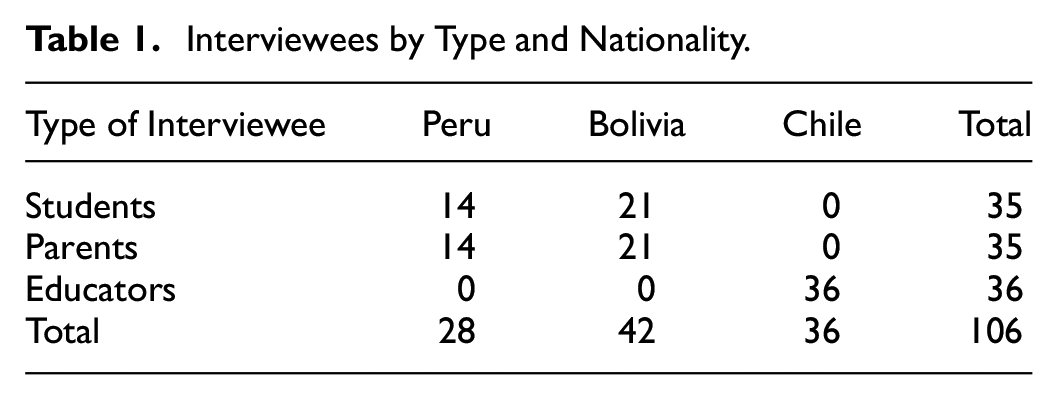
The interviews selected for this study are part of a long-term project regarding the experiences of Peruvian and Bolivian migrant students in Arica y Parinacota. Before constructing the interview sample, we began by characterizing the distribution of migrant students across schools in the region in 2018: of a total of 51,783 students, 2,843 were foreign-born. Moreover, 75% of migrant students were enrolled in public schools, and 25% were in subsidized or private schools. Because of the high concentration of students in public establishments, a sample of nine public schools located in different geographic areas of the region was selected: one in the Altiplano, two in the Andean foothills, three in the valleys, and three in the city of Arica. Each school’s goal was to interview four students, four parents, and four educators. Selected students and parents are Bolivian and Peruvian nationals, while teachers are Chilean (Table 1).
Interviewees by Type and Nationality.
Each interview began by presenting our research objectives and requesting the interviewee’s permission to audio record the session. When the interviewee seemed uncomfortable with the recording, we opted for taking written notes. In order to facilitate the note-taking process, we assigned a number to each individual to track their interventions. Interviews lasted, on average, 45 min. It is important to note that we followed a rigorous ethics protocol during the process, as mandated by the Ethical-Scientific Committee of our home institution.
While we performed an even number of interviews with students, parents, and educators, very few parents referred to stigmatization or boundary-making processes in the interviews. This is why we include only a couple of parents’ quotations in the findings section.
Interview Analysis
We analyzed the interviewees’ discourses, intending to interpret the meanings they granted to their everyday experiences. The analysis implied an iterative process of identifying codes and classifying pieces of data according to those codes, testing interpretations and alternative hypotheses (Weston et al., 2001). More specifically, we assumed a strategy inspired by the template analysis described by Crabtree and Miller (1992), in which the researcher produces a set of codes used as a data management tool. Following these authors, we took a “middle ground” approach between the poles of a priori defining codes based on the literature on the one hand and using codes that emanate from reading through the data on the other. This strategy means “beginning with a basic set of codes based on a priori theoretical understandings and expanding on these by readings of the text” (1992, p. 95). This decision is based on our previous experience conducting fieldwork with migrant and indigenous students in Arica; thus, we could predict some of the codes that would become relevant during the analysis. On the other hand, we assumed that new codes would emerge during the analytic process.
Findings and Discussion
Teasing as Boundary-Making
The topic of jokes, teasing, or name-calling among students emerged when we asked our student interviewees whether they had felt discriminated against at any point in school. About half of these youths recalled situations where native-born students had teased them because of their country of origin; however, many students did not provide details about these events.
One Peruvian student in an urban school describes a situation where other students cussed at him because of his national origin: They didn’t even notice when I said I was Peruvian because I had already picked up the [Chilean] accent. Sometimes my Peruvian accent comes up, but it’s because my parents are from there, and they speak to me that way. I always feel welcomed [by my classmates]. Once, they shouted “f**ing Peruvian” at me, but we were playing ball, so I didn’t pay much attention to it. It was a thing of the moment.
This student describes being teased during a football match, but he immediately points out that it did not impact him because of the context in which this occurred. This kind of assessment of potentially conflictive situations was often encountered in the interviews. Other situations in which this kind of teasing occurs is when the historical conflict between Chile and its neighboring countries is covered in class, as another Peruvian student from an urban school describes: Well, sometimes they tease me. For example, yesterday they showed a documentary about the naval war, and they were teasing me because the war was between Chile and Peru, but it’s only cases like that [when the teasing happens]. I get along very well with my classmates, sometimes they get annoying, but they are cool.
In both cases, students describe an event during which they were singled out because of their national origin, while at the same time, they express that this teasing does not trump the fact that they feel welcomed by their peers.
As the first cited student recalls, elements of speech such as an accent can be markers of otherness; therefore, being able to hide a foreign accent may become a relevant skill. An urban student reflects on how not having a marked Peruvian accent made her incorporation easier: The first day I sat down by a corner as there were no available chairs, and at that moment, a girl spoke to me and took me to see the school. The teacher didn’t think I was from Peru. They said I didn’t look Peruvian, that my accent wasn’t as strong as the other Peruvian students. My mother never liked it when I said “pe”
1
because she found it vulgar, so I always spoke correctly.
The importance of having the ability to speak and be perceived as a Chilean is evident in this last quote; this student associates having had a positive experience at his arrival with the fact that people did not realize he was from Peru. In contrast, another student describes how a series of situations in which he felt discriminated against began at the moment that a teacher disclosed to the class his national identity:
Maybe because of where I come from because I was born in Peru… it was a teacher who once asked me in front of the whole class, he asked me if I was Peruvian and I said yes, and that is when the mess started.
But he only asked you?
Only me.
These fragments illustrate a sentiment in many of the interviews with Peruvian and Bolivian students: at the least if they were teased, it happened because of their origin. At the most, when they have been teased, their nationality becomes the central theme.
Ethnicity, National Origin, and the History of the Border
It is important to note that not all students mentioned being teased because of their national origin provided details about how this occurred. Nevertheless, some students described painful events in which native-born students singled them out in a less than friendly way. One Peruvian student candidly describes what he has experienced at an urban school: I think that here the Chileans who are whiter tease the people from other countries a lot, and even those who come from the valley, they tease them a lot, they call Peruvians “f**ing Indians,”“paisanos,”“cholos,”
2
they tease the dark-skinned ones as “Azapeños,”
3
especially when they are alone at recess, they get together among themselves, form their groups… … for them they are all the same, even Bolivians for them are Peruvians, (…) always teasing, “f**ing Indian, Indian this or that”… or “go back to your country,” or do you want [access to] the sea
4
… there you have the sea… pure nonsense, it’s mostly silly stuff. Still, sometimes they are very offensive, or I do not know… they call you “cavemen,” or “cockroaches”… those who were dark-skinned were called “cockroaches.” They hit them, they struck them, they beat them up… they isolate them because of their skin color, because they are dark-skinned or because they talk funny, and they tease them, several of them… there were several dark-skinned folks in the class, and they all left.
This testimony suggests that, at least in this student’s experience, school social dynamics are highly hierarchized. A transparent status gradient divides those who do the bullying and those who get bullied. This status divide is marked by skin color (consistent with Telles’s (2014) findings of colorism in Latin America) and ethnic and cultural background. As this student describes, dark-skinned individuals and those perceived as indigenous, foreign-born, or rural are often victims of jokes, bullying, and even harassment at school.
Other Peruvian and Bolivian students in our sample coincide with this testimony in that they describe experiencing rejection, marginalization, and mockery from their classmates because of their national origin. They are frequently called “Indian,”“cholo,” and even “stinking.” Most of our interviewees succinctly replied to the question about why other students teased them: because of being Peruvian or Bolivian. A female Bolivian high school student from the Andean foothills said: “My male classmates are the most annoying; since I started at this high school […] they used to tell me ‘Get out of here, f**ing Bolivian, why don’t you go back to your own country, f**ing paisana’.”
Another Peruvian student from a school located in the Andean foothills stated: “… they always tease us when there is a fútbol match between the national teams, they cuss at us: ‘we are going to win, stupid paisanos, as we won the sea.’”
These accounts, both from urban and rural students and from Peruvian and Bolivian-origin students, characterize a critical finding of this article: symbolic boundaries based on nationality, ethnicity, skin color, and the consequences of a nineteenth-century war are reproduced in students’ discourses living by the border. For some students, these discourses are perceived as harmless jokes or, at least, as an easy-to-ignore annoyance. However, in other cases, migrant students perceive this teasing as unfair and discriminatory, affecting their sense of belonging. In those situations, symbolic boundaries can turn into social boundaries among groups.
To a certain extent, other characteristics can mediate the reproduction of these verbal distinctions. As one Peruvian student points out, the socioeconomic status of migrants can protect them from teasing and bullying. In contrast, being perceived as gay or LGBTQ+ could mean more persistent, and even violent, harassment:
And those that you say were dark-skinned, were they Aymara?
Yes, they were Aymara, or sometimes they were discriminated against because they were homosexuals. They also teased them because of that. They were really bullied, inappropriately touched; they’d pull down their pants, it was messed up… [kids would harass] the homosexuals, then the dark-skinned, the Peruvians, the Bolivians, and all the folks from Azapa. They [Bolivians] were very wealthy. When they joined the classroom, they immediately invited everyone to a barbecue. Their families had money, they took money to school every day, ten thousand pesos, twenty thousand pesos, and everyone else would stare at them in awe…“this guy deals,” even the teacher said that … However, nobody messed with them. (…) They were not integrated, let's say, into the class. They had their group; they would hang out in other places.
And with whom?
With other kids who were also Bolivian. Yes, or with other kids from Azapa, they knew each other.
Were they Aymara? Or with Aymara features?
Yes. With Aymara features, they were all dark-skinned and such. They had a kind of vibe among them; they were all boozing, drinking. They drank a lot. They would show up in class like that, hungover, they had been drinking all weekend, and they would bring bottles of rum and pisco.
Do you think that was influential in them not being teased?
Yes… because if you belong to a group, nobody messes with you, and if you are by yourself, they either will try to intimidate you or make you part of their group. But they’d [Bolivian students] hang out in groups, nobody said anything to them, nobody bothered them, … and they did not bother anybody either, it was like you don’t mess with me, I don’t mess with you.
Therefore, combining the perceived features of nationality, ethnicity, and skin color with other status markers such as money might alleviate the burden: students who can display an economically advantaged situation are left alone. On the other hand, those perceived or who identify as LGBTQ+ may be bullied even more.
Boundary-Making Discourses Giving Way to Stigmatization
Most students describe at least one situation in which they had been teased because of their national origin, although many downplay the impact of these interactions, considering them normal. However, some of the students we interviewed describe not only harsh interactions but also negative consequences associated with them. Previously, we defined stigmatization as a social distinction that brings social discredit and a perceived “abnormality” to the stigmatized. That way, the process of stigmatization involves the (re)production of a social hierarchy among stigmatizers and stigmatized groups.
Stigmatization can trigger behaviors that lead migrant students to consider themselves “bad students,” basing their judgment on “bad behavior.” Sometimes, this stress also results in poor performance, as one urban student reflects: “But I misbehave because my friends make me angry, they tease me, they call me ‘Peruvian.’ I am in the ‘bottom five’ because I am not doing well.” In another case, a Peruvian urban female student describes feeling insecure about her academic performance in terms of her ability to deliver a presentation in front of the class: “I was embarrassed when they made us read, and even more so when we had to present our work in front of the class. I get really nervous.” These accounts suggest that stigmatization and social exclusion may negatively impact the academic performance of migrant students.
Often, social boundaries that turn into discrimination and stigmatization have harmful consequences, and some of the students in our sample describe worrisome events. One Peruvian urban student narrates how teasing evolved into physical aggression, describing a situation where a group of native students harassed him. In contrast, others observed or even supported the attack: … they used to hide my jacket, empty my backpack, the usual, then they started to cross the line, shoving me, shouting things at me… because of this… because I was from there [Peru], offensive things, they insulted my mother, those were things that made me… they made me want to do something, but it was better not to get into trouble, I did not want to get into trouble, I did not want them to be calling my mom, to be telling her this, no… When they were teasing me, in fact, they were shoving me… we were at the gym, they pushed me, they took my hat away, they did that… and nothing, I stood up for myself, but there were three of them against me, and everybody was yelling: “hit him, hit him, hit him.”
They were saying that to you?
No, to them, “hit him”… No, I do not know why nobody ever said stop it. The only thing my friend did was to film. He showed the recording, and later they [school authorities] called me, and they were there with their mothers, and their mothers were defending them.
This testimony colorfully illustrates how harsh discrimination against foreign-born students can be. Also, this student is confused about why nobody defended him when he was being harassed or why other students would cheer those harassing him. A Bolivian student who recently arrived in Arica (two months before the interview) was surprised by how his male classmates treated him, especially as a “fellow Bolivian.” His classmates frequently reminded him that “we took the sea away from you,” thus alluding to a sense of superiority. This student connects his experience with a feeling of involuntariness regarding his migration history: I lived in El Alto, Bolivia, and the education was awful, but I still had my friends and my way of life, which is very different here in Chile. I did not want to come here because I did not know anyone, but I had to go with my parents because they needed to work here in Arica.
Based on this student’s reflections, we see that situations of overt discrimination against migrant students do not only mean exclusion from the majority; on the contrary, stigmatization involves other consequences, such as nostalgia for the home country and discontent with the idea of being in Chile. Another Bolivian urban student describes: “I have my friends, but it is not like my people in La Paz [Bolivia]. With most of [my classmates], we are only acquainted with each other and only interact at class meetings.” This phenomenon becomes more noticeable as the academic year passes and social relationships among students intensify, as the same urban student reflects: “at the beginning it wasn’t so hard, because when we entered school, we were all new and only a few knew each other from before. But later on, they formed groups, and I was left kind of alone. Maybe because of the way I speak, I don’t know.” This student describes a feeling of loneliness and associates this social exclusion with her foreign accent.
Normalization of Stigmatization
Despite the examples of stigmatization we identified across the interviews, it is essential to note that students often felt welcomed by their schools and classmates. One Peruvian urban student, for instance, argues: My aunts always told me that I could feel discriminated against because Chileans were discriminatory, but in reality, it is not like that; these are just prejudices. There is a bit of everything, there are all kinds of people everywhere, but I have never felt discriminated against.
This is the optimistic view many migrant students have regarding their inclusion in Chilean schools. However, paying closer attention to students’ discourses reveals a degree of tolerance to “milder” bullying actions. One Bolivian rural female student told us: “they tease me for being Bolivian, but they never hit me, any insults, only that [teasing].” This quote suggests that these dynamics—teasing about students’ ethnic or national backgrounds- are acceptable to a certain extent as long as they do not include physical aggression or insults.
Another element that emerges from the migrant students’ discourses is their memories of their schooling experiences in their country of origin. Bolivian students often describe a more respectful and kinder treatment by teachers in Chile, compared to what they experienced in their country of origin, as one urban student states: “Here they teach well, and in Bolivia, they do not, because there the teachers mistreat us, not like here.” The contrast with negative experiences in their home country might explain why some migrant students consider standard a certain degree of teasing.
However, despite having a favorable opinion of Chilean teachers, students still express feelings of nostalgia, increased by the kinds of classroom interactions we have described so far, as another Bolivian student in an urban school argues: My school was near my house, and almost everyone lived in the area. Here we are all from all over. Maybe because of our age, we were more cheerful and not so angry there; the kids here are very angry.
Feelings of nostalgia for the home country are not necessarily associated with stigmatization or negative experiences in the host society; however, these testimonies raise the question of why migrant students, to a certain extent, accept discourses that negatively distinguish them from the rest and what the consequences of these boundary-making dynamics are. At this point, we shall introduce teachers’ and parents’ discourses.
Teachers, counselors, principals, and other professionals are crucial for immigrant students adapting to a new school (Stanton-Salazar, 1997; Stanton-Salazar & Dornbusch, 1995). Previous research in Arica has shown that teachers underline the inclusion of immigrant students but in a way that accentuates specific stereotyped characteristics that might crystalize differences among groups (Alvarado-Urbina & Zapata-Sepúlveda, 2020). Teachers in our study coincide with this literature in that they often describe Peruvian and Bolivian students as quiet, passive, introverted, and shy. In this regard, a rural school teacher says: “They are quiet boys and girls who do all their homework and behave very well in the classroom; they play at recess like any of their classmates.” This quote expresses a positive view of Peruvian and Bolivian students as long as they behave in an obedient manner and do not interrupt the calm of a classroom.
In agreement with Alvarado-Urbina and Zapata-Sepúlveda (2020), these teachers perceive this obedience as an intrinsic characteristic of the Aymara people. A teacher at a school by the Andean foothills says: “This is my fourth year working here, … in general I feel that these children have a more withdrawn personality, more introverted, that it is difficult for them to trust even on us.” Another rural teacher supports this assertion: “They are quiet students, they do not mention their country of origin much, they receive some jokes because of their foreign quality.” Urban educators also share this view, as this example shows: We have discovered an issue, we are not sure if it is out of fear, but a significant group denies their origin. I do not know if they do it because they all adapt to the national identity or achieve certain things.
While assessing the extent to which these educators’ opinions are factually correct is out of the scope of this analysis, it is essential to note that shyness and seclusion may be consequences of a feeling of exclusion from the group. Moreover, not feeling comfortable speaking about their home country might be a sign of alert regarding the social inclusion of migrant students.
Furthermore, some educators seem to naturalize discriminatory actions among students as there is no evident physical violence. One rural teacher stated: “although there are situations when children tease their classmates, they are not discriminated against violently; it's just a thing of children and youth.” This separation between normal teasing and discrimination based on whether there is physical violence emerged in many of our interviews with educators. Another rural teacher plays down the presence of discrimination against migrant students by arguing that teasing happens among all students: “There is no rejection [of migrant students]. The bad jokes are for everyone, both for the chubby, the skinny, and others. There is no constant harassment.” In this quote, the interviewee discards the presence of discrimination, arguing that teasing is evenly distributed among students, thus, is not a matter of nationality.
While all the educators in our sample consider that relations among native-born and foreign-born students at their schools are “normal,” teachers occasionally catalog troublesome behaviors as common. One urban teacher candidly describes: The relationship between them [native-born and foreign-born students] is normal in that there are no significant incidents of discrimination. Chileans tend to speak ill of immigrants without considering who might be standing next to us, but it is a Chilean cultural thing. Calling others “paisano” or “Indian” is rooted in the language. It is kind of normal; it is a cultural issue that comes from home.
This teacher explicitly condones Chilean students’ use of derogatory terms because they would be part of the Chilean culture. While this particular reasoning may not represent most teachers in our study, it illustrates how the production of social boundaries between native and migrant students is overlooked.
Lastly, parents and guardians of migrant students have a favorable view of how schools incorporate their children. Most parents describe not having any knowledge of discrimination situations involving teachers or other students. On the contrary, parents underline activities like the celebration of Machaq Mara (Aymara New Year) and others, especially during national holidays, when parents participate.
Regarding social integration, some migrant parents in the rural valleys acknowledge that the presence of more migrant families makes the adaptation process more bearable: The good thing is that there isn’t much discrimination in Azapa. Because many children here are Peruvian, Bolivian, or have Bolivian or Peruvian parents, people are used to it and do not tease [migrant students] like in other schools. Well, in Arica, I think it would be a little more complicated, but here we have more Bolivian residents, so it isn’t so much. But in Arica, I believe it is a little more complicated.
This parent acknowledges the possibility of conflict between native and migrant children but locates them far from their child’s school and surroundings. This parent considers a sizable Bolivian community a protective element for their families. Similarly, an urban parent highlights the element of solidarity between migrant families who come from Bolivia and Peru and those of indigenous background, as both groups are discriminated against in Chile: “There is some discrimination, because only certain parents are kind to me, for example, the Aymara people are the ones who talk to me most in the meetings, but the people from southern Chile do not talk to me.” While this parent describes a personal experience with discrimination, she agrees with the value of having a community with shared experiences. It is interesting to note that, for this interviewee, a shared ethnic identity may shorten the social distance between different national origins.
All in all, none of the interviewed parents mentioned their children complaining about discrimination. A few parents said that their children were involved in misconduct, but they did not report acts of discrimination committed by classmates, teachers, or the school. This fact contrasts with what we observed during interviews with students.
Expectations of Inclusion
In this last section, we analyze how educators’ discourses regarding the coexistence of native and migrant students reveal different understandings of what integration means. Some teachers expect assimilation, while others, particularly in rural areas, rely on a shared Aymara identity as a unifying factor.
For some educators, incorporation is associated with assimilation in that they describe that immigrant students, as they adapt to their new context, increasingly identify with a Chilean identity. An urban teacher exemplifies this: In general, they are all shy, although we have some exceptions. In some cases, we have noticed that they want to turn from their origin, even though the school is used to this reality [having immigrant students]. In the beginning, they feel defensive, but as time goes by, they realize that this is an everyday reality at school. In the beginning, it is hard for them to socialize because of their foreign condition, but with time they identify more with being Chilean.
Assimilation is not only about embracing the Chilean identity but also about following the “right path.” One rural teacher describes how, in addition to advising students and their families on the task of regularizing their legal status, teachers aim to inculcate their values: No, here, everyone is treated equally. Of course, we guide them with residency procedures, we advise them on how to get the Chilean ID number, etcetera. The way teachers treat immigrant students comes from their own experiences, and sometimes we discuss this topic with students very subtly. We do have to try to impose our values. For that, we take advantage of Monday’s civic ceremonies.
In contrast, a rural teacher argues that the more significant presence of migrants facilitates social relations within schools because, often, in the rural setting, native-born and foreign-born students share their Aymara identity: Overall, integration has been good. All the children here are complicated, but they do not have the cruelty of urban students, and there is no racism. The Peruvians and Bolivians are more introverted, and they form their groups with other Aymara children.
Along the same lines, a teacher from a school in the highlands stated: “in my school, there is no discrimination of any kind because all my students are Aymara. I even have students who cross the border from Charaña [the first Bolivian town across the border] to come to this school, and there are no differences among them, only a different accent. Still, they all prefer to speak Aymara among themselves.” According to these educators, there are no discrimination issues among their students because they share an ethnic background. These interviewees emphasize how different their students are from urban children and the commonalities among foreign-born and native-born Aymara.
A common ethnic adscription likely helps cross-national relationships and the incorporation of migrant students, generating a feeling of solidarity between subaltern groups. According to another rural teacher: “The incorporation of migrant students has been normal, mainly because all children are of the same ethnicity. There are no problems; the teachers accept all children, and there are no ‘poor little things’ here.” This teacher emphatically asserts that there are no issues associated with the inclusion of migrant students because of their shared ethnicity and the educators’ welcoming disposition.
Interestingly, whether the optimistic view on integration is based on the notion of assimilation or the presence of a shared ethnic identity, all these quotes allude to students having (or producing) something in common. Whether it is an acquired Chilean identity, or a shared ethnic background, the argument for integration is supported by the idea that differences are not quite salient.
Conclusion
This article aimed to analyze the production of symbolic boundaries among students in urban and rural schools of Arica y Parinacota from the viewpoint of Peruvian and Bolivian migrant students and reflect on the extent to which these symbolic boundaries constitute social boundaries between groups. After interviewing Peruvian and Bolivian students enrolled in schools across the region, we conclude that they perceive that their native-born peers distinguish themselves from migrant students by pointing out their nationality but also by emphasizing phenotypical differences such as skin color, their ethnic identity, and also the sequels of the War of the Pacific. In some cases, these symbolic boundaries become social boundaries that impede the social inclusion of migrant students. In the words of Tijoux (2016), class, ethnicity, “race,” nation, and gender are markers that allow us to uncover the violence of hierarchical us/them divisions.
Secondly, most students accept a certain degree of teasing and othering, but many are eloquent in describing the harmful consequences of these practices. The notion of symbolic and social boundaries helps reflect on the fluid nature of social distinctions; what constitutes a limiting social frontier for some might be perceived as an irrelevant remark for others. In this case, stigmatization seems to be a familiar experience for all our student interviewees, either because they have observed it or been the subject. However, witnessing these interactions is not necessarily associated with feeling excluded or discriminated against. The reasons why students tolerate jokes and remarks that ridicule or diminish their nationality, appearance, or their ethnic identity are complex and cannot be fully established in this article. Nevertheless, we can confidently hypothesize that these students have little choice, especially if their educators consider these jokes part of innocent interactions.
Our fourth relevant conclusion is that while many students offer accounts of discriminatory events, parents and teachers overlook these situations. For teachers, the reason for this omission seems to be their understanding of what is normal behavior and what is problematic, and they often draw the line at physical violence. However, following Webb et al. (2018), it would be interesting to analyze whether this overlook is due to a reluctance to address inequalities in a context of high indigenous concentration and where the ideal of interculturality is ubiquitous. Furthermore, the coincidence with Riedemann and Stefoni’s (2015) findings regarding the denial of racism in school communities is salient in that our interviewed teachers show some of the same logic these authors describe for educators of Haitian students in a high school in Santiago. For parents, although this requires further exploration, it seems that their gratefulness for the public policies of universal access to schools, and the comparison to school experiences in their home countries, translates into an overall appreciation of the school system that leaves little room for complaints.
In the fifth place, we conclude that, in a border territory commonly described as multicultural and in which schools often refer to interculturality, the 100-year-old outcomes of war are still present and linked to the production of social hierarchies. Moreover, our findings suggest that, among other situations, events of stigmatization may be triggered by (or at least seem to coincide with) fútbol matches between Chile and Bolivia or Peru and by school lessons that mention the War of the Pacific. These two types of events have the accentuation of students’ national identities in common over other potentially unifying characteristics. This finding is relevant since studies focusing on other migrant communities emphasize phenotypical aspects as the markers of distinction among students.
Sixth, students use ethnicity as a marker of difference, while teachers consider that a shared ethnicity is a unifying factor. It is important to note that all the educators in our sample are Chilean, and most do not identify as part of an indigenous group; therefore, they see the Aymara identity from an outsider’s viewpoint. We cannot know with certainty if this is the reason why students and teachers give different meanings to ethnic identity; nevertheless, we can hypothesize that, to a certain extent, educators romanticize the idea of a shared indigenous origin or, at least, this view operates more like a normative ideal than an empirical observation.
Lastly, analyzing migration and indigenous status combined allows us to better comprehend the complexity of inclusion and exclusion dynamics in a border territory. Our article contributes to the literature by illustrating how national origin and ethnicity align and disentangle in the discourses of different agents in school communities, complicating the social integration of students labeled as “the others” and the production of their identities. Although our study did not delve into how students construct their identities, this hypothesis is supported by some teachers’ assertions about students not liking to discuss their nationality and by students’ perception of disclosing their nationality as having detrimental effects on their integration.
Overall, our study suggests that processes of stigmatization limit the inclusion of migrant students in the north of Chile. Furthermore, we can hypothesize that school agents often operate from the viewpoint of assimilation, expecting newcomers to melt into a supposedly monolithic Chilean national identity. According to our interviews, the specific situation of migrant students does not seem to be an issue of particular concern for schools, a notion reinforced by the idea that “all students are equal.”
Although this requires further exploration, we can hypothesize that the marked introversion of Peruvian and Bolivian migrants perceived by educators in this and other studies is a protective mechanism resulting from being in a country that has historically construed them as “enemies” (Staab & Hill Maher, 2006). Scholars should confront this hypothesis with the findings of other studies, which indicate that educators link this perception of shyness to the Aymara identity (Alvarado-Urbina & Zapata-Sepúlveda, 2020). Nevertheless, it could also be that the Aymara are, to a certain extent, constructed as foreign by the Chilean nationalist project, even though the Aymara are the second-largest indigenous group in Chile.
We can analyze the relationship of Andean migrants with Chilean society in light of Essomba’s (2008) work: the Chilean identity has historically rested on a discourse of national homogeneity, although this is a fictional idea in many respects. However, the cultural repertoire associated with this monolithic identity limits the possibility of realizing the ideal of interculturality. Indeed, our teacher interviewees’ ideas of assimilation, on the one hand, and of an ethnic commonality, on the other, seem to be at odds with the core attribute of interculturality: treasuring the wealth that comes from the interaction of different groups.
While this article contributes to the literature by analyzing the intricated ways in which nationalisms, shared ethnicities, and stigmatization emerge in students’ discourses in this border territory, further research should build upon our findings. In particular, considering the limitations of relying on interview data to study individual experiences, future research endeavors should consider nonverbal boundary-making. In addition, it would be interesting to explore how Chilean-born students interpret these jokes and teasing of their migrant classmates.
We believe that a decisive intervention is necessary to support the inclusion of migrant students, involving robust policy measures and institutional change. That way, the normalizing role of schools should give way to the understanding of schools as spaces for participation, diversity, and joint construction of the future. This task will not succeed without validating ethnic, national, and cultural diversity.
Footnotes
Acknowledgements
The authors thank the National Agency of Research and Development ANID-Chile for supporting this study through the FONDECYT Postdoctoral project Nº 3220783, and Universidad de Tarapaca for supporting this study through the UTA Mayor project Code 5739-23. The authors also thank ANID-Chile for supporting this study through the Millenium Nucleus MIGRA: Perceptions and Consequences of Immigration, ANID - MILENIO - NCS2022_051.
Ethics Approval
This research project has been approved by the Scientific Ethics Committee of Universidad de Tarapaca, as stated by the Approval Certificate N°23/2019.
Declaration of Conflicting Interests
The author(s) declared no potential conflicts of interest with respect to the research, authorship, and/or publication of this article.
Funding
The author(s) disclosed receipt of the following financial support for the research, authorship, and/or publication of this article: This research was funded by the National Agency of Research and Development ANID-Chile through the FONDECYT Postdoctoral project Nº 3220783, by Universidad de Tarapaca through the UTA Mayor project Code 5739-23, and by the Millenium Nucleus MIGRA: Perceptions and Consequences of Immigration, ANID - MILENIO - NCS2022_051.

Data Availability Statement
Data sharing not applicable to this article as no datasets were generated or analyzed during the current study.