




Abstract
Metaphors are known to present both opportunities and challenges for second language learners, but relatively little is known about learners’ awareness of them. To investigate this, we analyzed 72 argumentative essays written in English by a group of 37 intermediate Chinese university students of English. We identified metaphors using an established identification procedure, and then used dictionary descriptions and corpus procedures to identify unconventional uses. Seeking to understand students’ thoughts about their uses of metaphor, we interviewed them within 2 days of the writing task. In this article, we explore the boundary between unconscious use of non-nativelike metaphors and deliberate choices. We argue that in many cases, our learners made conscious, careful language choices which they were able to articulate fluently and thoughtfully. Interview data show that sometimes they consciously decided to use a metaphor from their L1, fully aware that it was not a nativelike use in English, for one of various communicative functions. Our study extends thinking on deliberate metaphor, suggesting implications for its use in reframing research into second language metaphor use. Pedagogical implications are presented for developing learners’ metaphoric competence in L2 writing classrooms.
Plain Language Summary
Our article describes a project researching Chinese intermediate English learners’ choices around unconventional metaphorical expressions, for example, love is invisible power, in their argumentative essays when expressing abstract topics. We used an established metaphor identification procedure, and then used dictionary descriptions and corpus procedures to identify unconventional metaphor uses. We also used stimulated recall interviews to investigate learners’ thought reports behind their metaphor uses. We found that L1 influence, cited in learners’ thought reports, is a major source leading to both conventional metaphors and unconventional ones. Unconventional metaphors, including some apparent errors are often the result of deliberate communicative choices. We hope to present pedagogical implications on how to develop learners’ metaphoric competence in L2, and contribute to the application of deliberate metaphor theory into L2 research.
Keywords
Introduction
Metaphors and L2 English Learners With Different Language Backgrounds
Metaphor involves talking about the more abstract topic-related information (topic domain) in terms of something more concrete (vehicle domain) for rhetorical effects or communicative purposes (e.g., when “time” is described as “money” by the phrase “saving or wasting time”; Semino, 2008). Research on metaphor in ESL/EFL writing in recent decades has shown that it can present both opportunities and challenges to ESL/EFL learners of English (e.g., Hoang, 2015; Hoang & Boers, 2018; Littlemore et al., 2014; Nacey, 2013, 2017, 2020, 2022; X. L. Wang & Wang, 2019; Yuan & Xu, 2019, 2021; W. L. Zhou, 2019). In this article, we describe learning of English as a second or foreign language (ESL/EFL) in formal classroom environments. Research in metaphor use by L2 learners of English in formal settings has involved learners with different language backgrounds at different language levels, for example, advanced Norwegian tertiary-level foreign learners of English (Nacey, 2013), Greek learners and German learners of English at language levels from A2 to C2 as defined by CEFR (Littlemore et al., 2014), year 2 to year 4 Vietnamese learners of English who were doing a 4-year undergraduate program in English Language (Hoang & Boers, 2018), first-year Chinese learners of English who were doing a 4-year undergraduate program in science and engineering (X. L. Wang & Wang, 2019), and year 1 to year 4 Chinese learners of English who were doing a 4-year undergraduate program in English Language (Yuan & Xu, 2021).
Findings of such research suggest that both learners with lower language proficiency levels and more advanced learners could produce metaphors in their English writing, but that advanced learners tend to produce more (Hoang & Boers, 2018; Littlemore et al., 2014; X. L. Wang & Wang, 2019). There is also a difference in the type of metaphors produced at different levels. Littlemore et al (2014) found that learners with lower language proficiency levels (e.g., A2) mainly use metaphorical prepositions and fixed expressions that are highly conventional, while upper intermediate or advanced learners (e.g., B2 or C1) are often able to use metaphors in new ways and to serve a range of functions such as “express abstract and complex issues,”“reinforce one’s evaluations” and “create dramatic contrasts” (Littlemore et al., 2014, pp. 134, 135). “Errors and L1 influence are particularly likely to occur at level B2” (Littlemore et al., 2014, p. 143) where learners are trying to use metaphors in new ways in their second language writing. X. L. Wang and Wang (2019) found that learners with higher writing scores produce more metaphors and metaphor-related errors in their L2 writing. W. L. Zhou (2019) found that learners with lower writing scores in the TEM-8 writing test are also able to use metaphors in more advanced ways, such as the creative figurative expressions like “For long, people compare life to climbing” and “Clear goal is to one person what the lighthouse is to the ships travelling in the vast ocean” (W. L. Zhou, 2019, p. 104).
Metaphors Presented as Both Opportunities and Challenges to L2 Learners
Metaphor is a powerful tool to motivate semantic extension and to help learners make new meanings from highly familiar words in both L1 and L2 (MacArthur, 2010). When L2 learners need to express abstract ideas, or fulfil communicative needs in their writing, they may produce, or need to produce metaphorical language. For instance, Yuan and Xu (2021) asked a group of 251 Chinese learners of English to write on the abstract topic of Mother’s Love. One of their participants wrote, “…mother’s love is sunshine. It gives warm to children. Mother’s love is ocean. It is endless. Mother’s love is cookies. It is so sweet…)” (Yuan & Xu, 2021, p. 123). As noted above, metaphors produced under communicative pressure may not always align with the norms of target language. An obvious challenge for language learners is that metaphors often do not have translation equivalents across languages (Shuttleworth, 2017). This can apply at the conceptual level (Shuttleworth, 2017), at the linguistic level (Goatly, 2011), or both. Deignan et al. (1997) found variation between English and Polish metaphors, firstly, where the same conceptual metaphor has different linguistic realizations in the two languages, secondly, where different conceptual metaphors are used to talk about a topic, and thirdly where the same linguistic metaphor translates into a different meaning across the languages. Other researchers have found numerous examples, especially of the first type of variation, across different languages. For example, Philip (2017) writes that both Italian and English use metaphors that conceptually map birth onto the beginning of something abstract, but that the Italian metaphor NASCITA is used far more widely than English BIRTH. MacArthur and Littlemore (2011) give examples of metaphorical mappings that are shared by English and Spanish but are exploited more extensively in one language than the other. Conventional metaphors may also be problematic for learners where their L1 uses a different expression from L2. For example, Paris (2018) finds that French intermediate learners of English made errors such as “leave a habit” rather than the correct “break a habit” (Paris, 2018, p. 161). X. L. Wang and Wang (2019) find that Chinese tertiary-level learners of English made errors such as “savor the letter” rather than the correct “savor the joy” (X. L. Wang & Wang, 2019, p. 59). Such uses are straightforward for the analyst to identify, and at first glance, it seems unproblematic to ascribe them to L1 influence. However, this does not tell us whether from the writer’s point of view they were intended to be unmarked uses but are errors, or whether a particular effect was actually intended. Prior research noted above has shown that linguistic metaphors are widely recognized to fall on a cline from highly conventional words and expressions through to very innovative language uses. In this article, unconventional metaphor use may include instances of novel, creative, “possible deliberate metaphor use” (e.g., Nacey, 2013; Yuan & Xu, 2021; W. L. Zhou, 2019), and “possible metaphor-related errors” (e.g., Littlemore et al., 2014; X. L. Wang & Wang, 2019).
Metaphors and Chinese Learners of English
As in the contexts noted above, Chinese university English learners at different language levels may also produce or need to produce metaphors to achieve more expressive power or to fill the gap between their limited L2 vocabulary and their communicative purposes in English writing. Prior research on Chinese English learners’ metaphor use has focused on learners’ language proficiency levels and ability in metaphor production (e.g., W. Zhou, 2019). Littlemore (2001) defines four aspects of metaphoric competence: “(1) originality of metaphor production, (2) fluency of metaphor interpretation, (3) ability to find meaning in metaphor, and (4) speed in finding meaning in metaphor” (Littlemore, 2001, p. 461). These four dimensions may be developed independently and differently concerning the distinct features of individual learners. Chinese English learners’ ability to use metaphors in new ways has been treated as an important manifestation of their metaphoric competence in L2 (Cai, 2005, p. 21). Chen (2010) also argues for introducing metaphor in mainstream English curriculum content design. Chen (2018) writes that investigation into the role of metaphor use in the development of learners’ communicative language ability is an under-researched area (Chen, 2018, p. 37). Learners’ metaphoric competence in L2 writing relates closely to their second language writing ability (Fan & Zhao, 2022). Up until now, metaphor has not received much attention in real English writing teaching contexts (W. L. Zhou, 2019). Some unconventional metaphor uses in L2 English writing could be treated as an important indicator of L2 learners’ productive metaphoric competence, which is an essential language skill in L2 teaching and learning (e.g., Chen, 2018; H.-C. Wang & Chen, 2016). This article focuses specifically on linguistic expressions that we identified as unconventional metaphors, to what extent the student writers were aware of their unconventionality, and their motives for their choices.
Theoretical Framework: Categories of Unconventional Metaphors
Conceptual Metaphor Theory (Lakoff & Johnson, 1980) states that metaphor maps at the level of thought, with linguistic metaphorical expressions being the realizations of conceptual mappings. Conceptual metaphors underpin a lot of our thinking, especially about the abstract, and as a result, linguistic metaphors and related tropes are very frequent in natural language use. In the production of proficient users of a language, the vast majority of linguistic metaphors are conventional. In this article, the term “unconventional metaphor” is used as an umbrella term for any marked metaphorical or metaphor-related figurative use. This avoids any implication that a conscious choice either has or has not been made. “Novel” and “creative” metaphors are within this category, while “deliberate metaphor” cuts across it; these categories are now briefly outlined.
Novel Metaphors
Philip (2017) writes that novel metaphors display infrequency and unfamiliarity. Infrequency in a corpus, sometimes understood as a sense occurring fewer than once per thousand occurrences of its headword, has been suggested as a guide (Deignan, 2005). This criterion can contribute to identifying candidates for novelty, but it can be problematic to operationalize and is not precise. The frequency of a specific sense of a word as a proportion of the word’s concordance is dependent on how many other senses the word has, how frequent those other senses are, the nature of the corpus and other factors (Lew, 2013). For example, some senses of see which would not be considered novel occur once or fewer per thousand occurrences. A study of 1,000 citations of see described by Deignan and Cameron (2014) found just one citation of a number of metaphorical senses which most language users would probably consider conventional, such as see eye to eye and see action. The sense “accompany” in “see someone home,”“see someone to their door” was not found in their sample. This is because see has so many senses that each one occurs fairly infrequently in any concordance extract. Unfamiliarity is also not straightforward to measure reliably. G. J. Steen (2011a) uses the attestation of a sense in a learners’ dictionary as a guide to conventionality, and on this basis claims that 1% or fewer of metaphors used in discourse, including fiction, are novel. In L2 English writing, novel metaphors have been demonstrated to be often motivated by negative L1 transfer (e.g., Nacey, 2013; X. L. Wang & Wang, 2019).
Creative Metaphors
Creative metaphors are of necessity novel, and a number of researchers use the terms to refer to the same phenomena (e.g., Cameron, 2003; Semino, 2008; H.-C. Wang & Chen, 2016). For instance, H.-C. Wang and Cheng (2016, p. 205) writes, “L2 learners often create novel metaphors they have never encountered to enrich their communication, such as highlighting the gist of their messages.” A case in point is the example “love is a magical medicine that can cure all disease” found in their research, which is a novel metaphor initiated by the Production Task of Novel Metaphors designed by their research team (H.-C. Wang & Cheng, 2016, pp. 208, 209). Birdsell (2018a) sees creativity as not just novel but also “meaningful” (p. 98), while Nacey (2013) sees it as involving imagination. Pitzl (2018) puts emphasis on novelty and unconventionality in the process of identifying creativity. Creative metaphors have been noted in learner language by several researchers. H.-C. Wang and Cheng (2016) found that L2 learners of English were capable of producing highly creative metaphors in English, the strongest predictor of this ability being English language competence. Using elicited metaphor data from Japanese learners of English, Birdsell (2018a) argues that creativity depends on the individual’s predisposition to novel language use, and will be manifested in both L1 and L2: “some individuals are more prone to seeking out unfamiliar and more distant semantic relations between concepts” (Birdsell, 2018a, p. 303). He claims that the ability to create these links “involves both conceptual wandering, […] or the straying from usual or accepted standard associations, and novelty seeking, which involves a motivational desire to seek out the unique and unfamiliar” (Birdsell, 2018b, p. 35). In the Chinese context, X. L. Wang and Wang (2019) mention novel and creative metaphors, and errors in metaphor production, but have not investigated these phenomena in detail. W. L. Zhou (2019) also mention novel and creative metaphors but he has decided not to discuss about the novelty or creativity in terms of Chinese English learners’ metaphorical production in L2 writing for three reasons: (1) metaphorical novelty or creativity will fade out as time goes by; (2) novel or creative metaphors are every rare in learners’ L2 writing; and (3) using conventional metaphors properly are important to L2 learners’ learning process (W. L. Zhou, 2019, pp. 83, 84).
Error Versus Creativity
Several studies look at errors. Littlemore et al. (2014) analyzed five essays by German speakers from each of the CEFR levels A2, B1, B2, C1, and C2, finding that the rate of errors in metaphor use was proportionately higher than the error rate overall, at all levels. Analysis of Spanish learners of English at levels B2 and C1 showed fewer errors at the higher level (Iaroslavtseva and Skorczynska, 2017). In Littlemore et al.’s (2014) study, an informant who was a native speaker of the learners’ L1 judged many errors in figurative language use to be linked to L1 influence. Experimental data with advanced English L1 learners of Korean has shown that L1 has a strong influence on the processing of L2 metaphors, especially when there is relatively little context (Türker, 2016). Iaroslavtseva and Skorczynska (2017) estimated that around half of the errors their participants made were due to writers having translated from L1; 53% of errors at B2 and 42% at C1. Paris (2018) found that nearly half of all metaphors used by French students in their written English in her study could be attributed to the influence of the corresponding French expression. X. L. Wang and Wang’s (2019) study found L1 transfer in first-year Chinese university students’ metaphor production in English writing. None of these studies included discussion with learners about their choices, so the question remains as to whether they consciously consider how to express their meaning in L2 and used L1 as a resource, or whether they translated from L1 without a conscious awareness of metaphor use.
When dealing with texts produced by a mature writer/speaker in their first language, it seems fairly safe to assume that unconventional uses, if not performance errors, are likely to be intentional, and produced for a communicative purpose, often affective (Cameron, 2008; G. J. Steen, 2011a). In L2 users, unconventional uses could be unintended, the learner thinking that they are conventional, and therefore errors. Other expressions which may have been generated through creative means are classified as instances of L1 transfers or overextensions (e.g., Paris, 2018). This does not deal with the extent to which learners are aware of metaphoricity, and attempt to use metaphors creatively. If unconventional uses are conscious attempts at novelty, then describing them as errors, by implication to be corrected, could be problematic, an infringement of the writer’s right to use language creatively. Nacey (2013) points out the issue in her database of argumentative metaphors produced by Norwegian learners of English, noting “the dichotomy between difference and deviation in learner language” and asking “where is the dividing line between legitimate creativity and an error in an L2?” (Nacey, 2013, p. 157). She notes that different scholars take different positions on this, from an insistence that any divergence from L1 norms is an error, through to celebration of variation. She discusses the deliberate use of the L1 in writing in L2, citing postcolonial writers who have deliberately exploited the rhythms of their L1 for literary effect in their English. Erdmann (2016) analyzed metaphors produced by school-aged migrant English language learners in Norway, finding that they often use metaphors unconventionally, to powerfully evoke their feelings of “loss, hope, pain and determination” (p. 196). Pitzl (2018) reports on creativity in speakers of English as a Lingua Franca (ELF) in the VOICE corpus (Vienna-Oxford International Corpus of English). She argues that some speakers use metaphors translated from L1 apparently as a strategy to extend their repertoire. In examples from her corpus, students use expressions translated from L1 where there is no related English expression, such as a Dutch student’s “I … put my hands in the fire for it” (Pitzl, 2018, p. 204), a literal translation of “de hand voor iemand in het vuur steken” [burn your hand in fire for someone], meaning to guarantee or vouch for someone. MacArthur (2010) suggests, metaphors are helpful for L2 learners to achieve semantic extension in real-life communication. Our assumption is that some “possible metaphor related errors” might have been consciously produced by Chinese English learners as novel or meaningful creative metaphor use. Treating anomalous metaphor use as merely errors may be unfair to L2 learners. Apart from the norms of standard targeted language, L2 learners who produce metaphors for communicative purposes also matter in deciding the metaphorical creativity in L2 writing.
Deliberate Metaphors
Like creative metaphors, deliberate metaphors are used with the aim of presenting topics to readers and listeners in new ways (Gibbs, 2011, p. 68). Unlike creative metaphors though, this can, and often does, involve the choice of pre-existing forms rather than the coining of a new linguistic or conceptual mapping (G. J. Steen, 2011a, 2011b). G. J. Steen (2011b) writes that the distinction between conventional and novel concerns metaphor in thought, while that between deliberate and non-deliberate concerns how they are used to communicate (p. 54). He also argues that deliberate metaphors serve a range of communicative functions, related to the genre in which they are used (G. J. Steen, 2011b). Proponents of Deliberate Metaphor Theory write that “the role of metaphor used as metaphor in communication” (Reijniersi et al, 2019, p. 302), that is, as a tool to achieve communicative functions, had been downplayed due to the focus of Conceptual Metaphor Theory on metaphor’s role in conceptual structuring. They propose a three-part model, consisting of the conceptual, linguistic, and functional dimensions. Reijniersi et al. (2019) found that in their collection of metaphors in use, 4.36% were potentially deliberate, the use of “potential” being an acknowledgement that ultimately it is not possible from the text alone to determine the producer’s intentions.
Up until now, research on Chinese English learners’ unconventional metaphor use and the behind reasons has been rare. The common belief is that novel or creative metaphors are less frequent in leaners’ L2 writing and to use conventional metaphors properly is more important in raising learners’ metaphor awareness (e.g., W. L. Zhou, 2019). In this article, first, we focus on the unconventional metaphors produced in Chinese English learners’ L2 written texts, which is one specific dimension of learners’ metaphoric competence; second, we analyze the role of metaphor use in L2 written communication and third, we ask learners about the behind reasons of some of their metaphor use. “Probing factors behind learners’ metaphoric creativity can thus enrich teachers’ knowledge of how to develop learners’ ability to use L2 metaphorically, preparing them to participate in actual social communication” (H.-C. Wang & Cheng, 2016, p. 205). We hope to draw both teachers’ and learners’ metaphor awareness in L2 English teaching and learning, and to prose corresponding pedagogical practices to facilitate Chinese English learners’ development of metaphoric competence in L2.
Our research questions were as follows:
RQ1: To what extent do Chinese learners of English use metaphors in their writing in English?
RQ2: Are these conventional or unconventional uses?
RQ3: How do the learners report their thinking around their use of metaphors in English?
Data and Methods
We collected research data from a group of Chinese learners of English at tertiary level in mainland China, with the Ethical approval granted by the Faculty of Social Sciences, University of Leeds (AREA 16-160), under which potential participants were approached, and informed consent obtained from those willing to take part.
Collecting and Analyzing Written Data
The written data that were analyzed for this study are a subsection of the data gathered for a larger project (Lu, 2021), for which 72 writing samples were collected, on two topics, Spend and Save, and Campus Love, taken from a textbook used in University writing classes in China (Yang et al., 2014). This dataset totaled 27,043 words, and was produced by 37 different Chinese university students of English in March and April 2018. The learning objective of the writing module they were studying was argumentative writing, as part of preparation for TEM-4 (Test for English Majors Grade 4). This is a national English language proficiency test for second year English students in mainland China. It is not among the most widely recognized English language tests internationally, but where it is recognized, it is accepted for entry to programs which require IELTS 6.5 and CEFR C1. While preparing and aiming at passing the TEM-4 test, the second-year English students involved in our research could be treated as at the transitional stage from intermediate leaners (e.g., CEFR B1 and B2) to more advanced learners (e.g., CEFR C1). As noted in the literature, unconventional metaphors are likely to occur in L2 English writing of learners at this transitional stage of language levels. Students were adult and aged around 20 years old, including 30 female students and 7 male students. We, as researchers, did not train students to produce writing samples particularly for this study. Authentic writing samples from coursework, which were planned writing assignments before formally taking the TEM-4 test, were collected without imposing additional work on teachers and students.
Metaphor Identification and Inter-Rater Reliability
In each of the 72 writing samples, metaphors were identified using MIP (“metaphor identification procedure”; Pragglejaz Group, 2007). In brief, MIP works by establishing the contextual meaning of a lexical unit and using dictionaries to determine whether a more “basic” or concrete meaning exists. If so, and if the relationship between the two meanings is one of comparison, the contextual meaning is marked as metaphorical. The online versions of Macmillan Dictionary and Oxford English Dictionary were used. MIP labels highly conventional metaphors as well as those that might more traditionally be thought of as metaphor in a literary approach to text analysis. For example, it would identify see and point in the expression I see your point as a metaphor, even though it “does not feel poetic or novel in any way—it is, in fact, one of the most worn-out expressions in English” (Dancygier & Sweetser, 2014, p. 34). Tokens rather than expressions were counted, that is, in the above example, two metaphors were recorded, see and point. We included metaphor-related words such as similes, metonymies, and blends of metaphor and metonymy in our count, rather than trying to exclude these related tropes, as we were interested in the use of figurative language broadly.
The metaphor identification in a sample of 6 of the total 72 texts, 3 on each topic, totaling 2,368 tokens, was checked with a co-rater who is bilingual in Chinese and English and was also a metaphor researcher, on a different project. There was agreement on the identification of 263 metaphorically-used words, and 2,052 non-metaphorically-used ones. Cohen’s kappa for the inter-rater reliability test was κ = .896, p < .001, which indicated an almost perfect agreement before discussion (Landis & Koch, 1977), and a reliable agreement rate. Due to time constraints, it was not possible to conduct this before the interviews.
Identifying Conventional and Unconventional Metaphors
As discussed above, unfamiliarity and infrequency are useful, though not perfect indicators of unconventional or innovative metaphors (Philip, 2017). Unfamiliarity was noted where the contextual meaning of a metaphor did not appear in the two dictionaries used alongside MIP. To establish infrequency, concordances of the words that had metaphorical meanings were analyzed in the two-billion word Oxford English Corpus, accessed using the program Sketchengine (Kilgarriff et al, 2014). Metaphorical meanings constituting fewer than 0.1% of citations were considered to be infrequent. In some cases, examination of collocations and co-text shows further complexity. For example, one student wrote the following, on the topic of Spend and Save: Healing financial disease of college students possibly have many solutions, but the substantial way is increasing money in.
The Macmillan Dictionary online gives as the second sense of disease“a serious problem in society or with someone’s attitude,” meeting this study’s criteria for a conventional metaphor. The OEC concordance for disease also shows that it is sometimes used metaphorically in the sense found in the student’s writing. The following corpus citation is typical.
Enron’s problems are but the symptoms of a much larger disease in our current financial and political system. (Business article, Oxford English Corpus)
The same procedure was applied to heal. The Macmillan dictionary gives two metaphorical senses, recover from emotional upset, and recover after fighting or an argument, neither of which fits the sense used by the student. Word Sketch, one of the suite of Sketchengine tools, was used to study patterns of heal in the OEC. Similar to the dictionary, this indicates that heal is used with a metaphorical meaning, collocating with breach and schism but not commonly associated with the economy. However, its near synonym cure is used in this sense, as in the following.
… not to expect too much of such efforts because they cannot be a cure for all financial problems (Business advice webpage, Oxford English Corpus)
There are 39,303 citations of healing in the OEC, of which 494 collocate with disease. All were literal, referring to physical, or occasionally mental diseases, suggesting that this lexicogrammatical pattern is not usually associated with the metaphorical meaning intended by this student. The lack of conventionality, or innovation lies not in the conceptual mapping of disease and health onto finance, which is conventional, but in the choice of heal, and in its collocation with disease. This was treated as unconventional for this study.
Collecting and Analyzing Stimulated Recall Interview (SRI) Data
Gass and Mackey (2000, 2017) argue that the stimulated recall methodology has an advantage over simple post hoc interviews and think-aloud protocols, since simple post hoc interviews “rely heavily on memory without any prompts” and standard think-aloud protocols require participant training, which is not always effective (Gass & Mackey, 2000, p. 13). Stimulated recall methodology has generated useful results in L2 research topics such as reading comprehension (e.g., Tode, 2012) and writing production (Hoang, 2015). Before this study, the technique had not been used with Chinese learners’ metaphor production.
For this study, the 37 students were asked if they would be willing to attend an interview within 2 days of completing the writing task to maximize the recall accuracy. Not all agreed, and of those that were willing, it was not always possible to make practical arrangements to set up interviews within the time frame. Ultimately, 14 students were interviewed, on one occasion and about one text each, even where they had contributed more than one, to avoid their answers being influenced by a previous experience of the interview questions. The 14 written samples that formed the basis of each interview were analyzed immediately after they had been submitted in class, in preparation for the interviews to follow. Interviews were mainly conducted in Chinese. Two were conducted in English, following the students’ preference. The advantage of giving participants freedom to choose the language of recall is that participants will be “able to verbalize more thoughts when they feel comfortable in expressing their thoughts” (Gass & Mackey, 2017, p. 49). Extracts in Chinese have been translated into English manually by one of the authors in a verbatim manner.
The interview questions were piloted with five participants at the beginning of the data collection procedure. Samples of the participants’ writing were printed out, and they were asked to review them briefly before the interviews began. Eight interviews focused on texts written on Campus Love, and six on Spend and Save. The students were asked to recall the process of writing, and in particular why they chose particular expressions. They were asked about a range of metaphors that had been identified, not solely those that had been labeled unconventional. The students were not told whether a particular expression had been classified as conventional or unconventional, and the terms “metaphor” and “metaphorical” were not used by the interviewer, to minimize the students’ preference of speaking favorably in the interview process.
The key questions asked in the stimulated recall interviews are centered around three key interview questions: (1) When writing words or phrases like this, what were you thinking about at that particular time? (2) Why did you use this/these particular word/words or phrases, what were you thinking about then? (3) Could you tell me why you use this/these particular word/words or phrases during your writing processes? Can you still remember thinking anything at that particular time? (adapted from Hoang’s (2015) interview protocol, pp. 240, 241). To demonstrate the approach taken and give a sample of a typical stretch of the interview data, we begin with a long extract from an interview conducted with the student writer of an essay on Spend and Save, which included the expression healing financial disease, discussed above. Minimal backchannel utterances have not been included. In the following interview extract,
We coded the interview data on a line-by-line basis (Richards, 2003). Working within the grounded theory framework, we do not pre-determine the codes and categories of recall comments in terms of the third targeted research question (Gass & Mackey, 2017). The codes, categories, or themes are emerged from our raw interview data. For instance, the student’s thought account “So I compared the problem to a kind of disease at that time and thought that it might be more vivid” is coded as “comparing one abstract concept to a more concrete one in order to achieve vividness.” The thought account “I thought about the simplest way to express the meaning of solving problems, which equals to the meaning of ‘healing disease’” is coded as “Compare one abstract concept to a more concrete one by looking for similarities.” This opening coding approach enables us to constantly compare the similarities and differences among learners’ recall comments on their metaphor use during their L2 writing. Similar explanations and comments are then grouped into themes or categories at conceptual level by breaking down the interview data for analytical purpose (Chapman et al., 2015; Clarke et al., 2015; Corbin & Strauss, 1990) . Notes of decisions made were taken and recorded by using the Microsoft Word software and the Nvivo 12 Plus software for keeping consistency and ensuring reliability of the coding process.

Findings
Metaphor Frequency
Around 10% of all words in the texts were identified as metaphorical, with a small variation between the topics. The interviews suggested that students engaged strongly with the topic Campus Love, which may have led to increased use of metaphors. On the other hand, the variation could be due to different students’ language use rather than the topics themselves. Table 1 shows the number of metaphors identified in all 72 of the texts that were analyzed.
Numbers, Averages, and Percentages of Metaphors Found in Each Text Type.

Table 1 shows that the overall metaphor density in our written data was about 10%. This means that the overall metaphor density in writing produced by our group of intermediate-to-advanced Chinese English learners is slightly lower than that of Vietnam English learners (13.15%; Hoang, 2015). The overall metaphor density (around 10%) is somewhat in between those in Level B2 Greek EFL learners’ writing (9.9%) and in Level B2 German EFL learners’ writing (11.62%) under the English language proficiency levels described by CEFR (Littlemore et al., 2014). This rough comparison with the findings from previous investigations on metaphor use in learners’ L2 writing shows that our research is comparable to prior research to some extent. However, metaphor counts can vary because the methods of identifying metaphors may differ.
Unconventional Metaphors
In our discussion of the literature above, we noted the central concepts of L1 influence, deliberateness, novelty, and creativity, and we coded the writing and interview transcripts for these. Through these categories and processes, we identified a total of 44 unconventional metaphor tokens, across the writing of 14 different students, from the total 37 who had contributed texts. That is, less than half of students used one or more unconventional metaphors, and 1.58% of metaphor tokens are unconventional. While this is a very small proportion of the total, it should be noted that MIP is inclusive, capturing uses such as prepositions and delexical verbs, and thus produces a higher total than some measures, especially of highly conventionalized uses. Reijniersi et al. (2019) found that 4.36% of all metaphors in their corpus were “potentially deliberate,” while for their academic sub-corpus, which is the closest in genre to our students’ work, the figure was 2.3%. However, as noted above, “deliberate” includes conventional metaphors that have been used for a conscious, communicative purpose, and is therefore a larger group than our unconventional metaphors. Our count also included some uses which were probably errors, as we discuss below. Table 2 gives examples of the unconventional figurative uses we identified.
Examples of Unconventional Metaphors.

Following the interviews, learners’ unconventional metaphor uses were divided into the following groups: (1) novel metaphors with negative L1 transfer (and deliberateness); (2) creative metaphors with positive L1 transfer and deliberateness; and (3) possible errors in metaphor use. For instance, some of these uses appear to be direct translations of metaphorical uses in the students’ L1. The expression single dog, example 4, occurs twice, and is a translation of the Chinese expression: “单身(single)狗(dog).” The metaphor compares people who have no romantic partner with a lonely dog, connoting pity. The expression carriages, example 8, is a translation of two Chinese characters “马(ma)车(che),” metaphorically referring to the factors that have power and capacity to carry forward the development of China’s economy. These innovative metaphor use, with possible deliberateness on part of the learners might be received as a mistake, which supports G. Steen’s (2011) hypothesis: “a metaphor may be deliberately produced as a metaphor but not received as one” (G. Steen, 2011, p. 85). In our research, deliberate novel metaphors are treated as innovative metaphors, instead of simple errors. We found that some novel metaphors with negative L1 transfer, such as in example 4 and 8, often occurred at the beginning or closing part of learners’ argumentative texts, with possible rhetorical aims like dramatic illustration (Hyland, 1990).
The creative metaphors with signaled deliberateness (e.g., similes) found in our written data, such as in example 1 and 2, often appeared to rely on metaphorical analogies. Intended communicative function might be justifying arguments and achieving persuasive power in the writing contexts (Goatly, 2011). These creative metaphor uses are often deliberately used to “invite the readership to take a new perspective on the target topic within specific communicative contexts” (Fedriani, 2020, p. 33), “by making the readership look at the topic from a different conceptual domain or a different area of experience” (Deignan et al., 2013, p. 22). For instance, in example 1, the target topic of romantic love in life was expressed in terms of dessert and medicine, with possible intentions of highlighting the positive side of romantic love in the argumentative text. Learners’ motives for deliberately using some creative metaphors are reported in the stimulated recall interviews, from which we know more about learners’ metaphor awareness and metaphoric competence. Other unconventional metaphors seemed likely to be due to lack of knowledge about collocation, or poor dictionary use. This may be the case for the use of fertilize in example 5. Direct translation from standard L1 expressions to non-standard ones in L2 may trigger metaphor related errors in second language learners’ writing. The student used the verb “fertilize” based on a direct translation from the Chinese verb “培 (pei) 养 (yang).” The verb “fertilize” are often metaphorically used with abstract concepts such as ideas and movements in standard English by referring to the native English corpus OECv2.
Learners’ Thought Reports on Unconventional Metaphor Use
Without speaking to the writers of these texts however, we could only have a limited understanding of their motives, and we now move on to the interview results. We were able to talk to 5 of the 14 students who had produced unconventional metaphors within our cut-off time of 2 days after writing their essays. This allowed us to discuss the uses of unconventional metaphors with their authors, in some depth. Table 3 lists the thought reports cited in the five students’ recall comments on the uses of unconventional metaphors in L2 English writing (including the thought reports in the interview extract on “healing financial disease” demonstrated above).
Unconventional Metaphors and Corresponding Recall Comments.
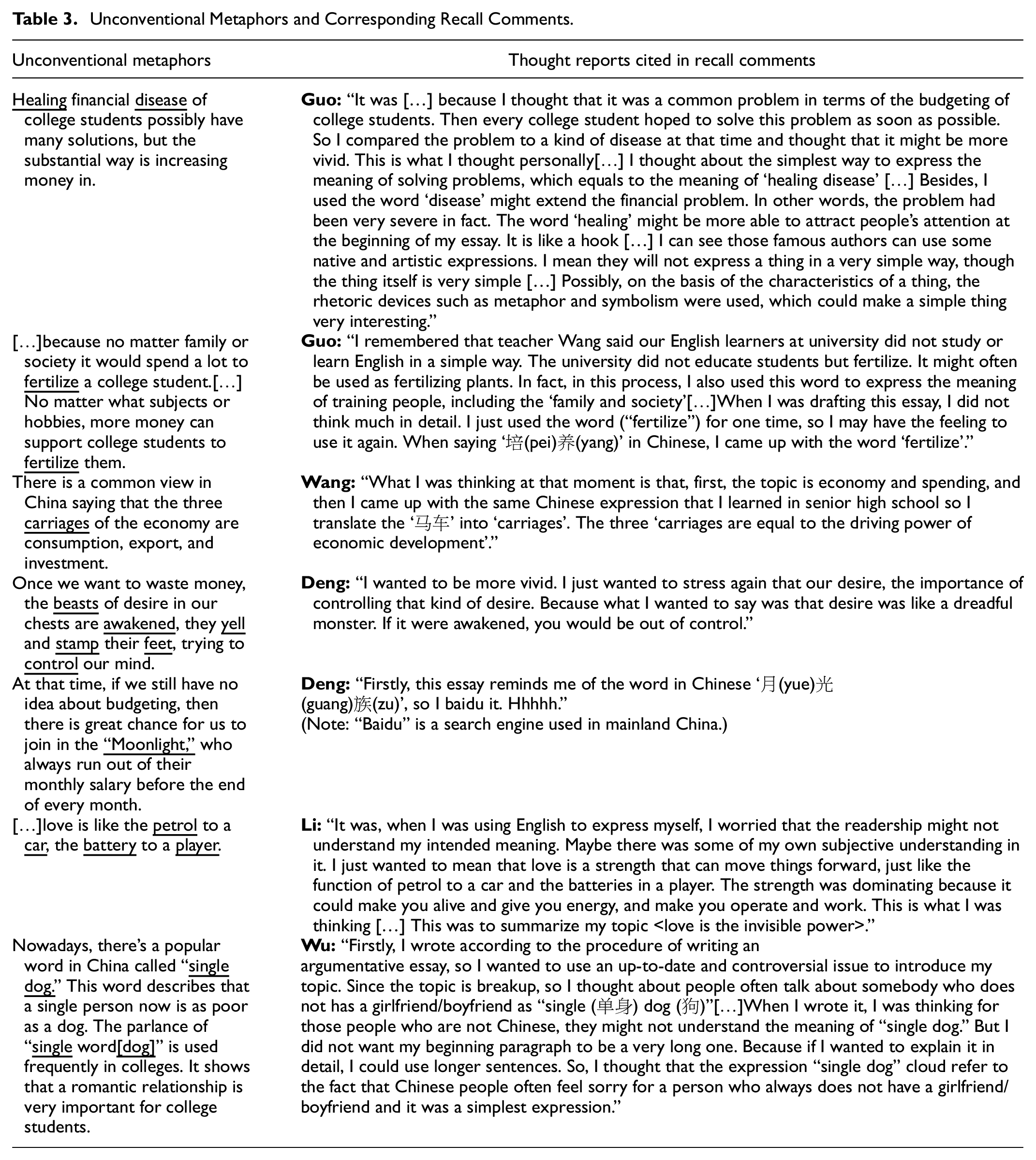
Our first reflection on learners’ thought reports was that the students appeared willing and able to discuss their language use. We also observed that there seemed to have been a good deal of conscious reflection on word and metaphor choice at the time of writing. For example, in Table 3, Deng shows her willingness and capability of discussing her intentions on using the beast metaphor to describe the negative effects of wasting money at the time of writing. Her thought reports reflect her deliberate metaphor choice based on her familiarity with the vehicle term “beasts.” Similarly, Li reports her aim to make herself understood by purposely referring the topic love to some familiar and concrete metaphor vehicles such as “car” and “player,” and Guo describes his deliberate metaphor choice based on his familiarity with the vehicle term “disease” and his knowledge of metaphor as a rhetoric device, when talking about university students’ financial problems for vividness. As noted in the literature review, learners’ consciously thinking about metaphor in L1, as a consequence of conceptual L1 transfer, may contribute to novelty and creativity in L2 English writing. The metaphoric thinking process involves the activation of a conceptual mapping from a vehicle domain that learners are more familiar with, as Sanchez-Ruiz et al. (2013) argues, to a less familiar topic domain.
Students also cited the influence of their first language on several occasions. In all cases, they reported that they had used a Chinese metaphor, and sometimes mentioned how they had translated this. For example, students’ thought reports on “fertilize” and “moonlight” shows that the students just directly translate the Chinese metaphorical expressions into English. The expression “fertilize” had been used twice by the same student. Recall comments on expressions like these show that negative L1 transfer, reflected as simple direct translation without much thinking, may result in some communication breakdowns. The expression moonlight (or moonlite) was used by 5 of the 14 students who used unconventional metaphors and wrote about “Spend and save.”Xu (2019) considers this neologism to be an example of metaphorical thinking, relating to the lunar cycle, and thus to monthly salary payments. It is also a pun, as the Chinese character for light can also mean “use up” or “empty,” giving the compound “month-empty” (New York Times, January 2011). In the recall comments on “single doge,” the student also reported about using an expression that is translated from L1. Interestingly, Wu shows awareness that a non-Chinese reader may not be familiar with the figurative use. Like the students we have quoted above, Wu articulates her choice of expression clearly. The expressions seem to capture a layer of meaning that they want to try to convey, even though they seem aware that this will make their writing non-nativelike.
From the students’ self-reports, we identified four reasons for the choice of an unconventional expression: (1) struggling to express meaning, such as Li’s recall comments on using metaphors to make herself better understood in L2 writing; (2) desire to make writing more vivid, such as the comments on disease metaphor and beast metaphor cited by Guo and Deng ; (3) influence from another speaker or writer; and (4) influence from L1. Categories of recall comments were not mutually exclusive. Learners may cite more than one category of recall comments on one single metaphor use. For instance, the use of “healing financial disease” involves possible metaphoric thinking in L1, the desire to make writing more vivid and the influence from another speaker or writer reflected in Guo’s added comments at the end of the interview. The self-reports discussed above showed that L2 English learners are able to articulate their thinking processes during their writing at length and they are willing to discuss their thoughts with the researcher. We did not get the impression from the way students spoke, and from the amount of time and thought that they contributed, that they were simply trying to please us. Learners’ deliberateness of metaphor use can be evident when they are reflecting on creative and innovative metaphors.
Discussion
Results from written data and interview data indicate that Chinese learners of English can consciously manipulate their L1 knowledge, to produce innovative and creative metaphors for achieving expressive power in L2 writing. The deliberateness of some creative metaphor uses is straightforward because of the form of a simile, which is further evident in the thought reports cited in recall comments. For example, as noted in Table 3, Li cited her conscious thinking of “love is a strength that can move things forward, just like the function of petrol to a car and the batteries in a player” in Chinese, and her purpose of summarizing the viewpoint on the positive side of love at the end of the argumentative text, that is, “love is the invisible power” (Li). Chinese English learners’ unconventional metaphor uses like these involve deliberateness, novelty, creativity, and the manipulation of existing everyday words in unconventional ways, for conveying meanings confidently, and serving intended communicative functions. Both our text analysis and interview analysis have indicated Chinese English learners’ metaphoric competence in L2. The positive conceptual transfer from L1 to L2 can trigger both conventional and creative metaphors. The stimulated recall interview analysis shows Chinese English learners’ metaphoric thinking in L1, and efforts made for all possible means of expressing meanings and creating effects in L2 writing, which contributes to the current knowledge of metaphor production or metaphoric competence in L2 communication (e.g., Chen, 2018).
The students interviewed spoke confidently, without hesitation when asked about word choice. They indicated that they had chosen particular figurative expressions for a specific discourse purpose, and they had drawn from resources such as their first language, their recollections of literature, a speaker they admired, or simply their knowledge and feelings about the vehicle term, as a strategy that they could explain readily. It would appear that these students are not trying to produce nativelike English and failing; rather, they are confidently using all means possible to express their meaning and produce language that is appealing and memorable. The students do not seem to have mistakenly thought that their word choice was unmarked, natural English, and thus made an error. If the reader perceives these as errors, as noted in the literature review, we have a new example of the asymmetry described by G. Steen (2011, p. 85) “a metaphor may be deliberately produced as a metaphor but not received as one”; here, a metaphor may have been deliberately produced as an innovative and meaningful metaphor but received as a mistake. Another contribution of this research has been to show that many, but not all, apparent errors in learners’ figurative language are in fact better understood as creative language use. Possible errors, which are not common our written data, deserve both teachers’ and students’ attention. For instance, Guo’s repeated use of the verb “fertilize” in different writing samples could indicate the need for teachers’ feedback.
Conclusions
Chinese English learners’ unconventional metaphor uses in L2 has often been overlooked because of the low frequency in L2 production and the fuzzy boundary between novelty and errors relating to metaphor use in L2 (e.g., W. L. Zhou, 2019). This research has shown that there are situations where Chinese learners of English may consciously decide to use metaphors in an unconventional way to meet communicative needs in L2 writing. Learners’ innovative and creative metaphors, often reported as deliberate ones in recall comments, can be an important indicator of learners’ productive metaphoric competence in L2 (H.-C. Wang & Chen, 2016). Our way of using stimulated recall interviews has left enough room for learners to talk about their intentions and desires on their unconventional metaphor uses at the time of writing. The situation where students explicitly reported the metaphor knowledge, as a rhetoric tool, in the interview process is rare (Guo, 1 out of the 5 interviewees). This does not mean that other students who did not report their metaphor awareness in the interviews, and who did not participate in the interview sessions, do not have awareness of using metaphors as a way of thinking and communication. Chinese English learners’ unconventional metaphor uses in L2 and the factors contributing to this unconventionality deserve both teachers’ and learners’ attention in L2 classrooms for future investigations. Clearly, this study is relatively small-scale. The text data and interview data may not represent all Chinese English learners’ unconventional metaphor use in L2 writing. Future research may involve Chinese English learners over different and consecutive academic years and track the changes of learners’ metaphor productions and behind motives from a longitudinal perspective (Nacey, 2022). Stimulated recall has some limitations. For instance, the cognitive processes may not be communicable in a verbal form because there may be participants who are not good at reporting what they have done (Gibbs, 2011), and there may be participants whose answers are influenced by a desire to present themselves favourably. Limitations of stimulated recall can be minimized by the careful design as noted above. The risk of using stimulated recall interviews seems to us offset by the very interesting insights generated by the method.
Our belief is that when learners have made conscious decisions to use unconventional metaphors to achieve certain communicative needs in writing, it is important for teachers to realize this and offer corresponding feedback to facilitate appropriate metaphor use in specific writing context. Teacher support through feedback on L2 learners’ metaphor use is needed, since errors may occur when learners try to use some words in new ways (Littlemore et al., 2014). It can also be helpful when language educators are more tolerant of learners’ innovative or creative metaphor use (Nacey, 2017). The reason is that learners may not recognize that some of metaphor use will be received as errors, and they may just think confidently that what they have written is the best way of conveying their meanings. Teacher feedback is essential to make the actual learning happen, especially when there are repeated errors. It is hoped that the findings of this research will be applied to practical writing teaching practices at tertiary level, and to help teachers, teaching material designers, and policy makers gain more insights about the importance of integrating explicit metaphor knowledge into writing teaching syllabus and textbooks, and into descriptors for measuring different levels of writing for English. This is in line with Low’s (2019) influential work on the importance of metaphor in language teaching and learning.
Footnotes
Acknowledgements
The authors would like to thank Jeannette Littlemore and Richard Badger for their comments on the first author’s Ph.D. thesis part of which developed into this article. The authors would also like to thank the anonymous reviewers for their suggestions on a previous version of this article. The gratitude is also extended to Dongman Cai for the co-rating work in metaphor identification.
Ethical Approval
This research received the ethical approval granted by the ESSL, Environment and LUBS Faculty Research Ethics Committee, University of Leeds. The committee approval number is AREA 16-160. Under this ethical approval, potential participants were approached, and informed consent obtained from those willing to take part.
Declaration of Conflicting Interests
The author(s) declared no potential conflicts of interest with respect to the research, authorship, and/or publication of this article.
Funding
The author(s) disclosed receipt of the following financial support for the research, authorship, and/or publication of this article: This work was supported by the joint scholarship of the China Scholarship Council and the University of Leeds under Grant No. CSC201606290040.

Data Availability Statement
The datasets analyzed during the current study are not publicly available due to ethical considerations but are available from the corresponding author on reasonable request.