




Abstract
Previous research on regional environmental pollution acknowledge that cross-level government cooperation plays an important role in controlling regional environmental pollution. However, the balance between local fiscal autonomy and governance costs has received little attention. To fill this research gap, this paper argues a model of local fiscal autonomy moderating the efficiency of environmental governance, which provides a basis for studying the effect of local fiscal autonomy on intergovernmental cooperative environmental governance. We collected the data set of the China Yangtze River Delta urban agglomeration, using Tobit regression model to evaluate the effect of local fiscal autonomy on cooperative arrangements and the moderating effect. The results show that higher local fiscal autonomy will positively affect vertical intervention actions and improve the efficiency of environmental governance. In addition, we found that more special funding for environmental projects will weaken the performance of horizontal cooperation on regional environmental governance.
Plain language summary
Efficiency of environmental governance in China’s Yangtze River Delta urban agglomeration is a typical example of the explicit impact of cooperative actions, although only a few studies have explored how local fiscal autonomy affects the performance of cooperation actions. To address this research gap, this study constructed a panel dataset of Yangtze River Delta urban agglomeration. We tested our theoretical hypothesis via a series of Tobit regression models in the following two approaches: first, we examined horizontal cooperation and vertical intervention separately. Second, we revealed the role and characteristics of local fiscal autonomy in cooperative actions and expanded the Institutional Collective Action theoretical framework. Our research identified the significant impact of vertical intervention on environmental public affairs as opposed to horizontal cooperation. Concurrently, we observed the moderating effect of local fiscal autonomy on vertical intervention. Although we examine the role of local fiscal in cooperation actions in the context of environmental governance in China, there are still some limitations. We are limited by the openness of China’s environmental data, and the dependent variable is constructed from the publicly available data, but we still haven’t comprehensively investigated all environmental protection indicators.
Keywords
Introduction
Practice in many countries reveals that environmental pollution can cross administrative boundaries, thereby requiring significant cooperative actions to address it (Zhou & Dai, 2023). Generally, the “cost–benefit” analysis revealed that local governments participate in cooperative actions (Feiock, 2013), which is influenced by a combination of local fiscal autonomy (LFA) and cooperation consensus. First, LFA is the crucial basis by which local governments can solve their environmental issues because it determines the fiscal support for environmental governance (Kunce & Shogren, 2008). Second, in the “central–local” administrative relationship, intergovernmental cooperative actions are divided into two, the horizontal cooperation (HC) and vertical intervention (VI) cooperative actions. The formation of cooperation consensus is promoted by institutional constraints to facilitate the exchange of benefits and resource transfer (Amirkhanyan, 2010; Kwon et al., 2014; Yi et al., 2018). All these research works emphasize reducing the fiscal cost of governance itself through cooperation.
Consistent with these academic debates on fiscal logic, the existing literature mainly focuses on how the autonomy and flexibility of local finance affect governance efficiency (He, 2015). Indeed, the local financial input in economic development, environmental governance, production safety and other matters can best reflect their autonomy and policy preference (Kim, 2018). Whether it is the motivation of local governments to participate in intergovernmental cooperation or the economic and social attributes of cities, local fiscal autonomy is important. Empirically, these discussions ignore the interplay of LFA and intergovernmental cooperation. China, in particular, is an authoritarian state. Different levels of government behaviors are subject to the intervention and involvement of higher-level governments, but local governments are not completely without autonomy (Chen, 2004). This paper argues that LFA has an impact on intergovernmental cooperation. Only relying on cooperative action cannot get rid of the shackles of finance, LFA is still the base of cooperative action. LFA is an important economic and social feature, and it is also an issue that affects local governments’ participation in intergovernmental cooperation. Thus, we intend to raise two policy questions in this paper:
How does LFA affect the benefits of intergovernmental cooperation?
How does LFA affect the impact of cooperative actions on the efficiency of environmental governance (EEG)?
We argue a key analytical framework (Figure 1) to evaluate the correlation between LFA and intergovernmental cooperative actions in regional environmental governance and proposed general theoretical explanations. First, we considered the role of hierarchical control in intergovernmental cooperation. Cooperation is not only a “voluntary mechanism”, but also an authorization (Zhang & Wu, 2020). In HC and VI, the objectives of governance can be formed by superior and peer governments, respectively; both cooperations interact (Feiock, 2013). Secondly, we believe that LFA will affect the governance benefits of intergovernmental cooperation. The impact of LFA on environmental governance efficiency directly reflects the balance between economic benefits and governance costs (Chen, 2004). Particularly, the calculations must consider the benefits of intergovernmental cooperation. Theoretically, if the objectives and efficiency can be achieved through fiscal expenditure, the additional administrative and economic costs will reduce the incentive to engage in cooperative actions.

Theoretical framework of the role of LFA in intergovernmental cooperation.
We selected the regional environmental governance data of China Yangtze River Delta urban agglomeration (YRDUA), to verify our theoretical framework. We use the slacks-based model (SBM), modified from the data envelopment analysis (DEA) model DEA–SBM, to calculate the EEG and evaluate the impact of intergovernmental cooperation and LFA. First, regional environmental pollution is a representative public wicked problem in China. The Yangtze River Delta urban agglomeration is the most competitive urban agglomeration in China. It can effectively deal with regional environmental pollution and play an exemplary role in other urban agglomerations. Secondly, using efficiency as a dependent variable can avoid the endogenous problems of the city itself. How intergovernmental cooperation plays a role in regional environmental pollution is a long-standing debate. We focus on the local government itself and examine whether the basis of local government functions is the important reason affecting the benefits of intergovernmental cooperation. This work aims to use a framework to explain the actual situation in China, and to frame a general explanation. The rest is arranged as follows: The second section discusses the existing literature and argues our theoretical framework. The third section introduces the research design and data. The fourth part analyzes the empirical results. The last section shows the conclusion and further discussion.
Literature Review
There is top–down pressure to protect the Chinese environment. Higher-level governments lead and form cooperation mechanisms involving multiple local governments (Wu & Zhang, 2022). Such intergovernmental cooperation entails specific governance objectives, as well as administrative costs. Accordingly, the local governments act swiftly to achieve the target and complete the assessment by the superiors. Concurrently, local governments will spontaneously form same-tier cooperation networks to address regional environmental pollution. However, as local governments are important actors in environmental governance, the impact of LFA on intergovernmental cooperation has not received extensive attention. Understanding these limitations of existing research, we focus on examining current research gaps to identify specific questions we need to address.
HC and VI in Regional Environment Governance
A significant hypothesis of the Institutional Collective Action (ICA) theory is that local governments, as “rational actors,” are committed to balancing governance costs and governance benefits. Theoretically, there are two kinds of benefits: “collective benefits,” which reflects the scale effect of economic growth and collective response to external public issues, and “selectivity benefit,” which reflects the performance assessment and promotion incentive of local officials (Zhou & Dai, 2023). In China, intergovernmental cooperation is affected by the information asymmetry between the different levels of the government, an imbalance in local development, and other reasons. Even if local governments are motivated to cooperate, it will be challenging to ensure the strength and stability of cooperation because of cross-sectional conflicts of interest (Ran, 2017). Depending solely on HC, when the regional transaction cost or differentiation level is extremely high, it will be challenging to cooperate and distribute the collective income effectively.
Additionally, the local governments in China are more receptive to superior interventions because the selectivity benefits come significantly from superior distributions (Liu et al., 2019). Thus, we defined VI as those from a higher-level government, which determines governance assessment objectives, as well as joins and promotes local government cooperation. Generally, VI exists in the bureaucracy because the higher-level government reserves the power to evaluate and determine the promotion of the lower government. Moreover, they also assume fiscal responsibility (Chen et al., 2023). However, the excessive interventions of the higher-level government will also impact intergovernmental cooperation negatively. As a coercive tool, the superior government can exercise the authority to achieve decision-making consistency (Yi et al., 2018). Owing to information asymmetry, administrative interventions, and other reasons, the superior government may be unable to make optimal decisions, and this may affect the selective benefits of cooperation. In the context of environmental cooperation in China, VI of the higher-level government proceeds via the following two influencing mechanisms: first, the higher-level governments reserve the legitimacy and power to guide the lower ones as a tool of mandatory intervention. Excessive interference in VI may also interfere with cooperation (Ko & Zhi, 2013). Second, the higher-level government is directly involved in the cooperation process as the leader. The superior government initiates cooperation as the convenor, offering knowledge and promoting learning among relevant stakeholders (Kostka & Nahm, 2017).
Chinese scholars have made a mechanism analysis of the influence of these two forms of cooperation. Wang et al. investigated the governance practices of urban agglomerations by using the Chinese urban agglomeration case (Zhan et al., 2014). They found that the form of cooperation action has a high correlation with the benefits of intergovernmental cooperation in Chinese urban agglomerations. This can be defined by the enthusiasm for HC and the number of VI by higher-level government. It is explained in further studies that Chinese urban agglomerations need resource input and administrative interventions from superior governments to form better cooperation. HC is less active, while VI have more forms of cooperation (Z. Wang et al., 2019). These studies inspired our choice of variables. We argue that different cooperative actions can more fully explain intergovernmental cooperative benefits. Such spontaneous and formal cooperative actions will form a stable cooperation mechanism and obtain cooperative benefits.
Moderating Effect of LFA on Cooperation Actions
In addition to the effects of HC and VI, we also assumed that LFA moderates the cooperation returns. Even if a higher-level government deploys VI to influence collaboration, there is no guarantee that the local actors will add significant costs and commitments to the arrangements. The existing literature has addressed this situation, where collaboration is challenging to sustain even with strong VI (Mu et al., 2019). However, the reality in China is different. Regarding specific public affairs, the legitimacy of the local governments’ the performance of relevant functions comes from the “top–down” authorization of the central government. However, in actual fiscal expenditure, local governments must be “self-sufficient” and play a key role in delivering public services (Esteve et al., 2013; Li & Zhou, 2005). The challenge of regional environmental issues lies in the fact that the environmental governance performance of a region cannot improve significantly owing to the spatial spillover of pollution, even if such a region increases its fiscal expenditure on environmental governance (Liu et al., 2017). Assuming that each local government exhibits a certain LFA, the incentive motive would result in different distributions of political attention. Therefore, there are different options for fiscal expenditure on pollution control (Mao, 2018). We focus on “cost-benefit,” LFA may be the new key to developing this theoretical framework. We argue a 2 × 2 framework to demonstrate the very probable role of LFA in HC and VI (see Table 1). In Table 1, the results of these possibilities are deduced based on existing studies and theories. Probability means more likely to produce an outcome, matched by a general cause. In the next part, we will explain the results of these theoretical deductions.
Probable Moderating Effects of LFA on Cooperative Actions.

Source. Authors.
Many studies have demonstrated that two competing hypotheses exist between local fiscal and environmental governance: “Race to the top” and “Race to the bottom” (Li & Zhou, 2005). The “Race to top” the hypothesis is that LFA can positively promote environmental governance. Enhanced LFA creates competition among governments and optimizes the effect of environmental governance. Fu et al. studied the haze pollution during the local “Two Sessions” in China and deduced that strong political pressure forced the local governments to swiftly improve their environmental quality (Van der Kamp et al., 2017). This is because local governments can swiftly improve their environmental quality through earmarked fiscal expenditures, even at the expense of short-term economic gains. Thus, the higher the LFA, the more obvious this behavior is when there is evident political pressure (Fu et al., 2021). This “Race to the bottom,” that is, LFA, will force local governments to decrease environmental regulations for economic development, thereby creating inferior competition in environmental governance. However, these studies are more about directly testing the impact of fiscal autonomy on environmental governance. However, this evidence has difficulty explaining how the fiscal autonomy of local governments affects the process of cross-government cooperation. Through traditional survey and observation methods, it is difficult to observe the mutual influence of fiscal autonomy and cross-government cooperation at the same time.
These challenges, we turn to the simultaneous consideration of two key variables: LFA and intergovernmental cooperation. We confirm our theoretical framework through the moderating and mediating effects approach. Furthermore, this paper gives an innovative explanation on how LFA affects intergovernmental cooperation: “Race to the top” indicates that a special fiscal allocation can respond to the environmental pressure from superior governments and achieve the assessment goals (Van der Kamp et al., 2017), thereby reducing administrative costs and cooperation risks and avoid drifting into institutional collective-action dilemmas. Improved LFA will crowd out the local government’s willingness and enthusiasm to participate in intergovernmental cooperation and weaken their cooperation motivation. “Race to the bottom” indicates that local governments exercise high LFA and are more likely to further improve economic returns and pursue the maximization of fiscal tax revenue. However, the local governments still account for their jurisdictional environmental quality, particularly regional environmental issues. Government-to-government cooperation reduces governance costs. Therefore, the LFA of local governments will not affect the benefits of environmental governance, and intergovernmental cooperation will become the main form of solving environmental pollution.
Research Design
Sample: China Yangtze River Delta Urban Agglomeration
We choose YRDUA as our research sample. It is one of the most competitive urban agglomerations in China, 26 cities (in Anhui, Jiangsu, and Zhejiang provinces). We have two reasons. First, YRDUA has a historical background of cooperation actions and formalized official arrangements. This region’s cooperation arrangements were first institutionalized in 1992, although the aim was to increase economic growth. In the early stage of cooperation, trust was built between local governments. It wasn’t until 2010 that the State Council officially approved a regional plan for the Yangtze River Delta. For the first time, collaborative environmental governance was a formal and official requirement. After this, YRDUA’s environmental governance cooperation became a normalized political mission.
Second, the cooperation arrangement of YRDUA has external validity. The division of urban agglomerations in China is characterized by the formation of a cooperation network with the political center city of a municipality directly under the central government or a province as the main actor under the guidance of a higher-level government, which is a vertical interventions cooperation arrangement. At the same time, there are also local governments of the same political level to carry out cooperation actions, which is a horizontal cooperation arrangement. It can be observed that cooperation actions in urban agglomerations have both horizontal relationships and vertical interventions. In addition, among urban agglomerations in China, YRDUA has the longest history of cooperation arrangements and has similar characteristics to other urban agglomerations. The conclusion of YRDUA research can be extended to the observation of other urban agglomerations.
Data Sources
YRDUA was our research object, and the 26 cities that constitute the agglomeration were employed as the analysis unit. Based on the reliability and availability of the data, as well as the cooperative arrangement policy implemented by the Chinese authorities in YRDUA, the selected period of the data was 2011 to 2020. Two data sources were employed: one was the textual data of local government cooperation, and the other is panel data on human capital, fiscal, and industrial economy. We identified data on cooperative arrangements from the news on local government cooperative actions from outlets, including local government websites, social media, and newspapers. For the other panel data, we referred to the China Urban Statistical Yearbook and public datasets on the websites of local statistics and local fiscal departments.
HC and VI arrangements were our main independent variables. We need a comprehensive search of YRDUA local authority cooperation arrangements and two ways to ensure the credibility of cooperation action data. First, we conducted a comprehensive search of different Chinese terms related to cooperation arrangements. For example, hezuo (cooperation), lihuiyi (joint meeting), and liandongjizhi (joint action arrangement). The Chinese word for “cooperation” has multiple policy implications, and we need to conduct a comprehensive search to ensure that nothing is left out. After retrieving all the information, we purged duplicate reports and reports of non-YRDUA cooperation arrangements. We sorted out all the reports of cooperation arrangements and, after discussion, identified different types of cooperation arrangements. In the end, only reports on cooperation arrangements for environmental protection were retained, totaling 272. Secondly, 10% of all cooperation arrangement reports were randomly selected to confirm that they were formal and reliable reports of environmental governance affairs and to ensure the reliability of cooperation arrangement data. Figure 2 shows the amount of YRDUA cooperation actions in 2011 to 2020.

The amount of YRDUA cooperation actions in 2011 to 2020.
Measurement of Variables
Dependent Variable
We employed EEG as the explained variable. Environmental governance includes water, soil, atmosphere, production, and other fields. If we had only focused on a single indicator of environmental governance, the diversified evaluation of environmental governance performance would be easily ignored. For the evaluation method, DEA–SBM represented an effective method. DEA–SBM evaluates the performance of environmental governance through the input and output of environmental governance in multiple aspects (Shi et al., 2020). Based on the relative efficiency, this model comprises evaluation units and indicators (Bi et al., 2014). The calculation basis of this model is the relative efficiency, and the value range is [0,1]. Notably, a relative efficiency value of 1 does not indicate that 100% “input–output” efficiency has been achieved; it indicates that a relatively optimum state has been attained in a set of data samples (K. Wang et al., 2013). The measurement units of different input indexes did not affect the reliability of the calculation results, i.e., the return to scale is a variable. Equation (1) displays the formula for calculating DEA–SBM:


Independent Variable
The research design includes the following four groups of independent variables: HC, VI, LFA, and control variables. LFA was also the moderator variable.
HC and VI: The cooperative agreements are the formal text of the local government cooperative arrangement. A cooperation network formed on this basis can present the dynamic process of cooperative action. The network density of a cooperation network represents a crucial index. An increase in the network density indicates the continuous strengthening of cooperative relationships among the cities, and it will increase the mutual dependence on the cooperation network. We distinguished the HC and VI actions. In China’s administrative system, the people’s provincial-level governments wield more power over personnel and fiscal management than the municipal governments. This power is top–down, and a collaborative action led by provincial governments is easier to implement in terms of execution and funding. Considering China’s actual situation, we defined the cooperation between the local governments at the same level as “HC”; it includes the cooperation between the prefecture-level, “provincial–provincial,” and “provincial–municipal.” Most HCs are at the prefecture level. When a higher-level government exists in the cooperation object, we define it as “VI”; it includes the cooperation between the provincial capital city, sub-provincial city, and other cities in the same province, as well as the cooperation between provincial-level and prefecture-level cities. In the calculation of HC/VI density, only the cooperation data between same-tier cities were retained, so that the obtained density could better reflect the time-variation trend of HC and VI densities, thereby maintaining their independence, although the obtained density is not suitable for the comparison of numerical size.
We manually coded and analyzed 272 cooperative agreement documents to construct a two-mode network of actors. The number of participating cities in the same agreement would be “1” or “0” if no cooperation exists between the two cities. The overall density, which is calculated by Ucinet software, was employed to measure the network intensity of HC and VI (see Figure 3).
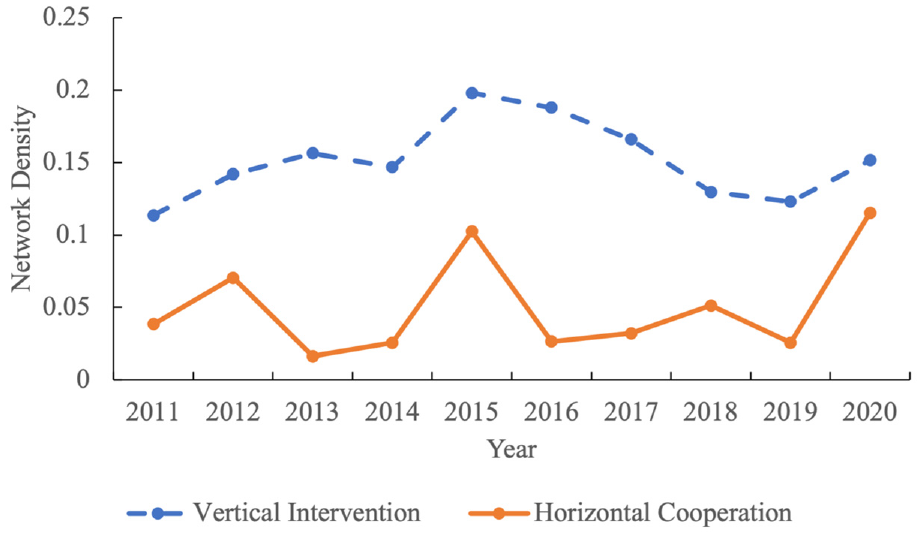
The network density of HC and VI.
The higher the overall network density, the greater the influence of the whole cooperation network. Since the influence of a cooperation network exhibited a time lag, the density of each network with one-stage lag was incorporated into the regression model for the analysis. Equation (2) for the specific calculation of the network density is a set of formulas, wherein

LFA: We employed a common method among Chinese scholars to measure LFA and calculate the ratio of fiscal expenditure in local budgets to the sum of fiscal expenditure in the budgets at all levels, from the local to central government. A certain degree of fiscal decentralization always corresponds to LFA exercised by a level of government. The calculated ratio reflects the degree of LFA through the degree of decentralization. Lessman observed that the discussion on fiscal decentralization in the study must be understood as “Factual Decentralization,” which emphasizes more reflecting the autonomy and decision-making power of local governments regarding local fiscals. In China, first, the local governments with higher LFA can exhibit real government behavior; second, LFA can improve the ability of local governments to respond to the needs of their residents. Finally, it can ensure the efficiency of local government in the provision of public services and the utilization of fiscal funds.
Control Variables
For control variables, we mainly consider which factors significantly affect the heterogeneity of different cities in China. Meanwhile, we refer to some studies on local government and environmental governance in China (Zhu & Zhao, 2021). Based on these, we select four control variables: the proportion of secondary industry, population density, FDI and GDP per capita.
The local economy is expressed in terms of the gross domestic product per capita (PGDP) of each city. Sec is expressed by the proportion of the GDP of the secondary industry. It is generally believed that the higher the sec, the more dependent the economic development will be on high energy consumption and high-pollution industries. Pop is expressed as the ratio of the local population to the urban administrative area. Areas with higher pop exhibit higher concentrations of surrounding public service facilities and more severe emissions of pollutants. Previous studies expressed FDI as the amount of foreign capital employed in the city in that year. Descriptive statistical analysis of various variables is presented in Table 2.
Descriptive Statistical Analysis of Various Variables.

Source. China Environment Yearbook; China Urban Statistical Yearbook; Statistical Yearbooks of various provinces.
Model Specification
The range of the dependent variable, EEG, was [0,1], which indicated that it was limited. According to the data, which were analyzed by DEA–SBM, the Tobit model was employed in several studies to estimate the restricted dependent variables. We extended this method by adopting a Tobit regression model as follows:

The dependent variable, LFA, is the environmental governance performance of city i in year t. The independent variable,
We assumed that LFA significantly impacted environmental governance and that it exerted a moderating effect on the two forms of cooperative action. The interaction terms, HC, VI, and LFA, were introduced into Equations (4) and (5), as follows:


Regression Results and Discussion
Panel Data Analysis
Table 3 presents six Tobit regression results, verifying most of the hypotheses. Moreover, we observed several surprising findings.
Regression Results.

Note. Robust standard errors are listed in parentheses.
p < .1. **p < .05. ***p < .01.
We estimated three groups of models. The first group (Models 1–2) estimated the impacts of HC and VI on EEG. The second group (Models 3–4) estimated the impact of LFA on EEG. Models 1 to 4 did not include interaction items, and only the third group (Models 5–6) examined the moderating effect of LFA by adding the interaction terms, HC and VI, respectively. The parentheses below the coefficients represent the robust standard errors, and the results of Models 1–6 were reliable.
In Model 1, no significant correlation was observed between HC and the EEG in each city; the symbol of the coefficient was consistent with our theoretical hypothesis. However, the lack of a significant correlation indicated that we could only avail sketchy evidence. Further careful analyses are required to deduce other possible explanations. In Model 2, VI significantly positively correlated with EEG in each city. This indicated that the higher the cooperation network density with hierarchical interventions, the higher EEG. This result correlates with the theoretical expectation. In China, superior order and political pressure are generally more binding than the constitution. The vertical and hierarchical interventions of high-level local governments can transmit performance pressure from the top to the bottom. This form establishes formalized institutional arrangements and promotes increased mutual interest regarding cooperation.
Models 3 and 4 examined the impact of LFA on EEG after HC and VI, respectively. LFA exhibits a significantly positive correlation with EEG and is not affected by HC and VI. This result indicating that a higher LFA corresponds to more fiscal budgets and expenditures for environmental public services. Our theoretical explanation is as follows: based on the “cost–benefit” analysis, local governments believe that the governance risks of fiscal projects are smaller, while the benefits are larger compared with the cooperation arrangements with risky benefits. Completing the political task of environmental protection is the first thing to be considered because of the performance pressure of the higher-level government.
The interaction terms, HC and LFA, as well as VI and LFA, were added to Models 5 and 6, respectively. In Model 5, the interaction term exhibited a negative sign, although the coefficient was insignificant. In Model 6, the coefficient of the interaction term between VI and LFA was significantly positive, indicating that the higher the LFA, the more significant VI would be in improving the environmental governance performance. We believe that LFA exerts a significantly positive moderating effect on VI. Furthermore, this result corresponds to our theoretical expectations. Local governments are more willing to pay fiscal funds to accomplish high-priority administrative goals and be subjected to VI. When more local governments follow this consistency of achievement, cooperation with VI will be more effective.
Based on the results of Model 6, we drew a plot to illustrate the average conditional marginal effect of LFA on VI (see Figure 4). The figure shows that the positive impact of VI on EEG increased with increasing LFA. This result also confirmed that LFA exerts a positive moderating effect on the relationship between VI and EEG. Furthermore, it supports the argument that VI exerted a stronger positive impact on EEG through increased LFA.

Conditional marginal effects of LFA on VI.
Robustness Check
A common test of robustness is the quantile regression model. A robustness test was conducted on the Tobit regression model to ensure the credibility of the empirical results. This method reduces the error caused by outliers on the regression values and tests the robustness. We built the following model:

In this model,
The results of Equation 6 are presented in Table 4. Similar to the results in Table 4, no statistically significant correlation was observed between HC and EEG. VI exerted a statistically significant effect on EEG. Similarly, LFA always exerted a significant effect on EEG.
Robustness Check Employing the Quantile Regression Model.

Note. Robust standard errors are presented in parentheses.
p < .1. **p < .05. ***p < .01.
More Evidence: The Mediating Effect of Special Funds for Environmental Protection
In Model 1 and Model 5 (Table 3), there is no significant correlation between HC and efficiency of environmental governance, as well as the interaction term between HC and LFA. We need more careful work to find other possible explanations.
In our theoretical framework, VI means formalized institutional arrangements, such as jointly determined rules, fiscal or personnel arrangements, governance performance targets, and specific execution plans. In terms of specific public affairs, the legitimacy of local governments’ performance of relevant functions comes from the “top-down” authorization of the central government. However, in China’s practice, local governments need to rely on fiscal expenditure to be “self-sufficient” (Zhu & Zhao, 2021). Taking environmental public affairs as an example, the governance logic of fiscal expenditure is reflected in the consideration of governance costs and benefits. This is also what ICA theory emphasizes. Horizontal cooperation actions, in theory, can reduce some of the negative externalities of environmental pollution governance costs. However, the negative externalities of environmental problems may lead to a “collective action dilemma” (Feiock, 2013). Local governments may attempt to achieve the assessment objectives of environmental affairs by “free-riding” actions. To reduce the cost of fiscal expenditure. Therefore, we argue Special Funds for Environmental Protection (SFEP) is a key factor influencing the effect of environmental governance. SFEP may play a mediating role in affecting the efficiency of horizontal cooperation actions in dealing with environmental public affairs. No studies have taken this into account.
We use SFEP as the mediation variable. SFEP is obtained through the annual report of each city’s ecological environment department. An important consideration is that intergovernmental cooperation projects and related funding arrangements will be announced in the annual report of the city’s eco-environment department. This arrangement is a visual representation of the formalized fiscal arrangements that can well reflect cooperation actions.
We present the steps to test for the presence of a mediating effect analysis of SFEP (Figure 5). The mediating effect’s model is as follows:


A mediating effect test model of SFEP.
We conducted tests in turn according to the steps of mediation effect analysis, and the report is shown in Table 5. First, the correlation between HC and EEG needs to be examined. The results of Formula 7 show that there is no significant correlation between HC and EEG, that is, the coefficient c (.706) is not significant, and the coefficient c is positive. This suggests that there may be “suppressing effects” (Kenny et al., 2003). Second, we test the significance of coefficient A in Formula 8. Through Tobit regression, we found a significant negative correlation between HC and SFEP, that is, the coefficient a (−.120***) was significant. Finally, we test the coefficients b and c′ in Formula 9. According to the regression results, there is still no significant correlation between HC and EEG, and the coefficient c′ (.323) is not significant. There is a significant correlation between SFEP and EEG, that is, the coefficient b (.180***) is significant. Model coefficients a and b were both significant, while coefficient c′ was not significant and had the same sign as coefficient c and were all positive, suggesting that the results should be interpreted as mediating effects rather than “suppressing effects.”
Mediating Effect of SFEP.

Note. Robust standard errors are given in parentheses.
p < .1. **p < .05. ***p < .01.
These results confirm our theoretical expectation that SFEP has a mediating effect on HC and EEG. For our research object, the negative correlation between HC and SFEP verifies the “free rider” action in the collective action dilemma. ICA’s theory emphasizes that local governments often expect to engage in intergovernmental cooperation at less cost, thereby achieving performance targets and environmental quality requirements at a low cost. Although environmental expenditure plays a positive mediating role between HC and EEG, it cannot compensate for the negative effects of the collective action dilemma. These results explain why HC is difficult to have a significant positive effect on EEG.
Conclusion and Discussion
Conclusion
Our research identified the significant impact of VI on environmental public affairs as opposed to HC. Concurrently, we observed the moderating effect of LFA on VI. This study argued that the previous studies on cooperative action in environmental governance mainly focused on a holistic cooperation approach, which is discussed within the ICA theoretical framework. Future studies must focus on the differential effects of the two cooperation actions. Similarly, the explicit impact of local fiscal is worth testing to extend the ICA theoretical framework. EEG in China’s YRDUA is a typical example of the explicit impact of cooperative actions, although only a few studies have explored how LFA affects the performance of cooperation actions. To address this research gap, this study constructed a panel dataset of YRDUA. We discussed how HC and VI affect EEG, as well as the moderating role of LFA. We tested our theoretical hypothesis via a series of Tobit regression models in the following two approaches: first, we examined HC and VI separately (they are two typical government cooperation behaviors in centralized China). Second, we revealed the role and characteristics of LFA in cooperative actions and expanded the ICA theoretical framework.
We observed that VI, particularly higher-level government interventions with fiscal arrangements, significantly promoted the performance and efficiency of local environmental governance. Although some scholars have started focusing on the “complementary” or “substitute” the relationship between different types of hierarchical interventions and policy tools (Lessmann, 2009), there few studies has examined the relationship between LFA and cooperation action performance in intergovernmental cooperation. We believe that this requires consideration. By confirming the moderating effect of LFA on VI and the mediating effect of SFEP, we have taken the first step to fill this gap. Previous studies have found that performance management and hierarchical interventions are able to promote improvements in environmental performance and the attainment of cooperative actions (Z. Zhang et al., 2020). We find a significant correlation of LFA in cooperative actions, which confirms that LFA is also important for cooperative actions and implies that higher-level governments can improve performance by VI to encourage and arrange for lower-level governments to financially support cooperative actions.
Further Discussion
We argued that implications for theory innovation. We discuss and confirm theoretically the weakness of HC and the effectiveness of VI on performance improvement. To explain the results of horizontal cooperation, we find more detailed evidence to examine the mediating role of fiscal project funds, which weakens the performance of horizontal cooperation. Therefore, future research should pay more attention to whether the project funding arrangement in horizontal cooperation has a heterogeneous influence on performance improvement. In practice, our findings contribute to local innovation for collaborative action. Specifically, local governments are often subjected to different institutional conditions and socio-economic constraints, and institutional collective actions might barely improve regional environmental performance (Scott & Thomas, 2017). The superior government applies performance pressure from top to bottom through VI and arranges local governments to avail supporting fiscal support in cooperative actions. This can be a special project, funded or budgeted for. Previous research observed that policies that do correspond to local realities may succeed if the superiors simply force local governments to meet performance targets (McNamara et al., 2019). Our findings form a basis for innovation in cross-domain environmental cooperative actions and contribute to reducing ineffective cooperative actions. Therefore, strengthening the moderating role of LFA in cross-regional environmental cooperative actions is a promising method for improving the performance of the regional environment.
Although we examine the role of local fiscal in cooperation actions in the context of environmental governance in China, there are still some limitations. First, the data were collected from Chinese prefecture-level governments. Some researchers believe that county-level governments and grassroots enforcement departments play a more important role in the implementation of environmental policies than higher-level governments (Fan et al., 2018). Therefore, we can consider using data sets of front-line administrative departments in future studies to provide stronger evidence to support our theoretical hypothesis. Secondly, we are limited by the openness of China’s environmental data, and the dependent variable is constructed from the publicly available data, but we still haven’t comprehensively investigated all environmental protection indicators. Future studies could further test our theory using other types of environmental pollution indicators. Finally, the influence of local officials on cooperation actions in China has not been included in this study, which is determined by China’s administrative system and official promotion system. The selective benefits emphasized by the theory of institutional collective action can be reflected in the individual incentives received by local government officials in politics, promotion, and others. At present, some studies have analyzed the political behaviors of local governments by taking the promotion of officials and the flow of hierarchy as key variables. We suggest that future studies should take this variable into account to provide theoretical vitality for issues related to regional environmental public affairs.
Footnotes
Acknowledgements
We appreciate the comments from the reviewers and the editor.
Correction (February 2025):
Article updated to include the department name for the first affiliation.
Declaration of Conflicting Interests
The author(s) declared no potential conflicts of interest with respect to the research, authorship, and/or publication of this article.
Funding
The author(s) disclosed receipt of the following financial support for the research, authorship, and/or publication of this article: The study was supported by the National Natural Science Foundation of China (No. 71974057), and Shuguang Program supported by Shanghai Education Development Foundation and Shanghai Municipal Education Commission (No. 21SG49).

Data Availability Statement
The data used to support the findings of this study are available from the corresponding author upon request.