




Abstract
The body of literature on English Language Teaching (ELT) research is increasing, but there is a paucity of bibliometric studies in this field. Thus, this bibliometric study visualizes a cumulative statistical report on the growth of studies with their impact and presents the research trends for further directions. This bibliometric study was conducted quantitatively by analyzing publication trends by year, country, institution, and citation; leading journals and authors; keywords for emerging themes in ELT on the 803 published research articles in the Scopus database from 2013 to August 2022. For analyzing data, this study employed two software, that is, VOSviewer and Harzing’s Publish and Perish software. The findings showed that the most productive year was 2021, with 149 publications. The highest number of publications was published in Turkey (n = 92). The highest number of publications was produced by Sultan Qaboos University, Oman (n = 17). The highest number of citations (123) was received by the study of Bruton in 2013. The number of research studies is increasing, and the leading country, institutions, and authors are mostly from the EFL or ESL contexts. The results found that there were 144 different journals and conferences as well as 159 authors during this specified time frame. Finally, the finding showed that there were 2,460 authors’ keywords and 14,268 keywords in the title and abstract. On the basis of the analysis, this study also presents future directions for practitioners, researchers, and policymakers.
Plain Language Summary
Purpose: This study visualizes a cumulative statistical report on the growth of studies with their impact and presents the research trends for further directions. Method: This bibliometric study was conducted quantitatively by analyzing publication trends by year, country, institution, and citation; leading journals and authors; keywords for emerging themes in ELT on the 803 published research articles in the Scopus database from 2013 to August 2022. For analyzing data, this study employed two software, i.e., VOSviewer and Harzing’s Publish and Perish software. Implications: Based on this bibliometric analysis, literature review, and our understanding of the ELT literature, the future research was categorized into four areas, i.e…., conceptualization, methodology, the antecedent of ELT, and practice-academia link. Limitations: This study only dealt with the publications published in Scopus, future research may also use other accessible databases like Web of Science, Google Scholar, and Dimensions. Combining all of these databases will likely produce more worthwhile and interesting results. Conclusion: This bibliometric analysis was conducted on the published research studies in ELT retrieved from the Scopus database from 2013 to August 2022. The findings showed a rising trend in the body of literature on ELT research. Different aspects of ELT have been studied rigorously. The common trend in these studies was integrating technology in ELT to innovate and improve language pedagogy.
Introduction
English language teaching is a crucial issue in many EFL (English as a Foreign Language) or ESL (English as a Second language) contexts for preparing learners skilled in English for unavoidable circumstances, for example, getting good jobs, maintaining social networking, etc. At the beginning of the twentieth century, language teaching had become a hot topic in educational research and development (Richards & Rodgers, 2014). The field of language teaching is always looking into novel instructional designs and pedagogies, but significant progress in language learning and teaching has been found over the past few decades. Today’s language classrooms reflect the changed status of English as a global language, which has increased the urgency for new, more efficient methods of imparting language skills (Richards & Rodgers, 2014). Moreover, the use of technology in ELT (So, 2016; Soria et al., 2020; Sugiarti et al., 2020) and the proliferation of online journals have accelerated the number of research articles in this field in different reputable and acceptable databases like Scopus. That is why, the body of literature is growing with original research studies for example, Dafouz and Gray (2022), Doeur (2022), Shyamlee and Phil (2012), and Zhao (2022), systematic literature review, for example, Duman et al. (2014), Ibna Seraj and Habil (2021), and critical literature reviews, for example, Nashruddin and Mustaqimah (2020) and Yağiz et al. (2014) on different aspects of ELT. With Scopus, a wealth of bibliometric data, such as authors, institutions, countries, citations of publications, and collaborative publications, can be searched and retrieved more quickly from datasets. Such data are helpful for assessing the impacts of researchers, articles, and journals, as well as the contributions of authors, institutions, and nations/regions to a field or a journal (Dong et al., 2022). Nevertheless, there is a scarcity of bibliometric analysis to identify the research trends in the field of ELT.
As a field of study, bibliometrics has received increasing interest from scholars worldwide (Wang et al., 2020). To analyze published works, bibliometric research employs a quantitative approach based on statistical measures of text and information (Ahmi & Mohd Nasir, 2019). To conduct a bibliometric analysis, which is defined as “the process of extracting measurable data through statistical analysis of published research studies and how the knowledge within a publication is used,” it is necessary to organize, classify, and quantitatively evaluate the patterns that emerged from the data (Lam & Habil, 2021). The use of bibliometric analysis to reveal the research direction has gained popularity in different fields. For example, So (2016)investigated the trends of research on business reporting language; Farrukh et al. (2023) identified trends and patterns in pro-environmental behavior research; Hashim et al. (2018) studied on trends on the use of social media for teaching and learning at higher education; Muritala and Maria-victoria (2020) traced out online reviews research in tourism and hospitality and Wang et al. (2022) examined studies of speaking skills teaching and learning. Thus, there is a need to conduct a bibliometric analysis for identifying the trends of the research in ELT.
Bibliometric studies in the field of ELT are scarce. Those found were confined to analysis of the publication trends in the specific journals. For example, the bibliometric analysis was held to analyze the quality and productivity levels in the field of teaching and learning English as a second language of the entire scientific production of Profile, Colombian Applied Linguistics Journal (CALJ) and How journals (Bakelak & Rodríguez, 2022). The other study explored a bibliometric portrait of TEFLIN Journal’s publication, indexation, and citation from 1990 to 2019 in the field of English language teaching (Syahid & Mukminatien, 2021). Another study explored the bibliometric analysis on key metrics, productivity, citation, frequent topics, most productive and influential author affiliations and countries, and the extent of author collaboration in teaching English as a second language of the first 99 issues of TESL-EJ (Pearson, 2022). Thus, it is a need to explore research trends in ELT from a reputable and credible database, such as Scopus. Scopus is one of the widely recognized and most comprehensive databases of scholarly abstracts and citations ever assembled (Khudzari et al., 2018; Meho, 2020; Sweileh et al., 2018; Talan, 2021).
Therefore, there is a research gap conducting bibliometric analysis on the studies held in ELT. Moreover, the above-mentioned bibliometric analysis mainly identified productivity, citation analysis, frequent topics, most productive and influential author affiliations and countries in the existing literature. Based on this nature of bibliometric study, this study will identify publication trend, leading journals, and authors, citation analysis as well as major themes. Thus, this study is conducted to analysis existing literature in the field of ELT from the Scopus database in the last 10 years dated from 2013 to 2022 for exploring the answers to the following research questions.
RQ1: What is the publication trend by year, country, institution, and citation in ELT?
RQ2: What are the leading journals and authors in ELT from 2013 to August 2022?
RQ3: What are the keywords or themes in ELT from 2013 to August 2022
Nevertheless, this study would leave insights for ELT researchers, practitioners, teachers, learners, and policymakers for promoting EFL/ESL learning and teaching.
Methods
This study employed a bibliometric analysis method to visualize current research trends in ELT. For getting output in response to the research questions, this study relied on the quantitative data collection and analysis. The following procedure was applied in this study.
Technique Used
The method of this study is employed for scientific mapping for analyzing and evaluating productive authors, publications trends, journals, countries, and keywords in published literature in the field of ELT (Wu et al., 2021). Thus, this study investigated the research works published in the last 9 years, from 2013 to August 2022, in the field of ELT. The search protocol for collecting data and software employed in this study for analyzing the data are discussed in the following.
Search Protocol
For this study, the Scopus database was used to elicit publication trends in the published articles from 2013 to August 2022 in the field of ELT. Scopus is one of the biggest databases for bibliographic information in the social sciences. It has been incorporated into numerous prior bibliometric analyses in the different fields of education research (Lam & Habil, 2021; Wang et al., 2022; Yoopetch, 2019). To ensure that all publications were consulted, the authors of this study used a number of search protocols covering ELT research. The initial search query is given as ((TITLE-ABS-KEY (“English Language Teaching”) OR TITLE-ABS-KEY (“ELT”)). The search results generated 8,056 publications without any confinement. Then the retrieval protocol (Table 1) was used to filter the publication for this study. The four conditions, such as time span (2013–August 2022), subject area, exact keyword, and language were applied to retrieve the data. Thus, after filtering with the retrieval protocol, 803 (Figure 1) out of 8,056 publications were suited to be considered in this study.
Retrieval Protocol.


Publication trends.
Software
For analyzing data, this study employed two software tools, that is, VOSviewer and Harzing’s Publish and Perish software. Vosviewer software was used to analyze authors’ keywords and the most frequent keywords from the title and abstract. It also produced scientific mapping and showed connectivity among keywords through visualization (Jan & Ludo, 2010). This software was chosen because it creates and presents bibliometric networks more effectively. For the citation analysis, this study employed perish or publish software (Baneyx, 2008). Publish or Perish/PoP supports to mine more effectively the bibliometric data more (Syahid & Mukminatien, 2021).
Results
In response to the research questions, the results are presented quantitatively as follows:
RQ1: What Is the Publication Trend by Year, Country, Institution, and Citation in ELT?
Publication Trend by Year
A total of 803 publications were found using the search protocol. The chronological analysis in Figure 1 demonstrates that the current research in the ELT field has undergone a significant increase since 2013. The most productive year was 2021, with 149 publications. The possible reason for a rapid increase in the number of publications on ELT is that the current research trend is on the integration of technology into language teaching and learning (Nguyen, 2021; Rafiq et al., 2021; Ulla et al., 2021), interculturality (Bose & Gao, 2022; Dafouz & Gray, 2022; Salih & Omar, 2022). This paradigm shift calls for a commitment by ELT practitioners during the period of COVID-19 pandemic(Al-Bargi, 2021; Hamad et al., 2021)
Distribution of Publications by Countries
According to the author’s affiliations, this study ranks the total number of publications produced in a country. There was a total of 78 countries mentioned in the ELT publications. In response to the most contributing countries, Figure 2 presents the top 15 countries in the field of ELT. The highest number of publications was written in Turkey (n = 92). Most of the studies (12 out of 15) were performed in either EFL (English as a Foreign Language) or ESL (English as a Second Language) countries. In the top 15 productive countries, there are a few native English-speaking countries in the list of top 15 leading countries, that is, the UK(n = 67), USA (n = 46), and Australia (n = 35). This result reveals that the EFL or ESL countries are leaders in the field of ELT.
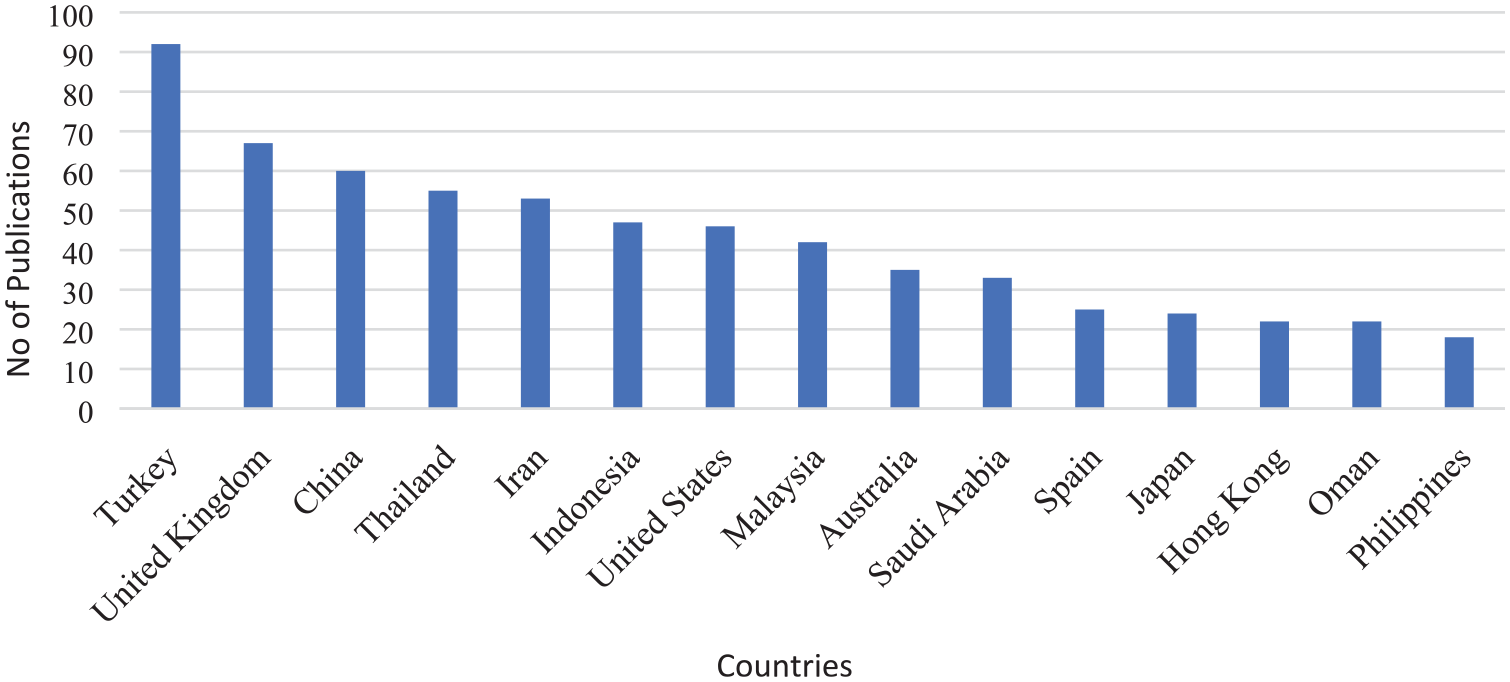
Top 15 countries with ELT publications.
The Most Productive Institutions
This section visualizes authors’ contributions from academic institutions worldwide to ELT research. Figure 3 shows the top 15 contributing universities in the field of ELT from 2013 to August 2022. Universities with sub and multiple campuses are considered as one single institution. The total number of authors’ affiliated universities was 159. Most of the universities are situated either in EFL or ESL contexts. The highest number of publications was produced by Sultan Qaboos University, Oman (n = 17).

Top 15 contributing universities.
Citation Analysis
As of 21 August 2022, the retrieved documents’ citation metrics are summarized in Table 2. There are 4,183 citations reported for 9 years of ELT publications (2013–2022). By importing a RIS-formatted file from the Scopus database into Harzing’s Publish and Perish software, the researchers are able to present the raw citation metrics here. The result also shows that citations per year and per paper were 464.78 and 5.21, consecutively. Citation analysis is one of the most popular techniques for evaluating the significance of a research publication in a field (Lam & Habil, 2021). This citation metric was generated by Harzing’s Publish and Perish software by importing a RIS-formatted file from the Scopus database and displaying the raw citation metrics.
Summary of Citation Analysis.

The Most Cited Publications
This area of study of ELT has expanded rapidly since the first publications were recorded in the Scopus database. Table 3 presents the list of the top 10 cited publications in the field of ELT from 2013 to August 2022. The authors provide a list of the most cited articles in the field of ELT to get a sense of the level of significance of these publications. The publication’s credibility and quality depend on the number of citations it receives. According to some sources, the number of citations a publication receives indicates how influential it is in this area (Aksnes et al., 2019). The publication by Bruton, published in 2013, received 123 citations, which was reported to be 13.67 citations/per year. The paper focused on Content and Language Integrated Learning (CLIL) to improve existing deficiencies in the formal learning of English learning. Most of the top cited publications dealt with flipped classrooms (Basal, 2015; Hung, 2017; Turan & Akdag-Cimen, 2020), which indicated that the integration of technology in ELT is a significant issue. Thus, this summary table gives readers idea about the subject matter of top cited studies, journals, and their growth in the field of ELT.
Most Cited Publications.

RQ2: What Are the Leading Journals and Authors in ELT From 2013 to August 2022?
Leading Journals
This study included publications on ELT from 2013 to August 2022 published in more than 144 journals and conferences. Just 15 journals published more than 5 articles in this field. Figure 4 presents the list of 15 leading journals in this field. With 29 articles, RELC Journal is the top leading journal in this field. From the list of 15 leading journals, it is noticeable that most of the journal is in the language teaching and learning field. Some journals like system, International Journal of Emerging Technologies in Learning, and the International Journal of Instruction focus on using educational technologies in language teaching and learning.
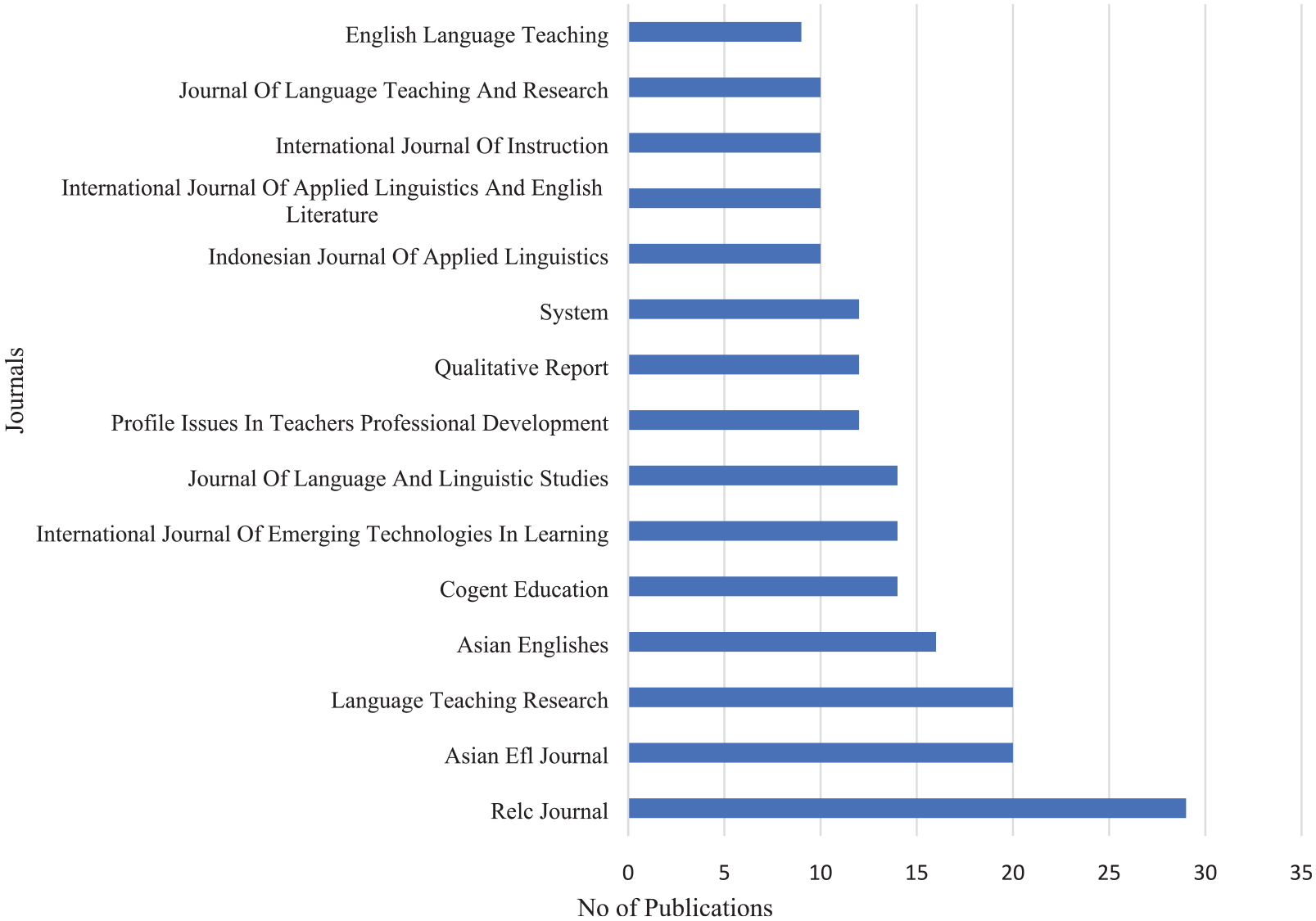
Top 15 leading journals.
The Most Productive Authors in ELT
Figure 5 presents the list of the top 15 leading productive authors in ELT from 2013 to August 2022. Boonsuk (Assalihee & Boonsuk, 2022) and Fang (Chu et al., 2021) are the most productive authors in this field, with 10 publications each. Boonsuk, Yosup (Assalihee & Boonsuk, 2022) is working at Prince of Songkla University, Thailand whereas, Fang, Fan is working at Shantou University, China. This list indicates that authors from ESL/EFL contexts are at the top list.
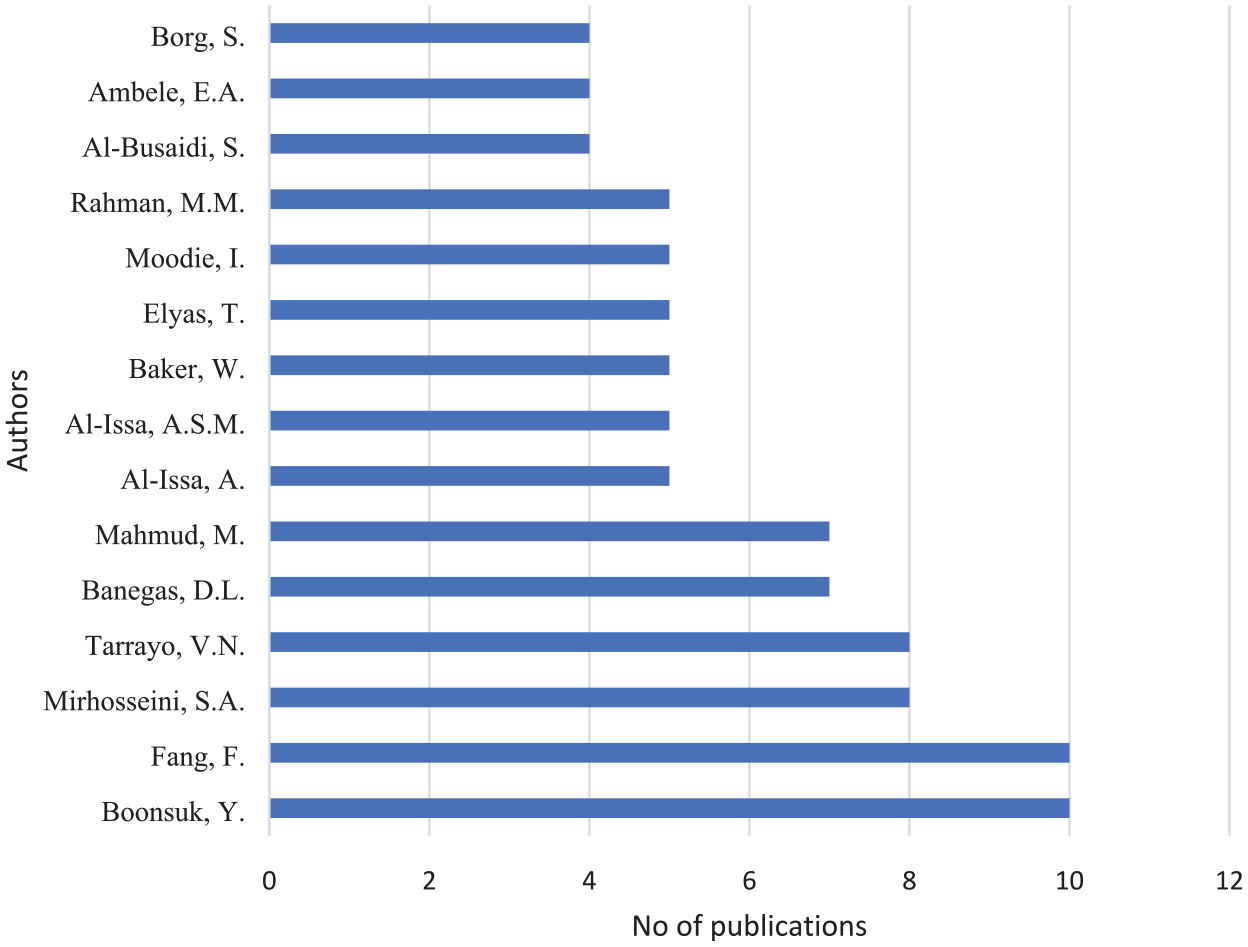
Top 15 productive authors.
RQ3: What Are the Keywords or Themes in ELT From 2013 to August, 2022
Keywords Analysis
VOSviewer was employed to map the author’s keywords in this study. Figure 6 shows a network visualization of the authors’ keywords, in which the relationship between terms is depicted through color, circle size, font size, and the thickness of connecting lines. The total number of authors’ keywords was 2,460. Of these keywords, those appeared 10 times was 30 excluding two countries’ names that were used to produce networking maps. Depending on the analysis, there were three clusters in ELT research. The first cluster, which is in red related to COVID-19, Culture, English as a foreign language, English language teaching (ELT), Language Teaching, Language learning, Professional development, and technology. The second cluster, which is green color is related to E-learning, education, Engineering education, English teaching, higher education, students, surveys, and teaching. Furthermore, finally, the third cluster colored in blue related to English as a foreign language, English as a lingua Franca, English language teaching, global Englishes, identity, teacher education, TESOL, global Englishes, EFL, ELT, ESL, Gender, motivation, teacher training. For researchers looking to create search strings for bibliometric or systematic analyses or searching literature on ELT, these keywords can be a useful resource.

Visualization of authors’ keywords.
Title and Abstract Analysis
In this analysis, we use VOSviewer to count frequent keywords in the title abstract of the publications based on the number of occurrences and co-occurrences. The co-occurrence network was built in this study using a binary counting technique. According to Van Eck and Waltman (2017), who developed VOSviewer, the use of a binary counting technique indicates that the frequency with which a noun phrase appears in a publication’s title and abstract is irrelevant. The frequency with which a noun phrase appears in a publication’s title and abstract is not considered when determining its significance (Van Eck & Waltman, 2017). The analysis shows there are 14,268 keywords found in the title and abstract. Figure 7 presents the networking map of 87 keywords that appeared 30 times in the title and abstract. The thickness of the connecting lines represents the strength of the association between the terms, while the size of the nodes represents the significance of the occurrence of the terms. Words of the same color tend to occur together because they are semantically related.

Visualization of keywords from titles and abstracts.
Discussion
The purpose of this study is to examine the trend of ELT research using bibliometric analysis. By employing this bibliometric analysis, it is possible to assess the productivity of research (Ahmi & Mohd Nasir, 2019) and publications in the particular research domain. According to Lam & Habil, (2021), the information provided by bibliometric data can be used to evaluate the performance of a specific research domain and is useful for research-related agencies in regulating funding allocation policies and comparing scientific inputs and outputs. In addition, the results of the bibliometric analysis can explain the factors that support the contribution of studies to a particular field of study and guide researchers in the production of influential studies (Ahmi & Mohd Nasir, 2019). Consequently, this study visualizes the research trends in the domain of English language teaching found in the Scopus database from 2013 to 2022. This research discovered 803 documents in the specified database using the specified search protocol. The most productive year was 2021, with 149 publications. The highest number of publications was published from Turkey (n = 92). And most of the studies were produced from either EFL (English as a Foreign Language) or ESL (English as a Second Language) countries. The highest number of publications was produced by Sultan Qaboos University, Oman (n = 17). The highest number of citations was received by the study of Bruton in 2013 titled with “CLIL: Some of the reasons why… and why not”. Thus, the research trends by year, country, institution, and citation visualized that research in this field is increasing conducted in EFL or ESL contexts globally. This finding was not found in any other bibliometric analytic articles in the domain of English language teaching (ELT).
This study also visualized the journals and authors in the research domain of ELT from 2013 to 2022. The results found that there were 144 different journals and conferences as well as 159 authors during this specified time frame. With 29 articles, RELC Journal was the top leading journal in this field. Boonsuk and Fang were the most productive authors in this field, with 10 publications each.
Further, this study visualized the keywords used by authors and identified from title and abstract. There were 2,460 authors’ keywords and 14,268 keywords in the title and abstract found. Authors’ keywords were visualized with three clusters whereas keywords in the title and abstract with four clusters. Both sources of keywords provided a holistic image of the major themes in this filed. These keywords will be a great source for future researchers for conceptualize their research. Moreover, these themes also provide ELT teachers and practitioners for gathering knowledge in this filed.
Future Research Directions and Implications
Based on this bibliometric analysis, literature review, and our understanding of the ELT literature, the future research was categorized into four areas, that is, conceptualization, methodology, the antecedent of ELT, and practice-academia link presented in Table 4.
Future Research.

Firstly, the conceptualization of teaching methods for developing EFL learners’ proficiency is one of the prerequisites for the progress of studies on the topic of ELT. This study led us to the conclusion that there are several issues related to ELT for improving EFL learners’ proficiency, for example, Language policy, culture-oriented textbook, interculturality, use of technology, and teacher professional development. For getting benefits of ELT, different contexts have different language policy effects. For example, the top-down language policy was articulated well in Singapore, but the Iranian top-down policy distorted ELT negatively (Shahi et al., 2022). Thus, the language policy of a country is responsible for articulating ELT appropriately. Culture performs a fundamental role in English language teaching. Therefore, local culturally oriented materials for language learning are effective in EFL contexts (Bose & Gao, 2022). Moreover, due to globalization, the importance of cross-cultural learning and teaching is increasing (Salih & Omar, 2022). In fact, interculturality is getting attention in ELT research. The use of technology in ELT is also increasing rapidly and widely. Different types of technology, for example, mobile phone, clicker, Messenger, or WhatsApp are being employed in ELT contexts. The spread of the COVID-19 pandemic adds a new dimension to ELT. Flipped classroom and mobile learning are getting popular and effective globally (Basal, 2015; Hasan et al., 2022; Ibna Seraj & Rahmatullah, 2022; Ökmen & Kılıç, 2022; Rafiq et al., 2021; Turan & Akdag-Cimen, 2020). The spread of the COVID-19 pandemic also adds digital literacy to the skills of ELT teachers. Thus, teacher professional development is now related to academics and literacy in adapting and implementing technology in ELT (Al-Bargi, 2021).
Secondly, from the view of research methodology, this study found that the qualitative method was dominant in ELT from 2013 to 2022. Most of the studies employed monomethod. And research design with teaching intervention was rare. Thus, there is clear evidence for conducting research in ELT by employing mixed methods with special focus on experimental intervention studies.
Thirdly, most of the studies investigated teachers’ and learners’ perceptions of ELT research but left the antecedent of ELT from 2013 to 2022. In this study, technology integration into courses, the effect of the flipped EFL classroom, the effectiveness of technology, and what technology is appropriate for what language skills are considered the antecedent of ELT. Research is needed to investigate how technology works after integrating into the courses and what type of technology is appropriate for what language skills, that is, listening, speaking, reading, and writing (Al-Bargi, 2021; Nguyen, 2021; Rafiq et al., 2021). More research should also investigate the impact of the flipped classroom on learners’ language proficiency (Adnan, 2017; Turan & Akdag-Cimen, 2020).
Fourthly, there are also research gaps based on practice and academic links. Here, the practice and academia link refer to learners’ needs, interests, attitudes and goals, teachers’ competence, experiences, and cultural awareness. Both EFL learners’ needs, interests, attitudes, and goals and a teachers’ competence, experiences, and cultural awareness are crucial for the success of ELT (Al-Bargi, 2021; Assalihee & Boonsuk, 2022; Galloway, 2013; Ökmen & Kılıç, 2022).
Fifthly, Scopus is one of the largest databases that indexes all scholarly works, but it does not exhaustively cover all sources (Ahmi & Mohd Nasir, 2019; Sweileh et al., 2018). Future research may also use other accessible databases like Web of Science, Google Scholar, and Dimensions. Combining all of these databases will likely produce more worthwhile and interesting results.
Nevertheless, since no search query can be guaranteed to be 100% accurate, false positive and negative results should be expected (Sweileh et al., 2018). Hence, more bibliometric analysis are needed in this filed for identifying rigorous comparison in the existing literature.
Conclusion
This bibliometric analysis was conducted on the published research studies in ELT retrieved from the Scopus database from 2013 to August 2022. The findings showed a rising trend in the body of literature on ELT research. Different aspects of ELT have been studied rigorously. The common trend in these studies was integrating technology in ELT to innovate and improve language pedagogy. In recent years, top countries, universities, and researchers of EFL/ESL contexts have been in the pioneer position. The themes from the keyword analysis show that there are a variety of topics studied in this field.
There are also limitations of this study, which are as follows: This study only analyzed data from the Scopus database. In addition, it considered only the published research studies from 2013 to August 2022, and for identifying future research directions, only the top 20 cited publications were considered. In spite of these shortcomings, this bibliometric study provides valuable information for teacher practitioners, ELT researchers, as well as ELT publishers on the current research trends and basis for further research in the ELT area.
Footnotes
Acknowledgements
This research was supported by the Excelence project 2202/2024, run at the Faculty of Informatics and Management of the University of Hradec Kralove, Czech Republic.
Declaration of Conflicting Interests
The author(s) declared no potential conflicts of interest with respect to the research, authorship, and/or publication of this article.
Funding
The author(s) received no financial support for the research, authorship, and/or publication of this article.
Informed Consent Statement
Not applicable.

Data Availability Statement
Not applicable.