




Abstract
This paper analyses the influences of informal institutions on interorganizational trust. Based on a case study, it identifies five impact paths of informal institutions operating between government and social organizations in China: internal referencing, direct entrustment, office visits, favor provision, and key figure decision-making. Most of these function to maintain relationships and facilitate affection. Trust in these informal institutions is particularistic, exclusive, limited in transferability, discrete, and information based. Accordingly, this paper shows that while informal institutions can foster simple cooperation between a particular government and social organization, they can also strengthen the power imbalance between these two subjects and undermine basic public values.
Introduction
As an essential dimension underlying all social exchange relations, the significance of trust has been widely recognized by different disciplines in the social sciences (Arrow, 1974; Barber, 1983; Luhmann, 1979). In recent decades, it has especially accumulated new momentum in organizational studies. According to Kramer (1999), there is ample evidence showing the contribution of trust in organizations, the most cited of which is its facilitation of cooperation (Fulmer & Gelfand, 2012; Malhotra & Lumineau, 2011). It has been argued that a certain amount of trust is a threshold for interorganizational cooperation (Blomqvist, 2002; Dibben, 2000; Seppänen et al., 2007). On the one hand, trust allows instrumental functionality by reducing transaction costs (Gulati & Nickerson, 2008), enhancing information and knowledge sharing (Liu, 2009; Nielsen & Nielsen, 2009), and directing subjects’ attention and efforts toward achieving a common goal (Oomsels et al., 2016). On the other hand, it plays a social-emotional role by simply making the cooperation process more pleasant and satisfying (Lewicki et al., 1998). McEvily et al. (2003) have integrated diverse trust literature and summarized the term as an “organizing principle” involving structuring and mobilizing. In this sense, trust, along with market and hierarchy (Ouchi, 1980), represents an alternative logic for managing interdependence in the face of uncertainty. Given the multitudes of benefits from cooperation, trust therefore has the potential to contribute to the ongoing domestic social reform in China, whose core aspect is the transformation of the governance structure from an all-around government to pluralistic participation and from strict bureaucratic control to flatter cooperation among different subjects (Farid & Song, 2020; Ji, 2013; Yu, 2006). It could be argued, then, that trust can serve as an effective mechanism to coordinate these subjects with different interests and motivations without incurring expensive monitoring costs and to mobilize them toward the attainment of public value without falling into a social dilemma. Public value represents the public’s overall preference and expectation for society and the important values that the public sector wants to provide and protect (Alford, 2009). It is also a consensus formed in interaction and the values that citizens, governments, and other stakeholders identify and determine in the process of negotiation, debate, and consultation (Stoker, 2006). Specifically, in the relationship between the government and social organizations in China, the public value goal emphasizes that the purchase of services by the government and the participation of social organizations in their supply can optimize the allocation of resources for public services, accelerate the transformation of government functions, improve the quality of services, meet the diverse needs of the public, and promote democracy.
Social organizations are key subjects actively engaged in this process and are rapidly expanding both in number and fields (Ji, 2013; H. Wang, 2000). However, trust between government and social organizations in China remains underresearched. This is partly due to the nonprofit nature of these two types of organizations. Trust at the interorganizational level seems to receive more favor in the business world, where its instrumental function generates more evident performance outcomes in monetary terms (Zaheer et al., 1998). Another reason is the real situation in China. Since the government holds an obviously dominant position, most studies concerning the relationship between government and social organizations in China focus on the power-control aspect, scholars prefer macrolevel depictions of the more abstract theoretical patterns of such relationships (X. C. Huang & Ji, 2014; Jiang et al., 2011; Kang & Han, 2005). Building mutual trust thus appears to be a merely taken-for-granted suggestion in the conclusions of these papers.
Classic theories highlight how institutional arrangement is an integral part of the environment in which different types of trust sprout and grow (S. P. Shapiro, 1987). The infertility of formal institutional grounds, hindering the construction of a sound relationship between government and social organizations in China, has been mentioned by many scholars who unanimously call for the publication of a basic law and the improvement of the administrative system (Deng & Wang, 2004; Fan & Cheng, 2005; X. C. Huang, 2015; M. Wang, 2009; Yu, 2006). However, in many circumstances, the informal institutions that are softer, less visible and tangible exert even more deep-rooted influences on collective attitude and behavior (Hall & Taylor, 1996; March & Olsen, 1983; North, 1990). The incompleteness and inappropriateness of formal institutions in China therefore leave vast space for the emergence of “unspoken rules” (Estrin & Prevezer, 2011; K. S. Tsai, 2006; H. Wang, 2000), whereby an analysis of China’s informal institutions will offer a new perspective for interpreting the real incentives and constraints of interorganizational trust. Informal institutions are commonly perceived as backstage manipulators (Helmke & Levitsky, 2004); in some situations, their “rules-in-use,” in contrast to any “rules-in-form,” constitute the real guarantee for trust (Granovetter, 1985; S. P. Shapiro, 1987; Sitkin & Roth, 1993).
Accordingly, this paper examines interorganizational trust in relation to institutional context, with special attention given to informal institutions. We focus on the following questions: (1) What are the impact paths of informal institutions in the interaction between government and social organizations? (2) How do they function and perform? (3) What effects do they have on the trust relationship between government and social organizations? We begin this study with an overview of the conceptual framework of trust and institutions. We then describe our case study, based on empirical evidence from observations, internal documents, and in-depth interviews, which identifies informal institutions and illustrates their primary working mechanism in real situations. Next, we discuss how this invisible hand actually shapes interorganizational trust. Finally, we discuss this paper’s implications for the construction and maintenance of sound trust relationships.
Literature Review
Interorganizational Trust: Concept and Dimensions
The notion of interorganizational trust is derived from that of interpersonal trust (Gulati & Nickerson, 2008; Zaheer & Venkatraman, 1995). When scanning the wide array of trust definitions across different disciplines, three core elements arise: risk, vulnerability, and expectation (Fulmer & Gelfand, 2012; Kim et al., 2004). According to previous work (Mayer et al., 1995; Mollering, 2001; Oomsels & Bouckaert, 2014; Rousseau et al., 1998), interorganizational trust can be defined as the willingness to suspend vulnerability by one organization based on its positive expectation toward another. Oomsels and Bouckaert (2014) point out that organizations are not faceless. Interorganizational interactions are practiced by boundary spanners, people who are mandated to act on behalf of their organization (Oomsels & Bouckaert, 2014; Perrone et al., 2003). Interorganizational trust, then, can be influenced by the interpersonal trust between boundary spanners.
The classifications or dimensions of trust are perhaps as diverse as its definition. Most researchers classify trust based on how it is generated. That is, trust may arise from a fear of deterrence (deterrence-based) (Ring & Van de Ven, 1992, 1994; D. Shapiro et al., 1992), a rational calculation (calculative-based) (Barber, 1983; Williamson, 1993), or a repeated interaction (relation-based or affect-based) (Coleman, 1990; McAllister, 1995). All of these concern more or less one central question: is trust rational or emotional? Dimensions such as calculative trust are centered on the rational aspect, while affective trust is centered on the emotional aspect. In the former situation, the trustor expects the gain from trust to outweigh the probability of loss (resembling gamblers’ psychology) (Coleman, 1990; Deutsch, 1960; Deutsch & Krauss, 1962; Gambetta, 1988). In the latter scenario, trust is built on the affective feelings (Lewicki & Bunker, 1995; Mayer et al., 1995; McAllister, 1995) accumulated naturally through interactions (Organ, 1990) or springs from perceived value congruence (Sitkin & Roth, 1993). Lewis and Weigert (1985), however, reject both theoretical extremes and argue that trust is a combination of strong positive affect and effective, rational reason. Akin to all human decisions, it is a mixture of sense and sensibility. Hence, instead of assuming that different antecedents produce different types of trust, we argue that trust’s various antecedents simultaneously operate at varying degrees to produce the overall attitude of trust. “Calculative” and “affective” are therefore used in a relative sense.
Institutions in Trust Research
Luhmann (1979) was the first to distinguish between personal trust and system trust. Since then, this topic has been continually expanded and expounded upon by many succeeding researchers (Bachmann, 2001; Gulati, 1995; S. P. Shapiro, 1987; Sitkin, 1995). A milestone in these works is the typology contributed by Zucker (1986) that classifies trust as process-, characteristic-, or institutional-based. Moreover, there are two ambiguities concerning institutions in trust research. The first concerns whether institutions should be treated as substitutes for trust or as part of the wider environment in which different types of trust exist. One group of scholars has positioned institution and trust on a parallel level. Williamson (1975) terms it, directly, as a substitute for trust, while Bradach and Eccles (1989) note that institution and trust are not exclusive but can complement and strengthen each other when used in combination. Zucker (1986) even regards institutions as a distinct type of trust: when relational-based trust or characteristic-based trust is not available, trust will take the place of institutional arrangements. She emphasizes the use of formal mechanisms, such as laws and standardizations, to replace the former social ties that are broken by economic and social transformation (Zucker, 1986). Another group of scholars use institutions in the sense of institutional environment. As a situational factor, it thus exists at different levels and spheres. For example, S. P. Shapiro (1987) notes that ethical codes, regulations, and practice standards are prerequisites for trust between a principle and agent. She calls these the “guardians of trust” (S. P. Shapiro, 1987). In this sense, the institution is not a distinct dimension of trust itself, nor can it substitute any other type of trust. Rather, it acts as broad support for risk-taking intentions and behaviors to grow (Gulati, 1995; Ring & Van de Ven, 1992; Sitkin, 1995). At the interorganizational level of analysis, it is more appropriate to take the second view. Unlike interpersonal trust, which can be attributed to the trustor’s character or psychological disposition (factors inside individuals but unknown to them) (Rotter, 1971), interorganizational trust is more heavily embedded in a broader environment and dependent on institutional frameworks (Bachmann, 2001; Lane & Bachmann, 1996). Therefore, while it is appropriate to say that some individuals are born to trust more in others, this is not the case for organizations. Certainly, some organizations are more likely to trust other organizations; however, this propensity is not in-born but embedded in their social identity. Trust, as Lewis and Weigert (1985) suggest, should not be divided into different domains, as interpersonal or institutional, but unified as a social reality.
Another ambiguity is associated with the scope of an institution. Researchers are not consistent in terms of what could be counted as or included in an institution, with some emphasizing a specific level or a particular example. An institution is most notably defined as a legal framework, such as a contract law or regulation (Luhmann, 1979). In addition, it can take the form of an industrial norm, such as a selection procedure, production standard, certification (S. P. Shapiro, 1987), or trade association (Whitley, 1992); organizing structure, such as a bureaucratic system (Zucker, 1986) or the role of the state (Lane & Bachmann, 1996); or a cultural tradition or ethical code (Child & Mollering, 2003; Q. H. Huang & Gamble, 2011). However, since the literature has primarily focused on trust, the concept of institution has not been delicately defined but taken for granted. For instance, Granovetter (1985) contends that trust is not generated by institutions but by the informal obligations inherent in social relationships. Nevertheless, those informal obligations are considered part of an institution by others (Hodgson, 2006; North, 1990; Ostrom, 2009). Helmke and Levitsky (2004) provide a widely accepted definition, conceptualizing an institution as “the rules and procedures structuring social interaction by constraining and enabling actors’ behavior.” They also make a clear distinction between formal and informal institutions according to whether their rules and procedures are enforced through or outside official channels (Helmke & Levitsky, 2004). Although not officially enforced, informal institutions are equally powerful in constraining or enabling behavior, the violation of which could trigger collective disapproval and social sanction.
Following this definition, most trust studies involving institutional analysis focus on formal rules; in China, they have even more narrowly targeted laws and regulations. In this research, however, we pay special attention to the informal aspects whose intangibility and flexibility add to the difficulty of identification and explanation. Before discussing the case of China, the next section thus sets out the theoretical framework of analysis, namely, the mechanism of how institutions, especially informal ones, shape interorganizational trust.
Analysis Framework Based on Informal Institutions
Informal Institutional Influences on Emotional Foundation: Affection and Value Congruence
The emotional foundation for trust comprises a set of intrinsic nonutility elements that trigger a leap of faith. While rationality leads to “conditional” trust, emotional foundation can generate “unconditional trust” (Jones & George, 1998). The first concept to ponder is affection. McAllister (1995) explains that affection is grounded in the reciprocated care developed during repeated interactions. Organizations can also foster affection with each other through good cooperative experiences or interactions among organizational members, especially those involving boundary spanners. This soft emotional bond is often said to be damaged by cold institutionalized rules and procedures (Granovetter, 1985; Zucker, 1986). As mentioned above, “legalistic remedies,” such as laws and regulatory requirements, could establish a barrier between two organizations and create a sense of formality and distance (Arrow, 1974; McEvily et al., 2003; Sitkin & Roth, 1993). Here, the intrinsic motivation to develop trust is undermined or even rendered unnecessary. This could therefore become a self-reinforcing circle: formality leads to more rules that result in greater formality, shrinking the space for emotional consideration (Larson, 1992). Other, mostly informal motivations, are grounded in long-term interactions and even take the form of interactions. Relationship building and networking, for example, are institutionalized in certain cultures (Estrin & Prevezer, 2011; Puffer et al., 2010; H. Wang, 2000). They require reciprocated, informal goodwill greetings and care among social actors somewhat linked with each other (Jacobs, 1979; Yang, 1994). Organizations not attending to these norms may thus be regarded as arrogant or conceited, sending a signal of being difficult to work with. These informal institutions can serve utilitarian purposes but are nonetheless purely instrumental (H. Wang, 2000). The constant and usually long-term interactions associated with these norms add to the probability of fostering emotional affection among organizations. In addition, institutions could make affection transferrable. Some scholars argue that organizations without formal, direct contact can still be bonded together and exchange favors through intermediaries (H. Wang, 2000). This is how social networks work: people are linked together by a long chain of reciprocity. Likewise, organizations sharing common friends tend to like each other, even without cooperative experiences. They trust each other simply because they trust and are trusted by the same median organization.
Another emotional condition that fosters trust is perceived value congruence. Both theoretical and empirical evidence show that value congruence and trust are positively correlated (Butler, 1991; Lindskold, 1978; Sitkin & Roth, 1993). Thus, when one organization is perceived as being culturally different, its identity will be spoiled in the eyes of another organization (Jones, 1983). In identity-based trust, subjects should share certain key fundamental values (Lewicki & Bunker, 1995; D. Shapiro et al., 1992). Their value congruence gives organizations a sense of belonging and comradeship, but value incongruence arouses a sense of estrangement. Moreover, Sitkin and Roth (1993) conclude that legalistic rules have limited effectiveness in retrieving trust when fundamental values are at stake. Their argument, however, reveals only the persistence and robustness of value (once formed, it is resistant to external forces); it does not sever the link between institution and value. Nevertheless, institutions are full of value. They are more or less underpinned by certain values that even manifest themselves in value statements (Meyer & Rowan, 1977). Indeed, some institutions are formed primarily to strengthen value congruence (Bachmann, 2001; Coleman, 1990). Exemplars within a system of political parties may aim to solidify and spread ideology or exist as moral obligations that have strong social cultural legitimacy. However, by claiming certain values, informal institutions also suppress others, creating a clear boundary between “us” and “them,”“friends” and “enemies.” In addition, the values of different types of organizations become institutionalized in their social identities and roles (Oomsels & Bouckaert, 2014). Hence, value-reinforcing informal institutions can bring some organizations closer while separating others further, shaping interorganizational trust in either direction.
Key Features of Informal Institutions: Relationship-Based, Particularistic, and Culture-Rooted
The above analysis has outlined how informal institutions may impact the emotional foundations of interorganizational trust. We also propose that informal institutions have an emotional aspect, which can be attributed to their respective features. According to three main streams in institutional research (rational choice, historical, and sociological), informal institutions can be created with deliberate purposes (Hall & Taylor, 1996; Stacey & Rittberger, 2003), unintentionally result from previous institutional choices, or derive from collective interpretations of what is proper and legitimate rooted in a broader culture (Lindner & Rittberger, 2003). Regardless of their source, most informal institutions share three key features: they are relationship-based, particularistic, and culture-rooted.
First, informal institutions often rely on (but are not limited to) social relationships (Puffer et al., 2010). To maintain stable relationships, their actors must be involved in a constant exchange of reciprocal care and act in a mutually beneficial way (Jacobs, 1979). As a result, they are more likely to develop emotional ties with each other and foster affection (Yang, 1994). Some of these relationships are based on close ties (Yang, 1988). Thus, their members have already engaged in considerable interactions in the past and hold strong emotional bonds (K. S. Tsai, 2006). These relationships can serve instrumental purposes, but any immediate utility should be subordinate to the long-term maintenance thereof. As China is a society of acquaintances, the intimacy between members is an important feature of Chinese relationships. As Fei (2012) summarizes, these involve “differential modes of association.” Every emotional bond is stronger when close to the center, decreasing progressively as it extends to the circumference (Hwang, 1987; Luo, 2005). Some scholars argue that affection can be transferred through a chain of relationships and that those without any former contact can still be bonded through intermediaries (Ruan, 2018; H. Wang, 2000). Likewise, organizations can trust each other because they trust and are trusted by the same median organization.
The second feature of informal institutions is that they are usually created to serve the interests of a particular group. This is especially true for what Helmke and Levitsky (2004) term endogenous informal institutions, which are created to complement or compete with existing, formal rules. In some situations, formal rules establish general guidance but can nevertheless influence details and contingencies (Weingast, 1979; Weingast & Marshall, 1988). Here, actors create flexible informal rules according to their own interpretations and needs (Helmke & Levitsky, 2004). In other situations, actors may dislike an existing formal institutional arrangement and thus substitute formal rules with informal ones in practice (Mershon, 1994). Compared to a written, widely applicable, and mandatory formal system, an informal system is one that is not necessarily written but self-evident, for example, a code of conduct, ethical norm, custom or traditional practice. Informal institutions are also usually local and only applicable in specific communities. An informal system has these characteristics because it requires social members to conduct long-term interactive games in a determined, closed space; that is, it is generated in strong social connections, which have flexibility (compared to a formal system) and produce a tacit code of conduct and confidence in the reliability of any “rule” (Fei, 2012; North, 1990). Informal institutions in both situations are thus somewhat conspicuous. Their actors are bonded by otherwise unattainable benefits and share tacit understandings (H. Wang, 2000). In this regard, these informal rules can generate a certain degree of comradery and value congruence among those involved, as they are sailing on the same boat. All emotional distance is close in such an encapsulated group, and affection can quickly accrue. In addition, by practicing these rules, actors further strengthen the values underpinning them.
In the absence of the strict implementation of a formal system within a social organization, informal systems, such as traditional morality, convention, and custom, have taken the place of a formal system, play its role in many instances. Nevertheless, although informal systems have some positive functions in harmonizing the internal relations of organizations and mobilizing the enthusiasm of their members, they can also cause the nonstandard operation of social organizations, which is not conducive to the maintenance and promotion of public interests; they can even reduce social organizations to tools for some people to fulfill their private interests. Exclusive in nature, informal institutions can also undermine value congruence on a broader scope. They often violate basic public values such as equity and fairness and create a chasm between internal and external actors. Hence, this is also how informal institutions can nourish corruption and erode the public spirit.
Moreover, informal institutions have a strong cultural base (Scott, 1995; Zucker, 1977). Actors abide by them not because external forces push them to do so but out of self-willingness and even unconsciously (North, 1990). They therefore provide the footnote for an action: there is no alternative in this scenario, and abiding by informal rules is taken for granted as the appropriate way to act. Compared to formal institutions, which are top-down, informal institutions are collectively constructed, result from long-term social interactions, and deeply rooted in shared values. Indeed, empirical evidence shows that in some cases, they are more effective in uniting and mobilizing people (O’brien, 1994; L. Tsai, 2002, 2007) than formal institutional forces. That is, although formal institutions have both formal and informal restrictions, the boundary between formal institutions and informal institutions is clearly demarcated; formal institutions are rules or codes based on laws, while informal institutions are regulatory means based on cultures and traditions (Z. Zhang & Guo, 2021). An informal institution is an inherent rule in a culture, an unwritten regulation of proper or normal behavior. Since culture and institution are not substitutive but mutually supportive, this form of institution must depend on cultural factors. Thus, it is possible to argue that guanxi (a type of informal relationship, pervasive in China and Chinese culture) draws from elements of Chinese culture (Barbalet, 2023). For instance, Wen (2013) demonstrates that in the rural areas of China, informal institutions are more effective in public goods provision than formal institutions and that villagers hold strong, blind trust toward informal authorities. Kramer and Lewicki (2010) therefore propose that trust works best when “it has acquired an almost tacit or taken-for-granted quality.” This can occur when the informal institutions embedded in a culture are internalized in actors as implicit knowledge and shared understandings (Figure 1).

Informal institutional influences on the emotional foundation of trust.
Impact Paths of Informal Institutions in the Interaction Between Government and Social Organizations in China: The Case of JIA Community Development Center
Method and Data
This paper adopts the inductive case study method. Through a longitudinal case study, while analyzing the focal evolution process over time, we can deeply explore its characteristics and internal laws (Yin, 1994). A case study is helpful for deeply describing the interactions between the government and social organizations and to observe the role of informal institutions in shaping the trust relationship between the government and social organizations. The empirical part of this paper focuses on the case of JIA Community Development Center (JIA), a social organization in C city, H province, China. It was founded in 2011 and registered as a social organization with the C City Civil Affairs Bureau (CCAB) in 2014. According to relevant regulations, being registered means being officially accepted and legally admitted (Gao, 2000). Currently, JIA has 12 full-time workers (the national average is 3), 8 part-time workers, and more than 6,000 volunteers. It is actively engaged in the coproduction of community public services and cooperation in community public spaces (see Table A1). We choose this case, first, because JIA is representative of successful grassroots social organizations in terms of its size, operation, and reputation. Second, many of its projects are carried out in cooperation with the government, especially subdistrict- and community-level agencies (see Table 1), which yields rich data for our investigation. Last, community coconstruction lies at the cutting edge of ongoing governance reform; thus, as a pioneer, JIA’s experiences could shed light on other social organizations.
Impact Paths of Informal Institutions Between Government and Social Organizations.

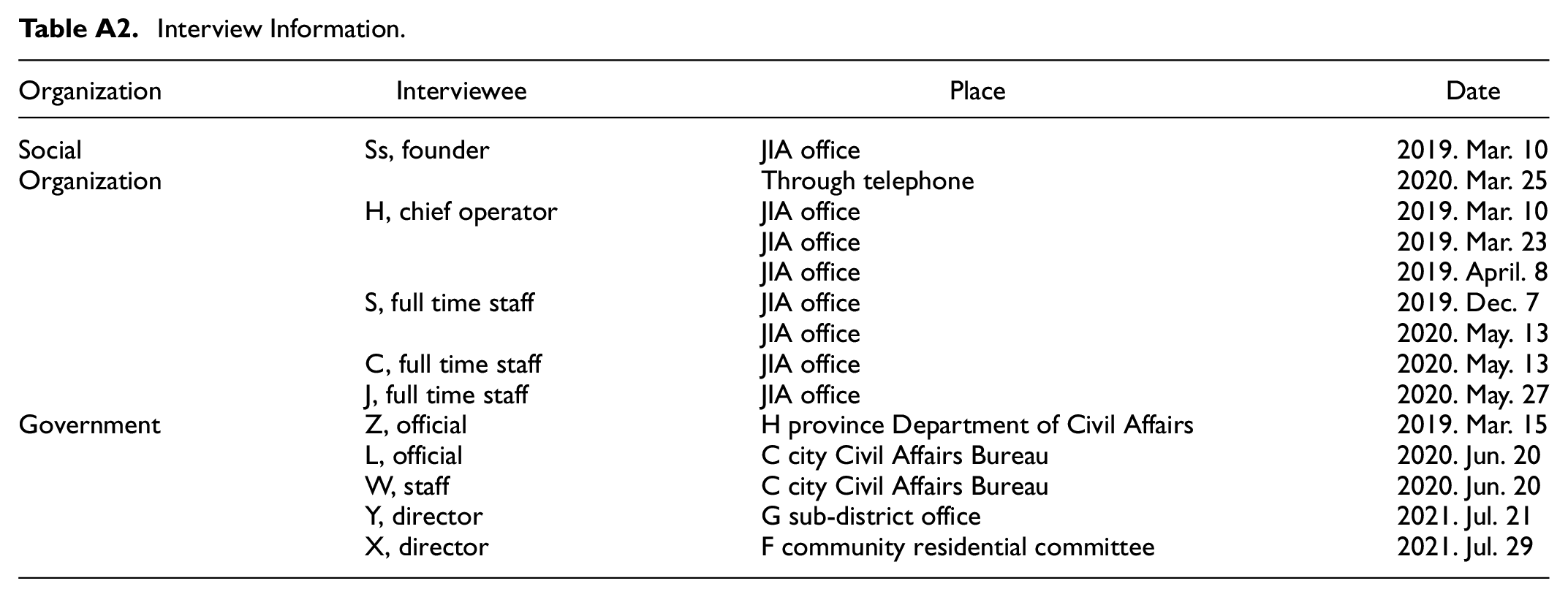
The data for the case study in this paper come from long-term observations that lasted nearly 2.5 years, from March 2019 to July 2021(see Table A2). According to the “triangle demonstration” principle, we conducted a series of open interviews with the founder and main staff of JIA and officials from different government levels who interact with JIA. In addition, we were allowed to observe the daily operations of JIA. We often listened to meetings and participated in its various activities. We also witnessed face-to-face negotiations between JIA and government agencies. Each interview took approximately 1 hr. We asked participants to describe their cooperation process over time in detail and focused on what action strategies they took in these processes and their views on mutual trust, for example, whether they take different action strategies in different relationship periods, whether there are different trust indicators, or how much trust they have. We often consulted the interviewees to ensure that the interview content is true and unambiguous. To improve the diversity of the data and the completeness of the story, we collected a text from the C municipal government, the CCAB’s public service purchasing policy text and the publicity materials of relevant social organizations, as well as the JIA’s working documents, annual organization reports, and other relevant materials from recent years. Charmaz (2006) has suggested that coding should include at least two stages: initial coding and focus coding. Therefore, two groups of researchers carried out the initial coding and focus coding of the data, repeatedly compared and corrected these data, and then verified any inconsistencies with experts outside the group. Meanwhile, they verified the analysis results with the research unit and endeavored to demonstrate the same phenomenon multiple times, form a chain of evidence, and thereby further ensure the reliability and validity of the study.
Internal Referencing: Reducing Perceived Risk
Internal referencing usually occurs in the initial stage of interaction. It pertains to the situation when a social organization wants to contact a particular government agency, and it must have a reference within the government’s system. The reference usually holds a position in the parent body of that particular agency or a parallel agency within the same sector. He or she does not necessarily need to be an official, but the more powerful the reference, the more effective the referencing. In most situations, the reference will make a phone call or send a short message to the social organization, introducing the matter in a simple and polite manner in advance. Internal referencing thus connects two organizations that belong to different domains and that have had no previous contact. It is based on a relatively high trust in the government system and the familiarity between the reference and the social organization. It thus mainly affects the rational foundation of trust by reducing perceived risk, which is different from our initial conceptualization. The reference serves as a guarantee that the social organization will not experience trouble, reducing the uncertainty felt by the other agency. Since everyone working in government is sensitive to the political risk associated with social organizations (X. C. Huang, 2015; J. G. Zhang & Zhuang, 2008), being a reference is a demonstration of both deep understanding and great confidence in the focal social organization.
When JIA registered with the CCAB in 2014, an officer in the H Province Civil Affairs Department served as their reference. Hence, JIA’s registration process went smoothly: “It took us only one month to register, which takes nearly two years for some other social organizations” (Interviewee Ss). Registration is strict and time consuming in the double administrative system. Before registering in the Civil Affairs Department, the social organization needs to find another government agency to serve as its “operational supervisor.” However, most agencies are not willing to be an operational supervisor due to political risk and extra workload (Deng & Wang, 2004; Tian, 2003). As a result, many grassroots organizations remain unregistered. JIA staff have also admitted that registration has become less stringent since 2014, as the central government has published a set of incentive policies. However, local governments are still cautious and usually adopt a “wait-and-see attitude” (Interviewee L). Having a reference, especially someone who holds a high official rank within the government, can ease social organizations’ efforts in finding operational supervisors and facilitate the censorship process. As M. Wang (2012, 2014) documents in The Oral History of NGOs in China, there are many examples of internal referencing, which has become a norm in the registration process.
Direct Entrustment: Accumulating Familiarity and Affection
Direct entrustment is adopted by government agencies in the purchase of services from social organizations. Instead of using public bidding to select service-undertaking subjects, the government usually directly appoints a particular social organization that it knows well. A certain degree of both rational and emotional trust therefore already exists between these two subjects. The government usually has had a previous interaction with the entrusted social organization, thus possessing considerable knowledge of its intentions and abilities as well as its affective feelings. The government is sure that such a social organization is capable of the focal services and can bring the desired outcomes. This is very common at the subdistrict and community levels. Indeed, JIA’s projects at these two levels are all based on direct entrustment. The relevant national- and provincial-level policy documents are also ambiguous. They list a set of selection methods without clarifying the condition for each, encouraging flexibility in practice (Deng & Wang, 2004; X. C. Huang, 2015; Ren & Song, 2021). This was confirmed by officials in the CCAB during our interviews.
We know that the central government encourages purchasing service from social organizations, but we do not know how to implement in real situations. We are experimenting cautiously, imitating other governments’ practice. One big problem is that there is no law but numerous policies, either repetitive or contradictory. (Interviewee L)
Direct entrustment thus arises as a contingent and expedient rule in practice, which can save time and money for both sides. For services with large budgets, public bidding is widely used. Such services at the community and subdistrict levels usually involve a smaller sum of money, and officers have considerable autonomy therein. It is plausible, then, that they choose to entrust persons they are familiar with and in favor of. This direct entrustment leads to more interactions and therefore more familiarity and stronger emotional reliance, resulting in a greater possibility for future entrustment. Notably, any increasingly emotional reliance on the part of the government is more mildly observed on the part of JIA. One possible explanation for this is that while a lower-level government agency often only cooperates with one social organization in a given period of time, a social organization such as JIA cooperates with several government agencies simultaneously. In addition, JIA is not passionate at all about government purchases since “the money the government gives can barely cover our personnel expenses, and we have very limited autonomy in these projects” (Interviewee H). Although direct entrustment is a demonstration of the government’s high trust, JIA’s acceptance is more passive. That is, JIA has accepted entrustment because “despite the meager income, a government project is at least stable” (Interviewee H). Consequently, on the one hand, JIA relies on government purchases to maintain stable operations; on the other hand, JIA is actively seeking other, more autonomous development opportunities, deliberately reducing its reliance on the government in pursuit of a balance of power in development.
Office Visits: Promoting Affection
Office visits are a tacit rule, undertaken by social organizations to maintain good relationships with the government. It has become an operational routine for JIA to regularly visit government offices, report on its recent work, and communicate problems with government officials. Office visits, as an informal process, should be distinguished from the formal visits required by regulations. For instance, when a social organization needs to change its legal representative, it must visit the Civil Affairs Bureau to register. Office visits, however, usually have no particular purpose and are outside administrative requirements. There are two agencies JIA visits frequently. One is the CCAB, as it is the administrative agency for all social organizations. The other is the higher level Communist Party Committee (CPC). According to policies issued by both China’s central government and the CCP, every registered social organization must establish its own party branch and develop party members. Accordingly, JIA employs one full-time staff member to oversee its own party construction efforts. She visits the higher level party office almost every week: “There is no particular purpose. I go there to report on recent work and chat” (Interviewee J). Constant visits promote affection on both sides. This is in accordance with the view that the density and frequency of interactions are positively related to trust (Edelenbos & Klijn, 2007). JIA staff thus mention that frequent visits enable them to leave a stronger impression on the government and provide an extra benefit in terms of acquiring timely information. Although government information transparency has greatly improved in recent years, information delay still prevails. In some cases, information is made public after a project has already been completed (X. C. Huang & Ji, 2014). During office visits, JIA staff can talk to government officials face to face and ask them questions directly, thereby acquiring the latest information otherwise not available to them.
According to JIA staff, the degree and frequency of office visits vary among social organizations: “We visit them less frequently than others since we do not solely rely on the government for projects” (Interviewee S). In some cases, office visits may take other forms, such as dining together, and are accompanied by gift giving. This is where the boundary between relationship maintenance and unlawful behavior blurs. JIA has never been involved in any gift-giving conduct, but staff disclose that it does happen within other social organizations. The founder has also expressed obvious contempt for other social organizations that are excessively active in office visits; however, she is proud of her own capability to leave a good impression during office visits.
Favor Provision: Gaining Affection and Anticipating Benefits
Favor provision refers to the norm that social organizations usually need to provide services exceeding what has been agreed upon in a purchase contract signed with the government. In our interviews with JIA staff, they mention that as long as they sign a contract with a community residential committee to provide a certain service, it requires JIA to help in every aspect of community building. JIA is also often asked to assist the government in preparing materials for various evaluations and award applications, which is outside JIA’s responsibilities. In addition, JIA provides professional consultancy services to many government agencies and even helps them organize activities without formal contracts. For example, since 2015, JIA has been assisting the CCAB in organizing a large annual forum for all social organizations and communities in C city to interact and exchange resources. As an important organizer, then, JIA is involved in many detailed preparatory works, but it only receives approximately 6,000 yuan each year as hardship pay, which barely covers its expenses. This sum is difficult to refuse, however, given the power imbalance between the government and social organizations. However, it does provide practical benefits since the more favors JIA provides, the more affection it gains from government. In addition, although the government may not give JIA immediate returns, it may perform favors for JIA in the future. For instance, the founder of JIA has been elected as the people’s representative of C city, a demonstration of high political legitimacy (S. Y. Li, 2018). Her election is attributed, by herself, largely to the favors JIA has been providing to the government. In this regard, favor provision is to some extent mutual. By providing favors, JIA also anticipates the fulfillment of any favor debt by the government. During our observations, in some face-to-face negotiations between JIA and government agencies, many officials expressed their thanks and affection in a direct way. However, favor provision has its downsides as well, which have been noticed by JIA’s chief director.
It shifts our attention away from our own mission and vision. And it is very energy consuming. We have less time to do the things we really want to do. Sometimes the government treats us as its own personnel and takes our extra effort for granted. However, relationship is very complicated and subtle. If we refuse, it would have some negative influence on our organization.(Interviewee H)
The paradoxical attitude of JIA is not unique. Many social organizations in China share this psychology. They desire both autonomy and recognition from the government (S. Z. Wang, 2013; Yao, 2013). Favor provision therefore enables them to establish a good relationship with the government at the expense of a certain amount of autonomy. Yao (2013) concludes that social organizations should have the wisdom to compromise some aspects while adhering to their own principles in others. Hence, favor provision should be practiced within a certain range. Otherwise, the expenses would be too costly, with social organizations ending up as subordinates to the government. In addition, favor exchange draws organizations emotionally closer, but if it is not reciprocated, no emotional bond will be sustainable. Researchers on relationships in Chinese society typically highlight reciprocity: the favor-receiving party feels the moral pressure of payback (Qi, 2013; Ruan, 2018; Smart, 1993). However, in real situations, the normative pressures seem to be diluted by power. The anticipation of future returns from the government cannot be fully guaranteed, and in most circumstances, the payback is out of proportion to the provision. In this sense, favor provision further strengthens the power imbalance between two subjects and influences their judgment on potential gains and losses. When mixed with a sense of gratitude and assurance of benefit, the government thus places more trust in social organizations that are stuck in the dilemma of gaining favor or preserving autonomy.
Key Figure Decision Making: Strengthening Value Congruence and Affection
In the context of the interactions between government and social organizations, the key figures are those with a leadership position in government agencies. Unlike boundary spanners, who act in the circumference of an organization, key figures are close to the center. They usually have a high degree of decision-making power or can at least influence decision-making on issues related to social organizations. The trust between government and social organizations is to a large extent the trust between key figures and the particular social organization they favor. Many JIA projects have been initiated by certain key figures. For instance, JIA’s first community project, a public study room operated successfully for 7 years, relied largely on the will of the community director. Seven years ago, the director accidentally visited a coffee shop run by JIA. The coffee shop was a mature product of JIA’s cooperation with a commercial bank: the bank provided free space while JIA was responsible for its operations. The community director was immediately attracted to the atmosphere there and thus invited JIA to cooperate in community construction. In that same year, JIA also signed a contract with the G subdistrict office, providing consultancy for the subdistricts’ governance innovation plan. This had been similarly initiated by the director of that subdistrict, who had watched JIA’s presentation in one meeting and approved of JIA’s value and mission. Hence, she contacted JIA and actively negotiated with it for 1 year before these two parties finally worked out a cooperative plan. Such value congruence has been highlighted by interviewees from both sides.
Our relationship with government relies largely on key figures. Their value and style influence both their willingness to cooperate with us as well as our willingness to accept. We have our own principles. We never cooperate with government officials who are only concerned with their own gains and losses without caring for people and society. (Interviewee J)
Key figure decision-making enables a key figure to transfer his or her own value and affection into organizational decisions. These decisions then strengthen the existing value congruence and affection between the two sides. As the key figure recognizes and likes a particular social organization, he or she will regard this organization with affection and differentiate it from others. In addition, both parties will stay in regular contact and maintain exchanges. Every social organization has its own key figure in the government that it can rely on. Gaining the approval or support of key figures can be very favorable for social organizations. In most cases, key figures’ decision-making is closely related to internal referencing and direct entrustment. Hence, if one official approves of JIA, he or she could recommend JIA to other officials or entrust it directly with projects. Nevertheless, relying on key figures is risky since their decision-making power is tied to their specific position. Once they leave that position, even if promoted, their previous decision-making power will be transferred to whoever who takes it over. In China, the transfer of government officials is both prevalent and frequent. Newly appointed officials each have their own style and plans. To demonstrate their own capacity, they are usually not willing to follow the previous path. JIA staff have thus revealed anxieties about future uncertainties.
Government only signs short term contract, usually one year, because official transfer is very frequent. Long term projects are signed on an annual base as well. If the official changes, everything would be different. (Interviewee H)
JIA’s project in the F community has lasted for several years, but the government still has no intention to sign a longer than 1-year contract. Additionally, a new project with the G subdistrict office must be signed on an annual basis despite being planned for 3 years. Key figures are very aware of the uncertainties facing them, and they are bounded by their organizational roles. Although they hold high trust toward JIA personally, when making organizational decisions, they make discounts. Therefore, interorganizational trust, which is greatly influenced by key figures’ personal preferences, can never be substituted with the latter. One staff member in JIA has revealed empathy for key figures: “They are emotionally on our side as individuals, but they have to put their organizational roles first and guarantee their career prospects” (Interviewee H). Hence, despite the discounted intensity of their emotional bonds, key figures are still great facilitators of interorganizational trust.
In summary, the impact paths of informal institutions we have observed operate during different stages during their interactions and exert considerable influences on the trust between parties (see Table 1).
Discussion: Interorganizational Trust in Informal Institutions
All the informal institutions identified in JIA’s case can influence the emotional foundation of trust. However, some can also equally influence the rational foundation of trust, especially by reducing perceived risk. This is plausible, given the sensitivity of political risk associated with social organizations in China. Risk is a priority for every government regardless of its emotional distance to social organizations. Certain key features arise from the trust built with these informal institutions, which are discussed in this section.
Personal Network-Centered
Personal networks are the core of almost every informal institution we have identified. They are one of the mechanisms for the operation of informal institutions. Two forms of networks are crucial for JIA. One is its volunteers, and the other comprises the friends of JIA staff. In its 7 years of development, JIA has accumulated over 6,000 volunteers, many of whom are still in close contact. Some of these volunteers work in government agencies. They thus either serve as internal referees for JIA or directly entrust JIA with service contracts. Some of them are key figures on whom JIA relies. Office visits and favor provision are not based on personal networks initially, but they are oriented toward the establishment of such networks. In this way, a personal network can connect all informal institutions and knit them into an informal institutional network. Boundary spanners impose influence on interorganizational trust in such networks, as Oomsels and Bouckaert (2014) contend. However, in the Chinese context, it is the attitude of key figures that truly counts. Consequently, the trust between JIA and the government is to a large extent the trust between JIA and various key figures therein. When asked about their relationship with a certain agency, JIA staff would discuss whether its officials like them or not. Every agency is therefore personalized to a great extent.
Not only JIA, but every social organization in China has realized the importance of personal networks and is actively engaged in networking (X. C. Huang & Ji, 2014). This is an expedient strategy in the current situation. Moderate networking is necessary since it brings more resources and better prospects for organizational development. Nevertheless, the power of social organizations lies in their actual capacity to establish, mobilize, and utilize what Granovetter (1973) terms “weak ties.” However, networking can be time consuming, especially when it is not generalized but oriented toward certain key figures. When compounded with the fact that most grassroots social organizations are short of personnel, excessive networking adds too much pressure. In addition, social organizations usually need to compromise and sacrifice in exchange for good relationships. Excessive networking may therefore lead them to deviate from their initial mission and vision.
Exclusive and Limited in Transferability
As mentioned above, the trust between JIA and the government is in actuality the trust between JIA and various key figures. Hence, it is not generalized trust but particularistic trust. The particularity of the trust prevalent in Chinese society has been identified by many scholars (Bian, 1997; Child & Mollering, 2003; P. P. Li, 2008; Luo, 2005). However, we want to further note that this type of trust is exclusive and has limited transferability. First, it is difficult for one government to extend trust in JIA to other social organizations, and it is unlikely that JIA can extend its trust in one key figure to another. Particularistic trust is based mostly on emotional attachment, accumulated through long-term interaction (McAllister, 1995). Active tactics of informal institutions, such as office visits and favor provision, directly strengthen this emotional foundation. In some situations, this trust can be transferred through informal processes, such as internal referencing. However, as argued above, the degree of emotional bonds is disproportionately scattered in a given network (Luo, 2005). As trust is transferred from one person to another, rationality increases in proportion. The effectiveness of internal referencing thus mostly lies in the reduced risk felt by the government and less in emotional attachment. In addition, the government in China is divided both horizontally and vertically by sectors and levels (S. Y. Li, 2018). Trust often cannot transcend the boundaries between divisions. Such trust is also fragile because of its heavy reliance on particular individuals. If these individuals leave their present organization, the relevant interorganizational trust simply ceases to exist. In addition, competition exists among different social organizations, whereby they do not share key figures with each other. This competitiveness thus shapes interorganizational trust via an exclusive tendency. Such exclusiveness can result in unfairness. Direct entrustment, for example, excludes other potentially capable social organizations from fair competition. As love blinds lovers, exclusive trust can evolve into blind trust as two subjects become increasingly emotionally reliant on each other (Lewicki et al., 1998).
Difference
JIA’s trust across different layers of government varies. Generally, the trust is higher between JIA and lower-level government agencies, such as community residential committees and subdistrict offices and lower between JIA and the CCAB. The lower-level government agencies are at the frontier of government purchases, since projects at lower levels involve smaller sum of money; most are purchased through direct entrustment. It is also easier to obtain access to key figures at lower levels of government and establish personal ties with them. Almost every staff member in the F community residential committee and G subdistrict office is therefore familiar with JIA, since there are only a limited number of social organizations they interact with compared to the CCAB, which has to interact with thousands of social organizations. Difference also exists in the trust between social organizations and different government sectors at the same layer. The trust between social organizations and the Civil Affairs Bureau is thus higher than other bureaus since it is the parent body of all social organizations and the policy-maker in this sphere. Most of JIA’s office visits are to the CCAB, and JIA also performs many favors for the CCAB. In addition, agencies within the civil affairs system purchase far more services from social organizations, while agencies in other sectors remain reluctant to do so and suspicious. More interactions lead to a better understanding and stronger emotional attachment, which results in greater trust. Informal institutions based on differential personal networks strengthen the differences in trust. Hence, it is difficult to provide conclusive remarks on the general level of trust between government and social organizations in China. The degree of trust can only be captured in specific situations. Exploring the relation between government and social organizations in China, Kang and Han (2005) uses the concept of “differentiated control”: here, the aspect and degree of government control are dependent on a social organization’s ability to launch collective action and the type of public goods it provides. Both “differentiated control” and differential trust therefore reflect the complexity of the state-society issue in China. While the former concept is constructed solely on rational considerations, the latter takes both rational and emotional aspects into consideration.
Ambiguous
Intangible and soft informal institutions also shape interorganizational trust in an ambiguous manner. Both sides have a tendency to keep the other side at an arm’s length. From the government’s perspective, the affection fostered by informal institutions such as favor provision creates a certain amount of tension between key figures’ personal emotions and their organizational roles. They identify with JIA personally but are bounded by organizational concerns. As a consequence, they show reserved trust in practice. In this case, governments directly entrust JIA with services but do not sign long-term contracts. Accordingly, while the decision-making power of key figures enables them to transfer their personal trust toward JIA to the interorganizational level, the actual amount of trust being transferred is discounted. Ambiguity on the government’s side also extends from psychology. On the one hand, governments enjoy the favors provided by JIA and rely on its professionalism; on the other hand, they are also sensitive to the risks associated with JIA’s resource capacity. This paradoxical situation is conceptualized by Lewicki and Bunker (1995) as “high trust and high distrust.” It is based on the assumption that trust and distrust are independent constructs and coexist in a relationship. While Lewicki regards this relationship as an ideal, in a real scenario, it is far from perfect: it hinders long-term cooperation and hampers full devotion from both sides. Commenting on a public space coconstruction project in F community, the chief operator of JIA has thus expressed pity at the government’s reservations.
Had the government signed five-years instead of one-year contract with us, we would have invested a million in this project. It is good now but it could have been a lot better. (Interviewee H)
From the perspective of social organizations, ambiguity arises from the struggle between better development prospects and greater autonomy. Informal institutions facilitate social organizations in gaining favor from the government, thus acquiring more legitimacy and resources. Nonetheless, most informal institutions further strengthen any extant power imbalance between government and social organizations. In this case, it is JIA that takes the initiative to visit government offices, but it is also JIA that has to compromise during favor provision. The extra workload for satisfying the government’s needs urges JIA to reflect on its own autonomy. Its chief operator is thus worried about losing the organization’s initial mission and deliberately avoids becoming overly reliant on the government. Based on several years of practice, he has recommended an approach that social organizations should follow when interacting with government.
Information Based
Barber (1983) and Coleman (1990) contend that calculative trust is based on the cognitive knowledge of the trustee. The trustee’s characteristics, including ability and intention, also referred to as goodwill (Ring & Van de Ven, 1992), integrity (Mayer et al., 1995) or dependability (Rempel et al., 1985), are two major sources of trustworthiness (Das & Teng, 2001). The above case seems to suggest that a certain amount of understanding between subjects is not only a prerequisite for rational trust but also for emotional trust. Affection and value congruence are unlikely to evolve without any previous contact. Even organizations that already value congruence cannot realize this without a basic understanding of each other. While formal institutions create general knowledge, thus enhancing general trust among social members (Zucker, 1986), the informal institutions we have identified facilitate particular knowledge about specific government and social organizations, thus promoting particular trust. More specifically, they increase the understanding between a key figure and a particular social organization. Whether this information is deliberately used to make rational calculations or naturally accumulated to cultivate emotional ties, it is expedient in any particular situation; in most situations, it is a combination of both.
In addition, informal institutions differ in the amount, completeness, accuracy, specificity, and directness of the information they provide (see Table 2), factors that are also related to the degree and nature of trust they influence. Internal referencing, for instance, provides very limited, incomplete, indirect, but accurate and specific information about a social organization. With a phone call or short message, a reference is unable to deliver a large amount of information, nor is it possible to include every aspect. In addition, aware of his or her political risk, the reference does not distort or exaggerate data, whereby accuracy can be guaranteed. In addition, as such information is acquired indirectly and targets a specific matter, the trustor is more likely to use it deliberately for rational considerations. In contrast, office visits provide a greater amount, more complete, but less accurate and specific, information in a direct way. During office visits, social organizations can speak face to face with government officials, producing abundant information compared to a brief phone call. However, as both sides are motivated to leave a good impression and are bounded by social etiquette, they behave very politely and present a good image. This is especially true for social organizations with a strong desire to gain favor. They express good intentions and their ability to do their best, thus reducing objectiveness. Again, as our interviewees have revealed, they visit offices usually without a particular purpose, whereby the information exchanged is rather general. When such office visits are made frequently and on a regular basis, they produce a large amount of favorable general understanding, drawing organizations emotionally closer.
Features of Information Produced by Different Informal Institutions.

Table 2 therefore indicates that the information provided through direct entrustment produces the highest level of interorganizational trust. That is, it fosters direct, close, and usually longer-term interactions between government and social organizations. It also requires both communications on a specific matter (a purchased service) and frequent exchanges on a general basis. It is, then, the only informal institution in which government and social organization interact with each other on a relatively equal basis. However, the problem is that akin to other informal institutions, it is particularistic trust that it fosters. Once direct entrustment stabilizes, the emotional aspect could thus gradually erode on the rational side and confine both sides in an inefficient but habitual cage. One way to resolve this is to substitute direct entrustment with more competitive mechanisms of service purchase.
Summary and Implications
The purpose of this paper is to elucidate the mechanism through which informal institutions exert influence on trust between government and social organizations in China. Informal institutions are relationship-based, in some cases benefit-oriented, and grounded in common values; thus, they are more influential on emotional aspects. The case we have examined is mostly in accordance with our conceptual framework. We have identified five informal processes operating in different interaction areas between government and social organizations. The interorganizational trust woven by these informal institutions is, in essence, the interpersonal trust among various boundary spanners based on personal networks. However, first, heavy reliance on particular individuals renders social organizations susceptible to the uncertainty and instability brought by official transfer and policy change. Second, it is costly to maintain. JIA staff members all complained of the workload needed in maintaining relationships, but they never denied its significance. JIA has actually partly changed its original mission to meet the government’s needs and tastes. This is an expedient strategy for a grassroots social organization to incrementally grow and influence society. Nevertheless, not all social organizations are similar to JIA, which is operated by a high-quality working team that is alert and reflective. Other social organizations could easily go astray and become merely an extension or subordinate branch of government. Last, particularistic trust could entail unfairness for other social organizations. Those being excluded have no access to timely information, project opportunities, or development prospects. It is also likely to facilitate corruption and incur misbehavior, undermining fundamental public values.
The prevalence of informal institutions could be partly attributed to the culture and traditions in Chinese society, which place heavy emphasis on relationship maintenance. Equally important is the inconsistency between the increasingly wakening public spirit and delayed legal construction in relevant areas. To quote a government official from our investigation, “the problem lies in the absence of law and overabundance of policies” (Interviewee J). Each government agency also has its own interpretation and implementation strategy. When this situation is compounded by the fact that head officials have considerable decision-making power over matters within their domain, informal institutions based on personal networks strive and continue to shape organizational attitudes and behavior. Here, we observe the dual character of organizations: they are both reactive and active toward external forces, adapting while challenging, reaping what has been sown by their own hands.
The issue of trust between government and social organizations in China has long been overlooked or merely taken for granted. Based on a single qualitative case, this paper far from captures the whole picture. However, we hope that through this tentative exploration, more researchers can realize the complexity and richness of this seemingly simple issue. While particularistic trust based on particularistic understanding is effective in supporting simple cooperation between specific governments and social organizations, general trust grounded in generalized understanding is essential in guaranteeing more complex cooperation across multiple subjects. Hence, in January 2018, the Ministry of Civil Affairs published the Regulations on the Management of Information of Social Organizations’ Trustworthiness. However, whether this is a step toward producing desired understanding or has merely added to the redundancy of already heavy regulations remains to be seen. In addition, informal institutions should not be eradicated in this area in any way. The emphasis on personal networks and emotional bonds is part of the cultural identity and fabric of Chinese society. A better choice, then, is to remold them and confine them within clear boundaries: to tame emotion with appropriate rationality.
Footnotes
Appendix
Interview Information.
| Organization | Interviewee | Place | Date |
|---|---|---|---|
| Social Organization |
Ss, founder | JIA office Through telephone |
2019. Mar. 10 2020. Mar. 25 |
| H, chief operator | JIA office JIA office JIA office |
2019. Mar. 10 2019. Mar. 23 2019. April. 8 |
|
| S, full time staff | JIA office JIA office |
2019. Dec. 7 2020. May. 13 |
|
| C, full time staff | JIA office | 2020. May. 13 | |
| J, full time staff | JIA office | 2020. May. 27 | |
| Government | Z, official | H province Department of Civil Affairs | 2019. Mar. 15 |
| L, official | C city Civil Affairs Bureau | 2020. Jun. 20 | |
| W, staff | C city Civil Affairs Bureau | 2020. Jun. 20 | |
| Y, director | G sub-district office | 2021. Jul. 21 | |
| X, director | F community residential committee | 2021. Jul. 29 |
Acknowledgements
The first author would like to appreciate all of the participants included in the study.
Ethical Approval and Consent to Participate
This study methods were performed in accordance with the relevant guidelines and regulations. Ethical approval for this study was obtained from the Human Research Ethics Committee of Central South University. A written informed consent was obtained from all participants included in the study.
Declaration of Conflicting Interests
The author(s) declared no potential conflicts of interest with respect to the research, authorship, and/or publication of this article.
Funding
The author(s) disclosed receipt of the following financial support for the research, authorship, and/or publication of this article: The work were supported by Social and Science Fund of Hunan Province (Grant Nos. 20ZWA03 and 21YBQ012).

Data Availability Statement
The datasets generated during and/or analyzed during the current study are available from the corresponding author on reasonable request.