




Abstract
The healthcare sector has faced increasing pressures to reduce costs and increase healthcare quality in recent years. Thus, managing knowledge in healthcare organizations is critical to achieving low-cost optimization of higher quality services. Also, information technology (IT) plays an essential and crucial role in providing a central database for managing patient data in the healthcare sector. The current study investigates the effects of three aspects of knowledge capabilities (i.e., individual knowledge capabilities, managerial knowledge capabilities, and collaborative organizational capabilities) on information technology governance in healthcare institutions in the Sultanate of Oman. Data were collected using a non-simple random sampling technique by distributing a questionnaire completed by (325) employees working in (13) public hospitals and medical centers in (8) governorates. The collected data were analyzed using AMOS software and structural equation modeling (SEM). This study indicates that individual knowledge capabilities significantly affect only one dimension of IT governance: IT risk management. Moreover, collaborative knowledge capabilities significantly influence all dimensions of IT governance pillars in healthcare institutions, while managerial knowledge capabilities have no significant effect. The study findings can be used to deeply understand the role of knowledge capabilities in sustaining the IT governance application in the health sector context.
Keywords
Introduction
For decades, knowledge management and information technology development in creating competitive advantage has been one of the main concerns of scholars and practitioners (Mao et al., 2016). Nowadays, due to the rapid change and development in the business, knowledge is considered an imperative factor of success in any organization (Qader et al., 2022). Today is increasingly changing environment makes IT-enabled knowledge management capacity a standard competency for institutions to enhance organizational capabilities, competitive advantages, innovation, and individual performance (Joshi et al., 2010; Ko & Dennis, 2011; Tseng, 2014).
The paradigm shift arising from information technology (IT) and social and technological changes has created a need to develop an innovative knowledge-based healthcare system that can meet the global healthcare system’s requirements and future trends (Acharyulu, 2012). Healthcare institutions rely on professional knowledge to integrate and analyze clinics, billing, prescriptions, and relationships with patients (Bose, 2003); accordingly, healthcare institutions are related to knowledge-intensive property, and medical employees, including nurses, technicians, and physicians, are the critical base to provide high-quality care services to patients (Wu & Hu, 2012). The efforts to develop patient services have prompted the hospitals to manage various information systems, which may have varying degrees of interoperability and platform. The knowledge management system effective develops on communication and education and thrives in hospitals that trigger collaborative learning (Kurniawan et al., 2019).
Since the 1990s, economic theories have focused on the knowledge-based economy as the main direction that drives the global economy (Rebentisch & Ferretti, 1995). Businesses face intense competition from local and international organizations in the 21st century due to globalization and technological developments in the digital economy. Moreover, there is an urgent need for institutions in various countries to take advantage of information systems applications to benefit from technological resources (Beard & Sumner, 2004), as IT plays a vital role in integrating processes within an enterprise. They include the structures and methods of effective interpersonal communication to allow a business to make informed decisions. IT technologies encourage the cooperation of those concerned since essential information should be utilized efficiently. Information technology governance is critical for driving IT in institutions (Haes & Grembergen, 2008). It enables an organization to develop effective strategies and make them more productive (Usman, 2019).
New trends in this field appear vital in knowledge management, where the predominant emphasis is on technology applications (Freeze & Kulkarni, 2007). Grant and Chen (2005) indicated that the theory of knowledge-based vision views the institution as a collection of multiple resources and assets and shows how institutions can obtain added value from these available sources. Blome et al. (2014) reported that a firm should be seen as a place for continuous improvement, development and the integration of all resources available to the company, such as human, financial, physical, and knowledge. However, Avison and Fitzgerald (2006) pointed out that knowledge and IT capabilities are not reflected in their financial indicators. Knowledge management is considered one of the main factors of progress in an enterprise, as it involves an exact and ongoing representation of the knowledge of several sets of personnel in a company. It is necessary to develop organizational activities because knowledge management is a critical issue in managing human resources and the general organization of a firm (Wu et al., 2013).
Few studies focus on the capabilities field; in particular, there is a dearth of studies on developing relationships between knowledge management capabilities and IT governance. Research in this area is still limited, and extensive research is required to define this relationship. Therefore, this study attempts to explore this research area for potential benefits. Moreover, it is also conducted to provide an in-depth understanding of knowledge capabilities and their effect on IT governance application, specifically within the Omani healthcare sector. The following research question was addressed: how do knowledge capabilities affect the IT governance application rate in Oman’s healthcare institutions.
The study’s novelty emanates from its research problem. The expenditures of the ministry of health in Oman were (RO 988.2 million equals about $2.6 billion, which is more than 3% of the overall GDP of the country) according to the national statistics in Oman 2020 (Department of Health Information and Statistics, 2020).
A considerable amount of the expenses were for developing information technology infrastructure, buying new technological instruments, IT staff training and facilitating access to information, over and above is developing the current enterprise system that serves the sector in the country.
In pandemic circumstances, the workload and pressure challenge training and monitoring the complicated instrument. At the same time, the IT department should monitor, control, and audit all IT investments to ensure their value-added to society and enhance this value over time.
Even through these contests, the health triumph was seen at all health care echelons at fast rates and has adopted the state-of-the-art technologies in providing medical and health services to the population, which was reflected in an increase in the mortality rates.
Literature Review
Knowledge and Organizational Knowledge
Previously, the concept of knowledge has been studied in various fields and discussed in socio-psychological, anthropological, and sociological works. Knowledge concept refers to a social product—what individuals within a social system need to understand to operate in that system (Ning et al., 2006). Knowledge has gained a prominent position and is an essential resource in modern economies (Nassuora & Hasan, 2010). Moreover, many researchers appreciate the vital role of knowledge in business organizations development and success (King et al., 2002; Shin, 2004), as knowledge is considered a primary factor in achieving sustainable advantages in the organization (Lewis, 2006). Knowledge originates from and is applied in individuals’ minds, making it an active process (Davenport & Prusak, 1998). Knowledge is a mix of information, experiences, values, and experts’ insights that provide a framework for evaluating and combining new information and experiences (Dalkir, 2009). Knowledge is also regarded as organizational culture, intuition, reputation, skills, and codified theory that influences human behavior and thought (Hall & Andriani, 2003).
Furthermore, knowledge sharing among individuals and departments plays an essential role in creating new knowledge in a sustainable innovation process in an institution (Barachini, 2009). Inspiring individuals to share knowledge and experience in organizations has drawn attention to identifying ways to motivate employees to engage in knowledge sharing. In order to reinforce this behavior, employees in business need to understand the influences and mechanism that drives individuals to contribute their valuable knowledge to others (Razak et al., 2016). Knowledge Transfer from one person to another can lead to new knowledge (van Den Hooff & de Ridder, 2004). Knowledge sharing can also be thought of as a supply and demand for new knowledge (Siddiqui et al., 2019).
It is essential to consider many factors in creating a firm’s knowledge process, such as external knowledge, external and internal knowledge and the organizational knowledge base, because it is necessary to review and update company systems (Popadiuk & Choo, 2006) continually. Many researchers have described the importance of organizational knowledge in developing innovations and improving services and products (Forcadell & Guadamillas, 2002). Al-Zayyat et al. (2009) defined organizational knowledge as firm-wide business practices that focus on the processes and lifecycle of knowledge. These practices include capturing, communicating, capitalizing, constructing, and codifying to structure and maintain complex and soft elements of knowledge infrastructure, aligning the organization policies and structures with knowledge initiatives (Baets, 1992), and developing information technology (Ozgen & Baron, 2007).
Cunningham et al. (2016) illustrated the importance of knowledge-sharing intention, considered one of the most vital organizational knowledge management elements. Organizational knowledge aims to enrich the quality of a business’s activities by overseeing information resources inside and outside the organization (Alkhaldi, Hammami, Kasem, et al., 2017). However, Urban suggested developing the informational and organizational infrastructures to increase business strategies’ success and achieve the institution’s core goals (Urban, 2015). Furthermore, organizational structures contribute through their diversity in facilitating knowledge-management processes when the organization relies on communication and knowledge sharing between individuals to create novel knowledge (Adenfelt & Lagerström, 2006; Cohen & Olsen, 2015). In short, the pillars of organizational knowledge are the development of a knowledge-management plan, the intention to share knowledge, organizational culture and organizational structure (Davy, 2006; Malhotra, 2005).
Knowledge Management
Knowledge is a crucial element for developing new technologies for society (Okatan, 2012). knowledge encourages researchers to develop new products and services to solve the present issues (Hilmersson & Hilmersson, 2021). Therefore, knowledge is the backbones of any industry (Lu & Tseng, 2010; Witell et al., 2016). Knowledge management involves developing methods and techniques for transferring knowledge from source to user. Knowledge is essential for any development, and any indispensable item is always the target of managers of organizations (Taques et al., 2021). Knowledge management is creating, storing, accessing, and disseminating an organization intellectual resources (Antunes & Pinheiro, 2020). An organization ability to use and benefit from knowledge largely depends on its human resources, which effectively create, share, and use knowledge (Ipe, 2003). The use of knowledge is only possible when individuals can share their knowledge and generate new knowledge from the knowledge of others (Antunes & Pinheiro, 2020).
All institutions, including healthcare institutions, have vast stockpiles of formal and informal knowledge within and across the minds of their staff, leaders and professionals (Evans et al., 2017). Knowledge management is an essential and dynamic factor for businesses (Cegarra-Navarro et al., 2014) as they attempt to establish a knowledge-intention strategy to transmit, share and reuse valuable insights (Abbas et al., 2020). Knowledge management is one of the most critical assets in an organization; it aims to improve the quality of a business’s activities by supporting formal information inside and outside the organization. It can be considered a process that seeks to create new knowledge as an upshot of business (Bernroider, 2008). Knowledge management is the process of creating value from the available resources of knowledge in organizations, combining information, experiences, and capabilities to produce new skills (Gloet & Terziovski, 2004). Knowledge management may include creating novel knowledge or focusing on acquiring, sharing, transferring, storage, and improving existing knowledge to provide the proper knowledge to the right individual at the appropriate time (Hajric, 2018).
Calvo-Mora et al. (2015) discussed the gaps in knowledge between business performance and technology inputs, discovering that knowledge management can influence the ability to improve business processes or take a specific action and handle the considerations linked to the resulting knowledge. Estrada et al. (2016) point out that if knowledge cannot be disseminated, this process is of no value, whereas when it is shared throughout the organization, it becomes more valuable and actionable. Additionally, the knowledge must reach the management level (i.e., operational, tactical, or strategic).
The process of knowledge transfer plays a vital role in an organization success (Hamdoun et al., 2018; Mubako et al., 2017). Knowledge transfer in a firm is how one unit (e.g., a person, group, or department) is affected by another’s experience (Argote & Ingram, 2000). Accumulation and assimilation of novel knowledge denote the successful transfer of knowledge (Liyanage et al., 2009). Ghani and Zakaria (2013) emphasize the importance of knowledge assets in an organization, defined as the knowledge related to products, services, technologies, markets, and organizations that the company owns or needs. McGinnis and Huang (2007) encourage firms to make more effort to achieve the knowledge management system, promote their application, and add novel insights to the organization success (Nonaka & Konno, 1998).
Knowledge Capabilities
In an environment characterized by uncertainty, risk, complexity, and intense competitiveness, institutions need to utilize their capabilities to make their staff capable of continuous learning and knowledge acquisition to improve performance and increase the value (Durrah et al., 2018; María Díez et al., 2010). Every institution has potential human and knowledge capabilities, leading to business development if used appropriately (Norozi et al., 2013). Many researchers have confirmed that knowledge capability is a significant factor in knowledge management (O’Dell & Jackson Grayson, 1999). Knowledge capabilities are organizational mechanisms for creating new knowledge (Lee & Lee, 2007), and the ability to launch a business from that knowledge can create many experiences and sources (Freeze & Kulkarni, 2007). An organization knowledge capabilities are less tangible and less evident in process-oriented resources (Gorman & Thomas, 1997). Knowledge capabilities are how an organization diffuses resources for producing value and achieving organizational goals (Dutta et al., 2005). They represent the capability to mobilize knowledge and deploy it in combination with other available resources and multiple capabilities to enable knowledge activities in the organization (Chuang, 2004). Knowledge management capability (KMC) connects many organizational components, including technology, culture, organizational structure, and human resource practices, to facilitate knowledge management initiatives and to ensure that the proper knowledge is transferred to the right people at the right time (Buuren, 2009; Yang & Chen, 2007).
Organizational capabilities can result from knowledge integration based on knowledge-based and resource-based view theories. Accordingly, knowledge can be found in personnel, and capabilities should be improved to integrate this knowledge within an enterprise (Gold et al., 2001). Some researchers think an organization capability base is the set of techniques, technologies and knowledge required for its core business. Knowledge capability can also be split into individual knowledge and the collective knowledge of a group or organization (Ning et al., 2006). Moreover, knowledge capabilities developed into knowledge processes perform more effectively in achieving institutional success, and to successfully improve knowledge capabilities, three tools, namely, skills, behaviors, and technology, were determined (Dawson, 2000). Knowledge capabilities support an information system’s strategy, wherein the business’s process requires achieving alignment across information technology inside the company and linking it to the business strategy (Breschi et al., 2003; Tseng, 2014).
Abate (2009) stressed the importance of improving an institution’s information systems’ average success rate, so the company’s goal must be to reach the level where the work focus is knowledge development. Paisittanand et al. (2009) emphasize that organizations seeking to develop their knowledge capabilities must continuously utilize them to achieve successful strategies. Former studies have considered the knowledge capabilities as an organization knowledge-asset group; however, this research determines the knowledge capabilities as including (Alkhaldi, Hammami, & Ahmar Uddin, 2017):
Individual knowledge capabilities: (reputation, sociality, intention to share knowledge, employee adaptability, qualifications).
Managerial knowledge capabilities: (mentor, facilitator, knowledge dealer, fosterer, motivator, learning advocate, developer, and innovator).
Organizational collaborative capabilities: (culture, climate, structure, trust, and incentive system).
IT Governance Framework
In the last 2 years, the world has faced an unprecedented outbreak that has affected all aspects of human life caused by the COVID-19 pandemic. Due to the novelty of the virus, health care systems have faced challenges represented by a high rate of patients and a shortage of medical tools, products, and devices (Badnjević et al., 2020). As technology improves, the main focus of scientists and researchers is to improve the quality of patient treatment, improving the functionality of medical devices (Gurbeta et al., 2017). The development of medical devices has dramatically changed how medical care is provided to patients. These devices enabled the development of clinical practices because they made it possible to manually measure parameters that could not be touched or seen (Kovačević et al., 2020). Medical device manufacturers use the technologies to innovate their products to help healthcare providers better and improve patient care (Burki, 2019; Flaxman & Vos, 2018). New advances in artificial intelligence in hardware and software have helped the rapid growth of wearable devices such as smartwatches, which contain digital health monitoring applications that contribute to disease detection, diagnosis and treatment (Badnjević et al., 2022). Badnjević et al. (2019) indicated that health technology management benefits from machine learning in cost optimization and medical device management. Adopting these systems will help overcome the challenges of adapting the protocols of medical devices’ maintenance and supervision mechanism for the rapid technological development of these devices.
Nowadays, information technology is one of the most vital resources in any company, and the field of IT is more dynamic than ever before. Developers and managers face constant challenges to introduce more flexible, robust, and effective systems and processes to keep up with business developments (ITGI, 2018). The support of operations and IT implementation in different institutions depend on various factors, of which information technology governance (ITG) is one. ITG enables organizations to develop effective strategies for future predictions while also ensuring IT expectations. ITG reduces the risks and uncertainty associated with IT and addresses the problems related to this field (Usman, 2019). Therefore, IT’s role in the overall governance of businesses has become a significant pathway to competitive advantage (Pereira & da Silva, 2012).
ITG is defined as the process of making decisions about how to acquire and diffuse IT competencies and resources (Bermejo et al., 2014) and informs the processes that guarantee the effective use of IT in enabling a firm to achieve its objectives (Usman, 2019). Steven and Wim (2004) defined ITG as the organizational ability exercised by IT management to control the implementation of IT strategies. ITG aims to guide IT’s activities to guarantee its performance aligns with the organization and achieves the desired benefits to ensure the organization ability to continue its operations and ensure that it can perform the required strategies to expand its activities in the long term (Qassimi & Rusu, 2015). ITG aims to optimize IT resources, measure IT performance and adequately manage associated risks. Many individuals are involved in the ITG process, such as managers, executive managers, team leaders, stakeholders and directors (Bermejo et al., 2014).
Information Technology Governance Pillars by COBIT and Hypothesis Development
The concept of governance can be used in many contexts, especially in business (Levstek et al., 2022). It focuses on the role of boards of directors in representing and protecting the interests of shareholders and addresses sound corporate governance (Kooper et al., 2011). While governance developments have been driven primarily by the need for enterprise risk transparency and the protection of shareholder value, the widespread use of information technology has created a critical dependence on information technology that requires a particular focus on the Integrated Technology Group (De Haes et al., 2013). Information technology (IT) can, directly and indirectly affect overall business performance. New technologies often change risks at various organizations strategic and governance levels. In the digitization age, we need to develop new concepts and approaches to governance and management. More established IT governance models, such as COBIT, CMMI, and ITIL, are global, one-size-fits-all models (Levstek et al., 2022; Solana-González et al., 2021).
Numerous ITG frameworks are used worldwide in competitiveness, corporate governance requirements, and organizational requirements, like COBIT, COSO, ITIL, CCBF, and GAISP (Chang et al., 2013, 2016). Control Objective for Information and Related Technology (COBIT) is considered one of the most important frameworks for ITG, and it was established by the Information Technology Governance Institute (ITGI) and the Information Systems Audit and Control Association (ISACA) in 1992. It provides institutions with valuable guidelines to initially appraise their ITG systems (Haviluddin & Anthony, 2012). The COBIT framework offers organizations information to achieve their goals by managing IT resources based on the aggregation process (Council, 2006).
COBIT is one of the most successful ITG frameworks; it determines organizations IT processes and control goals (Lunardi et al., 2014). COBIT was designed to supply an entire group of requirements for every process to allow managers to develop a business’s value or reduce risks in practices, policies, procedures and organizational structures (Voon & Salido, 2009). The COBIT framework’s essential aim is to provide distinct policies and exemplary practices in ITG (Gondodiyoto, 2007). COBIT helps an organization assess and understand the state of its IT systems and identify required improvements to capabilities, performance objectives and IT operation metrics, which measure how these operations meet businesses and IT objectives (The IT Governance Institute COBIT, 2007).
COBIT is a framework that allows administrators to bridge the gap between technical matters, business risks, and control requirements (Goldman & Ahuja, 2009; Jogiyanto & Abdillah, 2011). COBIT applications within an organization offer support to realize the benefits gained by effective governance and management of IT. COBIT helps an organization achieve optimal value from IT (ISACA, 2012). The ITG framework offered by COBIT includes five elements: IT-business alignment, IT delivery, IT resource allocation, IT risk management, and IT performance measurement. These elements are considered the critical components of ITG applications in an organization (Alkhaldi, Hammami, & Ahmar Uddin, 2017).
Business Value Delivery
To achieve the effective delivery of IT value and core aims, the organization must adequately manage the return on investment and actual costs of IT investments to deliver the right quality on time and within the budget (Doherty et al., 2015). The delivery of business value is related to implementing the value proposition during the delivery cycle, ensuring that IT will deliver the desired advantages in reducing costs and demonstrating the IT actual value (Drnevich et al., 2006). The IT and investment plan budget must be integrated and realistic in all organization objectives to fulfill business expectations concerning IT investments (Pereira & da Silva, 2012). Moreover, healthy controls must be in place to manage IT projects, define service levels and continuously monitor systems (Zhu et al., 2015). Thus, the following hypotheses are proposed:
H1: Individual knowledge capabilities significantly influence IT value delivery in healthcare institutions.
H6: Managerial knowledge capabilities significantly influence IT value delivery in healthcare institutions.
H11: Collaborative knowledge capabilities significantly influence IT value delivery in healthcare institutions.
IT-Business Strategic Alignment
IT-business alignment is crucial for continuity in business (Luftman, 2004). The Strategic Alignment Model (SAM) focuses on ensuring that businesses are linked to IT plans, verifying the IT value, aligning IT processes with those of the organization, formulating strategic plans to help organizations achieve their goals and linking all IT plans with specific organizational objectives (Alaceva & Rusu, 2015). In order to implement the IT strategy, it must be consistent and integrated with the business goals and processes, and this strategy and objectives should be translated into operational tasks. Senior management should commit to necessary IT ventures, and IT strategies must be implemented following appropriate IT policies and standards (El-Mekawy et al., 2015). As such, the following hypotheses are proposed:
H2: Individual knowledge capabilities significantly influence IT-business alignment in healthcare institutions.
H7: Managerial knowledge capabilities significantly influence IT-business alignment in healthcare institutions.
H12: Collaborative knowledge capabilities significantly influence IT-business alignment in healthcare institutions.
Resource allocation
The primary factor for IT’s success in an organization is the optimal investment, utilization, and IT resource allocation in serving its needs (ITGI, 2003; Zhang & Harte, 2015). Allocation relates to IT resources’ optimal investment in applications, data, information, people, and infrastructure (Qassimi & Rusu, 2015). Organizations need to make suitable investments in capabilities and infrastructure by applying tasks related to IT systems, ensuring that adequate skills and proper methods are in place to support and manage IT ventures and systems to improve workforce planning. The retention of skilled IT personnel, focusing on IT employees’ continuous training and development, is also essential, so upper management should apply innovative strategies to encourage these policies (Bowman et al., 1983; Boynton & Zmud, 1987). Given the above, the following hypotheses are proposed:
H3: Individual knowledge capabilities significantly influence IT resource management in healthcare institutions.
H8: Managerial knowledge capabilities significantly influence IT resource management in healthcare institutions.
H13: Collaborative knowledge capabilities significantly influence IT resource management in healthcare institutions.
Risk management
Risk management is considered a significant task conducted in any institution and is recognized as a vital element in improving innovation and productivity (Drucker, 1999). Risk management requires awareness from senior company personnel, a clear understanding of the organization willingness to take risks, transparency around the considerable risks to which the organization is exposed and the embedding of risk management responsibilities in the institution (Aven, 2016). Moreover, risk analysis requires a systematic method to identify the risks related to IT; however, there are many reasons why identifying and assessing these risks is a laborious task, such as continuous technological development, the complexity of IT and the diversity of applications of technological configurations (Ahlan & Arshad, 2012). Thus, the following hypotheses are proposed:
H4: Individual knowledge capabilities significantly influence IT risk management in healthcare institutions.
H9: Managerial knowledge capabilities significantly influence IT risk management in healthcare institutions.
H14: Collaborative knowledge capabilities significantly influence IT risk management in healthcare institutions.
Performance measurement
Performance measurement is a process of monitoring, evaluating and reporting on achievements in the organization, and it can also include quality, efficiency, effectiveness, productivity, timeliness, economy, and safety. Moreover, performance measurement can be focused on either collective or individual performance or a combination of both (Hyder & Hebl, 2015). Performance measurement with COBIT explains the process for supporting an IT function for business requirements and how to follow up, monitor the strategy’s implementation, allocate resources, perform the process, complete the project, and provide the service (Haviluddin & Anthony, 2012). Organization officials seek to expand the governance scope already practised to include IT via a practical ITG framework that addresses strategic alignment, value delivery, resource allocation, risk management, and performance measurement (Gerschewski & Xiao, 2015). As such, the following hypotheses are proposed:
H5: Individual knowledge capabilities significantly influence IT performance measurement in healthcare institutions.
H10: Managerial knowledge capabilities significantly influence IT performance measurement in healthcare institutions.
H15: Collaborative knowledge capabilities significantly influence IT performance measurement in healthcare institutions.
Ultimately, ITG and the practical application of the ITG framework are the responsibility of the executive management and board (Hammami & Alkhaldi, 2012). ITG is an essential part of corporate governance and consists of the structures, organizational processes, and leadership that ensure that IT supports and extends its strategies and goals. As described in the objectives of COBIT, an ITG framework can be a vital component in ensuring appropriate governance and control of the systems and information that make, store, process, and retrieve knowledge (Ward & Peppard, 2016).
Methodology
This research is a quantitative cross-sectional study; it offers tests for the model’s causal hypotheses by applying a computational methodology of structural equation modeling, as shown in Figure 1.
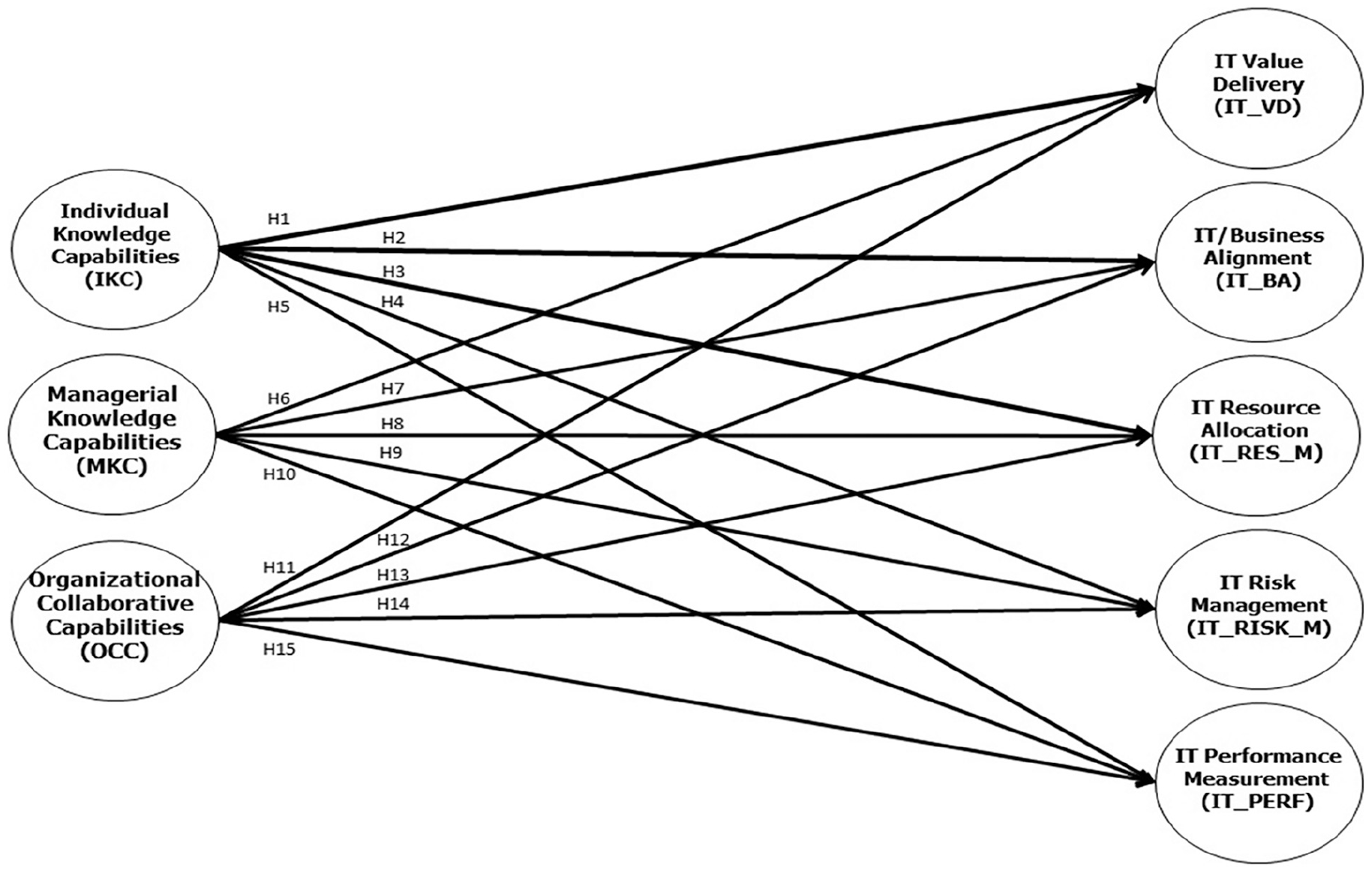
Proposed research theoretical model.
Operationalization and Measurement of the Model Variables
The research ontology asks if organizational knowledge capabilities sustain the application of information technology governance in healthcare institutions in Oman. The researchers follow a research epistemology of building a conceptual model depending on previous literature and testing it using data collected from a distributed questionnaire to any staff using IT systems in a healthcare institution in Oman.
The researchers personally visited hospitals and medical centers in eight governorates to distribute the on-paper questionnaire to the target audience.
Sample and Procedures
IT investment in the healthcare sector positively influences the national economy. The authors applied an empirical methodology to study the effect of organizational capabilities on IT governance in Oman’s healthcare sector.
The study’s target population consists of the staff who work in 13 public hospitals and medical centers in 8 governorates in Oman. The authors distributed the prepared questionnaire as the data collection tool paper in Arabic and English and used the non-simple random sampling method of 325 people as the study sample.
The three primary reasons the researchers applied convenience sampling as a non-probability sampling method are population size, timeframe, and accessibility.
Consequently, the researchers selected the sampled members from only available and easily accessible participants according to the accessible timeframe for participants to participate in the research and the high level of work pressure in the health institutions. So they distributed the questionnaire to any potential participant they may find. No other criteria determine which variable joins the sample.
Because all participants from the sampling frame have an equal chance to be drawn and occur in the sample, the sampling frame should coincide with the population of interest.
The data is analyzed using the structural equation modeling (SEM) technique via AMOS 25.
Measures
An eight-part questionnaire was designed to study the research variables. Organizational knowledge capabilities were measured on a scale of three constructs: individual knowledge capabilities (IKC: five variables), managerial knowledge capabilities (MKC: eight variables), and collaborative organizational capabilities (OCC: five variables), as developed by (Hammami & Alkhaldi, 2017). ITG was measured on a scale of five constructs, each of which has five variables: IT value delivery (IT_VD), IT-business alignment (IT_BA), IT resource management (IT_RES_M), IT risk management (IT_RISK_M), and IT performance measurement (IT_PERF), used by Alkhaldi, Hammami, Kasem, et al. (2017). A five-point Likert scale, ranging from strongly disagree (1) to strongly agree (5), was used.
Sample Characteristics
The sample respondents’ demographic characteristics showed that 40.88% of the sample respondents are female, and 59.12% are male. Regarding education, 47.08% of the sample population have a bachelor’s degree, 29.85% have a secondary school education, and 23.08% have a postgraduate degree. Of the sample group, 35.38% work at medical clinics and 64.62% work in management departments. Furthermore, 39.38% have fewer than 5 years of work experience, 28% have from 6 to 10 years, 18.77% have from 11 to 15 years, and 13.85% have more than 15 years of work experience.
Data Analysis
Exploratory study
The measurement model was estimated using AMOS 24 and SPSS 26 to evaluate the scales’ reliability and validity. The results presented in Table 1 show the high internal consistency of the 26 constructs, as all of Cronbach’s Alpha α, as recommended by Hair et al. (2017). Furthermore, the values of communalities were higher than .5 (Field, 2005). Also, the values of the correlations between the reflective constructs are lower than .85. Table 2 shows the correlations between first-order factors.
Descriptive Analysis, Assessment of Normality and Communalities.

Correlations Between First Factors.

Correlation is significant at the .01 level (two-tailed).
The authors used the principal component analysis: all 26 items were loaded into 8 common factors. Table 3 shows that the total variance is 69.300%, approx. chi-square = 10,304.37, df = 903, at a significant level (.000), which are accepted as the threshold point is <50% (Podsakoff et al., 2012). On the other hand, KMO equals .958, and α = .971. It is also evident that the indicators’ outer loadings are all greater than .5 (Durrah & Chaudhary, 2020; Hair et al., 2017), as observed in their ranges. Therefore, it can be concluded that the data in this study are reliable and valid to assess the hypotheses.
Exploratory Factor Analysis (EFA) of the Study Model.

Model fit measures
The results show fit indices of the tested model according to its acceptable threshold, as shown in Table 4: CMIN = 1398.020, df = 791, CMIN/df = 1.767, CFI = 0.945, TLI = 0.936, IFI = 0.946, SRMR = 0.042, RMSEA = 0.046, p = .696, PGFI = 0.695, PNFI = 0.758, and FMIN = 4.088.
Model Fit Measures.

Findings and Discussion
The authors tested the structural model to check the research hypotheses, as shown in Table 5. There is sufficient empirical evidence to achieve confidence in the structural model’s usefulness for business decision making. The results infer that six hypotheses are accepted and the others rejected in the study population of Oman’s health institutions, as illustrated in Table 5.
Hypotheses Results.

Concerning the first hypothesis, H1, the results obtained and presented in Table 5 (Std. β = −.014, T-value = −.171, and p > .1) indicate that individual knowledge capabilities have an insignificant negative effect on the delivery of IT value as an ITG pillar; therefore, H1 was rejected. This result means that managers need to highlight the role of employees in the IT department in achieving business objectives. It is also essential to build the user acceptance of IT to achieve business goals and to view IT as a goal in itself (Ashurst et al., 2008), but there is a lack of implementation of recommended ITG initiatives. IT-proficient individuals should also be involved to ensure IT-business engagement because effective ITG will not occur without adequate and appropriate engagement (Flynn et al., 2009; Goldschmidt, 2005).
As for hypothesis H2, the results obtained and presented in Table 5 (Std. β = .084, T-value = 1.03, and p > .1) indicate that individual knowledge capabilities have a positive but weak and insignificant effect on IT-business alignment as an ITG pillar; therefore, H2 was rejected. This result means that employees need to have further instruction about two things: the importance of IT as a tool, not a goal, and also the strategic goals of the organization so they will be able to employ technology in this regard better and collaborate with the relevant people better to govern IT assets (Henderson & Venkatraman, 1993; Hirt & Wilmmott, 2014).
Regarding hypothesis H3, the results obtained and presented in Table 5 (Std. β = .157, T-value = 1.905, and p < .1) indicate that the Ind individual knowledge capabilities have a positive but insignificant effect on the IT resource management as an IT governance pillar; thus, H3 was rejected either. This upshot means that employees are not aware (Flynn et al., 2009), do not have a voice or participate in the importance of IT resources investment in the organization; managers should build a rational plan to engage employees in the IT organizational plan investment (Hirt & Wilmmott, 2014; Joshi et al., 2013).
Regarding hypothesis H4, the results obtained and presented in Table 5 (Std. β = .175, T-value = 2.217, and p < .05) indicate that individual knowledge capabilities significantly affect IT risk management as an ITG pillar; hence, H4 was accepted. This result gives the impression that staff are, to some extent, aware that the work processes and procedures depend heavily on IT assets and capital (Goldschmidt, 2005). Senior executives are making some efforts to ensure IT support for the business (De Haes et al., 2013; Turel & Bart, 2014).
Regarding hypothesis H5, the results obtained and presented in Table 5 (Std. β = .092, T-value = 1.159, and p > .1) indicate that individual knowledge capabilities have a positive but weak and insignificant effect on IT performance management as an ITG pillar; as a result, H5 was rejected. This conclusion means that employees are not conscious that IT assets should be used to manage information across an entire organization to enhance its performance and have a user-orientated perspective, representing IT user evaluation to reach the partnership with the organization (Henderson & Venkatraman, 1993; Hirt & Wilmmott, 2014).
Concerning hypothesis H6, the results obtained and presented in Table 5 (Std. β = .177, T-value = 1.549, and p > .1) indicate that managerial knowledge capabilities have a positive but insignificant effect on IT value delivery as an ITG pillar; for that reason, H6 was rejected. This outcome gives the impression of a need for a statement of value gain through appropriate IT investment in the business environment, as IT has become crucial to support sustainability and business growth (Hammami & Alkhaldi, 2017; Hammami et al., 2021). For instance, senior management should not assign, neglect or prevent IT decisions that support enterprise goals because such attitudes are now unlikely in most sectors and industries, as businesses are progressively more dependent on IT for sustainability and development (De Haes et al., 2013; ISACA, 2012). Managers are advised to build a value benefit statement for IT in the enterprise and ensure employee engagement with the ITG mechanism, as it should be actively involved in the company’s further growth and innovation (Ashurst et al., 2008).
Regarding hypothesis H7, the results obtained and presented in Table 5 (Std. β = −.013, T-value = −.109, and p > .1) indicate that managerial knowledge capabilities have a negative and insignificant effect on IT-business alignment as an ITG pillar; so, H7 was rejected. Accordingly, the assurance of managers’ engagement with the application of ITG across the enterprise needs to be consolidated. This result shows a need to encourage senior management and build legitimacy to begin to break down the “us versus them” thinking displayed between the IT department and other areas of the company, which, in turn, would contribute to greater involvement, teamwork, and cooperation. Aligning IT-enabled services and service levels to meet business needs and desires (Flynn et al., 2009), particularly defining, determining, planning, writing, tracking, and deciding on those IT services and service levels and ensuring the engagement of stakeholders would help to solve the issue of a lack of committed and satisfied business champions in the ITG mechanism. Furthermore, it is necessary to engage employees in strategic IT projects to achieve business goals and solve alignment concerns (Goldschmidt, 2005)
In hypothesis H8, the results obtained and presented in Table 5 (Std. β = .03, T-value = .079, and p > .1) indicate that managerial knowledge capabilities have a positive but weak and insignificant effect on IT resource management as an ITG pillar; thus, H8 was rejected. The managers are advised to build an IT resources catalog representing the enterprise’s needs and defining its IT department’s needs. Correspondingly, IT budget plans, IT hardware and software costs, clear IT human resources costs, IT expenditures, and IT-related resources should be prepared and made ready to act in order to meet relevant current and annual projected business goals. Furthermore, managers are expected to plan and share guiding principles for allocating IT resources and capabilities (Hammami & Alkhaldi, 2017; Henderson & Venkatraman, 1993; Hirt & Wilmmott, 2014).
Regarding hypothesis H9, the results obtained and presented in Table 5 (Std. β = .072, T-value = .723, and p > .1) indicate that managerial knowledge capabilities have a positive but weak insignificant effect on IT risk management as an ITG pillar; thus, H9 was rejected. An emphasis should be placed on making fact-based choices to minimize uncertainties or assure IT value. Also, the results of internal audits should be considered to execute security initiatives, and plans should be made for the recovery assessment delivery (Hammami & Alkhaldi, 2017). Firms should base their practices on objective risk analysis, so managers should focus on culture and employee participation in IT risk management processes. Non-IT managers should be informed about IT’s value and risks, defining the responsibilities of IT risks and identifying factors impacting IT performance (Ashurst et al., 2008), including descriptive facts, categorizations, and high-level forecasts of the proposed costs and benefits of IT risks (Ashurst et al., 2008).
In hypothesis H10, the results obtained and presented in Table 5 (Std. β = .011, T-value = −.036, and p > .1) indicate that managerial knowledge capabilities positively but weak and insignificant effect on IT performance management as an ITG pillar; so, H10 was rejected. Upper management should publish internal policies for middle managers to monitor IT performance (Turel & Bart, 2014). They should also monitor activities that contribute to achieving the processing purpose and avoid the non-achievement of inter-company synergy to reach the IT performance goals. Managers may well promote expertise and collaboration with IT businesses to focus on IT expenses and budgets, especially the IT-related assets that come under intangible assets, because there is no means for finding and exchanging information on ITG policies within the organization because IT should be actively engaged in redesigning business processes efficiently (Grembergen & De Haes, 2009; Hammami et al., 2021).
Concerning hypothesis H11, the results obtained and presented in Table 5 (Std. β = .650, T-value = 4.331, and p < .001) indicate that collaborative knowledge capabilities have a positive and significant effect on IT value delivery as an ITG pillar; as a result, H11 was accepted. Management should be exploiting the positive relationship between individuals and management to share the concepts and knowledge about ITG framework importance, responsibilities (103), and tasks because efficient ITG will not occur in an enterprise without sufficient and applicable user engagement with the business, as various people within the organization view the value of IT differently. Also, enterprises are advised to have an IT committee; IT should be projected as an organizational strength and opportunity (De Haes & Grembergen, 2015; Goldschmidt, 2005; Grembergen & De Haes, 2009).
In hypothesis H12, the results obtained and presented in Table 5 (Std. β = .720, T-value = 4.615, and p < .001) indicate that collaborative knowledge capabilities positively and significantly affect IT-business alignment as an ITG pillar; therefore, H12 was accepted. Upper management must be aware of detailed planning to prioritize IT investments and projects to ensure that all information management systems fulfill existing and potential business requirements (Hammami & Alkhaldi, 2017; Hirt & Wilmmott, 2014). IT-business alignment is concerned with the linkage of strategy, architecture and processes from an IT and business perspective (Henderson & Venkatraman, 1993); when publishing the IT project in the annual report, IT should be mentioned as a strategic business issue (De Haes et al., 2011; Hammami et al., 2021).
Regarding hypothesis H13, the results obtained and presented in Table 5 (Std. β = .656, T-value = 4.316, and p < .001) indicate that collaborative knowledge capabilities have a positive and significant effect on IT resource management as an ITG pillar; therefore, H13 was accepted. This result demonstrates the importance of collaborative engagement strategy and resource planning. Management should ensure that all workers can search for and exchange awareness about the enterprise’s ITG activities by allocating resources across multiple business units and should also engage employees in the decision-making process regarding shared IT resources to ensure effectiveness and control the deployment of common IT resources, staff, capital, and budgets to secure operational efficiency (Goldschmidt, 2005).
In hypothesis H14, the results obtained and presented in Table 5 (Std. β = .481, T-value = 3.282, and p < .001) indicate that collaborative knowledge capabilities have a positive and significant effect on IT risk management as an ITG pillar; for that reason, H14 was accepted. IT management’s enterprise governance style should be split into smaller parts as IT investigates its risks, such as operational, business continuity and security. In a systematic approach to IT enterprise governance, it is well understood that IT is a complicated, nuanced, and dynamic framework (Hammami et al., 2021). Management should balance IT risk management and value generation through IT by tackling company practices, tasks, processes, and responsibilities by forming a team for IT security, compliance, and risk, impacting IT performance (Flynn et al., 2009). A business continuity plan, IT security policy, guidelines for using, compliance with and plans for IT should be proposed, tested, trained for, and actioned. Furthermore, IT resources should be distributed and a shared knowledge and learning process (Grant & Chen, 2005).
Finally, in hypothesis H15, the results obtained and presented in Table 5 (Std. β = .622, T-value = 3.964, and p < .001) indicate that collaborative knowledge capabilities have a positive and significant effect on IT performance management as an ITG pillar; and so, H15 was accepted. This aspect ensures efficient coordination and conversion of company demands into IT processes and advises users on corporate IT schemes. Management provides IT visibility for corporate planning to identify and manage IT risk metrics (Flynn et al., 2009; Hammami & Alkhaldi, 2017). Also, as this era is the knowledge and IT era, it is sufficient to promote a process of enhancing ITG systems for workers by exchanging knowledge. There is a need for information management to be evaluated by the doctrine of the knowledge cycle. This way, “lessons learned” could be exchanged among employees as all IT processes should be well established, controlled, maintained, and offer shared rewards (Hirt & Wilmmott, 2014).
As ITG culture spreads, organizations implement it differently and use various mechanisms to achieve IT investment’s potential goals while facing many processing challenges. Knowledge capabilities and ITG are vital factors considered groundbreaking solutions to data processing within an enterprise. Both can affect all business processes and procedures to ensure that IT assets are adequately managed (De Haes & Grembergen, 2015; De Haes et al., 2011). The goal is to make knowledge accessible, open, shared, and usable to develop an ITG culture to efficiently and effectively manage work assets and information. For an organization, IT enables quick, accurate decisions and fast responses through thorough organizational knowledge, which complies with business strategy to offer a comprehensive view of the knowledge area of enterprise governance and IT management (Hammami et al., 2021).
Implications for Management
Disseminating knowledge will be an indispensable goal to make people aware of using these technologies in healthcare; lack of knowledge is a primary challenge. Also, retention of the new knowledge over time is higher for those who always work under pressure.
To ensure that the IT systems have good usability, each task-action and sub-action part of the total IT experience has to be designed and tested carefully concerning the intended users and their skills, knowledge, and task requirements.
The study’s findings have explained several implications considered of great importance for Healthcare institutions. Adaptation to IT governance is a challenging knowledge-intensive task; the research contributes to encouraging managers of the Healthcare institutions in Oman to consider Knowledge Capabilities and IT Governance as follows:
Significant consideration should be given to the three main pillars of KM. Suitable Strategy execution techniques should be implemented, and knowing the importance of knowledge strategy and plan and how it should be aligned with the corporate strategy. Also, the IT strategy should be aligned with the business strategy. Wise IT resource allocation across the organization is crucial to implementing and emphasizing Oman health institutions.
IT risk management should be noted to ensure that the value of implementing IT projects investment is received.
Enhancing performance in Healthcare institutions through the exemplary implementation of IT Governance and KM concepts is one of the essential issues managers should focus on.
Upper management is expected to place high importance on achieving a digital firm. The IT investment should transform the whole organization to adapt to the changing business environment, which requires a sound ITG as a necessary condition to reach that objective. In this situation, stakeholders would encompass everyone from the board of directors, management, and medical workers.
Recent rapid innovations in ICT have rendered governance a beneficial instrument for a robust governance age in this new environment. This standpoint represents IT human and technological resources to align with business goals over time and plan a future orientation.
Based on the findings of this research, several recommendations and results have been presented that aim to develop awareness about the importance of knowledge capabilities practices in sustaining IT governance application in the healthcare organization.
Moreover, even though most authors state the importance of KM pillars: individual, managerial, and collaborative capabilities, the findings of this research were opposite to what the authors stated, possibly because the wide of the mark implementation of the concepts of KM and IT governance which are still a matter of debate in the context.
Finally, a complete description has been made of the role of knowledge capabilities in enhancing the IT Governance application of organizations in Healthcare institutions. Opposite to what authors pointed out in some hypotheses, they found knowledge capabilities pillars have a weak role in improving IT governance application in the healthcare institution, possibly because its implementation is still a new concept in Oman.
Conclusion
Corporate governance is a term that refers to the collection of systems, rules, and procedures that govern any entity like a Health institution, and it is concerned with establishing the best methods for making successful strategic choices. They provide standards for how it should be managed or governed to accomplish its goals and objectives in a way that contributes to the society’s value and benefits all stakeholders in the long run.
Moreover, IT governance is essentially a subset of an organization broader corporate governance strategy. In basic terms, IT governance establishes a structure around how to connect IT strategy with business strategy, ensuring that organizations remain on track to accomplish their goals and developing effective methods for measuring IT performance. It ensures that the interests of all stakeholders are considered and that procedures produce quantifiable outcomes.
This paper investigates IT governance application within healthcare institutions through an in-depth case study analysis. Correspondingly, the research describes the effect of knowledge management relatedness and its pillars (i.e., individual knowledge capabilities, managerial knowledge capabilities, and collaborative organizational capabilities) on IT governance pillars application, particularly (i.e., IT business Alignment, IT value delivery, IT resource management, IT risk management, and IT performance management) used by COBIT as a framework.
The authors conclude that realizing inclusion between various organizational knowledge components contributes to the overall success of a successful IT governance implementation process. However, managing inclusive knowledge is a matter of conscious strategies as it results from an emergent interaction process between stakeholders, experts, and officials within the organization to guarantee a successful outcome.
The researchers proposed a conceptual model, tested it and concluded that the knowledge capabilities of the health care institutions could sustain the proper application techniques of IT governance.
The researchers explained the impact of organizational Knowledge capabilities (OKC) on improving IT Governance applications in healthcare institutions. The results indicated that the OKC pillars support IT Governance of the organizations weakly with different ratios.
The reasons might be that the knowledge capabilities concept is still new in the studied context or not applied fittingly in the sampled institutions.
The researchers defined the areas where the sampled institutes need to focus on and try to enhance their work mechanisms to achieve the goals of this research. The research has gained several contributions: At the outset, it is the first comprehensive research that discusses and enhances understanding of IT Governance in healthcare organizations in Oman and one of the rare ones in GCC countries and middle-east.
The researchers hope this study can improve IT governance’s importance in healthcare institutions and urge these organizations to apply knowledge management practices appropriately.
Limitations and Directions for Future Studies
Despite the research’s novelty in its contextual field, the current study has some limitations that need to be highlighted to generalize results. One of the limitations is that the study was conducted in Oman’s health sector during the COVID-19 pandemic.
Researchers should collect data from other contexts and business sectors in future studies, such as industry, tourism, education, and finance. Finally, ITG is a new topic in Omani culture; researchers may consider researching the same factors in different contexts and working environments.
The authors urge other researchers to highlight the importance of preparing future healthcare executives with the knowledge and skills to effectively manage information and information systems technology in this new environment.
Footnotes
Appendix 1
Declaration of Conflicting Interests
The author(s) declared no potential conflicts of interest with respect to the research, authorship, and/or publication of this article.
Funding
The author(s) received no financial support for the research, authorship, and/or publication of this article.
