



Abstract
As a publishing success, Legends of the Condor Heroes (Legends) dispelled the belief that Jin Yong’s works are untranslatable, necessitating fresh scholarly attention. With a mixed-methods approach, this article investigates literary translators’ positioning in publishing network based on empirical data from paratexts, online sources and existing research of Legends through Actor-Network Theory (ANT)-inspired ethnography. It represents these data with visualized networks using Gephi, and conducts social network analysis (SNA) and qualitative analysis with various graphic metrics. It is illustrated that the three translators Anna Holmwood, Gigi Chang and Shelly Bryant and the publisher MacLehose Press serve as the focal actors with considerable connections with other actors in the publishing network. With further exploration of the connections, we find it is the multiple identities of these translators and the publishing strategy of the publisher that help shape their relative high centrality and visibility, which may also be one of the reasons for the success of Legends. This article hopes to complement the mainstream study on translator’s positioning and facilitate the conjunction of Translation Studies and publishing research, with rarely used but helpful techniques from graph theory and social network analysis.
Plain Language Summary
Our article focuses on literary translators’ positioning within the publishing industry, specifically in the digital and global age, given that previous studies explore translator’s presence in a historical setting, leaving the situation in modern times uncharted. To this end, we conducted a thorough review of existing literature and also conducted extensive research on the case study of Legends of the Condor Heroes, including Actor Network Theory-based ethnography to collect data, graph visualization software Gephi to map out the publishing network, and centrality analysis to find the most influential actors. We find that the three translators of this book and the publisher act as the focal contributors, and we further explore the reasons that underlie. This research is significant because it finds the compatibility between ANT and network theory, and investigates the under-researched concept of translator’s positioning. We believe that this manuscript is appropriate for publication because it emphasizes on translation research’s existing connections with neighboring disciplines. Furthermore, it uses mixed methods from sociological research, which generates a “joint methodological framework”, broadening the scope of Translation Studies. It can be enhanced through collecting primary data and conducting comparative studies.
Introduction: An Unusual Translation Publishing
Having enjoyed massive popularity in the Chinese-speaking regions, Jin Yong’s wuxia 1 novels were little known to the Anglophone world for their seemingly untranslatable Chinese elements. Published by MacLehose Press, and translated by Anna Holmwood, Gigi Chang and Shelly Bryant, four volumes of Shediao Yingxiong Zhuan (“射雕英雄传”) (English title of Legends of the Condor Heroes, thereinafter “Legends”) were released in a three-year period from 2018 to 2021, marking the first time for this novel to be officially published in English by a trade publisher. Previously, a couple of Jin Yong’s works were published by Hong Kong university presses for academic purposes and enjoyed a relatively narrow readership.
Normally speaking, trade publishers typically go after those books that guarantee a certain commercial success by anchoring authors with established reputations in the literature market and have been previously translated into English, therefore offsetting potential commercial risks. Whereas in publishing this wuxia novel, MacLehose Press took a different approach, using exaggerated advertising slogans such as “translating the untranslatable,”“Chinese version of Game of Thrones” and controversial taglines such as “A Chinese Lord of Rings” to hype the attractive elements. To broaden its range of publications beyond successful minority European languages like Swedish and Norwegian into English, MacLehose Press launched this unusual translation publishing project focused on previously under-tapped resources of Chinese traditional literature. By modern publishing and marketing methods, this endeavor led to the creation of a diverse network of collaborators and partners.
It is safe to say that Legends has outstripped earlier abridged renditions of wuxia novels in terms of marketing and reception, and has undoubtedly become a cultural phenomenon (Diao, 2021, p. 4). A number of studies from different perspectives have been made to investigate this translational activity. Wang (2020) examines the shifts of focalization in Legends from the perspective of narratology. He attributes these changes made by translators to the concerns for target readers and the insurmountable difference between Chinese and Western cultures. Chen and Dai (2022) take a similar path; they delve into the translator’s narrative intervention, taking omission as the indicator. Based on a corpus-aided approach, they demonstrate an average omission rate of 21.1%, all of which have shaped the rendition’s narrative structure; and, shall be conducive to the adherence to target norms. Ni and Tang (2022) and Musumeci et al. (2021) also conduct a textual analysis focusing on the specific translation strategies adopted by the translator. Their findings show the translator’s inclination for cultural adaptation pertaining to characters’ names, martial arts moves and religious traditions. Han (2020) and Diao (2022a) analyze the influence of translator’s identity on the translation subjectivity and validate it through accounts from paratexts and personal statements. Socially contextualized, Zhang (2020) and Y. Liu (2021) approach from the perspective of translator habitus, elucidating the sociological dissemination pattern of Legends in the Western world. Their research brings to the fore the agenda for excavating more underlying factors contributing to the success of translation activity. These studies on Legends, while informative, have been evident in shortcomings when considering their reliance on outdated models and lack of comprehensive data analysis, underscoring the need for more robust and inclusive research methodologies. First, in terms of research object, most of the studies concentrate only on the Maclehose edition, while nearly none of them give attention to the previous fan translation in wuxia forum or abridged version by Minford and Lai (1997). These studies have also taken the first volume of Legends only, regardless of the consistency of the original version. Second, the research content of these studies is far from comprehensive, focusing primarily on the translation strategies, and dissemination or reception of the audience based on qualitative materials. Even research targeting translators is limited to Anna Holmwood alone. Gigi Chang, the co-translator of three volumes of Legends, appears to be somehow invisible to the academic circle, needless to say Shelly Bryant, who joined the translation team at a later stage. In Writing in one voice: Thoughts and memories on co-translating Jin Yong’s Legends of the Condor Heroes (2023), Chang makes an exceptional and precious exploration into the cooperation and negotiation between translators from a participant’s perspective. It reads more like a memoir and lacks scholarly significance, but still, can offer evidence for subsequent research. Third, in terms of research method, most articles in question resort to qualitative methods such as translation criticism and reception analysis, leaving lots of topics, especially those conducted by mixed-methods research underexplored. The study of Legends necessitates a comprehensive approach that considers both the process and translator’s perspective, while focusing on the entire four volumes of Legends. It needs to take the publishing industry, translators, target readers, and even non-human actors into consideration.
In such context, the present study attempts to conduct mixed-methods research on the translation project of Legends so as to display a panoramic view of the translation process, from initiation, production, promotion to reception, based on extensive fieldwork materials, in-depth mathematical analysis and a theoretical framework built on a dialectical and reflexive understanding of Actor-Network Theory (ANT). Thus, it shall fall under the domain of the sociology of translation, a fertile ground that is increasingly gaining momentum in Translation Studies. In this study, we intend to delve into the following questions from a socio-constructivist perspective:
This study may serve several purposes. It makes a methodological manipulation centered around ANT, which enriches the sociology of translation from a theoretical perspective. Additionally, by taking a process- and translator-oriented view, this study can supplement the intersection of Translator Studies (Chesterman, 2009) and publishing research with innovative qualitative and quantitative devices.
Literature Review
Translator Positioning
Translation is not a business in isolation. Starting in the 1980s, the sociological turn in Translation Studies has emphasized the importance of acknowledging and examining diverse actors involved in the translation process, including but not limited to translators, editors, and their patronages, and even non-human actors as well as the social contexts in which translations are produced, circulated and received. Whereas translators are still the major concern when investigating cultural flows and translational phenomena. Just as Gouadec (2007) says: “[T]he translator is a key actor in the process of importing or exporting ideas, concepts, rationales, thought processes, discourse structures, pre-conceived ideas, machines, services, myths and so on” (p. 6). In a global and digital setting, there appears to be a “new politics of translation” (Cronin, 2003, p. 104) and translators’ practices and status take on a new shape thereafter. Especially, with the development of the modern publishing industry, translators’ role tends to shift in two aspects. First of all, translators are getting more and more involved in multiple tasks (Everson, 2020; García, 2018), they offer book recommendations, engage in strategy discussion, compare editions and provide suggestions on titles, typography, and illustrations, and even provide ideas for advertising and marketing assignments (see Vandal-Sirois, 2016). Second, translators are just a proportion of the multi-layered and heterogeneous translational phenomena (Daghigh & Amini, 2022; Marinetti, 2021), which include other agents such as authors, fellow translators, publishers, literary agents and editors. The ensuing new changes in translation industry have added to the complexity of Translation Studies and presented a problem as to how to situate translators in their working practices.
By definition, “status” refers to social ranking. According to Ruokonen (2013, p. 328), translator status is the “perceptions of [translators’] prestige attached to translation as a profession”. Therefore, it is typically a sociological concept because it can only be observed through sociological lenses such as survey, fieldwork and ethnographic approaches. Throughout the history of Translation Studies, it is a widespread and taken-for-granted idea that translators’ status is decidedly low, that is, the notion of “translator’s invisibility” (Venuti, 1995), or, more precisely, “translator’s textual, paratextual and extratextual invisibility” (Koskinen, 2000, p. 99). Previously, there has been a lot of research into the status of translators. For example, Dam and Zethsen (2008, 2010, 2012) use questionnaires and propose a yardstick for charting the status of translators in various contexts such as local companies and international organizations. They find that, in terms of salary, education/expertise, visibility/fame and power/influence, translators in different working conditions tend to suggest a lower-than-expected professional status. Chan and Liu (2013) collect quantitative and qualitative data from translators in developing ASEAN countries and find that the translation market in this region is more developed than commonly believed, while the translators’ status is quite low. C. F. Liu (2021) and Ruokonen and Svahn (2022) conduct cross-national comparative research into the status of translators with different backgrounds. The findings suggest that translators’ status shows significant variances in different countries of the same region. It should be noted that, although they propose a promising research framework for studying translator status, these “empirical studies” (Cipriani, 2022, p. 11) place their emphasis mainly on the “stereotyped” (Luo, 2018, p. 133) translator group as a whole, analyzing their status in the general working conditions at a macro level, and focusing on occupational concerns. They lack a process-oriented philosophy that remains peripheral in Translation Studies (Pięta et al., 2023). Furthermore, despite claiming to be quantitative, the majority of these studies collect data and analyze translator status primarily through practitioners’ subject perceptions of their occupational status perceived by themselves or by their fellow employees, which can inevitably lead to bias.
Translators in the Publishing Industry
If we turn to previous studies on translator’s positioning in the publishing industry, or on translator-publisher relations, we find that they are relatively superficial and not comprehensive enough. Previous research in this respect has mainly focused on the translator’s perspective, but there is also an emphasis on the publisher’s perspective, which can be found in the works of Schulte (1990, 1992), Buzelin (2006), Bourdieu (2008), Daldeniz (2010), Milani (2017), and so on. These papers’ accounts all originate from the publisher’s standpoint, explaining how their collaboration with the translator can facilitate the accomplishment of their specific objectives, including cultural exchanges, ideological distortion, competition for resources in the field, and so on. The aforementioned three levels of translator’s invisibility proposed by Koskinen (2000, p. 99) can be used as the categorization for analyzing translator’s situation in the publishing industry. Extratextually, it is common for a translator’s name to remain implicit or even absent from the publication. Publishers typically only showcase the names of renowned translators, often as part of their marketing strategy. And only when the name of a certain translator became a stamp of quality that the publisher will use it in book advertising as a guarantee of a good translation. Besides, translators may possess with themselves multiple identities in the publishing network, for example, translator-cum-literary agent (Diao, 2021; Schulte, 1992), translator-cum-editor (Goldblatt, 2004), translator-cum-title hunter (Buzelin, 2007), or even translator-cum-leader (Marin-Lacarta & Vargas-Urpi, 2018). Normally speaking, the role of a translator is crucial in bringing a new novel or collection of poetry to the attention of a publishing house. They are often the most well-informed and qualified person for the task, with their expertise in evaluating the original text, providing cultural contexts and nuances, and crafting sample translations. Additionally, their insights into the author’s significance as a literary innovator and cross-cultural communicator can prove valuable in ensuring the success of a foreign language literary work. Just as Schulte (1992, p. 1) argues: “[T]ranslators must make a constant effort to discover the creative intensity and excitement in other cultures and languages, to transfer the results of that creativity into their own language.” That means translators must take their responsibility as an agent to help excavate materials that are worth translating, a job that used to be exclusive to the publisher. The double or even multiple identities undoubtedly add to the complexity and hybridity of a translator’s working practices, and their visibility may be blurred. Whereas, in terms of the text of the final rendition, the extent to which translators are capable to have a say in decision-making varies, depending on the social capital they possess, translation norms drawn from their literary background, the censorship of the target culture, the publisher’s strategies, the readers’ taste, among other factors. Translators may be stuck in this spectrum of individuality or agency as AndréLefevere (1992, p. 9) notes: “[T]hey have the freedom to stay within the perimeters marked by the constraints, or to challenge these constraints by trying to move beyond them.” However, it is rarely the case that one sees how translators—even renowned ones—interfere with the original text, alter it arbitrarily, skip sentences and at times insert their personal punctuation which distorts the intended idea of the author, unless such adaptation is permitted or asked by the publisher. For example, during the translation of Mo Yan’s The Garlic Ballads, the translator Howard Goldblatt was entrusted to revise the end of this novel in accordance with the rewritten version by Mo Yan simply because the publisher thought the original one was full of fury and sorrow and might turn off American readers. And the new chapter replaced the old one in the subsequent Chinese editions (Goldblatt, 2004, p. 26). Apart from the translators’ limited intervention within the scope of the original text, their interaction with publishers on the issue of specific word choice is also limited, and may even be inequitable, or sometimes “susceptible to value manipulation” (Munday, 2012, p. 41). The most important and interconnected role in word processing is that of the editor. However, it should be noted that most editors at publishing houses are unable to read works in their original language and consequently rely on the judgment and recommendations of others. Nonetheless, they hold significant power and influence in the publication of translations (Moe et al., 2021), serving as the reviewer of the original text, coordinator between different actors in the publishing process, ally of the target reader and gatekeeper of good translation. As a common practice, the editor’s suggestions should always be submitted for the translator’s approval, since the latter bears sole responsibility for the work presented under their name. Instead, however, it is often the case that the translator is consulted only if they are exceptional, and the publisher proceeds with printing the changes without the translator’s input, leaving the translator with a fait accompli. This is presumably what a translator is, vital in some ways, unimportant in others, but always invisible. As Milani (2017, p. 297) observes: “[T]ranslations were strategic in shaping the political and literary identities of publishers and intellectuals,” which presents a paradoxical situation, given that translators themselves often occupy a precarious and undervalued position in the global publishing world.
Many scholars have delved into the translator positioning in the publishing industry using various research methods and data-collecting approaches. Paloposki (2016) uses historical documents from two Finnish archives to trace the negotiations between translators and publishers that are invisible to the public. She analyzes materials such as translator’s correspondence, copyright files, contracts and receipts; and finds that translator’s liberty to approach the publisher with different ideas is by no means universal. However, although giving voices to those under-represented literary translators, her conclusions remain within a textual and individual level, which may lack universal significance, leaving unexplored “a whole range of issues related to non-literary genres” (Silva, 2020, p. 19). Marin-Lacarta (2019) and Daghigh et al. (2022) adopt a Bourdieusian approach to investigate the translator’s visibility in the publishing industry, with their focus on feminist translators and digital context respectively. Although Bourdieu’s sociology is quite useful in locating varying types of capital that provide agency to translators, it is prone to fall into “a deterministic view of the translator’s behavior” (Sayols, 2018, p. 262), indicating limited translator’s subjectivity.
It is very obvious that previous research, regardless of translator status or translator-publisher relations, typically focuses on the translation process and primarily draws on sociological approaches, for example, field theory, activity theory, game theory and certain research devices such as questionary, archive, interview, and field work in the light of these theories. Whereas, there’s a lack of concern for the analysis of the underlying social structure, and of translator’s positioning in the greater social or organizational context. Considering the shortcomings that may impede the in-depth and objective analysis, this paper proposes a research framework that integrates Actor-Network Theory (ANT)-inspired approach, social network analysis (SNA) and visualization, in the study of literary translator’s positioning in modern publishing network. However, it should be noted that, simply presenting the singular connections between the translators and other actors is insufficient, and is prone to fall into an a priori or predetermined network that is centered around the translators. As such, in what follows, this article attempts to thoroughly examine both translational and non-translational factors within the scope of the publishing project, with the aim of presenting a network that is more comprehensive and objective.
Theoretical Basis
According to Burns and Grove (2003, p. 201), descriptive research “is designed to provide a picture of a situation as it naturally happens.” It may be conducive to justifying the aim of this article and guiding us to the theories that are appropriate for analyzing. Inspired by Toury’s (1995) work, methodology of Descriptive Translation Studies can only be multidisciplinary to study how translation—whether product-oriented, process-oriented, or function-oriented—interacts with the socio-cultural context in which it occurs. This leads us to a possible bringing-together of ethnography based on Actor-Network Theory, network theory and graph theory to provide synergy for our study. In general, we use ANT-based ethnographic approach to collect data, graph theory to chart the structure of a social group, and network theory to analyze the resulting visual presentation. For studying translators in a complex socio-cultural context, such a methodological integration offers a comprehensive, multidimensional and data-driven exploration of translator positioning within the publishing network, directly suggesting some of the most important features of these translators and yielding insights into the intricate dynamics that shape their roles and influences.
ANT-Based Ethnography
First and foremost, we must address the counter-intuitive relationship between the common usages of the word “network” and the connotation it implies in ANT. Actor-network differs from traditional notions of networks in that it includes human and non-human elements alike, as opposed to social networks that typically only involve people, and does not necessarily adhere to a rigid structure as in a technological one. Latour (1996, p. 379) argues that network is “not a thing but the recorded movement of a thing,” and ANT “is not about traced networks, but about a network-tracing activity,” so the network does not have an intuitive shape of interconnected points or fixed entities but serves as a seamless mapping tool for depicting something, not what is being depicted, indicating post-structuralist epistemology. Obviously, network in the sense of ANT “bears little similarity to other network-inspired research” (Tahir-Gürçağlar, 2007, p. 727). Therefore, it is necessary to claim that the network in this study belongs to social network and does not tend to be a part of ANT, instead, by presenting and analyzing network, we attempt to seek what ANT scholars oppose—“contextualization” (Latour, 2005, p. 186). What we intend to draw on ANT to complement this paper are the guiding principles of “following the actors” from an ethnographic perspective, and the diffusion of the dichotomy between human and non-human when clarifying the actors in the actor-network.
The first principle means taking ethnographic approaches to trace the object from the perspective of those actors who produce it, following their footprints and collecting “inscriptions” (or “textual material”) that imply and record the “making” of knowledge. Typically, in ANT-inspired Translation Studies, the translator is always the starting point in charting the overall configuration of the actor-network (see, e.g., Bogic, 2010; Jones, 2009; Kung, 2009; Solum, 2017). Though some may disagree with this notion, arguing that “all points lead one in a number of unilateral or multilateral directions and can be considered as ‘gateways’ into any given network” (Tahir-Gürçağlar, 2007, p. 729), this paper insists on selecting translator as the starting point to enter the network and map the translational phenomena with the collected data.
The second principle gives us a brand-new perspective on how to define actors in the network, proposing general symmetry in describing the role played by nature and society during the knowledge production. We adopt this notion under which human actors (e.g. translators, publishers, editors, critics, etc.) and non-human actors (e.g. events, letters, covers, etc.) are treated as equals when determining which factors should be counted as mediators in the specific translation publishing activity. All in all, we choose some notions from ANT as our guiding principles for data collection in an abridged and complementary way.
Network Theory
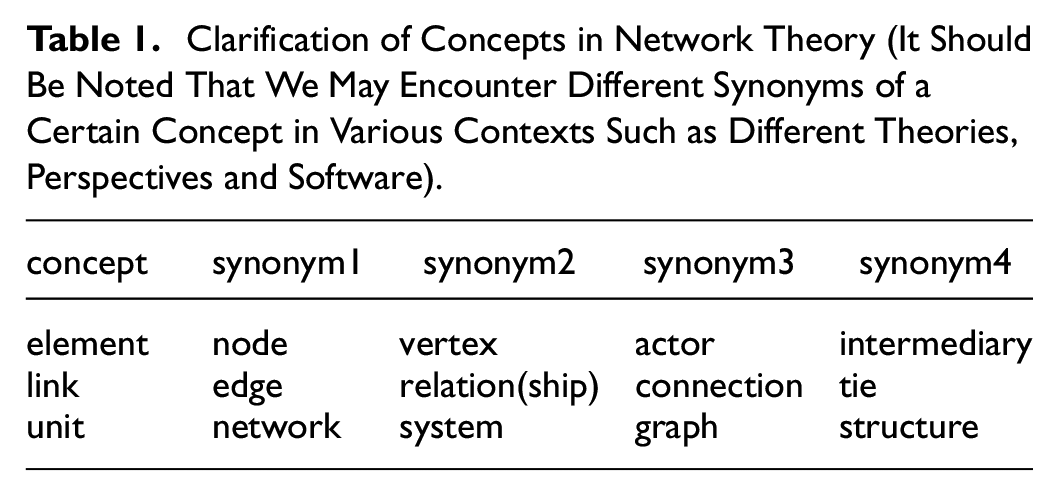
As the nervous system of society, the concept of network is commonly used today but is not all that well-defined. According to van Dijk (2006, p. 24), a network can be understood as “a collection of links between elements of a unit,” or “a mode of organization of complex systems in nature and society.” In brief, we use network to map out the structure of a certain object, be it physical or logical, real or virtual. To make terminology consistent in this paper, we clarify equivalence of key concepts as follows (Table 1):
Clarification of Concepts in Network Theory (It Should Be Noted That We May Encounter Different Synonyms of a Certain Concept in Various Contexts Such as Different Theories, Perspectives and Software).
Network theory, which originated in mathematics, has been widely applied in various fields including social sciences, behavior sciences, computer sciences, organizational theory, biology, economics, and cognitive sciences. Through its applicative development, network theory intertwined with a myriad of disciplines. This has nurtured a variety of research approaches, such as graph theory, social network analysis, and digital and computational tools (such as visual software, see below). In Translation Studies, a “network-translation dialogue” proposed by Folaron and Buzelin (2007, p. 639) has been conducted in various research objects, including translation historiography (Ashrafi et al., 2019; Tahir-Gürçağlar, 2007; Ye, 2022), scholarly scientometrics (Grbić & Pöllabauer, 2008; Xu, 2017), translation agent (Abdallah, 2010; Jones, 2009; Kung, 2009), translation production network (Abdallah, 2012; Luo, 2020), and organizational behavior of translator group (Li, 2020), among which fruitful results have been yielded. And the wide range of research interests under the network-based perspective also suggests that network studies is never a homogenous subject, but delves into various objects including texts, contexts, actors, relationships, influence, roles, agency, and profession. Due to its cross-disciplinary nature, network studies shed conceptual and methodological light on this paper by helping to reveal the regularities of structural configurations within network, and to situate the positioning of a certain element in the network.
Defined as an approach to “investigate the relations between actors or clusters of actors and the structure of networks” (Degenne & Forsé, 1999), SNA is a kind of network-analytic method for structural analysis and serves as the most notably adopted device in network studies. In SNA, the relationships among social entities, such as individuals and groups, are represented in the form of “points (nodes) and lines (ties) showing the central points and the directionality of relations within the network” (Tahir-Gürçağlar, 2007, p. 728). While ANT emphasizes the uncertainty and unpredictability in a network, SNA seeks to identify patterns and regularities of relations between interacting social entities, maintaining that the social structural properties can be charted through network-inspired analytical approach (Freeman, 2004; Wasserman & Faust, 1994). Figure 1 gives an example of a one-mode social network with nodes and edges (Table 2).

Padgett’s Florentine family marriage network.
Nodal Centrality of Padgett’s Florentine Family Marriage Network.

Source. Retrieved and Calculated From Figure 1.
A focal concept of structural variables in SNA is that of centrality, a quantitative measure based on degree, closeness and betweenness, indicating the salience and the relative power of each node in a network. By the narrow definition, a node’s centrality can be calculated through degree, that is, “the number of edges connected to it” (Newman, 2010, p. 133). Centrality-based measures can be classified into two categories: first-order and higher-order. The first-order zone is constituted by primary actors whose interactions with their neighbors are direct in the same network. Whereas second-order zone means a community with actors who are connected with someone in the former zone but excluded from the central, from which we can deduce a snowball network effect of higher-order zones. For example, we can easily get the centrality and order zone of each node in aforementioned Padgett’s Florentine family marriage network as follows:
Graph Theory
As a branch of mathematics and the most widely-used technique to view and analyze a network, graph theory models “dichotomous relations in a social network” (Wasserman & Faust, 1994, p. 94) and quantifies prominent structural properties in it, with a pattern of lines connecting the points that “can be represented in a matrix and mathematically processed” (Scott, 1999, p. 795). It has been used heavily in disciplines such as anthropology, communications, organizational research, and social psychology. To begin with, we need to make some clarification about the graph theory in this paper: The real world we intend to represent may not take a regular shape as in a graph, such as lattice, grid, cage, or linear forest. It is more complex, dynamic and diverse. And by the same token, given its modeling nature, graph theory just gives a simplified representation of a situation that contains some—if not all—of the elements it represents (Hage & Harary, 1984). Especially in a multifaceted socio-cultural context, it needs to be complemented by qualitative approaches in terms of contextual information, subjective intentions, cultural nuances, power dynamics, ambiguity, and semantics in the translation process. In this regard, we conduct a qualitative analysis at the end of Chapter 5 based on paratextual materials, to further probe the quantitative findings theretofore.
In Translation Studies, graph visualization and graph theory are often applied to bibliometrics and scientometrics of scholarly community (see Jiang & Tao, 2018; Ren & Huang, 2022; van Doorslaer & Gambier, 2015; Xu, 2017). However, there has been insufficient attention given to graphically and visually depicting the translation publishing network graphically and visually has not attracted sufficient attention academically, with some notable exceptions (Marin-Lacarta & Vargas-Urpi, 2018; Tahir-Gürçağlar, 2007; Ye, 2022). Michelle Jia Ye’s 2022 article “A history from below: Translators in the publication network of four magazines issued by the China Book Company, 1913–1923” can be considered pioneering in the use of network studies in translator positioning and serves as part of the inspiration for the present paper. Ye combines methods in historical studies, translation history, and network visualization to identify, mark, and connect translators in a large-scale and heterogeneous magazines publication network, with a focus of thick description on the graphical configuration (Ye, 2022). However, she does not resort to mathematical calculation and analytical metrics to reach her conclusions, albeit her calls to search for the “ordinary” is quite appealing. Tahir-Gürçağlar (2007) also refuses the metric of centrality in analyzing network structural properties. That being said, our intention is not to dismiss what they have done as trivial. While in this study, we seek to draw on the intertwined and synergistic graph theory and SNA to get a closer look at the translation publishing network, and the nexus between actors, with a special concern for translator’s positioning.
We have discussed our approach to actors (nodes) earlier, adopting an ANT-based ethnography to trace the trajectory left by human and non-human actors. It is worth mentioning that the so-called “general symmetry” in defining criteria for actors means treating social and natural elements as equals, instead of a parallel consideration towards diverse heterogeneous actors alike. In fact, interactions between actors in actor-network are more asymmetric, diverse, and dynamic. This provides foundation for ensuring compatibility between graph theory and ANT, because: (1) The concept of graph can be extended to take account of the direction of a line (Carrington & Scott, 2011, p. 4). (2) In most of the case, social network data consist of valued relations which cannot be completely represented using a regular graph, since edges in graph theory are dichotomous (0 or 1, i.e., present or absent). To sum up, with directed graphs and valued graphs, we can make an appropriate visualization of diverse relations in a social network. The following section will present an overview of the data and the graphical tool used in the study.
Introduction to Gephi
In order to represent and analyze data, we use the graph visualization and network analysis software Gephi. Developed in 2008, Gephi is extensively found helpful in humanities and social science for its high efficiency in revealing interrelations and properties of all kinds of networks and complex systems. To generate a Gephi graph, whose configuration is comprised of dots (“nodes” in Gephi) and lines (“edges” in Gephi) connecting the dots, we should first of all design a matrix spreadsheet (in CSV format) with a fixed pattern of table header that must include “source” and “target,” indicating what a line connects and the direction (if any) of that line. Considering the data properties, the network we intend to represent should be valued, instead of a binary one where the ties are simply present or absent. Gephi provides rich tools for meaningful graph manipulation, so that certain patterns and properties of the graph can be revealed to facilitate researchers’ reasoning and hypothesis. For example, we can select “Ranking Module” to configure node’s color and size to reflect its type and connectivity. Besides, Gephi supports force-directed layout algorithms that can help optimize the efficiency and readability of the graph. The most commonly used layout patterns are “Force Atlas” and “Yifan Hu,” whose principle is based on an attraction-repulsion model, that is, linked nodes attract each other and non-linked nodes are pushed apart, while the latter algorithm is more applicable for large-scale and complex networks. We can modulate the strength of attraction or repulsion to expand or narrow the graph in order to take a more nuanced or general look at the graph. Given the diachronic nature of the data, the network we create in Gephi involves a changing pattern in publishing Legends, and will be presented chronologically in terms of initiation, production and promotion stages. The large-scale graph mapping in this study, therefore, can help us see patterns, extract new meaning from the messy data and visually communicate the findings (Frankel & Reid, 2008).
Methods
Research Design
This paper excavates data that tend to be hidden under the translational phenomena, whereby a visual network is presented, emphasizing translation “in the making” 2 (Buzelin, 2007), thus can be considered a process-oriented research. Following the guiding principles of data collection mentioned above, we choose Anna Holmwood, one of the translators of Legends, as the starting point in this case study. Through the lens of ANT, we define “anything that can induce, whether intentionally or not, an action” (Buzelin, 2005, p. 197) as actors weaving themselves into the fabric of network. For example, we try to follow Anna Holmwood to find the genesis of the initiation of the translation project and gradually expand our vision to a wider scope, discovering more and more actors and their interactions. By collecting empirical data through ANT-inspired ethnography and identifying each actor and interaction as node and edge, we get a set of spreadsheets based on different stages of translation publishing project, which are suitable for exporting visual images representing nodes and edges in Gephi. In this way, the collected data can be represented vividly in the visualized network, where the structure and properties of the whole translation project, interactions between actors, and targeted translators’ positioning are clear-cut. And, based on the data-driven networks, conducting mathematical calculations and qualitative analysis can reveal more in-depth research findings.
Data Collection Procedures
In general, our ways of conducting an ethnographic data-collection approach include:
On a textual level, bibliographical information on the book cover, title page, verso, publisher’s details, translator’s introduction, prologue, translator’s notes, in-text illustrations, appendices, and forthcoming preview of the four volumes of Legends reveals the most directly relevant actors involved in the translation publishing project.
Online sources, including translators’ narratives, interviews (in various forms such as workshop, media interview, and book fair interview), public speeches, podcasts, book news, social media (Twitter, Facebook, LinkedIn, Instagram, etc.), industry commentary, publisher’s data, personal blogs, media reports, book reviews, and other individual and organizational internet resources, bring to light hidden actors and subtle interactions.
Capitalizing on the previous research on Legends, we collect existing primary data from scholars such as Diao (2021, 2022a, 2022b) and Chen (2021), who organize many valuable data in person such as email exchanges and interview records with some major actors of Legends.
As for the reception of Legends, we consider relevant translation scholars a group of agentive actors in that they are first and foremost readers with critical and discerning eyes; and their research findings exert significant influence that cannot be ignored on the circulation of Legends. As such, we manually access academic databases such as CNKI, 3 Clarivate Analytics and Google Scholar for relevant search, in an aim to discover academic actors.
Although the above-mentioned sources of data and ways of collecting them are various, they can be encapsulated into “data that the researcher directly copied from the computer-mediated communications of online community members” (Kozinets, 2006, p. 193) and data that the researcher inscribes. Throughout the procedure in online context, we try our best to keep the consistency between researchers, research objects, research methods, and research objectives, so as to ensure the data validity. And, by mutual verification from different online sources pertaining to the same material, any contradictory interpretation has been avoided, thus enhancing the authenticity and reliability of the data. In terms of the ethical considerations when collecting third-party data from cyberspace, we adhere to the moral obligations under the principles of non-maleficence, the protection of anonymity, the confidentiality of data, and the obtaining of informed consent. In some cases, the sensitivity that may be caused by cultural misinterpretation and infringement of regional laws has been carefully avoided. And we try our best to ensure the aggregation of data to the maximum degree while maintaining the data usefulness. Besides, before processing the data, we adopt a risk assessment tool from UN Global Pulse (2016) and make a reflection on the potential ethical issues of this study according to each checkpoint. The results show that the likelihood of potential ethical risks and harms is very low in comparison to the probability of the positive impact of this study.
Data Analysis
Having reviewed, transcribed, 4 categorized and labeled the data we collect, 5 it is found that there is an underlying publishing network with a great many heterogeneous actors embedded within the four volumes of Legends. Besides, the translation publishing project has undergone a process from initiation, production, to promotion. Therefore, it is imperative to chronicle a dynamic and diachronic panorama based on these data. To give a brief description, the data used for this study are diverse and multimodal, which range from oral material, periodical data, narratives, personal papers, academic articles, news reports to blog posts, and encompass 283 nodes and 334 edges (see Item C in the database). It is worth noting that some actors related to Legends, especially book reviewers found on individual websites or blogs, are pseudonymous or anonymous accounts, making them difficult to identify. Necessary disambiguation was carried out by checking sidelined hyperlinks such as users’ profile on YouTube and Instagram for subtlety. Considering the challenging and time-consuming procedure of technical and communicative approaches, we just skip elusive actors and label them as “unknown.” By comparison, some actors such as Anna Holmwood and Gigi Chang, co-translators of Legends, are more active and visible. Anna Holmwood is active in selecting works, leveraging connections, and exploring the market. She gives publishers advice on publications, including commissioning, text editing, the use of footnotes, and cover styles. Gigi Chang takes a more public-facing approach than Holmwood by making her appearance on interviews, social media, and academic articles and lectures. For example, her pinned tweet about the publishing information of the fourth volume of Legends is easily accessible to anyone who visits her profile page, and Chang is very kind in replying questions about Legends or the forthcoming volumes of Return of the Condor Heroes on her individual social media. Furthermore, research articles authored or co-authored by her can be found in books and journals such as Understanding and Translating Chinese Martial Arts, Asia Pacific Translation and Intercultural Studies and Zhejiang Academic Journal, and so on. It is now clear that the four volumes of Legends have formed a publication network, and different types of actors with different level of salience interact with each other directly or indirectly. We may proceed to present a visual publishing network and situate literary translators therein, to investigate their centrality, connectivity, and influence with analytical theory and technique.
Results and Analysis
In this section, we present an envisaged publication network of Legends which contains translators, publishers, literary agents, editors, workshops, interviewers, illustrators, cover designers, typesetters, book printers, book reviewers, media, scholars, book retailers, and so on, both human and non-human, based on empirical data. They serve as the “nodes” of the network (see “node sheet” of Item A, Item B, and Item C in the dataset). We can label these nodes by adding a column that shows their characteristic in order to partition the graph by color or size based on this attribute. An equally important element in graph visualization is “edges” (see “edge sheet” of Item A, Item B and Item C in the dataset), which represent publishing relationships in this study. Edges in this study are identified, collected, and recorded according to the following situations: (1) The publisher acknowledges some direct contributors in the book cover or copyright page of the four volumes of Legends. (2) Some major actors mentioned human actors they tied to, or non-human actors they considered useful or impactful in the translation project on certain occasions such as interviews or workshops. (3) Some scholars and book reviewers made critical comments on Legends in their articles or reviews, which directly connected them with the promotion of the rendition. All the aforementioned types of relations can be considered as “edges” in the network, and are recorded in the edge sheet. Furthermore, we divide the edges into “directed” or “indirected” (Column “Type” in the “edge sheet”) to mark the directionality of relations.
In what follows, we first of all adhere to the logical process of literary translation (see Figure 2) to generate time-progressive evolution networks and highlight the internal translators’ ego-centered networks, in an aim to depict the structure of the overall translation project. And then metrics of SNA are applied to unearth the properties of these networks, with an emphasis on the translators involved.

The process of literary translation.
Charting the Time-Progressive Evolution Network in the Publishing of Legends
The changing patterns of publishing relationships are explored and presented by importing “node sheets” and “edge sheets” in Item A, Item B, and Item C into Gephi 6 respectively, generating network graphs as shown in Figures 3 to 5 (see below), which span over an initiation-production-promotion period. The nodes’ color, size and the labels’ (node’s title) size are rearranged proportional to their degree, a metric refers to how many connecting lines a node has, and serves as the commonly used and simplest way to calculate centrality. It should be noted that the setting of nodes’ color in Gephi can be achieved in two different ways, one is categorical (separate colors for each level of attribute), the other is continuous (a color gradient, usually with darker or more intense colors representing higher attribute values). While in this study, we foresee no evidence of nodes constituting several blocs with parallel or confronting forces, so we select the latter one of coloring. Then, we apply the Yifan Hu layout algorithm, where attraction-repulsion model positions nodes that are connected to each other adjacently and moves connectors into the junctional area between their neighbors, to achieve better visual optimization of the network. The following figures are what we represent as publishing network of Legends after the abovementioned operations in Gephi.

Initiation network in publishing Legends (screenshot from Gephi).

Initiation-production network in publishing Legends (screenshot from Gephi).

Initiation-production-promotion network in publishing Legends (screenshot from Gephi).
It can be seen that the publishing of Legends is an ever-evolving process where numerous actors make their appearance, get involved, form connections and exert their influence. In the initiation period (Figure 3), the scale of the network is relatively modest, and it contains relatively limited number of actors. Anna Holmwood and MacLehose Press stay in the middle of the network and they bear the darkest nodes’ color, meaning that they are the most impactful and connective actors during the initiation process of publishing Legends, which may be justified by the “edge sheet” (Item A) and transcription (Item K) from Holmwood’s statement in interviews (Holmwood acquired the translation rights from Jin Yong’s representative and recommended this book to the MacLehose Press with her translation sample and introduction to Jin Yong and wuxia). In the next stage, Holmwood invited Gigi Chang and Shelly Bryant to the translation team. All of them acknowledged some non-human actors such as iPad, dictionary, original text, fan translation, and fan communities as contributing factors that involved in the production process. Furthermore, MacLehose Press enrolled individuals and corporations from industry in the translation publishing project of Legends, which can be viewed in the adjacent cluster surrounding the node “MacLehose Press” in Figure 4. After the release of Legends, numerous actors made contribution to the promotion stage of this book, which can be divided into two different types: One is interactive actions, such as interviews and workshops with the translators and publishers. And the other is independent critical reviews on the rendition, such as book reviews and academic articles. These two types of contributions can be found encircling the node “Anna Holmwood,”“Gigi Chang,” or “Legends” respectively in Figure 5. The translators’ presence in the bridges with relatively high visibility, which can be viewed from the nodes’ size, color, and positions, suggesting that they are—not only graphically but also physically—visible in the overall process of the translation publishing project of Legends.
Recovering the Translators by Highlighting Ego-Centered Network
An ego-centered, or local, network consists of a focal person or respondent, a set of alters who have ties to ego, and measurements on the ties from ego to alters and on the ties between alters (Wasserman & Faust, 1994, p. 53). We can use this idea to study individual features and roles in the entire network. In this study, three literary translators and the main publisher appear to be the focal actors, thus four ego-centered networks are selected and generated (see Figures 6–9) when we highlight these nodes and zoom in the overall publishing network (Figure 5) in the graph manipulation workplace of Gephi.

Ego-centered network of Anna Holmwood (retrieved from Figure 5).

Ego-centered network of Gigi Chang (retrieved from Figure 5).

Ego-centered network of Shelly Bryant (retrieved from Figure 5).

Ego-centered network of MacLehose Press (retrieved from Figure 5).
From an ego-centered and comparative point of view, we find that Anna Holmwood and Gigi Chang occupy a significant portion of the overall network with a great many connections with other nodes, and are especially visible at the center of the network. While in contrast, the other translator Shelly Bryant forms relatively small number of ties with other alters, showing less visibility. Her graphical invisibility is more pronounced textually and extratextually when we examine the “edge sheet” (Item C) and “transcription” (Item K). Shelly Bryant was the last to join the translation team, so she needed to adapt to the fixed translation pattern. And by then, a major part of marketing and advertising of Legends had been done by the publisher and the other two translators. What is also obvious in the network is that, the publisher MacLehose Press serves as the bridge between the three literary translators and the rendition, indicating visual and functional prominence in the translation publishing project.
Network Properties Analysis
Centrality Analysis
In this section, statistical measurement of centrality in SNA serves as an analytical tool for examining the properties of the publishing network of Legends, in an effort to identify the most influential actors. The “average degree” of node was calculated through the “statistics” module in Gephi, then a “degree” column of attribute was automatically added and attached to each node in the “Data Laboratory” (an interface for manipulating and presenting information about nodes and edges in Gephi).
Table 3 shows the degree/centrality scores of the top 20 most influential actors in publishing Legends, of which the rendition itself, three translators and a publisher rank rather high in the list, showing at least 6 ties with the rest of actors. For translators, their high level of centrality should be ascribed, first of all, to their active participation in the overall process of publishing; and then, to their multiple identities and extensive interests. For example, Anna Holmwood’s professional experience as a literary agent, translator, and editor empowers her to act as a versatile and connective actor. Gigi Chang, in the same vein, not only performs as a translator, but also a promoter by making appearance in numerous interviews, workshops, research articles and tweets about Legends. Shelly Bryant, albeit bears somewhat less visibility, proves herself to be competent as a prolific translator and poet with abundant translation experience in Chinese literature. MacLehose Press and the individual contributors it connects with, such as editors, cover designers, typesetters, and book binders, constitute a publication matrix around Legends. Besides, with the advent of digital advancement and new media which shaped a new form of modern publishing, MacLehose Press established an interactive platform connecting authors, translators, retailers, and readers, linking up activities such as publishing strategy, book planning, marketing, and promotion (tag lining, book review solicitation, market segmentation, cover design, titling and blurb writing, point of sale display, translator interviews, reading events), and after-sales service and feedback.
Top 20 Most Influential Actors in Publishing Legends.

Source. Retrieved From “Data Laboratory” in Gephi.
As shown in the table, target readership is the most prominent non-human actor, which has been acknowledged by all three translators on different occasions. This idea of consideration is also pronounced on the publisher’s agenda and mission. By careful review, we find that iPad, dictionary and online resources, as non-human actors too, have contributed a lot to the understanding, engaging and translation of wuxia novels for those translators. As for the promotion stage, a raft of workshops and interviews have not only served as single nodes correlating Legends, but also generated their own interrelated networks containing more heterogeneous human and non-humans actors, bridging the gap between the translation and its potential readers. They are not very central to the overall project, but their influence on the dissemination of Legends is not to be ignored. It can also be seen that scholars in relation to Legends are high in number, but low in centrality, Zhiwei Zhang being the most prominent but still with a relatively low centrality score of 4. The same is true for news media and other marketing events. And this is the typical feature of the publicity strategy of modern publishing, that is, making as many sources as possible (close to the notion of crowdsourcing), whether that’s a personal recommendation, a tweet from a reader, a journalist’s review, a WhatsApp message from a friend or myriad other things.
To sum up, the translators in this study show relatively high level of visibility throughout the translation publishing project, whether textually or extratextually, graphically, or statistically. This is quite counter-intuitive when we consider the consensus among translation practitioners and scholars regarding translators’ decidedly low level of visibility along the time. It is not always the case especially in modern digital and global times with numerous changes facing the modern literary translation publishing industry. Translators with outstanding translation competence, great taste for the market and familiarity with publishing issues are getting more and more involved and popular in the translation project, and gradually dominating the literary translation field. For example, Anna Holmwood, as the most salient actor in this study, sees the potential of Jin Yong’s wuxia fiction in the Anglophone world in the first place, persuades the publisher with translation sample and introductory statement, translates the text and reconciles in the translation team, proposes the title of each volume and the advertising tagline of “A Chinese Lord of the Rings” to the publisher. Of course, the high visibility of the translators in publishing Legends cannot be possible without MacLehose Press’s discerning eye for the quality of books, trust in the translation team and adherence to its publishing philosophy.
Density Analysis, Clustering Coefficient Analysis, and Average Path Length Analysis
The density of a graph is “the proportion of possible lines that are actually present in the graph” (Wasserman & Faust, 1994, p. 101). Or, put specifically, it can be calculated as the ratio of the number of all edges that actually exist to the maximum potential. For example, if all the possible lines are presented in a complete graph, then all nodes are adjacent and the density is equal to 1. On the contrary, if no edge exists between any two actors in an empty graph, then the density of this network is said to be 0. It can be easily found that density is useful for analyzing graphic properties, not for identifying individual actors. The clustering coefficient, along with the mean shortest path, can indicate a “small-world” (Watts & Strogatz, 1998) effect. It is defined as a measurement “quantifies the tendency of the nodes of a complex graph to cluster together” (Marinescu, 2017, p. 85), thus representing network segregation and aggregation. And the average path length can be understood through “graph distance.” If we assume any connected nodes have graph distance 1, then the average path length is equal to the average graph distance between all pairs of nodes. It is a measure of the efficiency of information transfer on a network. Gephi provides an accessible module to automatically run these statistics such as density, clustering coefficient and average path length, etc. After measuring the three time-progressive publishing networks as to the initiation, production, and promotion stages (see Figures 3–5) in Gephi, we get various graphic metrics (see Table 4).
Network Metrics of Publishing Legends.

Source. Retrieved from “Statistics” in Gephi.
The initiation network (N = 10, k = 10) has a density of 0.111, a clustering coefficient of 0.105, and an average path length of 2.071; the initiation-production network (N = 41, k = 59) has a density of 0.036, a clustering coefficient of 0.136, and an average path length of 2.044; and the initiation-production-promotion network (N = 283, k = 334) has a density of 0.004, a clustering coefficient of 0.098, and an average path length of 1.707. The results presented above show that as the network evolves, not only do the nodes and edges increase, but also the network properties change characteristically. It is interesting to observe that the average path length and density across stages drop quite dramatically, largely due to a considerable increase in the number of nodes, whereas the clustering coefficient remains quite stable. In other words, the translation publishing network of Legends sees increased network connectivity and more direct links formed between actors. And we ascribe the relatively high clustering coefficient to the fact that nodes tend to be strongly interconnected within a tightly-knit group, even as overall connectivity increases. This is evident in the various workshops, interviews, book reviews, academic activities, and other promotion-driven marketing strategies adopted by the publisher.
Paratextual Analysis
Paratexts, according to Genette (1997), refer to any materials that surround and support the core text. Paratexts in Legends range from book covers, an introduction of the story, profiles of important characters, a prologue about the historical background, illustrations, a note on the use of terms, a note on the culture-loaded items, an introduction of the author and translator, and previews of the forthcoming volumes on the peritextual level, to reviews and interviews on the epitextual level. In this study, we identify and account for the paratextual devices used by the translators to establish their own positioning in the translation publishing project, in a way to complement and further explore the aforementioned quantitative findings.
The translators try their best to avoid cultural misunderstanding and any barriers that could impede the readers’ reading process. It can be observed that a great portion of peritexts is centered on introducing the genre, the novel, and particularly the culture of Chinese wuxia. And according to Chang (2023), translating in one voice is of top priority among the translation team. It is safe to say that their peritextual strategies are reader-oriented. We can also see that the translators’ names only emerge on the title page, not on the book cover of Legends; but their paratextual visibility is relatively high. Translators’ translation philosophy that contains their egos is evident in both peritexts and epitexts. For example, as a professional translator and literary agent, Anna Holmwood is confident that Chinese wuxia can be and will be loved by English readers because “this story of love, loyalty, honor, and the power of the individual against successive corrupt governments and invading forces is as universal as any story could hope to be” (Holmwood, 2018a, p. ix). Besides, in a workshop on Legends, Anna Holmwood’s replied to an audience’s question as to whether translating other people’s stories makes her want to be a writer. She said: I have to say doing this work is not about my own ego or fame or anything. It’s got nothing to do with me. The best outcome is that everyone forgets about me and sees Jin Yong. And that’s when you’ve been successful as a translator. (Holmwood, 2018b; see also “Item K” in the dataset)
To conclude, the dynamics of translator’s positioning from the perspective of paratextual analysis are performed by the synergy of peritexts and epitexts. And we can position the translators involved in the translation publishing project of Legends as both market-oriented entertainers of English readers and faithful promoters of Chinese wuxia culture.
Discussion
Findings from research question 1 reveal that the translation publishing network of Legends evolves through different stages, exhibiting strong dynamics with increased heterogeneous actors and interrelations, which supports results from extant literature with a similar topic (Ashrafi et al., 2019; Li, 2020; Luo, 2020). Translation network, like any other type of social network, can be analyzed through various network properties such as centrality (Risku et al., 2016), density, clustering (Ye, 2022), and average path length. While the previous studies on the translation network dynamics adopt single measurement, this paper makes comprehensive use of these metrics and deduces the evolving characteristics between them, which provides a new perspective for translation network analysis.
Findings from answering research question 2 suggest that the majority of edges revolve around primary actors such as translations, publishers and translators, albeit many peripheral actors, including non-human entities, also play significant roles in the translation publishing process. Our findings partly echo works from Cao (2022), Moe et al. (2021), and Yu et al. (2023), whose ideas are mainly concluded by textual analysis, while this study takes a mixed-methods approach and generates comprehensive analysis results that are eloquent.
To answer research question 3, we present time-progressive publication networks of Legends based on empirical data, with a special focus on the three translators therein. By highlighting ego-centered networks, the results show that the three translators appear to be the focal actors with a great many connections with other nodes, and are especially visible at the center of the network. These basic findings are consistent with research showing that translator’s multiple identities (Diao, 2022a; Marin-Lacarta & Vargas-Urpi, 2018), translator’s paratextual subjectivity (Neveu, 2017; Wai-on & Ng, 2020) and publisher’s marketing strategy (Marin-Lacarta, 2019) contribute to the high visibility of translators in the modern publishing industry. Contrarily, they are not in line with the findings observed by some other scholars (Hong, 2019; Lapiedra & MacDonald, 2017; C. F. Liu, 2021; Ruokonen & Svahn, 2022). However, in the present paper, we have no intention to settle this dispute because the environment of translator’s activity may vary; instead, we try to propose a mixed-methods approach to study the translator’s positioning or visibility in specific situations.
Conclusion
By drawing on the idea of ANT-inspired ethnography to collect data, this paper has investigated how to chart a time-progressive visualized network of publishing the Legends of the Condor Heroes, and situate the literary translators therein, with the help of Gephi and SNA. We have identified Anna Holmwood, Gigi Chang, MacLehose Press, and Shelly Bryant as the focal actors with dense connections with other actors in the publishing network, showing higher visibility and salience than other actors in the network. Taking a closer look at the connections attached to these translators, we find it is the multiple identities of these translators and the publishing strategy of the publisher that shape their relative high centrality, which may also be one of the reasons for the success of Legends.
The approach to define actors, describe their interactions and collect data in this study is based on ANT-inspired ethnography, highlighting the general symmetric contribution between human and non-human actors. It echoes what Pym (1998, p. 92) contends: “[I]f we are to elucidate the specific role of translation within a network, we must first open up our range of inquiry to include non-translational modes of transfer.” This paper, with visual presentation and quantitative analysis, complements the mainstream study on translator’s positioning. It still, albeit having taken Pym’s notion into consideration, inevitably suffers from nonspecificity and partiality. We should confess that the data collected in this study are basically retrieved from existing sources. Besides, we may easily fall into a biased and subjective interpretation of the data, which may pose potential risks regarding the credibility of the study. This study seeks to provide a new approach to situating literary translators in the modern publishing, and its ways to collect, represent and analyze data should be put to meticulous test. Future studies on translator positioning or visibility should mitigate these lapses by: (1) Examining non-human actors more extensively, in an effort to fully utilize the potential of the theoretical framework established by ANT; (2) Seeking more primary data from key informants by questionnaires and face-to-face interviews; (3) Conducting comparative studies between translators working in different environments to identify translator positioning patterns, and assess the generalizability and applicability of the theory; (4) Giving a closer look at the actors’ negotiation reflected in the final translation products, so as to circumvent the bias of “a sociology of translation existing without translation,” or, over-contextualization, as observed by some translation scholars (Wolf, 2007, p. 27).
Footnotes
Declaration of Conflicting Interests
The author(s) declared no potential conflicts of interest with respect to the research, authorship, and/or publication of this article.
Funding
The author(s) received no financial support for the research, authorship, and/or publication of this article.
