



Abstract
The main goals of a successful education should consider students’ mental health and academic achievement. To overcome obstacles and setbacks in the classroom, the learners must be equipped with self-aid strategies. Despite the associations between affection control, the foundation of self-evaluation, and theoretical floatability, no research in psycholinguistics has ever revealed their connections. In order to do this, the current study tested a structural model of the affection control, self-evaluation, and theoretical floatability of EFL university learners. 155 Saudi EFL university students were given the affection control questionnaire (ACQ), self-evaluation questionnaire (SEQ), and the theoretical floatability scale (TFS). The results showed that learners’ theoretical floatability can be predicted by affection control and self-evaluation based on structural equation modeling (SEM). It was also proven that self-evaluation contributed to theoretical floatability. The findings have implications for increasing learners’ realization of their personality features and self-evaluation, which can promote practical evaluation.
Keywords
Introduction
Emotions are a crucial component of academic learning. To succeed academically, students should control and restrain their affections. The process of affection control tackles numerous techniques used to advance, impede, or modify an individual’s position or performance (Aunola et al., 2015). In educational environments, affection control functions as a compass, assisting learners to assess and modify the durability of their emotional expertise (Essau, 2021). All cognitive components of learning are impacted by the nature and intensity of affection control, and language learning is no exception (Kiany & Shayestefar, 2011). It seems vital to investigate how affection controls influences or is influenced by other student-associated constructs given the significant role that affection control plays in students’ emotional well-being and mental health.
Both instruction and assessment have an impact on language perception and production. As a result, the fundamentals of successful education are reflection and planning for efficient instruction and assessment. Self-evaluation is a comprehensive personality structure that represents how students evaluate and understand their work (Conti, 1999; Kremer-Hayon, 1993). Students’ perceptions of themselves and every step of their learning processes are impacted by SE. It enables learners to think critically, assess all the benefits and drawbacks of their learning process, and make wise decisions (Conti, 1999; Kremer-Hayon, 1993; Yan, 2022). To put it another way, effective SE fosters favorable viewpoints about educational experiences and raises student engagement. Positive self-evaluation enables students to better control their emotional needs and uphold greater social connections with both their peers and teachers.
The current study also takes into account theoretical floatability as a student-related construct. The theoretical floatability metaphor alludes to learners’ capacities to deftly manage academic problems and day-to-day hassles. Theoretical floatability functions as a buffer by restraining students’ daily worries (Yan, 2022). To put it another way, persistence, regularity adapting, personal competence, and approbation of academic life have all protruded as factors that assist students in handling academic hardship and setbacks efficiently. Given that theoretical floatability is a relatively new idea, there is still a need for research into the important elements that go into identifying and enhancing theoretical floatability (Abdollahi et al., 2022; Arslan et al., 2012).
The association between affection control, self-evaluation, and theoretical floatability has not been raised as a research focus, despite the major attributions of affection control and SE being acknowledged in earlier investigations. Because there is a lack of study in this area, further studies are needed to provide a comprehensive picture of their relationship. The findings of this study have the potential to enhance the field of study conceptually and practically. This research study aimed to provide a model to demonstrate the impacts of affection control and self-evaluation on theoretical floatability in light of the contributing roles of affection control, self-evaluation, and theoretical floatability as well as the gaps that still needed to be filled. The following research questions were put forth in this regard:
RQ1: How does the affection control of EFL university students influence their self-evaluation?
RQ2: How can the self-evaluation of EFL students impact their theoretical floatability?
Theoretical Framework and Literature Review
The Leverage of Affection Control
Affection control implies that feelings are what motivate people to act and behave in a certain way. There were many different definitions of emotions in the literature that was already available. The definitions and considerations of emotions vary depending on the field of study (e.g., physiology and sociology) (Burkitt, 2017; Yavuz, 2014). These approaches all share the idea that emotion is a multi-component construct, despite being based on different theoretical conceptualizations (e.g., Philippot & Feldman, 2004). People tend to view emotions as transitory, roughly intense constructs or trait-like behaviors that are roughly consistent throughout time (Grimm & Kroschel, 2007). In order to assess the affection control of EFL learners more accurately, emotions at the personal level (i.e., the average frequency of personal feelings) are assumed in this study.
The terminology of emotion, according to educational psychologists and linguists like Kiany and Shayestefar (2011), encompasses evaluation, personal experience, physiological modification, inner expressions, and action predilections. In the same vein, Kövecses (1990) and Ruba and Repacholi (2020) defined the concept of emotion using the phrases antecedent cognitive assessment, cognitive interpretation, and expressive conduct. From a different angle, Essau (2021) defined emotions as personally constructed states of being that can result from conscious evaluations of personal accomplishments in achieving objectives or upholding standards or beliefs during interactions within social-historical contexts. The process-oriented model of ER typically defines the techniques used in affection control (Aunola et al., 2015; Bijani et al., 2022). This paradigm categorizes affection control into five groups: context selection, situation alteration, attentional focus, cognitive shift, and response modulation.
Likewise, Gabás (2002) defined feelings as personally enacted states of being that result from unconscious assessments of perceived accomplishments in achieving objectives or upholding standards or beliefs during interactions within social-historical contexts. The process-oriented model of affection control typically defines the tactics used in affection control (Halliday, 1943; Heydarnejad et al., 2022).
From a totally different perspective, Murphy (2015) created a model of affection control with eight dimensions to address the processes of affection control in a learning environment (i.e., selecting situations, competence development, redirecting attention, self-appraisal, suppressing, venting, and social assistance).
Although stress and mood are not the same as emotion-related processes, they have long been used interchangeably (Mohr, 2010). At the summit of the hierarchy is affect, which includes both emotion and mood (Moskowitz et al., 2013). The three types of affective states include moods like despair and exhilaration in addition to emotions like grief and rage. While emotion encompasses both good and negative affective conditions, stress refers to negative affective responses. Moods and emotions are distinct from one another. More than action, moods have an impact on cognition (Dalgleish & Power, 2005). Additionally, moods are more erratic, even if they could result in widespread action tendencies like approach or withdrawal (Stanghellini, 2016). Unlike moods, though, emotions frequently pass more quickly. Typically, emotions arise from certain items and result in behavioral response tendencies that are distinct from those objects.
In order to control their emotional needs, people use “a heterogeneous mix of physiological, behavioral, and cognitive processes” (Gray, 2005). In other words, feelings are gradually revealed, and emotion control is a dynamic process that controls and adjusts feelings that have been felt. Lyons (2005) defined affection control as having three primary components: the inducement of a goal, the activation of regular techniques, and the modification of the emotional track. Higher-order cognitive abilities, including critical and reflective thinking, are strongly associated with affection control because they help people develop productive immunity. Additionally, affection control and self-efficacy have been linked to L2 grit and engagement.
According to Burić et al. (2016), affection control refers to the technique students employ to control and alter their emotions while engaged in academic activities. According to research, affection control has an impact on students’ academic progress, learning process, and engagement (Gray, 2005). Santos et al. (2021) provided evidence that age and gender have an impact on students’ academic involvement and affection control. Lyons (2005) explored the impact of cooperative learning and affection control on students’ enjoyment in the EFL context in the same line of research. Their research identified the critical roles played by affection control and constructive interdependence in the production of enjoyment.
Self-Evaluation
Evaluation, a necessary component of education, deals with the methods involved in gathering data from relevant sources. Assessment techniques and results help determine what the students have learned and what they still need to practice (Boud, 1995). One type of evaluation is self-evaluation, which is described as the “examination or evaluation of one’s activities, attitudes, or performance.” The technique of self-assessment should therefore be promoted and taught to every learner (Kremer-Hayon, 1993). The idea of SE is defined with regard to self-assessment. The main components of self-assessment are self-regulated learning, goal planning, and higher cognitive abilities (Harris & Brown, 2018)
People encounter a variety of problems every day, and how they choose to respond to these events can have an impact on their success in school and at work. High rates of self-assessment enable people to handle issues and challenges and try their best to fulfill all their obligations (Harding, 2018). High degrees of self-assessment enable learners to control and alter their emotional experiences (Dalen, 2002). An encouraging foundation for self-evaluation is to examine students’ sentimental experiences and guide them to enhance their learning (Harding, 2018). Because of this, the central component of self-evaluation is viewed as a gauge of emotional stability (Huang, 2022; Konzelmann Ziv, 2011).
According to the literature, self-assessment is linked to self-efficacy beliefs, academic emotion, metacognitive skills, critical thinking, and reflective thinking (Oettingen, 1995). Self-evaluation has also been shown to ensure students’ well-being (Greene, 2017). According to a study by Brady (2011) to examine the development of EFL learners, self-assessment was the reason for the learners’ improved cognitive and metacognitive abilities. The researcher looked at how coping mechanisms affect self-efficacy and academic stress. Oettingen (1995) discovered that among EFL students, having a high rate of coping style results in a favorable self-perception and the capacity to handle academic stress. Konzelmann Ziv (2011) used SEM to look into how SE and language learning anxiety among EFL university learners are affected by L2 grit. The researcher discovered that learners with more grit are better at self-monitoring and evaluation. In language classes, the learners were also able to control and manage their anxiousness.
Theoretical Floatability
theoretical floatability (TF) is a psychological concept that points to students’ capacity to deal with challenges they face on a daily basis during studying (Kim, 2022). Although TF and resilience are commonly combined, their operational and methodological justifications are distinct. Konzelmann Ziv (2011) stated that academic floatability differs from conventional flexibility and similar ideas, which imply day-to-day coping, in this sense. Academic resilience describes the tiredness and anxiety brought on by failure and subpar performance, whereas TF describes the stress and strain brought on by improper performance in a learning environment. Additionally, academic resilience relates to a clinical kind of academic context of anxiety and dissatisfaction, whereas theoretical floatability stands for low confidence, motivation, and engagement. According to Martin (2013), theoretical floatability is seen as a requirement for academic resilience, however, it is insufficient. Consequently, TF is essential for fostering resilience in adolescents and supporting them through obstacles and life events (Dwi Hastuti et al., 2022; Martin, 2013).
The basis of theoretical floatability is positive psychology (Shapiro, 2009). According to positive psychology, highlighting positive and self-help qualities will hasten the processes of language instruction and learning. Siemer (2001) asserts that positive psychology promotes and offers meaning to language instruction and learning. To evaluate the students’ TF, many tools were introduced. In a recent effort to measure theoretical floatability more thoroughly, Wang (2020) constructed a context-specific instrument. They used a 27-item instrument with four scales (i.e., sustainability, eligibility, and acceptance of academic life). Concerning sustainability, it takes into account the students’ capacity to overcome obstacles in their language-learning journey. Regular adaptation means a language learner’s capacity to create objectives and modify those objectives in light of their own values. The second feature of this test, positive personal eligibility, takes into account learners’ favorable perceptions. Positive academic life acceptance is the final factor, and it has to do with how students live their academic lives and how that affects how they learn languages.
Theoretical floatability is still unknown and requires further research, as the evaluation of the recent literature reveals, but papers on the topic of resilience in learning contexts were generally positive. Caspary and Boothe (2017) came to the conclusion that theoretical floatability is related to the challenge of learning new things and assessments of one’s own ability. Additionally, it was discovered by Wang (2020) that TF has an impact on student’s academic success as well as their advancement in learning English and mathematics. Another study examined the interactions between the emotional and physical states and the antecedents of theoretical floatability (Shapiro, 2009). The mental stages of habitual actions and reflections led to students’ engagement and success, as their findings revealed. Similar findings were made by Shepherd (2016), who discovered that language instructors’ floatability affects their students’ engagement. Therefore, it can be concluded that floatability can benefit both instructors and students and that investing in putting effective techniques to raise TF levels into practice is crucial in any educational situation. Kazemkhah and Azari Noughabi (2022) investigated the function of TF and self-efficacy in L2 grit in EFL learners from Saudi Arabia and China using structural equation modeling. This study demonstrated that students with high rates of TF and self-efficacy tend to be grittier. Additionally, Kazemkhah and Azari Noughabi believe that when learners are engaged and intrigued, their TF can flourish. Additionally, they think that teachers play a significant role in enhancing the TF of their students.
Research Methods
Participants
186 university students in Kingdom of Saudi Arabia who were majoring in various fields of English at the BA level participated in this study. 82 of the 186 participants were majoring in English teaching, 64 were studying literature, and 40 were majoring in English – to – Arabic translation. They were chosen using convenient or chance sampling techniques. They ranged in age from 19 to 25 and included 89 males and 97 females.
Research Instruments
Professional Affection Control Questionnaire (PACQ)
The affection control of EFL university students was investigated using the PACQ created and validated by Abdulaal et al. (2022) and Gloor (2011). There are 48 items on this questionnaire, each with a Likert scale of 1 to 5, with 5 being the strongest agreement. Choosing a situation (6 items), establishing competence (6 items), redirecting attention (6 items), reassessment (6 items), repression (6 items), breathing (6 items), venting (6 items), and social upholding (6 items) are the subcomponents of PACQ. The reliability of the PACQ in this investigation is determined via Cronbach’s coefficient (range from .846 to .988), which was quite satisfactory.
Self-Evaluation Questionnaire (SEQ)
SEQ was used to examine EFL university students’ basic self-evaluation. Abdulaal et al. (2022) created and validated this instrument, which has 14 items on a 5-point Likert scale that are rated as Strongly Disagree (SD) (1), Disagree (D) (2), Neutral (N) (3), Agree (A) (4), and Strongly Agree (SD) (5). This test included a 14 to 50-point scale for scores. High rates on this scale represent positive student self-assessment, while low levels are thought to represent negative student self-assessment. The reliability of SEQ in this research study was quite acceptable, as indicated by Cronbach’s alpha (.898).
Theoretical Floatability Scale (TFC)
Abdulaal (2021) designed and validated a TFC to measure the participants’ academic floatability. This measure evaluated the four aspects of L2 floatability (sustainability, regular adaptation, positive personal eligibility, and favorable acceptance of academic life emerged) in 30 items. In addition, TFC uses a Likert scale of 1 (SD) to 5 (SA).
Procedures
This study used a web-based platform to collect data beginning in March and continuing to August 2022. The PACQ, SEQ, and TFC electronic survey questions were submitted by the participants via Google Forms. 152 forms were received in total, with an 88.5% return rate. With varied age groups and sociocultural backgrounds, data from various regions can be gathered through electronic surveys. Additionally, an electronic survey is planned so that all components are linked together in order to ensure that no data are lost.
Data Analysis
First off, using the Kolmogorov-Smirnov test, the normal distribution of the data was examined. Parametric approaches can be employed because the data are regularly distributed. In this context, the data were analyzed using CFA, SEM, and LISREL 10.02. CFA is employed to validate all the latent variables in accordance with Latu and Schmid Mast (2016). SEM was used after CFA was used to validate the latent variables. Latu and Schmid Mast (2016) assert that SEM is a reliable multivariate method that is employed to adopt a confirmatory hypothesis-examining strategy for the suggested structural theory. Both the measurement and the structural models are the first two steps of SEM (Erford et al., 2017). The measurement model’s goal is to investigate the connections between observable and latent variables. As for the structural model, it aims to investigate the associations between the latent variables only.
Results
The findings of the quantitative investigation used to explore the relationship between affection control, SE, and TF are reported in this section in detail. The qualitative analysis for the affection control, SE, and TF of EFL university learners is shown in Table 1. Descriptive statistics show that among the AC’s structural components, focus redirecting had the greatest mean score (M = 52.189, SD = 4.635), while breathing had the lowest (M = 11.119, SD = 4.866). Positive personal eligibility when taking into account the elements of TF (M = 50.093, SD = 8.019) scored a high mean rate, and consistency adaptation (CA) (M = 9.594, SD = 5.193) was the lowest mean rate achieved by the university learners. Regarding SE, EFL participants achieved M = 49.729, and SD = 9.060.
Descriptive Statistics of AC, SE, and TF.

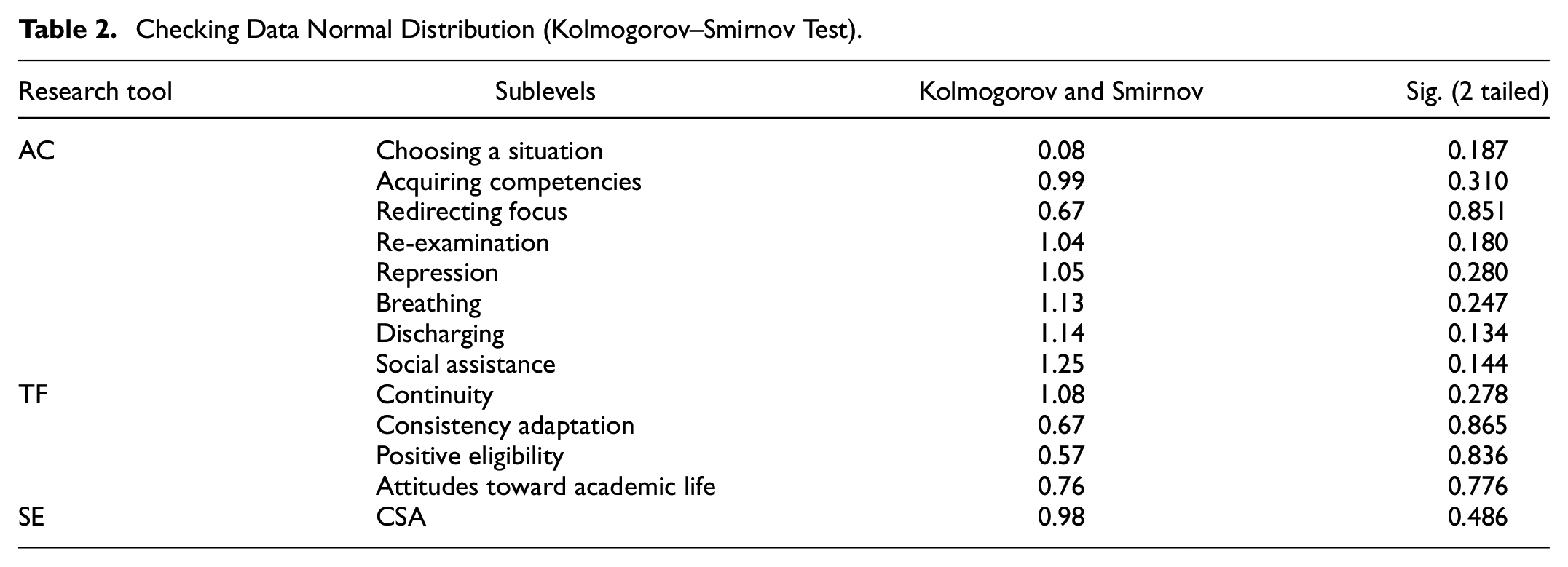
The Kolmogorov-Smirnov test (K-S test) is employed to investigate the data distributions and determine which statistical approaches would be most appropriate for this investigation. Table 2 displays the results of the K-S test. The data were normally distributed, and Table 2 below shows that the significance values for all the instruments were >.05. Therefore, it makes sense to use parametric approaches to investigate the relevant study hypotheses. In doing so, the structural links between affection control, TF, and SE were investigated using the LISREL 10.02 statistical software.
Checking Data Normal Distribution (Kolmogorov–Smirnov Test).
Concerning RMSEA, the comparative fit index (CFI), and the normed fit index (NFI) are employed to gauge the model’s suitability. The chi-square must be less than 3 and non-significant. Additionally, it is recommended that the root-mean-square approximation error (RMSEA) be less than 0.2. According to Kim (2022), the cut values for the NFI, GFI, and CFI should be higher than 0.90. Table 3 shows that the RMSEA (0.089) and the χ2/df ratio (2.912) were both acceptable. The acceptable fit levels were attained by GFI (0.815), NFI (0.822), and CFI (0.831).
Indices of Model Fit.

t-Values as well as standardized estimates are used to assess the strength of the causal links between the variables. Both Figures 1 and 2 indicate that affection control has a significant beneficial influence on self-evaluation (β = .78, t = 18.13) and theoretical floatability (β = .82, t = 15.78), with t-value greater than 1.9. Furthermore, the effect of self-evaluation on theoretical floatability was significant as well as positive (β = .74, t = 25.41), with a t-value greater than 1.9.

Path coefficient values for the correlations between AC, TF, and SE.

t-Values for path coefficient significance (model 1) (AC, TF, and SE).
The fit indices suggested in model 2, which was plausible, are shown in Table 4. The acceptable fit levels were presented by the χ2/df ratio (1.811) and the RMSEA (0.08). Moreover, GFI (0.845), NFI (0.877), and CFI (0.832) were all acceptable.
Indices of Model Fit.

Figures 3 and 4 show the path coefficient rates for the correlations between affection control, influence on self-evaluation, and theoretical floatability subscales (model 2). As these figures reveal, affection control is considerably and positively connected with sustainability (β = 1.73, t = 14.82), regularity adaption (β = .87, t = 16.73), positive eligibility (β = .92, t = 15.81), and acceptance of academic life (β = .91, t = 18.5). Similar statistically significant and positive relationships were discovered between self-evaluation and theoretical floatability subscales, as follows: sustainability (β = .79, t = 17.01), regularity adaptation (β = .87, t = 20.82), and positive acceptance of academic life (β = .78, t = 18.95). Pearson correlation was also used to assess the relationship between affection control, influence on self-evaluation, and theoretical floatability subscales.

Path coefficient rates for the correlations between AC, TF, and SE (model 2).
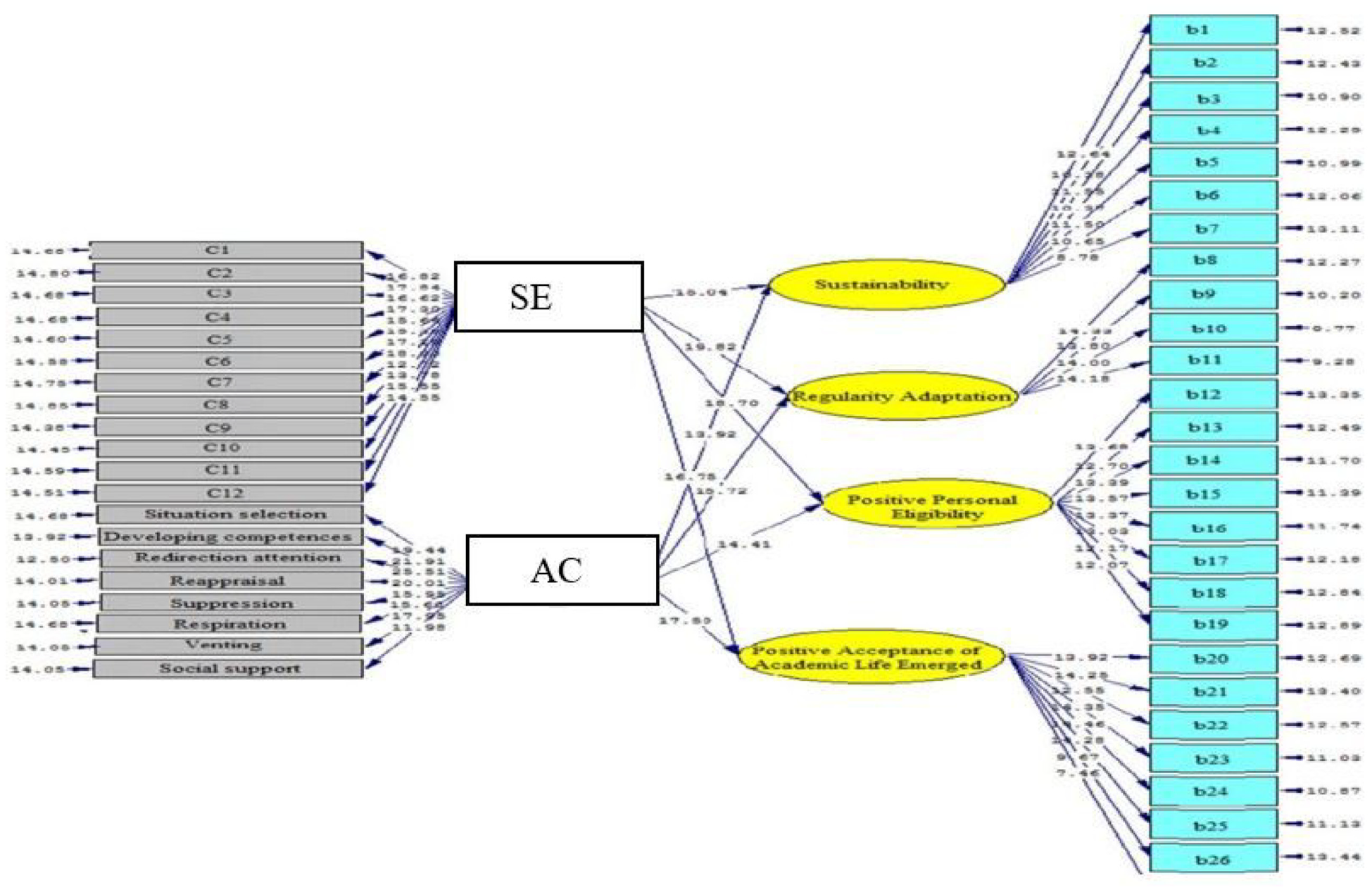
t-Values for path coefficient significance (model 2).
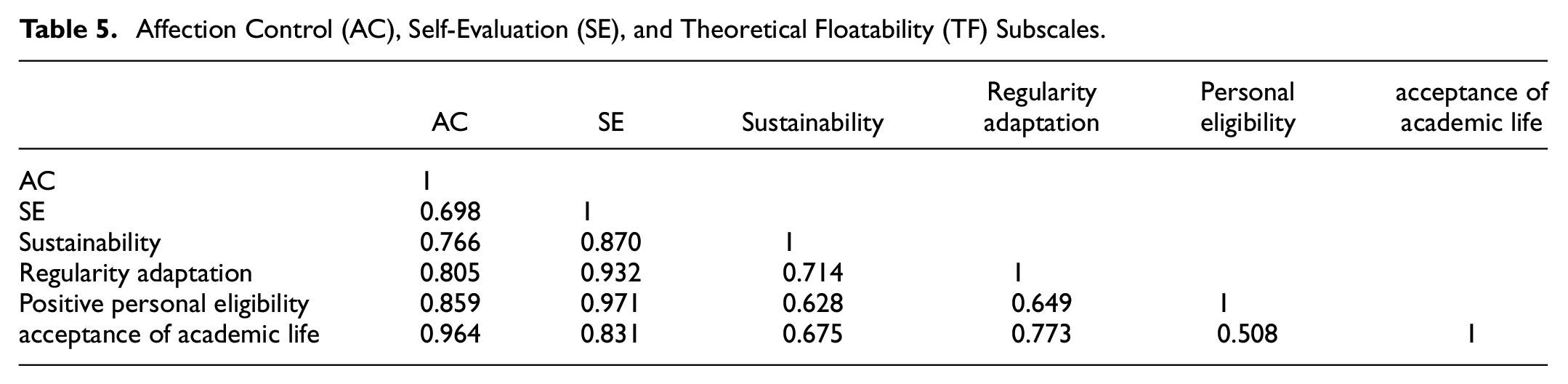
Table 5 shows that there was a statistically significant correlation between the affection control, self-evaluation, and theoretical floatability subscales. That is, there was a substantial and positive correlation between affection control and sustainability (r = .766), adaptation (r = .805), eligibility (r = .859, p less than .01), and favorable acceptance of academic life (r = .964, p less than .01). Table 5 shows positive and statistically significant correlations between the affection control and TF subscales, including the following: sustainability (r = .870, p less than .01), regularity adaptation (r = .932), positive personal eligibility (r = .971, p less than .01), and positive acceptance of academic life (r = .831).
Affection Control (AC), Self-Evaluation (SE), and Theoretical Floatability (TF) Subscales.
Discussion
This research study endeavored to uncover the link between affection control, self-evaluation, and theoretical floatability among EFL learners. To accomplish this goal, an SEM approach was used to suggest and create a causal model of the relationship between these variables. According to the results and what models 1 and 2 depict, affection control and self-evaluation play a mediator function in increasing theoretical floatability. The impact of self-evaluation on theoretical floatability has been determined (model 1). As a result, affection control and SE can be used to forecast theoretical floatability. As a result, the first null hypothesis, stating that EFL university learners’ affection control has no effect on their self-evaluation, and the second H0, stating that EFL learners’ self-evaluation has no effect on their theoretical floatability, were rejected.
According to the results of research question No (1): (How can EFL university students’ affection control impact their self-evaluation?), high rates of affection control among students can imply high rates of self-evaluation. It indicates that the affection control techniques (situation selection, growing competencies, redirecting attention, re-appraisal, suppressing, breathing, and social support) offer students an equilibrium in their educational lives, allowing them to critically examine their learning procedure. As previously stated, the self-evaluation process is derived from self-determination theories (Abdollahi et al., 2022; Heydarnejad et al., 2022; Margaret & Keally, 2011).
Based on the previously stated result, the emotional equilibrium of the EFL learners affects their identity, and attitudes toward metacognitive abilities. This discovery can be looked at from various perspectives. As has been shown, emotion and intelligence are intertwined, and a person’s success depends on how well each of these poles is balanced. University students can improve their educational experiences cognitively and metacognitively by receiving emotional support and applying the right strategies in the face of difficulties. According to study findings, students can evaluate themselves and make internal improvements through self-assessment, but high levels of self-evaluation are not possible without affection control.
As the previous studies on affection control and self-evaluation indicated, the potential association between affection control and self-evaluation was wholly unknown, and no theoretical investigations had been conducted on that score. As the affection control sub-components demonstrate, self-evaluation can be changed by regulating emotions through context selection, establishing competencies, redirecting attention, self-appraisal, suppressing, breathing, and social solidarity. These tactics are directly linked to other self-help theories that have been linked to affection control and self-evaluation. Shafiee Rad and Jafarpour (2022) affirmed that EFL students’ affection control and L2 grit impact their flexibility. Siemer (2001) and Bijani et al. (2022) demonstrated the importance of self-assessment in EFL teachers’ self-efficacy. Peistaraite and Clark (2020) discovered that emotion planning promotes self-organized learning in classical musicians. Likewise, Gorjinpour and Barzegar (2022) and Heydarnejad et al. (2022) investigated the impact of self-efficacy practice on students’ cognitive adaptation and anger management. The findings showed that including self-efficacy in practical courses promoted cognitive emotion planning and reduced students’ anger.
The second research question, “How does EFL university learners’ self-evaluation affect their theoretical floatability?,” examined the links between self-evaluation and theoretical floatability. This suggests that a high rate of self-evaluation is a significant predictor of TF. This discovery is backed by the underlying sciences and domains of psycholinguistics. It implies that self-evaluation augments the benefits of theoretical floatability among EFL university students. Furthermore, a statistically significant and positive association between self-evaluation and the theoretical floatability subcomponents was found. The more students engaged in self-evaluation, the better they might increase sustainability, eligibility, and personal acceptance of academic life.
It could also be argued that academically buoyant learners ought to be equipped with metacognitive abilities to assist them to sustain in all educational settings and be active in learning. While learners in higher education may face more anxiety as a result of their age and the demands of their future careers and lifestyles, self-evaluation and theoretical floatability will greatly assist them in staying in balance and making informed decisions. When it comes to theoretical floatability, Abdulaal et al. (2022) claims that appropriate evaluation feedback can attribute learners’ theoretical floatability. Esmailzade Ashini et al. (2020) emphasized the mutual relationship between theoretical floatability, engagement, and students’ self-efficacy. As previously said, self-efficacy is seen as an essential component of theoretical floatability. Higher degrees of self-efficacy beliefs are associated with higher levels of theoretical floatability.
This study also discovered that affection control could contribute to theoretical floatability (model 1). The findings indicated that affection control could influence theoretical floatability among EFL university students. To put it another way, buoyant kids used effective tactics to regulate their emotional experiences. It implies that affection control is an important step for sustainability, adaptability, positive eligibility, and favorable acceptance of academic life. The correlation between affection control and theoretical floatability was largely unknown.
The conclusions of this inquiry were implicitly supported by the findings of Hirvonen et al. (2019). Their research revealed a connection between theoretical floatability and emotions, which could affect learners’ behavior and academic expectations. Abdulaal et al. (2022) demonstrated that, in the same line of inquiry, learners’ academic meaning and academic adjustment are caused by theoretical floatability and emotion-regulating training. Jia and Cheng looked at theoretical floatability via the lens of social upholding in higher education. According to this study, social support and theoretical floatability both contributed to EFL university students’ motivation. As a result, upbeat pupils are more socially active and have greater levels of motivation.
Conclusion
The interaction between affection control, theoretical floatability, and self-evaluation was first demonstrated in the current study. The outcomes of structural equation modeling showed that students’ theoretical floatability might be predicted by affection control and self-evaluation. Self-evaluation’s contribution to theoretical floatability was also highlighted. It was established that their relationship was both statistically significant. Students who have emotional self-control can therefore evaluate their activities in addition to learning strategies. They learn more actively and are more involved. Students who practice positive regulation find it difficult to focus on every facet of their education through the prism of self-evaluation. Students feel more in control of their education in this setting, and they want it to be sustainable, regular, adaptable to their particular circumstances, and positively accepted by the academic community.
Footnotes
Acknowledgements
This study is supported via funding from Prince Sattam bin Abdulaziz University project number (PSAU/2024/R/1445).
List of Abbreviations
AC Affection Control
SE Self-Evaluation
TF Theoretical Floatability
SEM Structural Equation Modeling
ACQ Affection Control Questionnaire
SEQ Self-Evaluation Questionnaire
TFS Theoretical Floatability Scale
Authors Contributions
All authors made substantial contributions to the conception and design of the work. The interviews and the analysis were conducted by the first author. All authors participated in the interpretation of data. All authors drafted the work and revised it critically for important intellectual content. All authors gave final approval of the version to be published and agreed to be accountable for all aspects of the work in ensuring that questions related to the accuracy or integrity of any part of the work are appropriately investigated and resolved.
Declaration of Conflicting Interests
The author(s) declared no potential conflicts of interest with respect to the research, authorship, and/or publication of this article.
Funding
The author(s) received no financial support for the research, authorship, and/or publication of this article.
Ethical Approval
The researchers confirm that all research procedures were performed in accordance with the relevant guidelines and regulations involved in the Declaration of Helsinki.
Informed Consent
Written consent has been taken from the participants to use their responses for research purposes.

Data Availability Statement
The datasets generated during and/or analyzed during the current study are available from the corresponding author upon reasonable request.