




Abstract
In the pandemic era, online learning has become the standard mode of learning in China where lockdowns were in place. However, in lockdowns, the roles of guardian, teachers and learners transform and change traditionally-accepted responsibilities and roles as well as relationships, thus warranting an examination of the third space of learning and its implications for the stakeholders’ learning practices and emotions. A review of literature demonstrates a dearth of research on issues of role and practice shifts and power relations changes within the Chinese online English as Foreign Language (EFL) learning context. Using close ended and open-ended questionnaire data from teachers at Chinese school learners studying English as a foreign language, this study inquiries into the (i) changes in roles and emotions of teachers and guardian in the third space of learning in the Chinese online learning context, (ii) changes in the practices of the teachers, and (iii) transformations of power relations between guardian and teachers. The findings of the study contribute to literature on emergent online pedagogical practices and the emotions and roles and relationships of key stakeholders, namely teachers and guardian in the third space of learning mediated by technology.
Plain Language Summary
In the pandemic era, online learning has become the standard mode of learning in China where lockdowns were in place. The study provides the importance of a third space for online education during a pandemic.
Introduction
The COVID-19 pandemic has had a “profound impact, not only on people’s health, but also on how they learn, work and live” (Cerna et al., 2020, p. 2) across the world. It has escalated the need to better assess the implications and improve policy and practice in the field of international higher education in the post COVID 19 era. With the pandemic prompting an urgent transition to online learning for higher education institutions (Brasca et al., 2022), looking beyond the evident benefits of e-learning technologies, it is also important to consider how “the poly-synchronous world of learning in the digital age [is inserted] into the rhythms of family life” and leads to the colonization and co-option of the “physical spaces of the home” (Williamson et al., 2020, p. 111). This works both ways, disrupting not only the routines within the homes of the learners but also routines within the homes of the teachers as boundaries between school and home are effaced.
Due to the rapid spread of COVID-19 since the outbreak of the virus in 2019, millions of human lives have been affected around the world, with the global health emergency resulting in over 6.14 million deaths across the globe (Afzaal, 2020; Wu et al., 2022). The pandemic impacted not just China’s economy but also millions of university students across the country (Wu et al., 2022) as the country went into lockdown and moved to online learning. Three years into the pandemic, China has maintained a zero-Covid policy that has entailed containing outbreaks through strict lockdowns amongst other measures (Mallapaty, 2022). In the higher education settings, this entailed a continuing reliance on remote learning for university students and teachers.
With pandemic pedagogy compelling a shift in education from traditional face-to-face settings to the learners’ home settings, there was change not only in “pedagogy” but also in “who was teaching as well as when and where teaching took place” (Johnston et al., 2022). Conventionally the settings of home and learning are considered to be discrete contexts featuring clear boundaries that cannot be permeated (Cook, 2005) and uni-directional communication. In contrast, lockdown or pandemic pedagogy leads to an erasure of participants’ (e.g., teachers, students and families) “roles, responsibilities, and power relations as learning shift[s] online” (Johnston et al., 2022). This gives rise to a “third space” wherein learning now transpires.
Drawing upon Bhabha (1994) and Jordan and Elsden-Clifton (2014, p. 221) highlight that “Third Space theory is essentially used to explore and understand the spaces ‘in between’ two or more discourses, conceptualizations or binaries.” Distilling the ideas of Bhabha (1994) and Ratnam (2020, p. 4) explains that within “the context of postcolonial studies,” the idea of “third space” may be understood as “an oppositional response to the dualistic power relationship between the imperial colonizers and the subordinate colonized subjects” with an embedded aim being to dislodge “hierarchies [in order] to equalize relationships and overcome oppression.” While it is understood that that Bhabha’s notion of third space comprises a critique of colonization which may not be directly related to the present study, the lens it offers is relevant to how pandemic pedagogy has led to the creation of another space of learning in which there are shifts in the roles, responsibilities and the power dynamics of the participants. While the “first and the second spaces of learning within the context of the present study may be understood as the physical spaces of the university” (Flessner, 2014), the third space may be viewed as “a creative space that lies between the discourse or position of the ruling subject and the discourse or position of the subaltern subject” (Third Space, 2022). From this perspective, the “ruling subject” represents the formal institutions/universities and teachers, whereas the “subaltern subject” represents the learners who are usually subject to the more powerful “ruling subject.” Against this backdrop, the third space is catalyzed by online learning which transpires within the home settings of the learners.
Earlier third space learning research shows some focus on third space learning mediated by technology. For instance, studies have looked at how emerging lecture-software technologies can help novice teachers to create “third spaces” of learning (Elsden-Clifton & Jordan, 2011; Qiuhan et al., 2020) as well as the development of a Chinese EFL learner’s identity as she engages in the third space of “online intercultural writing exchange” (Yan-ling, 2018). More recent research has looked at how Taiwanese EFL learners have benefitted from telecollaborative language exchanges with foreign peers in Australia and New Zealand (Yeh & Heng, 2022). In the Chinese context, a recent topically relevant study has investigated the eco-system of pandemic pedagogy and online EFL learning at the school level by examining teacher, student and parental perceptions (Zhao et al., 2022). However, this study has looked largely at the challenges reported by the participants in terms of the effectiveness of online learning without taking into consideration the notion of third space. On the other hand, a study by Johnston et al. (2021) has looked more directly at the phenomenon of third space learning. These researchers explored how teachers in Scotland experienced lockdown teaching and the impact of this on their practices as well as on those of the guardian as they supervised their children’s learning at home. Nonetheless, the review of research suggests, particularly within the Chinese EFL context, limited attention to how pandemic pedagogy and lockdown teaching have led to the creation of a third space of learning within which roles, practices, responsibilities, and power relations are evolving. Given the prevalence of lockdowns in China and the reliance on online teaching by Chinese universities, a clear need was perceived to move beyond a focus on challenges faced by the teachers in terms of delivery and learner performance toward a deeper understanding of how the third space of learning brings about changes in practices, roles, responsibilities, and power relations amongst the participants. Therefore, the present study was designed to gain insights into the phenomenon of university EFL teaching via e-learning platforms in the Chinese context. The following research questions were formulated to address the complex inter-related dimensions of the issue under focus in this study:
Research Questions
The addresses the research questions;
What struggles across pedagogy, technology and emotional connections with learners are experienced by Chinese EFL teachers tasked to teach online during lockdowns?
What are the teachers’ perceptions of technological expertise needed for effective lockdown teaching?
What are the teachers’ perceptions of being open to parental scrutiny in lockdown teaching?
In what ways have pedagogical practices in lockdown teaching change as instruction has shifted into a third space of learning encompassing school and home?
Based on teacher perceptions and experiences, how has lockdown teaching affected their own lives, families and work-life balance?
Method and Theoretical Framework of the Study
As a space, third space allows us to “draw selectively and strategically from the two opposing categories to open new alternatives” (Soja, 1996, p. 5). An example of this is how in the era of pandemic pedagogy, learning is no longer restricted to the physical space of the university. Mediated by technology and lockdown learning, it has extended into the homes and lives of the learners and their families, thus opening up new avenues of learning and new challenges for the teachers, learners and their families (Figure 1). The lens of third space theory can be used to understand meaning making as well as opportunities for coming up with a new skillset or attitudes in digital spaces. Hence, against this backdrop, the first and second spaces of university learning may calibrate with the third space of pandemic learning to give rise to new knowledge and to expand beyond these spaces altogether (Moje et al., 2004).
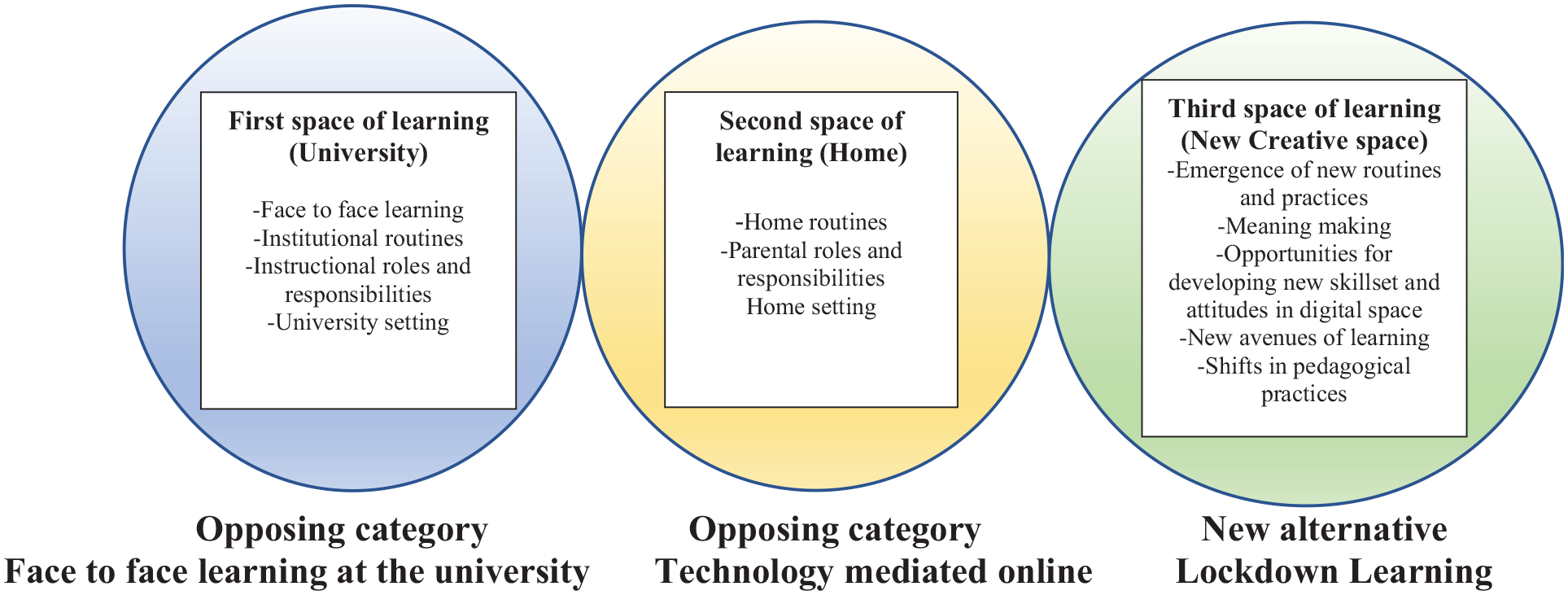
Steps of learning.
Data Collection and Analysis Procedure
A total of 26 participants took part in the study. These included 14 university teachers and 12 college Chinese teachers of English as a foreign language (EFL) across varying career stages, ranging from teaching assistant and lecturer to professor. The participants were selected through purposive sampling which allowed the researcher to choose participants who were “representative of the population” based on the researcher’s “expert knowledge of the population” (Battaglia, 2008). A questionnaire with close ended and open ended items was designed around the themes identified in topically relevant research articles including Shifting Selves and Spaces: Conceptualising School Emergency Remote Teaching as a Third Space (Johnston et al., 2022), Teaching in a third space during national COVID-19 lockdowns: in loco magister? (Johnston et al., 2021) and Technology as thirdspace: Teachers in Scottish schools engaging with and being challenged by digital technology in first COVID-19 lockdown (Brown et al., 2021). Section 1 of the questionnaire focused on eliciting demographic information from the participants, whereas Section 2 focused on inviting participants to reflect on their experiences of teaching online, changes in their pedagogical practices as a result of teaching online and their perceptions of balancing work and life while working in an online mode. In addition, questions pertaining to the shifts in teacher and parental relationships were also included. The questionnaire data were collated. The open ended responses were analyzed using thematic analysis which entails reading and re-reading the data to identifying emergent patterns and themes in relation to the research questions. Before commencing the study, informed consent was obtained from the participants, and anonymity and confidentiality of their data was ensured respectively through the removal of identifying information and the use of passworded storage and restriction of access to data.
Results and Discussions
The results of the study show that online classes were limited and constraints, however, the instruction of second language (L2) incorporates both the communicative language approach and grammar instruction. The meaningful application of language and the instruction of grammar are not mutually exclusive. The results also showed some challenges and advocates of communicative techniques contend that directing students’ attention toward teaching may impede or obstruct the process of language learning. Alternatively, some of the findings show that learners can initially be directed to comprehend and engage with the target language in a meaningful way, and then progress toward identifying and explaining the grammatical rules that they have comprehended, even if they may not necessarily recognize specific grammatical structures (e.g., Alfadda et al., 2020, 2022; Barbara et al., 2024; Siu et al., 2023). L2 instruction can effectively strike a balance between the practical application of language skills and an understanding of grammatical principles. By attentively encountering linguistic norms, learners might gradually internalize them over time. Consequently, learners can better handle the challenge of comprehending and using the target language by acquiring knowledge and consciousness of its usage within its specific context. This paper suggests that the conventional responsibilities of teachers and guardians often resemble colonial systems, creating a hierarchical framework that can impede the democratization of education. This similarity is not complete, but rather depends on the particular dynamics and settings of the educational environment. The research proposes a reassessment of these roles, advocating for a more cooperative and empowering approach to education.
The results of the study further present that the adaptability and availability of online education can enable a departure from the remnants of colonialism. Nevertheless, it acknowledges that online learning can continue to uphold existing inequities if not implemented critically.
The section below shows the struggles across pedagogy, technology, and emotional connections with learners.
Pedagogy-Related Challenges
As the new creative third space of online learning emerged and strengthened in the research setting, the participating teachers reported a number of challenges related to pedagogy in the third space of online learning. For instance, some of the teachers observed that this mode of learning led to challenges in interacting effectively with the students and exchanging ideas which are key processes in bringing about learning. As the extracts below show, some of the participants noted that: Not being able to see the students face to face makes it difficult to have conversations during classes, which leads to little interaction (P2) No enough facial communication and exchange of ideas (P3) As far as teaching methods are concerned, writing on the blackboard will be a problem, and interaction also needs to be considered (P7) Monitoring students’ learning was hard, and the interactions were not as effective as those face to face. Not being able to sit together in the classroom, it was also difficult to have group discussions as well as other class activities (P9)
As the data extracts above show, online classes were perceived to constrain student learning given that they made it difficult to carry out group discussions and class activities which tend to be the norm in face-to-face learning. In another example, the participating teacher showed concern about how the online mode with the option of typing answers in response to the teacher’s question which could be seen by peers immediately prevented other learners from learning from the thought processes of the responders. First, I can’t ensure my students are really listening. Second, when I ask a question, they may answer it by typing then everyone can see. In this way, their thinking is also limited (P6).
Another teacher also showed concern that during online classes, students were inclined to be “distracted” (P9) from other things transpiring in their home learning environments. The challenges related to pedagogy experienced and reported by the participating teachers were largely linked to the lack of interaction and learning conversations which take place during face-to-face classroom activities. According to the teachers, the online mode of learning also made it difficult for learners to develop their thinking as they could see the answers being typed by their peers, thus preventing them from thinking about the question and formulating their own ideas and responses.
Technology-Related Challenges
Challenges pertaining to technology reported by the teachers ranged from the internet connectivity, teacher unease in using the IT equipment, students being distracted easily and delayed responses from the learners. For instance, the participants reported issues relating to “Internet stability” (P1) and concerns about possible “network failure” (P9). The participants felt that the “students might be distracted using digital devices during class” (P2) and also shared feeling “awkward” in using the IT equipment in class (P4). Some teachers worried about the delay in receiving the students’ answers (P23) and not being able to “correct [their] teaching in time” (P22) which ties in with the worries expressed earlier about not having access to facial expressions in online teaching which allows teachers to gauge student comprehension and modify instruction.
Emotional Connections
However pedagogy and technology were not the only sources of the difficulties faced by the teachers in lockdown teaching. The teachers also shared concerns over forming emotional connections with their students due to online teaching which constrains interaction and communication. They felt that the students “were afraid of making mistakes in front of the class” (P8) and that they could not “have a connection with [their] student more often because they will refuse to answer questions” (P22). One of the participants also felt that the students were more distracted when doing online learning as they could not “really concentrate themselves because they are attracted by the surrounding” (P23). Another teacher felt that it was “hard to predict the problems that student many encounter in their daily studies because most students tend to be introverted and don’t want to talk much on line” (P13).
Teachers’ Technological Expertise as an Indicator of Instructional Effectiveness
While some of the teacher participants felt that the students’ attitudes and participation were more important than technology (P2), a majority of the teachers felt that their own technological expertise was very important. As the extracts below show, there was general consensus that effective teaching was dependent on expertise in technology and that teachers needed to improve their command over technology: As a teacher we have to increase our expertise in relative technology (P3) Very important. Teachers should have some knowledge of technology. University should provide such training to enable teachers to be able to use the technology (P4)
The participants also felt that teachers needed to be able to use a wide variety of computing devices and to build up technological skills that would allow them to prepare their lessons: Teacher must be good at using the latest technology and applying it in the teaching procedure. As for me, I used ipad, computer and the phone at the same time. It is the most important for all the teachers (P8) Teachers with good skills will be more skillful. They feel that they will be more abundant in preparing lessons, in class or after class task arrangement. If they are used to offline teachers who are not familiar with technology, they will be in a hurry, or unwilling or not good at using some functions of the platform to set activities (P11).
One of the teachers elaborated that teachers needed to have insights into using networks, carrying out effective Internet searches and using auxiliary tools to engage and motivate the students. The teacher noted that:
To have a good network course, you must have a certain understanding of the network, know how to search the relevant information on the Internet, know how to use the network neighbors can switch at any time to see the situation of each computer, in addition to the best also skilled operation of some auxiliary tools, such as Photoshop, Flash and other production of relevant courseware. Second, improve the art of teaching. How to attract students’ attention and make students devote themselves to online teaching is a problem worthy of attention. So we must choose to accord with the existing students cognitive level, and can cause students interest in learning, arouse their curiosity, let them willing to learn, good study, can collect rich learning materials, including nursery rhymes, songs, games, test, FLASH animation, etc., to find a way to meet students’ curiosity and attract their attention, to ensure the teaching The effect.
In some cases, there was only partial agreement with the need for teachers to have technological expertise in order to demonstrate their competence. For example, one of the teachers noted that while a bonus skill or added advantage, teachers’ expertise in technology was not decisive to their instructional competence:
Teachers’ expertise in technology could add a brilliant touch to the overall effect, but not so decisive to the teaching performance and the teaching effect, since online teaching didn’t really require too much of it, and the basic knowledge and skill could be adequate for online teaching.
Teachers’ Perceptions of Parental Scrutiny of Their Teaching
In regard to how the teachers felt about parental scrutiny and perceptions, there was a swath of perspectives in the data. While some of the participants shared that they had “no communication with guardian since I teach in college” and that they “do not hear any feedback from guardian,” there was one participant who acknowledged being careful of parental presence, noting that “as I know that guardian may be listening my class with their kids, I watch my manners when teaching.”
Another teacher felt that while cooperation between the teachers and guardian was key to “the better development of students,” in some cases guardian “worry too much, which will lead to great pressure on teachers.” One of the teachers also felt that “students who performed well was strictly supervised and helped by their guardian” and called for the “teachers and guardian [to] respect each other this is the best way for the students to have a better development.” Other participants revealed that “guardian” support and “trust in their children at home has helped me manage and teach [as] Junior high school students do not have strong self-control, so online classes at home need more family company (Siu et al., 2023).” The support of guardian was seen as being vital due to the perception that “a clean, steady and supportive family environment is of essence” and impacted learner outcomes.
However, in other instances, a teacher data explained that “there’s nothing special about parental perceptions of teachers and our performance, [and it has] no special impact on me, because my professionalism and conscientiousness motivated me to always work to a high standard, which allowed anybody’s monitor or observation.” Other participants also noted that being observed by guardian did not have any effect on how they taught in an online environment.
Pedagogy
Another theme in the data was that of “pedagogy” in online teaching. Some of the teachers valued the need to “be patient and strict” ensuring that assigned activities were checked with the help of technology (e.g., video-recordings of reading passages being read by the students) as well as the need “to have more class activities and have more active interaction with students.” In another case, the teacher revealed feeling “a little bit nervous because it is out of my control. and I still can’t connect with my students well as before even with the help of many different technology.” While one of the teachers valued parental support noting that “I am glad that guardian can join in because they will know more about their kids and take part in the study more deeply [and] this will help us a lot,” another teacher argued that “guardian should [not] participate in much of the activities in the class except for supervision of the students. Teachers can have more awareness to have more communication.”
Changes in Pedagogical Practices in Lockdown Teaching Within the Emerging New Third Space of Learning
The analysis of the data from the teachers showed a number of discernible changes in how they interacted with and instructed students. For instance, some of the participants noted they took recourse to “more online interactions like ask questions and students answer by typing” and “more QA, more writing, more waiting.” In other cases, there was more reliance “on ppt and my oral presentation” and assessments with the “assignments and quiz having to be done online” as well as onscreen correction of homework which consumed “a lot of time and energy.”
Another teacher revealed a greater need to “pay more attention to cultivating students” self-learning ability, and self- control over the appropriate use of electronic devices’ and “to make more appealing slides to catch their attention” as well as to ensure that “the assigned tasks needed to be diversified in forms.” A further change in pedagogical practices in lockdown teaching was reported to be a greater recourse to “more communicative methods and less task-based ones. [so that] students should have more chances to express, [through] more communicative activities like discussion.”
At a personal level, the teachers noted other changes transpiring as teaching shifted into a third space of learning. For instance, one teacher revealed struggling with having to adjust to teaching in silence:
It takes a process to get used to teaching in an extremely quiet silence. I didn’t get used to it very well at first, but now I get used to it quite well. The change of space makes me learn to adjust myself and reconcile with all things.
With face-to-face teaching being a highly social activity, featuring multiple interactions during the course of the day with learners, colleagues, supervisors staff and even guardian, lockdown teaching as the extract above shows entails a significant shift in perspective on the part of the teachers, also requiring much adjustment to the new normal of lockdown teaching.
Moving into the third space of learning also appears to create a greater burden on teachers as they have to manage more things on their own and self-regulate their instruction. For instance, there was a perception of an increase in teacher responsibility as lockdown teaching came into effect, as the extract below shows:
As I mentioned above, I feel the unprecedented sense of responsibility. At school, many communications and interactions come naturally while in lockdown teaching, teachers should make more efforts to maintain the norms and creating a sense of regularity to fulfill the teaching mission as well as increasing the learning productivity.
The third space of learning appeared to bring its own set of challenges in relation to student focus. As one of the participants reported, the students tended to be distracted when studying at home during lockdown:
Students are attracted by many entertainments when they are having online classes at home. Therefore, when having classes, no all the students are really presenting in class. Some students are even eating things when having classes.
Arguably these behaviors are not those that would be accommodated in face-to-face instruction, and the extract indicates the teacher’s struggle with adjusting to what appear to be new and not always welcome norms of learning in the third space.
Teacher Experiences of Balancing Working from Home and Taking Care of Their Families
There was a spectrum of opinions of teachers’ perceptions of teaching from home. While some of the teachers noted that their children were old enough to take care of them, others revealed that they “had to get help” and needed to “have my family understand the change.” In other cases, the teachers felt that “it is good since I could work at home and take care of work and family at the same time” or that as they had only been “married for one year and [had] no baby yet [they] could spend more time on work.” One teacher observed that as “I live by myself, so I have no such kind of concern. On the contrary, it offers more convenience to my life.”
However, several teachers struggled with lockdown teaching from home. As the extracts below show, it was hard for them to balance work and family due to the intensification of work and the disturbance caused by having to teach online while also attending to their families:
I don’t think there can really be a balance between work and family. All I did during the lockdown was spending more time preparing for every class at midnight when my family members fell asleep. I tried my utmost to accompany my child with the scattered time. It is very difficult to balance both of them, and classes at home are often disturbed.
In cases where the teachers lived away from their families, lockdown teaching brought a different kind of challenge due to having to teach from their home unsupported by their families. However, as the extract below shows, the initial anxiety was channeled into investing themselves into teaching to a greater extent:
Working for me is difficult because when I suffer from anxiety due to the unexpected long and challenging lock-down, I feel I could not give my best to my students. Worse still, my family back at my hometown were either unaware of my situation or were even more worried than I was, so I would not channel any negativity to them. The turning point was me deciding to focus on my students and teaching as best as I can. It was very enjoyable and rewarding, alleviating a lot of pressure and giving me strength to stay strong in front of my family. That’s why I love being a teacher. I will always have my students, my mission and my loving community.
One of the teachers reported a positive experience of teaching from home and maintaining their roles as guardian, observing that it was good to bond with her child as he took his classes at home, as the extract below shows:
It is very…it is very valuable for me to have my son. He was having the online classes at home. We not only have the classes such as Chinese, English, Math and other subjects and we also exercised together during the breaks. I think it’s unforgettable for him and for me, so if I have the chance to have the only classes with him, I will cherish it.
Another teacher felt that “we understand each other as guardian and children. Normally we did not disturb each other at the time of having classes.” This suggest that there was negligible shift in teacher-as- parent role due to the child and parent’s mutual respect for each other’s work.
However, several teachers reported big changes in their hybrid roles as teachers and guardian. As the extracts below show, lockdown teaching meant that supervision of their child had to be postponed till after their own work had been done and the “double-identity” led the teachers to be conflicted in their dual roles:
There has been a big shift in roles and attitudes. There are also time allocations. There are times when school needs to be done urgently, so the supervision of the child is bound to be postponed. When I have more free time, I will concentrate on educating children and have more interaction with children. Because of the epidemic, there are many advantages and disadvantages in interacting with children.
Double identity sometimes makes me a bad parent, and I often can’t treat children’s learning from the perspective of pure guardian.
Teaching my daughter’s skills will be tougher than teaching students because it is more likely to lose temper and the imbalance between the responsibilities of male and female
In the student’s heart, the teacher is the teacher, the parent is the parent, the two cannot coincide. In the child’s heart will feel at the end of the school to see the guardian of the whole person has been from the state of learning, can have a moment of respite. However, if you are both a teacher and a parent, it is easy to make the child’s spirit tense all day long, which is not good for the guardian’ education, and the teacher’s identity may also worry about the child’s learning.
Some of the teachers felt that there was little “difference” in the extension of school into teachers’ homes, that they had learnt to “adapt” themselves to it and that “there was no different feeling when the classroom extended to home.” Others felt it was convenient for them in many ways, despite its evident charges:
First, it makes my work easier than before because it saves time. Second, I have more time preparing classes. Third, students have more free time.
Tired and happy. It may be a little more troublesome to deal with problems in offline communication than before, and it is necessary to communicate through electronic communication. Although it is sometimes troublesome, it is very self-cultivating. The epidemic has made many people feel depressed, so I hope that the epidemic will pass as soon as possible and return to school teaching.
As for me, it is not a problem at all. Working at home is more convenient for me.
Great! I think students should have more independence and have more time to study at home. With the help of modern technology, it is more beneficial for students.
However, other participants felt differently. One defined the extension of school into home as being “outrageously wrong.” Other teachers felt that this led to a transgression of the boundary between school and home:
I think this trend is a double-edged sword. On one hand, learning is not limited to the school campus, which means that it becomes more available and convenient. On the other hand, there seems to be no boundaries between work and private life, which may be a little overwhelming to people.
I think there is no boundaries between family and school. I still hope that children can go to school offline normally.
Such strong feelings highlight that lockdown teaching and the extension of school into home is not always a matter of convenience for teachers. It leads to the erasure of boundaries between work and home settings and even the transgression of teachers’ privacy as they have to open up their home to student and even school scrutiny. Home is no longer a place to take a break and be one’s private rather than public self.
Conclusion
The study found that the participating teachers reported multiple challenges in lockdown teaching ranging from constrained student thinking due to the lack of discussion in the online mode, students experiencing multiple distractions within the third space of learning, technology issues and difficulty in connecting emotionally with learners. Some of the teachers felt that they needed better expertise in technology as this was central to delivering lockdown teaching well. Despite the increased likelihood of being exposed to parental scrutiny with shift to online mode of learning and teaching, in general, the teachers were comfortable with the arrangements, in some cases even feeling that parental support played a positive role in enabling the teachers to teach effectively. With the shift to online mode of teaching, some teachers reported feeling that they had greater responsibility for making sure everything went smoothly as opposed to face-to-face teaching in the physical environment wherein help was available from support staff and supervisors. In the latter context, the teachers reported interacting more with people. Some of them also felt alone as they delivered their lessons from home. Other teachers felt the need to help students acquire more self-regulation. There were mixed feelings about work-life balance due to the transition to lockdown teaching. While some of the participants felt that this gave them more flexibility and time to spend with their own children, others felt that shifting into the third space of learning could be intrusive and lead to erasure of boundaries between work and home. Based on the above, it is suggested that an effective third space of learning can only emerge if the teachers are supported to develop awareness of the dynamics of such pedagogical change and to learn suitable strategies for adjusting to a new way of teaching and a new “normal” as well as for addressing the learning needs of their students. The present study contributes to literature on post-COVID lockdown teaching in China from the perspective of third space learning which vantage point offers a prism for holistic development in teaching performance and professional as well as personal well-being. Some of the limitations of the study included the cross-sectional nature of the data, small sample size and restriction to one data collection method. Future studies may be designed to address these limitations and to extend and test the emergent insights in the current study on the basis of which the teachers can be helped to develop the awareness, expertise and emotional coping mechanisms for undertaking effective lockdown teaching while meeting the needs of their students and helping them make linguistic gains.
Footnotes
Declaration of Conflicting Interests
The author(s) declared no potential conflicts of interest with respect to the research, authorship, and/or publication of this article.
Funding
The author(s) received no financial support for the research, authorship, and/or publication of this article.

Data Availability Statement
The data that support the findings of this study are available from the authors upon reasonable request via email, without undue reservation.