




Abstract
The study explores the role of AI-driven chatbots in fostering collaborative learning among English as a Foreign Language (EFL) teachers. By examining the experiences of 25 pre-service EFL teachers who used a chatbot as part of their teacher training, the study investigates how the tool supports peer interactions, enhances collaborative learning, and addresses challenges related to group work and knowledge sharing. Through semi-structured interviews and chatbot interaction logs, the qualitative analysis identified key contributions of the chatbot. Participants reported that the chatbot facilitated peer collaboration by generating discussion prompts, supporting collective tasks, and encouraging shared learning. Additionally, the chatbot promoted accountability by tracking progress and enhancing communication, particularly for participants who found face-to-face collaboration challenging. Despite these benefits, participants highlighted challenges such as occasional inaccuracies in chatbot responses, a lack of personalized suggestions, and concerns about data privacy. The findings emphasize the potential of chatbots to transform collaborative learning environments when integrated thoughtfully into the curriculum, with improvements needed in tailoring responses and ensuring data security. This study provides concrete evidence of the chatbot’s capacity to enhance teamwork, task management, and communication among future teachers, offering valuable insights for implementing AI tools in teacher training programs.
Keywords
In recent years, AI technologies, particularly chatbots, have become integral in educational contexts, offering innovative ways to enhance education. Within the realm of English as a Foreign Language (EFL) teacher education, chatbots are increasingly seen as tools that can augment learning experiences, particularly in collaborative settings. Collaborative learning, defined as a situation where learners work together to solve problems or achieve shared learning goals, is a central pedagogical strategy in language teacher education (Vygotsky, 1978). The AI revolution contributed to releasing new solutions in different context but also enables learners to design own self-directed learning, which again strengthen very much the personalization and individualization of learning leaving cooperation behind.
While much research has focused on individual learning supported by chatbots, there is growing interest in their potential to enhance collaborative practices. Chatbots, powered by Natural Language Processing (NLP), can facilitate peer-to-peer interactions, provide immediate feedback, and support various learning tasks such as language practice, feedback exchange, and resource sharing (Zheng et al., 2024). Previous studies have demonstrated the effectiveness of AI tools in language learning, especially in areas such as vocabulary acquisition, speaking practice, and writing skills (Huang et al., 2023) but also problem solving (Lin, 2023). However, few studies have directly addressed the use of chatbots in fostering collaborative learning environments, particularly in pre-service teacher education. The positive impact of AI chatbots has been observed on student motivation (Annamalai et al., 2023), engagement (Mahmud, 2023), and language skill development (Hwang & Chang, 2021).
Collaborative learning, as supported by chatbots, holds the potential to create a dynamic learning environment where EFL pre-service teachers can engage in real-time discussions, problem-solving tasks, and cooperative decision-making processes (Burkhard et al., 2022). The ability of chatbots to facilitate interactions without the constraints of time and location makes them an ideal tool for peer cooperation in blended and online settings. Concerning the novelty of the subject and still dynamically developed field of AI implementation, the current study aims to contribute to broadening the understanding of chatbot-mediated collaborative learning, triggering at the same time the use of chatbots in future professional work among EFL pre-service teachers.
This study, however, aims at examining the use of a chatbot to support collaborative learning among pre-service EFL teachers. As these teachers are often required to work in groups during their training, the chatbot presents a potential solution to enhance peer interactions, knowledge sharing, and collective problem-solving. The research builds on previous work exploring AI tools in language education but shifts focus to how such tools can specifically enhance collaboration and peer-based learning.
Literature Review
The first chatbots solely followed a pattern-based interaction system, so more authentic and freely designed speaking training was impossible (Hwang & Chang, 2021). Modern solutions include Speech Recognition and Synthesis that enable complete individualization of the process and personalized, almost human-like feedback on the learning process (Jeon et al., 2023). Kent (2020) enumerates several opportunities for implementing modern chatbots into education, such as triggering conversational turn-taking, fluency development, combining speaking and listening skills, and introducing game or story-based plots into conversational training. These advancements suggest a shift from rigid, scripted interactions to more dynamic and learner-responsive dialogues. However, despite these gains, the literature reveals a tension between potential and perception. Kim et al. (2019) and Yang et al. (2022), when referring to better performance when interacting with chatbots, highlighted the limitations of AI-enhanced tools that contributed to a negative perception of their use in speech development. Also, Özer (2024) mentioned concerns related to the AI use in education such as deepening disparities in digital literacy in different countries, using AI as a “mask for learning” (p. 237), possible passing on teachers’ tasks to students, and, after all, cyber isolation. Taken together, these findings reflect both optimism and apprehension in the literature—while chatbots can offer personalized and multimodal learning experiences, their integration may also exacerbate systemic inequalities or reduce human engagement.
Pre-service Teachers and Chatbots
Given that technology is developing relatively quickly, and chatbots’ capabilities are changing, research into their use in education is still a relatively under-researched area. Research to date has mainly been undertaken in learning (Hew et al., 2023; Mahmud, 2023; Thu et al., 2023), not of the people who are to teach others in the future—that is, pre-service teachers. This gap in research is especially significant given the critical role pre-service teachers play in shaping classroom innovation. Such research was conducted by Liu et al. (2022), indicating teachers’ high interest and positive attitude in using chatbots to develop reading comprehension among young children and students. Further conclusions on that topic can be found in the study conducted by Yang and Chen (2023), who incorporated qualitative, quantitative, and evidence-based methods to investigate the perception and intention of pre-service teachers to introduce chatbots in their learning process. When checking the attitudes of 26 pre-service teachers from northern Taiwan, scientists did not notice any specific tendency toward using chatbots among participants. However, behavioral studies revealed some specific intentions of using chatbots that might be translated into the professional practices of the research group in the future. The contrast between stated attitudes and behavioral intentions in this study points to the complexity of technology acceptance, particularly among novice educators still forming their pedagogical identities.
It is worth underlining that according to the research by Saltan et al. (2017) comparing the skills and competences of pre- (388) and in-service teachers (211) from different fields, it occurred that in-service teachers achieved the highest scores in subject content knowledge tests but pre-service teachers were most agile in the use of ICT and modern technologies in education. Similar results were achieved in the experimental study by Fidan and Gencel (2022), conducted among 144 EFL pre-service teachers. The findings confirmed the efficiency of chatbot-enhanced learning and additionally highlighted higher intrinsic motivation in the group of participants using chatbots. These complementary findings reinforce the argument that pre-service teachers are uniquely positioned to integrate emerging technologies into future classrooms, especially if given structured opportunities to reflect critically on their pedagogical affordances.
The results of the discussed studies show the meaning of providing feedback on recent technologies at the stage of studies and encouraging the conscious development of one’s learning habits that may be the basis for future educational practices in the classroom. It is essential in the group of future teachers who will have an impact on the learning behaviors of their future students. Nonetheless, the current literature often lacks a longitudinal perspective on whether such early exposure to chatbots translates into sustained and context-sensitive use in professional teaching.
Pragmatics
Pragmatics, being the background for the study described in the current study, is understood as the course design to recognize language registers and train the skill of adequate communication in foreign languages in diverse social contexts (Deda, 2013). Knowledge about pragmatics is crucial for correct language use; however, it causes many difficulties due to a lack of consciousness about one’s own and foreign language identity and conversational nuances (Afrouz et al., 2023). Despite its importance, pragmatic competence often remains underemphasized in classroom discourse, partly due to its implicit nature and the limitations of conventional teaching resources. The meaning of pragmatics for FLE learners is pivotal since it shows how the language functions in the real world; nevertheless, the discussion on that topic in the classroom is usually limited to giving some examples, which might result from the insecurity of many non-native EFL teachers to talk about social diversification of the language (Puri & Baskara, 2023). Chatbots are proving to be a massive help in this respect, as they are working with massive datasets, which allow the free extraction of text fragments that allow a differentiated use of the linguistic registers needed to visualize the different language usages better (Puri & Baskara, 2023). This suggests that AI tools may compensate for the lack of real-life pragmatic exposure in traditional classrooms by simulating nuanced socio-linguistic interactions. Future EFL teachers can discuss pragmatic theories and their implications for education. The research conducted by Chai et al. (2021) provided promising results on using chatbots in training pragmatic competence among foreign language learners. Also, Lenci (2023) highlights that chatbots can produce multi-perspective dialogues with mental shortcuts, heuristics, and language economic statements that enable efficient conversations. Taken together, these studies build a compelling case for integrating chatbots in pragmatic instruction; however, the depth of pragmatic understanding that these tools facilitate—particularly regarding intercultural sensitivity—warrants further scrutiny.
Self-regulation
The development of self-regulation supports learning enthusiasm and contributes to students showing more initiative in learning, among other things, to better understand the material they are learning (Zhang, 2024). Kochmar et al. (2022) experimented with almost 20,000 students, indicating that data-driven personalized feedback can lead to a 22.95% improvement in student performance. Khan and Madden (2016) additionally mention the speed of learning that accelerates by using diverse opportunities for computer-enhanced learning. Chatbots can support the process of developing and training self-regulatory practices among students. Liu et al. (2022) describe using chatbots for more personalized learning and teaching while highlighting the new opportunities for a computer-based tutoring system that can provide feedback, help with goal setting, and monitor progress. Chatbots provide feedback and offer additional activities that can immediately make up for lacking skills or content. Through access to a comprehensive database of texts, chatbots interconnect knowledge, building logical combinations with already acquired elements and new ones, offering unique solutions (Lin & Chang, 2023). Chatbots affect learner motivation and metacognitive awareness (Sáiz-Manzanares et al., 2023). A later study of 57 students (42 undergraduates and 15 masters in Health studies) using mixed methods confirmed higher learning outcomes and satisfaction from learning with chatbots. The results highlighted that the Master’s students achieved better results after using chatbots than they had prior knowledge. The researchers did not formulate conclusive findings about frequency and metacognitive strategies that need further longitudinal research (Sáiz-Manzanares et al., 2023). This points to a limitation in the field: while chatbot-enhanced self-regulation is promising, the durability of these strategies over time and across disciplines remains unclear. The information collected in the recently conducted studies provides the foundation for individualized responses and contributes to developing a particular set of study tactics, improving and accelerating learning, which nevertheless needs further investigation (Liu et al., 2022; Perez et al., 2020). Notably, future research should also explore whether the self-regulation supported by chatbots complements or competes with learners’ autonomy and critical thinking capacities.
Collaborative Learning and Chatbots
The use of chatbots has opened up new possibilities for individualizing the learning process; however, their potential can also be exploited in the context of collaborative learning (Burkhard et al., 2022). Ramadevi et al. (2023) redefine ‘’blended learning‘’ by pointing out how AI supports the activity and motivation of learners in a group and allows for the solution of situational problems close to real life. This dual role of AI—as both an individualized tutor and a collaborative facilitator—reflects a shift in its instructional positioning and necessitates more nuanced pedagogical frameworks.
In his experiment, Chen (2024) looked at the impact of chatbots on the feeling of safety and freedom in learning. A comparison of two groups (one working with AI) and a control group in the context of group work and the indicated materials showed a higher level of metacognitive learning as well as more manageable and more effective collaboration for the group supported by the replica chatbot. Chen (2024) also emphasized the importance of direct feedback and emotional support. Burkhard et al. (2022) described a similar experiment using Tubo chatbot working with students at vocational schools. The results also indicated the great potential for a mediated classroom; however, the participants were critical about two things: one was a strict division of the roles in the group, which was required by the chatbot, and the second was the very high dynamics programmed in the chatbot interaction which was monumentally burdening to the students. These findings underscore the ambivalence surrounding chatbot-mediated collaboration—while certain cognitive and affective benefits are observed, the prescriptive structuring of interaction may inadvertently stifle learner agency.
Both experiments show, on the one hand, the opportunities and benefits of chatbot implementation; on the other hand, still, both researchers mention the need for more research. As such, the literature remains in its early stages regarding how chatbot-facilitated collaboration intersects with learner autonomy, group dynamics, and equitable participation.
Methodology
Research Questions
This study aims to answer the following research questions:
How do EFL pre-service teachers engage in collaborative learning practices when using the chatbot in their training?
What are the perceived benefits and challenges of employing chatbots in collaborative learning settings among pre-service teachers?
Research Design
The participants’ responses were analyzed using summative content analysis (Saldaña, 2009). This method, employed as part of the qualitative approach in this study, provides a framework for exploring the depth and complexity of human experiences, mainly focusing on how participants interacted with the educational tool (Mackey & Gass, 2022). Summative content analysis was specifically chosen for its ability to quantify the occurrence of certain words or content while maintaining a qualitative lens to interpret their underlying meanings and contextual significance. Unlike other qualitative methods, such as thematic analysis or grounded theory, summative content analysis aligns with the study’s goal of capturing both the frequency and nuanced meanings of participants’ responses. This dual approach allows for a comprehensive understanding of pre-service teachers’ subjective experiences, their interpretations of the educational tool, and the contextual factors shaping these experiences. By employing this methodology, the study aims to move beyond numerical data to provide rich, interpretive insights into the participants’ perspectives. Summative content analysis, as applied as qualitative research in this study, explores the depth and complexity of human experiences and understanding the participants’ interactions with the educational tool (Mackey & Gass, 2022). By selecting a qualitative methodology, the study sought to move beyond quantitative data and instead concentrate on understanding pre-service teachers’ subjective experiences, contextual influences, and interpretive processes. The research design utilized semi-structured interviews to gather data on the participants’ views and experiences regarding integrating the chatbot into their language education practices.
The researchers designed the study to consider any potential risk of harm to participants, to follow the research ethics for research involving human subjects. All procedures in this study were non-invasively applied and did not pose any risk of physical, psychological, or social harm to the participants, in addition, all involvement was voluntary, anyone was able to voluntarily withdraw from taking part in the project at any time without impact or risk to them. The data were anonymized, and any identifying information was removed once the data was analyzed and presented in the reporting. While there were no risks in participating in the study, other than the listed minimal risks, the benefits anticipated, such as contributing to improved teaching methods and experiences for educators and learners in classrooms, and providing contexts for ongoing professional development, will far outweigh the necessary minimal risks involved. Informed consent was obtained from all participants just prior to data collection, through the use of a consent form that provided the purpose of the study, explained the processes undertaken in the study, outlined possible risks, outlined possible benefits of participation, and summarized the methods taken to protect their data. Participants were also informed of their rights, including freely consenting and fully informed, and that they would know the nature of their interest in participating. In addition, the study followed the approval from The Code of Ethics of the World Medical Association (Declaration of Helsinki) for research involving human participants, further emphasizing the need for ethical and integrity practices in social research.
Participants
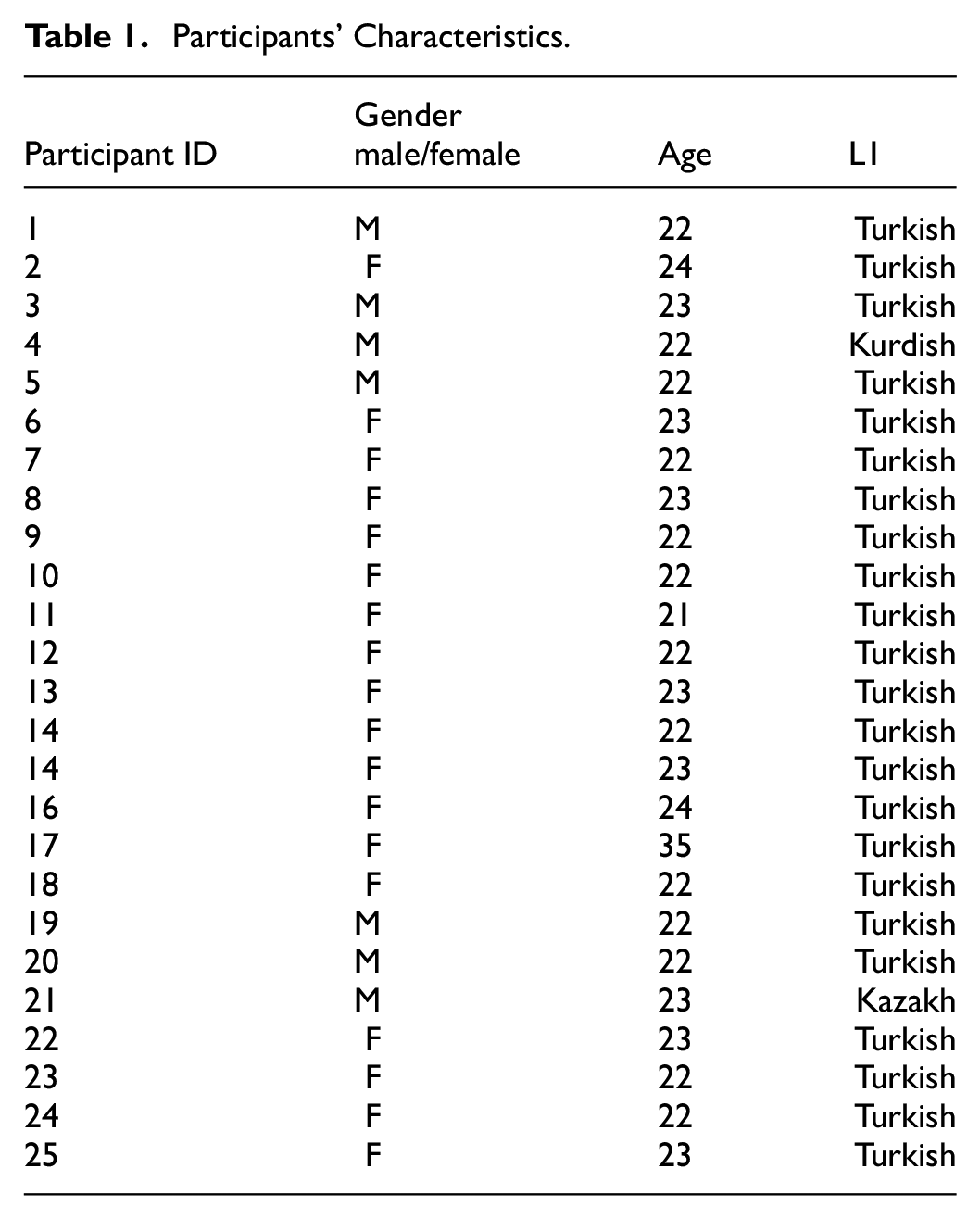
The study involved 25 pre-service EFL teachers who were selected through convenience sampling, as they were registered for a course integrating AI tools in language teaching (Table 1). The participants consisted of 8 males and 17 females, with ages ranging from 21 to 24 (mean age: 23). The majority of the participants identified Turkish as their first language (L1), while one participant spoke Kurdish and another Kazakh as their L1. Prior to the study, most participants had limited or no experience with AI tools, as their exposure was primarily through general-purpose applications rather than educational tools. All participants demonstrated a moderate to high level of motivation to explore AI tools, as they expressed curiosity and interest in how such tools could enhance their language learning and future teaching practices.
Participants’ Characteristics.
Data Collection Procedures
Journals provided a longitudinal perspective, complementing the data collected through semi-structured interviews. While these self-reported data sources offered rich qualitative insights, the study acknowledges their susceptibility to biases, such as exaggerating positives or downplaying negatives. Triangulation was employed to address this limitation and enhance the reliability of findings. Data were analyzed from three distinct sources: semi-structured interviews and the analysis of the logs, including participants’ interactions with the chatbot. This triangulation process ensured that themes and codes (Tables 2 and 3) were not derived from a single perspective but rather cross-verified across multiple data points for consistency and validity. The generation of themes and codes followed a systematic, multi-step process. First, the raw data were carefully reviewed and initially coded based on recurring patterns and key phrases across all data sources. This initial coding was carried out independently by two researchers to ensure objectivity and reduce potential bias. Second, the codes generated from the interviews were compared and cross-referenced during a triangulation meeting to identify overlapping patterns and resolve discrepancies. The disagreements were discussed through discussion by two inter-coders to ensure mutual understanding o the codes. The Cohen’s kappa was used, and the value was determined to be .89, which showed high inter-coder reliability. To ensure the consistency of the coding, another coder checked randomly chosen transcripts.
The Themes and Codes that Emerged from the Responses Regarding Collaborative Learning Using Chatbots.
The Themes and Codes that Emerged from the Responses Regarding the Benefits and Challenges.

The Chatbot, Carlos
Carlos is an AI-based language learning tool using artificial intelligence and machine learning capabilities. The resources include lessons, activities, quizzes, and assessments, providing comprehensive resources to learners. From this perspective, these features make Carlos a private language tutor who can present and teach learning materials. Moreover, Carlos adopts an adaptive learning approach. This way, it aims to provide targeted practice materials using a browser. Therefore, it can be stated that Carlos is not only an AI-based tutor but also a chatbot that can provide practice in receptive and productive language skills such as listening and speaking.
Within the scope of this study, the participants engaged in verbal and written communication with Carlos about the topics covered in the Pragmatics and Language Teaching course, where the teachers studied the main theories and how to apply them to classroom practice to prepare for the midterm and final exams. During the thirteen weeks, before each topic, the participants engaged with Carlos at home outside the classroom. The interactions with the chatbot were monitored and documented using system-generated logs. These logs captured details such as the participants’ queries, the chatbot’s responses, and the timestamps of interactions. While the chatbot interactions were not standardized to maintain flexibility in participants’ use, they were guided by broad prompts provided during the study. Participants were encouraged to use the chatbot in ways that supported their collaborative and individual learning practices, such as generating discussion prompts, organizing group tasks, or clarifying concepts. This approach allowed for naturalistic interactions, ensuring that the data reflected authentic user experiences.
The topics included:
What is Pragmatics?
Literal meaning, pragmatic meaning, Deixis, Anaphora, Entailment, Presupposition, Prosody, Inference, Implicature
Grice’s Contribution to Pragmatics: Maxims of Conversation
Speech Act Theory
Politeness
Cross-Cultural Pragmatics
Interlanguage Pragmatics
Pragmatics and SLA
Pragmatics in the classroom
Designing a lesson plan
Pragmatics in Textbooks
Incorporating technology into pragmatics
Assessing Pragmatics Ability
The participants were also provided with mock exams on the topics so that they could hold their conversations with the chatbot in both written and spoken forms. Several questions were presented as follows:
a) the participants are assumed to cooperate when contributing to a conversation. Grice then broke this principle into four fundamental maxims, which go towards making a speaker contribute to the conversation “cooperative.” In the following dialogues, briefly explain which maxims are violated or flouted in each dialogue. A: We’re going to the cinema. Would you like to join us? B: I’ve got to go to bed early tonight.
b) A language lecturer at the university wants to use the following situation to assess her learners’ appropriate use of language. Belike wants her students to produce the language with a partner. Which assessment items/format should she use?
Kelif’s landlady keeps his dog out on his porch well into the evening, and the barking drives her crazy. She wants to request that the dog be kept inside at night.
Findings
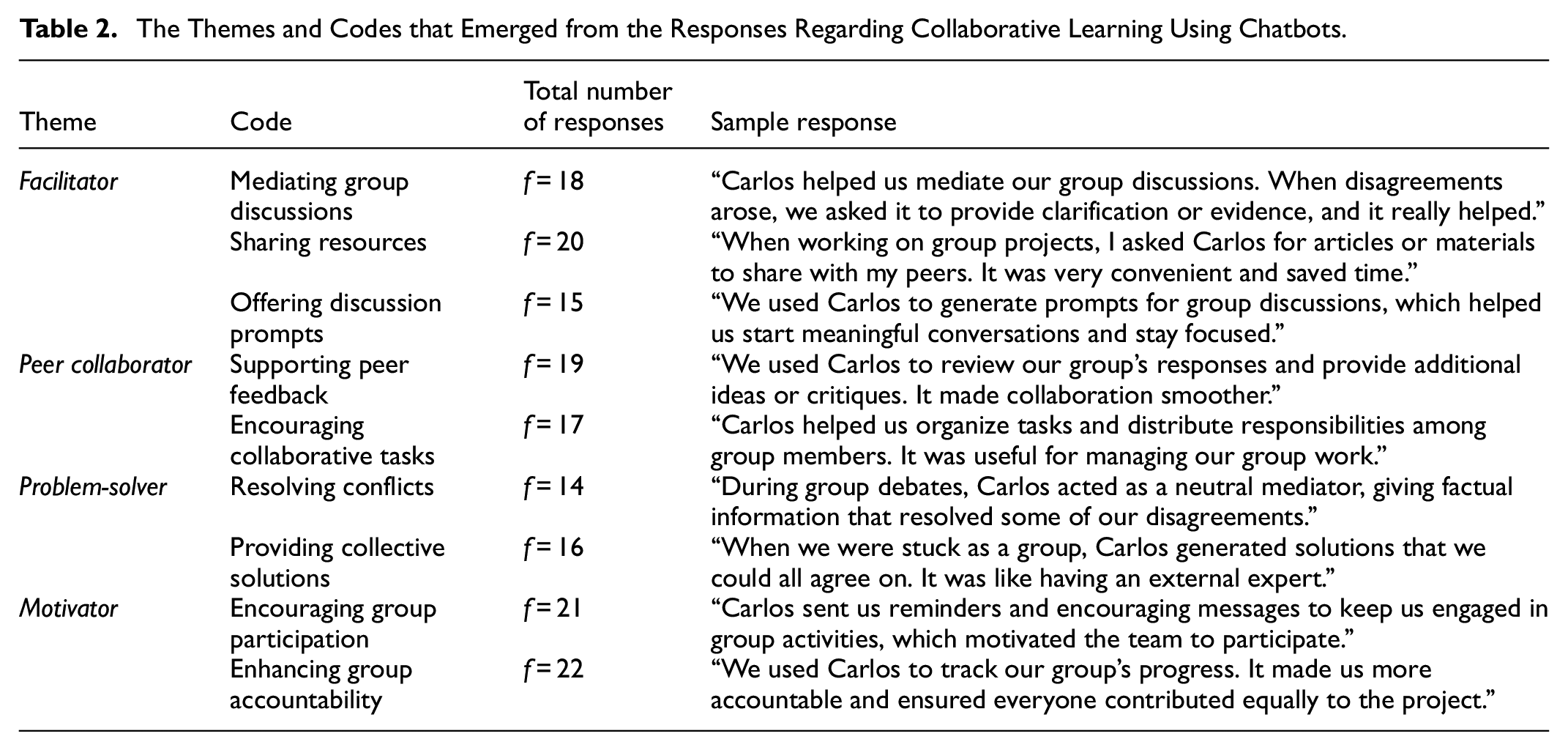
The themes and codes that emerged from the content analysis are presented in Table 2, which also includes several representative quotes to exemplify participants’ responses in their journals and interviews. The findings are provided as to the first research question: How do EFL pre-service teachers engage in collaborative learning practices when using the chatbot in their training? The analysis revealed four primary themes related to collaborative learning practices: Facilitator, Peer Collaborator, Problem-Solver, and Motivator. Each theme encapsulates distinct ways in which participants utilized the chatbot to foster collaboration, streamline group work, and enhance interaction among peers.
The Facilitator theme highlights the chatbot’s role in mediating discussions, sharing resources, and guiding group conversations. In terms of mediating group discussions (f = 18), participants frequently relied on the chatbot to resolve disagreements and provide clarifications during group debates. For instance, one participant (ID 8) noted, “Carlos helped us mediate our group discussions. When disagreements arose, we asked it to provide clarification or evidence, and it really helped.” Similarly, sharing resources (f = 20) was a significant benefit, as the chatbot provided articles and materials tailored to group needs. A participant (ID 15) explained, “When working on group projects, I asked Carlos for articles or materials to share with my peers. It was very convenient and saved time.” Additionally, the chatbot offered discussion prompts (f = 15) that encouraged meaningful conversations. One participant (ID 12) shared, “We used Carlos to generate prompts for group discussions, which helped us start meaningful conversations and stay focused.” These functions illustrate the chatbot’s effectiveness in facilitating and structuring collaborative interactions.
The Peer Collaborator theme underscores the chatbot’s role in fostering mutual support and organizing collaborative tasks. For supporting peer feedback (f = 19), the chatbot was used to review and refine group responses. A participant (ID 4) commented, “We used Carlos to review our group’s responses and provide additional ideas or critiques. It made collaboration smoother.” Similarly, the chatbot was instrumental in encouraging collaborative tasks (f = 17), as it helped distribute responsibilities and track progress. A participant (ID 21) shared, “Carlos helped us organize tasks and distribute responsibilities among group members. It was useful for managing our group work.” These findings highlight how the chatbot promoted group cohesion and enhanced task efficiency.
The Problem-Solver theme reflects the chatbot’s role in resolving conflicts and generating solutions during group activities. For resolving conflicts (f = 14), the chatbot acted as a neutral mediator, providing factual information that helped groups settle disagreements. A participant (ID 10) explained, “During group debates, Carlos acted as a neutral mediator, giving factual information that resolved some of our disagreements.” In addition, the chatbot provided collective solutions (f = 16), offering practical suggestions when groups encountered challenges. A participant (ID 18) remarked, “When we were stuck as a group, Carlos generated solutions that we could all agree on. It was like having an external expert.” These capabilities positioned the chatbot as a valuable problem-solving tool.
The Motivator theme highlights the chatbot’s role in encouraging participation and fostering accountability. To encourage group participation (f = 21), the chatbot sent reminders and motivational messages, which kept group members engaged. A participant (ID 5) shared, “Carlos sent us reminders and encouraging messages to keep us engaged in group activities, which motivated the team to participate.” Furthermore, the chatbot contributed to enhancing group accountability (f = 22) by tracking progress and ensuring equal contributions. A participant (ID 7) noted, “We used Carlos to track our group’s progress. It made us more accountable and ensured everyone contributed equally to the project.” These features helped establish a collaborative environment where participants felt responsible for their roles.
The themes and codes that emerged from the responses are presented in Table 3, which also includes several representative quotes to exemplify participants’ experiences. The results address the second research question: What are the perceived benefits and challenges of employing chatbots in collaborative learning settings among pre-service teachers? Two themes were identified regarding the benefits and challenges of using the chatbot: Benefits and Challenges. The theme Benefits included four codes: Facilitating peer collaboration, supporting collective tasks, Enhancing communication, and Encouraging shared learning, while the theme Challenges comprised four codes: Quality of collaborative output, Dependence on AI for group work, Lack of personalized responses, and Privacy concerns.
The benefits of using the chatbot for collaborative learning are reflected in four codes: Facilitating peer collaboration (f = 20), Supporting collective tasks (f = 18), Enhancing communication (f = 22), and Encouraging shared learning (f = 19). The chatbot proved highly effective in facilitating peer collaboration (f = 20), as it provided prompts and guidance that encouraged participants to brainstorm ideas and contribute to group efforts. For example, one participant (ID 6) shared, “Carlos provided prompts and guidance that helped our group brainstorm ideas and build on each other’s contributions effectively.” This indicates that the chatbot played a vital role in promoting group synergy. Participants also highlighted the chatbot’s ability to support collective tasks (f = 18) by helping them organize roles and track progress during group projects. One participant (ID 14) stated, “We used Carlos to assign roles and track progress during group projects. It made task delegation much easier and more organized.” This demonstrates how the chatbot streamlined task management within groups.
Another significant benefit was the chatbot’s role in enhancing communication (f = 22), as it suggested discussion points that helped participants engage in meaningful conversations and ensured equal participation. One participant (ID 2) remarked, “Carlos suggested discussion points that helped us start conversations and ensured everyone participated in the group chat.” This finding highlights how the chatbot facilitated inclusivity and fostered effective communication among group members. Finally, participants noted that the chatbot encouraged shared learning (f = 19) by enabling them to share materials and feedback within their groups. As one participant (ID 10) explained, “By sharing Carlos’ feedback and materials with my group, we were able to help each other learn and improve together.” These benefits illustrate how the chatbot enhanced collaborative learning experiences by fostering teamwork and mutual support.
Despite the benefits, participants also reported several challenges associated with using the chatbot, which was categorized into four codes: Quality of collaborative output (f = 16), Dependence on AI for group work (f = 14), Lack of personalized responses (f = 12), and Privacy concerns (f = 11). The quality of collaborative output (f = 16) was a recurring concern, as participants noted that the chatbot occasionally provided incomplete or inaccurate information. One participant (ID 9) commented, “Sometimes Carlos gave incomplete or inaccurate information, which confused our group discussions.” This issue underscores the need for more reliable and accurate responses from the chatbot. Additionally, participants expressed concerns about dependence on AI for group work (f = 14), as over-reliance on the chatbot reduced critical thinking and engagement during discussions. For instance, one participant (ID 17) mentioned, “We relied too much on Carlos for answers, which made some of us less engaged in critical thinking during group discussions.”
Another challenge was the chatbot’s lack of personalized responses (f = 12), as it did not always align with the specific needs of the group. One participant (ID 20) stated, “Carlos did not always understand the group’s specific needs, so some suggestions felt generic and less helpful for our discussions.” This indicates the need for a more adaptive and tailored approach to chatbot responses. Lastly, participants raised privacy concerns (f = 11) regarding the security and use of their data. One participant (ID 5) remarked, “I’m not sure if the data we shared with Carlos during group discussions is stored securely or used for other purposes.” This highlights the importance of transparency and data security in AI-driven tools.
To further understand participants’ experiences, their overall satisfaction with the chatbot was also inquired. When asked to rate their satisfaction on a scale of 1 to 5, the majority of participants reported being satisfied or very satisfied (mean score = 4.2). Positive ratings were often linked to the chatbot’s ability to foster collaboration and streamline group processes, as evidenced by one participant (ID 6), who stated, “Carlos provided prompts and guidance that helped our group brainstorm ideas and build on each other’s contributions effectively.” However, participants who expressed lower satisfaction (scores of 1 or 2) often cited challenges, such as occasional inaccuracies in output or concerns about over-reliance on the tool.
Discussion
1. How do EFL pre-service teachers engage in collaborative learning practices when using the chatbot in their training?
The participants mostly used Carlos to generate answers to questions about the concepts related to course content, such as Grice’s Maxims, and to produce examples for the concepts or the theories. Most participants reported that Carlos gave them novel perspectives and insights regarding the course material they had not considered. This echoes findings by Belda-Medina and Kokošková (2023) as well as Lin and Chang (2023), who noted that chatbots could offer unique interpretations and diverse examples that enhance learners’ understanding, and Lee et al. (2023), who emphasized that chatbots are helpful in providing immediate feedback and clarifying complex concepts, which was also evident in the way participants used Carlos to understand pragmatics-related content, such as Grice’s Maxims. These findings suggest that chatbot-facilitated dialogue not only enhances content comprehension but also activates higher-order thinking processes such as evaluation, comparison, and abstraction—key elements of collaborative knowledge construction as emphasized in Vygotskian sociocultural theory.
The achieved results also enabled recognizing certain trends in the use of chatbots by EFL pre-service teachers in collaborative context. The four main roles might be identified as facilitator, peer moderator, problem solver and motivator. As problem solving (Lin, 2023) and motivation (Annamalai et al., 2023) appeared in the previous research, however, peer moderation and facilitation have not been, to our knowledge, discussed yet. This expansion of functional roles attributed to the chatbot reveals an evolving perception of AI agents—not merely as informational tools but as dialogic partners that shape group interaction and learning structure. The identified roles confirm the results described earlier by Sáiz-Manzanares et al. (2023) that chatbots can efficiently support learners collaborative activities. What is more the students views show that not only chatbots can guide them in simply linguistic tasks but also supported the development of social skills, such as task division and planning of certain procedures (e.g., Burkhard et al. 2022). This also resonates with theories of distributed cognition, where tools like chatbots act as cognitive partners, extending learners’ problem-solving capacities across social and technological contexts.
The guidance referred also to the new role which is mediation in internal group conflicts. Unlike in the study by Yang and Chen (2023) the statements of participants of the experiment support strongly not only the motivational but also attitudinal change in students. This attitudinal shift suggests a form of socio-affective scaffolding, where the chatbot contributes to affective regulation and conflict resolution within group dynamics, thus performing a role traditionally assigned to human facilitators. The students opinions reflect not only visive benefits of the chatbots use (facilitating discussions, set of arguments accelerating the start of work) but also positive attitude to it. Also, Chen (2024) noticed the meaning of the application of chatbots in collaborative work, however, what the scientist not mentioned in the conducted research was the impact of chatbots implementation on group dynamics which profited a lot by having “ invisible assistant” (examples (ID 8) noted, “Carlos helped us mediate our group discussions. When disagreements arose, we asked it to provide clarification or evidence, and it really helped.”(ID8), “We used Carlos to review our group’s responses and provide additional ideas or critiques. It made collaboration smoother.”(ID4). These findings underscore a transformative shift in how learners negotiate roles, responsibility, and authority in peer collaboration, suggesting that the presence of AI interlocutors may reconfigure traditional power dynamics and interaction patterns.
2. What are the perceived benefits and challenges of employing chatbots in collaborative learning settings among pre-service teachers?
In addition to these tutoring functions, participants actively utilized Carlos as a Language Exchange Partner, leveraging the capacity of the chatbot to practice spoken language and enhance pronunciation skills. This role is well-supported by the literature, where studies by Jeon et al. (2023) and Kim et al. (2019) have shown that chatbots can effectively facilitate speaking and listening practices in a second language by providing a non-judgmental environment for learners to practice verbal communication. Moreover, Lin et al. (2022) also found that learners were more motivated to engage in speaking activities when interacting with a chatbot, reflected in the participants’ positive attitudes toward using Carlos for language practice. Moreover, engaging with the chatbot was perceived to contribute to an increase in course achievement. This finding is consistent with the idea that engaging with chatbots can improve learning outcomes (Sáiz-Manzanares et al., 2023). Additionally, Kochmar et al. (2022) emphasized that the role of chatbots as personal tutors significantly boosts learners’ engagement and persistence in learning tasks, which is reflected in the participants’ perceived improvement in their course performance. These positive perceptions reinforce the potential of AI-mediated dialogue to create a safe, adaptive, and motivating learning environment, aligning with self-determination theory’s emphasis on competence and autonomy as drivers of engagement.
The challenges mentioned by the participants were in line with some concerns expressed by Özer ( 2024) identified as “ask” of learning. Some students mentioned doubts about the feedback and content produced by Carlos, which had impact on the produced outcome. Inaccurate information require careful considerations and critical evaluation of the content. This observation points to a dual-layered learning challenge: while chatbots may foster immediacy and engagement, they also demand that learners develop critical digital literacy skills to evaluate and triangulate AI-generated information.
The immediate responds improved communication in the group but mad as well students too dependent on the Ai support as one of the participants mentioned “We relied too much on Carlos for answers, which made some of us less engaged in critical thinking during group discussions.” (ID17). This unintended dependence echoes concerns in cognitive load theory, where learners may offload too much cognitive effort onto tools, thereby limiting their deep processing and problem-solving engagement. Such findings suggest that pedagogical interventions should not only train learners in using chatbots, but also guide them in metacognitive strategies that balance AI support with individual accountability.
Conclusions
This study is believed to have contributed to the growing body of research on the use of AI tools in language learning by providing empirical evidence of the benefits and challenges associated with using a chatbot for learning. The achieved results show new role of the ChatGPT in managing learner group dynamics and moderating discussions, what can be of use in the AI mediated teaching practice. While Carlos proved to be a valuable tool in supporting various aspects of language learning, the findings also underscore the importance of addressing concerns related to output quality, shallow learning, overreliance, and data privacy. These insights suggest that while chatbots like Carlos have the potential to enhance language learning experiences, their integration into educational contexts should be approached with caution and an emphasis on maintaining a balanced and critical perspective. Future research should continue exploring the long-term impacts of chatbot use on learners’ autonomy and critical thinking skills, particularly in developing pragmatic competence in language learning.
Footnotes

Ethical Considerations
The study was carefully designed to adhere to ethical standards for research involving human participants, including the Declaration of Helsinki. All procedures were non-invasive and posed no physical, psychological, or social risk. Participation was entirely voluntary, with the right to withdraw at any time without consequence. Informed consent was obtained prior to data collection through a detailed consent form outlining the study’s purpose, procedures, potential risks and benefits, and data protection measures. All data were anonymized, and identifiable information was removed during analysis and reporting.
Funding
The authors received financial support from Adam Mickiewicz University in Poznan, Poland for the open access publication of this article.
Declaration of Conflicting Interests
The authors declared no potential conflicts of interest with respect to the research, authorship, and/or publication of this article.
Data Availability Statement
Data sharing is possible upon request.