



Abstract
Socially ascribed gender norms are a significant barrier for women of the fishing communities in coastal Bangladesh. These norms limit women’s income autonomy, access to productive resources, decision making capacity and mobility, which negatively affects their economic empowerment and overall well-being. The article delves into the topic of women’s empowerment in these communities. The study employed a mixed method approach to collect data from ECOFISH II project intervention villages. Pro-WEFI, which is a modified and refined version of the Women’s Empowerment in Agriculture Index (WEAI) was utilized for fishing community to determine women’s empowerment and disempowerment status across three domains of empowerment (3DE): intrinsic, instrumental, and collective agency. The findings revealed that men experienced fewer inadequacies than women, with a weighted average 3DE score of 0.75 for men and 0.57 for women, and only 14% of women and 37% of men were found to be empowered. The Gender Parity Index (GPI) score was 0.79 and households with gender parity made up 31% of the total. This study developed a comprehensive set of Pro-WEFI indicators applicable for assessing and comparing women’s empowerment across cultures in fisheries-related projects. Utilizing the disaggregated scores of each Pro-WEFI indicator, it is possible to identify areas of disempowerment for both genders and prioritize project interventions accordingly. Furthermore, employing the Pro-WEFI tool in a longitudinal panel design can capture the changes in women’s empowerment over time in any fisheries project.
Plain Language Summary
This article adopts Pro-WEFI (modified and refined from the original WEAI) method to estimate the women’s empowerment and disempowerment status under three domains of empowerment (3 DE). The overall situation of women in the fisher community can be translated as limited participation in productive decisions, less control over resources, and a weak leadership role that leads to a higher level of disempowerment. This information can help to target specific and need-based development interventions in fisheries projects that aim to enhance women’s empowerment in line with the lacking of an individual indicator. Findings provide important information for policymakers and practitioners to capture the changes in women’s empowerment.
Introduction
The Ganges-Brahmaputra-Meghna delta makes up the majority of Bangladesh’s coastal region, accounting of 32% of the country’s land area and being home to 25.7% of the population (BBS, 2011). Coastal ecosystems are known to be complex, have greater externality, and be hostile in nature (Campbell et al., 2006; Kawser et al., 2022). It is estimated that the livelihoods of around 37 million people depend on the coastal resources (Dasgupta et al., 2014), with many of them being poor and exposed to natural and human-caused shocks and stressors. Fishing is the primary economic activity for many coastal communities who are highly vulnerable to natural calamities (Islam & Shamsuddoha, 2018). Fishing is a male-dominated activity, which makes the contribution of women of the fishing community invisible and undervalued (Asadullah et al., 2021). Because of that, women are often excluded from fisheries related policy and decision-making processes (UN Women, 2020). This lack of recognition and involvement in the industry further reinforces the vulnerability of women in coastal communities. Hence, the empowerment of fisherwomen is not an issue of social justice but is also critical for creating more livelihood opportunities for women and the community’s overall wellbeing. Without alternatives, women are often confined to household chores, leading to a power imbalance, and suppression. Gender differentiated studies are required to grasp women’s vulnerabilities, therefore giving an indepth understanding of the coping mechanisms of the coastal fishing community (Alam & Rahman, 2014).
In Bangladesh, generally patriarchal norms and cultural practices shape women’s position in households and society, leading to gender norms that favor men (Boudet et al., 2013). As a result, these gender norms and values restrict women’s mobility and access to resources and limit power within the household and the community. Understanding power dynamics is crucial for women’s empowerment, which can be categorized into four types: power over, power to, power with, and power within (Gaventa, 2006; Rowlands, 1997; Vene Klasen & Miller, 2002).“Power over” is the most frequently discussed category of power, which is expressed through dominating and oppressing others, while “power to” refers to enacting personal goals. “Power with” refers to collective action and shared interests, while “power within” indicates to a person’s self esteem and sense of potential (Ibrahim & Alkire, 2007; Malapit et al., 2019; Mathine et al., 2017; Rowlands, 1997). It is important to recognize that empowerment involves more than just providing resources or opportunities to women but also addressing the structural factors embedded in the culture hamper their access to resources. Understanding and addressing power dynamics makes it possible to create a more equitable society where women have equal opportunities and can make strategic life choices. (Kabeer, 1999; Nikkhah et al., 2012).
Various techniques and indicators are used to assess women’s empowerment, such as experimental methods that analyze household decision-making processes (Doss et al., 2020). The Women’s Empowerment in Agriculture Index (WEAI) is widely employed in developing countries, like Bangladesh, to determine the status of women’s empowerment in different settings (Alkire et al., 2013; Waid et al., 2022). This tool uses qualitative methods to define empowerment at the local level and comprises 12 indicators that cover three domains of agency: intrinsic (power within), instrumental (power to), and collective agency (power with). The Women’s Empowerment in Fisheries Index (WEFI) is an adaptation of WEAI tailored for the fisheries sector, which was introduced by Cole in 2020. Pro-WEFI is a modified version of WEFI that includes or excludes specific questions based on the project-level activities in the fisheries sub-sector. The framework opens up a space for investigating the range of power dynamics in coastal Bangladesh, particularly in the fishing communities. Hence, two specific questions were addressed i) to what extent are women of different socio-economic groups empowered or disempowered relative to men? and ii) what are the specific barriers facing women of different socio-economic groups in terms of livelihoods and empowerment? Accordingly, Pro-WEFI was used to evaluate women’s empowerment status in Bangladesh’s coastal fishing communities.
Conceptual Framework
The idea of “women’s empowerment” has received global consideration and is now considered a crucial factor in designing programs and activities by national and international development partners. Researchers worldwide have shown immense interest in the term since the establishment of the United Nations organization, and it has become a political agenda for many countries (Mandal, 2013). However, the definition of women’s empowerment varies in different socio-cultural, economic, religious and political contexts. Generally, it involves enhancing women’s economic, social, and political status, particularly those traditionally marginalized in a society. This process aims to create a setting where women can speak up without being afraid of being oppressed, exploited, nervous, or subjected to prejudice or persecution in a patriarchal society (Dandona, 2015). Moreover, women’s empowerment can be regarded as the promotion of women’s perception of self-worth, their capacity of making their own choices, and their courage to challenge gender norms for themselves and others.
Women’s empowerment is universally acknowledged as an essential goal, but social scientists have no consensus on how to measure and conceptualize it. Different scholars have proposed various perspectives on women’s empowerment, making it difficult to develop a universal index that allows for comparative assessments individual, community, and national level (Galiè, 2013; Tsikata & Darkwah, 2014). For instance, although Giddens and Sutton (2017) emphasized societal ideals and norms, such as class, status, and gender, Bourdieu’s (1994) approach concentrated on manifested power in patriarchal societies. Three dimensions are included in Huis et al.’s (2017) model of women’s empowerment. The dimensions are i) the micro-level indicates personal empowerment which includes person’s distinct opinions and actions; ii) the meso-level, which indicates relational empowerment through attitude and behaviour in connection to important others; and iii) the macro-level, refers to societal empowerment by considering the broader socio-political context. The widely adopted empowerment framework is of Kabeer’s (1999), who emphasizes on resources, agency, and achievements. Other researchers, such as Cheston and Kuhn (2002), Malhotra et al. (2002), and, Hansen (2015) have focused on agency, autonomy, individual’s potential, self-determination, and self-reliance to measure women’s empowerment. Similarly, Eerdewijk et al. (2017) have emphasized resources, agency, and institutional structures as key indicators of women’s empowerment. Therefore, no “one size does not fit all” exists to assess and understand women’s empowerment. The various perspectives and frameworks proposed by scholars reflect the depth and breadth of the concept’s complexity and multidimensional multidimensional aspect, and more research is needed to develop a comprehensive and context-specific understanding of women’s empowerment.
While there are macro-level indicators that allow for cross-country comparison of empowerment, such as the Gender Development Index (GDI) or the Gender Empowerment Measure (GEM), some scholars have criticized them for providing only aggregate data and lacking analysis at the individual level, which is crucial for gender analysis (Alkire et al., 2013; Ibrahim & Alkire, 2007; Miedema et al., 2017). The GDI measures the gender gaps, while GEM measures gender inequality across countries (Klassen, 2006). Subsequently. The United Nations Development Programme (UNDP) has attempted to combine both measures and add a few more vulnerability indicators to construct Gender Inequality Index (GII) in 2010, combining both the GDI and GEM (UNDP (United Nations Development Programme), 2018). However, these indices have criticized for estimating inequality broadly rather than at a specific level (Alkire, 2005; Alsop et al., 2005; Narayan, 2005).
The Women’s Empowerment in Agriculture Index (WEAI) was developed by the Oxford Poverty and Human Development Initiative (OPHI), United States Agency for International Development (USAID) and the International Food Policy Research Institute (IFPRI). The index measures women’s engagement in agriculture across five domains, for example, production, resources, income, leadership, and time-use (Alkire et al., 2013). It evaluates women’s empowerment within households by comparing women’s involvement with males. The WEAI has been widely used in several nations in the global south, including Bangladesh (Alkire et al., 2013). The Pro-WEAI, an abbreviated version, and sector-specific variations like the Women’s Empowerment Livestock Index (WELI) and Women’s Empowerment Fisheries Index (WEFI) have also been modified for various sub-sectors (Cole et al., 2020; Galiè et al., 2019; Kefi et al., 2017; Malapit et al., 2019; Roy et al., 2017). Projects including fisheries, cattle, and nutrition have all used these indexes.
Cole et al. (2020) modified the WEAI for the fisheries sector; Cole’s study uses the WEFI to develop a score that gauges levels of empowerment of value chain actors from a gender perspective. The present study refines the WEFI tool by including and excluding certain questions that are appropriate to the interventions in fisheries and the WEFI becomes the Pro-WEFI. However, it does not change the number of indicators and three types of agencies which have been tested in Pro-WEAI, namely intrinsic agency (power within), instrumental agency (power to), and collective agency (power with). This study uses the Pro-WEFI to measure baseline level of women’s empowerment in fishing communities that could be used to track any changes that occurred through project interventions and can be evaluated in the endline. This Pro-WEFI might be useful for cross-cultural comparisons and monitoring women’s empowerment progress of fisheries projects that have the mandate to empower women (Figure 1).

Conceptual framework of women’s empowerment in fisheries index (WEFI).
Materials and Methods
Coastal Area and Sample Respondents
In connection to the research settings, data was collected from prospective ECOFISH II intervention villages of Teknaf, Ukhiya (known as Zones of Resilience (ZOR), and Charfassion (known as a Marine Protected Area (MPA) Upazila of coastal Bangladesh (Figure 2). These areas are well-known hilsa fish catching hubs, and the fishing communities concentrate there. It was not considered worthwhile to conduct a census covering all coastal fishing communities across ZOR and MPA as, in general, there is greater homogeneity in coastal fishing communities. Fishing families tend to live in a single village due to their low social status (Hossain et al., 2014). The coastal people have limited financial and social resources, affecting their food security, poverty status and overall livelihoods. About 35% of Bangladesh’s coastal rural population lives below the “Cost of Basic Needs” poverty line (upper poverty line) and 21% below the lower poverty line (HIES, 2016).

Charfassion, Bhola (MPA area) and Teknaf and Ukhiya, Cox’s Bazar (ZOR area).
A list of eligible households was selected based on pre-defined selection criteria, including monthly income, landlessness, livelihood dependency on fishing, ownership of fishing nets, and so on. From this list the target population was grouped according to each Primary Sampling Unit (PSU), and 65 to 70 households were selected randomly. A total of 401 households were surveyed for this study, including 388 households with dual members where both husband (man) and wife (woman) underwent separate interviews and 13 households with single members (widower or women-managed household) where only the household head (women) was interviewed. In the MPA region, 134 (33.42%) households were taken as sample respondents, of which 10 were women-managed households. On the other hand, 267 (66.58%) samples were taken from the ZOR region in which only 3 samples were women-managed households. The inclusion of women-managed households varies across regions as the study adopted random sampling techniques.
Data Collection
Interview questions were used to gather empirical data from the chosen respondents. Key questions were related to socio-demographics, women’s empowerment (intrinsic, instrumental, and collective agency), and gender attitudes scale. The data were collected using an online data collection software (ODK—Open Data Kit). Prior to finalization, the designed questionnaire underwent pre-testing. In addition, a Focus Group Discussion (FGD) checklist was prepared before performing group discussions at the study sites. All survey tools were prepared in English because bi-lingual post-graduate students were involved in the data collection process. The Ethical Review Board has reviewed and approved the study design. Besides, verbal consent was taken from each of the respondents before proceeding the interview.
A total of 12 post-graduate students who had—on training in data collection during their undergraduate study at BAU were recruited as data enumerators. A comprehensive three-day data collection procedure training was conducted in which enumerators spent one day in the field (pre-testing the study tools). The training emphasized the practical data collection process rather than the theoretical aspects of research methodology. The interviews were conducted in person under the clos guidance of the study team (in-person and virtual). The study team visited the study sites to ensure the quality of the data. In addition, virtual meetings were conducted regularly with the enumerators to solve any sort of emerging issues.
Besides the quantitative survey, FGDs were performed to collect narratives of how and why questions. A total of nine FGDs (six from ZOR area and three from MPA area) were carried out; three with women, three with men, and three with both (women and men together). The research team members facilitated the FGDs and were the primary note-taker with assistance from the post-graduates as needed. Extensive hand-written notes were collected as well as audio recordings for greater authentication.
Digital device (tablet/smartphone) was used to collect survey data, which was then uploaded to the ONA server (third-party cloud data storage service provider). Data was downloaded from online database and organized according to analytical needs. Communication (through a cell phone) was made with the responder right away when any data were found inaccurate, inconsistent, or incomplete, if the issue could not be resolved then the specific household/respondent was omitted (11 samples were omitted) from the analysis. Researchers must respect the confidentiality of participant information and data in a morally and legally acceptable manner, therefore the information was retained for use by both the researchers and the donor agency (WorldFish).
Formative Process of Developing Pro-WEFI
A modified version of the WEAI, called the project level Pro-WEFI, was developed to assess women’s empowerment in fishing communities in ZOR and MPA regions of coastal Bangladesh. Similar to the WEAI, the Pro-WEFI is a household survey-based index that measures empowerment-disempowerment and gender parity and identifies areas where empowerment-centered interventions can be strengthened. The Pro-WEFI measures the roles and level of women’s engagement in coastal fisheries. To fit with fisheries context, the Pro-WEFI embodied two main changes to the WEAI tool: i) exclusion of specific questions and domain sections that were not appropriate given the project focus, and ii) alterations of response scale on different question for more clarification. The Pro-WEFI tools were pretested in one fishing community outside the project area (Kishoreganj district) and subsequently refined the tools before employing in the field. Both WEAI and Pro-WEFI are rooted in Kabeer’s (1999, 2005) idea of empowerment, which characterizes empowerment as a process of change in the interconnected dimension of resources, agency, and accomplishments (Malapit et al., 2019). Unlike the original WEAI, which has five domains of empowerment and ten thematically organized indicators, the Pro-WEAI has 12 indicators aligned to three domains (Malapit et al., 2019). The three domains follow Malapit et al.’s (2019) schematic and comprise of intrinsic agency (power within), instrumental agency (power to), and collective agency (power with). The generative forms of power are indicated in these three facets of agency (Ibrahim & Alkire, 2007; Rowlands, 1997), which are strengthened in the Pro-WEFI. So, Pro-WEFI represents a more tailored approach and method for assessing women’s empowerment in fishing communities.
The WEFI tools underwent a pretest in a fishing community, which involved interviewing both women and men of the household who caught, processed, and traded fish. The results were analyzed to determine their level of control over income generated from these activities, decision-making regarding expenditures, and access to financial services. Based on this analysis, the WEFI tools were refined before being used in the field.
The Pro-WEFI is composed of three domains (3DE) and 12 indicators that carry equal weight. Each indicator is designed to assess whether an individual has achieved a certain empowerment threshold (Alkire et al., 2013). The domains and indicators of empowerment in fisheries are presented in Table 1. A gender parity index is calculated from the data collected across the three domains, which compares the empowerment scores of women and men within their respective households.
Domains, Indicators, and Weights in the 3DE.

Developing Pro-WEFI Index
The measurement scales for each indicator were qualitative in nature and differed from one another. The textual data obtained from the survey was converted into nominal numbers and matched against each indicator. Questions were created for each indicator to provide an overview of the issues being investigated. The families were asked whether they had participated in certain actions related to fish-catch and other productive activities in past 12 months. They were also asked about their level of involvement in decision-making regarding these activities, ranging from no input/control to large input/control. A person who contributes more to the household’s crucial fish-catch-related and productive activity decisions is considered to have greater instrumental agency. Participants were also asked who in their family has the right and control over certain resources, including themselves of their spouse. The self-efficacy indicator consisted of six statements to which participants had to respond from strongly disagree to strongly disagree. Another scale was used to measure the confidence level of the respondents, ranging from not at all comfortable to very comfortable (Alkire et al., 2013). The steps taken to calculate each indicator and the definition of adequacy for each one are outlined in the following section.
Intrinsic Agency
Autonomy in income (IN-1) reflects the power of intrinsic agency and is measured by summing responses for how an individual makes the final decision of executing solely fisheries-related activities and other agriculture and non-agricultural income-generating activities, including aquaculture (self = 1, others = 0, others including spouse, jointly with spouse, jointly with other HH member). Self-efficacy (IN-2) has two parts: self-esteem, and self-confidence. The response scale was: no, not at all comfortable; yes, but with a great deal of difficulty; yes, but with a little difficulty; yes, fairly comfortable; yes, very comfortable (Alkire et al., 2013). Since there were 13 statements under this indicator the adequacy level was set as a score ≥52, which indicates “agree/yes,”“fairly comfortable,” or “greater on average” to self-efficacy questions. To know about attitudes towards intimate partner violence (IN-3_, questions were asked to both partners (husband and wife). Accepts spouse is not legitimized in hitting or beating his spouse in all scenarios. The response level was set to violence or never violence translated from yes/no responses. The indicator respect among household members (IN-4) used the criteria of when you disagree with your household members, do you feel comfortable telling him/her that you disagree? The responses were scaled as most of the time, sometimes, rarely and never. The empowerment adequacy level was set to the responses of “most of the time” and “sometimes.”
Instrumental Agency
The input into productive decisions indicator (IN-5) includes two dimensions: a) fish-catch and related activities and b) other productive agriculture and non-agricultural activities. Adequacy is calculated if at least one of the conditions (moderate input/control or large input into decision) for fish catching, agricultural and non-agricultural activities they participate in is met. The ownership of assets indicator (IN-6), was calculated in three ways, firstly in terms of whether women own any of the assets either solely or jointly. Secondly, in terms of who makes the decision to sell, rent or give away most of the time and thirdly, who makes the decision regarding new purchases of any asset item. The adequacy level was set to “make the decision either solely or jointly.”Decisions about financial services (IN-7) including access to credit and access to saving services were recorded based on the question of who decided to take the loan/ saving and what to do with borrowed/ saved money. The adequacy level for financial services was met if at least one of the decisions was made either “solely” or “jointly.” The fourth indicator of instrumental agency (control over use of income [IN-8]) includes three dimensions: a) control over farm income (measured through decisions about the use of income generated from farm-based activities); b) control over non-farm income (measured through decisions about the use of income generated from non-farm activities); and c) control over expenses (measured through decisions about the use of income for household expenditures) (Galiè et al., 2019). For all dimensions, responses were recorded based on whether both men/women are consulted in each decision, participated in the final decision of using the generated income/expenditure, if there is any disagreement regarding using the income/expenditure and whose opinion usually prevails. The work balance indicator (IN-9) incorporates total workload (measured through “sum of time allocated to productive and household tasks”). Many projects format their time using data differently from the pro-WEAI survey modules (also outlined in the variable naming and coding guide). This study follows the pro-WEAI survey modules and calculated the time in minutes spent on each activity and the time spent on childcare as a secondary activity. The adequacy level of work balance was set to work less than 10.5 h/day: workload = time spent in primary activity + (1/2) time spent in childcare as a secondary activity (Malapit et al. (2019). Visiting important locations (IN-10) asks who decides whether she can go alone to different places and if her husband or other household member objects, in what circumstances would they allow you to go? The adequacy level was set to “the women can decide alone to visit different places,” and “the husband or other family members are not creating any objection to her going.”
Collective Agency
The group membership indicator (IN-11) reflects the power of collective agency, measured by summing responses for active group membership and how much input they have in making group decisions. The level of adequacy was measured by taking the responses of “input into most decisions” and “input into all decisions” of the respondents (Alkire et al., 2013). The second indicator of collective agency is membership in influential groups (IN-12). The question and adequacy standard level were similar to the indicator of group membership.
Calculating the Index
Project level Women’s Empowerment Fisheries Index (Pro-WEFI) was derived using an abbreviated version of Pro-WEAI based on Cole et al. (2020) and Malapit et al. (2019). The Pro-WEFI is composed of two sub-indices—the Three Domains of Empowerment Index (3DE) and the Gender Parity Index (GPI), which were weighted at 90 and 10%, respectively. The 3DE evaluates women’s empowerment in intrinsic agency (power within), instrumental agency (power to), and collective agency (power with) (Malapit et al., 2019), while the GPI compares the empowerment scores of the eligible individuals and their spouses, or the male responders within family. Improvements in either the 3DE or GPI will increase Pro-WEFI scores. The aggregate Pro-WEFI index, 3DE for women, 3DE for men, and GPI are all useful ways to summarize empowerment at the project level. The index’s decomposability enables the user to disaggregate the drivers of change and study how women’s and men’s empowerment scores affect it (Malapit et al., 2019). All indices were measured based on adequacy and inadequacy of women empowerment. Each Pro-WEFI respondent was classed as adequate (=1) or inadequate (=0) for a particular indicator by comparing their responses to the survey questions with a set threshold. During the data preparation for Pro-WEFI, we imposed the scale “self” participation as the level of her/his empowerment adequacy in the respect of decision-making activities. A respondent’s empowerment score is nothing but a simple weighted average of her/his adequacy scores in the 12 indicators (all weighted 1/12) (Malapit et al., 2019). We proposed the empowerment cut-off point is 25% because of the chance of having less empowerment among the women in the fishing community. Therefore, s/he is classed as empowered if her/his score is 75% or greater, or if s/he is sufficient in nine out of twelve indicators. In contrast, if her or his score is less than 75%, or if s/he is deficient in four or more categories, s/he is categorized as disempowered.
Summary of Findings and Discussion
Socio-Demographic Profile of the Sample Households
Age, education and experience are important attributes of an individual that can determine participation in productive activities. The age structure of the sample respondents was classified into four age groups: 18 to 35, 36 to 50, 51 to 65, and above 65 years (Table 2). Around 51% of the respondents belonged to the young age cohort (18–35), which is generally considered a productive age group across the region. It is well documented in the literature that education has a greater influence on increasing enterprise output. The education level of the respondents has been grouped into four categories: illiterate, below class five (primary), primary to class nine, and secondary (Secondary School Certificate [SSC]). It is observed from Table 2 that more than 50% of respondents do not have any formal education and that most of the respondents belong to either the “illiterate” or “below the primary level” of education categories. Of the educated respondents, 29.2% of respondents have “below primary level” education, followed by 17 and 0.5% for “primary to class nine” and “SSC” level education, respectively.
Socio-Demographic Profile of the Sample Respondents.

Besides formal education, experience is often reported as an important factor in ensuring productivity. The average experience of the respondents in catching fish was estimated at about 25 years (Table 2). Looking at different experience categories, a comparatively higher percent (25.2%) of the sample respondents had 16 to 20 years of experience, followed by 23.2% with 11 to 15 years, 20.9% with 21 and above years, 20.4% for 6 to 10 years and 10.2% for below 5 years of experience, respectively.
Synthesis Result of Pro-WEFI
The weighted average of the 3DE score for women and men in the sample was 0.57 and 0.75, respectively (Table 3). The 3DE score is based on the empowerment indicators used in Pro = WEFI and reflects the level of empowerment achieved by women in the sample. The score considers both the number of disempowered women, the severity of their disempowerment and the number of indicators in which they are not sufficiently empowered. The score also allows for comparing the deficiencies between men and women. The results showed that men had fewer deficiencies/inadequacies than women. The study found that only 14% of women and 37% of men in the sample were empowered, according to Pro-WEFI estimation. This is a lower percentage (14%) of empowered women than the Pro-WEAI estimation (16%) and WEAI estimation (25%) reported by Malapit et al. (2014, 2019), indicating that there is still significant room for improvement in women’s empowerment in the fishing community. Other studies have also reported on the impact of interventions on women’s empowerment. For example, a study on homestead food production found that 25% of men and 24% of women in the intervention group were empowered, compared to only 4% of women and 19% of men in the control group (Waid et al., 2022). Similarly, the SPRING (2017) study estimated that women who had participated in SPRING’s FNS scored higher on empowerment (0.72) than women who had not participated (0.60), respectively.
Pro-WEFI Result in Coastal Bangladesh.

Note. Survey, 2021.
On the other hand, the disempowerment score showed that 43% of women and 25% of men are disempowered, which implies that more women than men were disempowered, and on average, disempowered women had more inadequacies than disempowered men. Women, on the other hand, have a slightly higher level of disempowerment than men. Of those women who were disempowered, the mean adequacy score was estimated as 0.51; these women had achieved adequacy in an average of 51% of the indicators. The mean adequacy score for men who were defined as disempowered was 0.60, indicating that these men were adequate in 60% of the indicators. Malapit et al.’s (2019) Pro-WEAI estimation reported a mean 3DE score for not empowered of 0.49 for women and 0.59 for men, which is slightly lower than our Pro-WEFI results. Waid et al.’s (2022) empirical study estimated a mean 3DE score for the control group was 0.57 for men and 0.47 for women.
The GPI score was 0.79 and households with gender parity made up 31% of the total. Earlier studies by Malapit et al. (2014, 2019) scored the GPI for the Pro-WEAI as 0.77 and for the WEAI 0.99, respectively. Alkrie et al.’s (2013) study in southwestern Bangladesh scored the GPI as 0.899, which is greater than the Pro-WEFI score in this study. In contrast, Waid et al. (2022) estimated GPI score of 0.76 for their control group and a bit higher for the intervention group (0.88). SPRING (2017) estimates a GPI score of 0.95 and 0.79 for the intervention and non-intervention groups, respectively. The present Pro-WEFI estimation is in the middle of the scores of other studies and implies that women in these fisheries communities achieved relatively greater empowerment than the Pro-WEAI estimation, but a bit worse compared to the WEAI estimation of Malapit et al. (2019) and Alkrie et al. (2013). The average empowerment gap between women who did not achieve gender parity and the men in their households was 31%, a bit lower than Malapit et al.’s (2019) Pro-WEAI score of 33% but greater than Alkrie et al.’s (2013) WEAI estimation of 25.2%.
Domain Based Pro-WEFI Results
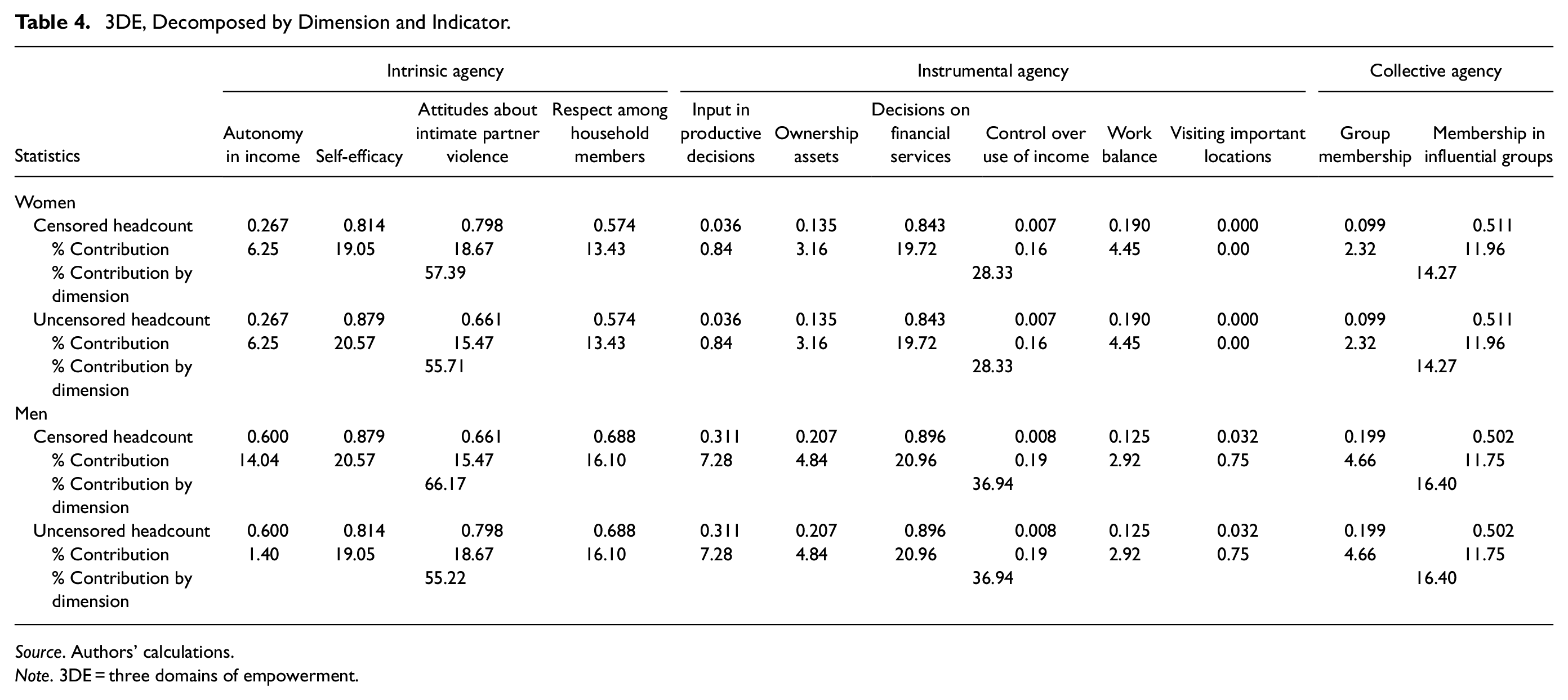
This section describes the contribution of the three domains of women’s empowerment (intrinsic agency, instrumental agency and collective agency) as well as each indicator by gender. It clarifies the threshold level of each indicator with respect to adequacy level (Table 4). A woman or man is defined as empowered if he or she has achieved 75% or above of the weighted indicators. Each indicator’s proportional contribution to disempowerment is equal to the contribution of a person who has reached empowerment. It is estimated as the censored headcount ratio for a given indicator divided by the total empowerment score, multiplied by the indicator’s weight, times 100. For Pro-WEFI analysis, comparing the uncensored and censored headcount ratio is crucial. The proportion of respondents who are disempowered and deficient in an indicator is known as the censored headcount ratio. Contrarily, the uncensored headcount ratio is the percentage of respondents who, regardless of their level of empowerment, are deficient in an indicator (Malapit et al., 2019). Table 4 presents the headcount ratio and relative contribution of each indicator to disempowerment as well as on a domain basis. In addition, Table 4 also shows the results of censored and uncensored headcount ratio. In addition, and importantly, the inclusion of a qualitative tool (FGD), provides additional insights into women’s empowerment.
3DE, Decomposed by Dimension and Indicator.
Source. Authors’ calculations.
Note. 3DE = three domains of empowerment.
Intrinsic Agency
There are four indicators under intrinsic agency: income autonomy, self-competence, behaviors toward intimate partner abuse and violence, and respect among household members. The average score in the intrinsic agency of censored headcount was estimated at 57.39% for women and 66.17% for men. Out of the four indicators, the self-efficacy indicator attained an adequate threshold level for men (0.879) and women (0.814). In contrast, the autonomy in income for censored headcount was estimated as 0.256 for women and 0.60 for men, while Alkire et al. (2013) report a comparatively lower score for both men (0.083) and women (0.259) for this indicator. Although men did not attain the adequate threshold level, they are in a better position than women in the study area. Surprisingly, the attitude about intimate partner violence was estimated at a higher threshold level for women, than that of men, this implies that women reported a higher rate of domestic violence than others did. This indicator has five different questions/statements regarding what circumstance a husband can do violence. Most of the women had the experience of intimate partner violence in fisher communities as noticed during FGD. In fact, physical violence is common in the fisher community also evident in another study (Ahmed, 2020) where more than 49% of fisherwomen reported they were victims of physical abuse. Both husband and wife reported an almost similar context for domestic violence, although women reported a higher rate of domestic violence than their men counterparts. It may be the case that women feel shy to disclose domestic violence to others but once women are together in a group, they feel more confident to tell the exact situation. One probable reason could be that once a woman expresses the domestic violence context, others overcome the fear/shyness to express her context. One of the female FGD participants expressed it like this We can visit our parents, relatives, friends, and families home with husband’s permission. But if someone moves around the village alone, her husband got informed and someone makes complaint against her, if she argues, then the husband torture his wife physically.
Similarly, one of the FGD participants (man) explained If the meal is not good, it makes me angry. If I can control my anger, I say nothing. If I cannot control it, I slapped her twice or thrice and then go outside.
Physical torture was a common practice that happened for disobeying the husband’s orders and command. Women did make legal claims against husbands in case of extreme physical violence. However, it is usually resolved within the family—in a few cases it is settled at the local government level.
Instrumental Agency
The instrumental agency domain includes contribution in major decision-making, ownership of tangible and intangible assets, decisions regarding financial services, control over the use of income, work-life balance, and mobility to important locations. The average score in the instrumental agency of censored headcount was estimated at only 28.33 for women and 36.94% for men. Among the six different indicators, only decisions on financial services attained the threshold level for both men and women. On the other hand, control over the use of income (women 0.007 and men 0.008) and visiting important locations (women 0.00 and men 0.032) had the least level of adequacy. Similarly, the WEAI study of Alkire et al. (2013) in southwestern Bangladesh found control of income had the least level of adequacy for men and women, although it was slightly higher than the results of this current study (0.248 for women and 0.027 for men). The situation may be explained by the way fisher households borrow money. Fisher households mostly borrow money from Mahajan (money lender) hence they have to return money whenever they earn money from catching fish- which implies limited control over their own income. None of the men and women had attained an adequate level regarding ownership of assets, but relatively less women (13.5%) had ownership of assets compared to men. This finding aligns with previous study results that 86% of plots are owned solely by men, 12% by women, and 2% jointly by men and women (Kieran et al., 2015; Seymour, 2017). When a family purchases new land there is no legal ownership of land for women until it is written in the deed or document (Sourav, 2015). Gender-specific ownership and control over assets have distinct effects on women’s ability to contribute to household wellbeing. In fact, women’s access to and control over productive resources generally enhances the diversity of household income sources and reduces the obstacles women experience when trying to access markets (Sharaunga et al., 2016). Hossain et al. (2021) found that women’s empowerment increases nutrient intake for children, including protein and calories through improving food security. It was well documented through FGD’s in ZOR and MPA regions, that women’s mobility in public places and gatherings are restricted and violence occurred when the disobey the restriction, thus the mobility score was zero for women. Women are not allowed to travel without permission from husband or parents but can travel with a trusted companion or under male supervision (husband or brother or others). Women and adult girls did not appear in the public places, researcher’s have observed this during the data collection. One of the female participants described this situation We can visit to our parents and relatives house with permission. Girls can go to school in a group. If someone moves around the village alone, her husband noticed but wife unable to provide proper explanation then physical torture is obvious.
In the similar way, one of the male participants mentioned that It is the shame for a husband if his wife moves outside home without any necessary reason. Villagers usually tease that man for his wife’s activities. That’s why, women are not usually seen outside home.
Collective Agency
Membership in influential groups and group membership are collective agency indicators that reflect leadership. Eight group membership types were considered, three were taken as an influential group—fisheries management group, local government, and religious group. It is observed from Table 4 that for both indicators, men and women did not reach the adequate threshold level. Relatively fewer women (9.9%) had access to group membership compared to men (19.9%), but both are far below the adequacy level. Bangladesh has experienced the emergence of diversified financial innovation that expands financial access to women in general. However, women had limited financial access in the study villages of the fisher community, the situation may be explained in two ways: i) although there is a good number of NGOs working in the study location they might fail to reach the women living in the fishing communities, and ii) women have limited supporting environment from the family to engage in financial institutions and/or with NGOs. These findings reflect the lower level of institutional access among fisher communities supported by other empirical studies (Khondker et al., 2014; Rahman et al., 2002) in Bangladesh. In contrast, Alkire et al.’s (2013) estimation shows a comparatively higher level of group membership for men (49.4%) and women (49.1%) in the case of the WEAI, but this number is still below the threshold level as around 50% of the women respondents do not have any group membership therefore are not empowered.
Despite limited institutional access, FGD’s confirmed that women are allowed to participate in NGO-led microcredit and livelihood development programs. World Vision and BRAC have offered a few income generating activities in ZOR and MPA regions. In this respect, one of the FGD female participants expresses that- We can attend NGO arranged meetings, listen to them, and ask them if we don’t understand.
However, a male participant indicated that they had some religious reservations about their wife participating Both husband and wife can earn. Women can earn by maintaining “Pardah.” There is no problem if women work outside by maintaining purdah. It is preferred to arrange such activities within household territory.
Through these findings, it can be said that women might take part in a livelihood development program that fits into local context.
In summary, the study found that women in the fishing community experienced higher levels of disempowerment across all 12 indicators, with the largest inadequacy gap observed in contribution to productive decisions, autonomy in income, and capacity to travel to important locations. Most women (77%) were disempowered, as reflected in both uncensored and censored headcount ratios, except for self-efficacy and attitude to intimate partner violence.
For men, 9 out of 12 indicators had similar for uncensored and censored headcount ratios, but autonomy in income, self-efficacy, and attitude about intimate partner violence showed a dissimilar trend, indicating that most disempowered men had inadequacy in these areas. Among the twelve indicators, only three indicators, that is, self-efficacy and decision on financial services, reached the adequate threshold level. Overall, women in the fishing community had limited participation in productive decisions, weaker leadership roles, and less control over resources, leading to higher disempowerment. Limited mobility (Waid et al., 2022), weaker market access (Faulkner, 2014), and less developed marketing skills also restricted women’s economic opportunities and excluded them from decision-making processes. These factors indicates that women are often barred from pursuits with greater financial gain and in decision-making processes. To address these challenges, interventions must be tailored to the local context and target specific indicators to enhance women’s empowerment. Prior research suggests that women’s empowerment is positively associated with life satisfaction, which underscores the importance of interventions that focus on contribution in production decisions, access to and control over productive resources, and control over income (Hossain et al., 2019). Hence, the findings highlight the need for context-specific interventions to improve the status of fisher community women and create an enabling environment for their empowerment.
Intra-Household Disempowerment Index
Figure 3 depicts a comparison between men and women’s disempowerment in the study, showcasing the contribution of each indicator to disempowerment. The depth of each bar represents the total disempowerment score (1-3DE), while the different colored bars display the absolute contribution of each indicator to disempowerment. Overall, eleven indicators found women were more disempowered than men, except for attitude toward domestic violence. The primary causes of disempowerment for both genders were access to and decisions on credit, attitude toward domestic violence, self-efficacy, membership in an influential group, control over use of income, and respect among household members. Previous studies conducted by IFPRI (2012) identified lack of control over resources, weak leadership and influence in the community, and lack of control over income as the most important contributors toward women’s disempowerment. However, Malapit et al.’s (2019) study found that group membership and membership in influential groups are the largest contributors of disempowerment for both genders in the fishing community. These results highlight the differences in men’s and women’s empowerment inadequacies in this context. The study also reveals that visiting important locations was the least disempowering indicator for women, while group membership was the least disempowering for men. Similarly, IFPRI’s (2012) study in Bangladesh found that the community’s lack of leadership and influence contributed much more to men’s disempowerment than women’s. These findings are crucial for future interventions aimed at shrinking the empowerment gaps, as they highlight the need to address these factors in the program design of a project.

Indicator specific contribution to disempowerment.
Strengths and Limitations of the Paper
This study was conducted in the ECOFISH II project areas to document the present situation of women’s empowerment in the fisher communities of coastal Bangladesh. A modified and refined Pro-WEFI was used based on three domains of empowerment (intrinsic, instrumental, and collective agency) to measure the status of women’s empowerment and disempowerment. One of the unique contributions of this paper is that it has developed comprehensive Pro-WEFI indicators that can be used for cross-cultural comparisons and evaluation of fisheries related projects that are mandated to examine women's empowerment in Bangladesh and elsewhere. In addition, the disaggregated score of each indicator for Pro-WEFI can also be utilized to determine the main areas of disempowerment (for men and women), that might be adopted for prioritizing project interventions. However, the specific findings may not be fully generalized outside of the study sites, as additional constraints might be found in other contexts. Further, the revised and refined indicators of the Pro-WEAI are yet to be validated in other contexts. Hence, future studies are needed on a larger scale using a comparable or slightly modified Pro-WEFI tool covering multiple sites. Finally, to document the diversity, cross-country comparative research might be conducted.
Conclusions
Bangladeshi gender norms are founded on the country’s patrilineal nature, which restricts women’s access to and control over productive resources, autonomy in income, and mobility, which is crucial for participation in fisheries governance. Persistent unequal relations norms within households, communities, and institutions have undermined women’s capability and restricted their active engagement. The scenario is obvious in fisher communities, particularly in coastal Bangladesh where women were mostly denied basic rights. This paper unpacks some pertinent women’s empowerment and disempowerment issues by adopting the Pro-WEFI tool. The Pro-WEFI delineates the empowerment and disempowerment scores of all 12 indicators. This analysis re-confirmed the worse situation of fisherwomen in the study sites. In all 12 measures, a higher proportion of women than males received inadequate results. Women had additionally constrained access to and decisions about credit, control over the use of income, contribution in productive decisions, and mobility in public places. Therefore, context-specific and needs-based development interventions are required to alter or change the situation. It is suggested to apply the Pro-WEFI tool in a longitudinal panel design of any fisheries project to capture the changes in women’s empowerment.
Footnotes
Acknowledgements
This work was undertaken as a part of the One CGIAR Research Program Resilient Agri-Food System (RAFS). It was carried out under a sub-project of the United States Agency for International Development (USAID) funded Enhanced Coastal Fisheries in Bangladesh II (ECOFISH II) activity through a collaboration between WorldFish and Bangladesh Agricultural University. The cooperation of the fisher in coastal regions in Bangladesh is gratefully acknowledged. We duly acknowledge Dr. Davina Boyd, Murdock University, Australia for her language editing services.
Author Contributions
This paper is contributed by six authors; Md. Wakilur Rahman is the first and corresponding author who prepare the final draft of this paper, A. B. M. Mahfuzul Haque helps in developing the conceptual framework, Tasnuva Zaman assists in doing qualitative analysis, Md. Salauddin Palash provides insights of Pro-WEFI analytical approach, Md. Nahiduzzaman provides extensive feedback on the draft manuscript while Tanzina Nazia help a lot to improve the manuscript by rephrasing the online text.
Declaration of Conflicting Interests
The author(s) declared no potential conflicts of interest with respect to the research, authorship, and/or publication of this article.
Funding
The author(s) disclosed receipt of the following financial support for the research, authorship, and/or publication of this article: We received reserach funding for this work from a sub-project of the United States Agency for International Development (USAID) through the Enhanced Coastal Fisheries in Bangladesh II (ECOFISH II) activity. However, it’s important to note that there was no finacial support specifically allocated for authorship or publicaiton of this article.

Data Availability Statement
Data sharing not applicable to this article as no datasets were generated or analyzed during the current study.