




Abstract
This study examines the relationship between antecedents of Individual Entrepreneurial Orientation (IEO) in female students. The study uses locus of control, Machiavellianism, resilience, and mindfulness as independent variables. Data for the study was collected using standardized self-rating questionnaires on 854 female students as a unit of analysis. Exploratory and Confirmatory Factor Analysis (EFA and CFA) have been used to examine the reliability and validity of the measurement. Consequently, Structural Equation Modeling (SEM) was conducted using Python after validating the measurement model. The final model describes the relationship of Individual Entrepreneurial Orientation with the internal dimension of locus of control together with Machiavellianism, resilience, and mindfulness. All mentioned constructs had a significant positive influence on the dependent variable. Simultaneously, mindfulness was found to have a positive effect on resilience and internal locus of control on Machiavellianism. This study has expanded the dynamic research boundary and resonates with the recent developments in IEO conceptualizations. Moreover, this work is one of the few studies conducted exclusively among female students.
Keywords
Introduction
In most countries, gender is a significant factor in the probability of establishing a business (Davidsson & Honig, 2003). It is one of the most potent distinguishing factors between nascent entrepreneurs and the general population (Delmar & Davidsson, 2000). Entrepreneurial orientation (EO), as a predecessor to entrepreneurial behavior, manifests itself differently between males and females regarding the manifestation of its dimensions (Covin & Miller, 2014). Sadly, the differences are always unidirectional in favor of men over women. In a widely popular and recognized study, the Global Entrepreneurship Monitor (GEM), has concluded that the Total Entrepreneurial Activity (TEA) rate for women is 10.2%, approximately three-quarters of that seen for men globally (Elam et al., 2019). Since there is a lower incidence of entrepreneurship among women compared to men (De Bruin et al., 2007), fewer high-growth businesses are led by women than men (Davis & Shaver, 2012), and women remain underrepresented in growth-oriented entrepreneurship (Jennings & Brush, 2013). Moreover, women-led businesses are smaller in size (Dautzenberg, 2012), which might relate to the desire to keep the company small and manageable to care for families (Brush et al., 2004). On its face, the overall innovation potential and future job creation are thus limited for women and men. Despite this disproportion, there are very few articles compared to those that address the issue without gender differences.
One possible method to increase female entrepreneurs is to focus on female students as education processes could significantly influence entrepreneurial intention (Pascucci et al., 2022) and entrepreneurial orientation (Frank et al., 2005). Entrepreneurial education in school and post-school is vital to entrepreneurial framework conditions (Kelley et al., 2017). Similarly, a supportive university environment positively affects entrepreneurial intentions (Turker & Sonmez Selcuk, 2009), giving educators the means to help solve this issue. The findings linking specific entrepreneurship education programs to entrepreneurship, although ambiguous, suggest a positive link between such education and the choice to become an entrepreneur and subsequent entrepreneurial success (Dickson et al., 2008). Building such programs and environments inevitably requires detailed knowledge of the antecedents of entrepreneurial attitudes and predispositions. When female students’ orientation toward entrepreneurship is understood, it becomes easier to facilitate their learning process and increase their intention to engage in entrepreneurship (Marques et al., 2018).
Moreover, to develop entrepreneurship and entrepreneurial competencies accordingly, the teacher needs to understand students’ entrepreneurial orientation (EO) (Taatila & Down, 2012). Thus, investigating relationships in entrepreneurial orientation models on an individual student level is of high practical value as well. In conclusion, understanding the causes of female entrepreneurial orientation is desirable for academia and policymakers. Thus, the study’s main aim is to examine the relationship between certain antecedents of EO. The antecedents examined in the study include locus of control, Machiavellianism, mindfulness, and resilience.
The research gap in the area of female entrepreneurship lies in the lower incidence of entrepreneurship among women compared to men, resulting in fewer high-growth businesses being led by women (Aggrawal et al., 2022; Bulsara et al., 2014; Franzke et al., 2022; MoMSME, 2018; Tiwari, 2017). This lack of representation in entrepreneurial ventures results in smaller business sizes, limited innovation potential, and future job creation (Franzke et al., 2022). To bridge this gap, focusing on female students as they embark on their educational journey could significantly increase their entrepreneurial orientation. The need for understanding the antecedents of female entrepreneurial orientation, including locus of control, Machiavellianism, mindfulness, and resilience, is significant for academia and policymakers. Hence, investigating these relationships on an individual student level could facilitate the development of entrepreneurship education programs and provide a supportive environment for female students to increase their intention to engage in entrepreneurship.
The organization of the article is as follows. The following section discusses entrepreneurship and entrepreneurial orientation and their importance for performance measures on national and company levels. Based on the literature review, we exhort individual entrepreneurial orientation (IEO) measurements and ground our arguments in previous studies. We then deductively create a research model and explain our methodology in the next section. Furthermore, we provide the reader with research results, and finally, the discussion and limitations section is included at the end of the paper.
Literature Review
To review the previous literature, we start with entrepreneurship’s influence on economic growth and its measurement. We argue entrepreneurship is a multidimensional concept, and it is most valuable when measured that way. Furthermore, we describe the development of entrepreneurial orientation from firm to individual level as one of the main concepts used in the entrepreneurial domain. This section presents the theoretical backdrop and discusses the different concepts identified for the study.
Theoretical Backdrop
This research derives inputs from various well-grounded theories. The Theory of Entrepreneurship of Lazear (2004, 2005) is the most prominent. The theory proposes that entrepreneurship originates from a thought pattern considering the choice between self-employment and paid employment. Furthermore, the theory proposes that lifetime income maximization is a crucial motive that explains why individuals become entrepreneurs. In the early entrepreneurial process, emotions, cognitions, and natural behavior patterns distinguish entrepreneurs from others (Breckler, 1984; Kollmann et al., 2007; Miller & Friesen, 1983). Further, fundamental differences exist in the cognitive thought processes of entrepreneurs who evaluate opportunities (Keh et al., 2002). In addition, Wiklund and Shepherd (2003) identified IEO as a positive force that helps discover and exploit opportunities. In addition, cognitive theories, like the Theory of Planned Behavior (TPB), Prospect Theory, and Transactive Memory, are also applicable to entrepreneurship research.
The TPB postulates that people who believe they intend to do and have the required experience will act out of the belief in the intention (Ajzen, 1985, 1987). Further, experience also affects the perception, feeding intention, and resultant action. Some key ideas from the social and behavioral sciences concerning predicting and comprehending behaviors in certain circumstances, such as IEO, can be incorporated into TPB. The Prospect Theory (Kahneman & Tversky, 1979) is another behavioral theory that can be applied to entrepreneurship. The theory explains how choices are made between riskier options with unpredictable outcomes. Based on the theory, it can be proposed that entrepreneurs are not risk-averse and that entrepreneurial aspirations act as reference points for EO (Bogliacino & González-Gallo, 2015). There could be three reference points for EO—representativeness, anchoring, adjustment, and availability (Roberts, 2010). A transactive memory system (TMS) examines where knowledge is formed and stored and how individuals can influence what they believe, remember, and use (Wegner, 1987). The TMS proposes a shared system of specialized knowledge acquired by individuals that could foster IEO.
Another applicable theory in the current context is the Social Learning Theory (SLT). The theory proposed by Wenger (1998) proposes that an individual needs to be actively involved in all aspects of the community, while simultaneously constructing the identity. This theory also posits that behaviors are learned through a process of observation, imitation, and reinforcement. The theory has been extensively applied in entrepreneurial research (Royo et al., 2015; Scherer et al., 1989). This theory can explain the four independent variables discussed in the paper. LOC is the belief about whether internal or external factors determine one’s outcomes. Rotter as early as in 1954 used SLT to present the theoretical background of LOC (Rotter, 1954). Later, Hansemark (2003) used SLT to suggest that individuals high in internal LOC are more likely to be entrepreneurial because they believe they can control their own success (Alshebami, 2022; Hansemark, 2003). A recent study by Al-Qadasi et al. (2023) also empirically identified a positive relationship between LOC and entrepreneurial intention. The next variable, Machiavellianism is related to risk-taking and exploitation of opportunities, which are also characteristics of entrepreneurial behavior (Matthews et al., 2022). SLT posits that individuals with high Machiavellianism are more likely to be entrepreneurial as they socially learned that these behaviors are rewarded.
The next variable is resilience is the ability to bounce back. Individuals with high resilience are more likely to persevere in the face of challenges, which is essential for entrepreneurial success. The SLT provides directions about the aspect that individuals having high levels of resilience are likely to be entrepreneurial due to their learnings from experience (Lietz, 2004). Mindfulness is the awareness of one’s thoughts, feelings, and sensations in the present moment. People with high mindfulness are more likely to be able to make sound decisions and take calculated risks, which are both important for entrepreneurial success. In a recent study, Judipat (2021) proposed that mindfulness has its basis in SLT, further suggesting that those with high mindfulness are likely to have EO. This is further based on the premise that the theory proposes a reinforcing position on the need to learn and be sensitive about the contexts (Bandura, 2000). The theory also proposes that mindfulness as a prerequisite for positive turnouts of learning.
Thus, in general, Machiavellianism, LOC, and mindfulness are viewed as social learning attractiveness, which is directly related to SLT (Alshebami, 2022; Bandura, 1977, Bandura & National Inst of Mental Health, 1986; Brown & Trevino, 2006; Lietz, 2004), having implications for EO.
Entrepreneurship, Growth, and Performance
While there is a tendency to assume entrepreneurship benefits economic growth, the literature on this fundamental effect differs considerably. Stel et al. (2005) failed to measure the universal effect of entrepreneurial activity on gross domestic product growth. Instead, they concluded that the entrepreneurial activity rate has a negative effect on relatively developing countries while it has a positive effect on relatively affluent countries. Further studies use economic growth as a dependent variable (Carree & Thurik, 2007; Valliere & Peterson, 2009, Urbano & Aparicio, 2016; Wong et al., 2005). Alternatively, Wennekers et al. (2005) studied the reverse effect and confirmed a U-shaped relationship between nascent entrepreneurship and per capita income as economic development metrics. Moreover, here one can find subsequent studies using entrepreneurship as the dependent variable with mixed results (Carree et al., 2007; Dau & Cuervo-Cazurra, 2014; Pinillos & Reyes, 2011). Galindo and Méndez (2014) summarized this overflowing research setting by pointing at double causality: economic activity promotes entrepreneurship and innovation activities, enhancing economic activity. However, the causality between entrepreneurship and economic growth has not been established conclusively (Valliere & Peterson, 2009).
However, we argue that the measure of total entrepreneurial activity as a proportion of nascent entrepreneurs in a population is of limited value for understanding innovation or economic growth. There are many examples in the literature where authors describe the various forms of entrepreneurship. For example, Mintzberg (1973) talks about three strategy modes. Entrepreneurial, adaptive, and planning. Then, the entrepreneurial model is characterized by several features compared to the other two models. There is an active search for new opportunities and dramatic leaps forward in the face of uncertainty, and growth is the dominant goal.
Entrepreneurial orientation (EO) as a concept was proposed by Miller (1983). He considered EO to have three dimensions: innovativeness, proactiveness, and risk-taking. He suggested that the absence of these elements could cause individuals to be less entrepreneurial (Miller, 2011). EO got popularized by the work of Covin and Slevin (1989). Subsequently, Lumpkin and Dess (1996) refined it and proposed a five-dimensional model: autonomy, innovativeness, risk-taking, proactiveness, and competitive aggressiveness.
Entrepreneurial Orientation from Firm to Individual Level
Many different units or levels of analysis can manifest entrepreneurship. However, the scholarly community has primarily coalesced and recognized EO as a firm-level construct that needs to focus on its performance (Covin & Lumpkin, 2011; Covin & Slevin, 1989; Goktan & Gupta, 2015; Haroon Hafeez et al., 2012; Lumpkin & Dess, 1996). For example, Koe (2013), using the five-dimensional model proposed by Lumpkin and Dess (1996), found EO to influence government companies’ performance positively. In addition, a handful of studies identified EO as a holistic construct and found it to affect organizational performance positively (Dada & Watson, 2013; Hult et al., 2003; Kemelgor, 2002; Reijonen et al., 2015; Swierczek & Ha, 2003).
However, enterprises are composed of human beings with predispositions, such as skills, character, and mindset. Therefore, several authors described the influence of individuals on organizational behaviour. For instance, Hambrick and Mason (1984) propose that organizational outcomes, strategies, and effectiveness reflect powerful organizational actors’ values and cognitive bases. Moreover, Dickson and Weaver (2008) and Anwar and Shah (2020) are more specific about the actors and argue that founders’ and top managers’ fundamental beliefs and predispositions shape the firm’s overall strategic direction. Basso et al. (2009) contribute to the debate with similar ideas. The angle of inclination of the top managers propose defines the firm’s orientation. Everything else (other players, initiative-takers, where entrepreneurial activities originate) is considered a mere execution of the overall posture. Shane (2003) reminds us of discovering entrepreneurial opportunities, and the decision occurs individually. Therefore, it was almost inevitable that the research stream measuring entrepreneurial orientation on an individual level would emerge, and its development is described in the following paragraphs.
Thus, recent researchers suggested and started investigating EO from a new perspective and considered it an individual-level construct (Koe, 2016; Robinson & Stubberud, 2014). Studies that considered EO an individual-level concept identified it as a multidimensional construct with elements analogous to firm-level EO (Chien, 2014; Koe, 2016). Because the measure of EO is based on self-reports by individuals (owners or chief executive officers), it is a psychological assessment of individual entrepreneurial orientation (Krauss et al., 2007). Kollmann et al. (2007) further helped to conceptually develop an individual orientation toward entrepreneurship in the context of pre-nascent entrepreneurs, elaborating its relationship with specific environmental factors, such as the cultural politico-legal, macro, and microeconomic environment. The conceptual model proposed in their paper operationalized individual entrepreneurial orientation (IEO) to measure autonomy, risk-taking, innovativeness, proactiveness, and competitive aggressiveness.
Langkamp Bolton and Lane (2012) advanced development in the individual measurement of entrepreneurial orientation by modifying the original Lumpkin and Dess (1996) variables initially used at the organizational level. The process consisted of IEO subscale development with items relevant to individuals not actively involved in business operations. Similarly, Taatila and Down (2012) altered the original Covin and Slevin (1989) EO measurement. For example, questions measuring innovativeness were adapted from an organizational context to examine the novel changes students have implemented in their lives.
Covin and Wales (2018) warn about this approach of concept stretching and ground their argument in a limited ability to use proactiveness as a component of EO on an individual level. Interestingly, one of the authors issuing this warning noted earlier that “it is arguable that EO behaviour may also be manifest at lower organizational levels through innovative and proactive business initiatives and projects undertaken by organizational members which lead to new firm product market entries” (Wales, 2016, p. 10). We argue that the proactive business initiatives undertaken by members, thus individuals, are a textbook example of individual proactiveness and are measurable on an individual level. Moreover, Langkamp Bolton and Lane (2012) confirmed proactiveness (together with innovativeness and risk-taking) to be reliable and valid components of IEO. We also must consider that in many countries, most entrepreneurs belong to micro-firms, which effectively exist as one-(wo)man companies (Bögenhold & Klinglmair, 2016). Thus, measuring EO on an individual level is highly desirable. However, we propose to distinguish between EO and IEO concepts carefully. Recent studies (Popov et al., 2019; Sahoo & Panda, 2019) followed the path and provided a promising starting point for further development and practical application of the IEO construct.
Model Specification
Once the dependent variable in our model (IEO) has been introduced, it is desirable to specify the independent variables used. Our theoretical model to describe entrepreneurial orientation uses several concepts discussed in more detail in this part of the article.
Locus of Control (LOC)
Locus of control is an individual’s general expectancy of the outcome of an event as being either within or beyond their personal control and understanding (Rotter, 1966). He used Social Learning Theory (Rotter, 1954) to present a theoretical background toward the internal and external dimensions of LOC. Internal locus of control (ILOC) shows that an individual believes in control of their decisions. External locus of control (ELOC) shows that an individual’s life is affected by external factors such as destiny, luck, or other individuals beyond their control. Consequently, one can deduce people with high ILOC can determine their career paths, have entrepreneurial intentions, and start businesses. Entrepreneurs must continuously make decisions related to their business outcomes. Therefore, the locus of control is assumed to be a highly relevant personality characteristic for entrepreneurial entry decisions (Caliendo et al., 2013).
Some studies demonstrated that new business founders have a higher ILOC than non-founders (Ahmed, 1985; Begley & Boyd, 1987; Mescon & Montanari, 1981). Entrepreneurs with an internal locus of control strive for high achievement, and at the same time, those whose businesses survived for 3 years had higher LOC than other people (Brockhaus & Horwitz, 1986). Higher LOC also significantly influences the decision to enter self-employment (Asante & Affum-Osei, 2019; Caliendo et al., 2013) and its positive influence on entrepreneurial intention (Tentama & Abdussalam, 2020).
Ishak et al. (2015) and Prakash et al. (2015) observed that those with ILOC exhibit a strong inclination toward EO. Similarly, Tentama and Abdussalam (2020) found a significant positive relationship between ILOC and EO. Hansemark (2003) showed the predictive power of LOC on entrepreneurial activity to start a new business. When comparing entrepreneurially inclined to non-inclined students, the latter showed lower scores in ILOC and risk-taking, need for achievement, and innovativeness (Gürol & Atsan, 2006). ILOC and the need for achievement and tolerance for ambiguity were observed to correlate with the EO of salesmen (Okhomina, 2010). ILOC is also higher among owners who rebuild the business after a major disaster (C. R. Anderson, 1977). Brunel et al. (2017) opined that LOC could decisively increase EO. Since the literature strongly points to LOC as an essential characteristic influencing entrepreneurial behaviour, thus, we include the ILOC and ELOC measures in our model.
There is substantial empirical evidence that ILOC is critical in positively predicting IEO (Baldegger et al., 2017; Rauch & Frese, 2007). A study by Spillan and Brazier (2003) found that ILOC is a characteristic that contributes to IEO. Those with high levels of ILOC have a strong belief to be successful in entrepreneurship (Brunel et al., 2017) and were indeed successful (Prakash et al., 2015). A recent study by Arkorful and Hilton (2021) found a positive relationship between ILOC and ELOC and EO among students. They also found ELOC to have higher levels of influence on EO. Moreover, females tend to be more external than males on most locus of control measures (A. C. Sherman et al., 1997). Studies have also found gender differences in locus of control and entrepreneurial abilities, with males and females differing in their locus of control and entrepreneurial abilities (Bamikole & Ilesanmi, 2012). Thus, it is hypothesized that:
H1: ILOC has a positive relationship with IEO.
H2: ELOC has a positive relationship with IEO.
Machiavellianism
Machiavellianism is conceptualized as one’s propensity to distrust others, engage in amoral manipulation, seek control over others, and seek status for oneself (Al Aïn et al., 2013; Dahling et al., 2009). Judgment and decision-making for individuals high in Machiavellianism are weighted to maximize personal gain and short-term profits, with little thought given to broader or long-term repercussions (E. D. Sherman et al., 2015). They also tend to follow their purpose with disreputable approaches (Do & Dadvari, 2017) and maintain a desire to control others (Zheng et al., 2017). Dahling et al. (2009) identified Machiavellianism to constitute a desire for control (DC) and a desire for status (DS). DC is the desire of Machiavellenists to exercise domination in social situations (Dahling et al., 2009). Through this, they tend to minimize the scope of power exercised by others. This is because those high in Machiavellianism see external others as threats, hence desiring authority over social situations. This is based on the perception of external causality, which aligns with several earlier studies (Fehr et al., 1992; Levenson, 1981; Mudrack, 1989).
Deci and Ryan (1985) proposed that Machiavellenists are driven by external rather than internal goals based on self-determination theory. The same opinion was also expressed by McHoskey (1999). This was based on the proposition that intrinsic goals are self-determined and Machiavellenists often perceive and identify events as externally controlled. They often identify success based on extrinsic goals like prosperity and status with internal goals. These factors add the dimension of DS to Machiavellianism. DS is the inclination toward external indicators to define success (Dahling et al., 2009).
Studies by Dhormare (2016) and Hunt and Vitell (2006) found an association between LOC and Machiavellianism. In addition, empirical evidence suggests that high ILOC and high Machiavellenists exert higher personal control over their environment (Christie & Geis, 1970). In a study on a sample of college students, Singh et al. (2017) found a negative correlation between the two. Furthermore, a recent study by Bonfá-Araujo et al. (2020) found Machiavellianism negatively related to ELOC. Bonfá-Araujo et al. (2020), Gable et al. (1990), and Solar and Bruehl (1971) also found a relationship between ILOC and Machiavellianism.
Individuals who score high in Machiavellianism can focus on a particular situation and devise the best winning strategies (Christie & Geis, 1970). However, empirical evidence suggests that once the individual becomes an entrepreneur, Machiavellianism could be detrimental as it affects innovativeness, proactiveness, and risk-taking (Bouncken et al., 2020). Concerning entrepreneurship, individuals high in Machiavellianism strongly demand money and wealth (Zettler & Solga, 2013) and thus could be well motivated to establish a business. They are highly result-oriented, use persuasion, and self-disclosure (Liu, 2008), have a desire for control and status (Dahling et al., 2009), and tend to manipulate and use others toward the realization of self-interest (Zheng et al., 2017). Furthermore, Machiavellians have low emotional exchanges (Zheng et al., 2017), can successfully hide their true intentions and biases, are highly adaptable, and use all possible means for goal achievement (Al Aïn et al., 2013). Entrepreneurs possessing these qualities exercise strategic competencies and make better decisions ideal for the current uncertain and unpredictable entrepreneurship milieu (Klotz & Neubaum, 2016; Rapp-Ricciardi et al., 2018). Earlier studies have found them well off in amorphous and unstructured work settings like entrepreneurship, where competitive spirit is valued (Fehr et al., 1992; Gable et al., 1992). They maintain a strong imperative toward monetary gain, wealth, supremacy, and competition (Zettler & Solga, 2013) and adopt a fast-life style that requires immediate gratification (Jonason et al., 2017). Successful entrepreneurship is ideal for achieving these goals, driving Machiavellians toward EO, and starting a business (Leonelli et al., 2020; Wu, Wang, Lee, et al., 2019; Wu, Wang, Zheng, & Wu, 2019). Based on the literature, it is presumed that LOC components could be connected to Machiavellianism. Thus, the following hypotheses are framed for the study:
H3: There is a positive relationship between ILOC and Machiavellianism.
H4: There is a positive relationship between Machiavellianism and IEO.
Mindfulness
Although the impact of mindfulness on organizational performance has been a matter of deep empirical examination, it is underexplored in entrepreneurship (van Gelderen et al., 2019). Mindfulness is a mental discipline based on deliberately projecting attention to physical sensations, emotions, and thoughts (Cooke, 2020; Sulphey, 2022). Mindfulness provides better awareness and attention, reducing stress and burnout, positively impacting the mind, body, and behaviour (Greeson & Chin, 2019; Strohmaier, 2020). It is a state of openness to novelty in which the individual actively constructs categories and distinctions, according to Langer (1992). He elaborated on it as an active state of mind that becomes receptive to context and perspectives. Mindfulness predicts LOC (Sulphey, 2016) and can reduce many harmful effects in the workplace (Zoghbi-Manrique-de-Lara et al., 2019).
The seminal work of Shapiro et al. (2006) brought the aspect of mindfulness to the limelight. They proposed a model which included three factors. The first one they proposed was the intention, which was identified as the motive for an individual to be involved in mindfulness practices. The next was attention, which involves the awareness of the current momentum, followed by attitude, which dented the quality of mindfulness. This work was a significant step and paved the way for identifying the mindfulness process. Those who are mindful accept the experiences, which could even be unpleasant. This acceptance of experience could reduce human suffering (Jnaneswar & Sulphey, 2021). van Gelderen et al. (2019) found mindfulness to be a concept that is relevant to entrepreneurship. According to them, mindfulness can stimulate alertness and flexibility, which would help further entrepreneurial action. In particular, they identified that dispositional mindfulness is directly related to being involved in entrepreneurial action.
Mindful individuals engage in thought patterns that allow them to make a more significant number of currently relevant, more precise distinctions. By remaining alert to potential changes in their situation, mindful individuals are more adaptively responsive to environmental shifts (Fiol & O’Connor, 2003). Sensitivity to change is one of the main precursors of entrepreneurial events representing a business opportunity (Brazeal & Herbert, 1999). From the organizational perspective, mindfulness is positively related to employee outcomes such as work engagement (Leroy et al., 2013), creativity (E. K. Byrne & Thatchenkery, 2019), self-consciousness (Evans et al., 2009), and job performance (Dane & Brummel, 2014). Mindful individuals benefit from the practice by being responsive to their environment, open to novelty, and are engaged in working, which matches some of the core entrepreneurial skills. Since mindfulness can help to be alert and flexible, it could further entrepreneurial mentality (Frese & Gielnik, 2014; Kabat-Zinn, 2003; Mathias et al., 2015).
However, there are contra opinions too. For instance, van Gelderen et al. (2019) suggested that mindful individuals are less reactive and are not likely to function in automatic patterns as they are conscious and aware. This consciousness and awareness could make them cautious and refrain from entrepreneurial actions. On the other hand, Kelly and Dorian (2017) proposed the positive impact of mindfulness on entrepreneurship orientation. Khalid (2018) proposed the temporal orientation and attentional breadth of mindfulness. Through these two, mindfulness can influence cognition and emotional ideals for a dynamic setting. Extending these to entrepreneurship, Khalid (2018) suggested mindfulness has extensive implications in entrepreneurship. He also proposed a framework underscoring the importance of mindfulness toward entrepreneurial orientation. According to Glenda (2019), imparting mindfulness training could help entrepreneurs succeed. Merkel (2020) found mindfulness to have a predictive relationship with EO.
A positive relationship exists between mindfulness and social entrepreneurship intention (Chinchilla & Garcia, 2017; Tuan & Pham, 2022). Furthermore, mindfulness upbringing perception can enhance prosocial motivation, leading to social entrepreneurship orientation (Shan & Tian, 2022). At the same time, there is a link between social entrepreneurship and gender, with research suggesting that women are more likely than men to set up a social enterprise (Fernández-Guadaño & Martín-López, 2022). Thus, we believe mindfulness can predict female entrepreneurial orientation. Accordingly the next hypothesis is formulated as: H5: There is a positive relationship between mindfulness and IEO
Resilience
Resilience is the process of capacity for or outcome of successful adaptation despite challenging or threatening circumstances (Masten et al., 1990), or in short, it is the ability to recover (Hedner et al., 2011). Rutter (1985) defined it as “a dynamic and flexible process of adaptation to life changes that enables an individual to cope with and recover from stress and to flourish when faced with adversity.” Resilience is planning and adjusting behaviour to unexpected events (Mallak, 1998). Several empirical studies have found mindfulness to help develop resilience in individual and organizational situations. Studies examining the relationship between mindfulness and resilience have found significant positive relationships (Gupta & Bajaj, 2017; Joyce et al., 2018; Pidgeon & Keye, 2014; Ramasubramanian, 2020). Glenda (2019) proposed a relationship between mindfulness and resilience and suggested that imparting mindfulness training to entrepreneurs could improve them in the long term.
Furthermore, Limphaibool et al. (2021) found that resilience and mindfulness can respond to various challenges of the modern world. Kelly and Dorian (2017) proposed that mindfulness can positively impact resilience. Rivoallan (2018) found that mindfulness plays a role in developing resilience in entrepreneurs and helps them cope with complex business situations. Similarly, Glenda (2019) also opined that mindfulness has the potential to develop resilience in entrepreneurs. Thus, It is hypothesized that mindfulness and resilience have a significant positive relationship.
H6: There is a positive relationship between mindfulness and resilience.
The literature has described resilience as positively related to intentions to start a business (Ayala & Manzano, 2014; Bullough et al., 2014). Aspiring entrepreneurs who believe in coping with stressful environments are significantly more likely to start a business (Bullough & Renko, 2013). Likewise, Monllor and Murphy (2017) propose that resilience protects intentions from the negative impact of fear of failure, thus increasing entrepreneurial intentions. Bullough et al. (2014) observed individual resilience to have a significant positive relationship with EO. Several studies (for example, Francis & Bekera, 2014; Jozefak, 2011) found resilience to be a critical phenomenon that makes entrepreneurs successful. According to Monllor and Murphy (2017, p. 628), resilience is “a shield that protects intentions from the negative impact of fear of failure.” Shelton and Lugo (2021) have also explored the resilience skills of African-American, Hispanic, and female entrepreneurs who face significant obstacles. Korber and McNaughton (2018) explored entrepreneurship and resilience through a meta-analysis from a multilevel and longitudinal perspective. From a socio-ecological sustainability perspective, they found the two constructs to have significant relationships. An empirical study by Pérez-López et al. (2016) revealed positive and significant relationships between resilience and entrepreneurial intentions. The same relationship was also found by Musara and Nieuwenhuizen (2020). While the relationship between resilience and entrepreneurial intention is clearly described in the literature, significantly fewer researchers connected resilience and entrepreneurial orientation. Exceptions are, for example, Wu, Wang, Lee, et al. (2019), Wu, Wang, Zheng, and Wu (2019), or Nasser (2021). Therefore, it is hypothesized that there is a significant positive relationship between resilience and IEO.
H7: There is a positive relationship between resilience and IEO.
Based on the hypotheses formulated, a theoretical model is proposed to be tested.
Methodology
Tools for Data Collection
Data for the study was collected by using various structured, standardized self-rating questionnaires as presented below:
Individual Entrepreneurship Orientation (IEO): The Entrepreneurial Orientation Questionnaire developed by the Entrepreneurship Development Institute (EDI), Ahmadabad was used to measure IEO, the dependent variable. The questionnaire measures 13 dimensions of IEO. The questionnaire measures initiative, Persistence, Systematic planning, Assertiveness, Persuasion, etc. The scale also has a correction factor consisting of five items. A few sample items include “I like challenges and new opportunities” and “When starting a new task or project, I gather a great deal of information.” The questionnaire also has a Correction Factor. Five items of this factor were used to determine whether or not a respondent tries to present a favorable image while responding. If the total score on this factor is 20 or greater, then the total scores on the 13 variables must be corrected to provide a more accurate assessment of the strength of that individual’s competency. The correction is done as per Table 1.
The questionnaire has been used in earlier studies in the same cultural milieu (Vivek & Sulphey, 2009).
External and Internal Locus of Control: Perceived External Locus of Control (ELOC) and Internal Locus of Control (ILOC) were measured using the questionnaire developed by Levenson (1981). The questionnaire has two sections of eight items, each on a five-point scale. Perceived ELOC is the belief that external forces control outcomes. Perceived ILOC is the belief that one’s ability, effort, or skills influence outcomes. A sample item of ELOC is “In order for my plans to work, I make sure that they fit in with the plans of the people above me.” A sample item for ILOC is “I can pretty much control what will happen in my life.”
Machiavellianism: Machiavellians are individuals who exploit others for their own purposes (Wilson et al., 1996). They are identified as goal-oriented individuals and tend to manipulate people in interpersonal situations (Hawley, 2006; Sutton & Keogh, 2000). Machiavellianism was measured with the six-item scale developed by Dahling et al. (2009). The questionnaire has two variables with three items each: Desire for control (DC) and Desire for status (DS). A sample item is “I enjoy having control over other people.”
Mindfulness: Mindfulness was measured using a five-item subscale from the spirituality questionnaire developed by Hardt et al. (2012). The tool was on a five-point scale ranging between “Not true at all” and “True nearly all the time.” The alpha of the scale was 0.89, signifying good reliability. “I deal consciously with the environment” is a sample item.
Resilience: Resilience was measured using the ten-item Connor–Davidson Resilience Scale (CD-RISC) validated by Campbell-Sills and Stein (2007). The scale enjoys good reliability, with an alpha of 0.85. The Scale had two subscales—Personal competence (seven items) and Control (three items). A sample item of the scale is “I tend to bounce back after illness or hardship.”
Details of Correction Factor.

The questionnaire also had a demographic section, which elicited information like age, program, year of study, and like.
Sample
The hypotheses proposed for the study were tested using data gathered from a sample of 854 Indian female students studying in the final year of professional programs like Engineering and Business Administration through a cross-sectional survey. After obtaining their concurrence and willingness to respond to the survey, the questionnaire was administered to the sample. The respondents were assured that the responses would be confidential and anonymous. These aspects were stated in the introductory letter appended to the questionnaire.
The researchers randomly selected a few professional colleges across the state of Kerala whose Heads of Departments (HoDs)/Deans were members of a social media group. The HoDs/Deans who informed their willingness to associate with the study were contacted, informing them of our desire to conduct a free short training program on Entrepreneurship Development. Permission was also sought from the HoDs/Deans to distribute and collect the questionnaires during the program. Approximately 15 to 20 min were required to complete the survey questionnaire. Data collection took around 3 months in the first part of 2022. Although over 900 questionnaires were collected, only 854 were found suitable for analysis. The rest were rejected due to various reasons. Nevertheless, the collected sample of 854 is well over the threshold limit of 384 proposed by Krejcie and Morgan (1970). Furthermore, the collected sample is according to the rules of thumb proposed by various experts for robust path model estimation (Barclay et al., 1995; Hoyle, 1995). For example, Barclay et al. (1995) stipulate that the sample size chosen has to be ten times the number of scale indicators or ten times the maximum number of structural paths in the inner path model. Hoyle (1995), on the other hand, suggested that a sample size of 200 is suitable for carrying out path modelling. Thus, the adequacy of the sample size can be assumed.
The minimum and maximum ages of the respondents were 19 and 28 years, respectively. The average age was 21.05 years, and the standard deviation was 1.50. They belonged to diverse programs, with maximum samples from BTech. (324), followed by MBA (228). The other programs include BPharm., BArch., BSc-Agriculture, and BSc-Optometry. The diversity of the sample in terms of geographical location and programs makes the data representative of the population, which makes the dataset acceptable and appropriate to examine the effect studied.
Data Analysis
The data were analyzed using structural equation modeling (SEM) through Python programming. SEM is best suited to measure and estimate multiple interrelations between independent and dependent variables (Hair et al., 1995).
Measurement of Reliability and Validity
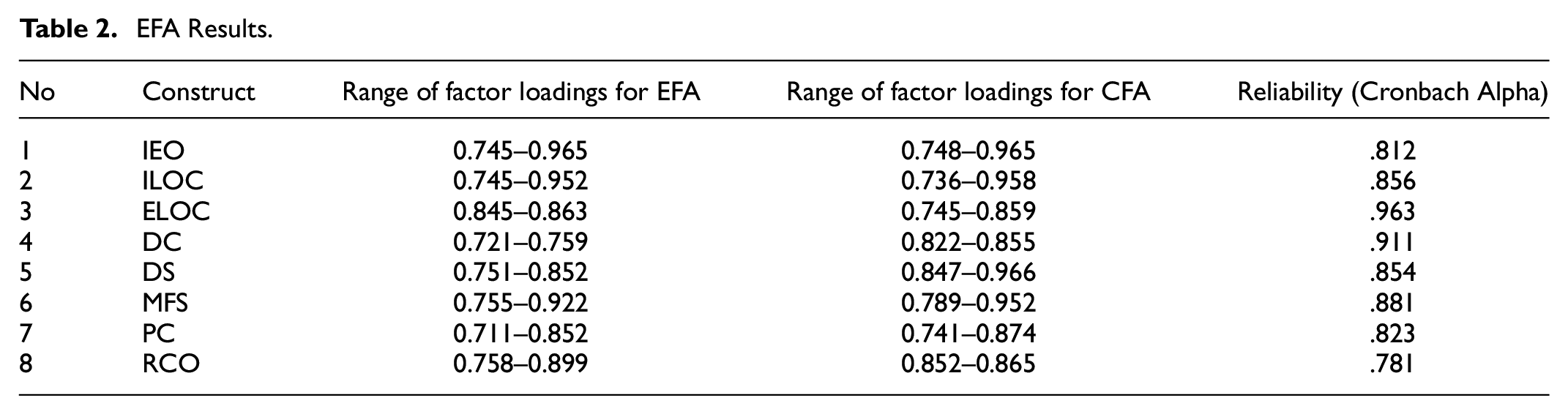
The study used Exploratory and Confirmatory Factor Analysis (EFA and CFA) to examine the reliability and validity of the measurement. All variables and items in the proposed model were subjected to EFA and CFA (B. M. Byrne, 2013). The reliability was assessed with Cronbach’s alpha. This is a base requirement for SEM. Other validating statistical metrics used in the analysis include composite reliability (CR) and average variance extracted (AVE).
Table 2 presents the results of the EFA and CFA. The table shows that the factor loadings (both EFA and CFA) and reliability scores are robust. All standardized factor loading coefficients were higher than the thumb rule of 0.50, confirming Kline’s (2016) and Hair et al.’s (2010) stipulations. The AVEs of all factors are higher than 0.70, as Hair et al. (2010) stipulated (Table 3). This confirms the internal consistency of the constructs (Aimran et al., 2017; Fornell & Larcker, 1981; Gefen et al., 2000; Hair et al., 2010). Thus, the measurement model comfortably satisfies the conditions for validity (content, construct, and convergent). Cronbach’s alpha meets Nunnally’s (1978) stipulation of 0.70. CR is the extent to which the constructs relate to the latent variable. It can be observed that all CR values are higher than 0.60 (Bagozzi et al., 1991; Fornell & Larcker, 1981; Hair et al., 2014). These values confirm the reliability.
EFA Results.
Convergent Validity (Standardized Regression Weights: Group number 1—Default model).
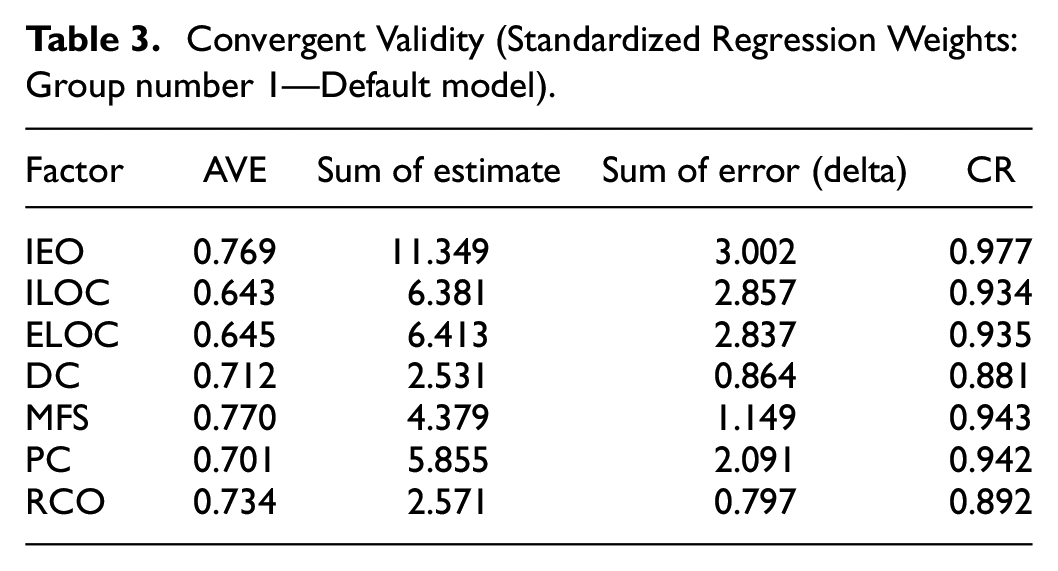
From the above results, it can be confirmed that the CFA model exhibits an exceptional fit. There arose no requirement to include any coefficients, error variables, or new paths between the constructs of the proposed structural model.
Fit Indices
The resultant model also provided robust fit indices (Table 4). Indices like RMSEA, RMSR, CFI, NFI, and TLI were assessed. From the Table, it can be observed that all fit indices are within the stipulations, thus presenting a picture of a good fit. According to Kenny et al. (2015), indices like RMSEA and TLI are highly recommended for assessing the model’s fit. All these indices are within the rules of thumb.
Fit Index.

Discriminant Validity
Discriminant validity is the uniqueness between the constructs (Hair et al., 2013; Hulland, 1999). Table 5 presents the discriminant validity. The constructs should have a relatively low correlation value to obtain discriminant validity (Bagozzi & Kimmel, 1995). It can be observed from Table 5 that none of the r values is over 0.70, as stipulated by J. C. Anderson and Gerbing (1988). Furthermore, all r values are lesser than AVE’s square roots (provided in the diagonal), meeting the Fornell and Larcker (1981) criterion. The values are an indication of discriminant validity.
Discriminant Validity.

Thus, the derived factor solution, validities, and reliability are within the stipulations proposed by Hooper et al. (2008). Since the data enjoyed a perfect fit, it was analyzed using structural equation modelling (SEM) with Python programming. SEM is ideal for estimating the multiple interrelationships between the proposed model’s independent and dependent variables (Hair et al., 2013). SEM can also evaluate the predictive validity of the structural model (Becker et al., 2013). SEM is an ideal analysis since the model for the present study involved multiple variables. This study closely followed the directions provided by Mueller (1996) and Thompson (2000) for the conduct of SEM.
Results
After validating the measurement model with CFA, SEM was conducted to test the hypothesized relationships between the variables. The details of the analysis are presented in the following sections.
Structural Equation Modelling (SEM)
SEM was conducted using the Python program after validating the measurement model. SEM is a tool that facilitates the complete and simultaneous test of multiple relationships in social science research (Tabachnick & Fidell, 2007). It also has the advantage of assessing the models’ (both measurement and structural) predictive validity (Becker et al., 2013). Hair et al. (2010) opined that SEM is helpful for testing theories that involve multiple relations and equations. Since the present study involves multiple variables, SEM is ideal for addressing research questions.
The path analysis procedure tested the hypotheses formulated for the study. Path analysis helps investigate the patterns of effect between variables (Allen, 2017; Wright, 1934). The main estimates of the latent variables are the beta-coefficients (β) and the related t-statistics, which test the path coefficients’ significance. A high β value strongly affects the predictor (Aibinu and Al-Lawati, 2010; Lleras, 2005). The level of significance of β was assessed using t-values. All path coefficients, barring one, are found to be significant at the .01 level. The various relationships between the constructs and the regression weights are presented in Table 6.
Structural Equation Modeling Results.

p at .01.
Table 6 shows that other than H2 that “There is a positive relationship between ELOC and IEO,” all other hypotheses formulated for the study are accepted at a .01 significance level. Based on the analysis, the final structural model arrived at is provided in Figure 1. The figure presents the complex and exciting relationship between the different variables identified in the study and IEO. All path coefficients have positive values, thus indicating a direct positive relationship between the variables identified in the study.

Final model.
The results show that ILOC has a positive relationship with Machiavellianism (coefficient of 0.921 and t-value of 6.21). The variable Machiavellianism is significantly related to Individual entrepreneurial orientation (coefficient of 0.833 and t-value of 5.36). Mindfulness has a significant positive relationship with resilience (coefficient of 0.711 and t-value of 2.56). Resilience is also significantly related to Individual Entrepreneurial orientation (coefficient of 0.752 and t-value of 3.55). The results derived from the study are indeed significant and provide directions about the factors associated with IEO.
The study’s findings are a fresh addition and contribute significantly to the entrepreneurial orientation literature. In addition, it provides multiple theoretical and practical implications, which are presented in the following sections.
Discussion and Conclusion
India is a catching-up economy that is critical in achieving global prosperity. The country has constantly witnessed buoyant economy, industry, and corporate transformations. Entrepreneurship has played a predominant role in these praiseworthy transformations. The country requires a constant flow of young entrepreneurs to achieve and sustain its growth objectives. The present study investigated the relationship between a few antecedents of IEO. The investigation has arrived at several key findings grounded on empirical analysis. The antecedents examined include locus of control (both internal and external), Machiavellianism, mindfulness, and resilience. Data for the study were collected from female students studying in professional colleges. The results mostly supported the measurement model.
The results have numerous academic, theoretical, and practical implications. It also enhances the understanding of the antecedent of IEO. First, this paper has contributed significantly to the limited literature on female student entrepreneurial orientation. Second, the study has investigated the antecedents of IEO in the Indian context, thereby adding to the limited body of literature accumulated from the country. Third, the study results indicated that the hypothesized model about ILOC, Machiavellianism, mindfulness, and resilience to IEO is accepted. Finally, these findings are consistent with several prior research studies.
ILOC is an important characteristic that has received deep empirical interest in the entrepreneurship literature. The positive relationship between ILOC and IEO observed in the present study substantiates the findings of Arkorful and Hilton (2021), Prakash et al. (2015), and Tentama and Abdussalam (2020). On the other hand, contrary to the hypothesized model, the study did not support the relationship between ELOC and IEO among female students. This contradicts Arkorful and Hilton’s (2021) findings and partially agrees with Ishak et al. (2015). The study found a positive relationship between Machiavellianism and IEO. This finding supports earlier studies by Leonelli et al. (2020), Wu, Wang, Lee, et al. (2019), and Wu, Wang, Zheng, and Wu (2019). In addition, the finding that mindfulness is related to EO substantiated earlier studies by Khalid (2018) and Merkel (2020). Similarly, the observed relationship between resilience and IEO extends the findings of Pérez-López et al. (2016) and Musara and Nieuwenhuizen (2020).
Theoretical Implications
This present study has several theoretical contributions. First, this work has expanded the dynamic research boundary and resonates with the recent developments in conceptualizations in IEO. Most existing research has considered only the general entrepreneurial orientation. Second, although entrepreneurial orientation has received prior attention, this research work is unique as it has examined the influence of a few antecedents of IEO among female professional college students. Next, it has successfully enriched the relevant literature on IEO and offers a comprehensive mechanism for the complex and interdependent relationship with the antecedents. In addition, the variables identified for the study, Machiavellianism, LOC, and mindfulness, are viewed as social learning attractiveness, which is directly related to SLT (Alshebami, 2022; Brown & Trevino, 2006; Jnaneswar & Sulphey, 2023), having a direct relationship with IEO. Finally, although multiple studies have independently examined the relationship between IEO and specific variables, the present work has studied the simultaneous association between the identified constructs. This is indeed a significant contribution to the field of entrepreneurial research. Furthermore, this is one of the few studies conducted exclusively among female students. Another uniqueness is that the study was conducted among students of professional courses.
Practical Implications
Rapid technological changes, fluctuating customer preferences, and escalating competition add dynamism to the economic and industrial milieu. Societies need to transform themselves better by utilizing human resources and capabilities to meet growing challenges. A band of emerging, creative, and innovative young entrepreneurs is an answer to these dynamic challenges. This study has made broad contributions toward identifying the causative factors of IEO. There is a need for any emerging economy to continuously sense, monitor, identify, and nurture entrepreneurship and EO. This is indeed a complex process. The finding of the study is a pointer toward this direction.
The research conducted among female professional college students has several practical implications. First, the present work extends the available literature by uncovering the psychological mechanisms IEO is influenced. For instance, available empirical evidence suggests that mindfulness predicts IEO (Merkel, 2020). Furthermore, imparting mindfulness training could help entrepreneurs succeed in their ventures (Glenda, 2019). The positive relationship identified between mindfulness and IEO confirms this. This finding augurs well for students, and various training programs combined with appropriate mindfulness training would help enhance EO. Mindfulness helps individuals maintain focus, manage stress and emotions, and improve decision-making abilities, all of which are valuable skills for entrepreneurs. Integrating mindfulness training into entrepreneurship courses can provide students with practical tools to enhance their well-being and performance, making them better equipped to succeed in their careers.
Another area is resilience. The study has found a positive relationship between resilience and IEO. Resilience is another trait that can be enhanced among individuals through training (Sulphey, 2020, 2023). Entrepreneurship is often associated with high levels of uncertainty, risk, and failure, making resilience an essential quality for individuals who wish to pursue a career in this field. By teaching resilience as a skill, universities can provide students with practical tools and techniques to handle adversity, bounce back from failures, and persist in the face of challenges. The focus on resilience should not replace the importance of theories and knowledge but complement it. This will provide students with a well-rounded education that prepares them not only for the challenges they will face in the classroom but also for the challenges they will encounter in their careers. Administrators and educators involved in entrepreneurial training could include modules intended to enhance mindfulness and resilience among the participants. Furthermore, resilience training would go a long way once they become entrepreneurs, cope with daily stress, and rebound successfully after a failure.
Limitations and Suggestions for Further Research
This study contributes substantially to the dynamic theory of EO. It has helped determine the interplay of multiple antecedents of IEO. However, as is common in research work, the study is not without certain limitations. A probable limitation is using cross-sectional data for data collection, which impedes making firm conclusions about the causal relationships between the variables. Future researchers could attempt studies based on longitudinal data to gauge the complex relationships between the variables. Furthermore, as the data was limited to female students, there is doubt about the generalizability. This aspect could be tackled through a comparative study that examines the model with data collected from male students. There could also be a lack of sensitivity to the various items in the questionnaire. This could make social desirability creep into data collected through self-reports. Future studies could also be undertaken using more related constructs that could enhance IEO. The authors would be highly obliged if the present work triggers future investigations in this exciting area.
Footnotes
Declaration of Conflicting Interests
The author(s) declared no potential conflicts of interest with respect to the research, authorship, and/or publication of this article.
Funding
The author(s) disclosed receipt of the following financial support for the research, authorship, and/or publication of this article: This research is funded by Prince Sattam Bin Abdulaziz University under a project numbered PSAU/2023/1444

Data Availability Statement
The date is available on request with the corresponding author.