




Abstract
Due to the dramatic rise in the entrepreneurship trend both in education and industry, there is a high growth in the tourism and hospital industry. But the valid tool for assessing talent’s entrepreneurship competence wasn’t available. Thus, the aim of this study is to construct an assessment scale for youth’s Restaurant Entrepreneurship Competency (REC) in Taiwan. Methods with qualitative step consisted of expert in-depth interview and Delphi technique which gained 35 original items and 5 domains. It shows the patterns of REC. The quantitative step involved students of universities as participants in the pre-test and survey. The collected 762 valid data were used for exploratory factor analysis, item analysis, and confirmatory factor analysis. Finally, a total of 29 items passed in the examination and named the “REC Scale.” It could be used to assess youth’s REC, and provide educational resources or designed curriculum for talent cultivation.
Keywords
Introduction
The Sharp Development of Taiwan’s Restaurant Industry
The trend that drove economic development in the 21st century focused on the tourism, hospitality, and culinary arts industries (Torrent-Sellens et al., 2016). Accordingly, public sectors supported in developing these fields. The “Annual Report of Foreign Tourists Survey” by the Taiwan Tourism Bureau (2017) pointed out that one major activity of foreign tourists in Taiwan was that of tasting delicious local food, fruits, and beverages, providing the nation with an evident economic return. The YoY turnover rate of the restaurant industry in Taiwan has been rising for decades, with the restaurant market being highly and evenly competitive. These circumstances caused the fast turnover, high pressure in business creation or innovation, and generated considerable opportunities for entrepreneurship. Table 1 summarizes the employment, enterprises, and annual turnover in Taiwan from 2013 to 2019, showing the development trend.
Statistical Data of Food Service in Taiwan From 2013 to 2018.

The Entrepreneurship of Restaurant Industry
Studies on culinary arts, leisure, tourism, and hospitality entrepreneurship have considerably increased in recent years (Andringa et al., 2016; Hallak et al., 2012; Kline et al., 2017; Komppula, 2014; Peters et al., 2019; Saadin & Daskin, 2015). To drive the development of the tourism industry, many countries engaged in innovations and entrepreneurial initiatives (Knychalska & Shaw, 2002; LaLopa, 2006). Most of these entrepreneurial ventures were small- and medium-sized enterprises (SMEs) in the restaurant, tourism, or hospitality industry. SMEs need substantial entrepreneurship, but research on the matter is scant (Chang, 2011; Hjalager, 2010; Koh & Hatten, 2002; Li, 2008; Solvoll et al., 2015). Therefore, Restaurant Entrepreneurship Competency (REC) has become a critical issue in the industry. However, the lack in nurturing entrepreneurship, literacy assessment, or the related issues in the field of culinary arts remains a concern. Some studies explored the value and importance of entrepreneurial competencies for university students (Chang et al., 2018; Rezaei-Zadeh et al., 2017; Shir et al., 2019), sharing the belief that entrepreneurship should be a core competency, nurtured at the higher education level. Furthermore, they mentioned creativity and innovation as essential within entrepreneurial competencies. There still are no specified scales for measuring entrepreneurial competencies in the culinary field. Therefore, if an integrated assessment tool was developed, these competencies could be distinguished and transferred into designing a curriculum for talent cultivation.
The Cultivation of Talent
In the complex and diverse environment of the modern era, the culinary industry and technological–vocational education not only cultivate employees and students’ professional knowledge, but they also equip students with skills in technology implementation, problem-solving techniques, innovation, and entrepreneurship (Kline et al., 2017; Lam et al., 2007; Sukasame et al., 2008). The number of undergraduate students of culinary arts, tourism, restaurant or hospitality has grown significantly between 2014 and 2018 (see Table 2). Furthermore, the student ratio of restaurant-related disciplines increased from 12.4% (2014) to its highest of 13.5% (2017), before dipping to 12.9% in 2018 due to low birth-rate. Compared to other disciplines, the number of students in restaurant-related disciplines was one of the top three in Taiwan from 2014 to 2018. Prior to 2014, the discipline did not isolate restaurant-related disciplines from the others; for this reason, those specific data could not be used in this study. From the collected data, it was easy to find that the restaurant-related discipline was the most popular among undergraduate students in Taiwan. In addition, these results meet the government survey result of the workplace survey.
The Number of Undergraduate Students of Culinary and Tourism in Taiwan From 2014 to 2018.

Source. National Academy for Educational Research (2015, 2016, 2017, 2018, 2019).
Hegarty (2004) believed that culinary curriculum development and modern education should be treated extensively as a range of knowledge and skills. Therefore, promoting culinary education into globalization and achieving the “internationalization of delicious local food” are components of the core policy of Taiwan’s national development plan (Ministry of Economic Affairs, 2010). Wennekers, Thurik, van Stel and Noorderhaven (2007) explained that 50% of successfully established businesses could disappear within 5 years. Therefore, entrepreneurial competencies should measure objectively either the decision-making on the capital-based provision, or the estimate of financial projections.
In summary, this study aims to develop an assessment tool for measuring youth’s REC. The research tool was used in evaluating the potential of restaurant entrepreneurs and culinary arts students in REC.
Literature Review
The Sharp Development of Taiwan Restaurant Industry
The new economic trend that focused on tourism, hospitality, and the culinary arts industries drove the economic development of 21st century (Torrent-Sellens et al., 2016). Accordingly, it was supported in developing these fields by the public sector. The “Annual Report of Foreign Tourists Survey” by the Taiwan Tourism Bureau (2017) pointed out that one major activity of foreign tourists in Taiwan was that of tasting delicious local food, fruit and beverage; the nation has thus gained a considerable income. The YoY turnover rate within the restaurant industry in Taiwan has been rising for decades, with the market of restaurant becoming highly and evenly competitive. These circumstances caused a rapid turnover, high pressure in business creativity or innovation, and considerable entrepreneurship opportunity. Table 1 summarizes the employment, enterprises, and the annual turnover in Taiwan between 2013 and 2019.
Entrepreneurship in the Restaurant Industry
Studies on culinary arts, leisure, tourism, and hospitality entrepreneurship have considerably increased in recent years (Andringa et al., 2016; Hallak et al., 2012; Kline et al., 2017; Komppula, 2014; Peters et al., 2019; Saadin & Daskin, 2015). To drive the development of the tourism industry, many countries engaged in innovations and entrepreneurial ventures (Knychalska & Shaw, 2002; LaLopa, 2006). Most of these were SMEs within the restaurant, tourism or hospitality industries. SMEs need substantial entrepreneurship; however, research on entrepreneurship is scant (Chang, 2011; Hjalager, 2010; Koh & Hatten, 2002; Li, 2008; Solvoll et al., 2015). Therefore, the REC has become a critical issue in the industry, despite the fact that entrepreneurship cultivation, literacy assessment or related issues in culinary arts field remain a concern. Some studies explored the value and importance of entrepreneurial competencies, including essential factors such as creativity and innovation, for university students (Chang et al., 2018; Rezaei-Zadeh et al., 2016; Shir et al., 2019). They all agreed that entrepreneurial competencies should be core competencies nurtured at the higher education level. There still are no specified scales to measure entrepreneurial competency in the culinary field. Therefore, if an integrated assessment tool was developed, entrepreneurial competencies could be outlined and implemented to design a curriculum for talent cultivation.
The Cultivation of Talent
In the complex and diverse environment of the modern era, the culinary industry and technological–vocational education not only cultivate employees and students’ professional knowledge, but they also equip students with skills in technology implementation, problem-solving techniques, innovation, and entrepreneurship (Kline et al., 2017; Lam et al., 2007; Sukasame et al., 2008). The number of undergraduate students of culinary arts, tourism, restaurant, or hospitality grew significantly between 2014 and 2018 (see Table 2). The student ratio in restaurant-related disciplines increased from 12.4% (2014) to 13.5% (2017), then dipping to 12.9% in 2018 due to the low birth-rate. Compared to other disciplines, the number of students in restaurant-related disciplines was among the top three in Taiwan between 2014 and 2018. Prior to 2014, restaurant-related disciplines were not separated from other disciplines; for this reason, no data from that period could be used in this study. The collected data, which matched those of workplace surveys administered by the government, showed that restaurant-related disciplines were the most popular among undergraduate students in Taiwan. Hegarty (2004) believed that curriculum development and modern culinary education should be treated as a range of knowledge and skills. Therefore, promoting culinary education into globalization and achieving the internationalization of local food are components of the core policy of Taiwan’s national development plan (Ministry of Economic Affairs, 2010).
In summary, this study aimed to develop an assessment tool for measuring youth’s REC; this research tool was used in evaluating the potential of restaurant entrepreneurs and culinary arts students in REC.
Theory of Entrepreneurship and Competency
Van de Ven (1993) argued that an enterprise creation is a product of entrepreneurs’ interpretation of market position, business characteristics, and achievement. In entrepreneur and entrepreneurship studies, a consensus exists on a set of attitudes possessed by the entrepreneur (Vilas Boas et al., 2014): variables of individual level (e.g., skills, determination, and intentions), interpersonal ability (e.g., innovations, clients, and potential employees), and social levels (e.g., governmental, political, and economic conditions) that seeped into each phase of the business process (Baron & Shane, 2007). “The entrepreneurs are differentiated people, who have a singular motivation, are passionate for what they do, feel satisfied just by being another one in the multitude. . .” (Dornelas, 2001). This definition suggests that entrepreneurs wish to create a legacy of entrepreneurship—hence, apart from administrative abilities, a successful entrepreneur has other characteristics, such as attitude, skills, motivations, and entrepreneurial sense.
Competency has conceptually been defined as involving different features, including knowledge, abilities, attitudes, and characteristics (Woolacott, 2009). Stoof (2005) has concluded that competency could be interpreted as a behavior that successfully integrates knowledge, capabilities, and attitudes, while Driessen and Zwart (2006) have identified the components of competency in desire, capability, and knowledge. Each component has been briefly discussed in the current study, especially in terms of entrepreneurship.
Mojab et al. (2011) determined that the most relevant entrepreneurial competencies involve having initiative, being ambitious and critical, and possessing analytical thinking. Scholars’ research finding led them to emphasize that the behavior of entrepreneurs reflected their functional literacy (Linder, 1990; Mojab et al., 2011). Furthermore, Mitton (1989) used a designed process that analyses an individual’s entrepreneurial abilities, and Driessen (2005) developed an entrepreneurial competency scale that comprises strong motivations and problem-solving abilities to reach the goal of being a successful entrepreneur. The 10 aspects of entrepreneurial ability (Oosterbeek et al., 2008) are the demand for a goal, need for autonomy, social trend, desire of power, self-efficacy, durability, orientation toward risk-taking, awareness toward the market, flexibility, and creativity. Ismail (2014) argued that female entrepreneurs of Indonesia hold an important role in operating SMEs; they encompass the needs for achievement, endurance, market awareness, orientation of risk-taking, and social trend. Many studies have aimed to determine the entrepreneur’s qualities in terms of psychological factors, characteristics, behaviors, and entrepreneurial skills (Baron, 2007; Baum & Locke, 2004; Fayolle & Gailly, 2013; Littunen, 2000; Sánchez, 2013). A strong correlation is identified between entrepreneurial potential and skills such as entrepreneurial abilities, creativity, reorganizing resources, and locus control (e.g., Luca & Cazan, 2011). Thus, the abovementioned variables have been included in the scale of this study.
REC and Education
Entrepreneurship is a crucial issue in the early development of the tourism and hospitality industry in rural or local communities, where international hotels and multinational companies hardly invested due to the relatively small scale of the market and its potential (Chang, 2011). Zapalska et al. (2004) studied and focused on the relationship between the life cycle and entrepreneurship of small hospitality companies. It shows that high or low entrepreneurship competency played a moderating role that impacted the achievement of new ventures, especially in the first stage. Wagener et al. (2010) used multiple analyses of variance on a unique data set from the hospitality industry which consisted of 194 business owners. The results showed that some unique personalities had distinguished themselves among those selected samples. Their characteristics consisted of tolerance of ambiguity, innovativeness, independence, leadership qualities, and risk-taking propensity of business owners; however, market orientation and self-efficacy were not included. According to Shahab et al. (2018), entrepreneurial self-efficacy would impact entrepreneurial intentions dramatically.
Camillo et al. (2008) identified the difference between a successful and an unsuccessful entrepreneur. In entrepreneurship, an individual holding a bachelor’s degree in Culinary Arts and related majors has a higher success rate than those with other degrees, who failed in business ventures. They further distinguished some successful concepts such as executive plan, marketing plan, and marketing practice. A successful business is evidently dependent on cultivating talent with entrepreneurial knowledge and skills in the early stage of education (Anabela, Arminda, João, Mário & Ricardo, 2013). Hence, competency-based education and its application caught the attention of academic and educational experts: scholars addressed the importance of learners’ preparation to act in a new, uncertain, and changing environment. It required individuals to acquire specific skills based on the environment they were engaged in (Mojab et al., 2011).
In general, it is clear that a successful entrepreneur relies on good education and a well-designed curriculum in entrepreneurial knowledge, skill, and attitude. Thus, researchers engaged in developing an adequate research tool for measuring students’ potential; thereafter, a specified curriculum would have been designed to cultivate their talent.
Entrepreneurship in Vocational Education
The entrepreneurial economy has been driven by personal initiative and diverse special skills, and it has been recognized by vocational educators. These factors are the goal of technological–vocational education (Kent, 1990). Empirical evidence demonstrated that graduate students would win more jobs opportunities than an entrepreneur in high school or at a lower education level (Weber, 2011). However, entrepreneurs receive a bachelor’s degree would successfully than who have no entrepreneur during the first stage (Shane, 2004). Weber (2011) explained that the German government announced the policy objective of nurturing entrepreneurship culture in higher education organizations, thereby developing students’ global competitiveness and mobility.
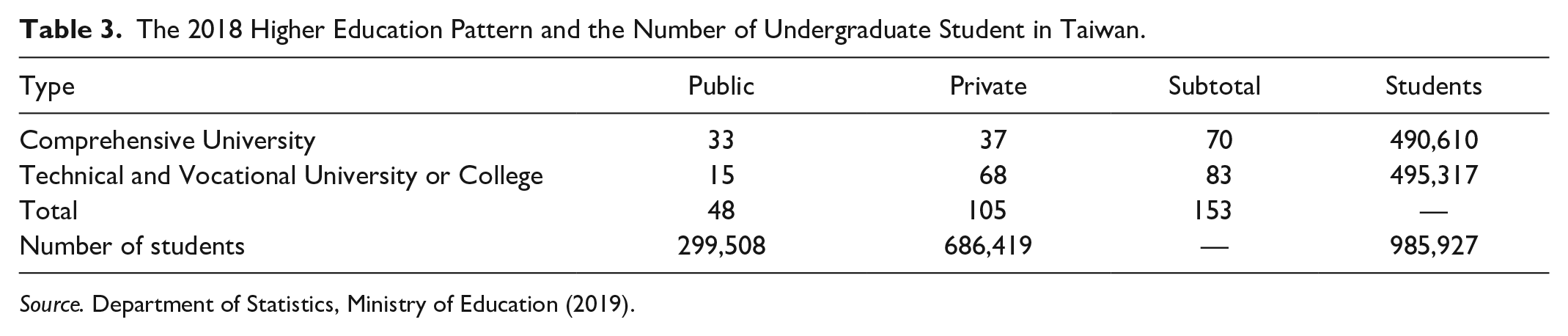
In Taiwan, according to the government database (Department of Statistics, 2019), there were 153 universities or colleges in total in 2018, with comprehensive universities being 70 (45.8%), and technical and vocational universities or colleges being 83 (54.2%). The number of technical higher education establishments was slightly higher than that of comprehensive universities. Moreover, undergraduate students from technical higher education institutions were 50.2% (n=495,317), with that of comprehensive universities being slightly lower. The statistical numbers (Table 3) reflected that the technical higher education system was more responsible for talent cultivation—the major difference, compared to comprehensive universities, being that the disciplines of technical higher education institutions focus on practical and industrial orientation, and actively cultivate the student’s professional skills, including entrepreneurship.
The 2018 Higher Education Pattern and the Number of Undergraduate Student in Taiwan.
Thus, the government policy and strategy for cultivating and extending entrepreneurship education be treated as beneficial in achieving the goal of promoting entrepreneurship education (European Commission, 2006; Ministry of Education, Taiwan, 2017; Weber, 2011). Weber (2011) argued that the importance of entrepreneurship in higher education catches stakeholders’ attention. It was determined that an individual’s education level was positively associated with entrepreneurial success (van der Sinis et al., 2005). However, scholars argued that entrepreneurship was not encouraged in the formal education system, but rather, for students’ employment preparation (Kourilsky, 1995; Spinelli & Adams, 2016; Weber, 2011); in other word, education even suppresses an individual’s creativity and entrepreneurship (Chamard, 1989; Fjortoft et al., 2018; Plaschka & Welsch, 1990) in Taiwan and Germany. To address this issue, specialized entrepreneurship education was integrated into the curricula of secondary and tertiary institutions in Germany (Klandt et al., 2008). In general, entrepreneurship is important to universities, and is further integrated into the curriculum to cultivate the talent of the students.
Entrepreneurship-Related Research Tools
Several questionnaires have been administered by researchers to measure related factors, including entrepreneurial intention, motivation or orientation (Fuller et al., 2018; Lumpkin & Dess, 1996; Miller, 1983; Rezaei-Zadeh et al., 2017; Wang, 2014), entrepreneurial characteristics (Bezzina, 2010; Hockerts, 2015; Liñán & Chen, 2006; Ploum et al., 2018; Rezaei-Zadeh et al., 2017; Wang, 2014), entrepreneurship index (Kopycińska et al., 2009), entrepreneurship readiness (Omenyi et al., 2009; Rezaei-Zadeh et al., 2017), and entrepreneurial intention (Liñán & Chen, 2006; Vargas-Halabí et al., 2017). Researchers have also distinguished factors such as risk taking (Bezzina, 2010; Vargas-Halabí et al., 2017; Wang, 2014), creativity or innovation (Bacigalupo et al., 2016; Bezzina, 2010; Omenyi et al., 2009; Shir et al., 2019; Wang, 2014), self-confidence (Bezzina, 2010; Omenyi et al., 2009), thinking variety (Ploum et al., 2018; Rezaei-Zadeh et al., 2017), and competencies (Lu et al., 2016; Ploum et al., 2018; Shir et al., 2019). The sub-dimensions of these scales reflected the researchers’ focus. Innovation or creativity was the most common comment in the questionnaires, followed by intentions and risk-taking. Table 4 summarizes the subjects, sub-domains, and developed item of the questionnaires.
Summary of Related Entrepreneurship Measurement Tools.

Source. Own compilation.
Note. GEM = global entrepreneurship monitor; SEAS = Social Entrepreneurial Antecedents Scale; EIQ = Entrepreneurial Intention Questionnaire.
Summary
As Taylor (2008) mentioned, youth’s aspirations, knowledge, opinions, and educational potential should be addressed and given more attention. It was found that a lack of knowledge and experience prevented entrepreneurs to achieve youth aspirations and r communities (Taylor, 2008). The same argument appeared in related studies that point out how entrepreneurs mentoring youth will positively affect their entrepreneurial intention as undergraduate students (Baluku et al., 2018; Mehtap et al., 2017; Taylor, 2008). Furthermore, Mehtap et al. (2017) found that a strong and supportive education system could reduce some barriers to entrepreneurship. In addition, the development of restaurant entrepreneur education in Taiwan was comparatively slower than Western countries. Thus, this study aims to fill this gap and develop an assessment tool for measuring and nurturing youth’s REC.
Methods
The questionnaire was developed step-by-step according to academic guidelines (Choi & Sirakaya, 2005; Churchill, 1979; Koskey et al., 2018), and applied multi-steps of item analysis to construct the validity and reliability of the REC scale (Sirakaya-Turk et al., 2008; Woosnam & Norman, 2010).
The confirmatory factor analysis (CFA) represented the standard for testing the hypothesis; it was employed for analyzing the reliability and validity of the scale (Hurley et al., 1997). The researchers used CFA as a validation strategy for the research tool. The first-order CFA (Model A) and the second-order CFA (Model B) were implemented for testing the goodness of fit of the hypothesized model by selected data. In addition, the first-order CFA (Model A) estimated the correlations among the following five factors: Handling Entrepreneurial Opportunity (HEO), Good Entrepreneurship Concept (GEC), Entrepreneur Organizing Competency (EOC), Maintaining Entrepreneurship Relationship (MER), and Maintaining Entrepreneurship Commitment (MEC). The second-order CFA (Model B) was constrained by the upper concept of REC, and free estimated the coefficient of factor loading of each factor. This is a reliable method to test the existence of the upper concept (Mjustapha & Bolaji, 2015). The result shows that the REC scale passed the examination, proving that those five factors belong to the upper concept of REC.
Qualitative Method
All items had generated from the literature and in-depth interviews of experts. Item development follows the guidelines of Churchill’s (1979) perspective, and the items and factors in the REC scale were generated in the first stage. The factors of the research tool had been identified via the literature review. Hereafter, the Delphi technique was employed to generate items and indicators.
Expert in-depth interview
In-depth interviews, repeated reading, conceptualization, coding, and compression of information, as well as grounded theory, conducted to analyzed results to develop the meaningful sentences of the REC scale. A booked schedule for all interviews was prepared to ensure the designed issues were discussed. Meanwhile, a formal guideline for the interview was applied, covering the following critical issues: (1) What is the core Restaurant Entrepreneur Competency that restaurant talents should possess? (2) What are the contents of restaurant entrepreneurship? and (3) How to develop successful restaurant entrepreneurship. The Delphi technique was employed to collect data and decompose the overall model. In all, 15 experts were invited for interview, with their background being as follows: restaurant or hotel owners (6), senior managers (6), and professors of a hospitality education major (3).
Delphi technique
The indicators were acquired from two-round Delphi surveys that were conducted in a period of 2.5 months. The designed questionnaires were then sent to the invited 15 experts, namely, high-level managers from franchise restaurants, higher education professors of restaurant entrepreneurship, department directors, and restaurant professionals. The experts had obtained at least a vocational high school diploma and seniority experience of over 12 years in restaurant entrepreneurship. Thus, the 35 original items were generated from in-depth interviews with scholars and experts, followed by item and domain reviews.
Quantitative Method
Pre-test
Prior to the pre-test, a pilot-run was conducted with a sample different from that of the questionnaires (MacCallum, Browne & Sugawara, 1996). In all, 65 restaurant entrepreneurs participated in the survey, where they were asked to evaluate the revised research tool for readability. Statistical techniques were implemented for data analysis to test the quality of data. This process included exploratory factor analysis (EFA), descriptive statistics, homogeneity analysis, and extreme group analysis. Several missing values were discovered in the responses. A linear imputation (Rubin, 1987) of the SPSS function was used for data imputation and further structure equation modeling analysis. The EFA result showed that the Cronbach’s α coefficients for all the 29 items/5 domains ranged at .855 up to .935; all coefficients were higher than the required .70, which passed the standard of reliability (George & Mallery, 2010; Nunnally, 1978). Once the developed items and domains were identified, the process to reduce and refine the developed items was conducted via pilot-run samples of five food service graduate students, who used the paper-and-pencil questionnaire to answer the survey. The participants’ feedback indicated that six items were to be eliminated because the semantic largely overlapped with other items. The results of the pilot-run analysis provided useful and meaningful information to improve the quality of the research tool. In addition, a self-administered, closed-ended questionnaire was used as the scoring system; the choices were arranged in a Likert-type scale that ranged from 5 (strongly agree) to 1 (strongly disagree).
The survey
To validate the scale, we designed two stages to ensure that the REC scale could reach the objective. Pre-test and pilot-run were conducted on restaurant entrepreneurs. Exploratory factor analysis was applied to test the construct validity for appropriateness of items in the first stage. In the second stage, questionnaires were distributed to Taiwanese restaurant practitioners who had obtained a bachelor’s degree of business administration in food service or hospitality. Of the 1,000 questionnaires distributed, 737 were returned (73.7%). A total of 726 valid data (98.5%) underwent data analysis. The participants’ age ranged between 18 and 22 years; 66.1% were females and 33.3% were males. The participants were female more than male due to the students of the university’s selected department being female more than male. Moreover, the feedback quality was provided by female participants rather than male; therefore, some responses from male students were excluded from this study. These data assisted the researchers in revising the description or meaning of each item for validity improvement. The participants’ demographic background is shown in Table 5.
The Characteristic of Participants’ Background.

Note. n = 726.
Validity and reliability test
The CFA was employed for testing the reliability and validity of the research tool. The multidimensional REC model and a total of 29 items were verified in this study. It was found that the entrepreneur’s relationship competency was related to interpersonal skills, such as cooperation and trust, keeping contacts and connections with others, and persuading or communicating closely with colleagues. Furthermore, the conceptual skill of entrepreneurship was related to different domains of ability that included decision-making, absorbing and understanding complex information, risk-taking, and innovativeness; these ought to be reflected in the behavior of an entrepreneur. In addition, an entrepreneur is equipped with core competencies identified as (1) organizational skills, meaning that he or she can assign tasks to people, do resource bricolage, and knows how to lead; (2) strategic skills, meaning that he or she will set, evaluate, and properly implement firm strategies; and (3) commitment skills, meaning that the entrepreneur will comply with his or her commitment that drives them to keep moving forward with their business. The research tool developed comprised 40 items, which were divided into 6 major domains:
HEO: 6 items;
GEC: 5 items;
EOC: 6 items;
MER: 6 items;
MEC: 6 items;
Demographic profile information: 11 items.
Research on human participants
The study was reviewed and approved by an institutional review board on IRB Authorized Organization of Taiwan (ethics committee): The Human Research Ethics Committee (https://hrec.ypu.edu.tw/), Yuanpei University of Medical Technology, Hsinchu, Taiwan.
Results
The result showed the following five critical attributes of REC: HEO, GEC, EOC, MER, and MEC. The average scores of the five dimensions reflected that MEC (M = 3.86) was the most critical; Handling Entrepreneurial Opportunity (M = 3.73) was second; MER (M = 3.57) was third; and GEC (M = 3.29) and EOC (M =3.29) were relatively low.
Reliability Test
Internal consistency test of the scale
The Cronbach’s α coefficient of the overall research tool was .955. The sub-factors’ internal consistency coefficient ranged from .840 to .911, which was at a reliable level (Nunnally, 1978).
Model reliability
Bagozzi and Yi (1988) explained that the reliability coefficient of a reliable individual measure item is above 0.50. Therefore, the squared multiple correlations (SMCs) should also be above 0.50. Table 6 and Figure 1 summarize the analysis results.
Summary of Estimated Model Reliability Coefficients.

Note. n = 726. SMC = squared multiple correlations; HEO = handling entrepreneurial opportunity; GEC = good entrepreneurship concept; EOC = entrepreneur organizing competency; MER = maintaining entrepreneurship relationship; MEC = maintaining entrepreneurship commitment.
SMC <.50.
p < .001.

The first-order confirmatory factor analysis of Restaurant. Entrepreneurship Competency Scale with coefficients of correlation, factor loading, and residual.
SMCs of the remaining items between 0.534 and 0.716 passed the standard. Six items were slightly lower than the standard, which ranged from 0.306 (first item of the GEC) to 0.491 (sixth item of the MER.) The standard required λ > 0.50 (Lu et al., 2016; Tabachnick & Fidell, 2007), and results showed that the factor loading coefficient of the measured items ranged from 0.600 to 0.846, which met the requirement (Wheaton, Muthen, Alwin & Summers, 1977).
Validity Examination
Convergent validity
Anderson and Gerbing (1988) mentioned that convergent validity had to be verified through significant tests of factor loading; further, the factor-loading coefficient should be below 0.05. Our results reported that the factor-loading of all items had reached the significant level (p < .05, see Table 6). This supported that the items had been measured with the assumption that they belonged to the same group of factors. Composite reliability (CR) and average variance extracted (AVE) were employed for testing convergent validity (Lee et al., 2007). Bagozzi and Yi (2012) explained that the required standard for CR and AVE must be higher than 0.50. It was found that all factors passed the required standards of CR, ranging between 0.841 and 0.921, and AVE, ranging between 0.510 and 0.660 (Table 7).
Summary of Reliability and Validity Coefficients.

Note. n = 726. CR = composite reliability; AVE = average variance extracted; HEO = handling entrepreneurial opportunity; GEC = good entrepreneurship concept; EOC = entrepreneur organizing competency; MER = maintaining entrepreneurship relationship; MEC = maintaining entrepreneurship commitment.
Discriminant validity
The discriminant validity assessment was divided into two approaches. Anderson and Gerbing (1988) suggested a paired-factor comparison based on hypothesis testing, namely, null and alternative hypotheses. Accordingly, the two models were compared. Factor correlation was set at 1.00 between factors A and B (restricted model). Thereafter, a free estimate for factor correlation was conducted. Thus, the delta chi-square (△χ²) was obtained from the χ² discrepancy of factors A and B. The positive value demonstrates the discriminant validity was accepted (Hair et al., 2010). Anderson and Gerbing (1988) explained that the 95% confidence interval of the factor correlation coefficient needed to be examined further, and that the range should not exceed 1.00 to prove discriminate validity. Considering that Type I error would increase due to the hypotheses being verified many times by the same data set, a Bonferroni process was used to solve this issue, with the standard significant level set at 0.005 (0.05 divided by times of check; 0.05/10) (Jaccard & Wan, 1996). The value of △χ² ranged from 178.939 to 279.946 (p < .001). The confidence interval did not exceed 1.00. Table 8 shows the result, which supported the good discriminant validity of the research tool.
Summary of Discriminated Validity Coefficients.

Note. n = 726. HEO = handling entrepreneurial opportunity; GEC = good entrepreneurship concept; EOC = entrepreneur organizing competency; MER = maintaining entrepreneurship relationship; MEC = maintaining entrepreneurship commitment.
p < .001.
Model Fit Indices
Anderson and Gerbing (1988) pointed out that, prior to CFA, data normality should be checked as a first necessary step. Table 9 summarizes the alternative models and the goodness of fit indices (Mulaik, James, Van Alstine, Bennet, Lind & Stilwell, 1989). It shows that the Model A was a substantially better fit than Model B for the indices, with the root mean square error of approximation (RMSEA) set at 0.066, although a goodness of model fit index that exceeds 0.90 is preferred. Hair et al. (2010) agreed that a liberal cut-off of 0.80 will support goodness of model fit. In general, the test results showed that all indices had reached the acceptable level.
Summary of Goodness-of-Fit Indexes Examination Results.

Note. n = 726. GFI = goodness of fit index; AGFI = adjusted goodness of fit index; NFI = normed fit index; NNFI = non-normed fit index; CFI = comparative fit index; PGFI = parsimonious goodness fit index; PNFI = parsimony normed fit index; SRMR = standardized root mean square residual; RMSEA = root mean square error of approximation; CFA = confirmatory factor analysis.
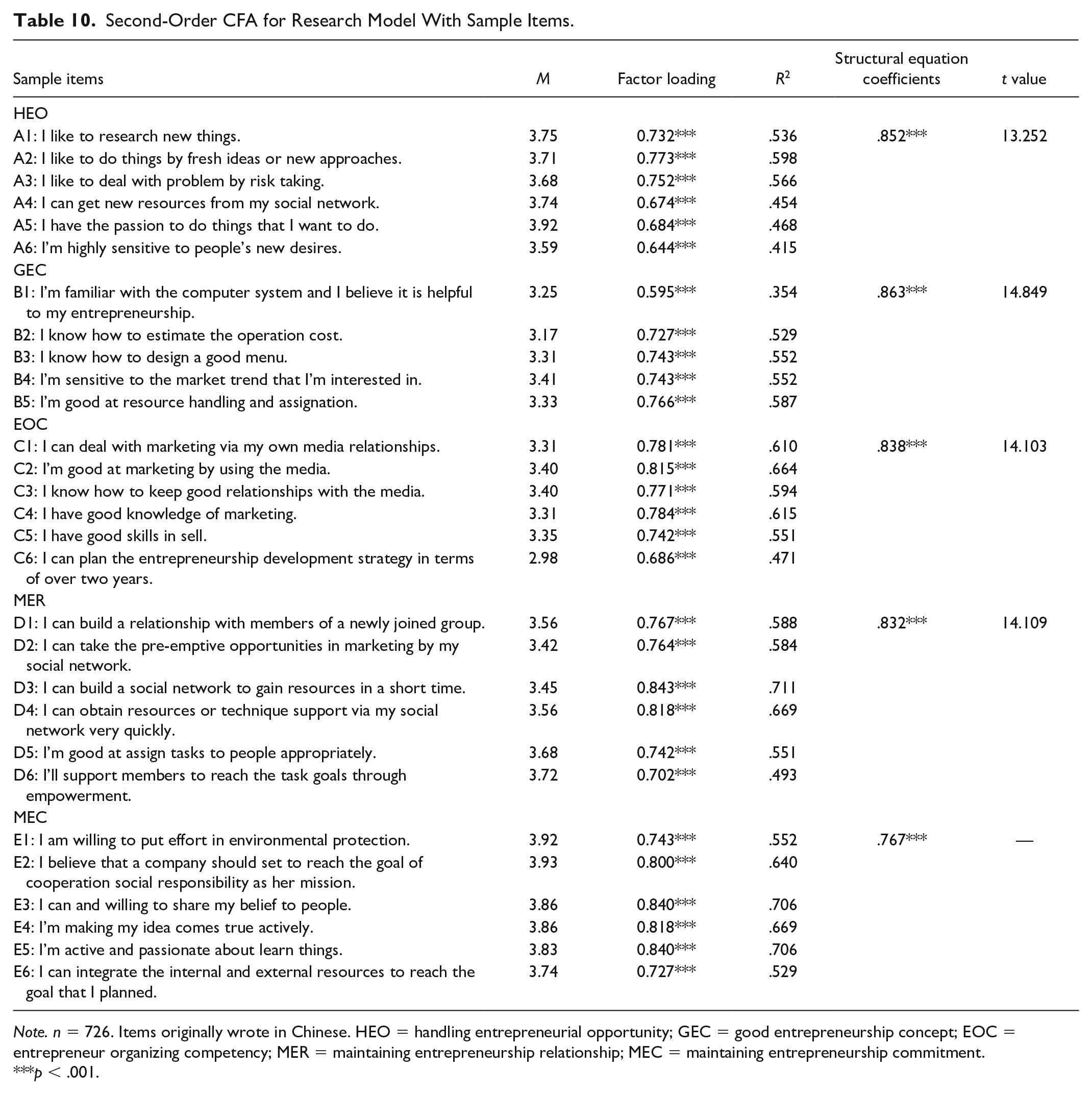
It was important that a higher-order model with goodness of fit would not be better than a correspondent first-order model (Marsh & Hocevar, 1985). Therefore, results show that the scores indicating goodness of fit of Model B and Model A were equal. The ratio of χ² to freedom degrees and other indicators demonstrated to goodness of fit of the model. All parameters of indices are also higher than the standard scores for Model B. The maximum likelihood estimates of Model B’s standardized parameter estimates were used for CFA—that included mean scores, path coefficients, R² values, factor loadings, corresponding t-values, and the model-fit indicator values of the model (see Table 10).
Second-Order CFA for Research Model With Sample Items.
Note. n = 726. Items originally wrote in Chinese. HEO = handling entrepreneurial opportunity; GEC = good entrepreneurship concept; EOC = entrepreneur organizing competency; MER = maintaining entrepreneurship relationship; MEC = maintaining entrepreneurship commitment.
p < .001.
The item’s factor loadings could be interpreted as validity, with t-values higher than 15.483 in their corresponding factors. Only five items (A4, A5, A6, B1, and C6) failed to exceed the factor loading criteria of 0.70. The R2 values of all items ranged from .354 to .711. The R2 coefficient of 24 items, which exceeded .49, showed acceptable reliability. The remaining five items were slightly below the acceptable level. To complete the measurement model of the second-order CFA, the latent variables were added; these consisted of HEO, GEC, EOC, MER, and MEC, with REC being positive and of high magnitude.
The results showed that the standardized path coefficient between REC and its underlying first-order latent variable was 0.852 for Handling Entrepreneurial Opportunity, 0.863 for Good Entrepreneurship Concept, 0.838 for MER, and 0.767 for MEC. Figure 2 shows that the second-order latent variable was represented by the REC. The standardized path coefficients were higher than 0.767 for the first-order latent variables. The coefficient of R² indicates that the MEC (0.588) was relatively low compared to other indicators in the reliability test.

The second-order confirmatory factor analysis of Restaurant. Entrepreneurship Competency Scale with coefficients of factor loading.
Discussions and Conclusion
Discussions
Despite the growing tendency to nurture REC and the increasing motivation in teaching, researching, and developing the Culinary Arts over the past three decades, the role of Entrepreneurship Competency is continuously overlooked in the hospitality development literature, including conferences, journals, and textbooks (Koh & Hatten, 2002).
This study extends the existing theoretical and empirical models of REC by incorporating many aspects. Reviewed literatures on REC highlighted the competency and relationship among the executives of small restaurant companies. Furthermore, scholars’ attention is attracted by new ventures due to its dramatic development (Dolnicar et al., 2010; Higham & Cohen, 2011; Horng et al., 2013). Therefore, restaurant talents should gain REC from the education system (Baluku et al., 2018; Mehtap et al., 2017; Taylor, 2008). However, only a few studies have comprehensively discussed and focused on the success factors and importance of education in REC in the hospitality industry (Gehrels, 2014; Starrett, 2014). The present study provides an overview of the attributes of the competencies required in restaurant entrepreneurship, which are meaningful to nurture culinary talents and are highly beneficial to the sustainable development of the hospitality industry.
The main attributes of RECs were thus provided for their understanding and practical implementation by practitioners in the context of Taiwan. As previously mentioned, Woollacott (2009) argued that knowledge, skills, abilities, attitudes, and characteristics affect the successful career development of an individual. Measuring the early Entrepreneurship Competency of restaurant entrepreneurs can help restaurant franchisers and educators in developing training classes and curricula, as well as aiding hospitality students in gaining entrepreneurship abilities (Colin & Jack, 2004). These are therefore the major contributions of the current study.
Conclusions
The result of this study presents meaningful implications in restaurant entrepreneurship. First, the constructed REC scale proved the contents and domains of the core competencies and helped restaurant entrepreneurs assess areas where improvements are a priority. Second, related knowledge in restaurant entrepreneurship would be cultivated during training to enhance the competency of employees or hospitality students. Therefore, the developed scale could provide useful resources for restaurant executives, owners, practitioners, and entrepreneurs for hiring or training employees. In addition, REC could help franchise managers or entrepreneurs understand and implement the competency scale when nurturing the competency of future practitioners. In this manner, the restaurant industry can continue to develop and innovate.
Furthermore, based on the coefficients of factor loading of REC, the GEC will be the priority for educators and business operators in training or improving the REC of students or staff members. According to Piaget’s (1962) theory of cognitive development, behavior is the result of an individual’s cognitive ability. Thus, the concept of cognitive ability should be the primary factor to be considered in an entrepreneurship training program. HEO reflects the individual’s sensitivity toward the external economic environment, which precisely indicates changing opportunities; EOC shows the potential of a student or staff member in organizing a business or company; MER means gaining a resource or social network to support business operations from an external environment, facilitating the motivation and enthusiasm of members to work for the internal organization—this finding is the basis of enterprise development, particularly during the first stage of entrepreneurship; MEC indicates the core value of an entrepreneur to establish and maintain his or her business on a sustainable base; finally, The REC scale is similar to a timeline that reflects the vertical process of supporting an entrepreneurial venture, and the research tool represents a framework design for training courses to improve the REC of students or staff members.
Limitations and Future Prospects
This study provides a well-developed scale for measuring the REC of future practitioners. However, several limitations must be considered for future research. First, the samples were selected among undergraduate students of Taiwan, thus raising concerns regarding the generalization of the developed REC scale to different countries. Accordingly, other countries may already have new concepts and implementations, as well as varied concepts and structures, for REC and REC scale. For instance, the concept of entrepreneurship and its motivation in the United States or other Western countries are stronger than those of countries in Eastern Asia. Another example of differences is that of Japan, where individuals are required to obey and cooperate with the organizations they belong to, instead of engaging in entrepreneurship and adventure.
According to the research findings, it was suggested that future studies should test the validity of REC empirically, including its theoretical concept and framework in different countries. Furthermore, the REC Scale was not applicable in measuring post-secondary students and those at other levels, because the maturity and ability of teenagers are not as developed as those of college students. The use of the REC Scale to measure the level of high school students may not accurately reflect their competency. Finally, it was a cross-sectional study in nature, and included one short survey. Therefore, the findings of future studies ought to be interpreted and examined by reverse causality.
Footnotes
Declaration of Conflicting Interests
The author(s) declared no potential conflicts of interest with respect to the research, authorship, and/or publication of this article.
Funding
The author(s) disclosed receipt of the following financial support for the research, authorship, and/or publication of this article: The research was supported by the Ministry of Science Technology, R.O.C., Project No. NSC 103-2511-S-228 -002–MY2: “Research on Culturing of Restaurant Entrepreneurial Literacy and Technology Orientation Curriculum.”
