




Abstract
China is one of the critical and strategic trading partners of Bangladesh. The Chinese government has declared a zero-tariff facility for 97% of products imported from Bangladesh. The objective of the study is to analyze the effects of the facilitating trade policy on the trade performance of different sectors of Bangladesh. The study applies partial equilibrium SMART simulations, which are accessible in WITS, and the general equilibrium CGE model with GTAP as the methodological tools to quantify the impact of China’s preferential trade policy on trade and the overall economy of Bangladesh. The results of partial equilibrium analysis show that the preferential trade policy substantially positively impacts Bangladesh’s exports to the Chinese market. The results also suggest that the change in total trade under China’s new preferential trade policy is around $58.99 million, with a trade creation of $ 52.16 million and a trade diversion effect of US$ 6.83 million. The CGE analysis results show that China’s new trade policy will have little impact on Bangladesh’s real GDP, and the effects of the policy on exports vary across different sectors. However, the overall effects suggest that Bangladesh will earn a net welfare gain due to China’s new duty-free trade policy in Bangladesh. The findings of the study provide crucial policy suggestions on whether China’s latest tariff facilities will substantially impact the trade and economy of Bangladesh as well as provide foundations for analyzing the effects of future bilateral trade agreements.
Introduction
Bangladesh was recognized as an independent nation in 1971 after the 9-month liberation war. Though there had not been much economic growth in Bangladesh before 1980, after that, various governments adopted various economic policies, such as trade liberalization and domestic deregulation, which helped Bangladesh transition to an export-led growth economy. A number of steps were taken to boost export levels, including the creation of the first export processing zone in Chittagong in 1980, the introduction of tax breaks for industries focused on exports, the availability of facilities for income tax rebates, etc. The Bangladeshi economy underwent a significant structural change as a result of this export-led growth strategy, with the share of industry and services export earnings on GDP (Gross Domestic Product) now surpassing the share of traditional agricultural products, jute, and jute products. These export-led growth policies gradually increased the share of export earnings on GDP. In the last 20 years, Bangladesh experienced accelerated economic growth. Now Bangladesh is the 35th largest economy in nominal terms and the 30th largest by purchasing power parity in the global economy. The United Nations also recognized Bangladesh as a developing country in March 2018. However, for faster economic growth in developing nations, policies regarding trade reform are more prominent than other growth factors. The ASIAN four tigers achieve and maintain economic growth after being a free market and outward-oriented (Export-led growth) economy.
Bangladesh is set to graduate from its status as a Least Developed Country (LDC) by 2026. Although this is a noteworthy achievement for Bangladesh, graduating LDC status brings more tangible challenges than benefits. As part of the LDC bloc, the country currently enjoys support measures broadly categorized into three areas—international trade, development assistance, and support in international forums. Upon graduating LDC status, the country would lose access to these facilities, leading to potential issues in trade, financing, and development support. As the graduation of Bangladesh from LDC to developing status poses new challenges to trade and investment, it should focus on the latest trade policies and rigorously look for new bilateral and multilateral trade blocs to boost export growth and economic development.
China is one of Bangladesh’s important and strategic trading partners. After establishing diplomatic ties in October 1975, China was regarded as a significant partner. Bangladesh now views China as a reliable ally and all-weather friend. The bilateral relationship between Bangladesh and China serves the fundamental interests of both nations, and both have agreed to forge a “Closer Comprehensive Partnership of Cooperation” based on friendship, equality, and mutual gain. So, China’s trade policy with Bangladesh is crucial to the export and import performance of the latter. While Bangladesh is trying to diversify its export markets and increase its presence in Asia, China’s duty-free offer for the nation’s garment producers has emerged as an excellent instrument. The Chinese government has provided a zero-tariff facility to 97% of goods imported from Bangladesh in the midst of the epidemic. Bangladesh can take advantage of these opportunities to export large quantities to China duty-free. The export potential and potential economic effects of China’s zero-tariff trade policy on Bangladeshi goods are therefore thoroughly examined. The goal of the study is to use partial-equilibrium SMART simulation and computable general equilibrium (CGE) models to analyze how the facilitation of trade policy affects the trade performance of various sectors of Bangladesh.
According to Gnangnon (2018), the benefit of trade policy liberalization is highly sustainable in more developed countries compared to less developed countries. In contrast, the impact of policy liberalization on low-income countries is not sustainable due to their structural weaknesses. In another study, Gnangnon (2019) argued that trade liberalization results in higher export performance in developing countries only when accompanied by greater Aid for Trade (AfT) facilities. A number of studies identified that trade policy liberalization has significant positive effects on export growth (Ju et al., 2010; Santos-Paulino, 2006; Zakaria, 2014), whereas some other studies found no or negative impacts of trade liberalization on export (Agosín, 1991; Clarke & Kirkpatrick, 1992; Ratnaike, 2012). Ratnaike (2012) identified that domestic competitiveness and world demand are the key drivers of export performance. In a recent study, Fan et al. (2019) identified differential impacts of trade liberalization in different sectors in China. Vijil and Wagner (2012) argued that the Aid for Trade (AfT) initiative is given high importance by the international community to increase export performance in developing countries and to integrate them into the global economy. Ahmed (2000) reported substantial impacts of trade policy liberalization on export growth in Bangladesh.
It is usually assumed that bilateral trade agreements significantly impact the trade and economy of the member countries. Thus, a beneficial trade policy of China for Bangladeshi products should bring a golden opportunity for a developing country like Bangladesh. Moreover, Bangladesh will graduate from a least developed country to a developing country by 2026. Due to this graduation to developing status, Bangladesh will lose a number of trade facilities it enjoys as a least developed country till now. The aforementioned discussions, however, show that trade liberalization policies have debatable effects on how well developing nations perform in terms of exports. The results of studies examining the effects of bilateral and multilateral trade agreements are mixed. The trade and economies of the member countries may be significantly impacted by trade agreements, little impacted, negatively impacted, or not impacted at all, according to studies. Therefore, a critical evaluation of the economic impact of China’s zero-tariff policy on Bangladesh’s economy is necessary. China’s recent announcement to grant duty-free access to 97% of export items will increase Bangladesh’s exports to the Chinese market and have a significant positive impact on Bangladesh’s economy is the research question this study attempts to answer. This study is an attempt to identify the potential effects of China’s recent liberalizing trade policy on the export and economic growth of Bangladesh. As this is a very current trade policy issued by the Chinese government, no study focused on the potential quantitative effect of this zero-trade policy on the trade and economy of Bangladesh.
This study will add to the body of recent literature in several ways. First, the study focuses on the impact of China’s most recent trade policy on Bangladeshi goods. It paves the way for a critical analysis of how bilateral trade policies affect the member nations, particularly those that will soon graduate from the least developed country to a developing country and lose access to a number of trade facilities. Second, the study examines the impact of new trade policy using partial and general equilibrium models. While partial equilibrium models like SMART simulation provide analysis at a very disaggregate level, general equilibrium analysis provides results at an aggregate level in a concise form. Thus, this study provides analysis at both aggregate and disaggregated levels and helps critically analyze trade policy in a broader scope. This study has uniqueness from the methodological point of view. The previous studies applied statistical methods for trade policy analysis that require data for a sufficient period. On the other hand, this study applies the ex-ante trade policy evaluation logic that identifies the potential impacts of trade policy using a simulation method that performs analysis using a range of parameter values without past data.
Literature Review
Following our fundamental foreign policy of “friendship toward all, malice toward none,” Bangladesh is trying to improve bilateral and multilateral trade relationships with our major important trading partners and also entering into various bilateral and multilateral trade agreements to accelerate export and economic growth. Among all other trading partners, China is one of Bangladesh’s trusted and crucial trading partners. China, the second largest investor in Bangladesh, has invested in sectors like textiles, power generation, and construction under the Belt and Road Initiative (Choudhury, 2023). According to Jasmin et al. (2023), Bangladesh should pay appropriate diplomacy and well-timed strategies to exploit the benefits of bilateral trade relations with China because the country’s economy and infrastructure can be developed by utilizing China’s soft power in the regional and global platforms. Bangladesh considers China an all-weather friend and trusted ally. Under the Asia-Pacific Trade Agreement (APTA), Bangladesh has enjoyed zero tariff facility on 60% of the export items to China since July 1, 2010. Recently, with the new announcement of the Chinese government, 97% of Bangladeshi products will join the zero-tariff club from July 1, 2020, which accounts for 8,256 products. However, a detailed analysis is necessary to examine the potential effects of China’s duty-free access to Bangladeshi products. This study is an attempt to identify the effects of duty-free access to Chinese markets on trade flow, trade performance, and economic growth of Bangladesh.
Theoretical underpinnings regarding the effects of trade policy on different economic aspects are controversial and ambiguous. Goldberg and Pavcnik (2016) suggest that trade policy such as the reduction of import tariff substantially affects trade volumes when tariffs are interacted with technology and especially higher vertical integration. Theoretical views also suggest that the relevance of trade policy is subject to relevant outcome metrics such as welfare gains, trade volume, trade growth, price level, firm and industry productivity, labor market, and aggregate growth and poverty. According to Baier and Bergstrand (2001), tariff reduction and preferential trade agreements explain 23% to 26% of trade growth. Yi (2003) found that there must have something else than tariff reduction to drive trade growth. Johnson and Noguera (2017) argued that trade frictions and regional trade agreements play a key role in explaining the changes in bilateral and global trade patterns. Trade policy was central to the overall design of policies for economic development (Krueger, 1984). Inward-oriented trade policy or import-substitution was the prominent trade policy in the early years, which now changed to an outward-oriented or export-oriented trade policy. Restricting imports and opening exports are two fundamental trade policies of international trade. The effects of trade policy on economic growth are also controversial. Studies such as Rodriguez and Rodrik (2000) and Harrison and Hanson (1999) found that the effects of trade policy on aggregate growth are not robust, whereas Estevadeordal and Taylor (2013) found a higher GDP growth in the countries with liberalized trade policy. According to Khan et al. (2022), energy efficiency and renewable energy policies significantly contribute to the green economic growth and mitigates the environmental degradation. These studies suggest for critical analysis regarding the effects of trade policy on trade and growth of the countries.
A bilateral free trade agreement (FTA) can significantly reduce the trade gap between Bangladesh and India. For years, India maintained a trade surplus against Bangladesh. To solve this problem, Siriwardana and Yang (2007) in their study mentioned that a proposed FTA can be used to solve this problem where India’s investment in new supply and export capacities is essential to make the FTA a successful one which helps Bangladesh to increase its export level in India. Another Free Trade Agreement (FTA) is ChAFTA, a bilateral free trade agreement between China and Australia. Though this FTA came into operation after a long process and negotiation, ultimately, it brought a net positive effect for both economies. ChAFTA provides opportunities for both member countries to access their markets without any trade barriers and increases outcomes and employment facilities for both partners. As both partners consist of larger markets, it will have a greater net economic effect on them. One of the most critical of the FTA is that the import of cheap products from China would hamper Australia’s manufacturing industry, which would affect domestic producers and may reduce some employment opportunities. However, as a whole, ChAFTA generated trade creation rather than trade diversion (Qi & Zhang, 2018).
Yeo and Deng (2019) conducted a study using the gravity model for 2006 to 2015 and found a significant correlation between trade policy variables and imports and exports. That study also suggested that the proliferation of free trade agreements will positively affect international trade. A developing country adopting outward or export-promotion policies is more conducive to economic growth. In 1987, Uganda transformed its economy by giving several incentives to its exporters, such as reducing taxes on exports and giving permission to retain all profit from export earnings. At that time, the country also liberalized financial markets and imposed fewer restrictions on imports. However, due to a lack of export diversification and an adequate level of institutional and infrastructural support, the country did not avail many benefits from export earnings (Morrissey & Rudaheranwa, 1998).
Gnangnon (2018) identified the impact of trade liberalization on the export performance of both developing and developed countries. The study found that because of their structural weaknesses, low-income countries do not have any sustainable impact on export performance. In contrast, more developed countries experience a greater sustained impact from trade liberalization than less developed countries. Hendajany (2016) inferred that out of the two types of economic growth strategies—inward-oriented, which emphasizes industrialization through import substitution and outward-oriented, which is export-led growth or can be described as participation in the global economy—Indonesia experienced an important positive impact from export growth when imports hampered economic growth.
Trade liberalization is not only limited to importing final goods, but it is shifting to imported intermediate inputs, which have differential impacts for different sectors and firms in different production procedure levels (Fan et al., 2019). Though several studies have shown a positive result on trade liberalization and export performance, a study conducted by Ratnaike (2012) using panel data for 27 OECD countries where both developing and developed countries were selected is showing a different result and claiming that trade policy remained an insignificant factor for export performance. Domestic competitiveness and world demand play a significant role in export performance for those selected OECD countries. A study conducted by Singer and Gray (1988) can also be mentioned here to support its findings, where it was shown that world demand puts greater weight on determining the export performance of an economy than changes in trade policies. That study also suggested that as external demand for a product strongly influences export performance, the outward-oriented policy is necessarily not a valued policy recommendation for all countries in all conditions. Dhingra et al. (2023) found an explicit and significant impact of deep trade agreements in stimulating international economic integration, which substantially increases trade between countries. Rahman and Strutt (2023) inferred that Bangladesh should focus on reducing the trade costs levied by tariff and non-tariff measures to realize its trade potential. In addition to tariff reduction and quota restrictions, Bangladesh should focus on forming multilateral, regional, and bilateral trade negotiations to achieve lower trade costs imposed by NTMs and better trade facilitation.
Along with trade reform, various other factors are associated with export performance. Infrastructure significantly impacts export performance (Vijil & Wagner, 2012). The study also found that developed countries exhibit exports over the GDP ratio relatively lower than poorer ones, and countries with larger markets export less. A lack of trade-related infrastructure discourages investment in on-trade sectors where aid for trade can play a significant role. Trade facilitation can contribute to export performance, but improvement in the regulatory environment, basic transport, and communication infrastructure can be equally or more critical factors in facilitating export growth (Iwanow & Kirkpatrick, 2007). According to Wilson et al. (2003), members of the Asia Pacific Economic Cooperation (APEC) can increase their trade flows by 21% by improving their port efficiency. The study also analyzed the relationship between trade facilitation and trade flows among APEC member countries. Four variables were used for measuring trade facilitation: port efficiency, custom environment, regulatory environment, and e-business, and it was found that each variable has a different level of significant effect on trade facilitation and trade flows.
The literature discussed above suggests that trade policies and free trade agreements should be critically analyzed to identify their potential impact on the trade and growth of a country. Recently, China announced a zero-tariff policy for 97% of the imported items from Bangladesh. However, a critical research question arises as to whether this zero-trade policy will boost the export and economic growth of Bangladesh. This study focuses on identifying the potential impact of China’s duty-free import policy on the export and growth of Bangladesh. As this trade policy was announced very recently, no previous studies quantitatively analyzed the effect of the liberal import policy on Bangladesh. Thus, this study contributes to the existing literature by focusing on a recent trade policy and methodological uniqueness by applying partial and general equilibrium models to quantify the effects at both aggregate and disaggregate levels.
Research Method
This study identifies the effects of China’s duty-free trade policy on the trade and economy of Bangladesh on three levels. The study begins by describing the potential effects of the trade policy on Bangladesh’s exports and imports. To determine the relative significance of China as Bangladesh’s export destination, the descriptive analysis includes both the country- and sector-level export structures of Bangladesh in the international market. The study then examines China’s tariff structure on various Bangladeshi exports. To have a broad perspective of the potential impact of the trade policy on Bangladesh’s export, the descriptive analysis section compares the export items under the reduced tariff policy and out of the reduced tariff. The study uses the partial equilibrium (PE) and computable general equilibrium (CGE) models to quantify the trade and economic effects of China’s trade policy on Bangladesh. The SMART simulation technique is used in the study as the partial equilibrium model. It is assumed that the imports from various nations are imperfect replacements. SMART is frequently used to evaluate the impact of a change in tariff that favors one trading partner over another. This method measures trade policy effects for both trade creation and trade diversion. The impact of changes in trade policy on tariff revenue, consumer surplus, and welfare is also calculated by SMART.
We utilize SMART simulations, which are accessible in WITS, to quantify the impact of China’s preferential trade policy on Bangladeshi commerce (World Bank and UNCTAD). SMART simulations employ the HS-Combined terminology. One advantage of this method is that it allows for assessing the impact of tariff reductions at a very disaggregated level. No other model can provide such disaggregated product-level estimates of the effect of tariff reductions. The data utilized for China’s trade policy analysis in SMART simulations is for the year 2018, which is the most recent year accessible in the model. The additional disaggregated trade statistics came from the UNCOMTRADE database.
The partial equilibrium model’s primary flaw is that it only considers a single area or sector of the economy. It is based on the supposition that the sector affected by the policy changes will have little to no impact on the rest of the economy and vice versa. By accounting for sectoral interactions, the computable general equilibrium (CGE) model improves upon the limitations of the partial equilibrium model. In order to evaluate the effects of China’s revised trade policy on all sectors of the Bangladeshi economy, the study applies the CGE model using the Global Trade Analysis Project (GTAP) as the last stage of the analysis. Among the quantitative methods of trade policy analysis, the GTAP model is widely used as this mode tackles the economic issues not only in different sectors and regions but also among different factors of production (Qi & Zhang, 2018). Several studies used the GTAP model to analyze the effects of bilateral and multilateral trade policy changes (Khoso et al., 2011; Lewis et al., 2003). As argued by Lloyd and Maclaren (2004), the popularity of using CGE models to undertake empirical research, especially in Australia, is understandable for its multinational scope and broader coverage over a variety of industries. The study uses the latest GTAP version 10 with the latest updated database. It is a multi-sector and multi-region CGE model with an updated database of 141 regions and 61 sectors and five factors of production for each region. Although The GTAP database provides several reference years, such as 2004, 2007, 2011, and 2014, the GTAP 10 uses the latest reference year, 2014. The GTAP model uses the standard neoclassical assumption of perfect competition and constant returns to scale. The following figure displays the most fundamental structure of the GTAP model of an open economy for a representative region or sector (Figure 1).

The structure of an open economy in the GTAP model.
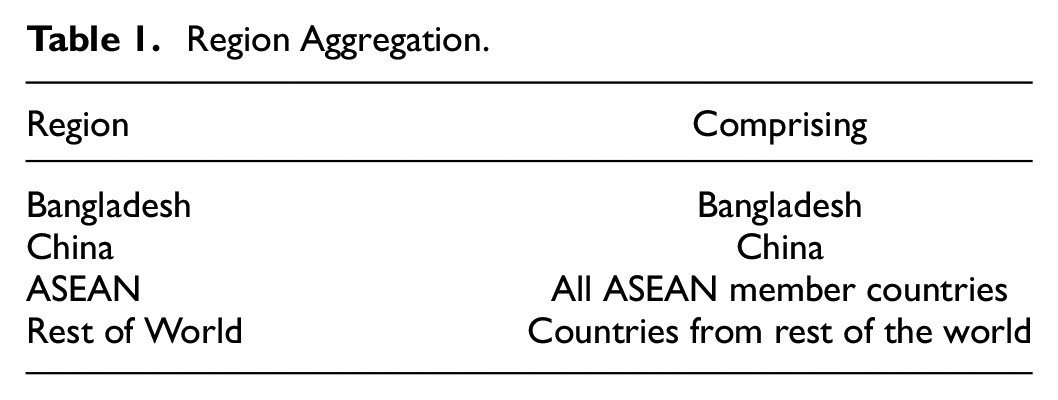
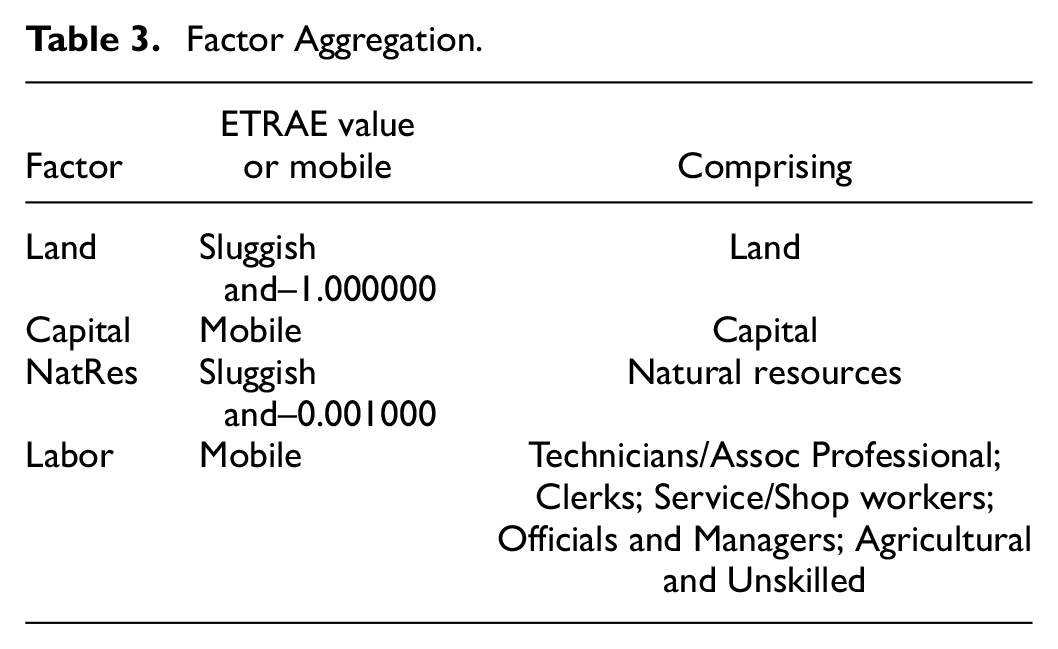
The GTAP model is aggregated by 141 regions, 65 sectors, and 8 factors of production. In this study, we aggregated the regions into four new regions, that is, Bangladesh, China, ASEAN, and the rest of the world (Table 1). All 65 sectors are aggregated into seven sectors, as reported in Table 2. We divided the factors of production into four types such as land, labor, capital, and natural resources as described in Table 3. Finally, in the GTAP CGE simulation, the ad valorem tariff (symbolized by tms in the model) on imports from Bangladesh into China is reduced to zero. The solution algorithm used is the Gragg 246 method with automatic correctness to obtain a high level of accuracy in the results.
Region Aggregation.
Sector Aggregation.

Factor Aggregation.
Findings and analysis
The analysis section of the study is divided into two parts. The first section makes a descriptive analysis of the export and import scenarios of Bangladesh as well as the trade and tariff structures between China and Bangladesh.
Figures 2 and 3 show Bangladesh’s import and export destinations. The figures suggest that Bangladesh mainly exports products to the EU and USA. The lion’s share of exports is directed to the EU (37%), followed by the second highest position of the USA (15%). The export and import destination scenario of Bangladesh provides interesting findings. Although the EU and the USA are the major export destinations of Bangladesh (52% combined), imports from these countries constitute only 9%. On the contrary, Bangladesh has the highest share of imports from China (30%), whereas Bangladesh exports only 2% of its total to China. The results infer that Bangladesh has a huge trade deficit with China. Thus, the duty-free access to Bangladeshi products in the Chinese market may open a new door to Bangladesh’s export destination and reduce the trade deficit of Bangladesh with China.

Export destinations of Bangladesh.

Import sources of Bangladesh.
Appendices 2 and 3 report major export and import items of Bangladesh to China as per the 2-digit HS code. The major export items of Bangladesh to the Chinese market are apparel (knitted or non-knitted), with a share of around 50%. The other major export items are textile fiber (14.5%), leather (5.17%), footwear and articles of leather and footwear (8.1% together), and cotton (2.9%). The share of other items in total exports is around 1% each. In contrast, the major import items of Bangladesh from China include machinery (11.5%), cotton (11.26%), electric machines (10.74%), fabrics (6.7%), and man-made staples fibers (5.83%). The contribution of the items to export is around 2% or less each.
China’s tariff schedule on different imported items from Bangladesh is given in Appendix 1. The summarized data shows that China has a substantial percentage of tariffs applied to the imports of Bangladeshi products under MFN. The tariff rate substantially differs across items. Most of the products imported from Bangladesh to China will enjoy a preferential tariff structure that equals zero under China’s new preferential trade policy. Thus, it can be assumed that Bangladesh can increase its export basket and volume to China due to the newly introduced tariff policy in the Chinese market. We also applied the SMART Simulation method to quantify the effect of preferential tariffs on the export of Bangladesh to the Chinese market.
Table 4 summarizes the trade effect of China’s preferential trade policy using SMART simulation. The results of the analysis show that the preferential trade policy substantially impacts the export of Bangladesh to the Chinese market positively. The results suggest that the change in total under China’s new preferential trade policy is around $59 million with a trade creation of US$ 52.16 million and a trade diversion effect of US$ 6.8 million. The highest trade gain is achieved in Ores, slag, and ash (HS code 26) followed by non-knitted apparel (HS code 62), wood and articles of wood (HS code 44), and prepared feathers (HS code 67). The simulation results also show that the trade creation effect is substantially higher (US$ 52.16 million) than the trade diversion effect (US$ 6.84 million). The results indicate that China’s preferential trade policy has the potential for robust trade generation of Bangladesh to the Chinese market. Table 4 also reports the trade value before and after and the change in trade value in different sectors. The results show that the preferential trade policy will increase the exports in almost every sector, with the highest increase in Ores, slag, and ash (HS code 26) of US$28.57 million.
Trade Effects of China’s Duty-Free Policy on Major Products (as per HS Code 2 Digit).

Source: Authors’ calculation using SMART simulation.
The results of the CGE simulation using the GTAP model provide a holistic scenario of the effects of China’s duty-free trade policy on Bangladesh’s trade and economy. Table 5 shows that China’s new trade policy will not substantially impact Bangladesh’s GDP. The results show that the GDP of Bangladesh will increase by $.86 million, resulting in only a 0.0005% rise in total GDP. The simulated effects of trade policy changes on Bangladesh’s total exports are summarized in Table 6. The results show that other manufacturing will experience the highest increase in exports to China ($9.91 million), followed by textiles ($7.87 million) and leather ($2.63 million). The results also show that trade policy hurts some sectors. Exports in the apparel sector will face a fall of $15.5 million, whereas fisheries, services, agriculture, and food sectors will see a slight decrease in exports from Bangladesh to China.
Real GDP Changes.

Source: Authors’ calculation using CGE model with GTAP simulation.
Simulated Effects on Total Exports Across Sectors.

Source: Authors’ calculation using CGE model with GTAP simulation.
Table 7 summarizes the simulated effects of trade policy on Bangladesh’s domestic output in different sectors. The results show that the output of the textile sector will increase by $6.25 million, followed by an increase in the output of the service sector ($4.98 million), the other manufacturing sectors ($4.51 million), and the leather sector ($2.55 million). The highest fall in output will occur in the apparel sector by $15.65 million after China’s new trade policy.
Simulated Effects on Domestic Output Across Sectors.

Source: Authors’ calculation using CGE model with GTAP simulation.
Finally, the simulated welfare effects of China’s new trade policy are summarized in Table 8. Bangladesh has a net welfare gain of $64.71 million, where the allocative efficiency increases by $3.8 million and terms of trade effects gain by $ 0.86 million. The highest efficiency gains are achieved in the apparel sector, followed by the other manufacturing sector. All sectors show efficiency gains from China’s new duty-free trade policy for all imports from Bangladesh.
Sector-Wise Simulated Welfare Effects.

Source: Authors’ calculation using CGE model with GTAP simulation.
Discussions
The results of the partial-equilibrium model using the SMART simulation method demonstrate how Bangladesh’s exports to China have benefited significantly from the preferential trade policy. The outcome suggests that the total trade effects will change by about $59 million due to China’s new preferential trade policy, with a trade creation effect of US$ 52.16 million and a trade diversion effect of US$ 6.8 million. The findings show that China’s preferential trade policy has the potential to generate significant trade from Bangladesh to the Chinese market. Exports will rise across almost all industries as a result of the preferential trade policy. The outcomes of the CGE simulation enable a more comprehensive analysis of how China’s new trade policy will affect Bangladesh’s trade and economy. The findings of the study indicate that Bangladesh’s real GDP will not be significantly affected by China’s new trade policy. Different sectors are affected by the policy’s export effects differently. Some sectors, such as textiles, leather, and other manufacturing, will experience a high export growth to the Chinese market, whereas the exports of other sectors, more specifically the apparel, service, food, and agriculture sectors, will substantially fall due to the new trade policy of China. Regarding domestic output, some industries are experiencing positive growth while the output of other industries will significantly decline. However, the overall effects suggest that Bangladesh will earn a net welfare gain due to China’s new duty-free trade policy in Bangladesh.
Conclusions and Policy Implications
Bangladesh is a nation that prioritizes exports, and its economy is heavily reliant on foreign trade. To date, international trade is one of the main forces behind Bangladesh’s economic development and growth. Due to China’s economic performance and contribution to the world economy, it is one of Bangladesh’s most significant and strategic trading partners. So, Bangladesh’s export performance depends significantly on China’s trade policy with that country. Ninety-seven percent of the goods imported from Bangladesh are eligible for a zero-tariff facility from the Chinese government. The study’s goals are to use a partial-equilibrium model with SMART simulation and a general equilibrium (CGE) model with GTAP to analyze the effects of the facilitating trade policy on the trade performance of various sectors of Bangladesh. The study offers significant policy implications for the bilateral trade agreements between nations. According to the study’s findings, bilateral trade agreements should be closely examined to determine whether they positively impact trade and the economy as a whole.
It is presumed that Bangladesh will significantly benefit from increased exports and economic growth as a result of 97% of its exports to China being duty-free, but the CGE model’s findings suggest that while Bangladesh will experience high export growth in some sectors, other sectors may be negatively impacted by China’s revised trade policy. The relevant authority should implement the appropriate policy measures to maximize the trade and economic benefits of bilateral trade agreements, such as China’s recent duty-free trade policy for 97% of Bangladeshi products. This study has theoretical, social, and practical implications too. The study’s findings confirm the contradictory economic effects of trade agreements. The agreements’ potential consequences don’t line up with the facts. Therefore, it is essential to carefully consider trade agreements’ social and practical effects on the economy. The study also opens up new areas for future study. The study provides a solid foundation for future research in the related field, particularly in analyzing the effects of trade policy and trade agreements, due to the methodological uniqueness and analysis at both aggregate and disaggregate levels.
The study also has some constraints. Due to the wide variety of products that Bangladesh exports and imports based on their HS codes, a more in-depth disaggregated analysis would be necessary to gain additional insights, but this would take time and make the paper harder to read. Furthermore, China offers zero-tariff facilities to 97% of the goods imported from Bangladesh; however, this study assumed the tariff policy applies to 100% of the goods because it is very challenging to separate them from the list and exclude them from the analysis. However, the excluded product list and their trade volume are negligible and will not significantly fade the credibility of the analysis.
Footnotes
Appendices
Major Import Items of Bangladesh from China.

| Commodity HS Code | Commodity | Import from China (US$ million) | Share of imports |
|---|---|---|---|
| 84 | Nuclear reactors, boilers, machinery and mechanical appliances; parts thereof | 1737.303 | 11.52391 |
| 52 | Cotton | 1698.936 | 11.26942 |
| 85 | Electrical machinery and equipment and parts thereof; sound recorders and reproducers; television image and sound recorders and reproducers, parts and accessories of such articles | 1619.394 | 10.7418 |
| 60 | Fabrics; knitted or crocheted | 1016.093 | 6.739969 |
| 55 | Man-made staple fibers | 879.6362 | 5.834822 |
| 27 | Mineral fuels, mineral oils and products of their distillation; bituminous substances; mineral waxes | 785.6571 | 5.211438 |
| 54 | Man-made filaments; strip and the like of man-made textile materials | 764.8397 | 5.073351 |
| 73 | Iron or steel articles | 575.1945 | 3.815393 |
| 39 | Plastics and articles thereof | 554.8322 | 3.680325 |
| 72 | Iron and steel | 388.1279 | 2.574538 |
| 8 | Fruit and nuts, edible; peel of citrus fruit or melons | 345.5523 | 2.292125 |
| 29 | Organic chemicals | 339.62 | 2.252775 |
| 87 | Vehicles; other than railway or tramway rolling stock, and parts and accessories thereof | 286.2261 | 1.898601 |
| 58 | Fabrics; special woven fabrics, tufted textile fabrics, lace, tapestries, trimmings, embroidery | 254.7746 | 1.689976 |
| 59 | Textile fabrics; impregnated, coated, covered or laminated; textile articles of a kind suitable for industrial use | 248.6478 | 1.649336 |
| 48 | Paper and paperboard; articles of paper pulp, of paper or paperboard | 229.2534 | 1.520688 |
| 90 | Optical, photographic, cinematographic, measuring, checking, medical or surgical instruments and apparatus; parts and accessories | 206.4234 | 1.369252 |
| 96 | Miscellaneous manufactured articles | 204.8075 | 1.358533 |
| 31 | Fertilizers | 196.386 | 1.302672 |
| 64 | Footwear; gaiters and the like; parts of such articles | 194.176 | 1.288013 |
| 38 | Chemical products n.e.c. | 188.6697 | 1.251488 |
| 53 | Vegetable textile fibers; paper yarn and woven fabrics of paper yarn | 173.8087 | 1.152911 |
| 94 | Furniture; bedding, mattresses, mattress supports, cushions and similar stuffed furnishings; lamps and lighting fittings, n.e.c.; illuminated signs, illuminated name-plates and the like; prefabricated buildings | 151.7317 | 1.00647 |
| 61 | Apparel and clothing accessories; knitted or crocheted | 31.99838 | 0.212252 |
| 26 | Ores, slag and ash | 3.18195 | 0.021107 |
Declaration of Conflicting Interests
The author(s) declared no potential conflicts of interest with respect to the research, authorship, and/or publication of this article.
Funding
The author(s) disclosed receipt of the following financial support for the research, authorship, and/or publication of this article: The research project is funded by the University of Dhaka Centennial Research Grant (CRG) and International Publication Grant, University of Dhaka.

Data Availability Statement
Data sharing not applicable to this article as no datasets were generated or analyzed during the current study.