




Abstract
Rural women in Bangladesh usually have lack of access, control and ownership over their land property because of existing patriarchal norms of the rural society. The prime objective of this study was to assess the impact of rural women’s access to land on their income as well as household income. A multistage, geographically clustered, probability-based sampling approach was adopted for this study. Primary data were collected from the rural women living in two selected districts of Bangladesh. The Propensity Score Matching technique was used to assess the impact of land accessibility on household income and rural women’s income. The Binary Logistic Regression technique was used to assess women’s opinions. The study findings revealed that land had a positive impact on household income but rural women’s income did not increase significantly despite having access to land. This study also showed that income, level of education, the existence of NGO operated programs in villages, and the number of visits to NGO offices by rural women were the key factors contributing to improving their overall well-being. Findings imply that the government should design an appropriate land ownership policy that guarantees titling as well as access for women to land.
Keywords
Introduction
Women are the main driving force behind the growth of rural and national economies as they represent around 43% of the agricultural labor force in developing countries globally (Ajadi et al., 2015; Mukasa et al., 2019). It is to be noted that women’s ownership of land and its distribution patterns vary significantly in Asia compared to men. Undoubtedly, agricultural land is the most essential productive asset in rural areas for generating income (Meinzen-Dick et al., 2019) but women are less likely to own land than men (Balasubramanian et al., 2019; Doss & Meinzen-Dick, 2020). In South Asia, men primarily have the access and ownership of land (Agarwal, 2018).
Furthermore, land owned by women is likely to be smaller and of lesser quality compared to the men’s. Unfortunately, most rural women in developing countries do not have access to and control over land and productive resources (Agarwal, 2018; Mishra & Sam, 2016) whereas securing women’s land and property rights is regarded fundamental to ensuring effective and sustainable human development (Adem et al., 2022; Meinzen-Dick et al., 2019). Equal distribution of productive assets between men and women, such as land, can smooth the way to achieving economic growth by reducing poverty (Doss & Meinzen-Dick, 2020).
According to some researchers, women’s empowerment is embedded in the concept of women’s well-being in terms of social and economic aspects (Hossain & Mahmud, 2021; Obayelu & Chime, 2020) . Women’s economic well-being indicates that women will be empowered on economic indicators (e.g. income, expenditure, saving, production, etc.). Financial well-being of women is also closely related to the ownership and rights over productive assets e.g. land, livestock, forest products, etc.(Hossain & Mahmud, 2021; Meinzen-Dick et al., 2019; Zaidi, 2019).
Ensuring women’s access to or ownership of land is essential for improving their economic status (Agarwal, 2018; Han et al., 2019; Meinzen-Dick et al., 2019). For example, equity in the land tenure system can help increase women’s financial status (Han et al., 2019). Ensuring women’s land rights can help them obtain credit facilities for investment, adopt technology, increase agricultural productivity, and boost their expenditure on food and healthcare (Meinzen-Dick et al., 2019; Muchomba, 2017). In India, women’s access to land played a vital role in increasing the capacity of women in poverty to obtain credit facilities and invest in agricultural activities (Santos et al., 2014). In Tanzania, women became successful in increasing their income due to ensuring their inheritance rights to property (Peterman, 2011). A study conducted in Ethiopia, showed that securing women’s rights to land played a positive role in increasing their healthcare expenditure (Muchomba, 2017). Goli and Pou (2014) indicated that ownership of land could increase the capacity of a woman to challenge the inequalities against them. Mishra & Sam, (2016) also observed that the decision-making capacity of the Nepali women increased because of land ownership. Similarly, access to land helped improve the decision-making capacity of women in China (Han et al., 2019).
Moreover, land can serve as a base for food production, act as a source of income and employment generation for women and improve the nutrition and food security status of women and their family members (Agarwal, 2018). Women’s access to land is also essential to improve their risk management capacity in pursuing agricultural activities (Meinzen-Dick et al., 2019). Therefore, women’s access to land property is central to their economic well-being (Hossain & Mahmud, 2021; Meinzen-Dick et al., 2019).
It is generally believed that women’s economic empowerment rely not only on land ownership but also on their capacity to decide about financial aspect and their access to other productive resources (e.g., credit, information, technology, etc.). Thus, women’s sole ownership of land may not guarantee women’s rights to land and economic empowerment if they fail to retain their complete control over the land property. Evidence suggests that despite being land owner, women have been unable to become economically empowered in many cases (Abbott et al., 2018; Bhaumik et al., 2016; Jacobs & Kes, 2015). Women in many developing countries often face tremendous challenges to have access or gain control over productive resources such as land. This is mainly due to the state laws, religious laws, and social norms. For example, as per Islamic religious law, a sister inherits half of the land property from her brother (Hossain & Mahmud, 2021; I. Khan et al., 2016; Quisumbing et al., 2018).
Bargaining theory asserts that a person in the household gains more power if he or she can contribute economically more than other members of the household (Murshid & Ball, 2018). In fact, a woman becomes powerful in the decision-making process when she gains the ability to control the resources (Murshid & Ball, 2018). However, evidence suggests that despite having the co-ownership of land with their husbands, rural women are more likely to fail to have control over their land property as they usually have limited voice and power within the household decision-making process (Jacobs & Kes, 2015). Unfortunately, women in developing countries typically lack power in the household decision-making process related to the social and economic issues (e.g. purchasing and selling of land, visiting different places, etc.). This is mainly due to the patriarchal norms of the society as well as their lack of access to the productive resources (Abbink et al., 2020; Abrar-ul-Haq et al., 2017; Al-Amin & Mathbor, 2019). In Bangladesh and Uganda, women in rural areas often fail to gain control over their incomes and land property due to pressure from the male members of their families. Eventually, these resources are found to be utilized by the males (Abbink et al., 2020; Shibata et al., 2020).
In the context of rural Bangladesh, women usually practice their agricultural activities in the homestead areas (Hillenbrand, 2010; Schreinemachers et al., 2016) as their mobility is still much restricted outside household chores due to conservative attitude of the rural society (Hilton et al., 2016; Orso & Fabrizi, 2016). In fact, the percentage of women landowners in Bangladesh, Nepal, and India is below 20% which is significantly less (Agarwal, 2018). It is undeniable that plots owned by women in Bangladesh are quite small (Hillenbrand, 2010; Kieran et al., 2017; Vemireddy & Pingali, 2021). Undoubtedly, women can play a vital role in increasing agricultural productivity since, more than half of the agricultural labor in rice-producing countries is female (Agarwal, 2018). However, their contribution to agricultural activities (e.g. crop, fisheries, livestock, etc.) is not properly recognized in the society (Doss et al., 2018; Vemireddy & Pingali, 2021) which is generally considered one of the major barriers against women in enjoying their land rights.
In Bangladesh, women lag behind men in terms of control and ownership of agricultural land due to some existing societal, cultural, or gender norms. Women have subordinate positions in family and society which are determined by their lack of ownership, control and management, transfer and access to land as well as other properties. A study report prepared by Solotaroff et al. (2019) on Bangladesh Integrated Household Survey of World Bank Group revealed that societal norm prevails in owning agricultural land by women. Society is yet to be comfortable enough to register a piece of land under the name of any woman. It is also revealed that many women do not have direct land ownership but have some economic rights jointly with their husbands or other family members pertaining to land sale, purchase, rent in or rent out. Only 10% of female respondents in that study have sole or joint ownership of agricultural land compared to 70% of males in the same households who own land in rural Bangladesh. This report also revealed that women hold less agrarian land than men in all divisions of Bangladesh.
In fact, a very limited number of studies have been conducted in the context of the sub-continent to assess the impact of land ownership on women’s living-standard. Few studies have been conducted in countries such as India, Pakistan, and Nepal to evaluate the impact of access to land rights on the living standard of rural women (Ahmad et al., 2016; Mishra & Sam, 2016; Santos et al., 2014). Few studies have been conducted in Bangladesh which focused on the issues of inheritance law, gender equality, and perception regarding women’s equal rights (Hossain & Mahmud, 2021; I. Khan et al., 2016).
Based on previous studies, one school of thought argues that land can play a crucial role, while another school of thought is quite skeptical. In Bangladesh, no study has focused on the issue of the impact of women’s access to land on their economic well-being which motivates us to conduct this study in the rural part of Bangladesh. It is generally believed that women having access to land will be in a greater advantageous position economically than women without access to land. Thus, the following question can logically be raised: Does access to land really improve the economic well-being of the rural women in Bangladesh?
This study has taken an effect to explore the answer to the question mentioned above. It is important to note that in this study, women’s economic well-being refers to the improvement of the status of women’s income. The prime objectives of this study are: (i) to assess the impact of rural women’s access to land on their income as well as their household income; and (ii) to assess the impact of women’s access to land and other socioeconomic factors on their economic well-being. Findings of this study highlight the importance of land accessibility for women which helps improve their economic well-being by increasing household income.
Conceptual Framework
According to Mahmud (Hilton et al., 2016; Mahmud et al., 2017), possession of land is one of the important factors that requires significant consideration in developing the livelihood framework of the rural poor. Land is expensive and scarce resource in Bangladesh. In Bangladesh, rural women are still in a subordinate position in terms of possession of productive resources and their lives are largely controlled by men due to existing patriarchal norms of the rural society (H. Khan & Rahman, 2016; Kieran et al., 2017; Mahmud et al., 2019). Landlessness gravely hampers the economic activities of women, and is also one of the major causes of their lower social status in rural society. Therefore, ensuring rural women’s access to land will enable them to select and pursue Income Generating Activities (IGAs) and help them in obtain income for themselves as well as for the households.
Moreover, the economic well-being of a person depends on various factors such as demographic and socioeconomic factors. Apart from access to land is not the only factor; other factors that play an essential role in improving the economic plights of a person include government policies, education, training, credit, access to rural infrastructure, and so on. Age is an important demographic factor that can influence a person’s economic activities (Mahmud & Hilton, 2020). Age is related to experience, decision-making capacity, and handling risk and uncertainty, which ultimately affect his/her financial performance. Education is closely related to the living standard of a person (Hilton et al., 2016; Mahmud et al., 2017). It can be logically assumed that an educated woman is more aware of IGAs selection and more capable of using the economic resources judiciously compared to women with little education. This leads the educated woman to obtain a higher level of income and also increases expenditure capacity.
The economic status of a woman is largely dependent on the women development policy as well as rural development policies of the government. Government can play a vital role to provide credit, training, facilities, and technological support to the poor so that they can perform economic activities promptly and efficiently. For example, government policies related to land rights can play a significant role in ensuring women’s ownership and access to land rights. Landless and marginal women farmers are provided government-owned land/ponds as a lease for pursuing IGAs.
In the context of Bangladesh, rural women usually lack the financial capital to start new IGAs or to pursue existing IGAs smoothly which creates obstacles for them to obtaining desired outcomes (Hilton et al., 2016; Mahmud et al., 2014, 2017). Without providing adequate financial support through government agencies and NGOs, no significant changes can be observed in the economic outcomes of the women. Therefore, providing credit support will create the opportunity for employment generation and income earnings. Credit support assists the women in selecting appropriate IGAs, increasing their investment, negotiation, and risk-bearing capacity resulting in a higher level of production and income (Hilton et al., 2016; Mahmud et al., 2017). Thus, it is important to provide credit support based on the demand and nature of the IGAs with a flexible repayment system.
Training is directly related to building a person’s skills in social and economic aspects (Hilton et al., 2016). Therefore, necessary steps need to be taken to provide skill-building training to the rural women as per their needs with a nominal charge so that they can utilize their lands properly for productive purposes. Rural infrastructural facilities are inadequate in Bangladesh (Kabir et al., 2018).
Financially poor people usually have a lack of assets. In this study, household assets refer to furniture, equipment, electronic devices, poultry, and livestock. Undoubtedly, a household having more assets will be in an advantageous position compared to households having less asset-base in terms of investment on IGAs and managing risk and uncertainties resulting in higher level of income. Mass media can play a vital role in building awareness on socioeconomic aspects (Hossain & Mahmud, 2021; Kabir et al., 2018). For example, mass media can play a pivotal role in building awareness among poor women to adopt modern and environment-friendly crop production technology. Media also assists in changing the existing practical norms of rural society through awareness building campaigns on women’s land rights.
Focus should be given to the country’s infrastructural development, especially in the rural areas. Lack of access to the rural market is one of the major obstacles for the poor women to produce and market their products yielding lower production and income for them. Access to rural markets helps women invest in IGAs, encourages them to diversify their products, and enhances their negotiation and risk management capacity as well as facilitates marketing their products resulting in an increase in their incomes which will ultimately lead them to have a higher level of expenditure.
Based on the above discussion, we have developed a conceptual framework (Figure 1) for our study by assuming that apart from access to land, other factors such as government policies, available infrastructural facilities, and age as demographic factors, education, training, and mass media as socioeconomic factors are also important for women to select or pursue any income-generating activities. These will help them increase their income and expenditure, which is ultimately expected to improve their economic well-being (Figure 1). This is actually a variant of the model developed by (Hilton et al., 2016; Mahmud et al., 2017).

Conceptual framework for improvement of economic well-being of the poor rural women.
Methodology
Time and Location of the Study
Rural women engaged in farming activities under the upazilas of two selected districts in Bangladesh were the target group of this study. Rural women from households that possessed the land of maximum 249 decimals were purposively targeted for this study. The survey was conducted from April 2019 to May 2019.
Sampling Methods
The study adopted a multistage, geographically clustered, probability-based sampling approach. Data had been collected from eight unions (smallest administrative unit) of four upazilas under two districts (Nilphamari and Chuadanga) from two divisions (Rangpur and Khulna) of Bangladesh. The study sites were selected randomly from division to upazila through a lottery system. Primary sampling units were the villages and the ultimate sampling units were the household and one individual (female) residing in the selected households. Sampling of eligible individuals was done from a sample of households with one individual randomly selected per household. During data collection, the research data collection team prepared a complete list of households who owned land piece of maximum 249 decimals or without having land.
After completing the listing procedure, they randomly selected the sample. A total of 452 women were selected as samples from the four upazilas of two districts in Bangladesh from 1,834 listed samples, conniving 4% of error at 95% confidence level. Purposively, 548 women were selected from the households having a land area of less than 50 decimals from the four upazilas of the selected two districts to form the control group.
Data Collection
A structured questionnaire was used to collect primary data from the respondents on the following aspects: (i) socioeconomic profile; (ii) household income, saving, and expenditure; (iii) land and non-land assets; (iv) opinions about their ownership and access to land; (v) rural infrastructure; (vi) training; (vii) decision and risk-management capacity; (viii) credit management; and (ix) problems in exercising land rights etc.
Operational Definitions
Techniques of Data Analysis
Descriptive statistics were used to analyze the respondents’ socioeconomic profile (such as age, education, possession of land, asset holding, etc.).
In this study, the propensity score matching (PSM) technique was used to assess the impact of women’s access to land on their living standard in terms of income and expenditure. Recently, researchers used the PSM technique to measure the impact of development programs on the living standard of the rural people (Mahmud et al., 2017; Mahmud & Hilton, 2020; Sohag et al., 2015). According to some researchers, participation in the project is endogenous and so creates a selectivity problem (Haque & Dey, 2016; H. Khan & Rahman, 2016). Thus, the PSM technique was extensively used for impact assessment. The PSM approach is based on identifying individuals in the treatment group and in the control group, who are similar with respect to controlling variables (Haque & Dey, 2016; Mahmud et al., 2017; Sohag et al., 2015).
In this study, women from households that possessed land between 50 to 249 decimals were treated as “Treatment Group” while women from households that did not own land or had land below 50 decimals were treated as “Control Group.”
In the PSM approach, the probit or logit model can be used to get the propensity score. After estimating the propensity score, each participant is to be matched with their “closest” non-participant using the estimated propensity score (Mahmud et al., 2017; Sohag et al., 2015). For matching, Nearest Neighbor Matching (NNM), Kernel Matching (KM), and Radius Matching (RM) techniques can be used. In this study, the NNM and KM techniques were used. It is important to note that these two matching techniques were also extensively used by the researchers (Haque & Dey, 2016; Mahmud et al., 2017; Mahmud & Hilton, 2020; Sohag et al., 2015). In this study, the age of the respondents and distance to the rural market from the respondent’s household were used as matching variables. Similarly, family composition (e.g. family size) and distance of rural market were also used by other researchers for matching purposes (Mahmud et al., 2017; Mahmud & Hilton, 2020). The validity of the PSM depends on assumptions of conditional independence and the presence of a common support (Haque & Dey, 2016; Mahmud et al., 2017; Sohag et al., 2015). In addition, “Balancing Property” was checked for the validity of PSM. This method estimates the average treatment effects on the treated (ATT). ATT is estimated as:

Here, Y1 and Y0 represent the outcomes of the treatment group and the outcome of the control group, respectively; X is the vector of exogenous explanatory variables (household characteristics); and I is the treatment indicator (I = 1 if the individual woman who has land area of 50 decimals and above).
Binary Logistic Regression (BLR) technique is appropriate to use when the dependent variable is dichotomous (Mahmud et al., 2017). Researchers widely use this BLR technique to assess opinions of the rural women about their socioeconomic well-being under the development programs (Mahmud et al., 2017; Weber & Ahmad, 2014). In this study, BLR was used to assess the perceptions of the women about their economic well-being through access to land. The dependent variable, “Women opinion on economic well-being,” has two categories. If a woman has opined that land ownership would increase their well-being, it is coded as “one,” otherwise coded as “zero.” A specific model can be written as follows:

Where, P = Probability that the woman would be able to be well off due to land access
1-P = Probability that the women would not be able to be well off due to access to land. The model would be as follows:
Pi = Probability that a woman would be able to be economically well-off
X1 = Total land possessed by the household in 2018 (decimal)
X2 = Total value of land possessed by the household in 2018 (Taka)
X3 = Total value of animals in the household in 2018 (Taka)
X4 = Total value of the furniture in 2018 (Taka)
X5 = Total income of the household in 2018 (Taka)
X6 = Total land possessed by the respondent herself X7 = Can sign only (Dummy; Yes = 1; No = 0)
X8 = 1 to 9 years of schooling of the respondent (Dummy; Yes = 1; No = 0)
X9 = 10 years of schooling of the respondent and above (Dummy; Yes = 1; No = 0)
X10 = Does your village have any banks? (Dummy; Yes = 1; No = 0)
X11 = Does your village have any markets? (Dummy; Yes = 1; No = 0)
X12 = Does your village have any schools? (Dummy; Yes = 1; No = 0)
X13 = Does any NGO work in your village? (Dummy; Yes = 1; No = 0)
X14 = Visit to the NGO branch office per month (number)
β0 = Constant of the equation one
βi = Coefficients to be estimated
μ = Error term of the equation one
This analysis has been performed by using STATA 14.2 software.
Results and Discussion
Demographic and Socio-economic Status of the Respondents. Descriptive Statistics
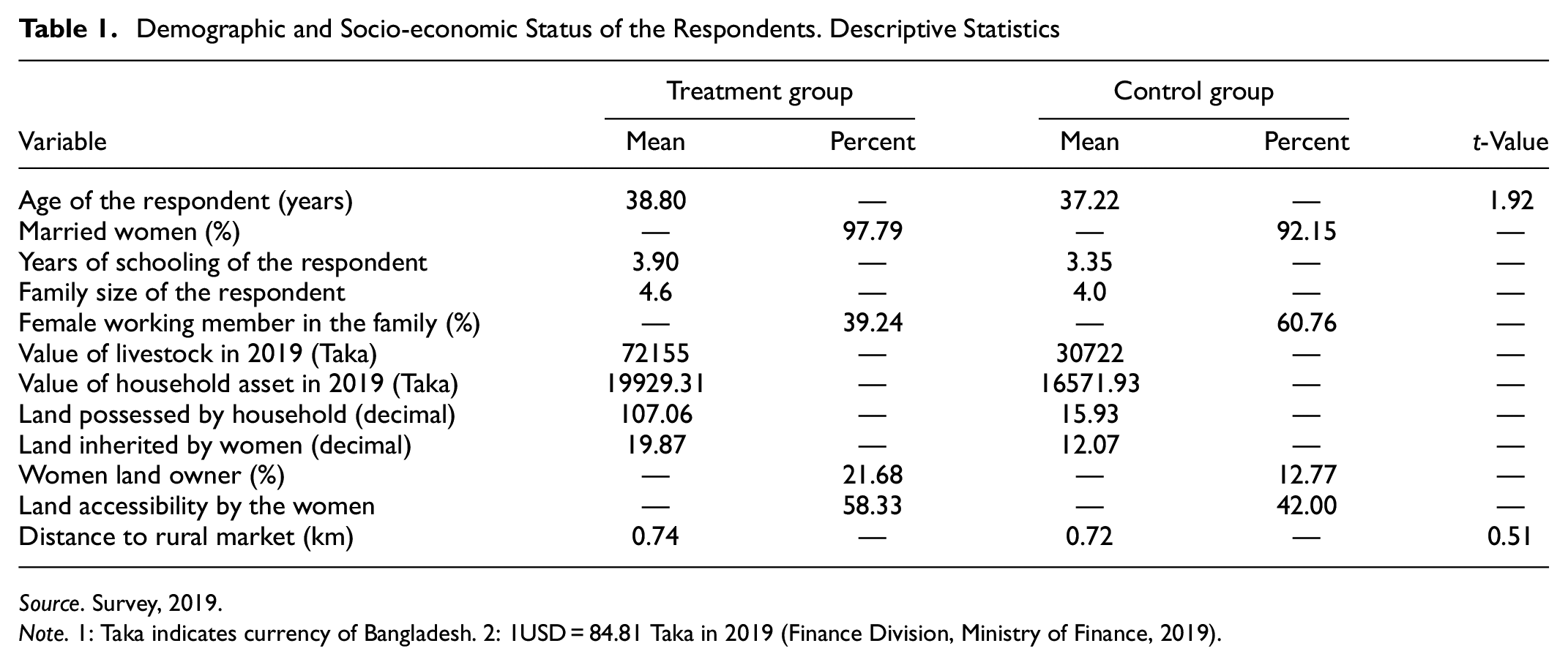
Source. Survey, 2019.
Note. 1: Taka indicates currency of Bangladesh. 2: 1USD = 84.81 Taka in 2019 (Finance Division, Ministry of Finance, 2019).
The average land possessed by households of the treatment group and the control group was 107.06 decimals and 15.93 decimals, respectively (Table 1). About 21.68%of women were owners of the land in the treatment group while it was about 12.77% for the control group (Table 1). In the treatment group, 58.33% of women have land accessibility and 42.00% of women have access to land from the control group (Table 1). The average area of land inherited by women in the treatment group was about 19.87 decimals, and it was found 12.07 decimals for the control group (Table 1). Similarly, Mahmud et al. (2023) also observed that rural women in Bangladesh owned small piece of land and the average land size was less than 50 decimals for women.
The average value of household asset for the treatment group was Taka 19,929.31 while it was Taka 16,571.93 for the control group (Table 1). It is to be noted that Taka indicates the currency of Bangladesh and one USD equals to Taka 84.82 in 2019 (Finance Division, Ministry of Finance, 2019). In this study, household assets refer to electronic devices, furniture, poultry and livestock, and equipment. The average value of households’ livestock in the treatment group and the control group were Taka 72,155 and Taka 30,722, respectively (Table 1).
The distance of rural markets from the treatment group and the control group did not vary significantly. The average distance of rural markets from the houses of respondents in the treatment group was about 0.74 km and in the control group, it was 0.72 km (Table 1).
Impact of Access to Land on Household Income
In the context of poor rural women, the usual lack of financial capacity is the major impediment to improving their overall living standard and rural women under this study are no exception. Generally, they have low levels of income, education, assets, and mobility because due to patriarchal norms of the rural society. Lack of income is the prime reason behind their vulnerability in terms of economic and social indicators. Undoubtedly, income is closely related to the living standard and improvement of living standard of a person largely depends on their income increase (Halam et al., 2017; Hilton et al., 2016). To exemplify, an increase in the household’s income level plays a pivotal role in uplifting the living standard through improving the food security status of the household in South Africa (Halam et al., 2017). Hilton et al. (2016) and M. A. Khan and Ali (2014) argued that increasing the rural poor households’ income in Bangladesh could increase their ability to enjoy healthcare facilities.
In this study, poor households mainly receive income from agricultural sources (e.g., crop cultivation, poultry raising, livestock rearing, fishery, nursery, agribusiness, leasing of agricultural land) but they also obtain income from non-agricultural sources (that included wage-earning, shop-keeping, hawking, handicrafts, remittance from overseas, service, etc.). As mentioned earlier, possession of land can play a pivotal role in improving household income as well as consumption. It can logically be assumed that women’s access to land can play a positive role in increasing household income. This study revealed that the treatment group’s household income was higher than the control group (Table 2). The increased income of the treatment group was Taka 33,476.47; Taka 28,246.98; and Taka 28,392.89 under the NNM, KM and RM methods, respectively (Table 2). Similarly, other researchers also observed that land ownership had a positive impact on household income (Han et al., 2019; Peterman, 2011).
Estimated Result of the PSM.

Source. Survey, 2019.
Note. 1: ATT = Average Treatment Effect on the Treated. 2: NNM = Nearest Neighbor Method; KM = Kernel Method; RM = Radius Method.
Impact of Women’s Access to Land on their Own Incomes
It was hypothesized that women’s access to land would increase their income. This study confirmed that women’s own income did not increase significantly despite having access to land (Table 2). This finding of our study is also consistent with the study of (Mahmud et al., 2023). There are few reasons for this failure. In fact, most women under this study were housewives and uninvolved in the IGAs. They had small pieces of land for generating adequate income. Moreover, they had a lack of control over the use of financial resources and on decision-making capacity. Their incomes were mostly used for the well-being of the family. In the context of developing countries, it is a common phenomenon that women’s earnings are often controlled and used by male members (Abbink et al., 2020; Ali et al., 2017).
Key Factors of Overall Welfare of Women
As stated earlier, household income is closely related to the living standard of women. Undoubtedly, increased household income will help women under this study select and pursue IGAs properly, resulting in higher return and expenditure for them as well as their households. It was observed in this study that the households’ total income was significantly and positively related to the dependent variable. This indicates that the economic situation of the women improves as the household income increases. The probability of being well-off for the woman was 50.01% for every additional increase in the households’ total income. Similarly, other researchers also observed that household income played a vital role in improving the living standard of rural poor community in Bangladesh on economic indicators (Hilton et al., 2016; Mahmud & Hilton, 2020).
NGOs have played a significant role in women’s development by providing financial and technical support for pursuing the IGAs to the poor, especially rural poor women (Hilton et al., 2016; M. A. Khan & Ali, 2014; Mahmud et al., 2017). Moreover, NGOs in Bangladesh also make efforts to increase the decision-making and leadership capacity of women, their social status, mobility, and employment opportunities (Al-Amin & Mathbor, 2019; H. Khan & Rahman, 2016; Zafarullah & Nawaz, 2019) through building awareness and creating access to information. It can be hypothesized that a village where NGOs are operating their development programs would be in a more advantageous position in terms of economic and social aspects than a village where NGO-operated development programs do not exist. This study showed that the dummy variable ‘Village has NGO’ was positively and significantly related to the dependent variable (Table 3). It indicates that women will be economically well-off if the NGO works in a village. The probability of women being financially well-off will increase by 55.28% if NGOs work in the village. According to Mahmud and Hilton (2020), increasing the distance between the dwelling place of the rural communities and the NGO branch office is more likely to reduce the economic welfare of the rural people.
Estimated Results of the BLR.
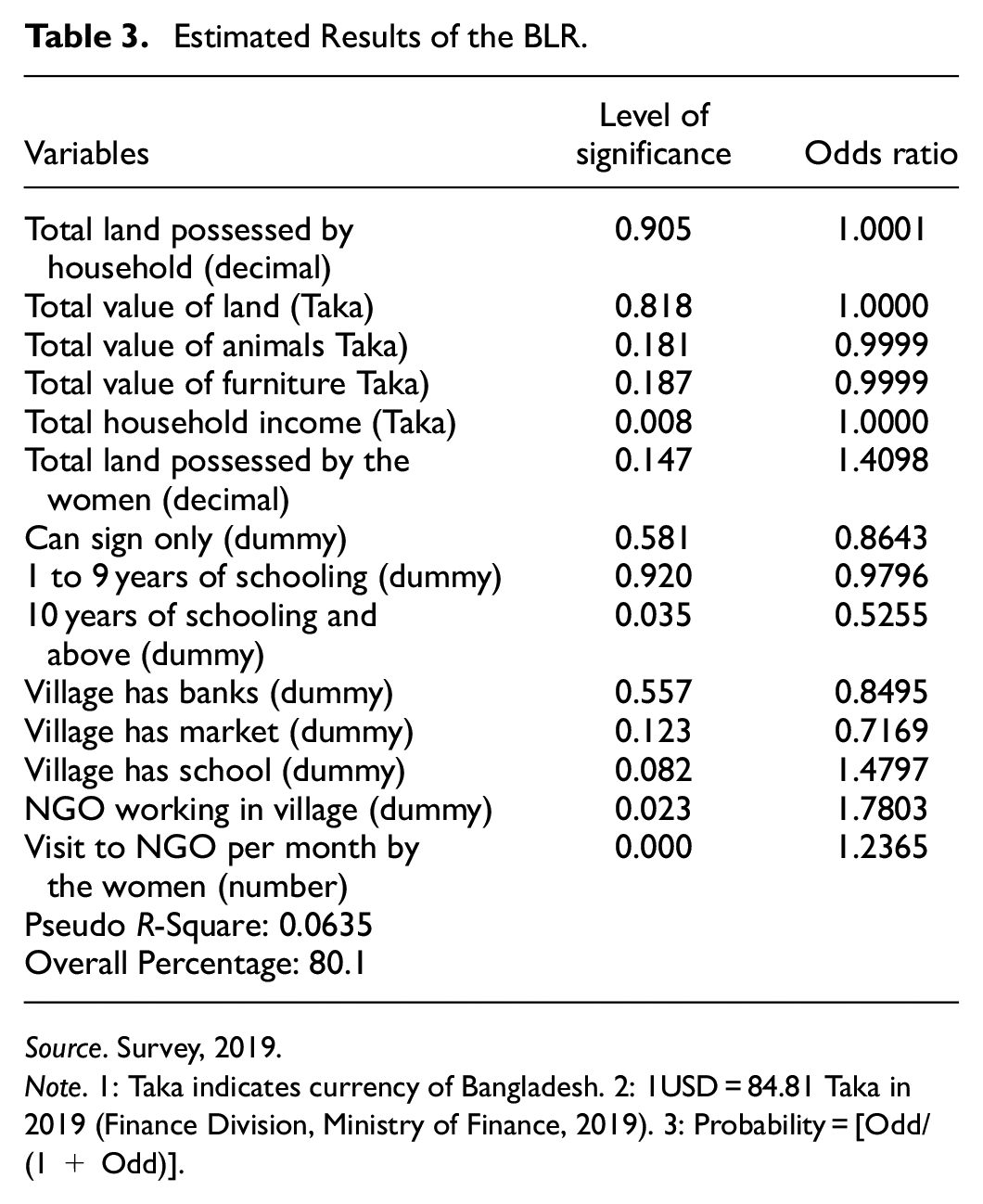
Source. Survey, 2019.
Note. 1: Taka indicates currency of Bangladesh. 2: 1USD = 84.81 Taka in 2019 (Finance Division, Ministry of Finance, 2019). 3: Probability = [Odd/(1 + Odd)].
It is assumed that a woman who maintains close contact with the NGO branch office will be ahead in receiving financial, technological, and informational facilities than a woman who has little contact with the NGO. This study shows that “the number of visits to the NGO per month” by the women is positively and significantly related to the dependent variable “Overall Well-being of the Women.” It indicates that the economic well-being of women will increase if the number of visits to the NGO office by women increases. The probability of women being economically well-off will increase by 55.28%for every additional visit to the NGO.
Education is also closely related to a person’s social and economic well-being (Hilton et al., 2016). It is assumed that the educated women are to be more advantageous in investing in IGAs, using technology, and having better decision-making capability than the women who are less educated. In this study, women were divided into three categories based on their educational background. These three categories were: (i) can sign only (category 1), (ii) 1 to 9 years of schooling (category 2), and (iii) 10 years of schooling or above (category 3). It was assumed that the woman under category 3 would be better off than those under categories 1 and 2. This study showed that higher schooling of the women (category 3) had a positive and significant impact on the dependent variable as expected (Table 3). The probability for the women under category 3 was 34.45% for being well-off if the number of schooling increases by 1 year. This study finding is consistent with the study of Mahmud et al., 2017.
Conclusion and Policy Implications
The prime objective of this study was to assess the impact of women’s access to land on their household income and their own income. Study findings revealed that the treatment group had higher household income than the control group. This study also confirmed that rural women’s own income did not increase significantly despite having access to land. Variables such as household income, educational background of women, and their visit to the NGO office are the key factors that contributed to the improvement of their overall well-being.
In rural areas of Bangladesh, income-generating opportunities are still limited. Steps need to be taken to create opportunities to increase the household income of rural people substantially. It is important to set up more small-scale industries in rural areas by establishing an effective partnership among different stakeholders of the society, such as the Government of Bangladesh (GoB), NGOs, donor agencies and rural communities. It is also essential to provide adequate skill-building training for rural people on the IGAs as per their needs. Emphasis should be given to providing credit facilities to rural households so that they can invest in their existing IGAs properly or start new IGAs which will assist them in increasing their household income.
It is also important to establish NGO branch offices as close as possible to villages. It is essential to ensure necessary financial, technological, or legal support for rural people, especially rural women. The focus should be given to providing necessary training facilities to the NGO staff working in the villages so that they can become friendlier to the villagers and provide necessary extension services to them promptly and efficiently. Social awareness building programs also need to be strengthened so that rural women feel encouraged in participating in different development programs operated by NGOs in rural areas.
Rural women usually lack educational facilities which severely hinders their participation in the social and economic arenas. Necessary steps need to be taken to provide them with adequate facilities for their schooling. More schools need to be established in rural areas for females with the support of GoB and NGOs. It is also important to provide female students with necessary educational materials at a nominal price and also give them adequate stipends on a merit basis so that they feel motivated to continue their studies. Necessary laws need to be formulated, and the strict implementation of the existing laws is also required to increase the participation of females in academic programs.
In addition, there should be proper focus on awareness building measures for women’s land rights and entitlement. Land ownership pattern in Bangladesh needs to be examined carefully, and the implementation of inheritance law should be enforced properly so that land access in terms of ownership increases the livelihood of women.
Limitations of the Study
This study has few limitations. It was conducted only in two districts of Bangladesh, but it can be conducted comprehensively by taking more villages and upazilas from other districts. Moreover, no in-depth investigation (using the qualitative method) was performed here as secondary data are available in the literature but inquiries cvan be made about insights of our results. Additionally, our focus was only on the economic part but there exists various social aspects (sanitation and hygiene) and cultural aspects (leadership patterns arising out of land access) which are not considered here. These could be an area for future research.
Footnotes
Acknowledgements
We gratefully acknowledge learned members of BIGM research team as well as all faculty members and officials for providing thoughtful comments and sharing their invaluable views from the proposal development stage to drafting of this paper. We also want to acknowledge the names of all the data collectors and data entry person of this study. The Upazila Nirbahi Officers of the study area deserve our special thanks. Ms. Saiyeeda Sania Munim deserves our special thanks for reviewing the paper. We also acknowledge Finance Division, Ministry of Finance and Ministry of Public Administration, Government of Bangladesh for continuous support and cooperation.
Declaration of Conflicting Interests
The author(s) declared no potential conflicts of interest with respect to the research, authorship, and/or publication of this article.
Funding
The author(s) received no financial support for the research, authorship, and/or publication of this article.

Data Availability Statement
Data sharing not applicable to this article as no datasets were generated or analyzed during the current study.