




Abstract
This article explores Bangladesh’s voting coincidences at the United Nations General Assembly (UNGA) with China, India, Russia, and the United States for the period 2001–2017 to draw inferences about country’s political proximity and policy preferences on global issues. Although Bangladesh’s voting coincidence shifted from China toward India since 2013, country’s “opposite” votes with India remained 3 times higher compared with that of China, suggesting that the post-2013 change in voting coincidence is more about the types and content of the resolutions and not fundamental. Bangladesh maintained a principled position on disarmament, conventional arms control, nuclear nonproliferation, and prohibition of chemical weapons resolutions, which are greatly at odds with India and China. Such voting coherency suggests that the small developing countries can maintain a higher level of voting consistency on issues that are of great interest to them. However, Bangladesh’s voting inconstancy in the country-specific human rights resolutions reflects a selective adherence to the policy of non-interference, particularly with respect to neighbors. Bangladesh’s voting records on the human rights situation in Myanmar, reveals that it joined the majority member states condemning Myanmar only when the resolutions started mentioning Bangladesh as an affected country. Although the voting coincidence alone may not capture the whole dynamics of a state’s leanings, this article has revealed that systematic research of UNGA voting records has the capacity to add to the knowledge of political proximity and policy preferences of states in terms of the way they weigh their choices and chart their path through idealism and opportunism.
Keywords
Introduction
The United Nations General Assembly (UNGA) is the hub of global policy innovation and diffusion. It is the only universally representative body where all member states enjoy equal status and openly exercise their voting preferences as a sovereign entity. Between 2001 and 2017, total 1,284 resolutions were adopted by recorded/roll-call votes at the UNGA where each state revealed its preference by agreeing, (yes), disagreeing (nay), or abstaining from voting. Although these resolutions are non-binding, hence considered as “inconsequential,” the platform remains a unique source to observe and compare the relative policy positions of essentially every member state in the same institutional setting. The voting preferences may not entirely be a “true” reflection of the “mind” of a state, and this is because voting at UNGA depends at times on a member state’s strategic agenda and influences key global and regional actors exert. However, the non-binding nature of the UNGA resolutions suggests that “strategic voting” is a less common phenomenon compared with the binding votes in the United Nations Security Council (UNSC) (Bailey et al., 2017, p. 437). Translating voting preferences into actions entails cost-benefit analysis and the capacity of the state. There are inherent distortions in converting states’ preferences into behaviour. Thus, preferences and interest similarity among pairs of states (dyads) expressed in the Assembly sessions must be interpreted with caution. States’ voting preferences at the UNGA, thus, reflect their unique policy preferences—arrived at either as an expression of commitment to certain fundamental values, influenced by strategic needs or a combination of both (Kim & Russett, 1996, p. 629; Rai, 1972, p. 394).
The UNGA voting records of developing countries like Bangladesh has received far less attention by the international relations (IR) scholars. To fill this gap in the literature, this article analyses Bangladesh’s voting coincidences with China and India—two regional players—and Russia and the United States—two extra-regional players—for the period 2001–2017. It explores the variations/consistency in Bangladesh’s voting preferences, analyze Bangladesh’s voting preference in different thematic issues including the country-specific resolutions on human rights (HR) situations. The findings demonstrate the usefulness of analyzing the UNGA voting record as a tool of assessing Bangladesh’s ideological and strategic preferences and highlight her policy inclinations and political proximity with China, India, Russia, and the United States.
Theoretical and Conceptual Debate: UNGA Voting Records of Developing Countries
The conceptual framework underlying the use of UNGA voting records to assess states’ policy preferences and political proximity is contested. A sole focus on the voting records as a “microcosm for world politics” offers little justification to comprehend the dynamics of states’ preferences and policy inclinations (Dixon, 1981; Keohane, 1967; Riggs et al., 1970; Voeten, 2013). Nevertheless, the relevance of key IR theories, such as realism, liberalism, rationalism, and constructivism, in the study of the UNGA voting records cannot be ignored (Brian & Damiel, 2002).
The realist worldview considers sovereign states are the main policy actors in an ‘anarchic’ international system. The realists are skeptical about the possibility of international cooperation and sees survival as the fundamental motive of a state in an anarchic international system (Andreatta, 2005; Mearsheimer, 1994). States are likely to ‘bandwagon’ or form alliances with powerful actors to survive in a system lacking a hierarchical political order. Thus, according to the realists, identically cast votes in the UNGA resolutions would be indicative of similar preferences within the limits of protecting the sovereignty norms. Such similar preferences, according to the realist school of thought, are likely to crumble in times of crisis where states are pushed for “self-help” to survive. Similarly, concerns for relative gains are likely to limit cooperating between the states or blocks of states and affect their voting preferences.
The liberalists disagree with the realist assumption, that power is the means by which security is guaranteed, suggesting cooperation as the most pervasive element in international relations (Cranmer, 2005; Walt, 1998). Liberalists’ emphasis on formal or informal institutions to promote cooperation between states justifies the relevance of the UNGA as a platform for policy diffusion and its voting records as an indicator for the prospect of cooperation or conflict. However, the incentive to cooperate in multilateral forum, according to the liberalists’ view, is constrained by national politics, interest groups and public opinion, particularly in democratic countries.
The rationalists view (Fearon & Wendt, 2002) the states as unitary actors which calculate the marginal utility of their actions. Rationalists believe that the state’s behavior is inspired by the logic of consequentiality (March & Olsen, 1989). Thus, for a rationalist, the UNGA voting preferences of a member state is a “goal-seeking behaviour” explaining the member state’s foreign policy.
The constructivist’s emphasis on the intersubjective structure of the state system, which helps to formulate state identities and interests (Wendt, 1994, p. 385), distinguishes it from the other approaches. Constructivists’ emphasis on “shared ideas” that shape behavior by constituting the identities and interests of actors (Copeland, 2006) suggests that the voting preferences of the member states in the UNGA are driven by the logic of appropriateness. State voting preferences are based on their assessment of what they consider proper within the context of the group they belong (or want to belong) at a particular time and on a particular agenda. According to the constructivist view, the voting blocks that form within the UNGA during any roll-call session is the result of informal, “societal” development, creating a web of consultation with integrative effects leading to the voting preferences of individual countries (Birnberg, 2009; Glarbo, 2001).
The conceptual and theoretical framework to explain the UNGA voting preferences of the developing states is much scantier. In multilateral forums, the developing states are generally considered to be engaged in “low politics” (promoting external economic relations, incentives and access) as opposed to “high politics” (i.e., traditional politico-diplomatic activities, alliance building, considered essential for the survival of the nation-state). The goals for these states, dubbed as “the third party,” are to get more favorable terms of trade with developed countries, to receive more aid, to regulate investments of transnational companies, to reschedule debt, or debt relief leveraging the multilateral forum (Iida, 1988; Voeten, 2013). Thus, their voting preference is mostly used as an independent variable to identify “voting blocks” and alignment with established regional and global powers.
In the context of developing states, the capacity of the state, regime type, and pressure from the donors, regional and global powers are cited as the most common causes for the propensity to and frequency of changes in voting preferences at the UNGA (Brazys & Panke, 2017; Dreher & Jensen, 2013; Dreher & Sturm, 2012). It is argued that the higher a state’s level of capacity, the less likely it will be to change its UNGA vote. Similarly, an autocratic state is more likely to shift its voting preference, while states with higher levels of aid dependency will have an increased likelihood of vote shifts. As a result, it is implied that for divisive resolutions, the developing states are often unable or unwilling to maintain a principled position. The UNGA voting records may also serve as a tool to demonstrate ideological unity and legitimation of policy to appeal regime loyalty and national cohesion. With these insights about the conceptual and theoretical underpinnings, we now examine the nature of the UNGA votes.
The Nature of the UNGA Voting Record
The sheer range of issues discussed at the UNGA in each year by the member states makes it a key platform for policy innovation, diffusion, and endorsement of global issues, albeit in a non-binding way. Although most resolutions are adopted without a vote, each year around 65 to 95 resolutions are adopted in the plenary sessions by recorded/roll-call votes. According to the Rule 66 of the Plenary Meetings Rules of Procedure, XII, at least one third of the members are needed to be present at these sessions for the voting to happen. Between 2001 and 2017, total of 1,284 resolutions were put to vote in 1,873 plenary meetings (Figure 1). The voting records broadly reflect where a country stands, with whom it stands and for what purpose—at least in the UN context.

Plenary meetings and resolutions adopted by recorded/roll-call vote at the UNGA, 2001–2017.
It is rare to know or directly observe the dynamics that shape the states’ voting preferences. Thus, the UNGA voting data are regarded as an indirect but close proxy of such dynamics to explore political proximity and policy inclination of a state (Alesina & Dollar, 2000; Dixon, 1981; Gartzke, 1998; Signorino & Ritter, 1999). As mentioned before, votes by a developing country may be influenced by her strategic motives, regional/global influence, material incentives, or leadership change. However, the non-binding nature of the UNGA resolutions also implies that “strategic” calculations are a less common phenomenon.
Second, in contrast to the UNSC, the UNGA is a universally represented body and its voting records offer a comparable longitudinal data set of all member states. The UNSC has only five permanent (China, France, Russia, the United States, and the United Kingdom) and 10 rotating members, hence no scope for a longitudinal data set on all countries. Some UNGA decisions on “important questions,” such as the maintenance of international peace and security, are made by a two-third majority of the members present and voting (Rule 86, Plenary Meetings, Rules of procedure). Some of these resolutions are also regarded as “critical” by a regional/global power, eliciting pressure, or incentives to secure a positive outcome at the plenary voting (Pauls & Cranmer, 2017; Schaefer & Kim, 2018, p. 432; Wang, 1999, p. 200).
Third, the voting data reflects the outcome of an obscured underlying process, arrived at by the officials of each country through an institutionalized mechanism for communication. These officials, representing their government’s position and operating through a repeated and regular interactions at the UNGA, share common values and goals such as global communication, cooperation, and negotiated settlements to isolationism and conflict. The unique characteristics of the actors and their network of knowledge make them an epistemic community—defined as “cross-national collective[s] of individuals with common interests and institutionalised mechanisms for communication” (Haas, 2018, p. 788). Such community has an authoritative claim to policy-relevant knowledge within their domain of expertise and plays an important role in the diffusion of information, influencing the decision-making process. Thus, the voting data—that is, the output of this epistemic community—are a valid proxy of the obscured underlying process at a set point of time (Bailey et al., 2017, p. 431; Lazer, 2005, p. 56; Newcombe, 1976).
Researchers have used the UNGA voting data to investigate systemic polarity in the international system (De Mesquita, 1975; Voeten, 2004), foreign aid effectiveness (Alesina & Dollar, 2000; Dreher et al., 2008), alliance building, probability of conflicts (Gartzke, 2000; Pevehouse, 2004), “third world” solidarity (Iida, 1988), and so on. The U.S. Department of State (2000, 2008) submits yearly report to the Congress analyzing the UNGA voting practices of the UN member states. The report evaluates the actions and responsiveness of those members states to U.S. policy on “issues of special importance” to the United States. The reports are sent to each U.S. diplomatic mission abroad with instruction to deliver a copy to the respective government. The UNGA voting data are also used to capture the position of member states vis-à-vis the “US-led liberal order” or “US dominance” in the UN to identify the member state’s policy shifts (Bailey et al., 2017; Voeten, 2004). Countries’ voting behavior is also used to test the “political proximity” hypothesis and linked to the lending decisions by the International Financial Institutions (Barro & Lee, 2005; Dreher, 2009; Dreher & Sturm, 2012, p. 233; Stone, 2004; Thacker, 1999).
However, as hinted before, the UNGA data are not the most comprehensive tool to explain the full dynamics of states’ policy preferences. The political dynamics of the bilateral relationships, geopolitical factors, trade and economic interdependence, security need, and regime type are also important to assess the political proximity of a member state and the matrix of conflict and cooperation (Lai & Reiter, 2000, pp. 203–227; Pevehouse, 2004). Indeed, the Gulf state of Bahrain that has consistently maintained a low voting coincidence with the United States at the UNGA (merely 25%–33% in 2001–2017) also houses the U.S. Navy’s Fifth Fleet—driven by its security needs (Jones, 2011). Similarly, Bangladesh’s low voting coincidence with the United States at the UNGA has not dwindled the U.S. military and economic aid and assistance to the country (U.S. Agency for International Development, 2018). The bilateral factors, context, and the contents of the resolution together with the importance attached to the agenda by the member state at a time and space remains important to meaningfully interpret the UNGA voting data.
Why to Compare Bangladesh’s Voting Data With the Key Players?
Several factors make Bangladesh a good case to study. First, Bangladesh is situated in the periphery of international politics like many other small developing states. The country houses 8.4% of the total world Muslim population and 88.2% of Bangladeshis are Muslims (Bangladesh Bureau of Statistics, 2016). Thus, Bangladesh came into the international spotlight following the declaration of the U.S.-led “war on terrorism” in 2001 for the fear that the influence by Islamist extremists could destabilize the country (U.S. Department of State, 2002; Vaughn, 2013). Some were tempted to brand Bangladesh as a “hotbed of terrorism,” potential “breeding ground of Islamist extremism,” and the “next Afghanistan” soon to become a “failed state” (Griswold, 2005; Karlekar, 2005; Perry, 2002). However, defying such speculations, Bangladesh upheld its reputation as a moderate and democratic Muslim majority country by pursuing a holistic multi-stakeholder approach to fight terrorism. It has also fostered a moderate and harmonious religious culture compared with its relatively more extreme neighbors (Bashar, 2017; Kamal, 2013; Vaughn, 2013). Thus, Bangladesh’s voting preferences at the UNGA at a period when it was under international spotlight could be useful to analyze her policy preferences on regional and global issues.
Second, the country is exposed to the influence of two key regional players—India and China, both vying to keep Bangladesh under their sphere of influence (Bhardwaj, 2003; Datta, 2008; Kanwal, 2018; Riaz, 2019, pp. 53–76). Nevertheless, it is widely believed that “Dhaka remains aware that both Delhi and Beijing take more than they give to Bangladesh” (Cookson & Joehnk, 2018). Thus, exploring the trend of Bangladesh voting coincidences with India and China and examining specific issues where Bangladesh voted against these two regional players, can provide useful insights into her foreign policy inclinations in a multilateral forum.
Third, the birth of Bangladesh in 1971 is the only example of forcibly creating a new state propelled by ethnic-linguistic movement in the Cold War era, amid a juxtaposed position of the United States and the former Soviet Union (Baxter, 1997; Blair, 2001, pp. 45–148). Two successive Soviet veto at the UNSC facilitated Bangladesh’s birth as an independent state. However, Bangladesh’s dependency and support from Russia have reduced over the years, particularly after the collapse of the Soviet Union. Bangladesh’s practice of multiparty democracy, in principle, also puts her in the block of countries promoting “the U.S. led liberal world order.” Amid such contrast and a resurgent Russia, it would be interesting to examine Bangladesh’s voting preferences at the UNGA to observe where the country stands, with whom and for what purposes in the multilateral platform.
Finally, a case study on Bangladesh’s policy inclination on global issues based on her UNGA voting records is long overdue. Most analyses on Bangladesh’s foreign policy inclination—particularly with respect to India and China—are descriptive, impressionistic, and unsystematic. These studies are focused on normative issues like history and culture, geography, leadership affiliations and bilateral visits, the religious factor, security posture, military hardware acquisition preferences, and so on (Bhardwaj, 2003; Datta, 2008; Kumar, 2017; Pattanaik, 2005; Zaman, 2017). As a result, an evidence-based analysis of where and with whom Bangladesh’s epistemic community stands in a multilateral forum on key global issues has largely remained unexplored.
Data and Method
The voting data extracted, are from the “The Index to Proceedings of the General Assembly,” published each year by United Nations Department of Public Information (UN DPI) and is available online in the UN Dag Hammarskjold Library. The index includes a voting chart that provides the list of resolutions adopted by recorded or roll-call vote. The vote by each member state is recorded in the textual form such as Y (for “yes”), N (for “no”), A (for abstention), and “blank” indicating absence. Bangladesh’s voting data from 1975 is available. However, this article examines data from the 56th session through the 72nd session (2001–2017). The selected period is large enough to include preferences on wide-ranging resolutions made by two major political parties in Bangladesh—namely the Bangladesh Nationalist Party and the Awami League, who were in power during this period.
Most analyses of UNGA voting records use dyadic data set. The U.S.-centric dyadic data set is the most common one (Voeten, 2013), while China and India–centric data set and analysis are also emerging (Das, 2017; Fu, 2013). This article is based on a novel Bangladesh-centric dyadic data set prepared by coding and comparing Bangladesh’s voting preference in each UNGA resolutions with the preferences of China, India, Russia, and the United States. However, an inherent limitation of dyadic data set is that it can only reveal shifts in preference similarity between two states, but not which state has shifted.
There are several methods to code the voting data to calculate voting coincidence. For example, Gartzke and Dong-Joon (2002) code voting coincidence between −1 and 1, with abstentions being in between compliance and non-compliance. Russett (1967) and Rai (1972) code each country’s vote as 2 (for yes votes), 1 (for abstain or absent), and 0 (for no vote). However, the most common approach is to categorize the dyadic data set as “same,” “opposite,” “partial,” and “absent” (Thacker, 1999; U.S. Department of State, 2008). The “same” is the total number of times both the countries voted as yes/yes, no/no or abstain/abstain for a resolution. The “opposite” is the situation when the countries voted counter to each other (i.e., one country voted “yes,” but the other country voted “no” and vice versa). The “partial” is the number of times when their voting preferences were partially aligned (one country, but not both, abstained). The “absent” is the number of times the listed country did not vote.
Subsequently, the voting coincidence is calculated by adding one (1) point for every “same” vote, zero (0) point for every “opposite” vote, and a half (0.5) point for every “partial” vote. The point assigned is rational—in particular, the weight of abstention votes affects the “partial” category making it distinctly different from the other two. It also conforms to the predominant view in the literature that a “no” vote is a stronger signal of disapproval than an abstention. A member state may be seduced/coerced not only to comply (i.e., vote Y/N) but also to avoid non-compliance (i.e., abstain). The total number of points is then divided by the total number of votes each year excluding absences and expressed in percentage. The “absences” is excluded, as the reasons for a country’s absence can be purposeful or situational (unable to attend)—which is hard to determine (Kegley & Hook, 1991; Palmer et al., 2002; Voeten, 2013; Zimmermann, 1993). For example, during “government turnovers” member states may temporarily have no UN delegation to vote at the UNGA (Voeten, 2013, p. 5).
Bangladesh’s voting coincidence with China, India, Russia, and the United States, as calculated by this methodology, forms the broad basis to compare the country’s policy inclination. Subsequently, Bangladesh’s “opposite” votes, voting preferences in different thematic categories with a focus on the country-specific resolutions on HR situation and the content of such resolutions, are examined for a more nuanced analysis of the country’s policy position and political proximity with the key players on global issues.
Bangladesh’s Voting Records at the UNGA
Bangladesh’s Constitution (1972; Art 25) states, ‘‘the State shall base its international relations on the principles of respect for national sovereignty and equality, non-interference in the internal affairs of other countries, peaceful settlement of international disputes, and respect for international law and the principles enunciated in the United Nations Charter . . .’’. Thus, it is expected that the country’s voting preferences will be largely aligned with the norms developed in the UNGA. Figure 2 provides a summary of the voting records of Bangladesh, China, India, Russia, and the United States on the 1,284 UNGA resolutions between 2001 and 2017. Bangladesh voted “yes” in 91% resolutions followed by China (83%), India (79%), and Russia (69%). Bangladesh disagreed with 35 resolutions (3%), “abstained” in 66 resolutions (5%), and was absent during the voting of 14 resolutions. Bangladesh’s voting trend as a strong supporter of UNGA resolutions is trailed by China, India and Russia.

Summary of voting records of Bangladesh, China, India, Russia, and the United States at UNGA, 2001–2017.
During this period, the United States disagreed with 68% of the resolutions. An analysis of the reasons for discordant votes by the United States is beyond the scope of this article. However, the IR scholars have attributed it to the “schisms” between the United States as the remaining superpower and the rest of the world, suggesting that such schisms “constitutes a prelude to the formation of balancing coalitions that could eventually undermine American hegemony” (Huntington, 1999, pp. 35–49; Nye, 2002; Voeten, 2004, p. 747). With these broad insights, we return to investigate the voting coincidence of Bangladesh with respect to India, China, Russia, and the United States to draw inferences about Bangladesh’s political proximity and foreign policy preferences.
Voting Coincidences
In terms of dyadic similarity/opposition, Bangladesh’s voting coincidence (Figure 3) shows that the country’s preference on global issues has been more aligned with China, India and Russia compared with the United States. Voting coincidence with the United States remained between 14% and 30%, gradually increasing since 2007 (with the exception in 2013–2014). However, Bangladesh’s vote on terrorism-related resolutions has been mostly aligned with the United States. In the case of Russia, the voting coincidence remained between 72% and 86% and gradually decreased since 2011–2012. Such a trend was maintained by all the governments in power between 2001 and 2017 in Bangladesh.

Bangladesh’s voting coincidences with China, India, Russia, and the United States at the UNGA, 2001–2017.
In the regional context, Bangladesh’s voting coincidence with the two key players never dropped below 80%. The comparative gap in Bangladesh’s voting coincidences with China and India is meager and has consistently remained in favor of China until 2011. However, the country’s voting coincidences with India surpassed that of China in 2013 and has gradually increased since then with the exception in 2014 (see Figure 4). Does this increased voting coincidence with India reflect a shift of Bangladesh’s policy preferences?

Bangladesh’s voting coincidences with China and India at the UNGA, 2001–2018.
As alluded before, a high voting coincidence alone may be meaningless as many UNGA resolutions are procedural in nature and not particularly “important” to a state’s national interest. Key regional/global players may not expend any political capital to influence the voting preferences of uncontroversial/procedural resolutions. One useful way to tease out the nuances of the increased/decreased voting coincidence and policy shifts is to examine the “opposite” votes by Bangladesh and the thematic issues of such resolutions, discussed next.
“Opposite” Votes
Exploring the ‘opposite’ votes allows examining the implicit assumption of ‘path dependency’ in developing states’ voting at the UNGA. Figure 5 depicts the yearly distribution of the “opposite” votes by Bangladesh at the UNGA for the period of 2001–2017. Bangladesh voted “opposite” to the United States 888 times followed by 89 times to Russia during this period. In the regional context, Bangladesh voted opposite to India 48 times while the same for China was only 16 times with three overlaps. Three overlapping resolutions are (a) declaration on human cloning, (b) taking forward multilateral nuclear disarmament negotiations, and (c) toward a nuclear-weapon-free world: accelerating the implementation of nuclear disarmament commitments (UNGA, 2005, 2017a, 2017b). Such preference broadly suggests that Bangladesh’s policy inclination on global issues is significantly closer to China.

Distribution of “opposite” votes by Bangladesh at the UNGA, 2001–2017.
To further explore this trend in the regional context, we examine Bangladesh’s voting preference in occasions where India and China voted opposite to each other. Bangladesh’s voting preference in such occasions could be deemed “important” and better reflect the country’s alignment. In 33 such occasions, Bangladesh’s voting preferences were aligned with China in 29 times and only 4 times with India (Figure 6). More importantly, Bangladesh’s voting preference was not aligned with either India or China in the remaining 28 occasions during this period.
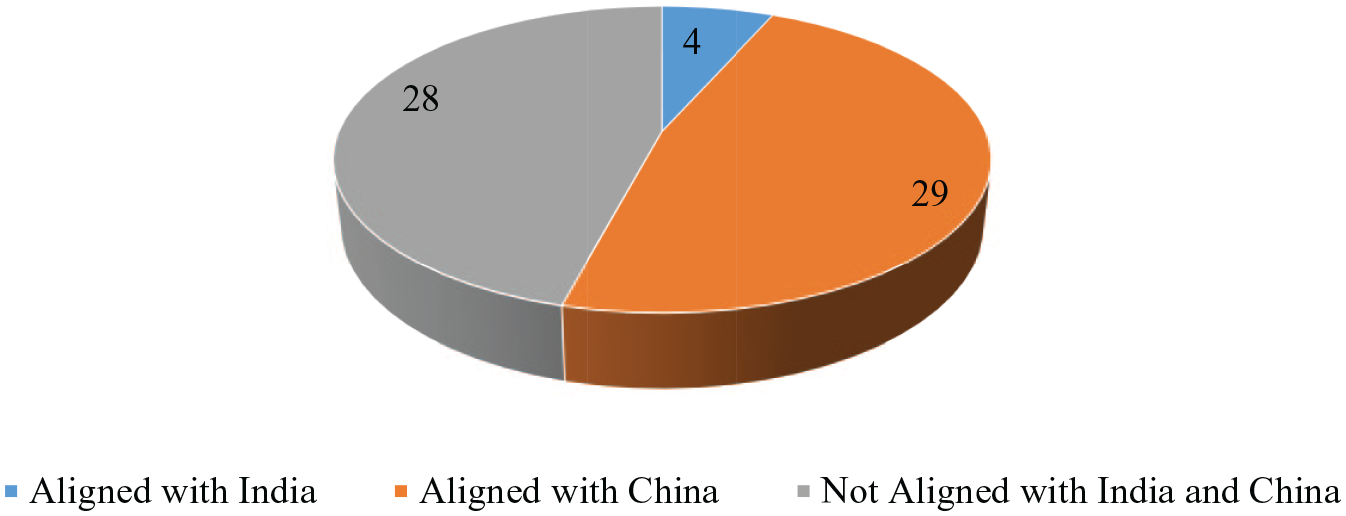
Alignment of Bangladesh’s “Opposite” votes with India and China at the UNGA, 2001–2017.
The analysis of the “opposite” vote hints at three possible inferences. First, despite Bangladesh’s increased voting coincidence with India since 2013, the country’s position on global issues has remained significantly aligned with China. Second, the aggregate increase/decrease in voting coincidence may be due to the nature of issues raised in the UNGA for voting in these sessions and not entirely a reflection of policy inclination. Third, the voting coincidence does not suggest the directionality—that is, whether Bangladesh’s policy preference is shifting toward China/India or the other way around. Indeed, Bangladesh maintains a principled position on some global issues that are not aligned to either India or China, suggesting an independent policy preference irrespective of the influence from the key regional players.
Thematic Issues of the Resolutions
Examining the thematic issues of the resolutions in which Bangladesh voted “opposite” (see Annex A for the list) to India and China provides a more nuanced insight into the nature of Bangladesh’s alignment and difference with the key regional players. The resolutions can be placed into three broad categories: (a) disarmament of conventional weapons, (b) nuclear disarmament and prohibition of chemical weapons, and (c) HR and the rights for self-determination. The “other” category includes three resolutions: (a) regional confidence building (UNGA, 2003), (b) human cloning (UNGA, 2005), and (c) entrepreneurship for development (UNGA, 2015). As evident from Figure 7, Bangladesh’s consistent support for the resolutions on conventional arms control at the regional and sub-regional levels stands at odds with India. These resolutions recognize the crucial role of conventional arms control in promoting regional and international peace, calling for urgent consideration to the issues to promote agreements to strengthen regional peace and security at the lowest possible level of armaments and military forces, and to prevent the possibility of military attack launched by surprise and to avoid aggression. The resolutions on conventional arms control also recognize that “states with larger military capabilities have a special responsibility in promoting such agreements for regional security.” However, India remains the only country that has opposed all such resolutions during this period.

Thematic issues of “opposite” votes by Bangladesh at the UNGA, 2001–2017.
As opposed to India, Bangladesh has consistently voted for a nuclear-weapon-free world and disarmament (24 “opposite” votes). These resolutions call for “achieving the universality of the nuclear Non-proliferation Treaty (NPT), devising ‘effectively verifiable treaty banning the production of fissile material for nuclear weapons or other nuclear explosives’,” design disarmament and non-proliferation education and training program to promote a culture of non-violence and peace. As a non-signatory of the NPT, India’s position on these resolutions is fathomable. Interestingly, until 2016, China consistently voted “opposite” to India or abstained on a resolution calling for a “nuclear-weapon-free world and accelerating the implementation of nuclear disarmament commitments.” Except for three abstentions, China consistently voted “yes” to this resolution between 2001 and 2017. India also consistently opposed a similar resolution titled “Toward a nuclear-weapon-free world: the need for a new agenda,” while China has either abstained or voted “yes.” China also opposes the prohibition of the development, production, stockpiling, and use of chemical weapons and on their destruction.
The analysis of the “opposite” votes on these thematic categories suggests that Bangladesh maintains a principled position on the issue of conventional arms control, nuclear nonproliferation, and prohibition of chemical weapons. It affirms that the epistemic community of Bangladesh dealing with country’s policy preferences at the UNGA is broadly aligned with the global community promoting disarmament, non-proliferation and regional peace. It also reaffirms the findings that the variations in Bangladesh’s voting coincidence with India and China are more about the type of resolutions that are put to vote at the UNGA sessions and may not reflect a fundamental policy shift. However, Bangladesh’s voting preferences with respect to the resolutions on HR shows greater inconsistency—discussed next.
Voting Record on HR-Related Resolutions
Considering the wide range of HR related resolutions, this article focuses on the voting records of country-specific HR situation. The HR resolutions cover issues like terrorism, torture, extrajudicial killing, use of mercenaries, unilateral coercive measures, distribution of membership in the HR treaty bodies, and review of HR conference/reports. These resolutions generally condemn the HR violations of a member state; as a result, they draw political reactions and variations in voting preferences by the member states (Flores-Macías & Kreps, 2013, p. 358; Office of the High Commissioner, United Nations Human Rights, 2017; UNGA, 2020). While voting in such resolutions, member states are often challenged to choose between the concept of “non-interference in the internal affairs of other countries” and supporting the oppressed peoples engaged in a “just struggle against imperialism, colonialism or racialism.” Although the resolutions on HR violation in Palestinian has consistently received broad support at the UNGA, the variations in voting preferences on other country-specific HR resolutions are wide. Examining these variations can provide useful insight into the country’s political proximity and foreign policy consistency.
Between 2001 and 2017 a total of 90 country-specific HR resolutions were put to vote at the UNGA (details in Annex B). Bangladesh voted against 27 such resolutions, abstained in 24 and agreed with 38 (Figure 8). Majority of the agreed (87%) resolutions relates to the Palestine issue, condemning the Israeli actions in the occupied territories. Bangladesh’s support for the Palestinian people is aligned with her constitutional provision (Art. 25b and c) of supporting oppressed peoples throughout the world. However, Bangladesh, like many others, has also voted against or abstained from voting in many country-specific HR resolutions. Majority of these resolutions relate to condemning the HR situation in Iran, the Democratic People’s Republic of Korea (DPRK), Syria, Myanmar and Democratic Republic of Congo (DRC). Consequently, Bangladesh’s voting coincidences on this issue vary widely as depicted in Figures 9 and 10. Overall, Bangladesh’s voting preference on these resolutions has been more aligned with India. With China, Bangladesh is mostly at odds with respect to her votes on the HR situation in the DPRK and Syria. Such variations tend to suggest Bangladesh’s selective adherence to the principle of non-interference in the internal affairs of other countries.

Bangladesh’s voting record on country/territory-specific HR resolutions at the UNGA, 2001–2018.

Bangladesh’s voting coincidences with China, India, Russia and the United States at the UNGA on country-specific resolutions on HR situation between 2001 and 2018.

“Opposite” votes by Bangladesh at the UNGA on country-specific resolutions on HR situation between 2001 and 2018.
Bangladesh’s voting preferences on HR situation in Myanmar is worth examining. Between 2001 and 2017, the resolution on the HR situation in Myanmar was put to vote on seven occasions (see Table 1).Until 2017, Bangladesh voted against the resolutions, aligned with Russia and China, and not with the majority in the Assembly. The pre-2017 resolutions on Myanmar consistently expressed concern about the “discrimination, HR violations, violence, displacement and economic deprivation affecting . . . the Rohingya ethnic minority” and called upon the government of Myanmar to grant citizenship to the Rohingyas (UNGA, 2010, p. 3; UNGA, 2012, p. 4; UNGA, 2007, 2008b, 2009b, 2011a). Despite receiving widespread condemnations, China has consistently voted against all such resolutions; India agreed to condemn Myanmar’s poor HR situation only in 2011; however, after the vote, the Indian delegation advised the Secretariat that it had intended to vote against (UNGA, 2011b, p. 2). India also abstained from voting Myanmar’s HR situation in 2017. Bangladesh started condemning the poor HR condition in Myanmar only since 2017. The change in Bangladesh’s voting preference raises the question as to why Bangladesh was shy to join the majority of the Assembly members to condemn Myanmar’s HR violation in support of the rights of the Rohingya?
Voting Records of Bangladesh, India, China, Russia, and the United States on Resolutions Relating to the HR Situation in Myanmar, 2001–2019.
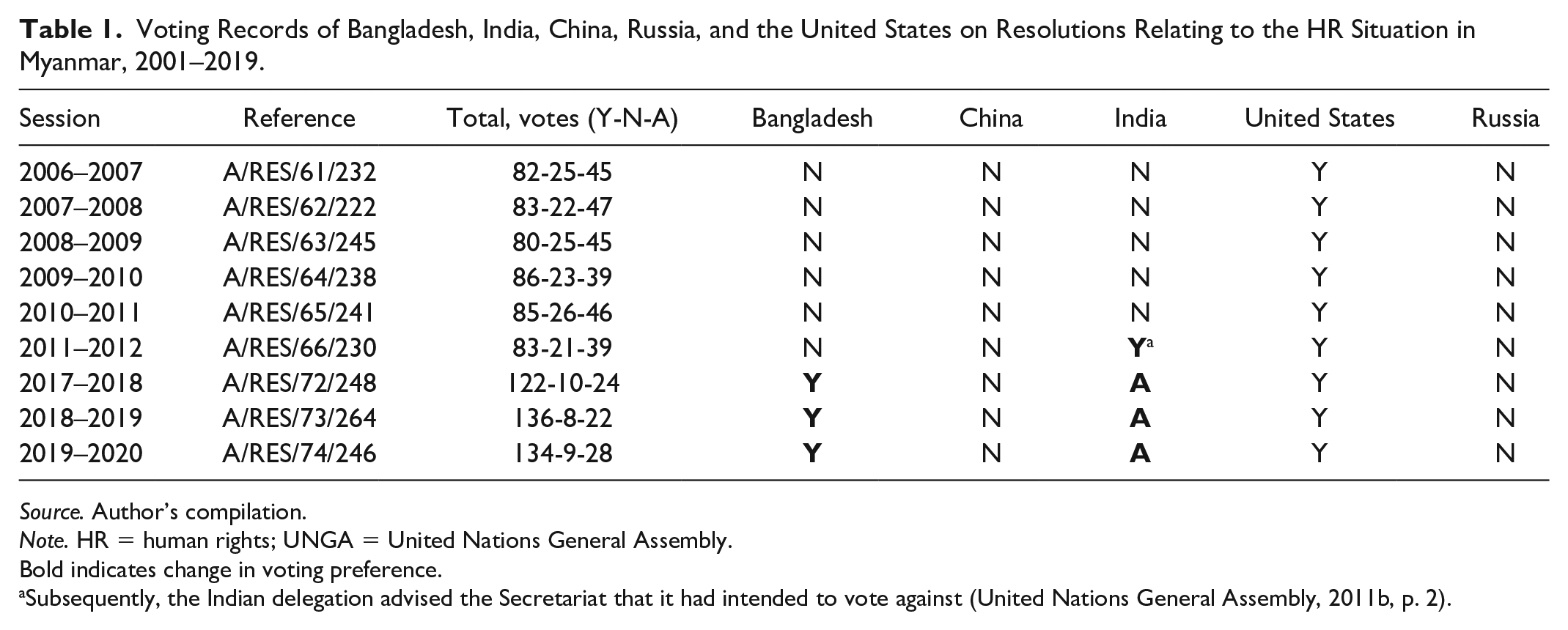
Source. Author’s compilation.
Note. HR = human rights; UNGA = United Nations General Assembly.
Bold indicates change in voting preference.
Subsequently, the Indian delegation advised the Secretariat that it had intended to vote against (United Nations General Assembly, 2011b, p. 2).
A comparison of the preambulatory and operative clauses of pre- and post-2017 resolutions on Myanmar’s HR situations provides a plausible explanation. Preambulatory clauses are historic justifications for action and operative clauses are policies that the resolution is designed to create. The preambulatory and operative clauses of pre-2017 resolutions do not mention Bangladesh. However, after 2017, resolution in which Bangladesh, joined the majority of the UN members to condemn Myanmar’s HR violation, mentions that the Assembly is “highly alarmed at the outbreak of violence in Rakhine State . . . that has caused hundreds of thousands of Rohingya civilians to flee towards Bangladesh” (UNGA, 2018a, pp. 4–5, italic added). Subsequently, the resolution expresses “deep concern at the plight of refugees and forcibly displaced persons living in Bangladesh” calling the international community to assist Bangladesh in providing humanitarian assistance (UNGA, 2018a, pp. 1–5, italic added). Thus, it would appear that Bangladesh joined the majority of the member states condemning its neighbor only when the resolutions started mentioning Bangladesh as an “effected State party.” Indeed, during the 65th plenary meeting, Bangladesh’s representative stated “a number of provisions of the draft resolution relates Bangladesh as an ‘effected State party’ reaffirming Bangladesh’s support for the draft as well as to comply with the provisions relevant to Bangladesh” (UNGA, 2018b, p. 11). It suggests that, in the context of its neighbors, Bangladesh tends to attach more importance to the principle of “non-interference” over the principle of “supporting the oppressed peoples.” Whether the adherence to such a policy in this context was prudent and served the country’s best interest remains contested.
The logic of “non-interference” appears to break down when comparing Bangladesh’s voting records with respect to the HR situations in DPRK and Syria (see Annex B). Breaking its practice of abstention, Bangladesh joined 101 and 94 other states, in 2007 and in 2008 respectively, to express “very serious concern at the persistence of continuing reports of systematic, widespread and grave violations of civil, political, economic, social and cultural rights” in the DPRK (UNGA, 2009a, p. 3; UNGA, 2008a). Similarly, in 2012, Bangladesh joined 135 other states to strongly condemn the continued widespread and systematic gross violations of HR and fundamental freedoms by the Syrian authorities (UNGA, 2013, p. 3). Thus, Bangladesh’s adherence to the principle of non-inference appears to be selective albeit more stringent in the context of neighbors. Such a practice can also be interpreted as cautions but imprudent—particularly in case of Myanmar since the country faced two major waves of Rohingya refugees and yet was late to join the global community to condemn Myanmar’s HR violation that led to the third wave of Rohingya refugees in 2019.
In sum, several conclusions can be drawn from the above analysis. First, although Bangladesh’s year-on-year voting coincidence shifted from China toward India since 2013, country’s disagreements (“opposite” votes) with India have remained 3 times higher compared with that of China, suggesting that the post-2013 change in voting coincidence is more about the types of resolutions that were put to vote and not a fundamental shift in its policy position on global issues. Bangladesh’s policy preference on global issues during this period has been mostly aligned with China followed by India and Russia. Second, Bangladesh maintained a principled position on the issues of conventional arms control, nuclear nonproliferation, and prohibition of chemical weapons. Country’s voting preferences on these issues have constantly remained at odds with the two key regional powers. Third, Bangladesh’s voting preferences with respect to the country-specific resolutions on HR reflects a selective adherence to the policy of non-interference in the internal affairs of other countries, particularly with respect to a neighbor. Overall, Bangladesh’s voting preferences at the UNGA tends to suggest that the country has maintained a principled position on certain global issues while remaining selective on HR-related resolutions amid the regional and extra-regional influences and security and humanitarian considerations.
Concluding Remarks
The UNGA voting record is the product of an epistemic community. Despite being non-binding, these voting records have long been used to explore member states’ policy preferences and understanding their political proximities on global issues. However, there has been very little research on the voting preferences of small developing countries. This article is expected to have filled that void by offering an evidence-based analysis of Bangladesh’s foreign policy inclinations in a multilateral forum, especially during the period 2001–2017.
It is believed that by taking Bangladesh’s voting patterns in UNGA as a case example, this study may have also revealed the usefulness and limitations of using the UNGA vote records as a tool to assess ideological preferences, policy choices and strategic alliances of small developing countries, especially on global issues.
The consistency in Bangladesh’s voting choices on issues related to the international peace, such as disarmament and nonproliferation of nuclear and chemical weapons, tend to reflect the constructivist’s emphasis on shared ideas, achieved and maintained through a degree of socialization with the global community. On these normative questions, Bangladesh’s epistemic community was guided by the logic of appropriateness and could not be swayed by a regional or global power. Such a principled position maintained by Bangladesh with regard to these (non-binding) resolutions tend to defy the conventional wisdom, that the developing states cannot maintain a principled position and are subject to “vote-buying” in the UNGA. Bangladesh’s voting coherency also suggests that the small developing countries with a democratic system can maintain a higher levels of voting consistency on issues that are of great interest to them.
However, Bangladesh’s inconstancy in the voting preference with regard to the HR resolutions further nourishes the theoretical debate on using the UNGA voting records as the microcosm of world politics. Indeed, the selective adherence to the principle of non-interference—in particular, Bangladesh’s vote shifting with respect to Myanmar since 2017—would support a realist worldview. Facing a large influx of Rohingya refugees that posed a security risk, the country chose the path of “self-help” and decided to condemn Myanmar, abandoning her previous position that was mostly aligned with the regional powers. However, the voting inconstancy on the resolutions regarding the HR situation in DPRK and Syria tends to suggest that the country is yet to formulate principled foreign policy positions on HR resolutions. Although assessment of voting coincidence alone may not capture the whole dynamics of the bilateral/international leanings of a state, this article has revealed that systematic research of UNGA voting records has the capacity to add to the knowledge of foreign policy dynamics of a developing state in terms of the way they weigh their choices and chart their path through idealism and opportunism.
Supplemental Material
Annex_A-Opposite_Votes – Supplemental material for Is Voting Patterns at the United Nations General Assembly a Useful Way to Understand a Country’s Policy Inclinations: Bangladesh’s Voting Records at the United Nations General Assembly
Supplemental material, Annex_A-Opposite_Votes for Is Voting Patterns at the United Nations General Assembly a Useful Way to Understand a Country’s Policy Inclinations: Bangladesh’s Voting Records at the United Nations General Assembly by Mohammad Zahidul Islam Khan in SAGE Open
Supplemental Material
Annex_B-_HR_Sit_Res-2001-2018 – Supplemental material for Is Voting Patterns at the United Nations General Assembly a Useful Way to Understand a Country’s Policy Inclinations: Bangladesh’s Voting Records at the United Nations General Assembly
Supplemental material, Annex_B-_HR_Sit_Res-2001-2018 for Is Voting Patterns at the United Nations General Assembly a Useful Way to Understand a Country’s Policy Inclinations: Bangladesh’s Voting Records at the United Nations General Assembly by Mohammad Zahidul Islam Khan in SAGE Open
Footnotes
Acknowledgements
The author thanks Prof. M Adil Khan, University of Queensland, Australia, and former senior policy manager of the United Nations and Prof. Ali Riaz, distinguished professor at the Department of Politics and Government, Illinois State University, for their valuable comments on the initial draft.
Declaration of Conflicting Interests
The author(s) declared no potential conflicts of interest with respect to the research, authorship, and/or publication of this article.
Funding
The author(s) received no financial support for the research, authorship, and/or publication of this article.

Supplemental Material
Supplemental material for this article is available online.
References
Supplementary Material
Please find the following supplemental material available below.
For Open Access articles published under a Creative Commons License, all supplemental material carries the same license as the article it is associated with.
For non-Open Access articles published, all supplemental material carries a non-exclusive license, and permission requests for re-use of supplemental material or any part of supplemental material shall be sent directly to the copyright owner as specified in the copyright notice associated with the article.
