




Abstract
Air service failures and negative customer reactions have been the subjects of increasing media attention in recent years. Drawing upon the expectation disconfirmation theory (EDT), this study investigates the impact of airline service failures on various negative emotions and negative behaviors of customers based on prior expectations and actual experiences after a service failure. The collected data was from 561 customers who experienced an air service failure within the past 6 months. The results show that, consistent with the EDT theory, prior expectations and actual experiences when an airline service failure occurs lead to disconfirmation, and this determines the negative emotions of customers. The results also show that, worry and frustration only lead to negative word-of-mouth intentions. Meanwhile, anger over an airline service failure will affect both complaints, negative word-of-mouth, and intention to switch to another airline. This study contributes by expanding and showcasing the applicability of the EDT theory to the domain of airline service failures.
Plain Language Summary
Air service failures and negative customer reactions are topics of increasing interest in recent times, both practice and academic. Although there are few previous studies on this topic, this study is based on the expectation disconfirmation theory to examine the effect of airline service failures on negative emotions and negative behavior of customers. The collected data was from 561 customers who experienced an air service failure within the past 6 months. The results show that, consistent with the expectation disconfirmation theory, prior expectations and actual experiences when an airline service failure occurs lead to disconfirmation, and this determines the negative emotions of customers. The results also show that, worry and frustration only lead to negative word-of-mouth intentions. Meanwhile, anger over an airline service failure will affect both complaints, negative word-of-mouth, and intention to switch to another airline. The contribution of this study is extending and demonstrating the relevance of EDT theory to the context of airline service failures. Implications and recommendations for future research are also provided.
Introduction
The inseparability between production and consumption is a critical aspect of service delivery. That makes it difficult to check the quality before providing the service, which leads to service failures even for the most prestigious service supplier (Zeithaml et al., 1996). In recent years, there has been significant media coverage on airline service failures (Elbaz et al., 2023; Zhang et al., 2018). Airlines always face challenges when serving passengers such as unequal demand, the involvement of many employees, many processes, different customer segments, etc. leading to different expectations on service quality. Therefore, airline service failure is almost inevitable in the service delivery process. These service failures produce adverse outcomes for airlines, such as negative word-of-mouth (Chang & Cheng, 2021; Eckhardt et al., 2019) and customer switching behavioral intentions (Harrison-Walker, 2019; Li et al., 2021). This is expected to cause significant loss to the financial performance of airlines (Nikbin et al., 2014).
Understanding customer feelings about airline service failures and its impact on customer behavioral responses can assist to implement appropriate service recovery strategies. In this line of research, two distinct categories can be used to classify previous studies on airline service failures (Xu et al., 2019). The first group of studies concentrates on examining the causes and consequences of airline service failures, including external factors such as adverse weather conditions (Anderson et al., 2009), lost luggage (Xu et al., 2019), delays flight (Jiang et al., 2020; Li et al., 2021) are discussed. Service failures have been found to have negative repercussions on various aspects, including customer loyalty, trust, customer switching behavior, and the supplier-buyer relationship (Jiang et al., 2020; Li et al., 2021; Xu et al., 2019) are also studied. The second group of research centers on assessing the severity of service failures, aviation service restoration actions and their consequences (Elbaz et al., 2023; Harrison-Walker, 2019; Lai & Chou, 2015). Research investigates service restoration actions and their outcomes. The findings indicate that implementing effective recovery measures can substantially enhance customer satisfaction and mitigate customer churn. However, it should be noted that not all recovery actions will produce the desired results (Cai & Qu, 2018; Lin et al., 2021; Xu et al., 2019). Two commonly used theoretical frameworks for service failure are attribution theory and perceived fairness (Harrison-Walker, 2019). Customers tend to attribute causes when things go wrong, and these causes influence their emotional and behavioral responses (Harrison-Walker, 2019).
Most previous studies looked at service failures and recovery actions without considering the differences between airlines (e.g., seat type, fare, airline type, etc.). Various airlines cater to diverse customer segments with distinct expectations and requirements (O’Connell & Williams, 2005). Therefore, the same type of service failure but each customer may react differently based on their expectations of the airline. Understanding the difference in service failure assessments can help airlines better deal with customer expectations. This study aims to address a gap in the literature by applying the Expectancy-Disconfirmation Theory (EDT) to investigate how both perceived performance and customer expectations influence reactions to airline service failures. Thus, grounded in EDT theory, we propose a research model that goes beyond relying solely on the perception of the severity of service failures experienced by customers (e.g., Jiang et al., 2020; Li et al., 2021; Xu et al., 2019). Our model also takes into account customers’ expectations for the chosen airline. By comparing perceived performance with customer expectations, we aim to understand the confirmation/disconfirmation process and its impact on customer reactions. The application of EDT theory enables us to assess the overall disparity between perceived performance and customer expectations in the context of airline service failures, a aspect not thoroughly explored in previous research in the context of airline service failures
In brief, the primary objectives of this study are (1) to investigate the impact of customer expectations and the severity of service failures on disconfirmation, (2) to investigate the impact of service failure disconfirmation on negative customer emotions and (3) to confirm the relationship between each negative emotion and the customer’s negative behavior. This study was undertaken within the context of service failures in the airline industry of Vietnam. Vietnam is the fifth fastest growing aviation market in the world and topped Southeast Asia (Ministry of Transport, 2022). Therefore, global airlines recognise the significance of gaining a deeper understanding of the emotional experiences and behavioral responses exhibited by customers following a service failure, particularly within the context of a transitional economy like Vietnam.
The research makes valuable contributions to both business theory and practice in numerous ways. First, while previous studies examined perceptions of specific service failures affecting customer responses, such as bad weather, lost luggage, flight delays (Anderson et al., 2009; Jiang et al., 2020; Li et al., 2021), This study evaluates the overall different between customers’ expectations of an airline and their perception of service failure. Besides, this study overcomes the limitations of previous research in understanding how different customer expectations will lead to their different responses when encountering the same service failure. Second, most prior research examined the influence of disconfirmation on customer satisfaction in various contexts (Au & Tse, 2019; Batouei et al., 2019; Y. Liu et al., 2020; Shen et al., 2018). This study assesses emotions in three dimensions: worry, frustration, and anger. This highlights the customer’s emotions when experiencing service problems. In addition, we also prove that different negative emotions will affect different negative behavior of customers. Finally, this is the first study conducted in the context of air service failures in Vietnam. These findings hold significant implications for managers in the airline industry, especially when they face customer pressure resulting from frequent service failures during passenger transportation.
Literature Review
Expectation Disconfirmation Theory (EDT)
EDT originates from the study of consumer behavior. EDT consists of five main constructs namely perceived performance, expectation, confirmation, satisfaction, and repurchase intention. The relationship between the constructs is shown in Figure 1. EDT assumes that product/service performance together with expectations will determine customer satisfaction (Oliver, 1980). In addition, the positive or negative disconfirmation acts as an intermediary with the following cases: (1) Product/service performance below expectations leads to negative disconfirmation; (2) Product/service performance equal to expectations leads to confirmation; and (3) Product/service performance above expectations leads to positively disconfirmation (Oliver, 1977). Extensive evidence indicates that both consumer expectations and disconfirmation play a significant role in influencing consumer responses following product or service usage (Swan, 1977). Therefore, confirm or not confirm influenced by expectations is an important factor for satisfaction.

Expectation confirmation theory.
If a product or service meets consumers’ expectations, they are more likely to repurchase it (Oliver, 1980, 1993). Positively disconfirmation will increase the user’s positive perception and satisfaction for using the product/service, thus, leading to intention to continue using it. On the contrary, negative disconfirmation will reduce the user’s positive perception and cause dissatisfaction with the use of the product, thus, leading to the discontinuation of the product/service (Bhattacherjee, 2001).
EDT has been applied to many different types of products/services, such as restaurants (J. Lee & Kim, 2020), online shopping (Y. Liu et al., 2020), remote work (Carraher-Wolverton, 2022) and so on. Consumers firstly develop product/service-related expectations. Then, consumers confirm or reject their initial expectations based on their actual experiences (Y. Liu et al., 2020). When the actual performance of the product/service surpasses the consumer’s initial expectations, they tend to confirm those expectations (Y. Liu et al., 2020). In contrast, when the actual performance falls short of expectations, it leads to the disconfirmation of those expectations (Carraher-Wolverton, 2022; Y. Liu et al., 2020). Consumer satisfaction and post-purchase behavior are based on confirmation or disconfirmation as results of their expectations (Y. Liu et al., 2020).
This study extends EDT in the context of airline service failures to explain how service failure perceptions affect customer responses of flights. The study compares customer expectations about airline service failures and the severity of service failures, next customer will positive or negative disconfirmation. This will affect the negative emotions and negative behavior of the customer (Zhigang et al., 2020).
Service Failure
Service failure is defined as a mistake, error, or problem in the delivery of a product/service (Colgate & Norris, 2001). Service failure occupies a prominent position as a research topic in the realm of service marketing due to its detrimental effects on the relationship between consumers and service providers (Bougoure et al., 2016). Service failure shows that customers are faced with a situation where their expectations are not met (B. Lee et al., 2021). As a result, customers respond to the incident based on their dissatisfaction. Overall, prior literature suggests that service failure leads to customer dissatisfaction (Smith & Bolton, 2002; Xu et al., 2019) and prompts negative word-of-mouth communication (Eckhardt et al., 2019).
Negative Emotions
Emotion refers to a cognitive judgment-based mental state of preparedness that arises when an individual deems an event to be congruent or incongruent with their motives or goals (Bougie et al., 2003). Thus, customers’ negative emotions stem from their perceived evaluation of a product/service experience that is not consistent with their motives or goals (Hien et al., 2022). The occurrence of service failures during the product/service experience will lead to negative emotional reactions from customers (Jiang et al., 2020; Li et al., 2018).
Consumer emotions can be identified through two primary approaches: the component approach and the emotion category approach (Nawijn & Biran, 2019). In the compositional approach, emotions are defined as a single construct. According to Bagozzi et al. (2003), emotions can be categorized broadly into positive or negative values, and the component approach to emotions aids in simplifying research models. In the case of specific service failures, customers typically encounter only negative emotions. As a result, negative emotions can be collectively considered as a single construct. The category approach defines emotions as a collection of distinct emotional states, such as happiness, anger, sadness, and anxiety (Yao et al., 2020). Both approaches concur that different emotions can elicit varied behavioral responses (Laros & Steenkamp, 2005). Studies in a variety of service failure contexts show that, despite all negative emotions, each distinct emotion (e.g., anxiety, anger) leads to various negative behaviors (Harrison-Walker, 2019; Jiang et al., 2020; Li et al., 2021). Nevertheless, both the component and category approaches are descriptive in nature and do not offer a mechanism to explain the emotional arousal or its subsequent behavioral consequences (Prayag et al., 2017).
This study applies a specific negative emotion approach, to assess how it affects the negative behavior of customers. The three emotions examined in this study include: Worry, Frustration and Anger.
Negative Behaviors
An individual’s emotional response to an event can lead to a corresponding behavioral response (Collins, 1996). Consequently, negative emotions resulting from service failure can prompt individuals to adopt either problem-focused or emotion-focused coping behaviors (Le & Ho, 2020; Xu et al., 2019). Emotionally focused negative behavior pertains to individuals’ actions and activities aimed at regulating and managing their own emotions. These behaviors can encompass actions like employing a cell phone as a means to detach themselves from the situation while waiting or seeking emotional solace by expressing their frustrations to friends (Menon & Dube, 2004). Problem-focused negative behavior refers to individuals’ actions and activities aimed at addressing or managing the underlying cause of a negative experience. This can involve behaviors such as switching to another airline, filing a complaint with airline companies (Le & Ho, 2020). Thus, the negative emotions are related to future negative behavioral intentions, and vice versa (Wong, 2004). However, different emotions can lead to different behaviors. Furthermore, the relationship between emotion and behavior is not clear (Prayag et al., 2017). In this study, complaining behaviors, negative word of mouth and switching intention will be considered.
Hypotheses and Conceptual Model
Antecedents of Disconfirmation
EDT has found extensive application in the service performance literature (Akturk et al., 2018; Peinkofer et al., 2016), as well as in the aviation literature, particularly in studying the connection between service quality and client outcomes (Sezgen et al., 2019). In the airline industry context, passengers typically have basic expectations that include on-time flights, well-maintained baggage handling, and safe arrival (Lucini et al., 2020). Flight delays negatively affect customers because it affects their costs, which is an important factor when choosing an airline to travel (Yimga, 2020). When a flight is delayed, it results in the negative disconfirmation of the expectation for a timely arrival (Lucini et al., 2020). When a flight is late it leads to unmet expectations. Likewise, a negative confirmation occurs when a passenger is inadvertently denied boarding and unable to arrive at the intended destination (Mellat-Parast et al., 2015).
The regulatory relationship between expectations and disconfirmation can have either a negative or positive effect (Bhattacherjee & Premkumar, 2004). The negative effect manifests as high expectations being more prone to negative disconfirmation, whereas low expectations are more inclined to experience positive disconfirmation (Qazi et al., 2017). In the context of the airline industry, when customers have high expectations for airline service, they are more likely to not confirm when experiencing service failures. Based on the aforementioned rationale, we propose the following hypothesis:
H1: Expectations of airline service failure will positively influence customer disconfirmation.
In the theory of EDT, both product/service expectations and performances will determine customer satisfaction (Oliver, 1980). Performance can have both direct and indirect effects on satisfaction, mediated by the process of disconfirmation (Oliver, 1977). From research results in the context of e-commerce websites, customer evaluation of functional performance has a negative impact on customer unconfirmation expectations (Y. Liu et al., 2020). Research of Qazi et al. (2017) in the context of user opinions also shows that user perceived performance positively affects unconfirmation. In the context of airline service failures, performance is measured through the severity of service failures. Service failure severity refers to the extent of cost or loss experienced by consumers in terms of financial impact, time wasted, and inconvenience endured (Bougie et al., 2003; Gelbrich, 2010). The relationship between service failure severity and disconfirmation is posited to be positive. This is because higher service failure severity increases the likelihood of performance falling below expectations, resulting in negative disconfirmation (Spreng & Page, 2003). Prior research on Internet-based services (Khalifa & Liu, 2003), as well as other studies (Oliver, 2014; Qazi et al., 2017) has demonstrated the positive effect of the service failure severity on disconfirmation. Based on the above analysis, we put forth the following hypothesis:
H2: Severity of airline service failure will positively affect customer disconfirmation.
Effects Disconfirmation on Negative Emotions
Worry is the definition for a state of anxiety and uncertainty that arises from uncontrollable factors following an unfavorable consumer experience (Mattila & Ro, 2008). Frustration occurs when an individual’s goals or needs are out of reach due to problems. Goals are delayed or require additional effort to achieve them (Scherer, 2001). Frustration arises when the perceived fault lies with the environment, whereas anger arises when the event is attributed to the actions of another individual or entity (Roseman & Smith, 2001). According to Gelbrich (2010), anger is the emotion that arises when an offense is perceived to have an impact on one’s self, social relationships, or even the public. Previous studies conducted by Kalamas et al. (2008) and Kim et al. (2016) have shown that anger tends to be the dominant emotion in situations where a negative event occurs due to controllable human factors like inadequate management and communication
Several studies have confirmed the relationship between waiting time and discrete negative emotions, with worry and anger being the two most common negative emotions (Gelbrich, 2010; Jiang et al., 2020; Li et al., 2021). Flight delays have the potential to evoke feelings of anger due to the financial costs and inconvenience associated with such delays (Jiang et al., 2020). Research by Le and Ho (2020) also showed that regret, anger, and frustration were the three negative emotions of customers after experiencing service failures in restaurants in Vietnam.
The relationship between disconfirmation and negative emotions in aviation has not been studied. Bhattacherjee (2001) suggested that positive disconfirmation would enhance positive perception, thus leading to continued service use. Conversely, negative disconfirmation would reduce the user’s positive perception and evoke dissatisfaction and led to service discontinuation. Y. Liu et al. (2020) confirmed that, both utilitarian disconfirmation and hedonic disconfirmation strongly influenced customer satisfaction when purchasing online. Therefore, we propose the following hypothesis:
H3: Disconfirm an airline’s service failure will positively affect negative customer emotions, including: (a) Worry; (b) Frustration; and (c) Anger
Effects of Negative Emotions on Negative Behaviors
While the three emotions (worry, frustration, and anger) share conceptual connections, they diverge in terms of their origins and subsequent behavioral responses (Harrison-Walker, 2019; Wetzer et al., 2007). Empirical evidence indicates that customers who experience anger are more inclined to engage in complaint behavior, showing negative intentions toward repurchasing (Harrison-Walker, 2019; Jiang et al., 2020; Li et al., 2021) and are also more likely to engage in negative word-of-mouth communication (Harrison-Walker, 2019; Jiang et al., 2020; Le & Ho, 2020). In contrast, frustration arises when the source of service failure is attributed to the environment (Roseman & Smith, 2001), while worry is a relatively low-level negative emotion that can be described as a state of discomfort linked to varying degrees of service failure (Banse & Scherer, 1996). Such failures are often attributed to external causes or circumstances beyond the control of the service provider by customers, which often leads them to refrain from filing a complaint (Gelbrich, 2010). However, the perception of affected experiences can lead consumers to share their negative experiences or to intend to choose another supplier in order to feel better (Gelbrich, 2010; Laros & Steenkamp, 2005). Therefore, we propose the following hypotheses:
H4: Worry about airline service failures will positively affect negative customer behavior, including: (a) Negative word of mouth; (b) Switching intention.
H5: Frustration about airline service failures will positively affect negative customer behavior, including: (a) Negative word of mouth; (b) Switching intention.
H6: Anger about airline service failures will positively affect negative customer behavior, including: (a) Complain; (b) Negative word of mouth; (c) Switching intention.
Research Methods
We have developed a research model consisting of nine structures related to airline service failures (see Figure 2). Table 2 briefly introduces the observed variables used in the model. Since there are no previously validated scales in the aviation service context, we adjust the scales in the same context for use in this study.

Proposed research model.
Sample and Data Collection
A self-completed questionnaire was developed to accomplish the research objective. The experience sampling method (ESM) was used, whereby participants were asked to recall and describe in detail an experience of severe service failure they had experienced (Bougie et al., 2003). In this study, respondents were asked to report on a major service failure within the past 6 months, then encouraged to recall their experience of a service failure to answer survey questions. The survey was conducted from October 5 to 25, 2022. Respondents were recruited using quota sampling, considering service failures (Flight delayed; lost baggage; passengers late for flight…) and gender.
The cross-sectional data set was collected to test the hypothesis to generalize the research problem (Dooley, 2001). A total of 583 feedbacks from passengers who have experienced airline service failures in Vietnam. After removing incomplete questionnaires, 561 responses were used in the analysis. Respondents had a common age from 25 to 44, male sex was higher than female gender (61% male and 39% female), with university and postgraduate education accounting for more than 50%. Common service failures were Arrival delays and Mishandled baggage (see Table 1 for details).
Structure of Research Sample (n = 561).

Source. Author compiled from surveyed data.
Note. *1 USD = 23,435 VND (dated January 17, 2023).
Measurement and Analysis Method
The survey questionnaire is designed in two parts: the first part contains personal characteristics information of participants, including gender, age, education, income, annual flight frequency, type incident. The second part consists of observed variables measuring the research concepts. Expectation scale (three variables), Severity of service failure scale (four variables), Disconfirmation scale (four variables), Anger scale (three variables), Frustration scale (four variables), Worry scale (three variables), Complain scale (three variables), Negative WOM scale (three variables), Switching intention scale (four variables). Observed variables were adjusted from the existing literatures (see Table 2) and adapted for airline service failure context.
Reliability and Convergent Validity.
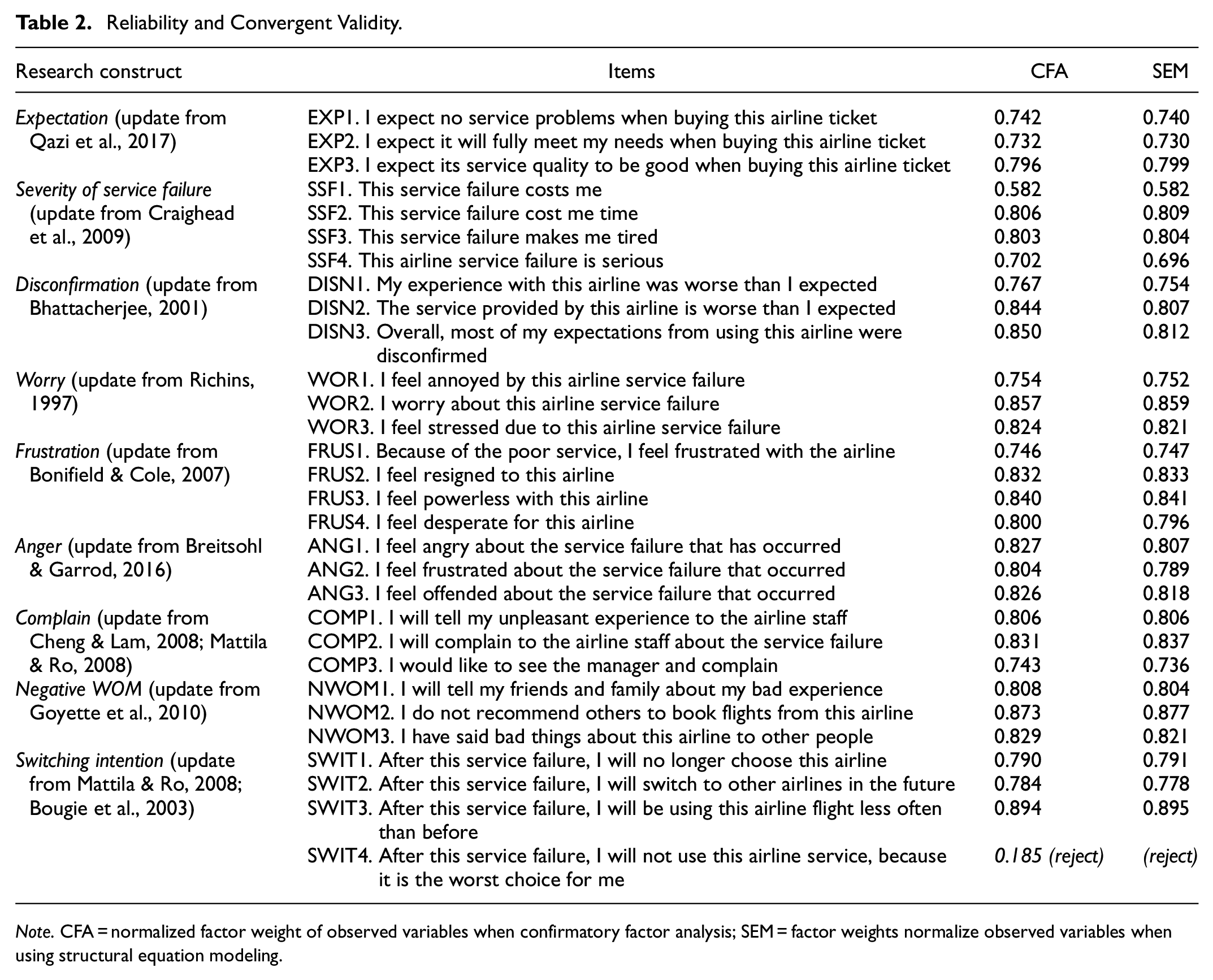
Note. CFA = normalized factor weight of observed variables when confirmatory factor analysis; SEM = factor weights normalize observed variables when using structural equation modeling.
In addition, seven experts (two lecturers in the tourism industry, two staffs in the customer service department at the airport, and three regular customers using airline services) edited the questionnaire independently. According to their proposal, the scales have been edited with words and expressions to better suit the context of airline service failures in Vietnam. Table 2 presents the modified scales, observed variables and scale sources.
Structural equation modeling (SEM) is employed as the statistical analysis technique to examine and evaluate the research hypotheses, because there are many antecedent and consequence relationships, consistent with the recommendation of Hair et al. (2016). The output of the measurement model is performed to evaluate the reliability and validity of the studied constructs. Next, path analysis was performed to evaluate the fit criteria of the model against the recommended values and test the research hypotheses (Hair et al., 2016).
Analysis and Results
Common Method Bias
The data was scrutinized for method bias, which is frequently a concern when dealing with cross-sectional data and self-reported surveys (Podsakoff et al., 2003). In order to tackle the problem of common method bias, we employed Harman’s single-factor test. This test assesses the presence of a single dominant factor that could potentially influence the correlation between the independent and dependent variables (Podsakoff et al., 2003). A fixed factor along with the remaining seven factors have eigenvalues greater than 1. The total variance extracted for these eight factors is 72.485%, in which the first factor has a total extracted variance of 37.698% (<50%). Thus, common method bias is not a problem for the model (Podsakoff et al., 2003).
Measurement Model
CFA is employed to assess and establish the reliability and validity of the measurement constructs. The factor weights of the observed variables have high statistical significance (p < .001), and the values range from 0.582 to 0.894 (Table 2). In addition, the model fit indexes are as follows: χ2/df = 1.969; GFI = 0.922, AGFI = 0.901, TLI = 0.957, CFI = 0.964, NFI = 0.930 và RMSEA = 0.042. These values indicate that the measurement model fits the data (Kline, 2015; Tabachnick & Fidell, 2007).
Scale reliability was evaluated by computing Cronbach’s alpha coefficient (α) and composite reliability (CR). The results shown in Table 3 demonstrate that both Cronbach’s alpha and CR surpass the recommended threshold of 0.70 (Nunnally, 1978), indicating satisfactory scale reliability.
Correlation Matrix and Square Roots of AVE.
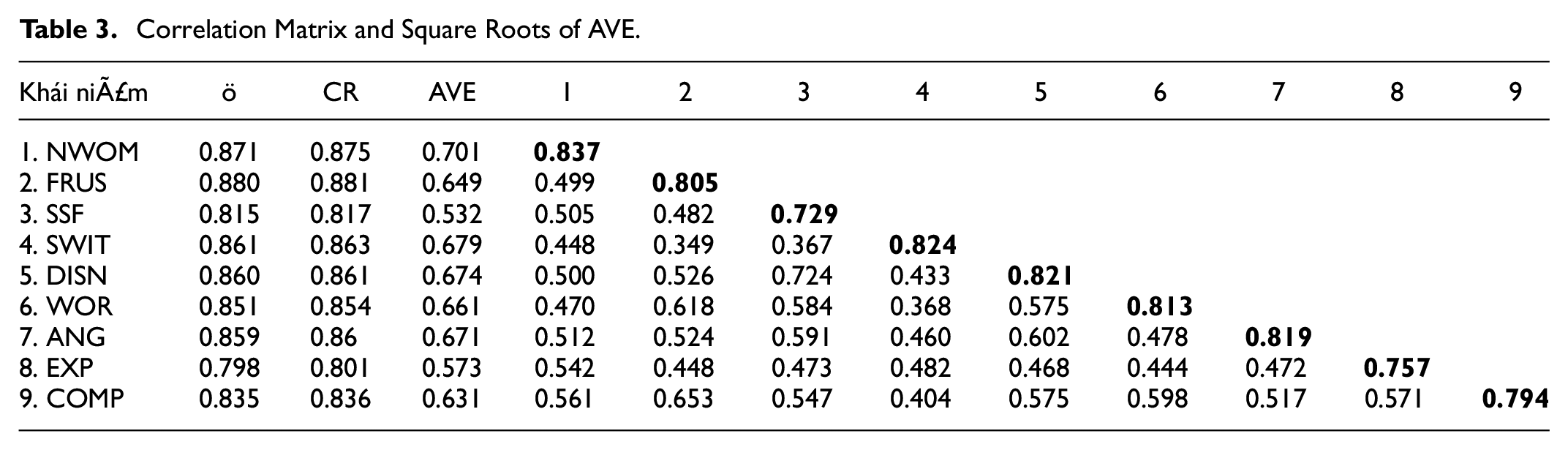
To test the validity of the scale, both convergent and discriminant validity were examined. Convergence was assessed using two criteria: factor loading and average variance extracted (AVE), with an accepted threshold of 0.5 as recommended by Fornell and Larcker (1981) and Kline (2015). All coefficients of the observed variable are statistically significant and exceed the 0.5 level, except for the variable SWIT4 (Table 2). In addition, all AVEs are above 0.5 (Table 3). Thus, the measurement scales reach convergence value. In line with the suggestion of Fornell and Larcker (1981) for evaluating discriminant validity, the correlation between constructs should be lower than the square root of the AVE. In Table 3, all values above the bold diagonal, representing the square root of the AVE, are higher than the correlation values between constructs that are outside the diagonal.
Structural Model
Firstly, the multicollinearity among the concepts is assessed using the variance inflation factor (VIF). The results indicate that the VIF values for the concepts, ranging from [1.582, 2.953], are all below 0.5. This is deemed acceptable as it signifies the absence of complete multicollinearity (Hair et al., 2016). Next, the results of the path analysis identified the model fit indicators and the significance of the regression coefficients. The indicators suitable for the research model are as follows: χ2/df = 2.023; GFI = 0.875, AGFI = 0.911, TLI = 0.911, CFI = 0.920 và RMSEA = 0.060. While the Goodness-of-Fit Index (GFI) does not surpass 0.9, it does meet the acceptance criterion of 0.8 as recommended by Baumgartner and Homburg (1996). Therefore, the results indicate that the model is consistent with the research data (Kline, 2015; Tabachnick & Fidell, 2007).
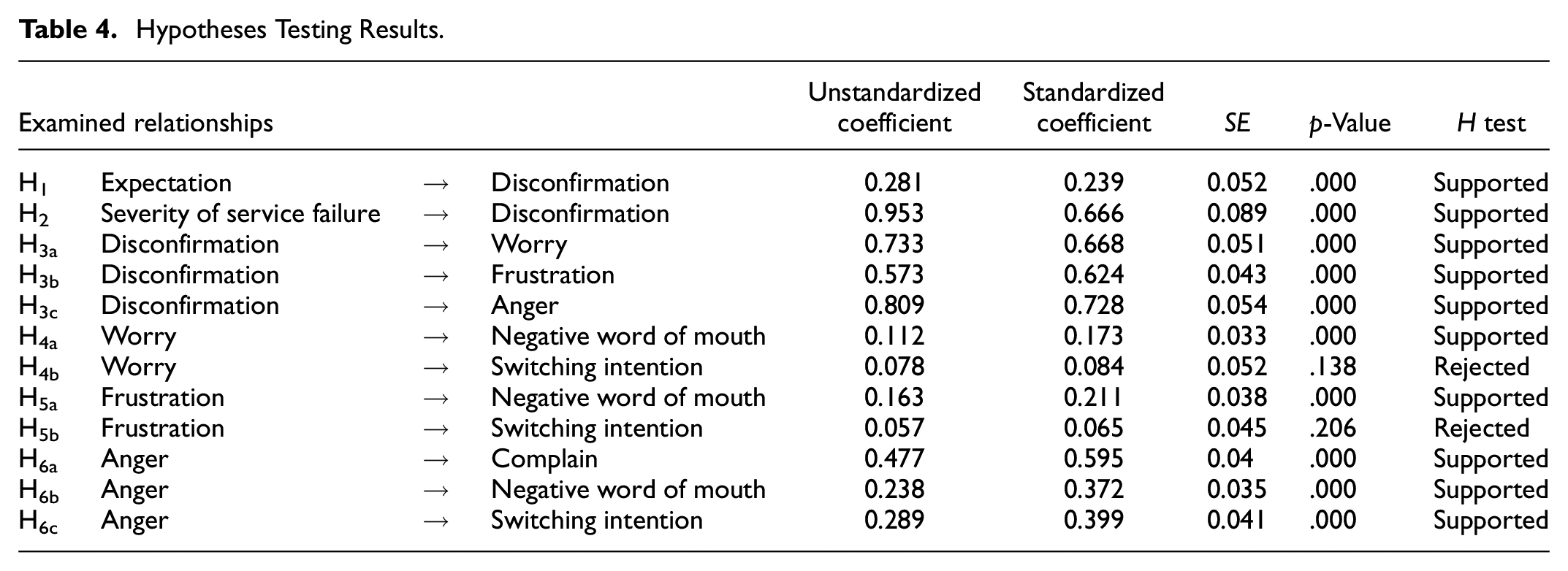
Subsequently, the regression weights for the proposed hypotheses, along with their corresponding probability values, provided support for hypothesis testing (Table 4 and Figure 3). The results indicate that the majority of the hypotheses are supported with a confidence level exceeding 99%, except for two hypotheses that were rejected: H4b and H5b (refer to Table 4).
Hypotheses Testing Results.

Path analysis results (standardized coefficients).
Of the two factors influencing disconfirmation, the severity of service failure factor is stronger than customer expectations. Table 4 shows that disconfirmation effect on Anger and Worry is stronger than Frustration. In addition, of the three factors affecting Negative word of mouth, Anger factor has the strongest influence, followed by Frustration and Worry.
The proposed research model explains 65.1% variance of Disconfirmation, 44.6% variance of Worry, 39% variance of Frustration, 53% variance of Anger, 35.4% variance of Complain, and 37.7% variance of Negative word-of-mouth and 26.8% variance of Switching intention. All R2 indicators exhibit robust findings, as values above 20% are deemed considerably high in consumer behavior studies (Hair et al., 2016).
Discussion and Implications
Discussion
Based on EDT theory, we built and tested a model of consumers’ attitude and behavioral responses to airline service failures. Unlike previous studies, we did not use specific service failures to measure service failure perception on consumer response. This study compared consumer expectations and experiences to disconfirm service failure, and how this affected consumer response. The findings in this study have the following notable points.
Firstly, when customers have higher expectations about the airline, they will have a higher tendency to disconfirm when a service failure occurs (H1). The positive aspect is that high expectations are susceptible to greater negative disconfirmation, while low expectations tend to encounter lower levels of negative disconfirmation (Qazi et al., 2017). In the context of the aviation industry, when customers choose airlines with low service failures, with high expectations that the flight will be on time, handle baggage properly, etc. so when it comes to service failure, they are more inclined to not confirm trend higher. The second factor used in EDT theory is product/service performance. In this study, performance was measured through severity of service failure. The findings indicate that the severity of service failure significantly influences the level of disconfirmation experienced by customers (H2). This relationship is consistent with previous studies in different contexts (Oliver, 2014; Qazi et al., 2017). In the context of the airline industry, the higher the severity of service failures, the more likely the performance is to be lower than expected, leading to negative confirmations. Thus, the results on the relationship between expectation, performance and disconfirmation in the context of airline service failure are consistent with Oliver’s (1977, 1980) EDT theory.
Second, this study investigates three separate negative emotions to assess customer’s negative attitude, after experiencing service failure, including worry, frustration, and anger. The results confirm that there is a difference between the three emotions. The customer’s disconfirmation has a strong influence on all three of their negative emotions (H3a, H3b, H3c). These are common emotions after experiencing service failures such as flight delays (Jiang et al., 2020; Li et al., 2021) or experiencing service failures in a restaurant context (Le & Ho, 2020). Consequently, this result confirms the mechanism affecting customers’ negative emotions. When experiencing service failures in the airline industry, customers will compare expectations and airline performance, and thereby form a negative attitude based on confirmation or disconfirmation.
Finally, the results of this study also confirm how each customer’s negative emotions will influence their negative behaviors. We confirm that, when customers are worried or frustrated about service failures, they tend to have negative word-of-mouth (H4a and H5a supported). As such, worry and frustration are low-level negative emotions. Customers often consider these failures to be caused by external causes, not seriously affecting them, so they will find ways to share these failures negative experiences (Gelbrich, 2010; Le & Ho, 2020). The results also indicate that worry and frustration do not have a significant impact on the intention to switch to another airline (H4b and H5b are not supported). This result is contrary to Le and Ho’s (2020) study but it is consistent with Harrison-Walker (2019). In the context of airline service failure, worry and frustration are two lower negative emotions than other negative emotions (Harrison-Walker, 2019). Besides, in the context of the aviation industry in Vietnam, when customers want to switch to another airline, it will cost a large opportunity cost due to the difference in ticket prices. Therefore, even when experiencing negative emotions at a low level, customers still have no intention of switching to another airline.
Another negative emotion is anger, the results show that anger affects complaints, negative word-of-mouth and switching intention (H6a, H6b, H6c supported). This finding aligns with the outcomes of prior studies conducted in diverse contexts. Anger is a strong negative emotion that leads to complaints and negative repurchase intentions (Harrison-Walker, 2019; Jiang et al., 2020; Li et al., 2021) and negative word-of-mouth (Harrison-Walker, 2019; Jiang et al., 2020; Le & Ho, 2020). In the context of the aviation industry, when a service failure of a serious degree strongly affects the negative emotions of customers, they will tend to complain to airlines, spread negative word-of-mouth to others and intend to switch to other airlines in the future.
Implication to Theory
First, this study explains the mechanism by which air service failure affects customers’ negative emotions and behaviors using EDT. While most previous studies applied EDT in other contexts, such as Wearable health information systems (Shen et al., 2018), online shopping experience (F. Liu et al., 2020), corporate social responsibility (Zhigang et al., 2020), service quality and crew capacity of airlines (Batouei et al., 2019). This study is the first to use EDT theory to test the impact of disconfirmation service failure on negative emotions and negative behavior in the aviation industry’s service failure context. This research supports the argument that customers’ negative emotions and behaviors are formed through disconfirm service failures. This arises from a comparison between customer expectations and actual experience of service failures. The results of this study overcome the limitations of previous studies in not assessing customer expectations when encountering airline service failures. Experiencing the same type of service failure, but each customer may react differently based on their expectations of the airline.
Next, the study investigates the effect of disconfirmation on customers’ negative emotions, by investigating the role of discrete emotions. While most previous studies examined the influence of disconfirmation on customer satisfaction in various contexts (F. Liu et al., 2020; Shen et al., 2018). In support of the argument that satisfaction with a service is not enough for customer loyalty (Bielen & Demoulin, 2007). This study emphasizes the emotional aspect of the customer’s failed service experience. Instead of looking at negative emotions as a single dimension, this study looks at emotions in three dimensions: worry, frustration, and anger. This highlights how customers feel when they have a service problem. The results show that, all three emotions appear when customers disconfirm. Where the emotions of worry and anger are greater than frustration, which means that worry and anger are more prominent during service failure handling. Thus, the results show that the EDT theory can be used to explain many different feelings, not just customer satisfaction. This study discovered new relationships between nonconfirmation and various negative customer emotions such as worry, frustration, and anger.
Finally, this study also contributes to academia by demonstrating that different negative emotions influence negative consumer behavior differently. The study provides insight into customer response mechanisms to airline service failures. In this study, when customers were worried or frustrated about airline service failures, they tended to spread negative word-of-mouth. Meanwhile, those who are angry about the service failure, they tend to complain, have negative word-of-mouth and intend to switch to another airline. The study show that negative emotions such as Worry and Frustration do not affect the Switching intention of customer. The results provide a mechanism for the analysis of airline service failures. When customers negative unconfirmation about air service failures, this will affect customers’ negative emotions. In turn, the severe negative emotions (e.g., anger) will influence the negative behavior of customers, of which the most serious negative behavior is the intention to switch other airlines. This study contributes to the theory by fully explaining the mechanism by which airline service failures affect negative emotional responses and negative customer behavior.
Implication to Practice
The findings of this study carry significant implications for managers in the aviation industry who face customer pressure resulting from service failures during passenger transportation. The results demonstrate the pivotal role of negative emotions arising from service failures in shaping subsequent customer behavior. Worry and frustration can lead to negative word-of-mouth, while anger can lead to complaints, negative word-of-mouth, and intention to switch to another airline. The study has the following practical significance.
First, the findings of this study show the importance of customer expectations. Airlines always try to increase advertising, branding… On the one hand, this increases customer satisfaction and loyalty. On the other hand, this increases expectations for the airline, which has a strong impact on disconfirmation when a service failure occurs. This affects the negative customer response to the airline. Therefore, airlines need to build a marketing strategy in accordance with the target market. For example, airlines that compete on low costs need to focus on the slogans of low cost, convenience. Meanwhile, airlines that compete on good service focus on advertising the experience they bring to customers. In addition, airlines limit service incidents related to the core values of the business.
Second, the severity of the service failure strongly influences the customer’s disconfirmation, which in turn affects their negative emotions. When customers rate a service failure that severely affects them, the negative emotional response increases. To manage the negative emotions of customers, airline managers need to keep service failures to a minimum or implement solutions to minimize damage and discomfort for customers. Airlines should consider improving communication and information sharing services that can elicit positive emotions (Valentini et al., 2020). For example, a text message to notify service failures in advance, a smartphone application for estimated flight time, arrival time, estimated check-in time, and information in real time for passengers such as airport situation (crowded), expected waiting time… In addition, airlines need to have reasonable support policies after a service failure.
Finally, our findings also suggest that different negative emotions lead to different negative behaviors. When customers are worried or frustrated, they just spread negative word-of-mouth. But when customers are angry, they have stronger negative behavior, including complaints, negative word-of-mouth and intention to switch to another airline. These negative behaviors adversely affect the airline’s reputation and negatively affect the attitudes of other customers (Gelbrich, 2010). To limit this problem, airlines need to have a specific strategy for serving passengers before, during and after the flight, such as being transparent about the flight and possible incidents and have a thorough approach to handling if flight problems occur. A simple apology may not lessen the impact of service failures on angry passengers (Mattila & Ro, 2008).
Limitations and Future Research
The results of this study have some limitations. First, this study selected worry, frustration, and anger as common emotions during flight service failures. However, the emotion triggered by service failure can have many other emotions, such as Irritation, Regret… (Li et al., 2021). Future research may assess other emotions evoked by service failure.
Second, because the interest of this study is to apply EDT theory to explain service failure, and the relationship between the concepts in the model. We’re not interested in specific service failures, and the mechanism that affects the emotions and behavior of each of those failures. In addition, Scheibe et al. (2015) suggested that personal characteristics such as age, income were related to emotion and reevaluation. Therefore, future research may look at each service failure specifically. Besides, it should be considered how different demographics will affect their negative emotions and behaviors.
Finally, this study approached customers who experienced an airline service failure within 6 months, and then asked them to recall the details of that service failure. This is an effective approach to evaluating customer experience. However, memory dependence may be related to cognitive predisposition and influence self-reported experiences due to individuals’ ability to remember (Li et al., 2018). Therefore, future research may survey customers who are experiencing airport incidents or have recently experienced an incident, to achieve a more accurate assessment of emotions and behaviors.
Footnotes
Declaration of Conflicting Interests
The author(s) declared no potential conflicts of interest with respect to the research, authorship, and/or publication of this article.
Funding
The author(s) disclosed receipt of the following financial support for the research, authorship, and/or publication of this article: This research is funded by Industrial University of Ho Chi Minh City and Van Hien University, Vietnam.

Data Availability Statement
Data sharing not applicable to this article as no datasets were generated or analyzed during the current study.