




Abstract
This paper investigates how tourists develop adaptive perceptions in response to pandemic situations and how these perceptions influence their international travel decision-making toward a COVID-19-shaken destination in the new normal era. The survey was administered to Chinese potential international tourists and 608 questionnaires were utilized in data analysis. The results revealed the indirect effect of COVID-19 risk perception on travel intention first through cognitive image and then through affective image. Cognitive and affective images were identified as mediators of these interrelationships. The findings also showed that COVID-19 displayed varying effects on tourists with different past travel experiences. By unveiling factors influencing individuals’ travel decision-making in the new normal era, this study provides a theoretical basis for understanding the psychological and behavioral effects caused by a pandemic; delineating the underlying mechanism of the COVID-19 risk perception effect on international travel decision-making; expanding the research on destination image by clarifying the mediating roles of cognitive and affective images and their relation; providing timely and insightful implications for post-pandemic tourism recovery.
Plain Language Summary
Purpose—This paper aims to investigate how tourists develop adaptive perceptions in response to pandemic situations and how these perceptions influence their international travel decision-making toward a COVID-19-shaken destination in the new normal era. Methods—The survey was administered to investigate Chinese potential international tourists’ perceptions and images of the US through a combination of online and offline channels. 608 questionnaires were utilized in data analysis. EFA using PCA was conducted to retrieve the constructs and Serial Multiple Mediation was performed to test the hypotheses of this study. Conclusions—This study reveals the indirect effect of COVID-19 risk perceptions on travel intentions first through cognitive images and then through affective images. Cognitive and affective images are identified as a mediators of these interrelationships. The findings also show that COVID-19 displayed varying effects on tourists with different past travel experiences. Implications—This study focuses on factors influencing individuals’ travel decision-making in the new normal era, providing a theoretical basis for understanding the psychological and behavioral effects caused by a pandemic; delineating the underlying mechanism of the COVID-19 risk perception effect on international travel decision-making; expanding the research on destination image by clarifying the mediating roles of cognitive and affective images and their relationships; providing timely and insightful implications for post-pandemic tourism recovery. Limitations—The validity and generalizability of results may be influenced by the study design and scope. The results thus need to be validated in different contexts.
Introduction
As a major component of international trade and foreign exchange, the travel and tourism industry is a key driver of cultural and socio-economic progress, providing livelihoods for hundreds of millions of people (Abbas et al., 2021). The COVID-19 pandemic is a combination of a health, socio-political, and economic crisis that has adversely affected more than 200 countries or regions worldwide. The travel and tourism industry has faced the hardest hit of the COVID-19 outbreak as it is highly susceptible to various human-induced and natural threats including pandemic diseases (Chew & Jahari, 2014). With stringent travel restrictions, country lockdowns, and preventive measures for containing the quick transmission of the pandemic, the pandemic outbreak caused a global travel collapse, posing unprecedented disruptions to local and national socio-economic development (Abbas et al., 2021). Although the economy has now largely recovered from the initial shocks, recurring outbreaks of the pandemic continue to adversely affect the travel and tourism industry. The United Nations World Tourism Organization (UNWTO) reported that the number of international tourist arrivals increased by 33.9% in 2023 compared to 2022 data for the same time; while it declined by 12.1% compared to 2019 data (UNWTO, 2024).
The effect of perceived risks associated with COVID-19 has resulted in a fundamental shift in individuals’ psyche and consumption patterns (Kock et al., 2020; Neuburger & Egger, 2020; Pappas, 2021), reshaping tourism marketing practices. There is a tendency to take short-stay trips, and to national destinations with lower tourist flow, which may lead to tourist ethnocentrism (Sánchez-Sánchez et al., 2024; Zenker & Kock, 2020). These issues pose challenges for destination marketing in the post-COVID-19 tourism industry, especially in terms of international tourism. The control measures regarding domestic and international travel vary across regions according to the epidemic situation, leading to regional variations in the pace and scope of tourism recovery (Wu & Blake, 2023). Particularly, “COVID-19-shaken” destinations with high infected cases are facing more challenges due to perceptual threats that have magnified individuals’ risk concerns (Fuchs & Reichel, 2011). Thus, it is worth examining the travel behavior of a “COVID-19-shaken” destination’s tourist source market, which allows the development of marketing strategies to manage and restore destination images.
The restoration of tourists’ sense of security and perceived level of confidence is vital for the rejuvenation of tourism (Jin et al., 2021). While much research has investigated individuals’ perceptions (Gössling et al., 2020; Hu et al., 2021) and decision-making (Bae & Chang, 2020; Hu et al., 2021; Neuburger & Egger, 2020) influenced by COVID-19, they generally regard perceived risks as inhibitors that prevent a potential tourist from traveling. Earlier research suggested that travelers at different stages of the COVID-19 pandemic appear to have different risk perceptions and travel intentions (Zenker et al., 2021). However, little was known about how the COVID-19 pandemic influenced potential international tourists’ decision-making and the extent to which potential international tourists could psychologically and behaviorally recover from the pandemic. Thus, there is a need to investigate the changing or adaptive risk perceptions and behavioral intentions to travel abroad in normalized pandemic situations (Simanjuntak & Fitriana, 2020). The findings could contribute to advancing a new, transformative normal in the industry post-pandemic to not only regain attractiveness and revenue but also reform the industry in meaningful ways (Benjamin et al., 2020).
Drawn on the cognition–affect–conation (C–A–C) framework, this study aims to enhance our understanding of tourists’ perceptions and post-crisis international travel intentions in the new normal era. Specifically, it investigated tourists’ adaptive perceptions in response to the pandemic situations and more importantly, how these perceptions influence their travel decision-making toward a COVID-19-shaken destination. Three key questions were derived to guide this empirical study.
(1) How do tourists perceive COVID-19-related risks in the new normal era?
(2) How do tourists’ COVID-19-related risk perceptions affect their images regarding a COVID-19-shaken destination?
(3) How do tourists’ COVID-19-related risk perceptions and destination images affect their international travel intentions to visit a COVID-19-shaken destination?
The findings map the interrelationships between tourists’ COVID-19-related risk perceptions, destination image, and intentional behaviors in the new normal era, which add valuable knowledge on how individuals develop their travel attitudes under the influence of COVID-19. Furthermore, this study offers insights to Destination Management Organizations (DMOs) in forming corresponding strategies to overcome the tourism recession caused by the pandemic.
Literature Review and Theoretical Background
Travel Decision-Making in the Context of COVID-19
Risk Perception and COVID-19
The term “risk perception” could be understood as an individual’s awareness and assessment of uncertainty and negative outcomes in the decision-making process (Dowling & Staelin, 1994; Joo et al., 2021; Ritchie & Jiang, 2019). The role of risk perception in determining travel decisions and behaviors has been widely recognized in the tourism literature. Previous research suggested that individuals’ perceived danger, harm, or loss due to natural disasters, hygiene, and diseases, crimes and accidents, terrorism, political instability as well as health concerns could affect various travel-related decisions, purchases, and consumption (Matiza, 2020; Pappas, 2021; Wolff & Larsen, 2014; Zenker et al., 2021). Particularly in the context of international travel which is often associated with a higher level of risks regarding personal security and health, tourists tend to be sensitive toward the occurrence of any type of risk in a destination and are likely to change their travel plans to a lower perceived risk destination (Chew & Jahari, 2014; Kozak et al., 2007).
Due to increasing natural disasters, several pandemic outbreaks, and elevating biosecurity to a prioritized policy issue and public concern in the 21st century, the safety issue associated with destinations has become an increasingly pressing concern among contemporary tourists (Chew & Jahari, 2014). The tourism literature has discussed the profound influence of health-related crisis incidents such as SARS, Avian flu, and MERS on the travel and tourism industry on tourist behaviors (Z. Wen et al., 2005). The outbreak of COVID-19 has amplified deep-rooted human anxieties and activated evolutionary protection mechanisms, thereby fundamentally changing tourists’ psyche and decision-making (Kock et al., 2020). Research has demonstrated that tourists’ perceived risks regarding infection, transmission, and fatal disease are strong predictors of tourists’ future travel behaviors after the occurrence of pandemics (Bae & Chang, 2020; Bhati et al., 2020; Ferrer et al., 2013; Ojo et al., 2022; Wang et al., 2022). Several studies also examined the effect of risk perception on residents’ tourism-related behavior during the COVID-19 pandemic (Joo et al., 2021; Woosnam et al., 2022). Joo et al. (2021) found that perceived risk was negatively related to residents’ emotional solidarity and support for tourism. In the study of Woosnam et al. (2022), the perceived risk of COVID-19 was not a significant predictor of residents’ pro-tourism behavior, while perceived tourism impacts were proved to have the strongest effect. Due to the restrictions on international travel, these studies mostly focused on residents’ perceptions and behavioral responses toward an influx of domestic tourists.
Bali et al. (2016) reported that perceived risk has a long-term effect that could result in a sense of helplessness and long-term anxiety in traveling during and after the pandemic. While some researchers noticed a short period of “blowout” of tourism demands after the pandemic outbreak (Z. Wen et al., 2005). Hu et al. (2021) revealed changes in travelers’ expectations and evaluations across the COVID-19 pandemic, resulting in variations in travelers’ expectations and preferences in the stage of the acute COVID-19 situation. Moreover, the researchers suggested the effect of COVID-19 continues in the recovery phase, possibly leading to an enduring shift in consumer preferences. Although previous findings imply a shift in tourists’ risk perceptions throughout the stages of a pandemic, little is known about the extent to which customers’ perceived risks may prevail in the normalization phase of the pandemic and how they influence tourist behavior after the pandemic.
Destination Image and Travel Behavior
Destination image refers to the accumulation of an individual’s beliefs, ideas, expectations, and impressions associated with a destination (Crompton, 1979). During the decision-making process, destination attractiveness constitutes a significant influence on tourists’ mental images of the destination (Perpiña et al., 2019). More specifically, a positive destination image enhances the destination attractiveness which further increases the destination competitiveness as a destination choice and vice versa for a negative destination image. Previous research revealed that destination image is influenced by various stimulus factors such as information sources (Baloglu, 2000; Smith et al., 2015), word of mouth (C. C. Chen et al., 2016), geographical distance (Gartner, 1994), psychological travel motivations (Li et al., 2010) and familiarity with a destination (Rasoolimanesh et al., 2021; Tan & Wu, 2016).
The formations of destination images are typically conceptualized into two interrelated components: cognitive and affective images (Hernández-Mogollón et al., 2018; Nicoletta & Servidio, 2012; San Martín & Del Bosque, 2008; Woosnam et al., 2020). Cognitive image refers to the knowledge or beliefs that tourists have related to a destination (Becken et al., 2017). It is typically assessed based on attributes of the destination corresponding to its resources and attractions (Perpiña et al., 2021; Woosnam et al., 2020). While affective image reflects the appraisal of positive, neutral, or negative feelings and emotional responses to the destination (Hallmann et al., 2015; Kim et al., 2019). Several studies have examined both cognitive and affective images and provided a holistic destination image (Hallmann et al., 2015; Hernández-Mogollón et al., 2018; Perpiña et al., 2021) indicating the necessity to examine both images for a more complete understanding of tourists’ perceptions of a destination.
Prior research suggested that cognitive and affective image post significant influences on tourists’ pre-travel and post-travel behaviors in terms of perceived quality, post-trip evaluation, satisfaction as well as behavioral intention to revisit and recommend (Hallmann et al., 2015). However, researchers provided different insights about the roles of cognition and affection in influencing tourists’ behavior. J. S. Chen (2001) argued that affective images tend to be vague and abstract thus having less practical value while cognitive evaluations that are constructed based on more concrete, interpretive information and attributes are more useful in destination marketing. Baloglu (2000) found that visit intention would be determined by both cognitive and affective images together with information stimuli and personal factors. However, Li et al. (2010) and Becken et al. (2017) reported that affective image but not cognitive image affects the likelihood of visitation or revisitation. The mixed results urge further examination of cognitive and affective images and their subsequent influences on visit intention.
Factors Influencing Travel Intention in the Context of Uncertain Risk
Tourists’ behavioral intentions have been regarded as predictors of their decision-making and travel behaviors (Y. Chen et al., 2021; Lam et al., 2005). The investigation of travel intentions not only enables the identification of potential travelers but also the understanding of the willingness of those who have visited the destination to revisit the destination and recommend the place to others (Assaker et al., 2010; Lam & Hsu, 2006). The current COVID-19 pandemic situation has challenged the existing norms and created a need to predict potential tourists’ international travel intentions to COVID-19-shaken destinations.
Research has emphasized the influential roles of socio-demographic factors in determining behavioral intentions in the context of uncertain risk (Skogland & Siguaw, 2004; Yang et al., 2017). Previous studies have noticed that individuals’ socio-cultural backgrounds would result in different levels of perceived risk constructions, thereby affecting travel decision-making (Fuchs & Reichel, 2011). Moreover, tourists’ age, gender, and educational level were also found to influence destination image, although inconclusive findings have been noticed in previous studies (Becken et al., 2017). In the context of COVID-19, Pappas (2021) noted that demographic factors including age and income level, significantly affect travel decisions during a health crisis. Similarly, Bae and Chang (2020) demonstrated the effects of gender and marital status in mediating the relationship between risk perceptions and behavioral intentions toward “untact” tourism during the first wave of the pandemic
Furthermore, past travel experience has been demonstrated as an important factor in affecting the choices of tourism destinations and tourism activities under the threat of crisis. Fuchs and Reichel (2011) found that past travel experience in terms of the number of previous visits was associated with tourists’ risk perceptions toward a highly volatile destination. Previous studies also noticed that tourists who have been to a risky destination on past occasions might have different cognitive processes in the image formation and level of perceived risks, in turn influencing the willingness to visit the destination (Chew & Jahari, 2014; Fakeye & Crompton, 1991). Becken et al. (2017) noticed that first-time visitors appear to focus on generic aspects, common features, and functional attributes of the destination, and their images become more realistic after visiting the place.
Theoretical Foundation: The C-A-C Framework
The C-A-C framework focuses on the three phases and/or aspects of the mind, namely, cognition, affect, and conation, and their relationships (Hilgard, 1980). Cognition is related to an individual’s beliefs, views, and values toward an object while affect represents one’s feelings and emotional responses regarding the object. Conation refers to an individual’s behavioral intention and actual behavior (Hsiao, 2020; Lu et al., 2022). Furthermore, the C-A-C framework clarifies the sequential linkage between the three aspects in a human decision-making process that cognition leads to affective responses, consequently resulting in the development of individuals’ behavioral intentions and actual behaviors (Dai et al., 2020; Qin et al., 2021). This framework has been employed as a core theoretical framework to understand human behaviors and empirically validated in various contexts such as information technology (e.g., T. C. Lin et al., 2015), marketing (e.g., H. Han et al., 2011; T. I. Han & Choi, 2019) and online retail and services (e.g., Dai et al., 2020). Previous studies on destination image have acknowledged that destination image has cognitive, affective, and conative elements (Woosnam et al., 2020; Yuksel et al., 2010); yet, the order of affective, cognitive, and behavioral responses in the new normal era of COVID-19 has not been adequately addressed.
This study adopts the C-A-C framework as the theoretical foundation as it offers a multi-layer perspective for understanding the mechanisms underlying a consumer decision-making process (Qin et al., 2021). The C-A-C framework illustrates how individuals’ perceptions can be translated through affect into behaviors that can fulfill the research objective of understanding potential tourists’ international travel intentions. Furthermore, this framework provides us with a valid, comprehensive means of identifying key influential factors and developing new insights into international travel behaviors in the new normal era (Lu et al., 2022). Building upon the C-A-C framework, this study investigates three stages involved in the travel decision-making process regarding a COVID-19-shaken destination. During the cognitive stage, individuals develop perceptions toward a COVID-19-shaken destination based on their previous knowledge and experience. Their perceptions would lead to emotional reactions toward the destination during the affective stage. During the conative stage, individuals are likely to develop behavioral intentions according to their emotional reactions formed in the previous stage.
Integrated Framework and Hypotheses Development
Although risk perception and destination image have similar predictive powers to affect tourists’ decision-making and behavior, rare attempts have been made to integrate the two constructs into one probably due to the interrelations between the constructs (e.g., direct role, mediating role) (Chew & Jahari, 2014; Perpiña et al., 2019). Research on risk mainly regarded perceived risk as an inhibitor to travel, while most research on destination image focused on the positive attributes of a destination that attract visitors (Becken et al., 2017).
Given the increasing vulnerability of destinations due to intensified crises and unfavorable images, tourism scholars call for integrating travel risk perception and destination image to benefit both theory and practice (Lepp et al., 2011; Perpiña et al., 2019). It is of particular importance to examine the two concepts holistically when a destination has gained a reputation for being unsafe or risky that could capture cognitive and affective processes simultaneously (George, 2003). Furthermore, empirical efforts should be made on their possible interrelations, particularly the mediating role of destination image in the relations between risk perception and behavioral intention (Chew & Jahari, 2014). This research thereby proposes an integrated framework of tourists’ risk perceptions toward COVID-19 and their images of a COVID-19-shaken destination to explore the interrelationship among the two constructs and how they further affect tourists’ travel intention in the new normal era (Figure 1). The C-A-C framework serves as the underlying theoretical foundation of our research framework. The cognitive factors examined in this study include COVID-19 risk perception and cognitive image of a COVID-19-shaken destination. The cognitive factors could evoke affective reactions that are measured by affective images of a COVID-19-shaken destination. In turn, the affective reactions might influence individuals’ travel intentions to the destination.

Conceptual model.
Tourism literature has demonstrated the strong predictive powers of individuals’ perceived risks on their travel behaviors after the occurrence of a health or disease crisis (Bae & Chang, 2020; Bhati et al., 2020; Chew & Jahari, 2014; Ferrer et al., 2013; Kozak et al., 2007; Matiza, 2020; Z. Wen et al., 2005; Zheng et al., 2021). Thus, this study argued that tourists may consider and evaluate the level of risk or danger of a destination that suffered from the COVID-19 pandemic during the travel decision-making process. Their risk perceptions regarding COVID-19 are likely to affect tourists’ travel intention to visit the destination. Therefore, the first research hypothesis is proposed:
H1: COVID-19 risk perception exerts a significant influence on travel intention to a COVID-19-shaken destination.
Personal security, risk, and safety of a destination have been traditionally regarded as attributes of a destination that influence the image of the destination. Several studies revealed that risk perception toward a post-crisis destination exerts an effect on destination images relating to the safety and security of public health conditions (Bhati et al., 2020; Chew & Jahari, 2014; J. Wen et al., 2020). Lepp et al. (2011) suggested that perceptions regarding a destination that is deemed risky probably due to disease, poverty, war, and civil unrest would contribute to a negative image of the destination. Specifically, a disaster significantly influences affective responses to emotional states such as pleasure, arousal, and dominance, which resembles the affective dimensions of the destination image (Lehto et al., 2008). Moreover, several studies noticed the mediating effect of destination image in affecting behavioral intention. For instance, Ahmad et al. (2020) demonstrated that destination image mediates the relationships between the physical, socio-psychological, and financial factors and visit intention during post-crisis recovery. Chew and Jahari (2014) indicated that cognitive and affective destination images have a mediating effect on the relationship between risk and intention to revisit a post-disaster destination. Becken et al. (2017) revealed the role of risk perception regarding air quality in eroding the destination image ultimately exerting a negative impact on visit intention, which implied the mediating effect of destination image in the relationship between perceived risk and visit intention.
Based on the above arguments and empirical findings, the following hypotheses are posited:
H2: Cognitive image of a COVID-19-shaken destination mediates the relationship between COVID-19 risk perception and travel intention to the destination in the new normal era.
H3: Affective image of a COVID-19-shaken destination mediates the relationship between COVID-19 risk perception and travel intention to the destination in the new normal era.
The interactive relation between the cognitive and affective dimensions of destination image has been recognized in the literature. Previous research generally holds that cognitive destination image influences affective destination image since the affective response to a destination largely relies on people’s knowledge of that destination (Boo & Busser, 2005). There is also empirical evidence that cognitive evaluations of a place’s attributes lead to affection toward that place. For example, Baloglu (2000) demonstrated that tourists’ cognitive evaluations contribute to their affection or feelings about destinations. C. H. Lin et al. (2007) suggested that tourists initially develop cognitive evaluations of a destination which govern subsequent feelings regarding the destination.
Based on the above arguments and empirical findings, the following hypotheses are posited:
H4: Cognitive image of a COVID-19-shaken destination exerts a significant influence on affective image of the destination in the new normal era.
H5: Cognitive and affective images of a COVID-19-shaken destination mediate the relationship between COVID-19 risk perception and travel intention to the destination in the new normal era.
Methodology
Study Context
The current study was situated in China. At the time of this study, China was experiencing the recovery phase of the COVID-19 pandemic, and the curve of cumulative cases of COVID-19 has flattened. The controlled situation of COVID-19 allowed China to first reopen its domestic travel market. The Chinese government actively promoted tourism revitalization through various promotional measures, leading to significant increases in domestic tourism revenue (MCTPRC, 2021). However, international travel remained restricted. International travel demand and factors influencing Chinese tourists’ international travel intentions were still unknown.
Chinese tourists’ destination image of the United States and their travel intentions to visit the United States were selected as the case of this study for the following reasons. First, both China and the United States were high-COVID-19 infected countries while the two countries experienced different paces and scopes of tourism recovery. Thus, the two countries provide an excellent context for studying tourists’ COVID-19 risk perceptions and how such risk perceptions affect their travel intentions to visit COVID-19-shaken countries. Furthermore, China is one of the top international markets of the United States (NTTO, 2021) Before the outbreak of COVID-19, around 2,830,000 Chinese citizens visited the United States in 2019, making the United States the most preferred non-Asian outbound destination among Chinese tourists (CTA, 2020). Due to the strike of COVID-19, the number of Chinese arrivals in the United States fell sharply in 2020 and continued to decrease in 2021 (NTTO, 2021). Knowledge of risk perceptions and travel intentions among the Chinese will provide insights for United States DMOs in developing marketing strategies for post-pandemic tourism.
Survey Instrument
Structured self-administered questionnaires were used whereby a preliminary list of measurement items was generated based on an extensive review of the literature. Respondents were instructed to complete five sections of the questionnaire: (1) risk perceptions of COVID-19, (2) destination image, (3) travel intention, (4) past travel experiences, and (5) demographic. Risk perception was measured on eight items developed by Young and Ju (2021). Destination image was measured along with two aspects: cognitive and affective images. The cognitive image scale, drawn from Woosnam et al. (2020), contained five underlying dimensions: natural scenery, facilities, attractions, accessibility, and social environment. The affective image scale was based on previous studies (Baloglu & McCleary, 1999; San Martín & Del Bosque, 2008) including four dimensions: distressing-relaxing, unpleasant-pleasant, boring-exciting, and sleeping-arousing. Responders’ willingness to travel to the United States after the pandemic and the degree of willingness to commit to the journey were measured with four items adapted from Young and Ju (2021). The variables of COVID-19 risk perception, cognitive destination image, and post-COVID-19 travel intention were measured using a 7-point Likert scale (1 for “strongly disagree” and 7 for “strongly agree”). The variable of affective destination image was measured using a 7-point semantic differential scale including positive and negative poles. The negative poles were assigned smaller values (1 = distressing and 7 = relaxing, 1 = unpleasant and 7 = pleasant, 1 = boring and 7 = exciting, and 1 = sleep-inducing and 7 = arousing). The fourth part was related to respondents’ past travel experiences in terms of the frequency of travel per year, the number of past international trips, and previous arrivals in the United States (three items). The last part was related to respondents’ demographic characteristics to gender, age, occupation, educational level, and annual income level (five items). The items in the two parts were single-choice questions.
The questionnaire was originally developed in English and then was translated into Chinese by one of the researchers who is a native Chinese speaker. The translated version was proofread by the other three researchers who speak both English and Chinese, and the ambiguous items were revised for clarity. Before administering the main survey, a drafted questionnaire was pilot-tested with 200 Chinese residents to assess the understandability of the questionnaire, which also allowed for an initial run of data analyses to test the validity of the measurements.
Sampling and Respondents’ Profile
The current study targeted Chinese, 18 years and older, who permanently reside in China. The survey was distributed through a combination of online and offline channels. For the online survey, snowball sampling was adopted for the selection of respondents. The online survey was hosted on a popular online survey platform in China (www.wenjuanwang.com). The survey link was forwarded to respondents via WeChat, the most popular social media application in China.
First, the researchers selected 50 initial respondents with diversified social-demographic backgrounds and geographic locations and invited them to fill up the survey. Then, these respondents were asked to forward the survey link to other potential respondents who were qualified for this study. Moreover, the survey link was also circulated in several WeChat groups such as university alumni groups, tourism research groups, and tourism education groups. Members of these groups were invited to participate in the survey and then forward the link to other qualifying respondents. Simultaneously, the same survey was distributed offline using convenience sampling. The offline survey can compensate for the sample truncation of snowball sampling and the bias of online surveys (Duffy et al., 2005). Printed questionnaires were distributed in Nanjing, Jiangsu Province by three researchers. Respondents were randomly approached and informed of the purpose of this study. Respondents were assured that the data obtained would be kept strictly confidential and used only for academic purposes.
Both approaches were conducted from April 20th to 26th, 2021. In total, 634 valid questionnaires were collected including 499 online questionnaires and 135 offline questionnaires. Of these, 25 were discarded and 608 questionnaires were utilized in data analysis.
Findings
Respondent Profile
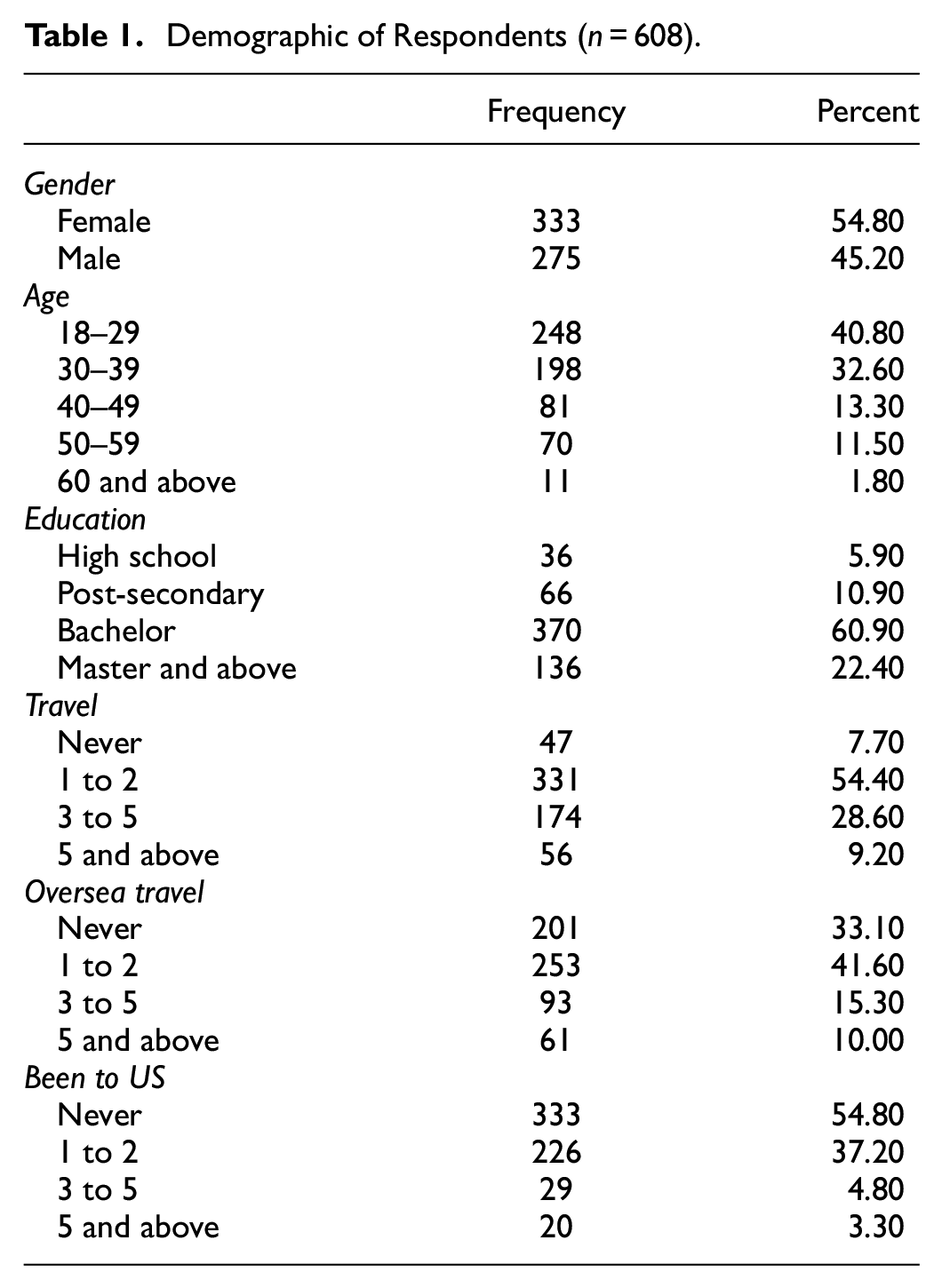
Of the 608 respondents, there were 45.20% of males and 54.80% of females. The sample covers a wide range of age groups but was skewed toward the youth group: 40.80% from aged 18 to 29, 32.60% from aged 30 to 39, 13.30% aged 40 to 49, 11.50% aged 50 to 59, and 1.80% aged 60 and above.
The majority of the Chinese respondents received at least a university education: 5.90% received until high school, 10.90% achieved post-secondary education, and 83.30% obtained bachelor’s degrees and above. 54.40% of the respondents have been traveling 1 to 2 times per year, and 28.60% traveled 3 to 5 times annually. Furthermore, 66.90% of the respondents have traveled overseas at least one time per year. Besides that, 48.20% have traveled to the United States. Table 1 summarizes the respondent demographic.
Demographic of Respondents (n = 608).
Purification of Constructs
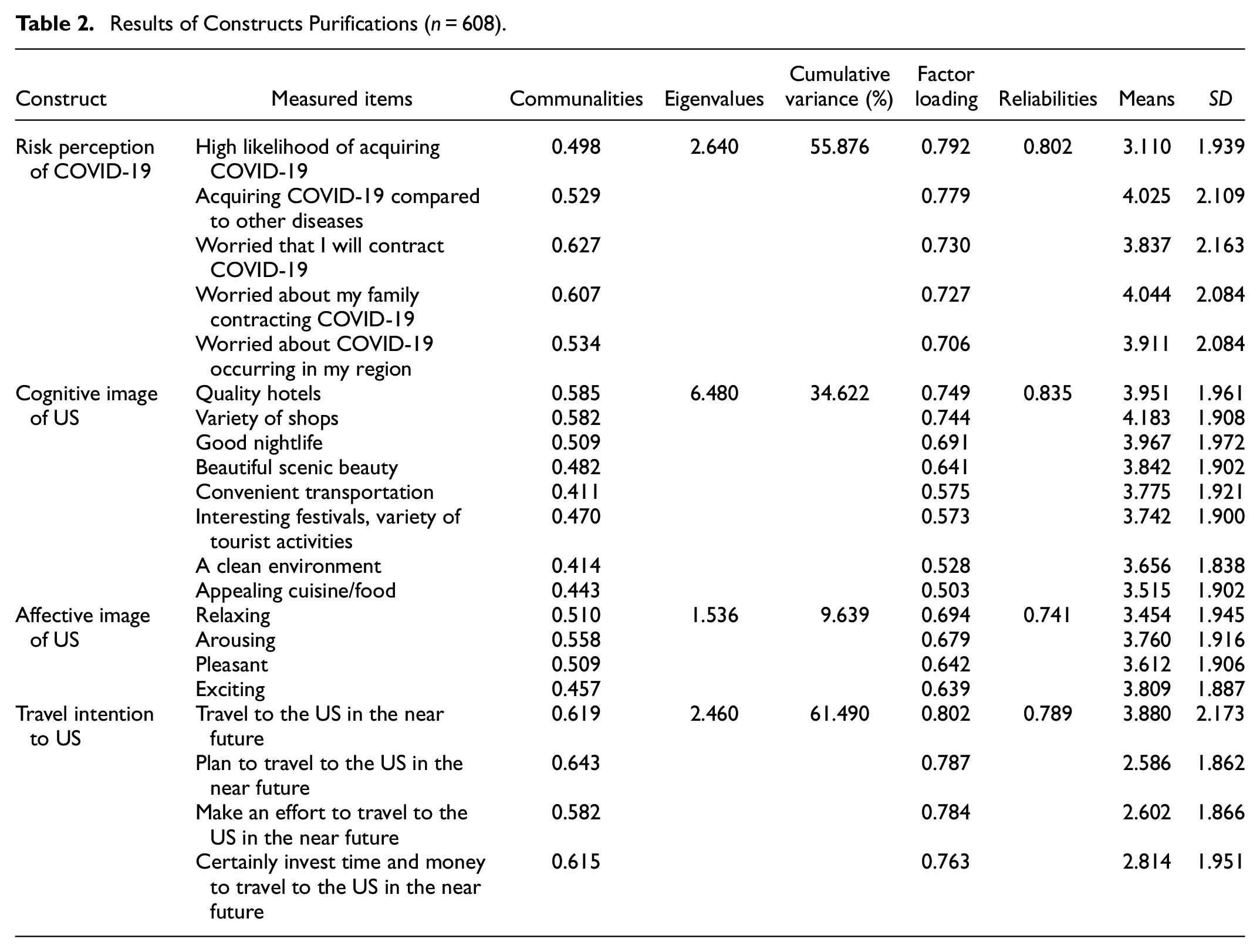
Using IBM SPSS 26.0, Exploratory Factor Analysis (EFA) using Principal Components Analysis (PCA) was conducted to retrieve the constructs for further analysis. Using varimax rotations, items with communality less than 0.40, factor loading lower than 0.50, and, eigenvalues less than 1 were removed. Also, the coefficients of items-to-total correlations must be above 0.40 (Choi & Sirakaya, 2005).
The results of Risk Perception showed that three items were removed as they failed to meet one of the requirements, leading to five measured items employed for analysis. Bartlett’s test of sphericity was 893.498 (p < .0001), which indicated that the items were appropriate for factor analysis. The Kaiser–Meyer–Olkin (KMO) measure of sampling adequacy was 0.804, which was considered a meritorious representation of the proportion of variance among the measured items (Kaiser, 1974). The extracted factor contained five items that accounted for 55.876% of the total variance, with Cronbach’s alpha of .802, exceeding the threshold value of .70 (Nunnally, 1978).
A similar approach was conducted on the measured items of the destination image. Bartlett’s test of sphericity was 3,715.194 (p < .0001) and the KMO measure of sampling adequacy was 0.927. KMO value above 0.90 is regarded as respectable (Kaiser, 1974). Two factors for destination images were extracted whereby the first factor consists of eight items that accounted for 34.622% while the second factor contains four items that account for 9.639%. The Cronbach’s alpha for the factors were .835 and .741 respectively.
Finally, the measured items of travel intention were analyzed with a similar procedure. The communalities results indicate there is no removal of items. Bartlett’s test of sphericity was 670.578 (p < .0001), which indicated that the items were appropriate for factor analysis. The Kaiser–Meyer–Olkin (KMO) measure of sampling adequacy was 0.791, which was considered a good representation of the proportion of variance among the measured items (Kaiser, 1974). The extracted factor contained four items that accounted for 61.490% of the total variance, with Cronbach’s alpha of .789. Table 2 summarizes the purification findings.
Results of Constructs Purifications (n = 608).
Testing Proposed Serial Multiple Mediation Model
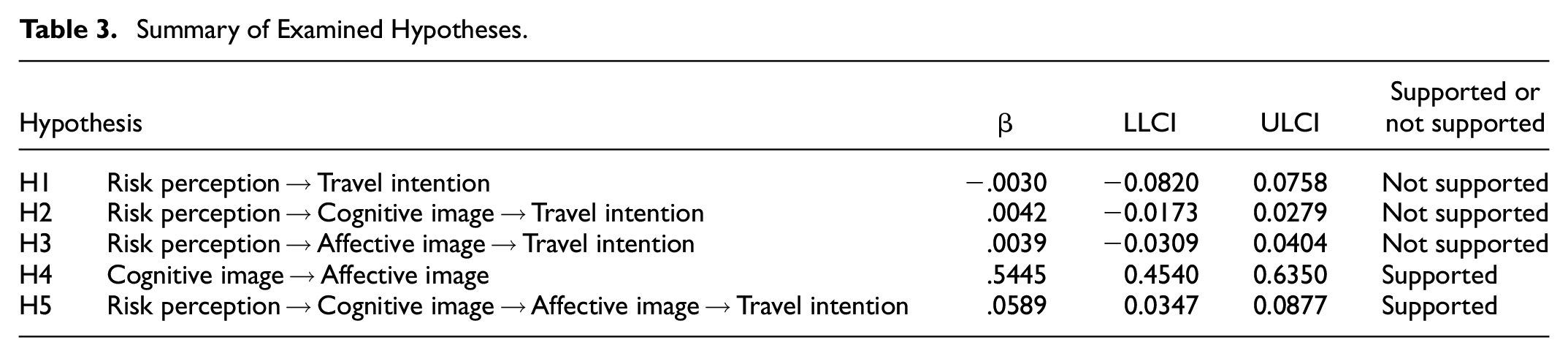
Serial Multiple Mediation was performed on Risk Perception, Cognitive, and Affective Destination Image, and Travel Intention using SPSS PROCESS v3.5 model number 6 with 10,000 bootstrap samples and a 95% confidence interval (Hayes, 2013). The indirect effect of Risk Perception on the Chinese’s travel intention first through Cognitive Destination Image and then through Affective Destination Image was the only significant indirect effect, which was estimated to be 0.0589 with a 95% bootstrap CI of 0.0341 and 0.0872. The total non-mediated effect of Risk Perception on Travel Intention (β = −.0702, p = .0567) became insignificant after controlling for the two mediators (β = −.0031, p = .9382), suggesting a full mediation model. Thus, H4 and H5 were supported. Furthermore, when the two mediators were considered individually, the indirect effect of Risk Perception Travel Intention through individual mediators became insignificant (abcognitive = 0.0042, 95% CI [−0.0173, 0.0279]; abaffective = 0.0039, 95%CI [−0.0309, 0.0404]). The path coefficients are shown in Table 3 and Figure 2.
Summary of Examined Hypotheses.
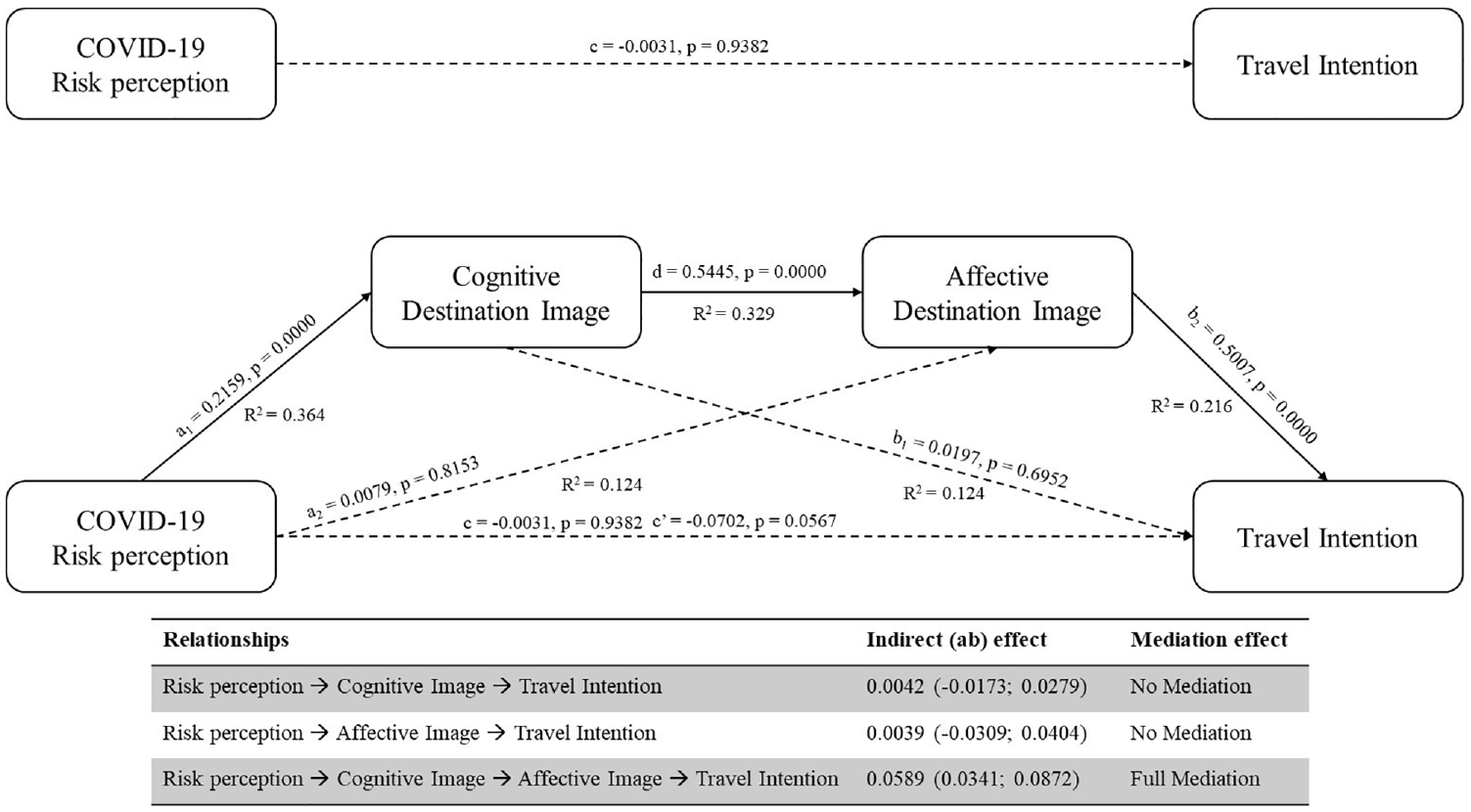
Serial Multiple Mediation of the proposed model.
Differences Between Groups
According to the existing literature, past travel experiences to the destination could be one of the possible factors that influence an individual’s risk perception, destination image as well as future travel intention (Becken et al., 2017; Chew & Jahari, 2014; Fakeye & Crompton, 1991). As such, we split the Chinese respondents into two groups (i.e., Never been to the United States and Have been to the United States) based on their reported travel experiences to the United States. Notably, 333 Chinese respondents have never been to the United States while 275 of them have been to the United States at least once. t-Tests were performed to compare the possible differences in the key constructs before the mediation analysis. The results, as shown in Table 4, indicated that the risk perception and cognitive destination image are significantly higher for Chinese respondents who have never been to the United States as compared to those who have been there once. On the other hand, Chinese respondents who have traveled to the United States have a significantly higher attachment toward the affective destination image as well as higher intentions to travel to the United States.
Comparison Between Chinese Respondents Based on Their Travel Experiences.

Discussion
This study sought to investigate how potential tourists perceive COVID-19-related risks and form travel decision-making behaviors in the new normal era of the COVID-19 pandemic. Based on the C-A-C framework, the research framework posited that cognitive factors trigger tourists’ affective reactions, resulting in behavioral responses. This study identified COVID-19 risk perceptions and cognitive images of a COVID-19-shaken destination as cognitive factors. The affective factor is the affective image of the destination, and the conation factor refers to travel intention to the destination. The framework of the mechanism underlying the process provides empirical evidence and a theoretical basis for understanding the psychological and behavioral consequences caused by a pandemic such as COVID-19. The influence of Chinese perceptions of COVID-19 risks on travel intention to the United States through affective variables was examined to provide empirical evidence of affective responses that are responsible for translating the cognitive factors into action.
Based on empirical findings, the study indicates that Chinese evaluations of COVID-19 risk do not influence their travel intention to the United States. Instead, risk perceptions display an influence on cognitive images of the United States rather than affective images, while their travel behaviors and decisions appear to be determined by affective images. Consistent with previous studies, destination image serves as the mediator between risk perceptions relating to COVID-19 and travel intention even during the pandemic phenomena (Becken et al., 2017; Chew & Jahari, 2014). The findings also indicate the relationship between cognitive and affective destination images, which are often perceived as an integrated construct rather than two independent constructs. In line with previous studies on destination image (Boo & Busser, 2005; Woosnam et al., 2020), this study supports that an individual’s feelings toward a pandemic-shaken destination are largely dependent upon their cognitive evaluations of the destination. Besides that, the findings also revealed that affective destination image, rather than cognitive destination image, has a significant influence on one’s travel intention. The effect of individuals’ emotional attachment on travel decisions indicates the importance of examining tourists’ affection in the COVID-19 context.
Regarding the influence of risk perception on travel behaviors, previous studies suggested that public fear and perceived risks triggered by a health-related crisis could display a long-term influence, resulting in risk-avoidant behaviors such as travel avoidance and cautious travel intentions during or even after the pandemic (Bae & Chang, 2020; Matiza, 2020; Zheng et al., 2021). This study demonstrates that the Chinese tend to hold optimistic attitudes toward COVID-19-shaken destinations and unremitting desire for international travel despite perceived COVID-19 risks. Lee et al. (2012) also found that Korean intentional travelers have adaptive beliefs and behaviors regarding a novel influenza A (H1N1) virus which could lower contagion risks to an acceptable level, thereby reinforcing international travel desire. While the existing studies argued that risk perceptions relating to disease could reduce one’s evaluation of destination image (Avraham, 2015; Becken et al., 2017; Chew & Jahari, 2014; Lepp et al., 2011), this research revealed a positive relationship between COVID-19 risk perception and cognitive destination image, which could be explained by the study context that the pandemic was beginning to level off worldwide. Previous research suggested that tourists’ expectations and their fear of traveling after the pandemic vary depending on the pandemic situation (Hu et al., 2021; Zheng et al., 2021). Since people who had higher levels of perceived risks appeared to pay close attention to the dynamics of pandemic situations, health infrastructure, and security in the destination, they were likely to hold more positive cognitive images due to the effective measures taken by the destination to contain the spread of COVID-19 and to prevent massive infection. This study offers new insights into the evolution of tourists’ perceptions and behaviors as a pandemic evolves. The results also echo previous research on post-crisis recovery (Avraham, 2015) suggesting that effective crisis management such as government policies and effective positive communication can significantly restore consumer confidence and reconstruct the destination image.
By testing the differences between potential first-time tourists and repeat tourists, this study reveals the varying effect of COVID-19 on tourists with different past travel experiences in terms of risk perception, destination image, and future travel. Previous research suggested that tourists feel more secure in familiar destinations while perceiving riskier in unfamiliar destinations (Lepp & Gibson, 2003). Moreover, knowledge of a destination obtained through past travel experience could minimize perceived uncertainty and risk in future travel, enhancing the willingness to support the destination and consequently inducing travel intention (Rasoolimanesh et al., 2021; Tan & Wu, 2016). This study extends previous findings by unveiling the higher levels of risk perception and cognitive destination image of potential first-time visitors. The findings show the higher levels of risk perception and cognitive destination image of Chinese respondents without experience in visiting the United States compared to those with experience. In comparison, potential repeat tourists are likely to display higher attachment toward affective destination images as well as higher intentions to revisit the United States. This study also echoes previous studies (Chew & Jahari, 2014; Fakeye & Crompton, 1991) suggesting that tourists who have been to a destination might have different cognitive and affective processes in image formation, in turn influencing the willingness to visit the destination.
Conclusion and Implications
COVID-19 changed us more than we realize. This crisis results in dramatic changes in tourist psychology and travel behavior in response to perceived risks (Sánchez-Sánchez et al., 2024). Furthermore, the experience of this pandemic arouses great concerns globally to make proactive preparations for future pandemics. Climate change, expansion of human activities, and cross-species pathogen transmission present unpredictable challenges and pose a growing pandemic risk. As such, people must begin to adapt to continue living in such uncertain conditions. Drawing on the C-A-C framework, this research explores and uncovers the underlying mechanisms that drive post-crisis international travel intentions. China and the United States are two key players in the global tourism market. The United States was the most affected nation by COVID-19 with the highest death toll. China was one of the most important source markets before the outbreak of COVID-19. Based on the timely data and analysis, the empirical findings of this study provide insightful implications for understanding a major source market (i.e., China) and factors conducive to post-COVID-19 tourism recovery. The findings deepen the understanding of tourists’ perceptions and behaviors in the relatively new context and lay a foundation for follow-up research to further explore travel behaviors in this context.
The current study makes several contributions to the existing body of knowledge. First, insights obtained from this research can enrich the discussion on tourists’ psychological and behavioral responses to the ongoing pandemic (Gössling et al., 2020; Kitamura et al., 2020). Previous studies mainly focused on travel intention during the pandemic, while this paper examined factors influencing post-pandemic tourism demand and tourists’ concerns pertinent to travel decision-making in the new normal era, providing a theoretical basis for understanding the long-term psychological and behavioral effects caused by a pandemic such as COVID-19.
Second, this study provides novel insights into the effect of potential tourists’ risk perceptions on their international travel intentions. Previous studies have often regarded perceived risks as inhibitors that impede a potential tourist from traveling during the pandemic (Matiza, 2020; Pappas, 2021; Zenker et al., 2021; Zheng et al., 2021). However, the results of this study indicate an alternative aspect whereby risk perception toward COVID-19 would induce one’s positive destination image and thus stimulate travel intention to that destination. More importantly, this study verifies the relationships between cognitive and affective factors, supporting the importance of affective factors in determining travel behaviors in the context of COVID-19. This study thus can be regarded as a valuable addition to the literature on crisis management.
Third, this study proposes a systematic model delineating the underlying mechanism of the COVID-19 risk perception effect on international travel decision-making, defining the mediating roles of cognitive and affective destination images between risk perceptions and travel intentions. The integration of risk perception and destination image has demonstrated their influences on each other as well as individuals’ decision-making on travel intention in the new normal era of COVID-19. The model has served to reveal the order decision-making mechanism among the four examined constructs, providing a rich extension of prior research focusing on either cognitive factors or affective variables.
Finally, this study validates the efficacy of the C-A-C framework in the normalized pandemic context and extends previous research that applied other theories such as the Health Belief Model and the Theory of Planned Behavior (e.g., Bae & Chang, 2020; Ojo et al., 2022). One of the novel insights in the theoretical realm is the identification of the varying effects of COVID-19 on potential tourists. This study unveils the effect of past travel experiences on tourists’ risk perception, destination image, and future travel intention, contributing to an important theoretical significance regarding existing tourism research. This indicates that the decision to visit a COVID-19-shaken destination involves a complex process that requires further investigation. This study deepens the understanding of tourists’ renewed perceptions and behaviors in the relatively new context and lays a foundation for future investigations of travel behaviors in the new post-COVID tourism scenario.
This study has practical values for understanding tourist psychology and demand which are crucial for market recovery from crises. The findings provide insights for DMOs to focus on the management and development of cognitive and affective destination images. Cognitive destination image revolves around the physical elements that a destination can provide while affective destination image focuses on the enjoyment and adventure that a destination could offer to an individual. For instance, DMOs may improve the environment cleanliness that could be seen as sanitized and safe to travel, thus enhancing an individual’s pleasant levels that may induce their travel intentions.
Besides improving the destination image, DMOs should also utilize their repeat visitors as their spoken person. By having a lower risk perception and higher travel intention, DMOs may target repeat visitors to their destination first through the introduction of novel and innovative tourism products according to the tourists’ needs. Since they are more familiar with the destination, “new attractions” have to be introduced so to stimulate their travel intentions. Their experiences will be shared by word-of-mouth with other potential tourists which may lower their uncertainties and increase their willingness to travel. Simultaneously, DMOs should also implement effective communication strategies in conveying COVID-19-related messages that may reduce first-time visitors’ risk perceptions. For example, government policies, infection rates, and treatment succession may benefit first-time visitors.
Furthermore, China has been one of the major international tourism markets among many destinations. Since China removed the cross-border restrictions imposed to tackle COVID-19 in March 2023, China’s tourism sector has been on a strong upward trend. It was estimated that the number of international trips by Chinese tourists in 2024 could double compared to the previous year, surging to nearly 80% of the 2019 levels (China Briefing, 2024). The results of this study imply a strong demand among Chinese residents for overseas travel. DMOs may employ the developed model to examine Chinese risk perceptions, destination image, and travel intentions to their destination. This will help DMOs formulate pinpoint marketing strategies to attract the Chinese market for their tourism rejuvenation as well as develop their destination competitiveness with respect to the evaluations of items of the destination image.
This study has several limitations but provides directions for future research. Previous research suggested that national backgrounds are likely to have varying degrees of perceived risk (Kozak et al., 2007). This study has employed one of the influential tourism markets, the Chinese tourists, and one of the most popular destinations, the United States. Future studies may employ other tourist markets and different destination images to examine the proposed model. Further research can replicate with sets of sociocultural variables such as individualism versus collectivism, social norms, and risk aversion could be considered to capture cultural differences across various regions.
While previous studies have suggested the negative relation between perception and destination image (Avraham, 2015; Becken et al., 2017; Chew & Jahari, 2014; Lepp et al., 2011), this study provided an alternative that requires additional investigations to understand its formation. The follow-up analysis may offer in-depth insight into why and how an individual with a higher risk perception will have a higher travel intention.
Most respondents were recruited through snowball sampling based on the social network of the research team. For instance, their friends, colleagues, and relatives completed the surveys and shared them with their contacts. This approach may result in under or over-representations of certain social groups. As noted from the respondents’ demographics, there is a large number of young respondents in this research, and age biases may exist given the risk perceptions. Despite the skewed sample, the findings offer valuable insights theoretically and practically.
Furthermore, it is acknowledged that while this study determines the relationship and modeling among the four proposed constructs, future studies should employ different analysis methods to revise the model accordingly. For instance, CFA-SEM analysis could be employed as it fulfills the examination of each proposed scale, hypothesis as well as model fit.
Footnotes
Declaration of Conflicting Interests
The author(s) declared no potential conflicts of interest with respect to the research, authorship, and/or publication of this article.
Funding
The author(s) disclosed receipt of the following financial support for the research, authorship, and/or publication of this article: This paper and research project are funded by the National Natural Science Foundation of China (Project Account Code: 42201254) and the Fundamental Research Funds for the Central Universities (Project Account Code: 2242024S20009).

Data Availability Statement
The data supporting the findings of this study are available upon request from the corresponding author.